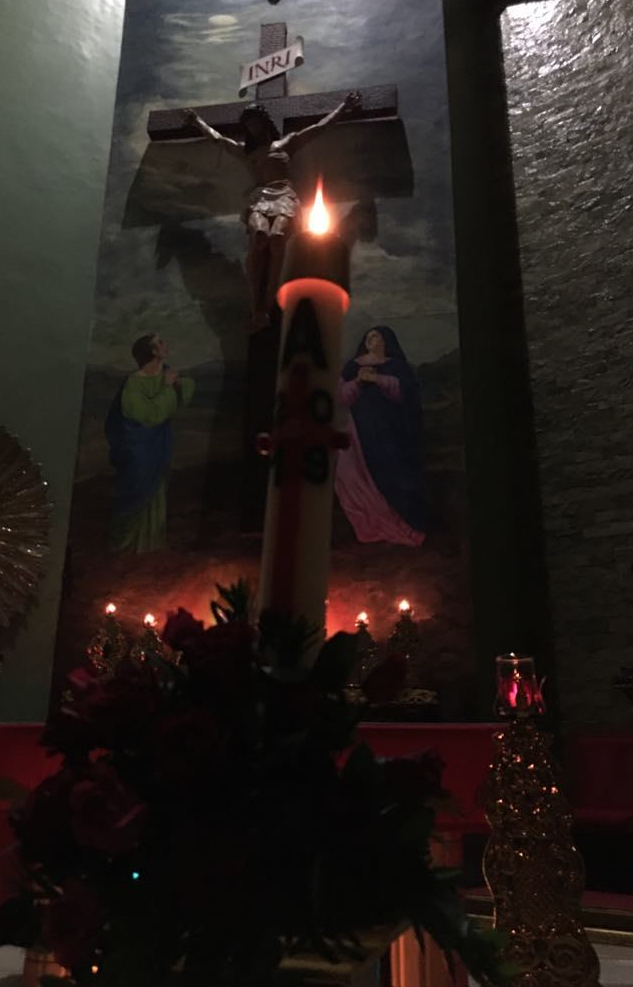
Finding Jesus in Easter darkness

The Lord Is My Chef Recipe in the Octave of Easter, also Divine Mercy Sunday, 19 April 2020

Acts 2:42-47 ><)))*> 0 <*(((>< 1 Peter 1:3-9 ><)))*> 0 <*(((>< John 20:19-31

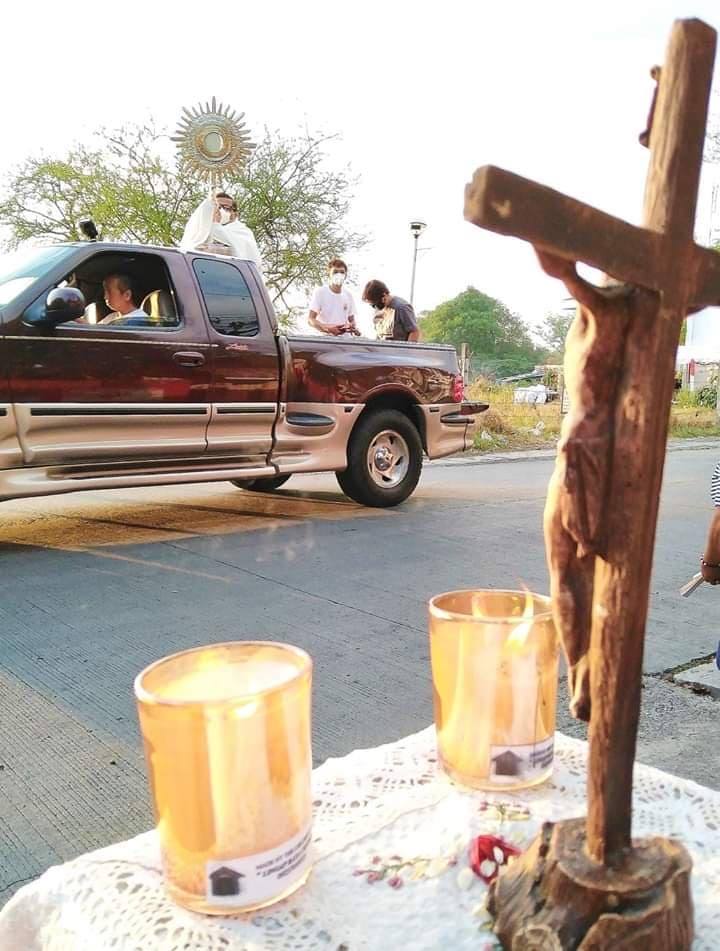
Carrying around our parish the Blessed Sacrament every Sunday afternoon since lockdown began.

I have almost forgotten – and it is only now amid this extended lockdown – that I have realized the first Easter happened in darkness! We are in the same situation with the Apostles when Jesus rose from the dead.

What we need is to “quarantine” ourselves more, our heart and soul within to see and recognize our Risen Lord among us like during that first Easter.

On the evening of that first day of the week, when the doors were locked, where the disciples were for fear of the Jews, Jesus came and stood in their midst and said to them, “Peace be with you.” When he had said this, he showed them his hands and his side. The disciples rejoiced when they saw the Lord. Jesus said to them again, “Peace be with you. As the Father has sent me, so I send you.” And when he had said this, he breathed on them and said to them, “Receive the Holy Spirit. Whose sins you forgive are forgiven them, and whose sins you retain are retained.”

John 20:19-23
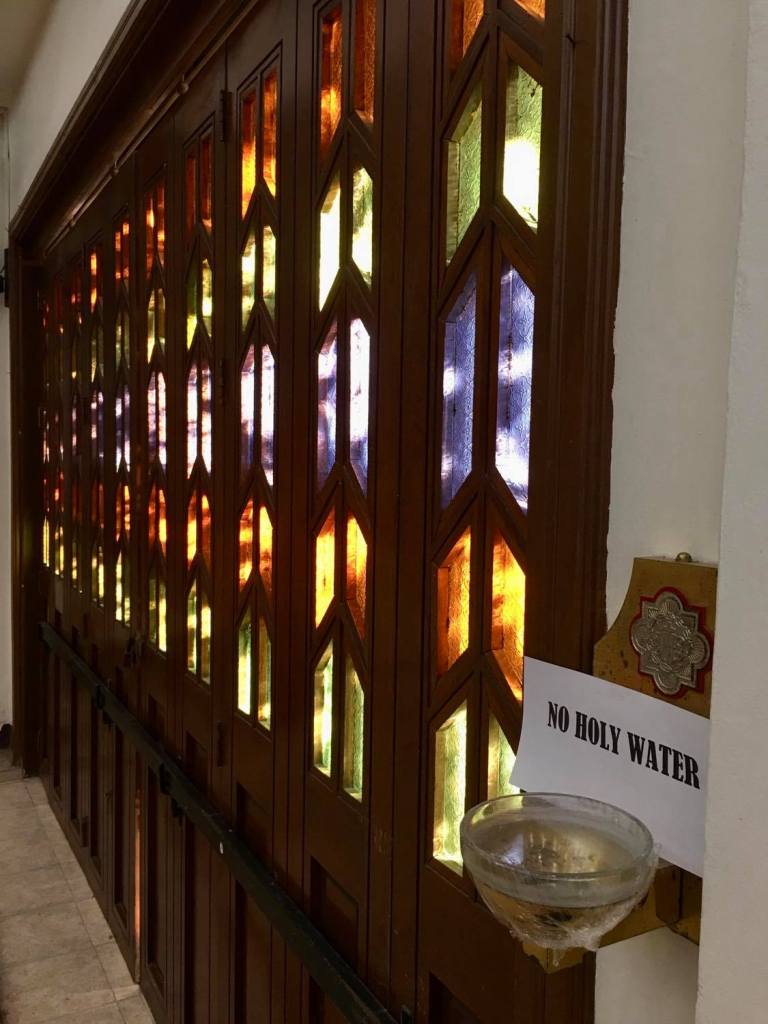
Stained glass at the back of our parish church depicting the appearance of the Risen Jesus with Thomas, aka, Didymus. Photo by author, 02 April 2020.

Jesus always comes in darkness to bring light of peace

In our reflection last Holy Wednesday, we have mentioned how Jesus was born during the darkest night of the year to bring us that light of hope and salvation. The same is true with Easter when he resurrected in the darkest part of the day just before dawn.

Jesus indeed is the light that bursts and pierces through the darkest darkness of the world and of our very lives, our sinfulness. This is the reason we also celebrate this Sunday the Feast of the Divine Mercy of God in Jesus Christ.

Through his Passion, Death and Resurrection, Jesus is the only one who can penetrate through whatever blockages and imprisonment we have or we are into like sin and evil, pains and hurts in the past that filled us with so much guilt.

In his Divine Mercy, Jesus had come to give us our life back complete with the gift of freedom that we have all lost to sin and evil.

And that is why on Easter, Jesus gave us his greatest gift of all which is peace or shalom in Hebrew that means wholeness or holiness. To be whole literally is to have a good relationship with one’s self, with others, and with God.

Vatican II asserts in its Pastoral Constitution on the Church in the Modern World:

Peace is more than the absence of war: it cannot be reduced to the maintenance of a balance of power between opposing force not does it arise out of despotic dominion, but it is appropriately called “the effect of righteousness” (Is.32:17). It is the fruit of that right ordering of things…

Gaudium et Spes, no. 78

Righteousness in the bible means justice that is also equivalent to holiness which is, to be filled with God, not necessarily to be sinless. That is why after greeting them with peace the second time, Jesus breathed on them the Holy Spirit, an imagery that reminds us of the story of creation when God breathed on the first humans to have life.

At Easter, we were breathed on again by the Risen Lord to renew our lives, to fill us again with God and be closest to him in our breath and thus enabling us to be free again from sin and evil, free for God and for others.

What a joy to read these days due to lockdowns worldwide that the Sierra Madres and Mt. Samat can be seen again from the metropolis or the Himalayas from India after 30 years due to clearer skies with less pollution. Or, the lions in Africa’s wildlife parks lazily sleeping without being disturbed by humans.

These are proofs that there is life indeed amid the darkness of this pandemic when Jesus restores life and balance, making everything new and alive again!

Peace and mercy, unity and mission

At his Supper before his arrest, Jesus prayed to God our Father that we may all be one – ut unum sint – like him and Father (John 17:21) are one. This would be partly fulfilled on Easter and eventually at the coming of the Holy Spirit at Pentecost when the Church is eventually launched.

It is in our faith that we enter into communion with the Father in Jesus Christ and with one another as a community, as a church.

That is why it was a beautiful imagery of Thomas eventually joining them the following Sunday not because he lacked faith; he had faith that is why he came to see and experience Jesus. And that faith bloomed upon encountering Jesus again that according to tradition, Thomas preached the good news to India where he died a martyr by being skinned alive.

We have always said in our previous reflections that whenever and wherever there is faith, there is always union and unity with God and others.

Eventually, from every unity and community, there is always mission.

In our first reading today we have heard how the early Christians were one in their faith, always praying, that is, celebrating the Eucharist from which flowed out their mission.

All who believed were together and had all things in common; they would sell their property and possessions and divide them among all according to each one’s need.

Acts 2:44-45
Easter in our Parish amid COVID-19.

In his entire life, we have seen that Jesus had always been clear in his being sent, that the words he had spoken and things he had done were not all his but from and by the Father.

Watch closely John’s narration of after the Lord’s Resurrection:

On the evening of that first day of the week, when the doors were locked, where the disciples were for fear of the Jews, Jesus came and stood in their midst and said to them, “Peace be with you.” When he had said this, he showed them his hands and his side. The disciples rejoiced when they saw the Lord. Jesus said to them again, “Peace be with you. As the Father has sent me, so I send you.”

John 20:19-21

After giving them the gift of peace and filling them with his breath of life to signify they have been forgiven for their sins and failures when they left him on Good Friday, Jesus is now drawing them into his great mission: As the Father has sent me, so I send you.

This is the defining and definitive characteristic of the Church, of any community of disciples in every age, most especially in this time of the corona virus pandemic.

Our mission continues in the darkness of COVID-19

Churches may be closed, public Masses are banned but the mission of proclaiming in words and in deeds the good news of the Risen Lord continues very loud and clear.

Detractors would always malign us, would spend for trolls just to ask “where is the Church in this time of crisis” but the people know best that we have never been remiss nor even flinched a single second whenever disasters strike anywhere in the world.

In the darkest moments of history in the past up to the present, the Church as a community of disciples of Jesus has always shine so brightly in Christ standing up for the poor and oppressed, the marginalized and forgotten, the sick and the hungry, those suffering in the most far-flung areas with its extensive networks of parishes and BEC’s.

This is also the reason why people always malign us in the Church about what we are doing amid the poverty and sufferings of the world: we work in silence because we are merely being sent by Jesus Christ. Like him our Lord and Master, whatever we say and do are not ours but the One who sent us, the Father in heaven.

We merely represent Jesus Christ who represents the Father and guided by the Holy Spirit, together we forge onto the darkness of this pandemic despite the many sufferings we go through, “tested by fire so that we may prove to be for the praise, glory, and honor of revealing Jesus Christ” (cf. 1 Peter 1:6-7).

This is who we are, disciples of Jesus sent to proclaim his love and mercy especially in the midst of all darkness.

This Sunday amid the darkness and threats of COVID-19, let us join the psalmist in his song, “Give thank to the Lord for he is good, his love is everlasting” (Responsorial Psalm , Ocatve of Easter).

A blessed week to everyone. Stay safe but keep working for the Lord! Amen.

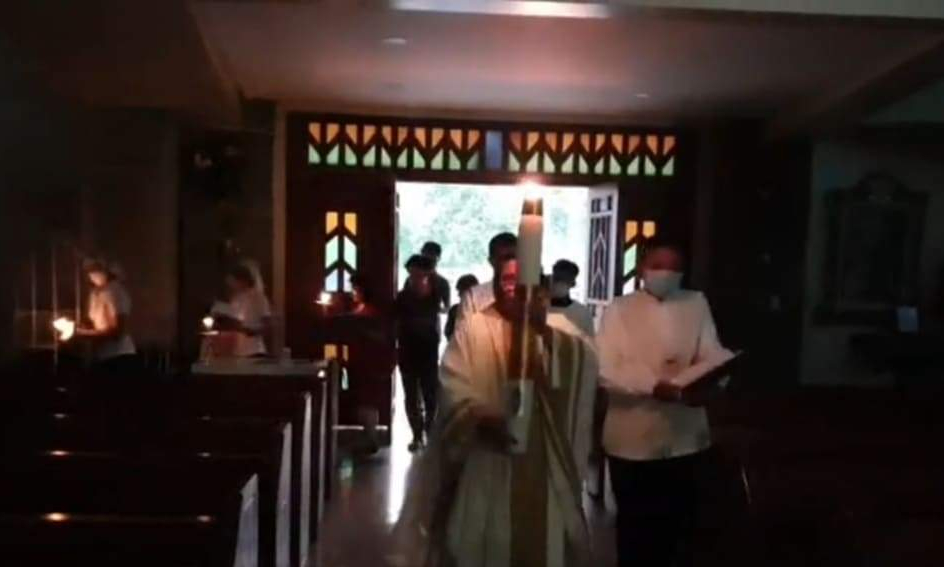
Easter Vigil in our Parish, 12 April 2020.

Photos in the collage clockwise: Malolos Diocese Social Action Center, Inc. with Caritas Manila spearheading relief operations in Bulacan; Sisters from the Daughters of St. Anne walking through fields and mountains to reach out to our poorest of the poor; trays of thousands of eggs to be given away to fisherfolks in Binuangan, Obando by Fr. Ramon Garcia III; last two photos, beneficiaries of the 10-m Php worth of Gift Certificates given throughout Bulacan before Holy Week that included everyone even those from other faith and beliefs.

Life will never be the same after Easter 2020

The Lord is My Chef Easter Vigil Recipe, 11 April 2020

Our simple yet meaningful Easter celebration amid Covid-19, 11 April 2020.

A blessed happy Easter to you my dear reader!

What have you been praying for since the start of this Holy Week amid the threat of COVID-19? Aside from being spared by this dreaded corona virus, what have you been praying for?

For almost a month, I have always been praying to God for one special thing: that we may all go back to our “normal lives” soon.

Since the first Sunday of our lockdown last March 22 that happened to be my 55th birthday, until after the Mass of the Lord’s Supper on Holy Thursday, I have been going around our parish with the Blessed Sacrament and Santo Entierro on Good Friday mounted on a truck to bless the people.

And every time I would go around – with strict orders on the people to observe social distancing – I have strongly felt how they were so hungry and thirsty for Jesus, kneeling along the highway, some with lighted candles while others have their little altar in front of their homes.

Photo by Mr. Randy Cajanding, 09 April 2020.

Except for some few people, almost everyone would make the sign of the Cross, take a bow or raise their hands, asking for blessings, praying silently in their hearts.

I really wonder what they were praying for.

Photo by Ms. Ria De Vera, 22 March 2020.
Photo by Ms. Anne Ramos, 10 April 2020.

Me?

Next to the request that we may all be spared of the corona virus in our parish, I always prayed silently to Jesus in the Blessed Sacrament and in his Santo Entierro, to please, “bring us back to our previous normal lives Lord… I am will to sacrifice everything, to bear all these pains and hardships… just bring us back to our previous normal lives… magbalik lang kami sa dating normal naming buhay, Lord, lahat titiisin ko po.”

Photo by Ms. Anne Ramos, 10 April 2020.

Easter is moving forward to new life, never a going back

But early this Holy Saturday morning as I prayed, I realized God is not going to answer that special prayer of mine.

God will never bring back our previous normal lives before this time of the corona virus when we take control of everything because Easter is leaving the past behind, the old misconceptions, the old sins, the old ways of life far from God.

Easter is moving forward to Jesus, with Jesus, in Jesus.

Then the angel said to the women in reply, “Do not be afraid! I know that you are seeking Jesus the crucified. He is not here, for he has been raised just as he said. Come and see the place where he lay. Then go quickly and tell his disciples, ‘He has been raised from the dead, and he is going before you to Galilee; there you will see him.”

Matthew 28:5-7

After this time of the corona virus in the year 2020, we shall never go back to our previous normal lives because Easter is a call to renewal, to going back to God, to going back to love and kindness.

Easter is going back to God, centering our lives anew in him because he is our life!

Entrance to our church during our Easter Vigil, 11 April 2020. Photo by Ms. Ria de Vera.

Jesus is inviting us on this Easter 2020 in the time of COVID-19 to come to him in his new life, to leave the previous normal lives when we spend Sundays on our own, when we just pray and celebrate Mass on special occasions or when we have problems or when going through calamities and disasters.

Jesus is inviting us on this Easter 2020 in the time of corona virus to come to him in his new life to renew our ties with our family and friends, to forgive and bridge gaps among us because life is too short, so fragile.

Jesus is inviting us on this Easter 2020 in the time of COVI9D-19 to come to him in his mercy and justice, to leave our previous lives when we take people for granted, especially those in the health sector like nurses or ordinary folks we call like janitors and garbage collectors.

Easter is rediscovering anew the more essential in lives like the value of each person, the value of health and education, the value of wisdom and sound judgement and decisions.

Jesus is demanding us on this Easter 2020 in the time of the corona virus to never go back to our “normal lives” of before when it was normal to be corrupt, to use foul language, to lie and malign others, to kill and disregard human life, to use violence and force.

Never again must we be silent when people and nature are taken for granted.

Jesus is inviting us on this Easter 2020 in the midst of COVID-19 to never go back to our old politics of trapos and vote buying, to rediscover how blessed is our country with great, talented people equally blessed with a country rich in natural resources ravaged by greedy politicians.

Jesus is inviting us on this Easter 2020 in the time of the corona virus to come to him in his new life by working for justice and truth, speaking against violence and disregard for lives, fighting corruption, rejecting the normal things of life of deception and lies in government, in the church, in school, and in our own families.

Photo by author, 02 April 2020.

If you have listened to our readings, from the story of the creation to the time of Abraham and Moses and then Jesus, people were blessed materially and spiritually because they never went back to old ways of lives but always moved forward in God, in selfless giving of self in service to others.

Without any doubt, Holy Week 2020 is the most unforgettable – even unbelievable we have ever had in our lifetime or even in recent history. And with the extension of the ECQ until the end of April, that makes our Holy Week 2020 as the longest one too!

But, it is not that bad at all.

Holy Week is “Mahal na Araw” in Filipino: mahal means valuable that is why it is the same word we use for expensive. Most of all, mahal is the root of pagmamahal or love because to love is to value another person.

Extended lockdown, extended Holy Week means longer “Mahal na Araw” — that is, more time to love God, others, and self.

So, it is still a blessed Easter to everyone!

Photo by Ms. Ria De Vera, Easter Vigil in our parish, 11 April 2020.

Hosanna in the time of corona

The Lord Is My Chef Recipe for the Solemnity of Palm Sunday of the Lord’s Passion, 05 April 2020

Isaiah 50:4-7 >>+<< Philippians 2:6-11 >>+<< Matthew 26:14-27:66

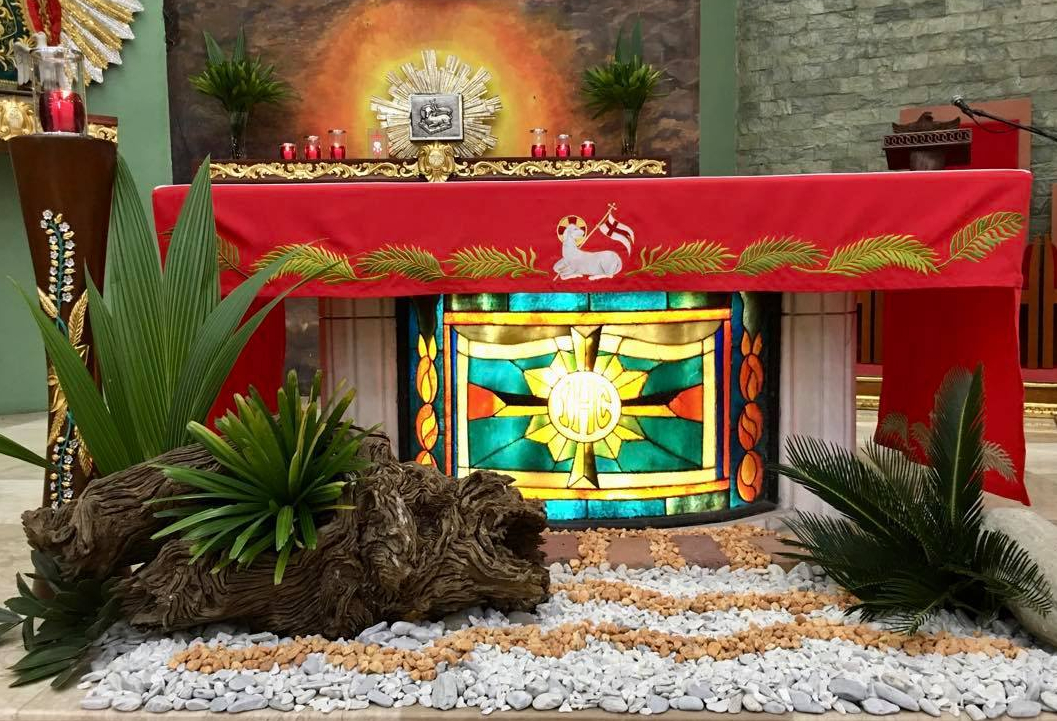
Photo by author, altar of Parokya ni San Juan Apostol at Ebanghelista, Bagbaguin, Sta. Maria, Bulacan, Palm Sunday 2020.

“Hosanna!” is the song of the day and despite the ongoing lockdown now entering its penultimate week, we have every reason to praise God this Solemnity of Palm Sunday in the Lord’s Passion.

Let us continue to sing “hosanna” even if our churches are closed due to threats of COVID-19 because even with all the difficulties arising from this enhanced community quarantine, it also gives us much needed time and space to reflect on the meaning of our Holy Week celebrations.

Let us make this Holy Week holy indeed so we may discover God anew in our sacred celebrations and right in our very hearts in this time of the corona pandemic.

The “ascent” to Jerusalem

Photo by author, ancient city of Jerusalem from the Church of Dominus Flevit (The Lord Wept) where Jesus came from towards the holy city via the eastern gate as prophesied in the Old Testament, May 2019.

Geographically speaking, to go to Jerusalem is to go up, to ascend to higher level as it rises to 754 meters above sea level (2,474 feet) compared with Galilee from where Jesus spent his three years of ministry which is just 209 meters (686 feet) above sea level.

Jesus Christ’s “trip to Jerusalem” was both literally and figuratively speaking an “ascent” in all aspects: he went up to Jerusalem to offer himself on the Cross to replace temple worship so people can finally worship in “truth and spirit” as he had told the Samaritan woman at Jacob’s well three Sundays ago.

More than the outward sign of ascending Jerusalem is the inner sign of Christ’s ascent in his outpouring of love for the Father and us.

That is the beautiful imagery of his triumphant entrance to Jerusalem which will reach its climax on Good Friday capped by the glorious Easter.

Every day, Jesus invites us to welcome him and most of all to join him in his ascent to Jerusalem, to the Father by forgetting one’s self, taking our crosses, and following the Lord in giving of self in love.

Now is the perfect time to sing “hosanna” – to welcome and follow Jesus in our inner ascent when everything and everyone is “down” due to COVID-19. The only way to rise again from this misery of the corona pandemic is to ascent in Jesus, with Jesus, and through Jesus.

For so long, we have been following the upward path of “social mobility” measured in income and material things without considering the emotional and spiritual imbalances that result in these worldly pursuits. In our rat race for higher productivity, more money and less costs, we have become distant from persons especially family. Now, we have to practice social distance not only to stop spread of virus but most of all, to realize anew that above all is always the human person.

And the best route to encounter each person is in Jesus Christ who leads us from Jerusalem to the Cross and into Easter; hence, the liturgies this Holy Week are the oldest and simplest we have in the Church so that we can truly sing “hosanna” and focus only to Jesus ever present to us.

Death and Love

Photo by author, parish altar, Lent 2019.

Now playing at Netflix is the fourth part of its hit series “Money Heist”. I had the chance to watch its first episode that opened with a scene of the professor escaping police in the forest with a narration by “Tokyo” trying to control the situation in the bank they have taken over. She said, “His (the professor) heart held two words that should not be together: love and death.”

Perfect sound bite for Palm Sunday of the Lord’s Passion – “two words that should not be together: love and death” when in fact, its opposite is the exact reality! For love to be very true, it must be willing to suffer and die as the Lord Jesus Christ had shown us more than 2000 years ago.

Love and death are always together! That is why we have a Holy Week leading to Easter!

It is a basic reality we have always tried to negate and escape that have only left us more empty and lost within. The undeniable sign of love is when we are able to love somebody more than our very self – and that includes willing to die for the beloved!

We can never ascend, never arise for as long as we have too much of self, like the characters opposite our Lord Jesus Christ this Holy Week.

One of the Twelve, who was called Judas Iscariot, went to the chief priests, and said, “What are you willing to give me if I hand him over to you?” They paid him thirty pieces of silver, and from that time on he looked for an opportunity to hand him over.

Matthew 26:14-16

Selflessness and silence of Jesus, Selfishness of man

Palm Sunday in our parish 2020.

One distinct characteristic of Jesus throughout his life that is most especially clear from Palm Sunday to Good Friday is his selflessness and silence in the face of too much pressure and suffering.

Rather than being a sign of weakness, it is Jesus Christ’s shining moment of mastery and control as we have noted last Sunday when he cried in meeting Martha and Mary at the tomb of Lazarus who had been dead for four days.

This becomes more evident starting this Sunday reaching its highest point on Good Friday to be capped by his glorious Resurrection on Easter.

See how during his entrance and ascent into Jerusalem, Jesus was silent. Because he knew what was going to happen! He was even looking forward into it.

His entrance into Jerusalem to assert his being the Christ by offering himself on the Cross is the culmination of what St. Luke had noted in his account early on at Caesarea Philippi that “when the days of his going up to heaven was nearing completion, Jesus resolutely journeyed to Jerusalem.”

Despite the dangers and the certainty of death, Jesus did not balk nor even thought of backing out. He resolutely went into his death because of his immense love for us and the Father. He never cracked under pressure!

Even during his trials first before the Sanhedrin and before Pontius Pilate, there was the mastery and surety of Jesus very evident in his silence. He was totally composed, wholly entrusting himself in total obedience to the Father in heaven.

How about us these days of lockdown in the face of the growing threats of COVID-19?

What a shame that our officials and their families finally revealed their true colors as the modern Judas Iscariots seeking VIP treatment for COVID-19 testing! So afraid of dying because love they have none whatsoever for the country and the people but for themselves alone.

From a Facebook post of my friend .

Like Judas, they think only of themselves, keeping their loot of more than 30 pieces of silver, looking for the opportune time to betray us again, totally quiet in the comfort of their homes when thousands are facing hunger and uncertainties.

They are the modern Pontius Pilates who mumble in public, who could not make a definitive stand on anything at all, more at home in accusing and blaming others for the confusions and lack of order, always washing their hands, without guts to humbly accept lack of foresight despite the grave dangers that did not happen overnight.

Most of all, look inside ourselves too for those moments we think more of “what we can have” than “what we can give or do” in these trying times? Do we hoard and panic buy? Do we cower in fear by hiding it with our anger and demands for assistance and relief goods?

Above is a nice guide I found on my friend’s Facebook, indicating three zones to show where are in the midst of COVID-19 pandemic. It can be very useful too in indicating where we can meet Jesus in ascending and entering Jerusalem to fulfill his mission and our mission too.

Entering Jerusalem, entering Jesus

My daily Mass attendees since the lockdown.

When the Luzon lockdown started last March 18, I cried on my first Mass: it was simply unbelievable – until now – for me celebrating Mass without people because a Mass always presupposes people and community to celebrate Christ’s presence!

But now, everybody is gone.

Except me. And the birds who keep constant company for me.

Every morning after pealing our bell as I celebrate Mass alone, I bow before the giant crucifix looming above our altar and look on the metal engraving of the Lamb of God on the cover of our Tabernacle where the Blessed Sacrament of Jesus is kept.

This week as I looked more often onto the lamb during prayer periods, I felt it to be looking at me too. That’s when I realized how the lamb perfectly signifies Jesus Christ entering Jerusalem, the “Suffering Servant” of God prophesied by Isaiah in the first reading today. But what struck me most is the song’s latter part not included in our first reading, referring to Jesus Christ:

Though he was harshly treated, he submitted and opened not his mouth; Like a lamb led to the slaughter or a sheep before the shearers, he was silent and opened not his mouth.

Isaiah 53:7

That lamb is indeed Jesus Christ, coming to us day in, day out in the Holy Eucharist we priests continue to celebrate even if our churches are closed. Every day especially in the Mass, Jesus invites us to ascend with him to the Father, little by little with our selfless acts of charity and kindness to others.

Looking into that lamb of our Tabernacle, I see the eyes of Jesu telling me how much he loves me, how much he has forgiven me from my sins despite his knowing me through and through.

And that is Jesus Christ: always silent, gazing with his eyes full of love, full of knowledge about us and what’s going to happen next, inviting us to join him, to come with him to ascend to our higher selves especially in this time of crisis. All despite his knowing our sins because he sees us too with eyes full of mercy!

These my dear readers are more enough reasons to sing “hosanna” today despite the many difficulties and uncertainties around us because Jesus is with us and will never leave us especially when we reach the cross. Amen.

A blessed holy week to you!

Our tabernacle, Palm Sunday 2020.

Conversing with God in time of COVID-19

40 Shades of Lent, Sunday Week-V, Year-A, 29 March 2020

Ezekiel 37:12-14 +++ Romans 8:8-11 +++ John 11:1-45

Photo by Ms. Anne Ramos last March 22, 2020 during our procession of Blessed Sacrament in the Parish when a rainbow appeared at the horizon.

Once again as we near the closing of our Lenten journey, Jesus does another “sign” or miracle — his last and grandest in anticipation of his coming Passion, Death, and Resurrection: the raising from death of his friend Lazarus.

What is so beautiful in this story is how the evangelist involves us his readers and hearers into a conversation with Jesus unlike last Sunday at the healing of a man born blind where the characters conversed only among themselves.

The raising of Lazarus to life is more engaging because it is deeply personal and intimate as it involves friends dearest to Jesus — exactly like each one of us! And that is why it is also very timely as we go through the ongoing lockdown due to COVID-19.

When Jesus heard this he said, “This illness is not to end in death, but is for the glory of God, that the Son of God may be glorified through it.”

John 11:4

My dear family and friends, Jesus assures us today of the Father’s love and healing, that he would save us from the deadly corona virus. Come and let us converse with him with the sisters of Lazarus, Martha and Mary.

After my “private Mass” (Missa sine populo) during the Solemnity of the Annunciation, 25 March 2020.

Presence of Jesus

Martha said to Jesus, “Lord, if you had been here, my brother would not have died. But even now I know that whatever you ask of God, God will give you.”

John 11:21-22

Twice do we hear this line in this very long story of the raising of Lazarus when Mary repeated it upon meeting Jesus later at the entrance of their town of Bethany.

And like Martha and Mary, we always say it to Jesus too as if he ever leaves us alone!

“Lord, if you had been here…”

Jesus is always with us.

We are the ones who always leave Jesus behind.

We always have so many other things to do, so many other people to meet that we have no time to truly pray and most of all, celebrate the Sunday Mass every week.

It is my hope that following the suspension of the “public Masses” due to lockdown, people now realize the value of the Holy Eucharist which is the “summit” of our Christian life where we are nourished by the words of God and strengthened by the Body and Blood of Christ.

Photo from Forbes.com via Facebook, 2019.

Long before we were told to observe “social distancing” in this time of pandemic, we have long been distant from one another and from God.

How ironic that these modern means of communications were invented to bring us closer but have actually brought us farther apart! Most often, we are close enough with someone miles across the seas but too distant and cold to persons physically near us, even seated beside us.

Let us spend more time with our family and most especially with God in prayer during this enhanced quarantine period to be the presence of Christ with one another. Let us remember Fr. Patrick Peyton’s expression, “The family that prays together, stays together; a world at prayer is a world at peace”.

Remember: the most wonderful and enriching relationships we can have are those rooted in Jesus Christ who is always present in us.

Jesus is perturbed and deeply troubled

While praying over this long gospel, this photo by Raffy Lerma kept on flashing in my mind, showing me how Jesus must have reacted upon seeing Mary weeping over the death of her brother Lazarus.

He became perturbed and deeply troubled, and said, “Where have you laid him?” They said to him, “Sir, come and see.” And Jesus wept.

John 11:33-35

Like our gospel today, Lerma’s photo of a mother crying over her son lost to “tokhang” at the height of this administration’s war against drug in July 2016 is very conversant, so moving like the Pieta by Michaelangelo in Rome. In fact, the government doubted the veracity of the photo, claiming through its trolls it was merely “staged” or “drawing” as we say in journalism. The photo is authentic because the event truly happened. And continued to happen before this lockdown.

What I like most with this photo is the composure of the mother. You can feel she was deeply sad and troubled, weeping without the hysterical theatrics or palahaw in Tagalog that we see in many instances like funerals.

Photo by Mr. Jay Javier, Quiapo, January 2020.

Multiply that to the highest degree and we get the image of Jesus “perturbed and deeply troubled, weeping” at the death of his friend Lazarus.

There is the gentle yet firm mastery by Jesus of the situation, of the loss and tragedy.

No hysterics nor theatrics. Pure and all-encompassing presence.

It would be the same mastery and composure Jesus would exhibit at his coming Passion and Death, reaching its highest point on Easter.

Here we find Jesus Christ truly human, truly Divine. Yes, he was perturbed and deeply troubled; he cried and wept not because of weakness but rather more of strength, of being true and determined in overcoming not only his coming Passion but most of all, our own setbacks and losses.

Have faith, my dear reader. Jesus is surely “perturbed and deeply troubled, weeping” again with us in this time of the corona pandemic. Step back and let him be himself in being one with us; then, wait and see what he is going to do next for us.

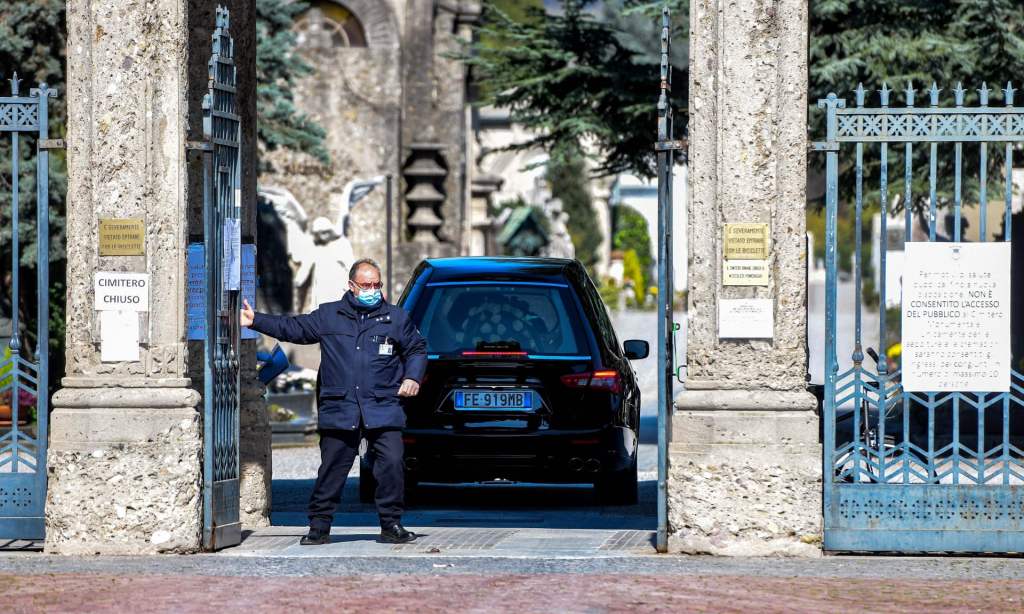
Photo from theguardian.com, 19 March 2020 reporting how a “generation has died” in Bergamo, Italy struggling with 1959 deaths from corona virus that has overwhelmed the nation’s funeral sector.

Jesus joins us in death so we can rise to life in him

Today is not a beautiful day to die, especially for victims of COVID-19. No wakes. No Masses. Just simple blessings after cremation. If ever possible.

The scenes from Italy are deeply disturbing that has become the new epicenter of corona pandemic. According to a report last Monday, the obituary page of a local newspaper had increased tenfold in a week, listing up to 150 deaths daily! More disturbing is the fact that “death and mourning happen in isolation”.

Our readings this Sunday speak a lot about death symbolized by graves.

But not on a morbid sense like a defeat or a loss; rather, as a victory, a raising to new life!

Thus says the Lord God: O my people, I will open your graves and have you rise from them, and bring you back to the land of Israel. Then you shall know that I am the Lord, when I open your graves and have you rise from them, O my people! I will put my spirit in you that you may live.

Ezekiel 37:12-14

Ezekiel proclaimed these words of the Lord to the Israelites during their Babylonian Exile when they lost everything and everyone, including God as they thought have forsaken them for their sinfulness. This prophecy is finally fulfilled in Christ’s coming and victory over death on Easter.

In calling back Lazarus to life, Jesus shows us in this scene his tremendous power over death and defeat, agony and pain, sin and evil. It is a prefiguration to a grander scale of his own Resurrection on Easter after the Good Friday.

And when he had said this, he cried out in a loud voice, “Lazarus, come out!” The dead man came out, tied hand and foot with burial bands, and his face was wrapped in cloth. So Jesus said to them, “Untie him and let him go.”

John 11:43-44
Photo by Mr. Raffy Tima of GMA-7 News. Used with permission. Seen here from atop the GMA Network Center in QC is Mt. Samat in Bataan with the Memorial Cross visible, across the Manila Bay, taken on 26 March 2020.

Do you believe this?

Jesus is calling us to have faith in him, to believe in him especially in this time of COVID-19 pandemic. And like his question to Martha which he repeated twice, the Lord is asking us the same question today:

Jesus told her, “I am the resurrection and the life; whoever believes in me, even if he dies, will live, and everyone who lives and believes in me will never die. Do you believe this?

John 11:25-26

Do you believe in him, Jesus the Christ?

Good things have also been happening lately in this two-week old lockdown.

Families are again getting together, staying together. Finally we now have more time than ever to converse once again as husband and wife, children and parents, brothers and sisters.

Some people have rediscovered God and are back to praying again, to believing again.

Even Mother Nature is said to have taken a big break during this lockdown, giving us spectacular views never seen before due to cleaner air, less pollution and congestion in the cities.

These are all conversations going on – thanks to COVID-19!

Let us join the conversations with our loved ones, with nature, with our self, and with God.

Below is one of my favorite photos this week taken by GMA-7 reporter Mr. Raffy Tima. Again, another photo conversing with us, like Jesus in the story of the raising to life of Lazarus.

See the Memorial Cross on Mt. Samat in Bataan?

The raising of Lazarus is the “sign” or miracle as the other evangelists would say, that prefigures the definitive victory of Jesus on the cross.

Like the sisters of Lazarus, believe in Jesus who is awakening us today amid the threats or crosses of corona virus to bear all these sufferings, to passover like him to the life that bodily death cannot touch “through his Spirit dwelling in us” (Rom. 8:11). Amen.

Who we are vs. who we are not

40 Shades of Lent, Sunday Week I-A, 01 March 2020

Genesis 2:7-9, 3:1-7 +++ Romans 5:12-19 +++ Matthew 4:1-11

From Google.

Lent has always been associated with the Sacrament of Baptism since the beginning of the Church. In fact our Sunday readings this 2020 (Cycle A) are among the oldest in our liturgy used in the preparation of candidates or catechumens to Baptism on Easter Vigil.

This intimate link between Lent and Baptism is very evident in our synoptic gospels as Matthew, Mark, and Luke present to us how after Jesus was baptized by John in Jordan River, his temptations by the devil in the desert immediately comes next.

At that time Jesus was led by the Spirit into the desert to be tempted by the devil. He fasted for forty days and forty nights, and afterwards he was hungry. The tempter approached and said to him, “If you are the Son of God, command that these stones become loaves of bread.”

Matthew 4:1-3

The Season of Lent and the Sacrament of Baptism

From Google.

Let us go back a little to that Baptism scene of Jesus at Jordan so we can understand this link between Lent and Baptism as well as to appreciate the meaning of our celebration this first Sunday of Lent.

It was during his Baptism at Jordan when the Father formally launched and made known the mission of Jesus as the Christ or the “Anointed One” of God, that is, the Messiah in Hebrew or Christo in Greek from which we derived the word Christ in English.

As a prefiguration of his coming Pasch – Passion, Death, and Resurrection – Jesus Christ’s Baptism became his “investiture” or “commissioning” when the Father declared, “This is my beloved Son, with whom I am well pleased” (Mt. 3:17).

In his Baptism, Jesus entered into solidarity with us sinners when he plunged into Jordan River to be one with us in everything except sin. It is here we find very clear the intimate link of Baptism with Lent when we are called to be faithful children of God like Jesus Christ

An anatomy of temptation and sin

Detail of the mosaic of the “Temptations of Christ” at the St. Mark Basilica in Venice. Photo from psephizo.com.

Every temptation by the devil, every sin is always a turning away from God, a deviation from our identity as children of the Father in Jesus Christ.

Whenever we would wake up, the Father reminds us like at the Baptism of Jesus at Jordan that we are his beloved son or daughter with whom he is well pleased despite our many sins, failures, and weaknesses.

And like Jesus Christ right after his Baptism at Jordan, the devil also comes every day to tempt us to turn away from the Father, echoing to us his same words in the desert with the Lord, “If you are the Son of God” to lure us into becoming someone we are not.

The tempter approached and said to him, “If you are the Son of God, command that these stones become loaves of bread.” He said in reply, “It is written: One does not live by bread alone, but by every word that comes forth from the mouth of God. Then the devil took him to the holy city, and made him stand on the parapet of the temple, and said to him, “If you are the Son of God, throw yourself down. For it is written…”

Matthew 4:3-6

See this pattern of the devil in his first two temptations, “If you are the Son of God” – very enticing to be somebody else, to prove one’s worth and being.

This pattern will significantly change at the third temptation when the devil took Jesus to a high mountain to show him all the kingdoms of the world in their magnificence. No more “If you are the Son of God” but a more direct temptation that is affront and “garapal” as we say in Filipino:

“All these I shall give to you, if you will prostrate yourself and worship me.”

Matthew 4:9

Observe how cunning was the devil in his temptations of Jesus until finally, he brings out his sinister plot: worship him, turn away from God!

The same is true with us: the devil will lure and deceive us in so many ways with just one objective which is for us to turn away from God. In every temptation, in every sin, the issue has always been the primacy of God which Jesus Christ firmly affirmed in his triumph over the devil’s temptations at the desert.

And this issue on the primacy of God is always attacked by the devil in every temptation when he confuses us on who we really are like the woman in the first reading after the serpent had told her that she would be like God:

The woman saw that the tree was good for food, pleasing to the eyes, and desirable for gaining wisdom. So she took some of its frit and ate it; and she also gave some to her husband. Then the eyes of both of them were opened, and they realized that they were naked; so they sewed fig leaves together and made loincloths for themselves.

Genesis 3:6-7

Do we not feel the same way after every sin? We feel naked – ugly, dirty, and alienated from our very selves precisely because we have not become our true selves!

These temptations of Jesus by the devil would persist up to his crucifixion where some people jeered and taunted him, telling him “if you are the Son of God” or “if you are the Messiah” so that he would turn away from the Father and forget all about his mission and Divine plan of salvation.

Notice that the last temptation of Jesus is exactly our last temptation too: abandon God the Father and simply be like the devil, with no dignity, with nothing at all because he is separated from God, our only grounding of being.

Hubris, our greatest temptation and sin

Photo by Mr. Raffy Tima of GMA-7 News, Batanes, 2018.

Last Sunday we have mentioned how the Greeks have always held that man’s first and greatest temptation and sin is hubris – that is, the arrogant presumption of man that he is god, or that he can defy the divine to do everything and have anything.

We call it pride which is at the very core of every temptation and sin. The director of the classic film “Ten Commandments”, Mr. Cecil de Mille was once asked which of the Lord’s commandments is most often violated by man?

According to Mr. De Mille, it is the first commandment of God that we always violate because whenever we sin, that is when we also have another false god or idol aside from the true God.

Very true!

Our problem in the world is not really hunger or war or poverty but our refusal to be faithful to God, to be who we really are as his blessed sons and daughters. In some instances, there are some who have totally rejected and denied God, believing more in themselves, in the sciences and technologies.

Jesus is not indifferent to hunger or wars still going on in many parts of the world today; he had come to show us the path to our problems is to reclaim our being children of the Father, listening and living his words, worshiping and trusting him alone.

In going through his Pasch, in fighting all temptations, Jesus shows us the path to see and experience the God we can meet when we come to our desert where we rely only in him alone. It involves hard work, without any shortcut and quick fixes or instants that have become our norm these days.

It is not a simplistic approach to the many problems we are facing, but if you read the newspapers or watch the news, we see how humanity is still in solidarity with Adam, with sin, with the material world as St. Paul explained in the second reading.

On this first Sunday of Lent, we are reminded anew of our identity as beloved children of the Father in Jesus Christ who showers us with every grace and blessing that we need. Let us live in him, trust in him, hold on to him to experience life anew.

Let us give Jesus a chance to work in us, rise with him to our being beloved children of the Father! Amen.

Photo by author at the ancient city of Jericho, Israel, May 2019.

Love: Morality of Christianity

The Lord Is My Chef Sunday Recipe for the Soul, Week VII-A, 23 February 2020

Leviticus 19:1-2, 17-18 ><)))*> 1 Corinthians 3:16-23 ><)))*> Matthew 5:38-48

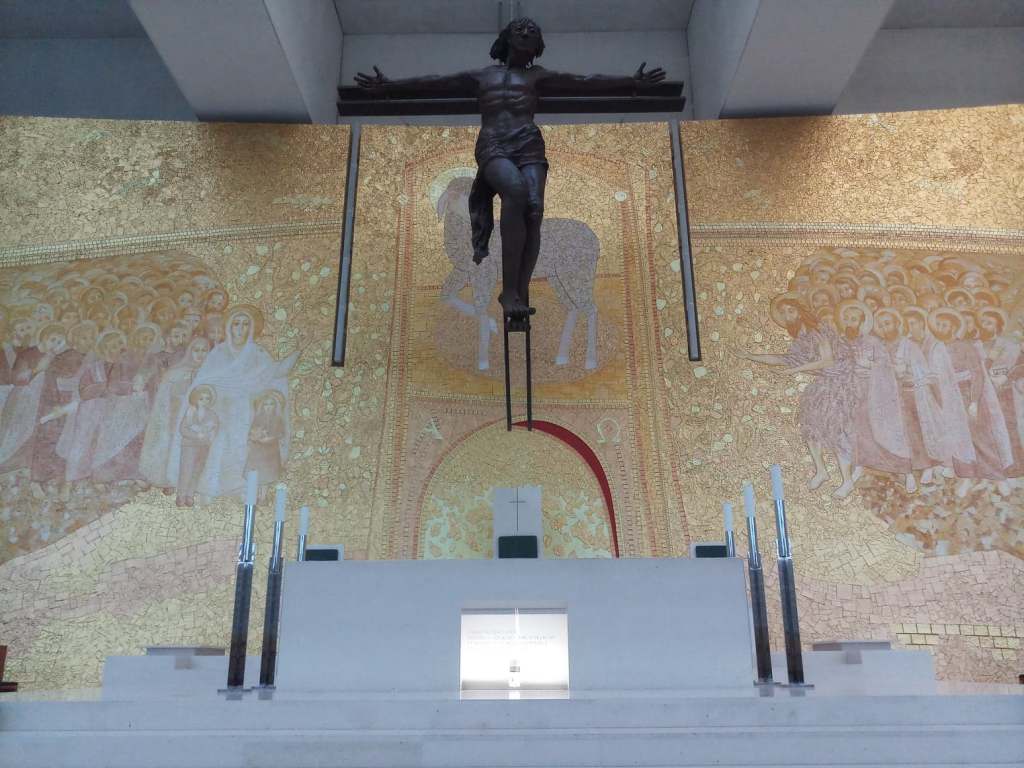
Altar of the modern Minor Basilica of the Holy Trinity at Fatima, Portugal. Photo by Arch. Philip Santiago, 2017.

Jesus concludes his Sermon on the Mount this Sunday just in time for the start of Lent this coming Ash Wednesday. He taught us last Sunday that righteousness is not only measured by acts but most of all by the purity of the heart’s intentions that we call “education of the heart”.

Today Christ comes to the demands of charity and love, the fullness of the Laws in himself.

Jesus said to his disciples: “You have heard that it was said, An eye for an eye and a tooth for a tooth. But I say to you, offer no resistance to one who is evil. When someone strikes you on your right cheek, turn the other one as well… You have heard that it was said, You shall love your neighbor and hate your enemy. But I say to you, love your enemies, and pray for those who persecute you, that you may be children of your heavenly Father..”

Matthew 5:38-39, 43-45

See again the Lord’s pattern in his preaching like last Sunday: a recall of the laws to show his adherence to them contrary to claims of his enemies, and then his infusion of his teaching that perfects the laws: “You have heard… But I say to you…”

Jesus focuses only on two laws today, that of revenge or “lex talionis” (from Latin talio for the word such) and that of hate for enemy which needs some clarifications.

Nowhere do we find in the Laws of Israel “to love your neighbor and hate your enemy”. Experts say Jesus must be citing a popular saying of his time in this part of his teaching. Besides, the Aramiac spoken by the Lord does not connote the harsh meaning we have today for the word “hate”. In short, Jesus is correcting here the norm among Jews of his time to “just love those who love us”.

This is why he adds this beautiful explanation with the most unique conclusion of all.

“For if you love those who love you, what recompense will you have? Do not the tax collectors do the same? And if you greet your brothers only, what is unusual about that? Do not the pagans do the same? So be perfect, just as your heavenly Father is perfect.”

Matthew 5:46-48
Photo by Lorenzo Atienza, 12 June 2019, Malolos Cathedral.

A fraternity of humanity in the Father

Here we find a beautiful dimension of Jesus Christ’s assertion last week that he had come to fulfill the Laws: more than having a broader approach to the spirit of the laws, education of the heart leads us to see everyone as a brother and a sister.

No one is different. Every one is a family – a kin! which is the root of the word “kind”.

Being kind is more than being good as we say in Filipino, mabait or mabuti.

Being kind is treating the other person as a kin, a relative or family; someone who is not different from us. When we say “he is kind to me”, it means more than being good to me but treating me as a family, a brother or a sister – not as “another” or “iba sa akin” as we say in Filipino.

Photo by author, Mt. St. Paul, Baguio City, 03 February 2020.

This is the essence of our “Year of Inter-religious Dialogue, Ecumenism, and Indigenous Peoples” in preparation next year of our 500 years of Christianity in the country.

Everybody is included in that celebration as we reach out to peoples of other faith and beliefs as well as to the indigenous peoples whose forefathers were actually the first settlers of the country.

This is very important in any dialogue and relationship and partnerships including marriage: there must always be the acceptance of everyone in equal footing with same dignity as a person. It is from here we start that fullness of the Laws in Christ in love.

Human holiness as a reflection of God’s holiness in love

Love can only happen where there is equality and fairness. Love demands we are first of all at equal footing with each other. This is why Jesus became human like us: the Son of God became human to stand on equal footing with us that we cannot argue that he is greater because he is truly human, too, going through everything we have gone through except sin.

When he said that we offer our other cheek, to give our cloak, and go for another mile, he is not referring to criminal or penal codes but more into our humanity, that spirit of universal brotherhood so that even our oppressors and enemies come to realize within them that we are one, that we should be caring for one another, not hating and hurting each other.

Loving our enemies does not mean we let evil continue; loving our enemies means continuing to “love” perpetrators of evils until they realize we are brothers and sisters, keeping each other, caring for each other.

Loving our enemies is making them realize that there are nobody else here on earth for them except us – why fight and perish?

Yes, these are easier said than done. And admittedly, I must confess it is the most difficult part of the gospel, of being a Christ-ian. But it is something Jesus is asking us in the most personal manner.

From Google.

Let it be clear that Jesus is not asking us to behave with naiveté that we give in to injustice, evil, and violence but that we always be peacemakers, the blessed ones he said in his Beatitudes. In our fight for justice and peace, we fight with the moral persuasions of love which is the morality of Christ.

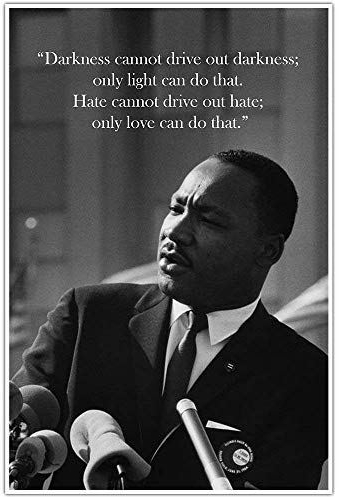
The American civil rights leader Rev. Martin Luther King, Jr. had shown in our modern time that the Lord’s teachings are doable: we just have to be convinced and must truly believe in Jesus.

“Love is the most durable power in the world. This creative force is the most potent instrument available in mankind’s quest for peace and security.”

Rev. Martin Luther King, Jr.

When we love truly in Jesus Christ, asserting what is true, what good, what is just, we make God truly present in the world. When that happens, the more we allow him to do his works of changing us within, of transforming us within. It is in our imperfect love that we make God present, the perfect I Am.

The Lord said to Moses, “Speak to the whole Israelite community and tell them: Be holy, for I, the Lord your God, am holy. Take no revenge and cherish no grudge against your people. You shall love your neighbor as yourself. I am the Lord.”

Leviticus 19:1-2, 18
Photo by Dra. Mai B. Dela Peña, Santorini in Greece, 2016.

Hubris, our greatest temptation and sin

The Season of Lent is fast approaching us, set to start with Ash Wednesday this week. It is a season characterized by barrenness: no Gloria and Alleluias, no flowers, no decorations, no images to make us turn back to God again, our Lord and Master alone.

St. Paul reminds us today in our second reading that we are “God’s temple… that there is no need to boast of anyone including one’s self” (1Cor. 3:16, 21). Instead of embracing or holding on to anyone including one’s self, we have to embrace the scandal of the cross of Christ, that is, power in weakness, wisdom in what the world considers folly.

For the ancient Greeks as depicted in their epics, the greatest temptation and sin of man is hubris – the arrogant presumption that he is god, that he can do everything, he can have everything that he defies the gods.

Hubris is the sin of pride that has led everyone from Adam and Eve to all the powerful men and women of history into their downfall. It is absolute power crumbling absolutely, always tragically.

In his Sermon on the Mount where we heard many of the Lord’s teachings this whole month of February, Jesus shows us the path away from hubris, his path of love and holiness in the Father. Let us heed his calls, give his teachings a try and a chance to be fulfilled in us.

A very lovely and loving Sunday to you!

“You’re In My Heart” by Rod Stewart (1977)

The Lord Is My Chef Sunday Music, 16 February 2020

From Google.

I have always been a big fan of Rod Stewart since my elementary days when his 1977 hit “You’re In My Heart” was released. Since then I have followed his career, saving on my baon to buy some of his records and cassette tapes that some of my relatives doubted if I would ever become a priest with my kind of music!

But, when I entered the high school seminary in 1979 and heard our rector and spiritual director playing Rod Stewart’s music, that’s when I realized I could still become a priest with my kind of music.

And so, I finally became a priest in 1998 after leaving the seminary in 1982 – not because of rock music – that 21 years after, here still rockin’, now blogging to relate secular music with our Sunday gospel.

Pilgrims entering the Church of the Beatitudes with a painting of the Jesus giving his Sermon on the Mount. Photo by author, May 2019, the Holy Land.

This Sunday, Jesus continues his Sermon on the Mount, inviting us to look deeper into our hearts to see how much love and respect we have there for God and for others.

He cites four grave sins – murder, adultery, divorce, and lies – that all begin in our hearts.

Like what Jesus would later tell us, it is not what enters us that defile us but what comes from our hearts.

All troubles and sins outside like the wars and famines, the corruption and injustices that happen begin right inside our hearts.

And that is why we have chosen Rod Stewart’s classic “You’re In My Heart” that speaks of the great love – perhaps a crush or first love to a high school classmate.

Rod Stewart wrote this song and the lyrics are not only poetic but also playfully true that we can all identify with it, especially us men who have gone through the same feelings and experiences when we think of girls and sports at the same time while always lagging in our academics (LOL).

It is something like what our teachers used to tell us in elementary and high school: “boys will always be boys but girls turn into ladies and then into women”.

Have a heart, bask in the feeling of loving, and mature in our love in Christ!

You’re in my heart, you’re in my soul
You’ll be my breath should I grow old
You are my lover, you’re my best friend
You’re in my soul
My love for you is immeasurable
My respect for you immense
You’re ageless, timeless, lace and fineness
You’re beauty and elegance
You’re a rhapsody, a comedy
You’re a symphony and a play
You’re every love song ever written
But honey, what do you see in me?
You’re in my heart, you’re in my soul
You’ll be my breath should I grow old
You are my lover, you’re my best friend
You’re in my soul
You’re an essay in glamor
Please pardon the grammar
But you’re every schoolboy’s dream
You’re Celtic, United, but baby I’ve decided
You’re the best team I’ve ever seen

Fullness of person, fulfillment of law

The Lord Is My Chef Sunday Recipe for the Soul, Week VI-A, 16 February 2020

Sirach 15:15-20 ><)))*> 1 Corinthians 2:6-10 ><)))*> Matthew 5:17-37

Photo by author of pilgrims entering the Church of the Beatitudes with a painting of the Sermon on the Mount above the door, May 2019.

Jesus continues his Sermon on the Mount this Sunday, expounding the meaning of his teachings called the Beatitudes. As we have reflected last week, the Beatitudes tell us the person of Jesus Christ as being “poor, merciful, clean of heart” whom we must all imitate to become the salt and the light of the world.

Most important of all, Matthew presents to us at the Sermon on the Mount that Jesus is more than the new Moses as giver of laws like at Mt. Sinai in the Old Testament: Jesus himself is the Law, who is both our Teacher and Redeemer.

This we see in his teachings today when he claims to be the fulfillment of the Laws and the Prophets from God in the Old Testament.

Jesus said to his disciples: “Do not think that I have come to abolish the law or the prophets. I have come not to abolish but to fulfill it. Amen, I say to you, until heaven and earth pass away, not the smallest letter or the smallest part of a letter will pass from the law, until all things have taken place.”

Matthew 5:17-18

Essence of the Laws: reflection of God, the good of man

Today, Jesus is teaching us to see the laws in the right perspectives, in the light of the will of God for the good of every person. Throughout his ministry, Jesus has always been consistent in reminding everyone that the laws were made for man, not the other way around.

During Christ’s time, people have lost the real meaning of the Commandments of God as priests and religious leaders focused more on its letters than in its essence and spirit that in the process, the laws have become burdensome. It has continued in our own generation with laws taking precedence over God and persons.

Photo by author of the Church of the Beatitudes at the Holy Land, May 2019.

At the Sermon on the Mount, we find Jesus restoring and recalibrating the laws so that these become more relevant and powerful as reflections of God in the service of man.

Jesus “relectures” us the laws in this part of his Sermon on the Mount by adding more righteousness (holiness), declaring that,

“I tell you, unless your righteousness surpasses that of the scribes and Pharisees, you will not enter the kingdom of heaven.”

Matthew 5:20

By using a pattern where he would cite Laws, saying, “You have heard that it was said”– Jesus shows us his fidelity and obedience to Judaism, contrary to his enemies’ accusations that he had abolished their laws. Moreover, in fulfilling the laws, Jesus put himself in the midst of every law and precept by declaring, “Amen, I say to you” or “but I say to you”.

In following that formula, Jesus gave the laws with a human face and a human heart in himself as its fulfillment so that from then on at his Sermon on the Mount, Christ made every law, every tradition, everything else to be seen always in his person.

Black and white photo by Mr. Jay Javier in Quiapo, 09 January 2020.

Performative powers of the laws in Jesus Christ

With Jesus in the midst of every law and precept as its fulfillment, God’s laws then become not only informative but most of all, performative to borrow one of Pope Emeritus Benedict XVI’s favorite expression. This we find Jesus teaching us in three stages in our long gospel this Sunday.

  1. Education of the heart.

The first two laws cited by Jesus in this long list of commandments are “You shall not kill” and “you shall not commit adultery”. Both laws bring us to the very core of our personhood, of what is in our hearts and in our minds. The Lord explains that being angry as well as saying bad words against another person is like murder while looking lustfully at a woman is a form of adultery because in both cases, we have ceased to regard the other individuals as persons to be loved and respected, created in the image and likeness of God.

From Google.

It is an invitation for us to purify our hearts and minds for what defiles man is not what enters him but what comes out from him (Mt.15:11). Whatever is within us will always have an effect in all of our actions, for better or for worse.

What a tragedy that right here in the middle of our wired world of social media and instant communications, we have actually grown apart than together in the last 35 year with so much animosities fed on by lies and misinformation.

How ironic also that despite the information explosion from the Net, we have more benighted souls today than ever before who have actually gone to schools who know nothing of our history and geography?!

Education of the heart is formation of the whole person, not just a training of skills. One problem we have these days is when information is geared on data and facts without integration that we forget our relationships as well as the values we keep like respect, kindness, and dedication. Unless we have an education of the heart, a wholistic and integral formation, we can never be transformed into like Jesus Christ.

2. Get into the roots of our sins.

In telling us to pluck out our right eye or cut off our right hand if these cause us to sin, Jesus is inviting us again to probe deep into our hearts and being to understand what causes us to sin.

Photo by author, water plants in my room at the Fatima Parish and National Shrine, Valenzuela City, 2010.

The key here is to be totally free. In the first reading, Ben Sirach counsels us to “choose” rightly what is good and avoid what is evil.

We can only exercise our true freedom when we have clearer knowledge and understanding of ourselves and of things within us. We fall into vices and sins because we do not know what is going on inside us; hence, we are enslaved by our desires and sins to be not free at all.

Once we understand our sins, we commit them less often. Most of all, when we understand our sins, our struggles against committing these become more persevering, resulting to more triumphs than defeats.

The Season of Lent is near. Once again, we shall be busy with fasting and abstinence, contrition and confession of sins, almsgiving and other spiritual works that make us holy. But too often, these acts become mechanical that sooner, we sometimes reach that point when we cannot find meaning in doing them anymore that we sink deeper into sins and evil.

This happens when we get focused with letters of the laws and we forget its spirit that we become mechanical because we have failed to understand our very selves as well as our sins.

3. Be true.

Jesus said it perfectly well at the end of his teachings today,

“Let your ‘Yes’ mean ‘Yes’ and your ‘No’ mean ‘No.’ Anything more is from the evil one.”

Matthew 5:37

In this last installment of reviewing the laws, Jesus underscored the problems with divorce as well as with lies that continue to this day because we always choose not to be true at all with ourselves, with God, and with others.

Photo by author of the last two Stations of the Cross at the chapel of my niece Ms. Babs Sison in Los Baños, Laguna 13 February 2020.

See the wisdom of Jesus in putting together divorce and oaths, the two great lies that until now continue to mislead so many among us who refuse to accept and carry the cross of Christ, preferring only the Easter Sunday minus the Good Friday.

Being true is embracing the Cross of Jesus Christ like St. Paul in the second reading. It is something we cannot deny in this life. There will always be pain and sufferings. As Dr. Scott Peck put it in his book The Road Less Travelled, “life is difficult.”

At his Sermon on the Mount, Jesus clearly showed in his Beatitudes that he and his values are in sharp contrast to the wisdom of the world. And this wisdom is only accessible to those willing to embrace the crucified Christ and the scandal of the cross.

It is there on the Cross with Jesus Christ we truly find the fulfillment of the laws as well as our fullness as persons. Amen.

Have a blessed Sunday, everyone!

Sharing the light of Christ

The Lord Is My Chef Recipe for the Soul, Sunday Week V-A, 09 February 2020

Isaiah 58:7-10 ><)))*> 1 Corinthians 2:1-5 ><)))*> Matthew 5:13-16

Our parish cross at night, taken with my camera phone, 02 February 2020.

For most of us, 2020 is a very tough year with all the dark clouds that have come to hover above us in January remain in this month of February.

Threats from the corona virus are growing especially in our country. And while the alert level at Taal Volcano had gone down, dangers of its major eruption remain while volcanologists observed last week a “crater glow” on Mayon Volcano, indicating a possible rising of magma in the world’s most perfect cone.

Elsewhere, more bad news are happening like the sudden deaths this week of healing priest Fr. Fernando Suarez and of our very own and beloved Fr. Danny Bermudo, just 24 hours apart due to heart attacks.

In our own circles of family and relatives, friends and colleagues are also dark clouds covering us while we go through our many trials and tests in life that seem to eclipse this early the many gains we have achieved in the whole of 2019.

Indeed, year 2020 shows us in “perfect vision” the sad realities of dark spots in life that behoove us more to heed Christ’s call to be the light of the world.

Jesus said to his disciples: “You are the light of the world. Just so, your light must shine before others, that they may see your good deeds and glorify your Heavenly Father.”

Matthew 5:14, 16
Photo by author, frost on petals, Baguio City, 04 February 2020.

Jesus is the light of the world, not us

Our gospel this Sunday follows immediately the inaugural preaching of Jesus called “the Sermon on the Mount” with the Beatitudes at its centerpiece. We have skipped that part of the gospel last Sunday due to the celebration of the Feast of the Presentation of the Lord.

For us to better appreciate this Sunday’s gospel, let us keep in mind that for Matthew, the Sermon on the Mount is the great discourse of Jesus Christ that depicts his image not only as the new Moses but as the Law himself, being both our Teacher and Savior as well.

Jesus shows us a picture of his person in the Beatitudes as someone we must imitate in being “poor in spirit, meek, and merciful” so we can follow his path to the Father. After all, as the Son of God, Jesus is “the way, the truth, and the life” (Jn. 14:6).

Hence, after enumerating the nine Beatitudes, Jesus followed up his Sermon on Mount with a call for us to be the salt and the light of the world: as salt, we merely bring out the Christ or the taste in every person and as light, it is the light of Christ that we share.

Focus remains in being like Jesus, not in replacing him who is our Savior. That is why he tells us clearly before shifting to another lesson in his Sermon that “your light must shine before others, that they may see your good deeds and glorify your Heavenly Father” (Mt.5:16).

Sharing Christ’s light with our good deeds as a community

So, how do we share the light of Jesus Christ in this age when so many others are claiming to be the light that will dispel all darkness in our lives?

As early as during the darkest period in the history of Israel in the Old Testament called the “Babylonian Captivity (or Exile)”, God had taught his people how to become light for one another during trials and sufferings.

Christ Light of the World, Red Wednesday, 27 November 2019. Photo by author.

Thus says the Lord: Share your bread with the hungry, shelter the oppressed and the homeless; clothe the naked when you see them, and do not turn your back on your own. Then your light shall break forth like the dawn… if you bestow your bread on the hungry and satisfy the afflicted; then light shall rise for you in the darkness, and the gloom shall become for you like midday.

Isaiah 58:7-8, 10

To share one’s bread with the hungry, to welcome the homeless, to clothe the hungry are some of the most concrete demands placed by God to his people since he had freed them from slavery in Egypt and later in Babylonia (Iraq today) when the third part of the Book of Isaiah was written.

Eventually, this prophecy was fulfilled in Jesus Christ who also preached exactly the same things shortly before fulfilling his mission in Jerusalem when he stressed the need to do good to one another because “whatsoever we do to one another, especially to the least among us, we also do unto him” (Mt.25:31-40).

We shall hear this part of Matthew’s gospel at the end of our current liturgical year on November 22, 2020 in the celebration of the Solemnity of Christ the King.

These instructions became the basis of our catechism’s “spiritual and corporal works of mercy” that Pope Francis stressed in 2016 during the Extraordinary Jubilee of Mercy.

From fathersofmercy.com

By saying “you are the light of the world”, Jesus is telling us that to fulfill this mission, we have to do it together as a community, as his Body, the Church!

No matter how good and holy we are, none of us is the “light of the world” on our own.

One candle or lamp, or even a light bulb today cannot produce enough light to brighten a whole town or community. But, if one Christian will be lighting just one little candle in the dark, he or she can encourage others especially those who are timid, hesitant, and indifferent until they finally set the world ablaze with Christ’s light.

Christ’s call to be the light of the world is also a call for us to be united as one community, one family, one faithful couple with all our imperfections and sinfulness. What matters is our striving to be good disciples, always charitable to one another as brothers and sisters in Christ.

Here we find the direct relationship of mission and community: every mission given by Jesus is also a call to become a community because without it, it soon becomes a cult centered on the disciple than the Lord.

Photo by Mr. Jim Marpa, 2018.

The example of St. Paul in sharing Christ’s light

St. Paul shows us the best example of being a light of Jesus is to always have it done and fulfilled in the context of a community, of the Church as the Body of Christ, avoiding chances of grabbing the light from him for personal gains.

“I came to you in weakness and fear and much trembling, and my message and my proclamation were not with persuasive words of wisdom, but with a demonstration of Spirit and power, so that your faith might rest not on human wisdom but on the power of God.”

1 Corinthians 2:3-5

It has always happened especially for us serving in the Church that in sharing the light of Christ, we get carried by our ministry and apostolate that we forget him until we claim being the light ourselves.

Sometimes, we consciously or unconsciously create clouts and personality cults for ourselves for being the best, the brightest, even the holiest and most humble of all!

We foolishly brag the great buildings and edifices we have built or the countless malnourished kids we have fed or sent to school for free through college, et cetera, et cetera, et cetera without being bothered at all where is Jesus Christ in all our efforts and projects!

How sad when we forget that what matters most in life is not what we have done or what we have achieved but what have we become as bearers of the light of Christ like St. Paul.

My dear friend, if you are going through many darkness in life today, simply be good, think only of Jesus Christ in everybody you meet and deal with. That is actually when you shine brightest as the light of Christ because people will be surprised at how calmly and gracefully you carry your cross.

In that way, you encourage others living in darkness to let their little sparks of light come out too without realizing how in their own darkness and limitations they have made Christ’s light seen. Amen.

Have a bright and blessed Sunday with your loved ones!

“I Saw the Light” by Todd Rundgren (1972)

The Lord Is My Chef Sunday Music, 02 February 2020

Photo by Mr. Jim Marpa, Bohol, 2019.

Welcome, followers and readers to this Sunday edition of our The Lord Is My Chef Sunday Music as we feature a double-header from singer-composer Todd Rundgren: his first solid hit “I Saw the Light” and “Hello It’s Me” that are both from his 1972 album Something/Anything?

We are featuring two songs today because both are related with our celebration of the Feast of the Presentation of the Lord which falls on February second.

And besides, Todd’s music has always been my favorite while growing up in the 1970’s.

First, we choose I Saw the Light because it is very close to our liturgical feast today also known as Candlemass or Candelaria with Jesus Christ being the Light of the world. St. Luke tells us when Joseph and Mary brought the child Jesus to the temple in Jerusalem 40 days after Christmas, an old man of God named Simeon carried him in his arms and sang:

“Now, Master, you may let your servant go in peace, according to your word, for my eyes have seen your salvation, which you prepared in sight of all the peoples, a light for revelation to the Gentiles, and glory of your people Israel.”

Luke 2:29-32

Jesus is the Light of the world, the only one who can dispel all darkness in our lives.

In I Saw the Light, Todd tells us the story of a young man probably groping in some darkness in his relationship – actually a fling according to the song – with a girl and he does not know if that is really love.

Though we had our fling
I just never would suspect a thing
‘Til that little bell began to ring in my head
In my head
But I tried to run,
though I knew it wouldn’t help me none
‘Cause I couldn’t ever love no one, or so I said
But my feelings for you
were just something I never knew
‘Til I saw the light in your eyes
But I love you best
It’s not something that I say in jest
‘Cause you’re different, girl, from all the rest
In my eyes
And I ran out before but I won’t do it anymore
Can’t you see the light in my eyes

Meanwhile, in our second song Hello It’s Me, we find another man so in love with a woman who is also into some darkness.

Like in I Saw the Light, there is no recognition and hence, no meeting here in Hello It’s Me.

Hello, it’s me
I’ve thought about us for a long, long time
Maybe I think too much but something’s wrong
There’s something here that doesn’t last too long
Maybe I shouldn’t think of you as mine
Seeing you, or seeing anything as much as I do you
I take for granted that you’re always there
I take for granted that you just don’t care
Sometimes I can’t help seeing all the way through
It’s important to me
That you know you are free
‘Cause I never want to make you change for me

Both songs show us the important lesson taught to us by the Feast of the Presentation of the Lord: like anyone else, Jesus also comes but we on our part have to cultivate a relationship with him in order to always recognize him and eventually meet him to be one with him.

Just like the people we love.

Have a wonderful Sunday of prayer, food and drinks, and good music.