The Lord Is My Chef Daily Recipe for the Soul by Fr. Nicanor F. Lalog II
Friday, Feast of the Presentation of the Lord, 02 February 2024
Malachi 3:1-4  ><}}}}*> + ><}}}}*> + ><}}}}*>  Luke 2:22-40
Presentation in the Temple painting by Fra Angelico from fineartamerica.com.
On this most joyous feast
of the Lord's Presentation in
the Temple, we pray, dear Father
for the same grace you gave
your servant Simeon to see each day
the coming of your Son Jesus Christ,
the true light of the world,
the only light to guide our lives.

Grant us the grace, O God,
to persevere in our prayer life
like Simeon and Anna who spent
much of their days at the temple,
praying and fasting that they became
attuned with your Holy Spirit.
How amazing that despite
the many couples coming to the temple
on that day, Simeon and Anna
recognized Jesus in the arms of Mary
with Joseph; many times in life,
we are so distracted with so many
other people we look up to,
we believe in so much
thinking them to be the light who will
guide us in this life;
there are times we look at new ideas
and novel thoughts and ways so bright
that we easily follow them as light
to dispel the many darkness in our life;
and there are times, O God, we simply lose
hope looking for your light,
waiting for your Son Jesus
that we leave your side to
make our own light
because of many distractions
like failures and disappointments
within us.

Let us be focused in Jesus
only like Simeon and Anna for he
surely comes each day amid the hustle
and bustle of life's daily grinds;
do not let us be discouraged
by the many difficulties and
trials that come our way daily
for Jesus comes when we least
expect him, in instances we never
expect like Mary and Joseph
despite having the Savior with them
still complied with the dictates of
the Law; most of all, Jesus came at
the old age of Simeon and Anna
when it was more easier to just
give up from waiting.

May we be able to pray every night
despite the darkness around us,
Simeon's Canticle:
“Now, Master, you may let your servant go in peace, according to your word, for my eyes have seen your salvation, which you have prepared in sight of all the peoples, a light for revelation to the Gentiles, and glory for your people Israel.”
Luke 2:29-32
Lord Jesus,
let us see you
so that we can make others
see you too in us
and through us.
Amen.
Photo by author, surise at Anvaya Cove, Morong, Bataan, 2023.
The Lord Is My Chef Daily Recipe for the Soul by Fr. Nicanor F. Lalog II
Wednesday, Memorial of St. John Bosco, Priest, 31 January 2024
2 Samuel 24:2, 9-17  <*((((>< + ><))))*>  Mark 6:1-6
Photo by Dra. Mylene A. Santos, MD in Tanza, Navotas, Metro Manila, 17 December 2020.
Your words today are very
intriguing, Lord;
both the first reading
and gospel spoke of our
pride and lack of trust in you
but, in both instances,
you were there,
the most merciful Lord,
"regretted the calamity"
imposed upon Jerusalem
while feeling "amazed for their
lack of faith".
But when the angel stretched forth his hand toward Jerusalem to destroy it, the Lord regretted the calamity and said to the angel causing the destruction among the people, “Enough now! Stay your hand.”
2 Samuel 24:16
Jesus said to them, “A prophet is not without honor except in his native place and among his own kin and in his own house.” So he was not able to perform any mighty deed there, apart from curing a few sick people by laying his hands on them. He was amazed at their lack of faith.
Mark 6:4-6
How interesting that you,
O God, was presented to us like
humans with all emotions and feelings
but in the face of human
hardness and disobedience,
you took the softer side of us humans:
you regretted sending pestilence
on Israel in punishment of David's
pride while your Son Jesus himself
only felt being "amazed" at the lack of faith
of the people in the synagogue;
if you have really acted as humans,
you have gone worst
in punishing David
and insulting the people
in Capernaum.
And that is how you deal with us
always in the face of our sinfulness:
you remain on our side,
choosing to be merciful than vengeful,
compassionate and understanding
than angry or mad,
simply be amazed at our incredulity
probably with a few chuckles
than insulting us,
nor lambasting us.
None of those human negativities
on your playing like us humans,
O God.
Most of all,
in the midst of our sins
and indifference, that is when
you raise and send us holy men
like St. John Bosco
who until now through his
Salesian priests and brothers
continue to make you present
in a world that loves to turn against you, God;
bless the Salesians all over the world
who form young people
into your image and likeness,
who witness to us
your most noble qualities
O God when you choose
to feel for us
at our worst selves.
Amen.
The Lord Is My Chef Daily Recipe for the Soul by Fr. Nicanor F. Lalog II
Wednesday in the Second Week of Ordinary Time, Year II, 17 January 2024
1 Samuel 17:32-33, 37, 40-51 <'[[[[>< + ><]]]]'> Mark 3:1-6
Guillaume Courtois, “David and Goliath,” 1650-1660. Oil on canvas. Image via Wikimedia Commons.
Dear God:
Bring out in me
the youthful faith and confidence
of David your servant
who slew the giant Goliath
in your most holy name;
many times in life I get so afraid
of the many trials in life
 that come my way -
sickness and death,
problems and difficulties,
sufferings and pains,
failures and rejections,
sins and evil situations
that enslave me.

Many times,
 you know how I wanted
to give up the fight,
to just quit and leave
but thank you for that spark
of faith in you from within
that reminds me of you,
of your abiding love and presence
like David before Goliath:
“All this multitude, too, shall learn that it is not by sword or spear that the Lord saves. For the battle is the Lord’s, and he shall deliver you into our hands.”
1 Samuel 17:47
Most of all,
let me hold on to that truth
that you sent us your Son
Jesus Christ "to do everything
that is good than evil,
to save life than destroy it"
(Mark 3:4);
let me do always your work,
dear Father,
in the way you would want me
to do it.
Amen.
The Lord Is My Chef Daily Recipe for the Soul by Fr. Nicanor F. Lalog II
Wednesday in the First Week of Ordinary Time, 10 January 2024
1 Samuel 3:1-10,19-20  <*[[[[>< + ><]]]]*>  Mark 1:29-39
Photo by author, 2020.
Dearest God our Father:
I find it so funny these days
we have that feature in our phones
"call waiting" - when we can identify
whoever is calling us, giving us
the easy choice to answer it
or not; if we have missed a call,
we still have a chance to call back
to return a missed call;
with "call waiting",
we cannot actually miss
a call.
Ideally.
Supposed to be.
But we not only ignore calls of
friends and relatives;
worst of all,
we refuse
answering your calls!
During the time young Samuel was minister to the Lord under Eli, a revelation of the Lord was uncommon and vision infrequent… Samuel grew up, and the Lord was with him, not permitting any word of his to be without effect.
1 Samuel 3:1, 20
How interesting the author
noted that "revelation of the Lord
was uncommon and vision infrequent"
during that time of Eli as your priest;
most likely reason was nobody
was listening to you at all
until Samuel came.
Teach us, dear Jesus,
to never keep you waiting
for us in answering your calls;
like the brothers Peter and Andrew,
James and John
that we immediately speak to you,
most of all always listen to you.
This 2024,
let us not keep you waiting in
answering your call
for you never missed our calls;
let me be patient, O Lord,
in awaiting your words,
your calls
so that like Samuel
when we speak,
our words have effect
because we speak your
words alone.
Amen.
The Lord Is My Chef Daily Recipe for the Soul by Fr. Nicanor F. Lalog II
Friday before the Epiphany of the Lord, 05 January 2023
1 John 3:11-21  <*((((>< + ><))))*>  John 1:43-51
Photo by Dra. Mylene A. Santos, MD, at Tagalag, Valenzuela City, 18 November 2023.
How wonderful on this fifth day
of 2024, O God our Father,
that you amaze us
first on what is truly
amazing...
"Do not be amazed, then,
brothers and sisters,
 if the world hates
you"
(1 John 3:13).
Many times we are amazed
at the evil men and women do;
we are amazed and surprised
in the negative sense
like shocked,
appalled,
even embarrassed
when others speak
and act shamelessly
against what is true,
good, and beautiful;
to be amazed in the negative sense
makes us withdraw
to examine our very selves
if we too have become callous
and shamelessly evil.
What is truly amazing,
worth of our surprise
is when we are amazed
in the positive sense
like Nathanael:
"Can anything good come from Nazareth?"
Philip said to him,
"Come and see"
(John 1:46).
Only what is truly good,
very true, and really beautiful
is amazing; nothing can make
our hearts leap even in
momentary disbelief
and amazement like Nathanael
to hear or see or experience
something so good and all good;
and that is YOU, O God,
the most amazing of all
now brought nearer to us
in Christ Jesus;
in him, we have realized
and experienced that
"God is greater than our hearts"
(1 John 3:20) because you,
O God, your love and your truth,
your mercy and your kindness
are all beyond our grasp;
nothing can be so amazing,
loving Father, for us to experience
your love far beyond anything
we could expect for ourselves;
make us believe,
let us be amazed
in you.
Amen.
The Lord Is My Chef Sunday Recipe for the Soul by Fr. Nicanor F. Lalog II
Feast of the Holy Family, Sunday in the Christmas Octave-B, 31 December 2023
Genesis 15:1-6, 21:1-3 ><]]]'> Hebrews 11:8, 11-12, 17-19 ><]]]'> Luke 2:22-40
Photo by author, 25 December 2023.
After the birth of the Christ in Bethlehem and the visit of the shepherds, Luke tells us how the Child was circumcised on the eighth day and given with the name Jesus. A short while after that, Mary and Joseph brought Jesus to Jerusalem to present him to God in the temple.
And that was when more exciting and wonderful things continued to happen to Mary and Joseph when two elderly people filled with the Holy Spirit, Simeon and Anna, took the Child Jesus and spoke great things about him to his astonished parents.
The child’s father and mother were amazed at what was said about him; and Simeon blessed them… There was also a prophetess, Anna, the daughter of Phanuel, of the tribe of Asher. She was advanced in years, having lived seven years with her husband after her marriage, and then as a widow until she was eighty-four. She never left the temple… And coming forward at that very time, she gave thanks to God and spoke about the child to all who were awaiting the redemption of Jerusalem.
Luke 2:33-34, 36-38
Photo from crossroadinitiative.com.
See again the artistry of Luke in showing to us in this scene how Jesus Christ makes every family holy. In narrating to us the story of Christmas, Luke had earlier shown us that Jesus comes first in every family, in every husband and wife and their children.
Clearly we see Luke’s consistency in telling us that in this season and beyond, our focus must always be centered on the person and mission of Jesus Christ as the Son of God, our Savior who makes every family holy like his! How they unfolded through Mary and Joseph is worth reflecting this Sunday.
I have always been amazed since our 30-day retreat in 1995 with this gospel scene of the presentation of Jesus at the temple. The situation of the Holy Family of Joseph, Mary and Jesus was simply an ordinary one with hundreds of other families making the same journey to the temple with nothing unusual happening.
Then all of a sudden, the unforeseen and unforeseeable take place amid all the crowds in the temple on that day. A great revelation by God not only for people at that time but also for us today is made known which allowed us too to perceive the hidden Jesus coming daily in our lives. See the obedience of Mary and Joseph to their Laws and customs. Most of all, their continuing openness to the many revelations still unfolding about their child Jesus.
Photo by author, Nazareth, Israel, May 2019.
It was not a case of exceptional grace to exceptional couple of Joseph and Mary nor to individuals like Simeon and Anna whom I always wondered how were they able to recognize Jesus as the Christ being offered on that day in the temple.
Again, we are invited to be attuned and opened always to the promptings of the Holy Spirit, of keeping that spark of faith within us like Abraham in the first reading who “put his faith in the Lord, who credited it to him as an act of righteousness” (Gen. 15:6). Here we find how God guides us in our steps and those of others in our long and often circuitous journeys in life to have faith in him in finding Jesus the light of our salvation and fulfillment. But faith is more than simply putting ourselves blindly in the hands of God, just moving on with life with a bahala na attitude.
Faith is more than believing and trusting God and persons. It is entering into a communion, a bond with God as our Lord and Master or anyone we love so dearly like our family. The author of the Letter to the Hebrews stressed this aspect of faith as a communion and a bond in our second reading which we find not only in Abraham but also in Joseph and Mary as well as in Simeon and Anna, too.
Recall those moments when you felt like Abraham who was already too old, when you felt it was already “game over” for our plans in life, the end of your rope or when you felt everything is down the drain that you simply accepted it as the reality when suddenly, because of that firm faith and union in God, something happens like a twist or a turn when everything in your life just falls into its right places!
Remember those moments in the past when we dared to walk in the right direction of Jesus – full of humility amid the pains and sufferings of his Cross – when we find later on how his words jibed perfectly with our experiences, so intertwined with our dreams and aspirations along with other people especially with our family that eventually get fulfilled – if not in us, in those next to us. This is the gist of the beautiful movie Firefly.
From GMA Films and GMA Public Affairs.
Firefly is one exceptional film in every aspect. Everything is so good. Watching it convinced me of a renaissance in Filipino film industry. It is a fantasy movie everyone must see this Season because it is a Christmas story, a Christ-film in fact.
Its main character is a small child named Tonton who lost his mother at a young age and embarked on a long journey to bring his mother’s ashes to her birthplace in an island in Bicol said to be inhabited by fireflies.
All Tonton had was faith and love for his mother played by Alessandra de Rossi. His map was actually his scrapbook of his colorful illustrations of the story narrated to him by his mother. Along the way, he met three individuals living in the darkness of their past, uncertain of their future: an ex-convict heading home, doubtful if he would be accepted by his wife and son; a broken-hearted man cheated by his girlfriend at a loss what to do with her name tattooed on his bicep; and a lovely lady on a backpack trip with a camera and some envelops she used to scam money from people for her supposed outreach programs for kids.
From GMA Films and GMA Public Affairs
They all found the light of life through the life and words of Tonton whom they helped reached his mother’s home island where he too eventually came to terms with his own ghosts of the past.
I won’t tell you any details any more. Do watch the movie and be enthralled with its attention to details, the many symbolisms, most of all, of the good news about the beauty of this life made manifest by the Child who opened our eyes to see the light of love and life. Amen. Have a blessed family in Christ Jesus this new year of 2024!
A short poem I wrote after watching Mallari and Firefly:
Two fantasy movies,
One so scary
The other a thing of beauty!

The best in cinematography
Indeed is Mallari:
How they sew together seamlessly
Fiction into a true story so eerie
Of the evil reality
But sadly sank deeply
In vicious circle of sin
And infamy.

But if you have to see
A movie do not miss Firefly
Everything is about beauty
Despite the ugly reality
Of life we all see;
The slum by the sea
The kid and his bullies
The story of his mommy
Led him into a journey
Intertwined with a many
Treading blankly from each one’s past
Into their present
afraid of what will be
Only to see through this kid’s story
That many times a fantasy
Is in fact the reality
We refuse to believe
That is why we can’t see;
How lovely is the movie
Though not about history
Or social malady
But deep theology
Of how a child brought
Fire and light
And made us see
We are loved so immensely
So that someday
We too can rise and fly
High to the sky.
The Lord Is My Chef Daily Recipe for the Soul by Fr. Nicanor F. Lalog II
Misa De Gallo V, Wednesday, 20 December 2023
Isaiah 7:10-14 <*((((>< + ><))))*> Luke 1:26-38
Photo by author, flower garden outside the Basilica of the Annunciation, Nazareth, Israel, May 2019.
Experts tell us that much of human communications are non-verbal in nature. And most often, people rely more to our non-verbal than verbal communication because it is more truthful by nature as actions speak louder than words.
For our reflection this fifth day of our Christmas novena, let us examine the two kinds of non-verbal communications employed by St. Luke to portray God’s immense love for us as well as his sublime uniqueness as perfect communicator. These are proxemics or the communication of spaces, of how places are designed or designated to convey something special and profound. The second i which is the use of time in non-verbal communication like time perceptions of punctuality, willingness to wait, and, “timing”.
Photo by author, Basilica of the Annunciation, Nazareth, Israel, May 2019.
See how St. Luke extensively employed these modes of non-verbal communications in his infancy narrative to show us that God is everywhere, any time.
In the sixth month, the angel Gabriel was sent from God to a town of Galilee called Nazareth, to a virgin betrothed to a man named Joseph, of the house of David, and the virgin’s name was Mary.
Luke 1:26-27
Right away St. Luke established here the direct correlation between John the Baptist and Jesus Christ, of how their respective mission are directly linked with each other that our Lord was conceived six months after his Precursor’s conception.
More than the time frame conveyed by the six month difference in their births, we find behind it a deeper meaning about their differences as well in stature and nature wherein John was completely human flowing with time while Jesus is both human and divine with God directly intervening in our time. John was born June 24, the summer solstice when days are longer and brightest while Jesus was born December 25 when nights are longest and darkest!
The chronemics and proxemics are undeniably hinting on something deep, of how our eternal God entered through our temporal time so that within we can have that cosmic experience of “the here and not yet” when time seems to stand still because we are being wrapped in God’s eternal embrace of love made possible by Christ’s birth, passion, death and resurrection. This we can see at the contrasting circumstances between the advent of John the Baptist and Jesus Christ where we find God most unique, immensely loving us.
Photo by author of the site of the Annunciation at the basement of the Basilica of the Annunciation in Nazareth, Israel, May 2019.
First, Zechariah was a priest while Mary was a commoner. It was natural for God to work through his ministers but in choosing Mary an ordinary woman was something else not because of any special quality she had but simply because God is good. The angel clearly told this to Mary, “you have found favor with God”. God does not call the qualified but he qualifies the call! Today, God is telling us Jesus is coming through us, no matter who we are or what we have gone through and did in life.
Second, God used the setting of the Temple of Jerusalem in yesterday’s account because that is where he is supposed to dwell but today, everything happened in a very simple house in Nazareth, the only place of significance and importance in the New Testament never mentioned in the Old Testament. It was a place looked down upon by many like St. Bartholomew asking Philip, “can anyone good come from Nazareth?”
The word “Nazoraios” or Nazarene mentioned by Matthew refers to the overall designation of Jesus by the prophets as the hope and fulfillment of God’s promise that there shall come forth a “shoot from the stump of Jesse” (Is. 11:1). Shoot in Hebrew is from the word nezer which is also the context used by Isaiah in chapters 7 and 9 found in Isaiah 11:1 cited by Matthew. Therefore, Jesus being called a Nazarene or Nazorean is more than a reference to his place of origin but most of all his very essence – a shoot from God, someone totally consecrated to God.
And that is also who we are! St. Paul’s letters teem with this beautiful theme of us being called and justified in Christ by God.
Today, God is telling us to never lose hope in life, to never give up because he will never give up on us because we are from him, we are his. For as long as we are alive, God will make a way to make a shoot or nezer bud forth from a stump to bring us back to life.
Yesterday, it was the imagery of barrenness of Elizabeth, of her being fruitless and therefore empty. Many times, that is just what God needs from us, an entry point, an opportunity when we are so weak so he can mightily work with his powers.
One of my hopes after Christmas is to celebrate Mass at the Quiapo Church, to cultivate a devotion to Jesus Nuestro Padre Nazareno. I just feel drawn to him as I have personally met so many people including non-Catholics with devotion to the Nazareno of Quiapo after granting them their almost impossible petitions and prayers.
Photo by Mr. Boy Cabrido, Quiapo Church, Misa de Gallo, 17 December 2023.
Third, there was a major feast going on, the Yom Kippur, with a lot of people present when Zechariah was informed of the birth of John; Mary was alone in her house when the angel came to announce to her the birth of Jesus on the sixth month after going to Zechariah. Again, here we find both the place and time conveying something deeper than mere locations and settings. This is what the Church has always been insisting, most especially lately after the lockdown during pandemic when people got the wrong impression that online Masses are enough or can replace actual participation in our Eucharistic celebrations especially on Sundays.
Yes, God comes to us personally as individuals but with Jesus Christ, we have been more interconnected than ever as we have seen how his birth was linked with John’s birth too. Faith and worship, life itself can never be relegated to just a personal matter. There is always the communal aspect of our faith and of life itself because man is a social being, created by God to relate which is what communication is all about.
Photo by author of a Filipino painting of the Annunciation scene on the facade of the Basilica of the Annunciation in Nazareth, Israel, May 2017.
In the first reading we found Ahaz refusing to ask for a sign on the pretext he did not want to offend God but actually because he did not want to show his faith like some people these days who try to see everything on the practical side, on the material side and most of all, the personal side. This is the tragedy of our time even in our Church that has become secularized in certain aspects. See those different guidelines of every diocese and archdiocese about the Simbang Gabi, with others allowing anticipated Masses we have long tried educating people that it is an oxymoron. Many times, we in the Church have overextended or over-interpreted many of our rubrics and traditions just to accommodate others in the name of inclusiveness and other woke ideas.
On this fifth day of our Simbang Gabi, the Annunciation of the birth of Christ invites us to ask ourselves how do we show others that the Lord is with us like Mary? If God is every where, all the time, how come so many have lost him or could not find him? Maybe we no longer have him. Let’s ger him back again today! Amen. Have a blessed Wednesday!
Photo by author, Basilica of the Annunciation, Nazareth, Israel, May 2019.
The Lord Is My Chef Daily Recipe for the Soul by Fr. Nicanor F. Lalog II
Tuesday, Misa De Gallo IV, 19 December 2023
Judges 13:2-7, 24-25 <'[[[[>< + ><]]]]'> Luke 1:5-25
Here’s another beautiful story I got from a blogger I recently followed from Spain at wordpress.com. It is actually an analogy which may sound simple but very true.
You are holding a cup of coffee when someone comes along and bumps into you or shakes your arm, making you spill your coffee everywhere. Why did you spill the coffee?
"Because someone bumped into me!!!"
Wrong answer. You spilled the coffee because there was coffee in your cup. Had there been tea in the cup, you would have spilled tea. Whatever is inside the cup is what will spill out.
Therefore, when life comes along and shakes you - which surely happens all the time - whatever is inside you will come out. It's easy to fake it, until you get rattled. So, we have to ask ourselves, "what's in my cup?" When life gets tough, what spills over from me?
Photo by Mr. Boy Cabrido, Quiapo Church, Misa de Gallo, 17 December 2023.
My dear friends, we are now on the fourth day of our Misa de Gallo and I find that story/analogy so appropriate with our readings today.
How interesting that Zechariah with his wife Elizabeth – according to St. Luke – prayed so hard all their lives to have a child but when God was about to fulfill it, Zechariah doubted it despite being told by an angel from God. Like in that story/analogy we presented above, Zechariah was “rattled” by the angel’s good news. “What was inside Zechariah that he doubted the good news”?
Then Zechariah said to the angel, “How shall I know this? For I am an old man, and my wife is advanced in years.” And the angel said to him in reply, “I am Gabriel, who stand before God. I was sent to speak to you and to announce to you this good news. But now you will be speechless and unable to talk until the days these things take place, because you did not believe my words, which will be fulfilled at their proper time.”
Luke 1:18-20
Photo by author, Wailing Wall of Jerusalem, May 2017, the section of the remaining parts of the temple closest to the Holy of Holies where priests used to incense once a year.
Advent is the presence of God but sometimes when we are overburdened with so many things like anxieties and problems in life, frustrations and disappointments, sickness and death in the family, we become unaware of his divine presence even if we continue to pray and do our religious duties and devotions. Too often we lack the conscious awareness of God in our lives that we take him for granted, considering him more as a given than a presence and a reality.
This is exactly what we told you yesterday about some of us pretending to be real disciples of Christ when in reality we are merely dreaming in a sleepwalking existence. It is a kind of spiritual immaturity due to our lack of honesty and sincerity with one’s self and with God that we remain a spiritual dwarf. Like Zechariah who happened to be a priest who must be more attuned and rooted in God, we too hardly notice God’s coming or even doubt him and his powers because we want to hold on to our comfort zone or insist our own agenda.
God is never put off by our queries in life but what “irritates” him is when we question him, when we doubt him, when we ask about his character like Zechariah. That is a lack of faith in God, a lack of trust, and lack of personal relationship with him unlike St. Joseph in our reflection yesterday, truly a righteous man.
Contrast Zechariah with his wife Elizabeth who is presented by St. Luke in a better position despite her being barren. In the Bible, barrenness is a sign of lifelessness and absence of God’s blessings. Worst, it was seen as a punishment from God for one’s sins.
Yet in this opening scene of St. Luke’s infancy story beginning with the annunciation of John’s birth, we find God’s power at its fullest when we are most emptied which is exactly the imagery of Elizabeth being barren and old. She had nothing at all to be proud of unlike Zechariah who still had duties to perform as a priest.
As we have reflected yesterday too, we burst in great rejoicing actually in those moments filled with negativities, with a lot of “no” answers of rejections and failure. That was how Elizabeth felt after being pregnant with John.
After this time, his wife Elizabeth conceived, and she went into seclusion for five months, saying, “So has the Lord done for me at a time when he has seen fit to take away my disgrace before others.”
Luke 1:24-25
Earlier, we asked what was inside Zechariah that he doubted the good news of the angel; now, we imagine what was inside the barren Elizabeth who welcomed the good news rejoicing by voluntarily going into a seclusion?
The story of the elderly couple Zechariah and Elizabeth finally being blessed by God with a child shows us God’s consistency not only in keeping his promises but most of all in working best even in our worst conditions, in the most unusual circumstances. In these two stories, one from the Old Testament and in the New Testament, we find the importance of being filled with God always.
Recall our story/analogy above. What is inside us that comes out when we are shaken? What spills over from our cup, is it joy, gratitude, and peace? Or, anger, bitterness, harsh words and reactions long festering within?
In starting his Christmas story with the annunciation of the birth of John the Baptist, St. Luke is telling us an important aspect in celebrating this blessed season – the need to fill ourselves with God.
See how Zechariah was forced to be silent and made mute so that he could spend more time listening and rediscovering God anew in his heart, of filling himself with God. On the other hand, Elizabeth opted to go into seclusion also to contemplate God already dwelling in her though she may have never known before that is why she wanted to listen more intently to his other plans with the gift of John. Similarly like her in the first reading was the wife of Manoah who remained silent and open when a man of God told her she would bear a son to be called Samson, saying that “I did not ask him where he came from” (Jgs.3: 6). Advent invites us to simply be still to be filled by God, with God.
The other day I joined my nieces and nephew for lunch. After dropping me off at the parish, they asked for a nearby Starbuck’s because my nephew had to buy a coffee mug for his exchange gift in their class. When I asked him why he had to give a Starbuck’s mug as gift, it turned out that is now the way it is in class Christmas party – your exchange gift partner can make a wish for the gift to receive for as long as it is within the agreed budget by the class.
Anyway, our life gives us the cup or the mug. We make the decision, the choice to fill it with coffee or chocolate or tea, in the same manner we fill ourselves with joy or bitterness, anger or serenity, gratitude or complaints. Or God.
Like Zechariah in the gospel today, we could be so tired already of doing so much, of banging our heads on the wall to solve everything, to answer everything. In this final stretch before Christmas, let us empty our cups or mugs of our selves and fill it with God who alone can truly fill us with life despite our dryness and barrenness. Amen.Have a blessed Tuesday!
The Lord Is My Chef Daily Recipe for the Soul by Fr. Nicanor F. Lalog II
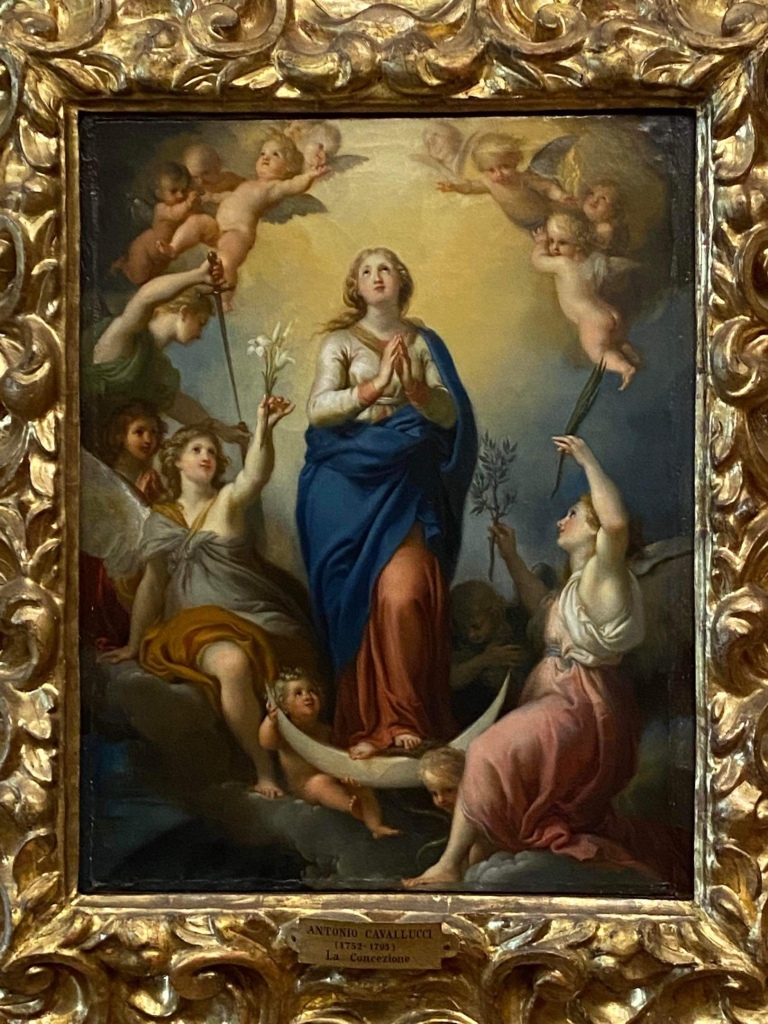
Friday, Solemnity of the Immaculate Conception, 08 December 2023
Genesis 3:9-15, 20 ><}}}*> Ephesians 1:3-6, 11-12 ><}}}*> Luke 1:26-38
Photo by Rev. Fr. Gerry Pascual of Iba, Zambales at Palazzo Borromeo, Isola Bella, Stresa, Italia 2019.
Until now, many Catholics still get wrong the meaning of the Immaculate Conception of Mary we celebrate today. Very often, they thought it is the Immaculate Conception of Jesus by Mary his Mother.
Wrong. The Immaculate Conception refers to St. Anne’s pregnancy of the Blessed Virgin Mary. According to Ineffabilis Deus issued by Pope Pius IX on December 8, 1854 establishing the dogma of the Immaculate Conception of Mary that had long been held as a tradition in the Church, the Blessed Virgin “in the first instance of her conception, by a singular privilege and grace granted by God, in view of the merits of Jesus Christ, the Savior of the human race, was preserved exempt from all stain of sin.”
Unlike everyone of us stained by original sin, Mary in all eternity was spared from any sin by God himself so that she would be pure and clean to conceive and bear, and eventually gave birth to the Son of God, our Lord Jesus Christ.
Count the months from December 8 to September 8 the birthday of Mary, you get exactly nine months and perhaps that gives you a clearer picture now of what the Immaculate Conception refers to. But, what should rely merit more of our attention in this great celebration happening also in this merry month of December is the great reality of how God works in wondrous and mysterious ways among us, asking for our cooperation for its realization.
Are we willing to be like the Blessed Virgin Mary to be God’s partner in bringing salvation in this world?
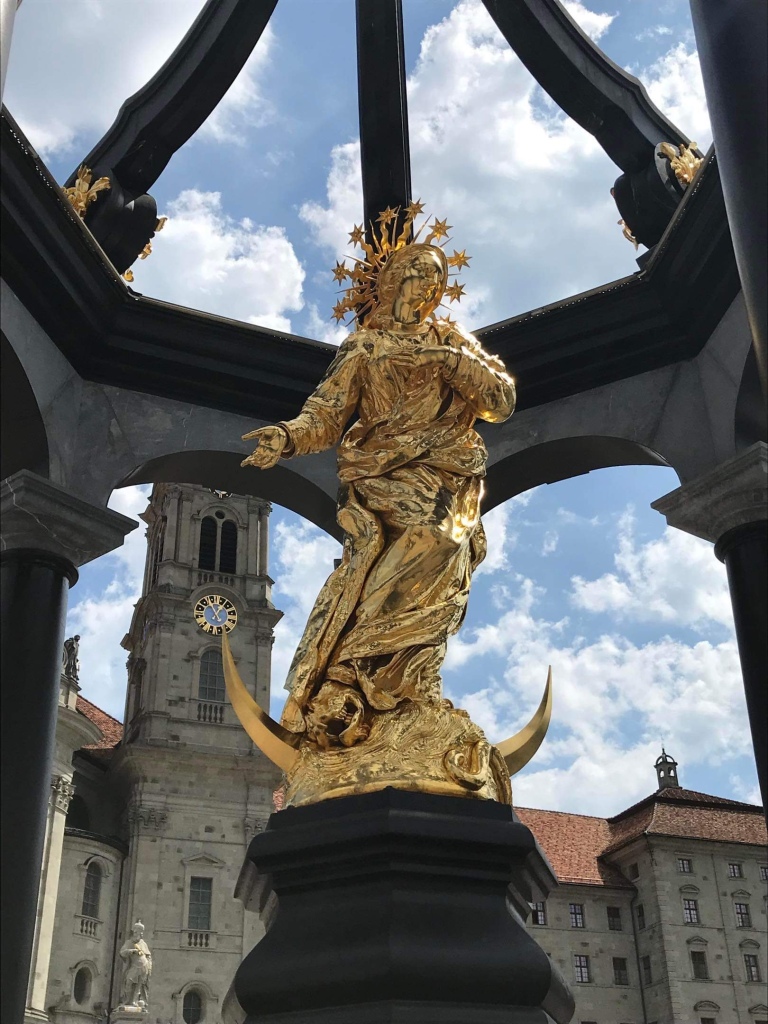
Photo by Fr. Gerry Pascual of Iba, Zambales at Einsiedeln Abbey, Einsiedeln, Switzerland, 2019.
Maybe one of the sources of confusion on the Immaculate Conception is the fact that it is not found in the Scriptures. See how our gospel today actually speaks of the annunciation of the birth of Jesus Christ; however, from this we can also glean Mary’s Immaculate Conception by being referred twice by Luke as a virgin.
The angel Gabriel was sent from God to a town of Galilee called Nazareth, to a virgin betrothed to man named Joseph, of the house of David, and the virgin’s name was Mary. And coming to her, he said, “Hail, full of grace! The Lord is with you.”
Luke 1:26-28
It is very interesting to keep in mind that the two dogmas about the Blessed Virgin Mary – the Immaculate Conception and the Assumption issued 100 years later – speak of our beginning and end. In the Immaculate Conception, we are reminded of our original status of being pure and sinless until the fall of Adam and Eve we have heard in the first reading. The Assumption on the other hand, tells us of our destiny in the future, of “the resurrection of body and life everlasting”.
Originally before our fall, we have always been clean and sinless. Like Mary in her Immaculate Conception. See how Luke was very specific in using twice the term virgin or parthenos in Greek because at that time like ours, not all maidens were virgin.
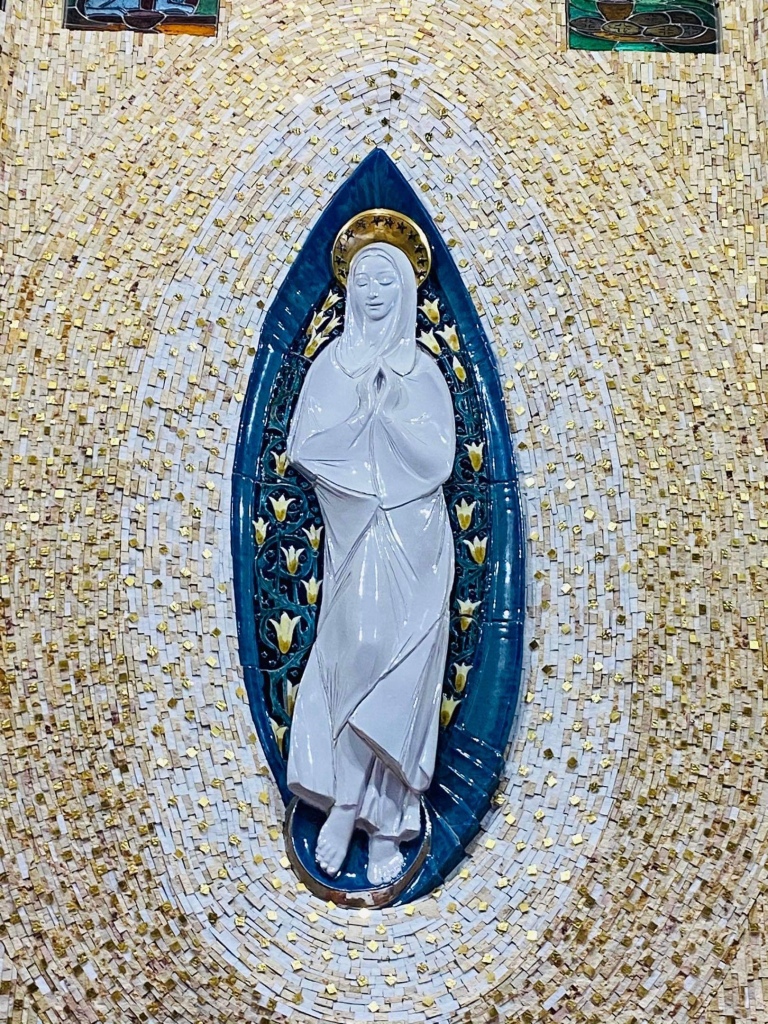
Photo by Rev. Fr. Gerry Pascual of Iba, Zambales at Santuario di Greccio, Rieti, Italy in 2019.
Virginity here does not only speak of the physical sense but also of the deeper spiritual meaning of being clean and open to receive, to accept God in our hearts, in our being. A virgin is someone who is pure and clean of heart like in the Beatitude taught by Jesus Christ at his sermon on the mount, “Blessed are the clean of heart for they shall see God” (Mt. 5:8).
How sad that in our highly competitive and materialistic world, the value of virginity is laughed at or even frowned upon like a handicap or a shortcoming, clear sign of how far we have veered away from God and his teachings. Worst, we have limited our views of virginity and purity to the physical level, forgetting to shift to higher level of understanding and appreciation.
To have a clean or pure heart is to be like Jesus Christ, wholly united and obedient to the Father. Jesus himself proclaimed that everything he had said and done were not his but of the Father. That is the purity of the heart of Jesus, deeply one in the Father that he was the first to see God.
And that is also the kind of person our Blessed Mother is, the model disciple of Jesus her Son for having a heart one with his that on her Assumption she truly became the first to see God too!
Recall also how at the wedding feast in Cana, Mary showed us the example of having a clean heart, of “doing whatever he tells you” which she later proved at the foot of the Cross by standing there with Jesus until his death. That is why according to the meditation of St. Ignatius of Loyola, the Risen Lord first appeared to his Mother, the Blessed Virgin Mary because she was the first to believe in him totally.
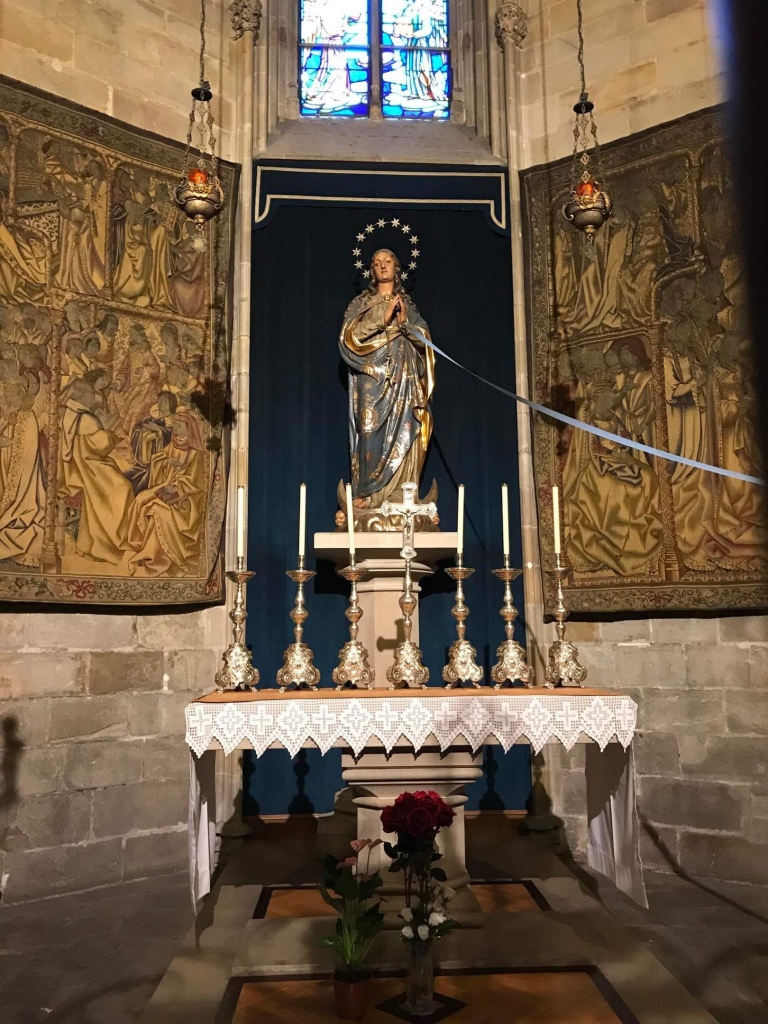
Photo by Fr. Gerry Pascual of Iba, Zambales at the Cathedral of Barcelona, Spain in 2019.
On this Solemnity of the Immaculate Conception of Mary, we are reminded that like her, we are all filled with grace from God in Jesus Christ. St. Paul beautifully expressed this in our second reading today.
Brothers and sisters: Blessed be the God and Father of our Lord Jesus Christ, who has blessed us in Christ with every spiritual blessing in the heavens, as he chose us in him, before the foundation of the world, to be holy and without blemish before him.
Ephesians 1:3-4
The grace of this Solemnity is the reality how God continues to work his wondrous deeds in this world among us, in us through his Son Jesus Christ. But, all his plans can only be realized when we his children are willing to cooperate with him, to be open like Mary to receive Jesus Christ.
Again, we do not have to take everything in the literal sense. God announces to us his coming every day not through the angel Gabriel but through those people around us, especially those we take for granted like the weak and marginalized, the children we do not take seriously because they are kids or the senior people especially the old and sick we find as burdensome.
Like Mary, we are all full of grace, the Lord is with us. Can we show him in our loving service to one another?
Let us pause on this day to go back to our roots in God, our origin and end in order to have that empty space for his Son Jesus Christ to come and work in us in healing us and our very sick world. Amen.
Sabi ko nga sa inyo, kumbinsido ako na mas maraming nasa langit kesa nasa impiyerno. Gagawa at gagawa ng paraan ang Diyos upang masagip ang isang kaluluwa kesa mapahamak sa walang hanggang apoy ng impiyerno.
Tinawag tayo ng Diyos hindi upang parusahan, kundi upang iligtas sa pamamagitan ng ating Panginoong Jesu-Cristo.
1 Tesalonica 5:9
Maraming pagkakataon ko ito napatunayan bilang pari, lalo mula noong 2021 nang maging chaplain ako dito sa pagamutan. Hindi ko makakalimutan yung isa naming pasyente noong isang taon bago mag-Undas.
Larawan kuha ni Dra. Mylene A. Santos, MD sa France, 2022.
Pagkaraan kong magmisa ng Miyerkules ng tanghali sa aming Basic Education Department, nakatanggap ako ng sick call sa aming emergency room. Kaagad ako pumunta at inabutan ko ang isang matandang lalaki na naka-oxygen at maraming mga aparatu na naka-monitor sa kanya.
Lampas 90 na kanyang edad at ang sabi sa akin ng duktor ay maaring pumanaw ang pasyente ano mang oras. Sa malakas kong tinig, sinikap kong kausapin ang pasyente, sinabihan ko siyang magsisi sa kanyang mga kasalanan habang siya ay aking dinarasalan at papahiran ng Banal na Langis. Bumalik ako sa aming university pagkatapos noon.
Laking gulat ko nang sumunod na araw ng Linggo sa aking paghahatid ng Komunyon at pagbabasbas sa mga may-sakit sa aming pagamutan: buhay pa rin iyong pasyente sa pinuntahan ko ng Miyerkules sa ER!
At nang sumunod na araw na naman ng Linggo, naroon pa rin ang naturang pasyente – buhay! Maniwala kayo, umabot pa ng ikatlong araw ng Linggo ang naturang pasyente na dinalaw ko at dinasalan. Nagtataka na rin mga duktor at nars na kung ilang ulit na rin iyon nag-delikado ngunit biglang lumalakas na di mawari.
Noong ikatlong araw ng Linggo na iyon, kinausap ako ng panganay na anak na babae na umuwi mula sa Amerika. Nalaman ko na tatlo silang magkakapatid na puro babae, pawang mga may asawa na rin sila. Filipino-Chinese sila na may-ari ng malaking negosyo sa Bulacan. Wala na ang kanilang ina na pumanaw sa sakit na cancer noon pa.
Larawan kuha ng may-akda, Camp John Hay, Baguio City, 12 Hulyo 2023.
Laking gulat ko at nangilabot din ako sa kuwento ng panganay na anak na babae: mahilig ang kanilang ama sa mga occult practices gaya ng pagkausap sa kaluluwa ng mga yumao nilang kamag-anak at iba pang mga espiritu, ang pag gamit ng mga anting-anting, mga tarot cards, ouija board at marami pang iba.
Bago daw iyon maglubha, pilit na ipinapasa sa isa sa kanilang magkakapatid ang “kapangyarihan” na nakuha sa yumao nilang lola na ina ng kanilang ama. Inutusan daw silang kunin at dasalin mga aklat-dasalan ng kanilang ama na nasa tila wikang Latin. Noon lamang daw nila nakita mga iyon bagama’t naaalala nilang patagong ginagamit ng tatay nila mga iyon noon pa man.
Noon ko naisip na kaya hindi pa pumapanaw ang naturang pasyente na ibig ipasa kanyang mga occult practices sa kanyang anak. Tinanong ko magkakapatid ano kanilang saloobin at pare-pareho silang ayaw nilang tumulad sa kanilang ama. Natuwa naman ako sa kanilang desisyon kaya ipinaliwanag ko na rin sa kanila ang kahulugan at mga implikasyon ng occult practices ng tatay nila. Kailangan kako na “madeliver” siya mula sa impluwensiyang iyon ng demonyo at ikalawa, wasakin mga gamit niya kayat ipinakuha ko iyon habang ako naman ay umuwi ng parokya upang kunin ang aklat ng exorcismo ni P. Jocis Syquia.
Larawan kuha ng may-akda, Pambansang Dambana ng Birhen ng Fatima, 06 Nobyembre 2023.
Pagbalik ko ng parokya, una kong ginawa ay nangumpisal ng aking mga kasalanan sa kasama naming pari. Kumain lamang ako ng kaunti at saka nanalangin sa harap ng Santisimo Sakramento. Pagkaraan ng isang oras, bumalik ako sa ospital upang ganapin ang deliverance prayer sa pasyente ayon sa aklat ni P. Syquia. Muli ko siyang pinahiran ng Banal na Langis at nanalangin kami ng kanyang pamilya pagkaraan ng deliverance session.
Pagkaraan noon ay dinasalan ko at binasbasan mga aklat-dasalan, anting-anting at iba pang mga gamit sa occult ng pasyente na pinagsama-sama ng kanilang boy sa isang black plastic bag. Hindi ko na binulatlat pa ni hawakan mga iyon. Basta, mahigpit kong pinagbilinan yung boy na sunugin lahat ng mga iyon at itapon sa ilog mga abo. Huwag na huwag ka ika ko magtatago ni kukuha ng isa kungdi ay mapapasama kanyang buhay. Hapon na nang maka-uwi ako ng parokya at ang una kong ginawa ay manalangin muli sa harapan ng Santisimo Sakramento.
Umuwi ang naturang pasyente kinabukasan araw ng Lunes. Wala pa raw isang oras sa bahay habang nakahiga sa bago niyang hospital bed, payapang pumanaw ang naturang pasyente. Ayon sa mga nars, nagbalik doon ang panganay na anak na babaeng kumausap sa akin upang magpaabot ng pasasalamat at naikuwento nga paanong pumanaw ang kanilang ama.
Larawan ni Lucifer, ang Satanas, mula sa wikipediacommons.org.
Muli, mga ginigiliw ko, noon ko napatunayan ang lalim at lawak, ang di masusukat na pagmamahal sa atin ng Diyos na hindi niya tayo tatawaging mamatay nang hindi pa handa.
Pakiwari ko ay sa tatlong linggong iyon mula nang pahiran ko ng Langis sa ER ang naturang pasyente, nakipagbuno at babag sa demonyo si San Miguel Arkanghel sa utos ng Diyos upang agawin at iligtas ang kaluluwa ng taong iyon.
Isinulat ko rin ito upang tigilan na rin sana ng mga makababasa nito ang anu mang uri ng mga occult practices pati na mga tawas at pagpunta sa mga faith healer, manghuhula at espiritista. Magpatingin muna sa duktor kung mayroong karamdaman. Lakipan ito ng taimtim na pananalangin at matibay na pananalig sa Diyos nating makapangyarihan sa lahat. Amen.












 lordmychef.com
