Be gentle to be in the banquet

Lord My Chef Sunday Recipe for the Soul, 28 September 2025
Twenty-Sixth Sunday in Ordinary Time, Cycle C
Amos 6:1, 4-7 ><}}}}*> 1 Timothy 6:11-16 ><}}}}*> Luke 16:19-31
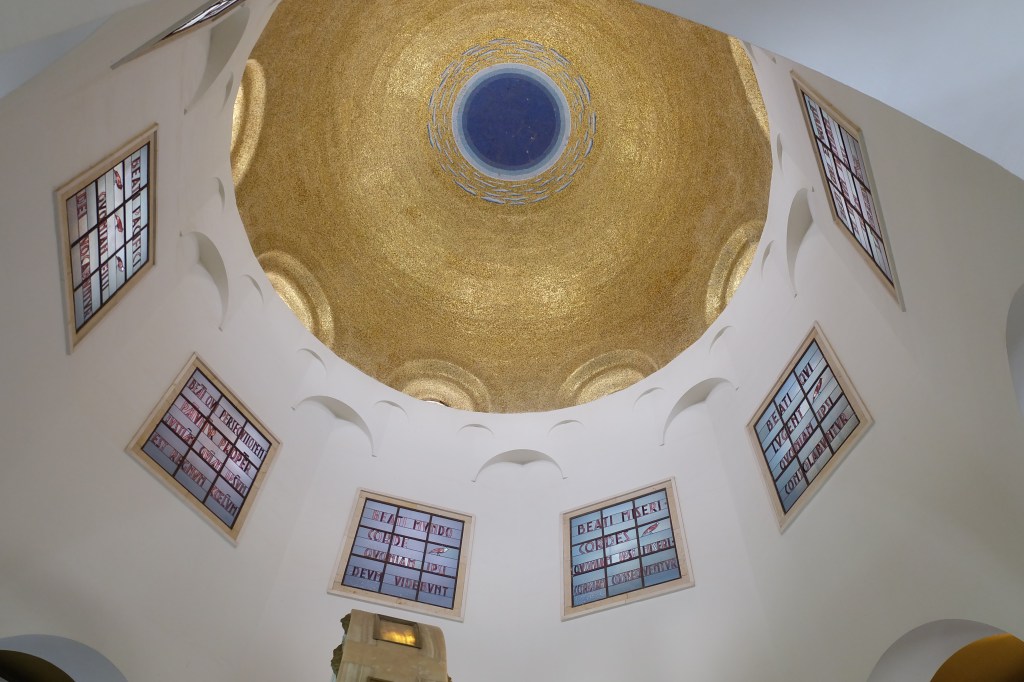
Photo by author, Carmel of the Holy Family Monastery, Guiguinto, Bulacan, 25 September 2025.

But you, man of God, pursue righteousness, devotion, faith, love, patience, and gentleness (1Timothy 6:11).

How lovely and so apt these days are the qualities Paul required through Timothy every man and woman of God must have. Of the six qualities Paul had cited, I like most “gentleness” which Jesus also asked us to have, “learn from me, for I am meek and gentle ( or humble) of heart” (Mt. 11:29).

From the Greek word prauteis, gentleness implies consideration, meekness, humility, calmness and strength amid adversities and difficulties. True power is expressed kindly and gently, not with harshness. Parents and teachers know this so well as children learn discipline better when authority and power are expressed gently than harshly.

Photo by author, Carmel of the Holy Family Monastery, Guiguinto, Bulacan, 25 September 2025.

Lately we have been sliding towards this kind of arrogance in our anger and frustrations following the wholesale corruption in Congress. Everybody feels the weight and pains of the ghost flood control projects but cursing and wishing death upon the corrupt officials are off bounds because that make us just like Duterte and his followers whose mouths spew expletives and death to their detractors.

Our readings are so timely this Sunday again, calling us to be gentle with one another because eternal life begins in the here and now of our earthly existence. How we live today determines our entrance or not into the eternal banquet of the Lord.

Jesus said to the Pharisees: “There was a rich man who dressed in purple garments and fine linen and dined sumptuosly each day. And lying at his door was a poor man named Lazarus, covered with sores, who would gladly have eaten his fill of the scraps that fell from the rich man’s table. dogs even used to come and lick his sores. When the poor man died, he was carried away by angels to the bosom of Abraham. The rich man also died and was buried, and from the netherworld, where he was in torment, he raised his eyes and saw Abraham far off and Lazarus at his side” (Luke 16:19-23).

Photo by author, Carmel of the Holy Family Monastery, Guiguinto, Bulacan, 25 September 2025.

Our readings continue to pursue that thorny issue of money, of how we use and manage it for God’s greater glory in the service of others not for our shameful selfish interests.

That is why we find Paul’s admonition to Timothy and to us today as men and women of God to be gentle in the midst of too much materialism. In the preceding verses Paul warned Timothy of the dangers of false teachings and the love of riches which he concluded with an exhortation to rely more on God than in wealth in verse 17. It is a timely reminder from over 2000 years ago against this growing trend among us spawned by social media of people flaunting their wealth as if finding their own value as a person in possessions than in their very selves.


Gentleness like Jesus is first of all finding our being’s sacredness. It is an expression of our being loving and charitable because we are children of one loving God we relate with as a Father.

How tragic we no longer see each other’s worth as a person, as an image and likeness of God as we seek more the face of money than the face of God in every person. Pera pera na lang lahat – even in the church, sad to say. Every consideration boils down to money like leadership in church activities or hermanidad in fiestas being reserved for the rich and famous who are always the politicians to whom many priests and bishops have become beholden, consciously or unconsciously. We have too much collections and envelopes that further drive away the poor from celebrating our Sunday Eucharist which is essentially a foretaste of the Lord’s banquet in heaven.

Photo by author, Carmel of the Holy Family Monastery, Guiguinto, Bulacan, 25 September 2025.

Amos continues his tirades against the priests of the temple of his time with their hypocrisies of hiding selfish motives in religious celebrations and practices that sadly continue to this day among us in the church.

Thus says the Lord the God of hosts: “Woe to the complacent of Zion! Lying upon beds of ivory, stretched comfortably on their couches, they eat lambs taken from the flock, and calves from the stall! They drink wine from bowls and anoint themselves with the best oils; yet they are not made ill by the collapse of Joseph!” (Amos 6:1, 4, 6).

That “eating lambs from the flock” and “calves from the stall” are the animals reserved for offering in the temple their priests have taken for themselves while “drinking from bowls” and “anointing with the best oils” harp on our rituals we have taken as our own like commercialization of Masses and sacraments. It is the color of money perfectly described by the purple clothing of the rich man in the parable that pervades us in the church that people no longer see and experience God as they have become so cautious asking about the price or the fees that come with every service we give.

Photo by author, Carmel of the Holy Family Monastery, Guiguinto, Bulacan, 25 September 2025.

Gentleness like Christ is using our power and authority at the service of the poor and disadvantaged, ensuring our Eucharistic banquet is a reflection of the eternal banquet in heaven where everyone is welcomed.

How sad this parable is repeated daily in the church that is why Jesus directed it to the Pharisees, one of the ruling class in the Jewish society at that time associated with temple worship and religion. Though Jesus did not say at all if the rich man is a good person or not, it is very clear that he lacked gentleness in his flamboyance, wearing purple clothes as if screaming to be noticed by everyone as a somebody while everybody is a nobody.

Maybe we should add “nepo Fathers” to the list of nepo babies and nepo wives who flaunt their wealth, looking more like showbiz kids than priests, feeling superstars who are more like entertainers than preachers who relish the tag “influencer” than remain hidden doing the work of Christ. They refuse wearing the proper liturgical vestments due to our tropical climate but would not mind at all wearing signature clothes with their perfumes leaving traces in their favorite stomping grounds like malls and cafes during offs.

Where is our gentleness or concern and consideration for the majority of our people who are poor further pushed out of our churches literally and figuratively speaking simply because we do not smell and look like them our flock of sheep as Pope Francis reminded us early in his pontificate?

Photo by author, Carmel of the Holy Family Monastery, Guiguinto, Bulacan, 25 September 2025.

Gentleness of Jesus is solidarity with the people, especially the poor and suffering who experience being uplifted or empowered in his mere presence so filled with warmth and love.

People understand us priests for being strict even stern-looking but what they find so difficult is when pastors are detached from them, always out of the parish for so many reasons, when priests are selective in their company even having cliques. How sad when priests are unapproachable and indifferent like the rich man who was oblivious to the presence of Lazarus at his door, who never gave him any attention at all while still on earth when in fact, they knew each other as mentioned in the parable after they have both died. Kakilala naman pala niya si Lazaro pero doon na lang sa kabilang buhay siya kinausap at pinansin kung kailan huli na ang lahat.

Pope Francis used to describe the church as a hospital where the sick in body and soul come to find solace and comfort in the presence of God. But, instead of hospitality, many times it is hostility that people experience in our parish when they are held hostage by our many rules and regulations that they never feel welcomed at all. Some get scolded that instead of their burdens being eased, they are traumatized by the priests or the office staff and volunteers.

Photo by author, Carmel of the Holy Family Monastery, Guiguinto, Bulacan, 25 September 2025.

If we could be a little more gentle with every Lazarus, perhaps we could be truly rich as we find God in everyone in our doors that lead to our banquet table, whether here on earth or in the afterlife.

Let me end with this parable within me these past five years as a chaplain in the hospital.

Have you ever noticed how the rich with all their wealth and resources are often afflicted with rare diseases without any cure and medication at all while so many poor people without money at all could not avail of the many procedures and medications available for their illness?

It is a parable in this life that begs us to be gentle, even extra gentle many times to ease each other’s sufferings with the rich sharing their material wealth and the poor sharing their gift of self in the face of death. Amen. Have a gentle week ahead everyone. Fr. Nicanor F. Lalog II, Our Lady of Fatima University, Valenzuela City (lordmychef@gmail.com).


Looking up, seeking what is above

Lord My Chef Daily Recipe for the Soul, 10 September 2025
Wednesday, Twenty-third Week in Ordinary Time, Year I
Colossians 3:1-11 <*((((>< + ><))))*> Luke 6:20-26
Photo by Dra. Mylene A. Santos, MD, September 2022.
How lovely are your words
today, Lord Jesus Christ
that pertain about heights.

In the first reading,
St. Paul invites us to seek
what is above,
think what is above
while in the gospel
you O Lord looked up
to us your disciples.

“Brothers and sisters: If then you were raised with Christ, seek what is above, where Christ is seated at the right-hand of God. Think of what is above, not of what is on earth” (Colossians 3:1-2).

Raising his eyes toward his disciples Jesus said: “Blessed are you who are poor, for the Kingdom of God is yours” (Luke 6:20).

Your beatitudes
lifted us up, dear Lord
changed radically
the way we must see
life and its meaning
so that we may aspire to
follow St. Paul's teachings;
before pointing our sights
up to heaven in you,
Jesus,
you first looked up to us
despite our miseries
and sins.
If we could just
imagine this great honor,
then perhaps we would no longer
doubt nor question
your beatitudes;
help us, Lord Jesus
to remember this great honor
you have given us
of lifting us up to you
in our poverty and hunger,
grief and exclusion,
insults and denunciations;
help us Lord
to set our sights up to you
so we may live your beatitudes
by finding and seeing you
among those below us
and with us.
Amen.
Photo by Dra. Mylene A. Santos, MD, September 2022.

“Take nothing”

The Lord Is My Chef Daily Recipe for the Soul by Fr. Nicanor F. Lalog II
Wednesday in the Twenty-fifth Week of Ordinary Time, Year II, 25 September 2024
Proverbs 30:5-9 <*((((>< + ><))))*> Luke 9:1-6
Photo by author, Sacred Heart Novitiate, Novaliches, QC, 20 March 2024.

Jesus said to them, “Take nothing for the journey, neither walking stick, nor sack, nor food, nor money, and let no one take a second tunic” (Luke 9:3).

Lord Jesus,
bless me to continue
in this journey with You,
in You,
taking nothing
but You;
at first,
I could not believe
it to be true
that many times,
I doubted,
taking so many things with me
in this journey;
but, as we walk farther,
Lord, the more I realized,
that indeed,
I need to take nothing.
The farther we journey,
Jesus, the more I take
and bring,
the more difficult,
the slower I move;
so true that the truly
rich among us is the one
whose who needs least in life;
grant me the grace,
O Lord,
the grace of integrity,
of wholeness
and harmony between my
inner self and
outward behavior;
like the author of the Proverbs,
"give me neither poverty nor
riches; provide me only with the food
I need; lest being full,
I deny you or being in want,
I steal, and profane the name
of my God"
(30:9).
Amen.

Exaggerating the truth, exaggerating self, part 2

Quiet Storm by Fr. Nicanor F. Lalog II, 23 July 2024
Photo from sunstar.com.ph of that viral incident between a Cebu personality addressed as a “Sir” by a waiter in a mall last Sunday.

It is a classic case of “brouhaha” in the real sense, especially if we consider our Tagalog word buruha or bruha: a waiter was told to stand for more than an hour to be “lectured” on gender sensitivity by a Cebu personality belonging to the LGBTQ community after being addressed as a “Sir”.

Well, at least, the issue had been settled amicably with an apology by the celebrity after a deluge of negative reactions from netizens. Likewise, we can now sigh with some relief that there are no plans among the LGBTQ community to imitate their sistah from the Queen City of Cebu, proof that there are more sane and kind LGBTQ who have better things to do than make a big fuss about themselves or the rainbow. Imagine if every LGBTQ will lecture everyone of us just on how to address them in Metro Manila alone, life would be disrupted and paralyzed, worst than what we went through during the lockdowns during COVID-19!

But kidding aside, what makes that incident disturbingly sad is how it had shown again the sad plight of the poor in our country. Bawal maging mahirap, maging dukha sa Pilipinas. So sad. Even in the church it is very true. We do not have to look far to see how this is so true among us. Kawawa palagi ang mga maliliit.

How do we treat our house helpers and drivers, delivery personnel, janitors and janitresses, even professionals doing not so glamorous tasks like nurses. And security guards, of course. (Kudos to our alma mater, the Faculty of Arts and Letters of UST who had their security personnel joined the march of their recent graduates!)

Photo by Mr. Jim Marpa, 2018.

The very sight of a waiter standing in front of a customer immediately caught my attention while scrolling my Facebook, asking myself, “what happened?” Gut feelings told me something was very wrong and surely, the guy must have been so disadvantaged.

For addressing that celebrity customer as “sir”, the waiter had to endure the humiliation of standing before him like in a trial. Even if it was just between the two of them. Even if he did not scream or yell at the waiter. What’s the big deal? Iyon lang?

His ego, his femininity more valuable than the very person of the waiter? It is the new pandemic among us spreading these last 20 years. The malady of entitlement, of never making the mortal sin to address some people as Doctor or Attorney or even Father. We have lost touched with our humanity, our being a human being, a person, a tao first of all.

Good thing there was a good soul around that mall who came to the waiter’s rescue.

What we have here is a classic case of “exaggeration of truth, exaggeration of self” – a phrase I have found years ago in one of the many writings of Pope Benedict XVI. It was my parting shot to our graduates of Senior High School last July 05, 2024 during our Baccalaureate Mass.

Many times in this age of so many platforms of communications, we tend to exaggerate the truths, of clamoring for so many things like inclusiveness everywhere when in the process, they have actually become so exclusive! Many times, people exaggerate the truth presenting themselves as disadvantaged and victimized when in fact it is far from reality. Many people are advancing so many things these days when in fact they are actually promoting themselves. Many are exaggerating the truths when they are actually exaggerating themselves (https://lordmychef.com/2024/07/10/exaggerating-truth-exaggerating-self/)

The tragedy of our time characterized by affluence and upward mobility so splattered across social media daily, is how so many among us who have lost touch with our humanity. Everything has become a show – a palabas we say in Filipino. We forget that inside – the loob – as more essential.

And what is inside each one of us?

Our dignity as image and likeness of God or pagkatao that is best seen and expressed in our being small, being little like the children, the very core of Jesus Christ’s teaching.

Look outside even in the countryside now invaded by those giant tarpaulins – why have we become like those tarpaulins, thinking and feeling we are larger than others?

Truth in Greek is aletheia that literally means an opening, of not being concealed like the blooming of a flower.

Simply be yourself. And don’t forget everyone as they are.

God bless everyone!

Photo by Dra. Mai B. Dela Pena, MD at Deir Al-Mukhraqa Carmelite Monastery in Isarel, 2014.

Sigh, and be kind!

The Lord Is My Chef Daily Recipe for the Soul by Fr. Nicanor F. Lalog II
Monday in the Sixth Week of Ordinary Time, Year II, 12 February 2023
James 1:1-11  ><))))*> + ><))))*> + ><))))*>  Mark 8:11-13
Photo by author, Lake of Galilee in Israel, May 2019.
Dear Jesus:
I love that word "kind"
from the responsorial psalm
"Be kind to me, Lord,
and I shall live"
and that scene from the
Gospel when you "sighed":
the word "kind"
is from the root "kin"
or "kindred", that is,
someone like us,
from the same family,
or the same tribe;
being kind is treating others
as one's family or kin
and that is how you are to us -
kind!
And you were most like one of us,
and kind, dear Jesus
when you "sighed from the depth
of your spirit" (Mk. 8:12)
after the Pharisees
asked you for sign from heaven
to prove you were the Christ;
of course, that meant nothing
for the Pharisees but for us
who believe in you, it was something;
like you, dear Jesus,
many times we sigh out of
exasperation and exhaustion,
acceptance and surrender,
hope and inspiration
to persevere,
to keep on,
to forge on in life.
You became like us,
dear Jesus,
in everything except sin
but, when you sighed
we felt you being so kind too,
truly a brother to us
like when St. James
addressed us 15 times
as "brothers and sisters"
in his short letter
while teaching us the important
lesson of bearing all trials
in life as you did at your
Crucifixion, Lord.
Whenever we sigh,
may we remember your kindness,
your being one with us, Jesus
because you too sighed
during those amazing moments
of difficulties and trials,
powerlessness and poverty
when we most gain character
and depth as person,
not when we are strong
and powerful
or successful.
Amen.

Blessedness & beauty of poverty

The Lord Is My Chef Daily Recipe for Soul by Fr. Nicanor F. Lalog II
Monday in the Thirty-fourth Week of Ordinary Time, Year I, 27 November 2023
Daniel 1:1-6, 8-20   ><}}}}*> + ><}}}}*> + ><}}}}*>   Luke 21:1-4
Photo by Dra. Mylene A. Santos, MD in Tagalag, Valenzuela City, 17 November 2023.
Praise and glory to you, 
our loving Father! 
Thank you 
in bringing us closer to you 
in Jesus everyday 
especially in this final stretch 
of our church calendar 
as we come to prepare for Christmas soon.
But, rather than focusing 
on the outside appearances 
and material inclinations 
of our Christmas feelings,
teach us to empty ourselves
to be filled by you in Jesus Christ!
Let us be poor, O God!
Let us embrace poverty
 and simplicity
 to experience you,
your coming,
 your presence
in Jesus,
our Emmanuel!
Let us treasure poverty
for it is our true wealth
in this life
like that “poor old widow”
who gave everything she had
into the temple collection box;
let us realize that it is in poverty
that we find true wisdom
and strength
like what Daniel and his companions
have taught the chief chamberlain
of King Nebuchadnezzar
(Daniel 1:11-20).
Let us be poor, O God,
like Jesus Christ to find
power and strength in weakness,
glory and honor in humility,
and life in death.
 Amen.

Why love is the greatest commandment

Lord My Chef Daily Recipe for the Soul by Fr. Nicanor F. Lalog II
Friday in the Twentieth Week of Ordinary Time, 25 August 2023
Ruth 1:1, 3-6, 14-16, 22   <*{{{{>< + ><}}}}*>   Matthew 22:34-40
Photo by Mr. Jay Javier at Tayabas, Quezon, 13 August 2023.
O how often,
Lord Jesus Christ
that we ask you until now
the same question by 
a scholar of the law:
"Teacher, 
which commandment
of the law is the greatest?"
(Matthew 22:34).
And we have always known
your answer, which is, loving God
with one's total self
and loving others as we love our
very selves.
But why do we keep on asking
the same question until now?

Because, we have always believed
that loving is having,
that loving is fullness,
when in fact, it is the 
exact opposite:
loving is not having,
loving is being poor,
loving is emptiness,
loving is letting go,
loving is surrendering
for the one you love.
Just like Ruth,
that Moabite woman,
a pagan who left everything
to join her widowed
mother-in-law Naomi to go
back to Bethlehem;
both of them were
widowed, both were
childless and empty,
so poor without anything 
except each other
and God.
Let the words of Ruth
be our prayer today
to those we love 
without if nor buts,
especially those empty
and poor, sick and dying:
"Do not ask me to abandon 
or forsake you! for wherever
you go I will go, wherever 
you lodge I will lodge,
your people shall by my people,
and your God my God"
(Ruth 1:16).
God our Father,
help us to remain faithful
and to keep loving when
in the midst of sufferings
and trials, of emptiness
and nothingness like Ruth
to Naomi; how lovely to recall
that Ruth's love for Naomi led
to her becoming the grandmother
of King David and one of the four women
in Matthew's genealogy of Jesus
for it is loving without nothing in return
that we gain, and it is in loving 
even in losing ourselves
that we find ourselves in you.  
Amen.

Praying for those driven away

The Lord Is My Chef Daily Recipe for the Soul by Fr. Nicanor F. Lalog II
Wednesday in the Thirteenth Week of Ordinary Time, Year I, 05 July 2023
Genesis 21:5, 8-20 ><]]]]'> + ><]]]]'> + ><]]]]'>   Matthew 8:28-34
Photo by author, sunset at Tagaytay City, 08 February 2023.
God our loving Father,
today we continue to pray 
for those in great trials and 
sufferings in life,
those in the eye of the storm
especially those driven out
from their own homes,
from their country,
from their roots 
like the refugees and those
fleeing from wars and calamities;
those displaced due to economic 
reasons like poverty;
the victims of the inhuman practice
of human trafficking.
Take care of those people
driven away from their homes
especially the children who 
always suffer most;
look after the welfare of
those thrown into foreign 
lands and environment,
so alienated in language and culture;
sustain those forced to make 
ends meet after being 
led to somewhere else
not of their own choice
and decision.
Hear the cries of the many
and modern 
Hagar and Ishmael
of our time;
bless them too for
we all came from Abraham;
punish the human traffickers,
convert them,
take away their hearts of stone
and give them natural hearts
who respect and rejoice
humanity.
Your very own Son
and our Lord Jesus Christ
was also driven out by people
after he had exorcised two demoniacs
at the territory of Gadarenes;
how sad that until now it continues 
to happen among us when we drive
people out and away because we
value more things and animals than persons.
The whole planet,
the whole land is yours,
O Lord but until now,
so many are lording over
vast tracts of land
when all we really need 
at the end is a simple plot
of three-and-a-half feet wide
by eight feet in length,
six feet under.
Amen.

True wealth

The Lord Is My Chef Daily Recipe for the Soul by Fr. Nicanor F. Lalog II
Tuesday in the Eleventh Week of Ordinary Time, Year I, 20 June 2023
2 Corinthians 8:1-9   ><]]]]'> + ><]]]]'> + ><]]]]'>   Matthew 5:43-48
Photo by author, Anvaya Cove in Morong, Bataan, January 2023.
How deep are your mysteries,
O Lord Jesus Christ,
so irresistibly true
but at the same time daring
and challenging for us
who are focused 
on what we have
without realizing
everything 
comes from you.
Many times, dear Lord,
we are like the Corinthians
rich in so many things
yet not convinced
we are so blessed
that we are also afraid 
of losing whatever we have; 
make us emulate the 
solicitude of the Macedonians 
in sharing their treasures 
with the needy churches
even if they were less affluent
than the Corinthians; 
make us realize that true wealth 
is freedom from our possessions,
of being free for sharing our gifts
and talents and treasures.
Help us realize, Jesus,
that true excellence in faith
is expressed in charity,
in oneness with those in need.

Now as you excel in every respect, in faith, discourse, knowledge, all earnestness, and in the love we have for you, may you excel in this gracious act also. I say this not by way of command, but to test the genuineness of your love by your concern for others. For you know the gracious act act of our Lord Jesus Christ, that for your sake he became poor although he was rich, so that by his poverty you might become rich.

2 Corinthians 8:7-9
Teach us to immerse ourselves
to your mystery of self-denial
and self-sacrifice, 
to your process of being
perfect like the Father
in heaven.
Amen.

True blessedness

The Lord Is My Chef Sunday Recipe for the Soul by Fr. Nicanor F. Lalog II
Sunday in the Fourth Week of Ordinary Time, Year A, 29 January 2023
Zephaniah 2:3, 3:12-13 ><}}}*> 1 Corinthians 1:26-31 ><}}}*> Matthew 5:1-12
Photo by author, 2020.

Blessedness is a very contentious term for us Filipinos. Very often, we equate blessedness with being rich and wealthy like having a lot of money, a beautiful house, and the latest car model as well as clothes and gadgets. Being blessed sometimes means being lucky or fortunate like winning the lotto or having a child graduating in college or getting promoted in one’s job.

In the Visitation, Elizabeth defined for us the true meaning of being blessed like Mary as someone who believed that what the Lord had promised her would be fulfilled (Lk.1:45). Blessedness is essentially a spiritual reality than a material one; however, it implies that being blessed results from doing something good like being faithful to God.

Today in our gospel from Matthew, Jesus shows us that blessedness is still a spiritual reality than a material one but, it is more of a being – like a status in Facebook – than of doing.

Most of all, being blessed is not being in a good situation or condition when all is well and everything proceeding smoothly in life; blessedness according to Jesus at his sermon on the mount is when we are on the distaff side of life like being poor, being hungry, being persecuted and insulted – being like him!

Photo by author, Church of the Beatitudes, Israel, 2019.

“Blessed are the poor in spirit, for theirs is the kingdom of heaven. Blessed are they who mourn, for they will be comforted. Blessed are the meek, for they will inherit the land. Blessed are they who hunger and thirst for righteousness, for they will be satisfied. Blessed are the merciful, for they will be shown mercy. Blessed are the clean of heart, for they will see God. Blessed are the peacemakers, for they will be called children of God. Blessed are they who are persecuted for the sake of righteousness, for theirs is the kingdom of heaven. Blessed are you when they insult and persecute you and utter every kind of evil against you falsely because of me. Rejoice and be glad, for your reward will be great in heaven.”

Matthew 5:3-12

After going around the shores of Galilee, preaching and healing the people, Jesus went up a mountain upon seeing crowds were following him. They were mostly poor people with deep faith in God, hoping and trusting only in him for their deliverance called the anawims.

They were in painful and difficult situations, maybe like many of us, fed up with the traffic and rising costs of everything, fed up with the corruption among public officials and most of all, disillusioned with our priests and bishops!

Then, Jesus called them blessed.

Now, please consider that it is more understandable and normal to say that after being persecuted or after losing a loved one, after all these sufferings that people would be blessed, that the kingdom of God would be theirs.

But, that is not the case with the beatitudes whereby Jesus called them already blessed now, right in their state of being poor, being persecuted, being maligned!

Keep in mind that Matthew’s audience were his fellow Jewish converts to Christianity. By situating Jesus on the mountain preaching his first major discourse, Matthew was reminding his fellow Jewish converts of their great lawgiver, Moses who stood on Mount Sinai to give them the Ten Commandments from God.

However, in the sermon on the mount, Matthew was presenting Jesus not just as the new Moses but in fact more than Moses because Jesus himself is the Law. His very person is what we follow that is why we are called Christians and our faith is properly called Christianity so unlike other religions that are like philosophies or any other -ism.

To understand the beatitudes, one has to turn and enter into Jesus Christ for he is the one truly poor in spirit, meek, hungry and thirsty, merciful, clean of heart, who was persecuted, died but rose again and now seated at the righthand of the Father in heaven. Essentially, the Beatitudes personify Jesus Christ himself. Those who share what he had gone through while here on earth, those who identify with him in his poverty and meekness, mercy and peace efforts, and suffering and death now share in his blessedness.

Therefore, the Beatitudes are paths to keeping our relationship with Jesus Christ who calls us to be like him – poor, hungry and thirsty, meek, clean of heart and persecuted. The Beatitudes are not on the moral plane like the Decalogue that tells us what to do and not to do. Have you ever used the Beatitudes as a guide in examining your conscience when going to Confessions? Never, because the Beatitudes are goals in life to be continuously pursued daily by Christ’s disciples.

Photo by author, Church of the Beatitudes, Israel, 2017.

The Beatitudes are more on the spiritual and mystical plane of our lives that when we try imitating Jesus in his being poor and merciful, meek and clean of heart, then we realize and experience blessedness as we learn the distinctions between joy and happiness, being fruitful and successful.

That is when we find fulfillment while still here on earth amid all the sufferings and trials we go through because in the beatitudes we have Jesus, a relationship we begin to keep and nurture who is also the Kingdom of God. Of course, we experience its fullness in the afterlife but nonetheless, we reap its rewards while here in this life.

As we have noted at the start, we must not take the beatitudes in their material aspect but always in the spiritual meaning. This we find in the first beatitude, Blessed are the poor in spirit, for theirs is the kingdom of heaven.

Actually, this first beatitude is the very essence of all eight other blessedness. Everything springs forth from being poor in spirit, of having that inner attitude and disposition of humility before God. We cannot be merciful and meek, nor pure of heart nor peacemakers unless we become first of all poor in spirit like Jesus, who, “though he was in the form of God, did not regard equality with God something to be grasped. Rather he emptied himself, taking the form of a slave, coming in human likeness and humbled himself” (Phil. 2:6-7, 8).

The prophet Zephaniah showed us in the first reading that poverty in the Old Testament does not only define a social status but more of one’s availability and openness to God with his gifts and calls to us to experience him and make him known. Experience had taught us so well that material poverty is one of life’s best teacher as it leads us to maturity and redemption best expressed in the Cross of Jesus Christ.

In this sense, the beatitude is also the “be-attitude” of every disciple who carries his cross in following Christ. See that each beatitude does not refer to a different person; every disciple of Jesus goes through each beatitude if he/she immerses himself/herself in Christ. That is why last week Jesus preached repentance which leads to conversion. Notice that the beatitudes of Christ are clearly opposite and contrary to the ways of the world as St. Paul tells us in the second reading with God calling the weak and lowly to manifest his power and glory.

Many times in life, we fail to recognize our blessedness when we are so focused with what we are going through, with our work and duties and obligations. This Sunday, Jesus takes us up on the mountain, in the celebration of the Holy Eucharist for us to see ourselves blessed and loved right in the midst of our simplicity and bareness, sufferings and pains. Stop for a while. Find Christ in all your troubles or darkness in life. If you do not find Jesus in your labors and burdens, you are just punishing yourself. If you find Christ because you see more the face of other persons that you become merciful, you work for peace, you mourn and bear all insults and persecution… then, you must be loving a lot. Therefore, you are blessed! Amen.

Have a blessed week ahead!

Photo by author, Church of the Beatitudes, Israel, 2017.