Desiring God

The Lord Is My Chef Sunday Recipe for the Soul by Fr. Nicanor F. Lalog II
Seventeenth Sunday in Ordinary Time, Cycle B, 28 July 2024
2 Kings 4:42-44 ><}}}}*> Ephesians 4:1-6 ><}}}}*> John 6:1-15
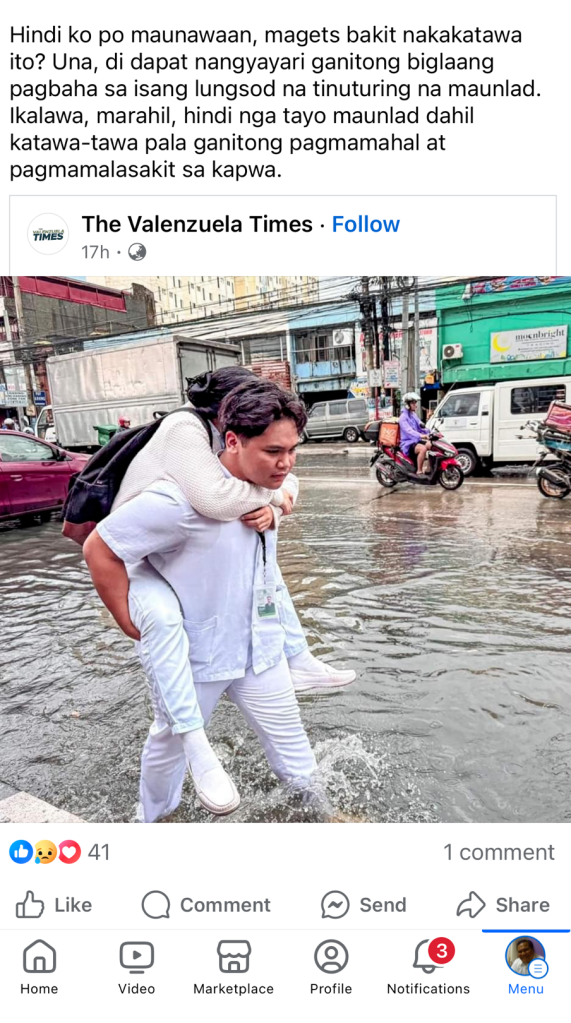
Residents wade through knee to waist-deep flood along P. Florentino Street in Quezon City on July 24, 2024. Photo by Maria Tan, ABS-CBN News

There is a new kind of storm sweeping us these days, more disastrous and silently wreaking havoc among us especially in our relationships with one another. It is a kind of storm borne out materialism that had given rise to other thoughts that have left us more lost and empty in life.

Photo from sunstar.com.ph, 22 July 2024.

More powerful than typhoon Carina was that storm in Cebu when a celebrity had a waiter stand in front of him simply for addressing him a “sir”, not as “mam” as he claimed to be a “beautiful” transwoman. The storm swept the whole social media on Monday with negative reactions and memes even from LGBTQ members. Many women rose to speak against this insistence by some in introducing wokism in the country for the sake of inclusivity which is nothing else but an exaggeration of one’s self and of the truncated truth they know.

*As I wrote this Saturday morning, there came the news of how the Paris Olympics made a mockery of the Lord’s Supper with a drag show in its opening ceremony. What a shame on France!

Photo from rappler.com.

Right after the devastation by the habagat, many were shocked to find Sen. Gil Puyat Avenue in Makati changed into “Sen. Gil Tulog” for an advertising stunt. Again, it flooded social media with criticisms that reached the Mayor of Makati who ordered the signages removed with the city official who approved it reprimanded.

Here we find two recent storms indicating how eroded our value system has become. Both are symptoms of our sick society that have allowed these to creep into our social consciousness on the pretext of inclusivity and creativity along with other western idiotic thoughts displayed in the opening of the Paris Olympics. The incidents show how some people have become so conceited without any sense of respect at all to God and to others, whether alive or deceased, as well as lack of sense of history.

Photo by author, Parish of the National Shrine of Our Lady of Fatima, Valenzuela City, 24 July 2024.

Sorry for the long introduction. I only wish to invite you my dear friends to stop for a while and honestly ask ourselves this question: what are we pursuing in life these days? 

Beginning today until the next four Sundays of August, all our Gospel accounts will be from John’s sixth chapter that opens with the story of the feeding of more than five thousand people. It is the continuation of last Sunday’s gospel scene when Mark narrated how Jesus invited the Twelve to a “deserted place to be by themselves” only to be followed by a vast crowd of people “like sheep without a shepherd.”  

Jesus went across the Sea of Galilee. A large crowd followed him, because they saw the signs he was performing on the sick. Jesus went up on the mountain, and there he sat down with his disciples. The Jewish feast of Passover was near (John 6:1-4).

The beloved disciple’s account of the event is so rich with many signs that point us closer to Jesus Christ.

Keep in mind that the miracles of Jesus in the fourth gospel are called “signs” because they were not just extraordinary things done like some form of magic; for John, the miracles of Jesus were signs that point and reveal superior realities of the highest order, of God Himself in Christ. This is difficult to understand unless our pursuits are clearly on God and not something else.

Photo by author, Fatima Avenue, Valenzuela City, 25 July 2024.

In his brief introduction of the scene, John tells us that if we really want to find and experience liberation from all the problems besetting us as individuals and as a nation, we must first pursue God, not our self-interests and well-being. See how John declared the great number of people pursued Jesus due to the “the signs he was performing on the sick” that they must have found hope and life in Him amid their many sufferings.

How sad many people today spend and waste time in social media and other material things forgetting the persons around them. In the pursuit for money and fame, persons are made into objects to be possessed; perhaps this is the reason of the growing number of many kamotes and pabebes in our time – the objectification of people, when persons are degraded into mere objects. It is an utter lack of respect for others which only shows too the lack of self-respect among many of us because we have lost our rootedness in God.

Do we still have that desire for God which leads us to higher ideals like virtues and qualities that make us more human and humane?

Photo By: FlickrBrett Streutker from catholic365.com.

Pursuing God is not just celebrating the Sunday Mass or praying often but applying these holy activities into our daily lives to experience and find Him working in us and through us in our daily life. As we have reflected last Sunday, the more we get closer to God, the closer we must get with others too!

Many times we are like Philip and Andrew, two of the closest Apostles of Jesus that even if we go to Mass every Sunday or even daily, we never meet Christ at all because we are so absorbed with ourselves and the world. Philip and Andrew saw only saw the huge problem before them, they saw what they lacked – bread – but never found Jesus Christ Himself as the answer to their problem despite their having witnessed His many healings and raising to life of the dead daughter of Jairus.

When Jesus raised his eyes and saw that a large crowd was coming to him, he said to Philip, “Where can we buy enough food for them to eat?” He said this to test him, because he himself knew what he was going to do. Philip answered him, “Two hundred days’ wages worth of food would not be enough for each of them to have a little.”  One of his disciples, Andrew, the brother of Simon Peter, said to him, “There is a boy here who has five barley loaves and two fish; but what good are these for so many (John6:5-9)?”

I love that small detail by John that “Jesus knew what he was going to do”, of how the Lord was merely testing them in asking where to buy bread. 

From psephizo.com

It does not really matter how Jesus multiplied the loaves of bread. What was very clear was the presence of Jesus, the Son of God who can do anything!

It was His person that was most important in this scene set when “The Jewish feast of Passover was near” which would later explain to us the meaning of the Last Supper and Good Friday. It is the very person of Jesus Christ who matters always in life. Recall our most trying moments in life when we have given up hopes but suddenly something happened and everything was reversed that we are still here, very much alive. Until now we are clueless how it all happened except that deep within our hearts, it is only Jesus whom we find as the answer and reason for everything.

In the first reading we heard how Elisha the prophet was given with twenty barley loaves of bread he gave to feed one hundred people that had plenty of leftovers.

Photo by Onnye on Pexels.com

Again, we are not told how Elisha multiplied the loaves of bread but one thing was very clear: the barley loaves were given by the man from Baal-shalisha as an offering to God through Elisha. The man clearly desired and pursued God that he baked those bread from “the first fruits, and fresh grain in the ear” of his bountiful harvest (2 Kgs.4:42). It was a thanksgiving offering for God that made wonders not only for him but for everyone. If we could just do the same in desiring God first of all!

Remember what Jesus told the devil during His first temptation in the wilderness, “One does not live by bread alone, but by every word that comes forth from the mouth of God” (Mt.4:4).

There in the deserted place, miracle happened because everyone desired God first by listening to the teachings of Jesus. When Jesus saw them opening to God’s words, He then fed them with bread and fish. This week, let us pursue God more sincerely by foregoing our usual pursuits for comfort and easy life so that Jesus may multiply whatever we have. Let us pray:

God our loving Father
who is over all and through all
and in all (Ephesians 4:6):
empty us of our pride
that make us pursue worldly
things like wealth, fame, and power;
let us desire You alone
in Jesus Christ so that we may
find You again in our hearts
and on the face of one another
we meet in this world that has become
so empty, hostile and unkind.
Amen.
Photo by author, view of Jerusalem from the Church of Dominus Flevit, May 2017.

Abundant harvest?

The Lord Is My Chef Daily Recipe for the Soul by Fr. Nicanor F. Lalog II
Tuesday in the Fourteenth Week of Ordinary Time, Year II, 09 July 2024
Hose 8:4-7, 11-13 ><))))*> + <*((((>< Matthew 9:32-38
Photo by Onnye on Pexels.com

Then he said to his disciples, “The harvest is abundant but the laborers are few; so ask the master of the harvest to sent out more laborers for his harvest” (Matthew 9:38).

Lord Jesus,
teach us to examine
again the meaning of your words
"the harvest is abundant" -
how do we look at,
what do we see at
this abundant harvest
of your people,
"troubled and abandoned,
like sheep without a shepherd"?
What do we see at your flock,
at your people?
Forgive us, Lord Jesus,
when we are like the wayward
kings of Israel of Hosea's time
who misled the people away
from God; what an abundant harvest
laid to waste by corrupt
and sinful laborers some of whom
were never sent by God while
others turned away from God.
Forgive the laborers among us
who see the abundant harvest more
as a business venture,
a shameful tourist attraction
for the display of our delusions of grandeur;
forgive us, Lord when some of us
your laborers label others
as troublemakers,
as oppositionists,
even daring to call declare
others using the power of the devil
like You!
Nothing much had changed
since the time of Hosea and
your time, Lord Jesus:
your abundant harvest wasted
by selfish laborers who see only
themselves and their well-being
instead of seeing your people as a
gift and a responsibility entrusted
to our care; help us, O Lord, to value
your abundant harvest meant for
your greater glory
not ours.
Amen.

The gift of persons

The Lord Is My Chef Sunday Recipe for the Soul by Fr. Nicanor F. Lalog II
Solemnity of the Most Holy Trinity-B, 26 May 2024
Deuteronomy 4:32-34, 39-40 ><}}}*> Romans 8:14-17 ><}}}*> Matthew 28:16-20
Photo by author, the Holy Trinity as depicted at the Parish of St. John the Baptist, Calumpit, Bulacan, March 2021.

We are now into the Ordinary Time and for the next two consecutive Sundays we are celebrating three important Solemnities in the next three weeks.

First in these series of Solemnities in Ordinary Time is that of the Most Holy Trinity, the highest truth in our faith which is our belief in One God in three Persons. Contrary to common beliefs, mysteries can be explained and understood, but, not fully well. After all, mysteries are not really meant to be solved but simply be lived and enjoyed like the mystery of the person which is in the heart of the Most Holy Trinity: How can there be three Persons in one God?

Moses said to the people: “Ask now of the days of old, before your time, ever since God created man upon the earth; ask from one end of the sky to the other: Did anything so great ever happen before? Was it ever heard of? Did a people ever hear the voice of God speaking from the midst of fire, as you did, and live? Or did any god venture to go and take a nation for himself from the midst of another nation, by testings, by signs and wonders, by war, with his strong hand and outstretched arm, and by great terror, all of which the Lord, your God, did for you in Egypt before your very eyes?”

Deuteronomy 4:32-34
Photo by author, sunrise at the Lake of Galilee in Israel, May 2019.

Our first reading this Sunday invites us too to examine ourselves and our lives to see how God has been so personal, so relational with us. As we say in Tagalog, “Sigue nga, paano mo naranasan ang Diyos?”

How did you experience God? Was it not just like the way we experienced other people in our relationships?

Very often when we meet people, our tendency to welcome or accept them were a result of their conduct, of their approach to us. If they are kind and good natured and warm, we are easily disarmed and we feel like knowing them.

That is what Moses was telling his people at that time, including us today: recall how personal was God in dealing with us with all His warmth and love because they indicate relationships and therefore, another person to relate with.

“The Trinity” (1425-27), an icon by Russian artist Andrei Rublev from wikipedia.org.

Remember how the books of the bible were written: the first questions the biblical writers asked were not the origins of the world but those asked by Moses today. After they have experienced the kindness and love of God that they eventually asked and reflected on the origins (genesis) of everything on earth and the universe.

In that experience, they felt a relationship with a Father as source of all life like dads giving life as well as protecting life and giving back life to those who may have lost it. That personal experience of God as a Father so loving and caring moved the biblical writers too to ask and reflect on the presence of evil and sufferings as we find in the Wisdom books like the Psalms and the Book of Job.

There is always the primacy of God’s personal relationship and of His conduct towards us humans that prompt us to “know” Him, to believe Him. Like people dear to us, God first revealed Himself to us in the most personal manner through a succession of events and other people we have met and known. That is why when we say “I believe in God”, we not only express a concept but also a relationship. Most of all, in this relationship is a commitment too to get to know God as a person! Before knowing any details about God or people, we first have relationships no matter how little it may be at the start. Later, we get phone numbers and other contact details with people we meet because we feel “committed” to getting to know them more in the future. In a sense, we believe them that is why we keep in touch with them. The same is true with God.

Photo by author, St. Catherine’s Monastery at the foot of Mt. Sinai in Egypt, May 2019.

The word person means “a conscious relating being”. Whether with God or with others, we experience the person and the relationship unfolding through time. There is always first the experience of a conduct like kindness before questions and details of a person come.

That word “kindness” actually indicates a relationship because its root is kin that means “one of us” or “of same tribe”. When we say “he is so kind to me”, it means he treats me as one of his family or his own. In that kindness and whatever good conduct present, there seems to be an “invisible line” linking us with people we meet. Or with God which the Holy Spirit does.

Of the Trinity, the Holy Spirit is the most elusive in nature and yet, it is the most frequently and concretely in contact with us. It is the principle of unity in the Trinity and among us as we have reflected last Pentecost Sunday. Today, St. Paul explains to us how the Holy Spirit as a Person keeps these relationships among us and with God united and strong, enabling us to cry out “Abba” or “Our Father”. It is the Holy Spirit who gives us the courage to keep our relationships as persons and with God especially at this modern time when some people refuse to recognize God and worst, some are bent in deleting God entirely from life.

That is why in today’s gospel, Jesus instructed His disciples including us today to “Go, therefore, and make disciples of all nations, baptizing them in the name of the Father, and of the Son, and of the Holy Spirit, teaching them to observe all that I have commanded you” (Mt.28:19-20). Persons always presuppose relationships; hence, the need to gather others always like what God did and continues to do in His Church.


It has been three weeks since my mother peacefully passed away. People ask me how am I doing. Truth is, I am not so well. I miss mommy so much. It is true we only realize the value of a person after he/she is gone. And it is most difficult with mothers!

Photo by author, Mt. Sinai in Egypt, May 2019.

Every time I come home, I have that strange feeling, wondering deep inside me of that great mystery, how did it happen that it was my mom – just one person – who had left us but our home has become so empty? Since May 7, that image of mommy’s empty room after her body was taken to the funeral had remained in my mind and as days passed, I have noticed how our home has been so hollowed when there are still my siblings and niece staying in the house?

That is the gift of person. A person fills not only spaces and homes but most of all, fills us. Every person fills another person in the same manner God first fills us with His love through persons dearest to us. That is why we believe in God.

Let us have good relationships with others so they may experience God too in their lives. Let us gather in the Father’s love in Jesus Christ to celebrate the gift of life together in the Holy Spirit through one another. Let us pray:

God our loving Father,
thank you for the gift of life,
for my gift of person
and for the gift of so many
persons in my life;
dwell in me, Holy Spirit,
fill me with your fire and life,
animate me with the Son's
justice and love
so that in myself
the mystery
of the Blessed Trinity
be alive.
Amen.

Lent is remembering

40 Shades of Lent by Fr. Nicanor F. Lalog II
Wednesday in the Third Week of Lent, 06 March 2024
Deuteronomy 4:1, 5-9 ><}}}}*> + <*{{{{>< Matthew 5:17-19
Photo by Pixabay on Pexels.com
Lent is remembering
especially because we are
beings of forgetfulness;
but, teach us Father,
that to remember you
is not like in remembering
an equation or a formula
as a task of the mind
or intellect;
to remember you, O God,
in the spirit of Lent is
to surrender ourselves to
you whom we do not see
but present among our
brothers and sisters;
to remember you, dear God,
is to surrender ourselves
to your Holy Will
that are not mere laws
and decrees
but the very person
of your Son Jesus Christ.

Jesus said to his disciples: “Do not think that I have come to abolish the law or the prophets. I have come not to abolish but to fulfill. Amen, I say to yo, until heaven and earth pass away, not the smallest letter or the smallest part of a letter will pass from the law, until all things have taken place.”

Matthew 5:17-18
To remember and keep your laws,
dear God is to remember and keep you
found in our brothers and sisters
through your Son Jesus Christ;
indeed, the greatness of any
nation is measured to a large part
in its legal system, in how it is justly
implemented and observed:

Moses spoke to the people and said: “Observe them carefully for thus will you give evidence to your wisdom and intelligence to the nations, who will hear of all these statutes and say, ‘This great nation is truly wise and intelligent people.’ For what great nation is there that has gods so close to it as the Lord, our God, is to us whenever we call upon him? Or what great nation has statutes and decrees that are just as this whole law which I am setting before you today?'”

Deuteronomy 4:1, 6-8
Father, in this season of Lent,
may we recover and put into practice,
not just remember that your laws
are fulfilled in Christ when we love;
how sad that love of God
and love of neighbors
is your law we often forget,
and find hard to remember
because we keep it in our minds
than in our hearts where you dwell.

Most of all, to remember
means to make one a member
of the present moment again:
help us remember in making
you present always in our love
and good works.
Amen.

Sowing the seeds of love

The Lord Is My Chef Daily Recipe for the Soul by Fr. Nicanor F. Lalog II
Wednesday, Memorial, St. Francis Sales, Bishop & Doctor of the Church, 24 January 2024
2 Samuel 7:4-17  <*((((>< + ><))))*>  Mark 4:1-20
“The Sower at Sunset” by Vincent Van Gogh, oil on canvas painted in June 1888 from wikimedia commons.
Lord Jesus Christ,
as you narrated to us today
the parable of the sower,
I wonder what were the other
seeds you have sowed
aside from your word?

On another occasion, Jesus began to teach by the sea. A very large crowd gathered around him so that he got into a boat on the sea and sat down. And the whole crowd was beside the sea on land. And he taught them at length in parables, and in the course of his instruction he said to them, “Hear this! A sower went out to sow.”

Mark 4:1-3
Photo by Onnye on Pexels.com
We are not just the different
kinds of soil where your seeds
fell, Lord Jesus;
like you, may we also be
sowers of your word and teachings,
sowers of your love and mercy,
sowers of compassion and kindness,
sowers of your light and life,
sowers of your hope and healing,
sowers of your very presence.

When God told David not to build
him a temple as he promised to raise
a house for him from whom
shall come the Christ,
that was when the Father also
sowed the seeds of redemption
and fulfillment in you,
Lord Jesus!
On this feast of St. Francis Sales,
patron of Catholic journalists and
media practitioners,
we pray for all communicators
to sow unity and peace,
not division
nor misunderstanding,
nor animosities;
we pray for all journalists
of different platforms
to sow understanding
and clarity,
to sow justice and equality
among peoples,
and to sow respect for life
at all times because every
communication must promote
first of all the dignity
of every person.
Amen.

Choose love. Always.

The Lord Is My Chef Sunday Recipe for the Soul by Fr. Nicanor F. Lalog II
Sunday in the Thirtieth Week of Ordinary Time, Cycle A, 29 October 2023
Exodus 22:20-26 ><}}}}*> 1 Thessalonians 1:5-10 ><}}}}*> Matthew 22:34-40
Photo by Dra. Mai Dela Peña, Mt. Carmel, Israel, 2017.

The enemies of Jesus continued with their barrage of questions to trick him into saying something that could lead to his arrest and execution. After failing last Sunday, the Pharisees sent today an expert – a “scholar of the law” – to test him anew with the question:

“Teacher, which commandment in the law is the greatest?” He said to him, “You shall love the Lord, your God, with all your heart, with all your soul, and with all your mind. This is the greatest and the first commandment. The second is like it: You shall love your neighbor as yourself. The whole law and the prophets depend on these two commandments.”

Matthew 22:36-40

For the second straight Sunday, Jesus not only responded to his enemies’ malicious questions with brief and brilliant answers but also taught them, including us today, with important lessons on discipleship.

Once again, Jesus is inviting us to have a wholistic view of life centered on God by healing the divisions within our hearts that are reflected in our broken relationships as individuals and family, church and community, and nation. How often do we reveal that same division in our hearts whenever we ask that same question 2000 years ago by the Pharisee, “which of the commandment in the law is the greatest”?

Photo by author, view from temple of Jerusalem, May 2017.

After receiving the Ten Commandments from God through Moses at Mount Sinai, the Jews dissected them into 613 instructions with 248 of these as positive laws every individual “should do” and the other 365 as negative laws everyone “should not do”.

Naturally, it was very difficult – if not impossible – for them to remember and observe these 613 precepts to guide them in their daily living so that their rabbis devised ways in which the Law could be prioritized with some categorized as “important” or “heavy” that should be followed more than those considered as “less important” or “lighter” in gravity. For example, laws pertaining to persons like parents are more important than those concerning animals that included about bird’s nest (Dt. 22:6-7)! Problem with this was when they circumvented the Law to give priority to lesser things that disregard the more important ones as Jesus pointed out so often to their religious leaders who have emphasized the sabbath by neglecting the human person like the sick.

Photo by author, St. Anne’s Church, Jerusalem, Israel, May 2017.

Another solution they have devised was to establish summary statements of the Law that could help put it all in perspective like “whatever is hateful to you, don’t do it to others”. Again, like in categorizing the Law, putting them into perspectives eventually led to their lost of essence because in our human experience, when many factors are weighed into our daily life, the way we see things are often narrowed and dimmed; then we begin making excuses and alibis to be exempted from our religious instructions. That is why Jesus “leveled up” the people’s perspectives in their views of the Law by telling them to shift their sights to higher level not just its letters but its spirit and source – God himself like the love enemies and the beatitudes.

Here we find the beauty and nobility of Jesus Christ’s answer to the scholar’s question by leading us all into the very essence of the Law which is love who is God too! Eventually on the Cross on Good Friday just like during the sermon on the mount, Jesus would show to everyone he was not only the fulfillment of the Law but the Law himself when he gave himself in love – to God our Father and to us his brothers and sisters. Today he deepens his teaching last Sunday that inasmuch as we have to give to Caesar what is Caesar’s like paying of taxes, then, we have to give our total self, our whole heart to God because that is what is due to God, our Maker and Master. To give our hearts to God is to always choosing to love God and love others as one loves one’s self.

Photo by author, garden beside St. Anne’s Church in Jerusalem, Israel, May 2017.

The moment we start categorizing or putting God’s laws into perspectives, into our own points of view, then we deviate from God himself and his plans. When we divide, separate and split the laws of God to find which could best suit us, then it becomes a DIY (do-it-yourself) Christianity where we choose laws applicable to us and disregard the rest we find difficult, calling them as outdated and conservative like divorce, contraceptives, and abortion.

In summarizing the commandments into the law of love, Jesus is inviting us today to welcome him into our hearts to let him alone dwell and reign over us so that when we are confronted with any issue and dilemma or confusion in life, we resolve them in the light of Christ which is always love. Letting Jesus reign in our hearts is choosing to find him in the other person we must respect and love and care.

Photo by author at Via Dolorosa in Jerusalem, May 2017.

To choose Jesus and his love is to always choose the human person above material things and even with one’s self. And to choose Jesus and his love is choosing his Cross too because he said there is no greater love than to offer one’s self for another. The true sign that we have really loved is when we love somebody more than ourselves like Jesus!

It is difficult and even insane as St. Paul declared “we are fools for Christ” (1 Cor. 4;10) because anyone who loves like Jesus who loves God with one’s total self and loves others like one’s self is crazy in the world’s point of view and standard. It has always been the way of Christianity ever since, always suspected as a threat to the ways of the world because the ways of Christ and his disciples are opposite the ways of the world as St. Paul explained to the Thessalonians “who received the word in great affliction, with joy in the Holy Spirit” (1 Thes. 1:6).

When I was still a young priest giving Marriage Encounter weekends to couples, I used to ask them this question: when husband and wife have an LQ or “lover’s quarrel”, who should make the first move to say sorry and be reconciled?

Many couples laugh, saying it should be the man first while men claim it must be ladies first. Still others reason out it should be the one who had sinned.

My answer: whoever has more love to give must be the first to make the move to reconcile because whoever has more love should love more!

The more we love, the more we are able to love because love is infinite like God. It is the only thing that will remain in the end because God is love. His laws are his expressions and manifestations of his love expressed in his compassion being a personal God relating with us through men and women around us (first reading). His laws fulfilled as love in the person of Jesus Christ light and guide our path in life often darkened by sin and imperfections. Choose love always and you shall never get lost! Amen. Have a lovely long weekend!

Photo by author, Pater Noster Church, Jerusalem, the Holy Land, May 2019.

The beauty of praying

The Lord Is My Chef Daily Recipe for the Soul by Fr. Nicanor F. Lalog II
Monday in the Twenty-fourth Week of Ordinary Time, Year I, 18 September 2023
1 Timothy 2:1-8   ><]]]]'> _ ><]]]]'> _ ><]]]]'>   Luke 7:1-10
Photo by Ms. Rose Anne, Our Lady of Fatima University Campus Ministry, Valenzuela, 13 September 2023.
Blessed be you,
O God our loving Father
for always hearing our prayers!
As I get older and hopefully
mature in life,
I have realized 
dear Lord
that the most beautiful
thing with prayer is how
you have mellowed us 
as persons, 
of how we have become
more personal 
with each other,
caring for each other,
accepting one another
as unique and a gift.
Indeed,
prayer changes more 
the person than the situation;
thus, prayer changes too
the way we relate with each
other, dissipating the anger
and mistrust among us, 
bringing about more peace and
harmony among us.
Oh how difficult it is to
hate a person we are 
continually praying!

Beloved: First of all, I ask that supplications, prayers, petitions, and thanksgiving be offered for everyone, for kings and for all in authority, that we may lead a quiet and tranquil life in all devotion and dignity.

1 Timothy 2:1-2
How lovely is the gospel
scene, dear Jesus, when your
fellow Jews sort of "prayed"
for the centurion that you may
come to heal his servant
for he "deserves to have you
do this to him" because 
he "loves our nation and he built
a synagogue for us" (Lk.7:4-5);
despite his being a pagan,
your fellow Jews highly
regarded him
that was quite a rarity
at that time!
Dearest Lord Jesus,
may we learn to pray 
specifically for some people
by naming them for those
we personally know
and at least mentioning
or identifying the kinds of
people we are praying for.
You know them all, Lord,
but when we name them,
when we identify them,
the more we know them
and find our relationships
with them as brothers and
sisters to love and respect
always.
Amen.

The parable of our lives and time

The Lord Is My Chef Daily Recipe for the Soul by Fr. Nicanor F. Lalog II
Thursday in the Sixteenth Week of Ordinary Time, Year I, 27 July 2023
Exodus 19:1-2, 9-11, 16-20   <*{{{{><< + >><}}}}*>   Matthew 13:10-17
Photo by author, Mt. Sinai in Egypt, May 2019.
You said it perfectly well,
Lord Jesus Christ,
our very own parable
of life
and of time:
"because they look but do not see
and hear but do not listen or understand"
(Matthew 13:13).

Why, O Lord,
 despite the modern communications 
meant to bring us closer,
the more we have actually
grown apart from each other?

Why, O Lord,
despite the great speed
 of our communications,
the more we cannot be reached,
or slower we have become
in reaching out, 
in coming to everyone
especially those in need?

Why, O Lord,
despite the clarity of signals
of communications, the more things
and persons are blurred,
including our relationships?
When you spoke 
to your people in the Old Testament
with peals of thunder and lightning,
they were scared to death;
when your Son Jesus came 
and lived among them, 
speaking their language,
they found him too ordinary, 
even a nobody;
today, you continue to speak
to us in nature and in person,
through our many experiences,
through the people we meet,
through the sacraments,
through many means and occasions
even right in our hearts
but still, 
we neither see,
nor hear nor listen.
What a parable we live!
Open our hearts, O Lord,
so we may believe,
hear and listen,
allow ourselves to be surprised
and amazed by you with the 
most simple things to make us
realize you are 
true and so real
right within us.
Amen.
Photo by PhotoMIX Company on Pexels.com