The Lord Is My Chef Daily Recipe for the Soul by Fr. Nicanor F. Lalog II
Thursday in the Second Week of Ordinary Time, Year II, 18 January 2024
1 Samuel 18:6-9, 19:1-7  <*{{{{>< + ><}}}}*>  Mark 3:7-12
Photo by author, sunflower farm in La Trinidad, Benguet, 12 July 2023.
"In God I trust; I shall not fear."
Let those words of the psalmist
today be my prayer too, dear Father
especially when jealousy slowly
creeps into me,
when people around me do better,
when they seem to be more
loved or liked or accepted;
like King Saul in the first reading
today, there are times I am filled
with insecurities
with my own self,
with my strengths
and abilities,
most especially,
with your love.
Jealousy arises easily in our hearts… When we truly enjoy God’s unlimited generosity, we will be grateful for what our brothers and sisters receive. Jealousy will simply have no place in our hearts.
Fr. Henri Nouwen
How true were the words
of the late Fr. Henri Nouwen;
jealousy arises easily
in our hearts;
sometimes they just come
without us even
thinking about it;
problem is,
many times we entertain
and let it take over us,
feeling we are a victim
of something,
 like King Saul,
or the elder brother in
the parable of the prodigal son,
or those early workers
in the parable of the vineyard
who felt they should be paid more
than those late workers
who were paid with same wage
as theirs.
When good things happen
to others,
teach me to rejoice
with them,
let me be thankful
too for their being blessed
by you;
let me not be jealous
of whatever they have
for you never fail to bless me
too with so many things
they do not have;
let me be more trusting
in your generosity,
O God,
to never have fear of you
running out of blessings
and other good things
for each one of us
according to our own abilities;
let me rejoice
when other people
are blessed like in the gospel today
because whatever good things
that happen around us
are signs
you are with us
in Christ Jesus.

Instead of looking on what
others have,
let me look what I have,
and always,
let that be YOU
in Christ Jesus!
Amen.
The Lord Is My Chef Sunday Recipe for the Soul by Fr. Nicanor F. Lalog II
Sunday in the Thirty-Third Week of Ordinary Time, Cycle A, 19 November 2023
Proverbs 31:10-13, 19-20, 30-31 ><}}}*> 1 Thessalonians 5:1-6 ><}}}*> Matthew 25:14-30
Photo by Mr. Jim Marpa in Carigara, Leyte 2018.
Our first reading today from the Book of Proverbs is very interesting on this penultimate Sunday of the liturgical calendar before the Solemnity of Christ the King next week. If we go by today’s way of thinking, it sounds “sexist”, stereotyping the tasks of a “worthy” or perfect wife:
She obtains wool and flax and works with loving hands. She puts her hands to the distaff, and her fingers ply the spindle. She reaches her hands to the poor, and extends her arms to the needy.
Proverbs 31:13, 19-20
But for those like me who grew up in the generation reared by mothers proudly described as “plain housewife”, there’s no sexism nor stereotyping of women by the author of the Book of Proverbs. It is actually in praise of women, of housewives and mothers supposed to be the most attentive in details, truly dedicated and faithful in daily house chores.
Photo by Mr. Jim Marpa in Carigara, Leyte 2018.
Our first reading reminds us to be like a “worthy wife” who is consistent in doing those little things mothers do to keep our homes warm and tidy. Most of all, orderly.
Moms are blessed with special grace and talent in budgeting limited resources to come out with outstanding meals daily, of keeping socks and handkerchiefs as well as cuff links and old clothes ready and handy just in case there is an instant out of town trip or school project. With moms, life is practically worry-free because she gets everything covered even outside home! I remembered how my mom had everything in her little bag, from medicines like Cortal to Vick’s Vaporub and Band-Aid, candies and money, tissues and even tape measure called medida! Truly a Girl Scout, always ready for any eventuality.
And that is why we have this part of the Book of Proverbs this Sunday: to wait for the Second Coming of Christ which is also the end of the world is to be like a “worthy wife” concentrated on life’s essentials “who fears the Lord” (v.30) and “reaches out her hands to the poor, and extends her arms to the needy” (v. 20). It is basically being wise like the five virgins last Sunday – faithful to God, to his laws and commandments expressed in lovingly serving others especially the poor.
Photo by author, sunset in Tagaytay City, 07 February 2023.
That is the whole point of Jesus in today’s parable of the talents where he spoke to his disciples who include us today “of his coming” that no one knows like those servants awaiting their master’s return.
The parable did not tell us how the first two servants made use of their talents that earned them interests but it clearly pointed out what the third servant did not do. The time of waiting for the Parousia is an active waiting, of keeping up with the tasks entrusted to us by Jesus our Master. Instead of knowing its date with all those useless calculations and speculations, we are called to be diligent and committed in striving and persevering to be good at what is entrusted to us according to our ability like the first two servants and the perfect wife in the Book of Proverbs.
To wait for Jesus is not to be idle, doing nothing like the third servant in the parable who simply buried the talent entrusted to him. He was lazy, lacked any initiative, a whiner and a complainer.
Perfection and holiness lead to readiness for Christ, achieved in our faithfulness to our daily duties as his disciples, not elsewhere like in great moments we often await but never happen at all nor in appearances that do not matter like “charm and beauty” as the author of Proverbs said (v.30). Active waiting for the return of Jesus is living fully in every present moment, not in useless crying over the past or fearful anxieties of the future.
Photo from inquirer.net, 2021.
Jesus is not asking us – and would never ask us anything beyond our abilities – to do great feats like that master who simply entrusted his possessions according to his servants’ abilities.
Jesus is not telling us to do a Mother Teresa but simply be kind first to your family. Smile more often at people, laugh your heart out at the simple joys and stories especially of children. Choose silence than answering every call and conversation. Forgive a lot and you forget what isn’t nice. Then you see the hidden beauty of every person and thing. And not far from that, you find Christ coming right in front of you, too.
When we do the work of God, it does not really matter how big or small nor how simple or complicated that may be. It is always great to do the work of God because it is God’s work entrusted to us! A basketball is just an ordinary rubber ball but when used by Michael Jordan, it becomes of great value. The same is true when we do the works of God.
When Christ comes again to judge both the living and the dead, the only thing he would ask us is what have we done to those people and responsibilities he had entrusted to us. Ultimately, it is a question of how much have we loved, have we lived like him? Remember Jesus said “Not everyone who says to me ‘Lord, Lord,’ will enter the kingdom of heaven, but only the one who does the will of his Father in heaven” (Mt. 7:21-23). What are we doing, how are we living our faith in God these days are the questions we must answer to be ready for the Second Coming.
Photo by author, Jesuit Cemetery at the Sacred Heart Novitiate, Novaliches, QC, 21 March 2023.
St. Paul lived at a time when people were so excited for the apocalypse, the end of time when Christ is expected to come again. They believed – along with St. Paul – that they would witness the return of Jesus in their lifetime.
And that is why St. Paul wrote them, trying to calm them by telling them to always live in the present moment, to live fully every day because the Parousia will come like a thief in the night, just “when people are saying ‘Peace and security,’ then suddenly disaster comes upon them, like labor pains upon a pregnant woman” (1 Thes. 5:2-3).
How sad that what is happening today is exactly the opposite. These days, many people live as if Christ is never coming back to judge us at the end of time. Worst, many people live as if there is no God at all with all the wars and crimes going on, the continuing disrespect for life and persons, as well the many abuses and injustices committed with impunity.
Photo by Mr. Jim Marpa in Carigara, Leyte 2018.
These very presence of sin and evil in the world show that God’s final victory has not taken place yet. Therefore, each day is actually a reminder of the coming end of time, the return of Jesus to establish final peace and order. Far from terrifying and discouraging us, it is a call for us to live fully in the present, mindful of that Latin phrase “memento mori” that means “remember you must die.”
The German philosopher Martin Heidegger said we are all “beings-towards-death”, meaning, we all die someday.
It is in being aware of this certainty of death that we humans live authentically. It is only when we have come to terms with death that we also come to terms with life. We fear death because we have not yet started living truly. Now is the time. No need to write those bucket list. Simply live in God, in Jesus. Be good, be joyful. Then, it does not matter anymore when death comes. Amen. Have a blessed, faithful week ahead.
The Lord Is My Chef Daily Recipe for the Soul by Fr. Nicanor F. Lalog II
Friday, Memorial of St. Leo the Great, Pope & Doctor of the Church, 10 November 2023
Romans 15:14-21   ><]]]]’> + ><]]]]’> + ><]]]]’>   Luke 16:1-8
Photo by author, San Juan, La Union, July 2023.
I just realized today,
God our Father,
how the word “miss”
has a variety of meanings:
as something we failed or
something or someone we remember
or, someone or something we
forget and neglected.
How sad that very often,
the people we miss -
those we forget,
even taken for granted
because they are common,
are those nearest to us like
family and friends,
those in our inner circles.
Thus I aspire to proclaim the Gospel not where Christ has already been named, so that I do not build on another’s foundation, but as it is written: Those who have never been told of him shall see, and those who have never heard of him shall understand.
Romans 15:20-21
Is it not so funny that the
ones we meet inside the church
every day and every Sunday are
also the very ones who are
like us - evangelized or simply
know Jesus and his teachings;
but, where are the rest?
the unchurched?
the ones we say who must hear the
good news?
Lord Jesus Christ,
teach us to be wise like
that steward in your parable today:
to save face and himself, he went to
see his master’s debtors he himself
must have missed,
disregarded and never given any
importance at all because they
were common, below him in stature;
let us realize like that shrewd steward,
like St. Paul to look for those we
miss most because of proximity
and ordinariness; they could be our
family members who have stopped praying
or celebrating Mass
or those living closest to our church
or chapel and have lost interest in the
sacraments and liturgy
or former colleagues in the ministry
who have lapsed in their practice
of faith.
Let us go out today
to find them and make them
feel and experience they are
loved,
they are missed most
in Christ Jesus.
Amen.
Quiet Storm by Fr. Nicanor F. Lalog II, 18 October 2023
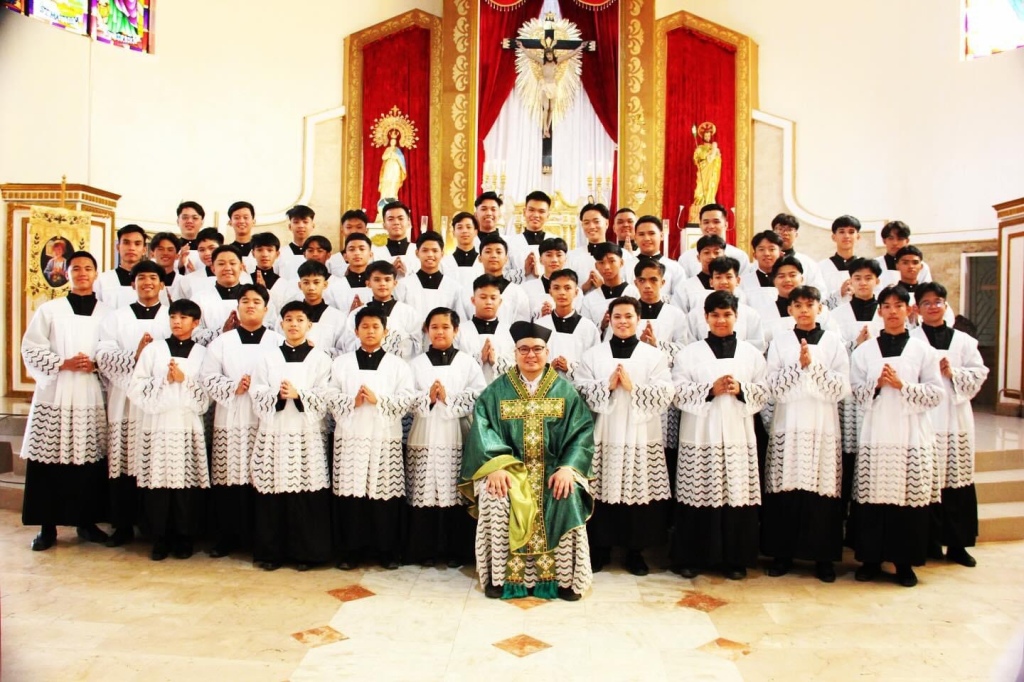
Photo courtesy of Fr. Herbert Bacani, Parish Priest of Immaculate Conception Quasi-Parish in Marungko, Angat, Bulacan, 15 October 2023.. When the pastor is properly dressed, his servers follow; surely, the parishioners are not far behind.
Thank you very much for the warm reception to our reflection last Sunday on the parable of the wedding garment when we took as cue the lack of sense these days of dressing properly even among us priests. So glad many priests reflected too along the same line in their homilies last Sunday. And the message is very clear: we priests have to set the example in dressing properly and decently at all times.
Methinks this deterioration in manner of dressing of people has a direct correlation with the clergy’s “undressing” of their cassocks and clerical shirts after Vatican II’s reforms they have abused and misconstrued into something else. No wonder, it started too the downward slide of credibility of clergy made worst by the reports of sexual abuses.
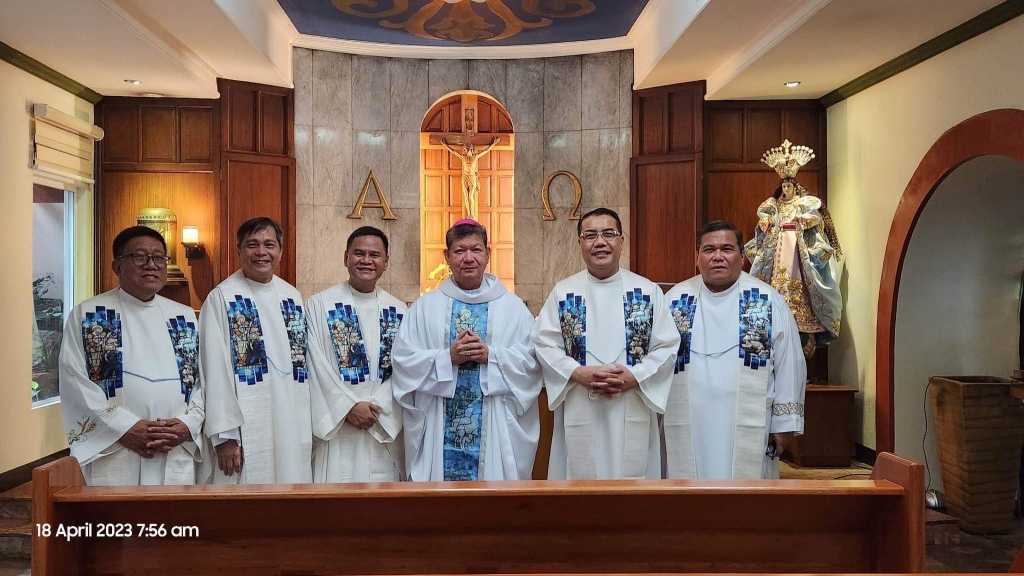
Photo courtesy of Fr. Len Hernandez taken during our 25th anniversary with Bp. Dennis at his chapel, 18 April 2023.
What a shame and pity when people comment how some priests not looking as priests at all at the way they dress. Some at the extreme have become so secular with their worldly fashion senses of designer clothes, jewelries even bling-blings with high end cars and gadgets who look like actors and models than priests while at the other end are those lost hippies or beatniks and rebels of no cause at all with their long hair, maong pants and sneakers in vain efforts to do liberation theology yet too far from the masses.
Again, many will argue our personhood does not depend on our outside appearances like clothes. Of course but not absolutely true! Jesus himself had taught us in the parable of the wedding garment last Sunday that dressing properly is an imperative because whatever is seen outside is always indicative of what is inside. If we, especially us priests, could not even look good outside, how can others believe we are good inside? Besides, if we could not even dress up decently for any occasion, how can we be expected to fulfill other greater things in life? Remember the Lord’s reminder, “The person who is trustworthy in very small matters is also trustworthy in great ones; and the person who is dishonest in very small matters is also dishonest in great ones” (Lk. 16:10).
When I was in my second year in seminary formation, our former teacher in elementary school, the late Miss Santiago saw me on my way to serve in the Mass at our parish church. When she saw me perspiring a lot, she said, “Naku, Nicanor! Iyang pagsusuot pa lang ng sutana pala e malaking sakripisyo na sa inyo? E basang basa ka na ng pawis.” That compliment by one of our kindest teacher has been etched in my heart ever since, teaching me that valuable lesson that our cassock in itself is a homily. That is why in teaching communications in the seminary, I have always insisted to seminarians that the priest himself – his clothes, his hair, his language and everything – is a sign of God before the people. Hence, I have offered them with these simple propositions:
If the priest is not that good looking and his homily is also not that good and then he comes poorly dressed during the Mass, what would people think? What an ugly God we have! Ang pangit naman ng Diyos!
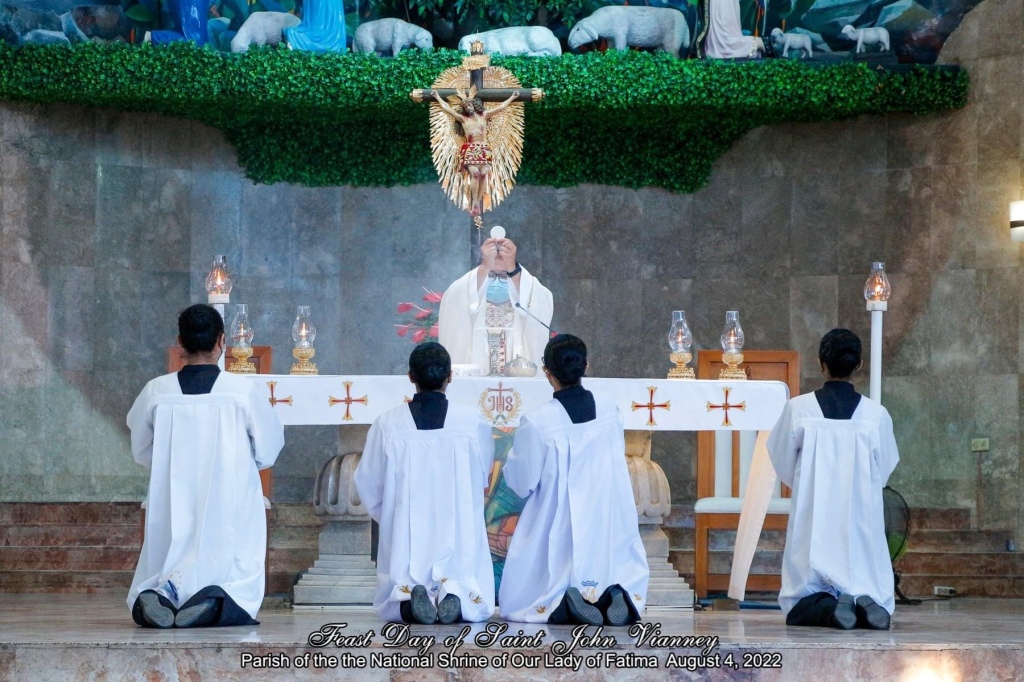
If the priest is not that good looking, his homily is also not that good but his vestments are beautiful as St. John Vianney would say are a homily in itself, then people are at least consoled to have a glimpse of God’s beauty.
If the priest is not that good looking but his homily is good complemented with his beautiful vestments, people are blessed as they feel God is indeed so good all the time.
If the priest is good looking, his homily is well prepared and prayed for with his matching beautiful vestments, people joyously sing “alleluia!” in their hearts as they are touched by God.
In 403 AD, St. Augustine wrote a catechism manual for his deacon named Deogratias called De Catechizandis Rudibus (On Catechizing Beginners) in preparing candidates for Baptism. Its most important lesson is found at the last part of the thick book when St. Augustine told Deogratias to always remember “the teacher/catechist is the lesson himself/herself.”
In the same manner, the priest is always the homily himself whatever he is doing and especially wearing, 24/7. There is no way of dissecting our being a priest from our being individuals and citizens; everything in us will always be seen and measured in Jesus Christ our eternal Priest and Master. That is why last Sunday in the parable of the wedding garment, Jesus taught us also of the need to be conformed in him, to be like him.
How can we priests demand people to dress properly in coming to the celebration of the Eucharist when we priests are the ones shabbily dressed?
What a shame when priests give as pretexts for not wearing the prescribed garbs because of the hot weather in the country or to be more attuned with the people we celebrate Mass with like the poor. Where is our sense of sacrifice? It is as if saying we are awaiting autumn and winter in the country before we could wear our cassocks and albs and vestments! And for those who insist on being one with the poor that they wear the simplistic white chasuble and stole, I say it is a disgrace because those who have less in life must have more of God. Mahirap na nga sila, titipirin pa natin sa magagandang gamit at damit natin?
How can we be vessels of God’s grace and blessings when we are untidy and dugyot at the altar and after the Mass?
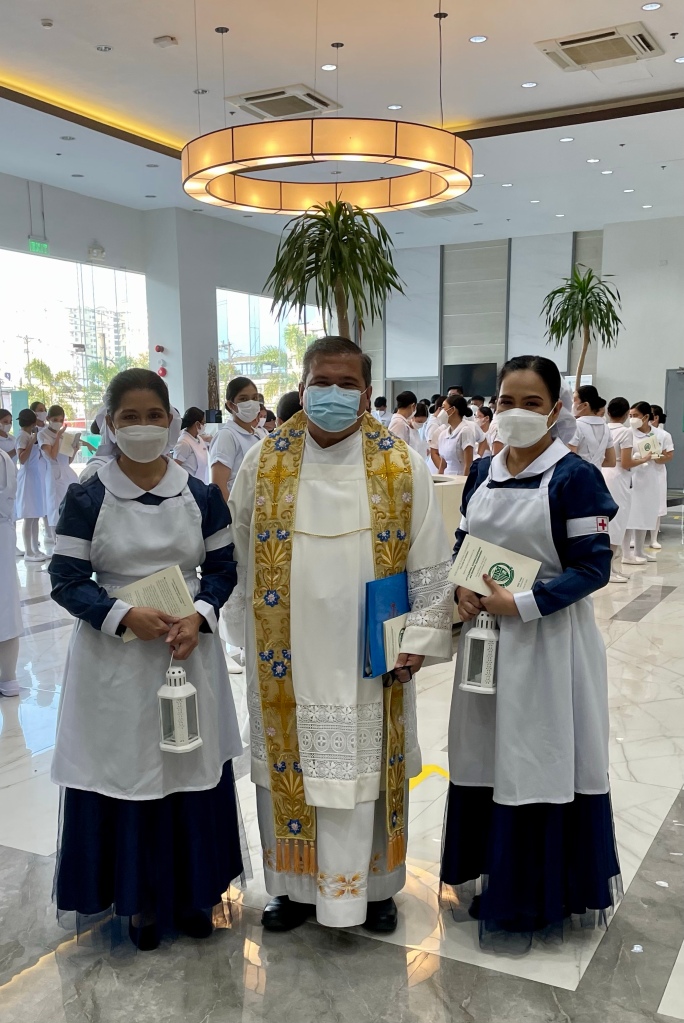
Pinning and capping ceremony of our nursing students, Our Lady of Fatima University-Valenzuela City with our faculty members acting as Florence of Nightingale, 2022.
Another pretext many priests use for not wearing the proper clothes in their ministry is practicality which is essentially the capital sin called sloth. How could a priest bless a car or a store or a house no matter how small they may be with just a stole without an alb and still get stipend meant in part so he can be decently dressed? Where is our effort in serving the people if not in proper attire?
The worst case of priests along with their sacristan not dressed properly is in the celebration of the Mass for a wedding. It is so unfair and unjust when priests do not take time to consider polishing the minute details of the Mass for God’s sake as his signs and channels of grace for those embarking on a lifelong journey in Christ as husband and wife.
In my 25 years as a priest, I have always prayed for my family and friends to also love my priesthood. I think the same holds true for the people who need to embrace our priesthood, not us priests! If you love our priesthood, then, you will love our cassocks and albs and chasubles and clerical shirt too. Demand that inasmuch as we must prepare our homily, we must also prepare for our vestments. Inasmuch as you help us to be good, help us to look good too in representing Jesus Christ here on earth, reminding you of eternal life and bliss.
We live in so different a time than before where sentiments against the Church and her clergy are growing. This situation calls us priests to strive harder as witnesses and reminders of Jesus Christ. And that begins with the way we dress, the simplest and most basic sign of our identity.
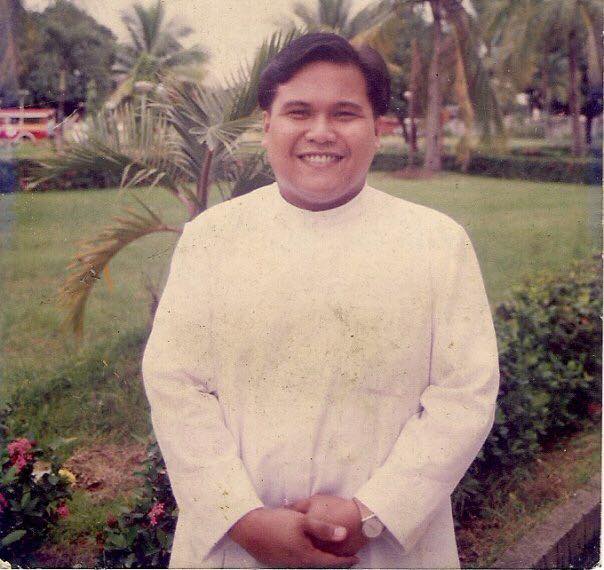
Me during my conferral of the cassock, June 1991, Immaculate Conception Major Seminary in Guiguinto, Bulacan.
One of my unforgettable moments in my vocation history happened in 1991 when I returned to the seminary, nine years after being told to leave in 1982. That Sunday afternoon after being conferred with the white cassock, I felt something so different inside me as if telling God like the Prophet Isaiah, “Here I am, send me” (Is. 6:8).
The same prophet reminds us priests whenever we wear our priestly garments for the liturgy and ministry of that great song to God, “I will rejoice heartily in in the Lord, my being exults in my God; for he had clothed me garments of salvation, and wrapped me in a robe of justice, like a bridegroom adorned with a diadem, as a bride adorns herself with her jewels” (Is. 61:10). Let us sing that song rejoicingly, heartily! Amen.
The Lord Is My Chef Sunday Recipe for the Soul by Fr. Nicanor F. Lalog II
Twenty-Eighth Sunday in Ordinary Time, Cycle A, 15 October 2023
Isaiah 25:6-10 ><}}}}*> Philippians 4:12-14, 19-20 ><}}}}*> Matthew 22:1-14
Photo by Mr. Jay Javier in Taal, Batangas, 15 February 2014.
I grew up in a generation when dressing properly – meaning, decently – was deeply inculcated both at home and the school. It has always been considered in our time as a sign of maturity when we come properly attired in every occasion.
Now, those days are gone along with the expression “Sunday’s best” when sneakers are paired with formal suits and worn even in weddings! Dressing has become so relative with total disregard for basic fashion sense and worst of all, without any sense of propriety at all in the name of personal comfort and style as well as individuality. That culture on “liberal” or “liberated” dressing has encroached into the church with priests refusing to wear the proper garments and dress as required by Code of Canon law. How ironic that while the lay people appreciate us priests dressed properly for the liturgy and ministry, the harshest insults and negative reactions against it come from some priests who argue using the hot weather as an excuse. Many priests have subscribed to the lame excuse of people that clothes do not make us who we are, that there is much more beneath the clothing we wear of who we really are.
True but not absolutely because what we wear, how we look outside is indicative of who we are, what we value, what we believe in. Dress speaks a lot about ourselves whether we like it or not as the Lord’s parable this Sunday teaches us.
The servants went out into the streets and gathered all they found, bad and good alike, and the hall was filled with guests. But when the king came in to meet the guests he saw a man there not dressed in a wedding garment. He said to him, ‘My friend, how is it that you came in here without a wedding garment?’ But he was reduced to silence. Then the king said to his attendants, ‘Bind his hands and feet, and cast him into the darkness outside, where there will be wailing and grinding of teeth.’ Many are invited, but few are chosen.”
Matthew 22:11-14
Photo by Fr. RA Valmadrid, National Shrine of Our Lady of Fatima, 13 October 2023.
We now come to the third and final series of parables addressed by Jesus Christ directly to his enemies, the chief priests and elders of the people while teaching at the temple area in Jerusalem to underscore to them the need to reform their lives and be converted to his good news of salvation like the tax collectors and prostitutes.
See how in today’s parable some semblances with the parables of the two sons and wicked tenants of the past two weeks to show us God’s loving patience in doing everything to make us come to him like the subjects of the king with all the chances to come to his son’s wedding banquet.
And like with the parables of the past two Sundays, Matthew makes again a crucial twist in today’s parable that can be sufficiently ended in that part when the king was enraged by the continued refusal of his guests to come to his son’s wedding banquet that he ordered them all killed and instead extended his invitation to everyone in the streets.
The wedding banquet is heaven like the vineyard in the parables of the past two Sundays.
But it is not only referring to heaven at the end of time but also speaks so well of the here and now – the present life we live as citizens of the kingdom of God in Jesus Christ. Rejecting the invitation to come to the meal which as an expression of our citizenship in God’s kingdom is an act of disloyalty and treason against him.
Photo by Arch. Philip Santiago, Hearts of Jesus and Mary parish, Malolos City, 2022.
When we were baptized, we became citizens of the kingdom of God. We do our “pledge of allegiance” to God as his citizens every time we pray and most especially celebrate Mass which is just half of the whole deal of being citizens of his kingdom! Like in being Filipinos or whatever nationality we have, we must live up to our citizenship in God’s kingdom by being good and holy. That is the wedding dress referred to in the parable, the life we lead as children and citizens of God and his kingdom.
Jesus invites us today to face squarely the uncomfortable issues that prevent us from being his good and faithful disciples and citizens of God’s kingdom. Many times we are like those invited guests in the parable who allowed something else in their lives like their wealth and possession, businesses and worldly pursuits become more important than their allegiance to the King. Every time we sin, every time we skip the Sunday Mass, that is when we have our new God and King that may be our very selves, gadgets, vices, or the malls we frequent more than the church!
Here we find a deepening in Jesus Christ’s invitation to conversion into conforming our lives into him. St. Paul made a lot of beautiful imageries of “putting on Jesus Christ” as our new clothes and garment which we have retained in the Rite of Baptism when the newly baptized is clothed with the white dress. See how the man caught by the king fell silent when confronted because there was no excuse at all at not wearing the wedding dress in the banquet. The same thing is true with us today. We have no excuse for not being dressed, for not being conformed in Jesus Christ in our lives as his disciples. Everyday he gives us the opportunities of being conformed to him through our daily conversions through prayers and good works. God does not expect us to wear extravagant nor expensive clothes for his wedding banquet; just a clean and decent clothes are enough. Nobody is perfect.
Photo by Dra. Mylene A. Santos, MD at Tagalag, Valenzuela City, 13 September 2023.
One of the things I used to enjoy in my school and seminary days were joining stage plays. Yes, I love acting but I just don’t know if acting (and singing) love me. Nonetheless, one of our most dreaded moments before the actual play was always the dress rehearsal when everything is considered as the “real thing”, the real play as our teaches and nuns have insisted when we were supposed to have memorized our lines and cues.
But, as I grew and matured, I realized that life is not a dress rehearsal at all; each day is an actual “play”, a “live” presentation where we must “perform” or “act” so well. Yes, we are all required to memorize our lines and cues in life but many times, we forget them. Nobody is perfect. And here lies the immense love and kindness of God to us: he allows us to improvise for our selves in case we have forgotten our lines just like those people instantly invited to the wedding banquet of the King’s son. They were able to improvise to make it to the banquet hall except for that one who came not dressed for the occasion. He was silent because he was so lazy to improvise, to find ways like the chief priests and elders in the time of the Lord. Until now, many of us make a lot of excuses and alibis for not being conformed in Christ, from the ordinary excuse of being “difficult” to the most absurd that “I am only human” or tao lamang, mahina at marupok. Keep in mind St. Paul’s words in the second reading, “I can do all things in him who strengthens me… My God will supply whatever you need, in accord with his glorious riches in Christ Jesus” (Phil.4:13, 19).
Photo by Ka Ruben, National Shrine of Our Lady of Fatima, 2022.
Every Sunday we are invited to celebrate with others the coming of Jesus and the salvation he has won for us. This wedding banquet is the Sunday Mass we celebrate, a fulfillment of the first reading from Isaiah of that mountain where “the Lord of hosts will provide for all peoples a feast of rich food and choice wines, juicy, rich food and pure, choice wines” (Is. 25:6). In the Holy Eucharist, we have the choicest food and drinks – the Body and Blood of Jesus Christ – given to us to nourish us and keep us strong in this journey of life into eternity in heaven with the Father.
How amazing that nothing is really imposed upon us in coming to this banquet of the Lord in the Eucharist that is totally free of charge except that we have to come properly dressed on the inside, of being conformed in him.
But please, let’s get dressed also on the outside. No need to wear expensive and beautiful clothes. Just proper and clean ones are more than enough. A good rule of thumb we can rely on is this: God has blessed me tremendously this week and I am coming to celebrate with him, for him. How do I look to to express to him my gratitude and appreciation to his wondrous gifts? Amen. It is a Sunday, go to Mass!
The Lord Is My Chef Sunday Recipe for the Soul by Fr. Nicanor F. Lalog II
Twenty-Seventh Sunday in Ordinary Time, Cycle A, 08 October 2023
Isaiah 5:1-7 ><}}}}*> Philippians 4:6-9 ><}}}}*> Matthew 21:33-43
Photo by author, San Juan, La Union, 25 July 2023.
A good friend recently came home from a 20-day Marian pilgrimage in Europe. I told him to get some rest and avoid reading the news, “Huwag ka munang magbasa ng balita baka masayang nalanghap mong hangin sa Europe.” He replied that with the very reliable internet service in Europe, they were all updated with the things happening in our country. He added, “parang ayaw ko nang magpunta sa Europe, lalo lang ako naaawa at nahihiya sa Pilipinas.”
Very true.
I rarely travel abroad but with what I have been reading and hearing especially from those visiting Japan and Singapore, the more I feel sad and hopeless for our country the Philippines. At least, God comforts us once in a while in sports like the recent golds in the Asian Games courtesy of EJ Obienna in pole vault, Annie Ramirez in jiu-jitsu, and Gilas Pilipinas in basketball. Aside from sports, nothing good seems to come from the news. Even the newscasts these days are depressing with robots “complementing” sportscasters.
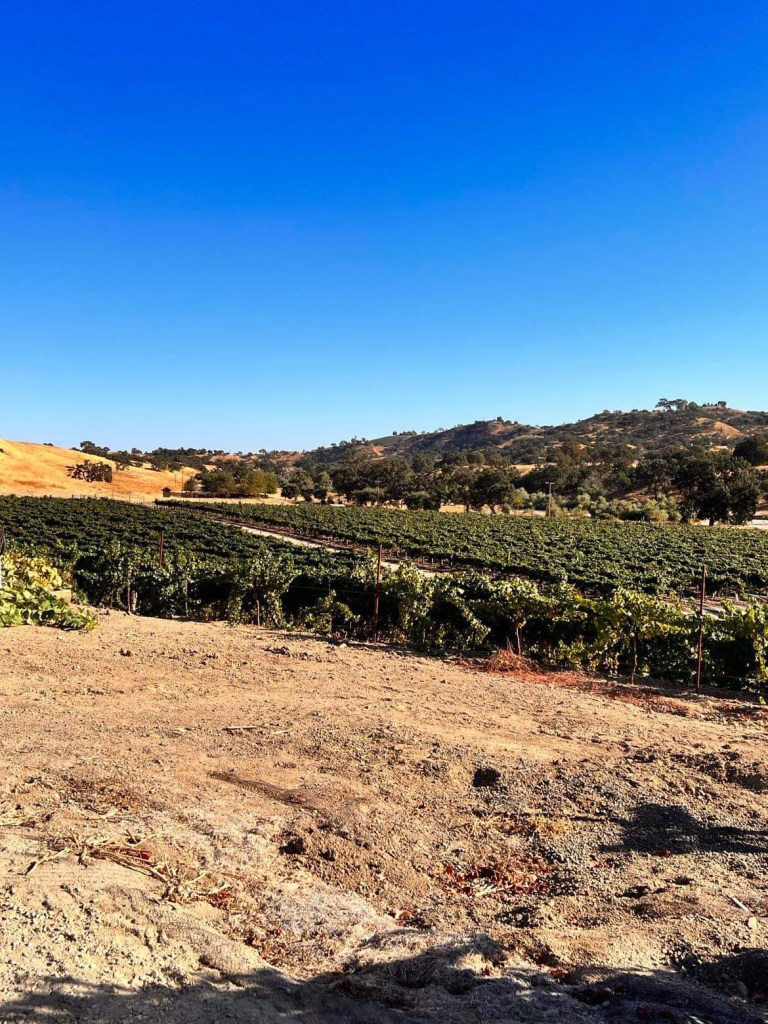
Photo of a vineyard in Southern California by Dra. Carol Reyes-Santos, MD, 01October 2023.
Our readings this Sunday seem to speak of us Filipinos and the Philippines which is like a wonderful vineyard planted by the Lord, especially when we think of our vast, fertile lands and long coastlines with rich bodies of water but we have to import our food, from rice to galunggong. What a shame that our chicharon producers import pig backfat from the tiny island of Taiwan?! Like Isaiah, we find ourselves asking what happened to our country?
Let me now sing of my friend, my friend’s song concerning his vineyard. My friend had a vineyard on a fertile hillside; he spaded it, cleared it of stones and planted the choicest vines; within it he built a watchtower, and hewed out a wine press. Then he looked for the crop of grapes, but what it yielded was wild grapes.
Isaiah 5:1-2
The vine and wine are important signs widely used in the Old Testament and in the gospel accounts by Jesus. In Isaiah’s writings, the vineyard represented Israel as the chosen people of God, so loved and cared for, saved from Egypt and gifted with a land flowing with milk and honey. Despite these blessings, Israel repeatedly turned away from God with their many sins of infidelity that continued in the time of Jesus Christ who borrowed and perfected this parable of the vineyard of the Lord to make it timely in every generation.
Jesus said to the chief priests and the elders of the people: “Hear another parable. There was a landowner who planted a vineyard, put a hedge around it, dug a wine press in it, and built a tower. Then he leased it to tenants and went on a journey. When vintage time drew near, he sent his servants to the tenants to obtain his produce. But the tenants seized the servants and one they beat, another they killed, and a third they stoned. Again he sent other servants, more numerous than the first ones, but they treated them in the same way. Finally, he sent his son to them, thinking, ‘They will respect my son.’ But when the tenants saw the son, they said to one another, ‘This is the heir. Come, let us kill him and acquire his inheritance.’ They seized him, threw him out of the vineyard, and killed him.
Matthew 21:33-39
Photo by author, Sacred Heart Novitiate, Novaliches, QC, 20 March 2023.
For the second straight Sunday, Jesus preached again at the temple area of Jerusalem and addressed this lesson to his enemies, the chief priests and elders of the people trying to find a probable cause to have him arrested.
See how this parable of the wicked tenants very similar with Isaiah’s but at the same time speaking a lot of ourselves and of our time, of how we have become like those wicked tenants taking the “vineyard” as totally ours like our body and country, arguing it is mine or ours that we can do whatever pleases us. Like those tenants, we have claimed of not belonging to God nor anyone at all, that we can do whatever we want because we are the owners of ourselves and the world. “It is my body, it is mine” and none of your business kind of thing.
How often we hear others claiming “this is my body, this is mine; therefore, I can do whatever I want with my body” like abort a baby, take contraceptives, or have a sex change, have those tattoos and body piercings? And we have spread this line of thinking to our environment with road rage spreading like a pandemic while bigger countries are grabbing territories ironically from their smaller neighbors.
The most tragic way of thinking that underlies this “mine mentality” is how so many of us have accepted – consciously and unconsciously – that most untrue statement of all that God is dead. Many would say they believe in God when actually what they mean is they know there is God and so often, they play that God, too. Pope Benedict XVI described it as “totalitarianism of relativism” when we see everything relative, no more morals and morality because we have made ourselves the measure and standards of everyone and everything – because, the “vineyard” belongs to us.
Photo of a vineyard in Southern California by Dra. Carol Reyes-Santos, MD, 01 October 2023.
More sad is the fact that we are beginning to see what happens next to us and the world with these things happening like families and relationships disintegrating, climate change and threats of wars, and more emptiness among us.
But, it is not that bad after all. Jesus not only updated Isaiah’s parable of the vineyard to speak to us in the present but also to promise us of a greater future. Notice the blessing and threat he used.
“What will the owner of the vineyard do to those tenants when he comes?” They answered him, “He will put those wretched men to a wretched death and lease his vineyard to other tenants who will give him the produce at the proper times.” Jesus said to them, “Did you never read in the Scriptures: The stone that the builders rejected has become the cornerstone; by the Lord has this been done, and it is wonderful in our eyes? Therefore, I say to you, the kingdom of God will be taken away from you and given to a people that will produce its fruit.”
Matthew 21:40-43
Once again, Jesus Christ’s parable asked a question to involve his hearers, including us today, in the story because the truth is, he had involved himself with us in his coming and eventually in his Passion, Death and Resurrection.
Unlike in Isaiah’s parable of the vineyard, God is distinct from the vineyard; but in Christ’s parable, we are in fact the vineyard of the Lord because Jesus is one with us being the son of the owner sent to gather his share of produce.
That is the good news, the blessing this Sunday and while there is also the threat of the vineyard being handed over to better tenants, there is the promise of better produce to be shared and enjoyed in all eternity, in heaven. There will always be darkness and difficulties in this life caused by selfish, arrogant, and self-righteous people who feel they own everything in this world. Many times, we too have wasted God’s bountiful blessings to us like our talents and abilities not put into use or never harnessed; health taken for granted and separation from our loved ones. Jesus Christ had died for us to repair ourselves and our relationships. Let us grab this opportunity today of taking care of the Lord’s vineyard, of sharing his blessings.
Most of all, like what St. Paul asked us in the second reading, let us be witnesses to others by remaining faithful to God, striving for “whatever is pure, whatever is lovely, whatever is gracious” (Phil. 4:8).
Last Thursday was World Teachers Day. I told our teachers during Masses in our university this week to remember St. Augustine’s final lesson to Deogratias his deacon preparing candidates for baptism: “The teacher is the lesson himself/herself.”
Beautiful. If we are the Lord’s vineyard, every time we produce good fruits, every time we share these fruits with others, then we become signs of hope of Christ’s presence among us. That is the most important lesson we can share with others especially in these times of darkness. Amen. Have a blessed week ahead!
The Lord Is My Chef Sunday Recipe for the Soul by Fr. Nicanor F. Lalog II
Twenty-sixth Sunday in Ordinary Time, Cycle A, 01 October 2023
Ezekiel 18:25-28 ><}}}}*> Philippians 2:1-11 ><}}}}*> Matthew 21:28-32
White roses for devotees of St. Therese whose feast is today, October 01; may she intercede for your much needed miracle!
American writer Anne Lamott wrote in one of her books that “The opposite of faith is not doubt, but certainty.” This is most true in our gospel this Sunday as we shift scene when Jesus finally entered Jerusalem and preached in the temple area among his enemies, the chief priests and elders of the people.
Again, we are familiar with today’s parable of the man who had two sons he asked to go and work at their vineyard. The first son refused but later changed his mind and obeyed the father; the second son said “yes” but did not go to the vineyard. Like the chief priests and the elders, we too can easily answer Jesus Christ’s question, “which of the two did his father’s will?” Of course, the first son – but, Matthew’s story did not end there as he recorded the Lord’s words to his enemies that say a lot to us too today:
Jesus said to them, “Amen, I say to you, tax collectors and prostitutes are entering the kingdom of God before you. When John came to you in the way of righteousness, you did not believe him; but tax collectors and prostitutes did. Yet even when you saw that, you did not later change your minds and believe him.”
Matthew 21:31b-32
Photo by author, 2019.
Keep in mind that Matthew insists in his gospel account the matching of our words and actions because “not everyone who says ‘Lord, Lord’ will enter the kingdom of heaven” (Mt. 7:21).
In the next three Sundays, we hear parables having this as its theme: the two sons today, the evil tenants next week and the wedding banquet after that. Notice too that although we still have nine weeks to go before Advent Season in preparation for Christmas, our gospel setting beginning this Sunday will be at the temple area just before the Lord’s Passion, Death and Resurrection. That means Christ’s teachings are getting more intense and challenging to everyone as well.
The sin of the chief priests and elders that Jesus mentioned today – “you did not later change your minds and believe him” – was their refusal to change their minds to accept him as the Christ despite the overwhelming proofs and evidence they have heard and seen, even experienced. They were fixated with their own beliefs and interpretations of the Laws and scriptures; nothing and no one, not even the Son of God Jesus Christ could change their minds, perspectives and opinions.
The same is true with us Christians today! Many times our faith has become so static, could not be changed anymore to become deeper and stronger and vibrant to recognize God present in the changing times. The danger we have today is not only many people are losing their faith but a greater number of us faithful have come to believe more in ourselves than in Christ and his Church led by the Pope! How sad that since last year, there have been so many people, including clergymen casting doubts and refusing to recognize the synod of bishops set to begin this month in Rome.
Photo by author, 2019.
Faith in God is a process that grows and deepens through time. It calls for openness to God in his daily coming to us even in the most unusual people and circumstances. Faith is a daily process of conversion, of kenosis or self-emptying like Jesus which Paul beautifully expressed in our second reading today:
Do nothing out of selfishness or out of vainglory; rather, humbly regard others as more important than yourselves, each looking out not for his own interest, but also for others. Have in you the same attitude that is also yours in Christ Jesus, Who, though he was in the form of God, did not regard equality with God something to be grasped. Rather, he emptied himself, taking the form of a slave, coming in human likeness.
Philippians 2:3-7
Here we find faith is about relationships and commitment, both to God and to one another. It is never static. That is one of the lessons Jesus is emphasizing in his parable today about the father and two sons. Obedience to their father is an expression of their relationship with him. Many times, we are either like the first or the second son. God our Father gives us all the chances and opportunities to make up for our lapses and sins.
That is why in the first reading, God reminds us through Ezekiel that his ways are not unfair because he gives us all every chance to change and become better, the very same principle we have heard in the three teachings of Christ recently about fraternal correction, forgiving, and generosity.
Have you noticed how often people seem unreasonable when they tell us we have changed or have not changed at all? I find those comments insane, even stupid because only change is permanent in this world. We always change. And we must change for the better.
One of my favorite series in the 1980’s was the American comedy “Newhart” starring Bob Newhart. In one of its episodes, Bob and his wife celebrated their anniversary amid so many mishaps and quirks. As usual, Bob saved the day at their renewal of vows when he told his wife that indeed, he had changed through their years of marriage as he had come to love his wife more than ever. So sweet and beautiful, and true!
Many times in weddings, I tell newly wed couples this prayerful wish, “May this day be the least joyful day of their lives.” Weddings and ordinations call for a lot of daily conversions, of growing and maturing, of finding Jesus in our loved ones and people we serve, and in new directions in our lives and ministry.
Photo by author, La Trinidad, Benguet, 12 July 2023.
Every relationship with God and with others can never be fixed for it must grow daily. Don’t worry, we will never run out of space for maturity and deepening of faith and commitments with God and with others. The more changes and flexibilities we go through no matter how difficult they may be physically, emotionally and spiritually, the more surprises and joys and fulfillment we shall experience.
Everyday, ask yourself, “Where did I see God today?” And, what does it mean to me?
Our answers to these two questions will determine how we live differently each day as Christ’s disciples because of what God has revealed to us! Amen. Have a fulfilling week in Jesus this start of October!
The Lord Is My Chef Sunday Recipe for the Soul by Fr. Nicanor F. Lalog II
Sunday in the Twenty-fourth Week in Ordinary Time, Cycle A, 17 September 2023
Sirach 27:30-28:7 ><}}}}*> Romans 14:7-9 ><}}}}*> Matthew 18:21-35
Photo by author at the RISE Tower, Our Lady of Fatima University, Valenzuela City, 28 July 2023.
This past week has been a very toxic one for us in the hospital where I serve as a chaplain.
Beginning last Sunday morning after our Mass at the University adjacent to our hospital, I had to proceed to the ICU to anoint a critical patient who expired 20 minutes later while I was still attending to seven other patients there in the unit. One died that evening, the other the following day. Last Tuesday and Thursday I had to go back to the hospital to anoint four more patients, two of them eventually died before this Saturday.
When that patient died last Sunday morning, the doctors and nurses at the ICU thanked me, telling me how the deceased must have just waited for me to receive the Sacrament of Anointing. “Hinintay lang po kayo, Father.”
I have heard that so many times even while I was assigned in a parish. And every time people would tell me that, I thank God deep in my heart for his infinite love and mercy, in never allowing patients to die until they have been anointed and absolved of their sins. That is why I am so convinced that almost everybody goes to heaven or purgatory when they die because God ensures that each one of us will have a chance to prepare to meet him in heaven. Only a few, even almost no one, except anyone who would reject God totally goes to hell.
Photo by Dra. Mylene A. Santos, MD at Tagalag, Valenzuela City, 13 September 2023.
My dear friends and family, today we continue the second in a series of what I have told you last Sunday of the Lord’s teaching on some of life’s most delicate issues we are all aware of but find so difficult to accept and practice.
Last Sunday, it was about fraternal correction, of the need for us to speak to those living in sin. Today, Jesus teaches us to forgive those who sin against us.
Peter approached Jesus and asked him, “Lord, if my brother sins against me, how often must I forgive? As many as seven times?” Jesus answered, “I say to you, not seven times but seventy-seven times. That is why the kingdom of heaven may be likened to a king who decided to settle accounts with his servants….”
Matthew 18:21-23
Notice how Jesus used a parable in explaining forgiving to Peter and other apostles along with us today. Forgiving from the heart because of love can never be fully explained as a concept; love is best expressed in forgiveness which Jesus showed us on the Cross where his first words were for the forgiveness of his enemies who “knew not what they were doing”.
Photo by Dean Mon Macatangga, May 2023.
When we love, we level up in our existence and that becomes most true when we forgive. See how love remains the antidote to sin which is lack of love. Both fraternal correction and forgiving are expressions of love that is true, the love of Christ. That is the point of Christ’s parable when he said, “That is why the kingdom of heaven may be likened to a king who decided to settle accounts with his servants.”
To love, to forgive, to correct those who sin are all in the realms of God, of the divine as Shakespeare said, “to err is human, to forgive is divine.” Whenever we forgive because we love like God, we become like him!
Becoming like God, becoming divine happens when we recognize one another as brothers and sisters in Christ. Here lies the beautiful twist in the Lord’s parable: forgiving is in the realm of the kingdom of God where we are brothers and sisters, not just servants who owe God our king or anyone with debts to be paid that are measurable in exact amount or quantity. St. Paul expressed it beautifully last Sunday, “Brothers and sisters: Owe nothing to anyone, except to love one another; for the one who loves another has fulfilled the law” (Rom. 13:8).
Love is the only debt we owe everyone. We can never repay love because it is a debt so huge, like the debt of that servant summoned by the king in today’s parable. Jesus came to “save” us from that debt of love that God asks us not because he needs it repaid but because he showers us with so much of that love. We just have to keep on sharing that love of God that is infinite because love is the essence of our lives. To live is to love and when we love, that is when we truly live. And that is why we must forgive also like him. On our own it is impossible to love and to forgive but that grace has always been there for us to take and share because we are all loved and forgiven children of God. To forget or disregard this truth is to separate from God and from everyone which is what hell is all about.
Photo by Dra. Mylene A. Santos, MD at Tagalag, Valenzuela City, 13 September 2023.
Both teachings and instructions by Jesus to correct our wayward brothers and sisters and to forgive those who often sin against us are expressions of our love of God. Indeed, they are both difficult, most especially forgiving from the heart. Problem with forgiveness is the fact that the most painful hurts we incur are always inflicted by those we love, by those people closest to us and dearest to us. It is a grace we have to pray for always, whether for us who have sinned or hurt by others.
But, there are also practical considerations why we have to forgive as Ben Sirach had noticed since the Old Testament days. It is something we continue to experience these days and sadly, even see on social media like the endless series of road rage everywhere in the world that has become like a pandemic.
How true were the observations by Ben Sirach that “Wrath and anger are hateful things, yet the sinner hugs them tight” (Sir. 27:30) as clips of road rage vividly show us in social media, from the lack of respect of those involved to abuse of authority as well as destruction of lives and properties. Like the other servants in the parable, we feel sorry for the victims of road rage considering mostly are about petty things blown out of proportions.
Photo by Dra. Mylene A. Santos, MD, Quezon Province, August 2022.
Psychologists and experts also tell us the importance of forgiving for practical reasons but they all pale in the light of the simple fact that the obligation to avoid resentment, hatred and violence is strictly enjoined on us who know God and are conscious of our own need for his forgiveness and mercy. In the end, let us forgive one another as St. Paul reminded us today in the second reading that everything will be determined and judged in our relationship with Jesus Christ who suffered and died for our sins. This we constantly honor and deepen when we forgive, when we pray the Our Father, and when we celebrate the Holy Eucharist. Amen. Have a blessed week ahead!
The Lord Is My Chef Daily Recipe for the Soul by Fr. Nicanor F. Lalog II
Monday, Memorial of St. Ignatius of Loyola, Priest, 31 July 2023
Exodus 32:15-24, 30-34   <*((((>< + ><))))*>   Matthew 13:31-35
Photo by author Camp John Hay, Baguio City, 12 July 2023.
Glory and praise to you,
God our loving Father,
our Lord and Master,
our Origin and Home;
thank you for the gift
of St. Ignatius of Loyola
who taught us through his
"Spiritual Exercises"
to truly pray by seeking
you and only you alone.
Teach me, O Lord,
to be patient
and persevering
in my prayer life,
to never be contented
with mere feelings and
self-absorption that are
manipulative like what your people
felt at the foot of Mount Sinai
while awaiting Moses;
let me be at home
with desolation and dryness,
being still when nothing seems to happen,
 finding you when you seem nowhere,
desiring you most while amid
all of these like in awaiting the
sprouting of a mustard seed
or the leavening of bread
in Christ's parable.
Many times we feel
we are awaiting you, God
when actually it is you who
awaits us always to experience
you and your presence,
your love and mercy
if we could just be still and
silent.  Amen.

St. Ignatius of Loyola,
Pray for us.
The Lord Is My Chef Sunday Music by Fr. Nicanor F. Lalog II, 30 July 2023
Photo by author in San Juan, La Union, 26 July 2023.
Finally we’re back! Sorry for being silent with our Sunday music blog relating secular songs with the Gospel of Jesus Christ.
For our return engagement since our last blog in June 11, 2023 with Stephen Bishop’s Parked Cars (https://lordmychef.com/2023/06/11/parked-cars-by-stephen-bishop/), we feature this Sunday one of our favorite local talents, Mr. Zack Tabudlo with his 2021 hit Habang Buhay from his album called Episode.
We can’t recall where and when we first heard this swinging OPM love song that sounds like from our era of VST & Co. Fact is, Tabudlo has other previous hits before Habang Buhay which struck us with two important things we find so close to our Sunday gospel.
First is its melodic upbeat tune teeming with profundity despite its being so light and refreshing to listening (and dancing). Though we find traces of influence from the late 1970 to1980’s disco era in Tabudlo’s music, Habang Buhay is so sincere with its Gen Z identity that is authentically so Pinoy especially with its shouts of Halika nga that is twice repeated.
Aking sinta, ano ba'ng mayro'n sa iyo?
'Pag nakikita ka na, bumabagal ang mundo

'Pag ngumingiti ka, para bang may iba
'Pag tumitingin sa 'kin, mapupungay mong mga mata
Wala akong takas sa nakakalunod mong ganda, ha
Halika nga (ha, ha, ha)
That shout of Halika nga is so typically Pinoy, so warm and genteel like Jesus Christ calling us to be open to his parables, to find God hidden in the most simplest things of ordinary life. Halika nga evokes those tender, loving calls of our Lola during summer vacation calling us to change clothes soaked in dirt and perspiration with a glass of Julep or Sunny Orange juice during those endless afternoons of fun and games.
Halika nga sometimes is an expression of playfulness masking as deeply serious. It is something we rarely hear these days because nobody seems to offer us with comfort and company, with love and concern anymore.
In Habang Buhay, Tabudlo is overjoyed, playfully or teasingly calling his beloved halika nga for them to bask and savor this wonderful love they have found. If we could just hear Jesus calling us too, telling us halika nga to stay with him to discover God as the only worthwhile love and treasure we could ever have in this life.
And where do we find that kind of love? In Christ’s dying for us on the Cross which Tabuldo had thought of as the true expression of his love that is faithful until the end.
Andito 'ko hanggang sa 'ting pagtanda
Mamahalin kita basta't 'pag nahulog
Nakahawak ako, 'wag ka lang bibitaw
Habang-buhay na ako'y iyo

Wala nang ibang nakagawa sa 'kin nang ganito
Kundi ikaw, nag-iisang diyosa ng buhay ko

'Wag ka nang matakot, 'wag kang mangamba
Andito ako 'pag ika'y mag-isa
Wala akong takas sa nakakalunod mong ganda, ha
Halika nga (ha, ha, ha)
This is the second thing that struck us in Habang Buhay, an amazing song that speaks of love that is pure and true, and most of all, willing to suffer and sacrifice. Like in the gospel today of the parables of the treasure buried in the field that prompted the farmer to sell all his possessions to acquire that property and of the fine pearl found by a merchant who also sold everything he had just to have it. The same is true with love, and with God: what are we willing to let go to have the love of our life?
It’s a rarity in this fast-paced world to hear from young people speaking about love in its deeper sense like the giving of self for a beloved, giving us deep sighs of relief that we’re leaving this world in good hands. Habang Buhay assures us not only of a love that is forever but invites us too to trust the next generation by witnessing to them Christ’s love found on the Cross. Amen.














 lordmychef.com