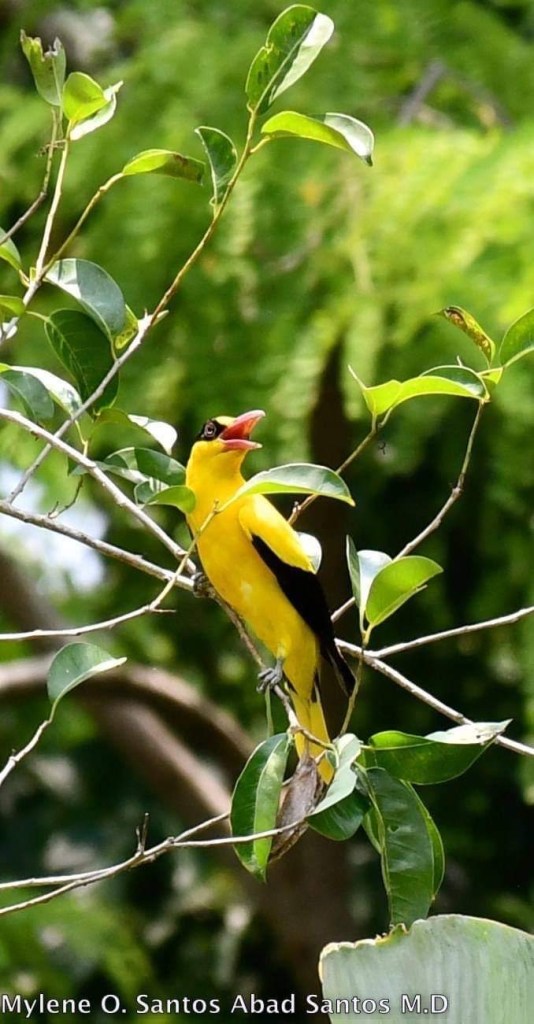
Photo by Dr. Mylene A. Santos, MD, Katmon Harbor Nature Sanctuary in Quezon, 2020.
Sorry for being away these past four weeks without any secular music inspiration for our Sunday gospels. Hoping to make up with you my dear Reader on this partly cloudy and warm Sunday with a classic song from a 1966 movie that starred Michael Caine, Alfie.
Written by the highly successful duo of Burt Bacharach and Hal David, sang and recorded for the said movie by their favorite interpreter Dionne Warwick, Alfie gives in its opening stanza the questions that create the drama of this 1966 film about a self-centered playboy who cared only for himself, using the people around him for his own gratification and satisfaction.
I have not seen the original 1966 film except its 2004 remake starring Jude Law that I find too “sleazy” that lacked what I suppose as the British “touch of class” and deep drama found in Caine’s starrer.
Nonetheless, we have chosen this song because of our Gospel this Sunday when a scholar of the law challenged Jesus with the question “which commandment in the law is the greatest”. Jesus answered the question so well by taking us all to the very foundation of all laws which is loving God with one’s total self expressed in loving others as we love our selves.
Jesus “passed the test” by the Pharisees and the question now is, how do we fare in the same test of love?
Do we love enough?
And that is why we have chosen the song Alfie that speaks so well of the same question.
There is a very interesting line in the song’s second stanza that relates perfectly well with Jesus Christ’s summary of the laws into love of God expressed in love of others:
And if only fools are kind, Alfie Then I guess it’s wise to be cruel And if life belongs only to the strong, Alfie What will you lend on an old golden rule? As sure as I believe there’s a heaven above, Alfie I know there’s something much more Something even non-believers can believe in
For years, many listeners including artists like Ms. Barbara Streissand have been baffled with the possible meaning of that line “What will you lend on an old golden rule?”; it has always been interpreted in so many ways despite Mr. David’s admission it meant nothing at all but just a line to fill in Mr. Bacharach’s music.
In that case, all the more we find how music is indeed more of the soul, touching our hearts with its deep meanings that transcends our physical world, giving us a glimpse of the Divine, of a personal and relating, loving God.
I believe in love, Alfie Without true love we just exist, Alfie Until you find the love you’ve missed you’re nothing, Alfie When you walk let your heart lead the way And you’ll find love any day, Alfie Alfie …
The problem with love, my dear Reader and Friend, too often our words are not enough to truly express it. Most often, when we love, we just have to love, love, and love!
A lovely and loving week to everyone!
Provided to YouTube by Rhino Alfie (2013 Remaster) · Dionne Warwick Playlist: The Best Of Dionne Warwick ℗ 1967 Scepter Records Producer: Burt Bacharach Producer: Hal David Writer: Burt Bacharach Writer: Hal David Auto-generated by YouTube.
The Lord Is My Chef Sunday Recipe for the Soul by Fr. Nicanor F. Lalog II
Week XXX-A in Ordinary Time, 25 October 2020
Exodus 22:20-26  |+++|   1 Thessalonians 1:5-10   |+++|   Matthew 22:34-40
Nuns bringing relief goods during the lockdown due to COVID-19 last summer. Photo from Facebook.
Our gospel this Sunday is a very usual scene happening daily in our modern world when we keep on testing Jesus Christ like the Pharisees for so many things about life we feel we know better than even God.
We keep on “pushing the lines” to avoid crossing them lest we break the laws and commandments when our hearts are clearly bent more on the legalisms than their spirit and sense.
How unfortunate that until now, when we would rather see the small parts than the whole that we keep on breaking down everything specially laws as if they are entities unto themselves, forgetting that each part leads to greater good.
Such is the essence of the one law of love, love of God is always love of neighbor and vice versa. They cannot be separated, like a face with two cheeks.
But more important than understanding the nature of the law of love which is the inseparability of love of God and love of others is passing its final test of loving.
I have always loved this actual photo of a banana vendor during the lockdown who kept his prices low as part of his effort in alleviating the sufferings due to COVID-19 pandemic. Photo from Smart, March 2020.
We keep on testing Jesus
who has passed every test we have
subjected him into...
Can we pass his test of love, too?
As we come to close our liturgical calendar in the coming weeks, our Sunday gospel today challenges us to examine our very selves too if like Jesus, can we pass the test of love?
When the Pharisees heard that Jesus had silenced the Sadducees, they gathered together, and one of them, a scholar of the law, tested him by asking, “Teacher, which commandment in the law is the greatest?”
Matthew 22:34-36
The scholar’s question to Jesus was partly a result of the confusion among people of his time when their experts and scholars of the Laws broke down into minute details and parts the Decalogue that eventually ended having over 600 precepts including those rituals of cleansing of things Jesus and his disciples were often accused of disregarding whenever they came to gatherings.
The sad thing is that instead of simplifying them so the people may find more the spirit of the Laws than its legalisms, the Jewish leaders “did not lift a finger” about it for selfish motives.
And now they were using it to test Jesus which we sadly continue in our present time.
While it is true that evil exists in lawlessness or when we live lawlessly, God’s law is directly opposed to a legalistic understanding that must be seen always in the light of faith.
This is perhaps the main point of Pope Francis in his recent statement proposing for “civil coexistence law” (convivencia civil) that will protect homosexual people from mistreatment and social rejection even from among their own family circles. The Pope is not calling for same sex civil union nor same sex marriage. We have to go beyond the legalese and legalisms of laws to see the Holy Father’s genuine concern and love for people with homosexual tendencies he had longed to bring back to the fold.
We cannot separate law and love if either is to bring deepened relationships and unity among peoples that are in fact the goals of both law and love. Law and love always take into consideration the other person often forgotten when we have an excess of our very selves.
In the first reading, we are reminded how the laws themselves are manifestations of God’s love for his people, of laws coming directly from him without any hint whatsoever of the distant lawgiver we have always seen and experienced among men.
See how he admonished everyone to be kind with everybody specially aliens for after all, we are all immigrants and travelers of this earth whom he takes care of. In declaring “I am compassionate” (Ex.22:26), God assures everyone of his oneness with us, that to love him is to love others, to hurt others is hurting him too! The very same thing Jesus is telling us today!
He said to him, “You shall love the Lord, your God, with all your heart, with all your soul, and with all your mind. This is the greatest and the first commandment. The second is like it: You shall love your neighbor as yourself. The whole law and the prophets depend on these two commandments.”
Matthew 22:37-40
Jesus easily passed the “test” by the Pharisees at that instant and would prove it more decisively and concretely on the Cross when he gives himself up to the Father for our salvation as the supreme sign of love that is true.
His answer takes us all to the very foundation of all the laws we have which is loving God with one’s total self expressed in loving others as we love our selves. Here we find Jesus doing away with our legalisms that focus on the letters and individual laws and commandments, summing them all in love.
Again, following the background and personality of Pope Francis, here we find his love in action being bogged down by legalisms and limitations of the language.
What does he really mean with convivencia civil or civil coexistence law minus any romantic meanings in adherence to our moral laws?
I do not know but in my heart, I could feel the love and compassion of this Pope for homosexuals we have long ostracized from the Church and even society, making fun of them, forgetting their feelings and well-being and persons. It might still take some time before the Pope’s idea is realized even in the Church. What we need at the moment is openness to the leading of the Holy Spirit to finally find those words and terms to encapsulate the love and compassion Pope Francis has for them.
That is the problem with love — always beyond words. One has just to do it, to just “love, love, and love” as Leo Buscaglia would always say.
In the second reading, St. Paul reminds us how the world continues to frown upon us Christians striving to live the life Christ had called us to. We can see the continuing biases in the society even in social media against us Christians standing for what is just, moral and true. It is in this context where we are challenged to be true witnesses of the love of Jesus Christ that the credibility of his gospel is proven daily as the only path towards peace and harmony.
Jesus passed the tests of his enemies about his love for God and love for us; all the past Popes have proven too their complete love for God and for others in their lives of holiness. Pope Francis has striven while still in Argentina to witness this immense love of Jesus for the marginalized. Instead of wasting our energies debating about his recent statements despite his being passed the same test of love, let us now examine ourselves how are we faring in this test of love too?
And loving and lovely week ahead of everyone in Jesus!
The Lord Is My Chef Breakfast Recipe for the Soul by Fr. Nicanor F. Lalog II
Friday, Memorial of St. John of Capistrano, Priest, 23 October 2020
Ephesians 4:1-6     >><)))*>  +  >><)))*>  +  >><)))*>     Luke 12:54-59
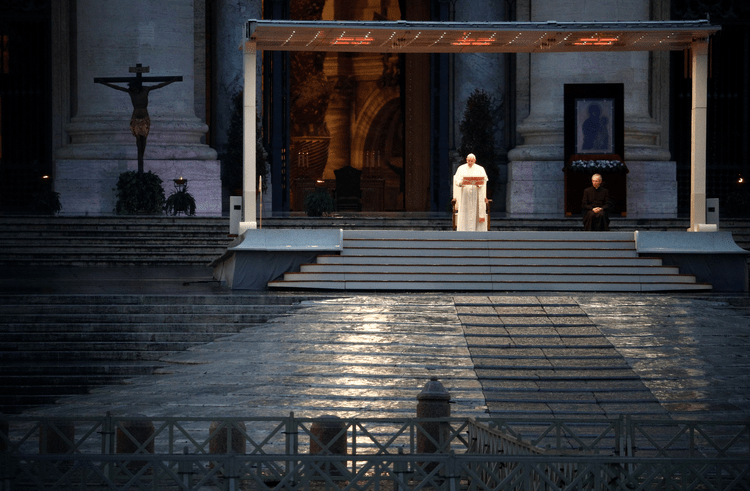
Pope Francis delivering his “Urbi et Orbi” before an empty St. Peter’s Square in Rome, 27 March 2020 at the height of COVID-19 pandemic. Photo from Vatican Media/AFP via Getty Images.
So many things have happened in the past 24 hours, O God our Father, that the peoples of the world felt as if the earth was shaken and thrown off its course following the news of the Pope’s recent interview.
So many have spoken without really reflecting the Pope’s statement proposing a “civil coexistence law” (translation by Fr. Darwin Resuello) among people with homosexual tendencies “so they may be legally covered” (Pope Francis, Catholic News Agency) “in seeking mutual help or helping another” (Fr. Resuello).
Many were quick to conclude Pope Francis is endorsing same sex relationships or same sex-marriage when in fact nowhere did the Pope said it; in fact, he had avoided using the word “marriage” in his adherence to our teaching that marriage is only between man and woman.
Everybody is now taking it to advance each one’s popular opinions and preferences long rejected that would never be allowed in the light of your teachings and commandment to truly love like your Son Jesus Christ.
In this world so divided and colored with different beliefs, guide us Lord Jesus in the Church as we seek ways to be compassionate and loving to everyone like Pope Francis, may everyone see it is always in your desire to be one, just as you and the Father are one.
Brothers and sisters: I, a prisoner for the Lord, urge you to live in a manner worthy of the call you have received… striving to preserve the unity of the spirit through the bond of peace; one Body and one Spirit, as you were called to the one hope of your call; one Lord, one faith, one baptism; one God and Father of all, who is over all and through all and in all.
Ephesians 4:1,3-6
We pray for Pope Francis, his continued guidance by the Holy Spirit as he tries to reach out to more people marginalized especially in the Church – which is so ironic. Help him in his efforts to bring into the fold those outside, those driven away by our lack of love and mercy.
Do not deter him from being your sign of unity despite his portrayal by some especially those in media who keep on presenting him as breaking away from tradition. May his life of kindness and compassion convince others of his fidelity and uprightness before you like St. John of Capistrano who called on us priests to be examples for others in holiness.
We pray also for everyone to be more reflective to avoid sowing confusion and divisions with the Pope’s pronouncements, just like during your time when those around you were so focused on themselves than on those truly in need. Amen.
The Chair of St. Peter, sign of the Primacy of Rome which is about the primacy of love and service especially to those neglected and unrecognized; how sad some sectors use these efforts by Pope Francis for their own agenda. Photo from en.wikipedia.org.
Lawiswis ng Salita ni P. Nicanor F. Lalog II, Ika-22 ng Oktubre 2020
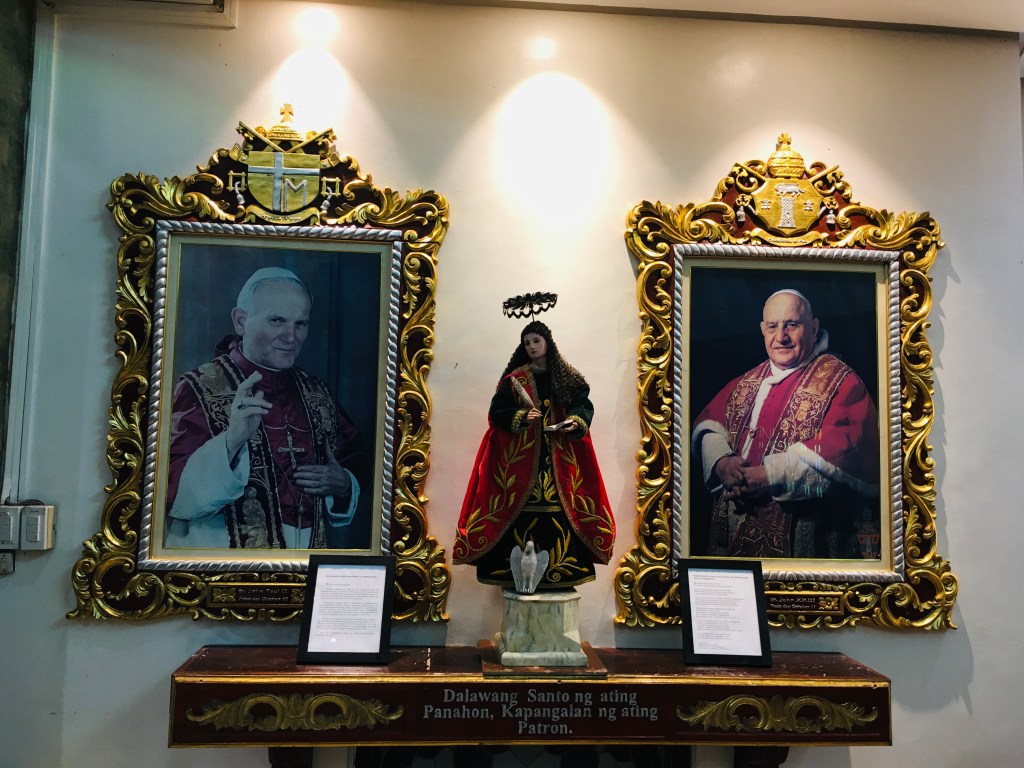
Larawan nina San Juan Pablo II at San Juan XXIII kasama isa sa mga matandang imahen ng aming Patron San Juan Apostol at Ebanghelista sa likuran ng aming simbahan sa Bagbaguin, Santa Maria, Bulacan.
PANALANGIN KAY SAN JUAN APOSTOL AT EBANGHELISTA KAUGNAY NG MGA BAGONG SANTO NG SIMBAHAN: PAPA JUAN PABLO II at PAPA JUAN XXIII(Bahagi ng aming mga Panalangin sa Parokya ni San Juan Apostol at Ebanghelista, Bagbaguin, Santa Maria, Bulacan mula nang itanghal bilang Santo ang dalawang naturang dating Santo Papa noong 27 Abril 2014, Linggo ng Dakila Awa ng Diyos.)
Minamahal naming Patron na Banal,
Juan Apostol at Ebanghelista po ang inyong ngalan!
Ngayo'y aming ipinagdiriwang sa buong Simbahan
dalawang bagong Banal: Kapwa sila pastol ng kawan,
nang manungkula'y pangalan mo ang hiniram.

San Juan Beinte-tres nang sa kanyang katandaan tuladmo,
Sinikap maging makabuluhan at buhay na palatandaan ng Diyos
sa gitna ng makabagong panaho nitong InangSimbahan
nang kanyang simulan ang Ikalawang Konsilyo sa Vatican.

Kasabay niyang tinanghal bilang Banal
ang tinaguriang Dakilang San Juan-Pablo Ikalawa;
Labis na pagtitiis ang kinamit sa kanyang sakit,
Krus ay sinapit, katulad mo’y naging malapit
sa Ina ni Hesus kaya’t “Totus Tuus” ang kanyang awit.

Itulot mo aming Mahal na San Juan Apostol at Ebanghelista,
kaming iyong mga anak sana’y matularan,
pinagsikapan ng dalawang bagong San Juan:
pamilya’t sambayanan mabuklod sa nagkakaisang pag-ibig
katulad ng dalangin ni Hesus doon sa Huling Hapunan. AMEN.

San Juan Ebanghelista, ipanalangin mo kami.
San Juan Beinte-tres, ipanalangin mo kami.
San Juan-Pablo Ikalawa, ipanalangin mo kami.
The Lord Is My Chef Breakfast Recipe for the Soul by Fr. Nicanor F. Lalog II
Thursday, Memorial of St. John Paul II, Pope, 22 October 2020
Ephesians 3:14-21     >><)))*>  +  <*(((><<     Luke 12:49-53
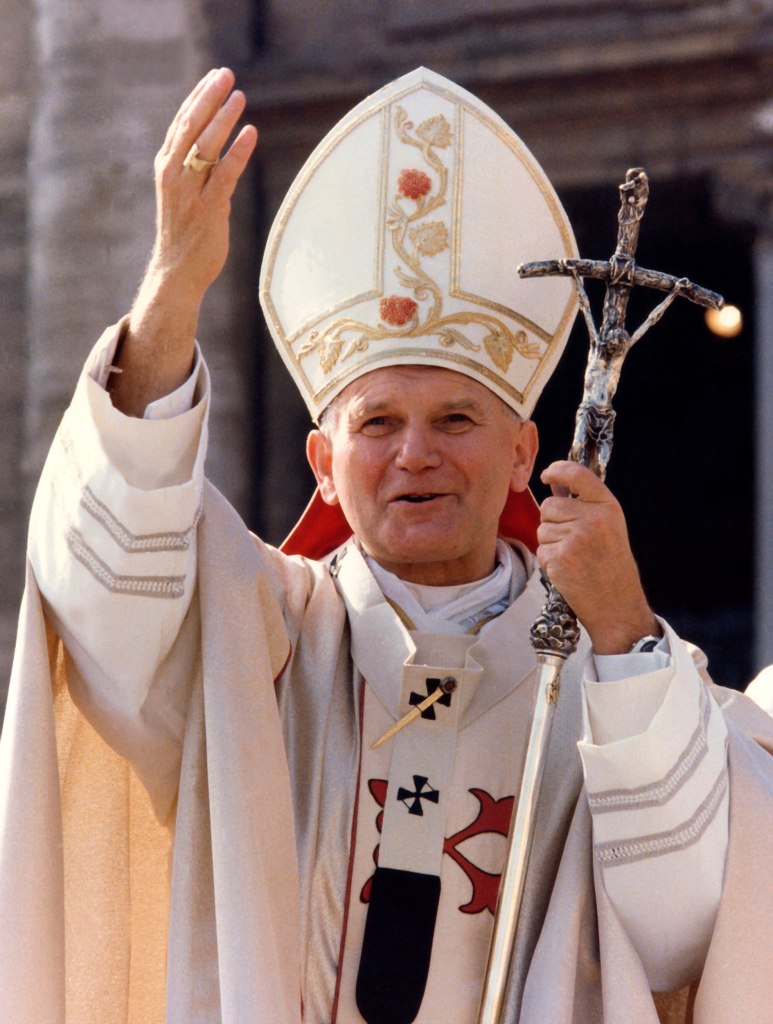
Pope John Paul II waves to well-wishers in St. Peter’s Square at the Vatican in 1978 when he was elected as the 263rd successor to St. Peter (CNS photo/Arturo Mari, L’Osservatore Romano).
One of the things I am so thankful to you, O God our Father in making me live in this generation is your gift to us of a great shepherd in St. John Paul II whose memorial we celebrate today. It is a tremendous blessing from you to grace our years of existence along with a great man like him who had overcome so many difficulties and struggles in life, being orphaned at a very young age from his mother, then from his father and later from his only beloved brother, not to mention his coming from Poland, a country exploited by foreign powers and subjected to communism for the longest time.
In his entire life, Lord, you have always manifested your loving presence in him and destined him to be your sign in this most difficult period in history when men and women have gravely challenged you with so many evil and sins, including some priests you have called to serve.
Praise and glory to you, O God, for the great St. John Paul II, a man rooted and grounded in love!
and that Christ may dwell in your hearts through faith; that you, rooted and grounded in love, may have strength to comprehend with all the holy ones what is the breadth and length and height and depth, and to know the love of Christ that surpasses knowledge, so that you may be filled with all the fullness of God.
Ephesians 3:17-19
What a beautiful prayer by St. Paul after extolling your love to call us all to be your children by having faith in your Son Jesus Christ!
What a beautiful prayer by St. Paul so perfect for today the memorial of St. John Paul II, a man rooted and grounded in love!
But, beyond the beautiful language, teach us, Father, what is to be rooted and grounded in love to know the love of Christ that surpasses knowledge, to be filled with all of your fullness?
Roots refer to something inside, deep within and hidden, not seen; on the other hand, grounded is something outside, above and seen.
What do you mean, Father?
It is so demanding but that is what to follow you, to be set on a blazing fire of purification in Jesus Christ (Lk. 12:49), to be one with him on the Cross so that inside and outside, we are totally yours with Mary like St. John Paul II’s Totus Tuus!
St. John Paul II, pray for us to be not afraid to follow Jesus and be one with the Father in the power of the Holy Spirit. Amen.
Quiet Storm by Fr. Nicanor F. Lalog II, 21 October 2020
Statue of St. Paul at the Malolos Cathedral by the famed ecclesiastical artist Willy Layug.
Today we conclude our reflections – or “postscript” – to St. Paul’s Letter to the Galatians about faith we heard proclaimed in the weekday readings two weeks ago from October 05-14, 2020.
A truly faithful personis one who is also free.
We have said that faith is a relationship with God and with others like in marriage and friendship. When our faith with God and with persons is strong with conviction and realistic, then the more we become free because there is no room for doubts that we are not loved.
Brothers and sisters: Scripture confined all things under the power of sin, that through faith in Jesus Christ the promise might be given to those who believe. Before faith came, we were held in custody under law, confined for the faith that was to be revealed. Consequently, the law was our disciplinarian for Christ, that we might be justified by faith. But now that faith has come, we are no longer under a disciplinarian.
Galatians 3:22-25
Recall those times we have felt imprisoned and chained by the past with all of our broken and toxic relationships, sickness and handicaps, failures and sins, and other painful memories: that was when we wavered in our faith, when we lacked conviction in our faith.
We have to be convinced that Jesus came to set us free from all forms of slavery that prevent us from growing and maturing in faith and freedom in him. When our faith is strong, then we are able to break the many barriers that imprison us like gender, color, language, social status and even religion.
Nourish our faith to be free to become our true selves!
Photo by author, 2019.
Faith works through love.
It is God’s gift of faith that enables us to do good, to do our works of charity and love. And because we are faithful and free, then we also love!
Incidentally, being faithful and free are always tied up with being able to love because love is a choice, a decision we make, not just feelings or emotions.
Every choice is made out of freewill and here is the most interesting part of being faithful and free and loving: like love, man is able to believe and trust because it is God who first believed and trusted us!
A faithful person is always a loving person because he is free to choose what is good, what is right. And the more faithful we become to God, to your spouse, to your family and friends, the more loving you become like them!
For in Christ Jesus, neither circumcision nor uncircumcision counts for anything, but only faith working through love.
Galatians 5:6
Without faith, it is difficult for us to love because of the pains that come always in loving.
Without faith, it is impossible to forgive and be merciful, to let go of others’ infidelity and lack of love and concern because these are virtues and values that come only from within, from a loving heart that is also faithful where Jesus Christ dwells and reigns.
A few years ago, GMA-7 launched its talent search called Starstruck inviting young people to… Dream. Believe. Survive.
For us Christians, it is… Dream. Believe. Live.
The moment we believe, then we are able to see, even God hidden among each one of us. Amen.
*All photos by Dr. Mylene A. Santos, MD at Katmon Harbor Nature Sanctuary, Quezon, 2020.
The Lord Is My Chef Breakfast Recipe for the Soul by Fr. Nicanor F. Lalog II
Thursday, Memorial of St. Teresa of Avila, Virgin and Doctor of the Church, 15 October 2020
Ephesians 1:1-10     <*(((><<  || + + + ||   >><)))*>     Luke 11:47-54
Photo by Dr. Mai B. Dela Peña at a Carmelite Monastery in Israel, 2016.
You know so well, O God, how we must pray to you that you have taught St. Paul one of the most beautiful prayer – and greetings – we can all recite individually or communally when gathered in your name.
Blessed be the God and Father of our Lord Jesus Christ, who has blessed us in Christ with every spiritual blessing in the heavens, as he chose us in him, before the foundation of the world to be holy and without blemish before him.
Ephesians 1:3-4
So beautiful are these words showing to us our blessedness in Jesus Christ! If we could all be aware of our blessedness in you that springs from your infinite love for us poured by Jesus Christ at the Cross, maybe there would be less chaos in the world today.
Forgive us in wasting your blessings, exchanging them for fleeting pleasures of fame and wealth that set us apart from one another. Worst, in misleading others away from you with our sinful ways of life like the enemies of Jesus in today’s gospel.
Help us restore all things in your Son, dear Father, like St. Teresa of Avila who taught us to be mindful always of Jesus Christ’s love for us.
Whenever we think of Christ we should recall the love that led him to bestow on us so many graces and favors, and also the great love God showed in giving us in Christ a pledge of his love; for love call for love in return.
St. Teresa of Avila, Office of Readings, October xv
The Lord Is My Chef Breakfast Recipe for the Soul by Fr. Nicanor F. Lalog II
Tuesday, Week XXVIII, Year II in Ordinary Time, 13 October 2020
Galatians 5:1-6     >><)))*>  +  >><)))*>  +  >><)))*>     Luke 11:37-41
Photo by author, Lovers’ Bridge, Tamsui in Taiwan, January 2019.
Thank you again, God our Father, for the gift of faith that enables us to do good, to do your works of charity and love. You have gifted us with freewill primarily because of faith itself when you believed in us and trusted us.
Yes, dear Father: like love, we are able to believe and trust you because you were the first to believe and trust us. Forgive us for those times we wrongly chose sin, when pride and selfishness, doubts and mistrust clouded our decision making. When despite our faith, we refused to love.
For in Christ Jesus, neither circumcision nor uncircumcision counts for anything, but only faith working through love.
Galatians 5:6
Indeed, it is because of faith that we are able to choose and do what is good. And the more faithful we become to you, O God, we become more loving like you!
Without faith, it is difficult for us to love because of the pains that come always in loving
Without faith, it is impossible to forgive and be merciful, to let go of others’ infidelity and lack of love and concern because these are virtues and values that come only from within, from a loving heart where faith dwells.
Photo by author, February 2020.
Sometimes, like the Pharisees, we become so focused with what is outside to cover what is missing inside us — faith!
And despite our confessions of our faith, we believe more on outside appearances and forget the more essential inside that is faith leading to love.
The Lord said to him, “Oh you Pharisees! Although you cleanse the outside of the cup and the dish, inside you are filled with plunder and evil. You fools! Did not the maker of the outside also make the inside? But as to what is within, give alms, and behold, everything will be clean for you.”
Luke 11:39-41
Teach us, Jesus, to trust in you, to grow in faith in you so we may be more loving like you! Amen.
The Lord Is My Chef Sunday Recipe for the Soul by Fr. Nicanor F. Lalog II
Week XXVII-A in Ordinary Time, 04 October 2020
Isaiah 5:1-7     ||+||     Philippians     ||+||     Matthew 21:33-43
Photo by Mr. Jim Marpa, 2018.
To all the plantitos and plantitas: happy feast day this Sunday, the fourth of October which is also the feast of St. Francis of Assisi, patron of those in the green movements.
Part of the grace of this pandemic is the new awareness and interests of many among us for all kinds of plants borne out of the prolonged quarantine periods these past seven months. I remember growing up in our barrio where fences were all plants like santan, San Francisco and gumamelas whose flowers we used to mix with Tide to play bubbles. Who would have thought that after several decades those plants we used to take for granted like the gabi varieties and others along with cactus found almost everywhere would cost a fortune today?
But what I really miss and hope the plantitos and plantitas will be able to revive and bring back are the fruit trees every home used to have even in vacant lots like guava, santol, atis, aratiles, mabolo, achesa, duhat, kamias and of course, mango. Whenever me and my cousin would trek to the mini forest at the back of our compound called “duluhan” near a swampland to shoot birds and everything with our slingshots (tirador), we always had some fruits to munch in our little adventures.
And part of that adventure was to “shake” until we break branches of trees to get fruits and local beetles called salagubang (on mango trees).
Shaking of tree. Exactly the same thing that Jesus did today in his next parable addressed to the chief priests and elders of the people who would soon have him arrested, tried, and crucified: after telling them parable of the wicked tenants who killed the servants and the son of the owner, Jesus shook and shocked his listeners who later realized the parable was about them!
“What will the owner of the vineyard do to those tenants when he comes?” They answered him, “He will put those wretched men to a wretched death and lease his vineyard to other tenants who will give him the produce at the proper times.” Jesus said to them, “Did you never read in the Scriptures: ‘The stone that the builders rejected has become the cornerstone; by the Lord has this been done, and it is wonderful in our eyes?’ Therefore, I say to you, the kingdom of God will be taken away from you and given to a people that will produce its fruit.”
Matthew 21:40-43
We are the vineyard of the Lord
From Google.
Jesus had already entered Jerusalem and was teaching at the temple area. Among his audience were the chief priests and elders of the people trying to gather evidences against him for his arrest and execution. Unknown to them, Jesus knew what was in their hearts.
Last Sunday the parable was directed to them so they may realize how wrong they have been in regarding them so highly above the publicans and prostitutes who repented for their sins and went to receive the baptism by John the Baptist.
Today, Jesus “shook them” with this second parable taken from a well known song and lament of a beloved to his vineyard by the Prophet Isaiah which we have heard at the first reading.
Vineyards are very common in Israel as in the rest of the Mediterranean and Europe where grapes and wine symbolize life. Hence, the vine is always considered as a highly prized plant that biblical authors have taken as the image of the people whom God cultivates and from whom he expects beautiful fruits.
In the first reading, we find God lamenting why after investing his vineyard with the best of everything, the grapes it produced were so bad that it had to be burned. It was a very strong warning against Israel who have gone wayward in its ways of living that aside from worshipping idols, they also killed the prophets sent by God.
Notice the transition by Jesus using the same imagery from the Old Testament of the vineyard as the people of God but this time bearing fruits at harvest time. By that time, the chief priests and the elders of the people felt they were better than their ancestors who had the prophets killed. In fact, they felt proud that they have been faithful to God, and therefore, fruitful — thinking they were a far cry from Isaiah’s lament. Unknown to them, Jesus could read their hearts, how they were all planning to kill him like the son in the parable so they can have the vineyard, the people and lord it over them!
Everything fell into right places at the end of the parable when Jesus asked them:
“What will the owner of the vineyard do to those tenants when he comes?” They answered him, “He will put those wretched men to a wretched death and lease his vineyard to other tenants who will give him the produce at the proper times.”
Matthew 21:40-41
Try to imagine the scene with Jesus face-to-face with the chief priests and elders of the people – and with us – discussing the present time, not the past.
Here is Jesus Christ shaking us all to find whatever fruits we have, telling us that this parable is about me and you (see v. 45), asking us, why are you trying to remove me from the people? Why are you easing me out, creating all these cults around yourselves like celebrities, getting the people’s money and approval for your own sake?
Sometimes we need to be shaken – even shocked – to bring out our fruits
Photo by author at Silang, Cavite, 22 September 2020.
See again my dear Reader the beauty of the Lord’s parables wherein he invites us to be involved with it to see how we felt with certain situations like in the merciless debtor and early workers at the vineyard; today, Jesus is asking us our opinion on what the vineyard owner must do against the wicked tenants.
He knows what to do and wants us to realize that we could be those tenants too because like the chief priests and elders, we easily see the sins and shortcomings of others, the fruitlessness of others without realizing our own darkness within, even our sinister plans to dominate.
See how the chief priests and elders of the people called the tenants “wretched men” deserving “wretched death”, not realizing that the more we talk of other people, the more we actually talk of ourselves!
Every parable by Jesus is always set in the present moment with sights set to the future, to eternal life.
Sometimes, God has to shaken us, even shock us so we may bring out and give him his share of harvest of fruits like our faith, hope and love that will build the community in him, not take people away from him. Problem with us is like with those tenants and the chief priests and elders: “masyado tayong bumibilib sa ating sarili”, that is, we believe too much on ourselves that unconsciously we feel like God, forgetting we are mere stewards or tenants of his vineyard.
St. Paul reminds us in the second reading that we strive to imitate Jesus, be like Jesus so that people may find in us a model in following Jesus. Very clear with St. Paul: nobody is replacing Jesus Christ whom we must all imitate.
This time of the pandemic is a time of harvesting, of showing others our fruits like love and kindness so we may lead more people to God, not to ourselves or anyone else trying to lord over us.
Quiet Storm by Fr. Nicanor F. Lalog II, 02 October 2020
Photo by author, resthouse in Silang, Cavite, 22 September 2020.
Methinks the saddest thing of this pandemic
is not in the restrictions it had imposed on us
from social distancing to other methods of quarantine
but more on the restrictions we have within
when we can be more loving and kind with others
then still choose to be harsh and brash.
We wash our hands to be clean
but the virus of sin clings deeper than skin
when forgiving or apologizing
can wash away that sting
of any guilty feeling within.
Even if we have to maintain social distancing
it does not mean we have to be apart;
it would be wonderful and most amazing
to everyone's part if we can let our hearts
sing the feelings deep inside like
"I love you, I miss you, I care for you"
than wring all the aching
and sufferings we are enduring.
Lastly, always put on your masks
for everyone's safety
but let us trust and bask
in the warmth of our humanity
to keep our sanity.
In this time of COVID-19
when death is no longer lurking
but closing into our very being,
let us be more of feeling than of thinking,
loving and caring, affirming each other
enjoying life together.
Photo by author, antique door of a resthouse in Silang, Cavite, 22 September 2020.