The Lord Is My Chef Sunday Music by Fr. Nick F. Lalog II, 04 April 2021
“The Three Marys” by Henry Ossawa Tanner, from womeninthebible.net.
Blessed happy Easter to everyone!
This is perhaps the only year when it is so difficult to greet others with “Happy Easter” due to this ongoing lockdown following the worsening surge in COVID-19 infections with hospitals now beyond capacity.
But, that is the mystery of Easter: it is an event that truly happened in our history but something more than the usual thing like in Christmas when God became a child like us. At Easter, God broke through all human limitations to enter a new realm, a vast expanse of unknown realities beyond our imaginations, beyond our most dreaded thing in this life we call “death” (https://lordmychef.com/2021/04/04/breaking-into-new-realities/).
Like Mary Magdalene and the rest of the apostles except for John the Beloved, there are times we see nothing at all and say things we hardly think or process because everything seemed to have been lost when suddenly from within we realize life bursting forth, new hope, new beginnings!
And that is Easter!
Like this great song composed by Sting with his former group The Police, Every Breath You Take from their penultimate album Synchronicity released in 1983.
Sting was surprised with the great reception by people worldwide to this song that became their most recognized piece, spending so many weeks in almost every music chart around the globe. It is a song filled with negativities, according to Sting who wrote it in 1982 while on a retreat at Jamaica in the Caribbean following his separation from Frances Tomelty when he got involved romantically with her best friend and neighbor, Trudie Styler. The affair was so controversial, even condemned by many. Complicating things was the brewing rift among them in The Police.
But, that’s how Easter is: death becoming gateway to new life!
Imagine Jesus Christ now singing this to us in the midst of the pandemic, assuring us in every breath we take, he is not only watching us but in fact, with us!
40 Shades of Lent by Fr. Nicanor F. Lalog II
Fifth Sunday in Lent-B, 21 March 2021
Jeremiah 31:31-34  +  Hebrews 5:7-9  +  John 12:20-33
Photo by author, details of the Seventh Station of the Cross at the St. Ildephonse Parish Church in Tanay, Rizal, January 2021.
In the beautiful church of the town of Tanay in Rizal is found a most unique Seventh Station of the Cross where one of those depicted when Jesus fell for the second time is a man with dark glasses looking afar. Local residents say the man with sunglasses is Caiaphas, the chief priest during the time of Jesus who led the Sanhedrin at his trial leading to his crucifixion.
Nobody can explain exactly why the artist portrayed that man wore sunglasses that was popular among people of stature and position in the country when the carving was made in 1785. Also interesting aside from the man in shades are the soldiers with him shown with Malay features of brown color and wide eyes opened, all looking somewhere except for one looking at the Lord while clutching his garment as he fell looking heavenwards.
I remembered this piece of work of art inside the Tanay Parish Church declared by the National Museum as “National Cultural Treasure” because our gospel today speaks about a request by some pagans to see Jesus. Seeing has many meanings, always leading to believing. And sometimes, it is in believing we are able to see most of all!
Some Greeks who had come to worship at the Passover Feast came to Philip, who was from Bethsaida in Galilee, and asked him, “Sir, we would like to see Jesus.” Philip went and told Andrew; then andfrew and Philip went and told Jesus. Jesus answered them, “The hour has come for the Son of Man to be glorified. Amen, amen, I say to you, unless a grain of wheat falls to the ground and dies, it remains just a grain of wheat; but if it dies, it produces much fruit. Whoever loves his life loses it, and whoever hates his life in this world will preserve it for eternal life.”
John 12:20-25
Seeing to believe
Photo by Dr. Mylene A. Santos, MD, Infanta, Quezon 2020.
As we have been mentioning three Sundays ago, the fourth gospel uses poetic expressions and symbolisms to convey deeper truths and realities about Jesus and our very selves, our having or lacking faith in God. Like the act of seeing by those Greeks who requested Philip “to see Jesus”.
If they simply wanted to catch a glimpse of Jesus, they could have easily seen the Lord who was always at the temple area at that time. Jesus had always been available to everyone like last Sunday when Nicodemus went to see him at night.
But, John often used the verb to see in many senses that also mean to believe like in his appearance a week after Easter to his disciples along with doubting Thomas: Jesus said to him “Have you come to believe because you have seen me? Blessed are those who have not seen and have believed” (Jn.20:29).
Most mysterious for me in John’s use of the verb to see is in the call of the Lord’s first disciples led by Andrew: He said to them, “Come, and you will see.” So they went where he was staying and saw where he was staying… Andrew followed Jesus. He first found his brother Simon and told him, “We have found the Messiah” (Jn.1:39-41).
What did Andrew see that he later told his brother Simon that they have found the Messiah?
Of course, John’s most notable use of the verb to see is from that scene at the empty tomb on Easter Sunday when the perfect model of the believer is the “other disciple” whom Jesus loved “went in, and he saw and believed” (Jn.20:8).
Very clear in the mind of John that the request of those Greeks to see Jesus was one of faith, of meeting and speaking with Jesus to be enlightened more like Nicodemus last Sunday. Here we find our important role of being another Philip and Andrew, leading other people to see Jesus.
Those Greeks described as “God-fearing” were pagans attracted to the teachings of Judaism and came to Jerusalem to observe the Passover Feast. They already have faith in God that must have been awakened further when they heard the teachings of Jesus; hence, their request to see Jesus.
It happens so often that when by the grace of God people are illuminated with faith even in the most personal manner, they still need Philips and Andrews who would enable them “to see” Jesus to grow and be deepened in faith. There will always be a need for an apostle who could lead others to “see” Jesus because faith happens within a community, within the Church and through others’ mediation.
And here lies the bigger challenge for us disciples for us to make Jesus “seen” in our lives and in our community.
Jesus answered them, “The hour has come for the Son of Man to be glorified. Amen, amen, I say to you, unless a grain of wheat falls to the ground and dies, it remains just as a grain of wheat; but if it dies, it produces much fruit. Whoever loves his life loses it, and whoever hates his life in this world will preserve it for eternal life. Whoever serves me must follow me, and where I am, there also will my servant be. And when I am lifted up from the earth, I will draw everyone to myself.” He said this indicating the kind of death he would die.
John 12:23-26, 32-33
In a sudden twist, John tells us nothing if those “God-fearing” pagans saw Jesus at all because the Lord immediately went on a discourse after being told by Andrew and Philip of the request, briefly interrupted by God’s voice speaking from heaven that everybody heard in the temple area.
Speaking in the parable of the grain of wheat dying first in order to produce much fruit, Jesus tells us how we can lead others to truly see him in us and through us by having the same determination and perseverance to follow him, stay with him, and be like him by dying to ones self for others. For the grain of wheat to die and spring forth to new life, it has to be detached. And so are we.
Notice Jesus repeating that sign of his being lifted up on the cross he mentioned last Sunday to Nicodemus. John mentions it again in this part of his gospel adding an explanation at the end because for him, the Crucifixion is Christ’s greatest sign and revelation of his glory, opening a path for us back to God in his Cross, through his Cross.
In teaching us about the parable of the grain of wheat dying and linking it with his being “lifted up”, Jesus now tells us and every “God-fearing” person that we can only “see” him in the scandal of the Cross.
Did those God-fearing Greeks remained in Jerusalem and saw Jesus on the Cross?
We do not know but we are sure that anyone who requests to see Jesus always sees him if we believe first in his crucifixion which is when everyone is drawn to him as he had said. We must first believe Christ died so we may see him risen to life.
It was on Christ’s dying on the cross when God established a “new covenant” among us as prophesied by Jeremiah in our first reading today, giving us all an access to him in Jesus, through Jesus, with Jesus which we celebrate daily in the Holy Eucharist.
Photo by author, 2020.
Grappling with death to see life
We have never seen the crucifixion of Jesus except in its portrayals in the many movies we used to watch in Holy Week; but, its realities are etched and impressed in our hearts through the many trials and difficulties we have gone through in life that we believe Jesus truly died. And because of that, we have also seen him alive!
Such is the reality of seeing Jesus that every time we describe something so difficult, so trying, we equate it with death like when we say “we felt like dying” taking the exam. And the good news is when we overcome the tests that we use again the word or concept of death to describe something so good as it leads us to glory like when we say a pizza or a steak or a cake to die for.
Such is the paradox and scandal of the Cross of Jesus: we can never see him risen in glory if we avoid and refuse seeing his Passion and Death right in our own selves, in our painful experiences.
Going back to that unique Seventh Station of the Cross at the Tanay Parish Church, I realized how the unbelievers and others among us could not see Jesus as the Christ because they have refused to believe in him first especially when they are down with all kinds of problems and trials, looking somewhere else instead of seeing Jesus fallen in front of them.
Let us believe in Jesus so we may see him in this final week of Lent as we prepare for Palm Sunday next. Amen.
40 Shades of Lent by Fr. Nicanor F. Lalog II
Thursday, Fourth Week in Lent, 18 March 2021 (St. Cyril of Jerusalem)
Exodus 32:7-14     ><}}}*>  +  <*{{{><     John 5:31-47
Illustration from chabad.org.
God our Father in heaven, forgive us for being constantly in the same situation like your people at the wilderness when Moses was up conversing with you on Mount Sinai. So many times we are like them, creating our own golden calves, turning away from you our true God.
So many times in life, we simply want to be in total control of everything that we doubt you, even grow impatient with you because we have other agendas in life like being god like you! And so, we make golden calves of everything we like to believe in, including in our selves.
Jesus said to the Jews: “You search the Scriptures, because you think you have eternal life through them; even they testify on my behalf. But you do not want to come to me to have life. I do not accept human praise; moreover, I know that you do not have the love of God in you. I came in the name of my Father, but you do not accept me; yet if another comes in his own name, you will accept him.”
John 5:39-43
You said it perfectly right, Lord Jesus: “I know that you do not have the love of God in you. I came in the name of my Father, but you do not accept me; yet if another comes in his own name, you will accept him.”
As we turn to idolatrous worship of our selves, then we stop loving you in others both in our hearts and in our hands. When we begin manipulating everything and everyone even our very own belief system, especially your gift of faith in each of us, that is when we become gods.
When we stop believing in you, then we stop loving, we stop relating, we stop authentic living as we forget others.
Forgive us, Lord, and look kindly upon us like at Sinai, reminding us always of the many blessings the Father showers us despite our sinfulness. Teach us to be grateful always so we may learn humility and embrace our humanity to start believing in you and love again by turning away from sins.
Once again, let your tender compassion, Lord, break upon us this Lent so we may begin to love and care, be tender with those who suffer amid our own pains and trials in life. Teach us to believe in you again to realize that wherever there is loving service, tenderness, and care for the weak and lowly, there you are too! Amen.
40 Shades of Lent by Fr. Nicanor F. Lalog II
Wednesday, Fourth Week in Lent, 17 March 2021 (St. Patrick's Day)
Isaiah 49:8-15     <*{{{><  +  ><}}}*>     John 5:17-30
Photo by author, December 2020.
"Can a mother forget her infant,
be without tenderness for the child of her womb?
Even should she forget,
I will never forget you."
(Isaiah 49:15)
If there is one thing we terribly miss these days a year since the start of this pandemic is tenderness, your kind of Tender Loving Care (TLC) only you, God our Father, can give like a mother to her child.
How sad that in this time of difficulties when there are so many sufferings and darkness around us, there are also much arrogance and apathy afflicting many of us.
More sad is how everybody is solely focused in finding a cure to control spread of COVID-19, often in drastic measures that only worsen the plight of the weak and marginalized, many have forgotten the need for more care for everyone, not only for those sick but also for our front liners who have lost so many of their family and friends in this time of the corona.
In this continuing darkness of our lives despite the sparkle from vaccines that are still unavailable to many of us, we know you continue to work to save us in Jesus Christ your Son who assured us, “My Father is at work until now, so I am at work” (Jn.5:17).
Let us do your work, Lord, especially today as we celebrate the feast of St. Patrick. Use our hands and our hearts to tenderly serve others especially those deep in darkness with sins and sufferings.
Teach us not only to be compassionate willing to suffer with others but most of all, fill us with the Father’s tenderness to care like you so that we are moved to reach out, going down to the level of those crying, of those so tired and about to give up in life.
Soften our hearts that have been hardened with negativities and cynicisms of time.
Stir our hearts, O Lord, that like you even in our hunger and pain, we may realize there are others more hungry and more in pain than us, hoping for some comfort and care, healing and encouragement, or simply company and inspiration and reason to live.
Let our hands and our hearts, our whole selves be an extension of your tender mercy and care so that “the dawn from on high shall break upon us, to shine on those who dwell in darkness and the shadow of death, and to guide our feet into the path of peace” (Lk.1:78-79). Amen.
40 Shades of Lent by Fr. Nicanor F. Lalog II
First Friday of March, Second Week in Lent, 05 March 2021
Genesis 37:3-4, 12-13, 17-28   ><}}}*> <*{{{><   Matthew 21:33-43, 45-46
Photo by Dr. Mylene A. Santos, MD, February 2021.
Lately O Lord you have been consoling me with the shades and hues of Lent, providing much needed inspiration and enthusiasm to forge on amid the many trials I have been going through along with some loved ones hurdling great obstacles in life these days.
As we close another week, you have never stopped showering us with your immense love, dear Father, by inviting us to come to you to be forgiven and enlightened to set all things right again in our lives. No matter how dark or light are the various contrasts of daily life, there is always your Son Jesus Christ journeying with us.
On this first Friday of March, you invite us to dream again of great, good things in life: to dream again of being close to you, of being good, of being loving and loved, of being saved from our sins as we heard the story of Joseph in the first reading and the parable of the wicked tenants in the gospel referring to Jesus. Both were dreamers that someday, we shall be with you in your glory, O God.
But unlike other dreamers, Joseph and Jesus dreamt of salvation in you with “eyes wide open” by working hard on their dreams by remaining faithful and true to you even if others despised them, plotting their deaths.
And so, loving Father, I pray that we dream anew beginning today — of being with you, of doing your work, of making you present in this world where nobody dreams big anymore except of being rich and famous. For those who refuse to dream or cannot dream again for any reason, give them the grace to dream with other dreamers instead of blocking or hindering our dreams like the brothers of Joseph and the wicked tenants of the parable.
Israel loved Joseph best of all his sons, for he was the child of his old age; and he made him a long tunic. when his brothers saw that their father loved him best of allo his sons, they hated him so much that they would not even greet him… They sold Joseph to the Ishmaelite for twenty pieces of silver.
Genesis 37:3-4, 28
Lastly, Lord Jesus, I pray for the dreamers among us that like Joseph and you, may we hold on to our dreams, to keep dreaming until they come true, in you and through you. Amen.
Most Sacred Heart of Jesus, make my heart like thine.
Photo by Mr. Red Santiago of his son praying in our previous Parish, March 2019.
40 Shades of Lent by Fr. Nicanor F. Lalog II
Thursday, Second Week in Lent, 04 March 2021
Jeremiah 17:5-10   ><}}}*>  +  <*{{{><     Luke 16:19-31
Photo by author at Silang, Cavite, 22 September 2020.
How lovely is the season of Lent with its shades and hues of violets that reveal to us in many beautiful ways, O God, the many contrasts in life, enabling us to see and appreciate its deeper realities and meanings when seen in your light.
Lead us back to you, dearest Lord, and let us stop believing that happiness in life lies in external impressions like wealth, power, and fame but in what is going on in the depths of our heart like believing in you, holding on to you, just having you.
Thus says the Lord: Cursed is the man who trusts in human beings, who seeks his strength in flesh, whose heart turns away from the Lord. He is like a barren bush in the desert that enjoys no change of season, but stands in a lava waste, a salty and empty earth. Blessed is the man who trusts in the Lord, whose hope is the Lord. He is like a tree planted beside the waters that stretches out its roots to the streams. It fears not the heat when it comes, its leaves stay green; in the year of drought it shows no distress, but still bears fruit.
Jeremiah 17:5-8
What a beautiful and simple contrast in this life, so easy to remember yet we also forget or ignore: with you, there is life; without you, no life too.
This reality becomes clearer in the contrasts presented by your Son Jesus in the parable of the rich man and Lazarus whose name means “God has helped” from the Hebrew el azar. No name was given to the rich man for he is more like us, Lord, who lavish ourselves with beautiful and expensive clothings, dining sumptuously in total disregard of Lazarus whose body was covered with sores, licked by dogs, gladly eating the scraps falling from the table of the rich man.
That’s a load of contrasts we take for granted in life yet so obvious though we hardly notice because we remember more what the rich man had without realizing that it was Lazarus who had more life despite his poverty.
Photo by author, August 2020.
Open our eyes, Lord, to the significance and meanings of these contrasts: purple garments and fine linen of the rich man versus the sores covering the body of Lazarus; and sumptuous meals of the rich man vis-a-vis Lazarus gladly eating scraps falling from the rich man’s table.
The rich man relied only to himself with his wealth, celebrated life with things like food and clothes while Lazarus had you in himself, gladly eating scraps from the rich man’s table and going on with life’s sufferings like body covered with sores.
Surely there were other things that eventually brought Lazarus into heaven but clearly, the rich man’s self-indulgence with worldly things and securities that made him forget and totally disregard Lazarus did him big time!
While still here on earth, especially in this season of Lent, may we see the many contrasts in life and choose always where there are more of you, no matter how dark or light it may be. Amen.
40 Shades of Lent by Fr. Nicanor F. Lalog II
Friday in the First Week of Lent, 26 February 2021
Ezekiel 18:21-28     ><}}}*>  +  <*{{{><     Matthew 5:20-26
From Google.
O God our Father, you alone are the Holy One, you alone are Good! You alone are the one who wishes and looks only for what is good in us despite our sinfulness. Your words today are very loud and clear:
“Do I indeed derive any pleasure from the death of the wicked,” says the Lord God. “Do I not rather rejoice when he turns from his evil way that he may live?”
Ezekiel 18:23
In this blessed season of Lent, help us to be good by thinking what is good, seeing what is good, saying what is good, and doing what is good.
Let us be good always in every here and now. Help us let go of the past, thinking how sinful we have been. Or, in a similar manner, claiming how good we have been. So often, we always live in the past than in the present where you are always found.
One thing so good with you dear God is your “poor memory” of our past sins! And so, bless us to always make every effort to be good and make good our relationship with you in others in every present moment so we stop harking back into the past.
You say, “The Lord’s way is not fair!” Hear now, house of Israel: Is it my way that is unfair, or rather, are not your ways unfair? When someone virtuous turns away from virtue to commit iniquity, and dies, it is because of the iniquity he committed that he must die. But if the wicked, turning from the wickedness he has committed, does what is right and just, he shall preserve his life since he has turned away from all the sins that he committed. He shall surely live, he shall not die.”
Ezekiel 18:25-28
Let me choose you always, dear God, to relate with you in the present moment each day in love and kindness. Let it start right here inside my heart where I choose to be good in thoughts and intentions, words and actions. Through Jesus Christ your Son and our Lord, let me not reject you by turning away from my brothers and sisters for that is not the kind of worship you want; let every good begin right inside me, within my heart and not from the outside that can always be faked just to look good. Amen.
40 Shades of Lent by Fr. Nicanor F. Lalog II
Wednesday, Week I, 24 February 2021
Jonah 3:1-10     <*(((><   +   ><)))*>     Luke 11:29-32
Photo by author, 26 February 2020.
Praise and glory to you, O God our Father, in making Lent a season of surprises just like in our readings today. Continue to surprise us with your love and mercy, with your movements in our lives and in our time. Open our hearts and minds at the many possibilities of good things happening even in the midst of great evil and sufferings.
Forgive us when we lose hope, when we refuse to be surprised with our pessimism and cynicism like Jonah who refused to obey you in going to Nineveh to warn the pagans and sinners there of your coming wrath lest they repent and change their ways.
Jonah began his journey through the city, and had gone but a single day’s walk announcing, “Forty days more and Nineveh shall be destroyed,” when the people of Nineveh believed God; they proclaimed a fast and all of them, great and small, put on sackcloth. When God saw by their actions how they turned from their evil way, he repented of the evil that he had threatened to do to them; he did not carry it out.
Jonah 3:4, 10
It is about time that we reflect and examine also this Lent our attitudes with other people, especially those different from us not only in ways and looks but also in beliefs, that there is always hope in everyone to change and become a better person.
Even your Son Jesus Christ had told us how we would be surprised someday with the kinds of people entering your kingdom in heaven. Let us not be surprised in the end in the wrong sense like that warning by Jesus:
While still more people gathered in the crowd, Jesus said to them, “This generation is an evil generation; it seeks a sign, but no sign will be given except the sign of Jonah. Just as Jonah became a sign to the Ninevites, so will the Son of Man be to this generation. At the judgment the queen of the south will rise with the men of this generation and she will condemn them, because she came from the ends of the earth to hear the wisdom of Solomon, and there is something greater than Solomon here. At the judgment the men of Nineveh will arise with this generation and condemn it, because at the preaching of Jonah they repented, and there is something greater that Jonah here.”
Luke 11:29-32
Cleanse us of our prejudices and biases, Lord, and open our sense of wonder and awe to continue to be surprised of your presence and coming, of your love and mercy in us and among others. Amen.
40 Shades of Lent by Fr. Nicanor F. Lalog II
Tuesday, First Week of Lent, 23 February 2021
Isaiah 55:10-11     ><)))*>   +   <*(((><     Matthew 6:7-15
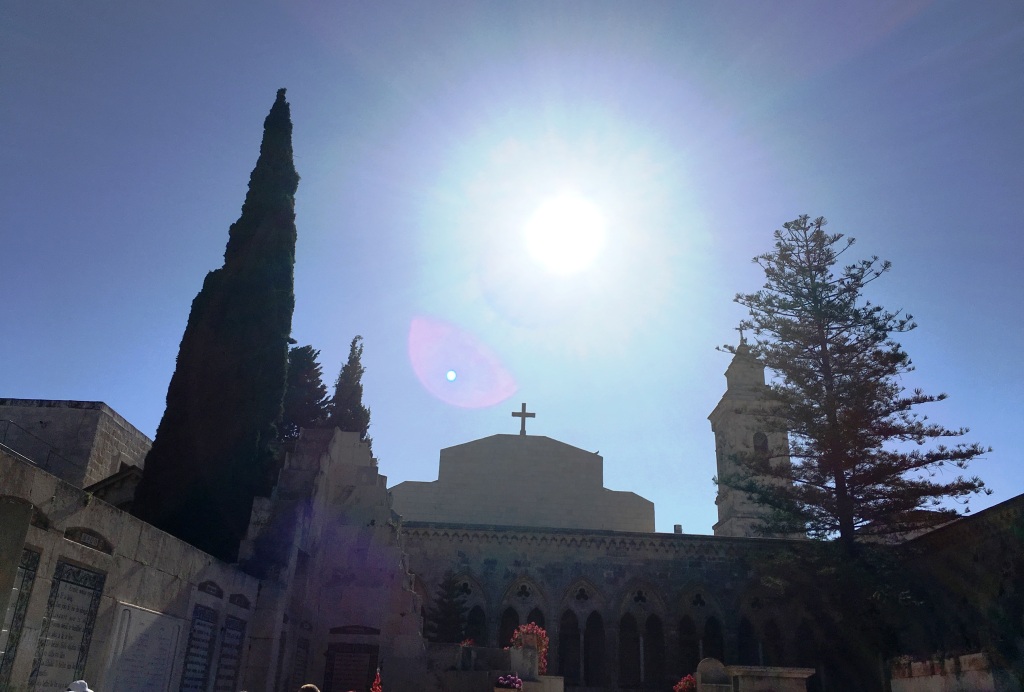
Photo by author, the “Our Father” Church at the Mount of Olives outside Jerusalem where Jesus taught his disciples to pray (2017).
Of the many things you have taught us, Lord Jesus, the “Our Father” remains one of the most enigmatic: on the surface it appears so simple but as we dwell and reflect on it, the more it becomes mysterious and fascinating as well that it is rightly called “the Lord’s Prayer”.
Today, I feel so touched, dear Jesus at how you have arranged the order of the prayer in the part of give and forgive:
Give us this day our daily bread; and forgive us our trespasses, as we forgive those who trespass against us;
Matthew 6:11-12
Give – forgive – forgive.
How amazing at how you have taught us to ask the Father to “give” us only once but asked to “forgive” twice! First to ask the Father to forgive us for our sins and second, that we may be like him to forgive those who sin against us.
There is also something very interesting with giving and forgiving, something deep in meaning and feeling: to give is so simple, as in to grant or bestow or simply, give. But, to forgive in itself is thought provoking, inviting everyone to an inner journey of meanings. Phonetically, it sounds like “four gives” as against just one “give”.
And this is where it gets so beautiful, Jesus: the word forgive is formed from the prefix fore that means first in order or rank or place or time like foreword, forewarn and forward.
We ask Father once only that he may give us our needs for he knows what is best for us.
But, we have to ask him twice to forgive — first that he forgive us for our sins so that we may also forgive others who sin against us.
Teaching them young how to pray (photo by Mr. Red Santiago, 2019).
There is something so deep in forgiving that inspired Shakespeare to write, “to err is human, to forgive is divine.” From the prefix fore, to forgive means to give something first even before you get anything in exchange for whatever you give. And that is what you have done for us, dear Jesus: giving yourself on the cross for us long before we asked forgiveness, long before we give our selves to you in repentance and conversion!
When we ask your forgiveness, what we actually do is claim that forgiveness you have given us without us asking for it!
Here lies the difficult part of the Our Father that makes us divine like you, Jesus: how do we imitate the Father of giving first forgiveness to those who have wronged us even if they have not come to us asking for forgiveness? It is indeed very difficult to follow for how can we give something first even if we have not received anything like a simple sorry in return?
How easy it is to ask you, Jesus, to give us grace to forgive but I think, what we must ask is for you to forgive us so we can forgive. How wonderful to realize that every time you forgive us, you actually give us something fourfold as in “four gives”.
Open our eyes, open our hearts to see this wonder and beauty of forgiving, of giving first even without receiving anything in exchange like the Father. Amen.
The Lord Is My Chef Sunday Music by Fr. Nick F. Lalog II, 21 February 2021
Rainbow appearing during our procession of the Blessed Sacrament last year during the first Sunday of lockdown, 22 March 2020. Photo by Ms. Anne Ramos, Parokya ni San Juan Apostol at Ebanghelista, Bagbaguin, Sta. Maria, Bulacan.
Rainbows are one of nature’s loveliest occurrence that remind us of God’s all-encompassing love for us despite our sinfulness. It is the most enduring and visible sign of God’s promise to love and keep us always despite our being-of-forgetfulness — forgetting God and others, forgetting our promises to be good, forgetting our loved ones.
On this First Sunday of Lent, we find how in the first reading God gave Noah the rainbow as a sign of his covenant to never destroy earth again after the great flood. Only Noah and his family along with the animals inside his ark survived the great flood that cleansed the world of sinfulness. It became the prefiguration of Jesus Christ coming to cleanse us of our sins to be able to lead holy lives anew amid the many temptations in life as seen in today’s gospel.
Jesus in the desert resisting temptations by Satan depicts how life really is, full of contrasts and struggles but always there is Christ helping us, comforting us, strengthening us like a rainbow after every storm.
Eventually on Good Friday when Jesus offered us himself on the cross, he became our rainbow in fact as seen in the shape of his outstretched arms.
And that is why we have chosen South Border’s 2003 hit Rainbow first heard for the movie Crying Ladies.
The song perfectly captures our reflection for this Sunday that life is a Lent, filled with so many contrasts like sufferings and joys, failures and victories, darkness and light.
Fallin’ out, fallin’ in Nothing’s sure in this world no, no Breakin’ out, breakin’ in Never knowin’ what lies ahead We can really never tell it all no, no, no
Say goodbye, say hello To a lover or friend Sometimes we Never could understand Why some things begin then just end We can really never tell it all no, no, no But oh, can’t you see That no matter what happens Life goes on and on So Oh baby, please smile Coz I’m always around you And i’ll make you see how beautiful Life is for you and me
Take a little time baby See the butterflies color’s Listen to the birds that were sent To sing for me and you Can you feel me This is such a wonderful place to be Even if there is pain now Everything would be all right For as long as the world still turns There will be night and day Can you hear me There’s a rainbow always after the rain
The lyrics of this OPM are so Lent, in fact, that you can replace the “rainbow” with Jesus who is our Eternal Rainbow amid all the storms of life. Amen.






 lordmychef.com