The Lord Is My Chef Daily Recipe for the Soul by Fr. Nicanor F. Lalog II
Monday in the Twenty-first Week of Ordinary Time, Year II, 26 August 2024
2 Thessalonians 1:1-5, 11-12     <*((((><  +  ><))))*>     Matthew 23:13-22
Photo by author, St. Scholastica Spirituality Center, Tagaytay City, 21 August 2024.
Thanks be to God,
our loving Father,
the month of August
is about to end,
always a difficult time
of the year for various reasons
that some have called it
a "ghost month";
of course, it is not true at all!
August is the month of so many
great saints and celebrations
that remind us of your presence
among us amid the many
hardships and difficulties.
We ought to thank you God always for you, brothers and sisters, as is fitting, because your faith flourishes ever more, and the love of every one of you for one another grows ever greater… This is evidence of the just judgment of God, so that you may be considered worthy of the kingdom of God for which you are suffering. We always pray for you, that our God may make you worthy of his calling and powerfully bring to fulfillment every good purpose and every effort of faith, that the name of our Lord Jesus Christ may be glorified in you, and you in him, in accord with the grace of our God and Lord Jesus Christ (2 Thessalonians 1:3, 5, 11-12).
Dear God our Father,
make us twice worthy like
the Thessalonians
in the midst of many trials this August:
to be worthy of the kingdom of God
who is Jesus Christ our Lord,
and to be worthy of your calling
in His most Holy Name;
many times, we have become
the modern scribes and Pharisees,
modern hypocrites who "lock the
Kingdom of heaven before men"
with so many of us, especially
in the clergy without any desires
at all of getting closer to Jesus
nor entering heaven!
Make us worthy of Jesus Christ,
the Kingdom of God
by embracing and carrying our cross,
of suffering with the people,
most especially praying
and sacrificing with the people.

Make us worthy of your calling,
dear Father to be your presence
among men and women in this
turbulent times when ironically,
as we advance in science and technology,
that more we grow apart from
each other and from our very selves.
Help us find our way back to You,
Father in Jesus Christ
through the Holy Spirit
with Mary and your Saints.
Amen.
Photo by author, St. Scholastica Spirituality Center, Tagaytay City, 21 August 2024.
The Lord Is My Chef Sunday Recipe for the Soul by Fr. Nicanor F. Lalog II
Eleventh Sunday in Ordinary Time, Cycle B, 16 June 2024
Ezekiel 17:22-24 ><}}}}*> 2 Corinthians 5:6-10 ><}}}}*> Mark 4:26-34
Photo by author, Camp John Hay, Baguio City, 12 July 2023.
While preparing this homily, I cannot resist thinking of this poem by Joyce Kilmer because of its similarities with the first reading from the Book of Ezekiel and partly with the parables of Jesus in the gospel.
Kilmer tells us in his poem that trees are God’s presence among us, a sign of His own majesty, a reminder of life’s mysteries, something many of us seem to have learned only recently after the scorching heat of last summer when everyone was posting on Facebook the need to plant trees!
I think that I shall never see
A poem lovely as a tree.
Photo by Dra. Mylene A. Santos, MD, April 2020 in Infanta, Quezon.
In the first reading, the Prophet Ezekiel picturesquely imagined how God would plant a great Lebanon cedar on a mountain as a sign of His divine intervention for our salvation that was eventually fulfilled in Jesus Christ’s coming.
Ezekiel lived during the Babylonian exile, the lowest point in life of Israelites when they did not have a country, nor a temple, not even a future. They felt abandoned, punished by God due to their sins; hence, Ezekiel was sent to give them hope. Through this beautiful allegory of the future Israel, Ezekiel tells his countrymen including us today how God would eventually intervene in a very personal manner to fulfill His promise of salvation.
Thus says the Lord God: I, too, will take from the crest of the cedar, from its topmost branches tear off a tender shoot, and plant it on a high and lofty mountain. It shall put forth branches and bear fruit, and become a majestic cedar. Birds of every kind shall dwell beneath it, every winged thing in the shade of its boughs. And all the trees of the field shall know that I, the Lord, bring low the high tree, lift high the lowly tree, wither up the green tree, and make the withered tree bloom. As I, the Lord, have spoken, so will I do.
Ezekiel 17:22-24
Photo by Dra. Mylene A. Santos, MD, April 2020 in Infanta, Quezon.
That beautiful imagery of the cedar tree planted in Israel reminds us that in whatever state of life we may be – whether we are like a tall or a lowly tree, a green or withered tree – it is always God who has the final say in life because He is the very reason for our existence.
Jesus declared to us in one of the Sundays of Easter, “I am the true vine and you are the branches…without me you cannot do anything” to show that more than a giver of life, He is life Himself because He is the tree planted firmly by God in our midst.
Incidentally, the word “tree” which is treowe in Old English is the root of the word true which connotes something firmly rooted, steadfast and faithful. From the same word treowe came trust because the roots of a tree signify relationships or interconnectedness. That is why the Anglo-Saxons have always traced their ancestors and family by using the diagram of a tree from which came our concept of “family tree” today.
How lovely to imagine that tree planted by God in our midst is Jesus Christ, “the Way, the Truth and the Life”, the One we must trust always!
Hence, Mark invites us today to listen more attentively to the Lord’s teachings, asking us to not just sit beside or around Him but try to “get inside” Him by taking into our hearts His words like Mary His Mother as we have reflected last Sunday.
Photo by Dra. Mylene A. Santos, MD, April 2020 in Infanta, Quezon.
Again, Mark surprises us in his story of Jesus teaching the people about seeds and plants, and ordinary activities like sowing we take for granted but so rich in meanings. That is what a parable is – a simple story with deep meanings about life.
Our life itself is a parable wherein we find the most profound realizations in the most ordinary things and events in our lives. And that is where Jesus Christ comes too often. He is in fact the kingdom of God He spoke so often in His teachings and parables.
Jesus said to the crowds: “This is how it is with the kingdom of God; it is as if a man were to scatter seed on the land and would sleep and rise night and day and through it all the seed would sprout and grow he knows not how (Mk.4:26-27).”
Mark 4:26-27
This parable of the seed growing by itself tells us of that reality of God living among us, right with us in Jesus Christ. The seed is His word germinating in us if we cultivate it daily in prayer and good works. Just like the fecundity of the tiny seed planted in the field, God grows in us beyond all our hopes and expectations because He is never absent nor distant from us.
Photo by Ms. April Oliveros on Mt. Pulag, 2023.
Look back in your life this past week or past month, examine how many times you were blessed, of how you were pulled out and saved from a dire situation in the nick of time. Surely you can offer a lot of rational explanations but, when you come to think of it, there’s always an “Invisible Hand” saving you, guiding you.
That’s the point of the parable of the seed planted without the farmer knowing how it grows: God works best in our lives in silence.
This is the reason why St. Paul tells us to “walk in faith, not by sight” (2Cor.5:7): our life is a journey of faith wherein we cannot see everything clearly, cannot appreciate right away the extent of how God works His miracles in us daily.
Yesterday we celebrated the 40th day of my mom’s passing then tomorrow, June 17, is her 85th birthday which is also the 24th death of my dad. I told my sisters and brother that maybe that is the reason why dad died on mom’s birthday 24 years ago: so that it would not be difficult for us to visit their graves on June 17. Isang lakad at punta na lang para matipid!
But kidding aside, though it is so difficult and painful to be ulilang lubos (orphaned), I still feel so positive more than a month after my mother’s death because in those 24 years when my father died, God never abandoned us. With mom’s passing, I’m sure God will never forsake us too.
When I look back at how many times God has blessed us in the past, I also see that soon in the future, if we remain faithful to Him, Christ shall unfold in us and around us in ways we never imagined.
Photo by Ms. Analyn Dela Torre, March 2024.
Time flies so fast indeed these days; we are almost done with the first half of the year. In a short while we shall be hearing Jose Mari Chan singing again “Christmas In Our Hearts” as the Christmas countdown begins even before September first.
And that’s what I have noticed these past 20 years: with all the comforts in life, we have become impatient that we rush everything, even Christmas and holidays. We live in a world of instants that we cannot wait anymore like the farmer in the parable of Jesus. Or the Prophet Ezekiel imagining God coming soon.
We don’t have to discard the modern amenities we have in life today for most of these are gifts from God Himself. However, we must remember these are not everything, that many times in life despite all our careful planning, things still do not turn out as we expect.
There is only one thing we can be sure of, Jesus Christ silently in our midst. Look at any tree around you, the many years it had weathered all kinds of storm and heat. Still standing, still green, reminding us of Jesus. Let us pray:
God our Father,
teach us to be patient
like the farmer who sows seeds
to his field, not knowing at all
how these germinate and grow;
teach us to be faithful to You
in Christ Jesus, always open
to find Him and embrace Him
in the ordinary things in life;
teach us to have more of You,
God in Jesus through prayers
and Sacraments,
to have more faith than gadgets,
more hope than instant gratifications
and more love than social media.
Amen.
The Lord Is My Chef Easter Recipe for the Soul by Fr. Nicanor F. Lalog II
Thursday in the Second Week of Easter, 11 April 2024
Acts 5:27-33     ><))))*> + <*(((((><     John 3:31-36
Photo by author, Bolinao, Pangasinan, April 2022.
Once again,
O Lord,
Your words
are very amusing today:
"For the one whom God sent
speaks the words of God.
He does not ration his gift
of the Spirit" (John 3:34).
It sounds so funny
yet so true, dear Jesus!
We not only ration the
Holy Spirit but we also
ration every good gift
You give us as if it would
run out, as if You would
stop blessing us,
as if You are not God.
Forgive us, Lord,
when we ration
especially Your love
to others, when we
do not realize that love
and life and every blessing
You give are meant to be
given and shared fully
with others.
“We gave you strict orders did we not, to stop teaching in that name. Yet you have filled Jerusalem with your teaching and want to bring this man’s blood upon us.”
Acts 5:28
Dearest Jesus,
fill us with courage
like Your Apostles
after Pentecost that
we too may give all
to fill the world
with Your Good News
of salvation
in You,
with You,
and through You!
Amen.
40 Shades of Lent by Fr. Nicanor F. Lalog II
Wednesday in the Second Week of Lent, 28 February 2024
Jeremiah 18:18-20     <*[[[[>< + + + ><]]]]*>     Matthew 20:17-28
Photo by author, Dominus Flevit Church in Jerusalem, 2017.
Lord God our Father,
your words today are too heavy,
so difficult to grasp
as they seem to be totally
unrelated with each other
until they showed me
a frightening reality -
that Lent is facing rejection,
of hearing our enemies
speak strongly against us.
The people of Judah and the citizens of Jerusalem said, “Come, let us contrive a plot against Jeremiah. It will not mean the loss of instruction from the priests nor of counsel from the wise nor of messages from the prophets. And so, let us destroy him by his own tongue; let us carefully note his every word.”
Jeremiah 18:18
Photo by author, near the Dead Sea, May 2017.
Like Jeremiah,
so many times
we have cried to you
his very same words,
"Must good be repaid
with evil that they should dig
a pit to take my life?"
(Jeremiah 18:20).
In the gospel today,
the other ten disciples
heard the mother of James
and John asking Jesus
to sit her sons on his right
and his left in his kingdom,
making them "indignant"
of their fellow disciples
baring their selfish plans
before their faces
to supersede them,
to outsmart them.
Photo by author, Benguet, 12 July 2023.
Many times,
O Lord,
it happens to us,
when before us
those we consider as friends,
as colleagues have motives
of getting ahead of us,
of dominating us,
of ruling over us.
It is painful and sickening
of how people are preoccupied
with themselves
like the enemies of Jeremiah
and the brothers James and John!
Remind us, Jesus,
that we only share
in your grace of being saved,
of being redeemed
as beloved children of the Father;
when we hear harsh,
nasty words against us;
when people are so hard
against us for whatever reasons;
when people compete with us
if there is no competition at all;
when we are face-to-face with rejections,
let us hold on more  to you,
Lord; in your kindness, save us!
Photo by Ms. Jo Villafuerte in Atok, Benguet, 01 September 2019.
Help me, Jesus,
to be your faithful servant,
called to serve not to be served;
called to ministry
not to me-nistry of popularity;
most of all,
let me be anchored in your Cross,
of being like you,
obedient to the Father
for his glory.
Amen.
The Lord Is My Chef Sunday Recipe for the Soul by Fr. Nicanor F. Lalog II
Fourth Sunday in Ordinary Time, Cycle B, 28 January 2024
Deuteronomy 18:15-20 ><}}}}*> 1 Corinthians 7:32-35 ><}}}}*> Mark 1:21-28
Photo by Dra. Mylene A. Santos, MD, an orange-bellied flowerpecker (Dicaeum trigonostigma) somewhere in the Visayas, December 2023.
The gospel makes us wonder anew this Sunday on the mystery of Jesus, on what was with his person and speech. Remember how we wondered the other Sunday on what he had told Andrew and his companion who “went and see” Jesus at his dwelling at “four in the afternoon” (Jn. 1:39) that they realized he was indeed the Messiah, the Christ.
Reading further in that portion of the fourth gospel, we find how Andrew and companion brought two others to Jesus, Simon Peter and Nathanael to become disciples too. This Sunday as we return to Mark’s gospel, the evangelist tells us the start of Jesus Christ’s public ministry on a sabbath in the synagogue of Capernaum with his first four “fishers of men”:
Then they came to Capernaum, and on the sabbath Jesus entered the synagogue and taught. The people were astonished at his teaching, for he taught them as one having authority and not as the scribes.
Mark 1:21-22
Photo by author of ruins of parts of the synagogue at Capernaum where Jesus taught, May 2017.
Every time we hear the word “authority” especially among us Filipinos, it often evokes the sense of power, of superiority over persons and things. In Tagalog, we translate it as “power” or kapangyarihan, kakayanan mapangyari ano mang bagay.
But, Jesus is now telling us something deeper about true authority. People compared his kind of authority with their scribes, men of power and authority in their time along with the priests and Pharisees who were considered experts in scriptures being learned men, highly regarded and feared. Their authority flowed only from their position and name, from the outside and not from within.
Jesus shows us today that real authority flows from within, from a person’s inner self, from one’s heart, not from designations nor positions. True authority is felt even without the titles nor any forms of externalities. True authority comes from people who “walk their talk” so to speak.
Photo by author, tourists and pilgrims at the ruins of the synagogue at Capernaum where Jesus taught, May 2017.
People of true authority “actualize” their words and their thoughts, making them a “reality” that everyone not just notices but even feels their authority. True authority creates a certain sense of aura, of positive vibes (arrive or “dating”) and a lot of mysteries that even in just reading Mark’s account of Jesus in the synagogue, we too could feel it and be astonished with the people there 2000 years ago!
What is most amazing here is that Mark did not tell us what Jesus spoke of nor what he taught nor even described how he spoke. What was so unheard of from Jesus that people and even us today are astonished with his words?
Keep in mind how Mark narrated this scene in the context of the synagogue on a sabbath – a beautiful reminder to us of Jesus continuing the Jewish tradition that had come into fulfillment in him. Recall also that at the start of Mark’s gospel After John had been arrested, Jesus came to Galilee proclaiming the gospel of God: ”This is the time of fulfillment. The kingdom of God is at hand. Repent, and believe in the gospel” (Mk.1:14-15).
Photo by author in May 2019 of a signage at the entrance of the ruins of the synagogue in Capernaum where Jesus taught more than 2000 years ago.
In the synagogue, Jesus continued this preaching. He claimed what he proclaimed for he is in fact – his very person – is the kingdom of God who had come as we reflected last Sunday.
People felt God in him as he spoke, very similar with the experience of the chosen people in the wilderness with Moses in the first reading. There in the synagogue on that sabbath day, Mark presents to us how Jesus is indeed the “Word who became flesh” that people felt God in him because he claimed what he proclaimed. As the first reading from Deuteronomy reminds today, the surest criterion for recognizing a prophet is being a spokesperson of God like Moses now fulfilled in Jesus Christ.
We all share in this prophetic ministry of Christ when we were baptized but, are we rooted in God’s words that we speak only God’s words like Jesus?
Can we claim what we proclaim that after celebrating the Sunday Mass, people experience Christ’s authority within us when we go home and go back to work and school because we actualize, we make God real in ourselves in our words and deeds?
How sad that we – especially us your priests – speak more of our selves and of the world, making the Mass a videoke and a variety show rolled into one that God is hardly felt by the people except be entertained.
The second time Mark mentioned the people being amazed with Jesus in his speaking with authority in the synagogue on that sabbath day was when he exorcised a man with an unclean spirit.
In their synagogue was a man with an unclean spirit… Jesus rebuked him and… And the unclean spirit convulsed him and with a loud voice came out of him. All were amazed and asked one another, “What is this? A new teaching with authority. He commands even the unclean spirits and they obey him.” His fame spread everywhere throughout the whole region of Galilee.
Mark 1:23, 25, 26-28
The surest sign of God speaking through us or anyone is when healing and repentance happen just like in the synagogue on that sabbath day. Notice how Mark recorded the words of the people about Jesus, “A new teaching with authority.”
In John’s gospel during the Last Supper we heard Jesus telling his disciples about his new command or teaching too which is to “love one another as I have loved you” (13:34).
True authority is about love and healing, kindness and compassion, mercy and forgiveness. Definitely not about subjugation nor manipulation nor use of force as we always experience from those with authority who display their powers and literally throw their weight around even amid heavy traffic with their security escorts blaring with sirens.
People were amazed at Jesus in healing the man with unclean spirit and called it a new teaching with authority because they felt God present among them because there was healing and exorcism which only God can do.
Most of all, the people in the synagogue felt God with them because Jesus was one of them unlike the scribes and other people of authority who were above them, detached from them.
The same thing is most true with us these days. Whatever authority we have is to help and comfort people, not to scare them nor burden them. We are most moved by people in authority – whether at home or in school, at work or in the community and in the church – when they are kind and approachable, caring and understanding.
Photo by author at the shore of the Lake of Galilee in Capernaum, Israel, May 2017.
Jesus teaches us today that true authority is making God present in us by offering comfort and consolation to those suffering like the poor and the weak who merely survive as they try to make ends meet daily.
True authority is being prophetic, making God and his words our very own, becoming ourselves his presence and his healing hands with our loving service to everyone, offering hope and inspiration to those down in sins and miseries.
True authority leads to salvation and liberation from sins. This begins with our communion in God through Jesus Christ in our personal and communal prayers, especially the Sunday Mass.
We are all blessed with the same kind of authority of Jesus Christ. Let us claim it by being free from all anxieties in this life (second reading) by joining Jesus in his journeys like the four disciples with him in the synagogue in Capernaum. Amen. Have a blessed week ahead.
The Lord Is My Chef Sunday Recipe for the Soul by Fr. Nicanor F. Lalog II
Feast of the Sto. Niño, Cycle B, 21 January 2024
Isaiah 9:1-6 ><}}}*> Ephesians 1:3-6, 15-18 ><}}}*> Mark 10:13-16
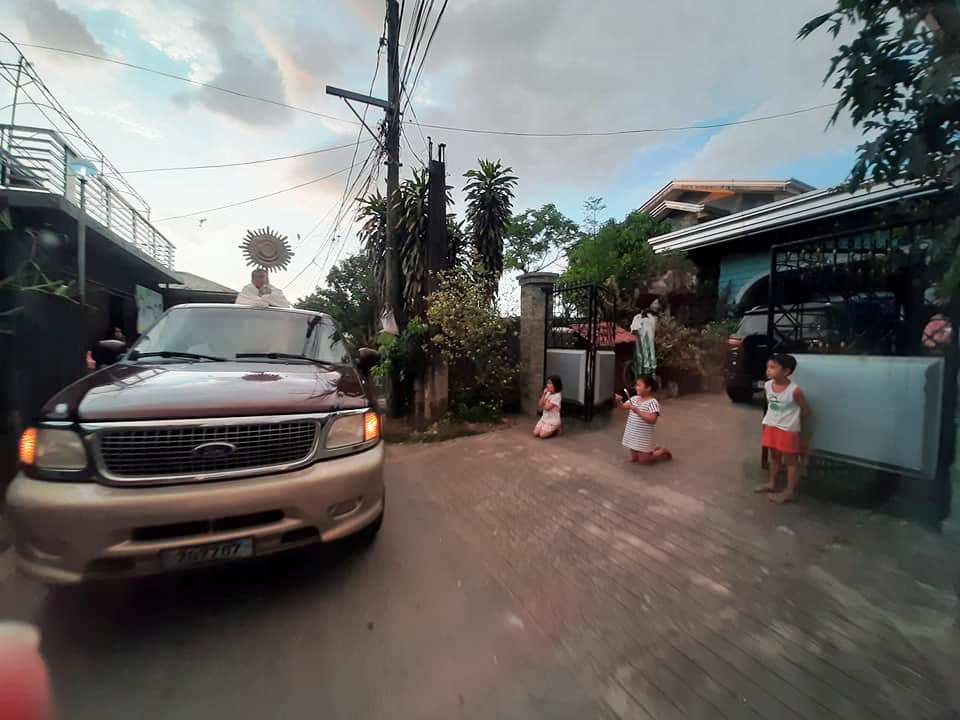
Photo by Ms. Anne Ramos, 22 March 2020 in Bagbaguin, Sta. Maria,Bulacan during our “libot” of the Blessed Sacrament at the start of the COVID-19 lockdown.
Our Lord Jesus Christ’s attitude to children is perfectly clear in our gospel this Sunday, “Let the children come to me; do not prevent them, for the kingdom of God belongs to such as these. Amen, I say to you, whoever does not accept the kingdom of God like a child will not enter it” (Mk 10:15).
Being like a child is actually the main teaching of Jesus Christ who came to us precisely as one. Right at his infancy like most babies these days, Jesus faced a lot of great risks of being harmed or even getting killed.
See how Jesus insisted in all his teachings on this need to become like a child, to go back to one’s beginnings in order to get into God’s kingdom which is actually him, his very person. Keep in mind that the kingdom of God is not a territorial domain but the very person of Jesus Christ himself. It is from this fact we realize that being a child as taught by Jesus is a mystery that can never be explained nor solved in our minds and mental faculties. This we find in that occasion when Nicodemus, a Pharisee, came to Jesus hiding in the darkness of the night to discuss the kingdom of God. When Jesus told him of the need to be born from above (or, be born again in earlier translations) which is to become like a child, he thought it to be in the literal manner.
Jesus chided Nicodemus by saying, “You are the teacher of Israel and you do not understand this?” (Jn. 3:9-10). It was not sarcasm nor an insult by Jesus but a clarification to everyone including us today that being a child to enter the kingdom of God is a mystery we have to embrace and experience and feel in the heart not deduced in the mind.
And this is exactly what the Feast of the Sto. Niño is all about that we celebrate every third Sunday in January.
The Vatican has given us this special celebration as an extension of the Christmas season in recognition of the great role played by the image of Sto. Niño Magellan gifted Queen Juana of Cebu in 1521.
After leaving our shores after Magellan was killed in Mactan, the Spaniards returned in 1565 under Miguel Lopez de Legazpi to claim our islands for the King of Spain. Upon their arrival in Cebu, they found the Sto. Niño enshrined in a house of worship prominently displayed as the main God of the natives along with their other idols and gods. Historians say the people of Cebu during those years between 1521 to 1565 have found the Sto. Niño as the most powerful and effective in granting their prayers for children (fertility), rains and bountiful harvests that rightly it was the Sto. Niño who actually conquered the Philippines that we have become the only Christian nation in this part of the world. In those 44 years after Magellan and his men left the Philippines, the Sto. Niño had remained and stayed with the natives keeping them safe and secured all those years until the Spaniards returned to be colonized through Legazpi.
What a beautiful imagery of the Sto. Niño staying behind with our forefathers conquering them not with swords nor force but with love and mercy, and youthfulness of the Child Jesus!
Recall how last Sunday we have reflected the words stay and remain when Andrew asked Jesus where he was staying: to stay, to dwell mean more than its spatial nature as a place or location but also in a deeper sense, a communion. It is in dwelling in Jesus who is the kingdom of God that we belong, we become a part of that kingdom.
When Jesus spoke of “being born from above” to Nicodemus, he was not only referring to the Sacrament of Baptism but to the very fact how he as the Christ from the very start has always dwelled and remained in the Father.
Three days after being found in the temple in Jerusalem when Jesus was 12 years old, he told Mary his Mother, “Why were you looking for me? Did you not know that I must be in my Father’s house?”(Lk.2:49). What a beautiful expression of that union in “being in my Father’s house” to show us this mystery of Jesus being like a child, the Son of God who has remained the Father’s beloved One into his adulthood because he had always been in union with the Father. Jesus is inseparable from the Father because he himself takes abode and dwelling in God.
“The Finding of the Savior at the Temple” painting by William Holman Hunt (1860) from en.wikipedia.org.
When Jesus was approaching his Passion and Death, he repeatedly told everyone how everything he had said and done were not his but his Father’s to indicate his communion and union in him. Ultimately there on the Cross, his final words expressed the same truth that he is the Son of God obedient unto death especially when he called out, “Father, into your hands I commend my spirit” (Lk.23:46).
Therefore, to accept and welcome a child in Jesus’ name is not just an act of charity nor of a simple finding of Jesus among children. It is ultimately being one, of remaining in the Father because Jesus also said “whoever welcomes such a child in my name, welcomes me” (Mt 18:5).
Photo by author, 2022.
That is why the kingdom of God is for those who are like children always one with God like Jesus.
To be a child is to remain in God, to always love expressed in kindness and care for others especially the weak, being forgiving and merciful and compassionate with those lost like the Father.
To be like a child is being a light who brightens the life of others just like a babies whose very sight and smiles can ease our pains and sorrows, giving us the much needed boost to forge on in life. We are filled with hope whenever we encounter or see infants because they remind us too of God dwelling in them, of a God who assures and ensures us with s bright future.
This the reason we have in our first reading that part of the Book of Isaiah we heard proclaimed on Christmas day to remind us that Jesus is the light born on the darkest night of the year to illumine our lives and the world darkened by sins and evil like wars, poverty, and diseases. We see light in being like a child because that is when we are one in the Father too in being like a child.
Let me cite again that beautiful movie Firefly where the main character, the child named Tonton loved his mother so much that he totally believed her stories that sent him into a journey to search for the magical island filled with fireflies. Tonton dwelled in his mother’s love that he eventually found the magical island with the many fireflies that in the process also brought light into the darkness within the three adults he befriended in the bus going to Bicol.
Many times in my ministry as chaplain in our hospital, I have seen the great powers within every child – of how a sick baby, a sick child could send his/her parents to summon all their faith in God to heal them, to save them.
Listen to the stories of those who join the Traslacion every year in Quiapo: most of them had their panata borne out of answered prayers for their sick children. Every parent knows it so well how they have moved mountains and did the most extraordinary for the sake of their infants and children.
That is the mystery of the kingdom of God belonging to children when God gives us every spiritual blessing we need to achieve the impossible (second reading) to become like children by remaining in God as the only power and salvation in this life.
Be with a child, stay with a child and you shall find God’s kingdom.
Be like a child and you shall experience the kingdom of God! Amen. Have a blessed week ahead!
The Lord Is My Chef Daily Recipe for the Soul by Fr. Nicanor F. Lalog II
Monday in Thirtieth Week in Ordinary Time, Year I, 30 October 2023
Romans 8:12-17   <*((((><  +  ><))))*>   Luke 13:10-17
Photo by author in Bolinao, Pangasinan, April 2022.
God our Father,
it is again elections day
in our country when we give
to Caesar what is due to Caesar
but let us not forget to give what
is due to you, our Lord and God
which is our heart,
our soul,
our mind.

Let us live in the Spirit
your Son Jesus Christ had
given us so that we live
in solidarity with you
not in solidarity with
old humanity of sin
St. Paul told the Romans
(Romans 8:12-17).
Like that bent woman healed
by Jesus in the gospel today,
let us stand straight for
what is right and true,
good and holy;
teach us to live in
the Holy Spirit as your
true children also heirs of
the kingdom of heaven
empowered by your Spirit
as we strive to build a more
humane and just society
in this imperfect world.

Let our love for you
O God, flow in our love
for one another and
for our country
by putting into office
men and women who are
selfless, not selfish;
honorable and just,
honest and true
who will pursue what
is good for everyone
especially the weak
and the poor.
Amen.
The Lord Is My Chef Sunday Recipe for the Soul by Fr. Nicanor F. Lalog II
Twenty-Ninth Sunday in Ordinary Time, Cycle A, 22 October 2023
Isaiah 45:1, 4-6 ><}}}}*> 1 Thessalonians 1:1-5 ><}}}}*> Matthew 22:15-21
Photo by author, Jerusalem, May 2017.
We are now getting closer toward the end of our liturgical calendar with our gospel scenes of Jesus still at the temple area in Jerusalem where his enemies were growing more intense in banding together to trap him for his arrest and crucifixion.
Many times, that same die-hard religious conceptions of the Lord’s enemies continue to distort our way of Christian living today. First of these is the apparent division between the realms of the world or Caesar and of God and his kingdom.
The Pharisees went off and plotted how they might entrap Jesus in speech. They sent their disciples to him with the Herodians saying, “Tell us, then, what is your opinion: Is it lawful to pay the census tax to Caesar or not?” Knowing their malice, Jesus said, “Why are you testing me, you hypocrites? Show me the coin that pays the census tax.” Then they handed him the Roman coin. He said to them, “Whose image is this and whose inscription?” They replied, “Caesar’s.” At that he said to them, “Then repay to Caesar what belongs to Caesar and to God what belongs to God.”
Matthew 22:15-16, 17-21
Photo by Lauren DeCicca/Getty Images in Laoag City, 08 May 2022.
It’s election fever again in the country (does it ever end?) when talks on the separation of the Church and the state abound in every corner of campaigns and discussions. What is very funny is despite everyone’s insistence of such separation, candidates keep on going to every church and chapel of all faith to meet their religious leaders and followers who in turn endorse some of them!
Then and now, the division was more clearly in our hearts than in religion and political life. Despite everyone’s endless quoting of the Lord’s declaration to “repay to Caesar what belongs to Caesar and to God what belongs to God”, we remain more divided as a people and individuals right in our hearts where the first casualty is Jesus Christ. Then us and our loved ones.
The way of God as Jesus had shown and taught us is not found in opposing civil and religious or spiritual realms of life but in giving ourselves for the good of others in all areas of life, first to God and everything follows. Jesus Christ came to the word to heal our divided hearts, to make us whole again (and be holy) by showing us how we are all one in God, our origin and end. St. Francis of Assisi saw this unity of God’s creation and was so central in his life and teachings that he was able to literally live out the gospel values of both material and spiritual poverty.
Photo by author, Jerusalem, May 2017.
There are no divisions between the material world and the spiritual world because everything is created by God, came from God and will ultimately end in God. “Caesar” is everything of the world we so often give more emphasis in life, more attention and more focus. Primary is our own self as we consciously and unconsciously stamp with the image and inscription of “Caesar” as we try to hide and remove God’s image in us.
See how Jesus in many instances did not bother himself with our worldly affairs like being a judge to divide the share of inheritance of feuding brothers (Lk. 12:13-15) or of James and John asking him to have them seated at his sides when his glory comes (Mk. 10:35-45) because those things separate us from God and each other.
One tragedy of Christ’s time that continues today is when we the supposed religious leaders and guides are divided within each of us, so concerned with our own pride and other priorities in life like fame and wealth. Forgive us your priests and bishops whose lifestyle and way of relating to others betray like the Pharisees who and what is first in our lives.
Keep in mind how the Pharisees were not supposed to have anything that bears semblances of idolatry in the temple area like the Roman coin with image and inscription of the Caesar considered as god and emperor by the Romans. We priests and bishops still have that “Roman coin” today in the form of social media especially Facebook that show and prove more than ever how we are a church for the rich and not of the poor no matter what the gospel and documents say. What a scandal of our time to find priests and bishops shamelessly posted on social media always present, readily available especially for funeral Masses of the rich but never or so rare with the poor! These only prove to the people of the existence of the great divide among us Jesus had supposedly healed more than 2000 years when churchmen continue to play these days the very game of the Pharisees, scribes, chief priests and elders of Christ’s time.
Photo by author, Jerusalem, May 2017.
When we examine world history, it has actually felt easier for us to divide our lives into the material and spiritual realms by giving what is due and proper to each one. This has been the way of the world especially in the past 300 years at the start of the Industrial Revolution that resulted in so many inventions and scientific breakthroughs that have spawned various thoughts and philosophies.
On the outside or in the realm of Caesar, we seem to be better with more technologies and affluence but as persons, we have remained lost and more hurting inside that drive many into suicides and depression. How ironic when we are supposed to be better, crimes against human persons get worst these days with wars and atrocities still happening. Life may had drastically improved especially in the fields of medicine and communications but the gaps among us peoples have grown wider especially these last 20 years known as the “Fourth Industrial Revolution” characterized by digitization and robotics that include Artificial Intelligence or AI. Like in the parable of the wicked tenants, we have usurped everything from God, even our very lives and the world itself.
Of course, the obligations to Caesar and to God are radically different: to the state we pay taxes, but to God we give our undivided hearts, our total being. This is what Isaiah told us in the first reading that everything in history is directed by God for the good of his people. He is the God of history. Let no one mistake any god for God because “I am the Lord, there is no other” (Is.45:6).
When Jesus asked his enemies to show him the coin that pays the census taxes, he is also asking us this Sunday to bare our hearts before him to let him heal us of the divisions within that are reflected by the many wars and divisions in the world. The deepest divide within us in this time is when we live and act like the Pharisees and Herodians with insincere hearts living a big lie of living in “accordance with the truth” (Mt. 22:16).
Let me end this reflection with those beautiful words by St. Paul in our second reading today:
We give thanks to God always for all of you, remembering you in our prayers, unceasingly calling to mind your work of faith and labor of love and endurance in hope of our Lord Jesus Christ, before our God and Father, knowing, brothers and sisters oved by God, how you were chosen. For our gospel did not come to you in word alone, but also in power and in the Holy Spirit and with much conviction.
1 Thessalonians 1:2-5
Photo by author, Church of St. Anne in Jerusalem, May 2017.
So lovely! St. Paul is also talking to us today, assuring us how despite our many sins, of being slaves of Caesar and other gods like the Thessalonians who were pagans before, we too were willed by God to be called as his children in Jesus Christ.
We in the Church are a people despite our many flaws and imperfections especially us your priests were called out of sin and darkness to be God’s own people, beloved children. He has given us life in the Holy Spirit that when we look back in our lives, we are convinced in our hearts it was him who worked in us in the realm of material world. God has always been the “invisible hand” leading us when we felt so down and lost, defeated and almost dead. Here we are, still alive and forging on amid the many difficulties we encounter within and outside us.
When we cooperate with the grace of God and focus more on him than to the many Caesars, when we live in faith in Christ, laboring in his love for others, God becomes more present in our material world, enabling us to endure further life’s challenges in hopes that Jesus Christ will come again. Amen. Have a blessed week ahead.
The Lord Is My Chef Sunday Recipe for the Soul by Fr. Nicanor F. Lalog II
Twenty-Eighth Sunday in Ordinary Time, Cycle A, 15 October 2023
Isaiah 25:6-10 ><}}}}*> Philippians 4:12-14, 19-20 ><}}}}*> Matthew 22:1-14
Photo by Mr. Jay Javier in Taal, Batangas, 15 February 2014.
I grew up in a generation when dressing properly – meaning, decently – was deeply inculcated both at home and the school. It has always been considered in our time as a sign of maturity when we come properly attired in every occasion.
Now, those days are gone along with the expression “Sunday’s best” when sneakers are paired with formal suits and worn even in weddings! Dressing has become so relative with total disregard for basic fashion sense and worst of all, without any sense of propriety at all in the name of personal comfort and style as well as individuality. That culture on “liberal” or “liberated” dressing has encroached into the church with priests refusing to wear the proper garments and dress as required by Code of Canon law. How ironic that while the lay people appreciate us priests dressed properly for the liturgy and ministry, the harshest insults and negative reactions against it come from some priests who argue using the hot weather as an excuse. Many priests have subscribed to the lame excuse of people that clothes do not make us who we are, that there is much more beneath the clothing we wear of who we really are.
True but not absolutely because what we wear, how we look outside is indicative of who we are, what we value, what we believe in. Dress speaks a lot about ourselves whether we like it or not as the Lord’s parable this Sunday teaches us.
The servants went out into the streets and gathered all they found, bad and good alike, and the hall was filled with guests. But when the king came in to meet the guests he saw a man there not dressed in a wedding garment. He said to him, ‘My friend, how is it that you came in here without a wedding garment?’ But he was reduced to silence. Then the king said to his attendants, ‘Bind his hands and feet, and cast him into the darkness outside, where there will be wailing and grinding of teeth.’ Many are invited, but few are chosen.”
Matthew 22:11-14
Photo by Fr. RA Valmadrid, National Shrine of Our Lady of Fatima, 13 October 2023.
We now come to the third and final series of parables addressed by Jesus Christ directly to his enemies, the chief priests and elders of the people while teaching at the temple area in Jerusalem to underscore to them the need to reform their lives and be converted to his good news of salvation like the tax collectors and prostitutes.
See how in today’s parable some semblances with the parables of the two sons and wicked tenants of the past two weeks to show us God’s loving patience in doing everything to make us come to him like the subjects of the king with all the chances to come to his son’s wedding banquet.
And like with the parables of the past two Sundays, Matthew makes again a crucial twist in today’s parable that can be sufficiently ended in that part when the king was enraged by the continued refusal of his guests to come to his son’s wedding banquet that he ordered them all killed and instead extended his invitation to everyone in the streets.
The wedding banquet is heaven like the vineyard in the parables of the past two Sundays.
But it is not only referring to heaven at the end of time but also speaks so well of the here and now – the present life we live as citizens of the kingdom of God in Jesus Christ. Rejecting the invitation to come to the meal which as an expression of our citizenship in God’s kingdom is an act of disloyalty and treason against him.
Photo by Arch. Philip Santiago, Hearts of Jesus and Mary parish, Malolos City, 2022.
When we were baptized, we became citizens of the kingdom of God. We do our “pledge of allegiance” to God as his citizens every time we pray and most especially celebrate Mass which is just half of the whole deal of being citizens of his kingdom! Like in being Filipinos or whatever nationality we have, we must live up to our citizenship in God’s kingdom by being good and holy. That is the wedding dress referred to in the parable, the life we lead as children and citizens of God and his kingdom.
Jesus invites us today to face squarely the uncomfortable issues that prevent us from being his good and faithful disciples and citizens of God’s kingdom. Many times we are like those invited guests in the parable who allowed something else in their lives like their wealth and possession, businesses and worldly pursuits become more important than their allegiance to the King. Every time we sin, every time we skip the Sunday Mass, that is when we have our new God and King that may be our very selves, gadgets, vices, or the malls we frequent more than the church!
Here we find a deepening in Jesus Christ’s invitation to conversion into conforming our lives into him. St. Paul made a lot of beautiful imageries of “putting on Jesus Christ” as our new clothes and garment which we have retained in the Rite of Baptism when the newly baptized is clothed with the white dress. See how the man caught by the king fell silent when confronted because there was no excuse at all at not wearing the wedding dress in the banquet. The same thing is true with us today. We have no excuse for not being dressed, for not being conformed in Jesus Christ in our lives as his disciples. Everyday he gives us the opportunities of being conformed to him through our daily conversions through prayers and good works. God does not expect us to wear extravagant nor expensive clothes for his wedding banquet; just a clean and decent clothes are enough. Nobody is perfect.
Photo by Dra. Mylene A. Santos, MD at Tagalag, Valenzuela City, 13 September 2023.
One of the things I used to enjoy in my school and seminary days were joining stage plays. Yes, I love acting but I just don’t know if acting (and singing) love me. Nonetheless, one of our most dreaded moments before the actual play was always the dress rehearsal when everything is considered as the “real thing”, the real play as our teaches and nuns have insisted when we were supposed to have memorized our lines and cues.
But, as I grew and matured, I realized that life is not a dress rehearsal at all; each day is an actual “play”, a “live” presentation where we must “perform” or “act” so well. Yes, we are all required to memorize our lines and cues in life but many times, we forget them. Nobody is perfect. And here lies the immense love and kindness of God to us: he allows us to improvise for our selves in case we have forgotten our lines just like those people instantly invited to the wedding banquet of the King’s son. They were able to improvise to make it to the banquet hall except for that one who came not dressed for the occasion. He was silent because he was so lazy to improvise, to find ways like the chief priests and elders in the time of the Lord. Until now, many of us make a lot of excuses and alibis for not being conformed in Christ, from the ordinary excuse of being “difficult” to the most absurd that “I am only human” or tao lamang, mahina at marupok. Keep in mind St. Paul’s words in the second reading, “I can do all things in him who strengthens me… My God will supply whatever you need, in accord with his glorious riches in Christ Jesus” (Phil.4:13, 19).
Photo by Ka Ruben, National Shrine of Our Lady of Fatima, 2022.
Every Sunday we are invited to celebrate with others the coming of Jesus and the salvation he has won for us. This wedding banquet is the Sunday Mass we celebrate, a fulfillment of the first reading from Isaiah of that mountain where “the Lord of hosts will provide for all peoples a feast of rich food and choice wines, juicy, rich food and pure, choice wines” (Is. 25:6). In the Holy Eucharist, we have the choicest food and drinks – the Body and Blood of Jesus Christ – given to us to nourish us and keep us strong in this journey of life into eternity in heaven with the Father.
How amazing that nothing is really imposed upon us in coming to this banquet of the Lord in the Eucharist that is totally free of charge except that we have to come properly dressed on the inside, of being conformed in him.
But please, let’s get dressed also on the outside. No need to wear expensive and beautiful clothes. Just proper and clean ones are more than enough. A good rule of thumb we can rely on is this: God has blessed me tremendously this week and I am coming to celebrate with him, for him. How do I look to to express to him my gratitude and appreciation to his wondrous gifts? Amen. It is a Sunday, go to Mass!
The Lord Is My Chef Sunday Recipe for the Soul by Fr. Nicanor F. Lalog II
Sunday in the Twenty-fifth Week in Ordinary Time, Cycle A, 24 September 2023
Isaiah 55:6-9 ><}}}}*> Philippians 1:20-24, 27 ><}}}}*> Matthew 20:1-16
Photo by author, Church of Dominus Flevit, Jerusalem, May 2017.
We now come to the final installment in the series of teachings by Jesus Christ of what we described as delicate issues affecting even us today. Two Sundays ago it was about fraternal correction, last week was forgiving, and today, something about work and pay that are indeed very delicate for many of us, even ticklish.
Recall that love is the main motivation why we must correct those who sin and go wayward in life. It is also love that moves us to forgive those who repeatedly sin against us.
In today’s parable of the workers in the vineyard, Jesus is also teaching us about love that results when we learn to be just and generous with others because these two are the minimum requirements of love. It is in our field of work and in the issues of pay and wages when our being Christians are most tested when our senses of justice and generosity are blurred and worst, when we even forget God.
Photo by author, 2018, Davao City.
Like last Sunday, Jesus used another parable today to use a simple story of daily life that appeals to our common experiences. What is very interesting is how both parables of the Lord incited hearers to take sides and adopt positions. Last Sunday we too felt indignant against that servant who was forgiven of his loan so huge but could not let go of the debts of his fellow worker that was so little in amount.
But today’s parable has a different twist that we felt swept off by our feet when Jesus through the landowner reacted differently at the grumbling of those workers who worked longer in the vineyard and received same amount with those who worked for less hours yet paid equally.
“When those who have started about five o’clock came, each received the usual daily wage. So when the first came, they thought that they would receive more, but each of them also got the usual wage. And receiving it they grumbled against the landowner, saying, ‘These last workers worked only one hour, and you have made them equal to us, who bore the day’s burden and the heat. He said to one of them in reply, ‘My friend, I am not cheating you. Did you not agree with me for the usual daily wage? Take what is yours and go. What if I wish to give this last one the same as you? Or am I not free to do as I wish with my own money? Are you envious because I am generous?'”
Matthew 20:9-16
Did we not feel surprised, even shocked? Did anyone cry unfair? How could the landowner – God – pay everyone the same amount when others worked so less than the rest?
How sad that when talks are about work and pay, we always insist on justice, especially if we feel the ones shortchanged. And worst, we used it also as our norm for salvation, for entering heaven with some openly declaring who would go to heaven and who would not!
And that is actually the context of the parable when Jesus said “The kingdom of heaven is like a landowner who went out at dawn to hire laborers for his vineyard” (Mt.20:1). This is not just about social justice and just wages but about the goodness of God. The vineyard is God, and heaven. Our salvation. Harvest time means judgment day as well as gathering of everyone in God to receive his blessings of love and salvation, healing and forgiveness.
Jesus Christ came to us like that landowner who never stopped looking and searching for us especially those lost and sinful. Truly a God so loving and merciful, he wants us all saved that as early as dawn and as late as 5 o’clock in the afternoon, he kept looking for workers to be blessed, to have something to bring home and share with their families and loved ones at the end of the day. What a beautiful imagery of God our Father who sent us his Son Jesus Christ so we could all come to him. Here we find the previous two parables still operating in the full sense wherein the landowner’s search for more workers into his vineyard was like Christ’s mandate for us to correct and forgive those who sin.
Photo by author, Church of St. Anne in Jerusalem, May 2017.
This Sunday, Jesus is telling us that each one of us is so loved by God who is overly generous, blessing us with everything we need, giving us all the chances in life to become better.
Therefore, let there be no room among us to own and box God and his blessings! Let us not usurp God’s power and generosity for others. We are all his children. Let no one assume to one’s self that he/she is more worthy to God nor he/she is more entitled much less a favorite of God! Please. Especially those who claim only they would enter heaven?
Today, Jesus is telling us we are all his servants, we are all his workers in his vineyard. Those workers hired at dawn were given a job because God is good. From his kindness, he gave them a silver coin for their wage. It is the same good and loving, kind and generous God who hired the other workers at 9am, noon, 3pm and 5pm with the usual salary. Therefore, it is very wrong for those hired at dawn – for anyone of us today – to complain to God of not receiving more than the others just because we have served longer than them. We have no right at all to command and direct God how he must give or dispense his blessings because whatever we receive from him is out of his goodness and never of our own merit.
Moreover, those workers hired at dawn should actually be grateful to God in giving them work while at the same time rejoice too that God had called others later to receive a decent pay to bring home. Here we find a similarity in the attitude of the elder brother in the parable of the prodigal son who also complained to their father the party thrown for the return of his younger brother (Lk.15:11-32).
We are all workers in the Lord’s vineyard, God’s beloved and forgiven children. What kind of workers, or children of God, are we then?
May we always remember St. Paul’s admonition two Sundays ago to “Owe nothing to anyone, except to love one another” (Rom.13:8). Like in the previous two Sundays, Jesus is inviting us today to imitate him and his ways, to shift_ our existence, our views, our person into higher levels in him, with him and through him. It is the same reminder by Isaiah in the first reading that we must let go of our human ways and thoughts to trust in God’s wisdom always. There are times emotions can run high with us sometimes especially when it comes to remunerations, whether material or spiritual but like the Philippians, we must trust that ultimately, everything in this life is the work of God, even the success of Christ’s gospel. All we need to do is trust in him, be like Jesus, merciful and forgiving. Most of all, generous and loving. Amen. Have a blessed new week!
From Facebook, Easter 2021: “There is an urgency to announce the joy of the Risen Lord.”




















 lordmychef.com