Lawiswis ng Salita ni P. Nicanor F. Lalog II, Ika-23 ng Marso 2020
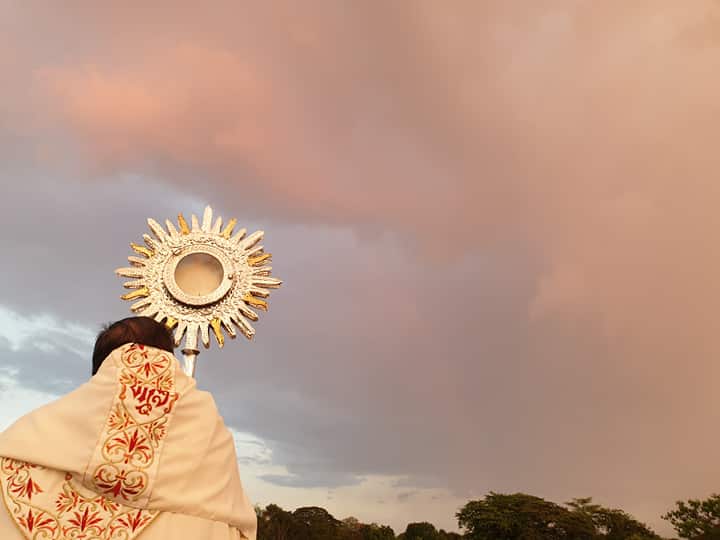
Larawan kuha ni Bb. Ria De Vera, Parokya ni San Juan Apostol at Ebanghelista, Bagbaguin, Santa Maria, Bulacan (22 Marso 2020).
Kahapon aking ipinagdiwang
ika-limamput-limang taon
ng kapanganakan sa
gitna nitong lockdown.
Wala akong inaasahang pagdiriwang
o ano mang kasiyahan maski walang lockdown
dahil hindi ko naman nakagisnan
mga gayong handaan sa aking kaarawan.
Mula kabataan lagi akong nagka-countdown
kinagabihan ng bisperas ng aking kaarawan
at saka mananalangin, magpapasalamat
sa Poong Maykapal sa buhay niyang kaloob.
Subalit aaminin ko rin
napakalungkot sa akin
na dahil sa COVID-19
walang nakapiling sa misa at pananalangin.
Larawan kuha ni Bb. Ria De Vera, Parokya ni San Juan Apostol at Ebanghelista, Bagbaguin, Santa Maria, Bulacan (22 Marso 2020).
Matapos Banal na Oras namin
Banal na Sakramento inilibot sa parokya namin
noon ko nadama lambing at pagmamahal
ng Panginoon Hesus tumawag sa akin.
Habang tangan kanyang sisidlan
aking binubulong mga panalangin
sa kawan kanyang pinagkatiwala sa akin
nawa maligtas sa sakit sanhi nitong COVID-19.
Pagkagaling Purok ng Fatima
ibig ko sanang maglakad sa Balutan
ngunit biglang pumatak mga ulan
anong ganda ng aking nasilayan!
Mahiwagang bahag-hari
tumambad sa aming harapan
busilak ng magagandang kulay
naghatid ng aliw at katuwaan.
Larawan kuha ni Bb. Anne Ramos, Parokya ni San Juan Apostol at Ebanghelista, Bagbaguin, Santa Maria, Bulacan (22 Marso 2020).
Sa aking pagyuko,
bumukal sa aking puso
kakaibang katuwaan naramdaman
sadyang napaka hirap ilarawan.
Alam ninyo yung karanasan
minsan-minsan wala tayong alinlangan
sa isang iglap ating nalalaman katotohanan
ngunit kulang, walang sasapat na salita man lamang?
Tila baga sa aki'y nawika
waring nagpapaalala Panginoong Maylikha
tipan kanyang iniwan pagkaraan
ng delubyo at ulan:
Higit pa sa makulay na bahag-hari sa kalangitan
kahawig na larawan iniwan, katiyakang hindi tayo pababayaan
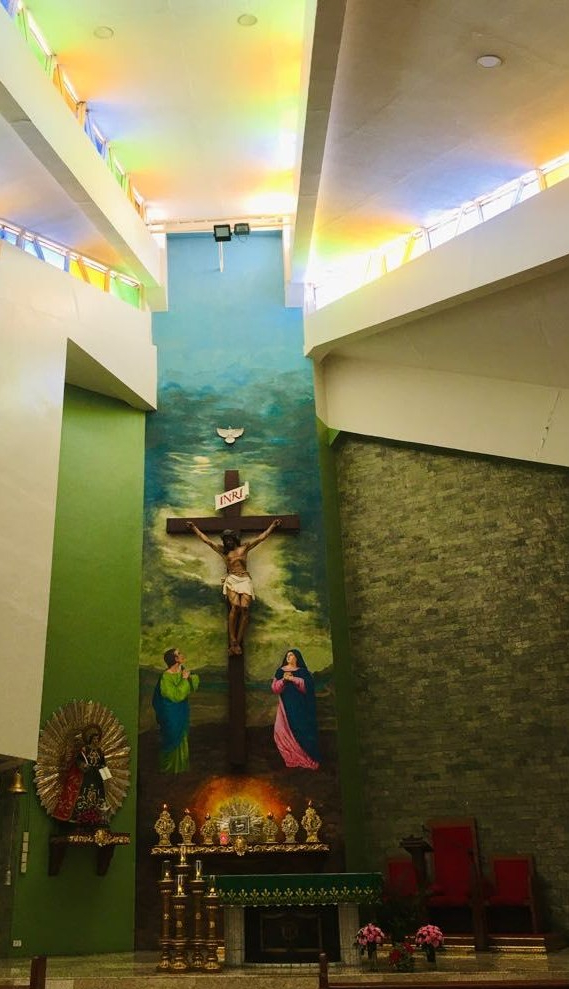
ating mamamasdan sa simbahan at tahanan
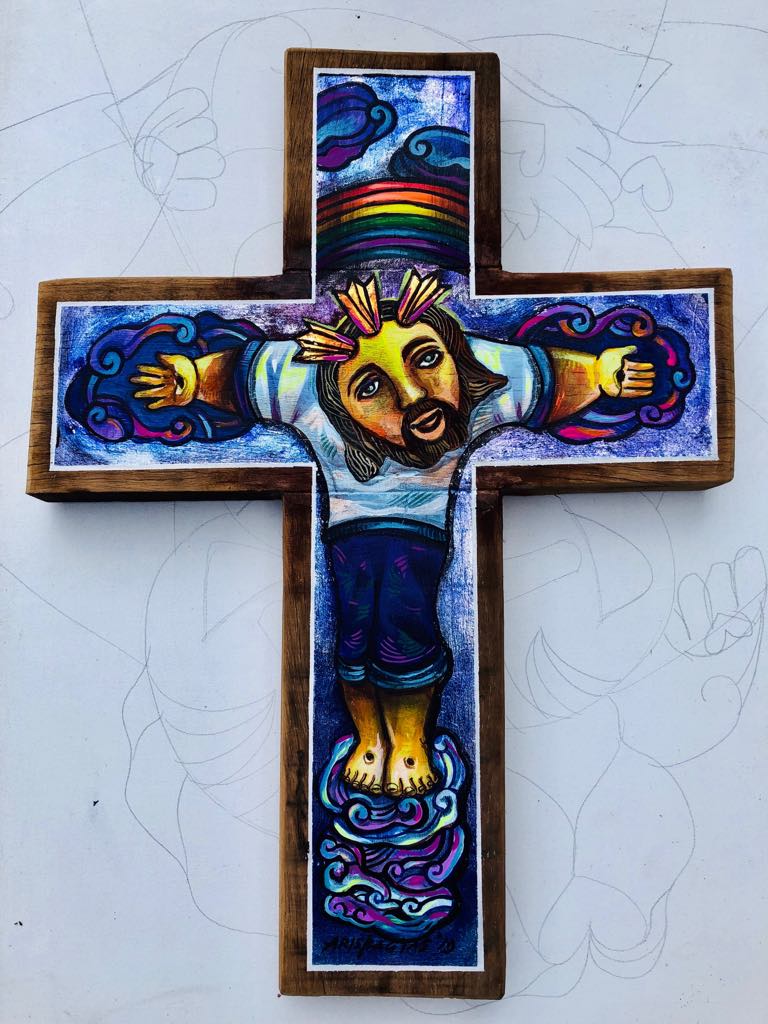
Krus pinagpakuan ni Hesus, sa atin nagtawid sa kaligtasan!
Parokya ni San Juan Apostol at Ebanghelista, 2019.
40 Shades of Lent, Saturday after Ash Wednesday, 29 February 2020
Isaiah 58:9-14 +++ 0 +++ Luke 5:27-32
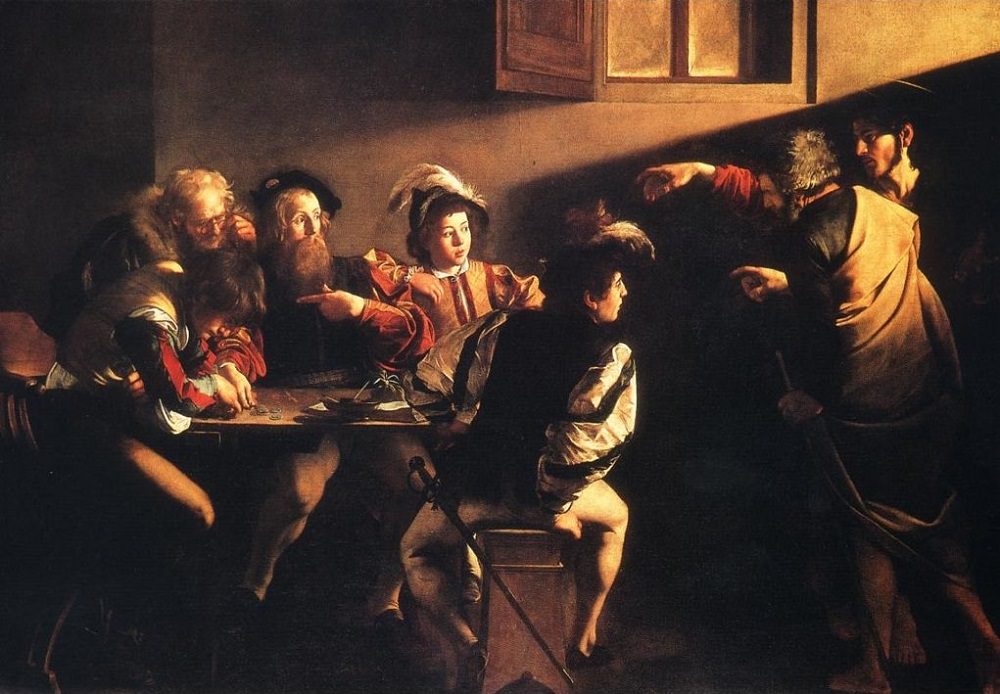
“The Calling of St. Matthew” by Caravaggio. From Google.
Dearest Jesus: I have been imagining in prayer of myself being Levi the tax collector sitting at his post.
It must be so lonely being like him, rich but deep inside longing for something deeper and meaningful than money and wealth. He had been thinking of making a “lifestyle shift” but he felt hopeless with nobody to help him.
Like in the first reading, your invitation Lord through the Prophet Isaiah seem to be too good to be true that anyone like Levi – or me – could make a big difference in life by “giving food to someone hungrier, abandoning my own comfort to care for someone afflicted, substituting a kind word for a malicious gossip, and worshipping you than pursuing my own interests”(Is.58:10,13).
I felt like Levi – there in his little customs post – that is impossible because everything is hopeless and there is no chance to change. Everything is doomed, especially for me, a sinner, Lord.
Then, suddenly you came, saying, “Follow me” (Lk.5:27).
How I love looking back, Lord, to those dark days when you suddenly came calling me to follow you!
It was so simple.
Like Levi, I just stood and followed you and everything changed in my life!
That was so nice of you, Lord Jesus, to take such a bold step of coming to Levi’s post to call him and, me. It was – and still is – a gamble on your part to call us sinners to follow you. And since then, you have never stopped calling us sinners Lord Jesus to follow you, even on our darkest and lowest days and hours, Lord, when everything seemed to be so doomed.
As we prepare for the first Sunday of Lent, remind me, O Lord, that this holy season is not all that drab and dry. After all, Lent originally means “springtime”, the coming joy of Easter which happens every time we turn our hearts to you like Levi. Amen.
Photo by Mr. Jay Javier, Traslacion 2020, Quiapo, Manila.
Lord Jesus Christ, today I beg you, please do not ask me the same question you have asked your apostles at Caesarea Philippi: “Who do people say that I am?”
I am not yet ready to report these to you, Lord, because I would be telling you also so many varied answers on what people say who you are just like the Twelve at that time.
But so unlike your apostles, the people’s many different answers on who you are – that are mostly wrong – are because of my own faults and shortcomings.
Yes, dear Jesus: when your apostles told you what people said about you, they merely reported what they have heard.
But, today Lord, people say different things about you largely because we your priests and modern followers have not fulfilled our mission from you. We have misrepresented you, Jesus, most of the time.
People get so many wrong ideas on who you are because we do not reflect your true self as a humble and loving servant living with the poor and marginalized.
People get so many wrong ideas on who you are because we do not reflect your true self as a suffering servant, sacrificing everything, bearing all pains for justice and truth.
Forgive us, Jesus, when most of the time, we are what your apostle St. James refer to as those showing partiality with the rich and powerful, forgetting the less fortunate among us.
I am sorry, Lord Jesus in misrepresenting you that until now, people still say so many things on who you are.
Please continue to purify me, to empty me of my pride, to fill me with your humility, justice and love so people may realize who you really are — through me. Amen.
The Lord Is My Chef Sunday Music, 16 February 2020
From Google.
I have always been a big fan of Rod Stewart since my elementary days when his 1977 hit “You’re In My Heart” was released. Since then I have followed his career, saving on my baon to buy some of his records and cassette tapes that some of my relatives doubted if I would ever become a priest with my kind of music!
But, when I entered the high school seminary in 1979 and heard our rector and spiritual director playing Rod Stewart’s music, that’s when I realized I could still become a priest with my kind of music.
And so, I finally became a priest in 1998 after leaving the seminary in 1982 – not because of rock music – that 21 years after, here still rockin’, now blogging to relate secular music with our Sunday gospel.
Pilgrims entering the Church of the Beatitudes with a painting of the Jesus giving his Sermon on the Mount. Photo by author, May 2019, the Holy Land.
This Sunday, Jesus continues his Sermon on the Mount, inviting us to look deeper into our hearts to see how much love and respect we have there for God and for others.
He cites four grave sins – murder, adultery, divorce, and lies – that all begin in our hearts.
Like what Jesus would later tell us, it is not what enters us that defile us but what comes from our hearts.
All troubles and sins outside like the wars and famines, the corruption and injustices that happen begin right inside our hearts.
And that is why we have chosen Rod Stewart’s classic “You’re In My Heart” that speaks of the great love – perhaps a crush or first love to a high school classmate.
Rod Stewart wrote this song and the lyrics are not only poetic but also playfully true that we can all identify with it, especially us men who have gone through the same feelings and experiences when we think of girls and sports at the same time while always lagging in our academics (LOL).
It is something like what our teachers used to tell us in elementary and high school: “boys will always be boys but girls turn into ladies and then into women”.
Have a heart, bask in the feeling of loving, and mature in our love in Christ!
You’re in my heart, you’re in my soul You’ll be my breath should I grow old You are my lover, you’re my best friend You’re in my soul
My love for you is immeasurable My respect for you immense You’re ageless, timeless, lace and fineness You’re beauty and elegance
You’re a rhapsody, a comedy You’re a symphony and a play You’re every love song ever written But honey, what do you see in me?
You’re in my heart, you’re in my soul You’ll be my breath should I grow old You are my lover, you’re my best friend You’re in my soul
You’re an essay in glamor Please pardon the grammar But you’re every schoolboy’s dream You’re Celtic, United, but baby I’ve decided You’re the best team I’ve ever seen
The Lord Is My Chef Sunday Recipe for the Soul, Week VI-A, 16 February 2020
Sirach 15:15-20 ><)))*> 1 Corinthians 2:6-10 ><)))*> Matthew 5:17-37
Photo by author of pilgrims entering the Church of the Beatitudes with a painting of the Sermon on the Mount above the door, May 2019.
Jesus continues his Sermon on the Mount this Sunday, expounding the meaning of his teachings called the Beatitudes. As we have reflected last week, the Beatitudes tell us the person of Jesus Christ as being “poor, merciful, clean of heart” whom we must all imitate to become the salt and the light of the world.
Most important of all, Matthew presents to us at the Sermon on the Mount that Jesus is more than the new Moses as giver of laws like at Mt. Sinai in the Old Testament: Jesus himself is the Law, who is both our Teacher and Redeemer.
This we see in his teachings today when he claims to be the fulfillment of the Laws and the Prophets from God in the Old Testament.
Jesus said to his disciples: “Do not think that I have come to abolish the law or the prophets. I have come not to abolish but to fulfill it. Amen, I say to you, until heaven and earth pass away, not the smallest letter or the smallest part of a letter will pass from the law, until all things have taken place.”
Matthew 5:17-18
Essence of the Laws: reflection of God, the good of man
Today, Jesus is teaching us to see the laws in the right perspectives, in the light of the will of God for the good of every person. Throughout his ministry, Jesus has always been consistent in reminding everyone that the laws were made for man, not the other way around.
During Christ’s time, people have lost the real meaning of the Commandments of God as priests and religious leaders focused more on its letters than in its essence and spirit that in the process, the laws have become burdensome. It has continued in our own generation with laws taking precedence over God and persons.
Photo by author of the Church of the Beatitudes at the Holy Land, May 2019.
At the Sermon on the Mount, we find Jesus restoring and recalibrating the laws so that these become more relevant and powerful as reflections of God in the service of man.
Jesus “relectures” us the laws in this part of his Sermon on the Mount by adding more righteousness (holiness), declaring that,
“I tell you, unless your righteousness surpasses that of the scribes and Pharisees, you will not enter the kingdom of heaven.”
Matthew 5:20
By using a pattern where he would cite Laws, saying, “You have heard that it was said”– Jesus shows us his fidelity and obedience to Judaism, contrary to his enemies’ accusations that he had abolished their laws. Moreover, in fulfilling the laws, Jesus put himself in the midst of every law and precept by declaring, “Amen, I say to you” or “but I say to you”.
In following that formula, Jesus gave the laws with a human face and a human heart in himself as its fulfillment so that from then on at his Sermon on the Mount, Christ made every law, every tradition, everything else to be seen always in his person.
Black and white photo by Mr. Jay Javier in Quiapo, 09 January 2020.
Performative powers of the laws in Jesus Christ
With Jesus in the midst of every law and precept as its fulfillment, God’s laws then become not only informative but most of all, performative to borrow one of Pope Emeritus Benedict XVI’s favorite expression. This we find Jesus teaching us in three stages in our long gospel this Sunday.
Education of the heart.
The first two laws cited by Jesus in this long list of commandments are “You shall not kill” and “you shall not commit adultery”. Both laws bring us to the very core of our personhood, of what is in our hearts and in our minds. The Lord explains that being angry as well as saying bad words against another person is like murder while looking lustfully at a woman is a form of adultery because in both cases, we have ceased to regard the other individuals as persons to be loved and respected, created in the image and likeness of God.
From Google.
It is an invitation for us to purify our hearts and minds for what defiles man is not what enters him but what comes out from him (Mt.15:11). Whatever is within us will always have an effect in all of our actions, for better or for worse.
What a tragedy that right here in the middle of our wired world of social media and instant communications, we have actually grown apart than together in the last 35 year with so much animosities fed on by lies and misinformation.
How ironic also that despite the information explosion from the Net, we have more benighted souls today than ever before who have actually gone to schools who know nothing of our history and geography?!
Education of the heart is formation of the whole person, not just a training of skills. One problem we have these days is when information is geared on data and facts without integration that we forget our relationships as well as the values we keep like respect, kindness, and dedication. Unless we have an education of the heart, a wholistic and integral formation, we can never be transformed into like Jesus Christ.
2. Get into the roots of our sins.
In telling us to pluck out our right eye or cut off our right hand if these cause us to sin, Jesus is inviting us again to probe deep into our hearts and being to understand what causes us to sin.
Photo by author, water plants in my room at the Fatima Parish and National Shrine, Valenzuela City, 2010.
The key here is to be totally free. In the first reading, Ben Sirach counsels us to “choose” rightly what is good and avoid what is evil.
We can only exercise our true freedom when we have clearer knowledge and understanding of ourselves and of things within us. We fall into vices and sins because we do not know what is going on inside us; hence, we are enslaved by our desires and sins to be not free at all.
Once we understand our sins, we commit them less often. Most of all, when we understand our sins, our struggles against committing these become more persevering, resulting to more triumphs than defeats.
The Season of Lent is near. Once again, we shall be busy with fasting and abstinence, contrition and confession of sins, almsgiving and other spiritual works that make us holy. But too often, these acts become mechanical that sooner, we sometimes reach that point when we cannot find meaning in doing them anymore that we sink deeper into sins and evil.
This happens when we get focused with letters of the laws and we forget its spirit that we become mechanical because we have failed to understand our very selves as well as our sins.
3. Be true.
Jesus said it perfectly well at the end of his teachings today,
“Let your ‘Yes’ mean ‘Yes’ and your ‘No’ mean ‘No.’ Anything more is from the evil one.”
Matthew 5:37
In this last installment of reviewing the laws, Jesus underscored the problems with divorce as well as with lies that continue to this day because we always choose not to be true at all with ourselves, with God, and with others.
Photo by author of the last two Stations of the Cross at the chapel of my niece Ms. Babs Sison in Los Baños, Laguna 13 February 2020.
See the wisdom of Jesus in putting together divorce and oaths, the two great lies that until now continue to mislead so many among us who refuse to accept and carry the cross of Christ, preferring only the Easter Sunday minus the Good Friday.
Being true is embracing the Cross of Jesus Christ like St. Paul in the second reading. It is something we cannot deny in this life. There will always be pain and sufferings. As Dr. Scott Peck put it in his book The Road Less Travelled, “life is difficult.”
At his Sermon on the Mount, Jesus clearly showed in his Beatitudes that he and his values are in sharp contrast to the wisdom of the world. And this wisdom is only accessible to those willing to embrace the crucified Christ and the scandal of the cross.
It is there on the Cross with Jesus Christ we truly find the fulfillment of the laws as well as our fullness as persons. Amen.
Quiet Storm by Fr. Nick F. Lalog II, 03 February 2020
Detail of the Presentation painting by Italian artist Andrea Mantegna (1431-1506) with Mary handing the Child Jesus to Simeon at the temple of Jerusalem (man at the middle Mary’s husband, Joseph).
As we come to close today’s Feast of the Presentation of the Lord, I wish to share with you a Quiet Storm brewing within me which I call “the Nunc Dimittis experience”.
Nunc dimittis is the Latin opening line of Simeon’s Canticle that says “Now you dismiss” when he was filled with joy by the Holy Spirit upon meeting our Lord and Savior on his presentation at the temple.
According to St. Luke’s account, God had promised Simeon that “he would not see death before he had seen the Christ of the Lord” (Lk. 2:26). Hence, the overflowing joy of Simeon when he finally met the Child Jesus at the temple 40 days after Christmas!
Part of St. Luke’s artistry in his Christmas story is to put songs on the lips of some of its important characters to express their profound joys in their unique experiences of the coming of Christ.
The Nunc Dimittis is the fourth canticle in the Lucan Christmas story: first is Mary’s Magnificat when she visited her cousin Elizabeth who was six months pregnant with St. John the Baptizer; second is the Benedictus by Zechariah when he regained his speech after naming his son John; and third is the Gloria sang by the angels when Christ was born in Bethlehem.
Of these four canticles recorded by St. Luke, Simeon’s Nunc Dimittis sounds the highest level of all, the fulfillment of time within each one of us when we personally recognize and meet Jesus the Christ our Savior like Simeon.
And so often, when we are overjoyed in experiencing Jesus Christ, that is also when we feel like saying “now I am ready to go, ready to die” exactly like Simeon because we have met the Lord.
That is why I call it “the Nunc Dimittis experience”: real joy can only come from that experience and intimacy with Jesus Christ, when we feel so close with him. It does not really matter whether we experience him here in this life or hereafter. What matters most is we feel so close with him, as if embracing him, here and now.
This may be a religious experience like after listening to a homily that really touched us, or after a good confession, or while attending a wonderful retreat or recollection. It may also happen when we feel so loved and accepted, when we are vindicated, or when assured of support and trust and confidence while going through difficult trials in life.
Our Nunc dimittis experience always comes at the end of each day, when we feel despite our failures and shortcomings, we are in God’s loving presence.
Simeon’s Canticle, our Night Prayer
Since the early sixth century during the time of St. Benedict, the “Nunc Dimittis” has been sung in the monks’ night prayer or “compline” from the Latin completorium or completion of the working day. Eventually, it was adopted into the Liturgy of the Hours or the prayers of the Church usually recited by priests and religious. (St. John Paul II had suggested in his encyclical Novo Millennio Innuete after the Great Jubilee of 2000 that the lay faithful also pray the Liturgy of the Hours.)
After the praying of the psalms and meditation of the Sacred Scriptures, there is a Responsory that declares, “Into your hands, Lord, I commend my spirit.” Like Jesus before he died on the Cross, we offer to God our very selves. This is takes on a beautiful dimension especially if we have done a good examination of conscience at the start of the compline, before the psalms and readings.
Then, we recite the antiphon that introduces the Nunc dimittis: “Protect us, Lord, as we stay awake; watch over us as we sleep, that awake, we may keep watch with Christ, and asleep, rest in his peace.”
The antiphon in itself is already a prayer!
It is after the antiphon that we chant or recite Simeon’s Canticle:
Lord, now you let your servant go in peace; your word has been fulfilled: my own eyes have seen the salvation which you have prepared in the sight of every people: a light to reveal you to the nations and the glory of your people Israel.
From the Compline of the Breviary
The antiphon is repeated and immediately followed by the Closing Prayer.
The cross atop our parish church at night with the moon above taken with my iPhone camera, 02 February 2020.
Capping the compline is the blessing at the end that says: “May the all-powerful Lord grant us a restful night and a peaceful death. Amen.”
Usually, a hymn to Mary is sung, then all the lights are turned off and the great silence (magnum silencium) begins until the morning prayers or lauds (Latin for praise).
See how our night prayer or the compline is oriented towards meeting God, or to put it bluntly, towards death.
Yes, it is always easy to say we are ready to die. It is a lot whole different when we are already face to face with death itself.
But, when we come to think of it, we realize that indeed, in death, “there is nothing to fear but fear itself”.
When we die, everything happens so fast. We may not even feel anything at all. And unknown to us, every night when we go to sleep, we rehearse our death, so to speak!
And what a tremendous joy to keep in mind how every night, the Lord fills us with joy and faith within us even if we often forget him. Every night when we sleep, it is automatic within us to entrust everything to God “unconsciously” without even thinking we may never wake up!
It is a “Nunc Dimittis” experience too because most of us go to bed filled with joy, full of hope the following morning would be a better day than today. And that is Jesus still coming to us at the end of the day to assure us of his love and concern, never bothering us at all of this tremendous grace gratuitously given to us.
Next time you sleep, remember how blessed you are to have come to the end of another day, blessed and loved.
Pray, and start experiencing Jesus more from the beginning to the end of each day and forevermore. Amen.
The Lord Is My Chef Sunday Recipe for the Soul, Feast of the Presentation of the Lord, 02 February 2020
Malachi 3:1-4 ><)))*> Hebrews 2:14-18 ><)))*> Luke 2:22-40
Photo by author of Baby Jesus at the Bishop’s Chapel, Malolos Cathedral, 07 January 2020.
We take a break from our Ordinary Sunday to celebrate today the Feast of the Presentation of the Lord at the temple, 40 days after Christmas. It is a prolongation of the celebration of the Lord’s Nativity with a paschal undertone recognizing Christ as Light who had come to us to lead us back to the Father through his Passion, Death, and Resurrection.
This feast used to be known in the East as the Ypapante or the Encounter of Jesus by the two elderly people at the temple, Simeon and Anna. When it reached Europe, it came to be known as the “Purification of the Blessed Virgin Mary” based on St. Luke’s description, evolving into Candlemass or Candelaria when Pope Sergius I in Rome adopted in the eighth century the French tradition of procession of lighted candles at dawn before the Mass to signify Jesus as the light of the world who had come to bring us back to the Father expressed by Simeon in his canticle.
“Now, Master, you may let your servant go in peace, according to your word, for my eyes have seen your salvation, which you prepared in sight of all the peoples, a light for revelation to the Gentiles, and glory for your people Israel.”
Luke 2:29-32
Despite its evolution through the ages with its many names and practices, the Feast of the Presentation of the Lord is a good reminder to us in recognizing, meeting, and sharing Jesus Christ to everyone as the light of the world.
Photo by author of a view from the Temple of Jerusalem, May 2017.
Being devout leads us to recognize and meet Jesus
Only St. Luke reports the story of the Presentation of Jesus at the temple because he wanted to show his audience who were Gentiles or pagan converts that Jesus came not only for the Jews but for everyone.
This remains true to us especially in these modern times when people live in artificial lights and “Klieg lights” that put us on the centerstage only to leave us later groping in the dark, even blinded to false hopes of virtual realities.
St. Luke invites us today to emulate both Simeon and Anna in recognizing and meeting Jesus, the only Light of the world who dispels darkness within and around us.
Now there was a man in Jerusalem whose name was Simeon. This man was righteous and devout, awaiting the consolation of Israel, and the Holy Spirit was upon him. It had been revealed to him by the Holy Spirit that he should not see death before he head seen the Christ of the Lord. He came in the Spirit into the temple; and when the parents brought in the cild Jesus to perform the custom of the law in regard to him, he took him into his arms and blessed God.
Recall how during our Simbang Gabi that for the Jews, a “righteous” person is someone who is holy because he faithfully keeps the Laws of God like St. Joseph, the husband of Mary.
But more than being holy and just, St. Luke also described to us Simeon – as well as Anna implicitly – as “devout” Jews. It is a word rarely used in the Bible. In fact, St. Luke used it only four times: once here in this scene and thrice in the Acts of the Apostles.
In Acts 2:5, St. Luke called the Jews who came to Jerusalem for Pentecost as “devout” ones; then in 8:2, he said “devout men buried” the first martyr of the Church, St. Stephen; and finally in 22:12, he gave the distinction to Ananias as “a devout observer of the law” who came upon instructions from God to pray over and heal Saul who was blinded by Christ’s light on the way to Damascus.
In all four instances, St. Luke described people as “devout” including Simeon and Anna as those of “good heart, ready to believe, and then to act openly and with courage” (Timothy Clayton, Exploring Advent with Luke; page 125). Devout people or devoted persons are a notch higher than just being faithful because they do not merely wait but look forward to the fulfillment of what they believe.
Devoted people make things happen; they do not wait for things to unfold. And that is why they are always at the right place in the right time. Like Simeon and Anna, they give themselves to God wholly to stay attuned with the Holy Spirit and be ready to follow its promptings and leads.
Anna meeting Jesus from catholicfunfacts.com.
See the common trait of both Simeon and Anna as devout people — the presence of the Holy Spirit in them that amid the crowd in the temple on that day, they were able to spot the Child and Savior Jesus Christ being presented by his parents Mary and Joseph!
There was also a prophetess, Anna, the daughter of Phanuel, of the tribe of Asher. She was advanced in years, having lived seven years with her husband after her marriage, and then as a widow until she was eighty-four. She never left the temple, but worshipped night and day with fasting and prayer. And coming forward at that very time, she gave thanks to God and spoke about the child to all who were awaiting the redemption of Jerusalem.
Luke 2:36-38
Jesus comes to us everyday in various ways, in many occasions. He is always passing by, calling us. We have to be on guard in these moments so that we do not miss him. Like reporters following the news, we have to be focused or “tutok” and immersed or “babad” so that nothing or no one escapes us.
Three ways of being devout like Simeon and Anna
It is imperative that we have to be devout first with God so that we recognize and meet his Son Jesus Christ coming to us so we may eventually share him to enlighten everyone. Simeon and Anna show us three important things to keep for us to be devoted to God to encounter Jesus Christ.
First, we have to be faithful in our prayer life. There is no other way in meeting Christ except in having a life of prayer which is a discipline. It is something we do as a habit, every day, every night. Not just once a year like those going to Quiapo every January 9 or completing any novena and then the whole year does nothing.
Devotion is more than collecting images of Jesus, the Virgin Mary, and the saints, joining processions during fiesta or Holy Week, then nothing. Devotion is life, not a show.
Like Simeon and Anna, we have to grow intimately with the Lord by cultivating personal prayers and joining communal activities like the Sunday Mass so that we may know personally and vibrantly God who always leads us to various directions and mission. God is never static but dynamic, unlike us people who keep on insisting on some of our traditions and ways no longer applicable.
Notice how in the first reading the Prophet Malachi said the Lord will suddenly come in the temple, calling on people to always await him (Mal.3:1).
The Old Jerusalem from the inside of the Church of Dominus Flevit (The Lord Cried) at the Mount of Olives, Jerusalem. Photo by author, May 2017.
Second, we can only recognize, meet and share Jesus Christ as Light when we care, love, and respect others. See how Simeon spoke to Mary about his coming mission and its harsh realities. He recognized not only Jesus but also Mary and Joseph. Simeon’s speaking to Mary and Joseph means he recognized the important roles of the parents in being instrumental that he met the Lord.
Any devotion to God and his saints and the blessed Mother Mary without any concern for the people especially the poor and the needy is merely a show and a pageantry of clerical and liturgical excesses. It is triumphalism in its purest sense and hypocrisy at its worst.
We meet Jesus among other people not only within us. This is the gist of the author of the Letter to the Hebrews today when he claimed how Jesus suffered and endured sufferings and death to help those facing trials and tests in life.
Third, we can only recognize, meet, and share Jesus Christ as Light when there is joy in our hearts. And not just being joyful but overflowing with joy like Simeon and Anna that upon encountering the Child Jesus, the more they felt eager to share the good news with others. In fact, they were overjoyed that they even felt so ready to die.
Our parish church on a Sunday afternoon. Photo by Angelo Nicolas Carpio, 12 January 2020.
Fruit of devotion is finally embracing Jesus Christ
Every night before we priests and religious pray Simeon’s Canticle in our Compline (Night prayer), we recite a responsory that says, “Into your hands, Lord, I commend my spirit”. And after that, the antiphon: “Protect us, Lord, as we stay awake; watch over us as we sleep, that awake, we may keep watch with Christ, and asleep, rest in his peace.”
It is only then that we recite or chant Simeon’s Canticle or Nunc Dimittis. It is then followed by the final prayer closed with a blessing that says, “May the all-powerful Lord grant us a restful night and peaceful death. Amen.”
Without sounding morbid or anything, it is my most favorite prayer of all our prayers because it is filled with joy, filled with Jesus, filled with Light. At the end of the day, what a consolation to be filled with joy of Christ that you have had a glimpse of him that you rest in peace hoping to meet him again as well as share him with others too.
I think it is only when we are overflowing with joy that we realize its fullness is found only in Christ, whether in this life or in eternal life. Amen.
2 Samuel 5:1-7, 10 ><)))*> ><)))*> ><)))*> Mark 3:22-30
Photo by author, sunrise at Camp John Hay, Baguio City, November 2018.
Praise and thanksgiving to you, O God our loving Father in heaven! How amazing we are now at the final stretch of the month of January 2020, passing through many darkness that have cast over us spells of gloom and sadness, disappointments and fears, even hopelessness.
Yet, you never failed to shine upon us the bright lights of love and mercy, power and grace in Jesus Christ our Lord that we are still awake and so alive this Monday morning, ready to face another week of work and school, challenges and trials.
In our readings today, O God, you remind us of the need to be filled with your power and grace to accomplish your will despite many obstacles.
David in the first reading was able to unite all the tribes of Israel and drove away other peoples to make Jerusalem their capital city and your dwelling place. Indeed, in whomever your power rests, nothing is impossible to achieve.
But how unfortunate and tragic when people refuse to recognize your power, O God, resting on your Christ – your Anointed One – Jesus of Nazareth!
Like the scribes of his time, there are still some of us who believe in the power of other men and women than of your power in Jesus we often doubt and refuse to believe in.
The scribes who had come from Jerusalem said Jesus, “He is possessed by Beelzebul,” and “By the prince of demons he drives out demons.” Summoning them, he began to speak to them in parables, “How can Satan drive out Satan? If a kingdom is divided against itself, that kingdom cannot stand.”
Mark 3:22-24
Bless us, O God, with the wisdom of the Holy Spirit to recognize your power in Jesus Christ by first claiming it in your most holy name. To claim your power, O God, is to submit ourselves to your power to forgive our sins, to cleanse us of all evil, and most of all, to do everything in your glory.
Fill us with your power and grace, O Lord, so we may accomplish your work this week. Amen.
Isaiah 9:1-6 ><)))*> Ephesians 1:3-6, 15-18 ><)))*> Matthew 18:1-5, 10
The Cross and the Bell of our parish church. Photo by Gelo N. Carpio, 12 January 2020.
Looming high always at the center of our Christian faith is the Cross of Jesus Christ. Whether inside or outside any church, there is always the Cross reminding us of our salvation in Jesus and of the path we have to follow as his disciples.
But, so often we forget that the first call of the Cross is for us to be a child of God above all in order to follow his Son our Lord in his Passion, Death, and Resurrection.
Here we find the full meaning of our celebration of the Feast of the Baptism of the Lord last Sunday, of how in our Baptism we have become the children of God in Jesus Christ who became like us so that we may become like him, blessed and divine as the eternal Son of the Father.
Such is the plan of God in the very beginning of his Creation.
Blessed be the God and Father of our Lord Jesus Christ, who has blessed us in Christ with every spiritual blessing in the heavens, as he chose us in him, before the foundation of the world, to be holy and without blemish before him. In love he destined us for adoption to himself through Jesus Christ, in accord with the favor of his will, for the praise of the glory of his grace that he granted us in the beloved.
Ephesians 1:3-6
It is only in our becoming first the sons and daughters of the Father in Jesus Christ that St. Paul declares how we are saved in this part of the second reading skipped by the liturgy today:
In him we have redemption by his blood, the forgiveness of transgressions, in accord with the riches of his grace that he lavished upon us.
Ephesians 1:7-8
A painting of Sto. Niño devotees by Bulakenyo artist Aris Bagtas, 2018.
Work of Christmas continues
We are already into the second week of Ordinary Time in our liturgy but, we in the Philippines are still celebrating an “extension” of the Christmas Season this third Sunday of January for the Feast of the Sto. Niño, the Holy Child Jesus.
And, for a very good reason! to remind us the story of Christmas continues even after the Feast of the Lord’s Baptism or when all decors have been kept.
The work of Christmas, of sharing Jesus Christ in our loving service with others continues the whole year through. In fact, it is during the 34 weeks of Ordinary Time where we are most challenged to continue Christ’s work he started at Christmas when he became a child among us.
And there lies the very core of his teachings, of his message to us: our being like a child!
At that time the disciples approached Jesus and said, “Who is the greatest in the kingdom of heaven?” Jesus called a child over, placed it in their midst, and said, “Amen, I say to you, unless you turn and become like children, you will not enter the kingdom of heaven. Whoever humbles himself like this child is the greatest in the kingdom of heaven. And whoever receives one child such as this in my name receives me.”
Matthew 18:1-5
Jesus remained the Child of God until the end
If we examine everything in the Gospel, from the Incarnation and Nativity of Jesus, his hidden and public lives, his miracles and preaching, into his Passion, Death, and Resurrection, everything is anchored in Christ’s being like a child, the eternal Son of God.
When he was lost and found in the temple at the age of 12, right away he told his Mother his being the Son of God: “Why were you looking for me? Did you not know that I must be in my Father’s house?” (Lk.2:49)
Painting by Aris Bagtas, 2018.
At Last Supper, Jesus explained his being the Child of the Father: “The words that I speak to you I do not speak on my own. The Father who dwells in me is doing his works” (Jn.14:10).
His being one with the Father is due to his being the Eternal Son that reached its highest point of expression at the crucifixion where Jesus repeatedly called God his “Father”.
Here we find as in our gospel today the essential requirement of first becoming a child of God to make it into the kingdom of heaven. It is impossible to follow Jesus to his Cross when we remain adults who know everything!
This is the problem with the Traslacion that has become rowdy, even crazy over the years which is completely the opposite of the Pit Señor de Sto. Niño in Cebu that remains solemn and orderly despite its vast crowd of devotees.
See how in Quiapo the devotees “fight” and insist on their own ways of doing the procession, of how things are now turned upside down with the hijos lording over (pun intended) everything every January 9 with the gall to call Christ “Padre Nuestro Jesus de Nazareno”?
Everybody wants to fulfill one’s panata of jumping into the revered image of the Nazareno, in total disregard of others.
Where is the spirit of being a child, of being generous and kind with others?
What we have been seeing these past years in the Traslacion is more of machismo, of who is the greatest to be able to reach the Nazareno. And included among them are the growing members of media suddenly becoming devotees with the panata to anchor Traslacion!
Being a child is a call to daily conversion in Christ Jesus
Becoming like a child a daily call to conversion to Jesus, a going back to the story of Christmas, of being humble and small. I like that word used by Jesus today – turn – when he declared, “Amen, I say to you, unless you turn and become like children…”
To be able to carry our cross and follow Jesus, we have to turn first, that is, be transformed from world-wise, self-sufficient, all-knowing adults of the world into abiding children of the Father of Jesus Christ by the grace of the Holy Spirit.
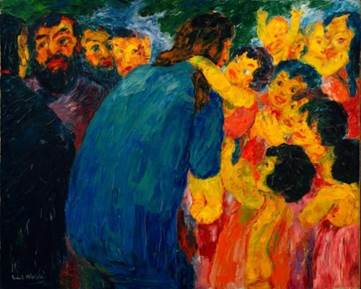
Children always have that glow within them that can disarm us of our insecurities and fears. Below is a painting by the Danish-German Modern Artist Emil Nolde (1867-1956) portrayed children with Christ in bright colors while the adults were all dark and gloomy.
“Christ Among Children” (1910) by Emil Nolde.
Being like a child is letting go of our fears and insecurities to entrust ourselves to God’s care and providence. And to others dependability and reliability too!
Maybe that is why as we get older, we mellow: we realize after all that we remain children of God and of somebody else in the end. There is always somebody out there who would look after us especially when we are already old and weak. There is always somebody whose heart would always be moved to come to our rescue or simply to warm our hearts or make us smile.
If each of us can become like a child daily, simply loving and trusting others, then we can bring light into this world deeply plunged in the darkness of sin and pride, of rat race without any winner, or arms race without any war at all.
If we can become like the child, we can become like Jesus Christ, the great light in the land of gloom bringing joy and great rejoicing (Is.9:1-2) with his life of love flowing from the great sacrifice at the Cross. Amen.
Isaiah 42:1-4, 6-7 ><}}}*> Acts 10:34-38 ><}}}*> Matthew 3:13-17
From Google.
Today is our “holy birthday” as children of God, the Feast of the Baptism of Jesus. That explains the sprinkling of Holy Water at the start of our Mass to remind us of continuing the Christmas story the whole year through as sons and daughters of God.
With this feast, we close the Christmas Season by celebrating the great mystery of Christ’s Nativity when he became human like us so that we can become divine like him as children of the Father in heaven.
Jesus came from Galilee to John at the Jordan to be baptized by him. John tried to prevent him, saying, “I need to be baptized by you and yet you are coming to me?” Jesus said to him in reply, “Allow it now, for thus it is fitting for us to fulfill all righteousness.” Then he allowed him. After Jesus was baptized, he came up from the water and behold, the heavens were opened for him, and he saw the Spirit of God descending like a dove and coming upon him. And a voice came from the heavens, saying, “This is my beloved Son, with whom I am well pleased.”
Matthew 3:13-17
We are the children of God
Sunrise at Atok, Benguet. Photo by Ms. Jo Villafuerte, September 2019.
Every morning when we wake up, the same thing happens with us with Jesus at Jordan: as we arise whether filled with joy or saddled with so many pains and worries from the previous day or night, Christ joins us in every brand new day as his brother and sister in the Father.
Despite all our anxieties and fears with every new day of work and school, the heavens open and the Holy Spirit comes down to us with our Father in heaven declaring to all his creation, “This is my beloved child, with whom I am well pleased.”
That is the mystery of Christmas we must celebrate daily when Jesus became human like us in everything except sin. In Baptism, we have become sons and daughters of the Father in his Son Jesus Christ our Lord through the power of the Holy Spirit.
That coming down of Jesus to John to be baptized in Jordan is the message of Christmas, of how God became human like us to be one with us in our dirt and stain so he may cleanse us in his Passion and Death in order to share in the glory of his Resurrection .
That is why Christmas is a continuing story we have to keep on telling and sharing with our life of holiness with others.
As children of God, we are called to holiness
Please don’t be scared with the call to “holiness”, my dear reader and follower.
Holiness is not being sinless.
Holiness is being filled with God.
Holiness is following Jesus who calls us to be holy like the Father in heaven with all of our imperfections and sinfulness.
Morning in our Parish. Photo by author, 2019.
So many times in our lives, as we strive to lead holy lives by being good individuals, we also feel so tired and exhausted that we question or wonder if we are still doing the right things in life especially when we try to be faithful to God and with others.
There are times we just cry and suffer in silence in order not to hurt with our words and actions those people dearest to us who are oblivious or even do not care at all to the pains and difficulties they cause us.
Like a slave driver boss, demanding and exacting parents, a perfectionist husband or wife or partner, a naive sibling.
It is very difficult to be holy, to be like Jesus who is so loving and merciful, kind and understanding.
And that is why he chose to come to us, to be with us, to help us, to assure us that “the Father is so well pleased with us”!
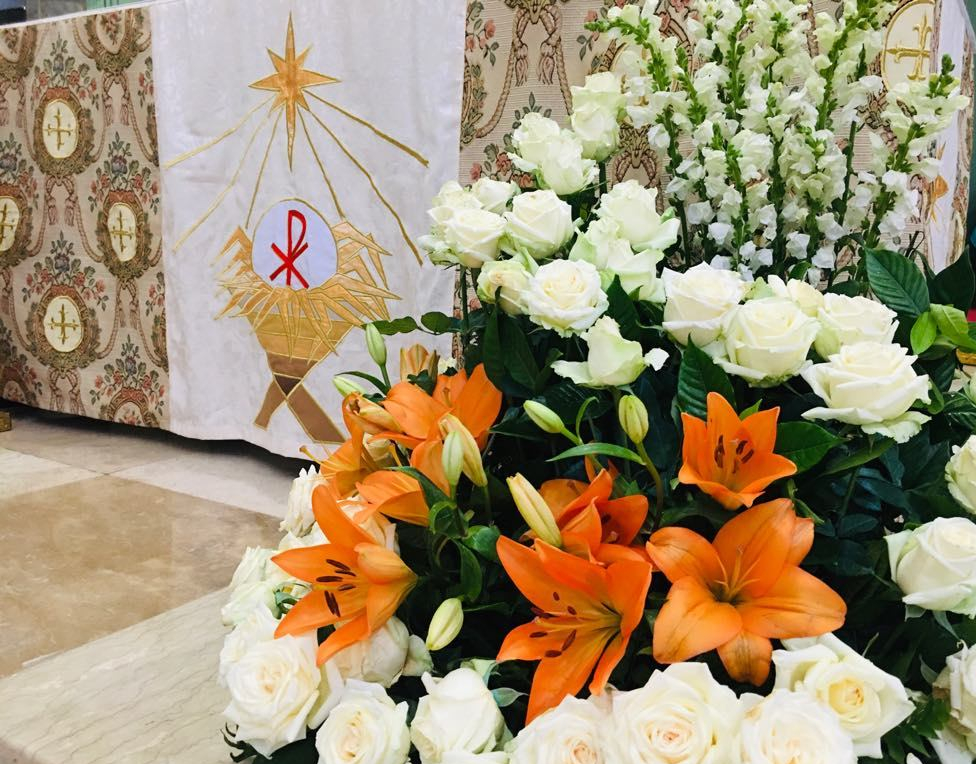
Flowers at our Altar, Epiphany Sunday 2020. Photo by author.
God is well pleased with us
Three things I wish to share with you this lovely Sunday, especially for some of us feeling tired and exhausted this early with our many tasks and responsibilities at home, the school, the office, and even the church and community.
First is get it done. We all have roles to play in life. Remain faithful and stay focused with the mission not with the person. Yes, it is easier said than done but like Jesus instructing John for his baptism, he said, “Allow it now, for thus it is fitting for us to fulfill all righteousness” (Mt.3:15). It must have been so difficult for John to baptize Jesus the Son of God but the Lord told him anyway, get it done! And just as John did his role, everything happened according to God’s plan.
Second is give others the chance to do the will of God. Sometimes many of us have that “messianic complex” as if we are the saviour of the world. No! That is Jesus alone and he has tasked all us with specific roles in doing his mission. Let others do their part. Stop monopolizing all good deeds because when there is a monopoly of holiness, certainly there is already a pervading evil. Jesus as the Christ is the definitely the holy one but he told John to baptize him and he in turn “allowed” the baptism to take place.
Third is do whatever is good. Always. That’s what Jesus told John, “Allow it now, for thus it is fitting for us to fulfill all righteousness” (Mt.3:15). Doing what is righteous is doing what is good, what is holy, what is just. But, it is not that easy. I know.
“Minsan nakakapikon na magpakabuti lalo na kapag tila walang pakialam yung mga ginagawan mo ng kabutihan.”
We have felt so many times that being good, doing what is right can take its toll. We always wonder “when is enough really enough” with people who have made it their way of life of hurting us, of stressing us, of being pain in the ass.
We want to scream, to spill the beans, to unmask them to reveal them as fakes and hypocrites!
But, don’t!
Do not be like them.
Be good like Jesus, the one prophesied by Isaiah in the first reading.
Thus says the Lord: Here is my servant whom I uphold, my chosen one with whom I am pleased, upon whom I have put my spirit; he shall bring forth justice to the nations, not crying out, not shouting, not making his voice heard in the street. A bruised reed he shall not break, and a smoldering wick he shall not quench…
Isaiah 42:1-3
Baby Jesus on a bed of white roses in our Sanctuary area, Epiphany 2020. Photo by author.
In the second reading, we heard St. Peter preaching after the Pentecost of how “Jesus went about doing good and healing all those oppressed by the devil, for God was with him” (Acts 10:38).
Whatever difficulty you are going through at this very moment, you are still God’s beloved child with whom he is well pleased. God is always with you. Continue the beautiful Christmas story with your life of loving service, even to people who hurt you.