Lent is quenching our deepest thirst, God

40 Shades of Lent by Fr. Nicanor F. Lalog II
Third Sunday in Lent-A, 12 March 2023
Exodus 17:3-7 + Romans 5:1-2, 5-8 + John 4:5-15, 39, 40-42
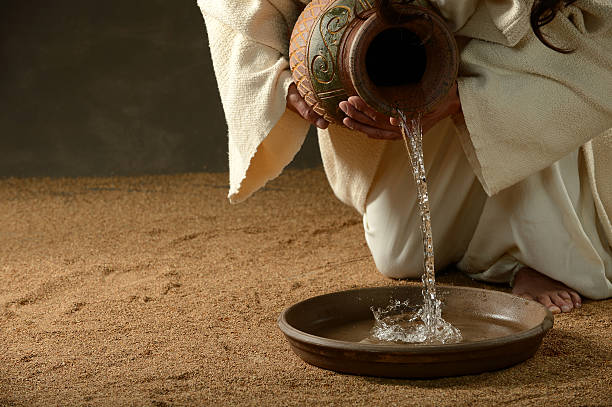
Photo by author, Taiwan, January 2019.

Thirst for water is something more intense for us humans than hunger for food. Thirst is something too strong we could feel affecting us deep down to the most remote and minutest parts of our body unlike hunger that is localized in the stomach area. Thirst moves us to search for water, even sending us to scamper even for droplets of water to quench our thirst unlike hunger we often dismiss by sleeping in the hopes of forgetting it, even overcoming it.

But not our thirst for water, something we would always quench by all means.

That is why, thirst would always mean more than physical but also something deeper that concerns our very soul and being. This is the beautiful meaning of our gospel this Sunday – from the wilderness of temptations to the summit of a high mountain of his transfiguration – we now join Jesus into a Samaritan town for some water after a very tiring journey on his way to Jerusalem to fulfill his mission. Here we also find Jesus thirsting for us humans, sinners as we are, like on the Cross at Good Friday.

Jesus came to a town of Samaria called Sychar, near the plot of land that Jacob had given to his son Joseph. Jacob’s well was there. Jesus, tired from his journey, sat down there at the well. It was about noon. A woman of Samaria came to draw water. Jesus said to her, “Give me a drink.” His disciples had gone into the town to buy food. The Samaritan woman said to him, “How can you, a Jew, ask me, a Samaritan woman, for a drink?” – For Jews use nothing in common with Samaritans. – Jesus answered and said to her, “If you knew the gift of God and who is saying to you ‘Give me a drink,’ you would have asked him and he would have given you living water.”

John 4:5-10
Photo by author, an old well somewhere in the desert of Egypt, May 2019.

There are a lot of interesting details in this opening lines of this long story of Jesus with the Samaritan woman. Very notable is Jesus coming into a Samaritan town and talking to a woman that are both a big no, no for Jews at that time as the evangelist explained in verse 9, – For Jews use nothing in common with Samaritans.

It is very clear that what we have here is more than a geographical setting but a revelation of God’s immense love (and thirst) sending Jesus for us all especially the sinners and those neglected by the society, living in the margins like women and children, the poor and the elderly.

That Samaritan woman symbolizes us whom Jesus searches to return home to the Father.

Notice that Jesus comes to the well at the hottest time of the day, at noon when the Samaritan woman would come to draw water. Why? Because as we have seen in the story, the woman was a sinner, living with her sixth “husband” as pointed out to her by Jesus himself. She drew water at that time when no one was at the well to avoid the Marites of the town who would always feast with gossips about her scandalous lifestyle!

Is it not the same with us too? Jesus comes to us right in the heat of our sinfulness, of our infidelities, of our cheating, of our unkindness and unforgiving? It is when we are hot in sin when Jesus comes thirsting for us, inviting us to return to him. And too often, he works wonders to win us over, even sometimes allowing us to feel like the Samaritan as so special in doing him a favor.

A woman of Samaria came to draw water. Jesus said to her, “Give me a drink.” His disciples had gone into the town to buy food. The Samaritan woman said to him, “How can you, a Jew, ask me, a Samaritan woman, for a drink?”

John 4:7-9
Photo by author, Third Week of Lent 2019, Parokya ni San Juan Apostol at Ebanghelista, Bagbaguin, Sta. Maria, Bulacan.

Here we find Jesus working subtly, even playing by our games while we are in the heat of our sins and other pursuits in life when he would ask us favors, namely, asking for a drink.

In response, the Samaritan woman opens herself to a dialogue with Jesus rather than outrightly dismissing him as a nuisance. She felt that in giving Jesus a drink, she would do him a favor when in fact, as we have seen later, it was the Lord who did her the most favor as we shall see too on the Cross at Good Friday especially with Dimas.

Are we not like this Samaritan woman when we are in the heat of our sinfulness with our bloated ego that we even dare think of doing God a favor by entering into a dialogue until suddenly, for good reasons, we are swept off in our feet, finding ourselves in his merciful and loving arms?

Like the Samaritan woman, in opening to Jesus to a dialogue when we are in the noontime of our sinfulness or simple ordinariness, that is also when we allow the Lord to do us a great favor.

That is why I always tell people to give us priests a chance to do something good, never to compensate our services and ministry with remunerations. Very often, people say they feel so blessed with our ministry and presence but the truth is, we priests are the ones more blessed when we are able to selflessly serve you our flock!

This I have always felt in hearing confessions and anointing the sick especially since last year as a chaplain at the Fatima University Medical Center here in Valenzuela City. I have instructed our nurses to always insist to the family of patients to never give me anything after visiting their sick. They do not realize the tremendous grace and blessings I experience when I visit the sick, hear their confessions and anoint them with oil. Even when patients die, because as my former Parish Priest Fr. Ersando used to tell me as a young priest 24 years ago, confessing and absolving the sins of the dying and anointing them with holy oil are the most meritorious acts of a priest in preparing the faithful in meeting God our Father. This I have experienced so true in the recent death of Msgr. Teng Manlapig whom I have shared last week.

Many times in our lives, it is through the many “inconveniences” we experience that Jesus comes to invite us to open ourselves to receive his abundant graces and blessings not necessarily material in nature. God is never outdone in generosity and everything is pure grace in him because we are always blessed with more than we give when we offer him the gift of our self to do his will.

Remember always Jesus Christ’s words to the Samaritan woman at the well which are the same words he tells us especially when we are hot in our personal pursuits in life, “If you knew the gift of God and who is saying to you ‘Give me a drink,’ you would have asked him and he would have given you living water.”

In the first reading we have heard how “In those days, in their thirst for water, the people grumbled against Moses” (Ex. 17:3), quarreling among themselves and testing God.

How sad that until now, we grumble and quarrel and test God because of our many thirsts for things and pleasures we thought would complete us. Sometimes we feel as if God owes us so much that we feel so entitled in this life, deserving all the good things without realizing how God knows us so well, even the sins we hide most. We keep on thirsting and desiring so many other things when it is only God whom we must desire first of all, actually desire and thirst most all like the deer that yearns for streams of running water (Ps. 42:2).

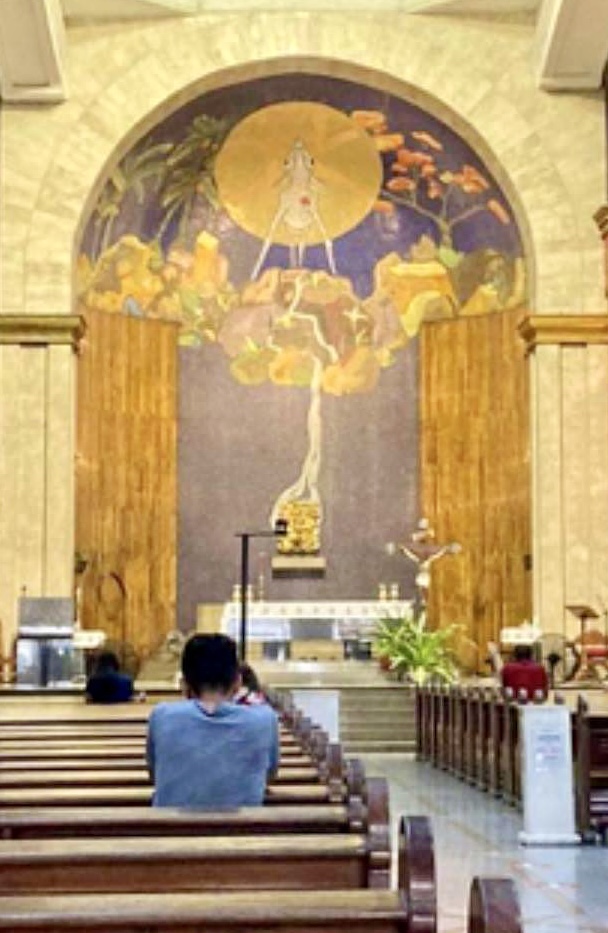
Photo courtesy of Rev. Fr. Herbert Bacani, 2023.

One of my favorite churches of all time is the Sta. Cruz in Manila. It is one of the most beautiful churches that has remained unchanged, never altered. As a child more than 50 years ago until now, I am still fascinated by its sanctuary of a painting or a mosaic of Jesus Christ the lamb slain and offered as sacrifice whose blood is like the waters of a spring flowing into us through the Blessed Sacrament.

Notice that this story of Jesus with the Samaritan woman comes after his meeting with the Pharisee named Nicodemus at night where the Lord first discussed the symbolism and importance of being born again in water of Baptism and the Spirit to become a new person in him. This time at Jacob’s well Jesus promised the Samaritan woman water that becomes in the one who drinks it a source springing up into eternal life so that whoever drinks it will never be thirsty again.

This has become possible because Jesus “died for us while we were still sinners” (Rom. 5:8) on the Cross when he said again, “I thirst” (Jn. 19:28-29)!

May we continue to thirst for God by entering into dialogue with Jesus especially when he comes to us, also thirsty, asking us for some small favors from us in order to gift us with his bigger favors we have never imagined. Amen.

On being kind

40 Shades of Lent by Fr. Nicanor F. Lalog II
Friday in the Second Week of Lent, 10 March 2023
Genesis 37:3-4, 12-13, 17-28   >>> + <<<   Matthew 21:33-43, 45-46 
Photo by author, Anvaya Cove, Bataan, January 2023.

Being kind is more than being good. The word “kind” is from the old English kin – as in kindred or kinsfolk or same family, clan, or tribe. A kind person is someone who treats you as a kin, a family and not as an alien or a stranger. “Hindi ka naman iba sa amin” as we would say in Tagalog (“You are not different from us”). It is perhaps the most Christian word in the English language as it refers to our belonging to one big family with God as our Father and everyone a brother and a sister in Christ.

Unfortunately, kindness has become a rarity in our world today that has become so unkind where we feel so “different” as in “iba” in Tagalog even right in our own family like in the experience of Joseph in our first reading today.

They said to one another: “Here comes the master dreamer! Come on, let us kill him and throw him into one of the cisterns here; we could say that a wild beast devoured him. We shall then see what comes of his dreams.”

Genesis 37:19-20

Most often, it is jealousy that makes people unkind like with the elder brothers of Joseph. This is expressed in our name-calling as we refuse to acknowledge someone as our kin by giving them aliases like Joseph referred to by his brothers as “master dreamer”. We Filipinos have all kinds of aliases and codes for the family members we hate like “bruha”, “demonyo”, “Hudas” or even “Hitler”. The more mean, the better, without us realizing how our jealousies expressed in name-calling deteriorate into sinister plots against our own kin. It is the most unkindest kind of unkindness demonstrated in the selling of Joseph:

Judah said to his brothers, “What is to be gained by killing our brother and concealing his blood? Rather, let us sell him to these Ishmaelites, instead of doing away with him ourselves. After all, he is our brother, our own flesh.” His brothers agreed. They sold Joseph to the Ishmaelites for twenty pieces of silver. (Gen.37:26-28).

Genesis 37:26-28
Photo by author, Infanta, Quezon, 04 March 2023.

This is the tragedy now going on in our family when we call our parents and siblings as “mom” and “dad”, “kuya” and “ate” yet at the same time, disrespect them in our thoughts and deeds! See the absurdity of Judah in concluding, “after all, he is our brother, our own flesh” that they sold him! He miserably missed the whole point that if Joseph were their brother and own flesh, all the more he should have cared and saved him even from being sold to slavery right there!

This is the curse of many fraternities in our universities. Even worst than Judah, there are some fratmen blinded by their rites and rituals of initiations that they have forgotten or have become oblivious to the meaning of brotherhood or fraternity. The most incomprehensible of all is with every death happening among their brods, still the same story of silence and cowardice happening with all attempts to hide their heinous crimes.

It is a tragedy we also participate daily in our homes when we regard our family as kin yet at the same time disregard all kindness and respect due to our parents and brothers and sisters, or to husband and wife. What an unkind world we have when we cheat on one another with our infidelity and betrayals, when we stab each other with harsh words of suspicions without bases at all as well as our never ending sumbatan.

Jesus himself shows us in his parable of the wicked tenants the face of this “unkindest kind of being unkind” springing not only from jealousy but from our self-centeredness and self-righteousness.

“when the tenants saw the son, they said to one another, ‘This is the heir. Come, let us kill him and acquire his inheritance.’ They seized him, threw him out of the vineyard, and killed him.”

Matthew 21:38-39
Photo by author, Infanta, Quezon, 04 March 2023.

What an unkind world when after recognizing one another as a kindred, instead of being kind and respectful, of having malasakit, like the wicked tenants we use our ties and kinships as bases for murderous and other evil plots against those we know and closest to us.

It is disheartening and frustrating when our social media are filled with moral aspersions as well as downright accusations so harsh that could sometimes get into one’s nerves, hurting our sensibilities. True, charity is never imposed and respect has to be earned but kindness is demanded of us because being kind is the hallmark of a person’s goodness.

Our responsorial psalm captures the reason why we must always be kind, “Remember the marvels the Lord has done.” And here lies the warning to those unkind, “When the Lord called down a famine on the land and ruined the crop that sustained them, he sent a man before them, Joseph, sold as a slave” (Ps. 105:16-17).

The story of Joseph the Dreamer never fails to move us of how in the end, his brothers wept in shame upon meeting him as their brother whom they have sold into Egypt. As Jesus said too to the chief priests and Pharisees of his time, “Did you never read in the Scriptures: the stone that the builders rejected has become the cornerstone; by the Lord has this been done, and it is wonderful in our eyes?” (Mt.21:42).

This season of Lent, let us try to bring back kindness in our hearts, in our words, in our thoughts and in our deeds even if others are not kind to us. Sometimes, kindness has a way of teaching us the importance of this virtue that may not be always be so kind at all. Amen.

Photo by author, Infanta, Quezon, 04 March 2023.

Lent is arising, not being afraid

40 Shades of Lent by Fr. Nicanor F. Lalog II
Second Sunday in Lent-A, 05 March 2023
Genesis 12:1-4 >+< 2 Timothy 1:8-10 >+< Matthew 17:1-9
Photo by author, sunrise at Taal Lake, 08 February 2023.

Something so personal has happened with me this past week. It is something that is still unfolding, making me realize so many things in my life and ministry that as I continue to reflect on the death last Sunday of our elderly priest, Msgr. Vicente Manlapig, at the Fatima University Medical Center where I serve as its chaplain.

I was out when told about Msgr. Manlapig’s passing shortly before 3PM. It was the First Sunday of Lent. After saying a prayer for him, it suddenly dawned upon me that he was the second elderly priest I had taken cared of who also died in this blessed Season of Lent. The first was Msgr. Macario Manahan who died 16 March 2014, the Second Sunday of Lent at that time. I was with him when he died that afternoon as he lived very near my former parish assignment.

What a tremendous blessing God has given me to have attended to their spiritual needs preparing them for their deaths, of how life indeed is a daily Lent preparing for Easter when we have to go through many difficult series of temptations and sufferings that lead us to our transfiguration (https://lordmychef.com/2023/02/27/deaths-in-lent/).

It is the very path of life and death of every disciple of Jesus, from temptations in the wilderness to transfiguration on the high mountain. It is something we all have to go through in Christ, with Christ and through Christ.

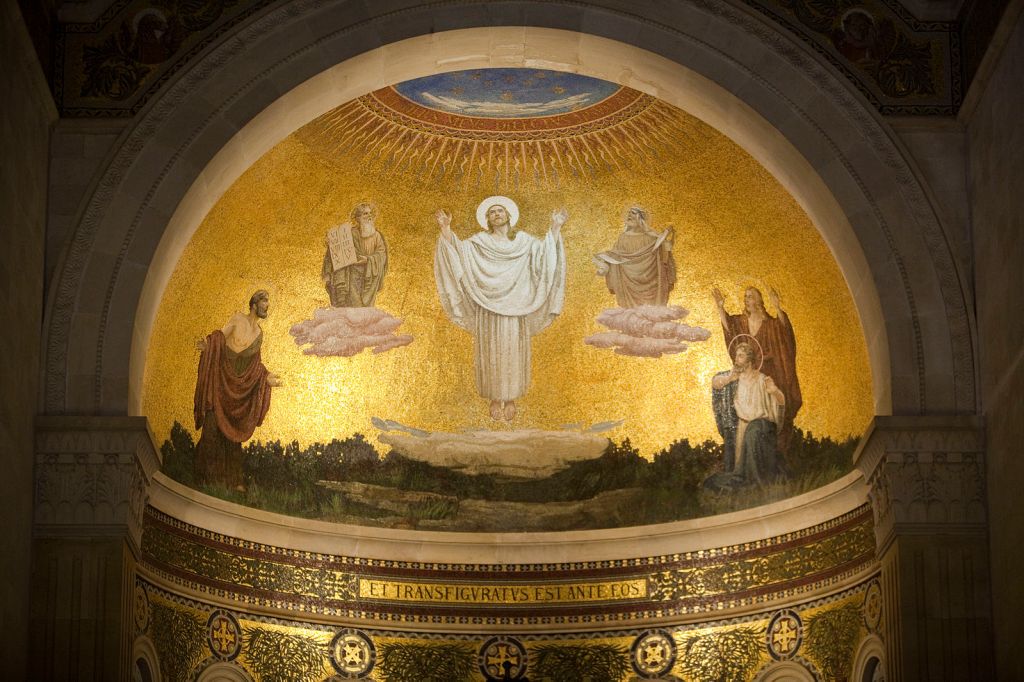
Jesus took Peter, James and John his brother, and led them up a high mountain by themselves. And he was transfigured before them; his face shone like the sun and his clothes became white as light. And behold, Moses and Elijah appeared to them, conversing with him. Then Peter said to Jesus in reply, “Lord, it is good that we are here…” While he was still speaking, behold, a bright cloud cast a shadow over them, then from the cloud came a voice that said, “This is my beloved Son, with whom I am well pleased; listen to him.” When the disciples heard this, they fell prostrate and were very much afraid. But Jesus came and touched them, saying, “Rise, and do not be afraid.” And when the disciples raised their eyes, they saw no one else but Jesus alone. As they were coming down from the mountain, Jesus charged them, “Do not tell the vision to anyone until the Son of Man has been raised from the dead.”

Matthew 17:1-4, 5-9
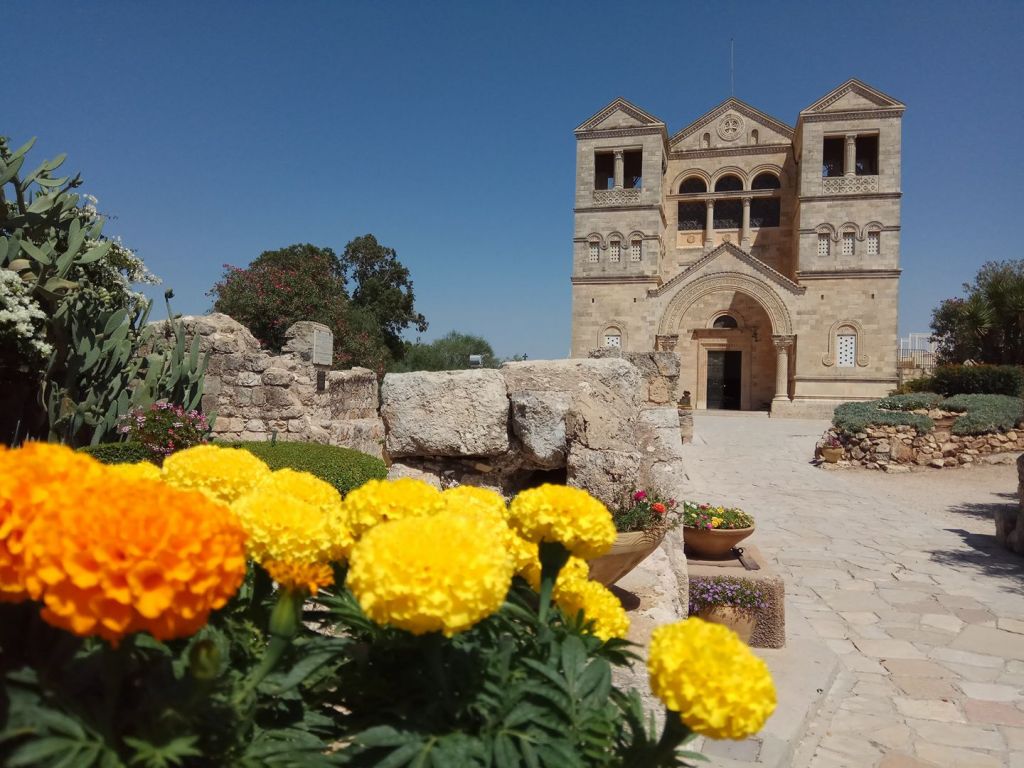
Photo from commons.wikimedia.org of mosaic inside the Basilica of the Transfiguration on Mt. Tabor, Israel.

Unlike Luke’s account that was set in the context of a prayer, Matthew’s version of the transfiguration of Jesus Christ illuminates the Lenten pilgrimage of the Church that is the tragedy of the Cross being seen always in the perspective of the Easter radiance. It is the oneness and inseparability of Christ’s divinity and glory with the Cross through which we get to know Jesus correctly.

Recall that the transfiguration happened after Peter’s confession of Jesus as “the Messiah, the Son of the living God” at Caesarea Philippi (Mt.16:16) where Jesus also made the first prediction of his passion, death and resurrection. From that day on, Jesus began instilling into the Twelve his conditions of discipleship, “Whoever wishes to come after me must deny himself, take up his cross and follow me” (Mt. 16:24). It was a very difficult lesson for them to learn and accept that triggered Judas to betray Jesus. The remaining disciples would only fully appreciate it after the Easter event with the help of the Holy Spirit on Pentecost.

That is why the transfiguration was actually some sort of a “teaching aid” for this most difficult lesson of his disciples when Jesus gave Peter, James and John a glimpse of his coming glory after his pasch. See that very clearly, Matthew recorded Christ’s instruction not to tell the “vision” to anyone until Easter; the transfiguration did happen and was seen by everyone there as Matthew used the word vision to describe it.

Like the three disciples, many of us are given with this unique privilege by Jesus to have a glimpse and vision of Easter, of glory when we join him on the Cross with our own sufferings and trials and when we accompany those in severe tests in life like the sick and dying.

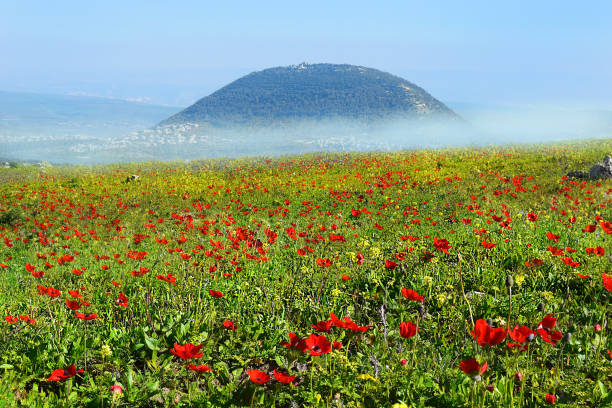
Photo from iStockphoto.com of Mount Tabor in Israel where Jesus is believed to have transfigured.

Amid the pain and hurts we go through or see in others, we “see” Jesus, we feel Jesus, we experience Jesus.

Many times like Peter we speak and do things without really thinking well about them because we are overwhelmed by the experience as well as the vision and sight.

And most of the time, the sight and experiences are very frightening when God speaks to us, telling us to listen to Jesus his Son, to simply obey him and trust him.

Here we have a deepening of our reflection last Sunday of the need to fix our eyes on Jesus son that we may not fall into temptations and sin. Many times we do not see everything clearly but if we close our eyes and have faith in Christ, things get clearer until it is him alone do we see with us especially after passing over a turmoil or a test in life. Like the first man and woman, our eyes are misled by so many things that look so good but not good at all. In fact, there are things that look bad that could really be good after all like pains and sufferings in life!

In the second reading, St. Paul tells us through St. Timothy to “bear your share of hardship for the gospel with the strength that comes from God” (2 Tim. 1:8) which matches directly the instruction in the voice heard during the transfiguration, “This is my beloved Son, with whom I am well pleased; listen to him” (Mt. 17:5). After the transfiguration, everything that Jesus would tell his disciples and everyone that include us today is his coming passion, death and resurrection as well as the conditions of discipleship we mentioned earlier. God wants us to listen and follow his Son Jesus Christ to the Cross in order to join him in the glory of Easter.

We are transfigured and transformed into better persons by our pains and sufferings. That is the irony and tragedy of this age: we have everything like gadgets and money and other resources to make lives easier and comfortable but we have become more lost and alienated, empty and no direction in life. There cannot be all glory without sorrow; no Easter Sunday without Good Friday.

Lent is a journey back home to God who wants us all to share in his glory through Jesus Christ’s passion, death and resurrection. It is a blessed season we are reminded to always arise in Christ, to have courage and be not fearful of failures because right now, we are already assured of victory and glory in Jesus. Let us ascend with him the high mountain of sacrifices and hard work, of prayers and patience, mercy and forgiveness to be transfigured and glorified like him. Let us imitate Abraham in the first reading to respond to this call by God with faith and hope, obedience and perseverance. Amen. Have blessed and transformative week ahead.

Photo from custodia.org of Basilica of the Transfiguration on Mt. Tabor, Israel.

Lent is for fixing our “eyes” on God

40 Shades of Lent by Fr. Nicanor F. Lalog II
First Sunday of Lent-A, 26 February 2023
Genesis 2:7-9, 3:1-7  +  Romans 5:12, 17-19  +  Matthew 4:1-11
Photo by Noelle Otto on Pexels.com

Lent is the season we fix our eyes to see clearly our selves, God, and others. It is the season where the dictum is “less is more” with no flowers allowed at the altar, only plants and leaves used as decorations. Ideally, images and icons inside the church are covered during these forty days when the Gloria and the Alleluia are also omitted in the liturgy because Lent invites us to look more inside our hearts than outside to find God.

Today’s first reading reminds us the problem with our eyes that lead us to falling into sin like the first woman who was tempted by the serpent into believing that eating the forbidden fruit would open her eyes to know what is good and evil like God. See the interplay of how the fruit was pleasing to the eyes and after they have fallen into the trap of the devil, “the eyes of both of them were opened, and they realized that they were naked” (cf. Gen. 3:4-7).

A big part of our temptations to sin happens in how we “see” things, literally and figuratively speaking. In the wilderness during the temptations of Jesus, the devil showed us what he often “sees” that if we follow could lead us into sin. Let us see what Jesus “saw” during those moments of temptations and triumphed over evil.

Detail of mosaic “Temptations of Christ” at St. Mark Basilica, Venice, Italy. Photo from psephizo.com.

At that time Jesus was led by the Spirit into the desert to be tempted by the devil. He fasted for forty days and forty nights, and afterwards he was hungry. The tempter approached and said to him, “If you are the Son of God, command that these stones become loaves of bread.” He said in reply, “It is written: One does not live on bread alone, but on every word that comes forth from the mouth of God.”

Matthew 4:1-4

First temptation of the devil is for us to see scarcity, to see nothing, to see too little, to see there are not enough that the tendency is for us to hoard and be selfish. But Jesus tells us today even in the barrenness of the wilderness where there was no food nor water, there is always plenty and abundance when we see God.

When we were in elementary school, we were told how food and water would run out in the future with worldwide hunger and thirst happening in apocalyptic proportions. It had never happened. Yes, our natural resources are depleting not because of our normal consumption but largely because of human greed. We see everything so few, not enough for everyone that our tendency is to get more, driving prices up with the poor left to fend for themselves of whatever is left behind.

What we see more is what we do not have, not seeing the beautiful and precious ones we have like family and friends, health and life itself as well as faith in God. There is always the temptation most especially in the midst of difficulties and trials to see everything as ugly and dismal like the first parents after the fall when “they realized they were naked” whereas before, “they felt no shame” because they were good.

Observe how the eyes and the mind are closely intertwined, of how wrong judgments result when our eyes are deceived by what we see or do not see. Look inside your heart when you feel like alone and abandoned or when in the wilderness of sickness and sufferings. See God in everything even in nothingness by reading and praying his words in the Sacred Scriptures and you shall find life and abundance.

Then the devil took him to the holy city, and made him stand on the parapet of the temple, and said to him, “If you are the Son of God, throw yourself down. For it is written: He will command his angels concerning you and with their hands they will support you, lest you dash your foot against a stone.” Jesus answered him, “Again it is written, “You shall not put the Lord, your God, to the test.”

Matthew 4:5-7

Second temptation is when see more of power and entitlement that lead us to becoming like gods.

See the deception of the devil as he brought Jesus to the temple, the house of his Father, making him stand on the parapet to test his obedience and submission to God. It continues to happen to us these days, especially for us priests and bishops, those inside the church like its volunteers and servants, or those who see themselves as devout and pious Catholics who feel entitled here on earth and even in heaven!

No one, not even Jesus Christ claimed any entitlement for being the Son of God. In fact, in his being the Christ, he taught us the importance of submission and obedience always to the will of God our Father.

The first sin was not just pride and disobedience of Adam and Eve. It was a sin rooted in the heart, of feeling so special in paradise, daring to be like God. A feeling of entitlement, of manipulation and control to play like God.

The second temptation of Christ reminds us all supposed to be close to God, his servants to always look and examine our hearts if it is truly God whom we love and follow or just rules and commandments, rites and rituals that we forget the people we are supposed to lovingly serve and care for.

The sad reality in our church is how the devil’s temptation of Jesus is realized among us priests who are being served wrongly, even adored and worshipped by the many people so deceived of the temptation to get close to clergymen or the church. This is the reason why the poor and sufferings are still marginalized because they have remained outside our reach as we all tend to see ourselves being protected by the angels in our positions of power.

Let us all get down from our ivory towers of power, of pride and entitlement especially in the church to begin seeing the poor people on the ground and stop testing God if he would work miracles on them lest we have forgotten we are his arms and limbs.

Then the devil took him up to a very high mountain, and showed him all the kingdoms of the world in their magnificence, and he said to him, “All these I shall give to you, if you will prostrate yourself and worship me.” At this, Jesus said to him, “Get away, Satan! It is written: The Lord, your God, shall you worship and him alone shall you serve.”

Matthew 4:8-10

Third temptation is clearly idolatry, of self-worship, of vanity. See how Jesus told Satan to get away after this third temptation because this is the most insidious as far as Matthew is concerned (in Luke’s version, this is the second temptation).

This third temptation is also very surreptitious which Al Pacino as the devil described in “The Devil’s Advocate” opposite Keanu Reeves as “my most favorite sin.”

We may not be kneeling before strange gods and idols but as Simon & Garfunkel sang in the “Sound of Silence”, so many of us “bowed and prayed on the neon gods we made” with our obsession with signature and expensive things and gadgets, whether original or fake.

It is also the temptation of being famous with our obsession not only with all the beauty augmentations readily available and the fitness craze of some who practically live inside gyms but also with too much living in social media where some have gone crazy counting the likes and reactions they receive in their posts.

See how Jesus won against Satan in all his temptations including in this final one because his focus was on God alone. Jesus is telling us this Sunday as we embark on our Lenten journey to remain in God above all.


Our eyes can be easily deceived because they cannot see everything at one instance. It takes times for us to recognize what or who we are looking at. There are times we need to use instruments to see everything clearly like telescopes and microscopes.

Most of all, what we see may not even be true at all. That is why we have to close our eyes in order to see better, to experience better and understand better like when we are deeply in pain and sorrow or in ecstasy and bursting with joy.

How sad that when Adam and Eve sinned and their eyes were opened, they hid themselves and sewed figs to cover themselves. Today, people go out into the open, even taking pride and not troubled at all in filming or recording and uploading sinful scenes in their lives. And everyone is so glad to take a look on them without realizing how it could lead them into shame like Adam Eve.

Let us heed St. Paul’s invitation in the second reading to live in Jesus so we may show our new humanity in Christ, we who are so loved and forgiven by God and restored to grace. Let us fix our eyes on Jesus alone to fight temptations for we are no longer slaves to our passions and desires like Adam (Rom. 5:12, 17-19). Amen. Have a blessed first week in Lent!

From bible.com.

A Sunday “detox”

The Lord Is My Chef Sunday Recipe for the Soul by Fr. Nicanor F. Lalog II
Sunday in the Seventh Week of Ordinary Time, Cycle A, 19 February 2023
Leviticus 19:1-2, 17-18 ><}}}*> 1 Corinthians 3:16-23 ><}}}*> Matthew 5:38-48
Photo by author, Baras, Rizal, 2021.

Jesus continues his Sermon on the Mount this Sunday, reminding his listeners that include us today that more is expected of us as his disciples in putting into practice the Commandments of God. Last Sunday he brought us into the heart of the commandments which is love; today, he gives us the concrete demands of this love like offering no resistance to one who is evil, loving our enemies, and praying for those who persecute us (Mt.5:39, 44).

For us to have a fuller grasp and appreciation of these two very difficult teachings by Jesus, it is best to see them in the context of holiness which is not being sinless but being filled with God, being like God himself. See how the opening line of today’s first reading and the last line of the gospel express very similar commandments:

The Lord God said to Moses, “Speak to the whole Israelite community and tell them: Be holy, for I, the Lord your God, am holy.”

Leviticus 19:1-2

In the gospel, Jesus concluded his teachings with these words of admonition:

“So be perfect, just as your heavenly Father is perfect.”

Matthew 5:48
Photo by author, Mt. Sinai, Egypt, 2019.

A lot often, people are allergic in hearing the word “holiness”. Many think holiness is something not for them, something exclusively for us priests and religious, and worst, that it is just a thing of the past that no longer exists! Vatican II clarified that the universal call to holiness falls on everyone. We are all called to be holy by God and holiness is actually close to us as a reality and experience because God is closest with us!

Imagine God the all-powerful, all-encompassing who is beyond our comprehension yet telling us to be like him? Is it not so beautiful and amazing that this God we find so far from us, so different from us, is the one who made the moves to be close to us by living with us and among us in Jesus Christ, the Emmanuel or God-is-with-us? He later sent the Holy Spirit on Pentecost so that he may be most closest to us as our breath, dwelling in us, making us his very temple as St. Paul explained in the second reading today.

The whole Bible shows us this nearness of God with us. He is a personal God, Someone who relates with us, directing the world and history not from afar but by getting involved in them himself, even with our very lives! It is in this aspect that Jesus is now asking us to show concretely the demands of discipleship by being holy. It is a very difficult task we cannot do on our own but through the grace of God. And here lies the great wonder – we the sinful ones becoming the image of God’s holiness when we learn to let go of retaliation or revenge and vengeance, when we love and pray for those who persecute us.

Jesus said to his disciples: “You have heard that it was said, An eye for an eye and a tooth for a tooth. But I say to you, offer no resistance to one who is evil. When someone strikes you on your right cheek, turn the other one to him as well… You have heard that it was said, You shall love your neighbor and hate your enemy. But I say to you, love your enemies, and pray for those who persecute you.

Matthew 5:38-39, 43-44
Photo by author, 13 February 2023.

See how our gospel this final Sunday so apt as we begin our Lenten journey this Ash Wednesday.

In giving us these concrete demands of love, Jesus is inviting us to “detox” ourselves of the many toxins in our souls that prevent us from being holy, from being the presence of God in this world. Everyday we find on Facebook many posts about toxic people, of how to detect them and the need to avoid them, even cut ties with them. Problem is, everybody is suspecting everyone as a toxic person with nobody ever admitting he/she is a toxic one needing detoxification.

Jesus is reminding us this Sunday to check on the many toxins of hatred and violence, resentment and bitterness that poison us as a person that also poison our many relationships. Last week, he asked us to look into our hearts, today we move into our souls. What fills us as a person, as a disciple of Jesus? The spirit of the world or the Spirit of God?

When Jesus asked us “to offer no resistance to one who is evil” by foregoing retaliation or even revenge and vengeance, he is not asking us to behave with naivete or yield to injustice and violence. To offer our other cheek when slapped on the right, to give our cloak not just tunic, to walk for two miles instead of just one mile, and never to turn our back on those who borrow is actually to be peace-maker like Jesus in his beatitudes.

Jesus is not asking us to be passive to evil doers but is in fact telling us to show them the wrongness, the evil of what they are doing. To continue to be good to those who do evil means to actively teach them of what is proper, what is right. It is not weakness but actually a sign of inner strength, courage, and security like Jesus before the Sanhedrin on Holy Thursday night and his enemies while on the Cross on Good Friday. Retaliation makes us no different from evil men and even further escalates the troubles instead of solving them. World history and daily news prove to us daily the foolishness of men and wisdom of God in Jesus Christ’s path of non-violence. A long time ago I have read an article about the never-ending clashes in Israel where a father told a reporter that war does not solve anything but only makes people bury more of their children and parents.

Very true. And yes, it is easier said than done but we have great men like Martin Luther King Jr., Mahatma Gandhi and Nelson Mandela who have showed us that the path of non-violence preached by Christ is always the best way to end war and killings. The Rev. King Jr. used to say that love is more powerful than guns and bullets. We have shown that in EDSA 1986 and we have seen it at the fall of Berlin Wall as well as in the triumph of democracy in South Africa.

This Sunday, let us flush out those toxins of festering anger within us, of the desire to get even with those who have hurt us. However, let it also be clear that Jesus is not asking us to have warm feelings of affection towards people who do us evil. When Jesus told us to love our enemies, the context of the word “to love” here means to “wish their well-being” which is a unilateral, unconditional desire for the deepest well-being of another person.

Again, Jesus is not asking us to be in love with people who do evil especially against us; he is not even asking us to have warm feelings for someone doing us serious harm and injuries. That would be ridiculous and insane. All Jesus wants us to do is to strongly show them how wrong they are in what they are doing. In a sense, by our strong actions of non-violence, of still wishing their well-being, we are actually teaching them hard lessons of truth and justice, and of holiness itself. We do not have to be friends with terrorists or kidnap men and murderers but we have to sincerely wish their well-being that they may finally stop their evil deeds not only for their own good but for everyone. In fact, all the more we should pray for their conversion, that they may stop from hating and hurting others and begin to learn to love and care for others. English poet Lord Alfred Tennyson said it so well, “More things are wrought by prayer than this world dreams of.”

Photo by Mr. Gelo Nicolas Carpio, 2020.

These past weeks we have seen since his sermon on the mount how Jesus has consistently taught us to go beyond the letters of the law, to go against the ways of the world, and to imitate his way of love and mercy, service and kindness that spring from the goodness of his heart. Through his words and actions, Jesus had taught us very concretely the fulfillment of the Law in love.

On our own we cannot achieve it but only through the grace of God. It is a process that requires constant detoxification of our selves, of our sins and other negativities inside us that prevent us from being holy like God. And likewise, we must keep watch on ourselves too that Christ’s call is never meant for us to outdo each other in doing what is good, what is right. One major toxins we need to flush from ourselves is the spirit of competition, of outdoing others in holiness and goodness. What must animate us always is to be perfect as the heavenly Father is perfect – not being better than anybody else that often leads to our vicious circles of hatred and violence. Amen.

Have a blessed week ahead as you prepare for the holy season of Lent.

A very Valentine Sunday Gospel

The Lord Is My Chef Sunday Recipe for the Soul by Fr. Nicanor F. Lalog II
Sunday in the Sixth Week of the Ordinary Time, Cycle A, 12 February 2023
Sirach 15:15-20 ><]]]]'> 1 Corinthians 2:6-10 ><]]]]'> Matthew 5:17-37
Photo by author, Tagaytay City, 08 February 2023.

We are two days away from Valentine’s Day and a week from Ash Wednesday for the start of the Lenten Season. And our Gospel this Sunday speaks so much of how our hearts may be whole and pure like that of Jesus, filled with love for others as Christ’s disciples.

We are still with Jesus giving us his Sermon on the Mount. Last week we have heard him showing us the practical side of the beatitudes, of blessedness which is being the salt of the earth and the light of the world. Today, Jesus elaborates to us the meaning of putting into practice our blessedness, of being the salt of the earth and light of the world by going right into our hearts in fulfilling the Laws in him as he clarified, “Do not think that I have come to abolish the law or the prophets. I have come not to abolish but to fulfill” (Mt. 5:17).

Living our lives as disciples of Jesus means that we follow a standard or norm totally different from the world’s standard that has become very personalistic and self-centered. The late Pope emeritus Benedict XVII called it as “dictatorship of relativism” – no more absolutes, no more God nor morality to follow because everything is relative that had given rise to everyone invoking each one’s rights totally disregarding the rights of others especially the weakest and most vulnerable. Worst, as most people insist on their individual rights these days, they also forget the other aspect of every right which is responsibility. What happens now is the covering up of temptations of lust so as not to deal with it like the promotion of abortion and artificial contraceptives or of divorce as a solution to marital infidelities.

The problem is not with the laws but with the heart of every person.

Photo by author, Don Bosco Chapel on the Hill, Batangas, 08 February 2023.

Jesus is challenging us today to look into our hearts, placing the responsibility on every individual and not on the object of temptations or anger or lust. He is inviting us to lead our lives with integrity where we follow not only the letter of the law but more important, its spirit. This integrity calls us to a whole-hearted living whereby more than the beautiful words we speak, our lives, our very actions reveal we are the children of the Father in Christ Jesus, animated by the Holy Spirit.

See how Matthew composed and arranged the Lord’s teachings today; there is always the reminder from the Laws of the Old Testament followed by the Lord’s clarification of its deeper meaning and application.

You have heard that it was said to your ancestors, “You shall not kill; and whoever kills will be liable to judgment. But I say to you, whoever is angry with his brother will be liable to judgment. You have heard that it was said, “You shall not commit adultery.” But I say to you, everyone who looks at a woman with lust has already committed adultery with her in his heart. Again you have heard that it was said to your ancestors, “Do not take a false oath, but make good to the Lord all that you vow.” But I say to you, do not swear at all. Let your “Yes” mean “Yes,” and your “No” mean “No.” anything more is from the evil one.

Matthew 5:21-22, 27-28, 33-34, 37

See how Jesus is directing us into his own heart, into the very heart of his Gospel found in the beatitudes we heard the other Sunday so that our hearts would also imitate. To be truly blessed, to be a salt of the earth and a light of the world is to have a clean, pure heart like Jesus, a heart filled with love and mercy. It is very difficult to do on our own but in the grace of Jesus Christ, it is doable.

At the very heart of Christ’s teachings today is the fact that not everything in life can be written and even fiscalized or enacted as a law. Human life is dynamic, always changing, supposedly for the best. Unfortunately, what we are seeing these days in history is decadence: when we are supposed to know more and know better, the more we are becoming less human, less personal because in our “reasoning”, what prevails upon us is our ego, our pride, our self-interests. These are what Jesus is attacking in his teachings today as he invites us to examine and cleanse our hearts, and to truly “feel” the depths and meaning of the Laws long given by God.

How sad that our usual argument against old laws is how they have become obsolete, not attuned with the times like the proponents of divorce. The problem is not with the natural order of things but us. And the tragedy is that we have not only polluted our hearts but also our minds, turning them away from God and from others.

Photo from reddit.com.

Very often, especially these days, many people insist on their freedom, on their power to choose forgetting that freedom is never absolute, that freedom demands also responsibilities. Though we are free to express our thoughts and feelings, it is not allowed to use the same freedom in spreading lies or maligning others.

The key to such “whole-hearted” living is found in our first reading from the Book of Sirach which emphasizes the meeting of the heart and the mind in God to choose, to decide and to do what is right, what is good.

If you choose, you can keep the commandments, they will save you; if you trust in God, you too shall live; he has set before you fire and water; to whichever you choose, stretch forth your hand. Before man are life and death, good and evil, whichever he chooses shall be given him. No one does he command to act unjustly, to none does he give license to sin.

Sirach 15:15-17, 20

We have the natural laws etched by God in our hearts to always do good, to do no harm on others. We also have his words and teachings finally revealed and fulfilled in Jesus Christ that must guide us in making the right exercise of freedom, of choosing life not death. Here we have true integrity, the meeting of the mind and the heart at what is true, what is good!

Freedom is the ability to choose what is good. Moreover, to be free is also to decide knowingly. Freedom is diminished and impaired when judgement is disturbed. As the Latin saying goes, Mens sana in corpore sano – a sound mind in a sound body. That is why our responsorial psalm says it so well that “Blessed are they who follow the law of the Lord”.

One fine example of this blessed man who follows the Lord is our national athlete and the world’s number three pole vaulter, EJ Obiena.

A UST student who has represented us in various competitions including the 2020 Olympics in Japan, Obiena opened 2023 by winning two gold medals in four tournaments. Unfortunately due to usual red tapes and inefficiencies of those in government, Obiena had to skip the Asian Indoor Championship in Kazakhstan this weekend because of lack of logistical support and fundings. He never ran out of problems despite the many honors he had brought to our country in sports that in the process had shown us also his giftedness as an athlete and as a person with his good moral character.

What I like with him most is his passion for what is ethical, for what is right. He is very consistent with that. He is a man with an undivided heart, clearly inclined to what is true, good and just.

When people wrote and offered him help to join the competition in Kazakhstan, Obiena politely declined the offers because of ethical reasons, of “double-dipping” wherein he explained how the people have already given their share for him with their tax payments, that for them to give donations was too much already, even unjust.

Wow! Praise God for a man like Mr. Obiena! Truly a man with a heart full of passion in God, in what is right, what is true!

What EJ Obiena has consistently shown us – and taught us unconsciously – is the wisdom of God in Christ crucified, the favorite topic of St. Paul in his letters like the one we have heard earlier. See how Obiena was ready to suffer and sacrifice for what is true and good that so often, he is vindicated and has won our hearts and admiration.

This Sunday, let us listen more to God’s voice there in our heart, often the softest and most feeble covered by the more noisy sounds of the world. Let us look into our hearts and see if we have more of our selves, or of others? Of persons or things? Of laws or spirit of the laws? Amen.

Have a blessed week ahead!

Photo by author, Tagaytay City, 07 February 2023.

How to fail in marriage

The Lord Is My Chef Wedding Recipe by Fr. Nicanor F. Lalog II
Homily at the Wedding of Ms. Gracie Rivas & Mr. Chino Orig, 08 February 2023
Don Bosco Chapel on the Hill, Bgy. Cahil, Calaca, Batangas
Tobit 8:4b-8   ><}}}}*> + ><}}}}*> + ><}}}}*>   John 15:12-16
Photo by author, Don Bosco Chapel on the Hill, Bgy. Cahil, Calaca, Batangas, 03 January 2023.

My dearest Gracie and Chino:

Congratulations on this most joyous day of your lives. Finally, after much prayers and waiting, following so many detours in your lives, you are now before the altar of the Lord to exchange vows in the Sacrament of Holy Matrimony.

I am sure you must have heard so many things on being successful and fruitful in marriage. In fact while praying over this homily since last year (yes, believe me), a lot of things have also come to my mind that I felt very important so you may grow and mature in your married life. But, as I prayed more, I realized lately that while there are many ways to be successful and fruitful in marriage, there is only one sure way in order to fail as husband and wife.

Disregard God.

Stop believing in God.

Live as if there is no God.

Do not pray. Do not celebrate the Sunday Mass.

Forget God. And you will surely fail in marriage.

Without God, Gracie and Chino, you cannot truly love each other because the only true love we must all imitate despite our weaknesses and imperfections is the love of Jesus Christ poured out on us there on the Cross. He said it so clearly today in our gospel, “This is my commandment: love one another as I have loved you. There is no greater love than to offer one’s life for a friend.”

Remember, Gracie and Chino, human love is always imperfect; only God can love us perfectly.

Here lies the great mystery and joy of human love, of marriage: God willed from the very start that man and woman be united in marriage. When his Son Jesus Christ came to the world, he not only reminded us of this wonderful plan of the Father for us but also elevated marriage into a sacrament, a sign of the saving presence of God.

In sharing his life with us, we are able to love like Jesus that is why he tells us too that it was him who chose and called you, Gracie and Chino, not you who chose him. God willed that on this day, Gracie and Chino that you get married. It was also part of his plan that you met during the COVID pandemic when we were locked down and when many weddings were either postponed or cancelled.

Very clear, Gracie and Chino, it was God who designed your marriage! Do not disregard him. Invite him daily into your lives in the same manner you invited him on this day of your wedding.

Photo by author, Don Bosco Chapel On The Hill, Bgy. Cahil, Calaca, Batangas, 08 February 2023.

Let me warn and remind you, Gracie and Chino, that a wedding nor a sacrament is not everything. Love is difficult because love is not just a feeling but a decision we renew daily. You must have heard how some couples ran out of love that eventually, they split up and separated and failed. When we have that deep faith, fervent hope and unceasing charity and love of God, you will never ran out of love, Gracie and Chino, because God is love.

Keep that in mind. If you want to remain in love, love God. That is what marriage is all about: in loving your wife, your husband, you are actually expressing your love to God who is after all our very first love. That’s what Tobias realized when he married Sarah in our first reading. Tobias went to a far away land not only to look for a wife and a cure for his father Tobit’s blindness but also for God! When he found Sarah, he also found God.

Is it not the same thing happened with you, Chino. upon meeting Gracie? It was not love at first sight but more like the experience of Tobias when God revealed by silently speaking into your heart Gracie is the woman whom you shall marry. In a flash, you felt so certain about it, Chino, and despite your distance from each other, you felt this love growing deeper every day.

There is no perfect marriage, Gracie and Chino, but every couple is surely blessed by God. Cooperate with him, do whatever he tells you as the Blessed Mother told the waiters in the wedding at Cana where Jesus transformed water into wine. Imagine, the first miracle by Jesus Christ was in a wedding just like this!

You know why? Because love is most truest when there is forgiveness and mercy. As I have told you, human love is imperfect, only God can love us perfectly. Without God, it is impossible for us to forgive and move on with life. Without God, it is impossible for us to say sorry and ask forgiveness too. It is God who gives us the grace to be sorry and to be merciful and forgiving like him.

Photo by author, Don Bosco Chapel on the Hill, Bgy. Cahil, Calaca, Batangas, 08 February 2023.

When couples become hardened in their hearts as they keep tabs of each other’s sins and mistakes and misgivings, they get tired and fed up with each other and then separate.

With God, we are able to clean our slate, delete our memories and restart/refresh our programs like the computer to begin anew each day.

Without God, the festering anger within us gets worst and soon, everything crashes. That is when we fail because we do not have God as our foundation and root.

If ever you quarrel, Gracie and Chino, remember that whoever has more love to give, that one should be the one to make the first move for reconciliation. That is a grace God gives every couple to be like his Son Jesus Christ, empty of self to be able to love without measure. When we are filled with ourselves, with our pride and ego, we cannot have that space for others and for God too to work in us.

Try seeing it this way: human relationships are like two hands together.

Without God, they are like interlocking fingers where the partners are both so good, so bilib in themselves, filling each other’s needs that soon, they get filled with themselves. Like interlocking fingers that get painful, they eventually breakaway or separate from each other because love has become a demand than a gift, sex an obligation than an offering, with each one becoming more an object to be possessed than a person to be loved.

With God, human relationships are like two praying hands. Very flexible. You keep your identities and personalities intact, growing together, maturing together in love as you both create an empty space for each one’s shortcomings and most especially for God to have a place in your lives.

Like Tobit and Sarah in our first reading, pray always. Handle your lives with prayer, Gracie and Chino. The more you pray and believe in God, the more you will love him, and the more you will believe each other too and hence, love more each other too! Keep God in your life as husband and wife. Whatever you do to each other, that you do first to Jesus who is always between you.

You see, Gracie and Chino, there are so many ways to be fruitful in marriage for as long as you are rooted in God. Take away God and you will surely fail as an individual and as a couple.

My prayer for you, Gracie and Chino is that today may be the least joyful day of your lives. Live in God through Jesus Christ with Mary our Mother. Amen.

Photo by author, 08 February 2023.

Practical blessedness

The Lord Is My Chef Sunday Recipe by Fr. Nicanor F. Lalog II
Sunday in the Fifth Week of Ordinary Time, Cycle A, 05 February 2023
Isaiah 58:7-10 ><}}}}*> 1 Corinthians 2:1-5 ><}}}}*> Matthew 5:13-16
Photo by author, Bolinao, Pangasinan, 2022.

We are still at the sermon on the mount by Jesus Christ that opened last Sunday with his teachings on the beatitudes. We have reflected that the beatitudes are actually Jesus Christ himself that are supposed to be the very disposition of his disciples by being like him who is “poor in spirit”, “meek”, “afflicted”, “hungry and thirsty for righteousness”, “merciful”, “clean of heart”, “peacemaker”, and “persecuted”.

Every disciple is already blessed in Christ because blessedness is primarily a being like status in Facebook, not a mere doing. What a dignity we all have in Jesus in being called blessed! That is why this Sunday Jesus is teaching us the practical side of our blessedness, of being “the salt of the earth” and “light of the world” that call on the characteristics and demands of being like Christ, of conforming to his gospel of salvation.

See that being a salt and a light perfectly match the beatitudes when we say, “Blessed are you who are the salt of the earth and the light of the world”! For this Sunday, let us focus on the call of being the light of the world.


After praying over today’s gospel, I saw on a friend’s FB this post from Meralco inviting anyone interested in becoming a lineman. The tag-line was very catchy, “Handa na ba kayo maghatid ng liwanag?” (Are you ready to bring light?) with a hashtag, #BuildingABrilliantFuture.

From Meralco/fb

I felt the Meralco advertisement so brilliant, extolling the great honor of being a lineman who brings light to homes and schools, offices and factories, and everywhere. Requirements are actually minimal except for that most important thing of not having fear of heights. Of course!

But, Jesus Christ’s call to us all is more pressing, more important. More than the linemen building the facilities that will bring light to towns and cities, Jesus invites us to be the light ourselves.

Jesus alone is the light of the world. The light we carry is his. We are all Christ-light who reflect the very light of Jesus Christ in our good works and loving service to others, in our witnessing to our faith.

Words are not enough to bring his light to the world. The light of Christ shines brightly in us when we are witnessing truth and justice, kindness and mercy among our brothers and sisters, when we bear all pains and sufferings in continually working for peace and uplifting of the lowly despite so many accusations by those in power. Here we find that being the light of the world is to put into practice the beatitudes of having a clean heart, of being peacemakers, and being persecuted. It is when we work on them that our light shine before others that upon seeing our good deeds, it is God whom they glorify and not us:

Jesus said to his disciples: “Just so, your light must shine before others, that they may see your good deeds and glorify your heavenly Father.”

Matthew 5;16

See the following verses when Jesus described in details his teachings of being good, of witnessing his gospel values, he also warned us his disciples to never do good deeds for the sake of being known and popular. It is very clear that in being the light of the world, it is God who must be seen in us not our selves. Living the beatitudes is not having the most “likes” and “reactions” in Facebook nor of being viral nor trending. Moreover, it is definitely not being an “influencer” whatever that word means.

At the same time, Jesus Christ’s call for us to be his light ourselves is also a call for us to work as a community, not just as individuals. It is perfectly good if every disciple will shine brightly as a light of Christ but it is better when all disciples as a community of believers shine in gospel values!

You are the light of the world. A city set on a mountain cannot be hidden. Nor do they light a lamp and then put it under a bushel basket; it is set on a lampstand, where it gives light to all in the house.

Matthew 5:14-15
Photo by author, La Mesa Dam Eco Park seen from OLFU-Quezon City, 01 February 2023.

How sad that lately, the world has grown darker not only because of fewer men and women sharing the light of Christ with their witnessing of the gospel but because nations and regions have abandoned the faith. Many are getting de-Christianized on a wholesale basis these days.

Nobody seems to care at all anymore of not going to Mass face-to-face while everyone is so glued on their cellphone and computer screens without a whimper of opposition or rejection even disdain with all the trash coming out in social media like TikTok so saturated with sexual content ranging from same sex relationships to display of too much skin and use of indecent language.

Making matters worst are the many priests and religious lacking understanding in communication who do all the stupid things on camera that instead of evangelizing are demoralizing the faithful. And the tragedy is how most of these media practitioners in the Church are simply playing on novelties than creating innovations in employing the modern means of communications that result in just creating cults around themselves and miserably fail in evangelizing the people. This is the message of St. Paul in the second reading, reminding us that faith rests on the power of God than in the personality and eloquence of the priests and bishops.

Christ’s call for us to be the light of the world is a resounding call we must all respond to in this present age through deep prayer to be immersed in the person of Christ, the light of the world. It is only Jesus and always Jesus whom we must share and give to the people by realizing and affirming our prophetic functions in denouncing the ways of the world of injustice against the poor and the hungry like what Isaiah described in the first reading.

The world badly needs prophets these days, men and women like Christ who are “light rising in the darkness who would turn gloom into midday” (Is.58:10) for indeed as the psalmist declares, “The just man is a light in darkness to the upright.” Amen.

Have a blessed and illuminating week ahead in Jesus Christ!

Photo by author, 01 February 2023.

True blessedness

The Lord Is My Chef Sunday Recipe for the Soul by Fr. Nicanor F. Lalog II
Sunday in the Fourth Week of Ordinary Time, Year A, 29 January 2023
Zephaniah 2:3, 3:12-13 ><}}}*> 1 Corinthians 1:26-31 ><}}}*> Matthew 5:1-12
Photo by author, 2020.

Blessedness is a very contentious term for us Filipinos. Very often, we equate blessedness with being rich and wealthy like having a lot of money, a beautiful house, and the latest car model as well as clothes and gadgets. Being blessed sometimes means being lucky or fortunate like winning the lotto or having a child graduating in college or getting promoted in one’s job.

In the Visitation, Elizabeth defined for us the true meaning of being blessed like Mary as someone who believed that what the Lord had promised her would be fulfilled (Lk.1:45). Blessedness is essentially a spiritual reality than a material one; however, it implies that being blessed results from doing something good like being faithful to God.

Today in our gospel from Matthew, Jesus shows us that blessedness is still a spiritual reality than a material one but, it is more of a being – like a status in Facebook – than of doing.

Most of all, being blessed is not being in a good situation or condition when all is well and everything proceeding smoothly in life; blessedness according to Jesus at his sermon on the mount is when we are on the distaff side of life like being poor, being hungry, being persecuted and insulted – being like him!

Photo by author, Church of the Beatitudes, Israel, 2019.

“Blessed are the poor in spirit, for theirs is the kingdom of heaven. Blessed are they who mourn, for they will be comforted. Blessed are the meek, for they will inherit the land. Blessed are they who hunger and thirst for righteousness, for they will be satisfied. Blessed are the merciful, for they will be shown mercy. Blessed are the clean of heart, for they will see God. Blessed are the peacemakers, for they will be called children of God. Blessed are they who are persecuted for the sake of righteousness, for theirs is the kingdom of heaven. Blessed are you when they insult and persecute you and utter every kind of evil against you falsely because of me. Rejoice and be glad, for your reward will be great in heaven.”

Matthew 5:3-12

After going around the shores of Galilee, preaching and healing the people, Jesus went up a mountain upon seeing crowds were following him. They were mostly poor people with deep faith in God, hoping and trusting only in him for their deliverance called the anawims.

They were in painful and difficult situations, maybe like many of us, fed up with the traffic and rising costs of everything, fed up with the corruption among public officials and most of all, disillusioned with our priests and bishops!

Then, Jesus called them blessed.

Now, please consider that it is more understandable and normal to say that after being persecuted or after losing a loved one, after all these sufferings that people would be blessed, that the kingdom of God would be theirs.

But, that is not the case with the beatitudes whereby Jesus called them already blessed now, right in their state of being poor, being persecuted, being maligned!

Keep in mind that Matthew’s audience were his fellow Jewish converts to Christianity. By situating Jesus on the mountain preaching his first major discourse, Matthew was reminding his fellow Jewish converts of their great lawgiver, Moses who stood on Mount Sinai to give them the Ten Commandments from God.

However, in the sermon on the mount, Matthew was presenting Jesus not just as the new Moses but in fact more than Moses because Jesus himself is the Law. His very person is what we follow that is why we are called Christians and our faith is properly called Christianity so unlike other religions that are like philosophies or any other -ism.

To understand the beatitudes, one has to turn and enter into Jesus Christ for he is the one truly poor in spirit, meek, hungry and thirsty, merciful, clean of heart, who was persecuted, died but rose again and now seated at the righthand of the Father in heaven. Essentially, the Beatitudes personify Jesus Christ himself. Those who share what he had gone through while here on earth, those who identify with him in his poverty and meekness, mercy and peace efforts, and suffering and death now share in his blessedness.

Therefore, the Beatitudes are paths to keeping our relationship with Jesus Christ who calls us to be like him – poor, hungry and thirsty, meek, clean of heart and persecuted. The Beatitudes are not on the moral plane like the Decalogue that tells us what to do and not to do. Have you ever used the Beatitudes as a guide in examining your conscience when going to Confessions? Never, because the Beatitudes are goals in life to be continuously pursued daily by Christ’s disciples.

Photo by author, Church of the Beatitudes, Israel, 2017.

The Beatitudes are more on the spiritual and mystical plane of our lives that when we try imitating Jesus in his being poor and merciful, meek and clean of heart, then we realize and experience blessedness as we learn the distinctions between joy and happiness, being fruitful and successful.

That is when we find fulfillment while still here on earth amid all the sufferings and trials we go through because in the beatitudes we have Jesus, a relationship we begin to keep and nurture who is also the Kingdom of God. Of course, we experience its fullness in the afterlife but nonetheless, we reap its rewards while here in this life.

As we have noted at the start, we must not take the beatitudes in their material aspect but always in the spiritual meaning. This we find in the first beatitude, Blessed are the poor in spirit, for theirs is the kingdom of heaven.

Actually, this first beatitude is the very essence of all eight other blessedness. Everything springs forth from being poor in spirit, of having that inner attitude and disposition of humility before God. We cannot be merciful and meek, nor pure of heart nor peacemakers unless we become first of all poor in spirit like Jesus, who, “though he was in the form of God, did not regard equality with God something to be grasped. Rather he emptied himself, taking the form of a slave, coming in human likeness and humbled himself” (Phil. 2:6-7, 8).

The prophet Zephaniah showed us in the first reading that poverty in the Old Testament does not only define a social status but more of one’s availability and openness to God with his gifts and calls to us to experience him and make him known. Experience had taught us so well that material poverty is one of life’s best teacher as it leads us to maturity and redemption best expressed in the Cross of Jesus Christ.

In this sense, the beatitude is also the “be-attitude” of every disciple who carries his cross in following Christ. See that each beatitude does not refer to a different person; every disciple of Jesus goes through each beatitude if he/she immerses himself/herself in Christ. That is why last week Jesus preached repentance which leads to conversion. Notice that the beatitudes of Christ are clearly opposite and contrary to the ways of the world as St. Paul tells us in the second reading with God calling the weak and lowly to manifest his power and glory.

Many times in life, we fail to recognize our blessedness when we are so focused with what we are going through, with our work and duties and obligations. This Sunday, Jesus takes us up on the mountain, in the celebration of the Holy Eucharist for us to see ourselves blessed and loved right in the midst of our simplicity and bareness, sufferings and pains. Stop for a while. Find Christ in all your troubles or darkness in life. If you do not find Jesus in your labors and burdens, you are just punishing yourself. If you find Christ because you see more the face of other persons that you become merciful, you work for peace, you mourn and bear all insults and persecution… then, you must be loving a lot. Therefore, you are blessed! Amen.

Have a blessed week ahead!

Photo by author, Church of the Beatitudes, Israel, 2017.

The human child, mystery of God’s love

The Lord Is My Chef Sunday Recipe for the Soul by Fr. Nicanor F. Lalog II
Sunday in the Second Week of Ordinary Time, Cycle A, 15 January 2023
Isaiah 9:1-6 ><]]]]'> Ephesians 1:3-6, 15-18 ><]]]]'> Matthew 18:1-5, 10
Photo from reddit.com.

The photo above is a sculpture called “Love” by Ukrainian artist Alexander Milov he created in 2015. I have kept the photo as a bookmark in one of the books I have read and saw it recently. Milov rightly called it “Love” because it shows how that mystery of love expressed to us by God in Christ’s coming continues if we could only be like a child!

See how the sculpture depicts two adults after a disagreement sitting with their back to each other while their inner child in both of them wanting to connect. What a beautiful expression of our condition when despite our vast learning and knowledge, we seem to can’t live without ego and pride, hatred and grudges that prevent us from forgiving and moving on in life. The free spirit exhibited by children in this sculpture shows our true nature which is the very core of Jesus Christ’s teaching, of being a child always.

At that time the disciples approached Jesus and said, “Who is the greatest in the kingdom of heaven?” He called a child over, placed it in their midst, and said, “Amen, I say to you, unless you turn and become like children, you will not enter the kingdom of heaven… See that you do not despise one of these little ones, for I say to you that their angels in heaven always look upon the face of my heavenly Father.”

Matthew 18:1-3, 10

On this Sunday of the second week in Ordinary Time, we extend our Christmas celebration for a day with the Feast of Sto. Niño or Child Jesus in honor of the crucial role of that image gifted by Magellan to Queen Juana of Cebu 500 years ago. It was the Sto. Niño who actually conquered our country to become the only Christian nation in this part of the world – proof enough of Christ’s teaching about being a child so powerful in God’s eyes!

This Feast is a very timely for us too as we go into the busyness of our lives to be reminded anew even for a day of the meaning of Christmas, of Jesus Christ’s coming in love. He came because of love, coming as love himself by being a child, an infant.

It was only recently as a chaplain in the hospital have I felt and realized why a baby is called a “bundle of joy” – my heart melts whenever I visit mothers with their newborn babies especially twins. It is said that even the most hardened criminals are softened upon seeing babies and children. And that is because of what Jesus told us today in the gospel,

“See that you do not despise one of these little ones, for I say to you that their angels in heaven always look upon the face of my heavenly Father.”

Matthew 16:10

What is there with children and the face of God?

I think that is God’s gift of love in each of us, so innately in us right during our moment of conception when life begins as the Church rightly insists based on Sacred Scriptures. It is nurtured and cared for first by the mother that even after we have matured, we call on our mother when surprised or shocked as in “Inang ko po!” or “Nanay ko po!”. See how those approaching death would always speak of seeing their departed mother, coming and visiting them.

This shows and proves to us the deep impact of a mother’s love to each of us because she is always the first to make us experience God’s love in her womb that even long after our umbilical cords have been cut off at birth, there remains an invisible line always between us and our mothers.

It is not only with our mother but also with everyone. This love innately gifted upon each of us by God who is our very first love remains in us through our family and friends and later the people we meet in life as living representatives of that invisible love of God in us. This is what Jesus meant when he warned his disciples in the gospel today,

“See that you do not despise one of these little ones, for I say to you that their angels in heaven always look upon the face of my heavenly Father.”

Matthew 18:10

How sad when this love that has always been in us and in the world suddenly becomes unrecognizable – even unrealistic – because of the darkness of sins and evil. When the child is born and begins to see, experience and realize the absence of love in the family, of a lack of that love between the child’s mother and father who quarrel or separate, or when the child himself/herself is threatened or hurt by anyone he/she looks up to, then trouble happens.

Children can only grasp the gift of life and of their existence when they experience the concreteness, the reality of love first right in their homes. One thing we adults always forget which I insist on every man and woman entering marriage that it is always the children who bear all the pains and sufferings when they separate. Experts claim that criminals mostly come from families where children witness domestic violence, especially when the husband beats the wife.

It is unfortunate that today’s gospel did not include Jesus Christ’s most terrible curse against those inflicting harm on children when he said in the same scene that “Whoever causes one of these little ones who believe in me to sin, it would be better for him to have a great millstone hung around his neck and drowned in the depths of the sea” (Mt. 16:6).

As chaplain of a university, I have been hearing the confessions of our students, recently from junior and senior high school. After listening to their stories and woes, I tell them point blank about their parents and family, of the love among them and they start crying. I do not blame parents for their apparent lack of love for their children nor for their separation nor for their need to work abroad; I stress to young people human love is always imperfect. Only God can love us perfectly.

When the world and the people around us miserably fail in showing us the face of our loving God, that is when all the more we have to be like children anew as Jesus tells us today. It is is in going inside our inner child within, in becoming like a child trusting in the great love of God in us like when we were in our mother’s womb can we grasp again this invisible love poured upon us in Jesus Christ.

This is the challenge for us of the Sto. Niño: let us keep the face of God aglow in us, on our face and in our lives like the light Isaiah spoke of in the first reading when the Messiah comes. Anyone who lives in the gospel of Jesus Christ, even amid all pains and sufferings, would always be aglow with that radiant face of God filled with love and mercy, kindness and compassion despite our many imperfections. The beloved disciple said it so well, “No one has ever seen God. Yet, if we love one another, God remains in us, and his love is brought to perfection in us” (1 Jn. 4:12). Simply love, love, and love. No ifs nor buts. Just love.

Let us remain children of God most especially in our adulthood like Jesus Christ who upon his death on the Cross called God Abba – Father – because he has always been the Son, the Child of God. Remember how at the Last Supper when he gave the new commandment of loving one another as he loves us: it is “new” because unlike the love the world knows which is all feelings and self-centered, Christ’s love is rooted in God through him, in him, and with him.

Let us pray:

Blessed be the God and Father
of our Lord Jesus Christ,
who has blessed us in Christ
every spiritual blessing in the heavens (Eph. 1:3),
as he chose us to be born
and be filled with his love as 
icons and representatives of his love;
enlighten the eyes of our hearts, Father,
so we may always answer your call
in your Son Jesus Christ for us to follow
him in being like a child
manifesting your face full of
warmth and love,
kindness and care
especially to those 
feeling unloved.
Amen.