Lawiswis ng Salita ni P. Nicanor F. Lalog II, Ika-24 ng Pebrero 2020
Mula sa Inquirer.net
Tuwing maiisip ko pangalang EDSA
ako ay naluluha at naaalala noong una
ang tuwa ng mapayapang pagbabago
nagmula sa makasaysayang kalsada.
Naluluha pa rin ako ngayon
tuwing masasambit pangalang EDSA
ngunit mayroon na parating sumasagitsit
mula sa langit lungkot at pait sa ating sinapit.
Masakit para sa amin na noon pa ma'y
tumutol sa mga ulol at hibang na K-B-L
ngunit pagkaraan ng EDSA,
mga halimaw din pala aming nakasama!
Inuna kanilang mga hacienda
makinarya sa pulitika
reporma anila sa ekonomiya
pagkakanya-kanya lang din naman pala.
Ano nga ba talaga nangyari
noong Pebrero mil-nueve-ochenta'y-sais?
Trahedya ng EDSA o
Trahedya sa EDSA?
Kung maari sana'y pakinggan nating muli
hindi tinig ko o ng kung sinu-sinong
magkomentaryong pilosopo o lalo naman
pinagsasabi ng sino mang pulitiko at relihiyoso!
Bawat isa sana ay magtika
dahil alin mang trahedya - ng EDSA o sa EDSA -
ay iisa:  Panginoong Diyos na siyang kumilos noon,
ating tinalikuran at kinalimutan ngayon!
The Lord Is My Chef Sunday Recipe for the Soul, Week VI-A, 16 February 2020
Sirach 15:15-20 ><)))*> 1 Corinthians 2:6-10 ><)))*> Matthew 5:17-37
Photo by author of pilgrims entering the Church of the Beatitudes with a painting of the Sermon on the Mount above the door, May 2019.
Jesus continues his Sermon on the Mount this Sunday, expounding the meaning of his teachings called the Beatitudes. As we have reflected last week, the Beatitudes tell us the person of Jesus Christ as being “poor, merciful, clean of heart” whom we must all imitate to become the salt and the light of the world.
Most important of all, Matthew presents to us at the Sermon on the Mount that Jesus is more than the new Moses as giver of laws like at Mt. Sinai in the Old Testament: Jesus himself is the Law, who is both our Teacher and Redeemer.
This we see in his teachings today when he claims to be the fulfillment of the Laws and the Prophets from God in the Old Testament.
Jesus said to his disciples: “Do not think that I have come to abolish the law or the prophets. I have come not to abolish but to fulfill it. Amen, I say to you, until heaven and earth pass away, not the smallest letter or the smallest part of a letter will pass from the law, until all things have taken place.”
Matthew 5:17-18
Essence of the Laws: reflection of God, the good of man
Today, Jesus is teaching us to see the laws in the right perspectives, in the light of the will of God for the good of every person. Throughout his ministry, Jesus has always been consistent in reminding everyone that the laws were made for man, not the other way around.
During Christ’s time, people have lost the real meaning of the Commandments of God as priests and religious leaders focused more on its letters than in its essence and spirit that in the process, the laws have become burdensome. It has continued in our own generation with laws taking precedence over God and persons.
Photo by author of the Church of the Beatitudes at the Holy Land, May 2019.
At the Sermon on the Mount, we find Jesus restoring and recalibrating the laws so that these become more relevant and powerful as reflections of God in the service of man.
Jesus “relectures” us the laws in this part of his Sermon on the Mount by adding more righteousness (holiness), declaring that,
“I tell you, unless your righteousness surpasses that of the scribes and Pharisees, you will not enter the kingdom of heaven.”
Matthew 5:20
By using a pattern where he would cite Laws, saying, “You have heard that it was said”– Jesus shows us his fidelity and obedience to Judaism, contrary to his enemies’ accusations that he had abolished their laws. Moreover, in fulfilling the laws, Jesus put himself in the midst of every law and precept by declaring, “Amen, I say to you” or “but I say to you”.
In following that formula, Jesus gave the laws with a human face and a human heart in himself as its fulfillment so that from then on at his Sermon on the Mount, Christ made every law, every tradition, everything else to be seen always in his person.
Black and white photo by Mr. Jay Javier in Quiapo, 09 January 2020.
Performative powers of the laws in Jesus Christ
With Jesus in the midst of every law and precept as its fulfillment, God’s laws then become not only informative but most of all, performative to borrow one of Pope Emeritus Benedict XVI’s favorite expression. This we find Jesus teaching us in three stages in our long gospel this Sunday.
Education of the heart.
The first two laws cited by Jesus in this long list of commandments are “You shall not kill” and “you shall not commit adultery”. Both laws bring us to the very core of our personhood, of what is in our hearts and in our minds. The Lord explains that being angry as well as saying bad words against another person is like murder while looking lustfully at a woman is a form of adultery because in both cases, we have ceased to regard the other individuals as persons to be loved and respected, created in the image and likeness of God.
From Google.
It is an invitation for us to purify our hearts and minds for what defiles man is not what enters him but what comes out from him (Mt.15:11). Whatever is within us will always have an effect in all of our actions, for better or for worse.
What a tragedy that right here in the middle of our wired world of social media and instant communications, we have actually grown apart than together in the last 35 year with so much animosities fed on by lies and misinformation.
How ironic also that despite the information explosion from the Net, we have more benighted souls today than ever before who have actually gone to schools who know nothing of our history and geography?!
Education of the heart is formation of the whole person, not just a training of skills. One problem we have these days is when information is geared on data and facts without integration that we forget our relationships as well as the values we keep like respect, kindness, and dedication. Unless we have an education of the heart, a wholistic and integral formation, we can never be transformed into like Jesus Christ.
2. Get into the roots of our sins.
In telling us to pluck out our right eye or cut off our right hand if these cause us to sin, Jesus is inviting us again to probe deep into our hearts and being to understand what causes us to sin.
Photo by author, water plants in my room at the Fatima Parish and National Shrine, Valenzuela City, 2010.
The key here is to be totally free. In the first reading, Ben Sirach counsels us to “choose” rightly what is good and avoid what is evil.
We can only exercise our true freedom when we have clearer knowledge and understanding of ourselves and of things within us. We fall into vices and sins because we do not know what is going on inside us; hence, we are enslaved by our desires and sins to be not free at all.
Once we understand our sins, we commit them less often. Most of all, when we understand our sins, our struggles against committing these become more persevering, resulting to more triumphs than defeats.
The Season of Lent is near. Once again, we shall be busy with fasting and abstinence, contrition and confession of sins, almsgiving and other spiritual works that make us holy. But too often, these acts become mechanical that sooner, we sometimes reach that point when we cannot find meaning in doing them anymore that we sink deeper into sins and evil.
This happens when we get focused with letters of the laws and we forget its spirit that we become mechanical because we have failed to understand our very selves as well as our sins.
3. Be true.
Jesus said it perfectly well at the end of his teachings today,
“Let your ‘Yes’ mean ‘Yes’ and your ‘No’ mean ‘No.’ Anything more is from the evil one.”
Matthew 5:37
In this last installment of reviewing the laws, Jesus underscored the problems with divorce as well as with lies that continue to this day because we always choose not to be true at all with ourselves, with God, and with others.
Photo by author of the last two Stations of the Cross at the chapel of my niece Ms. Babs Sison in Los Baños, Laguna 13 February 2020.
See the wisdom of Jesus in putting together divorce and oaths, the two great lies that until now continue to mislead so many among us who refuse to accept and carry the cross of Christ, preferring only the Easter Sunday minus the Good Friday.
Being true is embracing the Cross of Jesus Christ like St. Paul in the second reading. It is something we cannot deny in this life. There will always be pain and sufferings. As Dr. Scott Peck put it in his book The Road Less Travelled, “life is difficult.”
At his Sermon on the Mount, Jesus clearly showed in his Beatitudes that he and his values are in sharp contrast to the wisdom of the world. And this wisdom is only accessible to those willing to embrace the crucified Christ and the scandal of the cross.
It is there on the Cross with Jesus Christ we truly find the fulfillment of the laws as well as our fullness as persons. Amen.
Sirach 3:2-7, 12-14 ><}}}*> Colossians 3:12-21 ><}}}*> Matthew 2:13-15, 19-23
One of the many bas reliefs at the Cavern Church complex in Cairo, Egypt where the Holy Family fled to escape Herod’s wrath when he ordered the murder of all male children below three years old after learning from the Magi the birth of the “new king of the Jews”.
Among the celebrations during this Christmas Season, the Feast of the Holy Family is something peculiar because it was not borne out of liturgical origins but more of the changing times in the past 126 years since it was first celebrated as a devotion.
In the beginning, it was designed to counteract the growing attacks against family life and morality of the rapidly changing times.
Since 1969 when Vatican II designated its feast to be celebrated within the Christmas octave, the feast of the Holy Family has proven to be a major contribution in helping us understand the mystery of the Lord’s nativity in our modern time.
When the magi had departed, behold, the angel of the Lord appeared to Joseph in a dream and said, “Rise, take the child and his mother, flee to Egypt, and stay there until I tell you. Herod is going to search for the child to destroy him.” Joseph rose and took the child and his mother by night and departed for Egypt. He stayed there until the death of Herod, so that what the Lord had said through the prophet might be fulfilled, out of Egypt I called my son.
Matthew 2:13-15
A diptych mosaic depicting the story of the flight to Egypt of the Holy Family on the walls of the Saint Virgin Mary’s Coptic Church in Cairo, Egypt beside the Cavern Church. It is one of the oldest churches in Egypt that dates back to the third century.
Christmas, a living story continuing in our family
The feast of the Holy Family reminds us that Christmas is a living story that continues to this day wherein God comes first in and through our family.
We go back to Matthew’s gospel to hear again the important role of Joseph not only in taking Mary as his wife in order to give name to Jesus but also to protect them from all harm.
We have seen during Christmas how Jesus had always been subjected to suffering right in his mother’s womb when Joseph and Mary have to travel from Nazareth to Bethlehem to comply with Augustus Caesar’s directive to all subjects of the empire to register.
Now, they have to travel outside Israel to flee to another country to escape the murderous plot of Herod against Baby Jesus.
We have heard again the continuation of Joseph’s mission revealed again to him by an angel in a dream. But, Matthew added something very interesting that is the key to understanding our gospel today and our feast of the Holy Family.
He (Joseph) stayed there until the death of Herod, so that what the Lord had said through the prophet might be fulfilled, out of Egypt I called my son.
Matthew 2:15
Entrance to the Cavern Church where the Holy Family lived for about three years while in Egypt before going back to Israel.
Remember Matthew’s audience and followers were Christians of Jewish origins.
The Holy Family’s flight to Egypt is very similar to the story of Jacob’s migration into that country during the great famine when one of his sons, Joseph the dreamer, became a governor there.
Many years later, the Egyptians would make them suffer that God sent them Moses to bring them back to the Promised Land through Exodus that has become the single most important date in their entire history. Also known as the “passover”, it was at that time when Israel passed over from slavery in Egypt into freedom in the Promised Land.
But, the result was not favorable because after settling back into the Promised Land, the people would repeatedly break God’s covenant by worshipping foreign gods and idols that eventually led to their Babylonian exile, not to mention the division of the kingdom into two after David’s death.
By citing a prophecy by Hosea, Matthew is now telling us how Jesus, the Son of God, is the new beginning of fidelity to the covenant. Like Moses, God took out Jesus from Egypt; but greater than Moses and unlike him, Jesus would never be unfaithful to the covenant.
As the new beginning not only for Israel but also for the whole world, Jesus in fact passed us over from sin to grace with his own passover or pasch – his Passion, Death and Resurrection.
Welcoming Jesus in our family through our love and care for each member
The family is the basic unit of every society. Destroy the family, we destroy the society. Eventually, we destroy our nation.
The same is true with us in the Church: the family is a domestic church. Jesus comes first in our family.
But how can he now come when our family is disintegrating, when it is right in the family where women and children are first abused?
How can Jesus come in our family when we have lost all senses of the holy, of God that we no longer pray and gather together in the Sunday Mass and other sacraments?
See how the giant flatscreen has become every family’s altar and deity, replacing the Christ the King or any other Poon in our homes. Malls have replaced our places of worship. Worst of all, the great feasts and seasons of Christmas and Easter have become so commercialized, reduced to become our modern excuses for much needed breaks and supposed family bonding in beaches and abroad.
The Holy Family’s flight to Egypt brought them closer with one another and most especially with God. Unfortunately, our own “flight to Egypt” has become our excuse to leave God behind and focus more with our own lives.
A portion of a larger mix of bronze reliefs on one of the doors of the Duomo Cathedral in Florence, Italy depicting the harsh conditions the Holy Family have to face in Egypt while escaping Herod. Photo by Ms. Janine Lloren, 2015.
A friend had shared this photo with me which she had taken while on a trip in Italy, home to thousands of our OFW’s who, like the Holy Family, have to leave our country to find life, to escape “death”.
Like Jesus, Mary, and Joseph, God “sends” us out to our own, different “flight to Egypt”, pulling us out from the comforts of our family and home, career and other comfort zones in order to gather ourselves so we can start anew in Christ to be more free to love and be faithful to him and our loved ones.
Many times in our lives, separations and other adversarial situations make us better persons, enabling us to be more fruitful in life than just having everything for granted and so easily.
The adversarial conditions the child Jesus have experienced very early on – from his birth to early childhood in Egypt – strike many similarities with our situations today.
It is hoped that with this Feast of the Holy Family, we may be reawakened again with our sense of mission in bringing Jesus Christ more present especially when life is threatened, when persons are denied of justice and freedom.
May the first and second readings remind us that every relationship we have here on earth, starting in our families must always be based on our relationship with God our Father. Amen.
Monday, Dedication of the Basilicas of Sts. Peter and Paul, 18 November 2019
Acts of the Apostles 28:11-16, 30-31 ><)))*> Matthew 14:22-33
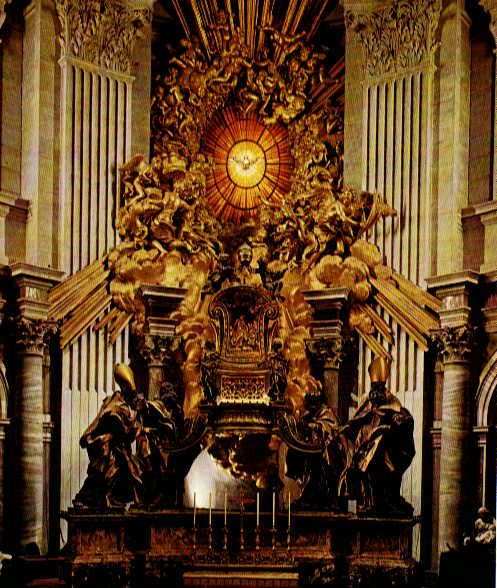
High Altar of St. Peter’s Basilica
My dearest Lord Jesus:
It is again the start of work and studies.
How I pity Monday!
It is perhaps the most hated day of the week primarily because of the many fears it brings upon us.
Inner and outer fears that lead us to doubt our selves, our talents and abilities, even people around us.
And worst, of doubting YOU.
There are times we are like the Apostles who could hardly see you coming to us in times of darkness and storms in life.
Though you keep on calling us, assuring us of your presence, to be not afraid, we still choose to be afraid that we sink deeper into sin and evil.
Immediately Jesus stretched out his hand and caught Peter, and said to him, “O you of little faith, why did you doubt?”
Matthew 14:31
Hardly a day passes in our lives, Lord, without our experience of so many fears, doubts, apprehensions, and anxieties that drain us of so much energies to do more good things for you through others.
Some of us have long been held captive by this dark power of fear within and without that we hardly experience true freedom!
As we celebrate the dedication of the two Major Basilicas in honor of your two great Saints and Apostles, Peter and Paul, teach us to come home to your dwelling place of love and freedom, not of fear and doubts.
Teach us to be at home with you, to always find you even in the midst of darkness and giant waves of uncertainties. Amen.
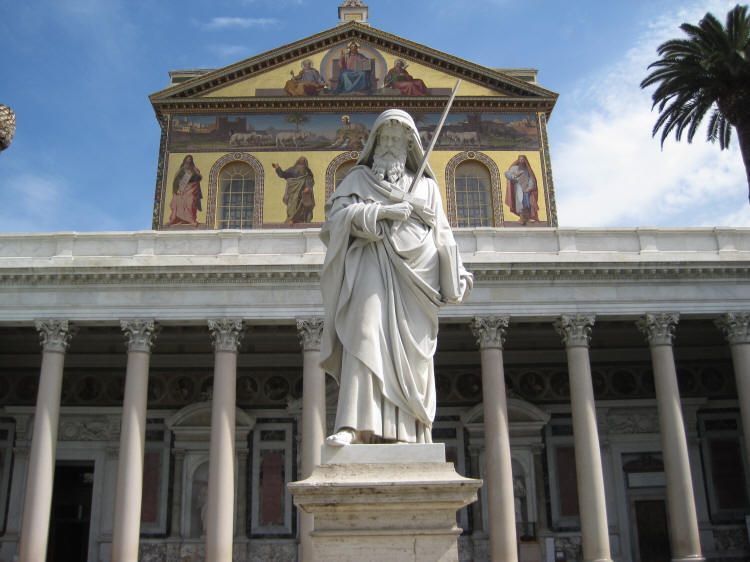
St. Paul with a sword in front of the Basilica in his honor in Rome. From Google.
Lawiswis ng Salita ni P. Nicanor F. Lalog II, 04 Oktubre 2019
Mula sa Be Like Francis Page sa Facebook.
Minsan daw ay nagimbal
kaibigang Kardinal ni San Francicso
na banal
nang kanyang malaman
dukha nilang pamumuhay
na sa kanyang palagay
labis na kahirapan hindi naman
dapat nilang pagdaanan.
Katuwirang ipinaliwanag
ni San Francisco kay Kardinal Hugolino
kay gandang pagnilayan
sa malalim nitong kahulugan:
"kung tayo'y maraming kayamanan,"
aniya ng ating banal
"kakailangan din natin mga sandata
upang mga ito'y ipaglaban at pangalagaan."
Sa kanyang isipan
at banal na kalooban,
ang pag-ibig ay namamatay
kapag tao'y nagkamal maraming ari-arian;
hanapin kanyang paliwanag
kung masasagot kanyang mga katanungan
na tila bugtong di lamang sa isipan
kungdi pati na rin sa puso at kalooban:
"Mapagnanakawan mo ba
na tao na walang ano man?
Maari mo bang gutumin
ang nag-aayuno?
Mayroon ka bang sisirain
sa taong namumuhi
sa parangal at pagkilala?
Ano nga ba magagawa sa taong aba at dukha?"
Para kay San Francisco
ang mga dukha ang tunay na malaya
kayang ipaubaya lahat
pati sarili sa Bathala
upang makagawa
ng kabutihan sa kapwa
na siyang simula ng ating kapatiran
at ugnayan pati sa kalikasan.
Mula sa Reuters.
Sa ating panahon ngayon
karukhaan ay pinag-uusapan
batay sa kawalan
ng ari-arian na kabaligtaran
ng kung ano mayroon
ang mayayaman na kadalasan
mga bagay nabibilang
at nabibili gaya ng kapangyarihan.
Ngunit kung ating pagninilayan
ano mang mayroon ang mayaman
ay wala pa rin o "NOTHING"
kung Inglesin natin
dahil ang higit na mahahalaga
ay hindi nakikita
ni nabibili o nabibilang
gaya ng pera at iba pang kayamanan.
Gayun din naman
hindi masasabi ng sino man
na siya ay dukha
at "walang wala" ika nga
dahil kung tutuusin natin
ang lahat ay palaging mayroon pa rin
o "SOMETHING"
kung Inglesin din natin.
Harinawa'y mapagtanto natin
sa pagdiriwang ng kapistahan
ni San Francisco na butihin
ito mismong buhay natin
ay dakilang kayamanan
na dapat ipagpasalamat natin
sa karukhaan ng loobing maialay
gaya ng Panginoon Hesus natin.
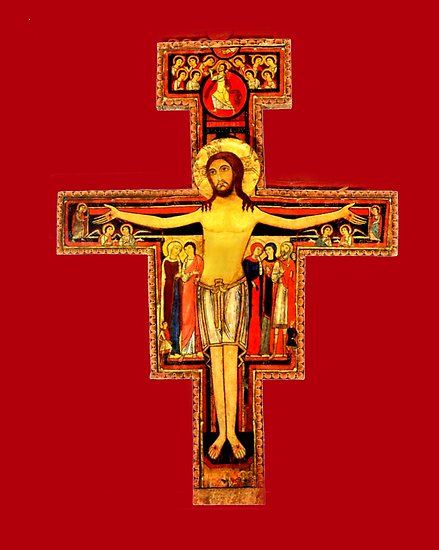
Ang Krus ng kapilya ng San Damiano na isinaayos ni San Francisco batay sa tinig na kanyang narinig habang nananalangin doon.
Do we really have a choice with you? Of course, you are not forcing us to choose you because you gave us freedom, your most wonderful gift expressing your love for us. You never impose yourself on us and, we are always free to choose you or not!
But, how can we not choose you, O God? You are the only good, the ultimate good. And you never fail to give us the best, nothing less.
Joshua addressed all the people: “Thus says the Lord, the God of Israel: I gave you a land which you had not tilled and cities which you had not built, to dwell in; you have eaten of vineyards and olive groves which you did not plant.”
Joshua 24:2, 13
Problem with us, Lord, is our failure to accept and own your gifts. We keep on looking for something else when you are giving us the very best. We always insist on what we want, on our choices we think to be good but not really good. But, because we are free, you allow us to disregard your gifts and choose something else – and still bless us!
And so we pray today that you teach us to both accept and own your gifts to us, Lord.
It is not enough that we accept gifts but we must also own them to be truly a blessing that can be shared and given to others.
Material and spiritual blessings, life lessons and life-blows, and all the other good gifts from you Lord are easy to accept but unless we own them too as ours, they get wasted.
Anything received but not owned becomes useless because it does not prosper nor grow nor mature and bear fruits. Be it our very selves, our country, our jobs, our family and friends. Everything, especially you, Lord, whom we always receive but never shared because we never truly have you in us. Let us own you, Lord! Amen.
Lawiswis ng Salita ni P. Nicanor F. Lalog II, Ika-12 ng Hunyo 2019
Mula google.
Tuwing sasapit petsa dose ng Hunyo
Problema sa ating mga Filipino
Nahahayag sa pagdiriwang na ito
Na tila hindi natin tanto kahulugan nito.
Ano nga ba ang wasto,
Araw ng kalayaan o araw ng kasarinlan?
Parehong totoo at magkahawig sinasaad ng mga ito
Ngunit malalim at malaki pagkakaiba mga ugat nito.
Mula sa Wikipedia.
Kung pagbabatayan ating kasaysayan
Araw ng kasarinlan ang petsang ito
Nang bumukod at magsarili tayo bilang isang bansa
Pinatatakbo ng mga sariling mamamayan at kababayan.
Ngunit totoo rin namang sabihing
Higit pa sa kasarinlan natamo natin sa petsang ito
Kaya nararapat tawaging araw ng kalayaan
Nang lumaya ating Inang Bayan sa pang-aalipin ng mga dayuhan.
Larawan mula sa ABS-CBN News.
Maituturing bang may kasarinlan ating bayan
Kung wala namang kalayaan linangin at pakinabangan
Kanyang likas na yaman lalo na sa karagatan
Gayong tayo ay bansang binubuo ng mga kapuluan?
Tayo nga ba ay nagsasarili at masasabing may kasarinlan
Kung turing sa atin ay dayuhan sa sariling bayan
Walang matirhan lalo na mga maliliit nating kababayan
Dahil sa kasakiman ng ilang makapangyarihan sa pagkamkam?
Gayon din naman sana'y ating matingnan
Kung tunay itong ating kalayaan
Marami pa rin ang nabubulagan at hindi matagpuan
Dangal ng kapwa na madalas ay tinatapakan.
Ang tunay na kalayaan ay ang piliin at gawi'y kabutihan
Kaya ito ma'y kasarinlan dahil ito'y kakayahang
Kumawala at lumaya sa panunupil sa sariling pagpapasya
Walang impluwensiya ng iba kungdi dikta ng konsiyensiya.
Larawan mula sa Google.
Kalayaan at kasarinlan kung ating pagninilayan
Dalawang katotohanang nagsasalapungan
Kung saan mayroong pagtatagpo ng kabutihan
Paglago at pagyabong ng buhay tiyak matatagpuan.
40 Shades of Lent, Wednesday, Week-V, 10 April 2019
Daniel 3:14-20, 91-92, 95///John 8:31-42
From Google.
If you remain in my word, you will truly be my disciples, and you will know the truth, and the truth will set you free.
John 8:31-32
Very often Lord Jesus, when you talk of us being set free, we feel like the people of your time bragging
…we have never been enslaved to anyone.
John 8:33
Very often, Lord, we feel so proud to claim being one with you, truly serving you when in fact we are enslaved by so many pleasures in life.
There are many ways of serving you, of being free for you, of being faithful to you.
But there is only one sure way of being enslaved: when we desire to please our very selves and others.
Like in the first reading, it is very easy to please King Nebuchadnezzar in serving false gods, thinking these would not harm us, that we can control ourselves, that we would not completely fall into it. There are many instances we think that with these modern times with the modern thoughts and modern ways of life sweeping all around us, just a little pleasure would not mean anything at all, would never have a control over us until we are trapped, enslaved, and have lost everything.
Knowing the truth is being one with you, O Lord: remaining in you, staying with you. Loving you, serving you. Through others. Not pleasing myself. Amen.










 lordmychef.com