Lord My Chef Daily Recipe for the Soul by Fr. Nicanor F. Lalog II
Thursday, Second Week in Ordinary Time, Year II, 22 January 2026
1 Samuel 18:6-9; 19:1-7     <*{{{{>< + ><}}}}*>     Mark 3:7-12
Your words today,
O Lord, are very disturbing,
even baffling but very revealing:
in the first reading we heard
the beginning of Saul's jealousy
of David while in the gospel
of how "unclean spirits" recognized
Jesus as the Son of God.
Lord, give us the courage
to confront every jealousy
that seeps into us,
from the most simple ones
to more greater ones that really
get us destabilized like that of Saul
when he heard people praised David
for killing ten thousand
compared to his thousands;
jealousy can be a terrible thing
because it is difficult to see others
better than us; most of all,
most difficult of all is to see people
turning away their attention from us
for others.
Saul was very angry and resentful of the song… And from that day on, Saul was jealous of David (1 Samuel 18:8, 9).
Teach us Jesus
to accept fully our strengths
and weaknesses,
to not measure our success
as persons by what we can do
or what others say; teach us to
imitate St. John the Baptist who
declared "Christ must increase,
but I must decrease" (John 3:30).
Teach us, Lord Jesus
to be honest and sincere
like you, so contented in yourself:
you silenced the unclean spirits
from making you known;
how intriguing that so often,
it is our dark, sinful side
where we truly find the hard truths
of life; if we could just be like you,
we would never be taken over
by jealousy because the moment
we experience jealousy,
then we realize the truth
of somebody better than us
in some aspects; jealousy is an
unclean spirit within us that
speak of the truth not to set us
free but to enslave us by driving us
into the opposite direction of self-
aggrandizement.
Teach us, Jesus,
that all that matters
is for us to give glory to God
and that the work of your
Kingdom is always done,
by us and by others.
Amen.
Photo by author, Don Bosco Chapel on the Hill, Nasugbu, Batangas, January 2023.
Lord My Chef Sunday Recipe for the Soul, 26 October 2025
Thirtieth Sunday in Ordinary Time, Cycle C
Sirach 35:12-14, 16-18 ><}}}}*> 2 Timothy 4:6-8, 16-18 ><}}}}*> Luke 18:9-14
Photo by author, Alberione Center, Araneta Ave., QC, 11 September 2025.
We got our inspiration anew for this Sunday’s reflection from the blog of Sr. Renee Yann, RSM whom we follow at WordPress (https://lavishmercy.com/2025/10/18/pride-of-place-2/). Her blogs are so wonderfully written with reflections so deep, inspiring and uplifting.
In her recent blog, Sr. Renee tells of their parishioner they fondly called “Mamie” who sat on the same seat in their church they called “Pride of Place” for forty years until her death. And for a good reason. Despite her many trials and sufferings in life, Mamie never failed in helping those in need in their community.
Photo by author, Carmel of the Holy Family Monastery, Guiguinto, Bulacan, 25 September 2025.
As told by Sr. Renee’s dad, Mamie had always sat in the same pew through the Depression as she struggled to keep her grocery opened; after the death of her husband in an accident, Mamie never missed their Sunday Masses seated at the same spot – in fact, she was at the same pew on a Sunday Mass when her son was killed at Pearl Harbor. It was actually their community who “proudly awarded” the seat as a “pride of place” to Mamie following her life of Christian witnessing.
“Pride of Place” isn’t always something physical like a pew in church. More often it’s a moral or spiritual position that’s granted to us by others after we pay moral dues. These dues include trustworthiness, sacrifice, contribution, and wisdom…“Pride of Place” doesn’t come automatically with power or position. It comes with respect. Unfortunately, not every parent, boss, teacher, pastor, elder, president, or champion deserves it. It must be earned and kept as a trust. (https://lavishmercy.com/2025/10/18/pride-of-place-2/).
The story reminded me of our own “pride of place” in the church, of people always occupying the same pew or spot during the Mass that they are amazed how we priests get to know them simply with their “seating arrangement” like their coming late or being absent!
Photo by author, Carmel of the Holy Family Monastery, Guiguinto, Bulacan, 25 September 2025.
But, what struck me most with Sr. Renee’s piece is the spiritual meaning of “pride of place” which refers actually not to where we sit but where we stand. That standing is more than physical but spiritual and moral in nature. Where we stand is about our stance or conviction not only on issues but about our faith and relationship with God expressed in our dealings with others exactly what our gospel tells us this Sunday.
“Two people went to the temple area to pray; one was a Pharisee and the other was a tax collector. The Pharisee took up his position and spoke this prayer to himself, ‘O God, I thank you that I am not like the rest of humanity — greedy, dishonest, adulterous —- or even like this tax collector. I fast twice a week, and I pay tithes on my whole income.’ But the tax collector stood off at a distance and would not even raise his eyes to heaven but beat his breast and prayed, ‘O God, be merciful to me a sinner.’ I tell you, the latter went home justified, not the former; for whomever exalts himself will be humbled, and the one who humbles himself will be exalted” (Luke 18:10-14).
Painting by French artist James Tissot, “The Pharisee and the Tax Collector” (1886-1894) from commons.wikimedia.org.
For the second straight Sunday, we hear another teaching of Jesus about faith expressed in prayers in another parable only Luke has.
Last Sunday we reflected that to persist in prayer is not about wearing God down but of allowing our hearts to clarify our desires until we silently surrender to what God knows is best for us which is salvation or “justification”. See how we find that word again – justified – as the key to this parable at its end when Jesus declared that it was the prayer of the publican that was heard for “he went home justified”.
The object of every prayer is God because prayer is a relationship, not just a ritual. To be filled with God is what holiness is, not being sinless. In fact, holiness is finding our sinfulness before God. And that is the essence of our parable this Sunday.
That is why Jesus directs our attention in the “where” when we pray – not just the location when we pray but our “place” in that relationship with God who is our very foundation. When all we see is our self in prayer like in any relationship, it means it is a monologue, a one-way street. Worst, it is an indication of the absence of God, even of others because the pray-er is so preoccupied with his or her very self!
Photo by the author at the Wall of Jerusalem, May 2017.
The Pharisee was clearly not in God even if he were in front of the temple. His very self was very far from God and all he had was his bloated ego. He may be a very pious person but not really good at all for he has no space for God and for others. He is a very closed man without any room for others. Remember, Luke said that “Jesus addressed this parable to those who were convinced of their own righteousness and despised everyone else” (Lk.18:9).
The tax collector, on the other hand, may be physically far outside the temple but was the one actually nearest to God with his self-acceptance and admission of sins, of his need for God. He was closest to God because he was more open with God and with others by admitting his true self.
Prayer is more than entering a church or a prayer room, or finding our most suitable spot or space to pray. Prayer is being one with God, one in God. Prayer is losing our very self in God. The question now is, “where are we when we pray?
I have always loved this photo by friend from GMANews, Ms. JJ Jimeno who took this while she was praying inside the UP-Diliman Adoration Chapel in May 2019; she aptly captioned it as “losing one’s head in prayer.” True!
First, we become one with God in prayer when we admit our sinfulness, when we confess our sins to him, and own them without any “ifs” and “buts”. God always comes to those who truly open themselves to him by emptying themselves of their sins and inadequacies.
The tax collector was justified in his prayer more than the Pharisee because in confessing his sins, he admitted his need for God. He knew very well his place, so unlike the Pharisee who felt God owes him so much!
Second, we are in God in prayer when we are humble and have the conviction to leave everything behind and go down with God into the lowest point because one is so confident of the efficacy of prayer like what Ben Sirach tells us in the first reading.
The one who serves God willingly is heard; his petition reaches the heaven. The prayer of the lowly pierces the clouds; it does not rest till it reaches its goal (Sirach 35:16-17).
Most often in life, friendships and relationships are kept when we are willing to take the lower stance, not necessarily admitting fault or guilt in any misunderstanding because being lowly indicates the person’s need for the other person and of one’s love to work on that relationship despite its fragility. I tell couples that when they quarrel, the first who must first make the move to greet the other person is not the guilty one but the one with most love and self to give.
Third, we are in God in prayer when there is an offering daily of one’s self to God. It is not enough to be lowly and sorry for our sins in prayer. It has to be sustained because prayer is a discipline like any sport as St. Paul tells us in the second reading, calling us to persevere and endure until the end for Jesus Christ “who shall award us with the crown of righteousness in heaven.”
We are all sinners forgiven and beloved by God. When we find our right place in God in prayer, then we also find him. And meet him. Amen. Have a blessed week ahead into November! Fr. Nicanor F. Lalog II, Our Lady of Fatima University, Valenzuela City (lordmychef@gmail.com)
Photo by author, Carmel of the Holy Family Monastery, Guiguinto, Bulacan, 25 September 2025.
Lord My Chef Sunday Recipe, 31 August 2025
Twenty-Second Sunday in Ordinary Time, Cycle C
Sirach 3:17-18, 20, 28-29 ><}}}*> Hebrews 12:18-19, 22-24 ><}}}*> Luke 14:1,7-14
“Meal in the House of a Pharisee” 1886-1896 painting by James Tissot from brooklynmusueum.org.
For the next three Sundays beginning today, Luke gathered teachings of Jesus Christ all set on the dining table, a sort of some “table talks” about the great banquet in the end of time and how we could all get in to share in the eternal meal with the Father.
On a sabbath Jesus went to dine at the home of one of the leading Pharisees, and the people there were observing him carefully. He told a parable to those who had been invited, noticing how they were choosing the places of honor at the table (Luke 14:1, 7).
I love the way Luke presented this scene when he said “the people there were observing Jesus carefully” while the Lord told them a parable after “noticing how they were choosing places of honor at the table.”
How lovely! People observe, Jesus notices.
As it had happened in every instances of gatherings with Jesus, people carefully observed him, trying to find something to accuse him in of disregarding their traditions and laws like healing the sick on a sabbath day. They have “boxed” and judged Jesus as a dissident and a trouble-maker among them in his apparent disregard of laws and traditions.
Photo by author, Manila Club, BGC, June 2025.
In a funny twist, Luke tells us in this scene the immense love of Jesus then and now for everyone that despite his noticing and knowing everything in us, he neither counted those things against us nor ever judged us. How sad many of us with that habit of putting God in a box like a cop keeping tabs of our infractions when in fact God simply noticed our actions and behavior to invite us to become better without any judgment at all.
Keep in mind this scene reveals to us its context of the heavenly banquet which took place after the sabbath services at the synagogue where Jesus participated, hosted by a Pharisee, a VIP of the synagogue and of the society at that time. It was a party where every who’s who was supposed to be present, with everyone competing for the best seats closest to the host. And so, Jesus the keen observant but never judgmental used the occasion to teach us the essence of humility to make it to heaven or eternal life that is signified by a wedding banquet like that big meal he attended.
“When you are invited by someone to a wedding banquet, do not recline at table in the place of honor. A more distinguished guest than you may have been invited by him… For everyone who exalts himself will be humbled, but the one who humbles himself will be exalted” (Luke 14:8, 11)
These past Sundays, we have seen Christ’s insistence of the Father’s desire to have everyone welcomed into heaven by giving us some instructions of what to do to gain eternal life.
This Sunday while in a big party, Jesus took the occasion to teach us the value of humility to get into heaven. From doing, Jesus now moves into being, our disposition and attitude to make it into heaven where what matters most is not where we are seated but where we stand. Recall how Jesus reminded the brothers James and John with their mother that he has nothing to do with the seating arrangements prepared by the Father in heaven after she requested her two sons to be seated beside him when he comes into his glory.
Heaven is more of where we stand with Jesus where his virtue of humility is most pronounced when he “humbled himself, becoming obedient to death, even death on a cross” (Phil.2:8). That is why St. Augustine taught that “humility is a sign of Christ”, a revelation of Jesus that allows us to recognize him our Lord and Master leading us to the Kingdom of heaven without any feelings of inferiority and despair.
On the Cross which he prefigured at his Last Supper, Jesus showed himself as the most humble of all who went to life’s lowest point of suffering and dying to meet us as he noticed everything in us to lift us up and be like him, humbly standing in our sufferings. It is on the Cross that we find humility as the basic and essential requirement to get into the heavenly banquet of the Lord.
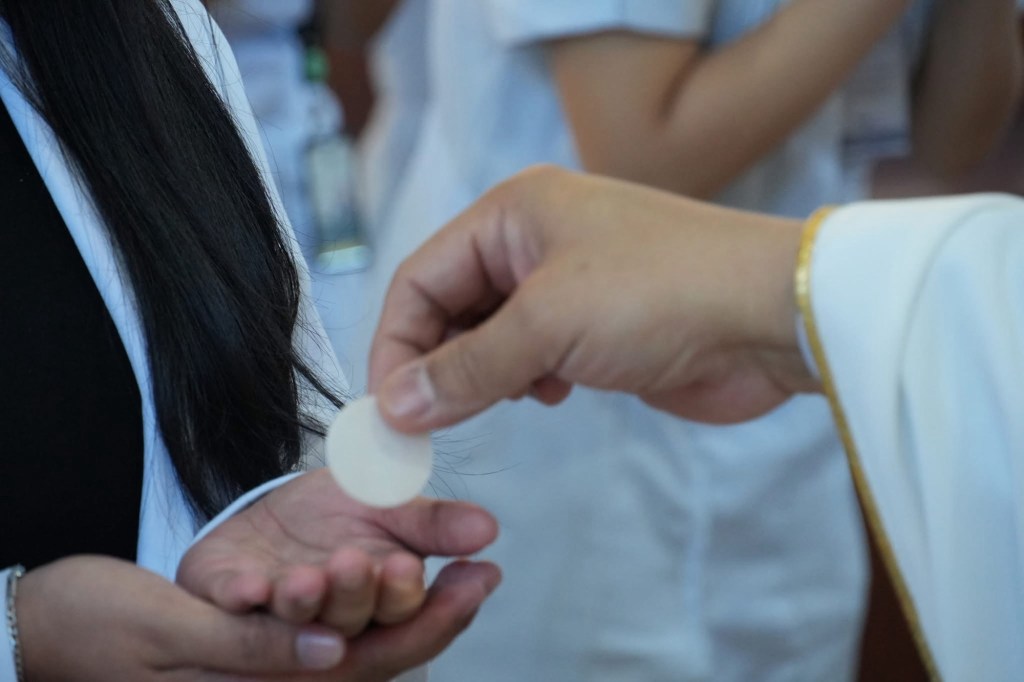
Very often when we examine our state of humility, what comes to our mind are the many negativities we have like our sins and failures, vices and weaknesses, our being unworthy. But, that is when we bow down most to beg for Christ’s mercy like before the Holy Communion when we pray, “Lord, I am not worthy to receive you under my roof but only say the word and I shall be healed.”
That is both the humility of Jesus and of us humans so vividly expressed at the washing of the feet after the Last Supper. Normally, we look up to Jesus in heaven but at the washing of feet, like every time we receive Holy Communion, we take the higher position, looking down at him not with pride but with all humility because Jesus humbled himself first before us. Here we find humility as seeing ourselves the way Jesus sees us – weak and sinful, yet so loved and forgiven. This is what Ben Sirach taught us in the first reading: humility is the fundamental attitude of wisdom because it opens us to the splendor of God when we find our self-worth and value too!
Without humility, it is either we see only the best or the worst in us as a person, without God, without others.
This is the bigger issue with the “nepo babies” now being bashed on social media after flaunting their wealth and ostentatious lifestyles. Their posts were far from inspiring, at most are tasteless and most convulsive. All we have noticed in their posts is their pride not only in lacking humility but most precisely in not finding value in themselves. Sadly but I dare say they are the ugliest and most pitiable persons because they find value only in wealth and things, not in themselves as persons. Hence, the flaunting of their possessions that only make them so pathetic because along that came their utter disregard for others especially the poor who suffer most with their parents’ greed for money through corruption.
Humility is always uplifting in the positive sense, not looking at others as below us but to realize despite our sins and weaknesses, we are loved, we are noticed as a person so worthy, so valuable. When we are humble, then we become joyful too because we are assured of love and acceptance despite our flaws. This is the gist of the message to us this Sunday of the author of the Letter to the Hebrews: unlike the Israelites in the Old Testament who were so fearful to approach God who spoke to them with thunder and lightning, we can get close to God in Jesus who humbled himself to be one with us by dying on the Cross.
True humility keeps us rooted with our selves, with others and with God. It is this rootedness best expressed in the Sunday Eucharist that we are able to follow Jesus in his journey to Jerusalem and eventually into heaven in all eternity. Amen.Have blessed Sunday and most blessed September too!
Photo by the Marketing Office, Our Lady of Fatima University, Valenzuela City, June 2025.
The Lord Is My Chef Sunday Recipe for the Soul by Fr. Nicanor F. Lalog II
Feast of the Baptism of the Lord, Cycle C, 12January 2025
Isaiah 40:1-5, 9-11  ><}}}*>  Titus 2:11-14; 3:4-7  ><}}}*>  Luke 3:15-16, 21-22
Photo by author, San Fernando, Pampanga, November 2021.
Today is your last chance to greet “Merry Christmas” the people you have forgotten as well as claim your gifts from Santa because this Sunday’s “Feast of the Lord’s Baptism” closes the Christmas Season.
The Lord’s Baptism shows us that Jesus did not remain an infant on the manger in Bethlehem nor a child in Nazareth. It is sad to note both the religious and secular emphasis on this child imagery of Christ have reinforced the notion among people that Christmas is for children and a time for adults to return to the innocence and joy of their childhood.
Jesus grew up and matured into an adult on a mission from the Father to save us that led to His Passion, Death and Resurrection at Easter. Through our baptism in becoming the children of God, Jesus invites us to continue His Christmas story by maturing in our faith, hope and love in Him by embracing His Cross that His Baptism anticipated.
This Sunday Feast of the Lord’s Baptism is a coming to full circle of last week’s Epiphany into a theophany. Yes, they sound Greek because both are from the Greek words “epiphanes” and “theophanes”.
Epiphany is Jesus manifesting Himself to all nations through the Magi as the King of kings last Sunday; today, it is God the Father who recognizes Jesus as His Christ, His Anointed One with the voice declaring as a theophany, “You are my beloved Son; with you I am well pleased” (Lk.3:22).
Every morning as we wake up is a theophany with God telling us “You are my beloved child; with you I am well pleased.” Three things I wish to share with you for us to hear God’s daily theophany and fulfill our mission as baptized children of the Father.
Photo by author, sunrise in Atok, Benguet, 27 December 2024.
First, let us recognize and affirm our being, identity, and existence. Many times, we are more of a “zombie” than a human person who can’t find life nor experience living at all, wasting precious time to be somebody else, living in the past or living in the future.
When Luke noted “The people were filled with expectation, and all were asking in their hearts whether John might be the Messiah”(Lk.3:15), he wished to inform us how the people at that time recognized and admitted they were sinners, that they were broken, that they were sick physically, emotionally and spiritually as they all affirmed their need for salvation. They accepted and owned the realities of their lives that they needed God, they needed the Christ whom they thought was John the Baptizer.
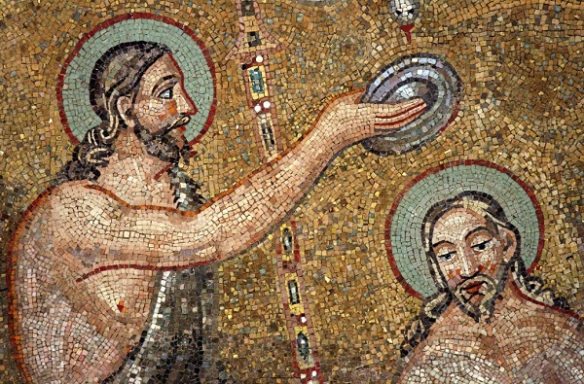
The Baptism of Christ by John the Baptist in the Jordan River. Detail of dome mosaic in the Battistero Neoniano (Orthodox Baptistery) in Ravenna, dating from 451-75. On lower right is a personification of the Jordan River as an old man rising from the water, holding a reed in one hand and offering a garment to Christ in the other. The right arm and dish of John the Baptist, the dove, and Christ’s head are 18th- and 19th-century restorations; the rest is original.
Even John the Baptizer is presented by Luke as also so sure of who he was as the precursor of the Messiah. Among the expectant people and John, we realize that indeed, growth happens the moment we accept who we are.
Examine the testimonies of many devotees of the Nazareno at Quiapo, of how they support each other in their woes and sufferings in life that we find a sort of theophanies by God, something like what we have heard from the first reading today, “Comfort, give comfort to my people, says your God”(Is.40:1). That comfort, that salvation, happened right there and then, in the now and not in a distant future.
Despite my “dislike” for their attitudes during the Traslacion, devotees of the Nazareno have always amazed me for daring to be truthful and honest with themselves, admitting their own sinfulness and weaknesses as they recognized too their need for help and most especially of their desire for God. This desire for God and admission of one’s sinfulness are very crucial to experience and hear God’s daily theophanies to us.
Photo by Mr. Jay Javier, 09 January 2019.
Second, for us to hear God’s theophany, we need to imitate Jesus Christ in taking the downward movement in life. His baptism at Jordan clearly illustrates this with His coming down to the Jordan valley through the mountains that evoked His own coming down from heaven to be born here on earth, in Bethlehem.
What is so beautiful with Jesus Christ’s downward movement is essentially a being with the sinful, the sick, the rejected, the marginalized, the poor, and those considered dirty. From being purely clean and sinless, Jesus took all our dirt to be cleansed like Him. Such is the kindness of God that Paul speaks today to Titus “so that we might become heirs in hope of eternal life”(Titus 3:7).
Our world today teaches us the opposite direction Jesus Christ had taken by climbing up the pinnacle of success, of good life, of supremacy, of power, of everything! They call it “upward mobility” that has prompted everyone even those in the Church to join the rat race for being rich and famous, of being somebody, putting on masks and taking more of the goods the world offers until we get lost in misery finding no meaning at all with one’s self because we thought life is “up there.”
Jesus Christ is not up there but down here, in our very selves, in our very hearts filled and battered with our many agonies and failures, hurts and pains, weaknesses and sins. Look down more into our very selves to find Jesus in our dirt and miseries which is the message of Jesus Nazareno.
Observe all those interviewed in Quiapo have only one prayer – well-being of a loved one. They never asked to be rich or have money. Just heal a sick child or parent was the most requested prayer of devotees. Our favorite Pope Benedict XVI explained this downward movement so well:
To accept the invitation to be baptized now means to go to the place of Jesus’ Baptism. It is to go where he identifies himself with us and to receive there our identification with him. The point where he anticipates death has now become the point where we anticipate rising again with him (Jesus of Nazareth, page 18).
Photo by author, sunset in Liputan Island, Meycauayan City, Bulacan 31 December 2022.
Last but not least for our reflection is something very peculiar with Luke alone: the theophany of Jesus happened not right after His baptism but while He was praying, “After all the people had been baptized and Jesus also had been baptized and was praying, heaven was opened and the Holy Spirit descended upon him in bodily form like a dove”(Lk.3:21-22).
In the Acts of the Apostles, Luke recorded the Pentecost happened while the Apostles with the Blessed Mother Mary were all praying when the Holy Spirit descended upon them like tongues of fires which is similar with what took place at Jesus’ Baptism. In all books of the whole Bible, divine revelation is always preceded with prayer. As we shall see this year when Luke guides us every Sunday with his gospel account, he is the one who portrayed Jesus most in prayer than any of the other evangelists.
Photo by author, Garden of Gethsemane, the Holy Land, May 2017.
If we want to hear God’s theophanies to us, let us handle life with prayer which is more of listening and being one with God. Begin and end each day with prayer. There is no other way to hear God’s voice, to hear Him affirming us, to know His plans for us until we are one with with Jesus in prayer.
In His baptism at Jordan, Jesus Christ as the Second Person in the Holy Trinity prayed not because He needed something from the Father but because He is one with Him in the Holy Spirit. That was when the Father affirmed Him as the Christ being sent on a mission.
Through the Sacrament of Baptism we have received, we are reminded today of God’s anointing of each of us as His beloved child. May we heed His voice and be one with Him for a more blessed 2025 ahead of us as we begin Ordinary Time tomorrow. Have a blessed week. Amen.
Quiet Storm by Fr. Nicanor F. Lalog II, 04 November 2024
Photo by author, Nagsasa Cove, San Antonio, Zambales, 19 October2024.
Lately I have noticed my getting delayed of turning calendars in my room. Normally, I would be late for only a day or two but since June, it has sometimes taken even weeks. Worst was September when it was already about to end when I noticed my calendars stuck in August!
There are three calendars in my room: first is the large type given away by hardware stores located at the back of my entrance door which I could read from my bed with its big fonts; second is an average-sized religious calendar with pictures of saints and dates of their feast I keep in the closet so I would see every morning when I put on my clothes; and the third one is a table calendar on my desk where I work. That’s the only one updated and most used but the other two bigger ones, I fear are slowly becoming obsolete to me like the alarm clock (because I always wake up ahead of its alarm).
As I age, calendars along with watches seem to be irrelevant with me.
Personally, it is ironic because I have long kept a sort of relationship with calendars, keeping them along with some planners since college in the 1980’s. I don’t know why. Basta – I love looking at old calendars, giving me that sense of joy within when I literally look back in time, recalling the reminders and important events I have jotted on them decades ago.
But now, sadly as I recall this major change in me, I feel to have lost that “lovin’ feeling” I used to have with calendars that have been replaced, of all things, by medicines.
You read it right. I now reckon time, especially the months not with calendars anymore but with maintenance meds I take daily – 30 days – to keep my sugar, blood pressure and cholesterol in control as well as my prostrate to remain “gentle”. Once a week, usually on a Monday morning, I fill my medicine dispenser with all the meds I will be taking from Sunday to Saturday.
It always funny when I do this weekly ritual like playing sungka: there are times I wonder with some irritation why my meds are getting fewer. That is when I realize the month is almost over and I have to buy again another 30 pieces of my meds for the next 30 days. And that is how I now count the days of each month…
Whenever I would do this ritual, Mitch Albom’s novel “The Time Keeper” comes to mind, reminding me of the value of time we often take for granted. I cannot recall in which part of the novel where one of the characters realized that “the reason God limits our days is to make each one precious.” Very true. It is said that “it is not time that is passing by but you who are passing by” because we cannot bring back time we have wasted with its opportunities to grow and learn, to live and love, to celebrate and laugh.
Lately I have been thinking if I am just going through a phase as I approach the age of 60 that would be in March next year. Is this part of getting old, of maturing?
Most likely.
Photo by author, Nagsasa Cove, San Antonio, Zambales, 19 October2024.
How funny, even stupid how we have kept ourselves busy all our lives, complaining about time when time has always been on our side.
Maybe one of the reasons why elder people mellow as they age is that we are no longer so concerned with time as something separate from us, divided into parts we try to gather and hold because the truth is, time is the reality itself, we are a being-in-time, not distinct from us nor apart, but always our wholeness. It does not really matter if it is the past or the future but always the here and the now, the present.
Time in its entirety is a cosmic reality within us which we cannot fully grasp yet. Not yet. That’s what we call heaven, which is already here but not yet. And achievable. Let me explain.
It seems to me that at the age of 59, our main task in life is to live fully in each moment. Though I would admit I am afraid of dying, death is something we must befriend. Coming to terms with life is coming to terms with death, and vice versa. When that happens, then, we have arrived truly in life. That’s heaven, Just in time. This we experience so well when we truly love as this anonymous saying tells us:
Time is fast for those who rush;
Time is slow for those who wait;
Time is not for those who love.
“Time is not for those who love” is what the Greeks refer to in their other word for time called kairos or “fullness of time”. It is the time of the Lord, when we are one with God in Jesus Christ. It is that moment when everything falls into its right places which I believe is what Paulo Coelho referred to in one of his novels “when the whole universe conspires in your favor.”
The other word for time by the Greeks is kronos from which the word chronology came from to refer to the the succession and measurement of time in seconds, minutes, hours, days, weeks, months and years; kairos is the fullness of time. Again, from Albom’s “The Time Keeper”, there is this line that says, “If you you are measuring life, you are not living it.” Same thing holds true with time; if we keep on measuring it, we shall never have it nor enjoy it.
Photo by author, Nagsasa Cove, San Antonio, Zambales, 19 October2024.
While there in Nagsasa Cove, one of the songs that kept playing at the back of my mind was Steely Dan’s Time Out Of Mind from their 1980 album Gaucho. Despite the critics’ insistence of its strong links with heroin use which I have never tried, it is one of my top favorite songs by the Steely Dan gods, Donald Fagen and the late Walter Becker. Oh how I imagined them telling me this…
Son you better be ready for love
On this glory day
This is your chance to believe
What I've got to say
Keep your eyes on the sky
Put a dollar in the kitty
Don't the moon look pretty
Our world has become so complicated like Facebook. It is all palabas, a show. No meaning nor substance at all because we have been trying to capture and keep time instead of allowing it to capture us, envelop us so we can move more freely with it within to discover more of the outside. No stress, no pressures. No calendars too!
Just time out of mind. Thank you for bearing with me.
The Lord Is My Chef Daily Recipe for the soul by Fr. Nicanor F. Lalog II
Wednesday, Memorial of St. John of Capistrano, Priest, 23 October 2024
Ephesians 3:2-12     <*((((><  +  ><))))*>     Luke 12:39-48
Photo by author, Pampanga, September 2024.
Lord Jesus,
many times I find myself
like Peter asking You
so often with his same
question especially
when things get
so difficult,
so trying:
Then Peter said, “Lord, is this parable meant for us or for everyone?” And the Lord replied, “Who, then, is the faithful and prudent steward whom the master will put in charge of his servants to distribute the food allowance at the proper time? Blessed is that servant whom his master on arrival finds doing so” (Luke 12:41-42).
Forgive me, Jesus,
when there are times I exclude
myself from the rest,
when I exempt myself
from your teachings,
when I unconsciously demand
from You some perks
and privileges for following You;
let me be your faithful servant
who takes care of others
even if my other fellow servants
are remiss of their responsibilities
or worst when those You have
entrusted with authority
forget to be humble,
throwing their weight
around us,
insisting on their powers.
Give me the grace, Jesus,
to imitate St. Paul
of ably dispensing God's grace
and mystery of salvation
to everyone despite the
many hurts and pains
that often come with it.
Amen.
The Lord Is My Chef Sunday Recipe for the Soul by Fr. Nicanor F. Lalog II
Twenty-sixth Sunday in Ordinary Time, Cycle B, 29 September 2024
Numbers 11:25-29 ><}}}}*> James 5:1-6 ><}}}}*> Mark 9:38-43, 45, 47-48
Photo by author, ongoing works on the stained glass of the National Shrine of Our Lady of Fatima, Valenzuela City, 24 July 2024.
Our Sunday gospel is getting more exciting each week as Jesus gets closer to Jerusalem in fulfillment of His mission with His Passion, Death, and Resurrection.
One thing we see these past Sundays is how Mark followed a certain series of contrasts in the trajectory of his reportage. Note the contrasting scenes with every Sunday as we find today the Twelve appeared united as one unlike last week when they debated on the way who was the greatest among them.
More than that, Mark narrated today two strongly contrasting components of the Lord’s teachings to His disciples about discipleship and membership.
Photo by author in Magalang, Pampanga, 23 September 2024.
First is His tolerance on those who do good even though they do not belong to His fold, telling us to let everyone do what is good because no one has a monopoly of serving.
At that time, John said to Jesus, “Teacher, we saw someone driving out demons in your name, and we tried to prevent him because he does not follow us.” Jesus replied, “Do not prevent him. There is no one who performs a mighty deed in my name who can at the same time speak ill of me. For whoever is not against us is for us” (Mark 9:38-40).
Then in a sudden shift, Jesus severely criticized those who cause scandal, strongly urging His disciples including us today to totally eradicate whatever that leads us to sin and evil. Rejecting sin is discipleship in essence, not membership.
“Whoever causes one of these little ones who believe in me to sin, it would be better for him if a great millstone were put around his neck and he were thrown into the sea. If your hand causes you to sin, cut it off. It is better for you to enter into life maimed than with two hands to go into Gehenna, into the un quenchable fire. And if your foot causes you to sin, cut it off. It is better for to enter into life crippled than with two feet to be thrown into Gehenna. And if your eye causes you to sin, pluck it out. Better for you to enter into the kingdom of God with one eye than with two eyes to be thrown into Gehenna” (Mark 9:42-43, 45, 47).
Jesus teaching his Twelve Apostles, from GettyImages.
What a lively discussion the Twelve must have had that day with Jesus. This scene is a favorite of many Christians when discussing the scriptures, of how they are to be understood and interpreted with our ready excuses that Jesus did not literally mean what He said about cutting off our sinful hand or sinful foot and plucking out our sinful eye.
But, have we really reflected on its meanings and implications to our lives today?
Jesus reminds us this Sunday that discipleship is more than membership because in doing what is good, “the sky is the limit” so to speak. No disciple of Christ can lay claim to a monopoly in doing what is good, serving others; moreover, no disciple of Christ can belittle the good works of others even if they do not belong to the same religion or church.
Photo by author in Magalang, Pampanga 23 September 2024.
When our good deeds become “exclusive” and selective, then, that cease to be good.
Our ability to do good is always a grace of God, a gift poured out upon us by God daily so that we can be more loving and caring, more understanding and forgiving to one another. The moment we forget that, then, we start playing God.
In telling His disciples to let that man exorcize those possessed even he were not among the Twelve was clearly a command for us to recognize all who do good as brothers and sisters even if they do not necessarily share our beliefs and traditions. It is a call to respect one another.
Recall how in John’s gospel Jesus called Himself the Good Shepherd who has other sheep not in this fold. And we cannot deny that many times those who do not belong to our Church or group are doing better in serving others than us who are so entangled with bureaucracy and programs or procedures, not to mention fame and other selfish motives.
This attitude of having a monopoly of ministries and charities is one serious malady afflicting parishes today. Very often, the people with this attitude are the cordon sanitaire of priests who most likely are a Jollibee or a pabida since they were seminarians. They are the epal for short who volunteer in everything leaving nothing else for others to do, eventually spawning more pabida and epal in the church. Many parishioners refuse to serve not because they are lazy nor indifferent nor afraid but simply they are never given a chance to serve due to the monopolistic attitudes of some. It is a sad case of ministry and service based on membership than discipleship.
Photo by author in Magalang, Pampanga 23 September 2024.
Jesus is telling us this Sunday that there should be no divisions in doing good. Allow others to do good! Give them the chance to enter heaven too with their services and charities.
God wants us all to be “prophets” as explained by Moses to Joshua in the first reading when Meldad and Eldad prophesied even though they were not present in the Lord’s meeting tent. Moses rightly identified “jealousy” as one reason for such monopolistic attitude of good works by some believers.
Sin is the only obstacle in doing good, not membership. That is why, Jesus was severely stern in His words, telling how better it is for one causing others to sin to be thrown into the sea with a great millstone around one’s neck. Or, to cut off one’s hand or foot, and pluck out one’s eye that cause anyone to sin.
Photo by author at Fatima Ave., Valenzuela City, 25 July 2024.
If doing good were “sky is the limit” among disciples of Jesus, sin definitely has no room among us.
See how in this Sunday gospel Jesus implied to John and other disciples including us today of the grave sin of pride when we have that attitude of having a monopoly of good works, of relying more on membership than discipleship. It makes us proud and bloats our ego, leading us to more sins along the way until later on, we succumb to what the Greeks called as hubris.
That is why St. James in the second reading instructed us to examine our attitudes on social ills like poverty and inequality because wealth, like fame and glory, are always stained by sin.
A good disciple is always a good member of the Church – or any team and organization for that matter. Most of all, in our own family and circle of friends!
From Caesarea Philippi down to Capernaum that began three Sundays ago, Mark has continued to show us who Jesus really is, as the Christ who invites us with a personal answer to His same question to the Twelve, “who do you say that I am?” (Mk. 8:29).
The contrasts we found in Him today are not opposed to each other like His meekness with the sick and toughness with those who cause sin. Jesus is very open with anyone doing good, being kind and helpful but amid all these contrasts, He remains firm on His demands on discipleship rooted on His Cross, not just membership or being called a Christian.
When we look on His face, on His person, we find integrity and coherence, wholeness and holiness for Jesus is the Christ who had come to make us all divine, to become holy like Him “filled with His spirit” (Num. 11:29).Amen. Have a blessed week and October ahead!
Photo by Ka Ruben, the new stained glass at the National Shrine of Our Lady of Fatima, Valenzuela City, 13 September 2024.
The Lord Is My Chef Daily Recipe for the Soul by Fr. Nicanor F. Lalog II
Friday in the Seventeenth Week of Ordinary Time, Year II, 02 August 2024
Jeremiah 26:1-9     <*{{{{><  +  ><}}}}*>     Matthew 13:54-58
Photo by author, Sacred Heart Novitiate, Novaliches, QC, 20 March 2024.
Thus says the Lord: Stand in the court of the house of the Lord and speak to the people… whatever I command you, tell them, and omit nothing (Jeremiah 26:2).
Omit nothing?

What a tall order from You,
God our Father;
and You know how much
I have tried to omit nothing
of your words when I spoke:
always, I am the first
to be shaken and affected!
Many times, people do not
see nor realize that when
we speak your words,
omitting nothing,
we are always the first to be affected
because your words cleanse
and purify us, committing us more
to You and your mission;
therefore, help us to "enflesh"
your words always in our witnessing
and omit nothing as You wished.
In this time when people
clearly omit many of your
very words like "male and female
You created them" as well as teachings,
making gender more of a preference
than of nature and part of your grand design,
grant us more perseverance and charity
when we speak and omit nothing
of your words and teachings
deemed by wokes and liberals
as not being cultured and inclusive;
let us remember that even Jesus
your Son was reviled and crucified
not only then but until now
by those who consider themselves
as learned and politically correct,
refusing to accept
your words and teachings
and very Self.
Amen.
The Lord Is My Chef Daily Recipe for the Soul by Fr. Nicanor F. Lalog II
Friday in the Fifteenth Week of Ordinary Time, Year II, 19 July 2024
Isaiah 38:1-6, 21-22, 7-8     <*((((><  +  ><))))*>     Matthew 12:1-8
Photo by author, somewhere in Bgy. Kaysuyo, Alfonso, Cavite, 27 April 2024.
When Hezekiah was mortally ill, the prophet Isaiah, son of Amoz, came and said to him: “Thus says the Lord: Put your house in order, for you are about to die; you shall not recover. Then Hezekiah turned his face to the wall and prayed to the Lord… Then the word of the Lord came to Isaiah: “Go, tell Hezekiah: Thus says the Lord, the God of your father David: I have heard your prayer and seen your tears. I will heal you: in three days you shall go up to the Lord’s temple; I will add fifteen years to your life” (Isaiah 38:1-2, 4-5).
God our Father,
help us
 to put our house in order;
give us the courage and
strength to put our lives
in order
by sincerely admitting our sins
with a firm resolve to turn away
from them and live the gospel
of Jesus your Son.
Let me put order
to my spiritual life by cultivating
the discipline to pray daily
keeping that relationship with You;
let me put order in my life
by seeking ways to be more
loving with others than
finding their faults;
let me put order in my life
by being less judgmental of others
to be more charitable and understanding.
Like Hezekiah
let me accept my fate,
let me accept death:
"In the noontime of life I must depart!
To the gates of the nether world
I shall be consigned
for the rest of my years" (Isaiah 38:10);
how wonderful that without praying
for his healing but for the grace
to accept your will,
You healed Hezekiah
and prolonged his life
to serve You more than ever.
Amen.
Quiet Storm by Fr. Nicanor F. Lalog II, 09 May 2024
Our mother had always loved flowers and shades of pink, especially pink carnation her favorite.
It has been said death is the greatest equalizer. But with my mom’s recent passing, I realized too that death is the best explainer of life. Death is life’s final joke on us that answers, clarifies the many questions we have been asking in our lifetime.
Consider these:
Dad died on June 17, 2000, my mom’s 61st birthday; we celebrated his 40th day of death on his birthday, July 26, 2000. He died on a Saturday, the eve of Father’s Day.
Mommy died May 07, 2024 with her 40th day coming on June 15, two days before her 85th birthday and dad’s 24th death anniversary. This Sunday after her burial is Mother’s Day.
Ever since my father died, I have realized that death weaves a certain pattern in our lives, telling us a lot of things about us and our loved ones. And about life itself if we would have faith in God by setting aside our fears and superstitions.
Photo by author, somewhere in Bgy. Kaysuyo, Alfonso, Cavite, 27 April 2024.
See how Jesus spoke to His disciples about His coming death during their Last Supper:
“Now I am going to the one who sent me, and not one of you asks me, ‘Where are you going?’ But because I told you this, grief has filled your hearts. But I tell you the truth, it is better for you that I go. For if I do not go, the Advocate will not come to you. But if I go, I will send him to you… But when he comes, the Spirit of truth, he will guide you to all truth. He will not speak on his own, but he will speak what he hears, and will declare to you the things that are coming.”
John 16:5-7, 13
It is always after someone had died when things and life itself become clearer for us. In every death comes an unfolding of truth in time, in persons. It is after a beloved had died when we realize how much we do not know of their goodness or kindness that often we are surprised at the outpouring of love by those who come to their wake. Many times, strangers know more of the brighter side of a person when he/she dies. Along this line of mystery of the person we find too how death happens on days that at first seem to mean nothing at all but at closer look, or later as we moved on in life after the demise of a loved one, we see how every death points to something about us and our family and friends!
Hence, we say death is not the end but the beginning of eternity. Actually, with the deaths of my father and now of my mom, I have found death is life. No wonder St. Francis referred to death as a person, calling him “cousin Death.”
This became more clear to me when I became a chaplain at the Fatima University Medical Center (FUMC) in Valenzuela City.
Last year I took care of an elderly priest, Msgr. Teng Manlapig when he was confined in our hospital for almost a month. Two days before he died on February 26, 2023, he asked me to hear his confession. It was a Friday and February 26 last year was the first Sunday in Lent when the gospel was the temptation of Christ in the wilderness.
It was on that Sunday evening after seeing Msgr. Teng for the last time before he was taken to the funeral parlor when I remembered another priest I had cared during his dying days, Msgr. Macario Manahan who died in front of me in his retirement home on March 16, 2014 – the second Sunday in Lent when the gospel was the Transfiguration.
What a tremendous gift from God for me to care until their deaths of two monsignori in the Season of Lent. From them I have realized that our final altar as priests are our deathbeds where even to the end, we celebrate Mass and the Sacraments. From that day on too, I have prayed to God to allow me to go home to Him not during Lent but on Easter. Or, preferably on Ascension Sunday when my time comes.
Have a blessed day celebrating life, finding its meaning and beauty in the prism of cousin Death in Jesus Christ. Amen.















 lordmychef.com