Faith of Jesus, faith we imitate

Lord My Chef Sunday Recipe for the Soul by Fr. Nicanor F. Lalog II
Twentieth Sunday in Ordinary Time, Cycle C, 17 August 2025
Jeremiah 38:4-6, 8-10 ><}}}*> Hebrews 12:1-4 ><}}}*> Luke 12:49-53
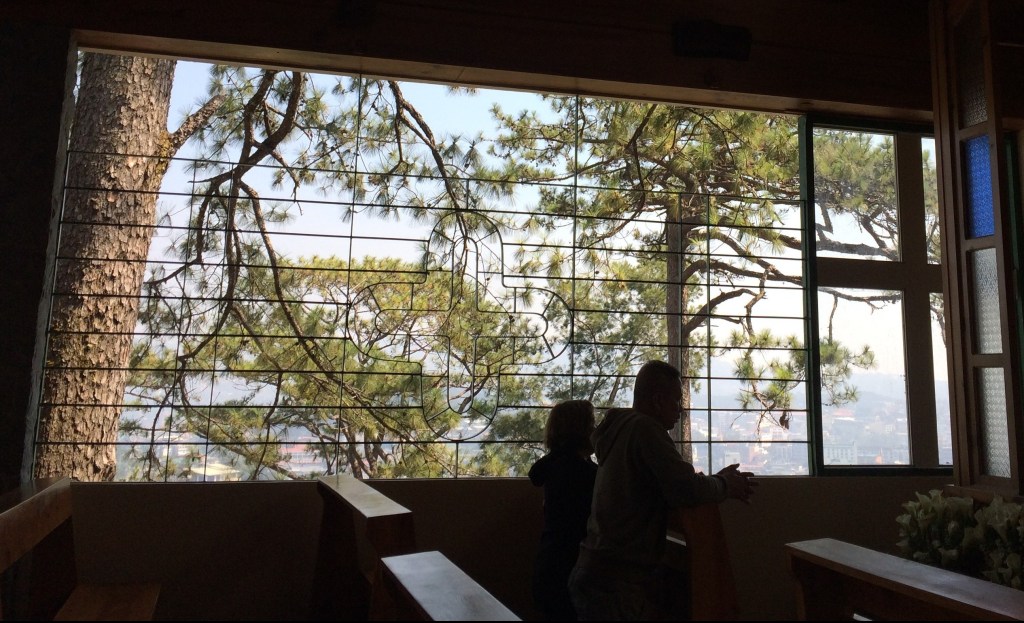
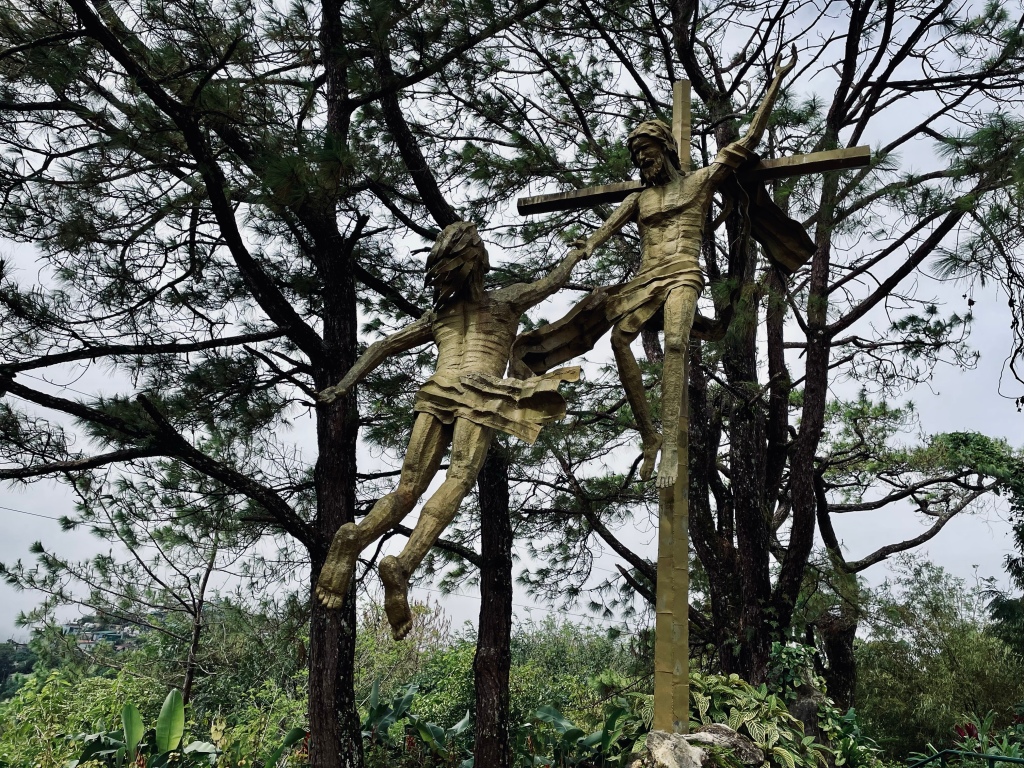
Photo by author, Archdiocesan Shrine of Nuestra Señora De Guia, Ermita, Manila, 28 November 2024.

We Christians believe in and trust in Jesus but seldom think of him as a man of faith because very often our concept of faith is always in terms of creeds and beliefs.

As we have reflected last Sunday in the second reading from the Letter to the Hebrews, faith is more than of the mind; faith is more of the heart, of the relationship one has with God or with whomever one believes in. Hence, “Faith is the realization of what is hoped for and evidence of things not seen” (Heb.11:1).

This Sunday we start anew our reflections from the second reading, the letter to the Hebrews that supports today’s gospel where Jesus is asking us to have more faith in him because following him can lead to distressing situations and painful, or even tragic choices. In identifying Jesus as “the leader and perfecter of faith”, Hebrews insisted on the human side of Jesus we rarely consider – that he was sustained by faith, who trusted God in vindicating him as he died on the Cross.

Brothers and sisters: Since we are surrounded by so great a cloud of witnesses, let us rid ourselves of every burden and sin that clings to us and persevere in running the race that lies before us while keeping our eyes fixed on Jesus, the leader and perfecter of faith… Consider how he endured such opposition from sinners, in order that you may not grow weary and lose heart. In your struggle against sin you have not yet resisted to the point of shedding blood (Hebrews 12:1-2, 3-4).

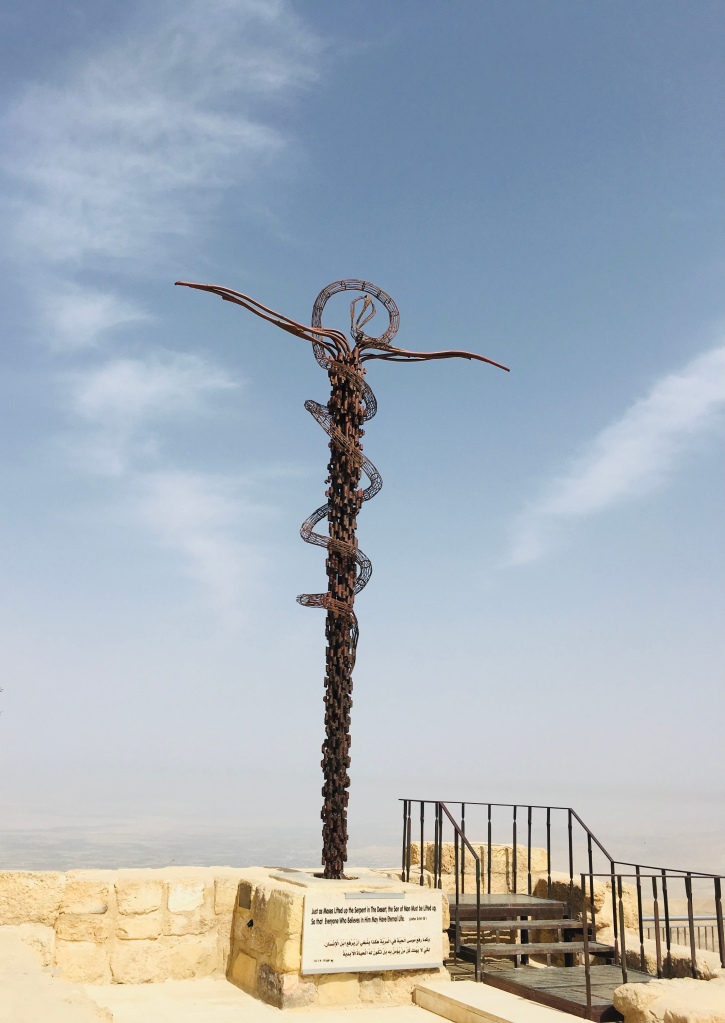
Photo by author, Malagos Garden Resort, Davao City, August 2018.

Every time I face difficulties and trials in life, I always think of my mom and dad, my “cloud of witnesses” of faith like those mentioned in Hebrews who have attained faith’s goal in the Old Testament.

Usually, I would ask my departed parents for prayers, asking them for guidance on how to deal with difficult situations I am facing. It is therapeutic for me because after that, my memory would waft into those days and nights I used to listen to mom and dad tell their many struggles and hardships they both endured early in life like dropping out from school in order to find work early and eventually why they married late.

“Mahirap ang buhay noon, anak” they would always tell me, followed by a litany of not having enough money for food, clothes and shoes and various forms of leisure and comforts we take for granted these days. After that short trip in memory lane with my parents, I feel better, inspired and energized knowing that I have poor souls praying for me.

Think of those people like family, friends, and mentors who have been part of this “cloud of witnesses” in your life. Include your favorite saints too. And of course, Jesus Christ our Lord and God who, as perfecter of faith shocks us with his teachings this Sunday:

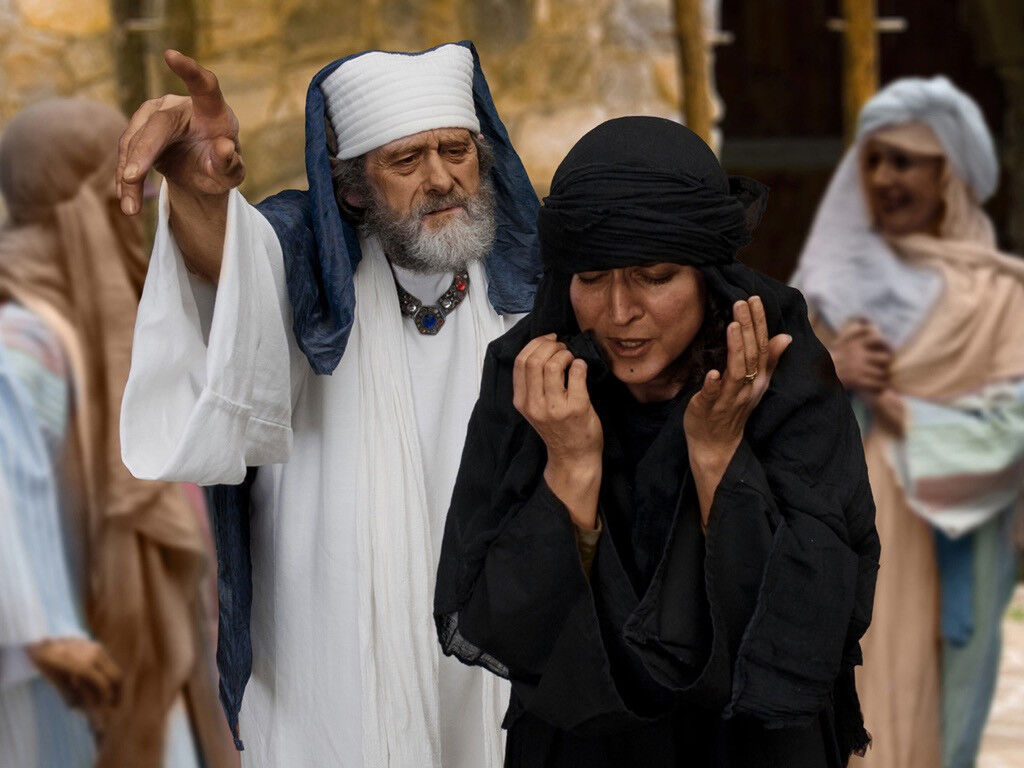
Jesus said to his disciples: “I have come to set the earth on fire, and how I wish it already blazing! There is a baptism with which I must be baptized, and how great is my anguish until it is accomplished! Do you think that I have come to establish peace on the earth? No, I tell you, but rather division (Luke 12:49-51).

Photo by author, St. Paul Spirituality Center, La Trinidad, Benguet, January 2025.

Unlike in the fourth gospel, it is very rare in Matthew, Mark and Luke to hear Jesus speaking of himself in the first person like today when he said “I have come… I wish… I must.” These are “involved expressions” where Jesus not only reveals to us the nature of his mission but especially his determination to fulfill it as Luke had earlier noted this at the start of this long journey to Jerusalem, “When the days for his being taken up were fulfilled, he resolutely determined to journey to Jerusalem” (Lk.9:51).

Feel in these expressions the ardent desire of Jesus, the burning fire within him to transform us and the world in his coming Passion, Death and Resurrection which is the baptism he must undergo.

The fire he mentioned here is the fire of the Holy Spirit he sent on Pentecost that filled his disciples with zeal to spread the gospel and the nascent Church as well. Luke knew so well in how those tongues of fire that hovered over the disciples’ heads on Pentecost was also the same fire Jesus referred here that dissolves our old selves to convert us into his disciples filled with zeal and enthusiasm in witnessing the gospel in the world that has gone cold and dark with sin and evil.

As fire purifies metals like gold, fire leads to divisions so to speak. It is a positive division that builds and perfects, not destroys. It is the kind of fire Jesus meant here as he continued his teachings on the way to Jerusalem to prepare us for the End with a capital “E”. It is a fire that sets apart truth from falsehoods and lies and most of all, of good from evil and sin so necessary in making it to eternal life. To fully appreciate this shocking lesson of Jesus today, we need to go back to the second reading where the author of Hebrews called us to “rid ourselves of every burden and sin that clings to us and persevere in running the race that lies before us while keeping our eyes fixed on Jesus, the leader and perfecter of faith” (Heb.12:1-2).

What are those burdens and sin that cling to us or we carry that make it difficult to imitate Jesus, to have faith in Jesus?

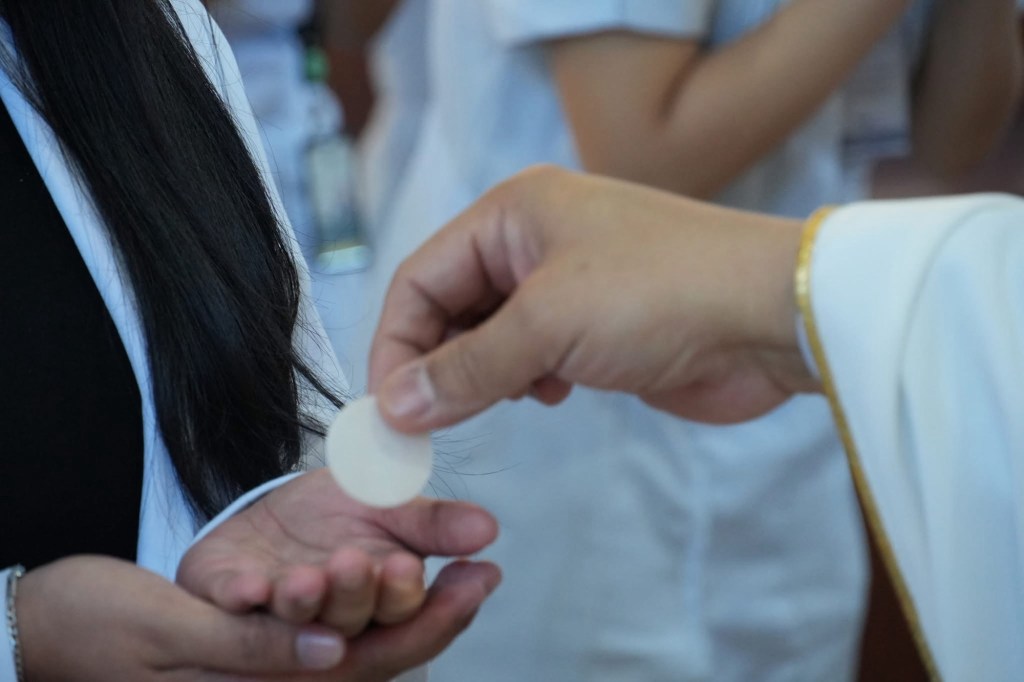
Photo from Fatima Tribune, Red Wednesday, Chapel of the Angel of Peace, Our Lady of Fatima University, 27 November 2024.

Very often, we are the ones who make our problems and sufferings worse with the excess baggage we keep on carrying like bitterness and resentments, self-doubts and self-rejection, and many other negative feelings that we allow to fester within us. Sometimes, we are like that man who asked Jesus to tell his brother to give his share of inheritance when we refuse to look more into our own sins, preferring to look more into other’s faults and failures. Or, maybe like Martha we are so busy and preoccupied with many other things that we not only forget God but even our very selves in the process.

Focus on Jesus alone, let him perfect our faith by purifying us with his fire of love.

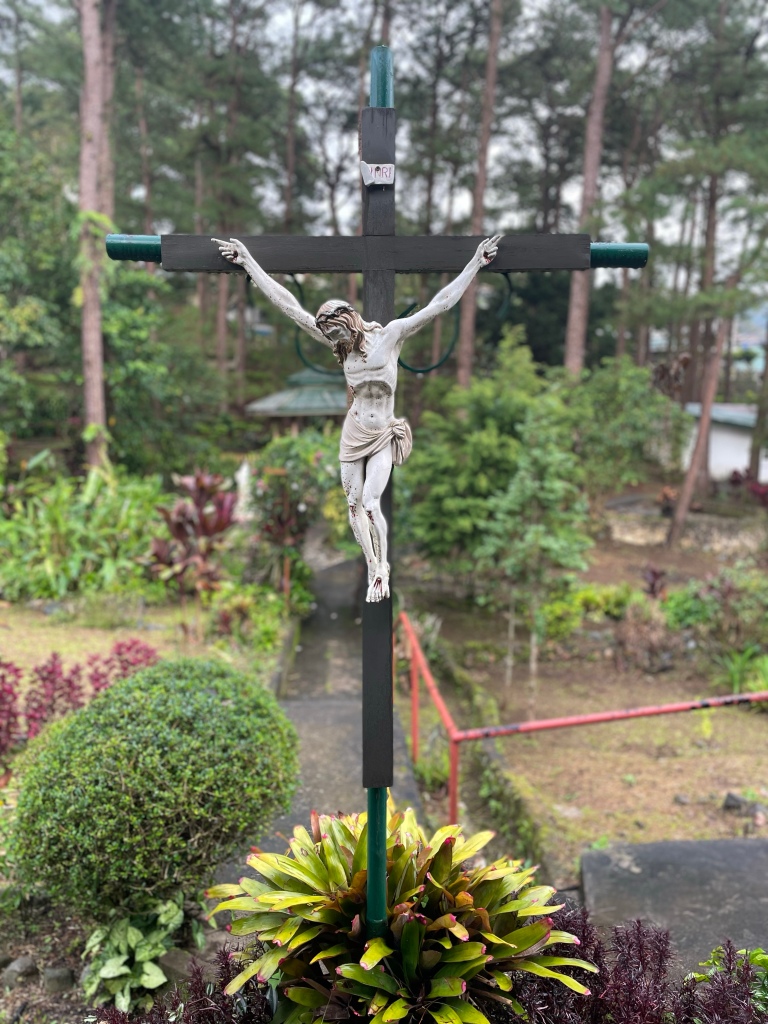
Photo by author, Archdiocesan Shrine of Nuestra Señora De Guia, Ermita, Manila, 28 November 2024.

Be on guard, however, that the more we follow Jesus on his path of the Cross, the more we experience “complexities” in life like Jeremiah in the first reading. He found enemies among his own people who tried to put him into death because he spoke the truth. Discipleship in Christ is being a prophet – a sign of contradiction especially in today’s world where sin and profanity are extolled while rights are exaggerated and truth and morals are relativized. There are strong temptations for us to withdraw to one’s corner, refusing to choose a side or take a stand especially when loved ones or those dear to us get involved.

This Sunday, Jesus invites us to focus on him alone, to have faith in him, to be like him. He perfects our faith in him, enabling us to choose and stand for what is true and good, fair and just. Let us pray to Jesus for more fire and warmth in our faith in him, remembering those words of the author of Hebrews that “In your struggle against sin you have not yet resisted to the point of shedding blood.” Amen. Have a blessed week ahead everyone!

Begin with the End in sight

Lord My Chef Sunday Recipe for the Soul by Fr. Nicanor F. Lalog II
Nineteenth Sunday in Ordinary Time, Cycle C, 10 August 2025
Wisdom 18:6-9 ><}}}}*> Hebrews 11:1-2, 8-19 ><}}}}*> Luke 12:32-48
Our new College of Medicine Building with the lovely flowers of Banaba trees welcoming the new academic year this Monday, 11 August 2025.

One of the remarkable trends in management these past two decades is the emphasis on values-based approaches like The Seven Habits of Highly Effective People by the late Dr. Stephen Covey. Second in his list is the title of our reflection this Sunday, “Begin with the end in sight.”

Actually we mentioned that in our reflection last Sunday but we stressed the word “end” begins with a capital “E” to refer to things of God and eternal life as in the End of all in death. This is the theme of the Lord’s teaching today he presented in three parables with the last two calling us to be faithful stewards awaiting their Master’s return in the End while the first one expressing the summary of his lessons, “For where your treasure is, there also will your heart be” (Lk.12:34). But unlike most Sundays, we reflect today on the second reading from the Letter to the Hebrews that shows us Abraham’s faith journey as an expression of Christ’s teachings on setting our sights with the End.

Faith is the realization of what is hoped for and evidence of things not seen. Because of it the ancients were well attested. By faith Abraham obeyed when he was called to go out to a place that he was to receive as an inheritance; he went out, not knowing where he was to go (Hebrews 11:1-2, 8).

Photo by author, RISE Tower, Our Lady Fatima University, Valenzuela City, 06 August 2025.

We all believe in something, whether it is something good or something bad. However, what or who we believe in makes the difference because what or who we believe in determines how we live.

That is why Dr. Covey’s declaration is most true, especially when we talk of our End that is actually a Who – God. It is our faith in God who drives us in this life especially when it is dark and difficult, even painful so that we may achieve our End to be with him in eternity. The author of Hebrews found Abraham’s faith journey so remarkable as it enlightens too our own faith journey in God through Jesus Christ our High Priest as a context.

First, the author of Hebrews defined faith as “the realization of what is hoped for and evidence of things not seen.” Faith is more than trusting God in Jesus Christ. For the author of Hebrews, faith is more of knowing and understanding of what lies ahead though it cannot be seen. Faith here is more of having vision than sight, of seeing beyond things, so convinced of its existence even not seen like Noah who built an ark on God’s command even if there were no dark clouds nor rains visible at all. Faith for the author of Hebrews is like our Filipino expression “a…basta!” of having the conviction God created the universe even though no one saw the act of creation. It is something real that “only the heart can see” because it is also borne out of a deep relationship with God and with those we love. See now the three instances cited by the author of Hebrews in Abraham’s faith journey that are similar with our own experiences.

Photo by author, RISE Tower, Our Lady Fatima University, Valenzuela City, 06 August 2025.

“By faith he sojourned in the promised land as in a foreign country, dwelling in tents… for he was looking forward to the city with foundations, whose architect and maker is God” (Heb.11:9-10). Abraham was a “pilgrim” – a wayfarer – not only from his place of birth into the promised land but also on the journey from the present into the future and eternity. See how Abraham looked into the End at the start of his journey in God and with God walking on the path of what is to come.

All he had was faith in God. Surely there were times of darkness and distress along the way which the author of the Book of Wisdom in our first reading accurately described as “night of the passover” that reminds us of darkness hovering the path of God. Jesus reiterated this “night of passover” literally and figuratively speaking. Have faith in Christ whenever our journey gets tough and rough, when there are detours or when we actually get lost. God will find us to reach his city he made for us.

“By faith he received power to generate, even though he was past the normal age – and Sarah herself was sterile – for he thought that the one who made the promise was trustworthy” (Heb.11:1). We all know the story of Abraham and Sarah having their own son in old age, of the many twists and turns in their lives before Isaac was finally born and thus fulfilled God’s promise that Abraham became the father of all nations. In Matthew’s genealogy of Jesus Christ, Abraham is mentioned first as a testament of his faith in God that led to the birth of the Messiah.

Photo by author, RISE Tower, Our Lady Fatima University, Valenzuela City, 06 August 2025.

Many times we ask why God takes so long in fulfilling his promises to us. We wonder if God really called us to a certain vocation or profession or wanted this and that for us especially when in our prayers we are convinced of God’s will. Why does God keep us waiting?

Experience had taught us that more than a test of our faith, those waiting moments for God’s answer to our prayers were grace-filled moments of our own transformation into better persons so that we may value more his gifts to us, whether they are persons or things or moments. God is faithful. Remember the words of St. Paul, “God’s gifts and call are permanent and irrevocable” (Rom.11:29).

“By faith Abraham, when put to the test, offered up Isaac, and he who had received the promises was ready to offer his only son…He reasoned that God was able to raise even from the dead, and he received Isaac back as a symbol” (Heb.11:17, 19). This is the most moving and touching in the story of Abraham’s faith: he never doubted nor questioned God at all when he was asked to offer his son Isaac. Imagine how Abraham must have felt after waiting for so long for a son, then suddenly God asked him to offer him back Isaac?

See the unfolding of this scene in Genesis 22 with Abraham totally silent going up the mountain with Isaac who asked what shall they offer to God? Abraham simply assured him God will provide. Everything proceeded in silence until Abraham was to kill Isaac when an angel stopped him and told him how God was so pleased with his fidelity. This scene reminds me of the pain of many parents, especially mothers at the funeral of their son or daughter. It is the most difficult Mass for me to celebrate; normally, it is the children who bury their parents, not the other way around. When parents bury their children, no matter how young or old they may be, it is beyond words. I just try to believe more, to have more faith in God that he would bless and comfort the grieving parents.

Photo by author, RISE Tower, Our Lady Fatima University, Valenzuela City, 06 August 2025.

Abraham’s faith is a gift from God we too have all received and must deepen. It is easier said than done but we have to accept that nothing in this life is really ours to keep for all is God’s. And if ever God takes something from us, it is because he is giving us something even more than what we already have. That is why Jesus asks us in the gospel this Sunday to give up everything for him for he is our only End.

Jesus said to his disciples: “Do not be afraid any longer, little flock, for your Father is pleased to give you the kingdom. Sell your belongings and give alms. Provide money bags for yourselves that do not wear out, an inexhaustible treasure in heaven that no thief can reach nor moth destroy. For where your treasure is, there also will your heart be” (Luke 12:32-34).

This Sunday, Jesus invites us to examine where our treasure is for that is where our heart is, giving himself to be our treasure for he alone can lead us to our final End. Like Abraham, Jesus asks us to see beyond the present moment, to give up whatever we have, whether good or bad, people or things, even memories. It is very difficult and even painful but with faith in God, it could be our most liberating and grace-filled moment in life when we learn to forgive and be sorry, to be content, and finally start living by loving and be convinced we are loved because these are all we need in the End. Amen. A blessed week to everyone!

Photo by author, RISE Tower, Our Lady Fatima University, Valenzuela City, 06 August 2025.

Jesus wants YOU.

Lord My Chef Sunday Recipe for the Soul, 03 August 2025
Eighteenth Sunday in Ordinary Time, Cycle C
Ecclesiastes 1:2; 2:21-23 ><}}}*> Colossians 3:1-5, 9-11 ><}}}*> Luke 12:13-21
Photo by author, Sacred Heart Novitiate, Novaliches, QC, March 2024.

Our gospel this Sunday is very interesting as it is similar with what we have heard last July 20, the sixteenth Sunday when Jesus visited the home of Martha who asked him, “Lord, do you not care that my sister has left me by myself to do the serving? Tell her to help me” (Lk.10:40).

Compare that with our gospel today:

Someone in the crowd said to Jesus, “Teacher, tell my brother to share the inheritance with me.” He replied to him, “Friend, who appointed me as your judge and arbitrator?” Then he said to the crowd, “Take care to guard against all greed, for though one may be rich, one’s life does not consist of possessions” (Luke 12:13-15).

Photo by author, PDDM Chapel, Araneta Ave., QC, August 2024.

“Tell my sister…tell my brother.”

How funny we waste energy complaining to Jesus about others when he is not interested at all because he is actually most interested with us! In Martha’s home and in this scene, the Lord shows us that he came here for each of us personally, as if telling us to stop all those pointing to others because each one of us will definitely be dealt with individually, personally by him in the end. But, are we ready like that rich man in the parable?

That is why Luke tells us this amusing anecdote in the journey of Jesus to Jerusalem to remind us anew that in the spirit of Christ’s teaching last week on prayer, he is most concerned with our relationship with God our Father – not with our petty quarrels on money and inheritance or politics. We have to stop that “holier-than-thou” attitude, of being sanctimonious pointing at others without looking deep into ourselves, “Why do you notice the splinter in your brother’s eye, but do not perceive the wooden beam in your own eye?” (Mt.7:1,3).

This Sunday, we hear one of Jesus Christ’s many warnings against relying on wealth, possession and even status for our well-being and security. He invites us to look deep into ourselves than look at others.

Photo by author, Sacred Heart Novitiate, Novaliches, QC, March 2024.

“Take care to guard against all greed, for though one may be rich, one’s life does not consist of possessions.”

A very tough warning from Jesus that sends chills down our spine. It is always easier to point at others than look into ourselves in responding to him, on what is to be “rich in the sight of God” we are all struggling with, though, admittedly many of us truly aspire to be.

There are so many anxieties and other feelings within each of us that push us against the words of Jesus not only here. And Jesus knows very well how we turn to many things other than God for our security and well-being like the rich man in the parable he told the crowd.

We call that “security blanket” which we use to cover ourselves that often temporarily relieves us of our fears and anxieties but ultimately gives us away in the end like that rich man in the parable. He thought he would be safe and secured by building a bigger barn for his “bountiful harvest” that year that would sustain all his needs. But, that night he was taken by the Lord and died, leaving everything behind him.

We can easily identify with that rich man in the parable who portrays what each of us harbors in the depth of our hearts of never having enough. Palaging kulang, palaging bitin at kapos ano man mayroon tayo. We are always afraid that what we have may not be enough that we want to increase, to have more of whatever we think gives us security and well-being in the face of life’s many exigencies and unpredictability.

But, when is enough really enough? In this age of affluence, we have totally forgotten about the value of contentment, of relying more to God than to ourselves. It is not really a question of what we have but of our attitude in what we have, no matter how much or how less that may be.

Of course, we need to be prudent and wise in responsibly planning for our future but Jesus tells us in this parable that what really matters in life is our relationship with God expressed in the Our Father last week. What we need to store in our “barn” is not material things but more of spiritual values like love, kindness, compassion, fidelity, mercy and compassion.

Photo by Pixabay on Pexels.com

Jesus is inviting us today to examine and clean out of our “barn” to make room for God who alone matters in the end. Let God be the only possession we have who possesses us in the end – not our cellphones and gadgets nor our popularity nor negatives feelings like bitterness we have kept so long in our hearts.

Qoheleth in the first reading is neither promoting cynicism nor any negative thoughts about life but simply warned us of the great “sorrow and grief” of too much focus on things of the world that vanish like vapor. The reason we work so hard, fulfilling many tasks and obligations is not merely to earn a living and have nice homes, wonderful vacations here and abroad, education of children and better retirement; we work because we want to have fullness of life. That is why I prefer the Pilipino word for “work” – hanap buhay that literally means “to search life” because we work to find the meaning of life. But, what happens if we become enslaved by our jobs and professions while our possessions eventually possess us that in the process, we lost our very selves and those dearest to us in our relationships?

Photo by Pixabay on Pexels.com

Fullness of life can only be found in God through Jesus who gave us himself totally on the Cross we receive every Mass in the Eucharist. That is why beginning this Sunday and in the next three weeks, we find Luke presenting to us various teachings of Jesus on the way to Jerusalem with a stress on the need to always consider the End, that is, God himself who alone gives us fullness of life. St. Paul speaks of this in the second reading that amid our many concerns in life, let us be focused into things of heaven that are eternal, not of earth that are passing.

Last Friday I read a beautiful story of a man taking care of his critically sick mother that he fell asleep by her side. When he woke up, she was gone forever. He checked their CCTV and saw how in her final moments, the mother saw her son not properly covered that she used all her remaining strength to pull the blanket over him. Then she closed her eyes and died peacefully. It was her final act of love: she tucked her son in bed the day he was born, she tucked him the day she died.

We reflected last Sunday that prayer changes us not the situations. This Sunday, let us pray to Jesus to help us clean and clear our “barn” of worldly things to make more room for God in ourselves to become better persons. And – beginning today – for us to stop pointing at others, asking Jesus to check on them; instead. let us focus on our personal transformation into Christ as better disciples and witnesses. Amen. Have a blessed week ahead! Fr. Nicanor F. Lalog II, Our Lady of Fatima University, Valenzuela City (lordmychef@gmail.com).

Photo by Mr. Sean Pleta in Australia,

Discipleship is prayer, a relationship

Lord My Chef Sunday Recipe for the Soul, 27 July 2025
Seventeenth Sunday in Ordinary Time, Cycle C
Genesis 18:20-32 ><}}}*> Colossians 2:12-14 ><}}}*> Luke 11:1-13
Photo by author, the “Our Father” Church outside Jerusalem where he is believed to have taught his disciples how to pray.

From the home of Martha and Mary, Jesus and his disciples proceeded on their journey to Jerusalem when the disciples saw him at prayer.

Of the four evangelists, Luke is the one who presents Jesus most at prayer, always making time to pray. The disciples noticed this importance of prayer for Jesus that they asked him to teach them how to pray.

More than teaching them the “Our Father”, Jesus again took the occasion to give the Twelve another lesson of things “to do” as a disciple we have seen in the past four weeks like greeting peace every home they visit as they proclaim the Kingdom of God is at hand (July 6, 14th Sunday); being a neighbor to everyone especially those in need in order to gain eternal life (July 13, 15th Sunday); and last week of choosing always the “only one thing needed” by every disciple which is to listen to him and his words.

This Sunday, Jesus deepens that by teaching us his disciples to always pray.

Photo by author, Jerusalem Temple, May 2017.

“And I tell you, ask and you will receive; seek and you will find; knock and the door will be opened to you. For everyone who asks, receives; one who seeks, finds; and to the one who knocks, the door will be opened. What father among you would hand his son a snake when he asks for a fish? Or hand him a scorpion when he asks for an egg? If you then, who are wicked, know how to give good gifts to your children, how much more will the Father in heaven give the Holy Spirit to those who ask him?” (Luke 11:9-13)

More than the mere recitation of a prayer like the “Our Father”, Jesus shows us this Sunday that prayer is the essence of discipleship that is also a relationship with God. That is why he began his lesson in prayer by telling the Twelve, “when you pray, say: Father” that clearly indicates a relationship.

During his time, God was regarded as Someone totally powerful, far from humans whose name could not even be mentioned for its holiness or “otherness”. When Jesus taught to call God “Abba” which is the equivalent to our “dad” or “daddy”, people were scandalized for God is above all to be accorded with the highest respect, never taken on a personal level with such terms of endearment like in human relationships.

Jesus clarified in many instances not only here that though our God is all-powerful and all-knowing, he is a person like us who relates with others, who is so loving and merciful to us he considers his beloved children because he is our Father. Here we find Jesus already bringing God closest to us not only as “God-with-us” but also “God-in-us” so close with each of us as our breath in the Holy Spirit! Jesus proved all these teachings on Good Friday when he died on the Cross.

Photo by author, a bass relief of Jesus Christ’s “agony in the garden” at Gethsemane, May 2019.

Prayer as a relationship is more than telling God what we need which he already knows even before we pray; prayer is more of listening to God for what he wants from us which is to become one in him in Jesus Christ.

I have realized even before my ordination to the priesthood that Jesus calls us not really for tasks he wants us to do but primarily that we may be one in him in an intimate relationship. That is why since my theological studies, I have stopped praying anything for me because God knows what I need most; I pray more for my family and friends while praying only one thing for me – that in every here and now, I am in him until my death.

This intimacy with God in prayer calls for openness that after teaching them the Our Father, Jesus encouraged the disciples to persevere in prayer with a parable of a friend asking for bread, “I tell you, if he does not get up to give the visitor the loaves because of their friendship, he will get up to give him whatever he needs because of his persistence” (Lk.11:8).

Perseverance in prayer is not a kind of “holy nagging” of God in order to change his mind so that he gives our requests. Perseverance in prayer opens us to God’s gifts and plans we acquiesce to with joy. Many complain of God not granting their prayers when in fact, the problem is many hardly pray at all, wearing God with their words without listening to him who has better plans for us by giving us something better than what we are asking for!

Photo by author, a bass relief of Jesus Christ’s “agony in the garden” at Gethsemane, May 2019.

And the best we can have is always him – God himself.

See how Jesus used the transitive verbs “to ask” and “to seek” that both require a direct object when he simply declared “ask and you shall receive, seek and you shall find.” What shall we ask for or seek at all? He did not indicate its direct objects because the answer is only God, as in ask only for God, seek only God.

When we are open to God and into a relationship in him, we are fulfilled, needing nothing at all except him who is everything.

Prayer changes us, not things and situations. There will always be sickness and death, calamities and trials in our lives which prayer cannot prevent from happening. What prayer does is make us stronger in dealing with the storms in our lives, making us better persons and disciples.

No saint had become holy without prayer which is the gateway and foundation of discipleship. This is the whole point of Abraham “bargaining” with God in the first reading: Sodom and Gomorrah were eventually destroyed because no one was left praying and therefore, no one was doing good in the forsaken cities. In their lack of any prayer at all, they have become insensitive of others and of nature that led to their destruction. These are the same dangers our present generation is falling into – a complete disregard of God and others including nature. We have become insensitive of our selves, of others and of the world that we find it so bad, so filled with evil, and so sick. How sad that fewer and fewer people are left praying with so many others not having any qualms at all in missing the Sunday Mass these days.

I have always loved this photo by our friend Ms. JJ Jimeno of GMA-7 News of a man who seemed to have lost his head in deep prayer inside the Prayer Room of the Holy Sacrifice Parish in UP Diliman last June 2019.

Prayer makes us sensitive of God, of our self and of others where we discern what is good and evil, learning what God has in store for us. The more we pray, the more we become sensitive of ourselves and of others and of the world. Yes, we lose ourselves in prayer so that it is Christ who lives in us as St. Paul asserted (Gal.2:20). Contrary to claims by some, prayer is not a flight from reality but actually a dive into the true realities of life as St. Paul tells us in today’s second reading: when we are “raised to life in Christ” (Col. 2:13) in prayers, we are abled to follow Jesus with our own crosses sustained by the gifts of the Holy Spirit in making our society more humane and just.

When we pray, we lose ourselves and we are filled with God so that his kingdom comes when his will is done here on earth as it is in heaven. Amen. Have a blessed week ahead, everyone!

Fr. Nicanor F. Lalog II
Our Lady of Fatima University
Valenzuela City
(lordmychef@gmail.com)
Full presence in Christ

Lord My Chef Sunday Recipe for the Soul, 20 July 2025
Sunday in the Sixteenth Week of Ordinary Time, Cycle C
Genesis 18:1-10 ><}}}*> Colossians 1:24-28 ><}}}*> Luke 10:38-42
Photo by author, Tagaytay City, February 2023.

After telling us what we must do to inherit eternal life through his parable of the Good Samaritan last Sunday, Jesus continued his journey to Jerusalem with his disciples with a stop over today in the home of the sisters Martha and Mary.

The visit became an occasion for Jesus – the Good Samaritan – to expound on the more important things we his disciples must “do” as exemplified in the contrasting attitudes of the two sisters.

“Jesus in the House of Martha and Mary”, painting by Johannes Vermeer (1654) from en.wikipedia.org.

Jesus entered a village where a woman whose name was Martha welcomed him. She had a sister named Mary who sat beside the Lord at his feet listening to him speak. Martha, burdened with much serving, came to him and said, “Lord, do you not care that my sister has left me by myself to do the serving? Tell her to help me.” The Lord said to her in reply, “Martha, Martha, you are anxious and worried about many things. There is need of only one thing. Mary had chosen the better part and it will not be taken from her” (Luke 10:38-42).

This is the third consecutive Sunday Jesus gives us the top things we his disciples must always “do”: two Sundays ago he instructed us to represent him well by greeting everyone with peace while proclaiming that the kingdom of God is at hand (14th Sunday); last week, Jesus asked us to consider everyone especially those in need as a “neighbor” with whom we must show mercy at all times.

Today’s teaching of Jesus is of capital importance in this series on discipleship before the Lord caps it next Sunday with the very foundation of discipleship which is prayer.

An icon of Jesus visiting his friends, the siblings Sts. Lazarus, Mary and Martha. Photo from crossroadsinitiative.com.
"Martha, 
burdened with much serving,
came to him and said..."

Only Luke has this unique story in the home of Martha and Mary.

Far from the simplistic views of a distinction between “contemplative” and “active” approaches in discipleship, Luke invites us not only to enter the home of Martha and Mary but most of all our Lord and Master Jesus Christ to experience and realize the deeper realities of being his disciple.

There is more at issue here than a conflict of duties of listening to the Word like Mary and doing the work like Martha. Jesus is not telling us to be like Mary listening more to the word – and forget all about the work to be done and accomplished? Not at all.

Jesus reproached Martha for being anxious and upset about many things in life that she had forgotten the more essential which is to listen to Christ himself.

Luke’s gospel teems with instances where we find Jesus warning his disciples against being overwhelmed with cares of the world like in the parable of the sower where he mentioned those seeds that fell among thorns were choked by the anxieties and pleasures of the world that they failed to be fruitful (Lk.8:14). In chapter 12 we find Jesus twice repeating in asking his disciples “not to worry” on how to answer their persecutors for the Holy Spirit will teach them (Lk.12:11-12) and immediately after that, “not to worry” again about what to eat or wear for life is more than food and body is more than clothing (Lk.12:22-23). There are many other instances in all gospel accounts we find Jesus denouncing too much focus on things of the world that are passing and worst, detract us his disciples in confessing faith in him as the Christ who had come and will come again at the end of time.

“Jesus in the House of Martha and Mary”, painting by Erasmus Quellinus II and Jan Fyt (1650) from en.wikipedia.org. See the folly of Martha’s worries and distractions with the enormous amount of food being prepared.

Jesus clarifies in the example of Mary that the first priority of every disciple is to listen to the Word who is himself. More than the division of time allotted for “contemplation” and “action” by every disciple, Jesus reminds us that the more we listen to him, the more we do his work; and the more we do his work, the more we desire to return to him and listen again and again to him.

Contemplation and action always go together. We cannot overdo the other and neglect the other. The moment we make a distinction between the two, problems arise like what we find in the church.

When priests and bishops concentrate only in contemplation, oblivious to the social conditions of the people, their proclamation of the Gospel is diluted as they fail to represent well Jesus as the Christ, the Son of the living God. When they are so immersed into social action and advocacies, business endeavors including entertainment in the Mass without contemplation, Christ is detached from the whole picture that people could no longer see nor feel the spiritual nature of the Church with everything becoming a show, empty of any sense of the divine and sacred. In both instances of abuses, either of contemplation or action in the Church, it is her credibility that is eroded as the Body of Christ with a growing number of the faithful disillusioned with priests and bishops more identified with the rich and powerful.

"There is need of only one thing."

Abraham in today’s first reading showed us the most beautiful example of discipleship. Like Martha, Abraham was also gracious in receiving his visitors at Mamre believed to be the Blessed Trinity in the form of angels; but, unlike Martha who was so concerned with her chores that she had forgotten Jesus, Abraham was intently focused on his visitors as “he waited on them under the tree while they ate” (Gen.18:8).

Like Mary listening at the feet of Jesus, Abraham was fully present in God while in Mamre. That is discipleship – to have that full presence in the Lord which is the “only one thing needed” of us which is to receive God’s gift of himself to us, of his Word who became flesh Jesus Christ who enables us to do his works by first recognizing him in ourselves and in one another as our neighbor.

This is the reason why even inside prison, St. Paul felt Jesus Christ’s coming and presence that he rejoiced in his sufferings as part of his ministry in proclaiming Christ as the hope for glory (Col.1:24, 27).

Photo by author, Sacred Heart Novitiate, Novaliches, QC, 20 March 2025.

Last week I read in one of the blogs I follow by an American nun, of how she attended many years ago to a delivery man who died of a heart attack in the ER of a Philadelphia hospital. Part of her ministry was to gather the things found in the chest pocket of the man’s shirt so she could inform the relatives of his death: there was a well-used prayer book, a thin wallet with a few dollars inside, a lottery ticket and a picture of his grandchildren. It was so touching how she narrated these simple things found in the man’s chest pocket as those closest to his heart (https://lavishmercy.com/2025/07/12/the-amoroso-man/).

That hit me so hard because even in this age of smartphones, I still carry a little notebook and pen in my chest pocket where I write my schedules as well as occasional notes on everything I notice and read. Deep inside me after reading that blog, I wondered where is Jesus Christ in all those notes and activities in my pocket notebook closest to my heart.

Dearest Lord Jesus,
make me fully present before
you always, even in my activities
and distractions for it is only in you
I am fulfilled. Amen.

Fr. Nicanor F. Lalog II
Our Lady of Fatima University
Valenzuela City

Stop “overthinking” to be a good Samaritan

Lord My Chef Sunday Recipe, 13 July 2025
Fifteenth Sunday in Ordinary Time, Cycle C
Deuteronomy 30:10-14 ><}}}*> Colossians 1:15-20 ><}}}*> Luke 10:25-37
Photo by author, Katmon Nature Sanctuary & Beach Resort, Infanta, Quezon, 17 March 2023.

Jesus continues his journey to Jerusalem with his disciples, teaching us with some important things “to do” following the questions of some people along the way.

Last Sunday Jesus taught us the five do’s and five don’ts of discipleship; today, he teaches us what we must do to inherit eternal life with the parable of the good Samaritan.

There was a scholar of the law who stood up to test Jesus and said, “Teacher, what must I do to inherit eternal life?” Jesus said to him, “What is written in the law? How do you read it?” He said in reply, “You shall love the Lord, your God, with all your heart, with all your being, with all your strength, and with all your mind, and your neighbor as yourself.” He replied to him, “You have answered correctly; do this and you will live.” But because he wished to justify himself, he said to Jesus, “And who is my neighbor?” Jesus replied, “A man fell victim to robbers as he went down from Jerusalem to Jericho.” (Luke 10:25-30)

First thing we notice is our similarity with the scholar of the law who already knew the answer to the question “what must I do to inherit eternal life?” We know deep in our hearts the answer and like in the gospel, we have felt Jesus affirming us many times like the lawyer. But, Jesus wants us to revisit his parable of the Good Samaritan this Sunday to realize its meaning as we continue to imitate the lawyer with the same question “who is my neighbor?”

But because he wished to justify himself, 
he said to Jesus,
"And who is my neighbor?"
Photo by author, Grand Canyon Woods, Batangas, March 2025.

The Filipino translation gives us a better picture of the lawyer justifying himself, “Sa hangad ng eskriba na huwag siyang lumabas na kahiya-hiya, tinanong niya uli si Jesus, ‘Sino naman ang aking kapwa?'”

See how Jesus did not give a straightforward answer but situated the lawyer including us today into something very concrete so that we stop thinking more and start feeling more. That was the problem with the scholar of the law and with us today: we analyze everything that we have become “over thinkers” but not necessarily “critical thinkers”. We know so many things about our faith but, we still ask for more clarifications because we think more than feel more.

As a chaplain giving recollections and talks to our students, I have seen many young people today are over thinkers but not critical thinkers. I always remind them that critical thinking is about comprehension and analysis of data and information gathered. Over thinking is different. It is not of the mind but of the heart because overthinking is lack of trust. It is a vice when we worry a lot – over think – because we lack trust with others and with ourselves. And ultimately with God!

Photo by author, Camp John Hay, Baguio City, 12 July 2023.

The scholar of the law was overthinking when he asked “who is my neighbor?” because for them at that time, their neighbors were just their fellow Jews. Sad to say, until now our society remains stratified into categories of people like ice cream – the old rich and famous as “all-time favorites”, the recent rich and popular as “flavor of the month” and the ordinary folks as “dirty ice cream” or sorbetes cheaply sold in carts pushed usually by old men.

Of course we know everyone is our neighbor or whoever needs us. But the problem with this all-encompassing view is that it leads us to casuistic argumentation, a kind of over thinking like when we start citing exceptions and excuses or alibis. That is why Jesus used the characters of a priest and Levite who were examples of holiness vis-a-vis a Samaritan who was an enemy of the Jews at that time.

The priest and the Levite passed by the victim of robbery to maintain the Jewish purity law of not touching a corpse to perform their tasks and duties in the temple, both were “overthinking” of their rites and rituals than the dying person. Holiness for Jesus is beyond names and titles but more of the heart seeing and feeling the other person like the Samaritan who alone acted out of his good naturedness as a person, even beyond giving first aid to the robbery victim.

From forbes.com, 2019.

Many times we are like the priest and Levite when we come up with many arguments like “do I not have any other obligation” or “does it really fall on me personally” and so on and so forth when confronted in real life with some people so badly injured or in need of attention.

We overthink with what would happen if we personally get involved with somebody in trouble that people these days are more quick in pulling out cellphones to record an accident and mishap instead of doing something to help.

We over think like the lawyer in the gospel, forgetting to feel more of the other person. That is why in answering his question, Jesus threw it back to him him in another form that is more personal and experiential, “Which of these three, in your opinion, was neighbor to the robbers’ victim?”

Photo by author, 2019.

St. Therese of the Child Jesus wrote in her journal more than a hundred years ago, “I have understood that true greatness is found not in the name but in the soul.”

Beautiful! If we would just look more into our heart, into our soul, we find Jesus, we find our true self, and we find everyone our neighbor to be loved and respected, cared and understood. This is what Moses is telling us in the first reading that the Lord and his commandment are right there in our hearts.

That is exactly what the scholar of the law felt after hearing the story of the good Samaritan that he forgot all labels and categories, answering Jesus’ question with, “The one who treated him with mercy.” There is no need to justify ourselves, of who we are, or even ask who is our neighbor. Everyone is our neighbor because everyone is a brother and sister in Christ; hence, no need to ask that question at all!

But, there is still something deeper to this. When Jesus ended their conversation with the instruction to “Go and do likewise”, the Lord is telling us this Sunday that whenever we encounter a person in need of help, regardless of who she/he is, let us put ourself in that person’s place for it is them – not us – who shall recognize us whether we acted as neighbor to them, or saw them as neighbor!

Photo by Mr. Chester Ocampo, UST Senior High School Building, 2019.

Recall those moments we were down when those dearest to us abandoned us and of all people, the least we expected were the ones who acted as neighbor to us. It is when we are down and low when we come to recognize our neighbor, not when we are up and able, when we feel proud asking what must I do to gain eternal life.

Stop all these over thinking. Simply remember and find Jesus in every person who is the “image of the invisible God” who “reconciled all things for him”(Col.1:15, 20) for he alone is our truest neighbor always present when needed most. Amen. Have a blessed week ahead, everyone! Fr. Nicanor F. Lalog II, Our Lady of Fatima University, Valenzuela City (lordmychef@gmail.com).

Representing Jesus well

Lord My Chef Sunday Recipe, 06 July 2025
Fourteenth Sunday in Ordinary Time, Cycle C
Isaiah 66:10-14 ><}}}*> Galatians 6:14-18 ><}}}*> Luke 10:1-12
Photo by author, Atok, Benguet, 27 December 2024.

Finally, we hit the fourteenth Sunday in Ordinary Time with Luke as our guide after a month of Solemnities.

We are at the turning point in the gospel of Luke – chapter 9 and first half of chapter 10 – where Jesus was identified by Peter as the Messiah (9:20) while Jesus for the first time made known his coming pasch (9:22). From this point on, Luke tells us of how Jesus “resolutely determined to journey to Jerusalem” (9:51) to fulfill his mission as they took a detour from a Samaritan town that had refused them passage (9:53). After this scene comes our gospel this Sunday.

At that time the Lord appointed seventy-two others whom he sent ahead of him in pairs to every town and place he intended to visit. He said to them, “The harvest is abundant but the laborers are few; so ask the master of harvest to send out laborers for his harvest. Go on your way; behold, I am sending you like lambs among wolves. Carry no money bag, no sack, no sandals; greet no one along the way. Into whatever house you enter, first say, ‘Peace to this household’… Stay in the same house and eat and drink what is offered to you, for the laborer deserves his payment. Do not move about from one house to another. Whatever town you and enter and they welcome you, eat what is set before you, cure the sick in it and say to them, ‘The kingdom of God is at hand for you.'” (Luke 10:1-5, 7-9)

First thing we notice about discipleship according to Jesus is that it is never easy, “behold, I am sending you like lambs among wolves.” Disciples need to be “resolutely determined” in the mission like Jesus, focused only on Jesus.

Early in his teachings during the Sermon on the Plain, Jesus enunciated in his Beatitudes the contradictions of his life and teachings to the ways of the world his followers have to imitate. Hence, his list of “do’s” and “don’ts” of discipleship in today’s gospel.

Do’s: greet peace every household they entered; stay in same house; eat and drink whatever is offered; cure the sick; and proclaim “the kingdom of God is at hand.”

Don’ts: no money, no sack, no sandals, no greetings along the way, and do not move about from one house to another.

Notice there are five do’s and five don’ts. And there are only two “do’s” that require speaking: to greet every household with peace and then the other is to proclaim to everyone the kingdom of God is at hand (10:5, 9) which is the sum of discipleship in Christ.

Photo by author, Sacred Heart Novitiate, Novaliches, QC, 20 March 2025.

“Into whatever house you enter, first say, ‘Peace to this household'”…

The only valuable we as disciples of Christ must have is peace that we have to offer generously to everyone.

Peace is the work of the Holy Spirit, a sign of the coming of the Kingdom of God as the angels proclaimed on Christmas, “on earth peace to those on whom his favor rests” (Lk. 2:14). Most of all, peace is the fruit of Easter that the Risen Lord offered his disciples upon seeing them on that evening, “Peace be with you” (Jn.20:19).

Vatican II defined peace “is not merely the absence of war… but the fruit of love which goes beyond what justice can provide” (Gaudium et Spes 78). Peace is something we all have to work and strive for, entailing wounds and sacrifices for us to achieve it by cooperating with the grace of Jesus Christ in overcoming sin and evil. It is a process that never stops, calling for perseverance and daily conversion on our part.

Peace comes when we disciples are open for Christ, for others, and for change and transformation. That is why Jesus insisted us his disciples not to bring anything material that may influence our dealings with others, especially with those who are poor.

The great irony of our time is that the more we have grown affluent with wealth and material things, the more we have become empty in meaning and directions in life. So many are disturbed, longing for peace but could not have it because we the disciples are also lost in the things and the ways of the world.

Photo by author, Sacred Heart Novitiate, Novaliches, QC, 20 March 2025.

“…cure the sick in it and say to them, ‘The kingdom of God is at hand for you.'”

In the Luminous Mysteries of the Holy Rosary introduced by St. John Paul in 2002 is its third mystery, the proclamation of the Kingdom of God.

It is truly a mystery of light because Jesus is the Kingdom of God! To proclaim the coming of the Kingdom of God is to proclaim the coming of Jesus Christ in our midst. When John the Baptist’s disciples asked Jesus if he was the One they were waiting for or had to wait for another, Jesus said in reply, “Go and tell John what you have seen and heard: the blind regain their sight, the lame walk, lepers are cleansed, the deaf hear, the dead are raised, the poor have the good news proclaimed to them” (Lk.7:22).

Where there is healing, there is new life, there is proclamation of the good news, there is Jesus Christ! Proclaiming the Kingdom of God is representing Jesus in our lives, in our mission.

From vaticannews.va

In the previous chapter and scenes before our gospel this Sunday, Jesus asked his disciples what people said about him, the very same gospel we have last Sunday during the Solemnity of Sts. Peter and Paul.

Recall how Jesus was mistaken for John the Baptist, Elijah and Jeremiah or one of the prophets.

That’s the problem we still have today: many followers of Jesus do not represent him well that people are lost at who he really is! And it first happens right in the Sunday Eucharist as noted by a Facebook group called Catholic Fortress in its series this past week.

Many reacted positively for the series that was really good and timely for us priests and ministers at the altar who have unconsciously abused the Mass, unknowingly deviating from Christ himself who could no longer be found and experienced by the people. Truly the Mass is about Jesus; but, when it becomes like a showbiz with so many ek-ek and palabas by the priest, the servers and ministers and the choir, then it leads us away from Jesus who is paloob or inside our hearts.

In 400 AD, St. Augustine wrote the first manual for catechism called De Catechizandis De Rudibus (On Instructing Beginners) detailing, step by step the many things to consider and lessons to teach people being prepared for Baptism. From a simple request by his deacon named Deogratias, St. Augustine came up with an entire book on how to catechize with a final lesson that is the heart of his book when he wrote, “Remember, the catechist is the lesson himself.”

The same thing is very true with us priests and altar ministers and every disciple of Jesus Christ! Do we have Jesus Christ or not especially in the celebration of the Holy Mass where we proclaim the Kingdom of God is at hand and share peace with everyone?

How can there be peace of Christ among us when priests fail to love first of all Jesus in prayers as reflected in his love for the people by preparing for the Mass so that the sick and the burdened may experience Jesus – not an actor or actress of a telenovela no matter how popular it may be?

Where is the Kingdom of God when people have to bear the tantrums and antics and hangups of their priest as they already have so much burdens in life? Or, when people have a hard time tightening their belts and the priest keeps on asking for collections without any reports?

Where is the Kingdom of God when priests play favorites among the parishioners and servers, when some support Pride Movement and corrupt officials?

How can there be peace when all we have in the Mass is clapping of hands that we never have time to listen to God speaking to us in silence?

Photo by author, St. Joseph’s Chapel of the Order of Friars, Tagaytay City, 17 January 2025.

This Sunday, Jesus invites us to examine our faith journey in him if we are still following him or somebody else.

Let us pray for that grace to represent Jesus well always in our lives as priests and laity alike that we truly become the Body of Christ, his presence on earth.

It is the relationships that we have with God that matters in discipleship which Isaiah likened to that of a mother and child in the first reading. This finds it fulfillment when like St. Paul in the second reading, it is Christ’s Cross that we carry in ourselves – not bags nor money nor self and fame. Amen. Fr. Nicanor F. Lalog II, Our Lady of Fatima University, Valenzuela City.

Seeing ourselves as Jesus sees us

Lord My Chef Sunday Recipe, Fr. Nicanor F. Lalog II
Solemnity of Sts. Peter & Paul, Apostles, 29 June 2025
Acts 12:1-11 ><}}}}*> 2 Timothy 4:6-8, 17-18 ><}}}}*> Matthew 16:13-19
St. Peter’s Square at the Vatican in Rome.

We enter today the 13th week in Ordinary Time with a fourth celebration on a Sunday of another Solemnity, that of Saints Peter and Paul, the two pillars of the Church Jesus Christ established over 2000 years ago.

Sts. Peter and Paul were men of diverse backgrounds with Peter the fisherman, impulsive and so human while Paul the Pharisee was an intellectual converted by an encounter with Jesus on the road to Damascus. Both were flawed as persons yet so loved and called by the Lord – Peter as first leader of his church and Paul as its first missionary to the Gentiles. Their Solemnity reminds us of Christ’s call for us to build his Body, his Church here on earth.

While this celebration is about the two great apostles of Jesus, our readings direct us to God’s goodness and grace in his actions on behalf of the church founded by Christ. Its focus is on God, not ourselves.

Statues of Sts. Peter & Paul, st. Peter’s Basilica, Rome; photos from opusdei.org

Being an apostle of Jesus is not about doing great things or being so good but more of encountering and keeping faith in Christ our Lord. By recognizing ourselves as the church – the Body of Christ as we have reflected last Sunday, all of our actions are indeed God’s actions on behalf of the church because it is through us that the proclamation of the Gospel of Jesus’ death and resurrection is continued and completed in this age.

What is essential is we constantly enter into a conversation with Jesus in prayer not only to tell him things but most especially for us to realize how he sees us!

When Jesus went into the region of Caesarea Philippi he asked his disciples, “Who do people say that the Son of Man is?” They replied, “Some say John the Baptist, others Elijah, still others Jeremiah or one of the prophets.” He said to them, “But who do you say that I am?” Simon Peter said in reply, “You are the Christ, the Son of the living God.” Jesus said to him in reply, “Blessed are you, Simon son of Jonah. For flesh and blood has not revealed this to you, but my heavenly Father. And so I say to you, you are Peter, and upon this rock I will build my church, and the gates of the netherworld shall not prevail against it” (Matthew 16:13-18).

Photo by author at Caesarea, Israel, May 2017.

What really happened at Caesarea Philippi was a close encounter of the apostles with Jesus, especially Simon whom would he called as Peter on that day on.

Very often in most reflections and commentaries, we are told to answer the question of Jesus like Peter in our most personal way not based from what we have read or heard: “who do you say I am?”

Of course, what else can we say but imitate Peter’s answer that seems to be the most correct answer.

But, is it really the best answer? Not really.

Paul later in his many writings will declare similar answers but far more better like when he said “For me to live is Christ, and to die is gain” (Phil.1:21).

Jesus is telling us something else in this scene, as if asking us too, would you want to know “who do I say you are?” What the Lord is actually telling us in this scene is the fact that he knows us so well inasmuch as he knows himself perfectly because he is God. In fact, he had said there was no need for him to have human testimony as the Christ (Jn. 2:25; 5:34).

Photo by author, Sea of Galilee, Israel, May 2019.

What I see more at Caesarea Philippi is Jesus Christ’s omniscience as God who knows everything – even that early he already knew Peter would deny him thrice, that Judas Iscariot would betray him, so on and so forth.

Jesus knows everything about us but he chose to love and believe in us that despite and in spite of everything he knew that could go wrong with us later in life, of how we would fall into sin over and over, STILL – he calls us, he sends us on a mission because he believes in us, he loves us.

Many times in life, we forget the truth about the saints who are just like us, ordinary people with many weaknesses and flaws, imperfections and even idiosyncrasies. What made them stand out and did all those great feats for the Lord was because they were able to see themselves the way Jesus sees them.

That’s the very core of the story at Caesarea Philippi – Jesus made the apostles felt especially Peter how valuable they were, how they were all loved, of how Jesus saw them as his ambassadors later when he returns to the Father.

Bass relief of St. Peter at the Malolos Cathedral, 2019.

Jesus had no need of knowing what people were saying about him because he knew himself so well aside from the fact he surely knew what they were saying about him. Actually, the answers the apostles gave him were for them to know and think about why people wrongly perceived Jesus.

Most of all, Jesus had no need to know what everyone of us is saying about who he is because, again, he knows himself perfectly. Whatever answer others would have given about him would have been surely appreciated and praised by Jesus. What matters most for everyone to realize is the fact that despite Christ’s foreknowledge of Peter’s fall and weaknesses, he still dared to call him to head his church. The same holds true with everyone of us. Jesus wants us to continue building his Body, his church here on earth, to make Jesus more present in us in this world so dark and lost searching for meaning except in Christ.

The same thing is true with Paul when Jesus called him on the road to Damascus to persecute the first Christians. Jesus knew everything Paul was doing; most of all, Jesus knew that even when converted, Paul would still be stubborn and insistent, would eventually quarrel with other disciples like Peter, Barnabas and John Mark but still, Jesus called him and even set him aside for a special mission to the Gentiles.

Bass relief of St. Paul at Malolos Cathedral 2019.

Again in his experiences, Paul saw how Jesus loved and trusted him that even he were the worst of all the apostles of the Lord, he was given such great task of proclaiming the gospel to the ends of the earth at that time. That is why in our second reading we find Paul giving up his whole life in the service of Jesus after experiencing Christ’s tremendous love for him.

Like Peter and Paul, we are all gifted with the same faith in Christ Jesus who challenges us to accept the same mission to continue in this modern time of proclaiming his gospel of love and mercy, of building up his Body the church so that there would be a more humane and just society here on earth as Vatican II envisioned (Lumen Gentium).

Many times when God works in us and through us, we could not believe it as happening like Peter when set free from prison by an angel at night. There are times we are resigned with our situations, of being deserving of the many hardships and sufferings without realizing that there are more bad things we deserve to suffer in this life but Jesus spared us because he believes in us that he sends us to some more missions for him.

Lord Jesus Christ,
thank you for still calling me,
sending me to a mission
despite my many flaws
and imperfections;
thank you for trusting me,
believing me;
let me see myself the way
you see me as someone
worth loving and trusting.
Amen.

St. Peter and St. Paul,
pray for us!

Re-membering Jesus, Body & Blood

Lord My Chef Sunday Recipe for the Soul by Fr. Nicanor F. Lalog II
Solemnity of the Most Holy Body & Blood of Christ, Cycle C, 22 June 2025
Genesis 14:18-20 ><}}}}*> 1 Corinthians 11:23-26 ><}}}}*> Luke 9:11b-17
Photo by FlickrBrett Streutker from catholic365.com.

From the highest truth of our faith last Sunday which is the Blessed Trinity in one God, we now celebrate in the resumption of Sundays in Ordinary Time the Solemnity of the Most Holy Body and Blood of Christ.

This feast highlights our faith in God who truly exists and had come to us in Christ Jesus, the Second Person of the Holy Trinity. In Christ through the Sacrament of the Eucharist he established at the Last Supper, we are given the “taste” of heaven literally speaking under the signs of bread and wine that become his Body and Blood we share. This was his command on that Holy Thursday evening to always remember him as St. Paul tells us in the second reading, the oldest account of the institution of Eucharist:

Brothers and sisters: I received from the Lord what I also handed on to you, that the Lord Jesus, on the night he was handed over, took bread, and after he had given thanks, broke it and said, “This is my body that is for you. Do this in remembrance of me.” In the same way also the cup, after supper (1 Corinthians 11:23-25).

Photo by MART PRODUCTION on Pexels.com

Two words I wish to share with you on this Solemnity of the Body and Blood of Christ.

First is the word “remembering” or to remember. A very common word we use often but perhaps never aware of its deeper meaning from its root word “member” which means a part. Literally, to remember means “to make part again”. When we remember a person, an event in life, a thing from the past or long gone or not with us, we make them a part of the present moment.

The Eucharist is the highest form of remembering because literally speaking, we make Jesus a member of our present moment. When we re-remember Jesus in the Eucharist, he truly comes to us in Body and Blood! Truly present with us, in us after receiving him in the Holy Communion. Whenever we remember a loved one or a friend long gone or not with us at the moment, all we have is a memory. They become a member of the present but only in the mind unlike Jesus truly present with us, in us, and before us in his words, in his Body and Blood and in one another celebrating the Eucharist.

Photo by author, Old Jerusalem seen from Church of Dominus Flevit, May 2017.

It is not magic but a work of faith, a gift through and through from God in Jesus Christ. By his dying on the Cross and Resurrection at Easter, Jesus superseded and transcended time and space, sharing with us that sacred reality.

St. John Paul II beautifully called that “cosmic reality” when he described in his encyclical Ecclesia De Eucharistia how he felt transported in time and space when the temporal becomes divine because of God’s true presence anywhere he celebrated the Eucharist. We too experience the same cosmic reality in every Mass we celebrate when we are properly disposed, especially the priest and the servers.

That is why I always demand the highest order from priests and servers in celebrating most solemnly as possible the Holy Mass. I can stand kids playing inside the church but what gets to my nerves are servers talking or moving unnecessarily during the Mass and worst of all, when lectors proclaim the word of God incoherently and wrongly. Lest we forget also the choir members feeling so magaling forgetting they are in the Mass not in a concert that they make it a show, forgetting all about God and the people.

What a tragedy when we priests and liturgical ministers are the ones who forget to re-member Jesus in the Eucharist with our too much attention to ourselves. Exactly like the Twelve in our gospel!

As the day was drawing to a close, the Twelve approached him and said, “Dismiss the crowd so that they can go to the surrounding villages and farms and find lodging and provisions; for we are in a deserted place here.” He said to them, “Give them some food yourselves.” They replied, “Five loaves and two fish are all we have, unless we ourselves go and buy food for all these people” (Luke 9:12-13).


Imagine that scene of how the Twelve have totally “forgotten” the more than five thousand people gathered there with them. They were just thinking of themselves because they were in a “deserted place”. What a disrespect!

Respect is lost and disregarded when there is no remembering of others, when we forget others. Respect is from two Latin words re (again) and specere (to look/see) from which the words spectacle and spectacular came from. Re + specere or “respect” means to look again in order to see!

The Twelve were just concerned with themselves, not only forgetting but without respect at all with the people they have failed or refused to recognize as humans too who get tired and hungry like them. As we have cited in earlier, this continues right in our eucharistic celebrations when priests and ministers celebrate unprepared, unmindful of the sanctity of the Mass.

Remembering is not merely “thinking” of others in our mind and memory.

Remembering is making others present in our very selves!

Remembering is making every-body a some-body by giving our very selves to them to be the Body of Christ. Unless we are able to truly share our very selves in person, in body and blood too, then every Mass will remain merely a rite or a ritual. Worst, an activity we just have to fulfill.

The Eucharist is the summit of our Christian life because of this aspect of remembering Jesus Christ that leads us into a true communion of sharing of persons and experiences, in our joys and sorrows, in our hopes and belief. When this happens, then every remembering becomes a thanksgiving too.

And that is our second word I wish to instill in you today – thanksgiving which is the meaning of the Greek word eucharistia.

When there is a real experience of each others’ presence in love and mercy, kindness and care, justice and fairness, gratitude flows naturally resulting in peace and harmony. It is the whole meaning of our first reading when the priest of God named Melchizidek who was also the king of Salem which means “peace” blessed Abram after winning in a battle.

This short scene is a story of remembering God’s goodness to Abram who thanked Melchizidek by giving him a tenth of everything he had won in the battle. In the Holy Mass, what do we really share from our very selves? Not just treasures but even our very time to give totally to Christ without texting.

Now we see the series and cycle of remembering and thanksgiving in sharing of gifts of self which the Body and Blood of Christ signify to us.

This coming Friday we shall celebrate the third consecutive Solemnity in the resumption of Ordinary Time with that of the Most Sacred Heart of Jesus, a reminder to us all to make Jesus present always in ourselves with others especially at this time the world has been deleting from its every aspect God.

Lord Jesus Christ,
transform me like the
bread and wine
into your Body and Blood
to be offered and shared
with others
especially those
in most need.
Amen.
Photo by Pixabay on Pexels.com

The God we delightfully await

Lord My Chef Sunday Recipe by Fr. Nicanor F. Lalog II
Solemnity of the the Holy Trinity, Cycle C, 15 June 2025
Proverbs 8:22-31 ><}}}}*> Romans 5:1-5 ><}}}}*> John 16:12-15
Photo by author, Hidden Spring Resort, Calauan, Laguna, 20 February 2025.

We resume the Sundays in Ordinary Time with the Solemnity of the Holy Trinity today that is the highest truth in our Church teachings often referred to as a “mystery” or something so difficult to explain and understand.

We find this context of “mystery” right in our gospel this Sunday that takes us back again to the Last Supper scene as in the final Sundays of Eastertide.

Jesus said to his disciples: “I have much more to tell you, but you cannot bear it now. But when he comes, the Spirit of truth, he will guide you to all truth. He will not speak on his own, but he will speak what he hears, and will declare to you the things that are coming” (John 16:12-13).

Photo by author, Hidden Spring Resort, Calauan, Laguna, 20 February 2025.

What is the “more” Jesus has to tell his disciples that include us today which we cannot bear, that we need to be guided by the Holy Spirit?

“I have much more to tell you, but you cannot bear it now.”

As we have learned in the scriptures especially during the Holy Week and Easter, Jesus was speaking at that time of his life and death prefigured by his Last Supper. He was preparing his disciples to do the same as he expressly said after washing their feet.

It is the same lesson Jesus teaches us every Sunday in the Holy Eucharist, of how we his modern disciples must learn to offer our lives with others which is what the Holy Trinity is all about – a sharing and giving of life of the Three Persons in One God. Unity happens only in the total union of one’s self-giving.

This is the mystery of our personal or relating God revealed to us slowly through time, from the Old Testament that reached its highest point in Jesus Christ in the New Testament that continues to these days because each one of us is a reality of the Holy Trinity.

This Holy Trinity sharing and mutuality of Persons in One God is an ongoing lesson we undergo as disciples of Jesus because like the Apostles, we too continue to cling to life, finding it so hard to let go and let God.

Photo by author, Sacred Heart Novitiate, Novaliches, 20 March 2025.

As we move on with life, we realize that life is not in clinging but in dying and letting go, in giving and sharing than having or taking or keeping. We realize as we age and mature that more than the wealth and recognition we all aspired for when younger were nothing but a waste in life because what really matters most is our relationships – with God and with others.

It is a lesson that unfolds to us every day, getting better as we age, when we look back to our past especially to our very roots like our parents with whom we find not only proximity and intimacy but most of all, delight and pride in being one with them. This is exactly what the first reading is telling us about Wisdom said to be the personification of Jesus Christ as the Second Person of the Trinity who is one with the Father:

Thus says the wisdom of God: “The Lord possessed me, the beginning of his ways, the forerunner of his prodigies long ago; from of all I was poured forth, at the first, before the earth… When the Lord established the heavens I was there, when he marked out the vault over the face of the deep… then was I beside him as his craftsman, and I was his delight day by day, playing before him all the while, playing on the surface of his earth; and I found delight in the human race” (Proverbs 8:22-23, 27, 30-31).

Photo by Mr. Boy Cabrido, EDSA 1986 People Power Revolution.

Life and man are all a mystery. Many times there are no easy answers to our many questions in life. There are times when our questions in life are actually answered in deaths like in the passing of our loved ones. Most of all, many questions in life can never be answered at all.

But, the joy of living is in still asking more questions. Man is known more in the questions he asks because the answers he gives are often wrong or off-tangent. When we ask the right questions, even if we do not arrive at the right answers, somehow we get a grasp or glimpse of the bigger realities and mysteries of life, of the things to come that Jesus tells us today.

I have always been curious as a child, always asking my father on the various things I heard from him and my mother or from the television and later from books I have read. After explaining things to me or passages I have read that I still could not understand, daddy would assure me that “pag-tanda mo maiintindihan mo rin yan.”

Those are my fondest memories of childhood with my father – the delight of learning, of discovering, of understanding. Now that I am a priest and a senior, there is still that deep joy and delight in searching and asking because like what Jesus said, there is so much more to learn in this life and in our very selves. There is that desire and attraction within that leads us outside our very selves to search for more meaning – like resulting from faith and hope in God as reflected by St. Paul speaks in the second reading wherein the Holy Spirit leads us to the glory of God.

Photo by Ms. Ria De Vera in Delia, Alberta, Canada, 03 June 2025.

A senator recently made a mockery of the Holy Spirit, claiming his move to dismiss the impeachment complaint as a leading of the Holy Spirit. Making things worst and most unbelievable is the fact that another senator, son of a founder of a local church and preacher played a real devil in quashing efforts to find the truth about the charges of corruption against the Vice President of the Republic.

Clearly, it was not of the Holy Spirit but more of the devil that is divisive and most untruthful, totally unmindful of our relationships as a nation.

The “more” that Jesus speaks of in sending us the Holy Spirit is for each of us to realize our being a Trinity in our very selves, our connectedness as one in God. It is sad that for many, the Blessed Trinity does not really matter that much for them to appreciate or even understand. For many, it is enough to believe in God just like the others in various religions and sects or worst, like those who do not care at all about God except that they “believe” in a Supreme Being.

As we resume the Sundays of Ordinary Time, this Solemnity of the Holy Trinity evokes the most concrete reality of God, that he is a Person like a Father who is the giver of life because he is life himself with whom alone we owe our lives. This we realize and experience in the Son Jesus Christ who became like us humans so we may become like him again as divine, with honor and dignity. It is the Holy Spirit, the third Person of the Trinity who guides us to more realities and truth of this loving God so immense, delighting us in awaiting our union in him. Let us pray:

Come, Holy Spirit!
Fill our hearts with that
desire to continuously await
God's coming in Jesus Christ,
as we delight in a life of
giving and sharing,
of caring and kindness,
of mercy and forgiving
until that day we shall be one
in the Father in heaven
in his love.
Amen.

Happy Father’s Day too!