The Lord Is My Chef Daily Recipe for the Soul by Fr. Nicanor F. Lalog II
Tuesday, Memorial of Therese of the Child Jesus, Virgin & Doctor of Church, 01 October 2024
Job 3:1-3, 11-17, 20-23     <*[[[[><  +. ><]]]]*>     Luke 9:51-56
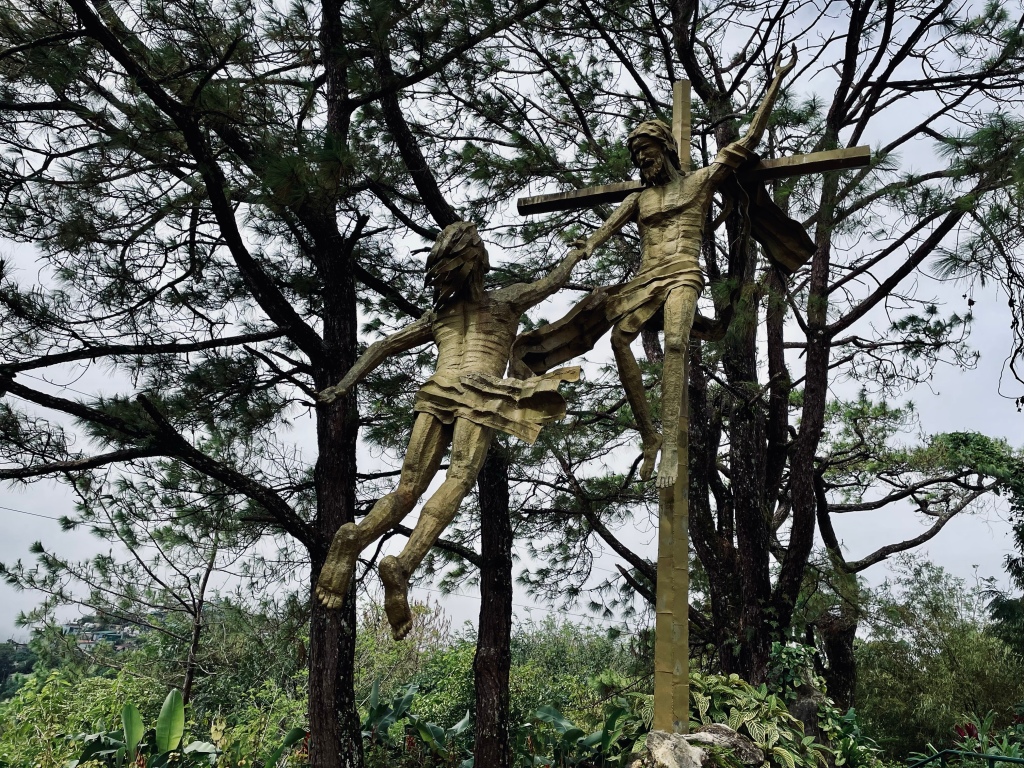
Photo by author, 2018.
Thank you,
dear God our loving Father
for the month of October!
Most of all,
thank you for sending us
Jesus Christ your Son
and thus "opened your Kingdom
to those who are humble
and to little ones" like
St. Therese of the Child Jesus
whose memorial we celebrate
today.


Lead us to follow
trustingly in the little way
of St. Therese
of the Child Jesus
especially in bearing patiently
filled with hope life's
many sufferings like Job.
Job opened his mouth and cursed his day. Job spoke out and said: Why is light given to the toilers, and life to the bitter in spirit? they wait for death and it comes not; they search for it rather than for hidden treasures, Rejoice in it exultingly, and are glad when they reache the grave: Those whose path is hidden from them, and whom God has hemmed in! (Job 3:1-2, 20-23)
Fill us too
with true hope,
dear Jesus like You,
Job and St. Therese,
a hope that trusts in God
even if things are sure
to get worst,
even end in death;
like You, Jesus,
may we resolutely
determine to journey to
Jerusalem even when
we know it could lead
to our passion and death;
help us live in hope
like St. Therese
that despite her sickness,
she did everything filled with
love for the Church missionaries;
may our pains in life
like St. Therese and Job
have both experienced
help us understand
 the pain of others
so that we may bring healing
compassion to their situation;
make us realize that
a world totally free of pain
can actually become a place
of total selfishness
and self-indulgence
because it is through
pains we truly love and hope
and become holy and saint.
Amen.
The Lord Is My Chef Daily Recipe for the Soul by Fr. Nicanor F. Lalog II
Saturday, Feast of the Exaltation of the Cross, 14 September 2024
Numbers 21:4-9 ><}}}}*> Philippians 2:6-11 ><}}}}*> John 3:13-17
Photo by author in my previous parish, 2017.
Today we celebrate a most unique Feast, the Exaltation of the Cross.
It is so unique because first of all, the cross is perhaps the most unique thing on earth made up of two pieces of wood that are so ordinary yet so deeply extraordinary in meaning, a sign of God’s immense love for us humans through Jesus Christ’s Passion and Death.
From being the sign of the most inhuman punishment in history, the Cross is now the very sign of how God “so loved the world that he gave his only Son, so that he who believes in him might not perish but might have eternal life” (Jn.3:16). It encapsulates the whole mystery of Jesus Christ, of how this all-powerful God beyond the ordinary became weak like us in everything except sin so that we too may be like Him, divine and more than ordinary. In His suffering and death on the Cross, Jesus made the lowly wood so ordinary to be so exalted to become His sign of love and mercy, power and majesty.
Photo by author, Jerusalem, May 2017.
Hence, in the Cross is the power of God’s love to transform us to better persons.
In the Cross is God’s power to lead us closer to Him with its vertical beam and to others with its horizontal beam.
In the Cross is the power of good if we choose to embrace it with Christ Jesus as our Lord and Master.
The Cross is most unique of all signs in the world because underneath its ordinariness, that is where we see God’s glory and majesty. It was underneath the Cross of darkness and gloom on Good Friday that humanity began to see light and hope in life’s many absurdities. Most of all, it was underneath that Cross of suffering and death of Jesus Christ that we feel and experience the assurance of the Resurrection.
How?
Through our own pains and sufferings that are most uniquely ours too!
With their patience worn out by the journey, the people complained against God and Moses, “Why have you brought us up from Egypt to die in this desert, where there is no food or water? We are disgusted with this wretched food!” In punishment the Lord sent among the people saraph serpents, which bit the people so that many of them died (Numbers 21:4-6).
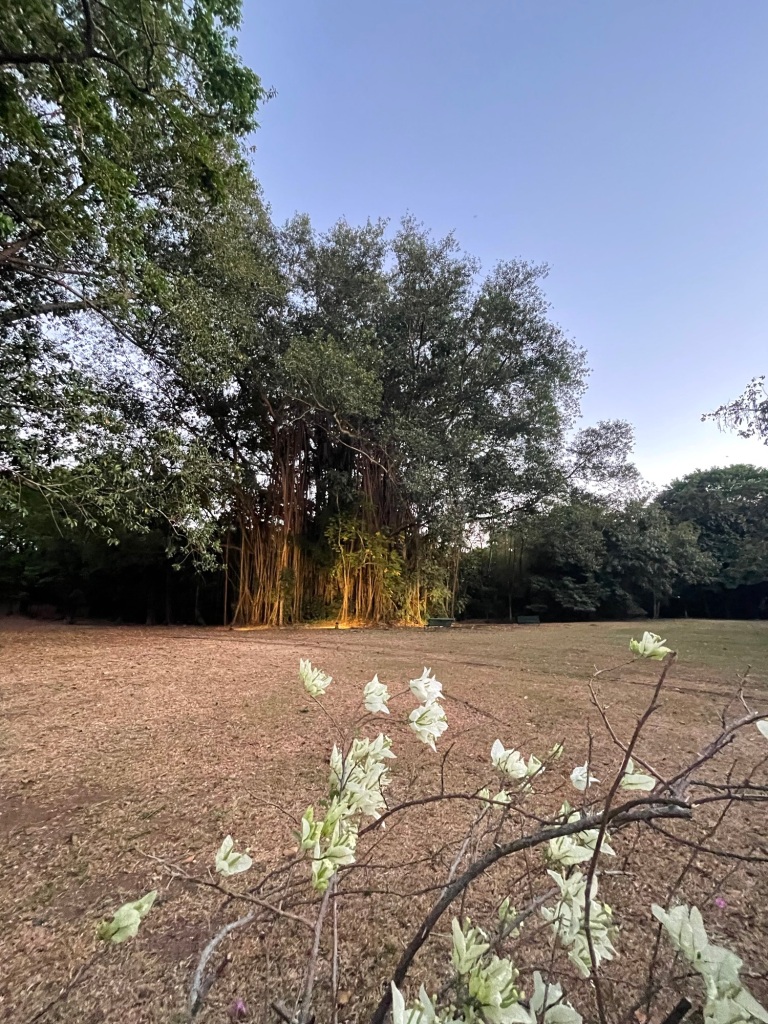
Photo by author, Dominican Hills, Baguio City, January 2018.
You must have heard that old story of a man who came to Jesus to return the cross given for him to carry; he asked Jesus to have it replaced with a lighter one. Jesus then led the man to a huge room with all kinds of crosses for him to choose which he prefers as the best one for him so that he would stop complaining.
After closely examining the specs of so many crosses, the man finally decided to pick one he deemed as perfect for him after considering its weight and other dimensions, only to find out from Jesus Himself that it was the same cross he had actually returned for exchange!
Many times in life we are like those people in the first reading, never ending in their complaints to God, even challenging Him, accusing Him of forsaking us, of being unfair when life becomes difficult and unbearable. There are times we feel being on the distaff side of life always like a flat tire, never on top. We cry foul to God especially with all our hurts and pains inflicted by others, asking Him where was He when most needed?
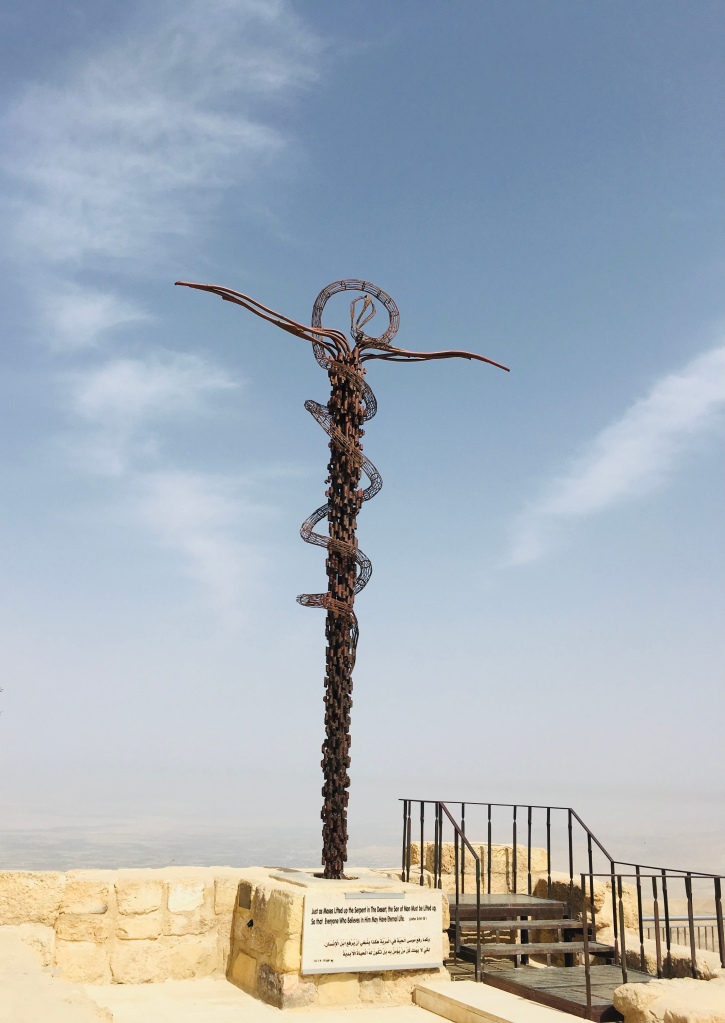
Photo by author in Jordan near the Israeli border where Moses put up the bronze serpent as instructed by God to heal those bitten by the snakes after they have complained of their conditions in the wilderness, May 2019.
While it is true life is indeed difficult, the cross reminds us of the fact that the pains and hurts we have are uniquely ours too, something we have to accept and most of all, own.
There are pains that are so deep and won’t go away that have in fact affected us dismally in our lives already. Instead of self-blaming and self-pity, we just have to ask for God’s grace to accept and own them like Jesus Christ. We just have to “bring it home” – that imagery of the Cross planted on the Calvary – into our very selves, in our being as something so true and real. And uniquely ours.
Stop thinking of others’ pains and hurts. We are not all the same. If ever we have similar experiences, the hues and shades even gravity and circumstances are not same because each pain and hurt, like the cross, is uniquely ours. Like every person, every cross is unique because it is also a gift, a mystery, and life. We have to “befriend” our pains and hurts, our own cross instead of resist it. It is in “befriending” our pains and hurts, our cross in life that we grow and mature, becoming more free to love and to be joyful because that is when the cross triumphs over its disgrace and shame in us and with others. That is when our pains and hurts, when our crosses begin to reveal to us the many beautiful truths of Easter awaiting us.
The Cross of Christ triumphed because Jesus carried it wholeheartedly, allowing those two pieces of wood to reveal not only to Him who knew everything beforehand its meaning but most of all to everyone of us the deeper truths the Cross signifies as St. Paul eloquently expressed in our second reading.
The Cross of Christ atop the church of our Lady of Lourdes in France. Photo by my former student Philip Santiago during his pilgrimage, September 2018.
One thing I realized after my mother died in May is the fact that while there are so many pains and sufferings in this world, my own pain and suffering in losing her are most difficult to bear; hence, something I must carry because it is uniquely mine.
But, one thing so unique I noticed is that the more I see my cross following my mother’s death, the more I saw also the cross of others. The Cross of Jesus triumphed truly in me when I embraced and owned my cross, when I befriended my pains and hurts that eventually led me to recognize and see, to feel more and experience too the crosses of others.
When we become conscious of each one’s unique cross, slowly we are able to reveal to them the meaning of their personal crosses too because we become more sympathetic, more open, more silent to listen more, love more, care more and be more present with those in their own unique cross. No wonder, I find conversing more engaging with others who also grieve because we can see each other’s unique crosses!
Jesus calls us to imitate Him that by embracing and owning our cross, we too may lead others to finding the meaning of their own cross and thus experience Easter soon. Let us pray:
Give us the grace, O God,
to always embrace the Cross
 like your Son Jesus Christ
where we can all be empty
of ourselves to be filled
with your Holy Spirit
to make your love visible in us.
Amen.
The Lord Is My Chef Daily Recipe for the Soul by Fr. Nicanor F. Lalog II
Friday in the Twenty-first Week of Ordinary Time, Year II, 30 August 2024
1 Corinthians 1:17-25     <*((((><  +  ><))))*>     Matthew 25:1-13
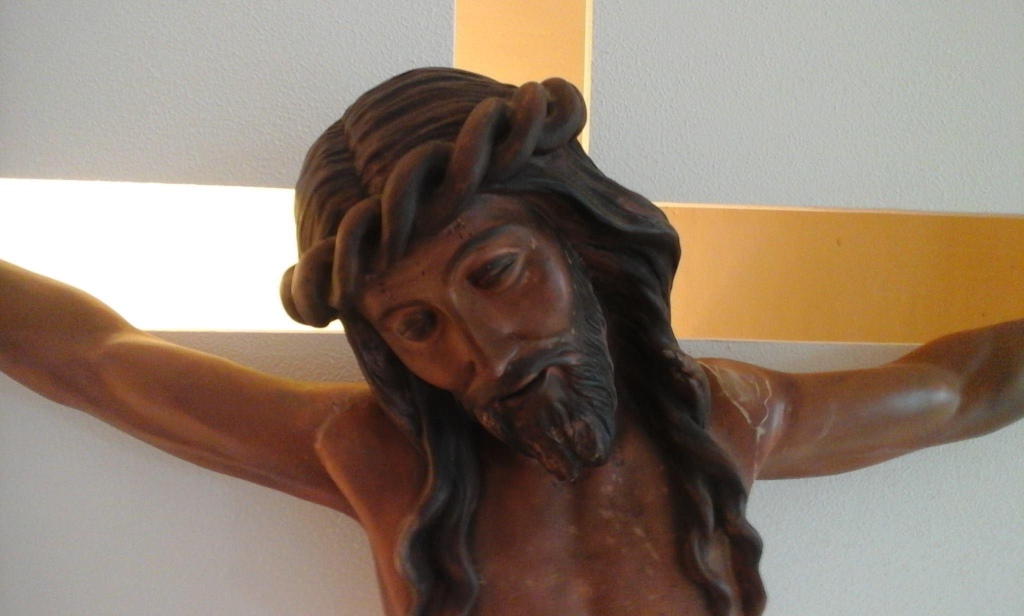
Photo by author, Chapel of angel of Peace, Our Lady of Fatima University, Valenzuela City.
For Jews demand signs and Greeks look for wisdom, but we proclaim Christ crucified, a stumbling block to Jews and foolishness to Gentiles, but to those who are called, Jews and Greeks alike, Christ the power of God and the wisdom of God. For the foolishness of God is wiser than human wisdom, and the weakness of God is stronger than human strength (1 Corinthians 1:22-25).
One of the most enduring
and endearing
words by the great St. Paul,
O Lord this final Friday
of August.
In a milieu
when even the Church
is threatened by interest groups
and ideologies running down to
the many parishes
sowing distractions and divisions,
let us find our unity anew
in the crucified Jesus Christ;
let us be like the five wise virgins
who brought extra oil in waiting
the groom's coming,
accepting the situation of darkness
and bringing along extra oil
of faith, hope, and love
in Christ;
make us humble, O Lord,
that whatever we have achieved
and gained are all
 by your grace, O God;
let us not be complacent like
the five foolish virgins;
let us choose
whatever is difficult like Christ crucified
allowing each of us to change
for the best in God;
let us choose
whatever is painful like Christ crucified
allowing us to empathize more;
let us choose
always Christ crucified
because the Cross is a plus sign,
an addition than a subtraction
in this life
through eternity.
Amen.
The Lord Is My Chef Daily Recipe for the Soul by Fr. Nicanor F. Lalog II
Friday in the Tenth Week of Ordinary Time, Year II, 14 June 2024
1 Kings 19:9, 11-16     <*((((><  +  ><))))*>     Matthew 5:27-32
Photo by Mr. Vigie Ongleo, Sagada, Mt. Province, 2014.
O God, dear Father,
how I have loved so much
ever since today's story
of Elijah fleeing from death
at the hands of Jezebel's army;
so many times I have felt like Elijah,
so tired, fed up fighting,
hoping for death when the going
gets tough and rough;
and so many times too,
You have never forsaken me,
Father like Elijah,
asking me many times
that question,
"Why are you here?"
(1 Kings 19:9, 13).
Very often, I get confused, Father,
if I am that zealous for You
like Elijah or just me so insistent
with what I believe,
with what I know,
with what I hold so dear
in You and for You;
many times I do not know
if I am still doing your will
especially when it is so difficult,
so uncomfortable and,
yes, I have asked You many times
why not just make me
an ordinary man,
instead of being your prophet....
Photo by Mr. Vigie Ongleo, Sagada, Mt. Province, 2014.
But your question remains,
Lord, that I rarely face nor
answer squarely:
"Why are you here?"

You know me so well,
Lord: like Simon Peter in
Capernaum after your discourse
on the bread of life,
my favorite response to You is
"Master, to whom shall we go?
You have the words of eternal life.
We have come to believe and
are convinced that you are the
Holy One of God" (John 6:68-69).
But most of all,
I am here because like the
psalmist,
"I long to see your face,
O Lord" (Psalm 27:7-8);
and for me to see your face
means to love more
until it hurts me;
to see your face, Lord,
is to be still and silent
amid the noise of this world
for you are always there in our
midst among the weak
and voiceless,
among those in the margins
and underneath the heaps
of scraps and garbage;
to see your face, O Lord,
is to remember always
it is your work,
not mine that I must
accomplish.

Why am I here, Lord?
Because You told me so.
Thank you so much
in bringing me here this far,
no matter what
for as long I feel
 getting closer
with You.
In that case,
I shall always be here
for You!
Amen.
Photo by Mr. Vigie Ongleo, Sagada, Mt. Province, 2014.
The Lord Is My Chef Daily Recipe for the Soul by Fr. Nicanor F. Lalog II
Monday in Tenth Week of Ordinary Time, Year II, 10 June 2024
1 Kings 17:1-6     <*((((><  +  ><))))*>     Matthew 5:1-12
Photo by author, Sacred Heart Novitiate, Novaliches, QC, 20 March 2024.
Your words today, O Lord,
seem to be so apart,
unconnected, even disconsonant
to some respect:
in the first reading,
You declared a drought as
punishment against Israel
who turned their backs from You,
worshipping Baal;
in the gospel,
Jesus preached His Sermon
on the mount, declaring as
"blessed" are those who are poor,
the meek, the hungry and thirsty,
the persecuted and insulted -
conditions and situations
directly contrary to the ways of the world,
so uncomfortable and difficult.
Every time we are facing
trials and difficulties in life,
we consider it as a drought,
a time when You, O God,
seem to be so far from us
when in fact, it is us who have gone
astray and away from You!
Let us see, dear Jesus,
your blessings
in every drought,
in every hardship,
in every poverty,
 and persecutions
we go through;
 let us realize the blessedness
of these moments of drought
and trials and difficulties
when we can examine what's
in our hearts,
who's in our hearts.
Many times we unconsciously
drift apart from You, O Lord,
when we are carried away by
our modern baals and gods
that separate us from You
and one another;
help us find our way
back to You,
rejoicing always in times of drought
to seek You and follow You.
Amen.
The Lord Is My Chef Easter Recipe for the Soul by Fr. Nicanor F. Lalog II
Tuesday in the Fifth Week of Easter, 30 April 2024
Acts 14:19-28     <*((((>< + ><))))*>     John 14:27-31
Photo by Fr. Pop Dela Cruz, Binuangan Island, Obanda, Bulacan, 2021.
Your words today,
O Lord Jesus,
are very comforting
and soothing on these
extremely hot days of summer;
and how amazing your words
were set in the most distressing
situations:
in the first reading, Paul was stoned
and dragged out of Lystra,
"supposing he was dead"
(Acts 14:19);
in the gospel, as You spoke
of Your impending betrayal
and arrest leading to Your
Passion and Death, You spoke
about peace, telling Your disciples
"Do not let your hearts be troubled
or afraid" (Jn.14:27).
How amazing, dear Jesus,
are Your strength and courage
to assure others even in the midst
of great turmoil Yourself;
where did Paul get those
grace and power to strengthen
the spirits of others, exhorting them
to persevere in faith (Acts 14:22)
after he almost got killed?
Photo by Fr. Pop Dela Cruz, Binuangan Island, Obanda, Bulacan, 2021.
Many times, my Lord,
I cave into myself,
worst, sulk in isolation
from the rest when disappointed
and hurt;
keep me strong, dear Jesus,
let me persevere in face of trials
and difficulties like Paul,
keeping in mind that difficulties
are temporary,
are meant to purify
and strengthen me
because the enemy has no power
over me for You have already
conquered the world in love;
let me rejoice in the face of
my adversaries so that the world
may know and experience Your great
love poured upon me in Your
passion and death.
Amen.
The Lord Is My Chef Good Friday Recipe, 29 March 2024
Isaiah 52:13-53:12  > + <  Hebrews 4:14-16;5:7-9  > + <  John 18:1-19:42
Photo by author, Chapel of the Holy Family, Sacred Heart Novitiate, Novaliches, June 2016.
The evangelists tell us that Jesus died on the Cross on a Friday at about 3PM. And they tell us too that our Lord died praying, exactly what most of the Seven Last Words expressed.
But from the gospel we have heard this afternoon written by the beloved disciple, we discover something very beautiful about the death of Jesus, that He was very calm and peaceful in His prayer unto death.
After this, aware that everything was now finished, in order that the Scripture might be fulfilled, Jesus said, “I thirst.” There was a vessel filled with common wine. So they put a sponge soaked in wine on a sprig of hyssop and put it up to his mouth. When Jesus had taken the wine, he said, “It is finished.” And bowing his head, he handed over the spirit.
John 19:28-30
Photo by author, Chapel of the Holy Family, Sacred Heart Novitiate, Novaliches, June 2016.
When we are deep in suffering, in severe pain like Jesus on the cross, what do we usually pray? Most often, we pray that the terrible ordeal we are going through would finally end, would be finished.
And sometimes, due to desperation, we even pray for death, of how we wish God would finally end our life to be free from all the problems we are going to.
One of the things I keep telling to sick people I visit came from Meryl Streep who acted as mother of Winona Ryder in the 1990’s movie “House of Spirits” when she said, “Do not pray for death because death surely comes.” Sometimes in our desperation, we feel death is the solution to our problems and sufferings. But when Jesus died on the Cross, He made death an offering, a gift of self in love.
Photo by author, Chapel of the Holy Family, Sacred Heart Novitiate, Novaliches, June 2016.
In the original Greek text, the word used to express Jesus Christ’s final prayer “It is finished” is tetelestai from the root word telos meaning the final end and direction. It is not just an ending but a direction too.
From the very start, Jesus was clear with His mission and how it would be accomplished. He has always been sure of Himself, of who He is. Notice how the beloved disciple repeated many times in his account of the Last Supper how Jesus was “fully aware” of everything that was going to happen to Him that He was actually in control and never left to the whims and powers of His enemies when He went through His Passion and Death.
Last night we heard how Jesus knew everything was coming to end that He washed the feet of His disciples after their supper. Most of all, Jesus was so composed and serene that He even gave bread to His betrayer Judas Iscariot during their meal. In fact in the washing of the feet of His disciples to His agony in the garden, Jesus calmly and courageously faced death that in the end, on the Cross, He had the upper hand that He was able to pray “It is finished” because He was never made under the power of death completely as He would rise again on Easter.
In praying “It is finished,” Jesus consecrated not only Himself but also all humanity to the Father so that we are able to bear and face death squarely like Him. Very notable in this part is how we find only in the fourth gospel how Jesus died by “handing over his spirit to the Father.”
Remember the verb to hand over is the literal meaning of the Greek word used paradidomi or betrayal. But here at the death of Jesus, handing over has no negative connotation but purely positive; Jesus never betrayed or handed anyone over to sufferings. He bore all sufferings and handed these over to the Father. That is true passion in the active sense when we let things happen not because we are helpless and resigned to the situation but we passively take everything in the positive sense because we have that firm faith and deep conviction that being silent, being patient, being persevering will eventually bear fruit for us like the death of Jesus that led to Easter.
Suffering and death thus are not resignation nor mere surrender but submission to the higher power of God to convert darkness into light, sadness into joy, and death into life. There on the Cross Jesus showed that true power is in weakness.
Photo by author, Chapel of the Holy Family, Sacred Heart Novitiate, Novaliches, June 2016.
After the consecration of the bread and wine into Christ’s Body and Blood in the Mass, we proclaim “Christ has died; Christ is risen; Christ will come again.” We call it as “the mystery of our faith” because when we say “Christ has died,” we admit that truly, the Son of God went through all kinds of sufferings in life we all go through like betrayal, rejection, loneliness, sickness, hunger, thirst, and yes, even death. And His sufferings continue as we suffer more in this world marred by evil and sins, making us cry, asking when would these end and be finished.
There lies the mystery of our faith on the Cross that led to Easter: when we look at Jesus Christ on His Cross, we see our own pains and agony as God’s pains and agony too. Jesus joined us in our anguish and death so that we could experience all the more His immense love for us. Without Jesus and His Cross, we would never be able to bear or even face the many deaths we go through daily. May we recognize God’s immense love for us again this afternoon when we venerate the Cross and see it as the merging point of human and Divine suffering. Keep praying with Jesus who has the final say with death in Easter. Amen.
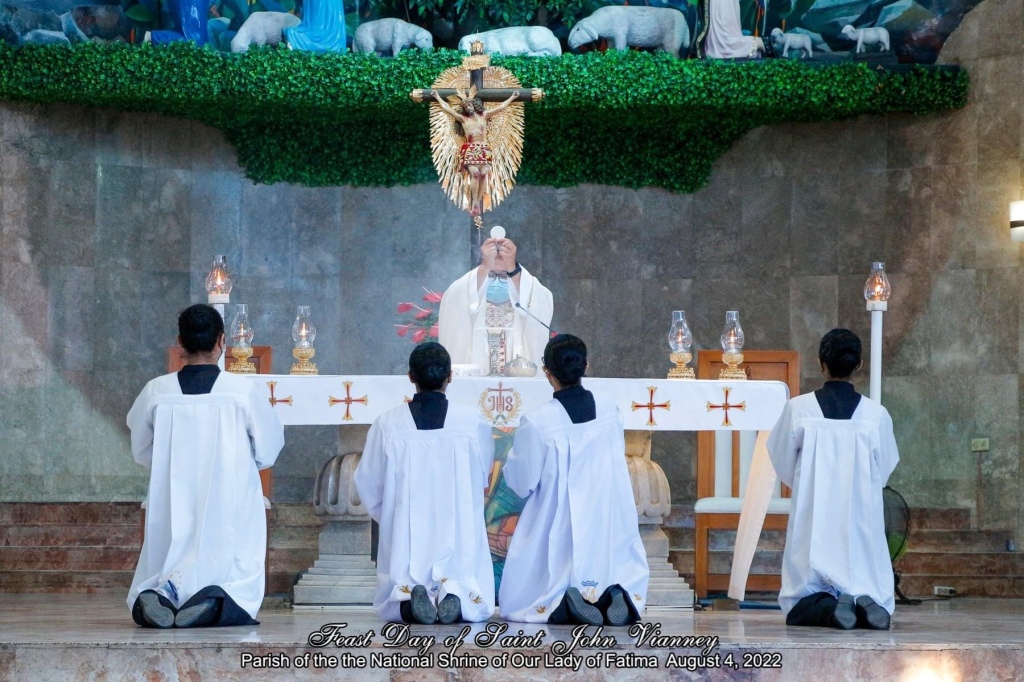
Photo by Ka Ruben, National Shrine of Our Lady of Fatima, Valezuela City, August 2022.
Lawiswis ng Salita ni P. Nicanor F. Lalog II, Ika-21 ng Marso 2024
Ikalawang Huling Wika ni Jesus sa Krus
Larawan kuha ng may-akda sa Mirador Jesuit Retreat House sa Baguio City, Agosto 2023.
Ang ikalawang wika ni Jesus sa Krus:
Tinuya siya ng isa sa mga salaring nakabitin, at ang sabi, “Hindi ba ikaw ang Mesias? Iligtas mo ang iyong sarili, pati na kami!” Ngunit pinagsabihan siya ng kanyang kasama, “Hindi ka ba natatakot sa Diyos? Ikaw may pinarurusahang tulad niya! Matuwid lamang na tayo’y parusahan nang ganito dahil sa ating mga ginawa; ngunit ang taong ito’y walang ginawang masama.” At sinabi niya, “JESUS ALALAHANIN MO AKO KAPAG NAGHAHARI KA NA.” Sumagot si Jesus, “SINASABI KO SA IYO: NGAYON DI’Y ISASAMA KITA SA PARAISO.”
Lukas 23:39-43
Muli ay ating namnamin ikalawang wika ni Jesus doon sa Krus pagkapako sa kanya. Nauna niyang sinambit ay kapatawaran; ngayon naman kanya itong sinundan ng pangako ng langit o paraiso.
At iyon ay agad-agad na, ora mismo! Wika nga ng mga bata, “now na”! Hindi mamaya pagkamatay nila ni Jesus o sa Linggo sa kanyang pagkabuhay. Malinaw na sinabi ni Jesus kay Dimas, “SINASABI KO SA IYO: NGAYON DI’Y ISASAMA KITA SA PARAISO.”
Tantuin ninyo mga ginigiliw ko na sa ebanghelyo ayon kay San Lukas, namutawi lamang sa mga labi ni Jesus ang pangakong ito ng paraiso noong siya ay nakabayubay sa krus at hirap na hirap. Wala siyang pinangakuan ng langit nang siya ay malaya at malakas na nakakagalaw, naglilibot at nangangaral.
Alalaong-baga, pumapasok tayo sa langit kasama si Jesus sa sandaling kasama din niya tayong nagtitiis, nagdurusa, nagpapakasakit dahil sa pagmamahal doon sa Krus!
Ang krus ang pintuan papasok sa langit o paraiso.
Madalas naiisip natin kapag nabanggit o narinig ang katagang langit at paraiso ay kagalakan, kawalan ng hirap at dusa. Basta masarap at maayos sa pakiramdam, langit iyon sa atin. Kaya mga addict noon at ngayon kapag sila ay sabog at nasa good trip, iyon ay “heaven” dahil wala silang nadaramang problema at hirap sa buhay.
Larawan kuha ng may akda, 2023.
Kaya hindi rin kataka-taka na ang gamot nating laging binibili ay pain killer – konting sakit ng ulo o kasu-kasuan, naka-Alaxan kaagad. Noong dati ay mayroong shampoo na “no more tears” dahil walang hilam sa mata.
Gayon ang pananaw natin sa langit. At tumpak naman iyon kaya nga sa pagbabasbas ng labi ng mga yumao, dinarasal ng pari, “Sa paraiso magkikitang muli tayo. Samahan ka ng mga Santo, kahit mayroong nauuna, tayo rin ay magsasama-sama upang lagi tayong lumigaya sa piling ng Diyos Ama. Amen.”
Nagmula ang salitang paraiso sa katagang paradiso na tumutukoy sa kaloob-loobang silid ng hari ng Persia (Iran ngayon) kung saan tanging mga pinagkakatiwalaang tao lamang ang maaring makapasok kasama ang royal family. Kaya nang isalin sa wikang Griyego ang mga aklat ng Bibliya, hiniram ang katagang paradiso ng mga taga-Persia at naging paraiso upang tukuyin ang langit na tahanan ng Diyos na higit pa sa sino mang hari sa mundo.
Ngunit, katulad ng silid na paradiso ng hari ng Persia, hindi lahat ay basta-basta na lamang makakapasok ng paraiso. Alalahanin nang magkasala sina Eba at Adan, pinalayas sila ng Diyos at mula noon ay nasara ang paraiso; muli itong nabuksan kay Kristo nang sagipin niya tayo doon sa krus na nagbunga sa pagwawalang-sala sa ating mga makasalanan. Dahil sa krus ni Jesus, tayo ay naging karapat-dapat patuluyin sa paraiso. Sa tuwing ating tinatanggap ang krus ni Kristo, tayo ay nagiging tapat sa Diyos sa pamamagitan ng pagmamahal at paglilingkod sa kapwa. Noon din tayo pumapasok ng paraiso.
Sa panahong ito na wala nang hanap ang karamihan kungdi sarap at kaluguran, ipinaaalala sa atin ni Jesus sa ikalawang wika na ibig niya tayong makapiling ngayon din sa paraiso kung tayo ay mananatiling kasama niya sa pagtitiis at pagpapakasakit sa ngalan ng pag-ibig sa Diyos at kapwa.
Sa panahong ito na dinidiyos masyado ang katawan at sarili upang maging malusog, malakas at kung maari ay manatiling bata at mura ang edad, pinapaalala ni Jesus sa kanyang ikalawang huling wika sa krus na sino mang nasa banig ng karamdaman pati na yaong mayroong kapansanan ay unti-unti na ring pumapasok ng langit ngayon din sa kanilang tinitiis na hirap at sakit.
Sa panahong ito na lahat ay pinadadali at hanggat maari iniiwasan ano mang hirap at dusa, pinapaalala ni Jesus sa kanyang ikalawang huling wika na sa ating pagsusumakit sa maraming tiisin at pasanin sa buhay na ito, noon din tayo pumapasok sa paraiso kahit na kadalasan ito ay nagtatagal sa paghihintay.
Larawan kuha ng may-akda, 2018.
Noong pandemic, natutunan natin na hindi lahat ng tinuturing ng mundo na negatibo ay masama kasi noong mga panahong iyon, iisa ating dasal tuwing tayo ay sasailalim ng COVID test na sana ay “negative” tayo, hindi ba? Noon natutunan natin yung negative ay positive. At iyon mismo ang kahulugan ng krus ni Kristo!
Para sa atin, ano mang mahirap, masakit tulad ng krus ay negatibo ngunit kung tutuusin, ang krus ay hugis positibo o “plus sign” (+) at hindi minus (-); kaya, ano mang hirap at pagtitiis sinasagisag ng krus ay mabuti dahil hindi ito nakakabawas bagkus nakapagdaragdag sa ating pagkatao na naghahatid sa atin sa kaganapan at paglago. Sa suma total, eka nga, sa paraiso!
Ang mga tiisin at pagsubok sa buhay ang nagpapatibay at nagpapabuti sa atin upang maging karapat-dapat makapasok sa paraiso at makapanahan ang Haring magpakailanman – ngayon din, ora mismo, now na!
Kaya, manalangin tayo:
Panginoong Jesus,
bago pa man dumating
lahat nitong aming tiisin
at pasanin sa buhay,
nauna ka sa aming
nagtiis at nagpasan
ng krus noong Biyernes Santo;
nauna kang nagpakasakit
at namatay noon sa Krus
dahil sa pagmamahal sa amin;
kaya, patatagin mo ako sa aking
katapatan at pananampalataya
sa Iyo upang manatiling kaisa mo
sa krus ng kalbaryo ng buhay
upang ngayon din
Ikaw ay aking makapiling,
makasama sa Paraiso.
Amen.
The Lord Is My Chef Daily Recipe for the Soul by Fr. Nicanor F. Lalog II
Thursday in the Fourth Week of Ordinary Time, Year II, 01 February 2024
1 Kings 2:1-4, 10-12  ><]]]]'> + ><]]]]'> + ><]]]]'>  Mark 6:7-13
Photo by author, Camp John Hay, Baguio City, 12 July 2023.
Praise and glory
to you God our loving Father!
Thank you for January,
thank you very much for February;
as we start this second month
of the year, you remind us
how in life every ending is also
a beginning.
When the time of David’s death drew near, he gave these instructions to his son Solomon: ”I am going the way of all flesh. Take courage and be a man. Keep the mandate of the Lord, your God, following his ways and observing his statutes, commands, ordinances, and decrees as they are written in the law of Moses, that you may succeed in whatever you do, wherever you turn.”
1 Kings 2:1-3
Give us the grace of
ageing gracefully, Father,
like your servant David;
give us the courage
and sincerity to accept,
to embrace when we are
"going the way of all flesh";
yes, we all wish a life of joy
and happiness with less pains
and difficulties but as we forge on
life, we have experienced,
we have realized,
and proven so many times
that hardships and hurts
are inevitable parts of this life,
even separations and death
that David perfectly called
as way of the flesh.
Joy and fulfillment
happen when we embrace
these shadows and darkness
for it is in those spaces
where lights are most visible
and life is most meaningful;
give us, Lord Jesus,
the courage to let go,
to leave our extra baggages
behind in order to travel light
in this life proclaiming your
good news;
make us realize that true wealth
is in having less of the material
and more of the spiritual;
most of all, every ending
is also a beginning,
hence, the need for us
to prepare those next to us.
Amen.
The Lord Is My Chef Daily Recipe for the Soul by Fr. Nicanor F. Lalog II
Tuesday in the First Week of Ordinary Time, Year II, 09 January 2024
1 Samuel 1:9-20  <*((((>< + ><))))*>  Mark 1:21-28
Photo by Mr. Jay Javier, Quiapo, 09 January 2020.
Praise and glory to you,
Lord Jesus Christ,
that today we shift into Ordinary Time
in our liturgy that coincides with
the annual Traslacion of the image
of the Black Nazarene in Quiapo,
Nuestro Padre Jesus Nazareno
as you remind us too in our readings
true meaning of authority
we often relate with power.
Jesus came to Capernaum with his followers, and on the sabbath he entered the synagogue and taught. The people were astonished at his teaching, for he taught them as one having authority not as the scribes.
Mark 1:21-22
People were astonished with your
authority, Lord Jesus, not only because
it is all-powerful but most of all,
it is most kind,
most compassionate,
most humane
because in your life,
in your very self as Jesus Nazareno,
you have shown us that
authority is not just having
power to make thing happen nor
lording over others;
like in Quiapo today as in Capernaum,
we are astonished with your
authority not because of its
powers of being efficacious
but because of your being so close
with us who are weak and suffering;
true authority for you, dear Jesus,
is to be one with the people -
in our miseries and anxieties,
in our pains and hurts,
as well as in our aspirations and dreams;
authority is most real,
most powerful
and most appreciated
when that authority
is felt as power for the people
to be healed and comforted,
raised up and inspired
like you have shown in your
coming to us,
in your carrying the cross,
of your bearing our infirmities.
Like Hannah in the first reading,
we beg those authorities above us
to "think kindly" of us people;
many times,
people in authority lord it over us
like Eli initially, suspecting
Hannah being drunk,
scolding us,
reprimanding us,
worst, judging us
without even knowing
our plight, so unlike you
who became poor like us,
most of all,
died for us.
Amen.














 lordmychef.com