The Lord Is My Chef Daily Recipe for the Soul by Fr. Nicanor F. Lalog II
Friday, Feast of St. Luke, Evangelist, 18 October 2024
2 Timothy 4:10-17     <*((((><  +  ><))))*>     Luke 10:1-9
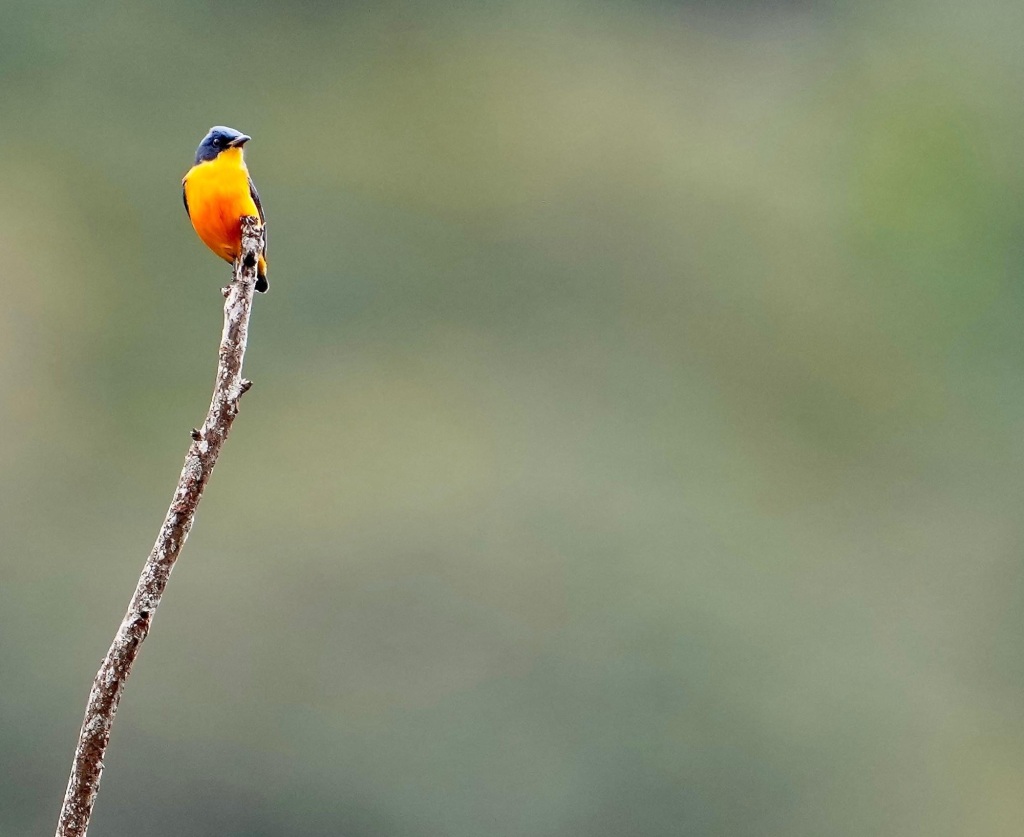
Photo by Dra. Mylene A. Santos, MD, an orange-bellied flowerpecker (Dicaeum trigonostigma), December 2023.
Beloved: Demas, enamored of the present world, deserted me and went to Thessalonica, Crescens to Galatia, and Titus to Dalmatia. Luke is the only one with me… (2 Timothy 4:10-11).
Lord Jesus Christ,
I pray on this beautiful Friday
for those friends and dearest
ones who are like St. Luke to me:
"the only one with me"
in my moments of darkness,
of trials and sufferings,
when everyone was so busy
and never noticed me,
of my need for company
and comfort,
most especially
who reminded me
of your fidelity
and love.
Thank you, Jesus
for those people You
sent me like St. Luke,
"the only one with me"
in prayers as I journeyed
through life's many adventures
and misadventures;
"the only with me"
who readily saw my points
of view;
"the only one with me"
who cheered me up
and let me cry;
"the only one with me"
in poverty;
"the only one with me"
who truly sought to understand
everything to bring out
the best in me,
to find the Christ in me.
O dear Jesus,
I pray for the other
St. Lukes You send us daily,
"the only ones" who care
and stand for women and children
still taken for granted in this world;
"the only ones" who work
to uplift the marginalized like
the poor and widows,
the sick and those old
people living alone and dying;
most especially,
"the only ones"
still believing in You
and your Church,
still praying and
still proclaiming
your Gospel,
still remaining in Your side
amid the many lures
of this selfish,
and godless world.
Amen.
The Lord Is My Chef Daily Recipe for the Soul by Fr. Nicanor F. Lalog II
Tuesday in the Twenty-seventh Week of Ordinary Time, Year II, 08 October 2024
Galatians 2:1-2, 7-14     ><000'>  +  <'000><     Luke 10:38-42
Photo by Ms. Ria De Vera at Banff, Canada, August 2024.
O Lord, you have probed me and you know me, you know when I sit and when I stand; you understand my thoughts from afar. Truly you have formed my inmost being; you knit me in my mother’s womb. I give you thanks that I am fearfully, wonderfully made; wonderful are your works (Psalm 139:1-2, 13-14).
Thank you,
loving God our Father
for this brand new day!
Like the psalmist today,
I am at awe with your creation,
beginning with me
at how you have formed
 my inmost being
that enables me to connect
with You through your wonderful
creation!

In forming my inmost being,
You have made me yours,
enabling me to realize my connection
with You, O God, my Creator
as well as with your entire creation;
and if I am lost or had gone astray,
it is still my inmost being You have formed
in me that enables me to reconnect
with You and myself
and others.
Photo by Ms. Ria De Vera at Banff, Canada, August 2024.
Brothers and sisters: You heard of my former way of life in Judaism, how I persecuted the Church of God beyond measure and tried to destroy it… But when he, who from my mother’s womb had set me apart and called me through his grace, was pleased to reveal his Son to me, so that I might proclaim him to the Gentiles, I did not immediately consult flesh and blood, nor did I go up to Jerusalem to those who were Apostles before me: rather, I went into Arabia and then returned to Damascus (Galatians 1:13, 15-17).
How lovely and so true
like St. Paul,
You have formed our inmost being
so that we may remain connected
or be reconnected with You
when we are lost
and separated.
Grant us O God
the gift of discipline in
cultivating a prayer life,
a life centered in You so that
we remain connected in You
through Jesus Christ like Mary
sitting beside Him at His feet,
listening to His every word;
let us be aware of your precious gift
of our inmost being
by cultivating a prayer life
to make our connections stronger;
You created us, O God
to be connected always
with You,
our self,
and with others;
keep us strong in resisting
temptations to sin,
to separate and be isolated
from You and others
by destroying our connections,
disregarding our inmost being.
Amen.
Photo by Ms. Ria De Vera at Banff, Canada, August 2024.
The Lord Is My Chef Sunday Recipe for the Soul by Fr. Nicanor F. Lalog II
Twenty-seventh Sunday in Ordinary Time, Cycle B, 06 October 2024
Genesis 2:18-24  ><}}}}*>  Hebrews 2:9-11  ><}}}}*>  Mark 10:2-16
With our student sacristans in our San Fernando Campus in Pampanga during the Mass of the Holy Spirit last year.
One of the joys of my ministry as chaplain in a university and a hospital is the daily interaction I have with young people who keep me young like them, always updated with the many trends happening among them especially in the languages they speak. In them I continue to find the many faces of Jesus Christ who continues to pass by even in this modern world so swiftly changing due to social media.
Two terms I have recently learned from them are “love language” and “situationship”. Let’s just talk about “love language” this Sunday that is more appropriate with our gospel and reserve that other word “situationship” when the setting is more apt. Lately I have noticed the term “love language” mentioned quite often in social media posts and reels. I never bothered to know it until somebody asked me what is my “love language” that threw me off balance with many wild things rushing into my mind, thinking what is it!
It turned out that “love language” is a term coined in 1992 by Baptist pastor Gary Chapman in his book of the same title where he identified five love languages we give and (prefer) to receive: words of affirmation, acts of service, receiving gifts, quality time, and physical touch. It was an amazing moment of learning from me when I realized that everyone – including us priests – has a favorite love language in expressing our love to everyone. And in our gospel today, we find that even God who is love Himself has a love language in the very person of His Son Jesus Christ!
The Pharisees approached Jesus and asked, “Is it lawful for a husband to divorce his wife?” They were testing him. He said to them in reply, “What did Moses command you?” They replied, “Moses permitted a husband to write a bill of divorce and dismiss her.” But Jesus told them, “Because of the hardness of your hearts he wrote you this commandment. But from the beginning of creation, God made them male and female. For this reason a man shall leave his father and mother and be joined to his wife, and the two shall become one flesh. So they are no longer two but one flesh. Therefore what God has joined together, no human being must separate” (Mark 10:2-9).
Photo by author, 2024; I have loved mosses that thrive even with little sunlight, reminding us of God’s grace especially when we are in darkness and tribulations.
Jesus and the Twelve continued their journey to Jerusalem with His teachings not only getting more exciting but actually more difficult and hard as He addressed the thorny issue of divorce which continues to divide us in this modern age.
Interestingly enough, this scene happened while Jesus and the Twelve were in Judea, the province governed by King Herod who had John the Baptist arrested and later beheaded upon the instigation of his wife Herodias. John spoke against Herod’s taking of Herodias as wife because she used to be the wife of his own brother Philip then governing another province. One can just imagine the grave danger the Pharisees have exposed Jesus in discussing divorce right in the turf of an evil ruler living with an adulteress!
As usual, Jesus did not fall into the test by the Pharisees because He had no intentions of joining our endless debates about divorce as He knew very well that it is something so complicated that has continued to ruin human relationships as a result of the “hardness of our hearts”. Recall too similar instances when Jesus was asked for an opinion in politics like the paying of taxes to Caesar and the settlement of disputes among brothers regarding their inheritance. See how Jesus would always make it clear that His mission is not to settle our disputes in economics and politics nor personal relationships but to always reveal to us the will of God.
Instead of giving a simple answer of “yes” or “no” on the lawfulness of a divorce or the paying of taxes to the Romans, Jesus would always bring us to God our Father, the very core of our being and relationships. It is only in being rooted again in God when we realize personally, existentially why we have to strive in choosing what is true, good and beautiful no matter how difficult it may be.
This Sunday, Jesus is not offering compromises to us weak human beings about divorce but rather proposes the ideal of marriage by going back to its very source and beginning, God Himself who is love.
That is why our first reading was taken from Genesis to remind us and make us realize that everything, most especially man and woman – is created by God. Everything in this world was from God, especially our desire for union and communion which we also find expressed even by trees and plants as well as animals.
However, what makes us distinct from the rest of creation as we see in other parts of Genesis is God breathing on us His breath of life that gives us the consciousness of our oneness, of that transcendent otherness called humanity that makes us realize our deeper reality in the “I-Thou” relationship. Plants and animals do not have that consciousness.
Photo by author, St. Scholastica Retreat Center, Tagaytay City, August 2024.
The creation of a woman as suitable partner of man is not a result of an after-thought of God as if He never knew man would never be fulfilled without a woman. The creation of woman being taken from one of the ribs of man cast into a deep sleep by God reminds us of each person being a gift to everyone. No pet nor plant can bring that kind of ecstasy and joy of finding somebody like us, of bringing unity in every one who is incomplete in one’s self.
See how Jesus repeated the Genesis account “that is why” or “for this reason” a man leaves his father and mother and be joined with his wife to become one.
This tendency of ours towards one another, a consciousness of then other person, is a gift and a grace indicating our origin who is God who always relates with us. Every time we destroy this unity, whenever we upset this complementarity among us in God, that is when disorder happens, generating competitions among us that lead to our endless conflicts that only leave us with more pains and sorrows. Hence, back in the house again towards the end of our gospel scene this Sunday, Jesus reiterated the example of the child after His disciples drove them away.
Photo by author, statue of the Child Jesus hugging St. Joseph, Sacred Heart Novitiate, Novaliches, QC, March 2024.
How lovely and ironic that despite the weaknesses and incompleteness of children, we find in them all five love languages too. What a joy to play and converse with children, especially carry babies despite their lack of language skills we find each one a love language in himself/herself – exactly like Jesus Christ, the love language of God who gave us everything to experience oneness in love.
God knows everything that He created us in His own image and likeness. Nothing, not even sin could ever destroy His grand design for us since creation so that right after the Fall, God right away promised salvation fulfilled in Jesus Christ whom He had sent to remind us anew of His wonderful plan for us.
I have a similar image like this in my room, my most favorite statue of St. Joseph as protector of the Child Jesus and Mary. But most of all, we find Jesus being the love language of God even in his childhood with His all-encompassing love that reached its highest point at the Crucifixion.
God knows everything, especially our weaknesses in keeping our relationships. Jesus is not judging us and knows very well the pains many are enduring as a result of separation and divorce. The Letter to the Hebrews we heard in the second reading tells us how Jesus in suffering death has become like us in order to share with us the grace we need to keep our human relationships strong.
Every Sunday, I visit our patients in the hospital to give them Holy Communion, hear their confessions and often, anoint most of them with Oil for the sick.
Whenever I meet couples especially those already old and with debilitating sickness, I praise God for the tremendous grace he gives them. In them I always find God so truly present among us, especially in every husband and wife lovingly serving each other in sickness and in health. Let us pray for all couples that they may cooperate with God’s grace in keeping their marriage alive. Amen. Have a blessed week ahead!
The Lord Is My Chef Daily Recipe for the Soul by Fr. Nicanor F. Lalog II
Friday, Memorial of St. Francis of Assisi, 04 October 2024
Job 38:1, 12-21; 40:3-5     <*{{{{><  +  ><}}}}*>     Luke 10:13-16
Photo by Fr. Bien Miguel, Diocese of Antipolo, 25 September 2024.
This is actually a rejoinder to our prayer earlier published today on the Memorial of St. Francis of Assisi. And how I love the first reading today, of God’s “speech” to Job’s lamentations that remind us all of the wonder and majesty of creation St. Francis of Assisi highly regarded in his life and teachings.
The Lord addressed Job out of the storm and said: “Have you ever in your lifetime commanded the morning and shown the dawn its place for taking hold of the ends of the earth, till the wicked are shaken from its surface? Have you entered into the sources of the sea, or walked about in the depths of the abyss? have the gates of death been shown to you, or have you seen the gates of darkness? Have you comprehended the breadth of the earth? Tell me, if you know all” (Job 38:1, 12-13, 16-18).
How interesting too these words written about 2700 years ago in the Middle East are echoed in our own time in theme song of the Disney movie Pocahontas, “The Color of the Wind”:
Have you ever heard the wolf cry to the blue corn moon Or asked the grinning bobcat why he grinned? Can you sing with all the voices of the mountain? Can you paint with all the colors of the wind? Can you paint with all the colors of the wind?
Photo by author, Sacred Heart Novitiate, Novaliches, QC, 20 March 2024.
Like Job, who was a fictional character, Pocahontas went through a lot of great sufferings beyond explanations which is the aim of the authors of the Book of Job – to reflect on the mystery of human sufferings and misery amid a loving God.
It is easy to understand our sufferings in life when we are the ones who have caused them like making wrong choices and decisions or simply not exerting enough efforts to our endeavors or projects.
The most painful sufferings that are really bothersome are those we feel “undeserved” at all like getting a rare cancer and disease, being offended by someone close to us despite our being good to them, or like Pocahontas who was then living in peace and quiet until the English colonizers came to America who kidnapped and gang raped her.
I have never seen that Disney movie Pocahontas that is loosely based on the life of a native American Indian woman Pocahontas whose actual name was Matoaka; she was the daughter of the Chief of the Powhatan tribe in Chesapeake, Virginia during the early 1600’s.
According to historians, there was really no romance at all between Pocahontas and the British colonizer Captain John Smith as portrayed in the Disney movie. After getting pregnant from that gangrape, Pocahontas was forced to marry the English explorer John Rolfe as a condition for her release that only made her life filled with great sufferings and humiliations until her death.
Though a work of fiction but a fruit of prayerful reflections about life’s realities unlike the Disney movie Pocahontas, Job suffered severely when he lost his children, properties and livestock in a single day. Worst of all, he was stricken with a rare disease and left to the care of a “nagging” wife and three friends who wanted him to curse God or admit his guilt for a sin for which God was punishing him.
But Job’s conscience was clear, remaining faithful to God throughout all his sufferings. His complaints and cries were actually a voicing out of his inner pains to God, an expression of his trust in Him, “But as for me, I know that my Vindicator lives, and that he will at last stand forth upon the dust… And from my flesh I shall see God; my inmost being is consumed with longing” (Job 19:25, 27).
Job like us today was not seeking any answer nor explanation at all for his sufferings; he cries to God like us because we believe only God can save us. We do not cry or air our pains to someone we do not trust or believe in; the same is true why we cry and complain to God!
God’s response to Job’s laments remind us today of the need for us to see the whole picture we are into in this vast universe, of how everyone and everything is interconnected in God through His own Son Jesus Christ.
Notice how the author structured the speech of God of seeming opposites in life: commanding the morning and being shown the dawn in verse 12; sources of the sea and depths of the abyss in verse 16; and, gates of death and gates of darkness in verse 17. Jewish thought at that time was so structured that they saw everything distinctly different like morning and dawn, sea and abyss, death and darkness. That explains why they were so strict with the letters of the law that they eventually forgot the primacy of the human person which Jesus tried to emphasized to them in His teachings and healings. Jesus came to show us how everything and everyone in this whole creation is linked together, interrelated in God through Him.
This He did when He died on the Cross.
Photo by Fr. Gerry Pascual of the fresco at the Assisi Basilica, Italy, 2019.
It is sad that St. Francis of Assisi is often “romanticized” by many nature lovers even by some “new agers” for his love for nature and animals. More than sentimental reasons, St. Francis’ love and concern for nature and animals were all the result of his deep love and devotion to Jesus Christ crucified found daily in the celebration of the Holy Eucharist.
St. Francis realized and experienced the interconnectedness of everything and everyone in his own sufferings and pains in life he humbly embraced and accepted as we see in that verse we pray at every Station of the Cross he had composed:
V. We adore You, O Lord Jesus Christ, and we bless you. R. Because by Your holy Cross, You have redeemed the world.
For his love for the Cross and his own sufferings, Jesus blessed St. Francis with the stigmata, His five wounds at His crucifixion.
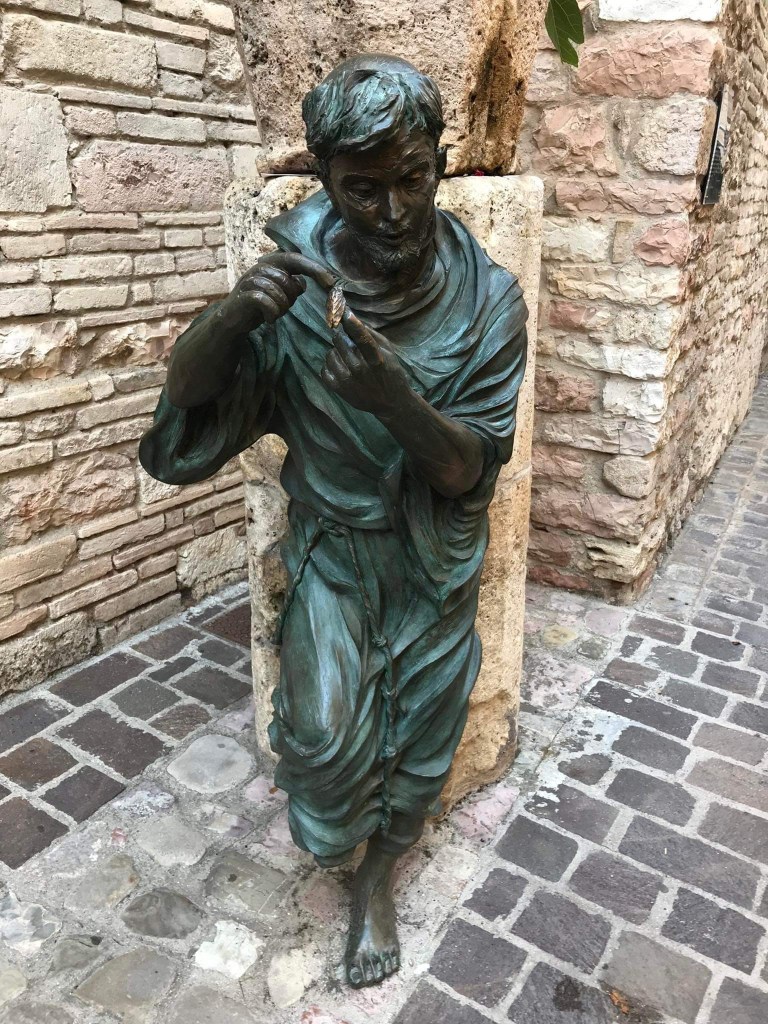
Photo by Fr. Gerry Pascual, Sculpture of the young St. Francis in Assisi, Italy, 2019.
After receiving those wounds, St. Francis was blinded as he went through severe sufferings after going through well-intentioned surgeries that went so bad. He was in his 40’s at that time and despite his great sufferings, it was during that period when he produced so many great writings we all cherish until now, notably the Canticle of the Sun where we find his famous expressions “brother sun, sister moon, and cousin death” – the very same things God expressed to Job in that speech out of the storm in our first reading today that is echoed by Disney’s Pocahontas in the theme “The Color of the Wind”.
But unlike that Disney movie that sugarcoats life’s realities of sufferings and pains, both Job and St. Francis of Assisi remind us today that the more we embrace our pains and sufferings in life like them, the more we see life’s wholeness, our oneness in God and the rest of His creations when seen in the light of the Cross of Jesus Christ.
When we see this oneness and interconnectedness in life, that is when we actually grow and mature, become fruitful as we find fulfillment in life despite the difficulties and pains we go through. Have a blessed weekend everyone! Happy feast day too to our Franciscan brothers and sisters!
The Lord Is My Chef Daily Recipe for the Soul by Fr. Nicanor F. Lalog II
Wednesday, Memorial of Guardian Angels, 02 October 2024
Exodus 23:20-23     <*((((><  +  ><))))*>     Matthew 18:1-5, 10
Photo by author, Baguio City Cathedral, January 2019.
How good and gracious
are You, God our Father
in assigning a guardian angel
to each one of us in order
to lead us closer to You
and eventually,
face-to-face with You
in all eternity!
“See that you do not despise one of these little ones, for I say to you that their angels in heaven always look upon the face of my heavenly Father” (Matthew 18:10).
Forgive us, O God,
for disobeying our guardian
angels so often when we
choose to sin than remain
in your grace;
forgive us most especially
when we forget we too
are an angel to everyone
tasked to care and look after
of every one especially the
children and elderly who are weak,
the sick and the poor,
those disadvantaged
in our society that does not believe
in You anymore
and in angels.
Photo by author, Fatima Avenue, Valenzuela City, December 2023.
“See, I am sending an angel before you, to guard you on the way and bring you to the place I have prepared. Be attentive to him and heed his voice. Do not rebel against him, for he will not forgive your sin. My authority resides in him (Exodus 23:20-21).
Bless us, dear God
to be humble always
like your angels
leading others from
darkness into light,
from ignorance into wisdom
and knowledge,
from bondage to sin
into the grace of freedom
to be more loving and
faithful in serving You
through Christ our Lord.
Amen.
Photo by author, Fatima Avenue, Valenzuela City, December 2023.
The Lord Is My Chef Sunday Recipe for the Soul by Fr. Nicanor F. Lalog II
Twenty-sixth Sunday in Ordinary Time, Cycle B, 29 September 2024
Numbers 11:25-29 ><}}}}*> James 5:1-6 ><}}}}*> Mark 9:38-43, 45, 47-48
Photo by author, ongoing works on the stained glass of the National Shrine of Our Lady of Fatima, Valenzuela City, 24 July 2024.
Our Sunday gospel is getting more exciting each week as Jesus gets closer to Jerusalem in fulfillment of His mission with His Passion, Death, and Resurrection.
One thing we see these past Sundays is how Mark followed a certain series of contrasts in the trajectory of his reportage. Note the contrasting scenes with every Sunday as we find today the Twelve appeared united as one unlike last week when they debated on the way who was the greatest among them.
More than that, Mark narrated today two strongly contrasting components of the Lord’s teachings to His disciples about discipleship and membership.
Photo by author in Magalang, Pampanga, 23 September 2024.
First is His tolerance on those who do good even though they do not belong to His fold, telling us to let everyone do what is good because no one has a monopoly of serving.
At that time, John said to Jesus, “Teacher, we saw someone driving out demons in your name, and we tried to prevent him because he does not follow us.” Jesus replied, “Do not prevent him. There is no one who performs a mighty deed in my name who can at the same time speak ill of me. For whoever is not against us is for us” (Mark 9:38-40).
Then in a sudden shift, Jesus severely criticized those who cause scandal, strongly urging His disciples including us today to totally eradicate whatever that leads us to sin and evil. Rejecting sin is discipleship in essence, not membership.
“Whoever causes one of these little ones who believe in me to sin, it would be better for him if a great millstone were put around his neck and he were thrown into the sea. If your hand causes you to sin, cut it off. It is better for you to enter into life maimed than with two hands to go into Gehenna, into the un quenchable fire. And if your foot causes you to sin, cut it off. It is better for to enter into life crippled than with two feet to be thrown into Gehenna. And if your eye causes you to sin, pluck it out. Better for you to enter into the kingdom of God with one eye than with two eyes to be thrown into Gehenna” (Mark 9:42-43, 45, 47).
Jesus teaching his Twelve Apostles, from GettyImages.
What a lively discussion the Twelve must have had that day with Jesus. This scene is a favorite of many Christians when discussing the scriptures, of how they are to be understood and interpreted with our ready excuses that Jesus did not literally mean what He said about cutting off our sinful hand or sinful foot and plucking out our sinful eye.
But, have we really reflected on its meanings and implications to our lives today?
Jesus reminds us this Sunday that discipleship is more than membership because in doing what is good, “the sky is the limit” so to speak. No disciple of Christ can lay claim to a monopoly in doing what is good, serving others; moreover, no disciple of Christ can belittle the good works of others even if they do not belong to the same religion or church.
Photo by author in Magalang, Pampanga 23 September 2024.
When our good deeds become “exclusive” and selective, then, that cease to be good.
Our ability to do good is always a grace of God, a gift poured out upon us by God daily so that we can be more loving and caring, more understanding and forgiving to one another. The moment we forget that, then, we start playing God.
In telling His disciples to let that man exorcize those possessed even he were not among the Twelve was clearly a command for us to recognize all who do good as brothers and sisters even if they do not necessarily share our beliefs and traditions. It is a call to respect one another.
Recall how in John’s gospel Jesus called Himself the Good Shepherd who has other sheep not in this fold. And we cannot deny that many times those who do not belong to our Church or group are doing better in serving others than us who are so entangled with bureaucracy and programs or procedures, not to mention fame and other selfish motives.
This attitude of having a monopoly of ministries and charities is one serious malady afflicting parishes today. Very often, the people with this attitude are the cordon sanitaire of priests who most likely are a Jollibee or a pabida since they were seminarians. They are the epal for short who volunteer in everything leaving nothing else for others to do, eventually spawning more pabida and epal in the church. Many parishioners refuse to serve not because they are lazy nor indifferent nor afraid but simply they are never given a chance to serve due to the monopolistic attitudes of some. It is a sad case of ministry and service based on membership than discipleship.
Photo by author in Magalang, Pampanga 23 September 2024.
Jesus is telling us this Sunday that there should be no divisions in doing good. Allow others to do good! Give them the chance to enter heaven too with their services and charities.
God wants us all to be “prophets” as explained by Moses to Joshua in the first reading when Meldad and Eldad prophesied even though they were not present in the Lord’s meeting tent. Moses rightly identified “jealousy” as one reason for such monopolistic attitude of good works by some believers.
Sin is the only obstacle in doing good, not membership. That is why, Jesus was severely stern in His words, telling how better it is for one causing others to sin to be thrown into the sea with a great millstone around one’s neck. Or, to cut off one’s hand or foot, and pluck out one’s eye that cause anyone to sin.
Photo by author at Fatima Ave., Valenzuela City, 25 July 2024.
If doing good were “sky is the limit” among disciples of Jesus, sin definitely has no room among us.
See how in this Sunday gospel Jesus implied to John and other disciples including us today of the grave sin of pride when we have that attitude of having a monopoly of good works, of relying more on membership than discipleship. It makes us proud and bloats our ego, leading us to more sins along the way until later on, we succumb to what the Greeks called as hubris.
That is why St. James in the second reading instructed us to examine our attitudes on social ills like poverty and inequality because wealth, like fame and glory, are always stained by sin.
A good disciple is always a good member of the Church – or any team and organization for that matter. Most of all, in our own family and circle of friends!
From Caesarea Philippi down to Capernaum that began three Sundays ago, Mark has continued to show us who Jesus really is, as the Christ who invites us with a personal answer to His same question to the Twelve, “who do you say that I am?” (Mk. 8:29).
The contrasts we found in Him today are not opposed to each other like His meekness with the sick and toughness with those who cause sin. Jesus is very open with anyone doing good, being kind and helpful but amid all these contrasts, He remains firm on His demands on discipleship rooted on His Cross, not just membership or being called a Christian.
When we look on His face, on His person, we find integrity and coherence, wholeness and holiness for Jesus is the Christ who had come to make us all divine, to become holy like Him “filled with His spirit” (Num. 11:29).Amen. Have a blessed week and October ahead!
Photo by Ka Ruben, the new stained glass at the National Shrine of Our Lady of Fatima, Valenzuela City, 13 September 2024.
The Lord Is My Chef Sunday Recipe for the Soul by Fr. Nicanor F. Lalog II
Sunday in the Twenty-fifth Week of Ordinary Time, Cycle B, 22 September 2024
Wisdom 2:12, 17-20 ><}}}}*> James 3:16-4:3 ><}}}}*> Mark 9:30-37
Photo by author in Caesarea Philippi, Israel, May 2017.
Time flies so fast these days and so does our gospel reading with Mark telling us in quick succession Jesus journeying south towards Jerusalem, passing through Galilee then making a stopover in a house in Capernaum.
Jesus is now intensifying His teachings to the Twelve – and us too today. For the second time since Sunday after being identified as the Christ, Jesus “spoke openly” of His coming Passion, Death, and Resurrection to His Apostles; but, unlike last Sunday, the Twelve remained silent and instead debated on who among them is the greatest as they grappled on the meaning of their Master’s coming Pasch.
Jesus was teaching his disciples and telling them, “The Son of Man is to be handed over to men and they will kill him, and three days after his death the Son will rise.” But they did not understand the saying, and they were afraid to question him. They came to Capernaum and, once inside the house, he began to ask them, “What were you arguing about on the way?” But they remained silent. They had been discussing among themselves on the way who was the greatest (Mark 9:31-34).
Photo by Ms. Marissa La Torre Flores in Switzerland, August 2024.
Did you notice that beautiful interplay again in the scene with the preceding Sunday?
Last Sunday, Jesus spoke openly of His coming Passion, Death, and Resurrection where Peter reacted by taking Him aside to protest. Jesus rebuked Peter, telling him how he thought in man’s ways than God’s ways.
Today, Jesus spoke openly anew of His coming Pasch but this time, the Twelve fell silent because according to Mark, “they did not understand the saying, and they were afraid to question him.”
Are we not like the Twelve so often with Jesus? We follow Him, we believe Him, we listen to Him but never understand His words and worst, so afraid to question Him?
What do we not understand in His words? Or, is it more of still refusing to accept the reality of His Passion, Death, and Resurrection like Peter last week?
We are afraid to ask Jesus the meaning of His words, of His plans for us not because they have hidden meanings but usually due to our own hidden agendas.
Photo by Mr. Jay Javier, 07 September 2024.
We find it hard to trust Jesus enough unlike the upright in the first reading especially in this age of social media and instant fame and popularity when numbers of “likes” and votes prevail over what is true, good, and beautiful. Real talents, innate goodness and whatever natural are disregarded. That is why I have never watched nor believed in any beauty or singing contest these days because winners are decided not really on their talents or beauty and intelligence but more on the votes they get from viewers and people. Life has become more of a popularity contest often seen in terms of money. Pera pera lang?
This propensity of equating number of votes and likes with what is true and good and beautiful reeks with a lot of those stinky attitudes of the wicked in the first reading. The author of the Book of Wisdom perfectly expressed the inner thoughts and dynamics of the wicked who are intolerant of contradiction in whatever form, most especially unbearable to them is the living reproach and challenge of the life of just persons in their midst. This was fulfilled in Christ Jesus, the Just One of God the wicked men have crucified.
The wicked say: Let us beset the just one, because he is obnoxious to us; he sets himself against our doings, reproaches us for transgressions of the law and charges us with violations of our training… Let us condemn him to a shameful death; for according to his own words, God will take care of him” (Wisdom 2:12, 20).
Photo by Mr. Jim Marpa, 2018.
Jesus Christ’s teaching of the Cross is the perfect spirit of being a child that runs contradictory to the ways of the world. To be like a child these days as Jesus showed the Twelve is to invite sarcasm and ridicule, unacceptable to those who live in the dictates of the world of power and force, wealth and fame that certainly lead to more divisions and destruction.
Jesus invites us this Sunday to “speak openly” to Him like a child filled with trust and enthusiasm to know and learn more about life and its meanings like our doubts and fears, incomprehension and uncertainties.
See how children’s face light up when grown-ups recognize their inquiries even without any explanations at all. The same is most true with Jesus in whom anything that is dull and drab shines brightly when seen in His light.
Photo by author, St. Scholastica Retreat Center, Baguio City,
We cannot escape the scandal of the Cross. To dwell on Easter Sunday without the Good Friday only makes our life journey difficult and tiring without any direction, a waste of time and energy circling around the ways of the world that has always been proven wrong.
The essence of Christ’s Passion, Death, and Resurrection is found in being a child in the same manner Jesus remained the Son of God there on the Cross. He has always been clear with this; though He knew His fate, Jesus was totally free in choosing to suffer and die on the Cross because He fully entrusted Himself to the Father as He prayed before dying on the Cross, “Father, into your hands I commend my spirit” (Lk.23:46).
That beautiful imagery of a child Jesus placed in their midst as He put His arms around him encapsulated perfectly His own Passion and Death:
Then he sat down, called the Twelve, and said to them, “If anyone wishes to be first, he shall be the last of all and the servant of all.” Taking a child he placed it in their midst, and putting his arms around it he said to them, “Whoever receives one child such as this in my name, receives me; and whoever receives me, receives not me but the One who sent me” (Mark 9:35-37).
Photo by Mr. Red Santiago of his son Clyde, January 2020.
Every Sunday, Jesus gathers us in the Eucharist, just like the house in Capernaum where He spoke privately to the Twelve to explain the Cross and being like a child.
Let us not be afraid to speak these openly to Jesus because in our shame or fears of questioning Him, the more we live in rivalries among each other, the more we covet and envy, the more peace becomes elusive because as St. James rightly said, “You do not possess because you do not ask. You ask but not receive, because you ask wrongly, to spend it on your passions” (James 4:2c-3).
Let us gather around Jesus every Sunday, speak openly to Him especially after receiving Him Body and Blood in Holy Communion to cast unto Him all our worries and doubts in life. Let us take time to listen to Him and be imbued with His teachings. Amen.Have a blessed week ahead, everyone.
The Lord Is My Chef Daily Recipe for the Soul by Fr. Nicanor F. Lalog II
Wednesday in the Twenty-fourth Week of Ordinary Time, Year II, 18 September 2024
1 Corinthians 12:31-13:13     <*{{{{><  +  ><}}}}*>     Luke 7:31-35
Photo by author, 20 August 2024.
What a lovely Wednesday
today, O God our merciful Father!
Thank you for this wonderful moment,
thank you for your presence,
thank you for the gift of life.
Thank you for the love.
St. Paul tells us today
that love is the greatest
of all your gifts,
O God
because no amount of
goodness and giftedness
will ever be worthy
without love.
And what is love?

Love is.
That is,
being present always.
Never absent.

Love happens in the present moment,
never in the past nor the future.

That is why
love is patient,
love is kind,
love is not jealous,
love is not pompous,
love is not inflated,
love is not rude,
love is not self-interested,
love is not quick-tempered,
love does not brood over injury,
love does not rejoice over wrongdoing,
love rejoices with the truth,
love bears all things,
love believes all things,
love hopes all things,
love endures all things
(1 Corinthians 13:4-7)
because precisely,
love is always in present tense.
Jesus said to the crowds: “Then to what shall I compare the people of this generation? What are they like? They are the children who sit in the marketplace and call to one another, ‘We played the flute for you, but you did not dance. We sang a dirge, but you did not weep'” (Luke 7:31-32).
Forgive us, dear Jesus
for being loveless,
always missing
every moment to love,
missing every chance
to be kind to others,
for desiring and having
always the best intentions
but never having
even the the smallest
kind deeds for anyone;
let us live in every present moment,
that thin line between
here and now
called present
which is the other word
for gift.

Let us live,
O Lord,
in love,
finding and cherishing
the gift of every presence
right here,
right now.
By being
a gift too
to others
in You.
Amen.
I have been searching the internet since last night of images of the widow of Nain whose only son was raised to life by Jesus in today’s gospel. After reading and praying over this scene found only in Luke’s gospel, it struck me differently last night, touching something so deep within me unlike before that I wanted to see how artists portrayed her.
Unfortunately despite the many paintings based on this story by Luke, only a few artists took time to paint with focus and emphasis on the widow of Nain. Despite Luke’s detail in saying that Jesus was moved with pity with her than with the young dead son, artists seemed to have looked more into the whole scene than the persons involved.
Jesus journeyed to a city called Nain, and his disciples and a large crowd accompanied him. As he drew near to the gate of the city, a man who had died was being carried out, the only son of his mother, and she was a widow. A large crowd from the city was with her. When the Lord saw her, he was moved with pity for her and said to her, “Do not weep” (Luke 7:11-13).
What a sorrowful sight it must have been with the widow of Nain burying her only child and son after losing her husband because she had practically lost everything in life!
The widow of Nain could have been a most wonderful subject for any painter or artist as she had melted the heart of Jesus who was prompted to raise to life her dead young son. In fact, this was the only third time Jesus had raised the dead to life in all four gospel accounts as He felt the enormous loss of the widow of Nain which remains so true to every widow these days.
In this brief and lovely story, Jesus reminds us of the special care we must have for widows and widowers who have lost everything in life while at the same time bares to us too the more disheartening aspect about death, of losing a beloved. Especially when it concerns a mother.
Photo by Mr. Jim Marpa, 2018.
The most striking truth I have realized until now since my mother died in May is how she meant everything to me and my siblings that I always say, “iisa lang siyang nawala sa amin pero lahat nawala.”
That’s the pain I feel most hurting inside me. I really could not picture our house without her every morning sweeping its front or watering her orchids or combing her dog. More painful was looking inside our home now so empty without her as I imagined those days she used to feed her aquarium fish named “pitimini” and “fetunia” and other flowers I did not know at all or simply bantering with her myna bird. Whenever I would come home, I still could not look long into her room now occupied by my brother because she’s all I see and feel inside.
The story of Jesus being moved with pity at the widow of Nain proclaims how every woman is a gospel herself, especially mothers who from the very start a part of us. See how the author of Genesis rightly narrated when God decided to create the woman, He said “Let us create a suitable partner for him” (2:18).
Photo by Mr. Jim Marpa, 2018.
Every woman is apart-ner of every man, especially mothers. Our umbilical cords are never cut off from our mom even after birth for our link with her continues even long after she – or us – is gone.
That’s because every woman is everything for each one of us as the Bee Gees sang it so well in one of the scenes in Saturday Night Fever, “more than a woman to me” because
Here in your arms I found my paradise
My only chance for happiness
And if I lose you now, I think I would die
Oh, say you'll always be my baby, we can make it shine
We can take forever, just a minute at a time

More than a woman
More than a woman to me...
During our Mass this morning, I chose to celebrate the Memorial of St. Hildegard von Bingen, a German Benedictine nun who lived over 1000 years ago. She was a mystic and a prolific writer, thinker and spiritual master who was beatified in 1326 but was only canonized in 2012 by Pope Benedict XVI who declared her a Doctor of the Church.
Like the other German woman saint, Teresa Benedicta of the Cross or Edith Stein, St. Hildegard’s writings are so deeply true but tenderly expressed that one could feel the woman touch of God. One of her quotes I used in reflecting on the widow of Nain says, “The mystery of God hugs you in its all-encompassing mystery.”
That’s what mothers do best, they hug us with God’s mystery as they themselves are a mystery to us that John Lennon rightly called woman as “the other half of the sky”.
Make a widow, a mother smile today for that would surely go a long, long way to heaven. God bless all the women of the world!
The Lord Is My Chef Daily Recipe for the Soul by Fr. Nicanor F. Lalog II
Tuesday, Memorial of St. Hildegard, Virgin & Doctor of Church, 17 September 2024
1 Corinthians 12:12-14, 27-31     <'[[[[><  +  ><]]]]'>     Luke 7:11-17
Jesus journeyed to a city called Nain, and his disciples and a large crowd accompnaied him. As he drew near to the gate of the city, a man who had died was being carried out, the only son of his mother, and she was a widow. When the Lord saw her, he was moved with pity for her and said to her, “Do not weep” (Luke 7:11-13).
Today, O God our Father,
you remind us of life's fragility,
of life's daily crossings
into a gate, a portal
of death and life,
of weeping and rejoicing,
of absence and presence
like Jesus drawing near
to the gate of the city of Nain;
you give us each day
a chance to enter each day
filled with life and joy,
love and mercy
of your Son Jesus Christ.
We pray most especially for widows
who have lost everything:
their husband,
their son or daughter,
their joy and meaning in life;
help them cross each day's
gate and portal of their daily Nain;
how lovely that Jesus was
moved by the widowed mother
not by the dead son to be buried;
many times we forget the living
especially widows
without realizing the unique
pains and hurts they go through
in losing a husband
and a child.
Take care, dear Jesus,
of the widows and widowers too
who often cry alone,
suffer in silence
for their loss;
visit them today with
your warmth and joy
to comfort them with your
loving presence through
their family and friends,
the Church which is your Body.
Through the intercession of the
great mystic St. Hildegarde von Bingen,
may widows and widowers
experience what she had written that
"The mystery of God hugs you
in its all-encompassing mystery."
Amen.