The Lord Is My Chef Sunday Music by Fr. Nick F. Lalog II, 13 September 2020
Entering through the narrow door of the Church of Nativity in Bethlehem, the Holy Land, May 2019.
Above is a photo I have taken of some pilgrims entering through the small door of the Church of the Nativity in Bethlehem last year. I have always loved the story why this entrance door is so small as it leads to a huge and very important church where the site of Jesus Christ’s birth is located.
According to tradition, pilgrims used to bring even their animals inside the church whenever they would come to worship at the site of the Lord’s birth. The priests and monks were so kind that they could not tell them to leave their horses outside to keep the church clean; and so, they built another entrance into the church with a door so small that even pilgrims have to bow in order to get inside.
Eventually, the small door taught everyone especially pilgrims the important lesson that to experience the coming of the Son of God to the world, one must learn to be humble, to bow or get low to get inside the Church of Nativity.
I know Christmas is still four months away but that is one reality we always forget, the we are all brothers and sisters in Jesus Christ. That is the meaning of Christ’s call in today’s gospel to “forgive from one’s heart” son we can forgive without limits because we are all brothers and sisters in God the Father who loves and forgives us all (https://lordmychef.com/2020/09/12/forgiving-from-the-heart-2/).
It is for this reason that we have chosen for our Sunday music “Every Kinda People” by the late English singer-songwriter Robert Palmer. It was his first top 40 hit released in 1978 that was rereleased in 1992 climbing the charts again for its beautiful music and superb lyrics that convey love and respect for every person.
Though the word forgiveness is nowhere to be found in the lyrics, it is implied because after all, the best expression of any love as shown to us by Jesus Christ is also the ability to forgive others and forego any revenge.
There’s no profit in deceit Honest men know that Revenge do not taste sweet Whether yellow, black or white Each and every man’s the same inside
What really hurts us most that we find it difficult to forgive those who have sinned against us is not only the injustice done to us but our being disrespected as a person who is a family like a spouse or a wife, a brother or a sister, a son or a daughter, a father or a mother, a kin or a friend, a confidant.
Our offenders thought only of themselves and forgot all about us, our love and kindness to them. Our oneness with them.
That is the unkindest cut of all, my brothers and sisters.
Have a blessed Sunday and a week ahead, keep loving and forgiving even if others do not. At least we remind them of that basic reality of every kinda people…
Music video by Robert Palmer performing Every Kinda People. (C) 1978 Universal Island Records Ltd. A Universal Music Company.
The Lord Is My Chef Breakfast Recipe for the Soul by Fr. Nicanor F. Lalog II
Tuesday, Week XIV, Year II in Ordinary Time, 07 July 2020
Hosea 8:4-7, 11-13 >><)))*> <*(((><< Matthew 9:32-38
Photo by author, 2019.
Forgive us, O Lord, for the many times we have played gods, knowing too much when in fact we know nothing at all. So often, we never consult you and rely more in our limited understanding and perception of things that in the end lead to more woes and problems for us.
Thus says the Lord: They make kings in Israel, but not by my authority; they established princes, but without my approval. With their silver and gold they made idols for themselves, to their own destruction. Cast away your calf, O Samaria! my wrath is kindled against them. How long will they be unable to attain innocence in Israel? The work of an artisan no god at all; destined for the flames — such is the calf of Samaria! When they sow the wind, they shall reap the whirlwind; the stalk of grain that forms no ear can yield no flour; even if it could, strangers would swallow it.
Hosea 8:4-7
When will we ever learn, Lord?
We always have our own golden calf to worship, turning away from you, the only true God, fount of all life and meaning, grace and fulfillment. We keep doing things according to our plans, each of us desiring to outdo each other, turning away from you.
How sad that whenever you try to intervene and save us or bring us back into the right course of life, we see you more as coming from the devil. Forgive us, Lord, in making it so difficult even for you to be in the right place in our lives for we are so full of ourselves.
And that is really how it is with us: we always feel so troubled and abandoned, like sheep without a shepherd but would never admit it, replacing persons with material things not realizing that life is meant to be lived with people not with things.
Create in us an awareness of your presence, of your love so we may be more attuned with you and the people around us. Amen.
Photo by author of plants growing on rocks at the Holy Land, 2019.
The Lord Is My Chef Sunday Recipe for the Soul by Fr. Nicanor F. Lalog II
Solemnity of the Most Holy Trinity, Cycle A, 07 June 2020
Exodus 34:4-6, 8-9 ><)))*> 2 Corinthians 13:11-13 ><)))*> John 3:16-18
Our empty church at the height of the lockdown in March-April 2020.
Two young ladies attended our 4:00 PM Mass last Sunday. Just before the Lamb of God, the other lady collapsed and fell on the floor. Thank God she suffered no injury; later after the Mass I checked on her to see if she was sick or maybe hungry that caused her to collapse.
She said she could find no other reason for feeling dizzy and later collapsing except that they have walked two kilometers from their home under the intense heat of the sun that afternoon to celebrate Mass in the parish. She added that sometimes they also ran so as not to be late.
Then, they told me something that really touched me and broke my heart: “sawa na po kami magsimba sa Facebook Live kaya po kami nagpunta sa Parokya para magsimba” (we are fed up joining Facebook Live Masses that we decided to celebrate Mass at the parish).
As I prayed this week, reflecting on this Solemnity of the Holy Trinity, that story from my two parishioners kept on echoing in my head because that is the reality of God in the Holy Trinity: a God who loves because he keeps on giving, without taking anything in return.
The reality of God in the Holy Trinity
Beginning this Sunday as we resumed Ordinary Time in the liturgy, we are celebrating three solemnities successively: Trinity today, Body and Blood of Christ or Corpus Christi next Sunday and Friday after that, the Most Sacred Heart of Jesus.
In a sense, these three solemnities remind us that God is with us always; hence, on this Sunday as we celebrate his being God in three Persons, he is also telling us to “get real” with him especially in this age of virtual realities and media manipulations.
Getting real with God is like my two parishioners who walked two kilometers under the sun just to celebrate Mass in the parish because they were fed up with online Masses that cannot capture entirely the experience of God in an actual Mass.
Photo by Ezra Acayan/Getty Images, Baclaran Church, 09 February 2020.
When we come to think of it, God does not need to prove himself to us. He simply shows us himself. That is why those two parishioners were willing to sacrifice walking two kilometers because they must have received something, must have experienced something from this God who is so personal, relating and so real that they wanted to experience him personally in the actual Mass.
The same must be true with us all who miss going to actual Masses, who continue to pray at home.
Why do we pray, why do we praise God, why do we ask him for mercy and forgiveness for our sins, why do we ask him for so many things, and the list can go on with one essential question: why do we come to God?
Is it not because he comes first to us? He makes himself known to us by giving himself to us, showering us with many blessings both material and spiritual, surprising us with so many wonderful things and sights like sunset and nature that we praise him? Most of all, he is so kind and loving that we feel sorry when we are mean with others, when we choose to do wrong, when we are not that good like him?
God so loved the world that he gave his only Son, so that everyone who believes in him might not perish but might have eternal life.
John 3:16
That is the essence of God, a personal and relating God who gives everything because he loves us. Only God can adequately “speak” of him to show us he exists in ways so marvelous we cannot even dissect yet jump into conclusion right away that “it is the Lord!” like Peter in Lake Tiberias.
When we speak of a Trinity, of Persons, we speak of relationships that presuppose giving and loving. That is God in himself that he poured out this love in him by first creating everything (Father), then giving us his Son to save us after we have turned away from him, and to ensure that we never get lost again and find our way back to him, gave us the Holy Spirit as Advocate and Counselor.
Here we find God is more than a concept or an abstract and structure in our minds that we have construed or created. He has always been there. He has no need of proving himself to us, unlike us who always have to prove ourselves with others.
God is the giver and the gift himself because he is perfect and complete unlike us who can only give gifts and things as representations of our very selves.
And there lies more the mystery of the Holy Trinity — in his being both the gift and the giver, God remains perfect and one even if he keeps on giving and giving without taking anything for himself, a mystery he shares with us by asking us to be like him in giving so we would remain full like him.
Photo by Mr. Jim Marpa at Carigara, Leyte, 2019.
Something’s got to give
This mystery of the Trinity, of a relationship of persons that only gives yet never depleted or exhausted reveals to us what we must can and must always do as created image of the loving God.
Time and time again we have proven in history and in ourselves that it is only in giving when we truly receive, when we are truly human, truly loving.
This pandemic is telling us in no uncertain ways that our lifestyle of having and gaining has led us to more wanting and more wasting, more destruction and more separation.
God is telling us in the midst of this pandemic that we get real — learn to give and forgive, to let go and let God!
We are all linked together as one, a community of beloved, saved and forgiven though imperfect and sinful. On Mount Sinai Moses saw for himself this God giving everything despite his people being so stubborn, that he asked God to accompany them in their journey.
Since then God has always accompanied us in our journey in life though we always turn away from him, wandering off in the wilderness, following other paths that we end up more lost, more tired.
What are we willing to give up in this life to experience fullness in God and with others?
Getting real is giving up ourselves so we may be filled by God so we may experience life’s fullness in him and in our relationships with others and even with nature. Amen.
Our closed church but open hearts willing to give, willing to sacrifice will enable us to go through this crisis, more complete, more fulfilled.
Lawiswis ng Salita ni P. Nicanor F. Lalog II, Ika-19 ng Mayo 2020
Larawan kuha ng may-akda, tabernakulo na walang laman bago magsimula Misa ng Huwebes Santo, 2020.
Kay hirap maunawaan
at hindi ko mailarawan
matay ko mang isipin
ngayong panahon ng COVID-19
pinaiiral nati'y karahasan
sa halip na kahinahunan
at kabutihan.
Minsa'y aking napakinggan
kaya aking tinunghayan
balita sa telebisyon nang
si Mang Dodong ay nakulong
mahigit sampung araw sa Navotas
nang siya ay dakpin dahil
walang papeles ng quarantine.
Asawa niyang si Aling Patring
di malaman gagawin
dahil ayon sa balita,
walang gaanong napag-aralan
mabuti't tinulungan ng mayroong
magagandang kalooban.
Kayo na mga mayroong pinag-aralan
napakaraming kaalaman at nalalaman
tingnan itong larawan kung pagdududahan
kakayahan at katauhan ni Mang Dodong
 na kailangan siyang pahirapan
sa tanging pagkukulang sa panahon ng lockdown
hindi nakakuha sa tirahan sa Kalookan
ng quarantine pass upang makahango ng isda sa Navotas.
Sino ang hindi mababagbag
at mababagabag sa mga kuwento
ng karahasan at karanasang ganito
sa panahon ng pandemya
na sa halip tayo ay magtulungan at magdamayan
nagpapahirapan at nagmamatigasan
sa mga bagay na mapapalampas naman.
Hindi ba puwedeng pagbigyan na lamang
kung hindi naman gaanong kabigatan, kalala ang kasalanan?
Nasaan ang katarungan kapag mga makapangyarihan
pinalalampas, kinakatuwiran taglay na husay at galing
samantalang nagkamali rin naman at masahol pa sa karamihan?!
Larawan kuha ng may-akda.
Hindi sasapat kailanman ating isipan
dapat mabuksan din ating puso at kalooban
dahil ang katotohanan hindi lamang
karunungang nababatid, naikakatuwiran
kungdi isang kapatid nararanasan
nararamdaman bawat pintig ng kalooban,
hangad makatawid sa gutom, mabuhay lamang.
Maraming pagkakataon sa iba't-ibang panahon
kapag nabubuksan isipan sa maraming kaalaman
mga kasangkapan pinahahalagahan, kapwa tao nalilimutan
tulad sa mga digmaan at labanan ng kanya-kanyang karapatan
hindi baleng tapakan at yurakan katauhan ng iba
pati sanggol sa sinapupunan
huwag lamang mahadlangan sariling kagustuhan.
O Diyos naming makapangyarihan,
Iyo sanang buksan aming puso at kalooban
upang sa amin Ika'y makapanahan;
Iyong mukha na puno ng awa at kabutihan
sa amin ay mabanaagan, huwag mong hayaan
paghariin kapos naming isipan at baka kami magkaubusan.
Quiet Storm by Fr. Nick F. Lalog II, 15 January 2020
From The Times.
Now streaming at Netflix is this excellent original 2019 BBC production, Giri/Haji (Duty/Shame), a Japanese story of two brothers set almost entirely in London seemingly inspired by French existentialist writer Albert Camus with closing scenes set in Paris.
Midway through the series, one notices right away the complexities or, absurdities of life that one cannot simply categorize it between “duty and shame”, or good and evil, right and wrong, black and white.
It is a series that hits our innermost core when we find ourselves in those gray areas of confronting what we believe as right and just versus the value of every human person that Camus beautifully expressed in his 1947 novel “The Plague”:
“A loveless world is a dead world, and always there comes an hour when one is weary of prisons, of one’s work, and of devotion to duty; and all one craves for is a loved face, the warmth and wonder of a loving heart.”
Albert Camus, The Plague
Like most Netflix series, Giri/Haji is rated 18+ for its violence, language, substance, and nudity but everything is done beautifully and artistically.
It is a masterpiece that shows some common threads among us humans regardless of our color and culture, gender and age, belief and language. How the creators were able to perfectly blend these all with the excellent cinematography, music, and fine prints into uncluttered and pure simplicity of Japanese Zen principles are a work of art and film genius.
Simple plot but very personal and universal
The plot is simple: an elder, straight brother is a cop with a younger brother who is a Yakuza member hiding in London after being presumed dead when he got the daughter of his boss pregnant. He staged his revenge in London where he killed a Japanese executive with the knife of his former boss that had sparked a war among Yakuza families in Tokyo that was going out of control. Cop-brother comes to London to bring his gangster brother back to Japan to atone for his sins so that peace is restored among the Yakuzas.
Along the way, the two brothers’ stories converged with the stories of three other main characters that provided the many uneventful twists to be united by the element of deaths in various forms and circumstances.
From Google.
Giri/Haji honestly confronts our basic issues of love and acceptance so lacking or taken for granted in our own families that lead to a host of so many other problems and situations like drugs and other crimes, infidelity and promiscuity, as well as homosexuality and sexual orientations.
What is so unique with the series is how it was able to take these sensitive issues as subjects to be seen in relation with persons, not as objects to be studied or examined apart from anyone that it becomes more of an experience, not just an entertainment.
Giri/Haji is so personal, you can feel yourself “slashed” so you experience the subjects’ pains and hurts, longings and desires, dreams and aspirations.
Like the samurai blade that can cut through almost anything, the series hits you at almost every turn that you find yourself laughing and weeping without realizing that along with the characters, you have also laid your soul bare for serious self-confrontation and examination about your very self and the people around you in the relationships you keep as well as skipped or taken for granted.
Death and new life
There is no glorification of evil and immoralities but Giri/Haji invites us to see these as realities in our imperfect world that must be seen more with our hearts than with our minds and convictions. The series contrasts the Western frame of mind of morals as codes to be followed to the minutest details that slashes even persons into categories with the Oriental point of view of seeing morality in the totality of the person.
How it is resolved in the end is amazing!
And despite its genre being crime and violence, I would still say Giri/Haji is so lovely, even quaint and as Japanese as it can be especially with the depiction of changing of seasons that peaked at autumn.
Despite the dark and gloomy nature of the topics of death in all of its forms, there is the radiance of hope always that will lead to new life. The series teems with other symbolisms and signs including great music selections that add intensity to its drama and tragedy that make us hope the new season comes soonest.
For the meantime, listen to the beautiful music theme of the Giri/Haji by British singer Tom Odell.
Take my mind And take my pain Like an empty bottle takes the rain And heal, heal, heal, heal
And take my past And take my sense Like an empty sail takes the wind And heal, heal, heal, heal
Quiet Storm by Fr. Nicanor F. Lalog II, 28 December 2019
Italian artist Giorgione’s “Adoration of the Shepherds” (1510) showing an intimate scene set up against a distant landscape. The shepherds’ gently kneeling and bowing their heads down show their humility and fascination with the Infant Jesus while the long road behind them shows the long and tiring journey they have taken before reaching their destination.
We continue with our enumeration of the best gifts of Christmas which is above all the coming of our Lord Jesus Christ. And because of his coming as human like us, we have come to share in his dignity and glory, thus, making us also the best gifts to share and receive every Christmas!
We await Christmas every year because we await Jesus Christ, the most beloved person of all we can know and have as friend.
We wait only for persons, not things.
Waiting is beautiful because we never wait alone. There is always another person waiting with us, waiting for us. And when we finally come and meet with the other person also awaiting us, then we become present, a gift for one another.
In our presence with each other comes the wonderful gift of intimacy.
“God became a human being so that in one person you could both have something to see and something to believe.”
St. Augustine, Sermon 126, 5
The spot where Jesus Christ is believed to have been born now covered and protected by this hole under the main altar of the Church of the Nativity of the Lord in Bethlehem. May 2019
Christmas is a story about persons called by God to bring us his Son Jesus Christ. It is a living story that continues to our own time. Here are some of the best gifts of Christmas coming from the gift of our personhood.
The gift of family. Christmas happens in a family of husband and wife and children. Very much like Joseph, Mary, and Jesus. Remove one and the Nativity scene becomes incomplete. Let us be thankful for our family, let us pray for the unity of our family. When Jesus was lost at the age of 12, Joseph and Mary decided to return to Jerusalem – symbolizing God – and eventually found him there in the temple. Let us always turn to God, ask for his guidance and protection of every family, for the healing of our family, for the mending of our broken relationships. Let us pray for all broken families whose members from the husband and wife to their children are all aching deep inside for the pains of separation.
The gift of women and of motherhood. When God created man, he found “it is not good for man to be alone” that is why he created the woman as man’s “suitable partner” (Gen.2:18). What a beautiful term for woman, part-ner, a part of man who is never complete by himself alone. How sad that until now, it is right inside the home where every woman first experience physical, verbal and emotional pains. Women are the best signs of fidelity and faith: Elizabeth called Mary “blessed” because she believed the words spoken to her by the angel from God will be fulfilled. Let us pray for the women in our lives especially own own mother and sisters, lola and aunties, cousins and nieces. Remember, the way we relate with women reflect to a great extent the way we relate with God. Love and bless the women!
The gift of men and fatherhood. When Jesus taught us how to pray, he taught us that God is like a “Father” whom we shall call “Our Father”. There is a crisis in fatherhood and manhood these days because many men have forgotten to be truly man enough like God our Father: a giver of life and protector of life as well. Most of all, when children lose this gift of life, it is the father who restores the life lost like the merciful father of the prodigal son in Luke’s gospel chapter 15.
Aleteia, December 2019.
This Christmas break, spend time with your family, hug your mommy and your daddy tightly and feel their presence again.
Thank your family, your mom and dad.
Pray for your departed loved ones, visit the cemetery and say a prayer for them, talk to them. Most of all, listen to them and feel them again.
Romans 15:14-21 ><)))*> ><)))*> ><)))*> Luke 16:1-8
Photo by Mr. Jim Marpa in Carigara, Leyte last September 2019.
Before everything else, O loving Father as we praise and thank you for this new day, we fervently pray for our brothers and sisters severely affected by the rains and floods up north in Cagayan as well as those displaced by the effects of earthquakes last two weeks in Mindanao.
Take care of them and make us more sensitive to their plights that we may be moved to do something concrete for them.
Like St. Paul, fill us with the same Holy Spirit, with zeal and enthusiasm to always do your work, Lord.
But I have written to you rather boldly in some respects to remind you, because of the grace given me by God to be a minister of Christ Jesus to the Gentiles in performing the priestly service of the Gospel of God, so that the offering up of the Gentiles may be acceptable, sanctified by the Holy Spirit.
Romans 15:15-16
Fridays for everyone is the end of school and/or work, a time to celebrate and have fun; the most welcome break of the week. But with you, Lord, you never stop working for us, with us, and in us.
Like St. Paul, fill us with yourself, O God which is the literal meaning of “enthusiasm” from the two Greek words, “en theos”, “be filled with God”.
Like St. Paul, may we never stop proclaiming you and your salvation joyfully even among those who have known you, Lord.
In this world of so much competition and rat race with no clear winners at all, make us realize like the shrewd steward in today’s gospel that being wise is giving more importance to people and persons and relationships than money and wealth. Amen.
1 Timothy 4:12-16 ><)))*> ><)))*> ><)))*> Luke 7:36-50
Photo by Ms. Jo Villafuerte, Atok, Benguet, 01 September 2019.
It has been raining for quite some time, Lord, dampening our moods. Some of us have been trying hard cheering ourselves up despite the rains and gloomy skies that have gotten inside inside us too!
Thank you very much for your soothing words of encouragement through St. Paul, sweet Jesus.
Beloved: Let no one have contempt for your youth, but set an example for those who believe, in speech, conduct, love, faith, and purity… Do not neglect the gift you have, which was conferred on you through the prophetic word with the imposition of hands of the presbyterate.
1 Timothy 4:12, 14
There are times Lord Jesus when we just hit it so low, when everything does not seem to be going in the right directions, when we feel even under attack.
How reassuring are your words through St. Paul reminding us of our giftedness and the gifts we have to offer you and others.
More reassuring were the words you spoke about that “sinful woman” who came to anoint you with oil and perfume as you dined with a certain Pharisee.
“Do you see this woman? When I entered your house, you did not give me water for my feet, but she has bathed them with her tears and wiped them with her hair. You did not give me a kiss, but she has not ceased kissing my feel since the time I entered. You did not anoint my head with oil, but she anointed my feet with ointment. So I tell you, her may sins have been forgiven; hence, she has shown great love. But the one to whom little is forgiven, loves little.”
Luke 7:44-47
So nice of you to remind us today to keep on doing what we think and feel as good and beautiful, to see ourselves still blessed despite our weaknesses and sins like that woman who has so much goodness to share like the oil and perfume she poured on you, Lord.
We pray for those going through hard times these days due to many problems not only with others but with their very selves – those feeling so guilty with their sins, feeling bad with themselves due to failures, or just having the “blues”.
We pray for those having difficulties with their loved ones who are sick and simply misunderstood even unwelcomed. Those having problems with family members who refuse to admit their faults for all the problems their family is going through.
Lastly we pray for those of us misunderstood and boxed or labelled. O Lord, help us bring out the goodness and giftedness we have inside to fill our homes, offices and schools with your fragrance, sparkle, and presence. Amen.
Our gospel this Sunday of the parable of the prodigal son speaks so well of what we may describe as the “wildness and wideness” of God’s love and mercy for each one of us, especially the lost and rejected. It is a love that goes “time after time”….
Lying in my bed I hear the clock tick And think of you Caught up in circles Confusion is nothing new Flashback, warm nights Almost left behind Suitcase of memories Time after
Sometimes you picture me I’m walking too far ahead You’re calling to me, I can’t hear What you’ve said Then you say, go slow I fall behind The second hand unwinds
If you’re lost, you can look and you will find me Time after time If you fall, I will catch you, I will be waiting Time after time
Written and originally performed by Cyndi Lauper, “Time After Time” is her second single she co-wrote with Rob Hyman that was released in January 24, 1984. It was an instant hit and earned very positive reviews for Lauper.
It is a story of unconditional love despite its being over.
The lover promises to continue loving her beloved despite their separation.
It is a kind of love that is so divine like the merciful father in the parable of the prodigal son. A love so true as it recognises the other person as a “somebody”, a part of the lover. A love that persists time after time because we remain a family despite our separation of distance or even of feelings.
We have chosen the 1988 cover by the jazz duo of husband and wife Tuck and Patti because of its more solemn rendition. The guitar and voice ensemble of the duo for me is one of the music world’s great treasure we are so thankful not only in delighting our senses but most of all in making us experience some of the most beautiful songs of our time.
The Lord Is My Chef Sunday Recipe, Week XXIV-C, 15 September 2019
Exodus 32:7-11, 13-14 ><)))*> 1Timothy 1:12-17 ><)))*> Luke 15:1-32
Camp John Hay, Baguio City, 23 August 2019.
Today we conclude the series of “table talks” by Jesus with three parables narrated while dining; but, unlike the other Sunday when he was with prominent people, this time we find the Lord among the notorious ones of his time.
Tax collectors and sinners were all drawing near to listen to Jesus, but the Pharisees and scribes began to complain, saying, “This man welcomes sinners and eats with them.”
Luke 15:1-2
It is the perfect setting where Jesus bared what we may call as “the wildness and wideness” of God’s love and mercy for everyone, especially the lost and rejected. This explains why Luke 15:1-32 is the “heart” of the third gospel also known as the Gospel of Divine Mercy. So, please bear with me reflecting today’s long but lovely gospel.
The first two parables are about things – a sheep and a coin – that were lost and later found. There is nothing extraordinary about losing things that we also experience today. But, in narrating these parables, Jesus ended both with a saying to explain their meanings and significance to introduce the third parable of the lost son.
“I tell you, in just the same way there will be more joy in heaven over one sinner who repents than over ninety-nine righteous people who have no need of repentance.”
“In just the same way, I tell you, there will be rejoicing among the angels of God over one sinner who repents.”
Luke 15: 7, 10
Photo by Ms. Jo Villafuerte, Atok, Benguet, 01 September 2019.
For the past two Sundays, we have been reflecting about the importance of our personhood, of how God comes first to our very persons, of the need for us to be true and humble because God meets us right in our weaknesses and sinfulness. Jesus warned us the other Sunday that “for everyone who exalts himself will be humbled, but the one who humbles himself will be exalted” (Lk.14:11). As they say, bloom wherever you are planted for God’s grace is more than enough for each one of us!
Such is God’s love us that Jesus demands total faith in him that “if anyone comes to me without hating his father and mother, wife and children, brothers and sisters, and even his own life, he cannot be my disciple” (Lk.14: 26). In our lives as his disciples, there would be countless times when no explanations, no reasons are enough why we choose to love and forgive, to be kind and understanding except the very person of Jesus Christ. That is what we call as communion, oneness with the Lord, of always preferring Jesus above anyone and anything!
This is the very reason why the Pharisees and scribes were complaining against him: the tax collectors and sinners were turning to Jesus and not to the Laws they represent! And that continues to happen in our time when some people insist more on religion and vocation, roles and rituals, totally forgetting and even disregarding the very person of God who calls us to himself in Christ!
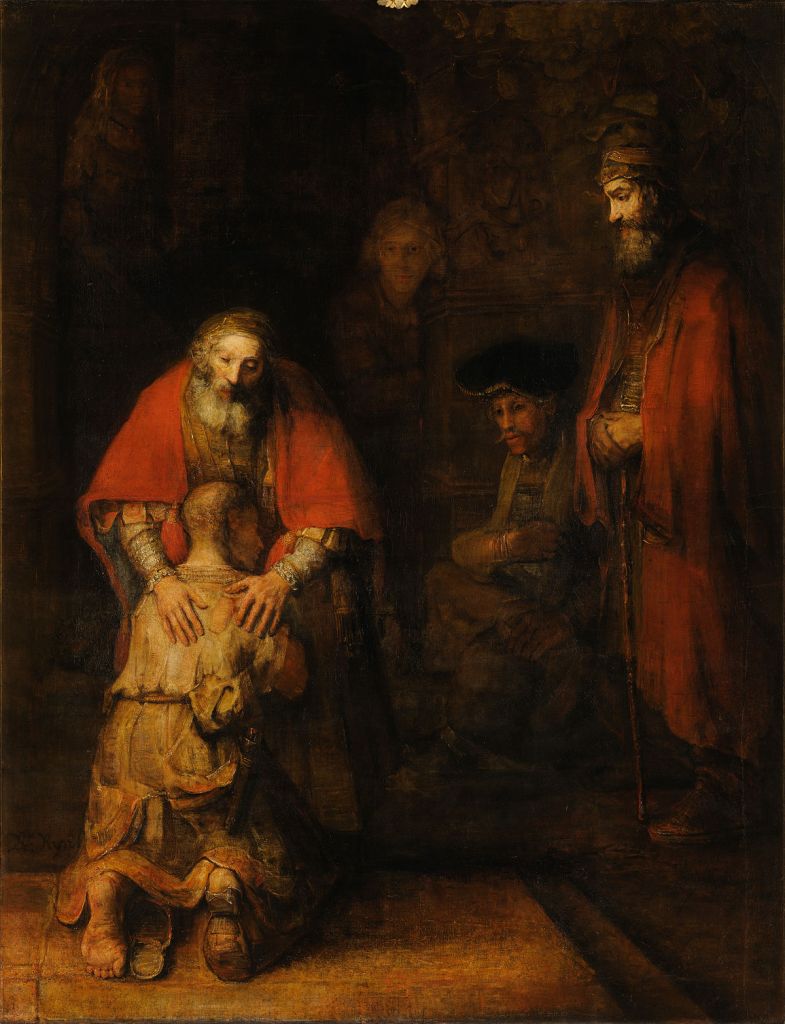
The Return of the Prodigal Son by Rembrandt (c.1661-1669). From Google.
Then he said, “A man had two sons, and the younger son said to his father, ‘Father, give me the share of your estate that should come to me.’ So the father divided the property between them. After a few days, the younger son collected all his belongings and set off to a distant country where he squandered his inheritance on a life of dissipation.”
Luke 15:11-13
Feel the solemnity of Jesus in introducing this parable, shifting from lost sheep and lost coin to lost son, from things to persons because the elder son is also lost. It is the father who eventually restored the lost personhood of the two sons when he lavished them with his love and mercy towards the end of the story. And that is why this parable is so lovely as it reminds us of how unconsciously we are “dumping” our own personhood despite our bloated egos. Slowly we are becoming robots or worst, even zombies without feelings and personal relations with others and with one’s self.
Just like the two sons in our parable who both define sonship in terms of servile obligations that is utilitarian and contractual in relationships, not as a family.
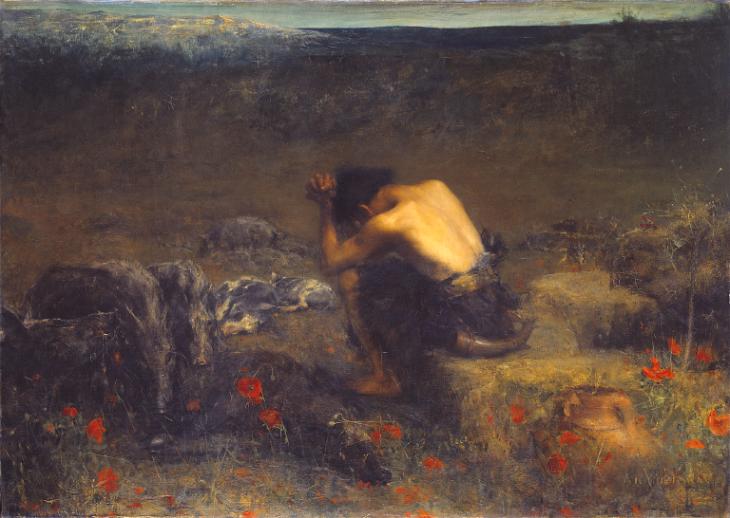
The Prodigal Son by John Macallan Swan, 1888. From Google.
Coming to his senses he thought, ‘How many of my father’s hired workers have more than enough food to eat, but here I am, dying from hunger. I shall get up and go to my father and I shall say to him, “Father, I have sinned against heaven and against you. I no longer deserve to be called your son; treat me as you would treat one of your hired workers.”
He (elder son) said to his father in reply, “Look, all these years I served you and not once did I disobey your orders; yet you never gave me even a young goat to feast on with my friends. But when your son returns who swallowed up your property with prostitutes, for him you slaughtered the fattened calf.”
Luke 15:17-19, 29-30
The prodigal son remembered his father when he was starving, thinking more of the food he could have if he returns home as a servant, not as a son. See how in the midst of sin, he never thought of his father as his parent, of himself as a son. He was convinced that the path to reconciliation with his father was becoming a hired worker, forgetting the very fact he is the youngest son.
The same is true with the elder son who refused to join the celebration when his brother had returned home, feeling so bad that his long years of service to his father deserve him a reward. In a sense, he is worst than the prodigal son: no father, no brother – just himself alone!
Both sons have a slanted view of their father, a very truncated one that is self-isolating, very constricting like the Pharisees and scribes who have forgotten their being persons, of being interrelated with one another in God. Very much like us today that slowly as the ties that bind us as family and friends are slowly being severed by so many things, we also start to lose many of our values like “malasakit” or concern for one another.
The father redefined their – and ours, too – relationships as family that lead to joy and celebration.
He (father) said to him, “My son, you are here with me always; everything I have is yours. But now we must celebrate and rejoice, because your brother was dead and has come to life again; he was lost and has been found.”
Luke 15:31-32
Santorini. Photo by Dra. Mai Dela Pena, 2016.
Today, Jesus reminds us, and assures us too that no matter what happens with us, we will always be his brothers and sisters, beloved and forgiven children of the Father.
We call and relate with God as Father because as his children, he is our giver and keeper of life.
And should this life get lost, God as our Father, can also be so “prodigal” to “wastefully” love us and bring back this life to us for we are more valuable than anything else in this universe. That’s how wild and wide is his love and mercy. Amen.













 lordmychef.com