The Lord Is My Chef Breakfast Recipe for the Soul by Fr. Nicanor F. Lalog II
Wednesday, Memorial of St. Cornelius (Pope) and St. Cyprian (Bishop), Martyrs,
16 September 2020
1 Corinthian 12:31-13:13   ///   Luke 7:31-35
Photo by author, Mt. St. Paul Spirituality Center, La Trinidad, Benguet, January 2020.
Praise and glory to you, God our loving Father!
Thank you for the rains these past three days. Thank you for the feasts of the Exaltation of the Cross and of Our Lady of Sorrows, respectively these past two days.
Most of all, thank you for the present moment!
As I prayed on your words for today, I got fixed on St. Paul’s description of love as the greatest of all your gifts:
It bears all things, believes all things, hopes all things, endures all things. Love never fails.
1 Corinthians 13:7-8
I just prayed on these verbs, Lord. I do not know if I make sense. But, through them I felt your love!
Love bears all things when you keep on carrying, having someone just because you love the person, you feel a link with the person like a brother or a sister, a friend, a parent. Like you, our Father. Or Jesus our brother.
Love believes all things when you give more room, more space for something to be realized and fulfilled in a person just because you love. Like when we feel unworthy with all our sins, you still welcome us back to you, you let us “shower” and clean up to begin anew in you and with our loved ones.
Love hopes all things when you know even if things get worst, you still love us, Lord. I know some things in me and my loved ones will not get any better. Some day we shall die and everything will end. But, you will always love us, dear God, because you are love.
Love endures all things because it bears all things, it believes all things, it hopes all things. That is why love never fails.
Photo by author, Petra, Jordan, May 2019.
In all of these, Lord, I found love is everything because it is the present, the here and the now – the meaning and reality of your name “I AM WHO AM”.
All these verbs describing love are all in the present tense, not in the past nor in the future.
And that is love, always present, also a present — a gift. A most wonderful gift leading to eternity!
That is why love is the greatest!
Teach me, Jesus, to be always present in you, to you, and with you through others around me as you implied in the gospel today. Amen.
The Lord Is My Chef Sunday Music by Fr. Nick F. Lalog II, 13 September 2020
Entering through the narrow door of the Church of Nativity in Bethlehem, the Holy Land, May 2019.
Above is a photo I have taken of some pilgrims entering through the small door of the Church of the Nativity in Bethlehem last year. I have always loved the story why this entrance door is so small as it leads to a huge and very important church where the site of Jesus Christ’s birth is located.
According to tradition, pilgrims used to bring even their animals inside the church whenever they would come to worship at the site of the Lord’s birth. The priests and monks were so kind that they could not tell them to leave their horses outside to keep the church clean; and so, they built another entrance into the church with a door so small that even pilgrims have to bow in order to get inside.
Eventually, the small door taught everyone especially pilgrims the important lesson that to experience the coming of the Son of God to the world, one must learn to be humble, to bow or get low to get inside the Church of Nativity.
I know Christmas is still four months away but that is one reality we always forget, the we are all brothers and sisters in Jesus Christ. That is the meaning of Christ’s call in today’s gospel to “forgive from one’s heart” son we can forgive without limits because we are all brothers and sisters in God the Father who loves and forgives us all (https://lordmychef.com/2020/09/12/forgiving-from-the-heart-2/).
It is for this reason that we have chosen for our Sunday music “Every Kinda People” by the late English singer-songwriter Robert Palmer. It was his first top 40 hit released in 1978 that was rereleased in 1992 climbing the charts again for its beautiful music and superb lyrics that convey love and respect for every person.
Though the word forgiveness is nowhere to be found in the lyrics, it is implied because after all, the best expression of any love as shown to us by Jesus Christ is also the ability to forgive others and forego any revenge.
There’s no profit in deceit Honest men know that Revenge do not taste sweet Whether yellow, black or white Each and every man’s the same inside
What really hurts us most that we find it difficult to forgive those who have sinned against us is not only the injustice done to us but our being disrespected as a person who is a family like a spouse or a wife, a brother or a sister, a son or a daughter, a father or a mother, a kin or a friend, a confidant.
Our offenders thought only of themselves and forgot all about us, our love and kindness to them. Our oneness with them.
That is the unkindest cut of all, my brothers and sisters.
Have a blessed Sunday and a week ahead, keep loving and forgiving even if others do not. At least we remind them of that basic reality of every kinda people…
Music video by Robert Palmer performing Every Kinda People. (C) 1978 Universal Island Records Ltd. A Universal Music Company.
The Lord Is My Chef Sunday Recipe for the Soul by Fr. Nicanor F. Lalog II
Week XXIV, Cycle A in Ordinary Time, 13 September 2020
Sirach 27:30-28:7     >><)))*>   Romans 14:7-9   >><)))*>   Matthew 18:21-35
Photo by author, dusk in our parish, July 2020.
This Sunday we go deeper into the lessons gathered by Matthew from Jesus regarding love as the basis of our relationships. Last week we were told how mutual love is the sole reason why we correct brothers and sisters going stray in life.
But, more sensitive and delicate, not to mention most difficult than fraternal correction is the question of forgiving.
How many times should we forgive?
Peter approached Jesus and asked him, “Lord, if my brother sins against me, how often must I forgive? As many as seven times?” Jesus answered, “I say to you, not seven times but seventy-seven times. That is why the kingdom of heaven may be likened to a kind who decided to settle accounts wit his servants. When he began the accounting, a debtor was brought before hm who owed him a huge amount. Since he had no way of paying it back, his master ordered him to be sold, along with his wife, his children, and all is property, in payment of the debt. At that, the servant fell down, did him homage, and said, ‘Be patient with me, and I will pay you back in full.’ Moved with compassion the master of that servant let him go and forgave him the loan.
Matthew 18:21-27
Forgiving is always difficult because it is from God, calling us to be one with him, one in him, and be like him as that saying perfectly summed up, “To err is human, to forgive is divine.” It is beyond human abilities, reserved only for God until he became human like us in Jesus Christ who made us share in his greatest expression of love which is forgiveness. Hence, every time we forgive, we also become like God, divine and holy that unfortunately, we refuse and even hate!
Yes, it is very difficult because like love, forgiving is the nature of God. In fact, any kind of love is best expressed when it is forgiving. The good news is that we now share in this great love of God in forgiving others like him as we shall see in today’s parable, keeping in mind also that it was the Risen Lord’s commission to his disciples when he appeared to them on that Easter evening (John 20:22-23).
Photo by author, Baguio Cathedral, January 2018.
Forgiving like God our Father
The beauty of forgiving is that it is always a grace from God freely given to us. It is doable in Jesus Christ. The problem is when we refuse to let God work in us, when we refuse to level up our relationships to that of brothers and sisters in Jesus Christ.
There is always that pride in us exhibited by Peter at the start of the gospel today when he asked Jesus how many times he must forgive his brother. Must it be seven times?
Of course, seven being a “perfect number” does not specify a numerical figure of times to forgive except that it gives enough room to let go of a sinner or an offender. However, it still connotes some form of “counting” or taking tabs at how many times must one forgive, implying a limit.
But Jesus pushed it further when he told Peter to forgive “not seven times but seventy-seven times” — that is, twice the perfect number he had cited!
The Lord is telling Peter, and us today, to forget all about keeping tabs, of counting how many times you must forgive because God forgives us without limits which his parable tells us.
The king or master in the parable is God, so wealthy that he could lend sums exceeding the normal level of what one can borrow. Most surprising is like God, the master lent so much amount beyond the debtor’s ability to pay!
That is how rich our God is — so rich in love and mercy, giving us with so much even beyond our ability to pay him back in return. Exactly what we have in the responsorial psalm: “The Lord is kind and merciful; slow to anger and rich in compassion.”
And when that servant prostrated before his master, then the more we see in that religious gesture the deeper meaning of the parable: the rich mercy of God forgiving us for our debts even after we have lost everything like that debtor with nothing enough to pay his loans, not even his wife and children.
See the contrast of the king moved with compassion echoing the same attitude of Jesus so often like in the wilderness where he fed more than 5000 people and that servant so lost with nothing else left but still forgiven.
The parable could have stopped there but Jesus went on to continue what happened next to teach us the deeper truth of forgiving, which is imitating God our Father because we are brothers and sisters in him.
From Google.
When this servant had left, he found one of his fellow servants who owed him a much smaller amount. He seized him and started to choke him, demanding, ‘Pay back what you owe.’ Falling to his knees, his fellow servant begged him… but he refused. Instead, he had the fellow servant put in prison until he paid back the debt. Now when his fellow servants saw what had happened, they were deeply disturbed, and went to their master and reported the whole affair. His master summoned him and said to him, ‘You wicked servant! I forgave you your entire debt because you begged me to. should you not have had pity on your fellow servant, as I had pity on you?’ Then in anger is master handed him over to the torturers until he should pay back the whole debt. So will my heavenly Father do to you, unless each of you forgives his brother from his heart.”
Matthew 18:28-35
Forgiving from the heart
After hearing the second part of the parable, we all felt like the master, angry and indignant with that merciless servant whose action was very shameless and scandalous. But, more than being like the king who properly judged the conduct of that merciless servant, Jesus is also inviting us to probe deeper into our hearts the realities why we felt like the king in the parable?
How many times have we felt so angry and frustrated during this pandemic period at the many occasions when we heard news of injustices and abuse of powers against the little ones like Mang Dodong or the Marawi verteran shot to death in Quezon City? Of those punished in violating the protocols when its chief implementor got away free after attending a mañanita party?
The list goes on specially in our country where laws favor the abusive rich and powerful, those with connections while ordinary citizens with lesser violations, even without any crimes at all suffer the same fate as the servant with lesser debts.
Photo by author, “patak-dugo”, 2019.
We all feel so angry and very sad because more than the injustices and lack of mercies committed by those in powers, they have forgotten we are brothers and sisters in one God our Father. Parang sila lang ang anak ng Diyos…
We feel like the king in the parable because we felt left out, disregarded, and disrespected despite our kindness and mercy with others.
Forgiving from the heart means to forgive others not because we are fellow servants but most of all as brothers and sisters of a loving and merciful Father who forgives us always from our unpayable debts of sin and evil against each other.
This is the very thing St. Paul is telling us in the second reading, that “None of us lives for oneself, and no one dies for oneself” (Rom.14:7). Sometimes we need to be in control of our lives but the truth is, when we try to live St. Paul’s message that our lives belong to one another in Christ, the more we become truly free and happy.
It is the same reminder from Ben Sirach in the first reading telling us how we must avoid anger and resentment specially revenge because it is contrary to our faith in God. Most of all, we also know so well that we need the mercy of God in forgiving our countless sins.
The example of St. John Paul II about forgiving like God
I know what I am telling you are easier said than done. And I confess that I also find it so hard to forgive people who have wronged me, specially those I have loved and helped. Allow me to end this reflection with this beautiful bit of history that happened in our lifetime.
We were in high school seminary when Mehmet Agca shot and almost killed St. John Paul II at St. Peter’s Square on May 13, 1981. We were shocked, so sad for him and very angry with Agca. But, two years later after Christmas in 1983, we were more shocked in disbelief while at the same time in tears with joy when news came out that St. John Paul II came to visit Agca in his cell to forgive him!
It was a major news that landed on TIME magazine the following year with the cover story so relevant with our gospel today:
From Pinterest.
Those who do not forgive are those who are least capable of changing the circumstances of their lives…
Not to forgive is to be imprisoned by the past, by old grievances that do not permit life to proceed with new business.
Not to forgive is to yield oneself to another’s control. If one does not forgive, then one is controlled by the other’s initiatives and is locked into a sequence of act and response, of outrage and revenge, tit for tat, escalating always. The present is endlessly overwhelmed and devoured by the past. Forgiveness frees the forgiver. It extracts the forgiver from someone else’s nightmare. “Unless there is a breach with the evil past,” says Donald Shriver, “all we get is this stuttering repetition of evil.”
Lance Morrow, TIME Magazine, 19 January 1984
As I searched for photos of the assassination attempt on him by Agca, I came across this photo below of their meeting with an accompanying report that made me admire and love St. “JP2” more than ever.
It said that while recuperating in the hospital, St. JP2 learned from the news how people hated Agca, prompting him to ask everyone to “pray for my brother (Agca)… whom I have sincerely forgiven.” That is how holy is this great Pope of our time! Long before visiting Agca in 1983, St. JP2 had already forgiven him, calling him a “brother” despite the evil and sin done to him.
What a great Amen!
Have a blessed and wonderful week ahead, brothers and sisters in Christ!
The Lord Is My Chef Breakfast Recipe for the Soul by Fr. Nicanor F. Lalog II
Thursday, Week XXIII, Year II in Ordinary Time, 10 September 2020
1 Corinthians 8:1-7, 11-13  >><)))*>  >><)))*>  >><)))*>   Luke 6:27-38
Photo by author, dusk at my parish, July 2020.
Thank you, dear Jesus, for the grace of being together again with our family and relatives at this time of the pandemic. Your words from St. Paul today are so timely as we now spend more time together at home due to shortened work periods while kids have online classes.
But, despite these grace-filled moments in the pandemic while being together again with our family, frictions happen because we have never been truly at home with each other. We always forget the fact that love of one another is more important than being right.
Brothers and sisters: Knowledge inflates with pride, but love builds up. If anyone supposes he knows something, he does not yet know as he ought to know. But if one loves God, one is known by him.
1 Corinthians 8:1-3
Oh yes, Lord! We are sometimes surprised at how fast we have grown in age with our parents and siblings. And yes, how we have grown apart too from each other, still carrying those sentiments and memories we have had when younger.
Purify us, Jesus. Heal our memories. Enable us to let our love flow to others specially those dearest and closest to us. Remove all emotional blockages in our hearts and mental blocks in our minds that prevent us from being kind and understanding, and be more spontaneous and more sincere with everyone.
Make us realize that the more we know, the more we must be loving and understanding.
Photo by author, Malagos Garden Resort, Davao City, 2018.
Let our knowledge make us “holier” because to know what is right always leads us to being more loving as we heed your words in the gospel today, “Do to others as you would have them do to you” (Lk.6:31).
Inspire us to reflect further on these words by St. Bernard about spiritual life so that it may soothe our souls and calm our minds:
The whole of the spiritual life consists of these two elements. When we think of ourselves, we are perturbed and filled with salutary sadness. And when we think of the Lord, we are revived to find consolation in the joy of the Holy Spirit. From the first we derive fear and humility, from the second hope and love.
Office of Readings, Wednesday of 23rd Week, The stages of contemplation by St. Bernard
We pray in a very special way today, Lord, for our family and relatives, for those we live together at home. Amen.
The Lord Is My Chef Sunday Music by Fr. Nick F. Lalog II, 06 September 2020
Photo by Dr. Mylene A. Santos, April 2020 at Infanta, Quezon.
The most severe test of our being Christian lies in our being able to love one another specially when it is so difficult to love them, when the one we love like a brother or a sister or a friend sins (https://lordmychef.com/2020/09/05/presence-and-love-of-christ/).
Jesus said to his disciples: “If your brother sins against you, go and tell him his fault between you and him alone. If he listens to you, you have won over your brother. If he does not listen, take one or two others along with you… If he refuses to listen to them, tell the church. If he refuses to listen even to the church, then treat him as you would a Gentile or a tax collector… Again, amen, I say to you, if two of you agree on earth about anything for which they are to pray, it shall be granted them by my heavenly Father. For where two or three are gathered together in my name, there am I in the midst of them.”
Matthew 18:15-16, 19-20
In our Sunday gospel today, Jesus is asking us to have love as basis of our relationships, whether at home or in the community, in the church or in the society. When there is love, there is Jesus, there is order, there is peace and harmony. Even when there is imperfection and sin, when love prevails, life and its struggles become bearable, even fulfilling. But when there is no love, there is always disorder and chaos and life becomes more difficult.
And that is why we go back to Black Eyed Peas’ 2003 hit “Where Is The Love?” for our Sunday music today which is very timely and relevant in this time of the pandemic.
People killin’ people dyin’ Children hurtin’, I hear them cryin’ Can you practice what you preachin’? Would you turn the other cheek again? Mama, mama, mama, tell us what the hell is goin’ on Can’t we all just get along? Father, father, father help us Send some guidance from above ‘Cause people got me, got me Questioning (Where’s the love)
Of course, we all know our kababayan apl.de.ap is part of this group and one of the composers of this smash hit that was also the largest selling record of 2003, earning a nomination to the Grammy the following year for Record of the Year and Best Rap/Sung collaboration. From their third album Elephunk, “Where Is the Love?” gave Black Eyed Peas its first commercial success that also put them onto the mainstream music scene. Not mentioned at its single release was the back-up vocals rendered by Justin Timberlake who showed support to the group even though he was from another record label.
Very interesting is the last stanza which I just realized while reflecting on the song relating it to the gospel this Sunday: our problem is not really the corona virus but a disease within us when we refuse to accept and share that love freely given us by God.
I feel the weight of the world on my shoulders As I’m gettin’ older y’all people gets colder Most of us only care about money makin’ Selfishness got us followin’ the wrong direction Wrong information always shown by the media Negative images is the main criteria Infecting the young minds faster than bacteria Kids wanna act like what they see in the cinemas What happened to the love and the values of humanity? (Where’s the love) What happened to the love and the fairness and equality? (Where’s the love) Instead of spreading love we’re spreading animosity (Where’s the love) Lack of understanding leading us away from unity (Where’s the love)
Some people have been asking me this early how would Christmas 2020 be?
We need not read the news for we can feel and readily see around us the bleak prospects of this coming Christmas — financially and materially speaking. But I am filled with hope that Christmas 2020 amid the pandemic will most likely be one, if not the most meaningful Christmas we shall ever have because when we have less of the material things, that is also when we have more of the spiritual things in life, more of love, more of kindness, more of the person next to me, and most of all, more of Jesus. All we have to do is honestly answer the question, “where is the love?”
Have a blessed Sunday everyone!
Music video by Black Eyed Peas performing Where Is The Love?. (C) 2003 Interscope Geffen (A&M) Records A Division of UMG Recordings Inc.
The Lord Is My Chef Sunday Recipe for the Soul by Fr. Nicanor F. Lalog II
Week XXIII, Cycle A in Ordinary Time, 06 September 2020
Ezekiel 33:7-9 /// Romans 13:8-10 /// Matthew 18:15-20
Photo by Mr. Gelo N. Carpio, January 2020.
For the next three Sundays beginning today, our liturgy directs our gaze to the nature of the Church as the mystical Body of Jesus Christ. For today we hear from Matthew how we as a church or a community of believers are signs of the presence and love of Jesus Christ.
Recall how two weeks ago at Caesarea Philippi Jesus called Simon as “Peter” (“Rock”) to head his “church”, giving him the keys to the kingdom of heaven that whatever he binds on earth shall be bound in heaven and whatever he looses on earth shall be loosed in heaven (Mt.16:17-19).
Matthew is the only evangelist so particular in using the term “church” that he devoted chapter 18 of his gospel on its nature, collecting and giving some of the Lord’s teachings about community life to his own group of disciples or early church.
And off he went to start with the most important part of community life:
Jesus said to his disciples: “If your brother sins against you, go and tell him his fault between you and him alone. If he listens to you, you have won over your brother. If he does not listen, take one or two others along with you… If he refuses to listen to them, tell the church. If he refuses to listen even to the church, then treat him as you would a Gentile or a tax collector… Again, amen, I say to you, if two of you agree on earth about anything for which they are to pray, it shall be granted them by my heavenly Father. For where two or three are gathered together in my name, there am I in the midst of them.”
Matthew 18:15-16, 17, 19-20
Photo by author, dome of the Malolos Cathedral, 2019.
Presence of Jesus in the love and unity of community
In a very short teaching taking a step by step method, Jesus tells us today how our mutual love shall always take precedence above all in our community life as his disciples and sign of presence.
Though we do not find in our gospel this Sunday the word “love”, it is clearly the Lord’s lesson for today: it is mutual love for one another that must guide everyone specially in the delicate matter of fraternal correction when one is going wayward in his/her path of life.
This explains why Jesus spelled out step by step how we correct others primarily because we love, not because we are better than them or that we have such authority or task and duty. Paul beautifully says it in our second reading:
Brothers and sisters: Owe nothing to anyone, except to love one another; for the one who loves another has fulfilled the law. Love does no evil to the neighbor; hence, love is the fulfillment of the law.
Romans 13:8, 10
But of course, we need to clarify that all these lessons of love from the Lord and Paul are based on the love of Jesus Christ who clearly mandated us during his last supper how we must love:
I give you a new commandment: love one another. As I have loved you, so you should love one another. This is how all will know that you are my disciples, if you have love for one another.
John 13:34-35
What makes this loving one another a “new commandment” is loving like Jesus Christ, unlike the pagans in ancient times that are still imitated to this day even by many among us who are also Christians. So often we find specially in media how love is portrayed as mere feelings like physical attraction that always leads up to sex, devoid of any sanctity and inner beauty at all.
St. Augustine called it “disordered love” when we become self-centered and selfish, directing our love solely to attaining what pleases us that we use persons and love things like money.
Love is not just a feeling but a decision, a choice we make and affirm every day specially when times are very rough and tough for us like when we are not loved in return.
Most of all, love is when we find somebody else we can love more than ourselves (Thomas Merton). This is the kind of love that Jesus and Paul as well as all the other saints speak of: the self-sacrificing love Christ showed us when he offered himself on the cross for the forgiveness of our sins.
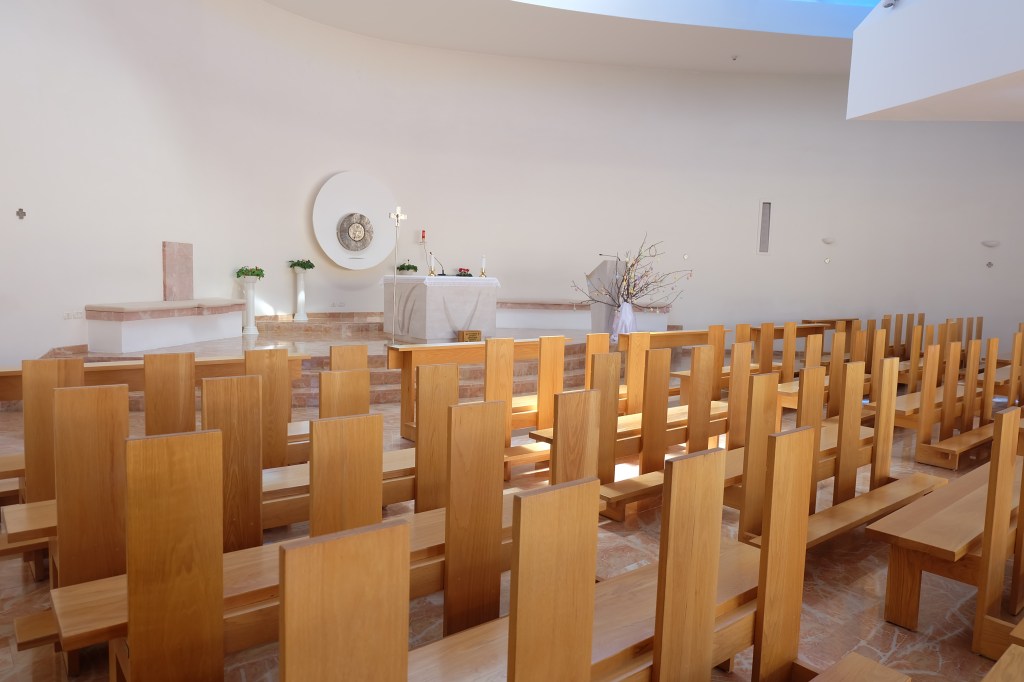
Photo by author, Chapel of the Monastery of the Sisters of Perpetual Adoration of the Blessed Sacrament at the Milk Grotto in Bethlehem where the Holy Family hid before fleeing to Egypt to escape Herod’s order to massacre the Holy Innocents, May 2019.
Love of Jesus builds, not destroys
Applying the law of love to our community is the most severe test of our being disciples of Jesus when we are challenged to be sincere in our love by hating what is evil and holding on to what is good like blessing those who persecute us, foregoing vengeance against those who have wronged us along with other expressions of mutual love in our community that Paul tells us in Romans 12:9-21.
In teaching us mutual love for one another in a step by step manner, it may seem to be a duty that one must follow in the church. It may even sound as contradictory that Jesus seems to be commanding us to strictly follow his law of command because no law can ever impose love.
However, when we try to reflect the ending of his teachings today – “For where two or three are gathered together in my name, there am I in the midst of them” – we find Jesus not ordering us to love but asking us our love because he loves us. He comes to us, grants our prayers because he loves us; therefore, when we love, when we gather as his disciples, we become his presence. And that is when our prayers are most effective because Jesus is in our midst!
Jesus and his love always build people and community; without him and his love, all we have is destruction and divisions. Hence, love is the only debt we owe to anyone. Love as a debt and “duty” is never paid back because the more we love, the more we have love, the more we are indebted to Jesus. It is the only debt that is never burdensome; in fact, the opposite happens when we refuse to love – we are burdened, life becomes heavy and so difficult.
This is what Ezekiel is telling us in the first reading: we are a “watchman”, a brother’s keeper of everyone. St. Pope Gregory the Great wrote a beautiful homily on being a watchman:
Note that a man whom the Lord sends forth as a preacher is called a watchman. A watchman always stands on a height so that he can see from afar what is coming. Anyone appointed to be a watchman for the people must stand on a height for all his life to help them by his foresight.
Office of Readings, Memorial of St. Pope Gregory the Great, 03 September
Photo by author, sunset inside our parish, 25 August 2020.
In the Church, those designated as watchman of the flock of Jesus is the Bishop or episkopos in Greek that means watcher or overseer. It is the bishop’s duty to always be above others in the loving service of the Church that sometimes out of love for Christ, he has to discipline those going astray as instructed in our gospel today, “If he refuses to listen even to the church, then treat him as you would a Gentile or a tax collector”, that is, excommunication or suspensions and other measures not meant to punish but to convert and correct the sinner.
Next Sunday, Matthew deepens our lesson on mutual love when he presents us the teachings of Jesus on how often we must forgive our brother or sister who repeatedly sins against us.
See my dear reader, how after presenting to us who is Jesus Christ last month, in how much he loves us and seeks us, these following Sundays we are challenged by the Lord to be like him – loving and merciful – to truly keep our relationship with him.
It is the first Sunday of September, the -ber months that tell us Christmas is around the corner. But, it seems we are still in a long haul in this pandemic. Having a vaccine will not totally eradicate COVID-19 nor guarantee us this won’t happen again in the future because the disease that is truly plaguing us until now is our refusal to love and live as brothers and sisters in Christ. Let us give it a try. Slowly. Jesus is not rushing us. All he is asking us is be open to his words expressed earlier in our responsorial psalm: “If today you hear his voice, harden not your hearts.”
Have a heart and have a blessed, lovely week, everyone!
The Lord Is My Chef Breakfast Recipe for the Soul by Fr. Nicanor F. Lalog II
Saturday, Memorial of St. Teresa of Calcutta, 05 September 2020
1 Corinthians 4:6-15 /// Luke 6:1-5
Photo by author, 25 August 2020.
By blood, I am Albanian. By citizenship, an Indian. By faith, I am a Catholic nun. As to my calling, I belong to the world. As to my heart, I belong entirely to the Heart of Jesus.
St. Mother Teresa of Calcutta (26 August 1910-05 September 1997)
One of the great joys I have come to treasure lately, O Lord, is the grace to have lived in these interesting part of history among some of the great modern saints of our time like St. Mother Teresa of Calcutta whose Memorial we celebrate today.
I practically grew up during her time when she was called a “living saint”, a very small woman in stature clad in her usual white and blue-striped habit, always wearing a smile, radiating with your light, sweet Jesus Christ.
Yet, deep in her fragile-looking body was a rock-solid faith in you, Lord, that enabled her to accomplish so much to alleviate the sufferings of so many people!
She knew so well our time marked with material affluence amid spiritual and moral bankruptcies that she went to serve the “poorest of the poor” not only in India but in the entire world. She was a soul filled with your light, Lord, burning with love for you with the sole desire to be your love and compassion to the poor.
Thank you, dear Jesus for being present with us through saints like St. Mother Teresa.
Like her, I pray that I may remain faithful to you than be successful by becoming your light to the world plunged in darkness of sin.
Like St. Paul before her, use me, Jesus, to heal the world of its wounds and divisions by remaining faithful and true to your words that you are the “Son of Man, the lord of the sabbath.”
Like St. Mother Teresa, may I share you Jesus, only Jesus, and always Jesus. Amen.
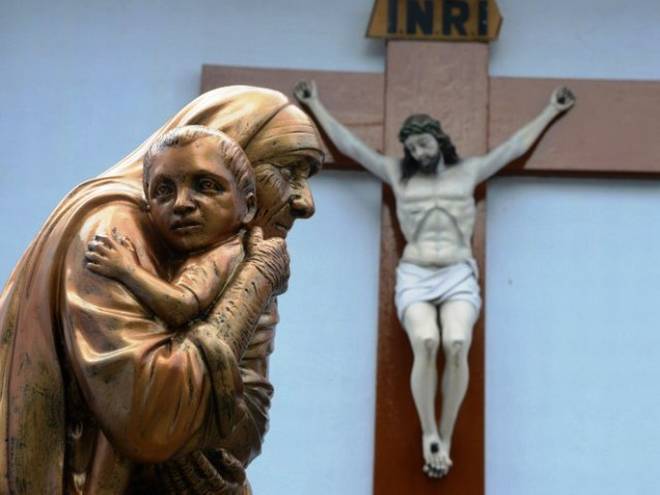
A statue of St. Mother Teresa in their Mother House in Calcutta, India. From devdiscourse.com.
Photo by author, Jewish cemetery outside Old Jerusalem, May 2019.
Together with the psalmist today I sing to you, O God our Father: “Give thanks to the Lord, for his love is everlasting.”
Yes, O Lord, your love is everlasting, your fidelity is so true and whatever that is good for us, there is no stopping you from doing it because of your love for us.
Thank you for fulfilling this promise you made to Ezekiel your prophet in the Old Testament:
Thus says the Lord God: O my people, I will open your graves and have you rise from them, and bring you back to the land of Israel. Then you shall know that I am the Lord, when I open your graves and have you rise from them, O my people! I will put my spirit in you that you may live, and I will settle you upon your land; thus you shall know that I am the Lord.
Ezekiel 37:12-14
Through the Passion, Death, and Resurrection of Jesus your Son, you have indeed opened our graves and put your spirit upon us for we have been dead to sin but now raised to life in Christ.
Unfortunately, many of us have turned into spiritual “zombies” by being dead to sin again – lifeless and therefore loveless!
Revive your Spirit in us, O God, the spirit of love that Jesus poured on us.
Let us love you beyond words and letters of your laws but in flesh and blood by being loving to our brothers and sisters, in loving you by loving others.
May we continue the work of St. Pius X whose papal motto was “Renew all things in Christ” by returning to you in Jesus through the Blessed Sacrament and the Holy Eucharist.
St. Pius X came at a crucial stage in Church history in the early 1900’s when the world was experiencing great changes and revolutions not only in many nations but most especially in the thinking and outlook of people of his time — exactly like today, Lord.
May we restore all things in you, Lord Jesus by awakening in us anew the basic spirit of love through kindness and generosity to one another specially in this time of the pandemic.
We also remember today the assassination of Benigno S. Aquino Jr. who had offered us his life because he believed we “Filipinos are worth dying for.”
As our nation slid back to darkness these past decade, help us, O Lord, to rise again, to be filled with life and love for one another, for our nation and our future generation by being selfless and honorable before one’s self, others, and you. Amen.
Photo by Dra. Mai B. Dela Peña, Carmelite Monastery, Israel, 2014.
Photo by author, an oasis at the Dead Sea area, May 2017.
Thank you very much, dear God our Father in bringing us closer to you more than ever through your Son Jesus Christ our Lord.
Thank you for “taking away our stony hearts and giving us natural hearts” (Ez.36:26) as you have promised your prophet Ezekiel in the Old Testament.
Thank you for inviting us always into your “wedding banquet”, revealing to us your wonderful plan of being with you in eternity.
Forgive us, too, O merciful Father when despite our new and natural heart in Christ, we refuse to follow your Spirit within us to totally change our ways, when we forget to realize that for every gift from you is our responsibility to nurture and make this bear fruits in our lives.
Like the man who came to the wedding banquet not dressed for the occasion in the parable by Jesus, we always miss the chance of being truly one with you in loving charity when we fail to seek knowledge to serve you in others.
May we keep in our hearts these beautiful teachings by St. Bernard whose memorial we celebrate today that like him, may we nurture your gifts through constant studies and prayers:
There are those who seek knowledge for the sake of knowledge: that is curiosity.
There are those who seek knowledge to be known by others: that is vanity.
There are those who seek knowledge in order to serve: that is LOVE.
St. Bernard of Clairvaux (1090-1153)
Lord Jesus, please take away our stony hearts and give us natural hearts that beat with firm faith, fervent hope, and unceasing charity and love. Amen.
The Lord Is My Chef Sunday Music by Fr. Nick F. Lalog II, 16 August 2020
Our parish on a lazy afternoon before the pandemic in January 2020. Photo by Mr. Angelo Carpio.
Our Sunday gospel today is so touching at how great is the love of Jesus Christ for us who knows no boundaries when he “withdrew to the region of Tyre and Sidon” to heal the daughter of a Canaanite woman “tormented by a demon” (Mt.15:21, 28).
Two Sundays ago we heard how Jesus fed more than 5000 people who have followed him to a deserted place from just five loaves of bread and two pieces of fish; last week, he walked on water to rescue his disciples in a boat caught in a violent storm at the middle of the lake at night.
Very clear in all his actions is the immense love of Jesus Christ for everyone, doing everything in love and for love.
And that is why we have Rock n’ Roll’s dynamic duo, Daryl Hall and John Oates singing their eighth #1 hit released in 2003 “Do It For Love” from their sixteenth studio album of the same title.
I have always considered Hall and Oates as my topmost favorite musicians standing side by side with the equally great tandem of Walter Becker (+) and Donald Fagen of Steely Dan fame.
Smooth and sophisticated with their characteristic Phillysound, Hall and Oates’ Do It for Love tells of how a man would go to great lengths to express his love for his beloved.
I would fly ten thousand miles In the pouring rain Just to see your face
I’d bare my soul to a total stranger Just to say your name And I’m not ashamed Just to love you into every morning
I would change my name And run away I won’t do it for money I won’t do it for pride
I won’t do it to please somebody else If it don’t feel right But I’ll do it for you And at least I’ll try
I don’t need any other reason Than I feel it deep inside I’ll Do It For Love
I have used it so many times in counseling single and married men having problems with their girlfriend and wife; and so far, it seems to have always worked with most of them still together and happily married!
Try it yourself this Sunday… with a lot of prayers and honest-to-goodness soul searching, miracles may still happen!










 lordmychef.com