The Lord Is My Chef Daily Recipe for the Soul by Fr. Nicanor F. Lalog II
Thursday, Sixth Week in Ordinary Time, Year I, 20 February 2025
Genesis 9:1-13     <*{{{{><  +  ><}}}}*>     Mark 8:27-33
Jesus and his disciples set out for the villages of Caesarea Philippi. Along the way he asked his disciples, “Who do people say that I am?” They said in reply, “John the Baptist, others Elijah, still others one of the prophets.” And he asked them, “But who do you say that I am?” Peter said to him in reply, “You are the Christ.” (Mark 8:27-29)
You are always on the move,
Lord Jesus:
you are always moving,
crossing the lake,
hiking in the mountains
and most often,
walking the streets.

What a lovely imagery
of you, Jesus,
always on the road
with me following you,
watching you,
observing you,
sometimes stopping
because of being tired
but you are always there
waiting for me.
And now,
what a lovely scene
of you back on the road again
but this time asking those closest
to you - including me! -
with that most personal question
of all: "But who do you say
that I am?"
Who are you for me, Jesus?
So many, actually.
I may not be as eloquent
like Peter, but no doubt about
who are you for me, Jesus:
my life,
my meaning,
my love,
my hopes,
my fullness.

But,
very often along this
road,
on these streets we walk
and cross,
dear Jesus
when that who are you for me
is shaken,
is tested,
even doubted
like Peter:
how could you allow
yourself and us your followers
suffer and cry,
and die?
He began to teach them that the Son of Man must suffer greatly and be rejected by the elders, the chief priests, and the scribes, and be killed, and rise after three days. He spoke this openly. Then Peter took him aside and began to rebuke him (Mark 8:31-32).
Let us think always
as God does, Jesus,
not as human beings do
seeking fame and prestige,
comfort and wealth,
self and ego;
let me walk closer with you
Jesus on the streets,
on whatever road
you take
upholding that covenant
of God with Noah to
uphold and respect
human life by
"accounting for human
life" (Genesis 9:5);
more than the colorful
rainbows of the skies,
may we always see in your
outstretched arms on the Cross
the true and new covenant
of God with us sealed in
your blood.
Amen.
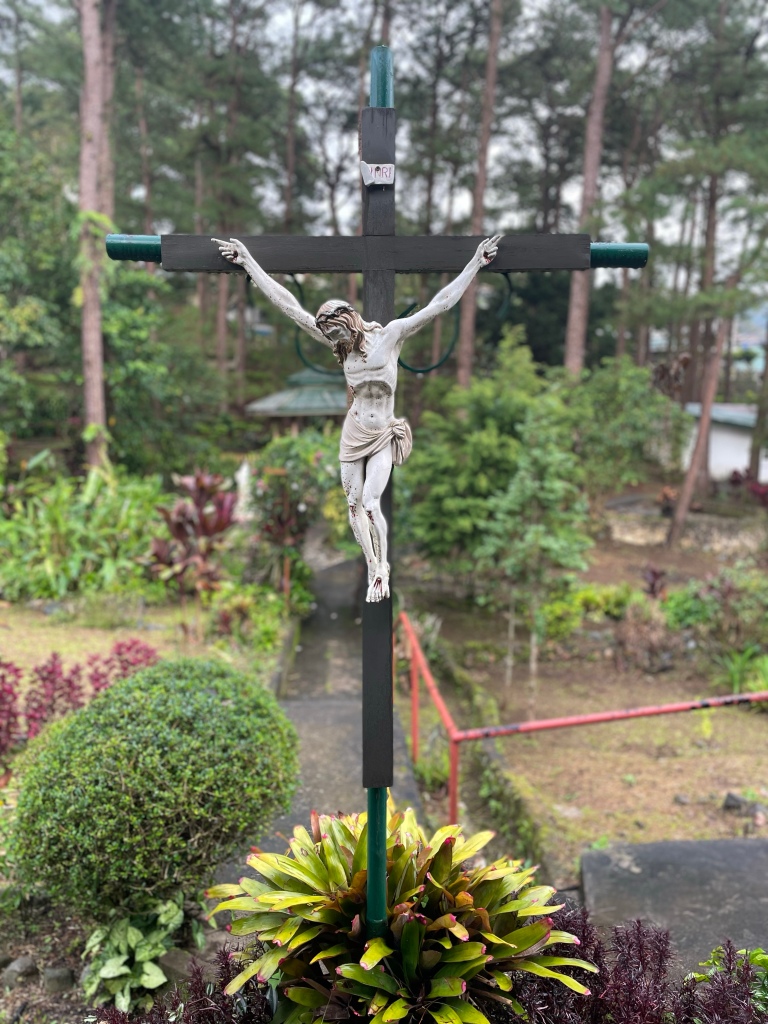
Photo by author, St. Scholastica Spirituality Center, Baguio City, August 2023.
The Lord Is My Chef Good Friday Recipe, 29 March 2024
Isaiah 52:13-53:12  > + <  Hebrews 4:14-16;5:7-9  > + <  John 18:1-19:42
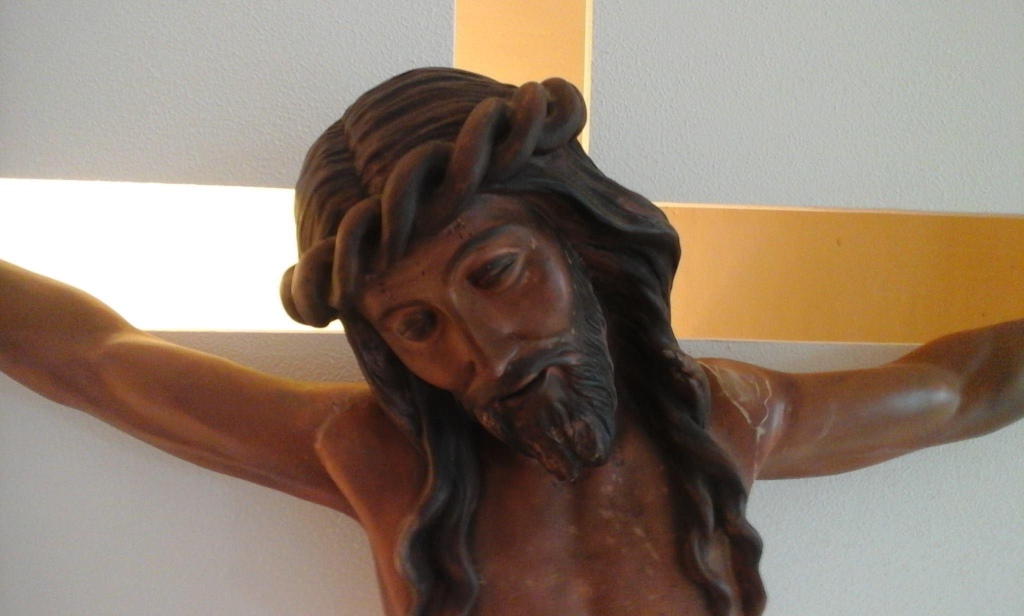
Photo by author, Chapel of the Holy Family, Sacred Heart Novitiate, Novaliches, June 2016.
The evangelists tell us that Jesus died on the Cross on a Friday at about 3PM. And they tell us too that our Lord died praying, exactly what most of the Seven Last Words expressed.
But from the gospel we have heard this afternoon written by the beloved disciple, we discover something very beautiful about the death of Jesus, that He was very calm and peaceful in His prayer unto death.
After this, aware that everything was now finished, in order that the Scripture might be fulfilled, Jesus said, “I thirst.” There was a vessel filled with common wine. So they put a sponge soaked in wine on a sprig of hyssop and put it up to his mouth. When Jesus had taken the wine, he said, “It is finished.” And bowing his head, he handed over the spirit.
John 19:28-30
Photo by author, Chapel of the Holy Family, Sacred Heart Novitiate, Novaliches, June 2016.
When we are deep in suffering, in severe pain like Jesus on the cross, what do we usually pray? Most often, we pray that the terrible ordeal we are going through would finally end, would be finished.
And sometimes, due to desperation, we even pray for death, of how we wish God would finally end our life to be free from all the problems we are going to.
One of the things I keep telling to sick people I visit came from Meryl Streep who acted as mother of Winona Ryder in the 1990’s movie “House of Spirits” when she said, “Do not pray for death because death surely comes.” Sometimes in our desperation, we feel death is the solution to our problems and sufferings. But when Jesus died on the Cross, He made death an offering, a gift of self in love.
Photo by author, Chapel of the Holy Family, Sacred Heart Novitiate, Novaliches, June 2016.
In the original Greek text, the word used to express Jesus Christ’s final prayer “It is finished” is tetelestai from the root word telos meaning the final end and direction. It is not just an ending but a direction too.
From the very start, Jesus was clear with His mission and how it would be accomplished. He has always been sure of Himself, of who He is. Notice how the beloved disciple repeated many times in his account of the Last Supper how Jesus was “fully aware” of everything that was going to happen to Him that He was actually in control and never left to the whims and powers of His enemies when He went through His Passion and Death.
Last night we heard how Jesus knew everything was coming to end that He washed the feet of His disciples after their supper. Most of all, Jesus was so composed and serene that He even gave bread to His betrayer Judas Iscariot during their meal. In fact in the washing of the feet of His disciples to His agony in the garden, Jesus calmly and courageously faced death that in the end, on the Cross, He had the upper hand that He was able to pray “It is finished” because He was never made under the power of death completely as He would rise again on Easter.
In praying “It is finished,” Jesus consecrated not only Himself but also all humanity to the Father so that we are able to bear and face death squarely like Him. Very notable in this part is how we find only in the fourth gospel how Jesus died by “handing over his spirit to the Father.”
Remember the verb to hand over is the literal meaning of the Greek word used paradidomi or betrayal. But here at the death of Jesus, handing over has no negative connotation but purely positive; Jesus never betrayed or handed anyone over to sufferings. He bore all sufferings and handed these over to the Father. That is true passion in the active sense when we let things happen not because we are helpless and resigned to the situation but we passively take everything in the positive sense because we have that firm faith and deep conviction that being silent, being patient, being persevering will eventually bear fruit for us like the death of Jesus that led to Easter.
Suffering and death thus are not resignation nor mere surrender but submission to the higher power of God to convert darkness into light, sadness into joy, and death into life. There on the Cross Jesus showed that true power is in weakness.
Photo by author, Chapel of the Holy Family, Sacred Heart Novitiate, Novaliches, June 2016.
After the consecration of the bread and wine into Christ’s Body and Blood in the Mass, we proclaim “Christ has died; Christ is risen; Christ will come again.” We call it as “the mystery of our faith” because when we say “Christ has died,” we admit that truly, the Son of God went through all kinds of sufferings in life we all go through like betrayal, rejection, loneliness, sickness, hunger, thirst, and yes, even death. And His sufferings continue as we suffer more in this world marred by evil and sins, making us cry, asking when would these end and be finished.
There lies the mystery of our faith on the Cross that led to Easter: when we look at Jesus Christ on His Cross, we see our own pains and agony as God’s pains and agony too. Jesus joined us in our anguish and death so that we could experience all the more His immense love for us. Without Jesus and His Cross, we would never be able to bear or even face the many deaths we go through daily. May we recognize God’s immense love for us again this afternoon when we venerate the Cross and see it as the merging point of human and Divine suffering. Keep praying with Jesus who has the final say with death in Easter. Amen.
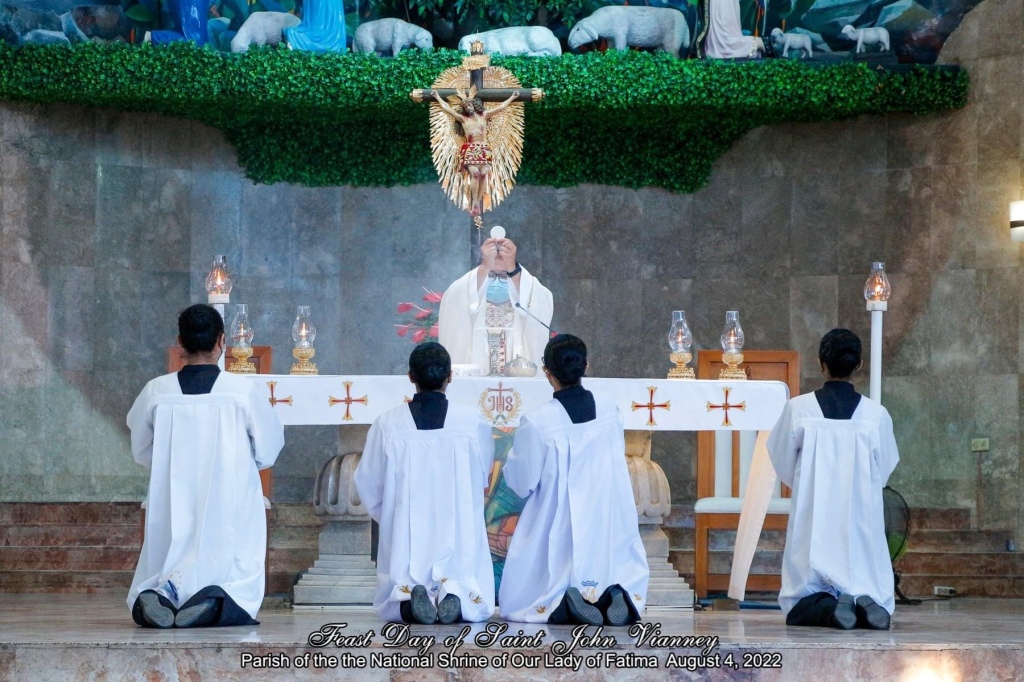
Photo by Ka Ruben, National Shrine of Our Lady of Fatima, Valezuela City, August 2022.
Lawiswis ng Salita ni P. Nicanor F. Lalog II, Ika-26 ng Marso 2024
Ika-anim na Huling Wika ni Jesus
Larawan kuha ni G. Chester Ocampo, kapilya ng Immaculate Conception Seminary, Guiguinto, Bulacan, 30 November 2015.
May isang mangkok doon na puno ng maasim na alak. Itinubog nila rito ang isang espongha, ikinabit sa sanga ng isopo at idiniit sa Kanyang bibig. Nang masipsip ni Jesus ang alak ay Kanyang sinabi, “NAGANAP NA!” Iniyukayok Niya ang Kanyang ulo at nalagot ang Kanyang hininga.
Juan 19:29-30
Kung minsan ako ay nalulungkot tuwing Huwebes Santo kapag natutuon ang pansin ng mga tao sa rito ng paghuhugas ng pari sa mga paa ng ilang mananampalataya. Tunay na kakaibang eksena at karanasan iyon sa mga tao ngunit ang totoo, hindi naman talagang bahagi ng Misa ng Huwebes Santo ang naturang paghuhugas ng mga paa na puwede namang hindi ganapin.
Ang tunay na lundo ng Banal na Misa ng Huwebes Santo ay naroon sa bahagi ng Ebanghelyong nagsasaad ng diwa ng paghuhugas ni Jesus sa mga paa ng kanyang mga alagad:
Bisperas na ng Paskuwa. Alam ni Jesus na dumating na ang panahon ng kanyang paglisan sa sanlibutang ito upang bumalik sa Ama. Mahal niya ang kanyang mga tagasunod na nasa sanlibutan, at ngayo’y ipakikita niya kung hanggang saan ang kanyang pag-ibig sa kanila.
Juan 13:1
Hanggang saan nga ba ang pag-ibig sa atin ni Jesus?
Hanggang sa wakas. O, end sa Inggles. Ngunit kapag sinabi nating hanggang sa wakas, parang mayroong hangganan ang pag-ibig natin kaya ang pahayag na ginamit sa pagkakasalin ay “ipakikita niya kung hanggang saan ang kanyang pag-ibig sa kanila.”
Mas mainam ang pagkakasalin sa Inggles ng huling pangungusap na nagsabing “He loved his own in the world and he loved them to the end.” Mula sa salitang Griyego na telos ang katagang wakas o end sa Inggles. Nguni’t salungat sa madalas nating isipin ang “wakas” bilang hangganan dahil ang telos ay nagpapahiwatig ng direksiyon at hahantungan na kaganapan o perfection. Hindi lang pagtigil at paghinto ang wakas o end.
Kaya naman nang sabihin ni Jesus doon sa Krus na “naganap na”, ang pakahulugan Niya ay ang kaganapan ng Kanyang misyon na mahalin tayong lahat hanggang sa wakas na siyang tinutukoy ng pahayag sa simula ng kanilang Paskuwa, “at ngayo’y ipakikita niya kung hanggang saan ang kanyang pag-ibig sa kanila” sa paghuhugas ng kanilang mga paa na ang kaganapan ay sa Kanyang kamatayan sa Krus kinabukasan ng araw ng Biyernes.
Ipinamalas sa atin ni Jesus ng buong-buo at ganap sa Kanyang pagkamatay sa Krus ang pag-ibig ng Ama para sa atin batay sa Kanyang sinabi kay Nicodemus, “Gayon na lamang ang pag-ibig ng Diyos sa sanlibutan, kaya ibinigay niya ang kanyang bugtong na Anak” (Jn.3;16).
Kung tutuusin ay hindi naman kailangang mamatay si Jesus sa Krus upang tayo ay maligtas ngunit pinili pa rin Niya ito bilang tanda ng Kanyang pagmamahal sa ating lahat. Kaya naman dito rin nating makikita ang magandang kahulugan ng pagmamahal na hindi lamang basta pagtupad sa mga kautusan o pagiging mabuti sa kapwa. Sa kabuuan nito, ang pagmamahal ay pagiging-ganap ng ating buhay. Love is the perfection of life, ayon kay Thomas Merton, isang mongheng Amerikano noong araw.
Kapag tayo ay nagmamahal, tayo ay nagiging ganap tulad ng Diyos! Kaya, basta magmahal lang ng magmahal hanggang masaktan dahil hindi iyan mauubos tulad ng Diyos.
Mga minamahal, yamang gayon kadakila ang pag-ibig ng Diyos sa atin, dapat din tayong mag-ibigan. Walang taong nakakita sa Diyos kailanman, ngunit kung tayo’y nag-iibigan, nasa atin siya at nagiging ganap sa atin ang kanyang pag-ibig.
1 Juan 4:11-12
Mula sa unang sulat ding iyan ni San Juan, ating matutunghayan ang pahayag niya na ang Diyos ay pag-ibig na ayon sa dating Santo papa Benedicto XVI sa kanyang unang encyclical na Deus Caritas est, ito ang pinaka-malalim na pahayag tungkol sa Diyos na hindi matatagpuan sa ibang relihiyon maliban lamang sa Kristiyanidad.
Mga ginigiliw ko, Diyos lang ang makapagmamahal sa atin ng ganap. Tanging si Jesus lang ang makapagmamahal sa atin ng ganap na Kanyang pinatunayan doon sa Krus.
Palagi kong sinasabi, “human love is always imperfect” kaya hayaan nating punan ni Jesus, gawin Niyang ganap at buo ang ating pagmamahal na palaging kapos at kulang. Maari itong mangyari kapag tayo nagsimulang magparaya at magpatawad, magbigay ng walang hinihintay na kapalit, manahimik kesa kumibo at humaba pa usapan. Tanggapin natin at angkinin mga sakit at sugat natamo natin sa imperfect love ng pamilya at kaibigan o sino pa man.
Tularan natin si Jesus na nagpakasakit at naghandog ng buhay sa Krus dahil sa pag-ibig.
Manalangin tayo para sa mga minamahal natin at sa nagmamahal sa atin sa kabila ng ating mga imperfection:
Panginoong Jesu-Kristo,
sana makapagmahal din ako
tulad Mo hanggang kamatayan;
sana masabi ko rin sa wakas tulad Mo
"naganap na";
patawarin po Ninyo ako
sa maraming pagkakataon
na hindi pa rin tapos
at patuloy pa rin sa pagnanana
ng mga sugat kong natamo
sa imperfect na pagmamahal ng kapwa
kaya hindi ako maka-move on
dahil nilalamon akong buhay ng mga sugat
at alaalang ito kaya hindi ako lumago
at maging ganap sa Iyo.
O Kristo Jesus,
patawarin po Ninyo ako
at turuang magpatawad
dahil sa pagpapatawad
kami tunay na nagmamahal
ng ganap tulad Mo.
Amen.
Lawiswis ng Salita ni P. Nicanor F. Lalog II, 24 Marso 2024
Ikaapat na Huling Wika ni Jesus
Larawan kuha ng may-akda, Kapilya ni San Francisco Javier, Sacred Heart Novitiate, Novaliches, 20 Marso 2024.
Mula sa tanghaling tapat hanggang ikatlo ng hapon ay nagdilim sa buong lupain. Nang mag-iikatlo ng hapon, sumigaw si Jesus, “ELOI, ELOI, LEMA SABACHTANI?” ibig sabihi’y “DIYOS KO, DIYOS KO, BAKIT MO AKO PINABAYAAN?”
Mateo 27:45-46
Sa tagpong ito ating mababanaagan kadakilaan ng pagmamahal sa ating lahat ng Diyos, Siya na ganap, walang kapintasan at kakulangan (perefect) ay piniling maging katulad nating hindi ganap (imperfect) bilang tao sa lahat ng bagay maliban sa kasalanan kay Kristo Jesus.
Pinili at mas inibig ng Diyos kay Kristo na maging tao upang maranasan hirap at sakit natin maging ang kamatayan, lalo’t higit ang magdusa at mamatay na nag-iisa at iniwanan ng lahat doon sa Krus.
Ano mang paghihirap at pagdurusa ay nagiging napakabigat kapag ika’y nag-iisa, na walang kasama ni karamay. Ito pinakamasaklap sa panahon natin ngayon maging sa ating bansa na dati rati’y walang mga bahay ampunan para sa matatanda ngunit nagyon ay naglipana na dahil sa maraming matatanda ang iniiwan, tinatalikuran di lamang ng mga kamag-anakan kungdi pati ng lipunan. Ito ang dahilan kung bakit si Santa Mother Teresa ay bumuo noon ng samahan na mag-aalaga sa mga tinaguriang “poorest of the poor” sa India nang makita niya maraming may-sakit sa Calcutta namamatay nang mag-isa. Hindi lamang ito totoo sa mga mahihirap na lugar kungdi maging sa mga mauunlad na lupain ay maraming matatanda ngayon ang namamatay na lamang ng mag-isa sa buhay.
Larawan kuha ng may-akda, Baguio City, 2023.
Iyan man ay pinagdaanan ni Jesus lalo na noong ipinako siya sa krus na halos iwanan siya ng lahat. Sa labingdalawang alagad niya, naghudas ang isa habang ang pinuno naman nila ay ikinaila siya ng tatlong ulit kaya’t nagtago noon kasama ang iba pang mga alagad. Tanging si Juan na minamahal na alagad ang nanatili sa paanan ng krus ni Jesus kasama ang kanyang Ina na si Maria at ilan pang mga kababaihan.
Nasaan ang mahigit limang libong tao na pinakain ni Jesus sa ilang? Wala din doon ni isa sa mga pinagaling niyang mga may-sakit. Nawala at naglaho ang lahat ng tao na tuwang-tuwang sumalubong kay Jesus noong Linggo ng Palaspas.
Ngunit kailan man ay hindi naramdaman ni Jesus ang pagiging mag-isa doon sa Krus. Tulad ng sino mang mabuting Judio, dinasal ni Jesus noon ang Salmo 22, ang awit ng panaghoy, ng pagpapakasakit at buong pagtitiwala sa Diyos.
Ito ang mabuting balita ng pagkamatay ni Jesus sa Krus: mula noon tayong mga tao ay hindi na mag-iisa sa mga hirap at tiisin nitong buhay maging kamatayan dahil kasama na natin ang Diyos kay Jesus.
Ito ang ating consolation o consuelo, wika nga.
Mula sa dalawang katagang Latin na con (with) at solare (alone) na ibig sabihin ay samahan ang nag-iisa, naging pinakamalapit at tunay na kaisa tayo ng Diyos sa tuwing tayo ay nasa gitna ng mga tiisin at hirap sa buhay maging kamatayan dahil sa pagdamay sa atin ni Jesus doon sa Krus upang sa gayon sa kanyang muling pagkabuhay tayo man ay kanyang makasama at makaisa.
Sapagkat siya ma’y tinukso at nagbata, kaya ngayo’y matutulungan niya ang mga tiutukso.
Hebreo 2:18
Sa tatlong taon kong pagiging chaplain sa Our Lady of Fatima University at Fatima University Medical Center, nakita ko at naranasan sa maraming pagkakataon paano mga tao – bata man o matanda, mahirap at mayaman, may sakit o karamdaman maging mga malalakas at malusog ang pangangatawan – ay nararanasan ang pangungulila at pag-iisa sa gitna ng kanilang mga paghihirap at pagdurusa sa buhay. Marami sa kanila ang mag-isang umiiyak kasi maraming ginagawa o nasa kung saan-saan kanilang mga mahal sa buhay. Maraming pagkakataon nga naitatanong ko na lang kung mayroon pa bang umuuwi ng bahay o nakatira sa kanilang tahanan? Is anybody still home?
Larawan ng convolvulus tricolor mula BBC Gardeners World Magazine.
Halina at ipagdasal ang bawat isa, lalo na yaong mga nahihirapan, nagtitiis ng mag-isa sa buhay:
Diyos Amang mapagkalinga,
ibinigay mo sa amin
ang Iyong Anak na si Jesus
upang aming maranasan Iyong
pag-ibig at habag,
ang Iyong pagpapagaling at pagkandili,
ang Iyong kapanatilihan at kapayapaan
upang hindi na kami mag-isa pa sa buhay na ito;
maalala nawa naming palagi
na kung kami man ay dumaraan sa
napakatinding pagsubok sa buhay
na tila nag-iisa at walang karamay,
naroon si Jesus pinakamalapit sa amin
dahil Siya ang unang nagpakasakit
at namatay doon sa Krus
para sa amin.
Amen.
Quiet Storm by Fr. Nicanor F. Lalog II
The Seven Last Words, 06 April 2023
Photo by author, Chapel of the Holy Family, Sacred Heart Novitiate, Novaliches, Quezon City, 2014.
There was a vessel filled with common wine. So they put a sponge soaked in wine on a sprig of hyssop and put it up to his mouth. When Jesus had taken the wine, he said, “It is finished.” And bowing his head, he handed over the spirit.
John 19:29-30
Every Maundy Thursday, people await that most unique part of the Mass every year when the priest washes the feet of some members of the community. As a priest, it is one of the most humbling experiences I have had when a brother priest washed my feet on that Mass I attended in 2008 and 2021.
But there is something more beautiful to the ritual washing of feet. It is the context and words that accompany that: “Before the feast of Passover, Jesus knew that his hour had come to pass from this world to the Father. He loved his own in the world and he loved them to the end” (John 13:1).
The Greek word for the “end” is telos which is not just a terminal end in itself but indicates or connotes direction. Or fulfillment and perfection, not just a ceasing or end or stoppage of life or any operation.
When Jesus said on the Cross “It is finished”, he meant he had fulfilled his mission, that is, he had perfectly loved us to the end by giving us his very life.
At his death on the Cross, Jesus showed us perfectly in no uncertain terms his love for us, the Father’s love for us that he had told to Nicodemus at the start of the fourth gospel that “God so loved the world that he gave his only Son” (Jn. 3:16).
There on the Cross this was definitively fulfilled and perfected more than ever. Jesus did not have to die on the Cross but he chose to go through it because of his love for us.
Here we find the beautiful meaning of love. It is not just obeying the commandments nor being good and kind with everyone. Love in its totality is the perfection of life. It is our only destiny in life, our call to life from the very beginning. Love, love, love. Keep on loving until it hurts. Until the end.
Beloved, if God so loved us, we also must love one another. No one has ever seen God. yet, if we love one another, God remains in us, and his love is brought to perfection in us.
1 John 4:11-12
From that same letter, John declared at the very start that God is love which according to Pope Benedict XVI in his first encyclical is the most profound statement about God found only in Christianity.
My dear friends, only God can love us perfectly. Only Jesus can love us perfectly like what he did on the Cross. Human love is always imperfect. In our imperfect love, let us find Jesus filling up, making whole, perfecting our love for each other. Let us die in our selves sometimes when we have to let go with each one’s imperfection like when they make side comments. Forget all about revenge. Forgive. Understand the shortcomings of everyone. Accept and own the pains and hurts inflicted on us by our loved ones like our mom and dad, your former wife or husband, your friends, of those who have hurt you in words and deeds. That is being like Christ, dying on the Cross because of love.
Let us pray for those we love and those who love us despite our imperfections.
Lord Jesus Christ,
how I wish I could love until the end,
how I wish I could say too like you
"It is finished";
forgive me because many times with me,
the pains and hurts I have had are not yet
finished, even festering inside me,
eating me up, rotting inside me
that I could not grow and bloom in you.
Forgive me and teach me to forgive too
for it is in forgiving we truly love
perfectly like you.
Amen.
Photo by my former student, Ms. April Oliveros on their ascent to Mt. Pulag, 25 March 2023.
Quiet Storm by Fr. Nicanor F. Lalog II
The Seven Last Words, 01 April 2023
Photo by author, Chapel of the Holy Family, Sacred Heart Novitiate, Novaliches, Quezon City, 2014.
When they came to the place called the Skull, they crucified him and the criminals there, one on his right, the other on his left. Then Jesus said, “Father, forgive them, they know not what they do.”
Luke 23:33-34
Such is “the breadth, and length, and depth, and height of Christ’s love for us all” (Eph. 3:18-19) that right upon His crucifixion, Jesus begged God for our forgiveness. And that was not only for those who nailed Him on the cross on that Good Friday but also for us today who continue to crucify Him whenever we destroy our relationships.
In the Jewish thought, “to know” is not just of the mind but of the heart because to know is to have or enter into a relationship with others. Hence, Jesus begged first for our forgiveness when crucified because if there is something we must “know” above all is the fact that we are brothers and sisters in Him, one family in God our Father.
Every time there is a breakdown in our relationships, when we destroy our ties with one another, that is when we sin and know not what we do. And crucify Jesus anew.
We sin and know not what we do when we hurt those dearest to us – our mom and dad, sisters and brothers, relatives and friends – when we speak harsh words to them, calling them names, denigrating their persons as things.
We sin and know not what we do when we betray the trust of those with whom we promised to love forever, keep their secrets and protect them like your husband or wife, your children, your BFF, your student, your ward.
We sin and know not what we do when we lose hope in persons around us, choosing to do them evil because we thought they could no longer change for better, that they could never learn and overcome life’s pains and tragedies, that they could no longer get well from an illness or, sadly, because they are old and dying.
We sin and know not what we do when we cheat on those true to us, when we hide from those open to us, when we back stab those who believe and support us.
We sin and know not what we do when we abuse and use those people we are supposed to serve and protect, when we regard persons as objects to be possessed even if we do not know them personally.
Is there anyone whom you might have hurt in words or in deeds which you might not be aware of?
Who are the people who cause you pains and sufferings, who do not know what they are doing?
Let us pray:
Lord Jesus Christ,
I am sorry in crucifying You again,
when I know not what I am doing
like hurting the people You give and send me
to experience your love and mercy,
your trust and confidence
your kindness and fidelity;
I pray also for those who make me
suffer physically and emotionally,
those who do not know what they are doing;
help us build again
our many broken relationships;
make us humble and true;
let us believe in Your love
expressed by our family and friends
and by everyone who cares for us.
Amen.
Photo above is a sculpture called “Love” by Ukrainian artist Alexander Milov he created in 2015 showing two adults after a disagreement sitting with their back to each other while their inner child in both of them wanting to connect. A beautiful expression of how we are all interconnected and related as brothers and sisters. This Holy Week, let us mend and heal our broken relationships, let the inner child within us come out and simply say “I am sorry” or “I forgive you” and most especially, “I love you”. Photo from reddit.com. See also our blog, https://lordmychef.com/2023/01/14/the-human-child-mystery-of-gods-love/.
The Lord Is My Chef Sunday Recipe for the Soul by Fr. Nicanor F. Lalog II
Solemnity of Christ the King, Cycle C, 20 November 2022
2 Samuel 5:1-3 ><000'> Colossians 1:12-20 ><000'> Luke 23:35-43
Painting of Christ’s Crucifixion by Tintoretto in 1565 portraying Jesus so “kingly”; interesting too were the people dressed as Venetians of his time as reminder that the evils that crucified Jesus continue in our own time. Photo from wikiart.org.
We now come to the final Sunday of our liturgical calendar called the Solemnity of Christ the King with a scene from his crucifixion on Good Friday. All these Sundays since June “When the days for Jesus’ being taken up were fulfilled, he resolutely determined to journey to Jerusalem” (Lk.9:51), Luke had been showing us that Christ’s crucifixion and glory are one just like John in his gospel account.
But the most beautiful part of our gospel on this solemn celebration is the fact that inasmuch as Jesus had clearly showed in all eternity his kingship while dying on the Cross, it is also right on the cross of sufferings as we strive to resist temptations of turning away from God that we proclaim Christ’s kingship. Please bear with me, my friends in reflecting Luke’s artistic presentation of Christ’s crucifixion as the expression of his kingship.
Notice how Jesus was “sneered, jeered, and reviled” at the cross, reminding us of the devil’s three temptations in the wilderness after his baptism at Jordan by John. After failing to tempt Jesus at the wilderness, Luke said the devil “departed from him for a time” (Lk.4:13), returning at his crucifixion as the most opportune time to test him.
In the wilderness, the temptations by the devil to Jesus applied very well with us too but, here on the cross, it was totally different. The devil himself was nowhere to be found because he was in the person of the rulers, the soldiers, and the thief! And that is how evil and sin have become so “powerful” in a pernicious manner among us when many times we are the devil in fact.
Here, we are reminded to be aware always of that opportune time when the devil attacks us when we see or face many sufferings in life by reflecting the last three temptations of Jesus on the Cross.
Photo by author, 2017, Sacred Heart Novitiate, Novaliches, QC.
The rulers sneered at Jesus and said, “He saved others, let him save himself if he is the chosen one, the Christ of God” (Lk.23:35).
Just like at the wilderness when the devil tempted Jesus with what he can do as the Son of God by changing stone into bread, at the Cross it was the same temptation hurled on him by the rulers of Israel, the priests and the scribes.
How sad that amid the many sufferings in the world today we contemptuously mock others like the poor for not working so hard to liberate themselves from poverty and hunger. There is the tendency among us blessed with better living conditions to look down at others without considering how they never have the same opportunities in life like us in having good education or a caring family or worse, not having the right connections.
The tragic part of this “sneering” by the rulers on Jesus is when we look at others as if they are not humans and persons like us who play gods knowing everything even who should live and who should die like in the systematic approach by state rulers to come up with what St. John Paul II called as “culture of death” in solving poverty and crime with abortions and capital punishments.
Let us examine our attitudes at the way we look at those going through sufferings and pains like sickness, poverty and other social ills we do not go through. Let us stop the mockeries of blaming them for their plight because many times like Jesus Christ, they were betrayed by loved ones like us, by the society, or even by the institutions meant to uplift them.
Photo by author, 2017.
Even the soldiers jeered at him. As they approached to offer him wine they called out, “If you are King of the Jews, save yourself.” Above him there was an inscription that read, “This is the King of the Jews” (Lk.23:36-38).
Sneering and jeering are both contemptuous mocking or insulting of others; they are both employed by those in vantage positions of power and control like the rulers of Israel. Going “higher” than the priests, the Roman soldiers sneered Jesus by rudely mocking him in loud voice. Sneering is a superfluous display of might, of superiority, of power. It is a kind of vanity that is why in the wilderness, the devil tempted Jesus to have all the kingdoms in the world for him to be famous and popular in exchange of worshipping him.
Sneering is something so prevalent these days in our use of the social media where we practically scream and insist on everyone to notice and recognize us, that we have “arrived” in having the latest and most expensive clothes, food, gadgets and everything. There is so much wild attitude among us like the soldiers at the cross when we use social media in too much talks, even of spewing foul languages and invectives as well as lies. Fake news and lies spread so fast and are sadly taken as true to the detriment of its victims because we have been so gullible for gossips and rumors too.
But the worst part of our imitation of the soldiers jeering at Jesus is when many of us are afflicted with this perversion called exhibitionism – from those salacious posts in TikTok to those “food porns” and too much display of everything about ourselves and of our loved ones. When do we get tired of all these selfies that have become so sickening that we do not realize of how we make known to everyone of our emptiness and lack of the more essential things like love and self-respect? Like the soldiers, the more we promote ourselves, the more we affirm the obvious that Jesus indeed is the King we needed most.
Photo by author, 2017.
Now one of the criminal hanging there reviled Jesus, saying, “Are you not the Christ? Save yourself and us” (Lk.23:39).
Reviling is also kind of of mocking others like sneering and jeering; however, to revile is the lowest kind because it is to insult somebody you are with in a same situation. To revile is the lack of recognition of one’s faults and sins that he would rather insult others like this thief traditionally identified as Hestas. In reviling Jesus while also hanging on the cross, Hestas went down deeper his lowest point as a convicted criminal when he had the gall to insult Jesus!
And that is the most unkind evil of all when we become so numb, so dense and stupid to even mock others we are with us in a similar situation. It happens daily when even we are in deep shit, we still see ourselves cleaner and better than others! Just read or watch the news about our politicians.
In the wilderness, the final temptation of the devil to Jesus was to jump from the top of the temple because his angels would not let him fall and even touch ground; here at the cross, Hestas saw himself no different from Jesus, feeling so entitled to be liberated. Many times, this is the problem why evil continues among us: when people from below are promoted to higher positions, they forget their roots that they also forget to fix the problems of inequalities and injustices down below where they came from. The key is to always remember. Like Dimas, the good thief.
Photo by author, 2017.
The other, however, rebuking him, said in reply, “Have you no fear of God, for you are subject to the same condemnation? And indeed, we have been condemned justly, for the sentence we received corresponds to our crimes, but this man has done nothing criminal.” Then he said, “Jesus, remember me when you come into your kingdom.” He replied to him, “Amen, I say to you, today you will be with me in Paradise” (Lk.23:40-4).
See how Luke inserted here the fourth verb “to rebuke” to break the series of sneering, jeering, and reviling of Jesus. Like Dimas, we have to strive in breaking the cycle and series of evil especially in this time.
To rebuke means to express sharp disapproval. Imagine Dimas contradicting Hestas and even the rulers and soldiers as well by defending Jesus Christ while hanging there on the cross.
How sad when we remain silent, when we just walk away from people sneering, jeering and reviling Jesus in those who suffer in life because we are afraid to make a stand for what is true and good, what is right and just. How ironic that another thief hanging on the cross was the only one who made a stand for Jesus on that Good Friday along with the Mary and the beloved disciple below.
Every time we make a stand for life and dignity of every person, when we stand for what is true, right and just, that is when we imitate the tribes of Israel in the first reading coming to David to pledge their loyalty and allegiance to him as their king.
When we submit ourselves to Jesus Christ as our only King to be obeyed and followed, that is when our celebration today becomes a daily reality.
That is when we also earn heaven right on the Cross of our sufferings like Dimas when we “remember” Jesus.
Normally in the whole Bible, it is God who remembers. People always forget. When we sin, we forget consciously and unconsciously God and all the good things he had done to us. We forget others too.
There on the Cross, see the reversals of roles Luke has presented so beautifully, from the devil replaced by the rulers, the soldiers and the other thief; and now Dimas sort of assuming God’s role who remembered everything and everyone, especially Jesus our Savior. Dimas remembered what St. Paul expressed to the Colossians that Jesus is Lord in whom, with whom and through whom everything was created and renewed because he is the Christ!
From Google.
The word “remember” literally means to make member or part again, that is, “re” + “member”.
When we remember somebody, we make that person present with us again.
In asking Jesus to remember him when he comes into his kingdom, Dimas was assured that right now as he remembered everything including his sins, he already becomes a member, a part of his kingdom.
May we not forget and always remember Jesus and others always to experience Paradise even when we are on the cross. Amen. Have a blessed week ahead!
The Lord Is My Chef Good Friday Recipe by Fr. Nicanor F. Lalog II, 02 April 2021
Isaiah 52:13-53:12  +  Hebrews 4:14-16; 5:7-9  +  John 18:1-19:42
Photo by Marc Angelo Nicolas, January 2020.
"Biyernes Santong Biyernes Santo."
(A popular expression among us Filipinos.)
Perhaps, today we can truly feel the meaning and gravity of our favorite expression when somebody looks so sad and gloomy, when somebody seems to have been totally lost: “Biyernes Santong Biyernes Santo”.
That is how we are today – stuck in our homes, others in hospitals while others almost about to give up as this new wave of COVID-19 gets stronger with about 15000 infections today!
As I have been saying since Palm Sunday, this could be our holiest Holy Week in our lives in this most unholy time of our history when we are given the opportunity to be holy, to be good and kind, to be forgiving and caring with others. Side by side every post in Facebook we find prayer requests for sick family and friends, help for those trying to find a hospital that would admit their sick, or buy much needed medicines and equipment like oxygen.
For the second straight year, churches are empty and everyone is home due to COVID-19 pandemic. Perfect example of “Biyernes Santong Biyernes Santo”… so bad… so negative.
That is often how we think of Good Friday – so negative in the sense it is so sad and gloomy, so painful and too difficult.
Ultimately, Good Friday is so negative for us because it means death. Even of the Son of God, Jesus Christ. Nothing would be more sad than that.
Photo by author, Chapel of the Holy Family, Sacred Heart Spirituality Center, Novaliches, QC, 2015.
Lately due to this COVID-19 pandemic we have been living inversely or “baligtad” as we say.
We would always pray at every swab test for the virus that we be “negative”.
Never has been thinking negative has become so positive, so good, in fact!
And it all began more than 2000 years ago at the calvary when Jesus offered himself for us on the cross.
That is why Good Friday is called “Good”: the cross of Jesus Christ is a sign not of death but of the good news or gospel of life, hope, and eternal life. The cross of Jesus Christ is not a negative sign (-) but a positive sign, a plus sign (+).
We celebrate in the most solemn and unique way because the cross is no longer a sign of condemnation but honor. Before, it was a symbol of death but now a means of salvation. The cross of Christ has been the source of countless blessings for us, illuminating our path with light when our lives are so dark with sins and mistakes, sickness and disappointments. Most of all, the cross of Christ has brought us closer to God again and with one another despite our sins and past, promising us a bright a joyful Easter.
Yes, for some the cross of Christ is so negative: why display the body of the Lord everywhere in our churches and homes, bloodied and defeated, lifeless and dead?
See, my servant shall prosper, he shall be raised high and greatly exalted. Even as many were amazed at him – so marred was his look beyond human semblance and his appearance beyond that of the sons of man – so shall he startle many nations, because of him kings shall stand speechless; for those who have not been told shall see, those who have not heard shall ponder it.
Isaiah 52:13-15
Many times in life, and we have proven this, God uses of many of “negative” experiences lead us to more positive outcome and results.
Yes, we may be Biyernes Santong Biyernes Santo in sadness and fear, even anxieties.
But, we continue to pray and forge on with life’s trials and difficulties because we see the cross of Jesus Christ leading us to the light and life, joy and celebration of his Resurrection at Easter.
A very good Good Friday to you. Amen.
Photo by author, Chapel of the Holy Family, Sacred Heart Spirituality Center, Novaliches, QC, 2015.
Quiet Storm by Fr. Nicanor F. Lalog II, 11 October 2020
Photo by Ms. Anne Ramos, Good Friday “motororized procession” of Santo Entierro in our Parish during COVID-19, 10 April 2020.
Lately I have noticed
since month of August
when we have a spike of the virus
I have felt heavy and serious
as Sundays have become
more like a Good Friday
with the streets and church seats
both empty;  nobody seems to be happy
or Sundays have become more lazy?
How I miss the people I always see
wondering if they are safe and healthy
or maybe so wary just like me.
Sometimes I still feel
how everything is surreal
will I make it to next year
enjoying life without fear?
I have been wondering
if the Lord is still hanging
or have they crucified him again?
Life in the midst of COVID-19
has become more challenging
listening to silence so deafening
when God does not seem to be caring;
but, deep within
there is that calming
during Good Friday
that Easter Sunday
 is surely coming:
keep on believing, keep on praying
if Sundays look like a Good Friday
this may only mean one thing, that
Jesus is with us suffering COVID-19!
Yesterday I saw the Maundy Thursday letter of Archbishop Soc Villegas to us his brother priests. I have never had a death threat in my life but have experienced being the subject of a fake news on being dead in 2005. And like the good Bishop Soc, I also asked “why me for doing what is right?”
It was one of the darkest hours in my entire life. I was then assigned at our diocesan school for boys in Malolos when I initiated an investigation on two married teachers allegedly having an affair following a tip from some faculty members. Our school principal who was well-respected by everyone headed the board. After a few days into the investigation, the teachers concerned resigned after realizing the overwhelming evidences their accusers have gathered against them. We were so glad the case was peacefully and easily resolved.
A week later, a teacher woke me up very early morning with a call, asking if the text message they have received was true that I have died of a heart attack past midnight. My immediate response to the teacher was, “why did you call me if I have died already?” She was crying and was so concerned as I listened to her on the phone. Then I asked her to send me the text message, but, later I changed my mind, telling her “what if it were true?”
I was never able to get back to sleep that morning because everybody was asking about the fake news that spread so quickly. I had to call my family to assure them I am very alive and well. By eight o’clock I realized the gravity of the matter: nuns were praying and masses have been offered for my “untimely death” that some priests have in fact came to see me in the school. I tried to brushed it aside, taking it lightly with my usual jokes. I even held my classes that whole day, telling my students that even if I die, I would always come to teach them.
Things became so different later that day for me. Especially when I prayed first in our chapel that evening and later in my room. Alone, I cried, feeling a deep pain within, asking myself what have I done wrong to deserve such a fake news? It was a pain so different, something you could really piercing through one’s self, slashing and shredding every bit of my being. That night I felt I have finally grasped all those existential absurd and pessimistic stuffs by Abert Camus and Soren Kierkegaard. Like what young people would say these days, “gets ko na sila”.
Crucifixion at the altar of the Betania Retreat House, Tagaytay. Photo by author, 2017.
It did not stop there. The “mystery texter” eventually texted me, threatening me of so many things, cursing me that I would suffer so much before I die. With that, I sought help from my friends in the news who referred me to a text scam investigator whom I never met but was so kind to help me for free. With his technical skills plus my news background as well as pastoral psychology, I was able to eventually identify my mystery texter who was a co-teacher of the accusers of the teachers in the illicit affair. It turned out, she was so broken-hearted after being dumped by the male teacher for another co-teacher who was prettier and lovelier than her. And she’s also married! She thought I was protecting the accused male teacher who happened to be an ex-seminarian but later we learned he was notorious in having illicit affairs among his married co-teachers.
She eventually resigned from our school in 2006 along with her group of co-teachers who all end up miserable in life. Their leader got separated from her husband who was caught in the act in another school banging an employee in a vacant room during summer break. Another was widowed. The third just got uglier. And she? She went to teach abroad in 2007 but had to go back home after learning her husband’s extra-marital affairs. She was able to go back to our old school because I never told my rector my findings. After a year and a half, she was fired from our school when the wife of our school driver caught them having an affair. I have never seen her nor her group since I left our school in 2010.
The Cross of Christ atop the church of our Lady of Lourdes in France. Photo by my former student Arch. Philip Santiago during his pilgrimage in 2018.
Thank you for bearing with me with my long story. It is the first time I have shared it with anyone except with one good teacher I have kept as a friend. Since yesterday I have been telling you about the “hour” of Jesus Christ, his passion that started at the Last Supper, culminating at his crucifixion. We said the darkest hour of Jesus Christ is also his finest hour because of his immense love. In the end, it was his love that triumphed over sin and evil. And that is why we call this Friday as Good.
When I recall that episode in my life, I thank God. You know when I was being attacked then by that mystery texter, that was the same year God gifted me my first trip to the US when my Ninang’s daughter got married. Life has become harder for me since then but has become “betterer”.
Of course I was scared at that time, checking on everything I was doing. Everything in my life has to be planned and calculated; I hate surprises that is why I am not fond of gifts, that I do not readily open them. But, was I angry or mad? No. Even at that time. I even pitied our teacher for being fooled. There is still pain in my heart when I remember those people behind those things but overall, I have transcended the episode. And I feel I have been transformed by it. The incident made me more resolved to be good and better as a person, as a priest. Most of all, it had taught me that like Jesus Christ, we always have to make a stand for what is true, what is good, what is just. It is always painful, lonely and scary to be on the cross. But it is on the Cross of Christ where we shine and share in his glory. It is only at the Cross of Christ where we are truly transformed into better persons because of love. It is only on the Cross of Christ where we realize the value and beauty of this gift of life, of every person in our lives that we start living authentically. At the Cross of Christ, we are assured always of a bright new day to get better and stat anew in life. A blessed weekend to you!
The Crucifix by National Artist Napoleon Abueva at the Holy Sacrifice Parish at UP Diliman. Here we find Good Friday and Easter Sunday, Death and Glory of Christ always together, a hairline apart from each other. See also the long arms of Christ that seem to be disproportionate to his body. According to a story, the UP Chaplain who commissioned that crucifix, the Jesuit Fr. John Delaney asked Abueva to make the arms of Christ longer than usual to show Jesus welcomes everyone; there’s a room for everyone in the Lord’s Cross, especially those suffering. Photo from Google.


















 lordmychef.com