The Lord Is My Chef Breakfast Recipe for the Soul, 09 January 2020
Thursday after Epiphany, Traslacion of Black Nazarene at Quiapo
1 John 4:19-5:4 ><)))*> ><)))*> ><)))*> Luke 4:14-22
Photo from MyPilipinas.com
Praise and glory to you, O Lord Jesus Christ! Every year on this date as we continue to celebrate Christmastime, you bless us with a unique Epiphany at the Traslacion of the Nuestro Padre Jesus Nazareno in Quiapo, Manila.
Many cannot understand the immense power of your image as the “Nazarene” as the gospel today tells us how you came home to Nazareth, your origin.
More than indicating to us your origin at Nazareth, the only place in the New Testament never mentioned in the Old Testament, your being called a Nazarene according to Matthew and Isaiah reveals to us your very essence as the “nezer” or the “shoot from the stump of Jesse” (Is.11:1), the new beginning of life here on earth with your coming as our Saviour from sins. You O Lord Jesus is the fulfillment of God’s promise in the Old, of the coming of the Emmanuel born by a Virgin.
The millions of people who flock to your annual Traslacion can never be wrong, Lord, in having experienced your manifestation or epiphany with them when they were so burdened with so much sufferings in life.
A debilitating disease maybe or serious sickness of loved ones.
Utter darkness and despair before hopeless situations.
Or a crushing defeat and failure in life.
You were there, Lord Jesus the Nazarene helping us all with our heavy crosses in life.
Help us to continue to love you, to love your Cross, and most of all, to love our neighbors so we may truly imitate you as Jesus the Nazarene by keeping your laws. Indeed, all these devotions are nothing without love that always entails pains and sufferings.
For the love of God is this, that we keep his commandments. And his commandments are not burdensome, for whoever is begotten by God conquers the world. And the victory that conquers the world is our faith.
1 John 5:3-4
Help us, Lord Jesus, to carry our Cross and follow you always faithfully and lovingly. Amen.
Nuestro Señor Padre Jesus Nazareno, have mercy on us!
Isaiah 40:25-31 ><)))*> ><)))*> ><)))*> Matthew 11:28-30
Eagle, the symbol of our Patron Saint, John the Evangelist, Advent 2018.
What makes Advent so wonderful, Lord, is the fervent hope your words instill in us to persevere in believing and serving you.
Though young men faint and grow weary, and youths stagger and fall, they that hope in the Lord will renew their strength, they will soar as with eagles’ wings; they will run and not grow weary, walk and not grow faint.
Isaiah 40:30-31
Teach us to trust you more, to always walk in firm faith in you because you always keep your promise.
Enlighten us, Lord, that you never promised to take away our cross; let us realize the great comfort you offer us in helping us carry our cross.
Enough to comfort us and assure us is your gentle mastery, Lord Jesus Christ.
“Come to me, all you who labor and are burdened, and I will give you rest. Take my yoke upon you and learn from me, for I am meek and humble of heart; and you will find rest yourselves. For my yoke is easy and my burden light.”
Matthew 11:28-30
Thank you, dear Jesus, for these kind words today, enough for us to forge on in life’s many trials.
We pray for those having some form of crisis in life today, enlighten their minds and their hearts in making the right choices in life. We pray for those who are very sick and those taking care of them in this most trying time of their life. We also pray especially those who lost a loved one, feeling guilty in the process. Please assure them Lord of your gentle presence, that they are cared for, and most of all, loved. Amen.
Lawiswis ng Salita ni P. Nicanor F. Lalog II, Ika-26 ng Nobyembre 2019
Ang Krus ni Kristo sa tuktok ng simbahan sa Birhen ng Lourdes, France. Larawan ay kuha ng dati kong estudyante si Arch. Philip Santiago noong Setyembre 2018.
Panginoong Hesu Kristo
tunay ngang kay dakila mo
nang gawin mong trono
ng pagkahari itong Krus
na pinagpakuan mo.
Kakaiba sa gawi ng mundo
pagkahari mo'y pakikiisa
sa aming abang pagkatao
upang kami'y mahango at makasama
sa luwalhati ng pagkabuhay mo.
Sa Krus ikaw ay pumasok
sa aming pagkatao;
sa Krus mo rin kami'y
pinapasok sa iyong kabanalan
nang kami'y bahaginan ng iyong pagkabuhay.
Dating sumpang dulot ng kamatayan
sa iyong Krus naging pagpapala
at ito ay nagsimula nang iyong
ipinangako ang Paraiso
sa kasamang nakapako.
Itong Krus ni Kristo
hindi lamang trono ng kanyang pagkahari
kungdi pintuan din patungo sa Paraiso;
nawa tantuin ng bawat tao
saan mayroong Krus, naroon din si Kristo!
Altar ng Parokya ng San Juan Apostol at Ebanghelista, Bagbaguin, Santa Maria, Bulacan, 17 Nobyembre 2019.
The Cross is the throne of our Lord Jesus Christ, King of the Universe. It is also a lesson in itself, the most profound Jesus has given us that continues to unfold and unravel the “depth and breath” of God’s love for each of us.
Through his Cross, Jesus did not only enter humanity but also allowed humanity to enter him by putting into his heart its very symbolism which is death we all deny and are afraid of. By dying on the Cross, Jesus turned it into a blessing to now become the symbol of life.
Let’s make an illustration.
Yes, it is Bruce Willis from a scene in one of his popular series, “Die Hard” which I continue to watch whenever possible.
What I like most with Bruce Willis in all of his movies is his being so “human” – very vulnerable physically, emotionally and even psychologically. His roles never hide his being a frail human being despite his muscular strength and tactical acumen. Bruce never hides his weaknesses that he can get shot and wounded, dumped and divorced or cheated by his wife like in “The Last Boy Scout”, making him more believable than the other action stars.
And that’s our point here: Jesus never hid his humanity from us. The all-powerful God on whose everything was created according to St. Paul in the second reading became human like us in every aspect except sin.
He is the image of the invisible God, the firstborn of all creation. For in him were created all things in heaven and on earth… He is before all things, and in him all things hold together. He is the head of the body, the church. He is the beginning, the firstborn from the dead, that in all things he himself might be preeminent. For in him all the fullness was pleased to dwell, and through him to reconcile all things for him, making peace by the blood of his cross through him, whether those on earth or those in heaven.
Colossians 1:15-19
Carmelite Monastery, Guiguinto, Bulacan, 12 November 2019.
In becoming human like us, Jesus entered our humanity. He who is the Son of God became an infant and child so weak, entrusting himself to us humans.
And when he had grown into a man, he experienced leaving home and family to fulfill his mission like almost everybody. He had friends, some eventually became faithful while another had betrayed him.
Jesus went to almost every gathering like weddings and banquets, met everybody from the “who’s who” to the nobody like sinners and marginalized. He was manly enough to relate with every kind of people, be they children or women, rich and poor alike.
He had wept at the death of a good friend and the impending destruction of his beloved city of Jerusalem, felt hunger and thirst, got angry and was surprised in some occasions.
Jesus is truly human that we can also identify with him but in his dying on the cross, we were able to enter him to become like him when on his Resurrection, he took away the curse of death and turned it into pure grace in him.
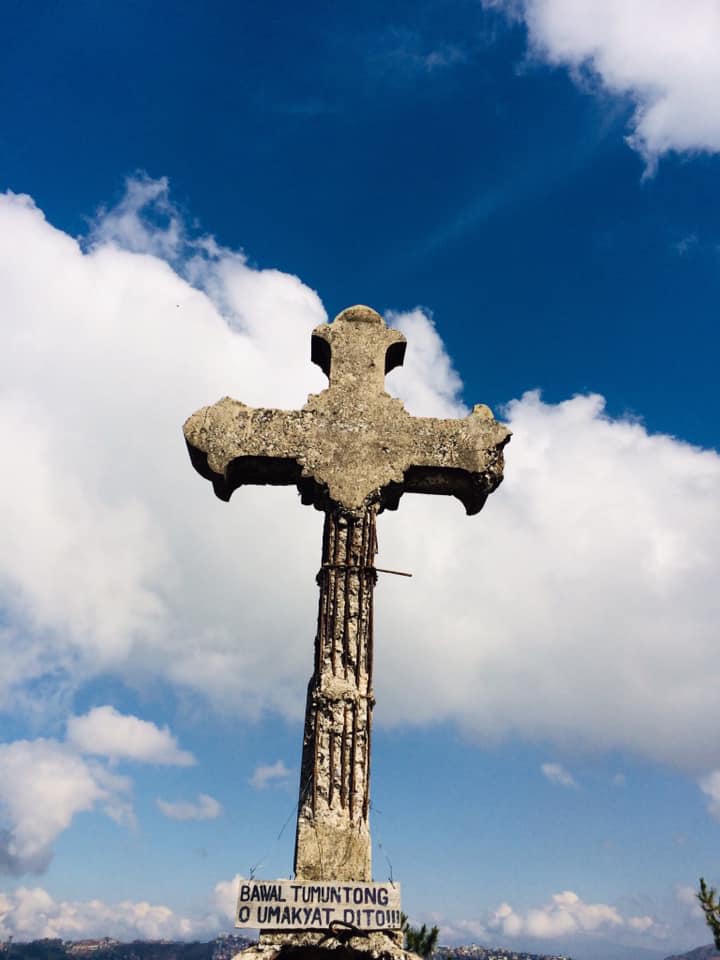
Cross at the Dominican Hill in Baguio City, January 2019.
A very unique characteristic of Jesus as a human is his being a radical in its truest essence and meaning. From the Latin word “radix” that means roots, Jesus brought us back to our very roots, to our grounding of being who is God himself.
Too often, we think of radical people as rebels and revolutionaries leading movements and many changes in the society. They are the “game changers” because they radically change things to show us the more essential.
But in reality, radicals do not change things: they restore things to its original state and being. They get into the roots or “radix” of things to bring out its true meanings by doing away with the unimportant accidentals that have taken over the realities.
That is why Jesus is a radical: by dying on the Cross, he firmly reestablished his throne as King of the Universe because that is where evil ended and death is conquered.
It is on the Cross his throne where every new life begins because it is our very rootedness and “grounding of being” as beloved children of God in him.
Most of all, it is on the Cross his throne, our root and grounding from which comes our sole focus and attention in life – God in Christ Jesus.
The rulers sneered at Jesus… even the soldiers jeered at him. Now one of the criminals hanging there reviled Jesus, saying, “Are you not the Christ? Save yourself and us.” The other, however, rebuking him, said in reply, “Have you no fear of God, for you are subject to the same condemnation? And indeed, we have been condemned justly, for the sentence we received corresponds to our crimes, but this man has done nothing criminal.” Then he said, “Jesus, remember me when you come into your kingdom.” He replied to him, “Amen, I say to you, today you will be with me in Paradise.”
Luke 23:35, 36, 39-43
We have a beautiful expression in Filipino about a person described as “malalim” or deep. A radical is the truly deep person because he is rooted and grounded in his being who is God!
Anyone who truly recognizes Jesus Christ becomes a radical person too, a person of depth because he is rooted in God like the other thief hanging on the cross with Jesus.
See how the rulers or the elite like the priests and elders of Israel who sneered at Jesus: the more they poked fun on him as “the Christ of God”, the more they indict themselves of the grave crime of putting Jesus to death. Eventually at the death of Jesus, the Temple curtain would be torn from top to bottom to signal the end of temple worship and the start of worshipping God in “truth and spirit” in Christ.
The soldiers jeered Jesus too because they “know not what they were doing” because they were all pagans. But again, upon Christ’s death, we find one soldier there at the scene declaring “truly this is the Son of God.”
In any case, some members of Israel’s rulers and Roman soldiers eventually followed Jesus after the Resurrection to show us how the Cross is indeed the throne of Christ the King: it is also a door that opens anyone to conversion, to accept his reign and kingdom!
Most of all, the “good thief”, usually referred to as Dimas, shows us how at the cross any one can become radical like the Lord. While agonizing with Jesus on the cross, Dimas must have examined his life and got into his very core, his roots and realized that basic truth inside him was right there suffering also with him — Jesus whose name means “Yahweh saves”.
What is so surprising with his request from Jesus “to remember him he gets into his kingdom” is the fact that in the Old Testament, it is God who always remembers his people, remembers his promise, remembers his covenant.
Man always forgets God and his covenant that we always turn away from him to live in sin. But at the cross, the throne of Jesus our King, he enables us to remember our roots, our being children of God, our being loved and forgiven that we finally find our way back home.
And that home is God in eternity: “Today you shall be with me in Paradise.”
Every time we are at the cross, when we are getting through so many pains and sufferings, failures and disappointments, even darkness and sin, get into your roots – Jesus Christ – and you will never get lost.
Long before we got into all these crosses in life, remember Jesus was there first for us to suffer and die on his Cross. And that is why he is our King for he rose again so we can become like him in eternity. Amen.
Saturday, Feast of the Exaltation of the Cross, 14 September 2019
Numbers 21:4-9 ><)))*> Philippians 2:6-11 ><)))*> John 3:13-17
The Brazen Serpent Monument on Mt. Nebo inside the Franciscan Monastery in Jordan, May 2019.
“We adore you, O Christ, and we praise you. Because by your holy cross you have redeemed the world.”
As we celebrate today the Feast of the Exaltation of the Cross, we widen our gaze on your holy cross, Lord Jesus, that remains standing to remind us of your love and mercy, of your abiding presence and light amidst the many darkness enveloping us today.
When we look around us, when we read the newspapers, watch the TV and listen to the radio, we cannot help but cry, even complain deep within like the Israelites in the wilderness why all the miseries still happening around us with all the killings and injustices going on.
Sometimes, Lord, the powers of evil and sin seem to prevail over the world cast in widespread darkness with all the chaos and confusions going on.
But here lies the beauty of your Cross, Jesus Christ: it does not deny the sufferings and pains caused by our sins that led to your death that still continue to this day and cause our grave sufferings; however, despite this gravity of our sins, your Cross reminds us too of your unending love and mercy.
More powerful than evil and darkness are your love and light, O sweet Jesus made manifest on your Cross.
Grant us that gaze of faith, the look of faith needed by so many of us travelling in this wilderness to always see you Lord who was sent by the Father because he so loved the world that whoever believes in you might not perish but gain eternal life. Amen.
Feast of the Transfiguration of the Lord, 06 August 2019
Daniel 7:9-10, 13-14 >< }}}*> 2 Peter 1:16-19 >< }}}*> Luke 9:28-36
Photo by Atty. Grace Polaris Rivas-Beron, top of Mt. Sinai, May 2019.
Lord Jesus Christ, two Sundays ago you have taught us how to pray, welcoming us into your inner self on having the right attitude in prayer, of being formed like you, obedient unto death to the will of the Father in heaven.
Today as we celebrate your feast of Transfiguration, once again through St. Luke, you welcome us into your prayer moment to be transformed like you on Mount Tabor.
Jesus took Peter, John, and James and went up the mountain to pray. While he was praying, his face changed in appearance and his clothing became dazzling white. And behold, two men were conversing with him, Moses and Elijah, who appeared in glory and spoke of his exodus that he was going to accomplish in Jerusalem.
Luke 9:28-31
Thank you for bringing us along like your three privileged apostles up on the mountain to pray. Thank you in enabling us to pray with you, in you, and like you. Indeed, every prayer is a moment of transfiguration and transformation.
Most of all, every prayer period is also an exodus, our passing over from darkness to light, from sinfulness to grace, from slavery to freedom.
On the evening of your Resurrection as St. Luke recorded, you walked with two disciples going home to Emmaus, explaining to them how the “Law and the Prophets” spoke about your own pasch or passover and exodus on the Cross.
There on top of the mountain during your transfiguration while you were praying, Moses and Elijah, representing the Law and the Prophets, came to discuss with you your own exodus of Passion, Death, and Resurrection.
When we are so hard pressed with our life, with our pains and hurts, when nobody seem to care, when everybody seem to forget us, join us in our mountain of prayerful transfiguration.
When we feel giving up, when things are breaking apart in our life whether at home or office or school, when we feel hopeless even in the Church, in our Parish and among our parishioners, when we see you dear Jesus “dead” on the Cross, let us hold on to that revelation on Mt. Tabor that you are “the chosen Son” of the Father so we may listen to you always to deny our selves, take up our crosses and follow you.
May we stop seeking some “cleverly devised myths” (1Pt.1:16) towards Transfiguration for there is no other way but through your Cross that makes us your indwelling and presence. Let your face shine on us today to bring more light and hope in this world darkened by sin. Amen.
Happy 13th Anniversary to our Parish of St. John Evangelist, 06 August 2019.
The Lord Is My Chef Sunday Recipe, Palm Sunday of the Lord’s Passion, Year C, 14 April 2019
Isaiah 50:4-7///Philippians 2:6-11///Luke 22:1-49
Photo from Bing.com.
Today we begin the Holy Week with two celebrations merged into one, Palm Sunday of the Lord’s Passion. The Palm Sunday is a tradition started by the early Christians in Jerusalem in the fourth century while in Rome during the 12th century, the Pope proclaimed the long gospel account of the Lord’s Passion on this Sunday to signal the start of Holy Week. Almost 2000 years later in reforming the liturgy, Vatican II merged these two traditions into one to usher in our holiest days of the year.
Like in the four Sundays of Lent except last week, St. Luke guides us today in reflecting the Lord’s Passion with emphasis on the Cross with its call to conversion. For St. Luke, the cross is the object of discipleship in Christ. Join me in reflecting on the last three words our evangelist had recorded when Jesus was crucified.
First word:
When they came to the place called the Skull, they crucified him and the criminals there, one on his right, the other to his left. Then Jesus said, “Father, forgive them, they know not what they do.”
Luke 23:33-34
Mosaic of the Crucifixion at the crypt of the Manila Cathedral. Photo by Arch. Philip Santiago, October of the Jubilee of Mercy 2016.
This is very striking. Immediately upon his crucifixion, Jesus prayed for the forgiveness of his enemies! It is a total adherence to his preaching during his sermon on the plain, “love your enemies, do good to those who hate you, bless those who curse you, pray for those who mistreat you” (Lk. 6:27-28, Seventh Week Ordinary Time, 24 February 2019). Here we find the immense love and mercy of Jesus — no hatred, no calls for revenge or threats like “karma” against those who crucified him. He simply begged for their forgiveness because “they know not what they do.”
In Jewish thought, to know means more than an intellectual knowledge for it implies relationship. Knowing somebody for them is more than knowing one’s name but having ties with the person. And to know something is always to see things in this perspective, always in relation with a person. Had they known Jesus is the Christ, they would have not crucified him! Exactly the preaching of St. Peter at the healing of a lame man after Pentecost at the temple when he told them they have “acted in ignorance” in “killing the Author of life whom God raised from the dead” (Acts 3:15). St. Luke also notes in his Acts of the Apostles how the crowd upon hearing St. Peter’s preaching were moved or “cut to the heart” (2:37) that many were baptized on that day. Recall also how at the arrival of the wise men from the East searching for the child Jesus: the scholars of Jerusalem “knew” from the books how the Christ would be born in Behtlehem yet he was found by the pagan magis! Even the most learned man in the New Testament, St. Paul admits how ignorant he had been in persecuting and blaspheming Jesus before (1Tim.1:13) experiencing God’s loving mercy.
In the bible we always see this combination of knowing and ignorance at the same time to indicate that more than factual and cerebral knowledge, there is that deeper knowing of relating and of loving. If we really know somebody, the more we love, the lesser we sin. St. Thomas Aquinas used to say that the more we know and become intelligent, the more we realize the truth, the more we must become good and holy. That is why saints are the most intelligent people that they were able to do what is good and what is right.
In this age of Google and Wikipedia , Jesus is challenging us that if we truly know so much that we have become smart and more intelligent, then, how much do we really love and care for others?
Photo from Google.
Second word:
Then he said, “Jesus, remember me when you come into your kingdom.” He replied to him, “Amen, I say to you, today you shall be with me in Paradise.”
Luke 23:42-43
The Venerable Archbishop Fulton Sheen used to claim that Dimas was indeed a great thief who was able to steal or snatch Paradise from Jesus just before dying on the Cross. It may be funny but very true. But more than “stealing” his salvation from the Lord, Dimas had displayed on the cross what we have discussed earlier about the combination of knowing and ignorance. I would say Dimas is perhaps the “most learned thief” of all time who truly knew what is most essential in life which is to know Jesus. The moment he called out to him “Jesus”, Dimas expressed his knowing Jesus, of belonging to Jesus. As we have reflected earlier, to know is to relate. Anyone who truly relates must first believe in order to love dearly. Dimas believed in Jesus that he called out to him while hanging on the Cross.
Today, Jesus is reminding us that the door to Paradise is him alone. And we begin to enter Paradise the moment we entrust our total self to Jesus like Dimas who came to know Christ at the Cross, and then believed him and loved him. If we really know, do we believe?
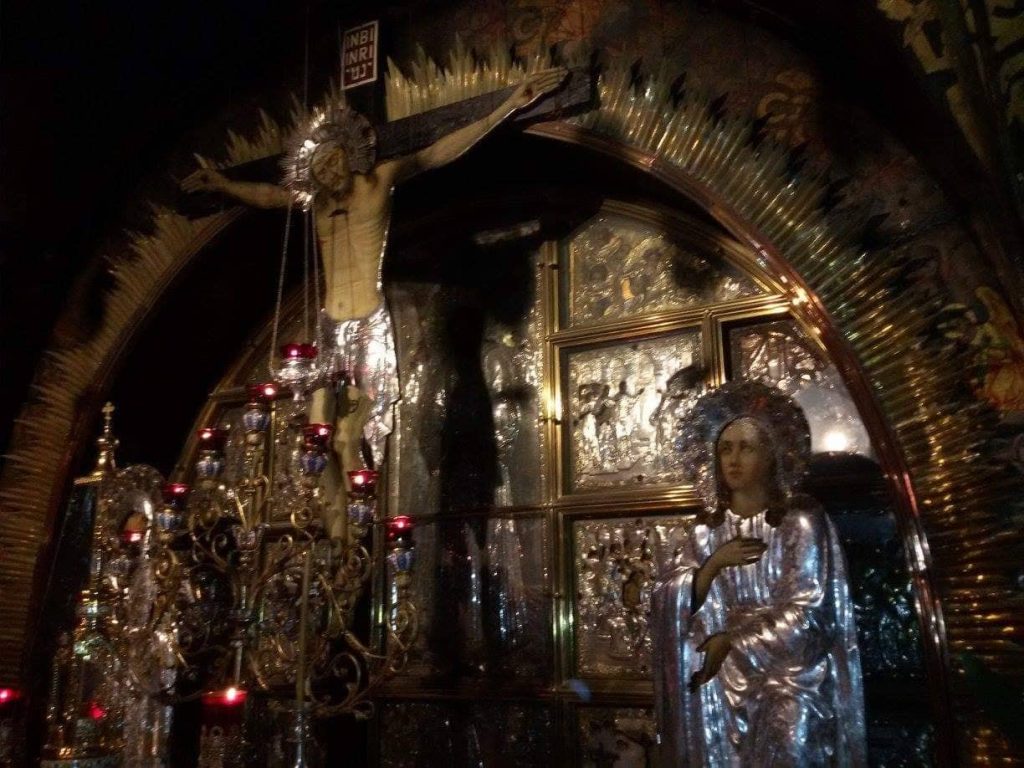
Altar of the Church of the Holy Sepulchre over the exact site where Jesus was crucified outside Jerusalem. Photo by Arch. Philip Santiago, October 2017.
Third word:
Jesus cried out in a loud voice, “Father, into your hands I commend my spirit,” and when he had said this he breathed his last.
Luke 23:46
One of St. Luke’s unique feature is always presenting to us Jesus at prayer. Especially here at his crucifixion. See how his first words were prayer of forgiveness for his persecutors. Now at his death, St. Luke presents Jesus again at prayer, reciting Psalm 31:5, “Father, into your hands I commend my spirit.”
Here we find the whole picture of Jesus Christ’s life which is a prayer and his prayer is his very life. From the very start, Jesus has always been one with the Father which is the essence of every prayer called communion. And that is the important aspect of his being our Savior: everything he said and did was everything the Father had told and asked him. There is that perfect communion of the Father and the Son in the Holy Spirit so that in his death, Jesus offered his total self with us to God. Everyone and everything is thus sanctified anew in Christ. This became possible only with his kenosis, his self-emptying eloquently expressed to the Philippians by St. Paul in our second reading.
On the Cross, everything in the life of Jesus Christ came to a full circle, God’s whole picture emerged. Now more than ever, we have become closest to God in love. In his dying on the Cross, Jesus made known to us God, brought him closest to us so we can relate and be intimate with him more than ever. In his becoming human like us by bearing all the pains and sufferings expressed in the first reading from Isaiah, God proved to us his love in Jesus. Most of all, he enabled us too to be capable of knowing and loving like Jesus Christ by being intimate with him always. This is why these days are called Holy Week when we are filled with God so we experience him anew and have him more than ever in our hearts, in our very selves. Amen.
The Cross of Christ atop the church of our Lady of Lourdes in France. Photo by my former student Philip Santiago during his pilgrimage, September 2018.
We had a rare weekend yesterday in the Feast of the Presentation of the Lord that wonderfully complemented our gospel on this Fourth Sunday in Ordinary Time. Recall that last Sunday we were told how Jesus went home to Nazareth, entering the synagogue on a day of rest. Everybody was amazed with His “gracious words” in proclaiming the word of God that we ended the gospel with a very positive note when Jesus declared “Today this Scripture passage is fulfilled in your hearing” (Lk.4:22). Our gospel today repeated this line as its take off point to continue the story of Jesus at the synagogue but, this time Luke tells us of a twist from the very positive “all spoke highly of him” to their skeptical “Isn’t this the son of Joseph?” (Lk.4:22). The mood deteriorated further after Jesus had spoken so that “the people at the synagogue were filled with fury. They rose up, drove him out of the town, and led him to the brow of the hill on which their town had been built, to hurl him down headlong” (Lk.4:28-29)!
What and how did this sudden turn of events happen? Here we find the complementing Feast of the Presentation yesterday based on the infancy narratives of Christmas by St. Luke when Simeon told Mary the mother of Jesus, “Behold, this child is destined for the fall and rise of many in Israel, and to be a sign that will be contradicted – and you yourself a sword will pierce you – so that the thoughts of many hearts may be revealed” (Lk.2:34-35). See how Jesus at the inauguration of His ministry at their Nazareth synagogue last week proclaiming the word of God would now start to be seen as a sign of contradiction among His people as prophesied by Simeon to His mother yesterday. That would reach its highest point 33 years later in Jerusalem where He was presented to the Temple 40 days after Epiphany after resolutely going there to offer or present Himself to the Father on the Cross. This explains why Jesus merely “passed through the midst of them and went away” when the people at the synagogue tried to hurl Him down headlong because His time of final offering had not yet come. But very clearly here at the synagogue of Nazareth, Christ is indeed the sign of contradiction not only to His people but also to us in this generation when we would also speak highly of Jesus, shouting Amen with clapping of hands and suddenly hit people near us with harsh and nasty words or even brutal force. Most of all, like the Lord, we too have experienced being a sign of contradiction when people would speak highly of us then suddenly or over time, turn against us and speak ill of us, betraying us like what Judas did to Jesus on Holy Thursday.
My dear friends in Christ, it is our calling and our life too in living out the word of God through our life of witnessing His immense love in service and mercy for those in the margins. Every time we gather for the Sunday Mass like when Jesus entered the synagogue of Nazareth on a day of rest, He invites us to follow Him to be a prophet by entering Him more than merely the church building. Being a sign of contradiction like Jesus is our prophetic mission in Him. So unlike what most people think, a prophet is not a fortune teller or a seer of the future. As the spokesperson of God, a prophet is one who makes God’s word happen or fulfilled in every here and now. Keep in mind that one feature of Luke’s gospel is the pre-eminence of “listening and doing” the word of God like when he reported how Jesus declared Isaiah’s prophecy fulfilled in their hearing that led into the sharp and sudden shifting in the reaction of people against the Lord, from approval to rejection.
First of all, those reactions were most evidently from His claiming to be the Messiah referred to in Isaiah’s prophecy on whom the “Spirit of the Lord rests upon.” He was the one who proclaimed the word and if we have truly immersed ourselves into this beautiful scene in the synagogue on that Sabbath day, we would really feel Jesus is in fact the one Isaiah is speaking of as being “anointed to bring glad tidings to the poor, liberty to captives, sight to the blind, freedom to those oppressed, and to usher in a year acceptable to the Lord” (Lk.4: 18-19). Salvation decisively begins in Christ and through Christ whenever we enter Him in His words. That “today” in Nazareth synagogue is also the today of our own time that continues to provoke astonishment among others when we try to be Christ’s witnesses of authentic love for others. That is perhaps the sad reality of these days when it becomes big news when people do something genuinely good and beautiful like the woman who impulsively rented 20 hotel rooms in Chicago so the homeless could escape the deep freeze this week in the US Midwest; her deed snowballed into other strangers doing the same! That is essentially the meaning of Paul’s lofty words on love being the greatest of all gifts because it makes God most present in our midst. To truly love like Christ is essentially being a sign of contradiction in this world where the norm is selfishness and self-centeredness often masked in different in lofty terms and ideals bereft of any love at all.
Along this line of self-centeredness we find Luke reminding us in this scene at the Nazareth synagogue of the persisting problem self-entitlement among people then and now when we prophetically live out our mission of making Christ present. People always look down and frown upon those who try to be good and holy by striving to do what is right and just while the holier-than-thou sanctimoniously feel they are the only ones anointed to do such things because they are entitled. They are the modern Gnostics according to Pope Francis in his latest encyclical about holiness in our modern time (Gaudete et Exsulatate)” who feel as the only ones gifted in knowing what is right or wrong, true and good as if they are God. Like those people at the synagogue in Nazareth, they refused to accept Jesus of being more knowledgeable because He is the son of Joseph who was a carpenter. Jesus would strike at the very core of their self- entitlement when He told them “Amen, I say to you, no prophet is accepted in his native place” (Lk.4:24), citing how Elijah and Elisha of the Old Testament days were both sent by God to help pagan peoples and not the Jews who have turned away from Him exactly like them. That filled them with fury against Jesus, wanting to hurl Him down the hill headlong. It is the same feeling those people around us experience like our relatives and friends who could not accept we are better than them that they start spreading all kinds of lies and nasty talks against us as they see their self-entitlement slowly eroding. Such is our life as a prophet like Jeremiah, always going against the flow of the people, choosing Christ to be a sign of contradiction and give way to the fulfilment of God’s word among us. Amen.Fr. Nicanor F. Lalog II, Parokya ng San Juan Apostol at Ebanghelista, Gov. F. Halili Ave., Bagbaguin, Sta. Maria, Bulacan.
Our loving Father, today we celebrate the unique Feast of the Exaltation of the Cross.
It is so unique because when we come to think of it, how could two pieces of wood that are very ordinary things in life became the means to express to us your immense love through Jesus Christ’s sacrifice on the cross? It is so unique for how can two pieces of wood used to punish people now remind us of how you “so loved the world that you gave your only Son, so that he who believes in him might not perish but might have eternal life (Jn.3:16)”?
In the cross is hidden the power of your love to transform us to better persons. In the cross is hidden the power to lead us closer to you with its vertical beam and to others with its horizontal beam. In the cross is the power of good if we choose to embrace it and be subjected to you in Christ Jesus as our Lord and Master.
What is most unique with the Cross, O God, is that underneath its ordinariness, that is where we see your glory and your majesty. Underneath the Cross of darkness and gloom, that is where we see glimpses of light and hope. And underneath the Cross of sufferings and death, we get to feel assured of the resurrection.
Give us the grace, O God, to always embrace the Cross like your Son Jesus Christ where we can all be empty of ourselves to be filled with your Spirit to make your love visible in us. Amen.Fr. Nicanor F. Lalog II, Parokya ng San Juan Apostol at Ebanghelista, Gov. F. Halili Ave., Bagbaguin, Sta. Maria, Bulacan 3022.
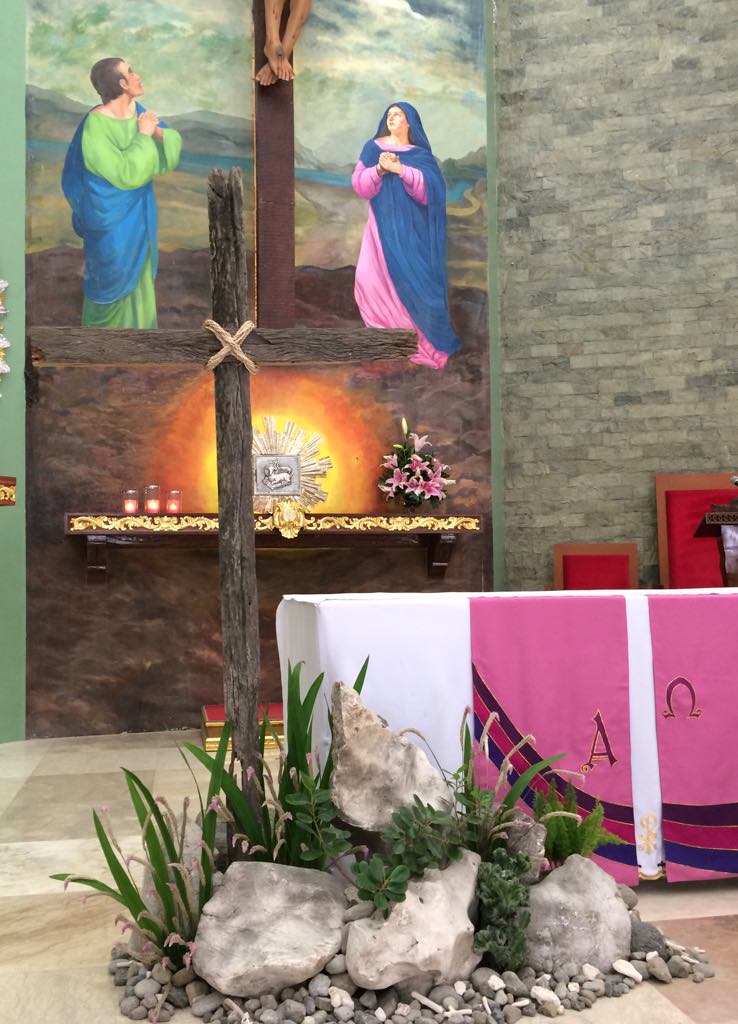
Photo by the author, Fourth Sunday of Lent in our Parish, 11 March 2018.









 lordmychef.com