Sight and Vision

The Lord Is My Chef Recipe for the Soul by Fr. Nicanor F. Lalog II
27 December 2020, Feast of St. John the Apostle and Evangelist, Patron of our Parish
1 John 1:1-14 >><)))*> John 20:2-8
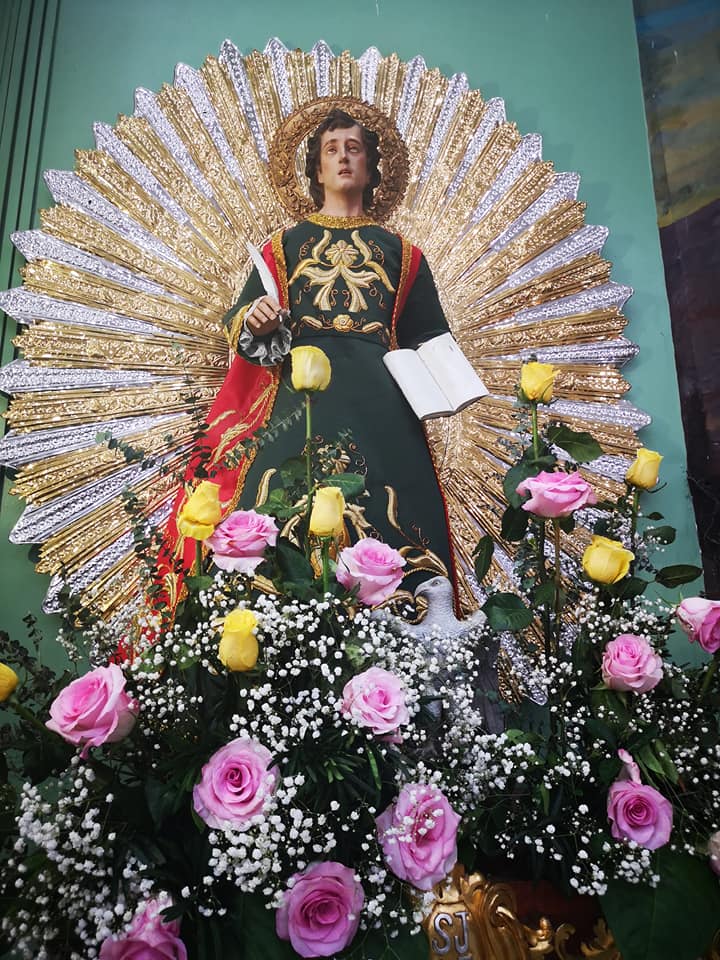
Our Parish Patron, the beloved disciple of the Lord, St. John the Apostle and Evangelist (Photo by Ms. Jo Villafuerte, Sept. 2018).

Today we celebrate in our Parish the feast of our Patron Saint, John the Apostle and Evangelist also known as “the beloved disciple of the Lord”. Although it is a Sunday in the Christmas octave when the Feast of the Holy Family is celebrated by the universal Church, parishes and dioceses with the beloved disciple as patron as exempted. Perhaps, it is St. John’s gift to me before I move to my new assignment in February next year that I celebrate his feast for the last time this Sunday.

I tell my parishioners to love St. John; that is their first task as parishioners, to love and support their Patron Saint. Moreover, I have always stressed to them how St. John the Apostle is so special, and not an ordinary saint or Apostle. Next to his being the beloved disciple of Jesus, he is the only Apostle to have not died a martyr but grew old to witness the growth of the Church; he was the one who took care of the Blessed Virgin Mary as per instruction by the Lord Himself before He died on the Cross on Good Friday; and though there are only a few parishes dedicated to him, mostly are Cathedrals like the one at Dagupan-Lingayen in Pangasinan, at Naga City in Camarines Sur, and of course, the Cathedral of Rome, the St. John Lateran, the Mother of all churches in the world.

He is often symbolized by the eagle for his sharp and incisive way of looking at things and events in the life of teachings of Jesus that he is the only one able to tell us about the wedding feast at Cana, the man born blind, the raising of Lazarus as well as the more detailed account of the teachings after the feeding of five thousand people.

The great American writer Helen Keller, a blind woman, said it so well, “The only thing worse than being blind is having sight but no vision.”

I wish to reflect on that vision of St. John, on what had he seen in our Lord Jesus that hopefully we may always try to look into in our own lives.
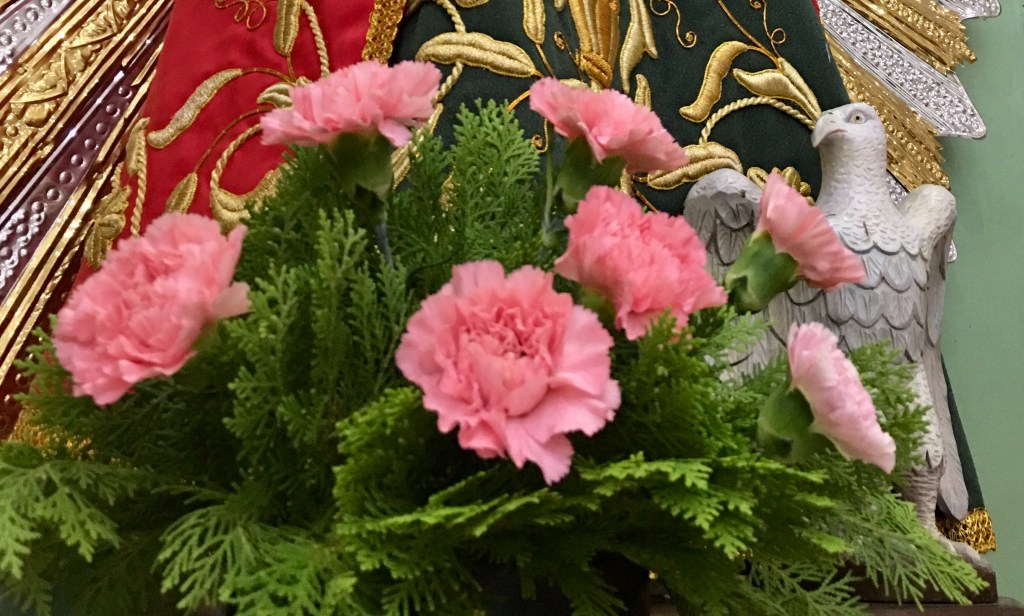
Photo by author, Gaudete Sunday 2020.

Seeing Jesus, a real man among us

I used to say in my wedding homilies that women should always look for men who not only has sights but also vision. We all have sights but not everyone has a vision, the ability to see and look beyond what is on the surface, on what can only be seen but also perceived further.

St. John the Evangelist had a great vision of who Jesus Christ is. No wonder towards the end of his life while a prisoner at the island of Patmos off Greece, the Lord offered him a vision of heaven which he had recorded to us in the most difficult book of the Bible, the Revelation; his other four writings, the Gospel and three letters are also difficult to understand due to the different layers of meaning that only the beloved disciple was able to perceive.

Such is the kind of the vision of St. John said to be like the eagle, believed to be the only creature that can stare directly into light without getting blinded — very sharp and keen, as we say in Filipino, “matang-lawin” or eagle sight.

Being the only Apostle of the Lord to have grown old and spared from dying a martyr like the rest, St. John witnessed the first errors or heresies of early Christians concerning the humanity of Jesus Christ. They could not accept the Son of God took on a genuinely human body so that in a mistaken zeal for spirituality, they condemned everything material as evil, claiming the humanity of Jesus was just an appearance. As a result, these heretics like the gnostics taught that to be fully united with God meant to withdraw as much as possible from everything material.

St. John wrote his letters primarily to address this wrongful and erroneous views (which would persist for 400 years, still echoing in our present time), insisting that Jesus Christ is true God, and true man. We have heard him declare that on Christmas day when his prologue was proclaimed when he claimed “the Word became flesh and dwelled among us” – that Jesus Christ fully entered into our humanity and material condition by blessing and making it holy!

Today St. John insists on this contact with the real, bodily Jesus, repeating the words “seen” and “visible” about five times in four verses, emphasizing contact with a real, bodily Christ.

What was from the beginning, what we have heard, what we have seen with our eyes, what we looked upon and touched with our hands concerns the Word of life — for the life was made visible…

1 John 1:1-2

Here we find what St. John tells us also after the Resurrection in his gospel account how Jesus invited the doubting Thomas to touch and feel him, “Put your finger here and see my hands, and bring your your hand and put it into my side, and do be unbelieving, but believe” (Jn.20:27).

It is this physical, truly human, touchable Jesus that the Church proclaims every Christmas. Yet, how tragic that through the ages, we in the Church had always had that tendency to withdraw from the material that perhaps had led to so many problems with the human body and sexuality so that we have all these sex scams happening even long before.

Part of the mystery of the Incarnation is for us to be at home with our humanity like Jesus our Lord because everything God had made is good. Mention SEX, even in seminaries or Catholic schools, you hear for sure that rising crescendo of whispers and impish laughters.

Everything that God made is good. That is why Jesus became human to show us it is good to be a human being, it is the path back to God, into heaven. If we cannot accept Jesus as truly human, how can we truly love God whom we do not see? Hence, we find this beautiful flow of reason and reflection of St. John in his first letter:

No one has ever seen God. Yet if we love one another, God remains in us and his love is brought o perfection in us. God is love, and whoever remains in love remains in God and God in him. We love because he first loved us. If anyone says, “I love God,” but hates his brother, he is a liar; for whoever does not love a brother whom he has seen cannot love God whom he has not seen.

1 John 4:12, 16, 19-20
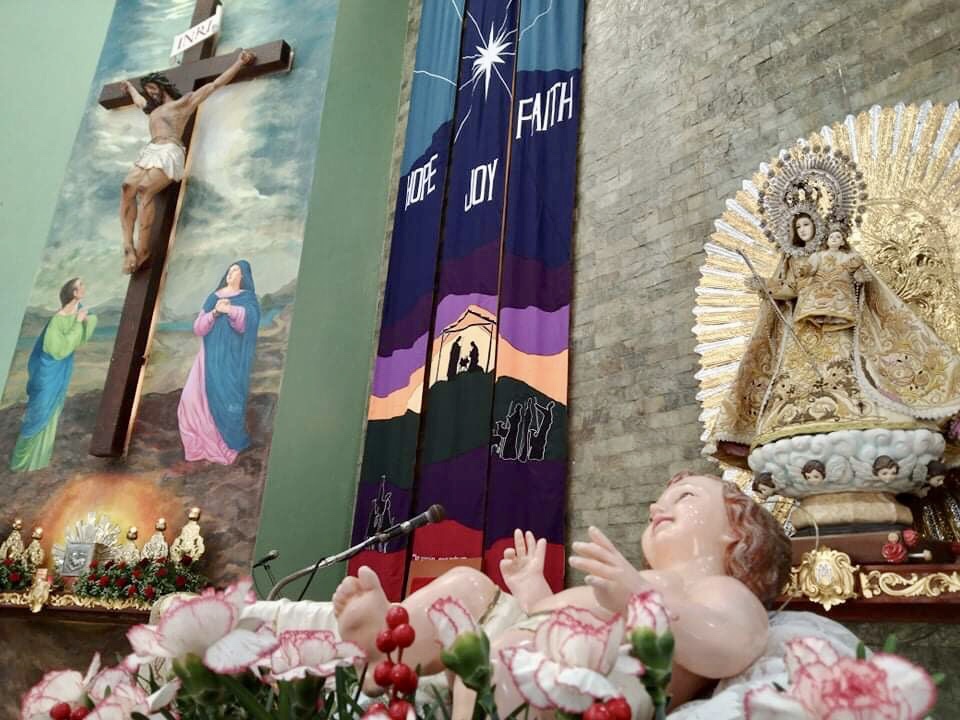
Photo by Mr. Marc Angelo Nicolas Carpio, Christmas 2020.

In short, to love God and to love others, we must first love our very selves, accept our “human-ness” like Jesus, a real man in everything except sin. The more we accept each other, the more we “see” God among us as a community, as a Church, the Body of Christ.

The Church, the Body of Christ

This vision of the Church as the body of Christ by St. John came from the empty tomb of Jesus at Easter, when the Lord was paradoxically not in sight!

When Simon Peter arrived after him, he went into the tomb and saw the burial cloths there, and the cloth that had covered his head, not with the burial cloths but rolled up in a separate place. Then the other disciple also went in, the one who had arrived at the tomb first, and he saw and believed.

John 20:6-8

What did our Patron Saint “see” that he believed, not like Simon Peter who was the leader of the Apostles?

Photo by author, August 2020.

This is the best example of St. John’s vision, of seeing beyond the physical, of seeing the significance of the folded cloth that covered the Lord’s face that has its basis in the story of Moses who had to put on a veil whenever he would converse with God face to face (cf. Exodus 34) due to the immense brightness of God, of His overwhelming presence. This the Israelites have seen every time after Moses had spoken with God, his face shone so brightly.

With the cloth that covered the head of Jesus folded and separated from the burial cloths, it meant that Jesus had met the Father, the veil to cover His face was no longer needed.

At that instance, everything became clearer for St. John – from the cleansing of the temple to His conversations with that Samaritan woman at Jacob’s well – convincing him that Jesus had risen to new life, to new level of existence. Years later, we find Jesus appearing to Saul on his way to Damascus, asking him, “Saul, Saul, why are you persecuting me?(Acts 9:1-5)” to indicate that whatsoever you do anyone, you do unto Jesus (Matt. 25:40).

In His glorified body, we are now able to look at God also in the new body of Jesus, the Church. It is in this aspect that we have to learn so much from the beloved disciple, St. John. Our lack of any sense of community like the collective effort in stopping the spread of COVID-19 shows of the great need for us to have wider and sharper vision of Jesus among us especially in the Church. May we strive to love more Jesus to find Him in our humanity. Amen.

Photo by author, Malolos Cathedral, September 2020.

Advent is being consistent

The Lord Is My Chef Sunday Recipe for the Soul by Fr. Nicanor F. Lalog II
Fourth Sunday of Advent, Year B, 20 December 2020
2 Samuel 7:1-5, 8-12, 14, 16  >><)))*>  Romans 16:25-27  >><)))*>  Luke 1:26-38
Photo by author, Christmas 2019.

We are now on the final week of our four Sundays of preparations for Christmas. We have been saying Christmas 2020 is surely the most different and difficult in our lives due to the pandemic. However, it may also be the most meaningful when we have more of spiritual values, less of material things; more of the other persons, less of ourselves; and, more of Jesus, less of the Christmas trimmings.

Today we heard the beautiful story of the annunciation of the birth of Jesus Christ found only in the gospel of Luke, the source of many inspirations in arts for many centuries even today. The scene reveals to us the artistry and spirituality of Luke believed to be a medical doctor who was a disciple of St. Paul. He is the only evangelist who admitted he had “investigated everything accurately anew, to write it down in an orderly sequence (the events about Jesus Christ) so that you may realize the certainty of the teachings you have received” (Lk.1:3-4).

And what is that certainty Luke looked into? That Jesus Christ is the Son of God, the fulfillment of the Old Testament promises to the patriarchs and prophets, who is the very presence of God among us. That is why Luke wrote a second volume to his gospel, the Acts of the Apostles to show us Jesus still present in the Church in the power of the Holy Spirit. In this beautiful canvass painted to us by Luke on Jesus the Christ in his Gospel and Acts we also find in a supporting role the Blessed Virgin Mary, His own Mother and model disciple.

The angel Gabriel was sent from God to a town of Galilee called Nazareth, to a virgin betrothed to a man named Joseph, of the house of David, and the virgin’s name was Mary. And coming to her, he said, “Hail, full of grace! The Lord is with you.” But she was greatly troubled at what was said and pondered what sort of greeting this might be. then the angel said to her, “do not be afraid, Mary, for you have found favor with God. Behold you will conceive in your womb and bear a son, and you shall name him Jesus. He will be great and will be called Son of the Most High, and Lord God will give him the throne of David his father, and he will rule over the house of jacob forever, and of his kingdom there will be no end”

Luke 1:26-33

The discipleship of Mary

As a former journalist, I have always considered the four evangelists as the premiere reporters of Jesus Christ. Mark is the old school type of straight news reporting, writing the basic who, what, where, when and why, making his gospel the first to be written and shortest as he was in a hurry, a true journalist. Matthew is more of a feature writer or interpretative reporter while John was a news analyst, an op-ed columnist.

Luke is the modern journalist using the “digital platform” who goes on “live as it happens” with all the colors and actions without losing depth and focus like the BBC and Al Jazeera. He brings us where the news is happening as you must have noticed yesterday in the story of the annunciation of the birth of John the Baptist to Zechariah which also served as introduction to his lead story of Christmas, the annunciation of the birth of Jesus Christ.

Here we see the unique position of Mary as a disciple of Jesus Christ. Unlike Mark and Matthew, Luke tells us how Mary is the only one to have believed in a “situation of contemporaneity” as Fr. Cantalamessa would love to say, meaning, she believed while the event was taking place and prior to any confirmation by the event or history.

See how Matthew presented some facts already known to him in narrating the annunciation to Joseph where the angel clarified Mary’s pregnancy was due to the Holy Spirit. Luke, on the other hand, is like reporting live in real time, so realistic with Mary and the angel conversing to each other!

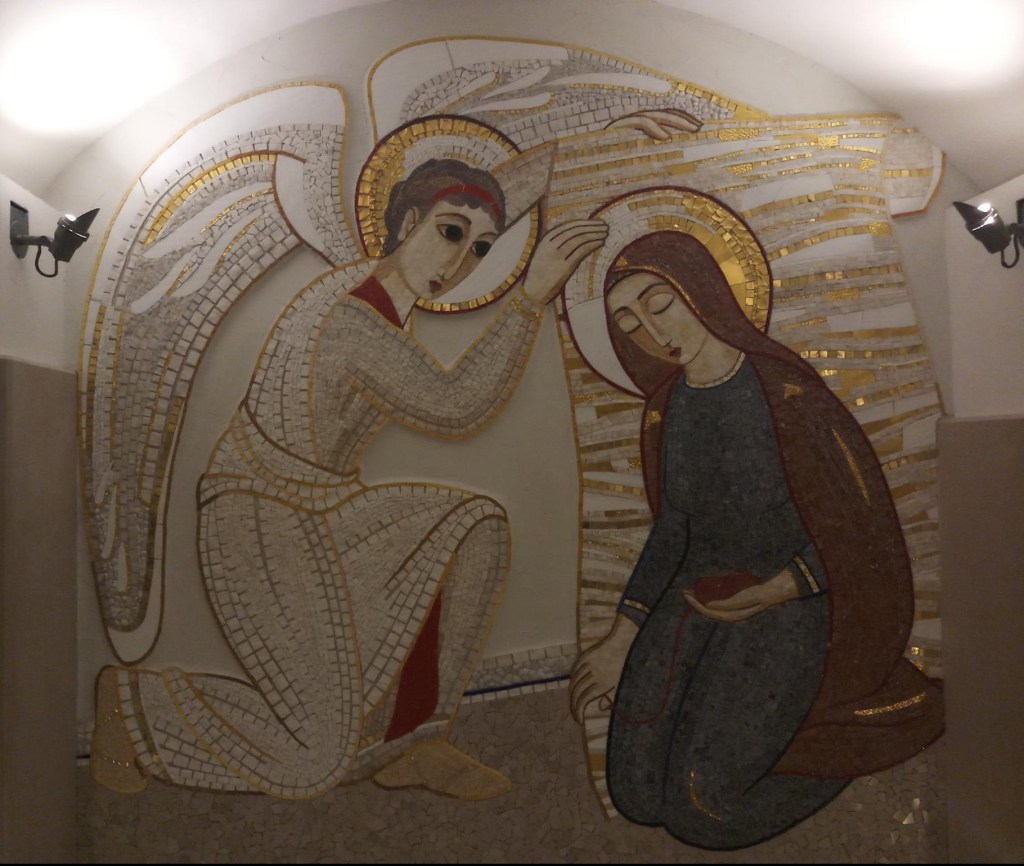
Photo by Arch. Philip Santiago, mosaic of the Annunciation at the San Padre Pio Church in San Giovanni Rotondo, Italy, 2016.

Writing in Greek like the rest of the authors in the New Testament, Luke did not use the usual Hebrew greeting of “Shalom” when Gabriel appeared to Mary, addressing her instead with chaire or “Rejoice favored one” that means especially graced from which came our translation from the Latin “Hail, full of grace!” in 1:28.

The favor or grace of Mary has found with God in 1:30 is explained in 1:31 in the future tense, “you will conceive in your womb and bear a son“. What is amazing here is that there is the sense of certitude on the part of the angel that the future will definitely take place because Mary has already been highly favored one by God before this event. How?

Though Mary will finally become a disciple at the end by saying “Behold, I am the handmaid of the Lord. May it be done to me according to your word” in 1:38, we find in 1:29 how she had always been disposed to the will and grace of God when Luke described how “she was greatly troubled at what was said and pondered what sort of greeting this might be“.

Mary “pondered – meaning, she prayed, she meditated right away the greetings to her, indicating her openness and disposition to listen and follow the will of God. That shows how even before the annunciation happened, Mary had always been obedient to God that is why she could say yes to Him when asked to be the Mother of the Savior.

Here we find Mary’s consistency as a disciple of the Lord, her Son Jesus still to be born but already existing in eternity!

When we were growing up, our mother would always tell us that once our names are called either by her or by our father, we only say one thing, “Opo… ano po iyon?” (Yes, what is it?). That is old school discipline where we literally obeyed first even without any instruction yet because we have always been assured parents would never tell kids to do something bad or wrong. And we believed that. Unlike today’s generations where the usual reply to parents’ call is “wait” that no wonder, we now ask God wait before he can speak to us. Thank God I did not get married….

Going back to Mary, we now find the contrast with yesterday’s annunciation to Zechariah: Mary pondered and felt everything in her heart and soul while Zechariah reasoned out, used more his head than his heart – something we must ponder this Christmas. Mary right away had her heart, her very self onto the Christmas Nativity while Zechariah was stuck in his negativity.

Mary believed while the event, the annunciation, was taking place, prior to any confir­mation by the event itself or by history. Later we shall see that expression “pondering in her heart” repeated often by Luke and also by John in presenting Mary: after listening to the words of the shepherds who came to see baby Jesus at His birth in Bethlehem, at finding Jesus at the temple aged 12, and during the wedding feast at Cana where He did His first miracle.

Photo by author of the site where the annunciation to Mary took place found below the Basilica of the Annunciation in Nazareth (2019).

The faith of Mary

From the annunciation of the birth of Jesus to His crucifixion, Easter and Pentecost, Mary always believed. During the Visitation, Elizabeth praised her, becoming the first to call Mary as “blessed” because “you believed what was spoken to you by the Lord would be fulfilled” (Lk.1:45).

Eight days after Easter, Jesus said to Thomas, “Have you believed because you have seen me? Blessed are those who have not seen and yet believe! ” (Jn 20:29). Early at the annunciation, Mary was the first to have believed without having seen Jesus Christ!

Mary teaches us the importance of subjective faith or the act of simply believing and trusting God, a person-to-person relationship with Him.

But it is not enough because it could lead to isolationism when we become individualistic and begin to have our own concept of God like what is happening these days especially with many Catholics with their own interpretations of God, heaven, evil and sin among other things.

Like Mary, we need to cultivate also objective faith, believe in the content of faith of the community. Mary believed God relating with the ancient prophets and patriarchs of Israel which the angel mentioned to her during the annunciation. See that after the annunciation, Mary hastily went to visit Elizabeth to share her good news and her faith. In her we learn that faith leads to a mission that is seen in the context of a community, the Church where Mary was portrayed to us praying with the disciples of Jesus during the Pentecost at the Upper Room in Jerusalem.

So here we find the consistency of Mary even before the annunciation that continued on in the life of the Church we still experience today in her many apparitions and messages always centered on Jesus not herself.

That is the call of Advent to us all: to be consistently clear with our faith with the one to be born at Christmas, Jesus Christ who is the Son of the Father, our Savior promised in Old Testament, now the very presence of God among us.

People kneeling on the streets during our Christ the King celebrations, 22 November 2020.

It is not enough that we just pray and believe; like Mary, we need to get out of ourselves and give ourselves to God and the Church. This is especially true with us priests who seem to believe more to himself and to media than with God! We must constantly examine ourselves if we truly believe in what we preach, in the kind of lives we lead. Is Jesus still center of our lives or us that we are so concerned always with our “image”, always seeking “likes” and “followers” than anything else?

If there is anyone who should be the first to be consistent in faith in God in any community, that must be the priest or pastor.

A few weeks ago while striving through the many challenges of my personal life and my ministry since this pandemic began, a parishioner told me how they draw strength and inspiration from me. I asked her why and how? What does my personal life has anything to do with them?

She explained that whenever they see me still going through with my ministry, holding on in my prayers and daily Masses, still smiling and can still laugh and crack jokes — they just feel they too can overcome their trials and difficulties.

I have realized in that short conversation more than preaching and explaining faith and its content, people look more at how faithful are we truly are as men of faith. That aside from dispensing the sacraments and doing all the ministries in my parish, there is also the task so unknown to me before of enkindling the faith of my flock, of guiding and leading them to God based on how do I live that faith in God with joy and patience.

People believe in God and the Church when they experience their pastor believing first in God and the Church. Like the COVID-19 virus, faith is contagious that spreads by coming into contact with. We priests must be the first to be “infected” with faith in the parish so that everyone would be “positive” with it, creating a “pandemic” in faith!

That is the consistency of Mary as a disciple — she is a “carrier” of a deep, joyful and active faith in Jesus, “infecting” everyone so positively that despite the difficult and trying situations we are into, we celebrate Christ’s coming amid the pandemic.

A blessed Sunday as we prepare for Christmas!

Righteous acts of God

The Lord Is My Chef Breakfast Recipe for the Soul by Fr. Nicanor F. Lalog II
Red Wednesday, 25 November 2020
Revelation 15:1-4     >><)))*>  +++  <*(((><<     Luke 21:12-19
Photo by author, Red Wednesday 2020.

Once again, dear Jesus, we pray in the most special way this Red Wednesday for your persecuted Church including those severely affected by the COVID-19 pandemic like the medical frontliners, the survivors and their families, and the poor who have sank deeper into poverty due to the prolonged lockdowns we have had.

We pray that we may find your good news behind every persecution we suffer and go through as a community of your believers and disciples because where there are sufferings, there are hearts and souls willing to comfort, willing to share, willing to sacrifice.

When there are sufferings, there is the color RED that means LOVE because that is when we have your Cross, Jesus Christ, and therefore share in your own destiny of glory!

It is in every shade of red like the blood poured out by Christ and the martyrs after him that the Father’s “righteous acts have been revealed” (Rev.15:4), that is, when we experience more of God’s protection and salvation in the face of grave dangers and even death.

Grant us the grace, Lord Jesus, to persevere in your words and ways so we may secure our lives in you. Amen.

Photo by author, Red Wednesday 2020.

Bayan ng Diyos, Biyaya ng Diyos

Lawiswis ng Salita ni P. Nicanor F. Lalog II, Ika-20 ng Nobyembre 2020
Larawan kuha ng may-akda, 2019.

Labing-tatlong taon na akong pari nang ako ay maging kura paroko sa unang pagkakataon dito sa Parokya ni San Juan Apostol at Ebanghelista sa Bagbaguin, Santa Maria, Bulacan noong 2011. Dapat sana’y anim na taon lamang ang aking panunungkulan nguni’t dahil sa maraming pangayari na ang pinakahuli ay COVID-19, halos abutin na ako ng sampung taon dito hanggang sa paglilipatan sa 2021.

Wala akong pinagsisihan at pinanghihinayangan sapagkat tunay napagyaman ang aking pagkatao at pagkapari sa parokyang ito sa loob ng siyam na taon. At maipagmamalaki ko na maganda at mabuti ang parokyang ito sapagka’t kumbinsido ako na bawat parokya bilang bayan ng Diyos ay biyaya ng Diyos.


Unang aral sa parokya:
pangalawa sa Diyos ay mahalin
at pagmalasakitan ng mga tao kanilang parokya.

Wala akong mga karanasan at kaalaman sa buhay parokya bilang pari nang dumating dito nguni’t unti-unti sa pananalangin at pagninilay, aking natutuhan ang maraming bagay. Una na rito ang tungkulin ng mga tao pangalawa sa pag-ibig at katapatan sa Diyos ay ang pagmamahal at malasakit sa kanilang parokya na kinabibilangan.

Ang mga pari ay dumarating at umaalis, palipat-lipat ng mga parokya nguni’t ang mga tao ang naiiwan at nananatili sa kanilang parokya. Kaya dapat lamang sila ang higit na bigyan pahalagahan sa ano mang usapin ukol sa kanilang katipunan bilang mga alagad ng Panginoon.

Kaya naman tungkuling din naming mga kura paroko na unang ituro sa mga tao ang pagmamahal at pagmamalasakit nila sa kailang sariling parokya, lalo’t higit sa kanilang patron at mga kaugalian kung ang mga ito naman ay tunay na naunawaan at nasa katuwiran.

Isinasaad sa Vatican II lalo’t higit sa “Gaudium et Spes” ang pangangalaga sa kalinangan ng bawat lunan sapagkat doon nangungusap at naramdaman ng mga tao ang pagparito ng Panginoong Hesu-Kristo.

Malaking trahedya kapag nakalimutan ang mayamang kasaysayan at mga tradisyon ng isang bayan alang-alang sa mga kung anu-anong naiisipang gimik at kaartehan gaya ng sari-saring debosyon na umuusbong na wala namang pinag-ugatan sa karanasan ng mga tao.

Maliwanag wala doon ang Panginoong Diyos na palaging nagpapakilala sa isang pamayanan, hindi lamang sa iilan lalo na kung ito ang nagiging sanhi ng pagkakawatak-watak sa halip na kaisahan.

Larawan kuha ng may-akda, Marso 2020.

Ang ating Patron ng Parokya,
gabay sa buhay dito sa lupa
hanggang sa kabila.

Isang bagay na nagpatingkad nito sa akin ang sariling karanasan ng aking Lola Cedeng na tiyahin ng aking Ina. Siya ang kauna-unahang may-sakit na aking dinasalan at pinahiran ng Banal na Langis matapos mag-comatose ilang linggo pagkaraan ng aking ordenasyon noong Abril 1998.

Akala noon ng aking Ina at kanyang mga kapatid ay magtutuluy-tuloy na sa kamatayan ang Lola Cedeng kaya dagli nilang inihanda lahat ng gagamitin sa libing – damit, kabaong, sementeryo nguni’t gaya ng kasabihan, humahaba pa raw ang buhay ng may sakit kapag pinaghahandaan kanyang kamatayan.

Pagkaraan nga ng isang linggo ay nagkamalay ang Lola Cedeng at tumagal pa ang buhay ng limang taon!

Dagli ko siyang dinalaw at ang unang hiniling niya sa akin ay ipanalangin siya kay San Martin ng Tours, ang patron namin sa bayan ng Bukawe (dalawa lang kaming bayan sa Pilipinas na ang patron ay si San Martin ng Tours;Taal sa Batangas ang isa pa na mas nauna).

At ito ang dahilan ng kanyang kahilingan: isinaysay sa akin ni Lola Cedeng kung paano sa kanyang NDE o “near death experience” habang naglalakad sa madilim na kalsada nang kanyang makita na dumarating si San Martin ng Tours nakasakay ng kabayo.

Sinabi raw sa kanya ni San Martin, “Cedeng… bumalik ka na sa Bunlo (ang aming baranggay). Nagkamali lamang at hindi mo pa oras,” aniya.

Pagkasabi daw niyon ay kaagad tumalikod si San Martin at umalis habang siya naman daw ay natigilan, iniisip paano siya nakilala ni San Martin?

Maya maya daw ay bumalik si San Martin at tinanong niya, “Hindi po ba kayo si San Martin ng Tours? Paano po ninyo ako nakilala at nalaman aking pangalan at tirahan?”

“Paanong hindi kita makikilala Cedeng,” paliwanag daw sa kanya ni San Martin, “hindi ba’t palagi kang nagsisimba sa Bukawe tuwing pista ng Mahal na Krus sa Wawa at sa akin tuwing Nobyembre onse? Sigue, umuwi ka na.”

Noon din daw ay natuwa ang aking Lola Cedeng, tumalikod at nagulat na lamang siya paano siya napunta sa Mt. Carmel Hospital!

Larawan mula sa Facebook ng Parokya ni San Martin ng Tours, Bocaue, Bulacan.

Naniniwala ako sa kuwento ng aking Lola Cedeng dahil pagkalipas ng limang taon, pagkaraan ng kanyang kaarawan noong ika-29 ng Hunyo 2003 bago sumapit ang Pista ng Krus sa Wawa noong ika-03 ng Hulyo ng taong iyon, siya ay aking dinalaw at mismong sa harap ko nalagutan ng hininga at pumanaw.

Habang hinihintay ko aking mga tiyo at tiya na tumawag ng duktor, kaagad ako nag-alay ng Misa sa tabi niya.

Pagkaraan pa ng ilang panahon mula noon nang aking mapagtanto mga kahulugan niyon, na kung paano si San Martin ng Tours ang gumabay sa aking Lola Cedeng habang nabubuhay, siya marahil din ang umalalay sa isang Bukaweñong tunay patungo sa buhay na walang hanggan.

Iyan ang kahalagahan ng mga Patron natin sa parokya. Sila ang ating mga tagapamagitan sa Diyos. Sila ang ating mga gabay at patnubay sa buhay hanggang kamatayan.

Kung saan marubdob ang pagmamahal at malasakit sa patron ng parokya, palaging buhay ang pananampalataya. Sino mang pari mapunta roon sa kabila ng kanilang maraming kapintasan maging kakulangan, palaging buhay ang parokya sapagkat sila’y nakasandig sa Diyos at hindi sa kung sinu-sinong tao lamang.

Gayon din naman, wala sa mga gusaling bato at kung anu-anong gawain matatagpuan ang buhay ng parokya kungdi sa buhay na pamimintuho sa patron nila na nagbubuklod sa kanila bilang isang bayan ng Diyos, mga alagad ni Kristo na nagmamahal at nagmamalasakit sa bawat isa.

Sa panahong ito ng pandemya, nawa higit nating makita wala sa karangyaan at luho ng simbahan at mga pagdiriwang ang diwa ng parokya kungdi sa pagiging payak at bukas palagi sa galaw ng Banal na Espiritu patungo sa higit na makabuluhang katipunan ng mga alagad ni Kristo. Amen.

Praying for our Church and churches

The Lord Is My Chef Breakfast Recipe for the Soul by Fr. Nicanor F. Lalog II
Monday, Feast of Dedication of the Lateran Basilica, 09 November 2020
Ezekiel 47:1-2, 8-9, 12  >><)))*>  1 Corinthians 3:9-11, 16-17  >><)))*>  John 2:13-22
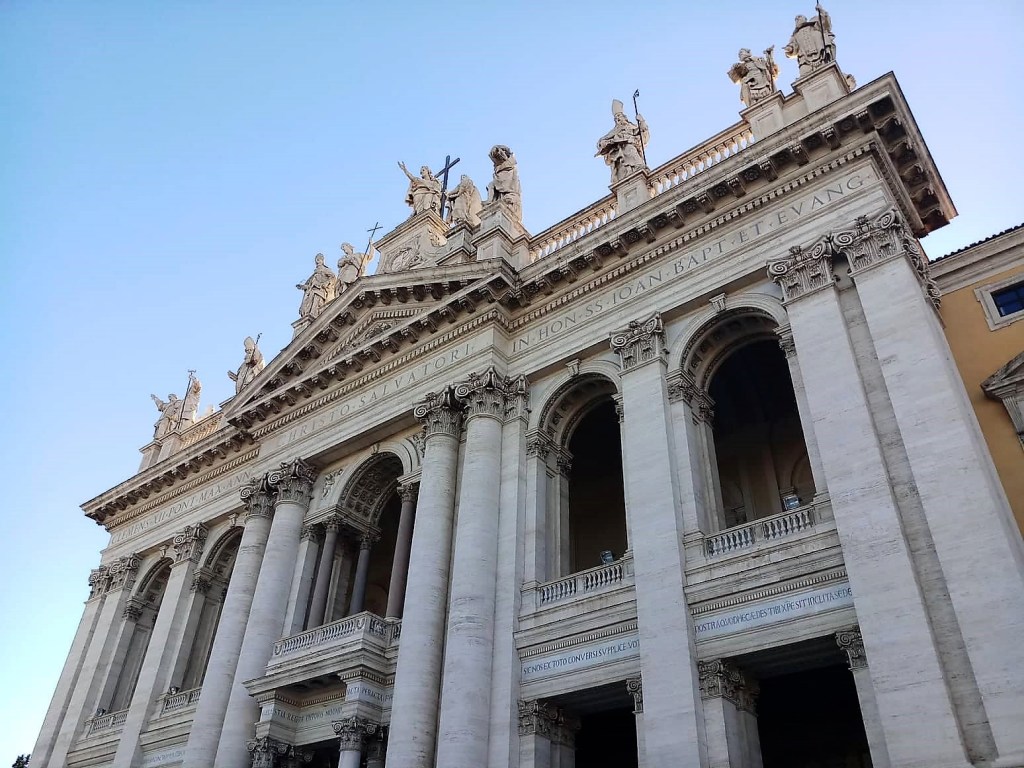
Photo by Arch. Philip Santiago, 2018.

Glory and praise to you O God our Father who had sent us your Son Jesus Christ to establish his Body among us, both as the Church made up of his people and made of stones. As we celebrate the Feast of the Dedication the Cathedral of Rome, the Basilica of St. John Lateran, we pray also for Pope Francis, all bishops and priests, and all the faithful who make us the Body of Christ.

May our temple of stones be a symbol of the living Church, the Christian community, your Building among us as St. Paul reminds us today.

Let life flow like waters from the vision of Ezekiel in the first reading from our Church and give life to its members especially the sick and the poor, the marginalized and the forgotten.

Dearest Jesus, help us draw inspiration from the beauty and harmony of your beautiful churches despite our many flaws and sins to form a unity in you in the Holy Eucharist we celebrate day in, day out in our sacred buildings to proclaim your glory and majesty.

At the same time, as we strive to follow your will in building a spiritual temple of people who worship in truth and in spirit, may this feast remind us also to take special care in keeping your house in order where we meet you in our liturgy. Guide us with the Holy Spirit to make every sacred building a living temple of your love, a church of the poor. Amen.

Photo by Arch. Philip Santiago, 2018.

Prayer to rediscover the beauty of the Church

The Lord Is My Chef Breakfast Recipe for the Soul by Fr. Nicanor F. Lalog II
Wednesday, Feasts of Saints Simon and Jude, Apostles, 28 October 2020
Ephesians 2:19-22   >><)))*> + <*(((><<  ||  >><)))*> + <*(((><<   Luke 6:12-16
Photo by author, Malolos Cathedral, August 2020.

Dearest Lord Jesus:

What did you pray for on the night before you named your Twelve Apostles?

Jesus went up the mountain to pray, and he spent the night in prayer to God. When day came, he called his disciples to himself, and from them he chose Twelve, whom he also named Apostles:

Luke 6:12-13

What an amazing sight, a scene to behold you, Jesus who is true God and true man, praying to the Father, spending the night just to name the Twelve Apostles! Most likely, you prayed for them individually so they may be strong in their commitment to you. What an honor!

And the most beautiful part in every call you make specially with the Twelve Apostles is how you have chosen them from their so diverse backgrounds and temperaments to prove that what interests you most Lord Jesus are people or persons, not labels or backgrounds.

Remind us always, dear Jesus of this reality, of how you value each of us that you have called us to be your followers as Christians.

Open our eyes and our hearts to always have the zeal and passion of St. Simon.

His two nicknames given by Luke as a “Zealot” belonging to Zealots Party demanding the ouster from Israel of the occupying Romans and that by Mark as “Cananean” from the Hebrew verb qana for “to be jealous, ardent” both mean being filled with passion for his Jewish identity for God, his People Israel and Torah or the Laws.

In choosing Simon as an Apostle, may we be reminded of always having room in the Church for all charisms and human qualities of all peoples who find their communion in our Lord Jesus Christ.

Likewise, we pray to be like Jude Thaddeus who stood firmly by his faith in you, Lord Jesus in writing a short letter to remind the early Church of keeping their Christian identity, of not being deceived by some preachers who sowed confusion and division with their thoughts and ideas.

Pray for us, dear Jesus in this modern time when we who are in the Church who are lacking in passion and drive to make you known not only in words but also in deeds.

Pray for us, still Lord Jesus in this modern age that we may have the strength, clarity, and courage in defending and upholding our Christian identity amidst the many contradictions of the world in which we live in.

May St. Simon and St. Jude help us rediscover the beauty of our Christian faith and live it faithfully, witnessing to its beauty and truth. Amen.

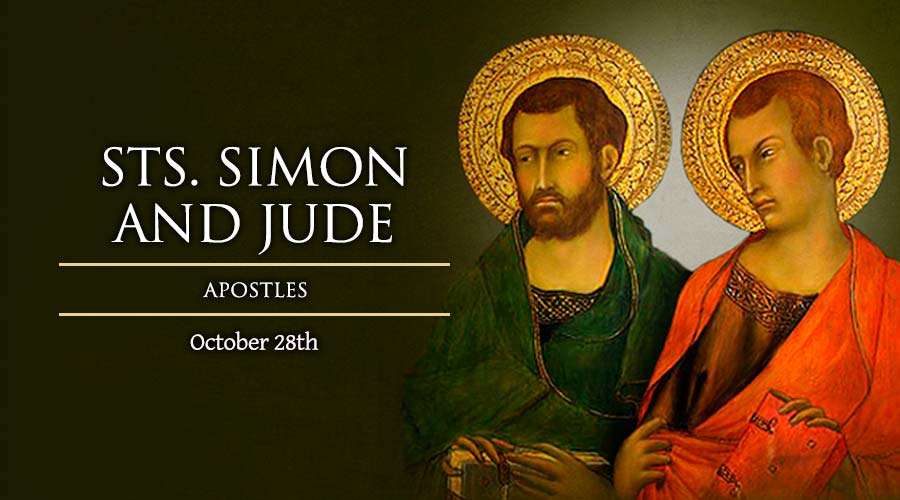
From catholicnewsagency.com.

The test of love

The Lord Is My Chef Sunday Recipe for the Soul by Fr. Nicanor F. Lalog II
Week XXX-A in Ordinary Time, 25 October 2020
Exodus 22:20-26  |+++|   1 Thessalonians 1:5-10   |+++|   Matthew 22:34-40
Nuns bringing relief goods during the lockdown due to COVID-19 last summer. Photo from Facebook.

Our gospel this Sunday is a very usual scene happening daily in our modern world when we keep on testing Jesus Christ like the Pharisees for so many things about life we feel we know better than even God.

We keep on “pushing the lines” to avoid crossing them lest we break the laws and commandments when our hearts are clearly bent more on the legalisms than their spirit and sense.

How unfortunate that until now, when we would rather see the small parts than the whole that we keep on breaking down everything specially laws as if they are entities unto themselves, forgetting that each part leads to greater good.

Such is the essence of the one law of love, love of God is always love of neighbor and vice versa. They cannot be separated, like a face with two cheeks.

But more important than understanding the nature of the law of love which is the inseparability of love of God and love of others is passing its final test of loving.

I have always loved this actual photo of a banana vendor during the lockdown who kept his prices low as part of his effort in alleviating the sufferings due to COVID-19 pandemic. Photo from Smart, March 2020.

We keep on testing Jesus
who has passed every test we have
subjected him into...
Can we pass his test of love, too?

As we come to close our liturgical calendar in the coming weeks, our Sunday gospel today challenges us to examine our very selves too if like Jesus, can we pass the test of love?

When the Pharisees heard that Jesus had silenced the Sadducees, they gathered together, and one of them, a scholar of the law, tested him by asking, “Teacher, which commandment in the law is the greatest?”

Matthew 22:34-36

The scholar’s question to Jesus was partly a result of the confusion among people of his time when their experts and scholars of the Laws broke down into minute details and parts the Decalogue that eventually ended having over 600 precepts including those rituals of cleansing of things Jesus and his disciples were often accused of disregarding whenever they came to gatherings.

The sad thing is that instead of simplifying them so the people may find more the spirit of the Laws than its legalisms, the Jewish leaders “did not lift a finger” about it for selfish motives.

And now they were using it to test Jesus which we sadly continue in our present time.

While it is true that evil exists in lawlessness or when we live lawlessly, God’s law is directly opposed to a legalistic understanding that must be seen always in the light of faith.

This is perhaps the main point of Pope Francis in his recent statement proposing for “civil coexistence law” (convivencia civil) that will protect homosexual people from mistreatment and social rejection even from among their own family circles. The Pope is not calling for same sex civil union nor same sex marriage. We have to go beyond the legalese and legalisms of laws to see the Holy Father’s genuine concern and love for people with homosexual tendencies he had longed to bring back to the fold.

We cannot separate law and love if either is to bring deepened relationships and unity among peoples that are in fact the goals of both law and love. Law and love always take into consideration the other person often forgotten when we have an excess of our very selves.

In the first reading, we are reminded how the laws themselves are manifestations of God’s love for his people, of laws coming directly from him without any hint whatsoever of the distant lawgiver we have always seen and experienced among men.

See how he admonished everyone to be kind with everybody specially aliens for after all, we are all immigrants and travelers of this earth whom he takes care of. In declaring “I am compassionate” (Ex.22:26), God assures everyone of his oneness with us, that to love him is to love others, to hurt others is hurting him too! The very same thing Jesus is telling us today!

He said to him, “You shall love the Lord, your God, with all your heart, with all your soul, and with all your mind. This is the greatest and the first commandment. The second is like it: You shall love your neighbor as yourself. The whole law and the prophets depend on these two commandments.”

Matthew 22:37-40

Jesus easily passed the “test” by the Pharisees at that instant and would prove it more decisively and concretely on the Cross when he gives himself up to the Father for our salvation as the supreme sign of love that is true.

His answer takes us all to the very foundation of all the laws we have which is loving God with one’s total self expressed in loving others as we love our selves. Here we find Jesus doing away with our legalisms that focus on the letters and individual laws and commandments, summing them all in love.

Again, following the background and personality of Pope Francis, here we find his love in action being bogged down by legalisms and limitations of the language.

What does he really mean with convivencia civil or civil coexistence law minus any romantic meanings in adherence to our moral laws?

I do not know but in my heart, I could feel the love and compassion of this Pope for homosexuals we have long ostracized from the Church and even society, making fun of them, forgetting their feelings and well-being and persons. It might still take some time before the Pope’s idea is realized even in the Church. What we need at the moment is openness to the leading of the Holy Spirit to finally find those words and terms to encapsulate the love and compassion Pope Francis has for them.

That is the problem with love — always beyond words. One has just to do it, to just “love, love, and love” as Leo Buscaglia would always say.

In the second reading, St. Paul reminds us how the world continues to frown upon us Christians striving to live the life Christ had called us to. We can see the continuing biases in the society even in social media against us Christians standing for what is just, moral and true. It is in this context where we are challenged to be true witnesses of the love of Jesus Christ that the credibility of his gospel is proven daily as the only path towards peace and harmony.

Jesus passed the tests of his enemies about his love for God and love for us; all the past Popes have proven too their complete love for God and for others in their lives of holiness. Pope Francis has striven while still in Argentina to witness this immense love of Jesus for the marginalized. Instead of wasting our energies debating about his recent statements despite his being passed the same test of love, let us now examine ourselves how are we faring in this test of love too?

And loving and lovely week ahead of everyone in Jesus!

Photo by author, 2019.

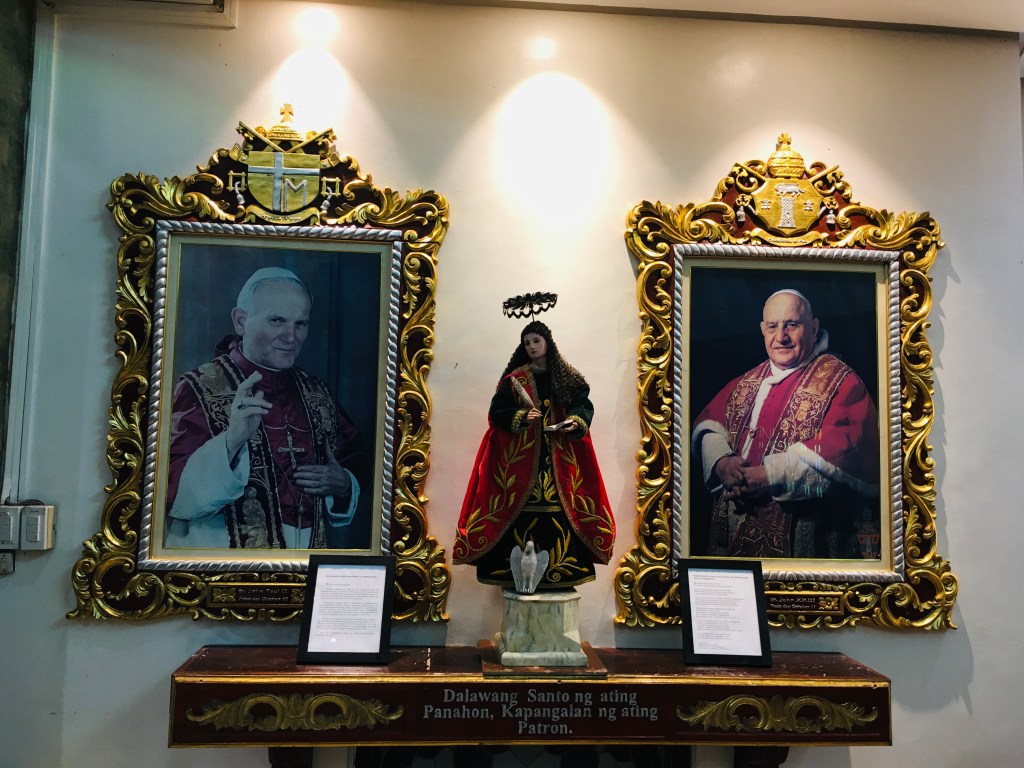
Dalawang makabagong santo, kapangalan ng aming Patron

Lawiswis ng Salita ni P. Nicanor F. Lalog II, Ika-22 ng Oktubre 2020
Larawan nina San Juan Pablo II at San Juan XXIII kasama isa sa mga matandang imahen ng aming Patron San Juan Apostol at Ebanghelista sa likuran ng aming simbahan sa Bagbaguin, Santa Maria, Bulacan.

PANALANGIN KAY SAN JUAN APOSTOL AT EBANGHELISTA KAUGNAY NG MGA BAGONG SANTO NG SIMBAHAN: PAPA JUAN PABLO II at PAPA JUAN XXIII (Bahagi ng aming mga Panalangin sa Parokya ni San Juan Apostol at Ebanghelista, Bagbaguin, Santa Maria, Bulacan mula nang itanghal bilang Santo ang dalawang naturang dating Santo Papa noong 27 Abril 2014, Linggo ng Dakila Awa ng Diyos.)

Minamahal naming Patron na Banal, 
Juan Apostol at Ebanghelista po ang inyong ngalan!
Ngayo'y aming ipinagdiriwang sa buong Simbahan 
dalawang bagong Banal: Kapwa sila pastol ng kawan, 
nang manungkula'y pangalan mo ang hiniram.

San Juan Beinte-tres nang sa kanyang katandaan tuladmo,
Sinikap maging makabuluhan at buhay na palatandaan ng Diyos
sa gitna ng makabagong panaho nitong InangSimbahan
nang kanyang simulan ang Ikalawang Konsilyo sa Vatican. 

Kasabay niyang tinanghal bilang Banal 
ang tinaguriang Dakilang San Juan-Pablo Ikalawa;
Labis na pagtitiis ang kinamit sa kanyang sakit, 
Krus ay sinapit, katulad mo’y naging malapit
sa Ina ni Hesus kaya’t “Totus Tuus” ang kanyang awit.

Itulot mo aming Mahal na San Juan Apostol at Ebanghelista,
kaming iyong mga anak sana’y matularan,
pinagsikapan ng dalawang bagong San Juan:
pamilya’t sambayanan mabuklod sa nagkakaisang pag-ibig
katulad ng dalangin ni Hesus doon sa Huling Hapunan. AMEN.

San Juan Ebanghelista, ipanalangin mo kami.
San Juan Beinte-tres, ipanalangin mo kami.
San Juan-Pablo Ikalawa, ipanalangin mo kami.

Our heavenly citizenship

The Lord Is My Chef Breakfast Recipe for the Soul by Fr. Nicanor F. Lalog II
Tuesday, Week XXIX, Year II in Ordinary Time, 20 October 2020
Ephesians 2:12-22     >><)))*> + >><)))*>  +  >><)))*>     Luke 12:35-38
Photo by Dr. Mylene A. Santos, MD in Quezon, 2020.

Glory and thanksgiving to you, God our Father, through your Son our Lord Jesus Christ in the power of the Holy Spirit for reconciling us all in you, making us one despite our many differences.

How lovely to the ears, to our being the words of St. Paul today, Lord Jesus, assuring us of our citizenship in heaven through the salvation you have brought us all, regardless of our color, race, status or even religion!

So then you are no longer strangers and sojourners, but you are fellow citizens with the holy ones and members of the household of God, built upon the foundation of the Apostles and prophets, with Christ Jesus himself as the capstone. Through him the whole structure is held together and grows into a temple sacred in the Lord; in him you also are being built together into a dwelling place of God in the Spirit.

Ephesians 2:19-22

Help us, O Lord, to embody and manifest this unity of peoples in you in the Church, your Mystical Body here on earth.

Heal us of our many divisions and make us truly Catholic by helping everyone enter into communion with you through one another.

Keep us on guard for your return, Jesus, by “girding our loins and lighting our lamps” (Lk.12:35) ready to welcome you with our good works each day, leading others closer to you.

Let us start by going back to you in prayers and silent meditations that many have forgotten or taken for granted in this 24/7 world saturated by media with all the cacophony of sounds and blinding visuals that have blurred our vision of who we really are as citizens of heaven, beloved children of God our Father in heaven.

Help us find our way back home to the Father in heaven here on earth by finding our way back home to our true selves and to our brothers and sisters in you, dear Jesus. Amen.

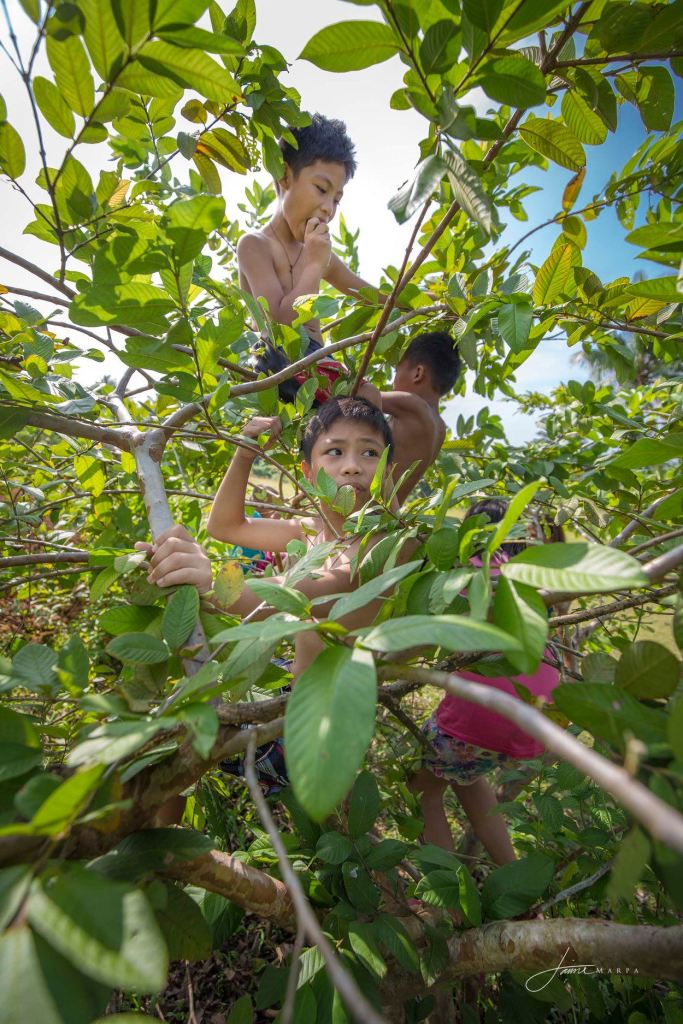
Trees are “shaken” to get its fruits

The Lord Is My Chef Sunday Recipe for the Soul by Fr. Nicanor F. Lalog II
Week XXVII-A in Ordinary Time, 04 October 2020
Isaiah 5:1-7     ||+||     Philippians     ||+||     Matthew 21:33-43
Photo by Mr. Jim Marpa, 2018.

To all the plantitos and plantitas: happy feast day this Sunday, the fourth of October which is also the feast of St. Francis of Assisi, patron of those in the green movements.

Part of the grace of this pandemic is the new awareness and interests of many among us for all kinds of plants borne out of the prolonged quarantine periods these past seven months. I remember growing up in our barrio where fences were all plants like santan, San Francisco and gumamelas whose flowers we used to mix with Tide to play bubbles. Who would have thought that after several decades those plants we used to take for granted like the gabi varieties and others along with cactus found almost everywhere would cost a fortune today?

But what I really miss and hope the plantitos and plantitas will be able to revive and bring back are the fruit trees every home used to have even in vacant lots like guava, santol, atis, aratiles, mabolo, achesa, duhat, kamias and of course, mango. Whenever me and my cousin would trek to the mini forest at the back of our compound called “duluhan” near a swampland to shoot birds and everything with our slingshots (tirador), we always had some fruits to munch in our little adventures.

And part of that adventure was to “shake” until we break branches of trees to get fruits and local beetles called salagubang (on mango trees).

Shaking of tree. Exactly the same thing that Jesus did today in his next parable addressed to the chief priests and elders of the people who would soon have him arrested, tried, and crucified: after telling them parable of the wicked tenants who killed the servants and the son of the owner, Jesus shook and shocked his listeners who later realized the parable was about them!

“What will the owner of the vineyard do to those tenants when he comes?” They answered him, “He will put those wretched men to a wretched death and lease his vineyard to other tenants who will give him the produce at the proper times.” Jesus said to them, “Did you never read in the Scriptures: ‘The stone that the builders rejected has become the cornerstone; by the Lord has this been done, and it is wonderful in our eyes?’ Therefore, I say to you, the kingdom of God will be taken away from you and given to a people that will produce its fruit.”

Matthew 21:40-43

We are the vineyard of the Lord


From Google.

Jesus had already entered Jerusalem and was teaching at the temple area. Among his audience were the chief priests and elders of the people trying to gather evidences against him for his arrest and execution. Unknown to them, Jesus knew what was in their hearts.

Last Sunday the parable was directed to them so they may realize how wrong they have been in regarding them so highly above the publicans and prostitutes who repented for their sins and went to receive the baptism by John the Baptist.

Today, Jesus “shook them” with this second parable taken from a well known song and lament of a beloved to his vineyard by the Prophet Isaiah which we have heard at the first reading.

Vineyards are very common in Israel as in the rest of the Mediterranean and Europe where grapes and wine symbolize life. Hence, the vine is always considered as a highly prized plant that biblical authors have taken as the image of the people whom God cultivates and from whom he expects beautiful fruits.

In the first reading, we find God lamenting why after investing his vineyard with the best of everything, the grapes it produced were so bad that it had to be burned. It was a very strong warning against Israel who have gone wayward in its ways of living that aside from worshipping idols, they also killed the prophets sent by God.

Notice the transition by Jesus using the same imagery from the Old Testament of the vineyard as the people of God but this time bearing fruits at harvest time. By that time, the chief priests and the elders of the people felt they were better than their ancestors who had the prophets killed. In fact, they felt proud that they have been faithful to God, and therefore, fruitful — thinking they were a far cry from Isaiah’s lament. Unknown to them, Jesus could read their hearts, how they were all planning to kill him like the son in the parable so they can have the vineyard, the people and lord it over them!

Everything fell into right places at the end of the parable when Jesus asked them:

“What will the owner of the vineyard do to those tenants when he comes?” They answered him, “He will put those wretched men to a wretched death and lease his vineyard to other tenants who will give him the produce at the proper times.”

Matthew 21:40-41

Try to imagine the scene with Jesus face-to-face with the chief priests and elders of the people – and with us – discussing the present time, not the past.

Here is Jesus Christ shaking us all to find whatever fruits we have, telling us that this parable is about me and you (see v. 45), asking us, why are you trying to remove me from the people? Why are you easing me out, creating all these cults around yourselves like celebrities, getting the people’s money and approval for your own sake?


Sometimes we need to be shaken – even shocked – to bring out our fruits


Photo by author at Silang, Cavite, 22 September 2020.

See again my dear Reader the beauty of the Lord’s parables wherein he invites us to be involved with it to see how we felt with certain situations like in the merciless debtor and early workers at the vineyard; today, Jesus is asking us our opinion on what the vineyard owner must do against the wicked tenants.

He knows what to do and wants us to realize that we could be those tenants too because like the chief priests and elders, we easily see the sins and shortcomings of others, the fruitlessness of others without realizing our own darkness within, even our sinister plans to dominate.

See how the chief priests and elders of the people called the tenants “wretched men” deserving “wretched death”, not realizing that the more we talk of other people, the more we actually talk of ourselves!

Every parable by Jesus is always set in the present moment with sights set to the future, to eternal life.

Sometimes, God has to shaken us, even shock us so we may bring out and give him his share of harvest of fruits like our faith, hope and love that will build the community in him, not take people away from him. Problem with us is like with those tenants and the chief priests and elders: “masyado tayong bumibilib sa ating sarili”, that is, we believe too much on ourselves that unconsciously we feel like God, forgetting we are mere stewards or tenants of his vineyard.

St. Paul reminds us in the second reading that we strive to imitate Jesus, be like Jesus so that people may find in us a model in following Jesus. Very clear with St. Paul: nobody is replacing Jesus Christ whom we must all imitate.

This time of the pandemic is a time of harvesting, of showing others our fruits like love and kindness so we may lead more people to God, not to ourselves or anyone else trying to lord over us.

This is the time we are asked to feel more than think more like those tenants, a time to lead people back to God who truly owns us, his vineyard (see https://lordmychef.com/2020/10/02/on-being-kind-and-loving-during-covid-19/).

When shaken by the Lord, will there be fruits found in us to share with others?

Have a blessed Sunday and brand-new week ahead! Amen.