Blessedness of mourning

Lord My Chef Daily Recipe for the Soul, 01 November 2025
Saturday, Solemnity of All Saints
Revelation 7:2-4, 9-24 ><]]]'> 1 John 3:1-3 ><]]]'> Matthew 5:1-12
Thousands of people arrive to pray at the graves of their relatives at a cemetery during the annual observance of All Saint’s Day in Manila on November 1, 2019. Millions of Filipinos flocked to cemeteries to visit and pray at the graves of their loved ones to mark the holiday. Photo by Ted Aljibe, AFP.

Many are amused even some of us Filipinos why all roads lead to cemeteries during this time of the year to celebrate the Solemnity of All Saints when remembering our departed loved ones actually falls on the following day, November 2.

There’s nothing wrong with this tradition except that people forget celebrating Mass on All Saints’ Day which is the essence of the feast ranked as a Solemnity, the highest in our liturgy. Offer a Mass first for your departed loved ones on November 1 before going to the cemetery!

More than the close connections of All Saints’ Day and All Souls’ Day in its theology and tradition, our celebration of these two feasts collectively referred to as Undas is the classic tension of our experiences of heaven on earth, of the here and not yet, of the mixture of joy and sadness within us when we remember our dead best expressed in our grief and mourning.

When Jesus saw the crowds, he went up the mountain, and after he had sat down, his disciples came to him. He began to teach them, saying: “Blessed are the poor in spirit, for theirs is the kingdom of heaven. Blessed are they who mourn, for they will be comforted” (Matthew 5:1-4).

From forbes.com, 2019.

In a world that thrives and promotes so much fun and merry-making, our second beatitude is difficult to understand or even grasp in this time of faith in a mass-mediated culture.

What is “blessed” with grieving and mourning or crying when you have lost a loved one, like a parent or a child or a friend?

Pope Benedict XVI explained in his book “Jesus of Nazareth” there are two kinds of mourning that the gospels offer us exemplified by the two most extreme of the Apostles, Judas Iscariot who betrayed Jesus and, Simon Peter who denied the Lord thrice (pp.86-89).

Photo by author, Church of St. Anne, Jerusalem, Israel, May 2017.

This first kind of mourning as shown by Judas Iscariot is when one has lost hope, succumbing to the miseries of losing a beloved and becomes mistrustful of love that leads to self-destruction. It is the worst kind of mourning that eats away and destroys man within just like Judas Iscariot who hanged himself (see Matt. 27:3-5).

The second kind of mourning according to Pope Benedict XVI that Jesus must be referring to as “blessed” in his Beatitudes which leads to salvation is when the mourning is caused by an encounter with the truth that leads to conversion like what happened to Simon Peter when he was struck by the gaze of Jesus that he burst into healing tears and cleansed his soul to enable him to begin anew in his life in the Lord (see Lk.22:60-61,62).

This will have its lovely conclusion eight days after Easter before Jesus ascended into heaven when he asked Simon Peter thrice, “Do you love me?” (Jn.21:15ff.) to remind him of that episode that eventually pushed him to follow Christ unreservedly “by taking care of his sheep”. Guided by these thoughts of Pope Benedict XVI, let us see reflect the blessedness of weeping…

Photo by Juan Pablo Serrano on Pexels.com

Blessed are those who weep because that means they have love in their hearts. Deaths and bad news that befall our loved ones sadden us, even jolt us with deep pain that move us to console them, to suffer with them, and to be one with them by reconnecting with them and their loved ones like when we go to a funeral or a wake.

This did not happen with Judas Iscariot. The little love he had in his heart when he realized his sin was completely wiped out when he chose to surrender totally to evil, finding no more hope for forgiveness and reconciliation with Jesus.

Photo by Mr. Jay Javier, September 2024.

Never lose hope in Jesus. Seek that love in your heart. Seek Jesus in that tiny voice telling you to always come home to him. Do not be shy nor ashamed of your loss and failure. Keep that fire of love in Jesus burning.

Do not let grief overcome and consume you, wiping out the embers of love left in your heart with the loss of a loved one. Life goes on in Jesus and in that same love we have in our hearts that surprisingly even grows deeper as we move on after the death of a loved one.

In the recent ghost projects scam by government and elected officials, we too felt the pain of loss too in the billions of pesos stolen from us. We are deeply affected because we love the Philippines; let us keep that love for the country burning within us by taking concrete steps against corruption while preventing opportunists from plunging us into chaos.

Blessed are those who weep because more than the love they have in their hearts, they have been loved first of all. We weep and grieve the death of a beloved family member or relative or friend because of the love they have given us, of the kindness they have shown us, and the care they have lavished upon us.

Photo by Oscar Millu00e1n on Pexels.com

Simon Peter did not merely have love in his heart; he was so loved by Christ!

Luke dramatically described to us how Peter’s eyes met the merciful and loving eyes of Jesus while he was denying the Lord. It must have struck him so hard that immediately he felt contrition for his sin, feeling strongly the need to reform himself and reconnect with the Lord. He could not let the imperfect love he has in his heart to just go to waste that is why when he wept bitterly on that Holy Thursday evening, it was not the end but the beginning of another chapter in his beautiful story of love for Jesus. It was precisely what he meant when he told Jesus at Tiberias, “Lord, you know everything; you know that I love you” (Jn.21:17) – that despite his weaknesses and failures, he loves Jesus, he tries so hard to love Jesus in his little ways.

There’s a saying that “If you have love in your heart, you have been blessed by God; if you have been loved, you have been touched by God.” We are blessed in mourning our departed loved ones because through them, we felt being touched by God. That is why we have to move on after every death – so we may love more those left around us for them to feel God’s loving touch too!

Residents of Hagonoy Bulacan walk their way to flooded portions of premise surrondings St. Anne Parish as they protest this was following exposes of flood control anomalies. The Bulacan has been under scrutiny for receiving multi million worth of flood control projects but still suffers severe flooding. (Photo by Michael Varcas)

Blessed are those who mourn because that is when we actually stand for what is true and good, for what is just and right.

When we weep, it does not mean we have lost; in fact, even in the face of apparent loss like Jesus on the Cross, mourning is the most firm expression of our belief in what is right and just, and what is true and good.

According to Pope Benedict, this blessed mourning that leads to salvation is found at the death of Jesus Christ where his Mother, the Blessed Virgin Mary stood by the foot of his Cross with the beloved disciple and other women (Ibid.,p. 87). At the Cross, Mary showed us that mourning is blessed because it is the strongest expression of our solidarity with Christ, of our going against evil and sin.

In this world when conformity to whatever “everyone is doing” is the rule of the game like corruption, dishonesty, infidelity, and lies, mourning and weeping with the victims of oppression and persecution and corruption too can be our strongest signs of protest and resistance against the prevailing evils of our time. When we weep and mourn for victims of violence and evil, that is when we become God’s instruments of his comfort to his people, when we strengthen them in their pains and sufferings.

To comfort means “to strengthen” – from the Latin cum fortis, “with strength”. When we mourn and stand by those weeping and suffering, we are blessed because that is when we resolve to live and love more like Christ on the Cross.

Photo by Dra. Mai B. Dela Peña, Mt. Carmel, Israel, 2015.

What are your griefs today?

Blessed are you in your weeping not only in having love in your heart but most of all, for being loved. Dwell in the love of God in Jesus Christ like the saints who have gone ahead of us, resisting all evils and temptations to sin for the Lord comforts us his people always. Amen. A blessed All Saints’ Day to you! Fr. Nicanor F. Lalog II, Our Lady of Fatima University, Valenzuela City

*This is based on our previous blog in 2022. Salamuch.

Looking up, seeking what is above

Lord My Chef Daily Recipe for the Soul, 10 September 2025
Wednesday, Twenty-third Week in Ordinary Time, Year I
Colossians 3:1-11 <*((((>< + ><))))*> Luke 6:20-26
Photo by Dra. Mylene A. Santos, MD, September 2022.
How lovely are your words
today, Lord Jesus Christ
that pertain about heights.

In the first reading,
St. Paul invites us to seek
what is above,
think what is above
while in the gospel
you O Lord looked up
to us your disciples.

“Brothers and sisters: If then you were raised with Christ, seek what is above, where Christ is seated at the right-hand of God. Think of what is above, not of what is on earth” (Colossians 3:1-2).

Raising his eyes toward his disciples Jesus said: “Blessed are you who are poor, for the Kingdom of God is yours” (Luke 6:20).

Your beatitudes
lifted us up, dear Lord
changed radically
the way we must see
life and its meaning
so that we may aspire to
follow St. Paul's teachings;
before pointing our sights
up to heaven in you,
Jesus,
you first looked up to us
despite our miseries
and sins.
If we could just
imagine this great honor,
then perhaps we would no longer
doubt nor question
your beatitudes;
help us, Lord Jesus
to remember this great honor
you have given us
of lifting us up to you
in our poverty and hunger,
grief and exclusion,
insults and denunciations;
help us Lord
to set our sights up to you
so we may live your beatitudes
by finding and seeing you
among those below us
and with us.
Amen.
Photo by Dra. Mylene A. Santos, MD, September 2022.

Magnanimous Jesus

The Lord Is My Chef Sunday Recipe for the Soul by Fr. Nicanor F. Lalog II
Sixth Sunday in Ordinary Time, Cycle C, 16 February 2025
Jeremiah 17:5-8 ><}}}}*> 1 Corinthians 15:12, 16-20 ><}}}}* Luke 6:17, 20-26
Photo by Haley Black on Pexels.com

After the call of his first disciples last Sunday, Jesus went on to preach in Galilee as great crowds followed him with some of them becoming his disciples too. From among these many disciples, Jesus chose twelve to be his Apostles after praying one night on a mountain (Lk. 6:12-16).

As they went down from the mountain, Jesus taught the Twelve along with his other disciples and crowd of people who have gathered to listen to him in what came to be known as his Sermon on the Plain.

Luke patterned his Sermon on the Plain on earlier account of Matthew’s Sermon on the Mount that portrayed Jesus like the new Moses and moreover, the new Law himself. Matthew’s Sermon on the Mount has a smaller audience that was limited to just the Twelve while Luke’s Sermon on the Plain had a wider audience of not just the Apostles but also the other disciples and the crowd of people who have been following him.

But, more than their differences in their setting and audience, the two sermons differ greatly in the message itself. Both Luke and Matthew begin with four beatitudes, but Matthew concludes with additional beatitudes while Luke matched the four beatitudes with four woes that frankly speaking, are very disturbing.

“But woe to you who are rich, for you have received your consolation. Woe to you who are filled now, for you will be hungry. Woe to you who laugh now, for you will grieve and weep. Woe to you when all speak well of you, for their ancestors treated the false prophets in this way” (Luke 6:24-26).

Again, Luke is telling us something deeper about Jesus in his version of the Sermon on the Plain that actually echoes the Blessed Virgin Mary’s Magnificat found only in his gospel too.

Recall in the Magnificat how Mary spoke of God sending the rich “away empty” (Lk.1:53) as he blessed the poor and the hungry. And here now is Jesus Christ fulfilling those words of his Mother.

The gospels and the whole Bible itself teem with many pronouncements against the rich and those in similar good fortune in life. Is God against the rich, those happy and those of good reputation? What’s wrong with being rich or well-off, of having our fill of food and laughter, and being spoken well of by others?

Photo by author, November 2024.

Nothing really.

Jesus is not against anyone for he loves everyone as he preached extensively on the need to love one another as we love God. If Jesus preached only love, he would have not been crucified, and most definitely would have not made so much enemies. But, the kind of love Jesus preached was so radical that shook not only the ways of the old but also of modern time because it is a kind of love that pulls down the mighty and favors the poor and those suffering. His Sermon on the Plain rings louder than ever today as we have not seemed learned from the lessons of the past. And believe it or not, the four woes declared by Jesus in his Sermon on the Plain are actually expressions of his magnanimous love, contrary to what others claim.

The four woes that are antitheses of the four blessings are not actually maledictions as most interpretations have expressed. A malediction is like a curse, an expression of one’s desire for someone’s harm like in calling down God’s wrath. The four woes of Jesus in his Sermon on the Plain is far from that reality nor a condemnation against anyone.

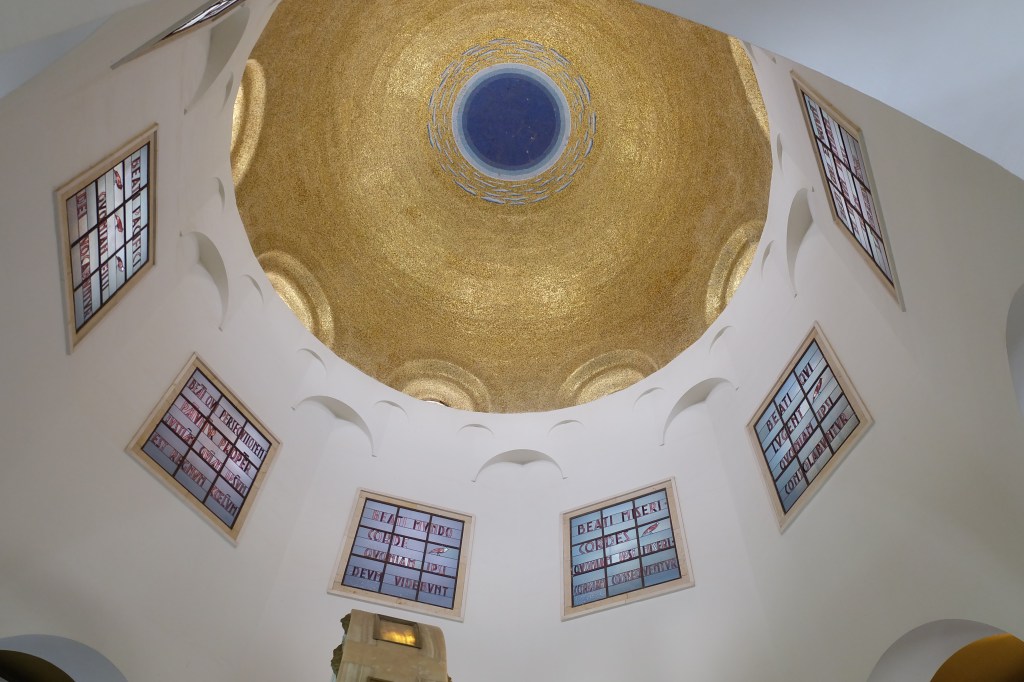
Photo by author, Church of the Beatitudes, the Holy Land, May 2017.

In calling the rich “woeful” along with those who are filled and those who laugh “now” as well as those of whom “all speak well”, Jesus is neither condemning them nor declaring them as evil-doers; in calling them “woeful”, Jesus reminds them and us today of being on the wrong and bad path in life that can lead to a fatal outcome or end.

Like in the parable of the rich man and Lazarus that only Luke has an account in his gospel, Jesus Christ’s “woes” are warnings – “red flags” – everyone must consider who might be in the wrong direction and wrong choices in “enjoying” life “now” without any concern for those who are suffering like the poor and the hungry, those who grieve and those maligned and hated.

Photo by Mr. Jay Javier, Quiapo, 09 January 2020.

The poor, the hungry, the weeping and the hated are blessed not simply because of their state in life but more of their willingness to forego so many worldly things “now” for they trust in God who shall deliver them to salvation and justice.

They are blessed because they have realized that things of the world are passing, something that the worldly could not accept. How sad that many today have lost sight of eternity and even of God, living only for the “now”.

Jesus is not asking us to be “masochists” or at the other end of the extreme, to be complacent in the face of widespread suffering and pains. Remember how in the synagogue at Nazareth one sabbath when Jesus launched his ministry by proclaiming from the Prophet Isaiah how the Spirit of God rested on him to bring glad tidings to the poor, liberty to captives, healing to the sick (3rd Sunday, Jan. 26).

By calling the poor and the suffering as “blessed”, Jesus assures them that God is with them and that justice shall be reestablished on “that day” when they enter the kingdom that has been prepared for them in eternal life. He called us “woe” to warn us while there is still enough time to change our course in life to be blessed not only now but in all eternity too!

Photo from forbes.com.

See how our readings this Sunday are actually about our making of wise choices in life: in the first reading, Jeremiah warns us of the consequences of trusting God or trusting humans while the psalms show us the ways of the just and the ways of the wicked; Paul in the second reading presents to us the grace of believing in Christ’s Resurrection and the folly of denying it while in the gospel, Jesus offers us blessing or woe in living.

These readings show us there is no middle ground in following Jesus nor grey areas in God. Our decisions in life define the course of our lives like what the Pepsi Cola ad used to say in the 1990’s, “we are made (or unmade) by the decision we make.”

Moreover, in giving us those four woes, Luke reminds us that in making our decisions, we must consider more than the moral but the Christological perspective of life to be like Jesus Christ – who is himself the “blessed” because he is the poor one, the hungry, the weeping and the hated.

Should we make the wrong decisions in life, Jesus remains magnanimous, remaining in us, telling us those woes over and over so we would still make the right choices in life. Don’t take it personally; Jesus cares for you.

In three weeks we shall be entering the Season of Lent. Incidentally, the last time we celebrated Sixth Sunday of Ordinary Time in Cycle C was in 2010, the Seventh Sunday in 2007, and the Eighth Sunday in 2001!

Our gospel readings in the coming two more Sundays before Ash Wednesday would still be taken from Jesus Christ’s Sermon on the Plain to emphasize the closeness of God with those who are poor and suffering.

As we approach the holy Season of Lent that calls us to more prayers, fasting and almsgiving, we can already start this Sixth Sunday examining our lives to see if we are aligned with the blessed ones of God or are we the woeful ones. The choice is ours. Let us pray for the grace to choose Jesus, only Jesus, always Jesus. Amen. A blessed week ahead to everyone!

Time is running out, the world is passing away

The Lord Is My Chef Daily Recipe for the Soul by Fr. Nicanor F. Lalog II
Wednesday in the Twenty-third Week of Ordinary Time, Year II, 11 September 2024
1 Corinthians 7:25-31 <*[[[[>< + ><]]]]*> Luke 6:20-26
Photo by author at Anvaya Beach Resort, Morong, Bataan, April 2024.

I tell you, brothers, the time is running out. From now on, let those having wives act as not having them, those weeping as not weeping, those rejoicing as not rejoicing, those buying as not owning, those using the world as not using it fully. For the world in its present form is passing away (1 Corinthians 7:29-31).

Thank you, dear Father
for these timely and wonderful
reminders as we often compare
our selves with others or
are never contented with what we have
or where we stand,
always wondering amid
great temptations that
"the grass is greener at the
other side of the fence."
Teach us contentment
in your Son Jesus Christ;
teach us dear Father
to be always aware of the
day of the Lord,
of Parousia;
while many times most Christians
believe in parousia,
only a few believe it will happen
in their lifetime;
many of us forget that
even if the parousia does not
occur in our lifetime,
our life will definitely end,
making us stand before the
judgment seat of Christ for sure;
help us realize that to live as if
our life will never end is the height of folly,
while to live with the knowledge
that our life will end is the beginning of wisdom.
That is why, Jesus calls us blessed
when we are poor,
when we hunger,
when we weep,
when we are hated
and maligned
because in your beatitudes
you make us look forward
what is beyond material and temporary,
that is passing away;
let us set our sights more
on things that shall remain after
everything has ended,
with things that shall persist
in eternity like our souls
and You, O God.
Amen.

Husband & Wife, an Icon of Christ

Quiet Storm by Fr. Nicanor F. Lalog II, 04 June 2024
Photo by Pixabay on Pexels.com

Here is our second instalment of our contribution in reflecting why divorce should not be allowed because it is against the plan of God and therefore, a sin. Please, we are not judging anyone here.

It is the simple truth that for the longest time people have refused to accept in their hearts that they have continuously sought ways of justifying divorce because right in their hearts, they are the first ones bothered. They had their chance to confront Jesus Christ about it 2000 years ago but the Lord minced no words when He declared the painful truth any pro-divorce would not discuss, “Because of the hardness of your hearts Moses allowed you to divorce your wives, but from the beginning it was not so” (Mt.19:8).

How sad when articles come out trying so hard to dilute this truth by deliberately interpreting it in their own terms especially the many statements by Pope Francis which he had repeatedly clarified including that of the same sex union.

Most sad is when a news report supposed to present all sides chooses to cite only the questionable teachings of some experts in religion or theology without citing the Sacred Scriptures, the Catechism of the Catholic Church and Church documents for official teachings on marriage. Worst, the same report highlighted views of Catholic theologians silenced long ago (may they rest in peace) by the Church for their misleading views on morality!

Divorce is against God’s plan. Marriage is only between a man and a woman as created by God, not invented by any one that is subject to changes or whims. Jesus explained this clearly in the same gospel scene which we shall echo today and forever: “Have you not read that from the beginning the Creator ‘made them male and female’ and he said, ‘For this reason a man shall leave his father and mother and be joined to his wife, and the two shall become one flesh’? So they are no longer two, but one flesh. Therefore, what God has joined together, no human being must separate” (Mt.19:4-6).

As a creation of God, marriage is a sacrament, a sign of His saving presence in this world in Jesus Christ who had come to reassert this truth. The problem remains the hardness of the hearts of people, especially of those getting married who are so preoccupied with the accidentals of marriage without realizing that they are an icon of Jesus.


Photo by author, 2019.

My first assignment after ordination in 1998 was to teach at the Immaculate Conception School for Boys (ICSB) in Malolos City. We also run an all-girls high school and an elementary school for boys and girls.

Marian was my student from elementary to high school whom I have known so well including her parents. We call our students ICONS, from the initials of our school name. Here are parts of my homily to Marian’s wedding last June 29, 2019 at the Malolos Cathedral.

Congratulations to you, my dearest Marian and Matt!

God willed that you get married today on the Solemnity of St. Peter and St. Paul, the two pillars of the Church established by our Lord Jesus Christ.

Like you, Marian and Matt, St. Peter and St. Paul are two people of opposite personalities, of different social and cultural backgrounds but were able to overcome these to work together for Jesus Christ. We celebrate their feast together because despite their many differences, they were united in their love for Jesus Christ. It was Christ who brought them together and kept them together so his Church would grow and be what it is today.

The same is true with you, Marian and Matt: Jesus Christ brought you together in spite of your many differences to be united in his love. Most of all, Marian and Matt, Jesus wants you to be his ICONS or images in the world today that has become individualistic.

An icon or image of Jesus like St. Peter and St. Paul is to be one in the Lord. A man and woman get married to become disciples of Christ, to become one in Christ, to look like Christ. That is the meaning of the word sacrament, visible sign of the saving presence of Jesus in the world.

And that is why the gospel you have chosen for your wedding day is so perfect, the Sermon on the Mount where Jesus gave us his Beatitudes that are actually directions for discipleship… let us reflect on the sixth Beatitude of Jesus: “Blessed are the clean of heart, for they shall see God” (Mt.5:8).

Remember the Little Prince where the fox told him that “What is essential is invisible to the eye; it is only with the heart one can truly see”?

We can only see God with our hearts. The intellect alone is never enough.

And so it is with any person.

We can learn and know so many things about another person with our intellect but nothing will be enough for us to truly love him or her unless we let our hearts see the real him or her.

The heart is the wholeness of the person. Yesterday we celebrated the Solemnity of the Sacred Heart of Jesus. Sometimes, when we use our minds, we see the world as so dark and so evil. But, if we have hearts that can see, we will be more surprised that there are more goodness, more beauty in this world than what we hear and see in the news and around us.

Marian and Matt, always have a clean heart to see each one’s goodness and beauty.

Always go back to those early days when you first saw each other with your hearts. Aside from the kilig factor, you felt and realized something deeper with each other. The beloved disciple, St. John, wrote in our first reading, “No one has ever seen God. Yet, if we love one another, God remains in us, and his love is brought to perfection in us” (1 Jn. 4:11-12).

And that is how we see God and others: always with our hearts when we love.

To have a clean heart, Marian and Matt, is to enter into the mind of Jesus Christ and that is to embrace his Cross. Having a clean heart is becoming one with Jesus Christ, especially in his love and fidelity.

A clean heart is a loving heart that always gives life, other-centered, veritable and enduring. Always in communion with Jesus Christ who gave us the new commandment to love like him by being rooted in the Father.

The love of Christ is the fire that purifies and cleanses our hearts, unifying our intellect, will and emotion that enables us to see oneness in ourselves before God. We see not only the good and the bad sides in ourselves but also among those around us, especially those we love.

Look back at your many experiences, Marian and Matt. Look at your past lives, your struggles, your mistakes and sins. Despite all these, you have also seen and experienced God’s loving presence in you in spite of your many darkness and divisions within.

That is why you are so “blessed”, Marian and Matt, because today on your wedding day, you enter God himself and you are able to “see” him with your loving hearts despite your pains and hurt, failures and shortcomings. Keep your hearts clean in Jesus Christ so you may always see God in each other. Amen.

https://lordmychef.com/2019/07/06/husband-and-wife-icons-of-christ/
Photo by author, Malolos Cathedral 2019.

My dearest married couples, please do not forget that fact, that reality: you are an image, an icon of Jesus Christ. And what a great honor!

That is why Jesus made His first miracle in a wedding at Cana to show your special place in God’s plan. You have chosen a most difficult kind of life but that is why you chose to get married in the Church – to be blessed by God.

God keeps His promise. Keep yours too! Praying for all couples especially those going through difficulties these days.

Going back to our roots to make room for God

The Lord Is My Chef Daily Recipe for the Soul by Fr. Nicanor F. Lalog II
Friday, Solemnity of the Immaculate Conception, 08 December 2023
Genesis 3:9-15, 20 ><}}}*> Ephesians 1:3-6, 11-12 ><}}}*> Luke 1:26-38
Photo by Rev. Fr. Gerry Pascual of Iba, Zambales at Palazzo Borromeo, Isola Bella, Stresa, Italia 2019.

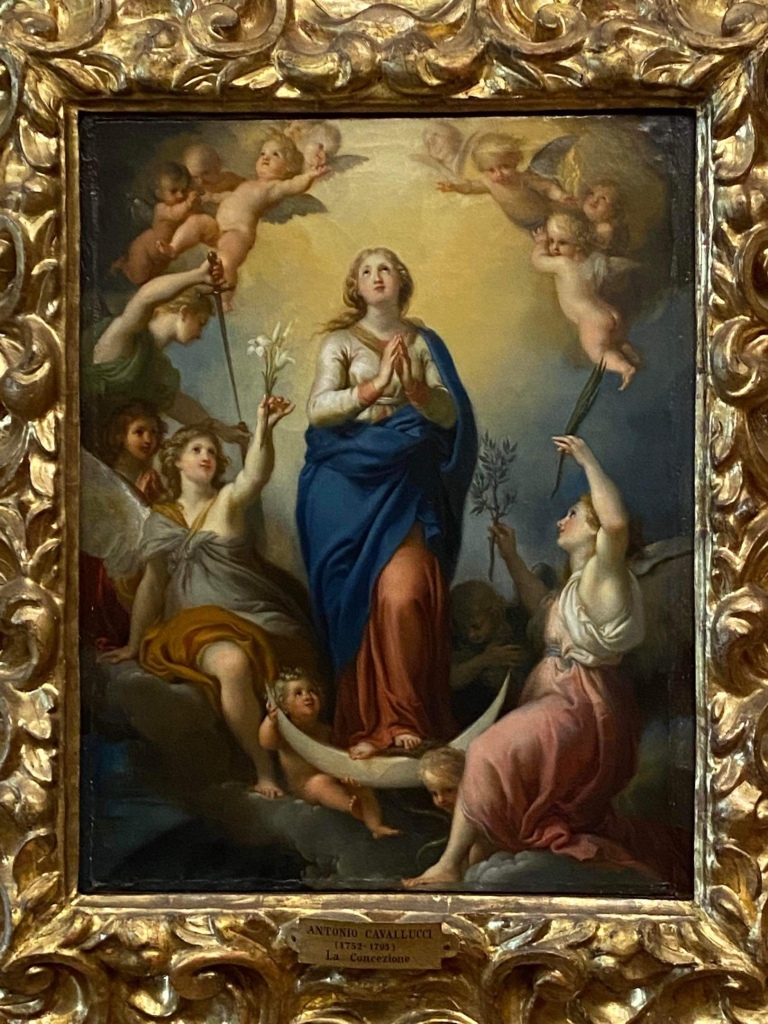
Until now, many Catholics still get wrong the meaning of the Immaculate Conception of Mary we celebrate today. Very often, they thought it is the Immaculate Conception of Jesus by Mary his Mother.

Wrong. The Immaculate Conception refers to St. Anne’s pregnancy of the Blessed Virgin Mary. According to Ineffabilis Deus issued by Pope Pius IX on December 8, 1854 establishing the dogma of the Immaculate Conception of Mary that had long been held as a tradition in the Church, the Blessed Virgin “in the first instance of her conception, by a singular privilege and grace granted by God, in view of the merits of Jesus Christ, the Savior of the human race, was preserved exempt from all stain of sin.”

Unlike everyone of us stained by original sin, Mary in all eternity was spared from any sin by God himself so that she would be pure and clean to conceive and bear, and eventually gave birth to the Son of God, our Lord Jesus Christ.

Count the months from December 8 to September 8 the birthday of Mary, you get exactly nine months and perhaps that gives you a clearer picture now of what the Immaculate Conception refers to. But, what should rely merit more of our attention in this great celebration happening also in this merry month of December is the great reality of how God works in wondrous and mysterious ways among us, asking for our cooperation for its realization.

Are we willing to be like the Blessed Virgin Mary to be God’s partner in bringing salvation in this world?

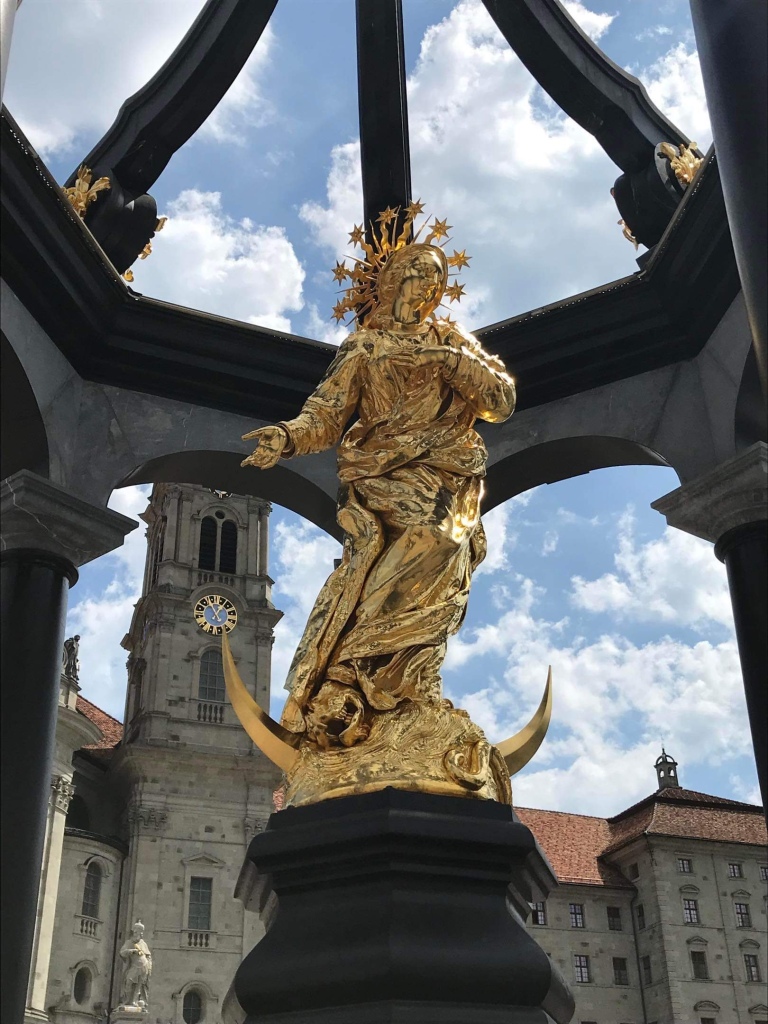
Photo by Fr. Gerry Pascual of Iba, Zambales at Einsiedeln Abbey, Einsiedeln, Switzerland, 2019.

Maybe one of the sources of confusion on the Immaculate Conception is the fact that it is not found in the Scriptures. See how our gospel today actually speaks of the annunciation of the birth of Jesus Christ; however, from this we can also glean Mary’s Immaculate Conception by being referred twice by Luke as a virgin.

The angel Gabriel was sent from God to a town of Galilee called Nazareth, to a virgin betrothed to man named Joseph, of the house of David, and the virgin’s name was Mary. And coming to her, he said, “Hail, full of grace! The Lord is with you.”

Luke 1:26-28

It is very interesting to keep in mind that the two dogmas about the Blessed Virgin Mary – the Immaculate Conception and the Assumption issued 100 years later – speak of our beginning and end. In the Immaculate Conception, we are reminded of our original status of being pure and sinless until the fall of Adam and Eve we have heard in the first reading. The Assumption on the other hand, tells us of our destiny in the future, of “the resurrection of body and life everlasting”.

Originally before our fall, we have always been clean and sinless. Like Mary in her Immaculate Conception. See how Luke was very specific in using twice the term virgin or parthenos in Greek because at that time like ours, not all maidens were virgin.

Photo by Rev. Fr. Gerry Pascual of Iba, Zambales at Santuario di Greccio, Rieti, Italy in 2019.

Virginity here does not only speak of the physical sense but also of the deeper spiritual meaning of being clean and open to receive, to accept God in our hearts, in our being. A virgin is someone who is pure and clean of heart like in the Beatitude taught by Jesus Christ at his sermon on the mount, “Blessed are the clean of heart for they shall see God” (Mt. 5:8).

How sad that in our highly competitive and materialistic world, the value of virginity is laughed at or even frowned upon like a handicap or a shortcoming, clear sign of how far we have veered away from God and his teachings. Worst, we have limited our views of virginity and purity to the physical level, forgetting to shift to higher level of understanding and appreciation.

To have a clean or pure heart is to be like Jesus Christ, wholly united and obedient to the Father. Jesus himself proclaimed that everything he had said and done were not his but of the Father. That is the purity of the heart of Jesus, deeply one in the Father that he was the first to see God.

And that is also the kind of person our Blessed Mother is, the model disciple of Jesus her Son for having a heart one with his that on her Assumption she truly became the first to see God too!

Recall also how at the wedding feast in Cana, Mary showed us the example of having a clean heart, of “doing whatever he tells you” which she later proved at the foot of the Cross by standing there with Jesus until his death. That is why according to the meditation of St. Ignatius of Loyola, the Risen Lord first appeared to his Mother, the Blessed Virgin Mary because she was the first to believe in him totally.

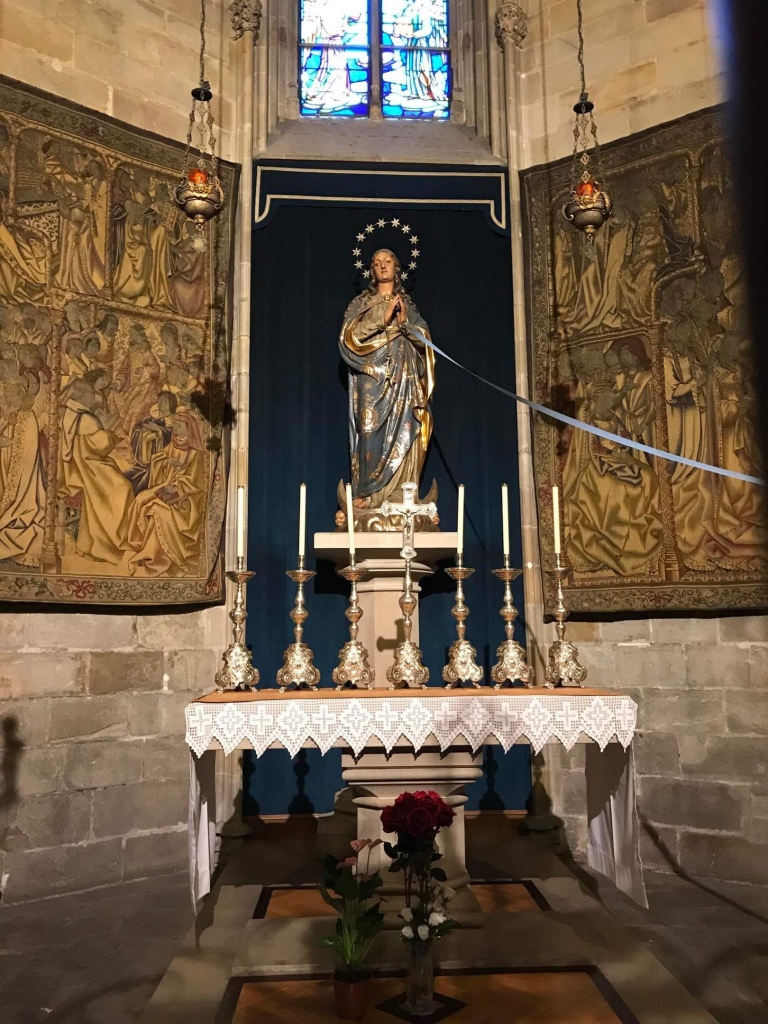
Photo by Fr. Gerry Pascual of Iba, Zambales at the Cathedral of Barcelona, Spain in 2019.

On this Solemnity of the Immaculate Conception of Mary, we are reminded that like her, we are all filled with grace from God in Jesus Christ. St. Paul beautifully expressed this in our second reading today.

Brothers and sisters: Blessed be the God and Father of our Lord Jesus Christ, who has blessed us in Christ with every spiritual blessing in the heavens, as he chose us in him, before the foundation of the world, to be holy and without blemish before him.

Ephesians 1:3-4

The grace of this Solemnity is the reality how God continues to work his wondrous deeds in this world among us, in us through his Son Jesus Christ. But, all his plans can only be realized when we his children are willing to cooperate with him, to be open like Mary to receive Jesus Christ.

Again, we do not have to take everything in the literal sense. God announces to us his coming every day not through the angel Gabriel but through those people around us, especially those we take for granted like the weak and marginalized, the children we do not take seriously because they are kids or the senior people especially the old and sick we find as burdensome.

Like Mary, we are all full of grace, the Lord is with us. Can we show him in our loving service to one another?

Let us pause on this day to go back to our roots in God, our origin and end in order to have that empty space for his Son Jesus Christ to come and work in us in healing us and our very sick world. Amen.

Praying for integrity

The Lord Is My Chef Daily Recipe by Fr. Nicanor F. Lalog II
Tuesday, Memorial of St. Anthony of Padua, Priest & Doctor of Church, 13 June 2023
2 Corinthians 1:18-22   <*((((>< + ><))))*>   Matthew 5:13-16
Photo by author, Mount Sinai, Egypt, May 2019.
Today, O Lord Jesus,
I pray for the gift of integrity,
of wholeness in you,
holiness not of being sinless
but filled with you like
St. Paul and St. Anthony of Padua
whose memorial we celebrate today.

Brothers and sisters: As God is faithful, our word to you is not “yes” and “no.” For the Son of God, Jesus Christ, who was proclaimed to you by us, Silvanus and Timothy and me, was not “yes” and “no,” but “yes” has been in him. For however many are the promises of God, their yes is in him. Therefore, the Amen from us also goes through him to God for glory.

2 Corinthians 1:18-20
In our world that thirsts for integrity
when many people find ways to 
compromise their faith and beliefs
with the gall of defending themselves
by refusing to call their dissimulation a lie,
teach us, dear Jesus to be like St. Paul
in taking your example at the Cross as 
basis of our integrity in you 
by dying too for what is
true and good and just.
Give us the courage 
to mean what we say 
by proving it with our actions.
Like St. Anthony of Padua who said,
"Actions speak louder than words;
let your words teach
and your actions speak."

O dear Jesus,
let us realize it is not enough
to be blessed and imbued with your
beatitudes; let our blessedness 
be visible like light
and be experienced by others
like salt as our lives of integrity
give flavor to the bland taste
of lies and dishonesty
of the world.
Amen.


Practical blessedness

The Lord Is My Chef Sunday Recipe by Fr. Nicanor F. Lalog II
Sunday in the Fifth Week of Ordinary Time, Cycle A, 05 February 2023
Isaiah 58:7-10 ><}}}}*> 1 Corinthians 2:1-5 ><}}}}*> Matthew 5:13-16
Photo by author, Bolinao, Pangasinan, 2022.

We are still at the sermon on the mount by Jesus Christ that opened last Sunday with his teachings on the beatitudes. We have reflected that the beatitudes are actually Jesus Christ himself that are supposed to be the very disposition of his disciples by being like him who is “poor in spirit”, “meek”, “afflicted”, “hungry and thirsty for righteousness”, “merciful”, “clean of heart”, “peacemaker”, and “persecuted”.

Every disciple is already blessed in Christ because blessedness is primarily a being like status in Facebook, not a mere doing. What a dignity we all have in Jesus in being called blessed! That is why this Sunday Jesus is teaching us the practical side of our blessedness, of being “the salt of the earth” and “light of the world” that call on the characteristics and demands of being like Christ, of conforming to his gospel of salvation.

See that being a salt and a light perfectly match the beatitudes when we say, “Blessed are you who are the salt of the earth and the light of the world”! For this Sunday, let us focus on the call of being the light of the world.


After praying over today’s gospel, I saw on a friend’s FB this post from Meralco inviting anyone interested in becoming a lineman. The tag-line was very catchy, “Handa na ba kayo maghatid ng liwanag?” (Are you ready to bring light?) with a hashtag, #BuildingABrilliantFuture.

From Meralco/fb

I felt the Meralco advertisement so brilliant, extolling the great honor of being a lineman who brings light to homes and schools, offices and factories, and everywhere. Requirements are actually minimal except for that most important thing of not having fear of heights. Of course!

But, Jesus Christ’s call to us all is more pressing, more important. More than the linemen building the facilities that will bring light to towns and cities, Jesus invites us to be the light ourselves.

Jesus alone is the light of the world. The light we carry is his. We are all Christ-light who reflect the very light of Jesus Christ in our good works and loving service to others, in our witnessing to our faith.

Words are not enough to bring his light to the world. The light of Christ shines brightly in us when we are witnessing truth and justice, kindness and mercy among our brothers and sisters, when we bear all pains and sufferings in continually working for peace and uplifting of the lowly despite so many accusations by those in power. Here we find that being the light of the world is to put into practice the beatitudes of having a clean heart, of being peacemakers, and being persecuted. It is when we work on them that our light shine before others that upon seeing our good deeds, it is God whom they glorify and not us:

Jesus said to his disciples: “Just so, your light must shine before others, that they may see your good deeds and glorify your heavenly Father.”

Matthew 5;16

See the following verses when Jesus described in details his teachings of being good, of witnessing his gospel values, he also warned us his disciples to never do good deeds for the sake of being known and popular. It is very clear that in being the light of the world, it is God who must be seen in us not our selves. Living the beatitudes is not having the most “likes” and “reactions” in Facebook nor of being viral nor trending. Moreover, it is definitely not being an “influencer” whatever that word means.

At the same time, Jesus Christ’s call for us to be his light ourselves is also a call for us to work as a community, not just as individuals. It is perfectly good if every disciple will shine brightly as a light of Christ but it is better when all disciples as a community of believers shine in gospel values!

You are the light of the world. A city set on a mountain cannot be hidden. Nor do they light a lamp and then put it under a bushel basket; it is set on a lampstand, where it gives light to all in the house.

Matthew 5:14-15
Photo by author, La Mesa Dam Eco Park seen from OLFU-Quezon City, 01 February 2023.

How sad that lately, the world has grown darker not only because of fewer men and women sharing the light of Christ with their witnessing of the gospel but because nations and regions have abandoned the faith. Many are getting de-Christianized on a wholesale basis these days.

Nobody seems to care at all anymore of not going to Mass face-to-face while everyone is so glued on their cellphone and computer screens without a whimper of opposition or rejection even disdain with all the trash coming out in social media like TikTok so saturated with sexual content ranging from same sex relationships to display of too much skin and use of indecent language.

Making matters worst are the many priests and religious lacking understanding in communication who do all the stupid things on camera that instead of evangelizing are demoralizing the faithful. And the tragedy is how most of these media practitioners in the Church are simply playing on novelties than creating innovations in employing the modern means of communications that result in just creating cults around themselves and miserably fail in evangelizing the people. This is the message of St. Paul in the second reading, reminding us that faith rests on the power of God than in the personality and eloquence of the priests and bishops.

Christ’s call for us to be the light of the world is a resounding call we must all respond to in this present age through deep prayer to be immersed in the person of Christ, the light of the world. It is only Jesus and always Jesus whom we must share and give to the people by realizing and affirming our prophetic functions in denouncing the ways of the world of injustice against the poor and the hungry like what Isaiah described in the first reading.

The world badly needs prophets these days, men and women like Christ who are “light rising in the darkness who would turn gloom into midday” (Is.58:10) for indeed as the psalmist declares, “The just man is a light in darkness to the upright.” Amen.

Have a blessed and illuminating week ahead in Jesus Christ!

Photo by author, 01 February 2023.

True blessedness

The Lord Is My Chef Sunday Recipe for the Soul by Fr. Nicanor F. Lalog II
Sunday in the Fourth Week of Ordinary Time, Year A, 29 January 2023
Zephaniah 2:3, 3:12-13 ><}}}*> 1 Corinthians 1:26-31 ><}}}*> Matthew 5:1-12
Photo by author, 2020.

Blessedness is a very contentious term for us Filipinos. Very often, we equate blessedness with being rich and wealthy like having a lot of money, a beautiful house, and the latest car model as well as clothes and gadgets. Being blessed sometimes means being lucky or fortunate like winning the lotto or having a child graduating in college or getting promoted in one’s job.

In the Visitation, Elizabeth defined for us the true meaning of being blessed like Mary as someone who believed that what the Lord had promised her would be fulfilled (Lk.1:45). Blessedness is essentially a spiritual reality than a material one; however, it implies that being blessed results from doing something good like being faithful to God.

Today in our gospel from Matthew, Jesus shows us that blessedness is still a spiritual reality than a material one but, it is more of a being – like a status in Facebook – than of doing.

Most of all, being blessed is not being in a good situation or condition when all is well and everything proceeding smoothly in life; blessedness according to Jesus at his sermon on the mount is when we are on the distaff side of life like being poor, being hungry, being persecuted and insulted – being like him!

Photo by author, Church of the Beatitudes, Israel, 2019.

“Blessed are the poor in spirit, for theirs is the kingdom of heaven. Blessed are they who mourn, for they will be comforted. Blessed are the meek, for they will inherit the land. Blessed are they who hunger and thirst for righteousness, for they will be satisfied. Blessed are the merciful, for they will be shown mercy. Blessed are the clean of heart, for they will see God. Blessed are the peacemakers, for they will be called children of God. Blessed are they who are persecuted for the sake of righteousness, for theirs is the kingdom of heaven. Blessed are you when they insult and persecute you and utter every kind of evil against you falsely because of me. Rejoice and be glad, for your reward will be great in heaven.”

Matthew 5:3-12

After going around the shores of Galilee, preaching and healing the people, Jesus went up a mountain upon seeing crowds were following him. They were mostly poor people with deep faith in God, hoping and trusting only in him for their deliverance called the anawims.

They were in painful and difficult situations, maybe like many of us, fed up with the traffic and rising costs of everything, fed up with the corruption among public officials and most of all, disillusioned with our priests and bishops!

Then, Jesus called them blessed.

Now, please consider that it is more understandable and normal to say that after being persecuted or after losing a loved one, after all these sufferings that people would be blessed, that the kingdom of God would be theirs.

But, that is not the case with the beatitudes whereby Jesus called them already blessed now, right in their state of being poor, being persecuted, being maligned!

Keep in mind that Matthew’s audience were his fellow Jewish converts to Christianity. By situating Jesus on the mountain preaching his first major discourse, Matthew was reminding his fellow Jewish converts of their great lawgiver, Moses who stood on Mount Sinai to give them the Ten Commandments from God.

However, in the sermon on the mount, Matthew was presenting Jesus not just as the new Moses but in fact more than Moses because Jesus himself is the Law. His very person is what we follow that is why we are called Christians and our faith is properly called Christianity so unlike other religions that are like philosophies or any other -ism.

To understand the beatitudes, one has to turn and enter into Jesus Christ for he is the one truly poor in spirit, meek, hungry and thirsty, merciful, clean of heart, who was persecuted, died but rose again and now seated at the righthand of the Father in heaven. Essentially, the Beatitudes personify Jesus Christ himself. Those who share what he had gone through while here on earth, those who identify with him in his poverty and meekness, mercy and peace efforts, and suffering and death now share in his blessedness.

Therefore, the Beatitudes are paths to keeping our relationship with Jesus Christ who calls us to be like him – poor, hungry and thirsty, meek, clean of heart and persecuted. The Beatitudes are not on the moral plane like the Decalogue that tells us what to do and not to do. Have you ever used the Beatitudes as a guide in examining your conscience when going to Confessions? Never, because the Beatitudes are goals in life to be continuously pursued daily by Christ’s disciples.

Photo by author, Church of the Beatitudes, Israel, 2017.

The Beatitudes are more on the spiritual and mystical plane of our lives that when we try imitating Jesus in his being poor and merciful, meek and clean of heart, then we realize and experience blessedness as we learn the distinctions between joy and happiness, being fruitful and successful.

That is when we find fulfillment while still here on earth amid all the sufferings and trials we go through because in the beatitudes we have Jesus, a relationship we begin to keep and nurture who is also the Kingdom of God. Of course, we experience its fullness in the afterlife but nonetheless, we reap its rewards while here in this life.

As we have noted at the start, we must not take the beatitudes in their material aspect but always in the spiritual meaning. This we find in the first beatitude, Blessed are the poor in spirit, for theirs is the kingdom of heaven.

Actually, this first beatitude is the very essence of all eight other blessedness. Everything springs forth from being poor in spirit, of having that inner attitude and disposition of humility before God. We cannot be merciful and meek, nor pure of heart nor peacemakers unless we become first of all poor in spirit like Jesus, who, “though he was in the form of God, did not regard equality with God something to be grasped. Rather he emptied himself, taking the form of a slave, coming in human likeness and humbled himself” (Phil. 2:6-7, 8).

The prophet Zephaniah showed us in the first reading that poverty in the Old Testament does not only define a social status but more of one’s availability and openness to God with his gifts and calls to us to experience him and make him known. Experience had taught us so well that material poverty is one of life’s best teacher as it leads us to maturity and redemption best expressed in the Cross of Jesus Christ.

In this sense, the beatitude is also the “be-attitude” of every disciple who carries his cross in following Christ. See that each beatitude does not refer to a different person; every disciple of Jesus goes through each beatitude if he/she immerses himself/herself in Christ. That is why last week Jesus preached repentance which leads to conversion. Notice that the beatitudes of Christ are clearly opposite and contrary to the ways of the world as St. Paul tells us in the second reading with God calling the weak and lowly to manifest his power and glory.

Many times in life, we fail to recognize our blessedness when we are so focused with what we are going through, with our work and duties and obligations. This Sunday, Jesus takes us up on the mountain, in the celebration of the Holy Eucharist for us to see ourselves blessed and loved right in the midst of our simplicity and bareness, sufferings and pains. Stop for a while. Find Christ in all your troubles or darkness in life. If you do not find Jesus in your labors and burdens, you are just punishing yourself. If you find Christ because you see more the face of other persons that you become merciful, you work for peace, you mourn and bear all insults and persecution… then, you must be loving a lot. Therefore, you are blessed! Amen.

Have a blessed week ahead!

Photo by author, Church of the Beatitudes, Israel, 2017.

Heaven our Promised Land

The Lord Is My Chef Daily Recipe for the Soul by Fr. Nicanor F. Lalog II
Tuesday, Solemnity of All Saints, 01 November 2022
Revelation 7:2-4, 9-14 ><}}}}*> 1 John 3:1-3 ><}}}}*> Matthew 5:1-12
Glory and praise to you,
O God our loving Father 
in fulfilling your Promised Land
to us all in Jesus Christ
in heaven!

Blessed are the meek, for they shall inherit the land.

Matthew 5:5
Thank you for the gift
of All Saints Day as we remember
and emulate those who have gone
ahead us into heaven,
the real Promised Land you
had promised since the beginning;
more than a piece of land nor a country
nor a continent nor a place in this planet,
your Promised Land dear God is heaven -
a sacred space within us where YOU and I,
Father, commune, live together as one in
Jesus Christ.
Heaven is the paradise Jesus
promised the thief on the Cross;
Heaven is when we live in communion
in Jesus Christ not only after we have died
but while we are still here on earth,
when we are meek and humble 
bearing in you and with you
the pains and sufferings
of lovingly serving others,
of working for peace, 
of hoping in eternity.
Inheriting the land, dear Jesus,
means orienting our goals into
striving to let your reign of peace
be a reality despite all the troubles
we have here on earth; after all,
history has shown us how the violent 
and powerful conquerors have come
and go when it is always the humble
and lowly who remain and last longer
just like the Saints now in heaven.
Enable us dear Jesus 
to alway listen and pray,
most of all abide in your words
like the Saints who have truly
lived out the Scriptures that they
have inherited heaven; like all the
Saints now in heaven, may we put
into practice the words of the Sacred
Scriptures no matter how we may 
sound and look foolish like with the experiences
of St. Paul, St. Francis, and St. John Paul II;
the Saints are the best examples 
of being meek to inherit the land
because in living out the Sacred Scriptures,
they have opened so many possibilities 
of good things in life in the future,
not only in heaven but here on earth
as testified by their many works
and teachings still continuing to this day.
As we slowly return
to normal these days, Jesus,
may we humbly return to you
in our Sunday Masses when
you as Prince of Peace reigns
supreme in your words proclaimed, 
in your offering of your Body and Blood,
when we also create a sacred space 
for you in our hearts so that every Eucharistic
celebration becomes a dress
rehearsal of our entry into heaven.
Amen.

*Photo credits: from en.wikipedia.org painting by Fra Angelico called “The Forerunners of Christ with Saints and Martyrs”.