Ageing gracefully

Quiet Storm by Fr. Nicanor F. Lalog II, 15 January 2026
Photo by Ar. Philip Santiago, Basilica of the Annunciation, Israel, October 2025.

Two priests and a former nun personally known to me died in our diocese last Sunday. It was also the birthdate of the late Bishop Cirilo Almario, Jr. whom I had remembered in my two early morning Masses on that Sunday, January 11, 2026.

In those two Masses too I mentioned in my homily the retreat I facilitated first week of January with my friends about “ageing gracefully” – my own realizations since joining their ranks as senior citizens last March.

Let me elaborate those two points I have shared with them and in my homily last Sunday.

From forbes.com.

First, let us embrace our being old. Stop saying “when we get old”, pagtanda natin because we are already old. Period. Matanda na tayo.

We cannot reverse our ageing process and it is useless to have all these cosmetic manipulations like dyeing our hair black or stretching our sagging skin and removing those wrinkles.

Embrace old age. It is beautiful and wonderful because it is so good. Our Filipino word for “old” says it all – matanda – which ironically so many women hate to hear as they stress that kalabaw lang ang tumatanda. That is not true.

Our word matanda is from the root word tanda which means “sign” that is why an old person is rightly called matanda because he/she is a sign of God’s goodness, a sign of God’s mercy and love, a sign of God’s beauty and majesty.

Moreover, a matanda is a sign of wisdom and grace that is why when we were young boys, we wanted to be old by putting our dad’s eyeglasses or taste his cigarettes and beer while girls put on their mom’s make up and high heeled shoes. How funny that when we are already old, we resist to accept the fact that we strive to look young again, sometimes ending up as nagmumurang kamatis.

Photo by Mr. Jim Marpa, 2019.

Technically speaking, “old” is actually harsh. Old is something about a past phase that has ran its course like being outdated. Luma in Filipino that connotes stale, passe, lacking relevance and sadly, useless. Just for display purposes. As a person, that is the one we refer to as walang pinagkatandaan. Or huklubang matanda.

To be more specific, the better English term referring to ageing gracefully is ancient that exudes with a sense of timeliness, of being perpetually relevant like the ancient ruins in Rome, Athens, and Jerusalem. Actually, some biblical experts have wanted to rename the “Old Testament” as “Ancient Testament” following this line of thinking.

Photo by author, Ephesus, Turkiye, November 2025.

Things and even persons can rightly be referred to as ancient because of their beauty still intact that inspires us and makes us wonder about life itself. They are not just old sites nor old persons that remind us of the past long gone but ancient because still lovely, “still full of sap and green” as the psalmist extolled the seniors of his time.

Persons who age gracefully like ancient sites stir our inner selves with deeper beauty and realities of life that eyes cannot see. That is perhaps the reason these days many senior men and women are so “in” and considered as attractive.

It is the same wisdom realized by St. Augustine when he wrote about God, “Late have I loved you, O Beauty ever ancient, ever new, late have I loved you. You were within me, but I was outside, and it was there that I searched for you.”

Being ancient -whether as a person or a thing – is something of the inside we must turn to not outside like our skin and physical body. From that inside realization and acceptance of being senior or elderly we experience the grace of ageing because we experience God still present in us, in fact loving us more as he makes as a sign or tanda of his loving presence.

Ageing gracefully is a modern virtue we need to cultivate in this age of instants that glorify youthfulness equated with usefulness. That is why when Pope Benedict XVI resigned from the Papacy in 2013, the more I have come to love and admire him. In his resignation, he taught us the importance of embracing and lovingly accepting our old age when we can no longer adequately perform our many tasks in office even in life itself. It was not a failure nor a surrender in the negative sense but more of a deep courage and trust in God that we accept our being weak and ready to come to him soon.

Photo by author, Pundaquit, San Antonio, Zambales, May 2025.

This brings me to my second realization since turning sigisty years old last year: corollary to embracing old age is accepting death. That is why, as seniors, let us stop saying and thinking of our coming death because we are already dying. Huwag na nating isipin yung “kapag namatay ako” dahil namamatay na nga tayo.

Being senior is doing away with those bucket lists, of thinking about things to do, places to visit before we die. We are already dying and hence, whatever you can do, do it now. There could be no more tomorrow. All we have is the present moment. Anything could happen to us, for better and for worse.

Ageing gracefully is coming to terms with life which leads us to coming to terms with death. Yes, this is easier said than done, but slowly, I am learning and loving it!

Photo by author, Bucharest, Romania, November 2025.

One of the reasons that made me decide to become a priest in the early 1990’s was the conviction that I have felt so deeply God’s love for me as a person in the many experiences I have gone through in life. I felt at that time that by becoming a priest, I could convince more people about the truth and existence of this loving God we have.

I still hold on to that but a year after turning sigisty, becoming sigisty-one in March 22, another fascinating realization I have had is how wonderful this life is. Now that I am old, the more I can boldly claim with conviction that it is good to be alive. Masarap pa rin ang mabuhay! Maganda ang buhay maski mahirap!

Accepting and embracing our ageing, our getting weak, our failing memory are all kinds of dying. And in that midst that we actually live fullest and meaningfully. I don’t know if I can write any further because I ain’t dead yet but… just in case, it was worth the trip. Amen. May you have a fruitful and fulfilling weekend ahead.

A more decisive 2026 in Christ

Lord My Chef Sunday Recipe for the Soul by Fr. Nicanor F. Lalog II
Feast of the Baptism of the Lord, Cycle A, 11 January 2026
Isaiah 42:1-4, 6-7 ><}}}}*> Acts 10:34-38 ><}}}}*> Matthew 3:13-17
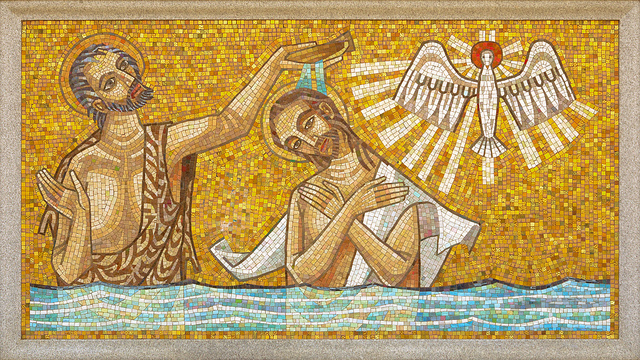
Mosaic of the Lord’s Baptism by John at the Neonian Baptistery, Ravenna, Italy; from wikimedia commons.

Still, our greeting today is a blessed Merry Christmas until the last Mass tonight when we close the Christmas Season with this Feast of the Lord’s Baptism. Tomorrow we shift into the Ordinary Time with the green motif back in our liturgy.

Most often during this time of the year, many of us make “new year’s resolutions” that always end up unfulfilled, discarded, and forgotten because these are merely based on whims or fads or anything less than a matured decision. A decision is the making up of the mind and heart to act firmly on something; hence, it connotes a sense of determination in fulfilling that decision made.

In this Feast of the Lord’s Baptism, Jesus invites us to reflect our decision-making process as we embark on another journey of twelve months in him with Matthew as our guide so we can be more matured in our faith and as a person.

Jesus came from Galilee to John at the Jordan to be baptized by him. John tried to prevent him, saying, “I need to be baptized by you, and yet you are coming to me?” Jesus said to him in reply, “Allow it now, for thus, it is fitting for us to fulfill all righteousness.” Then he allowed him (Matthew 3:13-15).

From wikimedia.org.

See the brief and direct reportage by Matthew of the event that immediately followed his story last Sunday of the Lord’s Epiphany to the world represented by the wise men from the East as we meet Jesus today all grown up, so matured as a man in his decisions.

And what do we find so remarkable in his decision-making process we can all emulate? His obedience to the Father!

All throughout his ministry, Jesus always made known to everyone that whatever he said and did were not his but the Father’s will. From his coming here at the first Christmas until his death on the Cross, it was all about Christ’s obedience to the Father. In fact, there was no need for him to be baptized by John for it was a baptism of repentance because Jesus is sinless, being the Son of God. Yet, he decided to be baptized “to fulfill all righteousness” as planned by the Father. In a similar manner, see John’s obedience too to Jesus and the Father when he could had insisted not to do it because Jesus is the Christ.

Photo by author, 2025.

Fulfillment of every aspiration and mission in this life becomes difficult when we insist on what we know or what we prefer rather than what God wills for us.

Obedience is one virtue that is vanishing in this modern age so characterized by everyone wanting to be in control of everything, of one’s life and even of others expressed in those handheld gadgets as well as cars and other vehicles. See how everyone would want to “drive” one’s own life, totally disregarding those in authority especially God.

The word obedience is from two Latin words “ob audire” that literally means “to listen attentively”.

One cannot be obedient without first learning to listen that begins with our willingness to to be silent. Jesus is obedient because he always listens to the Father through frequent and long periods of prayers. Even the Blessed Mother as we reflected last January first exemplified the virtue of obedience when she listened intently and treasured in her heart the words spoken by the shepherds who came to adore the new-born Jesus in Bethlehem.

It would be nice this 2026 that we start cultivating a prayer life by embracing silence to listen attentively to God’s plans for us so that we could make the right decisions in life.

The opposite of “ob audire” in Latin is “absurdus” – exactly what we are when we make the wrong decisions and become absurd.

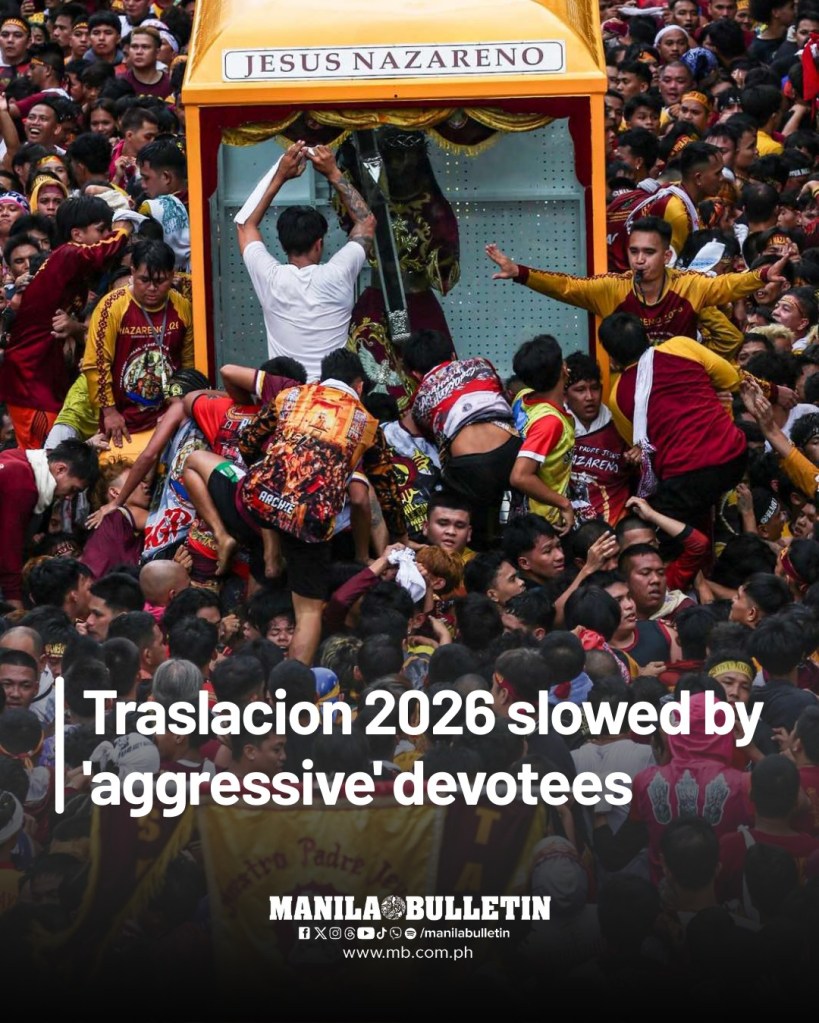
And sorry, that’s how we can describe this year’s Traslacion – absurd. In fact, every year, it becomes more absurd than ever and something drastic even radical has to be done in the real sense of the word, that is, by going back to its very roots.

When the devotees refused to obey the priests to stop at the San Sebastian Church and insisted on bringing the Poon Nazareno to Quiapo regardless of its many safety and practical implications, it was a clear case of misplaced devotion. It is fanaticism. Selfish and un-Christian. Despite the many defenses and theologizing by many, it is about time Nazareno devotees examine themselves about this devotion, of their panata that admittedly have been so baffling that if our faith in God is such intense, why are we still electing corrupt and evil officials?

Obedience is always a virtue because everything that is good follows when we are obedient, like being more loving at its truest sense. Whenever we decide out of obedience to God and parents and superiors, it is most often because of love.

Photo by Ryan Jacob, Paco, Obando, Bulacan, 2023.

This is the second characteristic of Jesus Christ’s decision-making process that is based on his love for the Father expressed in his love for us.

Again, there was no need for Jesus Christ to be baptized by John in the river Jordan because he is sinless but, he chose to be baptized there as a sign of his solidarity, of his oneness with us sinners and weak people. It was all because of love. 

Jesus chose to be baptized even there was no need because he loves us and wants to be one with us. Jesus chose to die on the Cross, as depicted in the Black Nazarene of Quiapo, because he loves us and wants to carry our burdens.  Jesus chose to be eaten as bread in the Holy Mass all because he loves us too so that we may have eternal life.

When Jesus went down to Jordan river, out of obedience and most of all out of love for all of us, he became one with us in our pains and hurts and sickness and failures and even sins which St. Peter realized personally that he declared after Pentecost that “God shows no partiality” (Acts 10:34) that we are all loved by God and are called to be obedient to him always by loving one another as he loves us. That is our mission, to love and be like Jesus Christ, the “Suffering Servant” who was “sent to bring forth justice… to open the eyes of the blind, to bring out prisoners from confinement, and from the dungeon, those who live in darkness” (Is.42:1,6-7).

Photo by Mr. Boy Cabrido, January 2024.

In going down into the dirty waters of Jordan River that signifies this earth, this life, Jesus showed us his mission of redeeming us so that we can become like him, God’s beloved child with whom he is well pleased. Every morning when we wake up, this scene at Jordan happens anew. The choice is ours to make by being like Jesus Christ who throughout his earthly life was a total obedience and yes to God because of love.

Last week I went to Baguio to facilitate a retreat with some of my kababata or teenage friends from my hometown of Bocaue. Being the youngest among them at 60 years old, I reflected about our senior years. Two things I shared with them:

First, as senior citizens, let us stop thinking of getting old because we are already old. Stop saying pagtanda ko… matanda na nga tayo. Let us face the reality we are old and find most especially the grace of God of reaching this stage. Being senior is to look with gratitude to our youth and to our past as we look forward to finding and meeting God who continues to call us to him.

Second, I told them to stop saying or thinking about our coming death because we are already dying. Huwag na nating isipin yung “kapag namatay tayo” kasi namamatay na nga tayo. Being senior is doing away with all those bucket lists, of things to do or places to visit before we die. We are already dying; hence, do whatever you can do now!

Perhaps the same propositions are applicable to anyone of any age. What matters is how much we love God and others expressed in our obedience to them like Jesus Christ. Let us keep following Jesus in the next twelve months of this 2026 to be filled with himself. Amen. Have a blessed week ahead.

Photo from forbes.com, 2019.

Age is just a number

The Lord Is My Chef Daily Recipe for the Soul by Fr. Nicanor F. Lalog II
Wednesday in the Sixteenth Week of Ordinary Time, Year II, 24 July 2024
Jeremiah 1:1, 4-10 <*((((><< + >><))))*> Matthew 13:1-9
Photo by Hatice Nou011fman on Pexels.com
"Ah, Lord God!"
I said,
"I know not how to speak;
I am too young."
But the Lord answered me,
say not, "I am too young."
To whomever I send you,
you shall go;
whatever I command you,
you shall speak
(Jeremiah 1:6-7).
I have always heard
that expression
"age is just a number"
without really understanding
nor having a grasp of its real meaning
until recently after losing my mom
and be totally orphaned of our parents;
how different it is now to live without
our parents and quickly realize
time flies so fast indeed
because suddenly we are catapulted
into that state in life when we are
in the very same situations
of our parents when we were younger;
now I could feel we are never too young
nor too old to be called and entrusted
by God with a mission in life.
Life indeed is a parable,
dear Jesus:
You come to us daily
whether we are too young
or too old to sow your seeds;
keep us open to receive You
so that we may bear You
and share You.
Amen.
“The Sower”, a painting by Van Gogh from commons.wikimedia.org.

Prayer to age gracefully

The Lord Is My Chef Breakfast Recipe for the Soul by Fr. Nicanor F. Lalog II
Saturday, Week XXV, Year II in Ordinary Time, 26 September 2020
Ecclesiastes 11:9-12:8     <*(((><<   +   >><)))*>     Luke 9:43-45
Photo by author, sunset at Silang, Cavite, 22 September 2020.

It is officially the end of the week, and how true are your words through Qoheleth that everything comes to an end, that we must strive to make every ending a happy one. Especially our very lives.

Rejoice, O young man, while you are young and let your heart be glad in the days of your youth. Follow the ways of your heart, the vision of your eyes; yet understand that as regards all this God will bring you to judgment. Ward off grief from your heart and put away trouble from your presence, though the dawn of youth is fleeting.

Ecclesiastes 11:9-10

God our Father, grant me the gift of ageing gracefully by having the grace of being excited and surprised each day while still young. It is said that it is not really time that is passing by if we waste it but us who are passing by because lost time can never be recovered or brought back.

Keep me excited and full of enthusiasm of following my heart, pursuing my vision of a better and beautiful future by celebrating every present.

Let me bear in mind Lord that I am not perfect so that I may always have room for my mistakes and those of others; keep me simple so as not to be demanding and exacting. Just let me enjoy life, trust more in you, worry less among us.

And in all my pursuits in life while still young, be at the center, Lord Jesus.

Let me keep in mind as you reminded your disciples in the gospel today, that I may not be so focused and amazed with great and wondrous deeds but most of all in how you have bore all pains and sufferings to save us.

After all, you saved the world by dying on the Cross, O sweet Jesus, and not with so many activities.

And that is the meaning of ageing gracefully: that towards the end of our lives when we sum up everything, we can always look back to the past, to our youth with pride and joy at how we have followed you Jesus in your Passion and Death while awaiting our glorious resurrection in you like the twin brothers Sts. Cosmas and Damian and others saints. Amen.