40 Shades of Lent, Monday, Week III, 16 March 2020
2 Kings 5:1-15 ><)))*> + <*(((>< Luke 4:24-30
Photo by author, Baguio Cathedral, January 2019.
Praise and glory to you, O God our Father for this Monday, our first working day and most of all, when all plans for community quarantine are put to severe tests. Please give us the grace to be simple and faithful to you.
In the eerie silence of this past weekend while many have finally stayed home and hopefully reconnected with you and family, we still need your tremendous grace to change our ways to become better persons and disciples of Jesus your son.
We pray most especially for our leaders in the government today to be sincere and simple but also professional, efficient and exceptional in serving the people.
Please, we pray O God, enough with our callous and grandstanding politicians who act like the king of Israel in the time of the Prophet Elisha who tore his garment and exclaimed against the friendly request of the king of Aram for Naaman’s healing, always seeking attention:
“Am I a god with power over life and death, that this man should send someone to me to be cured of leprosy? Take note! You can see he is only looking for a quarrel with me!” When Elisha, the man of God, heard that the king of Israel had torn his garments, he sent word to the king: “Why have you torn your garments? Let him come to me and find out that there is a prophet in Israel.”
2 Kings 5:7-8
Come to us, O God, send us a prophet who can stand up against these people playing gods and cast them down from their thrones. They have long been a burden to your people like those enemies of Jesus at the synagogue of Capernaum.
Likewise, keep us simple and faithful too, O God, that we learn to be obedient and cooperative in this time of serious emergencies. Like Naaman, help us to set aside our biases and other inclinations, thinking only of the good of the country.
Let our prayers and pieties bear fruit in more authentic service especially to the poor and those with less in life. Amen.
40 Shades of Lent, Sunday Week III-A, 15 March 2020
Exodus 17:3-7 +++ Romans 5:1-2, 5-8 +++ John 4:5-42
Photo by author, Parokya ni San Juan Apostol at Ebanghelista, Lent Week III, 2020.
Lent 2020 will be a very unforgettable liturgical season in modern time due to pandemic COVID-19. And for a lot of good, spiritual reasons which we have taken for granted even disregarded for so long. Consider these:
First, due to COVID-19 more people are now praying and celebrating the Holy Mass, imploring for Divine intervention to end this pandemic that has claimed so many lives since December 2019. In disrupting our way of life, COVID-19 made us realize to treasure every opportunity to celebrate the Holy Sacrifice of the Mass now being cancelled in many parts of the world, especially in our predominantly Catholic nation.
Second – most of all – in disrupting our flow and way of life, COVID-19 forces us today to reexamine our lives and values, our being Christians, of learning the true meaning of worshiping God “in Spirit and truth”.
Jesus said to her, “Believe me, woman, the hour is coming when you will worship the Father neither on this mountain nor in Jerusalem. You people worship what you do not understand; we worship what we understand, because salvation is from the Jews. But the hour is coming, and is now here, when true worshipers will worship the Father in Spirit and truth; and indeed the Father seeks such people to worship him. God is Spirit, and those who worship him must worship in Spirit and truth.” The woman said to him, “I know that the Messiah is coming, the one called the Christ; when he comes, he will tell us everything.” Jesus said to her, “I am he, the one who is speaking with you.”
John 4:21-26
Water, Spirit, and truth in Jesus Christ
So typical of St. John’s rich symbolisms, our gospel today conveys many lessons for us about life and its meaning in this time of COVID-19.
Like the Samaritan woman, many of us are soul-searching, thirsting for God. How ironic that a virus – microscopic organisms – have laid bare everything that has been going wrong with us, from our faith and religious practices as well as in our exercise of choosing our leaders in government who have only worsened the tough situations we are into in these first three months of 2020.
Many of us have rightly turned back to God for answers in the wrong manner: we are merely praying, asking God’s help but we refuse to change. We are asking him for strength but we are not willing to ask for redirection. Most of all, we keep on asking God for encouragement but we do not want to be converted.
In the story of the Samaritan woman and Jesus, we find the need to set aside our own agendas in life in order to draw water from God himself.
Water evokes life and the Well, especially in the Old Testament, symbolizes God. The Well is where one meets God to have more life. This is the context of the Samaritan woman going to Jacob’s well even at noon time when it is hottest. Why? Because the Samaritan is in deep trouble. She’s a sinner and ostracized by the people in her town because as Jesus pointed out to her, though she did not have any husband, the man she was living with at that time was her sixth partner!
Here lies the beauty of the gospel: despite her state of life, of the darkness in her, she comes to the Well, that is, to God. And this time, “this hour” as Jesus told her, she met the Lord and her life was changed.
Photo by author, ancient well in the oasis of Elim in Egypt (May 2019) where Moses camped with Israelites going to Mt. Sinai.
She was so surprised at how could Jesus knew that truth about her that she totally forgot all about fetching water, leaving her jar and Jesus behind proclaiming the good news back in her town.
Jesus is not only the water who quenches our thirst for life and meaning but also the Spirit who animates us, moves us to be filled with life. He is the fullness of the living water spoken so often in the Old Testament that can be drawn from the Well.
Here we find the clear linkages of water, Spirit, and truth in Christ Jesus who comes, right in our midst in every celebration of the Eucharist and even in the midst of our many crises and sufferings.
Most of all, Jesus is also the new Jacob who opens for us the heavens by inaugurating for us a new kind of worship in Spirit and truth when he dies on the Cross on Good Friday. Remember how Jacob also called Israel saw in his dream a stairway to heaven with angels going up and down (Gen. 28). This time in Sychar, the evangelist is showing us how Jesus is the new Jacob or new Israel, leading us all into heaven he had opened for us with his sacrifice on the Cross.
From FB photo by Ms. Lane Blackwater, 12 March 2020.
In this time of the COVID-19 pandemic, Jesus is coming right in our midst, reminding us to worship the Father in Spirit and truth through him by being more charitable with others like staying home when feeling sick, covering our mouth with mask or handkerchief when sneezing and coughing. Simply be considerate of others, be kind and be patient.
Check that beautiful account on Facebook by Ms. Lane Blackwater last Friday of some good Samaritans at a Landmark Supermarket.
According to Ms. Blackwater, it was a busy Wednesday evening with a lot of shoppers along with some hoarders probably when she overheard a pretty lady asking a Manong to get some more stuff for himself after seeing he just had a handful of groceries in his basket.
The lady assured Manong she would pay for everything. Manong was hesitant at first and eventually, took some more items, feeling so shy. But the nice lady insisted Manong to get more until eventually, some shoppers gave him canned goods while at the counter – all paid for by the many good Samaritans!
What a beautiful story about love in time of COVID-19!
From Facebook account of Ms. Lane Blackwater
Never test your God, for he cannot be outdone in generosity
I was teary eyed as I read that account by Ms. Blackwater, of how some people gave Manong additional groceries. It is the opposite of what the Israelites did while at Meribah and Massah of our first reading when they tested God in not having water to drink in the desert, asking “Is the Lord in our midst or not?” (Ex.17:7)
When you look at Manong, he appears to be a good person. I believe so. He must have felt God that evening. And most likely because he truly deserved it because, hopefully, he trusted in the Lord.
St. Paul rightly tells us in the second reading:
Indeed, only with difficulty does one die for a just person, though perhaps for a good person one might even find courage to die. But God proves his love for us in that while we were still sinners Christ died for us.
Romans 5:7-8
Jesus is surely with us in the midst of this COVID-19 pandemic, resting just like that hot noon in Sychar, waiting for anyone thirsting like the Samaritan woman. Let us learn the lessons of this crisis, let us worship in Spirit and truth to be amazed like the Samaritan woman. Or Manong at Landmark Supermarket.
40 Shades of Lent, Sunday Week II-A, 08 March 2020
Genesis 12:1-4 +++ 2 Timothy 1:8-10 +++ Matthew 17:1-9
“Creation of Adam” by Michaelangelo at Sistine Chapel, the Vatican. From Wikipedia.
Touch is a very powerful word – literally and figuratively speaking. We say “we are touched” when we are deeply moved by words or music, gestures, acts, and scenes that need not be so spectacular because to touch is about making a connection, a communion of persons.
A touch can be so powerful that when filled with love and sincerity, it can transform the person being touched. Experts say that a touch of about five seconds is worth more than 300 words of encouragement and praise!
And that is why our Lord Jesus Christ, the Son of God is a certified “touch person” who always reached out to people by physically touching them, embracing them to make them feel his loving presence, his mercy, and most of all, his healing.
Almost all his healings were done by touching the sick when he would lay his hands on them like with the blind Bartimaeus on the street of Jericho.
There were times Jesus held up the hand of the sick to raise them up from their bed like Peter’s mother-in-law and the daughter of Jairus. Sometimes in rare occasions, Jesus healed in the most bizarre ways with his sense of touch like with that deaf in Decapolis.
He (Jesus) put his finger into the man’s ears and, spitting, touched his tongue; then he looked up to heaven and groaned, and said to him, “Ephphatha!” (that is, “Be opened!”).
Mark 7:33-34
In Nain, Jesus raised to life the son of a widow by touching the coffin – not the dead – by saying, “Young man, I tell you, arise!” that everyone was amazed, saying “the Lord has visited his people”.
Jesus never missed an occasion without personally touching another person, especially the children like when he caught his disciples driving them away.
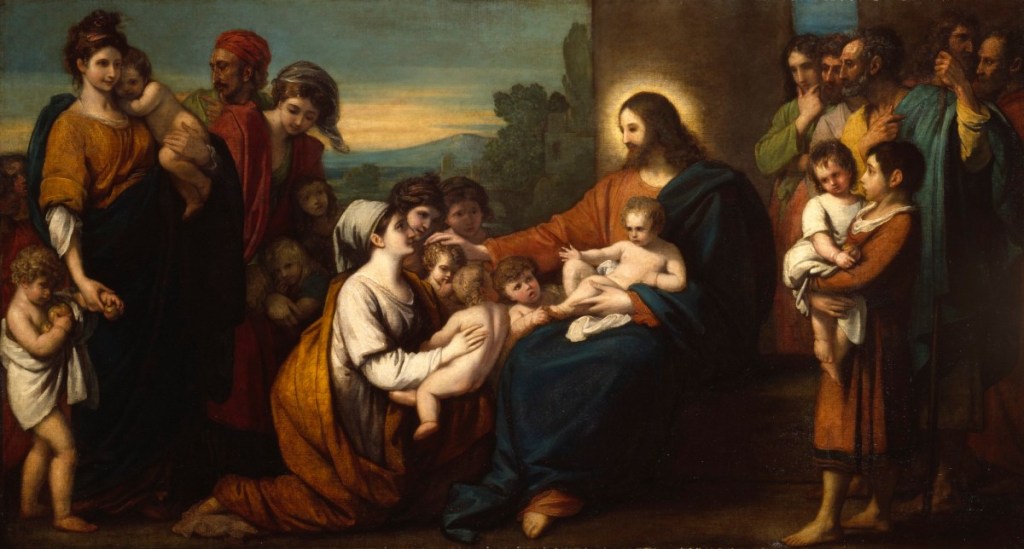
“Jesus blessing Little Children”, painting by British North American Benjamin West PRA (1781). Photo from wikipedia.
It is perhaps one of the most touching story of Jesus touching others when he told his disciples to “let the children come to me for theirs is the kingdom of heaven”, after which he embraced them, laid his hands on them and blessed them.
How blessed were those children must be to be embraced and laid with hands on by Jesus! According to tradition, one of those kids embraced and blessed by Jesus was St. Ignatius of Antioch who became a bishop and martyr in the early Church.
That is the transforming power of the touch by Jesus that children are blessed, the sick are healed by restoring their sight or cleansing their skin of leprosy, forgiving the sinners, giving hope to the poor. His touch is always a part of his proclamation of the good news to the people.
Jesus continues to touch us today in every Mass we celebrate when he first speaks to us in the scriptures, trying to make us feel our “hearts burn inside” like the disciples going home to Emmaus on Easter Sunday; and secondly, when he gives us his Body and Blood to partake in the Holy Eucharist.
Most of all, Jesus continues to literally touch us today through one another in our loving service to one another as a community of his disciples.
But, in this age of social media when every communication is mediated by gadgets and other instruments, this kind of personal communication is something we have all been missing because we have stopped touching Jesus, touching others too.
And this is what the second Sunday of Lent is trying to remind us today in the Transfiguration of Jesus.
Transfiguration of Jesus, communion of God with us
Jesus took Peter, James, and John his brother, and led them up a high mountain by themselves. And he was transfigured before them… a bright cloud cast a shadow over them, then from the cloud came a voice that said, “This is my beloved Son, with whom I am well pleased; listen to him.” When the disciples heard this, they fell prostrate and were very much afraid. But Jesus came and touched them, saying, “Rise, and do not be afraid.” And when the disciples raised their eyes, they saw no one else but Jesus alone.
Matthew 17:1-2, 5-7
“Transfiguration of Jesus” by Raphael from wikipedia.
We hear this story of the Transfiguration of Jesus twice every year: the Second Sunday of Lent and the sixth of August for the Feast of the Transfiguration. At this time of the year, the Transfiguration story is heard in relation with the Lord’s coming Passion, Death, and Resurrection.
At his Transfiguration, Jesus made it very clear that his glory and divinity must always be seen in the light of his Cross for it is only with his Cross that he can be correctly recognized as the Christ. It is on the Cross where Jesus truly touches us too in our personhood, in our humanity.
See how the three disciples were seized with fear upon hearing the voice of the Father while a bright cloud cast a vast shadow over them; but, it was right in that “tremendum fascinans” that we also find the intimacy, the closeness of God to us through Jesus Christ when he touched the three disciples.
Jesus came and touched them, saying, “Rise, and do not be afraid.” And when the disciples raised their eyes, they saw no one else but Jesus alone.
Matthew 17:7
And that is the good news for us all!
God had chosen to be so close to us in his Son Jesus Christ who touches us most not only in glory but most especially in moments of trials and tribulations! It is on the Cross where humanity and the divine truly become one in Jesus, when that personal and loving touch of Jesus becomes transformative and even performative.
This is the reason St. Paul exhorted Timothy to “bear your share of hardship for the gospel with the strength that comes from God” (2Tim.1:8) because oneness with Jesus always starts at the cross!
This is very true with us too when we only come to realize who are our true friends, our BFF’s when they are personally one with us in our trials and tribulations, not only in times we are well and good.
True transformation in Jesus can only happen when we are willing to be one with him, to be in touch with him in his passion and death for it is the only path to his Easter glory of transfiguration.
Touch communication vs. mediated communication
From Forbes.com
How sad that in this age of modern communications that have shrunk the world into a “global village” with instant communications that instead of growing together we have grown more apart than ever from each other.
We have lost real communications that lead to communion of persons or unity of people because we have become more concerned with the techniques of communication, more of skills and gadgets than of persons.
That is the meaning of media or “mediated communication” where there is always a medium between or among persons like cellphones and gadgets.
No more interpersonal relationships, making us more isolated and alienated, leading to growing problems of loneliness, depression, and suicides.
How frustrating sometimes to attend social functions like dinners and weddings where everyone is more busy and interested with their cellphones than with persons beside them!
Aside from isolation from persons, we have also grown “out of touch” with reality itself when more and more people are retreating into their own small worlds like cocoons with wires attached into their ears while their eyes fixated on screens oblivious to the world around them.
We have become so out of touch with ourselves and with others that more and more we are becoming like porcupines – we have not only stopped getting in touch with others but even hurt others if ever we touch them!
From Google.
Parents, lovers, couples, even people we trust like priests and religious sometimes hurt us with their touch instead of healing us, comforting us. Nobody would want to go through the Passion of the Cross anymore that we would rather stay on top of the mountain, of everything to be delighted with our perceived power and glory.
So unlike in our first reading where we get the feel and touch of real encounter in persons between God and Abraham. Note how in just four verses the word “bless” used five times by God to Abraham, promising to bless him more if he leaves his kin to follow him to the land he would give him.
In their conversation, we find a very personal and engaging communication, as if God and Abraham were literally in touch with each other, where there is personal contact and communication.
We know this for a fact at how effective and more reliable are personal interactions in communication than mediated ones through phones and email – personal communications always have that feel and touch that enable us to negotiate further and be more fruitful.
This Season of Lent, the Father is asking us to be in touch with him again by listening to the words of his Son Jesus who asks us only one thing: deny yourself, take up your cross and follow him. Let us heed him, touch him, and allow him to touch us again to be healed and transformed.
May you be touched as you touch also others in the most loving way this Sunday throughout the whole week! Amen.
Photo by author, Parokya ni San Juan Apostol at Ebanghelista, Bagbaguin, Santa Maria, Bulacan, Lent 2020.
Once again, our loving Father, I take the computer as my point of comparison for my prayer reflection on this second Friday of Lent.
Thank you in giving us this blessed season of Lent when we are able to “debug” our “internal hard drive” – the heart – to be cleansed of bugs and virus as well as unnecessary materials that slow us down to be holy and perfect like you.
Your words are very reassuring of how you want us to be “fixed” always, to be in good condition, filled with life and holiness.
Thus says the Lord God: “Do I indeed derive any pleasure from the death of a wicked?” says the Lord God. “Do I not rather rejoice when he turns from his evil way that he may live? Hear now, house of Israel: Is it my way that is unfair, or rather, are not your ways unfair? When someone virtuous man turns away from virtue to commit iniquity, and dies, it is because of the iniqity he committed that he must die. But if the wicked, trning from the wickedness he has committed, does what is right and just, he shall preserve his life; since he has turned away from all the sins that he committed, he shall surely live, he shall not die.”
Ezekiel 18:23, 25-28
Educate our hearts, O Lord.
Help us “surpass the righteousness of the scribes and the Pharisees” in Jesus Christ who have come to perfect the laws in himself, in love.
May your purifying love, sweet Jesus, cleanse us of our sins, delete our painful memories that continue to hold us back, preventing us to move forward and forgive others and especially our very selves.
Make us rejoice, O Lord, in your immense love and share it with others so that we may grow more in holiness in you. Amen.
40 Shades of Lent, Thursday, Week I, 05 March 2020
Esther C:12, 14-16, 23-25 +++ 0 +++ Matthew 7:7-12
Photo by author, Parokya ni San Juan Apostol at Ebanghelista, 01 March 2020, Bagbaguin, Santa Maria, Bulacan.
O God our Father, you know very well how ignorant I am with computers and the Internet. But, somehow, Lord, I have learned something very important with computers like the “default system” whereby a computer setting is on a desired preexisting configuration useful to the user.
On this season of Lent, help us to restore our default system in you, O God!
Make us stop “surfing” the universe for better default systems for there is no one better than you whom we must always have as our first option in everything, whether in good times or in bad.
Like Queen Esther in our first reading today who only had you as her recourse in seeking help for her countrymen:
“Now help me, who am alone and have no one but you, O Lord, my God… come to help me, an orphan. Put in my mouth persuasive words in the presence of the lion, and turn his heart to hatred for our enemy, so that he and those who are in league with him may perish. Save us from the hands of our enemies; turn our mourning into gladness and our sorrows into wholeness.”
Esther C: 13, 24-26
Create a clean heart in me, O God, so that I may always seek and follow you.
Most of all, incline my heart to you always so you may dwell in me to let justice and love and mercy reign in me. Amen.
Lawiswis ng Salita ni P. Nicanor F. Lalog II, Ika-04 ng Marso 2020
Ang panunukso ng diyablo kay Hesus sa ilang, isang mosaic sa loob ng Basilika ni San Markos sa Venice, Italy. Larawan mula sa psephizo.com.
Palagi na lang kung
ating titingnan
iisa lang napapakinggan
nang tuksuhin ng diyablo si Kristo:
"Kung ika'y anak ng Diyos...
gawin mong tinapay mga batong ito!"
"Kung ika'y anak ng Diyos...
magpatihulog ka mula taluktok ng templo!"
Puro "kung ika'y anak ng Diyos"
ang tukso ng diyablo kay Kristo
pati ng mga tao nang ipako siya sa Krus
patuyang hiniyawan, "Kung ikaw ang anak ng Diyos...!"
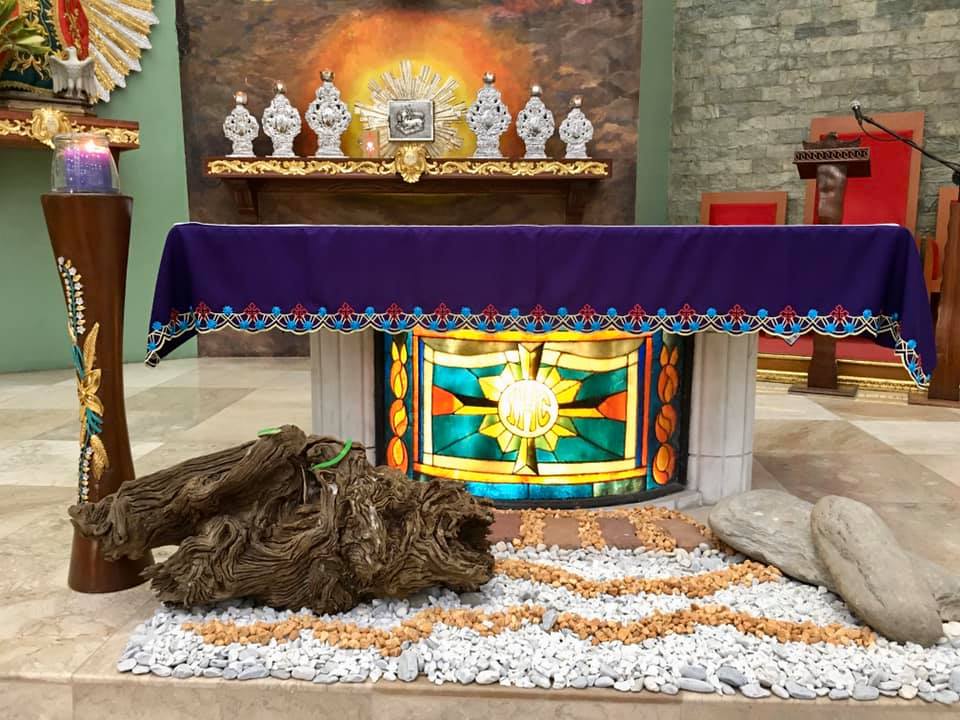
Larawan kuha ng may akda, gayak ng altar sa unang Linggo ng Kuwaresma, 01 Marso 2020, Parokya ni San Juan Apostol at Ebanghelista.
Ano kahulugan nito
sa ating mga tao?
Hindi ba ganito rin ang takbo
ng panunukso ng diyablo?
Sinisira ating pagkatao
tulad ni Kristo
upang tumalikod tayo
sa Diyos na tanging Absoluto sa mundo?
Ginugulo, nililito tayo ng diyablo
tanong niya ay "kung ikaw ang anak ng Diyos"
gayong ang totoo at sigurado tayo
taguri sa Diyos nati'y ,"Ako'y si Ako nga"!
Kuha ng may-akda, 01 Marso 2020.
Alalahanin huling tukso pa
ng diyablo kay Kristo
garapal at tahasang binigay
buong mundo kung siya ay sasambahin nito.
Ganyan din tayo
kung hindi malilito ng diyablo
bibilhin niya tayo
sa presyo na nakagugulo.
Kung ating tutuusin
maliwanag naman lahat sa atin:
iisa lang ang Diyos na sasambahin
na tunay nagmamahal sa atin.
Larawan kuha ng may-akda, 01 Marso 2020.
Ito ang diwa ng pag-aayuno at sakripisyo
sa panahon ng Kuwaresma
sarili'y dinadalisay, ang ilang ay tinutunguhan
upang Diyos muling matagpuan at maranasan.
Sarili'y huwag nang pag-alinlanganan
tayo ay sinasamahan ni Hesus
na dumaan din at nagtagumpay sa lahat ng
pagsubok at paghihirap (Hebreo 2:18).
Sa gitna ng kawalan ay ating katiyakan
at kaseguruhan sa Diyos Anak na sa sariling dugo
ating kasalanan ay hinugasan
upang tayo ay mapabanal at malampasan mga kasamaan.
40 Shades of Lent, Wednesday, Week I, 04 March 2020
Jonas 3:1-10 +++ 0 +++ Luke 11:29-32
Photo by Mr. Raffy Tima of GMA-7 News, Batanes, 2018.
Our dearest Father in heaven:
On this first week of Lent, we pray for the grace that we become more trusting of ourselves, of our worth, of our identity as your beloved children.
Until now, we can hear your Son Jesus our Lord lamenting that “This generation is an evil generation; it seeks a sign, but no sign will be given it, except the sign of Jonah (Lk.11:29)” because we keep on looking for signs from you and from others before we can believe in ourselves.
Remind us, O God, that we are already a sign of your presence in Christ Jesus, our Emmanuel or “God-is-with-us”.
Like Jonah in the first reading, we keep on running away from you, from disobeying your will.
Worst of all, like Jonah, we cannot trust you and others because we always doubt and mistrust the people around us of something good they could do.
From Google.
And sad to say, the very people we doubt much about their own abilities and goodness are the ones closest to us like husband or wife, children, brother or sister, and friends!
What a tragedy indeed that we always refuse to appreciate our worth as your beloved children that lead us to see also the value of others around us, especially those who truly care and love us like our family and friends.
May we have the grace and courage to finally be reconciled with you in the Sacrament of Confession in one of these 40 days of Lent, that we may return to you in Jesus Christ with our “whole hearts, for you are gracious and merciful.”
Most of all, may we believe more in you, O God, so we also begin to believe in our selves, in our goodness and ability to change for the best. Amen.
Isaiah 55:10-11 +++ 0 +++ Matthew 6:7-15 03 March 2020
Photo by author, Pulilan bypass road in Bulacan, 25 February 2020
Slow me down Lord, especially this Lent, a season when you invite us to rely in you alone as our life and fulfillment.
Forgive us Lord for being so impatient, when we cannot wait because we want to rush everything simply because we always have so many plans in life; hence, we want total control that we refuse to trust others, especially you, our dearest, loving God.
We always want to rush you, to be quick in fulfilling your words. We refuse to trust in your words that never fail.
Thus says the Lord: “Just as from the heavens the rain and snow come down and do not return there till they have watered the earth, making it fertile and fruitful, giving seed to the one who sows and bread to the one who eats, so shall my word be that goes forth from my mouth; it shall not return to me void, but shall do my will, achieving the end for which I sent it.”
Isaiah 55:10-11
Teach us to purify our dispositions and attitudes to you this Season of Lent, Lord.
Teach us that attitude of giving our complete selves to you, O God our Father especially in calling out to you as Jesus had taught us in his Lord’s prayer.
When we say “Our Father” in praying, may we submit ourselves to your Divine will and design, O God, so we may learn to set aside out own plans and agenda so we may experience fully you power and grace. Amen.
Leviticus 19:1-2, 11-18 +++ 0 +++ Matthew 25:31-46
Photo by author, Mt. St. Paul Spirituality Center, Baguio City, 03 February 2020.
“Your words, Lord, are Spirit and life.”
Responsorial Psalm
Today, Lord, I borrow your psalmist’s words for they summarize the two beautiful readings on this first Monday of Lent 2020.
Thank you for reminding us that we are your Holy Spirit’s indwelling, that we must be holy for you, O God, are holy (Lev.19:2).
Continue to fill us with your holiness so that we continue to do whatever is good to our brothers and sisters, especially the least among them for whatever we do to anyone, that we do also to you, dear Jesus (Mt.25:40, 45).
May your holy season of Lent remind us that it is our nature to share and give life because we have you Jesus in us. That’s the implication of those like the sheep on your right side, Lord, who were surprised and could not believe asking “when were you Lord hungry we gave you something to eat, when were you Lord…?”
When we let your Spirit of holiness animate us, that is when we are never bothered to think of anything else upon seeing the poor and suffering except to love, to practice charity.
May our Lenten practices of fasting and abstinence, sacrifices and alms-giving empty us of our selves and be filled with you, sweet Jesus, the Word who became flesh to dwell in our hearts for you alone are Life and Spirit.
Teach us to examine today our attitude towards everyone who may be unknown to us silently poor and suffering. Let us reacquire that nature in us we fondly refer to as “second-nature” of being kind and charitable to everyone because he/she has you, Jesus, in him/her.
That need not be difficult for us because in the first place, YOU, O Lord, is in us too! Amen.
Genesis 2:7-9, 3:1-7 +++ Romans 5:12-19 +++ Matthew 4:1-11
From Google.
Lent has always been associated with the Sacrament of Baptism since the beginning of the Church. In fact our Sunday readings this 2020 (Cycle A) are among the oldest in our liturgy used in the preparation of candidates or catechumens to Baptism on Easter Vigil.
This intimate link between Lent and Baptism is very evident in our synoptic gospels as Matthew, Mark, and Luke present to us how after Jesus was baptized by John in Jordan River, his temptations by the devil in the desert immediately comes next.
At that time Jesus was led by the Spirit into the desert to be tempted by the devil. He fasted for forty days and forty nights, and afterwards he was hungry. The tempter approached and said to him, “If you are the Son of God, command that these stones become loaves of bread.”
Matthew 4:1-3
The Season of Lent and the Sacrament of Baptism
From Google.
Let us go back a little to that Baptism scene of Jesus at Jordan so we can understand this link between Lent and Baptism as well as to appreciate the meaning of our celebration this first Sunday of Lent.
It was during his Baptism at Jordan when the Father formally launched and made known the mission of Jesus as the Christ or the “Anointed One” of God, that is, the Messiah in Hebrew or Christo in Greek from which we derived the word Christ in English.
As a prefiguration of his coming Pasch – Passion, Death, and Resurrection – Jesus Christ’s Baptism became his “investiture” or “commissioning” when the Father declared, “This is my beloved Son, with whom I am well pleased” (Mt. 3:17).
In his Baptism, Jesus entered into solidarity with us sinners when he plunged into Jordan River to be one with us in everything except sin. It is here we find very clear the intimate link of Baptism with Lent when we are called to be faithful children of God like Jesus Christ
An anatomy of temptation and sin
Detail of the mosaic of the “Temptations of Christ” at the St. Mark Basilica in Venice. Photo from psephizo.com.
Every temptation by the devil, every sin is always a turning away from God, a deviation from our identity as children of the Father in Jesus Christ.
Whenever we would wake up, the Father reminds us like at the Baptism of Jesus at Jordan that we are his beloved son or daughter with whom he is well pleased despite our many sins, failures, and weaknesses.
And like Jesus Christ right after his Baptism at Jordan, the devil also comes every day to tempt us to turn away from the Father, echoing to us his same words in the desert with the Lord, “If you are the Son of God” to lure us into becoming someone we are not.
The tempter approached and said to him, “If you are the Son of God, command that these stones become loaves of bread.” He said in reply, “It is written: One does not live by bread alone, but by every word that comes forth from the mouth of God. Then the devil took him to the holy city, and made him stand on the parapet of the temple, and said to him, “If you are the Son of God, throw yourself down. For it is written…”
Matthew 4:3-6
See this pattern of the devil in his first two temptations, “If you are the Son of God” – very enticing to be somebody else, to prove one’s worth and being.
This pattern will significantly change at the third temptation when the devil took Jesus to a high mountain to show him all the kingdoms of the world in their magnificence. No more “If you are the Son of God” but a more direct temptation that is affront and “garapal” as we say in Filipino:
“All these I shall give to you, if you will prostrate yourself and worship me.”
Matthew 4:9
Observe how cunning was the devil in his temptations of Jesus until finally, he brings out his sinister plot: worship him, turn away from God!
The same is true with us: the devil will lure and deceive us in so many ways with just one objective which is for us to turn away from God. In every temptation, in every sin, the issue has always been the primacy of God which Jesus Christ firmly affirmed in his triumph over the devil’s temptations at the desert.
And this issue on the primacy of God is always attacked by the devil in every temptation when he confuses us on who we really are like the woman in the first reading after the serpent had told her that she would be like God:
The woman saw that the tree was good for food, pleasing to the eyes, and desirable for gaining wisdom. So she took some of its frit and ate it; and she also gave some to her husband. Then the eyes of both of them were opened, and they realized that they were naked; so they sewed fig leaves together and made loincloths for themselves.
Genesis 3:6-7
Do we not feel the same way after every sin? We feel naked – ugly, dirty, and alienated from our very selves precisely because we have not become our true selves!
These temptations of Jesus by the devil would persist up to his crucifixion where some people jeered and taunted him, telling him “if you are the Son of God” or “if you are the Messiah” so that he would turn away from the Father and forget all about his mission and Divine plan of salvation.
Notice that the last temptation of Jesus is exactly our last temptation too: abandon God the Father and simply be like the devil, with no dignity, with nothing at all because he is separated from God, our only grounding of being.
Hubris, our greatest temptation and sin
Photo by Mr. Raffy Tima of GMA-7 News, Batanes, 2018.
Last Sunday we have mentioned how the Greeks have always held that man’s first and greatest temptation and sin is hubris – that is, the arrogant presumption of man that he is god, or that he can defy the divine to do everything and have anything.
We call it pride which is at the very core of every temptation and sin. The director of the classic film “Ten Commandments”, Mr. Cecil de Mille was once asked which of the Lord’s commandments is most often violated by man?
According to Mr. De Mille, it is the first commandment of God that we always violate because whenever we sin, that is when we also have another false god or idol aside from the true God.
Very true!
Our problem in the world is not really hunger or war or poverty but our refusal to be faithful to God, to be who we really are as his blessed sons and daughters. In some instances, there are some who have totally rejected and denied God, believing more in themselves, in the sciences and technologies.
Jesus is not indifferent to hunger or wars still going on in many parts of the world today; he had come to show us the path to our problems is to reclaim our being children of the Father, listening and living his words, worshiping and trusting him alone.
In going through his Pasch, in fighting all temptations, Jesus shows us the path to see and experience the God we can meet when we come to our desert where we rely only in him alone. It involves hard work, without any shortcut and quick fixes or instants that have become our norm these days.
It is not a simplistic approach to the many problems we are facing, but if you read the newspapers or watch the news, we see how humanity is still in solidarity with Adam, with sin, with the material world as St. Paul explained in the second reading.
On this first Sunday of Lent, we are reminded anew of our identity as beloved children of the Father in Jesus Christ who showers us with every grace and blessing that we need. Let us live in him, trust in him, hold on to him to experience life anew.
Let us give Jesus a chance to work in us, rise with him to our being beloved children of the Father! Amen.
Photo by author at the ancient city of Jericho, Israel, May 2019.