It is a very “bed weather” these days here in Metro Manila, so perfect for family gatherings, sharing stories and of course, music from the yesteryears like the Beatles‘ 1966 classic romantic love song composed by Paul McCartney, Here, There and Everywhere.
To lead a better life, I need my love to be here
Here, making each day of the year
Changing my life with a wave of her hand
Nobody can deny that there's something there

There, running my hands through her hair
Both of us thinking how good it can be
Someone is speaking
But she doesn't know he's there
As I have mentioned in my homily this Sunday, this classic love song had inspired me to dwell on the demonstrative pronouns used in our gospel today when Jesus conversed with his apostles Philip and Andrew before feeding the more than 5000 people from just five loaves of bread and two pieces of fish (https://lordmychef.com/2021/07/24/when-where-and-there-are-persons-not-locations/).
McCartney admits that it is one of his favorite compositions of all time which happens to be his only song truly appreciated by his fellow composer John Lennon.
The song jibes so well with our gospel this Sunday wherein the here, there and everywhere do not merely refer to locales and locations; there are times when these demonstrative pronouns point to particular persons like in this song, McCartney’s girlfriend at that time, Ms. Jane Ashley.
Jesus remains true as our here, there and everywhere in our lives, in everything that we need. When Jesus asked Philip where can they buy food for the crowd, his where was not actually a place like a store or bakeshop but himself. It was as if telling Philip and everyone of us today, where can you find solace and peace in this time of pandemic? Where else but in Christ alone!
Every where is where God is, where Jesus is!
I want her everywhere
And if she's beside me
I know I need never care
But to love her is to need her everywhere

Knowing that love is to share
Each one believing that love never dies
Watching their eyes
And hoping I'm always there
Going back to McCartney, his relationship with Ashley did not bloom after she caught him cheating on her, in fact while in bed with another woman as the story went. He would get involved with other women that ended in divorce but probably found his here, there and everywhere most with his third wife Linda with whom he remained married until her death in 1998 due to cancer.
In today’s gospel, we find the downside of demonstrative pronouns replacing persons, when we see and value more our very selves and things than others like Andrew who never bothered to ask the name of the boy who gave his five loaves and bread and two fish that Jesus took to do his miracle.
This time of calamity, may we find in Jesus our every where as our source of strength to guide others there to safety. Have a blessed week ahead!
*We have no desire of infringing the copyrights of this song and video except to share its beautiful message and hope brighten the day of everyone.
The Lord Is My Chef Sunday Recipe for the Soul by Fr. Nicanor F. Lalog II
Sunday XVII-B in Ordinary Time, 25 July 2021
2 Kings 4:42-44 ><]]]]*> Ephesians 4:1-6 ><]]]]*> John 6:1-15
Photo by Mr. Raffy Tima of GMA7-News, Batanes after a storm, 2018.
Beginning today until August 22, 2021, our Sunday gospel will be from the sixth chapter of John who continues last week’s scene of the great crowd following Jesus and his disciples to a deserted place in order to rest after returning from their first mission.
We were told by Mark how Jesus was “moved with pity” upon seeing the people who were “like sheep without a shepherd” that he taught them with so many things (Mk.6:34); after teaching them, Jesus fed them – about 5000 men excluding children and women – from just five loaves of bread and two pieces of fish with a lot of leftovers gathered that filled 12 wicker baskets!
It is a very beautiful story found in all four gospel accounts but it is only in John’s gospel where we are presented with a more complete and detailed story of the event followed by Jesus Christ’s “bread of life discourse” at Capernaum. Let us focus at the conversations among Jesus, Philip, and Andrew before the miracle where they used the demonstrative pronouns “where” and “there” that indicate deeper meanings.
The Jewish feast of Passover was near. When Jesus raised his eyes and saw that a large crowd was coming to him, he said to Philip, “Where can we buy enough food for them to eat?” He said this to test him, because he himself knew what he was going to do. Philip answered him, “Two hundred days’ wages worth of food would not be enough for each of them to have a little bit.” One of his disciples, Andrew, the brother of Simon Peter, said to him, “There is a boy here who has five barley loaves and two fish; but what good are these for so many?”
John 6:4-9
Photo from iStock/Studio-Annika.
When all directions point to Jesus – but we miss!
While praying over today’s gospel, one song kept playing in my mind, the Beatles’ 1966 classic love song by Paul McCartney, Here, There and Everywhere. It is a very lovely music, so unique in many aspects that it is also McCartney’s most favorite as a member of the Fab Four.
What struck me with this Beatles hit are the demonstrative pronouns here, there and everywhere used not to point at directions but to a person, the girlfriend of McCartney at that time he so loved who would also be his Here, There and Everywhere!
To lead a better life, I need my love to be here
Here, making each day of the year
Changing my life with a wave of her hand
Nobody can deny that there's something there

There, running my hands through her hair
Both of us thinking how good it can be
Someone is speaking
But she doesn't know he's there
The same is so true with Jesus today asking Philip “Where can we buy enough food for them to eat?”
Jesus was not asking for a store in that deserted place to buy and get food for the people. John tells us that Jesus said this to test Philip because “he himself knew what he was going to do”. He wanted Philip to look deeper, to see beyond places and things even if his answer was correct, that “two hundred days’ wages worth of food would not be enough for each of them to have a little bit.”
When odds are against us, when things are beyond us and humanly impossible, where do we go to?
Of course, we go to God!
Where else do we go when we are in deep or great troubles?
We go to prayers, we go to church, we go to the prayer room or Adoration Chapel, or wherever there is peace and silence where we can be with God.
When this pandemic started, where did we go during lockdown? To God with our online Masses at home, daily praying of the Rosary with the whole family. But when the quarantines were eased, we suddenly forgot God, regarding every where as merely a place, a location.
Every where is where God is, where Jesus is!
From Facebook, May 2020.
We now come to that second demonstrative pronoun in the same scene before the miraculous feeding of five thousand said by Simon Peter’s brother Andrew who told Jesus, “There is a boy here who has five barley loaves and two fish; but what good are these for so many?”
How unfair that the boy who actually had Jesus working on his miraculous feeding of the crowd with those five barley loaves and two fish he had given was merely referred by Andrew as there or here!
See how Andrew did not bother to ask the boy’s name because during that time, any male kid had no any significance at all except by the time they reached 13 years of age for the bar mitzvah, when boys begin to read the Torah. In fact, John noted in this narrative how the children and women were not even counted to show their grave error at that time of giving importance only to men.
How sad the same thing continues to our own time when we are taken for granted as a person, reduced to mere statistics, to mere numbers, to there and here!
Despite our insistence on the use of inclusive terms for all, it seems that the more we have actually degraded the human person into objects as we personified objects. Listen to commercials and newscasts to realize what I mean: food is described as “masarap siya” while typhoon is referred to as “siya ay lalabas ng Philippine Area of Responsibility” while persons are made into objects like handsome men called “yummy” or “delicious”. No wonder, people have become like food, good only when young and fresh but when old, discarded like trash! Sometimes, people are labelled like ice cream as “flavor of the month” or “all-time favorite” when rich and famous while ordinary folks are called “dirty ice cream”.
There is always a person to be respected and recognized in every here and there!
Let us heed St. Paul in the second reading telling us “to live in a manner worthy of the call” we have received as beloved children of God “with all humility and gentleness, with patience, bearing with one another through love, striving to preserve the unity of the spirit through the bond of peace” (cf. Eph. 4:1-3).
How sad that we cannot even look at one another as a brother and a sister, even in our own family circles because we are so focused on the bread, that is, the money and wealth we could get for ourselves. And that is the great irony in this scene: the boy was willing to let go of his five loaves of bread and two pieces of fish yet Andrew did not notice at all the face, the personhood of the boy so kind to share what he had, thinking more of others than himself!
What a tragedy in our time, in our own family and circle of friends, at work and in school, even in our parish community when some people would give more value to things than persons, who would rather maintain or keep their honor and dignity at the expense of others.
Photo by Marc Angelo Nicolas Carpio, January 2020, Bagbaguin, Santa Maria, Bulacan.
When the “where” and “there” of Jesus meet on the Cross
This story of the multiplication of bread occupies an exceptional place in all four gospels. However, it was only John who added a long discourse preached by Jesus at Capernaum after this event to reveal its full meaning.
For John, the multiplication of bread is more than a miracle but a sign, a revelation of supernatural power above the ordinary pointing to Jesus as the Christ, the Son of God who is the bread from heaven who had come down to nourish us in this journey of life to eternity like during the time of Moses in the wilderness. Or like Elisha in the first reading, Jesus multiplied the loaves of bread to satisfy the hunger of not just 100 people but over 5000 with leftovers of 12 wicker baskets.
Photo by author, March 2020.
We are reminded of other instances in the Old Testament like the Jewish feast of Passover as backgrounds of this sign by Jesus in the deserted place as a prelude to the sign of the Holy Eucharist he instituted on Holy Thursday that we celebrate daily especially on Sundays as one body, one family. This in turn will reach its highest point on Good Friday as the ultimate sign Jesus Christ’s loving presence when his being the “where” and “there” of God would be revealed in the final sign of the Crucifixion that many would still miss to recognize.
That is why in the next four weeks, we shall hear John narrating to us the discourse by Jesus to explain the full meaning of this multiplication of bread in that deserted place.
When the people saw the sign he had done, they said, “This is truly the Prophet, the one who is to come into the world.” Since Jesus knew that they were going to come and carry him 0ff to make him king, he withdrew again to the mountain alone.
John 6:14-15
Let us “capture” Jesus in the Holy Communion of the Mass later when the priest holds high the Body of Christ saying, “Behold the Lamb of God, behold him who takes away the sins of the world. Blessed are those called to the supper of the Lamb.”
Here in the Mass, it is very clear this is where Jesus is, where we get the real food to eat. Tell it to everyone, point unto Jesus, there is the Lamb of God who takes away the sins of the world like John the Baptist. Most of all, it is in the the Holy Mass where Jesus is present here, there, and everywhere – in his words proclaimed, Body and Blood shared, and with everyone celebrating!
The Lord Is My Chef Sunday Music by Fr. Nick F. Lalog II, 18 July 2021
Photo by Atty. Polaris Grace Rivas Beron, Mt. Sinai in Egyot, May 2019.
This is the second time we are featuring this lovely song from the 2013 movie Begin Again starring Keira Knightley, Mark Ruffalo and Maroon 5’s Adam Levine who also sang the same song in the said movie. But, like most people, we have always preferred Knightley’s version.
In Begin Again, Knightley is dumped for another woman her boyfriend Levine had met after signing up with a record studio in LA.
Knightley was naturally left broken-hearted and lost in New York City where she was discovered by a struggling recording executive (Ruffalo) in a local bar singing one of her songs.
It is a beautiful love story with excellent selection of songs but Lost Stars is the movie theme composed by Gregg Alexander with Danielle Brisebois that earned an Academy Award nomination for best original song that year.
It captures so well the pains and fears of being lost with no one to turn to which is part of the theme of our Sunday Mass readings when Jesus was moved with pity upon seeing the crowd who have followed them for they were “like sheep without a shepherd” (https://lordmychef.com/2021/07/17/being-lost-getting-lost-in-christ/).
But, being lost is not totally a loss at all like what Knightley – and Ruffalo – have both realized in the movie for their losses led them to gaining back everything they have initially lost like family and career, most of all, one’s self.
Cupid's demanding back his arrow
So let's get drunk on our tears
And, God, tell us the reason
Youth is wasted on the young
It's hunting season and the lambs are on the run

Searching for meaning
But are we all lost stars
Trying to light up the dark?
Who are we?
Just a speck of dust within the galaxy
Woe is me
Jesus came to the world to search for those lost so they may find life again. And the beautiful part of it is that even if we are lost, we are like lost stars the still shine brightly leading others unto life and meaning.
This Sunday, get lost in Jesus Christ to find your self and others. Have a blessed week ahead!
*We have no intentions of infringing into the copyrights of this music and video but simply to share its beautiful message. Thank you.
The Lord Is My Chef Sunday Recipe for the Soul by Fr. Nicanor F. Lalog II
Sunday XVI-B in Ordinary Time, 18 July 2021
Jeremiah 23:1-6 ><}}}'> Ephesians 2:13-18 ><}}}'> Mark 6:30-34
Photo by author, Sonnen Berg Mountain View, Davao del Sur, 2018.
Being lost or getting lost is sometimes not totally bad – or a loss – like in traveling when new routes and destinations are discovered along the way. Our readings this Sunday are about being lost, getting lost – both in the good sense and in the bad sense.
Let us reflect first on what we mean by getting lost in the good sense, that is, of getting lost in Jesus which is resting in the Lord.
The apostles gathered together with Jesus and reported all they had done and taught. He said to them, “Come away by yourselves to a deserted place and rest a while.” People were coming and going in great numbers, and they had no opportunity even to eat. So they went off in the boat by themselves to a deserted place.
Mark 6:30-32
Photo by author, sunrise at Lake Tiberias, the Holy Land, 2019.
Getting lost in Jesus, with Jesus
Our gospel today is the conclusion of last Sunday’s topic about the mission of the apostles that includes us in this time which is to proclaim the good news of salvation by preaching repentance and casting away evil spirits that destroy life’s beauty.
Mark now presents to us the other two essential elements of our being missionaries of Christ: of getting lost in Jesus, that is, resting in him and last but not least, seeking and comforting those who are lost in this life.
To rest in the Lord is to make time, spend time with him in disciplined prayer, of having a prayer life that is the most essential component of one’s life because without Jesus, we die.
As missionaries of Christ, we can never share and preach him to others unless we first have him in ourselves. Hence, right upon the return of the apostles amid their joys of reporting how they have accomplished their mission so well, Jesus asked them to cross the lake anew to a deserted place to be with him alone to show them that without him, they cannot do anything.
Here we find the great wonder of prayer life, of the discipline of making time for Jesus every day in prayerful meditations and contemplation: the more we spend time with Jesus, the more we can see and feel the people we serve, their needs and aspirations. As we enter into communion and intimacy with Jesus, the more we become one with others.
No apostolate, no ministry, no service will be fruitful without Christ at the center found only in prayer. The late Fr. Henri Nouwen wrote in one of his reflections that the more we become active in the ministry, the more we must be contemplative; while, the more we become contemplative, the more we become active.
Photo by Ms. JJJimeno of GMA7-News, June 2019.
It is in getting lost in Christ when we are absorbed to him in prayer where much of our mission and ministry truly happens because that is when we are most purified, when we lose ourselves to let Jesus take over us in directing our lives.
Getting lost in Jesus is entering the true sabbath, a return in Eden where we stop playing God and simply be his image and likeness again as the crowning glory of his creation.
It was after creating human when God saw everything he did as good and completed when he rested and blessed the sabbath day. He rested because he had accomplished his works; on the other hand, we rest in order to accomplish further our work in him through Jesus Christ.
To rest in the Lord is not to stop working and do nothing – resting in the Lord is getting lost and finding him in ever new circumstances and conditions that unfold before us, deepening our intimacy with him that we are eventually recreated and transformed in him.
That is the loss we must go through like St. Paul in order to gain Christ (Phil. 3:8-10) because that is when we truly find our very selves and one another as one in belonging in Jesus and the Father, that we are all indeed, one like him and the Father.
This will get clearer when we enter the third essential element of being missionaries of Christ:
Finding and comforting those lost
Unlike Matthew and Luke, Mark gives us a very brief account of the return of the apostles to Jesus with a dash of humor when the people saw them leaving to rest at a deserted place and arrived at the place even before them! There is really not much time at all to rest for the missionaries of the Lord!
Imagine how the apostles must have felt when they saw the crowd who have arrived ahead of them at the deserted place.
They must have been so disappointed, even disgusted.
But, Mark tells us a completely different picture of Jesus:
When he disembarked and saw the vast crowd, his heart was moved with pity for them, for they were like sheep without a shepherd; and he began to teach them many things.
Mark 6:34
Photo by Mr. Jim Marpa, 2018.
The more time we rest in Jesus, the more we become like him – sensitive to the needs of the flock. To be moved with pity is not just a feeling mixed with some disdain or condescension for those in misery that we have heard and read a lot during this time of the pandemic wherein the poor are being blamed for being stubborn and everything that caused the spread of COVID.
Pity characterizes God like when we appeal to him when we are in deep trouble and suffering like the blind and lepers begging Jesus, “have pity on me”. Pity is a deep feeling that moves us to do something to relieve the pain and suffering of others.
It is oneness with those suffering, of “making sakay” as we say in Filipino or “riding on” or being on their same shoes. It is empathy and sympathy in action.
Notice the words of Mark: Jesus was moved with pity for they were like sheep without a shepherd. This is something deeply rooted among the people of Israel and elsewhere shepherding is largely a part of life and culture.
Photo by Dr. Mylene A. Santos, MD, 2020.
A sheep getting lost without a shepherd is the worst thing that can happen to any member of the flock.
A lost sheep is surely a prey to wild animals without any defense nor defender at all.
Likewise, a sheep is a very communal animal that when lost, it bleats so miserably wandering in the desert or the open field, feeling so “kawawa” or miserable.
Did we not feel so the same the first time we went to the big city to study or work? Imagine our own feelings when we were lost, trying to find our ways into school or work or life in general when moved residence here or abroad? There was that feeling of being alone, with nobody to turn to in case of emergencies or dangers.
It is also the most common feeling we have since the start of the pandemic, of being locked down, of not knowing where to go as a result or who to trust.
No wonder, so many among us have suffered some forms of depression or emotional turmoil, from young children who could not process what they were going through to the elderly who are refused entry to almost every establishment. There is that feeling of being lost as to what have happened or why are things going like these!
This is then usual bad case of being lost, of being alone with nobody to rely on, to trust. That is the image of a sheep without a shepherd, almost facing certain death.
It is a very scary and traumatizing situation in life that Jesus felt so much with the crowd who followed them that despite his being tired, he gathered them and preached to them (next Sunday, he would feed them).
This is the context of the prophecy by Jeremiah in the first reading that God was so angry with the unfaithful shepherds of Israel who have misled and scattered his flock, promising to “raise up a righteous shoot to David” (Jer.23:5) fulfilled in Jesus the Good Shepherd.
Brothers and sisters: In Christ Jesus you who once were far off have become near by the blood of Christ. He came and preached peace to you who were far off and peace to those who were near, for through him we both have access in one Spirit to the Father.
Ephesians 2:13, 17-18
Jesus came to gather those who are lost as he specifically told the Twelve to “Go rather to the lost sheep of the house of Israel” (Mt.10:6, Wednesday, Wk. 14).
This is the problem, ironically, in our age of instant mobility and accessibility when feelings of being lost is hardly noticed nor even recognized especially during this time of the pandemic. So many people, young and old alike, feel so lost. Many of them are shouting inside in desperation for their many other losses in life like losing a loved one, losing a business, losing so many chances in life.
Let us join Jesus in crossing the lakes of this life, getting lost in him in prayers, to find those who are lost and reach out to them. A smile, a simple gesture of kindness like a short text or a phone call could surely bring relief to them to find themselves again and discover new directions in life in Jesus Christ. Amen.
Photo by Mr. Raffy Tima, locally stranded people near NAIA, June 2020.
The Lord Is My Chef Sunday Music by Fr. Nick F. Lalog II, 11 July 2021
Photo by Mr. Raffy Tima, GMA7-News, Batanes, 2018.
Life is always beautiful, even if not all days are bright and sunny. Despite the rains and darkness above us, life is still good because of God’s great love for us expressed through the people he sends us like family and friends, even strangers sometimes.
In today’s gospel, we heard Jesus sent the Twelve to cast out unclean spirits and to heal the sick and afflicted (https://lordmychef.com/2021/07/10/we-are-missionaries-of-christ/). It is the first task given by Jesus to every missionary he sends because wherever there are darkness and sickness, you also find evil and sin. By casting out evil and sins, preaching repentance, the world is restored to its original order of beauty and truth in God.
That is why we have chosen Mr. Ryan Cayabyab’s classic composition from 1980 Tuwing Umuulan at Kapiling Ka originally recorded by Mr. Basil Valdez that was covered by other artists until recently .
One of the most beautiful OPM (Original Pilipino Music) love song courtesy of Mr. Cayabyab also known as “El Maestro” for his being a musical and lyrical genius.
The song speaks so well about the nature of life that is sometimes caught in a storm with so much rains and darkness; but, the guy is not worried at all, even asking for more rains for as long as he is with his beloved one.
Pagmasdan ang ulan, unti-unting pumapatak
Sa mga halama't mga bulaklak
Pagmasdan ang dilim, unti-unting bumabalot
Sa buong paligid tuwing umuulan

Kasabay ng ulan, bumubuhos ang iyong ganda
Kasabay rin ng hanging kumakanta
Maaari bang huwag ka nang sa piling ko'y lumisan pa?
Hanggang ang hangi't ula'y tumila na

Buhos na ulan, aking mundo'y lunuring tuluyan
Tulad ng pag-agos mo, 'di mapipigil ang puso kong nagliliyab
Pag-ibig ko'y umaapaw, damdamin ko'y humihiyaw sa tuwa
Tuwing umuulan at kapiling ka
Today, the Lord is sending us as is missionaries in his name, in his power. We merely propose but do not impose through our life of witnessing to the saving power of Jesus Christ. May we bring light and life to those going through many rains and darkness these days so they may realize that despite the storms, life is always beautiful.
*We have no intentions of infringing into the copyrights of this song and music video except to share its beautiful message of life and love. Thanks.
The Lord Is My Chef Sunday Recipe for the Soul by Fr. Nicanor F. Lalog II
Sunday XV-B in Ordinary Time, 11 July 2021
Amos 7:12-15 ><}}}'> Ephesians 1:3-14 ><}}}'> Mark 6:7-13
Photo from Joint Task Force Sulu via Inquirer.net, 07 July 2021,
Everybody is saying 2020 is a very bad year that had extended its negative vibes into 2021 with the continuing string of disasters and bad news like the recent C-130 plane crash in Sulu where 50 soldiers were killed, mostly were young in the prime of their lives.
Not to mention are the persistent threats of new surge of COVID-19 that continues to mutate into deadlier and more transmissible variants despite the vaccine roll outs.
Photo courtesy of Dr. Julian Arguilla.
But, upon closer look and deeper reflections, we also realize what we are going through is not that totally bad. It is still a very beautiful world, so blessed by God with the people he sends us to bring hope and find meaning amid all the deaths and darkness around us.
In that recent C-130 plane crash is 30 year-old Capt. Dr. Nigel Emeterio who selflessly served our people as a medical frontliner of the Philippine Air Force fighting COVID-19 in far flung areas and as a flight surgeon of troops sent to fight terrorist rebels in Mindanao.
A graduate of the Our Lady of Fatima University’s College of Medicine Batch 2015 here in Valenzuela City, Capt. Dr. Nigel is most of all a faithful husband and loving father to his wife and kids left behind in a life so short but filled with loving service and dedication to others.
Earlier this year, another young woman in Quezon City – Ms. Patricia Non – inspired us to harness the vast powers we have in our hands to see one another as a brother and a sister by setting up a community pantry where the poor may get basic food according to their needs provided by others according to each one’s ability.
The movement soon caught the attention of more people in various parts of the country, even abroad, setting up their own community pantry with support coming in from the rich and poor alike, bringing out the spirit of Christ’s gospel in the most concrete manner.
And lastly, who was not touched by the infectious smiles and fighting spirit of America’s Got Talent contestant called Nightbirde when she courageously admitted to the world the multiple cancers she was afflicted with a 2% chance of survival?
We were all moved to tears when she sang her own composition to assure everyone that “I’m Ok”, that despite all her sufferings, she chooses to be happy due to her strong and deep faith in God?
There are still so many stories of men and women, young and old alike, being sent by God in Christ Jesus to remind us amid all the darkness hovering above us in this time that the world and life he created for us is truly beautiful because he created us meant to be filled with joy and fulfillment, not misery and sufferings.
Jesus summoned the Twelve and began to send them out two by two and gave them authority over unclean spirits. He instructed them to take nothing for the journey but a walking stick – no food, no sack, no money in their belts. They were, however, to wear sandals but not a second tunic.
Mark 6:7-9
Our first mission is to cast out unclean spirits
Photo by author, Jerusalem, 2017.
Life is always beautiful, true and good. Despite all the bad news we hear and see daily, overall we realize that it is always a beautiful world out there waiting to be discovered by us. Everyday God sends us in his Son Jesus Christ to proclaim this reality by fighting the evils that try to destroy life.
For the past Sundays, St. Mark has been presenting to us who is Jesus Christ, telling us the teachings he preached, the miracles he performed, and the setbacks he went through when he went home to Nazareth.
This time, we find Jesus sending his Apostles that include us in this modern time to continue his work and mission of proclaiming the good news of salvation amid the many demons or unclean spirits in our time found not only in dire situations but among evil men and women in their arrogant display of power going unpunished, escaping justice. It is a scenario we have seen throughout history, of natural and man-made disasters happening along with a dash of human inanities and follies in every period everywhere.
But life continues and gets better largely with the prophets sent by God sent to speak his words of justice and truth to bring back order and harmony in our world distorted and marred by evil and sin.
That was the first order of Jesus: authority over unclean spirits, over “demons” who destroy lives.
From the Greek word “daemon”, a demon is someone or anything that destroys life. It refers not only to evil persons but also situations like diseases, afflictions, addictions, economic imbalances, social injustice and systematic evils happening everywhere, even among church people.
Any form of evil and sin is always a lack of order and wholeness, a privation. Too often, evil to us is something interior that is difficult to remove or even diagnose. It has entangled its roots deep within us, creating confusions and doubts. Hence, we feel Jesus very emphatic in his commissioning of the Twelve: he “gave them authority over unclean spirits”.
It is the power of Jesus Christ borne out of our deep faith that leads to boldness and courage tempered with humility and simplicity that enables us to fight evil in this world. As that famous saying tells us, “the only thing needed for evil to succeed is for good men to do nothing”.
Fighting evil and sin is not a personal crusade of anyone but a sharing in the power and destiny of our Lord Jesus Christ. The mission of the Twelve that is also our mission is a direct continuation of the mission of Jesus Christ who offered his life on the Cross for our salvation.
We are the first to be affected by Christ’s preaching and actions by being transformed in him. That is why he calls us to be detached from the world and its allurements to be one in him alone.
Like the prophet Amos in the first reading, it is always a call from God, a mission from God. We are mere instruments of the Lord for he is still the one who will effect changes and transformations.
Forget all those myths and illusions of being the savior of the world or “messianic complex” as if we are indispensable and much needed in the world. We might even be surprised that the world might be better off without us!
As missionaries of Christ like the Twelve and Amos in the first reading, we only propose but never impose our message of salvation with conviction. It is not our persuasive arguments and discourses that will cast out the unclean spirits but the Christ in us with our life of witnessing.
It is never easy and can be a thankless task prone to misinterpretations and criticisms. That is why next Sunday upon the return of the Twelve, Jesus will invite them to rest at the other side of the lake that clearly shows us the very essence of being a missionary of Christ – oneness in him.
Photo by Ms. Ria De Vera, June 2021.
Restoring all things in Christ
Blessed be the God and Father of our Lord Jesus Christ, who has blessed us in Christ with every spiritual blessing in the heavens, as he chose us in him, before the foundation of the world, to be holy and without blemish before him. In love he destined us for adoption to himself through Jesus Christ, in accord with the favor of his will…
Ephesians 1:3-5
For many people today, the world is very chaotic, lacking harmony and rhythm with all the bad things happening right in their personal lives and in their homes and places of work. While the pandemic drags on, there is a strong temptation to be negative and even lost hope, of being cynical.
As missionaries of Christ, we are called to imitate the courage and conviction of St. Paul to faithfully reveal God’s plan of peace and harmony in him through Jesus.
Photo by author, 2019.
In his opening benediction that is so beautifully structured and expressed, St. Paul is inviting us to restore all things in Jesus Christ.
Like St. Paul, we missionaries of Christ must be the first to have that conviction that life is beautiful, that God has great plans for each of us despite all the sins and evil going on.
Imagine St. Paul writing the Ephesians while in prison, awaiting trial and certain death that did not deter him in being so upbeat and joyful with life?!
God knows very well the trials and difficulties we are all going through. Others have gone worst than us but never lose that sparkle of hope in Christ, giving their very lives for us to have a better world today.
Let us cast away all doubts and indifference and start living faithfully in Christ to realize the Father’s vision for us today. I pray that God hear your prayers to be filled with all the blessings you need to be a wtiness of his love and mercy. Amen.
The Lord Is My Chef Sunday Music by Fr. Nick F. Lalog II, 04 July 2021
Photo by author, Pater Noster Church, Jerusalem, Israel, 2019.
Love presupposes faith. It is not enough to know the person in order to love him/her; you have to believe the person too. To love and to believe both call us to be one with the other, to become the part of the other person, of the beloved.
This is most especially true with Jesus who was amazed at the lack of faith in him of his folks at Nazareth though they knew him as the “carpenter son of Mary” (https://lordmychef.com/2021/07/03/surprising-jesus/).
That is why we have chosen for this lazy Sunday the 1980 hit by Ambrosia composed by their lead singer David Pack, Biggest Part of Me. It is a love song sometimes sung in weddings because of its expression of love and faith with the beloved, of what is essentially the life of married couples of being a part of each other.
Faith is essential in any relationship most especially when failures and rejections happen, when things we hope for do not push through like when Jesus was rejected in Nazareth.
In the seventh stanza of Biggest Part of Me we find the importance of faith, of believing essential in love and any relationship.
More than an easy feelin'
She brings joy to me
How can I tell you what it means to me
Flow like a lazy river
For an eternity
I finally found someone who believes in me
And I'll never leave
(Now I've found all I need)

Need your lovin' here beside me
(To guide me) Keep it close enough to guide me
(Inside of me) From the fears that are inside of me
You're the biggest part of me

Got a feelin' that forever
(Together) We are gonna stay together
(Forever) From now until forever
You're the biggest part or me
You're the life that breathes in me
You're the biggest part of me

You changed my life
You made it bright
And I'll be a savior to you
For the rest of my life
Oh, oh the biggest part of me
There are only two instances in the bible that Jesus was amazed: first in Nazareth which is the gospel we heard today when he was amazed for their lack of faith in him. The second was in Capernaum when he was amazed with the faith of a Roman centurion who asked him to heal his servant remotely, saying, “Lord, I am not worthy to have you enter under my roof; but only say the word and my servant shall be healed” (Mt. 8:8). Jesus praised the pagan officer for his great faith.
It is when we believe, when we have faith in Jesus and with our beloved that great things begin to happen in our lives because that is when we make them the “biggest part” of our selves.
Have a blessed Sunday!
*We have no intentions of infringing into the copy rights of this song and video except to share its beauty and joy with others.
The Lord Is My Chef Sunday Recipe for the Soul by Fr. Nicanor F. Lalog II
Fourteenth Sunday in Ordinary time, Cycle B, 04 July 2021
Ezekiel 2:2-5 ><}}}'> 2Corinthians 12:7-10 ><}}}'> Mark6:1-6
Photo by author, Sacred Heart Center for Spirituality, Novaliches, 2015.
There are only two instances in the gospels that say Jesus was surprised or amazed: first is in his hometown of Nazareth as we have heard today when “He was amazed at their lack of faith” (Mk.6:6) and the second is in Capernaum when a Roman centurion asked him to heal his sick servant. When Jesus obliged to come with him to heal the servant, the Roman officer declared, “Lord, I am not worthy to have you enter under my roof; only say the word and my servant shall be healed. When Jesus heard this, he was amazed and said to those following him, “Amen, I say to you, in no one in Israel have I found such faith” (Mt.8:8, 10).
What surprises Jesus most is our faith in him. Or, its lack like the people of Nazareth.
Last Sunday, he dared us to examine our faith in him when he brought back to life the dead daughter of Jairus. On their way, Jairus was told his daughter had died, that there was no need to bother Jesus anymore; that’s when Jesus said, “Do not be afraid; just have faith” (Mk.5:36). Reaching his home, there was commotion on the dead child but later, everybody was “utterly astounded”(Mk.5:42) after Jesus brought her back to life.
Today, St. Mark deepens our reflection on the need to have faith in Jesus by telling us a surprisingly sad episode in the Lord’s life and ministry of being rejected right in his native Nazareth:
When the sabbath came he began to teach in the synagogue, and many who heard him were astonished. They said, “Where did this man get all this? What kind of wisdom has been given him? What mighty deeds are wrought by his hands! Is he not the carpenter, the son of Mary, and the brother of James and Joses and Judas and Simon? And are not his sisters here with us?” And they took offense at him. so he was not able to perform any mighty deed there, apart from curing a few sick people by laying his hands on them. He was amazed at their lack of faith.
Mark 6:2-3, 5-6
Photo by author, Nazareth, Israel, 2019.
The need for faith
For the past three weeks, St. Mark has slowly introduced to us that Jesus is the Christ, the awaited Messiah or Savior through his teachings and miracles like healing the sick, pacifying a violent storm at sea in the darkness of the night, and bringing back to life the dead child of Jairus.
However, it is not enough to “know” who Jesus is.
Knowing Jesus – or anyone – will not matter at all unless we believe in him and enter into a relationship with him lest we end up like his folks who “knew” him as the carpenter and son of Mary, wondering where he got all his wisdom and power.
And worst, “they took offense at him”. As we would say in Filipino, “pinersonal nila si Jesus.”
But, that is what faith is – something very personal because it is a relationship. No relationship can mature and grow unless there is faith. The deeper and stronger the faith, the most wonderful is the relationship because despite all the troubles and sufferings that may come, the ties remain because of faith.
That is why it St. Mark is telling us today the rejection of Jesus at Nazareth, of how even the Son of God experienced failures and rejections, calling us for a deeper and firmer faith in him who alone is our Lord and Savior. Aside from sickness and deaths in our lives, there are many other pains and heartaches, disappointments and failures and losses in our lives that if we do not have faith, we can never make it through with Jesus.
Yes, Jesus is with us in this journey of life in the many seas to cross while in darkness amid violent storms; but, we have to believe in him first before he can make his moves in our favor like in Nazareth where he “was not able to perform any mighty deed there, apart from curing a few sick people by laying his hands on them” due to their lack of faith in him.
Photo by author, altar in my room at the Fatima National Shrine, Valenzuela City, February 2021.
Surprising Jesus with our faith
Too often in our lives, we have boxed God as being stiff and stern, a disciplinarian watching us for our sins and mistakes. Wrong! God sent us his Son Jesus Christ so we may experience his tender mercy and love, his personal relationship with each of us.
Unlike most of us, Jesus is a touch person, so sensitively human, not numb, always feeling us in our gestures and looks and words like that Roman centurion at Capernaum, that sick woman in the crowd last Sunday, the widow of Nain and the sisters Mary and Martha. They all moved and touched Jesus with their grief and sufferings, and most especially with their faith and joy and confidence in him.
Most beautiful in these stories of Jesus being surprised and moved by humans are the more surprising kindness and blessings he bestowed on them – like in our own experiences! Notice that when we were so surprised by God with his blessings, that is when we have also surprised him with our faith.
Jesus is surprised with our faith when we continue to listen and speak his words of justice and truth. In this age of faith in a mass mediated-culture, we find the voice of God drowned in the cacophony of many sounds competing for everyone’s attention where the ones that prevail are those appealing to the senses that are both easy and pleasurable. Through media manipulations, what was unacceptable was first made to be tolerable until it has become acceptable like promiscuity and “safe-sex”, divorce and same sex marriage, birth controls and abortions. Any discussion of God and religion, ethics and morality and values are dismissed as limiting and narrow-mindedness or worst, as being old-fashioned and conservative. In modern man’s effort to be “fair” and “all-encompassing”, the human person has been reduced to technicalities and legalese, replacing life with lifestyles.
Hard of face and obstinate of heart are they to whom I am sending you. But you shall say to them: Thus says the Lord God! And whether they heed or resist – for they are a rebellious house – shall know that a prophet has been among them.
Ezekiel 2:4-5
Jesus shows us today in his unhappy homecoming to Nazareth that even if people refuse to listen, we continue with our prophetic role of proclaiming his good news of salvation “in season, out of season”.
Even if nobody listens, even if we do not win converts or followers, we are prophets of God like Ezekiel, the voice of God, of his justice and truth amid a rebellious and wayward generation. Like John the Baptist, we are the voice in the wilderness preparing the coming of the Lord by speaking the truth, calling people to repentance and conversion.
Though God speaks in silence, our being silent in the midst of evil worsens the sinful situation as we shut doors among humanity leaving no room at all for Jesus to come and work his wonders among us. Be the voice of Jesus, be his opening, and be ready for great surprises happening soon!
Jesus is surprised with our faith when we remain standing with him at his Cross, bearing all pains and wounds with him. In this age of affluence and convenience characterized with everything instant in a click of a button, modern life has become sedentary to our own detriment. As we prefer to be seated more than standing, we have become so passive, avoiding every form of pain and suffering that make pain relievers as the most prescribed and widely used medication these days.
See how we quarrel over our places of “seat” everywhere – at home and school, office and community and parish, public and private transport – as they connote powers without realizing that what matters most in life is where we stand because that is when we are defined as a person for our faith and values in life, when we most surprise Jesus as he surprises us most with his strength like what St. Paul had realized:
Therefore, I am content with weaknesses, insults, hardships, persecutions, and constraints, for the sake of Christ; for when I am weak, then I am strong.
2 Corinthians 12:10
Great things begin to happen in us, in our lives when we are out standing for Jesus, with Jesus because that is when we are truly one in him as he passed over our miseries and sins to rise again with him and in him in his Resurrection.
Jesus is surprised with our faith when we are filled with joy and love in him despite everything. To love and be joyful like Jesus calls for a deep faith in him, to be kind and merciful even when others are rude and unforgiving. Notice how these days it takes a lot of guts to be good. And we are so amazed with them!
On the other hand, notice when we hear news of a band of people who are inconsiderate, corrupt, unkind, selfish, and proud: are you not surprised they are filled with anger and hate and negativities?
During the persecution of the early Church, Christians were easily spotted and rounded because they were amazingly loving and caring with the marginalized like the poor, the sick, the widows, the old, and the orphans. Pagans were most surprised that the more they persecuted the Christians, the more they grew in number! It is one of history’s most surprising facts but, that is how God moves, so unusual in the most surprising ways.
Have you been surprised by Jesus lately?
Try surprising him with your great faith in him and you will be surprised greatly by him!
Have a blessed Sunday!Amen.
Photo by author, flowers at the Pater Noster Church outside Jerusalem in Israel, 2019.
The Lord Is My Chef Sunday Music by Fr. Nick F. Lalog II, 27 June 2021
Photo by Dr. Mai B. Dela Peña, M.D. at Athens, Greece 2016.
Chaka Khan’s Through the Fire is one of the songs that have intrigued me for some time not because I love it. In fact, it is one of my least liked song of all time. I have never liked it – until now – though I have always admired Ms. Khan as a musician, especially as a percussionist (I Feel for You is my favorite).
My interest for this song began about 12 years ago when I asked help from a millennial to make me a playlist in my new laptop wherein she included more than one – maybe three copies of Through the Fire.
I felt the young lady was making fun of me but I never had the chance to ask her why she was so fond of the song.
Years later as I interacted with young people in schools and parishes, I found that so many of them who belonged to a different generation in fact love this song very much! It was only this week when I finally found the answer: it is a most unique romantic song about a true love being found by a woman who was so willing to put it to test, hence, through the fire.
Love is like faith that has to be tested, that must be passed “through the fire” to make it more firm and deeply rooted in Christ. And like love, faith dares us to let go of everything for it to truly grow and mature.
Through the fire
To the limit, to the wall
For a chance to be with you
I'd gladly risk it all
Through the fire
Through whatever, come what may
For a chance at loving you
I'd take it all the way
Right down to the wire
Even through the fire
Composed by David Foster in 1984, he claimed in an interview that Through the Fire is the only song he had written with just one particular singer in his mind, Ms. Chaka Khan. And it proved to be so good as it earned numerous awards aside from staying on top of the charts for several weeks.
The melody is very comely, so perfect with Ms. Khan’s sweet voice that is unusually formal and laid-back in this particular piece.
In our gospel today where Jesus brought back to life the dead daughter of the synagogue official name Jairus, we are challenged to examine our faith in God especially in these trying times of sickness and death due to the pandemic (https://lordmychef.com/2021/06/26/arise-be-whole-again-in-christ/).
How far are we willing to go, to risk all through the fire in following Jesus in the midst of the many trials and sufferings COVID-19 had brought to us not only with our health and well-being but also with our means of livelihood.
May we keep and deepen our faith in Christ as we go through the fire for it is only in him can we arise and be whole again in the face of many sickness and deaths of this time.
Have a blessed week ahead!
*We have no intentions of infringing the copyrights of this beautiful music except to share its pure joy and listening pleasures.
The Lord Is My Chef Sunday Recipe for the Soul by Fr. Nicanor F. Lalog II
Thirteenth Sunday in Ordinary Time, Cycle B, 27 June 2021
Wisdom 1:13-15; 2:23-24 <+> 2 Corinthians 8:7, 9, 13-15 <+> Mark 5:21-24, 35-43
Photo by author, sunrise at the Lake of Galilee, the Holy Land, 2017.
Once again, we find Jesus crossing the Lake of Galilee this week with a crowd following him to listen to his teachings and experience his healing. What a beautiful image of life in Jesus, of constantly crossing the sea, sometimes in the darkness of the night amid storms.
It was something like what we had gone through last Thursday on the Solemnity of the Nativity of John the Baptist when as a nation we crossed history with the inauguration of the new Archbishop of Manila marked with the passing of former President Noynoy Aquino.
We hope and pray that like our gospel this Sunday, our recent crossing will lead us to new awakenings and realizations leading to national healing and yes, a resurrection, a rising from the dead like that young daughter of Jairus brought back to life by Jesus.
When they arrived at the house of the synagogue official, he caught sight of a commotion, people weeping and wailing loudly. So he went in and said to them, “Why this commotion and weeping? The child is not dead but asleep.” And they ridiculed him. Then he put them all out. He took along the child’s father and mother and those who were with him and entered the room where the child was. He took the child by the hand and said to her, Talitha koum, which means, “Little girl, I say to you, arise!” The girl, a child of twelve, arose immediately and walked around. At that they were utterly astounded.
Mark 5:38-42
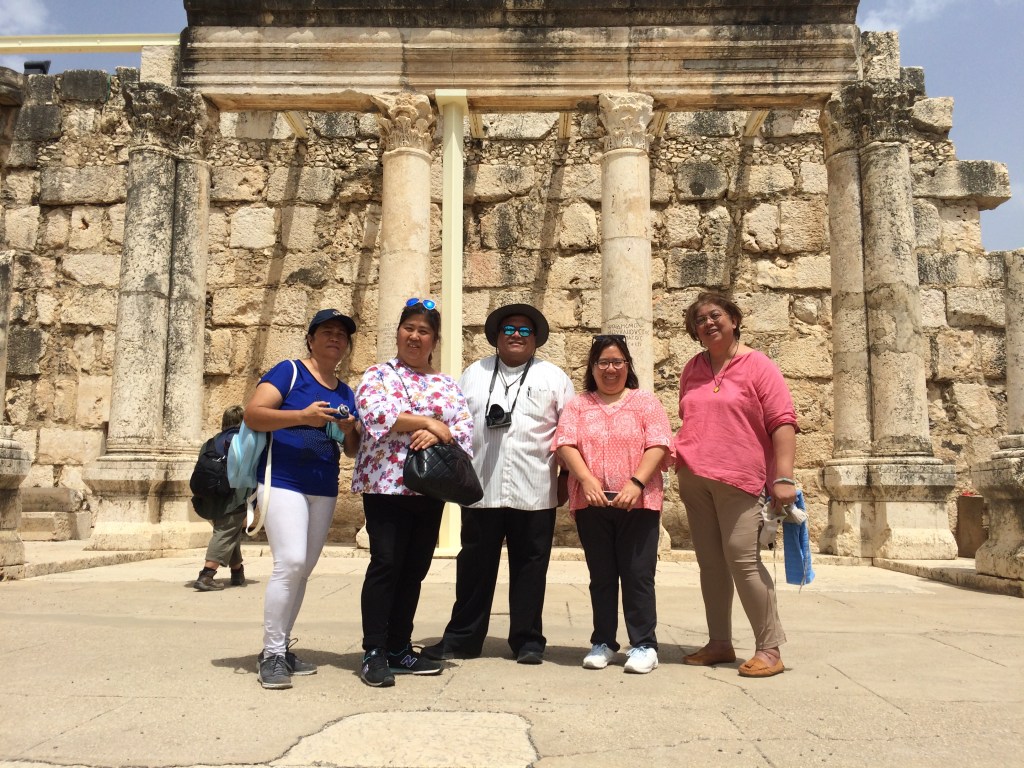
Photo by author with friends at ruins of the synagogue at Capernaum, 2017.
Examining our faith in Jesus
Notice, my dear reader, how similar is our story of Jesus raising to life the dead daughter of Jairus with that of the calming of the storm while crossing the lake last Sunday. In both instances, we find Mark “exaggerating” some details as if Jesus were somewhat oblivious to what was going on around him.
But again, Mark is not entertaining us with his stories narrating the powers and miracles by Jesus for he is telling us something deeper and very important with those surprising details of his stories. Primary of which is the supremacy of Jesus as the Son of God over nature like the sea and death both symbolizing evil and sin.
Mark affirms this truth today in telling us how Jesus brought back to life the dead daughter of Jairus, that Jesus is the Christ who had come launching a new world order where death and sin are overcome in him through his pasch.
Recall last Sunday how Mark ended his story with the disciples asking, “Who then is this whom even wind and sea obey?” (Mk.4:41).
That question is finally answered by our story today that clearly shows Jesus is the Christ, the Son of God who is life himself when he brought back to life the dead little girl.
Unfortunately, like during the time of Mark until now, many still doubt the powers of Jesus. Then and now, there is still that crisis of faith among us expressed by people from the synagogue official’s house who arrived and said, “Your daughter has died; why trouble the teacher any longer?”(Mk.5:35).
If you were in that crowd following Jesus, would you still go with him to enter the house? Would you heed his words like Jairus, “Do not be afraid; just have faith” (Mk.5:36)?
And while inside the house, knowing the little girl was already dead, would you join the rest in ridiculing Jesus who said, “The child is not dead but asleep” (Mk.5:39)?
These are the questions Mark is asking us today like the Christians of his time going through persecution and crisis in the early Church.
It is easy to “believe”, proclaiming with arms raised that Jesus is Lord, that Jesus is the Son of God but it is another thing to be truly convinced, to have faith in him when faced with the stark realities of life persistently attacked by sickness and death, of pains and sufferings that make us wonder why God could allow these to happen!
We have all felt our faith shaken when this pandemic struck us last year that took away those dearest to us so sudden, often without seeing them at all before they were cremated.
Like his story last Sunday, Mark’s narration of the raising to life of the daughter of Jairus is filled with many surprising details we find it so true with our own experiences of struggling to avoid or survive COVID-19, of having a sick child or spouse, of trying to make it to another day, of keeping our jobs to pay for food and rent and other needs of our family.
Do we really have that faith in Jesus, convinced that everything will be “okay” like Nightbirde who can brim with all smiles even if saddled with three kinds of cancer with a 2% chance of survival, claiming it is better than zero?
Today’s gospel is more than the revelation of who Jesus Christ is: the raising to life of the daughter of Jairus dares to invite us in examining our faith in God in the face of unrelenting attacks on life by sickness and death especially in this time of the pandemic.
Death and sickness are realities we face daily, that make us doubt God’s love and concern for us which the first reading clarifies with its declaration that
God did not make death, nor does he rejoice in the destruction of the living. For God formed man to be imperishable; the image of his own nature he made him. But by the envy of the devil, death entered the world, and they who belong to his company experience it.
Wisdom 1:13, 2:23-24
Photo by author, Lake of Galilee, 2019.
Arising and being whole in Jesus
Jesus came not to remove sickness and death, pains and sufferings which did not come from God for God is love. He came to be one with us in sickness and death, in our pains and sufferings so that we may rise with him too in his resurrection and be whole again in him.
Notice the words Jesus used in every healing, “your faith has saved you” to show that healing is not just a cure of the disease but making the person whole again. The words health, healing, wholeness, and holiness are all interrelated if we examine their origins and implications. Hence, we see that whenever Jesus would heal, it is not only an eradication of an illness but restoring harmony and balance in the person – physical, spiritual, mental, and emotional aspects.
It is the same in raising the dead young man in Nain and his friend Lazarus: Jesus or the evangelists used the word “arise” as a foreshadowing of Easter when Jesus himself rose from the dead, an indication of his power over death.
All these people in the gospels Jesus had healed and brought back to life eventually died but the good news is that death and sickness are no longer dark and an ending in itself.
Jesus came to bring salvation to the world, a wholeness in life which disease and physical death can no longer control and hold. That is why we need a firm faith to believe in him in spite of the many sickness and deaths now around us. It is faith that will enable us to grasp the full meaning of this pandemic and other sufferings we are going through in life. It is our deep faith in God that will also enable us to explain and show to others especially our loved ones the true meaning of healings and resurrections performed by Jesus who gives us a share in his victory over sickness and death.
May we dwell on the beautiful exposition of St. Paul today about being poor like Christ “that though he was rich, for your sake he became poor, so that by his poverty you might become rich” (2Cor. 8:9).
We can only be whole when we share whatever we have because that is when we allow Jesus to work in us, to be in us, to complete us. This happens when we wholeheartedly celebrate the Holy Eucharist where we become poor like Jesus, emptying ourselves of our sins, sharing with others our wealth through our contributions not only to the church collections but also to other charities where some of us share also time and talent aside from treasures.
The experience of the community pantry recently had taught us the value of St. Paul’s call for us to share and be poor like Christ when we were encouraged to take only what one needs and to give according to one’s ability – “kumuha ayon sa pangangailangan, magbigay ayon sa kakayahan”.
Yes, the realities of poverty and hunger remain with us but people are fed, sufferings are alleviated and most of all, the whole nation is united in believing again there is hope amidst the pandemic worsened by the systematic evil that has plagued us for so long.
Faith in God is deepened and strengthened when we become poor and weak like Jairus because that is only when we can arise and be whole again in Jesus Christ who is himself our Resurrection and Life. Amen.