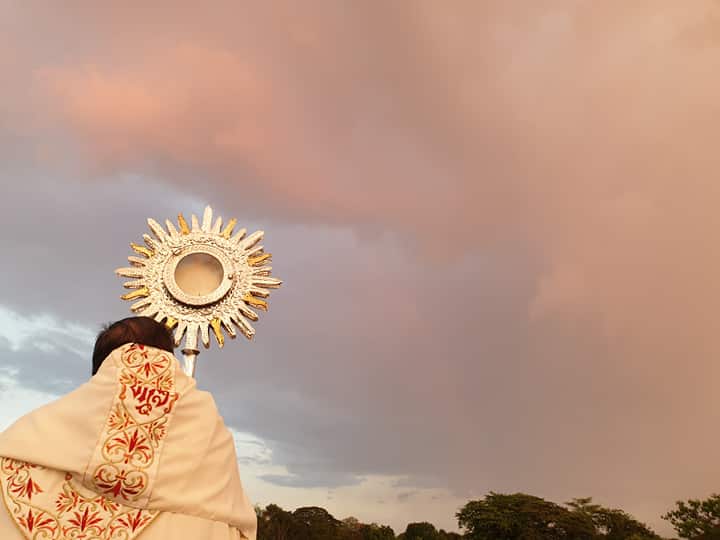
Mary, mirror of God’s greatness

The Lord Is My Chef Sunday Recipe for the Soul by Fr. Nicanor F. Lalog II
Solemnity of the Assumption of the Blessed Virgin Mary, 15 August 2021
Revelation 11:19-12:1-6,10 ><}}}*> 1 Corinthians 15:20-27 ><}}}*> Luke 1:39-56
Photo by author, December 2020.

We take a break this Sunday from our readings in the bread of life discourse in John’s gospel to celebrate on this date the Solemnity of the Assumption of the Blessed Virgin Mary following Pope Pius XII’s dogma in 1950 that at the close of her earthly life, Mary was taken up body and soul into the glory of heaven.

Without telling the manner or the circumstances of time and place of the Assumption, its dogma forms part of the deposit of our faith received from the Apostles as attested by its long line of traditions since the Pentecost. It is so important that its celebration supersedes the liturgy of any Sunday because it invites us all to see in Mary raised to heaven the image of the Church and of all the faithful on our way to eternal glory with God.

It is a very timely celebration while we are in the midst of another lockdown due to a surge in COVID-19 cases, giving us hope and inspiration to persevere in all these difficulties and trials to become better disciples of Jesus like his beloved Mother.

Photo by author at the Assumption Sabbath, Baguio City, 2019.

Mary, a type of the Church

Our first reading today presents us with two images of a woman that seem to contradict each other with scenes that anti-climactic, flowing in the reverse mode. It could have been better as in most cases that the first scene depicting the woman in all glory should have been last instead of the woman in childbirth pains and dangers that comes in second. Is it not the sorrowful always comes first leading to glory?

A great sign appeared in the sky, a woman clothed with the sun, with the moon under her feet, and on her head a crown of twelve stars. She was with child and wailed aloud in pain as she labored to give birth. Then another sign appeared in the sky; it was a huge red dragon, with seven heads and ten horns, and on its heads were seven diadems.

Revelation 12:1-3

It is easy to see the Blessed Virgin Mary in that woman depicted in John’s vision especially if we continue reading on to find the title and authority attributed to her child as our Savior Jesus Christ. But modern biblical studies go deeper than that simplistic view: the scenes speak more of the birth of Christ among us his disciples. It is “painful” because it takes place amid many evil and sins like persecutions and temptations symbolized by the red dragon; but, amid all these, Jesus remains among us, leading us, protecting us, and blessing us. Hence, the woman in this passage becomes a symbol of the Church in the glory of God following Christ’s Resurrection while at the same time in the midst of many earthly battles.

Of course, no other woman can best fit that image than Mary who gave birth to Jesus, who has always been in the most intimate relationship with her son as disciple among all humankind. And because of her role in relationship to her Son, to us his disciples also his Body as community, Mary is the image or type of the Church still giving painful birth to believers like in this time of the pandemic while we are already assured of glory in heaven as children of God. Vatican II perfectly expressed it in declaring:

“By reason of the gift and role of divine maternity, by which she is united with her Son, the Redeemer, and with His singular graces and functions, the Blessed Virgin is also intimately united with the Church. As St. Ambrose taught, the Mother of God is a type of the Church in the order of faith, charity and perfect union with Christ.”

Lumen Gentium #63

With that, Mary has also become the mirror of God’s greatness in all time, the very reason we venerate her as first among the saints and angels because it is also the same call of holiness to us all as children of the Father and disciples of Christ. It is in this framework that we celebrate her Assumption, especially when we profess every Sunday: “I believe in the Holy Spirit, the holy Catholic Church, the communion of saints, the forgiveness of sins, the resurrection of body and life everlasting. Amen.”

Photo by author, Nazareth, 2019.

Greatness of God, lowliness of Mary

As we have mentioned at the start, the dogma of the Assumption of Mary does not go into details how it took place. What matters most is the fact of the Assumption of Mary, body and soul. Like with her Immaculate Conception, there are no direct nor explicit biblical references to her Assumption; however, from the collective meditations and contemplations in the Church, we find vast and rich sources in reflecting the beauty and wonder of the Blessed Mother’s unique place in our salvation history.

For the Mass of the day of the Solemnity, we contemplate on Mary’s canticle called Magnificat which she sang after being praised by her cousin Elizabeth during the Visitation.

And Mary said:
"My soul proclaims 
the greatness of the Lord;
my spirit rejoices in God my savior.
For he has looked upon his lowly servant.
From this day all generation will call me
blessed:  the Almighty has done 
great things for me, and holy is his Name."
(Luke 1:46-49)

It was the first proclamation of the gospel of salvation in Jesus Christ whom Mary first received and shared first with her cousin Elizabeth in a town in Judah. See how in the Visitation Elizabeth praised and admired Mary, becoming the first to call her “blessed among women” because “she believed the word spoken to her by the Lord would be fulfilled” (Lk.1:45). Instead of giving back her praise and admiration to Elizabeth who was pregnant with John the Baptist at that time despite her old age and being barren, Mary sang praises to God like the other great women in the Old Testament after experiencing God’s extraordinary acts in their personal lives and in Israel’s history.

Though we may never have the same personal experiences of the Blessed Virgin Mary, as members of the Church she represents, we can always look through her Magnificat the extent we have also become the mirror of the greatness of God especially at this time when everybody seems to doubt his loving presence in this time of the pandemic.


 It is the reason why we also sing the Magnificat 
during our evening prayers in the Church because 
before we can ever praise God for his kindness and majesty, 
we must first allow him to work in us by being lowly before him like Mary.

See how the Magnificat sings of the depths of Mary’s soul and her faith, of her perfect obedience to the word of God and the mission entrusted to her. Very clear in its lyrical expression, the focus and center is God, not Mary. It is the reason why we also sing the Magnificat during our evening prayers in the Church because before we can ever praise God for his kindness and majesty, we must first allow him to work in us by being lowly before him like Mary.

Have we truly been God’s lowly servant like Mary, allowing God to work his great wonders through us?

Three things I wish to share with you on Mary’s lowliness that enabled God to work his wonders through her:

First is her openness to the word of God like in the Annunciation of the birth of Jesus. Mary had a prayer life, a discipline of making time with God, setting her self aside for the Lord. Prayer is always the start of every relationship with God. That is when we truly become humble to lose control of ourselves, to forget our selves and let God in the Holy Spirit dwell into us. Even in the darkest moments of our lives, there will always be that glimmer of hope because the Holy Spirit enlightens us in our paths.

Second is Mary’s saying “YES” to God. She does not merely listen to God; she says “be it done unto me according to your word.” From the very start, Mary never doubted God in his wisdom and plans that she always said yes. One most beautiful expression by the evangelists of Mary saying yes to God is whenever Mary would “treasure in her heart” words of Jesus and of others.

But Mary’s greatest yes happened at the Cross, in her sharing in the Paschal Mystery of her Son Jesus Christ, being the only other disciple who remained with the Lord until his death. No wonder, it was to her based on tradition that the Risen Lord first appeared on Easter.

Third is Mary’s fidelity to God, her yes was not just a one-shot deal but an everyday yes to Jesus even after he had ascended into heaven. The Acts of the Apostles tells us explicitly how Mary was among the disciples present inside the upper room at Jerusalem when the Holy Spirit came on the day of Pentecost. Throughout the ages in her numerous apparitions, Mary said yes to God delivering Jesus Christ’s call for us to penance and conversion, to prayers and the Holy Eucharist especially at Fatima in Portugal.

“The Assumption of the Virgin” by Italian Renaissance painter Titian completed in 1518 for the main altar of Frari church in Venice. Photo from wikidata.org.

Mary went through many hardships and difficulties in her life and in the history of Israel, coming from an obscure town that was a butt of jokes of their time like when Nathanael asked Philip who claimed to have found Jesus Christ, “Can there any good thing come out of Nazareth? (Jn.1:45)”.

In this time of the pandemic, the vision of John in the first reading becomes more real when people refuse to recognize the spiritual dimension of COVID-19, of the need to be converted and to again nurture that relationship with God following decades of affluence and materialism. Like Mary, let us be humble to accept we are not the masters of this world nor of our own life but God almighty.

We are called to persevere with Mary, to be strong in our faith and charity that God will never forsake us so we can be present among the poor and marginalized including those spirits weakened by the prolonged quarantines.

With Mary, let us believe the words of St. Paul how all will come to life again – body and soul like Mary – in the final end of time that begins right now, right here in the midst of all these trials and sufferings. Amen.

Have a blessed week ahead!

“Pag Tumatagal Lalong Tumitibay” by Wadab (1979)

The Lord Is My Chef Sunday Music by Fr. Nick F. Lalog II, 08 August 2021
Photo by author, Sonnen Berg Mountain View, Davao City, 2018.

We are on the first week of our fourth lockdown in Metro Manila since this pandemic began last year. All we need at this time are good vibes to uplift the sagging spirits of our suffering people, those who have lost loved ones as well as have lost their jobs or livelihood as a result of COVID-19 and its quarantine.

Since we are also celebrating the whole of August as “Buwan ng Wika” (Month of Filipino National Language), we have chosen an Original Pilipino Music (OPM) from 1979 by a group of five gentlemen from down south calling themselves “Wadab”, the inverted name of Davao City.

Long before today’s generation had this lodi (for idol) expressions, our generation have long been speaking backwards like jeproks to refer to spoiled brats from Quezon City’s middle class living in different subdivisions called “Project” like Project 7 (spent my early childhood there), Project 2, Project 6. Invert the word “project”, make it hip by adding an “s”, you get jeproks. It was the coolest thing at that time!

Going back to Wadab’s 1979 hit called “Pag Tumatagal Lalong Tumitibay”, the song speaks about the love of a man to his beloved, telling her how his love has grown stronger and deeper for her through time, assuring her of his undying love and fidelity.

Wadab’s song is very interesting for many reasons. Our readers in the US and other English speaking countries can easily relate because like some of the OPM songs of the 70’s, the lyrics is a mixture of Tagalog or Filipino language mixed with English expressions called “Taglish” (from Tagalog + English).

Melody and music are very soothing as they were patterned after the American Philly soul sounds of the Stylistics among others.

We thought of this lovely song for this Sunday because in essence, it is what Jesus is telling us in the gospel today, his being the bread from heaven, the bread of life giving life and nourishment to all believers. It is not enough that we know Jesus in our head; we need to believe in him to experience and share the love he has for us (https://lordmychef.com/2021/08/07/knowing-believing-loving-jesus/).

Imagine Jesus serenading you with this song, assuring you of his loving presence especially in this time of trials. Try to reflect also on our depth of love for Jesus through our family and friends.

Has our love gone stronger through the years despite our failures and sins?

Before listening to our featured music this Sunday, try reflecting on these beautiful words by St. Bernard of Clairvaux (1090-1153) from one of his homilies about love:

"Love is fully sufficient to itself;
when it enters the heart,
it absorbs all other feelings.
The soul who loves,
loves and knows nothing more."


A blessed week ahead of you. Stay safe always.

*We have no intentions of infringing into the copyrights of this song and video except to share its beauty with others. Thank you.

From Youtube.

Knowing, believing, loving Jesus

The Lord Is My Chef Sunday Recipe for the Soul by Fr. Nicanor F. Lalog II
Sunday XIX-B in Ordinary Time, 08 August 2021
1 Kings 19:4-8 ><]]]]'> Ephesians 4:30-5:2 ><]]]]'> John 6:41-51
Photo by Mr. Vigie Ongleo, 04 August 2021, Singapore.
Elijah went a day's journey into the desert,
until he came to a broom tree and sat 
beneath it.  He prayed for death, 
saying:  "This is enough, O Lord!
Take my life, for I am no better
than my fathers." (2 Kings 19:4)

Many of us can probably identify with the Prophet Elijah in the first reading today: so tired and fed up with all the sufferings and trials that seem unending with another round of lockdown due to a surge in COVID-19 infections.

“This is enough, O Lord!”

Elijah was not the only one to cry out to God in that way: there were Moses, Jeremiah, and Jonas who cried in a similar way while bent under the heavy load of responsibilities on their shoulders from God who never failed in coming to their rescue with his comforting and reassuring words of encouragement.

And this time as we have heard from the first reading, God sent Elijah with bread from heaven to sustain his 40 day journey to Mt. Horeb to escape the soldiers of Queen Jezebel out to kill him after a showdown with the priests of baal at Mount Carmel. God nourishes us not only spiritually and emotionally but also physically and materially if we know him, believe him, and love him in Jesus Christ his Son!

This is the context of the continuation of Jesus Christ’s second bread of life discourse at Capernaum, very timely in these two weeks of our fourth Enhanced Community Quarantine (ECQ) as we rely on God’s mercy and protection against COVID-19 and its new Delta variant.

Photo by Ms. Anne Ramos, March 2020.

Knowing Jesus.

When the people finally caught up with Jesus and his disciples last Sunday at Capernaum, the Lord immediately began his bread of life discourse by declaring “I am the bread of life; whoever comes to me will never hunger, and whoever believes in me will never thirst” (Jn. 6:35).

That is the first time in the fourth gospel where Jesus introduced himself with the “I AM” declaration very crucial for John in presenting him as the Christ, the Son of God. This would be followed later by similar statements when Jesus said “I am the good shepherd”, “I am the vine”, and “I am the resurrection”.

Recall how God told Moses to say to his people in Egypt that he was sent by “I am who am”; hence, when Jesus says “I AM”, it was a cue of who he is – the One who had come down from heaven!

The Jews murmured about Jesus because he said, “I am the bread that came down heaven,” and they said, “Is this not Jesus, the son of Joseph? Do we not know his father and mother? Then how can he say, ‘I have come down from heaven?'” Jesus answered and said to them, “Stop murmuring among yourselves.”

John 6:41-43

Reminiscent of the desert experience when the people murmured against God for lack of food and water, John also begins referring to the crowd as “Jews” to indicate their lack of belief in Jesus, like their forefathers who doubted God in the wilderness. Here we find something so common even to our own time of “knowing” God we so easily claim with everybody even if what we know does not square up with the reality.

Knowing is not purely cerebral. In the Jewish culture, to know is to enter into a relationship. Unlike us Filipinos who are so fond of name dropping when we usually tell everyone how we know somebody’s name and address like on Facebook – even if we are not friends or related at all!


To know anyone especially God by entering 
into a relationship requires an opening of the mind.  
That is why Jesus told the crowd to stop murmuring, 
telling them and us today to stop limiting 
ourselves to what we know who the Lord really is 
because so often, we hardly know him at all! 

To know anyone especially God by entering into a relationship requires an opening of one’s mind. That is why Jesus told the crowd to stop murmuring, telling them and us today to stop limiting ourselves to what we know who the Lord really is because we hardly know him at all!

We keep on receiving him in Holy Communion not as the Person but more as the Bread or Sacred Host; we go to Mass but hardly celebrate it with him; and lastly, we know Jesus more as provider and giver, rarely as companion and friend, most of all as Savior.

The Jews have refused to believe in Jesus at the very start because they have always been closed from knowing him, insisting they know better, that he is the “son of Joseph”. We have seen how last Sunday in their asking of “Rabbi, when did you get here?” in Capernaum was cloaked in suspicion at how was he able to cross the lake at night when winds were strong and waves were huge, unmindful of the signs he had shown in feeding them all at a deserted place.

Their knowing of Jesus as well as of God and the Scriptures have remained superficial, stuck in the material level manifested in their being too legalistic and ritualistic in religion without any regard for the people especially the sick and marginalized. Most of all, they did not seem to really believe in God as they saw more of themselves as God himself who knows everything!

Photo by Ms. Ria De Vera, March 2020.

Believing, loving Jesus.

All these words and actions by Jesus during his public ministry at Galilee and Jerusalem later would be used by his enemies against him, wrongly accusing him of blasphemy and disregard for the Laws or Torah. Their minds were all closed to God’s coming in Jesus or at least to his heavenly origin.

Jesus tried to clarify it with them by referring to God his Father, citing the prophet Isaiah:

“No one can come to me unless the Father who sent me draw him, and I will raise him on the last day. It is written by the prophets: They shall all be taught by God. Everyone who listen to my Father and learns from him comes to me. Amen, amen, I say to you, whoever believes has eternal life. I am the bread of life; this is the bread that comes down from heaven so that one may eat it and not die. I am the living bread that came down from heaven; whoever eats this bread will live forever; and the bread that I will give is my flesh for the life of the world.”

John 6:44-45, 47-48, 50-51

Now here we find Jesus taking off to higher level in his discourse, from knowing to believing that is perfected in loving. As we have said, knowing is relating. It is through our relationship with God that we are taught through Jesus Christ in knowing all about him. Yes, God in the Old Testament revealed himself to the Chosen People through the prophets and his Laws. But now, Jesus is telling the people that God is revealing himself through him, the Son who had come from heaven with the gift of faith.

As a gift, it is not like an ordinary present given to just one or several persons privileged to receive it like the Israelites in the Old Testament; faith as a gift from the Father is freely given to everyone for all time. Jesus is now inviting his audience in Capernaum including us today to open one’s mind, to level up in thinking and understanding because it is above the realm of material world but of spirituality that leads to relating, believing, and loving to be expressed later in the Eucharist, the sign of his self-sacrifice on the Cross.

Recall how last Sunday Jesus stressed that it is a work of God, not of men – that is faith! It is a gift from God freely given to everyone which every individual must “turn on” like a switch and make it operate. In that discourse also, Jesus added that the ultimate fulfillment of this faith in God as work of God is faith in himself, the Son sent by the Father.

In this scene alone, Jesus had mentioned the word “bread” five times, repeating it to the crowd like in a crescendo, rising from a sapiential or cerebral and material meaning into something so profound, higher level inviting us to put on our faith in him as he continues to reveal the Father’s plan for all mankind for all time leading to eternity.

And what is it that remains into eternity? LOVE!

"Love is fully sufficient to itself;
when it enters the heart,
it absorbs all other feelings.
The soul who loves,
loves and knows nothing more."
(St. Bernard of Clairvaux)
Photo from Dr. Yangas Colleges Inc., Bocaue, Bulacan in one of their community pantry called “Paraya”, May 2021.

Jesus is now hinting at his discourse the Eucharist as the meaning of the sign he did at the deserted place when he fed and satisfied the more than 5000 people from just five loaves of bread and two fish. Notice the words “eats” and “flesh” – indications of the elevation of knowing into believing, blossoming in love.

To eat his flesh is to accept Jesus, to be one in him and with him through one another. Knowing Jesus, relating with him means believing him, loving him through one another.

Faith is closely linked with love, they always go hand in hand because whoever believes truly always loves!

St. Paul sums up everything that Jesus had taught this Sunday with his call to us to “live in love, as Christ loved us and handed himself over for us as a sacrificial offering to God for a fragrant aroma” (Eph.5:1-2).

It is very difficult to dissect knowing, believing and loving, of finding the very cause of faith and love except in Jesus Christ who had come to us and continues to come in every Eucharistic celebration. There are times we can be aware of the reasons why we believe and love God and our beloved, even explain what we find so lovable in them but still difficult to locate with precision the starting point of everything. That is why at the end of this discourse two weeks from now, we find everybody leaving Jesus except the Twelve who chose to remain with him.

In this life, we may know so many things but we cannot know everything like God.

Let us stop murmuring, stop all talks and sink into silent prayer, opening our minds and our hearts to Jesus to receive him not only in words but in himself as Body and Blood in the Holy Mass so we can start loving him in one another to make life more bearable in these trying times. Amen.

Have a blessed and safe week ahead!

Photo by author, 2019.

“Casio” by Jungle (2018)

The Lord Is My Chef Sunday Music by Fr. Nick F. Lalog II, 01 August2021
Photo by Ray Piedra on Pexels.com

It is another rainy, heightened season of quarantine measures here in Metro Manila this Sunday with all religious gatherings being banned again while other business establishments especially like the spa are allowed with limited access by the public.

It is a crazy set up. While we believe there has to be some health protocols needed to control the spread of COVID-19, we find it so baffling since last year when religious gatherings continue to be at the bottom list of essentials in this predominantly Christian country.

And the more crazy is how every time our public Masses are restricted, the more people troop to churches to pray and worship!

That is why we have chosen the British neo soul band Jungle with their 2018 “Casio” for our featured music this Sunday that speaks of heartbreak and dysfunctional relationship. It is aptly called Casio because it speaks of a relationship so utilitarian like a Casio watch wherein the woman is just using the guy for her own advantage like the people who have followed Jesus to Capernaum in today’s gospel in order to have food again like last week (https://lordmychef.com/2021/07/31/beyond-when-and-what/).

Casio, playing on my heart just like a Casio
Breaking it apart so you can let it go
Wait another year that's not original, or cynical
Alright, let's go now

When all your dreams are gone
And you're still holding on
You waited far too long
Don't say
I know, you know it's over

We discovered this electronic band last year at the height of the pandemic and since then have been hooked with their funky sound that is characteristically British – intelligent and no non-sense. You have to see the music video for Casio we find so groovy and savvy, perfect for a quarantine Sunday with family.

In an interview at San Francisco’s KEXP, Jungle members explained how in their latest album For Ever (2018) they explored themes – “to shake off their shallow self-doubt” by making “more vulnerable songs” that gave “new directions where they were going in the soul.”

The band is clean cut like most Brits and hip, they really rock so well with their depth and simplicity – exactly what Jesus is asking in today’s gospel so we would desire things of higher levels that “lead to eternal life than food that perishes”.

*We have intentions of copyright infringements to the following music video except to share its good vibes and wonderful music and message.

Beyond “when” and “what”

The Lord Is My Chef Sunday Recipe for the Soul by Fr. Nicanor F. Lalog II
Sunday XVIII-B in Ordinary Time, 01 August 2021
Exodus 16:2-4, 12-15 ><}}}}'> Ephesians 4:17, 20-24 ><}}}}'> John 6:24-35
Photo by author, Church of Dominus Flevit overlooking Jerusalem, 2017.

Last Sunday we reflected the “where” of Jesus in asking Philip, “Where can we buy enough food” for the crowd who have followed them to a deserted place. We said that “where” of Jesus referred not to any place or location but to himself as the only one who can give “enough food” for everyone.

Today I invite you, my dear readers to join me reflecting on the “when” and “what” of the people who have followed Jesus to the other side of the lake, looking for him to have more food after that miraculous feeding last week. This time, the people are the ones asking Jesus with when and what that reveal their pride before God.

When the crowd saw that neither Jesus nor his disciples were there, they themselves got into boats and came to Capernaum looking for Jesus. And when they found him across the sea they said to him, “Rabbi, when did you get here?” Jesus answered them and said, “Amen, amen, I say to you, you are looking for me not because you saw signs but because you ate the loaves and were filled. Do not work for food that perishes but for the food that endures for eternal life, which the Son of Man will give you. For on him the Father, God, has set his seal.”

John 6:24-35
Photo by author, Capernaum’s shore at Lake Tiberias, 2017.

From a deserted place to Capernaum

To fully appreciate today’s gospel account by John, let us get its whole picture with a little help from Mark who started the story of Jesus and the Twelve crossing the lake to a deserted place to rest the other week. With his usual dash of humor, Mark told us how the people arrived to the place ahead of Jesus who was moved with pity at seeing the crowd “for they were like sheep without a shepherd that he taught them with many things.”

John continued the story last Sunday telling us how Jesus fed the people to their satisfaction with so many leftovers out of just five loaves of bread and two fish. The people were astonished that they tried to get Jesus to make him a king but he “withdrew again to the mountain alone.”

This Sunday, John continued his story telling us how the crowd finally found Jesus at Capernaum with his disciples.

How did he get there?

Photo by author, Lake of Tiberias (aka, Galilee), 2020.

According to Mark 6:45ff., after feeding the people, Jesus told the Twelve to proceed ahead of him to the other side of the lake that evening while he dismissed the crowd. Later that evening while Jesus was praying on the mountain, he saw his disciples’ boat being tossed by big waves due to strong winds. He followed them at the “fourth watch of the night” (about 3AM) by walking on water that terrified the Twelve who thought they have seen a ghost.

Upon identifying himself as the Lord, Peter asked to let him come to him by walking on water too; Peter sank when he doubted due to the strong winds until Jesus saved him and joined them on the boat going to Capernaum.

Mark’s story of Jesus walking on water after the miraculous feeding provides us the context for the people’s question to him today in John’s continuation of the story last week, “Rabbi, when did you get here?” (Jn.6:25): it was very difficult, almost impossible for anyone to have crossed the lake at night due to giant waves caused by strong winds. (Any pilgrim to the Holy Land can attest to this fact even today.)

And that was the main issue here: the people refused to see the deeper meanings behind the two events when Jesus fed them and the almost impossible crossing of the lake that night.

That is why Jesus did not answer their question by bluntly addressing their suspicious motive, “Amen, amen, I say to you, you are looking for me not because you saw signs but because you ate the loaves and were filled. Do not work for food that perishes but for the food that endures for eternal life, which the Son of Man will give you. For on him the Father, God, has set his seal.”

Ironically, while their asking of “when did you get here” implicitly acknowledged the Lord’s miraculous crossing of the lake, they still refused to accept it by downplaying everything like addressing Jesus as “Rabbi” when in fact, they were not interested with him but merely with the food he had given them!


Their question of "when" 
was not really about his time of arrival there 
but more of an inquiry on the person of Jesus....

Their question of when was not really about his time of arrival there but more of an inquiry on the person of Jesus as they wondered how could he made it across the lake that night. They have failed to recognize the deeper meaning of the sign Jesus did in feeding them with enough food which Jesus explained anew.

And the stage is now set for Jesus to reveal himself, of who he really is which his disciples were also asking and contending among themselves all these weeks and months of being with the Lord.

Photo by author(2017), ruins at Capernaum with a church built over the house where Jesus was believed to have stayed.

The need for us to be open to Jesus, our bread of life

Many times in life, our words and attitudes betray us of our inner motives, of our selfish interests to get near some people, to meet and know them not for who they are but for what we can have from them – even with God!

Remember Andrew last Sunday who did not bother to ask the boy’s name who gave the five loaves of bread and two fish from which Jesus performed his miracle? “There is a boy here with five barley loaves and two fish” – no name, just a “there” because the did not matter at all to Andrew except his food.

But there is something deeper being revealed in this attitude of forgetting the other person and being focused on material things: that is our pride, of believing only in ourselves, of playing God!

So they said to him, “What can we do to accomplish the works of God?” Jesus answered and said to them, “This is the work of God, that you believe in the one he sent.” So they said to him, “What sign can you do, that we may see and believe in you? What can you do? Our ancestors ate manna in the desert, as it is written: He gave them bread from heaven to eat.”

John 6:28-31

See how the crowd ignored Christ’s promise of giving food that endures for eternal life by following up their question with What can we do to accomplish the works of God?” – another veiled question like their when, insisting on their own achievements and abilities, on what they can.

Worst is how in a twist highlighting pride in themselves as they dared to question Jesus again with What sign can you do, that we may see and believe in you?“!!! Helloooooo….!

Photo by author at the ruins of the synagogue of Capernaum where Jesus preached his bread of life discourse, 2017.

They have gone so blinded with their pride that suddenly the miraculous feeding they have personally witnessed plus the unimaginable crossing of the lake at night remained lacking, not enough for them to believe in the powers of Jesus that they still asked for another sign.

Their “what” had become a demand from them, an insistence on Jesus the Son of God to give them signs from heaven even if they ironically preferred without them knowing how they were stuck at the lowest level of looking at things.

They have closed their eyes to seeing beyond the ordinary things happening to them since Jesus came teaching and healing. And now after feeding them, they demanded Jesus to follow them instead of them following the Lord.

Is it not the same thing happens with us when we keep on demanding God for proofs of his love and mercy, demanding so many other things from him above while we refuse to rise above ourselves, to “level up” in our lives?

This is the call by St. Paul in the second reading, that we must “be renewed in the spirit of your minds, and put on the new self, created in God’s way in righteousness and holiness of truth” (Eph. 4:23-24).


Once again, we are placed on highest level of quarantine due to a surge in COVID-19 cases with threats from the new Delta variant. Unless we learn to see this pandemic on a higher plane or level that calls for spiritual renewal among us, it will persist to disrupt and destroy lives among us.

It is more than a virus infecting us but an attitude deep within us when we have lost respect for one another and with nature. Pope Francis had long ago sounded this alarm in 2015 with his encyclical Laudato Si calling for each of us to change our lifestyle, each of us contributing for the betterment of the world because it is easiest to join advocacies but difficult to change our ways of life by having less.

With all these pandemic and climate changes going on around us, the signs are getting clearer for us to shift our perspectives, to see things on a higher plane like what Jesus had began at Capernaum declaring himself, “I am the bread of life; whoever comes to me will never hunger; and whoever believes in me will never thirst” (Jn.6:35).

Our misunderstandings with others and in life will persist unless we remove the veils and masks that cover so many insincerities of our questions in search of the many answers to the problems we face.

Like the people who have followed Jesus to Capernaum that day who were stuck in the desert experiences of Moses (first reading) that they could not see Jesus himself as the new bread from heaven; in fact, Jesus had to correct them that it was not Moses who gave the manna but God the Father in heaven who now gives Jesus to nourish us in our journey to eternal life.

Let us empty our selves of our pride to let Jesus fill us today with his words and his Body and Blood so we may realize next week the meaning and sweetness of himself as the Bread of life. A blessed week to you. Stay safe and keep praying. Amen.

Photo by author, April 2020.

“Here, There And Everywhere” by the Beatles (1966)

The Lord Is My Chef Sunday Music by Fr. Nick F. Lalog II, 25 July 2021
Photo by Pixabay on Pexels.com

It is a very “bed weather” these days here in Metro Manila, so perfect for family gatherings, sharing stories and of course, music from the yesteryears like the Beatles‘ 1966 classic romantic love song composed by Paul McCartney, Here, There and Everywhere.

To lead a better life, I need my love to be here
Here, making each day of the year
Changing my life with a wave of her hand
Nobody can deny that there's something there

There, running my hands through her hair
Both of us thinking how good it can be
Someone is speaking
But she doesn't know he's there

As I have mentioned in my homily this Sunday, this classic love song had inspired me to dwell on the demonstrative pronouns used in our gospel today when Jesus conversed with his apostles Philip and Andrew before feeding the more than 5000 people from just five loaves of bread and two pieces of fish (https://lordmychef.com/2021/07/24/when-where-and-there-are-persons-not-locations/).

McCartney admits that it is one of his favorite compositions of all time which happens to be his only song truly appreciated by his fellow composer John Lennon.

The song jibes so well with our gospel this Sunday wherein the here, there and everywhere do not merely refer to locales and locations; there are times when these demonstrative pronouns point to particular persons like in this song, McCartney’s girlfriend at that time, Ms. Jane Ashley.

Jesus remains true as our here, there and everywhere in our lives, in everything that we need. When Jesus asked Philip where can they buy food for the crowd, his where was not actually a place like a store or bakeshop but himself. It was as if telling Philip and everyone of us today, where can you find solace and peace in this time of pandemic? Where else but in Christ alone!

Every where is where God is, where Jesus is!

I want her everywhere
And if she's beside me
I know I need never care
But to love her is to need her everywhere

Knowing that love is to share
Each one believing that love never dies
Watching their eyes
And hoping I'm always there

Going back to McCartney, his relationship with Ashley did not bloom after she caught him cheating on her, in fact while in bed with another woman as the story went. He would get involved with other women that ended in divorce but probably found his here, there and everywhere most with his third wife Linda with whom he remained married until her death in 1998 due to cancer.

In today’s gospel, we find the downside of demonstrative pronouns replacing persons, when we see and value more our very selves and things than others like Andrew who never bothered to ask the name of the boy who gave his five loaves and bread and two fish that Jesus took to do his miracle.

This time of calamity, may we find in Jesus our every where as our source of strength to guide others there to safety. Have a blessed week ahead!

*We have no desire of infringing the copyrights of this song and video except to share its beautiful message and hope brighten the day of everyone.

When “where” and “there” are persons, not locations

The Lord Is My Chef Sunday Recipe for the Soul by Fr. Nicanor F. Lalog II
Sunday XVII-B in Ordinary Time, 25 July 2021
2 Kings 4:42-44 ><]]]]*> Ephesians 4:1-6 ><]]]]*> John 6:1-15
Photo by Mr. Raffy Tima of GMA7-News, Batanes after a storm, 2018.

Beginning today until August 22, 2021, our Sunday gospel will be from the sixth chapter of John who continues last week’s scene of the great crowd following Jesus and his disciples to a deserted place in order to rest after returning from their first mission.

We were told by Mark how Jesus was “moved with pity” upon seeing the people who were “like sheep without a shepherd” that he taught them with so many things (Mk.6:34); after teaching them, Jesus fed them – about 5000 men excluding children and women – from just five loaves of bread and two pieces of fish with a lot of leftovers gathered that filled 12 wicker baskets!

It is a very beautiful story found in all four gospel accounts but it is only in John’s gospel where we are presented with a more complete and detailed story of the event followed by Jesus Christ’s “bread of life discourse” at Capernaum. Let us focus at the conversations among Jesus, Philip, and Andrew before the miracle where they used the demonstrative pronouns “where” and “there” that indicate deeper meanings.

The Jewish feast of Passover was near. When Jesus raised his eyes and saw that a large crowd was coming to him, he said to Philip, “Where can we buy enough food for them to eat?” He said this to test him, because he himself knew what he was going to do. Philip answered him, “Two hundred days’ wages worth of food would not be enough for each of them to have a little bit.” One of his disciples, Andrew, the brother of Simon Peter, said to him, “There is a boy here who has five barley loaves and two fish; but what good are these for so many?”

John 6:4-9
Photo from iStock/Studio-Annika.

When all directions point to Jesus – but we miss!

While praying over today’s gospel, one song kept playing in my mind, the Beatles’ 1966 classic love song by Paul McCartney, Here, There and Everywhere. It is a very lovely music, so unique in many aspects that it is also McCartney’s most favorite as a member of the Fab Four.

What struck me with this Beatles hit are the demonstrative pronouns here, there and everywhere used not to point at directions but to a person, the girlfriend of McCartney at that time he so loved who would also be his Here, There and Everywhere!

To lead a better life, I need my love to be here
Here, making each day of the year
Changing my life with a wave of her hand
Nobody can deny that there's something there

There, running my hands through her hair
Both of us thinking how good it can be
Someone is speaking
But she doesn't know he's there

The same is so true with Jesus today asking Philip Where can we buy enough food for them to eat?”

Jesus was not asking for a store in that deserted place to buy and get food for the people. John tells us that Jesus said this to test Philip because “he himself knew what he was going to do”. He wanted Philip to look deeper, to see beyond places and things even if his answer was correct, that “two hundred days’ wages worth of food would not be enough for each of them to have a little bit.”

When odds are against us, when things are beyond us and humanly impossible, where do we go to?

Of course, we go to God!

Where else do we go when we are in deep or great troubles?

We go to prayers, we go to church, we go to the prayer room or Adoration Chapel, or wherever there is peace and silence where we can be with God.

When this pandemic started, where did we go during lockdown? To God with our online Masses at home, daily praying of the Rosary with the whole family. But when the quarantines were eased, we suddenly forgot God, regarding every where as merely a place, a location.

Every where is where God is, where Jesus is!

From Facebook, May 2020.

We now come to that second demonstrative pronoun in the same scene before the miraculous feeding of five thousand said by Simon Peter’s brother Andrew who told Jesus, “There is a boy here who has five barley loaves and two fish; but what good are these for so many?”

How unfair that the boy who actually had Jesus working on his miraculous feeding of the crowd with those five barley loaves and two fish he had given was merely referred by Andrew as there or here!

See how Andrew did not bother to ask the boy’s name because during that time, any male kid had no any significance at all except by the time they reached 13 years of age for the bar mitzvah, when boys begin to read the Torah. In fact, John noted in this narrative how the children and women were not even counted to show their grave error at that time of giving importance only to men.

How sad the same thing continues to our own time when we are taken for granted as a person, reduced to mere statistics, to mere numbers, to there and here!

Despite our insistence on the use of inclusive terms for all, it seems that the more we have actually degraded the human person into objects as we personified objects. Listen to commercials and newscasts to realize what I mean: food is described as “masarap siya” while typhoon is referred to as “siya ay lalabas ng Philippine Area of Responsibility” while persons are made into objects like handsome men called “yummy” or “delicious”. No wonder, people have become like food, good only when young and fresh but when old, discarded like trash! Sometimes, people are labelled like ice cream as “flavor of the month” or “all-time favorite” when rich and famous while ordinary folks are called “dirty ice cream”.

There is always a person to be respected and recognized in every here and there!

Let us heed St. Paul in the second reading telling us “to live in a manner worthy of the call” we have received as beloved children of God “with all humility and gentleness, with patience, bearing with one another through love, striving to preserve the unity of the spirit through the bond of peace” (cf. Eph. 4:1-3).

How sad that we cannot even look at one another as a brother and a sister, even in our own family circles because we are so focused on the bread, that is, the money and wealth we could get for ourselves. And that is the great irony in this scene: the boy was willing to let go of his five loaves of bread and two pieces of fish yet Andrew did not notice at all the face, the personhood of the boy so kind to share what he had, thinking more of others than himself!

What a tragedy in our time, in our own family and circle of friends, at work and in school, even in our parish community when some people would give more value to things than persons, who would rather maintain or keep their honor and dignity at the expense of others.

Photo by Marc Angelo Nicolas Carpio, January 2020, Bagbaguin, Santa Maria, Bulacan.

When the “where” and “there” of Jesus meet on the Cross

This story of the multiplication of bread occupies an exceptional place in all four gospels. However, it was only John who added a long discourse preached by Jesus at Capernaum after this event to reveal its full meaning.

For John, the multiplication of bread is more than a miracle but a sign, a revelation of supernatural power above the ordinary pointing to Jesus as the Christ, the Son of God who is the bread from heaven who had come down to nourish us in this journey of life to eternity like during the time of Moses in the wilderness. Or like Elisha in the first reading, Jesus multiplied the loaves of bread to satisfy the hunger of not just 100 people but over 5000 with leftovers of 12 wicker baskets.

Photo by author, March 2020.

We are reminded of other instances in the Old Testament like the Jewish feast of Passover as backgrounds of this sign by Jesus in the deserted place as a prelude to the sign of the Holy Eucharist he instituted on Holy Thursday that we celebrate daily especially on Sundays as one body, one family. This in turn will reach its highest point on Good Friday as the ultimate sign Jesus Christ’s loving presence when his being the “where” and “there” of God would be revealed in the final sign of the Crucifixion that many would still miss to recognize.

That is why in the next four weeks, we shall hear John narrating to us the discourse by Jesus to explain the full meaning of this multiplication of bread in that deserted place.

When the people saw the sign he had done, they said, “This is truly the Prophet, the one who is to come into the world.” Since Jesus knew that they were going to come and carry him 0ff to make him king, he withdrew again to the mountain alone.

John 6:14-15

Let us “capture” Jesus in the Holy Communion of the Mass later when the priest holds high the Body of Christ saying, “Behold the Lamb of God, behold him who takes away the sins of the world. Blessed are those called to the supper of the Lamb.”

Here in the Mass, it is very clear this is where Jesus is, where we get the real food to eat. Tell it to everyone, point unto Jesus, there is the Lamb of God who takes away the sins of the world like John the Baptist. Most of all, it is in the the Holy Mass where Jesus is present here, there, and everywhere – in his words proclaimed, Body and Blood shared, and with everyone celebrating!

Have a blessed week! Keep safe and stay dry. Amen.

Photo by Pixabay on Pexels.com

“Lost Stars” by Keira Knightley (2013)

The Lord Is My Chef Sunday Music by Fr. Nick F. Lalog II, 18 July 2021
Photo by Atty. Polaris Grace Rivas Beron, Mt. Sinai in Egyot, May 2019.

This is the second time we are featuring this lovely song from the 2013 movie Begin Again starring Keira Knightley, Mark Ruffalo and Maroon 5’s Adam Levine who also sang the same song in the said movie. But, like most people, we have always preferred Knightley’s version.

In Begin Again, Knightley is dumped for another woman her boyfriend Levine had met after signing up with a record studio in LA.

Knightley was naturally left broken-hearted and lost in New York City where she was discovered by a struggling recording executive (Ruffalo) in a local bar singing one of her songs.

It is a beautiful love story with excellent selection of songs but Lost Stars is the movie theme composed by Gregg Alexander with Danielle Brisebois that earned an Academy Award nomination for best original song that year.

It captures so well the pains and fears of being lost with no one to turn to which is part of the theme of our Sunday Mass readings when Jesus was moved with pity upon seeing the crowd who have followed them for they were “like sheep without a shepherd” (https://lordmychef.com/2021/07/17/being-lost-getting-lost-in-christ/).

But, being lost is not totally a loss at all like what Knightley – and Ruffalo – have both realized in the movie for their losses led them to gaining back everything they have initially lost like family and career, most of all, one’s self.

Cupid's demanding back his arrow
So let's get drunk on our tears
And, God, tell us the reason
Youth is wasted on the young
It's hunting season and the lambs are on the run

Searching for meaning
But are we all lost stars
Trying to light up the dark?
Who are we?
Just a speck of dust within the galaxy
Woe is me

Jesus came to the world to search for those lost so they may find life again. And the beautiful part of it is that even if we are lost, we are like lost stars the still shine brightly leading others unto life and meaning.

This Sunday, get lost in Jesus Christ to find your self and others. Have a blessed week ahead!

*We have no intentions of infringing into the copyrights of this music and video but simply to share its beautiful message. Thank you.

Being lost, Getting lost in Christ

The Lord Is My Chef Sunday Recipe for the Soul by Fr. Nicanor F. Lalog II
Sunday XVI-B in Ordinary Time, 18 July 2021
Jeremiah 23:1-6 ><}}}'> Ephesians 2:13-18 ><}}}'> Mark 6:30-34
Photo by author, Sonnen Berg Mountain View, Davao del Sur, 2018.

Being lost or getting lost is sometimes not totally bad – or a loss – like in traveling when new routes and destinations are discovered along the way. Our readings this Sunday are about being lost, getting lost – both in the good sense and in the bad sense.

Let us reflect first on what we mean by getting lost in the good sense, that is, of getting lost in Jesus which is resting in the Lord.

The apostles gathered together with Jesus and reported all they had done and taught. He said to them, “Come away by yourselves to a deserted place and rest a while.” People were coming and going in great numbers, and they had no opportunity even to eat. So they went off in the boat by themselves to a deserted place.

Mark 6:30-32
Photo by author, sunrise at Lake Tiberias, the Holy Land, 2019.

Getting lost in Jesus, with Jesus

Our gospel today is the conclusion of last Sunday’s topic about the mission of the apostles that includes us in this time which is to proclaim the good news of salvation by preaching repentance and casting away evil spirits that destroy life’s beauty.

Mark now presents to us the other two essential elements of our being missionaries of Christ: of getting lost in Jesus, that is, resting in him and last but not least, seeking and comforting those who are lost in this life.

To rest in the Lord is to make time, spend time with him in disciplined prayer, of having a prayer life that is the most essential component of one’s life because without Jesus, we die.

As missionaries of Christ, we can never share and preach him to others unless we first have him in ourselves. Hence, right upon the return of the apostles amid their joys of reporting how they have accomplished their mission so well, Jesus asked them to cross the lake anew to a deserted place to be with him alone to show them that without him, they cannot do anything.

Here we find the great wonder of prayer life, of the discipline of making time for Jesus every day in prayerful meditations and contemplation: the more we spend time with Jesus, the more we can see and feel the people we serve, their needs and aspirations. As we enter into communion and intimacy with Jesus, the more we become one with others.

No apostolate, no ministry, no service will be fruitful without Christ at the center found only in prayer. The late Fr. Henri Nouwen wrote in one of his reflections that the more we become active in the ministry, the more we must be contemplative; while, the more we become contemplative, the more we become active.

Photo by Ms. JJJimeno of GMA7-News, June 2019.

It is in getting lost in Christ when we are absorbed to him in prayer where much of our mission and ministry truly happens because that is when we are most purified, when we lose ourselves to let Jesus take over us in directing our lives.

Getting lost in Jesus is entering the true sabbath, a return in Eden where we stop playing God and simply be his image and likeness again as the crowning glory of his creation.

It was after creating human when God saw everything he did as good and completed when he rested and blessed the sabbath day. He rested because he had accomplished his works; on the other hand, we rest in order to accomplish further our work in him through Jesus Christ.

To rest in the Lord is not to stop working and do nothing – resting in the Lord is getting lost and finding him in ever new circumstances and conditions that unfold before us, deepening our intimacy with him that we are eventually recreated and transformed in him.

That is the loss we must go through like St. Paul in order to gain Christ (Phil. 3:8-10) because that is when we truly find our very selves and one another as one in belonging in Jesus and the Father, that we are all indeed, one like him and the Father.

This will get clearer when we enter the third essential element of being missionaries of Christ:

Finding and comforting those lost

Unlike Matthew and Luke, Mark gives us a very brief account of the return of the apostles to Jesus with a dash of humor when the people saw them leaving to rest at a deserted place and arrived at the place even before them! There is really not much time at all to rest for the missionaries of the Lord!

Imagine how the apostles must have felt when they saw the crowd who have arrived ahead of them at the deserted place.

They must have been so disappointed, even disgusted.

But, Mark tells us a completely different picture of Jesus:

When he disembarked and saw the vast crowd, his heart was moved with pity for them, for they were like sheep without a shepherd; and he began to teach them many things.

Mark 6:34
Photo by Mr. Jim Marpa, 2018.

The more time we rest in Jesus, the more we become like him – sensitive to the needs of the flock. To be moved with pity is not just a feeling mixed with some disdain or condescension for those in misery that we have heard and read a lot during this time of the pandemic wherein the poor are being blamed for being stubborn and everything that caused the spread of COVID.

Pity characterizes God like when we appeal to him when we are in deep trouble and suffering like the blind and lepers begging Jesus, “have pity on me”. Pity is a deep feeling that moves us to do something to relieve the pain and suffering of others.

It is oneness with those suffering, of “making sakay” as we say in Filipino or “riding on” or being on their same shoes. It is empathy and sympathy in action.

Notice the words of Mark: Jesus was moved with pity for they were like sheep without a shepherd. This is something deeply rooted among the people of Israel and elsewhere shepherding is largely a part of life and culture.

Photo by Dr. Mylene A. Santos, MD, 2020.

A sheep getting lost without a shepherd is the worst thing that can happen to any member of the flock.

A lost sheep is surely a prey to wild animals without any defense nor defender at all.

Likewise, a sheep is a very communal animal that when lost, it bleats so miserably wandering in the desert or the open field, feeling so “kawawa” or miserable.

Did we not feel so the same the first time we went to the big city to study or work? Imagine our own feelings when we were lost, trying to find our ways into school or work or life in general when moved residence here or abroad? There was that feeling of being alone, with nobody to turn to in case of emergencies or dangers.

It is also the most common feeling we have since the start of the pandemic, of being locked down, of not knowing where to go as a result or who to trust.

No wonder, so many among us have suffered some forms of depression or emotional turmoil, from young children who could not process what they were going through to the elderly who are refused entry to almost every establishment. There is that feeling of being lost as to what have happened or why are things going like these!

This is then usual bad case of being lost, of being alone with nobody to rely on, to trust. That is the image of a sheep without a shepherd, almost facing certain death.

It is a very scary and traumatizing situation in life that Jesus felt so much with the crowd who followed them that despite his being tired, he gathered them and preached to them (next Sunday, he would feed them).

This is the context of the prophecy by Jeremiah in the first reading that God was so angry with the unfaithful shepherds of Israel who have misled and scattered his flock, promising to “raise up a righteous shoot to David” (Jer.23:5) fulfilled in Jesus the Good Shepherd.

Brothers and sisters: In Christ Jesus you who once were far off have become near by the blood of Christ. He came and preached peace to you who were far off and peace to those who were near, for through him we both have access in one Spirit to the Father.

Ephesians 2:13, 17-18

Jesus came to gather those who are lost as he specifically told the Twelve to “Go rather to the lost sheep of the house of Israel” (Mt.10:6, Wednesday, Wk. 14).

This is the problem, ironically, in our age of instant mobility and accessibility when feelings of being lost is hardly noticed nor even recognized especially during this time of the pandemic. So many people, young and old alike, feel so lost. Many of them are shouting inside in desperation for their many other losses in life like losing a loved one, losing a business, losing so many chances in life.

Let us join Jesus in crossing the lakes of this life, getting lost in him in prayers, to find those who are lost and reach out to them. A smile, a simple gesture of kindness like a short text or a phone call could surely bring relief to them to find themselves again and discover new directions in life in Jesus Christ. Amen.

Photo by Mr. Raffy Tima, locally stranded people near NAIA, June 2020.

“Tuwing Umuulan at Kapiling Ka” by Basil Valdez (1980)

The Lord Is My Chef Sunday Music by Fr. Nick F. Lalog II, 11 July 2021
Photo by Mr. Raffy Tima, GMA7-News, Batanes, 2018.

Life is always beautiful, even if not all days are bright and sunny. Despite the rains and darkness above us, life is still good because of God’s great love for us expressed through the people he sends us like family and friends, even strangers sometimes.

In today’s gospel, we heard Jesus sent the Twelve to cast out unclean spirits and to heal the sick and afflicted (https://lordmychef.com/2021/07/10/we-are-missionaries-of-christ/). It is the first task given by Jesus to every missionary he sends because wherever there are darkness and sickness, you also find evil and sin. By casting out evil and sins, preaching repentance, the world is restored to its original order of beauty and truth in God.

That is why we have chosen Mr. Ryan Cayabyab’s classic composition from 1980 Tuwing Umuulan at Kapiling Ka originally recorded by Mr. Basil Valdez that was covered by other artists until recently .

One of the most beautiful OPM (Original Pilipino Music) love song courtesy of Mr. Cayabyab also known as “El Maestro” for his being a musical and lyrical genius.

The song speaks so well about the nature of life that is sometimes caught in a storm with so much rains and darkness; but, the guy is not worried at all, even asking for more rains for as long as he is with his beloved one.

Pagmasdan ang ulan, unti-unting pumapatak
Sa mga halama't mga bulaklak
Pagmasdan ang dilim, unti-unting bumabalot
Sa buong paligid tuwing umuulan

Kasabay ng ulan, bumubuhos ang iyong ganda
Kasabay rin ng hanging kumakanta
Maaari bang huwag ka nang sa piling ko'y lumisan pa?
Hanggang ang hangi't ula'y tumila na

Buhos na ulan, aking mundo'y lunuring tuluyan
Tulad ng pag-agos mo, 'di mapipigil ang puso kong nagliliyab
Pag-ibig ko'y umaapaw, damdamin ko'y humihiyaw sa tuwa
Tuwing umuulan at kapiling ka

Today, the Lord is sending us as is missionaries in his name, in his power. We merely propose but do not impose through our life of witnessing to the saving power of Jesus Christ. May we bring light and life to those going through many rains and darkness these days so they may realize that despite the storms, life is always beautiful.

*We have no intentions of infringing into the copyrights of this song and music video except to share its beautiful message of life and love. Thanks.

From Youtube.