Lent is encountering Jesus

40 Shades of Lent by Fr. Nicanor F. Lalog II
Fifth Sunday in Lent, Cycle C, 06 April 2025
Isaiah 43:16-21 + Philippians 3:8-14 + John 8:1-11
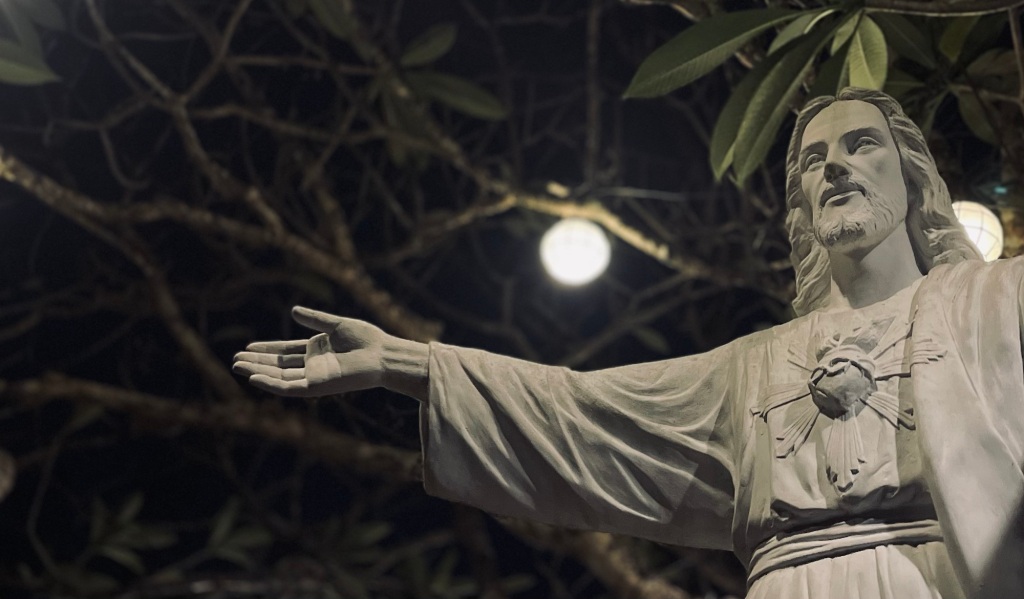
Photo by author, Sacred Heart Novitiate Main Chapel, 17 March 2025.

Our gospel on this last Sunday in Lent is so similar in its beauty and simplicity -and drama – with last week’s parable of the prodigal son. In fact, some believe the style of the woman caught in adultery is very much like Luke but, let’s leave that to the experts.

On this beautiful Sunday, it is John’s turn to invite us to enter into the scene of his story set at the temple area shortly before the arrest of Jesus Christ.

Jesus went to the Mount of Olives. But early in the morning he arrived again in the temple area, and all the people started coming to him, and he sat down and taught them. Then the scribes and the Pharisees brought a woman who had been caught in adultery and made her stand in the middle (John 8:1-3).

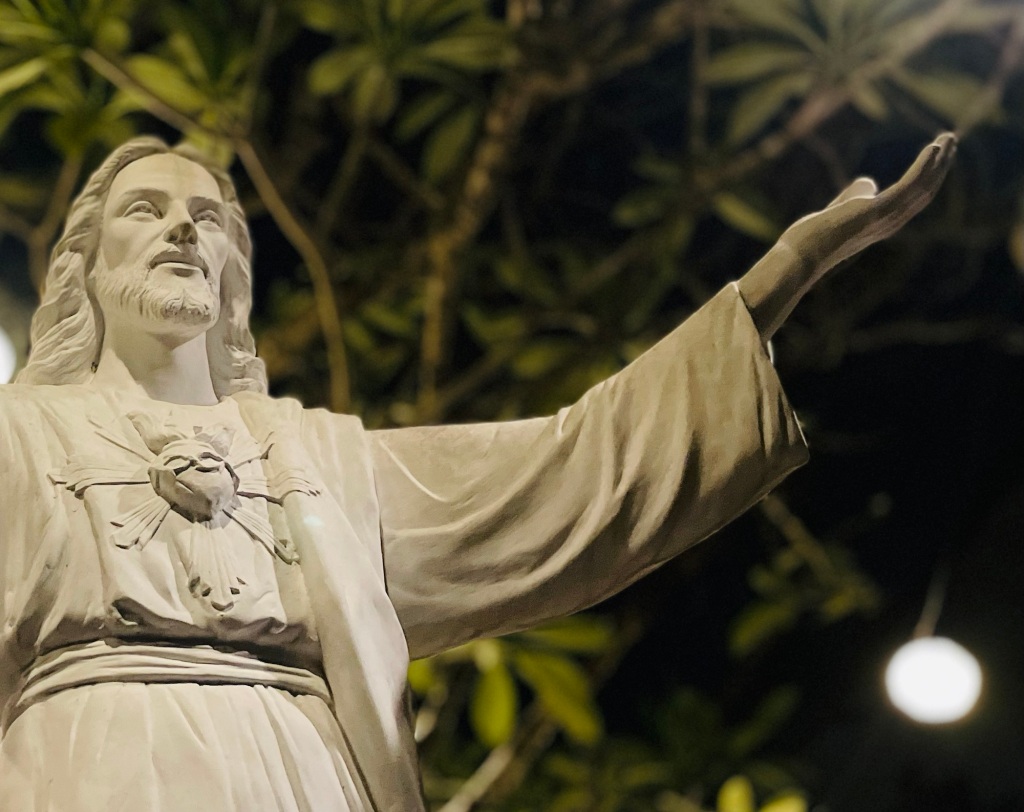
Photo by author, Sacred Heart Novitiate, 17 March 2025.

Try entering the scene. See the woman who most likely almost naked draped only in a piece of cloth as proof of her committing adultery. The Pharisees and the scribes were ganging up on her to Jesus whom they wanted to test, “Teacher, this woman was caught in the very act of committing adultery. Now in the law, Moses commanded us to stone such women. So what do you say?”

Imagine being there, standing close to Jesus and the woman. How would you feel? Would you be able to look at the woman straight on her face? Nah… seems not good. Perhaps, glance only as you feel also her pain and shame. But, can you look straight at the angry mob? Probably for a while with much fears and trepidation along with a deep anger within you cannot express.

Most likely, it is only at Jesus you can look intently and longer because he is not looking at you. Tensions were rising and Jesus simply bent down, writing something on the ground with his finger while the Pharisees and scribes raised up their attacks against him and the lowly woman standing listlessly, so embarrassed, so ashamed. Even in tears.

Recall those moments when we too were caught in the midst of an undeniable transgression like her or, simply being a witness, someone caught in between of another person without any way out of his/her predicament. It must be so dark. So scary. And shameful.

Then, the unexpected happened: But when they continued asking him, he (Jesus) straightened up and said to them, “Let the one among you who is without sin be the first to throw a stone at her.” Again he bent down and wrote on the ground. and in response, they went away one by one, beginning with the elders. So he was left alone with the woman before him (John 8:7-9).

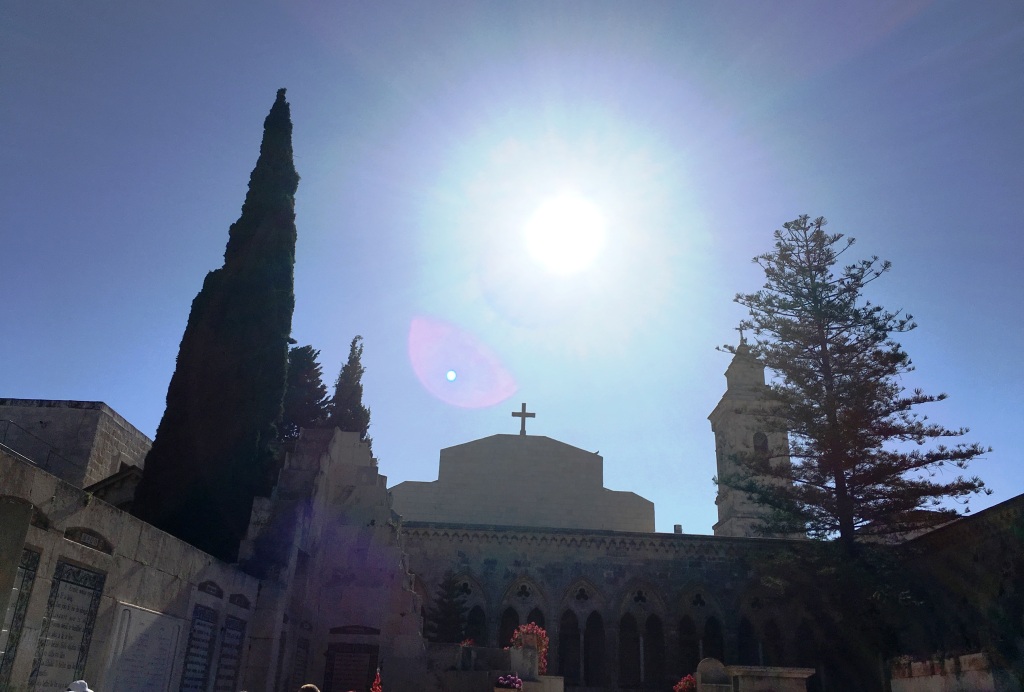
Photo by author, Sacred Heart Novitiate Main Chapel, 17 March 2025.

Many times, we encounter Jesus in our most vulnerable situation when we let go of our guards so to speak.

It is one of the great ironies in life: when we are most vulnerable and weakest, that is when we are also most truest to our self. And that is when we truly grow and mature in life.

That is when we feel peace and joy and freedom within when we are left alone with Jesus still looking down, writing with his finger on the ground to give us more space literally and figuratively speaking. It is not that Jesus wants to shame us or whatever but simply wants us to be true as he has always been true to us, full of love and mercy. Most of all, with all of Christ’s humility in bending, that is when we finally admit the need for a Savior, the need to be converted in him.

We encounter Jesus when we disarm ourselves of our false securities and pretenses, masks and camouflages that all cover our sins. It is when we come face-to-face with our sinful self when we eventually meet Jesus face-to-face too because that is when we surrender in silence like the woman caught in adultery and the mob to some degree because all the charges against us are true.

See also that it is only the fourth gospel that Jesus is portrayed “bending” low – first here before the woman caught committing adultery and secondly at the washing of the feet of his Apostles at their Last Supper. How lovely is that sight to behold, dear friends! Imagine God bending before us, giving us like the sinful woman and the mob that space for us to confront our true self, to realize and accept the whole realities we are all interconnected in love.

Only the woman remained – like the eleven Apostles at the Last Supper – because she was the only one willing to change, probably sorrowful and contrite for her sins. Contrary to our fears, Jesus has only love and mercy, kindness and forgiveness to anyone contrite and sorrowful of one’s sin that so unlike with the people’s wrath and anger, judgment and condemnation. St. Augustine perfectly described that moment in today’s gospel, Relicti sunt duo; misera et miserecordia (Two were left; misery and mercy).

Then Jesus straightened up and said to her, “Woman, where are they? Has no one condemned you?” She replied, “No one, sir.” Then Jesus said, “Neither do I condemn you. Go, and from now on do not sin anymore” (John 8:10-11).

Stations of the Cross, Fatima University & Medical Center, Valenzuela City, 28 March 2025.

We are now on the final Sunday of Lent. Next week will be the Palm Sunday of the Lord’s Passion that ushers in the Holy Week leading to the Sacred Triduum of Holy Thursday Evening, Good Friday and Easter Vigil and on to the Mother of all Feasts, Easter.

As we get closer to the holiest week of the year, our liturgy invites us to intensify our Lenten practices to be “conformed to Christ’s death” as St. Paul urged us in the second reading which opened with these beautiful confession:

“Brothers and sisters: I consider everything as a loss because of the supreme good of knowing Christ Jesus as my Lord. For his sake I have accepted the loss of all things and I consider them so much rubbish, that I may gain Christ” (Philippians 3:8).

The pillars of Lent – prayer, fasting and alms-giving – aim to empty us of our very selves, of our pride and sins that all prevent us from encountering Jesus Christ always coming to us full of love and mercy. On this final stretch of Lent, are we ready to let go of ourselves and to let God?

Today, Jesus assures us of his love and forgiveness for our sins. The first reading tells us of God asking us to forget the events of the past. Just come home to him. And never leave him like the woman caught committing adultery. Amen. Have blessed week ahead.

Stations of the Cross, College of Maritime Engineering, Our Lady of FatIma University, 28 March 2025.

Standing with Jesus, standing like Jesus

The Lord Is My Chef Sunday Recipe for the Soul by Fr. Nicanor F. Lalog II
Third Sunday in Ordinary Time, Cycle C, 26 January 2025
Nehemiah 8:2-4, 5-6, 8-10 ><}}}*> 1 Corinthians 12:12-30 ><}}}*> Luke 1:1-4; 4:14-21

Doctors tell us that prolonged periods of sitting can lead to many health issues like increased risks of heart disease, diabetes, certain cancers, obesity as well as depression. They have been sounding the alarm for several decades with the rise of “couch potatoes” and now had worsened as we get tied to our seats due to continuous use of computers and other gadgets.

Along with this worsening scenario of our prolonged sitting is the growing “competition” among us these days – consciously or unconsciously – for our places of seat in jeepneys and buses or airplanes, in classrooms and offices, on dining tables, in meeting rooms and in churches. People are so concerned where to be seated not realizing that what really matters in life is where we stand than where we sit!

The verb “to stand” evokes firmness and stability not only in the physical sense but also emotionally and spiritually speaking. Very close to it is the word “stance” that indicates our “stand”, of where we “stand” with our beliefs and convictions regarding issues. Before the coming of social media where we often make our stand while seated, there were placards calling us to “make a stand”.

In this age when most people prefer to sit than to stand as well as kneel to pray, our Sunday readings today are very timely as they teem with the words and images of standing for God.

He came to Nazareth, where he had grown up, and went according to his custom into the synagogue on the sabbath day. He stood up to read and was handed a scroll of the prophet Isaiah. He unrolled the scroll and found the passage where it was written… (Luke 4:16-17).

“Jesus Unrolls Book In the Synagogue” painting by James Tissot (1886-1894), brooklynmuseum.org

We now dive into the Sunday Ordinary Time with Luke giving us a glimpse of how Jesus spent a typical sabbath day proclaiming the word of God by first “standing to read.”

It was not the first time Jesus stood to read as He always stood teaching and preaching to the people. Jesus was a man who literally stood for the Father, stood for what is true and good, stood for what is just and fair. Most of all, He stood for all of us that He died on the Cross.

This Sunday as He launched His public ministry in His hometown Nazareth in Galilee, Jesus made it clear that He is the “word who became flesh” as He stood to read the scripture, claiming what He proclaimed from the Prophet Isaiah:

“The Spirit of the Lord is upon me, because he has anointed me to bring glad tidings to the poor. He has sent me to proclaim liberty to captives and recovery of sight to the blind, to let the oppressed go free, and to proclaim a year acceptable to the Lord” (Luke 4:18-19).

Imagine present there. More than being spellbind, there must have been that feeling of fulfillment, of the true reality unfolding as Jesus clearly stood by the word of God because He is the word who became flesh.

Our Filipino word paninindigan evokes it so well like in Pinanindigan ni Jesus ang kanyang ipinahayag (Jesus stood by what He proclaimed). From its root tindig which is “to stand” in English, paninindigan is conviction. Jesus spoke with such conviction and authority that those in the synagogue were amazed with Him. Interestingly, our Filipino synonym for paninindigan is pangatawanan which is from the root katawan or “body” in English. Pangatawanan ang salita is to stand by one’s word, like Pinangatawanan ni Jesus ang Kanyang sinabi (Jesus stood by what He said).

See how our readings this Sunday are so interesting, so beautiful especially for us in the Philippines because the words of “standing” and “body” are related, capturing in our own language discipleship in Christ, our standing for Jesus and His gospel.

“Jesus Unrolls Book In the Synagogue” painting by James Tissot (1886-1894), brooklynmuseum.org

At the end of this scene in the synagogue, Luke told us how Jesus declared as He sat that His words were “fulfilled in your hearing” which amazed the people because Christ “walked the talk” even before this took place.

Anyone wishing to have any kind of fulfillment in life has to first make a stand for whatever he believes in. To walk the talk, one has to stand first. Nothing gets fulfilled by sitting. We have to make a stand for everything and everyone we care and love most.

Like Jesus, we can only bring glad tidings to the poor by standing by their side, standing with them to uplift them. In the same manner, liberty for captives and recovery of sight to the blind can only happen standing, by actually being present with them and never remotely from a distant office or setting where we are comfortably seated. The oppressed can only go free as we proclaim a jubilee like this 2025 when we stand for justice and truth instead of simply affixing our “like” to some posts “standing” for whatever causes.

Photo by author, ambo in our Chapel of the Angel of Peace, RISE Tower, Our Lady of Fatima University, Valenzuela City, 25 December 2024.

In the first reading we find the priest Ezra standing as he proclaimed the words of God from a book recovered after their exile from Jerusalem.

Ezra convinced the people so well in his proclamation of the scriptures that people cried and bowed their heads before finally prostrating themselves to God because they felt and experienced the Scriptures as so true.

The words “standing” and “stood” were repeated thrice to underscore not only the physical posture taken by Ezra and Nehemiah but most of all to indicate their emotional and spiritual bearings.

Going back to our gospel scene, see how before narrating to us Jesus in the synagogue, the Church had rightly chosen to include for this third Sunday the prologue of Luke where he laid down the reason for writing his gospel account – so that we “may realize the certainty of the teachings” about the Christ. In writing his prologue, Luke naturally sat but in mentioning that word “certainty”, he tells us a lot of standing he had to make in completing his two-volume work, the gospel and the Acts.

Here we find that like all the evangelists and saints for that matter, they spent much time standing than sitting, second only perhaps to kneeling or praying.

There is a beautiful prayer attributed to St. Teresa of Avila called “Christ has no body” which goes this way, “Christ has no body but yours, no hands, no feet on earth but yours.”

Can we make a stand for Jesus, stand with Jesus, and stand like Jesus to be His body as St. Paul explained to us in the second reading?

“Brothers and sisters: As a body is one though it has many parts, and all the parts of the body, though many, are one body, so also Christ… Now the body is not a single part, but many” (1 Corinthians 12:12, 14).

Photo by author, Chapel of Angel of Peace, RISE Tower, Our Lady of Fatima University, Valenzueal City, June 2024.

As we embark into this long journey of Ordinary Time with Luke as our guide every Sunday, may we do the work of Jesus by standing along with our fellow believers and disciples.

Together let us make that collective stand for truth and justice, for decency and reason in this time when people are so fragmented, held captive by so many thoughts and beliefs propagated from the arrogant chairs of entitlement by some lazy minds influencing the world remotely. Together we stand and experience life as it is in Jesus Christ, even at His Cross. Amen. Have a blessed week ahead as we close January 2025!

True freedom is being like children

The Lord Is My Chef Sunday Recipe for the Soul by Fr. Nicanor F. Lalog II
Feast of the Sto. Niño, Cycle C, 19 January 2025
Isaiah 9:1-6 ><}}}}*> Ephesians 1:3-6, 15-18 ><}}}}*> Luke 2:41-52
Photo by Daniel Reche on Pexels.com

I have never liked children especially infants not until these last twenty years of my life. Before, I could not understand when parents especially mothers giggled with joy in seeing babies, describing how handsome or pretty they are when they all look the same to me.

Everything changed when I became a priest especially when I turned 40 and had my own nieces and nephew. Suddenly, I realized how children could be so nice with their energy and laughter and wits too. As I now approach my 60th birthday serving as a chaplain in a University with a hospital since 2021, I have come to love children that I have been telling my sister to push her two daughters to get married so we could have babies again in the family!

As my attitudes with children changed, the more I understand why our Lord Jesus Christ had insisted in His teachings the need for us to become like them. Until His death, Jesus showed us the importance of being like a child not only in trusting and having faith in the Father but most of all on the true meaning of freedom.

Photo by author, Tagaytay City, 17 January 2025.

Contrary to common beliefs of many, freedom is not the ability to do whatever one likes; freedom is choosing to do what is good. That is why freedom is never absolute. In the Book of Genesis we find God telling Adam and Eve to eat every fruit of trees in Eden except the fruit of the tree in the middle of the garden (cf. Gen. 3:2-3). And we have seen how in the abuse of their freedom, they including us today have become “unfree”.

In Christ’s coming, He made us recover our freedom, giving us the grace to always choose and do what is good, to be free from sin and free to love, free to forgive, free to be kind. This essence of freedom He taught even at His early age as the true Son of God.

Each year his parents went to Jerusalem for the feast of Passover, and when he was twelve years old, they went up according to festival custom. After they had completed its days, as they were returning, the boy Jesus remained behind in Jerusalem but his parents did not know it… After three days they found in the temple, sitting in the midst of the teachers, listening to them and asking them question, and all who heard him were astounded at his understanding and his answers. When his parents saw him, they were astonished, and his mother said to him, “Son, why have you done this to us? Your father and I have been looking for you with great anxiety.” And he said to them, “Why were you looking for me? Did you not know that I must be in my Father’s house?” (Luke 2:41-43, 46-49)

“The Finding of the Savior at the Temple” painting by William Holman Hunt (1860) from en.wikipedia.org.

First thing we notice in our gospel regarding freedom as the ability to choose what is good is Luke’s portrayal of Joseph and Mary as devout Jews who regularly went on pilgrimage to Jerusalem.

Each year his parents went to Jerusalem for the feast of Passover, and when he was twelve years old, they went up according to festival custom. 

What a simple expression of the essence of freedom of choosing what is good, choosing God: the parents of Jesus devoutly practiced their faith that Jesus fully imbibed. The gospels teem with many stories of Jesus regularly going to the synagogues on sabbath to proclaim the word and to preach to the people.

This is something many parents today are missing, the Sunday devotion. No wonder that many children today do not understand the meaning and importance of the Sunday Mass, even the preeminence of God in our lives. How sad that many families even on holy days of obligation choose malls and vacation than choose God to worship Him in the church.

And many have the gall to defend this as part of their freedom, an expression of unity as family. But, where is God among them? Most of all, have we really become free by not going to the Sunday Mass?

Definitely not. Even at the surface some people would not seem to have any qualms at all in skipping Sunday Masses, deep inside many are bothered. Many of them feel an emptiness within, a kind of darkness that Isaiah described in the first reading. See how despite the affluence of many people today than three decades ago yet more and more are feeling lost and depressed because they have lost their roots in God who leads us to our rootedness in ourselves and with others.

Photo by author, January 2022.

Speaking of roots, its Latin origin is radix from which the word radical came from.

When we hear the word radical, we associate it always with someone who is a revolutionary, someone who literally or figuratively “destabilizes” our status and ways of thinking like Jesus Christ.

Very often, we find Jesus presented to us as one who was radical in His teachings who was thought to have been a revolutionary member of the Zealot party that worked to overthrow the Roman occupiers in ancient Israel. It was one of the accusations hurled against Him at His trial, citing His declaration to destroy the temple that He would rebuild in three days after its cleansing. Of course, these are not true; Jesus was not a radical revolutionary like the communists or power grabbers of modern century.

However, if we examine His teachings and mission, Jesus was a radical revolutionary because He preached and worked to bring humanity back to our very “root” – radix – who is God Himself. Listen to His words to His Mother after being found in the temple…

And he said to them, "Why were you looking for me? Did you not know that I must be in my Father's house?" 
Photo by author, Parish of St. Joseph, Pacdal, Baguio City, 28 December 2024.

Here Jesus showed His Mother and us today that true freedom is being one always with the Father. Jesus was a truly free person because even at His early age, He was totally united with the Father’s will.

All throughout His life and mission, Jesus helped us all attain that freedom of inner communion with God our Father to be truly free from sin and evil to be free to love, free to understand, free to serve and whatever is good.

See how Jesus spoke so plainly to Mary and Joseph, as if reminding them and us today that our roots is in God alone and that is what we must always be concerned with, of how we must remain rooted in God as His children.

In the fourth gospel, we find this imagery of remaining rooted in God in Jesus Christ so beautifully explained during the Lord’s Last Supper discourses specifically in that of the vine and the branches (Jn. 15:15:1-17).

That’s the paradox of true freedom in Christ: being one in God does not limit but rather expands one’s freedom as a person. Any freedom outside of God is a fake and most likely, leads only to bondage because it is only in doing what is good when we truly grow and mature as persons.

Photo by author, Malolos Cathedral January 2022.

This Sunday we celebrate an extra day of Christmas for the Feast of the Sto. Niño in recognition of its great role in the spread of Christianity to our country since its coming in 1521 when Magellan gifted Queen Juana of Cebu with a Sto. Niño image.

The late Nick Joaquin rightly claimed in his many writings that the Philippines was actually conquered by the Sto. Niño than by the guns and cannons of the invading Spaniards more than 500 years ago. That’s probably because of this lesson on true freedom by the Child Jesus.

Let us learn and grow in true freedom by first choosing God especially on Sundays by celebrating the Lord’s Supper, the Holy Mass. Like the Child Jesus, let us remain in the Father, be free to ask most of all to listen and learn about life.

Like Mary and Joseph, it takes time before we can truly understand the words of Jesus Christ; what matters is like them, we keep on choosing always Jesus, only Jesus because Jesus is the truth. May the Lord “enlighten the eyes of our hearts so we may know what is the hope that belongs to his call, what are the riches of glory in his inheritance” (Eph.1:18). Amen. Have a blessed and free week ahead!

Photo by Mr. Jim Marpa, 2018.

Christmas is God at home with us; are we at home with God?

The Lord Is My Chef Sunday Recipe for the Soul by Fr. Nicanor F. Lalog II
Feast of the Holy Family, Cycle C, 29 December 2024
1 Samuel 1:20-22, 24-28 ><)))*> 1 John 3:1-2, 21-24 ><)))*> Luke 2:41-52
Photo by author of a depiction of the Holy Family near the main door of St. Joseph the Worker Parish in Pacdal, Baguio City, 28 December 2024.

You must have heard of the classic song “A House Is Not A Home” composed by the great tandem of Burt Bacharach and Hal David recorded by Dionne Warwick in 1964 for a movie of the same title. It went back to charts in 1981 when the late Luther Vandross covered it in his first album.

It is a very lovely ballad of a love lost, teaching us that indeed, “a house is made of walls and beams while a home is made of love and dreams”.

A chair is still a chair
Even when there's no one sitting there
But a chair is not a house
And a house is not a home
When there's no one there to hold you tight
And no one there you can kiss good night

A room is still a room
Even when there's nothing there but gloom
But a room is not a house
And a house is not a home
When the two of us are far apart
And one of us has a broken heart

But, in the Hebrew language and Jewish thought, the word “house” in itself connotes relationships. There are no distinctions between a house and a home for them that is why we find Jesus claiming the temple as His Father’s house.

Pope Francis opening the Jubiliee Door at St. Peter’s in Rome to launch the start of the Jubilee Year of 2025. Photo by Maurix/Gamma-Rapho via Getty Images.

In fact, the first letter of the Hebrew word for God (Yahweh) is actually shaped as a door or a house. That is why there is the blessing of church doors in dioceses today worldwide following the blessing and opening of the Jubilee Door at St. Peter’s in the Vatican by Pope Francis last Christmas Eve to launch the Jubilee Year. The Jubilee Door signifies our passing through, an entering into a relationship with God.

In John’s gospel we find Jesus as an adult using the word “house” twice when He cleansed the temple, telling everyone to “stop making my Father’s house a marketplace” (Jn.2:16) and at their last supper when He assured the disciples, “In my Father’s house there are many dwelling places or rooms” (Jn.14:2).

The only other occasion Jesus used the word “house” to mean the same thing as John was when He was found by His parents in the temple as we heard today on this Feast of the Holy Family.

Each year Jesus’ parents went to Jerusalem for the feast of Passover, and when he was twelve years old, they went up according to festival custom. After they had completed its days, as they were returning, the boy Jesus remained behind in Jerusalem, but his parents did not know it. After three days they found him in the temple… When his parents saw him, they were astonished, and his mother said to him, “Son, why have you done this to us? Your father and I have been looking for you with great anxiety?” And he said to them, “Why were you looking for me? Did you not know that I must be in my Father’s house?” But they did not understand what he said to them (Luke 2:41-43, 46, 48-50).

“The Finding of the Savior at the Temple” painting by William Holman Hunt (1860) from en.wikipedia.org.

We find in the story of the finding of Child Jesus in the temple that even at a very young age, Jesus had always been clear with His oneness in God by always referring to the temple as His “Father’s house”.

As we have reflected in December 19 in Luke’s first Christmas story, the annunciation of John’s birth to his father Zechariah while incensing at the temple in Jerusalem during a major Jewish feast that Christmas begins in the church where we gather to praise and worship God as a community. See how this Sunday after Christmas our many empty pews in the church. How sad that many Catholics after Christmas have totally disregarded the Sunday Mass, going to all the vacation spots here and abroad with many of them having no qualms at all that this is the “day of the Lord”, a Sunday obligation.

Again, here is Luke in his artistic narration of Christmas into Christ’s adolescence insisting on us the importance of communal worship and prayer. Not surprising that of the four evangelists, Luke is the one who presented Jesus always at prayer as an expression of His oneness or communion in the Father and he wants us hearers of his gospel account to cultivate that same communion with God in Jesus, with Jesus, and through Jesus.

Christmas is essentially Jesus Christ becoming human so that God may be “at home” with us humans as John beautifully wrote in his prologue we heard last Christmas Day, “And the Word became flesh and made his dwelling among us” (Jn.1:14).

But, are we at home with God in Jesus?

Photo by author, the small entrance door leading to the Church of the Nativity in Bethlehem where one needs to bow low literally and figuratively to enter Christ’s birthplace.

On this Feast of the Holy Family, our gospel reminds us this Sunday of how even Mary and Joseph had trouble with their adolescent son Jesus like most parents these days, a kind of family conflict so familiar with many people everywhere.

What a lovely scene today this Christmas season amid widespread reports of child kidnappings and so many children caught in the middle of many conflicts among adults like wars in many parts of the world and worst, right inside every family, right in their house, or homes where there are no relationships at all.

Luke was a physician who understood very well the anguish and sufferings of many people, especially parents during his time that continue to these days. In narrating to us this sad episode of his Christmas stories when Jesus was lost but eventually found in the temple, Luke is assuring us that despite all the darkness and troubles that engulf many families today, we have a very loving, personal God in Christ always with us.

Photo by author, picture taken from the inside of the Church of the Nativity in Bethlehem of its small entrance door.

Mary and Joseph did not understand what Jesus meant that He must be at His Father’s house but it did not deter them from exploring its meaning so that only Mary with John and two other women remained with Christ at the foot of the Cross on that Good Friday.

How lovely that Mary and those others at the foot of the Cross were the ones truly “at home” with the Lord, in the Lord! The same thing speaks so true with Joseph who in his silence was so “at home” with God in Jesus, whether awake or asleep. He kept that relationship with God alive through Mary and those others around him especially Jesus.

As an adult approaching His pasch, Jesus assured His disciples including us today of having a dwelling place or room in His Father’s house in heaven – that, despite our many sins, God would never cut off His ties with us in Jesus, with Jesus! That is how God loved us so much as the author of the Letter to the Hebrews reminds us “God is greater than our hearts and knows everything” (1Jn.3:20).

Like Hanna the mother of the child Samuel, let us start cultivating this relationship with God even while still very young. It does not really matter if we destroy and cut it so often; what matters is we keep on trying to let it grow anew for it is and would never ever get lost again. Thanks to Christmas!

That is why I personally insist in my homilies and writings that we keep greeting everyone with a Merry Christmas until January 12, the Feast of the Baptism of the Lord that closes the Christmas season. It is still Christmas after all!

Photo by author, Chapel of the Angel of Peace, RISE Tower, Our Lady of Fatma University, Valenzuela City, Christmas 2024.

Like Mary and Joseph, let us keep coming back to God symbolized by Jerusalem and its temple now replaced with our churches. Let us go back to prayer and to Sunday Masses to find Jesus again present in the signs and symbols of the liturgy and most of all, in everyone present celebrating His coming.

Let us continue the story of Christmas with our relationships with God through others, of our being at home with the Father in Jesus Christ who “advanced in wisdom and age and favor before God and man” (Lk.2:52) after this episode which closed Luke’s Christmas account.

Let us be at home with God and with one another in Jesus, with Jesus, and through Jesus. May you continue to have blessed Christmas Season. Amen.

Advent & Christmas begin in the church

The Lord Is My Chef Daily Recipe for the Soul by Fr. Nicanor F. Lalog II
Simbang Gabi-4 Homily, 19 December 2024
Judges 13:2-7, 24-25 <*((((>< + ><))))*> Luke 1:5-25
Photo by author, wailing wall of Jerusalem where Jews pray until now being the section closest to the Holy Holies destroyed in year 70AD.

From Matthew, we now shift to Luke to listen to his account of Christmas which is the most complete and detailed. In fact, most artistic renditions of Christmas were inspired by Luke’s gospel.

Very surprising in his Christmas story, Luke started it with the annunciation of the birth of John the Baptist to his father Zechariah who was then serving at the temple of the Lord in Jerusalem. It is a reminder to us all these days that Advent and Christmas begin in the church, in our holy celebrations.

In the days of Herod, King of Judea, there was a priest named Zechariah of the priestly division of Abijah; his wife was from the daughters of Aaron, and her name was Elizabeth. Once when he was serving as priest in his division’s turn before God, according to the practice of the priestly service, he was chosen by lot to enter the sanctuary of the Lord to burn incense. Then, when the whole assembly of the people was praying outside at the hour of the incense offering, the angel of the Lord appeared to him, standing at the right of the altar of incense (Luke 1:5, 8-11).

Luke’s detailed account of the event is the Jewish Day of Atonement (Yom Kippur) when their priests incense yearly between September 18-24 the Holy of Holies where they used to keep the Ark of the Covenant. From this detail by Luke we got the reliable timetable in the celebration of Christmas on December 25 by considering this event as the time of Elizabeth’s conception of John who was born June 24 or nine months after. Tomorrow we shall hear in the gospel how “on the sixth month” of Elizabeth’s pregnancy which fell on March 25, the angel Gabriel announced to Mary the birth of Jesus, the Solemnity of the Annunciation we celebrate on that date. Nine months from March 25, we have December 25! Who said our Christmas date is not in the Bible? We got it here in our gospel today courtesy of Luke!

Photo by author, Parish Church of St. Joseph in Morong, Rizal, January 2021.

It may sound simple yet, it is so profound. In narrating this to us, Luke reminds us today that the Christmas story began in a holy celebration in the temple of Jerusalem now happening in our Eucharistic celebrations in every church around the world.

Many take our Sunday Masses for granted these days with so many excuses and alibis but, let us set aside all these to reflect on this simple detail from Luke’s first story on Christmas.

Photo by Mr. Jim Marpa, 2018.

First, this is a call for us all to go back to the church by finally putting a stop NOW of online Masses. Online Mass as a term is an oxymoron because it presupposes actual presence of people. There can be no virtual Mass because there is no such thing as virtual sacrament nor virtual grace. That is why God introduced Himself to Moses as “I AM WHO AM”, the One who is perfectly present, always actual never virtual.

Since the waning of the COVID virus last year, both the Pope and the CBCP have called for the ending of online Masses but unfortunately, so many priests have remained stubborn with some making “shameful profit” out of it which is strongly prohibited by Canon Law and other Church and papal documents. Unless online Masses are stopped, people will always find reasons and alibis not to go to church on Sundays.

As we reflect on Luke’s account of the celebration at that time of the annunciation of the angel to Zechariah while he was incensing the Holy of Holies, we get the feel of solemnity and sacredness that are sorely missing these days in many of our celebrations of the Mass.

Like Zechariah and the priests of the Jerusalem temple at that time who were all steeped in traditions and presumably spirituality, we have every reason to expect the same, even more, from our bishops and priests today. They are the ones who set the tone of every celebration and of life in the parish; their spirituality or lack of it is manifested in the parish life, from its building structure to its witnessing.

Photo by author, pious Jews and Rabbis in another enclosed section of the wall of the temple of Jerusalem, May 2017.

How sad when priests have lost the sense of the sacred of the Holy Mass when they disregard the solemnity of the celebration with all their antics and gimmicks; worst of all, of coming to Mass unprepared without a homily and good vestments, sometimes without having showered or shaved! What is tragic is when the priest attends all socials in proper attire, but never in the Mass.

The other day, I saw a sticker at the back of a delivery van that asks, “How’s my driving? And my grooming?” Too bad I was not able to get the name of the company of that delivery van but how great are its people must be in giving a premium on how their drivers behave and look!

Some priests shamelessly argue that what is essential is what is inside but they forget that the outward appearance is an indication of what’s inside them too. How can the people feel and experience God if their pastor comes shabbily dressed without any good vestments, so untidy as in dugyot, unprepared for the Mass, without a good homily?

What had become of our churches that have been the shining glory of architecture through the centuries but now look like malls? Some churches look like videoke bars with a lot of giant TV screens while priests serenade the people with their wonderful voices instead of delivering a homily.

How sad that many churches are untidy and ugly. Yes, ugly is the word. And kitschy, bereft of any sense of the holy that people cannot experience God except be played on their emotions with dramas and not to forget, second and third collections. Choirs are on their own with a concert, totally deaf to the fact their music is supposed to lead the congregation into prayerful reflections not to applaud them for a performance. It is about time we restore the dictum of the Roman liturgy of noble simplicity not only of the church and also of celebrations.

Photo by author, Archdiocesan Shrine of Nuestra Señora De Guia, Ermita, Manila, 28 November 2024.

Our gospel invites us today, especially us priests and bishops along with those involved in preparing our parish celebrations to be silent like Elizabeth – lest we be silenced and be made mute by the Lord like Zechariah to finally open ourselves to listen to God’s instructions about His Son’s coming.

Let’s face that sad reality of so many of us clergy and laity in the church who are like Zechariah trying to control everything including God, even playing God who give the people enough reasons to turn away from the Church completely.

Photo by author of the beautiful sacristy of the Archdiocesan Shrine of Nuestra Señora De Guia in Ermita, Manila where even a guest priest could feel at “home” with everything in order.

Like Elizabeth, let us choose to be silent in order to pray truly, awaiting God in the Holy Spirit to stir us into His Divine Plans like Samson in the first reading, “The boy grew up and the Lord blessed him; the Spirit of the Lord first stirred” (Jgs.13:24-25). We find the same thing in the gospel when Gabriel told Zechariah how John while still in Elizabeth’s womb would be filled with the Holy Spirit (Lk.1:15) in accomplishing his mission as precursor of Jesus.

If we could allow ourselves to be stirred by God first – not by fad or ulterior motives in our church celebrations – then every Mass becomes a Christmas, a coming of Christ.

Let us do away with unnecessary things in the church and in our celebrations that call attention to us, to our abilities and talents, even power like Zechariah by being more daring in silence and noble simplicity to experience God’s coming every Mass.

As we shall see in the coming days from the gospel of Luke, Christmas is both a journey into Bethlehem, Jerusalem and other places as well as into the very hearts of Joseph and Mary and of those who would recognize and accept Jesus Christ. May our churches reflect what is in our hearts as disciples of Christ, always with a space for Jesus to come and dwell inside and among us. Amen.

Photo by author, Simbang Gabi in our previous parish, 2018.

Jesus sitting among us

The Lord Is My Chef Sunday Recipe for the Soul by Fr. Nicanor F. Lalog II
Thirty-second Sunday in Ordinary Time, Cycle B, 10 November 2024
1 Kings 17:10-16 ><}}}}*> Hebrews 9:24-28 ><}}}}*> Mark 12:38-44

Our Sunday readings are so lovely, so picturesque where you find in both first reading and gospel the character of a poor widow standing side by side with great men of faith in God as the main focus, the Prophet Elijah and Christ Jesus, respectively.

In the first reading, we find humorously the Prophet Elijah asking for water, then some bread from a widow gathering sticks outside her home in Zarephath.

Elijah said to her, “Do not be afraid… For the Lord, the God of Israel, says, ‘The jar of flour shall not go empty, nor the jug of oil run dry, until the day when the Lord sends rain upon the earth.'” She left and did as Elijah had said. She was able to eat for a year, and he and her son as well; The jar of flour did not go empty, nor the jug of oil run dry, as the Lord had foretold through Elijah (1 Kings 17:13, 14-16).

Elijah had fled Israel after proclaiming a drought because the people turned away from God to worship baals or false gods brought by the wife of King Ahab, Queen Jezebel. God then directed Elijah to Zarephath outside the city of Sidon to hide where the king was the father of his archenemy, Queen Jezebel!

Imagine Elijah hiding in the most hostile place of all with a pagan widow who worshipped baal so denounced by him. But, here is a marvelous story of faith of Elijah who trusted God completely in obeying Him to move to the pagan region ruled by his enemies. Similar was the faith of the pagan widow who surprisingly believed Elijah and God’s power that she did not mind putting her life and her son’s at risk in harboring their enemy. Their admirable faith both remind us how God accomplishes His great acts of mercy and love when we surrender ourselves totally to Him.

Photo by author, Wailing Wall of Jerusalem, May 2019.

Nine hundred years later after Elijah, we had Jesus in Jerusalem like the prophet in a very hostile place and situation too – in the Temple that was the very domain of His enemies. This was the Holy Week after Jesus had entered Jerusalem on Palm Sunday leading to Good Friday.

And like Elijah who approached a widow worshipper of baal, Jesus dared to sit at the temple area after harshly castigating the scribes there:

He sat down opposite the treasury and observed how the crowd put money into the treasury. Many rich people put in large sums. A poor widow also came and put in two small coins worth a few cents. Calling his disciples to himself, he said to them, “Amen, I say to you, this poor widow put in more than all the other contributors to the treasury. For they have all contributed from their surplus wealth, but she, from her poverty, has contributed all she had, all her livelihood” (Mark 12:41-44).


Jesus sat down 
opposite the treasury and observed
how the crowd put money into the treasury.

Throughout this week, that scene of Jesus seated at the Temple had so absorbed me. What was Mark trying to tell us in reporting this? Jesus seated at the temple opposite the treasury observing the crowd is something else.

See the genius of Mark in weaving this Sunday’s gospel scene: right after castigating the corrupt leaders of Israel who were affiliated with the temple, Mark segued into this poor widow dropping some coins into the treasury box. In ancient Israel, the poor like the widows were not required to give those contributions. In a stroke of genius, Mark tells us something is wrong in this scene which Jesus rightly attacked because that widow was one of those widows whose house was devoured by the scribes!

“The Widow’s Mite” painting by French painter James Tissot, from brooklynmuseum.org.

And Mark never intended the story only for the Christians of his time but also for us as we have continued in the Church that malpractice by priests and scribes of Jerusalem. Woe to us priests and bishops who go around in “long robes and accept greetings, seats of honor” and worst of all, “devour houses of widows”, forgetting the poor, preferring always to be with the rich and powerful that social media attest.

Like Zarephath and the Jerusalem Temple, there is Jesus sitting in the middle of our Church under attack on all fronts and within in order to be closer with us especially the widows and the poor who are victims of an unjust society and systems perpetrated by same men and women supposed to be servants of God, or, at least men and women of God.

Photo by author, July 2024.

That image of Jesus seated at the Temple opposite the treasury was in fact a reminder of His being the victim too of injustice in the temple like the poor widow, of His Crucifixion on Good Friday. In fact, the 30 pieces of silver the priests have paid Judas Iscariot to betray Jesus must have come from that treasury.

In the midst of the hostilities and hurts, the divisions and abuses of power by priests and lay alike, in the Jerusalem Temple then and now in our Church, there has always been Jesus sitting among us, observing our offerings after first offering Himself for us all as our perfect High Priest (second reading) who finally freed us from these injustices and inhumanity of the past.

That is why I love this scene so much.

More than tithing, Jesus tells us this Sunday that like that generous heart of the poor widow, despite her plight, she continued to give because she believed, she hoped, most of all, she loved God. She need not give but still insisted because the treasury was for the upkeep of the temple, the very house of God, therefore, for God Himself.

There are times I hurt deep inside for the pains of the many scandals some priests and bishops have caused the Church but I choose to remain, even to sit in this Church or be a victim like Jesus amid all these because I love Jesus. Yes, amid all these sorrows, there is one “first” I see above all, Jesus Christ. This is concretization of last Sunday’s “which is the first of the commandments” – God who is love above all!

Jesus is telling us this Sunday through the poor widow that it is recognizing God in us and in one another that matters, and that is why we give at all.

Photo by author, 2022.

If we love God, if we find God in us and in others, when we find Jesus seated among us, then we realize we are the Church, we are the Temple we love. The moment we realize this, the more we feel at home “sitting with Jesus in the temple”, then we start giving totally because we love as well as know for a fact that whatever we give is actually what we receive from God in Jesus.

Why give so little? Give all, give everything because you never have anything to begin with! Everything is from God. That is why it is in giving that we truly receive. In every Mass, we do not give anything except our mere presence that is not even complete and yet, we get abundant blessings, primarily Jesus Christ whom we receive wholly, Body and Blood.

In every Mass we celebrate, we sit with Jesus in the midst of this inhospitable world we live in, even right in the church we love and hate sometimes. We do not give up. We persevere because we believe, we trust, we hope. Most of all, we love like Elijah and Jesus and believe like the poor widows of Zarephath and Jerusalem Temple. Amen. Have a blessed week ahead!


From fear of the Lord to love of God and neighbors

The Lord Is My Chef Sunday Recipe for the Soul by Fr. Nicanor F. Lalog II
Thirty-first Sunday in Ordinary Time, Cycle B, 03 November 2024
Deuteronomy 6:2-6 ><}}}}*> Hebrews 7:23-28 ><}}}}*> Mark 12:28-34
Photo by author, river at the back of Nagsasa Cove, San Antonio, Zambales, 19 October 2024.

Jesus finally entered Jerusalem to fulfill His mission as we also enter the last four Sundays of our liturgical year before entering the season of Advent in preparation for Christmas.

Two Sundays ago we reflected the atmosphere of fear among the Apostles and the crowd following Jesus to Jerusalem after He had made known to them for the third time His coming Passion, Death, and Resurrection. This Sunday our readings invite us to look into that feeling of fear we often experience.

Fear can be negative in nature when we experience a threat to our safety whether there is a clear and present danger from a person or animal hurting us, or when our imagination runs wild with ghosts or a snake underneath the bed at night.

Positive fear is actually the reverence we experience due to a sense of awe often associated with our relationships like with our parents and relatives, teachers and superiors, or any person who seem to amaze us. We fear them not because they threatened us but actually inspired us with their presence, dignity and grace, intelligence and kindness among other things. This kind of fear we experienced in childhood then slowly matured and blended with trust, translated into adoration of the persons so unforgettable to us, influencing us in many ways that we have come to love them eventually, especially God. This is what the Bible and catechism books refer to as “fear of the Lord”.

Photo by author, Mount Sinai, Egypt, May 2019.

Moses spoke to the people, saying: “Fear the Lord, your God, and keep, throughout the days of your lives, all his statutes and commandments which I enjoin on you, and thus have long life. Hear, O Israel! The Lord is our God, the Lord alone! Therefore, you shall love the Lord, your God, with all your heart, and with all your soul, and with all your strength. Take to heart these words which I enjoin on you today” (Deuteronomy 6:2, 4-6).

This “fear of the Lord” that Moses and later the prophets instilled among the Israelites was expressed in faithfulness and obedience to the Laws so that for them, being holy or upright was obedience to the Laws.

This “fear of the Lord” is not about God overpowering man to keep him in bondage. In giving the Ten Commandments, God first entered into a relationship or covenant with the chosen people based on friendship, trust, and love. See here that positive aspect of fear, of reverence like our fear of parents and elders as well as those seemed larger than us including our crushes and first love when we revered them by showing them love and respect.

This “fear of the Lord” then becomes a passing from fear to love that leads us to maturity as persons. And believers. Then lovers and followers not only of those significant people in our lives but most especially of God!

One of the scribes came to Jesus and asked him, “Which is the first of all the commandments?” Jesus replied, “The first is this: Hear, O Israel! The Lord your God is Lord alone! You shall love the Lord your God with all your heart, with all your soul, with all your mind, and with all your strength. The second is this: You shall love your neighbor as yourself. There is no other commandment greater than these” (Mark 12:28-31).

Photo of author, Mount Sinai, Egypt, May 2019.

Unlike the tricky questions posed by His enemies, this one from a scribe was so unique with his calm attitude that invites everyone including us to join in the discussion. One can feel his sincerity in seeking out the truth he felt (rightly so!) only Jesus can answer.

Many times, we feel the same way like that scribe so convinced in asking Jesus, ready to follow Him only if we are clarified which is the first to follow in life in order to mature from fear to love.


"Which is the first of all the commandments?"

Like that scribe, many times we feel confused in our lives, in our faith with the many laws and traditions we were told since childhood to follow; hence, we ask “which is the first of the commandments” that really matter most in life.

Such moments in our life is a grace from the Holy Spirit because in asking “the first of the commandments” is not to determine a hierarchy nor a list of which ones to be prioritized and dismissed; the “first” commandment means the absolutely capital that is always binding on all. The “first” commandment is the one to which all others are subjected without being cancelled or considered least nor optional. The “first” commandment is the very essence of all commandments present in each commandment. It is actually a search for the First Principle who is God Himself!

That is why Jesus quoted verbatim Deuteronomy 6:4-5, the opening words of their best known prayer Shema every pious Jew knows by heart, “Hear, O Israel! The Lord is our God, the Lord alone! Therefore, you shall love the Lord, your God, with all your heart, and with all your soul, and with all your strength.”

Similar to His manner of answering the question about divorce last month, Jesus did not answer the scribe’s question by making reference to a code of laws but instead recited the Shema that encapsulates maturity and deepening of faith in God who is One, with no other except Him. The Shema also shows how our personal God relates with us His people, bonding in a covenant like husband and wife that is reciprocal, exclusive, and total love “with all your heart, with all your soul, with all your mind, with all your strength.”

This “first” commandment is also a relationship that flows to our relationships with one another we rightly call as neighbors. See how Jesus added a “second” commandment not as in a hierarchy making it less important but as an expression of the essential “first” commandment of all the scribe understood well when he affirmed, “Well said teacher… and to love your neighbor as yourself is worth more than all burnt offerings and sacrifices” (Mk.12:32, 33).

For the Jews, their neighbors were their fellow Jews and those aliens residing in their land as found in the Book of Leviticus; but, in this scene, we find Jesus bringing that whole notion of neighbors for everyone, regardless of color and status in life, or of gender, or beliefs.

Jesus makes known to us this Sunday His mission of salvation is for all, for everyone. Most of all, Jesus tells us this Sunday that He is the fulfillment of the Law that many during His time and sadly until now have misread as mere letters to be followed, failing to find the face of God in every law inscribed on every person.

Photo by author, view from Jerusalem Temple, May 2019.

How interesting that each face has two cheeks, both essential, both as the first commandment: love of God is love of neighbor. To profess and practice this faith in God that started in fear and matured into love finding Him in everyone as our neighbor is to be “not far from the kingdom of God” (Mk.12:34).

Friends, let us not fear asking Jesus which is the “first” of the commandments like that scribe.

Keep asking Him until we find Jesus “first” in our trials and tribulations, darkness and confusions, failures and emptiness.

Keep asking Him until we find Jesus “first” on those people who burden us, those who hurt us, those who judge us, those who refuse to listen to us, those who dictate on us.

Keep asking Him until we find Jesus even in programs and plans we could not understand or that are downright crazy.

That is what to truly love God and to love everyone. It is difficult but we have Jesus as our high-priest “who has passed through the heavens” leading us closer to the kingdom of God. Amen. Have a lovely November!

Photo by author, Pundaquit Mountains, San Antonio, Zambales off Nagsasa Cove, 19 October 2024.

Mga pamahiin at kaalaman turo sa atin ng paglalamay sa patay

Lawiswis ng Salita ni P. Nicanor F. Lalog II, Ika-01 ng Nobyembre 2024
Larawan kuha ng may-akda, Sacred Heart Novitiate, Novaliches, QC, 20 Marso 2024.

Salamuch sa mainit na pagtanggap sa ating nakaraang lathalaing nagpapaliwanag sa ilang mga pamahiin sa paglalamay sa patay.

Sa ating pagsisikap na tuntunin pinagmulan ng mga pamahiin sa paglalamay, nakita rin natin ang kapangyarihan ng mga kaisipan ng tao na mahubog ang kamalayan at kaugalian ng karamihan sa pamamagitan ng mga ito.

Ang nakakatuwa po, mayroon namang praktikal na dahilan sa likod ng maraming pamahiin katulad po ng maraming nagtatanong, bakit daw masamang magwalis kapag mayroong patay?

Larawan kuha ni Fr. Pop dela Cruz, San Miguel, Bulacan, 2022.

Sa mga katulad kong promdi o laki sa probinsiya inabutan ko pa mga kapitbahay naming nakatira sa kubo at mga sinaunang tirahan na mayroong bubong na pawid at silong sa ilalim. Tablang kahoy ang mga sahig kung mayroong kaya at masinsing kinayas na mga kawayan kung hindi naman nakakaangat sa buhay. Ang silong palagi ay lupa din, mataas lang ng kaunti sa kalsada. Bihira naka-tiles noon. Kaya, masama ring ipanhik ng bahay ang tsinelas o bakya o sapatos kasi marumi mga ito.

Masama o bawal magwalis kapag mayroong lamay sa patay kasi nakakahiya sa mga panauhin na nakikiramay – mag-aalikabok sa buong paligid! Liliparin mga lupa at buhangin kasama na mga mikrobyo.

Marumi, sa madaling salita. Kaya ang utos ng matatanda, pulutin mga kalat gaya ng balat ng kendi o butong-pakwan. Noong mamatay Daddy ko, hindi ko matandaan kung tinupad namin pamahiing ito pero hindi ko malimutan paano nilinis ng mga kapit-bahay aming bahay nang ihatid na namin sa huling hantungan aking ama. Bagaman bawal magwalis noong lamay, asahan mo naman puspusang paglilinis ng mga kapit-bahay at kaanak pagkalibing ng inyong patay.

Kapag ako po ay tinatanong kung “naniniwala” sa pamahiin, “hindi” po ang aking sagot kasi iisa lang aking pinaniniwalaan, ang Diyos nating mapagmahal. Tandaan turo ni San Pablo noon sa marami niyang mga sulat, hindi mga ritual at kaugalian nagliligtas sa atin kungdi tanging si Kristo Jesus lamang.


Bakit lamay o "wake" 
ang pagbabantay sa patay?


Nakakatawa at marahil mahirap paniwalaan sagot sa tanong na iyan. Ang paglalamay ay hindi pagtulog sa gabi dahil sa mga gawain at gampanin kinakailangang tuparin. Wake ang Inggles nito na ibig sabihin ay “gising” tulad ng awake.

Naglalamay ang mga tao noong unang panahon lalo na sa Europa kapag mayroong namamatay upang matiyak na talagang namatay na nga kanilang pinaglalamayan. Inihihiga ang hinihinalang namatay sa mesa habang mga naglalamay ay nagkakainan at nag-iinuman upang hindi antukin; higit sa lahat, baka sakaling magising at matauhan hinihinalang patay sa kanilang ingay.

Alalahaning wala pang mga duktor noon na maaring magdeklarang pumanaw na ngang tunay ang isang tao; kaya, hindi malayo na may pagkakataong ang mga inaakalang namatay ay nag-comatose lamang. Kapag hindi pa rin nagising sa ingay ng kainan at inuman ng mga naglamay ang patay pagsapit ng bukang-liwayway, ipinapalagay nila noon na tunay na ngang patay iyon at saka pa lamang pag-uusapan ang libing.

Nang maglaon sa paglaganap ng Kristiyanidad, ang lamay na dati ay kainan at inuman, naging panahon ng pagdarasal ngunit hindi rin nawala mga kainan at inuman sa mga lamayan upang huwag antukin. At higit sa lahat, para maraming makiramay na ibig sabihin, mabuting tao namatay.


Mga salita at kaalaman
natutunan dahil sa mga patay...

Heto ngayon ang magandang kuwento mula sa kasaysayan kung paanong napagyaman ng mga tradisyon sa paglalamay ng namatay ang ating mga wika maging kaisipan. Kitang-kita ito sa kulturang banyaga tulad ng mga Inggles.

Nagtataka maraming archaeologists sa ilang mga takip ng kabaong sa Inglatera ay mayroong kalmot ng kuko ng daliri. At maraming bahid ng dugo.

Napag-alaman sa pagsasaliksik na may mga pagkakataong nalilibing mga yumao noon na hindi pa naman talagang patay! Kaya, kapag sila ay nagkamalay o natauhan habang nakalibing, pinagtutulak nila ang takip ng kabaong hanggang sa pagkakalmutin upang makalabas hanggang sa tuluyang mamatay na nga sa libingan.

Kaya naisipan ng mga tao noon na magtalaga ng bantay sa sementeryo lalo na mula alas-diyes ng gabi hanggang pagsikat ng araw na siyang pinagmulan ng katagang graveyard shift – literal na pagtatanod sa sementeryo o “graveyard” upang abangan sakaling mabuhay ang nalibing.

Larawan kuha ng may-akda, libingan ng mga pari at hermanong Heswita sa Sacred Heart Novitiate, Novaliches, QC, ika-20 ng Marso 2024.

Ganito po ang siste: tinatalian ng pisi ang daliri o kamay ng bawat namamatay kapag inilibing. Nakadugtong ang taling ito sa isang kililing o bell sa tabi ng bantay ng sementeryo, yung nasa graveyard shift.

Nakaangat ng kaunti ang takip ng kanyang kabaong at hindi lubusang tinatabunan kanyang libingan upang sakaling magkamalay, tiyak magpipiglas ito sa loob ng kabaong para makalabas… tutunog ang kililing sa gitna ng dilim ng gabi para magising o matawag pansin ng bantay na agad sasaklolo upang hanguin ang buhay na nalibing.

Isipin ninyo eksena sa sementeryo sa kalagitnaan ng dilim ng gabi… at biglang mayroong kikililing? Sinong hindi matatakot sa taong nalibing na biglang nabuhay? Doon nagmula ang salitang dead ringer na ibig sabihin ay isang taong nakakatakot o kakila-kilabot. Ikaw ba namang magtrabao ng graveyard shift sa sementeryo at kalagitnaan ng gabi ay tumunog kililing… marahil magkakaroon ka rin ng tililing sa takot!

Kaugnay din nito, alam ba ninyo na mayroong nakatutuwang kuwento rin ang paglalagay ng lapida sa libingan ng ating mga yumao?

Balikan ang Bagong Tipan ng Banal na Kasulatan na nagsasaad ng isa sa mga pangunahin nating pinananampalatayanan: ang muling pagbabalik ni Jesus o Second Coming of Christ na tinuturing end of the world.

Takot na takot mga unang Kristiyano sa paniniwalang ito na baka wala pa ang Panginoon ay magsibangon kaagad mga naunang namatay sa kanila!

Ang kanilang solusyon, lagyan ng mabigat na batong panakip ang mga libingan tulad ng lapidang marmol upang hindi agad bumangon ang patay bago ang Second Coming of Christ o Parousia.

Isa iyan sa mga dahilan kung bakit sinesemento rin mga puntod at libingan: upang huwag unahan pagbabalik ni Jesus.

Larawan kuha ng may-akda, libingan ng mga pari at hermanong Heswita sa Sacred Heart Novitiate, Novaliches, QC, ika-20 ng Marso 2024.

Kahalagahan ng pagsisimba...
hanggang kamatayan...
bago ilibing.

Mula sa tahanan, dumako naman tayo ngayon sa loob ng simbahan para sa pagmimisa sa mga yumao. Pagmasdan po ninyong mabuti posisyon ng mga kabaong ng mga patay kapag minimisahan.

Kapag po layko ang namatay katulad ng karamihan sa inyo na hindi pari o relihiyoso… pagmasdan ang kanilang paa ay nakaturo sa dambana o altar habang ang ulunan ay nakaturo sa mga tao o nagsisimba.

Kuha ng may-akda, 2018.

Ito ay dahil sa huling sandali ng pagpasok ng sino mang binyagan sa simbahan, siya pa rin ay nagsisimba. Pansinin na nakaturo kayang mga paa sa altar at ulo naman sa pintuan dahil kapag siya ay ibinangon, nakaharap pa rin siya sa altar, nagsisimba, nagdarasal.

Kapag pari naman ang namatay, katulad ko (punta po kayo), ang aming mga paa ay nakaturo sa pintuan ng simbahan at ulo naroon sa direksiyon ng dambana.

Hanggang sa huling pagpasok naming pari sa simbahan bago ilibing, kami ay nagmimisa pa rin ang anyo: nakaharap sa mga tao kung ibabangon mula sa pagkaposisyon ng aming ulo nakaturo sa altar at mga paa sa pintuan.

Larawan kuha ng may akda ng pinakamahal at isa sa matandang sementeryo sa mundo; mga paa ay nakaposisyon sa silangang pintuan ng Jerusalem upang makaharap kaagad ang Mesiyas na inaasahang magdaraan doon kapag dumating. Ang totoo, doon nga dumaaan si Jesus pagpasok ng Jerusalem mahigit 2000 taon na nakalipas.

Salamuch muli sa inyong pagsubaybay sa ating pagninilay at pagpapaliwanag ng ilang mga pamahiin at paniniwala kaugnay ng mga namatay. Ang mahalaga sa lahat ng ito ay patuloy tayong mamuhay sa kabanalan at kabutihan na naka-ugat palagi sa Diyos sa buhay panalangin (prayer life) na ang rurok ay ang Banal na Misa.

Huwag na nating hintayin pa kung kailan patay na tayo ay siyang huling pasok din natin sa simbahan na hindi makasalita ni makarinig o makakita. Tandaan, ang pagsisimba tuwing Linggo ay dress rehearsal natin ng pagpasok sa langit!

Kaya ngayong todos los santos, unahing puntahan ang simbahan upang magsimba. Tiyak makakatagpo natin doon ang ating yumao sa piling ng Diyos, kesa sa sementeryo napuro patay at mga kalansay. Amen.

Larawan kuha ng may-akda, bukang-liwayway sa Camp John Hay, Baguio City, Nobyembre 2018.