Lord My Chef Daily Recipe for the Soul by Fr. Nicanor F. Lalog II
Friday in the Second Week of Ordinary Time, Year II, 23 January 2026
1 Samuel 24:3-21     ><))))*> + ><))))*> + ><))))*>     Mark 3:13-19
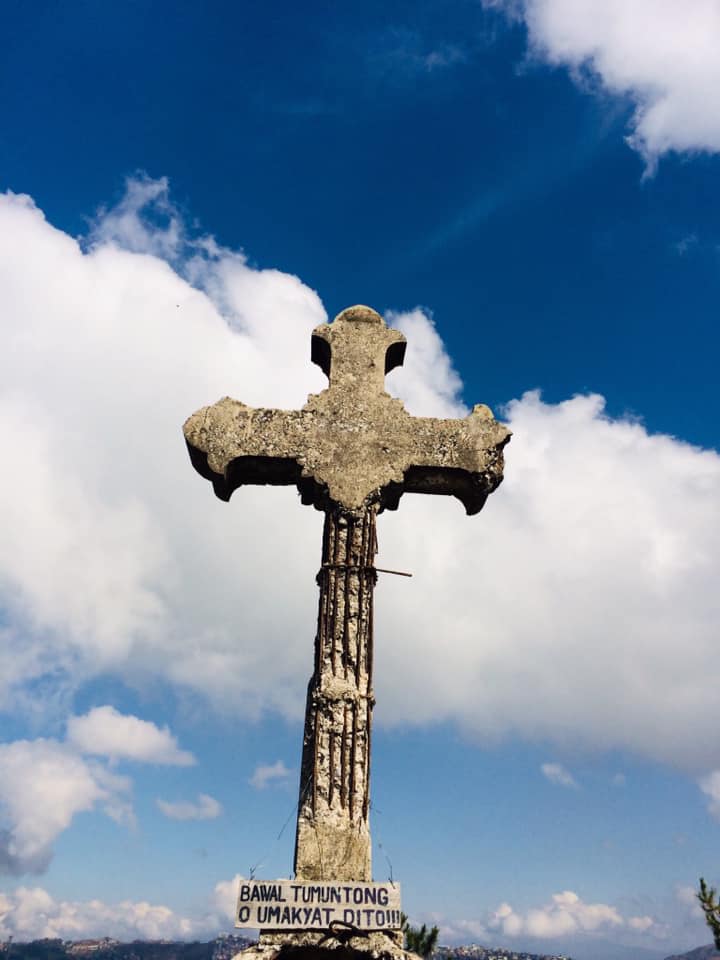
Photo by Mr. Jim Marpa, 2019.
In this time of too much
violence not only in media
but in real life especially those
we witness and experience
in ordinary streets near and far
from our places of comfort
to those larger than life violence
taking place in the high seas and
other countries, may your words today
remind us, our dear loving Father
to imitate David your servant of old.
David also stepped out of the cave, calling to Saul, “My lord the king!” When Saul looked back, David bowed to the ground in homage and asked Saul: “Why do you listen to those who say, ‘David is trying to harm you’? You see for yourself today that the Lord just now delivered you into my grasp in the cave. I had some thought of killing you, but I took pity on you instead. I decided, ‘I will not raise a hand against my lord, for he is the Lord’s anointed and a father to me.’ Look here at this end of your mantle which I hold. Since I cut off an end of your mantle and did not kill you, see and be convinced that I plan no harm and no rebellion. I have done you no wrong, though you are hunting me down to take my life” (1 Samuel 24:9-12).
Teach us, dear Father,
to show respect to your
anointed leaders among us,
from our family and home
into our leaders in school,
office and work, government
and the church; despite their
flaws and even abuses, help us
to transcend these and try to find
your favor in giving them to us;
may we pray for them to be more
reasonable, just and fair in the
exercise of their office and position.
Teach us, dear Father,
to look anew to them repeatedly
and try to find your image in them;
may Jesus be the main factor
we must consider in obeying them,
respecting them, and in recognizing
their power and authority;
may we not resort to violence
often preceded by betrayals
perpetrated by those supposed
to be closest to those in authority.
Amen.
Photo by author, Dominican Hill, Baguio City, January 2019.
Lord My Chef Daily Recipe for the Soul, 19 November 2025
Wednesday in the Thirty-Third Week of Ordinary Time, Year I
2 Maccabees 7:1, 20-31     ><))))*> + ><))))*> + ><))))*>     Luke 19:11-28
Lady of Sorrows from a triptych by the Master of the Stauffenberg Altarpiece, Alsace c. 1455; photo from fraangelicoinstitute.com.
What a lovely phrase,
dear Jesus for today
for us all
especially mothers
and all women:
"womanly heart,
manly courage."
At this time when
a wayward daughter
and sister viciously attacks
her own brother in total
disregard of our family values
and tradition, not to mention
the need for decency and respect
as well as a little sanity too,
here comes out in the open
the nobility of many women and
mothers as well as men still intact;
in this time like during the
Maccabean Revolt when many
sold their souls to evil for the price
of comfort and ease, there are
still more like that mother who dare
to go against the tide of insanity
and folly, indecency and disrespect,
most of all, of idolatrous worship
through religious leaders of the many
sects and cults who use God's name
in vain and shameful profit too.
Keep us strong inside,
Jesus, to be not afraid in
venturing into finding ways of
serving you most than being idle
in keeping your gifts and talents;
teach us anew the virtue of
obedience, of docility
to authority
whether at home and family or
in the society in general
and in other civil institutions.
Lastly,
we pray dear Jesus
for all mothers crying in silence
these days for the many pains
they bear inside their hearts
especially those who have lost a child,
those betrayed by their own husband
or children,
those separated from their families
due to work and employment,
those nursing a sick loved one,
those forgotten even by families
and societies; grant them
a "womanly heart" filled with faith
in God and a "manly courage"
trusting in you alone.
Amen.
Now more than ever, we are proven right: the past administration is the most decadent in our history with its utter lack of respect for life and for women; that its war on drugs was totally a lie. May they “who have contrived every kind of affliction not escape the hands of God” (2 Maccabees 7:31).
The Lord Is My Chef Sunday Recipe for the Soul by Fr. Nicanor F. Lalog II
Seventeenth Sunday in Ordinary Time, Cycle B, 28 July 2024
2 Kings 4:42-44 ><}}}}*> Ephesians 4:1-6 ><}}}}*> John 6:1-15
Residents wade through knee to waist-deep flood along P. Florentino Street in Quezon City on July 24, 2024. Photo by Maria Tan, ABS-CBN News
There is a new kind of storm sweeping us these days, more disastrous and silently wreaking havoc among us especially in our relationships with one another. It is a kind of storm borne out materialism that had given rise to other thoughts that have left us more lost and empty in life.
Photo from sunstar.com.ph, 22 July 2024.
More powerful than typhoon Carina was that storm in Cebu when a celebrity had a waiter stand in front of him simply for addressing him a “sir”, not as “mam” as he claimed to be a “beautiful” transwoman. The storm swept the whole social media on Monday with negative reactions and memes even from LGBTQ members. Many women rose to speak against this insistence by some in introducing wokism in the country for the sake of inclusivity which is nothing else but an exaggeration of one’s self and of the truncated truth they know.
*As I wrote this Saturday morning, there came the news of how the Paris Olympics made a mockery of the Lord’s Supper with a drag show in its opening ceremony. What a shame on France!
Photo from rappler.com.
Right after the devastation by the habagat, many were shocked to find Sen. Gil Puyat Avenue in Makati changed into “Sen. Gil Tulog” for an advertising stunt. Again, it flooded social media with criticisms that reached the Mayor of Makati who ordered the signages removed with the city official who approved it reprimanded.
Here we find two recent storms indicating how eroded our value system has become. Both are symptoms of our sick society that have allowed these to creep into our social consciousness on the pretext of inclusivity and creativity along with other western idiotic thoughts displayed in the opening of the Paris Olympics. The incidents show how some people have become so conceited without any sense of respect at all to God and to others, whether alive or deceased, as well as lack of sense of history.
Photo by author, Parish of the National Shrine of Our Lady of Fatima, Valenzuela City, 24 July 2024.
Sorry for the long introduction. I only wish to invite you my dear friends to stop for a while and honestly ask ourselves this question: what are we pursuing in life these days?
Beginning today until the next four Sundays of August, all our Gospel accounts will be from John’s sixth chapter that opens with the story of the feeding of more than five thousand people. It is the continuation of last Sunday’s gospel scene when Mark narrated how Jesus invited the Twelve to a “deserted place to be by themselves” only to be followed by a vast crowd of people “like sheep without a shepherd.”
Jesus went across the Sea of Galilee. A large crowd followed him, because they saw the signs he was performing on the sick. Jesus went up on the mountain, and there he sat down with his disciples. The Jewish feast of Passover was near (John 6:1-4).
The beloved disciple’s account of the event is so rich with many signs that point us closer to Jesus Christ.
Keep in mind that the miracles of Jesus in the fourth gospel are called “signs” because they were not just extraordinary things done like some form of magic; for John, the miracles of Jesus were signs that point and reveal superior realities of the highest order, of God Himself in Christ. This is difficult to understand unless our pursuits are clearly on God and not something else.
Photo by author, Fatima Avenue, Valenzuela City, 25 July 2024.
In his brief introduction of the scene, John tells us that if we really want to find and experience liberation from all the problems besetting us as individuals and as a nation, we must first pursue God, not our self-interests and well-being. See how John declared the great number of people pursued Jesus due to the “the signs he was performing on the sick” that they must have found hope and life in Him amid their many sufferings.
How sad many people today spend and waste time in social media and other material things forgetting the persons around them. In the pursuit for money and fame, persons are made into objects to be possessed; perhaps this is the reason of the growing number of many kamotes and pabebes in our time – the objectification of people, when persons are degraded into mere objects. It is an utter lack of respect for others which only shows too the lack of self-respect among many of us because we have lost our rootedness in God.
Do we still have that desire for God which leads us to higher ideals like virtues and qualities that make us more human and humane?
Pursuing God is not just celebrating the Sunday Mass or praying often but applying these holy activities into our daily lives to experience and find Him working in us and through us in our daily life. As we have reflected last Sunday, the more we get closer to God, the closer we must get with others too!
Many times we are like Philip and Andrew, two of the closest Apostles of Jesus that even if we go to Mass every Sunday or even daily, we never meet Christ at all because we are so absorbed with ourselves and the world. Philip and Andrew saw only saw the huge problem before them, they saw what they lacked – bread – but never found Jesus Christ Himself as the answer to their problem despite their having witnessed His many healings and raising to life of the dead daughter of Jairus.
When Jesus raised his eyes and saw that a large crowd was coming to him, he said to Philip, “Where can we buy enough food for them to eat?” He said this to test him, because he himself knew what he was going to do. Philip answered him, “Two hundred days’ wages worth of food would not be enough for each of them to have a little.” One of his disciples, Andrew, the brother of Simon Peter, said to him, “There is a boy here who has five barley loaves and two fish; but what good are these for so many (John6:5-9)?”
I love that small detail by John that “Jesus knew what he was going to do”, of how the Lord was merely testing them in asking where to buy bread.
From psephizo.com
It does not really matter how Jesus multiplied the loaves of bread. What was very clear was the presence of Jesus, the Son of God who can do anything!
It was His person that was most important in this scene set when “The Jewish feast of Passover was near” which would later explain to us the meaning of the Last Supper and Good Friday. It is the very person of Jesus Christ who matters always in life. Recall our most trying moments in life when we have given up hopes but suddenly something happened and everything was reversed that we are still here, very much alive. Until now we are clueless how it all happened except that deep within our hearts, it is only Jesus whom we find as the answer and reason for everything.
In the first reading we heard how Elisha the prophet was given with twenty barley loaves of bread he gave to feed one hundred people that had plenty of leftovers.
Again, we are not told how Elisha multiplied the loaves of bread but one thing was very clear: the barley loaves were given by the man from Baal-shalisha as an offering to God through Elisha. The man clearly desired and pursued God that he baked those bread from “the first fruits, and fresh grain in the ear” of his bountiful harvest (2 Kgs.4:42). It was a thanksgiving offering for God that made wonders not only for him but for everyone. If we could just do the same in desiring God first of all!
Remember what Jesus told the devil during His first temptation in the wilderness, “One does not live by bread alone, but by every word that comes forth from the mouth of God” (Mt.4:4).
There in the deserted place, miracle happened because everyone desired God first by listening to the teachings of Jesus. When Jesus saw them opening to God’s words, He then fed them with bread and fish. This week, let us pursue God more sincerely by foregoing our usual pursuits for comfort and easy life so that Jesus may multiply whatever we have. Let us pray:
God our loving Father
who is over all and through all
and in all (Ephesians 4:6):
empty us of our pride
that make us pursue worldly
things like wealth, fame, and power;
let us desire You alone
in Jesus Christ so that we may
find You again in our hearts
and on the face of one another
we meet in this world that has become
so empty, hostile and unkind.
Amen.
Photo by author, view of Jerusalem from the Church of Dominus Flevit, May 2017.
40 Shades of Lent by Fr. Nicanor F. Lalog II
Friday in Second Week of Lent, 01 March 2024
Genesis 37:3-4, 12-13, 17-28     ><)))*> + <*(((><     Matthew 21:33-43, 45-46
Thank you, dear God,
for this first day and
Friday of March;
teach us to learn anew this
blessed season of Lent
the virtue of respect from
two Latin words, re + specere
that literally mean "to look again";
many times,
we fail or choose not
to respect others
because we refuse to look
at them again, and again,
that they are our kin,
a brother and a sister
in Jesus Christ;
many times we see them
but do not recognize them
as one of us that we look
at them with suspicions,
jealousies, and mistrust.
So Joseph went after his brothers and caught up with them in Dothan. They noticed him from a distance, and before he came up to them, they plotted to kill him. They said to one another: “Here comes that master dreamer! Come on, let us kill him and throw him into one of the cisterns here; we could say that a wild beast devoured him. We shall then see what comes of his dreams.”
Genesis 37:17-20
Father, instill
 in our minds and hearts
through Jesus your Son,
that we own nothing
in this world,
that we are your stewards,
your tenants of the vineyard;
how sad
and tragic when we lay claim
to everything in this world
even our very own life
and those of others
as ours alone,
a private matter we alone
can decide on who is to live
and die; or, too much stress
on privacy that this is my body
that I alone can decide what to do
with my body.
Finally, he sent his son to them, thinking, ‘They will respect my son.’ But when the tenants saw the son, they said to one another, ‘This is the heir. Come let us kill him and acquire his inheritance.’ They seized him, threw him out of the vineyard, and killed him.
Matthew 21:37-39
Forgive us, O Lord Jesus!
So many times we have acted
like those evil tenants
who lacked any respect
for you and others
when from afar,
even if we knew,
we are mere stewards,
we insist and poison
others into thinking
we can claim ownership
of everything
 including this most
precious life.
Forgive us,
Lord Jesus,
for our lack of respect
to you and to one another;
how sad that in our
rampant disrespect,
unknown to us,
we have lost respect
to our very selves too.
Help us regain
respect this Lent.
Amen.
The Lord Is My Chef Daily Recipe for the Soul by Fr. NIcanor F. Lalog II
Friday in the Second Week of Ordinary Time, Year II, 19 January 2024
1 Samuel 24:3-21  <'[[[[>< + ><]]]]'>  Mark 3:13-19
Photo by Ms. April Oliveros on Mt. Pulag, March 2023.
Dearest Lord Jesus:
today I imagined myself
one of your twelve Apostles
you have called and appointed;
I also imagined myself like
David in the first reading,
stealthily cutting off an end
of King Saul's mantle while
inside a cave in pursuit of him
to kill him!
In my prayers,
I felt one desire,
one important thing
I need in the moment:
the grace to overcome
personal differences
especially with my co-workers
in your vineyard,
with those above me
as superiors.

Teach me, O Lord,
to overcome differences
with others like your Apostles
who came from various backgrounds
with temperaments and attitudes
even poles apart
like Matthew the former tax collector
and collaborator with the Romans
working with Simon the Cananean
also referred to as the Zealot;
teach me to focus more on you,
to always find you,
most of all,
to bring you and share you
in every dealing with others
I have differences with.

Grant me the grace
to be centered in you alone
than be overtaken by our many
differences that ruin
the mission you have entrusted to us.
Likewise,
teach me the virtue of respect
that literally means to look
again and again (re specere);
when differences become so
deep, even would cause us
to fight others like David and
King Saul,
let me still focus on you,
O Lord,
to respect the person
and their office
and designation
in order to avoid hurting
and dividing your precious Body,
the Church.
Amen.
Photo by Ms. April Oliveros on Mt. Pulag, March 2023.
The Lord Is My Chef Daily Recipe for the Soul by Fr. Nicanor F. Lalog II
Thursday, Misa de Gallo VI, 21 December 2023
Zephaniah 3:14-18 <*{{{{>< + ><}}}}*> Luke 1:39-35
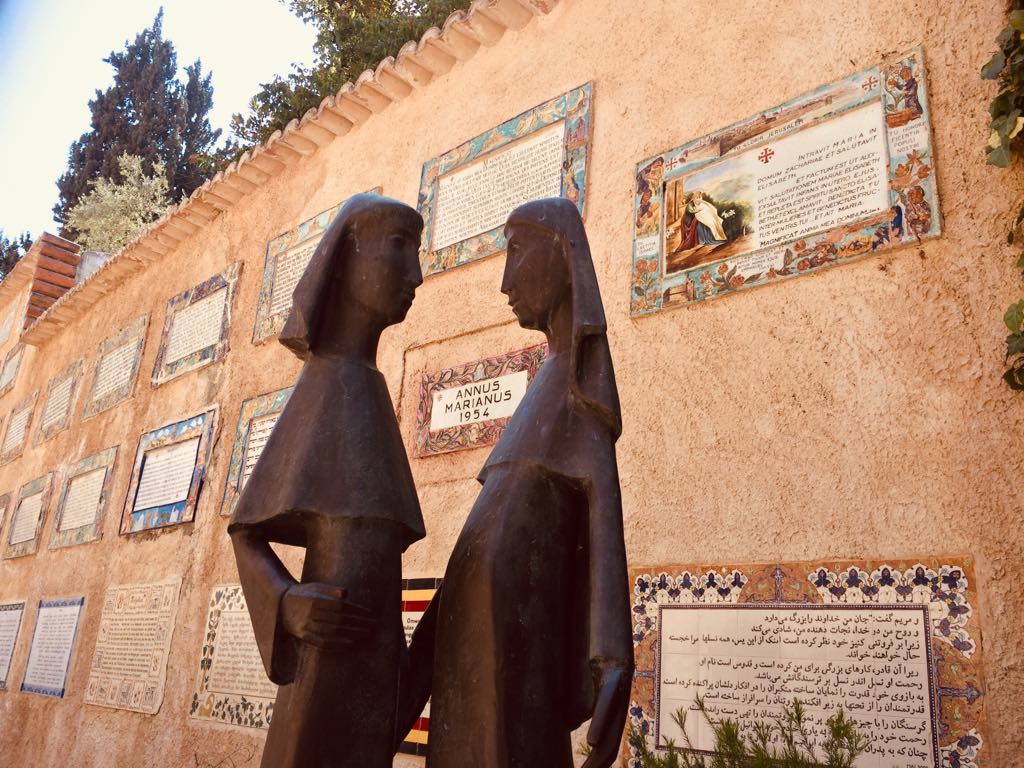
Photo by author, bronze statues of the Blessed Virgin Mary and St. Elizabeth, Church of the Visitation at Ein-Karem, Israel, April 2017.
For the third straight day since Tuesday until Saturday morning at the end of our Christmas novena, all our gospel readings will be from St. Luke, the only evangelist with the most “comprehensive coverage” of the first Christmas following his extensive research on Jesus Christ’s life and teachings (cf. Lk.1:1-4).
Hence, his gospel has the most stories and parables than the gospel accounts of Mark and Matthew. Most of all, St. Luke’s gospel account has two distinctive characteristics that showed Jesus always at prayer while at the same time gave special emphasis on women like the Blessed Virgin Mary. You must have noticed this by this time since Tuesday when we began listening to his infancy narrative.
Mary set out in those days and travelled to the hill country in haste to a town in Judah, where she entered the house of Zechariah and greeted Elizabeth. When Elizabeth heard Mary’s greeting, the infant leaped in her womb, and Elizabeth, filled with the Holy Spirit, cried out in a loud voice and said, “Most blessed are you among women, and blessed is the fruit of your womb.”
Luke 1:39-42
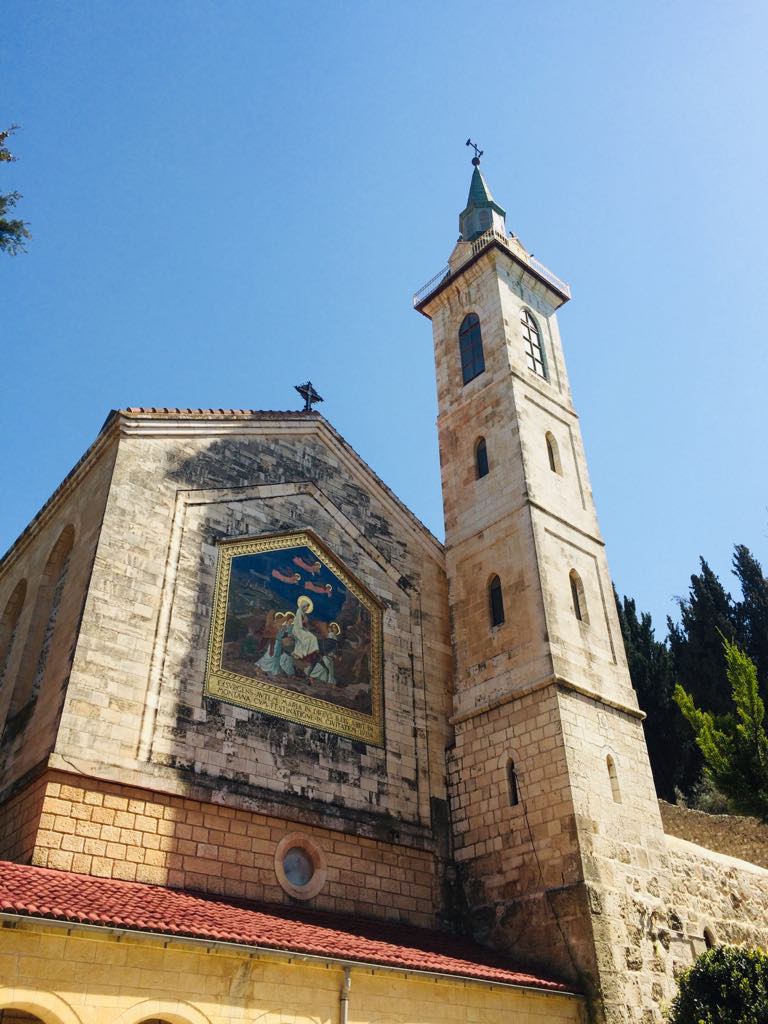
Photo by author, mural on the apse of the Church of the Visitation at Ein-Karem illustrating the Visitation (left panel) and how the angel helped St. Elizabeth hid the infant St. John the Baptist after King Herod ordered the murder of all children aged two and below.
It is rare in the Bible to find two women presented positively together in a single scene. Very often especially in the Old Testament, there is always a sort of animosity among them due to the prevailing patriarchal points of view of the time.
The only instance two women were presented together in good terms in the Old Testament is in the Book of Ruth that still hinted some sense of superiority of Naomi over her daughter-in-law Ruth who was like her a widow but childless.
Therefore, this scene of the Visitation only St. Luke has is a gem in itself as it speaks eloquently of the important place of women in God’s plan of salvation. It beautifully portrays to us the joy of two great women filled with God and humble before him, affirming and acknowledging the two great men in their wombs about to change the course of human history: Elizabeth with John the Baptist who would prepare the way of the Savior, Jesus Christ in the womb of Mary.
Photo by Mr. Boy Cabrido, Our Lady of Mt. Carmel, QC, Misa de Gallo, 18 December 2023.
The story of the Visitation reminds us how God works mysteriously in everyone without exceptions by linking or interconnecting us with each other in Jesus Christ our great Mediator and Savior. How lovely to see in this instance how John and Jesus already performing their mission even while in the womb of their mothers, of bringing together people. What a wonderful illustration of women as God’s vessels and carriers!
In both Mary and Elizabeth, we now “shout for joy” as Zephaniah prophesied in the first reading at how God saved us when he “removed the judgment against you, he has turned away your enemies; the Lord, your God, is in your midst, a mighty savior, who will rejoice over you with gladness, and renew you in his love… so that no one may recount your disgrace” (Zep. 3:14,15,17, 18).
Do we truly share in this shout for joy for the women of the world, for the women among us? How sad that until now women continue to suffer from all kinds of abuses not only from men but even from their fellow women.
Some spiritual writers say God is more like a woman because whatever was lacking in man, God put it in her. Perhaps that is why it is the woman who completes every man – including with us priests! But sadly, as we speak a lot about synodality in the Church these days, it is often among us priests with whom women are often taken for granted, and worst, abused.
One problem directly related today with how we regard women is the great number of people especially the youth trapped in the insidious effects of pornography due to prevalence of social media. At its core, the problem and evil with pornography is the failure of so many to recognize the lack of respect for women who are created equal with men in the image and likeness of God.
St. Joseph showed us the other day that true holiness is expressed in the way we respect women. According to an article by Papal Preacher Cardinal Cantallamessa I have read two decades ago where he cited a Dominican biblical scholar who’s name I could not recall, “the way we treat and regard women is a reflection of our relationship with God”.
That is very true.
When I review my life, I have found God making so many ways to lead me into the priesthood through the many women I have met and known, and many of them have remained my “bestest” friends like the three former executives of GMA-7 News Department who asked me to guide them in their Holy Land pilgrimage in Easter 2017.
Photo by author, Church of the Visitation, Ein Karem, Israel, April 2017.
It was my second Holy Land pilgrimage but my first time to visit the beautiful Church of the Visitation in Ein Karem.
Outside that lovely church are two bronze statues of Elizabeth and Mary conversing on how God had blessed them with sons under unique circumstances: Elizabeth was too old and barren while Mary was too young, a virgin, not yet married with Joseph.
What a beautiful reminder of God coming to us through women!
While there at Ein Karem, I prayed for all the women I have loved and have loved me before, all the women who have blessed me and have taken care so well of my vocation to the priesthood. I thanked God for the women like Elizabeth who have blessed me in believing that what was spoken to me by the Lord would be fulfilled in the priesthood. Blessed are the women who like Mary have helped me see the women’s perspectives that made my priesthood more complete especially in dealing with feminine issues. The women who taught me how to respect differences, to feel the society’s bias against them, and most especially feel their deep pains when they shared with me their ordeals of abuse and rape.
Let me end this reflection with an unforgettable anecdote at the funeral Mass for the mother of our late Bishop Jose F. Oliveros in Quezon province about ten years ago when he recalled how his mother held his right hand while still a child, and taught to make the sign of the Cross. On her deathbed, it became his turn, as a priest and a bishop, to hold his dying mother’s hands to make the sign of the Cross.
Hail to all women and mothers in the world who bring life into this dying world with their joy and perseverance, artistry and simplicity, warmth and presence of God almighty. May this story of the Blessed Virgin Mary’s Visitation of St. Elizabeth teach us to always respect women for they are the carriers of God to us. Amen.
The Lord Is My Chef Sunday Recipe for the Soul by Fr. Nicanor F. Lalog II
Twenty-Fifth Sunday in Ordinary Time, Cycle-C, 18 September 2022
Amos 8:4-7  ><}}}}*>  1 Timothy 2:1-8  ><}}}}*>  Luke 16:1-13
Photo by author, sunrise at Lake Tiberias, the Holy Land, May 2019.
Our first reading this Sunday from the Book of Amos sounds like coming from a recent publication denouncing the corruption and social decadence in most countries these days, of the rampant injustice and exploitation of the poor, of how hypocrisies thrive among the rich and powerful and religious too!
Hear this, you who trample upon the needy and destroy the poor of the land! “When will the new moon be over,” you ask, “that we may sell our grain, and the sabbath, that we may display the wheat? We will diminish the ephah, add to the shekel, and fix our scales for cheating! We will buy the lowly for silver, and the poor for a pair of sandals; even the refuse of the wheat we will sell!”
Amos 8:4-6
How sad that long before the coming of Jesus Christ and more than 2000 years after his birth with all the civilization and religion all over the world, nothing has really changed at all: greed for power and money continue to divide peoples and nations, causing many losses of lives from crimes and wars that have ensued.
"Everything has a price,
everything has to be summed up
that sadly in the process,
God and people are commodified
while things are personified! "
Photo by Mr. Jay Javier, April 2022.
Throughout history, we have never learned and perhaps, have continued to refuse to learn from God, beginning from his prophets like Amos down to his own Son Jesus Christ, the important lesson of giving more value to him and to one another. We have always put more premium and value on things that perish than on those of true value that remain even to eternity, none other than God and one another.
“If, therefore, you are not trustworthy with dishonest wealth, who will trust you with true wealth? If you are not trustworthy with what belongs to another, who will give you what is yours? No servant can serve two masters. He will either hate one and love the other, or be devoted to one and despise the other. You cannot serve God and mammon.”
Luke 16:11-13
True wealth vs. dishonest wealth
Jesus continues his journey to Jerusalem, intensifying his teachings on discipleship with two parables this Sunday and next week to deepen our knowledge and relationship with him and others as disciples.
We have heard today his parable of the wise steward who reduced the debts of his master’s creditors to ensure he could find employment in them when fired from his job. Jesus did not approve of his wily scheme but praised him and those like him of the world in finding ways to “win hearts” of people with their pakikisama as we call in Pilipino which is often a wrong sense of camaraderie when people help each other even in shenanigans and other corrupt practices.
(Photo by Lauren DeCicca/Getty Images)
If we could just find means in truly helping each other in life with the same ardor, we could probably have a better and more humane society where we value persons more than things. That is the kind of discipleship Jesus is teaching us today with his sayings after narrating this parable — of having God and one another as our true wealth in life, not dishonest wealth of money, power and fame that feed on our pride and ego. Having God and others as our true wealth means valuing them most in our lives through Jesus Christ.
Problem happens when we value things like money and fame more than God and persons like in the time of Amos that continues to this day as we focus more with how much we shall earn, of what’s in store for us in terms of profits and returns without giving the slightest concern for people and God. Everything has a price, everything has to be summed up that sadly in the process, God and people are commodified while things are personified!
Sorry to say this but the clearest example of our commodification of God is this online Mass when we make him like a canned good or a video on-demand like in Netflix we take out to watch and consume when we just have a feel for it. No relationship at all. Just like that, as in ganun lang… in case of an emergency, we take out God like a life vest tucked under the plane seat.
In the same manner, we commodify people when we see them in utilitarian perspectives, in their usefulness for us in attaining our selfish goals. We commodify people when we totally disregard them as “no body”, as if they do not exist that we do not recognize them at all, not caring for them as “some body” like in next Sunday’s parable of the rich man and Lazarus.
Even us in the Church contribute in this commodification of God and of people long before the advent of online Masses in the way we regard parish assignments. How do we priests look at the people and the parish, really?
What a shame at how we priests persist that unChristian frame of mind in distinguishing parishes as “big parish” and “small parish” in reference to their income and collections, never in terms of population or number of souls and their pastoral needs! This results in the tragic mire we are stuck called careerism fueled by the never-ending competition among priests for parish assignments, forgetting altogether our sense of service and mission.
Sad. Very, very sad.
"True wealth and riches are God and people.
We live to love.
Let us put an end to restrictions on whom to love,
whom to value for we are all brothers and sisters in Christ..."
Photo by author, 12 August 2022.
This Sunday, Jesus is blessing us with the grace and challenge of examining deeply in our hearts what and who do we value most?
If we consider material things as riches, then, we have not moved away from the time of Amos; we are still living in ancient time of decadence and immoralities despite the sophistications we now have like hi-tech gadgets we use for cheating others as we hide in our fine clothes and air conditioned homes, offices, and vehicles.
True wealth and riches are God and people. We need more people, more children, more family, more friends to share and celebrate life with. Not more money nor more houses and cars we cannot use at the same time; we do not need more food nor more clothes for we live not to eat.
We live to love. Let us put an end restrictions on whom to love, whom to value for we are all brothers and sisters in Christ as St. Paul reminds us in the second reading today. Most of all, the great apostle tells us to value everyone, from our leaders down to the common tao we meet everywhere, praying for one another for it is God’s design that in the end, we shall all together dwell in him in heaven, the true wealth and riches we must all aspire. Amen.Have a blessed weekend everyone!
The Lord Is My Chef Sunday Music by Fr. Nick F. Lalog II, 19 June 2022
Photo by author, 19 April 2022.
With everybody greeting dads this Father’s day, we have decided to feature Kalapana’s first major hit from their first album in 1975 called “The Hurt” to remind everyone of the many hurts most dads have.
It is most fitting too with our gospel on this Sunday when we also celebrate the Solemnity of the Body and Blood of Jesus Christ when we are reminded that everybody is a somebody, everyone has to be loved and respected because we are all members of the Body of Christ. How sad that since the time of Christ, many people still take some persons as nobody especially those considered as ordinary people, those without power and wealth (https://lordmychef.com/2022/06/18/corpus-christi-everybody-a-somebody/).
The Hawaii-based group so famous in the country during the 70’s not only for their music but also for their looks produced some of the coolest sounds and romantic lines on that famous decade; it is just sad that the three original members of the four-man band had all died very young.
The Hurt is about a man who seems to have had his karma after fooling for sometime that now either he was dumped by his girlfriend or being played by her as her lover despite her going out with other men. It is the beat of the music that makes this so lively and appealing, especially the oft-repeated word “hurt, hurt, hurt” especially at the end of the song.
But still, the song is nice with a gospel-message challenging us if we would hurt the one who especially loves us and cares for us. The person may be your boyfriend or husband, could be our dad, or may be your girlfriend or wife, or anyone who truly loves you.
Oh you say you’re mine And I believe you every single time Even though they say you’re not my kind I just can’t believe you’d lie Oh all my friends are laughing Seeing you out with other men I’m dying Can’t you see it in my eyes I’m cryin’ I just cant believe you’re not mine
Would you hurt the man who loves you Would you hurt the man today Would you take the love you gave me away Would you hurt the man who loves you Would you hurt the man today Would you take the love you gave me away
Oh what have I done All the time I guess it was just fun I gave away this Sweetest girl I knew Oh, just for you
Would you hurt the man who loves you Would you hurt the man today Would you take the love you gave me away Would you hurt the man who loves you Would you hurt the man today Would you take the love you gave me away
Just don’ hurt anyone, physically and emotionally speaking. Have a blessed week ahead!
*We have no intentions of infringing into the copyrights of this music and its uploader except to share its beauty and listening pleasure.
The Lord Is My Chef Sunday Recipe for the Soul by Fr. Nicanor F. Lalog II
Solemnity of the Body and Blood of Jesus Christ, 19 June 2022
Genesis 14:18-20 ><}}}}*> 1 Corinthians 11:23-26 ><}}}}*> Luke 9:11-17
Photo by Ms. Ria De Vera in Bagbaguin, Sta. Maria, Bulacan, November 2020.
A week after celebrating the Solemnity of the Blessed Trinity, we celebrate today the reality of this mystery of our personal God who relates with us with the Solemnity of the Body and Blood of Jesus Christ.
This Solemnity of the Body and Blood of Jesus Christ reminds us of the great honor of every person, of everybody as a part of the Body of Christ who became human like us to share his very self so that we too may become food for everyone. It is a very timely and appropriate feast when we are deluged with news here and abroad of how people are treated as nobody.
The recent viral video of an SUV driver bumping a security guard in a busy intersection in Mandaluyong remains a hot trending topic precisely because it is a story of how poor people are disregarded in this nation. Although the suspect had surrendered to authorities after a week of “no-show” to summons, statements especially by his mother ignited only more fire into the blazing topic. Adding insult to injuries to the nation is the press conference called by the police in presenting and speaking for the suspect which is absurd and directly opposite to how they deal with poor people involved in similar offenses.
Over in the United States where one loses count of victims of shootings happening almost every week, lawmakers grandstand for more gun controls for the protection of children when in fact, the same lawmakers refuse to consider the child in the mother’s womb as a person with a right to life that they have legalized abortion. Almost everywhere in the world, see how people take some people as somebody and others as nobody. So contrary to what Jesus is telling us in the gospel today, that everybody is a somebody. Observe how the disciples of Jesus acted in the gospel:
Jesus spoke to the crowds about the kingdom of God, and he healed those who needed to be cured. As the day was drawing to a close, the Twelve approached him and said, “Dismiss the crowd so that they can go to the surrounding villages and farms and find lodging and provisions; for we are in a deserted place here.” He said to them, “Give them some food yourselves.” They replied, “Five loaves and two fish are all we have, unless we ourselves go and buy food for all these people.” Now the men there numbered about five thousand. Then he said to his disciples, “Have them sit down in groups of about fifty. They all ate and were satisfied. And when the leftover fragments were picked up, they filled twelve wicker baskets.
Luke 9:11-14, 17
Photo from istock-studios.com by Getty Images.
We have heard this story so many times and yet, we continue to miss its whole meaning that it continues to happen in our lives minus the miracle of Jesus. See how Luke tells us first that Jesus spoke to the people about the kingdom of God.
We will never experience Jesus in his person, in his Body and Blood unless we listen first to his words, to his teachings of the kingdom of God. That is why in the Mass, the first part is the liturgy of the word to prepare us for the liturgy of the eucharist. So many times in life, we dismiss right away anything that is spiritual in nature like prayers and the sacred scriptures, of faith in God.
Luke does not tell us how Jesus multiplied the loaves and fish; we have to leave it to him how he did it. After all, he is the Son of God. Recall how during his temptation by the devil to turn stones into bread and he answered that “one does not live by bread alone but by every word that comes forth from the mouth of God” (Mt.4:4). Here in this scene, his words were precisely fulfilled when he fed the people after they have opened themselves to God’s words, to God himself.
Miracles happen in our lives when we first open ourselves to God himself. And opening to God means opening to others too by seeing everyone as a brother and sister in Christ whom we must care for.
Photo by Fr. Howard John Tarrayo, August 2021.
Too often, we tend to isolate ourselves from others, thinking only of ourselves and own good and comfort like the Twelve who asked Jesus to dismiss the crowds so they would find food and lodging for themselves in the wilderness.
What a sad reality still happening today, of how even parents and couples would proudly say how difficult it is to have another child because it is expensive. We have become so utilitarian in our perspectives in life that we compute everything as a cost, forgetting God except when praying which is precisely for asking for more blessings without even seeing the overflowing abundance of gifts from God.
Notice that despite the affluence of many these days, both as individuals and as nations, many are afflicted with the scarcity mentality, of not having enough, fearful of losing money and other resources like oil that we now have this exorbitant fuel prices.
When Jesus told the Twelve to “give the crowds some food yourselves”, he is telling us to look at God first for he is a God of abundance. Abraham in the first reading gives us the best example of always trusting God, of finding God behind every blessings we have. Abraham had just won a war with several kings in the region by the power of God who sent his priest named Melchizedek to bless him with bread and wine after. But unlike other victors in war, Abraham never had intentions of taking all the wealth and treasures of the kings he had beaten and instead gave Melchizedek the priest of God “a tenth of everything” (Gen.14:20).
Our response to God’s many blessings to us is to “tithe” ourselves like Abraham but not just ten percent as the Old Testament had taught but like Jesus in the New Testament by giving all of our very selves. This is the meaning of Paul’s words in the second reading of “proclaiming the death of the Lord until he comes” as often as we eat this bread and drink the cup (1 Cor.11:26).
We have learned and realized (hopefully) during the past Lenten and Easter seasons that death leads to new life in Jesus Christ when we share our very selves like him. God blesses us abundantly daily with his life and other blessings. There is enough for everyone. That is the meaning of the leftovers of twelve wicker baskets, one each for every apostle of the Lord who represented us.
This Solemnity of the Body and Blood of Jesus we receive in the Eucharist reminds us not only of the sublime gifts of God to each of us but also of our ultimate response of dying to ourselves so we may share Christ’s life to the world so dead with ego and selfishness, a world of “I” and “me” and “my” and “mine” totally disregarding everybody as nobody.
As we celebrate today the Body and Blood of Christ honoring him with Masses, vigils and processions, remember how not everybody in the world is considered a somebody unless one has wealth and power. It is the new meaning given by modern man to the golden rule – he who has gold rules, implying that the poor are always taken as a nobody, bearing all the abuses of those in power and authority.
Let us examine ourselves how we have contributed to these abuses still going on, even in our thoughts at the way we perceive others, especially those not like us in status and beliefs and colors.
After receiving Jesus Christ’s Body and Blood in the Eucharist, silently pray:
Dearest Lord Jesus Christ:
empty myself of pride and
fill me with your humility, justice and love;
reign in my heart now and always.
Amen.
The Lord Is My Chef Daily Recipe for the Soul by Fr. Nicanor F. Lalog II
Monday, Memorial of St. Anthony of Padua, Priest and Doctor of the Church, 13 June 2022
1 Kings 21:1-16   ><]]]]'> + ><]]]]'> + ><]]]]'>   Matthew 5:38-42
The Church of St. Anthony called Igreja de Santo António de Lisboa built at the site of his birthplace in Lisbon, Portugal. Photo by Mr. Jilson Tio taken in his 2018 pilgrimage.
Today as we celebrate the
Memorial of your beloved Saint
Anthony of Padua famous for
interceding in the recovery of
things lost, we pray to you O God
our loving Father also for the recovery
of something so precious becoming
so rare these days - decency and honor,
love and kindness, respect and justice.
Through the intercession of St. Anthony,
Lord, please help us recover our
"lost humanity" so vividly exposed
last week in that viral video of an
SUV hitting and running over a traffic
aide in Mandaluyong City.
How sad, even tragic, dear God
in this modern time of too much
sophistication in science and technology,
we have lagged behind in our humanity;
aside from the war at Ukraine, how could
violent shootings continue in the States
at the loss of so many children?
What is so tragic is how politicians there
talk about protecting children when the
same politicians push so hard for abortions,
in killing the most innocent persons of all!
Have we become like Jezebel, the pagan wife
and queen of Ahab who have no regard at all
for humans, creating fake news and gossips
against people, promoting corruption among
people for material gains?
So she wrote letters in Ahab’s name and, having sealed them with his seal, sent them to the elders and to the nobles who lived in the same city with Naboth. This is what she wrote in the letters: “Proclaim a fast and set Naboth at the head of the people. Next, get two scoundrels to face him and accuse him of having cursed God and the king. Then take him out and stone him to death.” On hearing Naboth was dead, Ahab started off on his way down to the vineyard of Naboth the Jezreelite, to take possession of it.
1 Kings 21:8-10, 16
Your Son Jesus Christ
taught us the ways to recover our
lost humanity more than 2000 years
ago but until now, we have not recovered
it yet because of our refusal to let go
of our pride and attachment with wealth
and other things of the world.
Like St. Anthony, help us to let go of
our possessions and comforts, "to give
to the one who asks of us, and to not
turn our back on one who wants
to borrow" (Matthew 5:42).
St. Anthony of the World,
Pray for us!
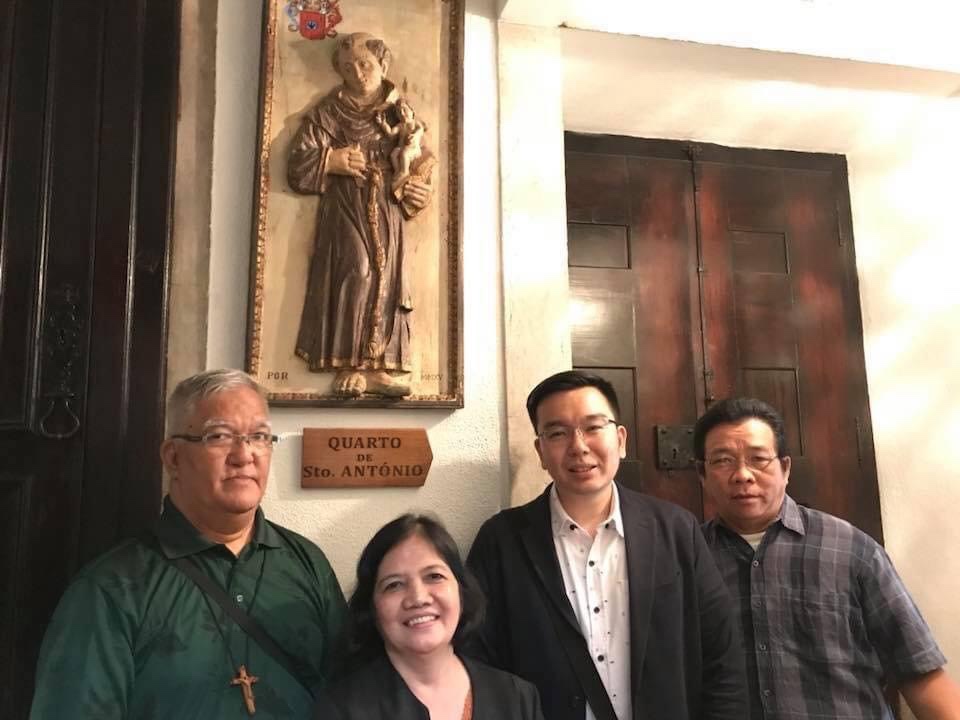
The room where St. Anthony was born in the year 1195 preserved in the church built at the former site of their home in Lisbon, Portugal. Photo by Mr. Jilson Tio, 2018.
The Portuguese people have always referred to St. Anthony of Lisbon than of Padua where his body is buried in Italy; in 1982, St. John Paul II visited his birthplace, and told the crowd their native saint was not St. Anthony of Padua to which the crowd cheered. Then, the Pope said he is neither St. Anthony of Lisbon and the people fell silent. But when the great Pope said their native saint is St. Anthony of the World, they cheered loudly! (Anecdote and photo courtesy of Mr. Jilson Tio)
Praying at the birthplace of St. Anthony protected by iron grills. Photo by Mr. Jilson Tio, 2018.
Mr. Jilson Tio (third from left) with fellow pilgrims outside the room where St. Anthony was born in Lisbon, Portugal in 2018.















 lordmychef.com