The Lord Is My Chef Daily Recipe for the Soul by Fr. Nicanor F. Lalog II
Tuesday in the First Week of Ordinary Time, Year II, 09 January 2024
1 Samuel 1:9-20  <*((((>< + ><))))*>  Mark 1:21-28
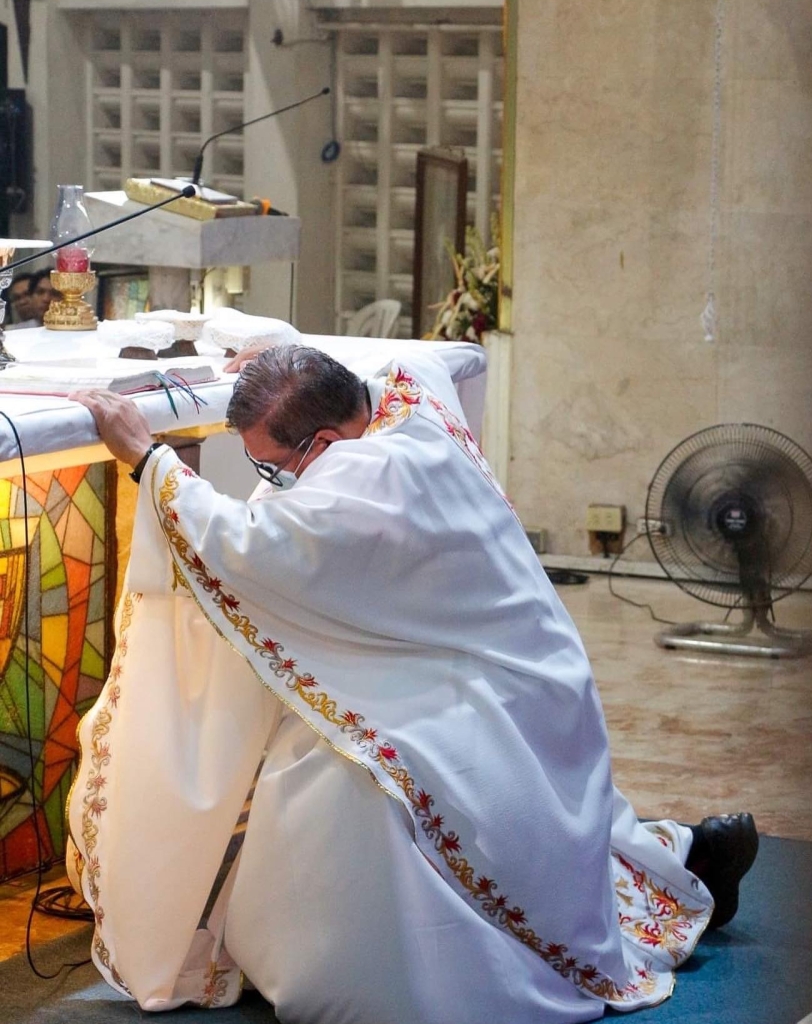
Photo by Mr. Jay Javier, Quiapo, 09 January 2020.
Praise and glory to you,
Lord Jesus Christ,
that today we shift into Ordinary Time
in our liturgy that coincides with
the annual Traslacion of the image
of the Black Nazarene in Quiapo,
Nuestro Padre Jesus Nazareno
as you remind us too in our readings
true meaning of authority
we often relate with power.
Jesus came to Capernaum with his followers, and on the sabbath he entered the synagogue and taught. The people were astonished at his teaching, for he taught them as one having authority not as the scribes.
Mark 1:21-22
People were astonished with your
authority, Lord Jesus, not only because
it is all-powerful but most of all,
it is most kind,
most compassionate,
most humane
because in your life,
in your very self as Jesus Nazareno,
you have shown us that
authority is not just having
power to make thing happen nor
lording over others;
like in Quiapo today as in Capernaum,
we are astonished with your
authority not because of its
powers of being efficacious
but because of your being so close
with us who are weak and suffering;
true authority for you, dear Jesus,
is to be one with the people -
in our miseries and anxieties,
in our pains and hurts,
as well as in our aspirations and dreams;
authority is most real,
most powerful
and most appreciated
when that authority
is felt as power for the people
to be healed and comforted,
raised up and inspired
like you have shown in your
coming to us,
in your carrying the cross,
of your bearing our infirmities.
Like Hannah in the first reading,
we beg those authorities above us
to "think kindly" of us people;
many times,
people in authority lord it over us
like Eli initially, suspecting
Hannah being drunk,
scolding us,
reprimanding us,
worst, judging us
without even knowing
our plight, so unlike you
who became poor like us,
most of all,
died for us.
Amen.
The Lord Is My Chef Sunday Recipe for the Soul by Fr. Nicanor F. Lalog II
Feast of the Transfiguration of the Lord, Cycle A, 06 August 2023
Daniel 7:9-10, 13-14 ><}}}*> 2 Peter 1:16-19 ><}}}*> Matthew 17:1-9
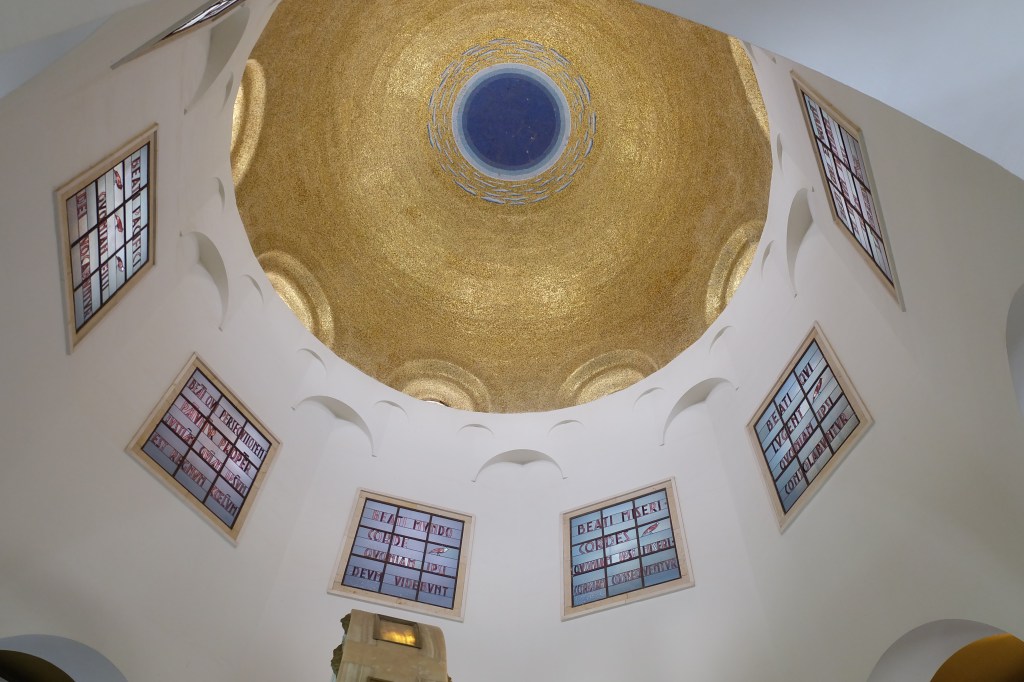
Photo of the mosaic inside the Basilica of the Transfiguration on Mt. Tabor, Israel (from commons.wikimedia.org).
Today we take a break from our gospel readings to celebrate the Feast of Transfiguration (August 06) that falls on a Sunday this year. The segue fits perfectly the series of parables we heard these past three Sundays that mentioned judgment day at the end of time.
Recall how Jesus interpreted his parables especially the separation of the weeds and wheat at harvest time as well as keeping the good fish caught in the net, throwing the bad ones that all evoke of judgement day in the end of time. For Matthew, the transfiguration of Jesus is exactly about the end of time when Christ’s glory is revealed at his Resurrection and ultimately in his Second Coming.
Jesus took Peter, James, and his brother, John, and led them up a high mountain by themselves. And he was transfigured before them; his face shone like the sun and his clothes became white as light.
Matthew 17:1-2
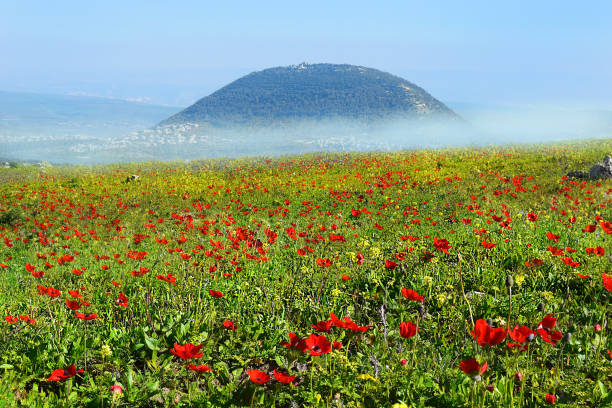
Mt. Tabor, believed to be the site of the Transfiguration of Jesus. Photo from iStockphoto.com.
In the Gospel according to Matthew, major events in the life of Jesus Christ mostly happened on a mountain: his temptation (Mt. 4:8), his inaugural teaching, the sermon on the mount (Mt. 5:1) and the sending of his apostles on their mission throughout the world until the end of time (Mt. 28:16).
Here at his transfiguration on top of the “high mountain” of Tabor we find glimpses of Christ’s explanation of the parable of the weeds among the wheat when he said that “the righteous will shine like the sun in the kingdom of their Father” (Mt. 13:43). See how this transfiguration of the elect at the end of time that was shown to Daniel in the first reading is expressed exactly in the same way as that of the face of Jesus on Mount Tabor that had “shone like the sun” as witnessed by the three apostles. Peter strongly attested to it later as we have heard in the second reading.
Last week in the daily readings from Exodus we have heard how the face of Moses also shone like the sun after he had conversed with God on Mount Sinai and every time he would see God at his tent called the dwelling in their journey in the desert. That is the context why Peter volunteered to build three tents for Jesus, Moses and Elijah during the transfiguration. The Jews have a celebration called feast of booths or tents they called sukkoth. The tent is the dwelling place of God in the wilderness that eventually became the temple of Jerusalem. It was the closest thing they have with God and with heaven. At the transfiguration of Jesus, the three apostles were enthralled at the experience and sight they did not want to go down because it was literally heaven, being with God. The transfiguration event itself for them was the fulfillment of their faith and everything in the Old Testament.
They would realize later that to dwell with God means to continue the journey in Christ, with Christ marked with many ascents and descents happening not just in space or physically but more of the interior kind. That is how we are transfigured, always inside. Right in our heart and soul. That was the deeper meaning of Moses entering God’s dwelling in the desert – of him being one in God, with God – that his face would shone after, prompting him to cover it because people were scared.
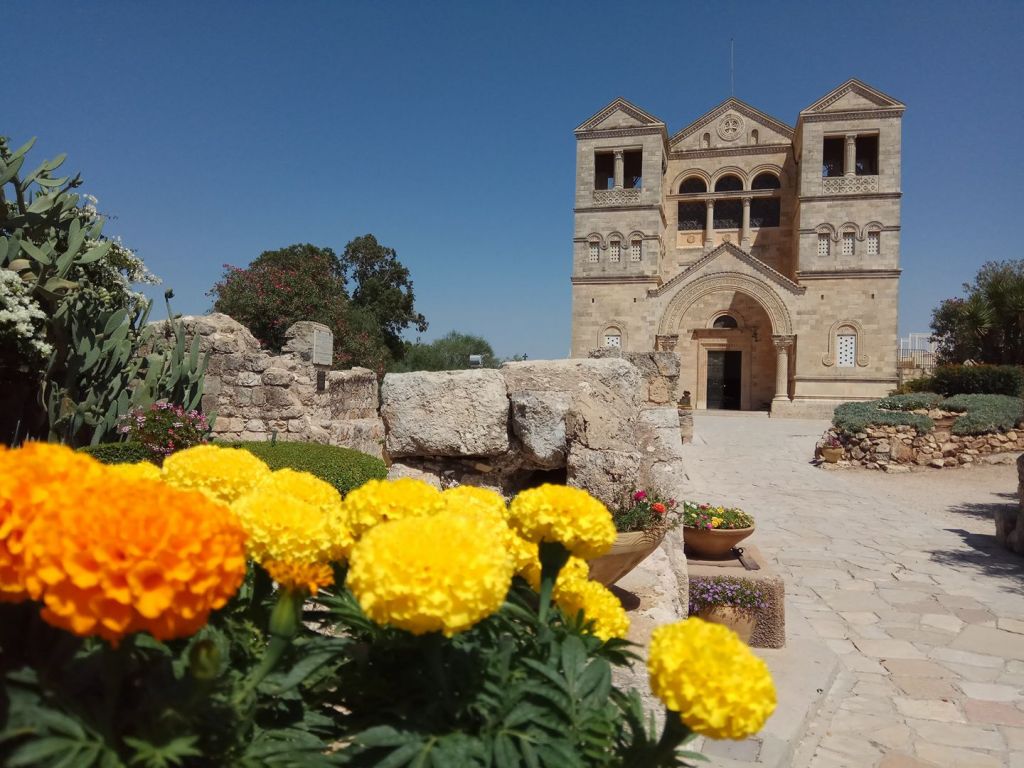
Photo from custodia.org, Basilica of the Transfiguration on Mt. Tabor, Israel.
Whatever is found on the face is always a reflection of what is in the heart and soul. No amount of cosmetics and beauty procedures can ever bring out that glow and radiance of anyone’s face beaming with joy and fulfillment, peace and contentment.
The face is the reflection of the depths – or shallowness – of one’s heart and soul. There is an English word used to describe this inner dynamics of the face – countenance. Any change in our countenance indicates something is being transformed within us as a result of our communion with God. That is why we describe some people even we do not know them as malalim or deep, or magaling magdala ng problema because of their countenance. In the same manner, we easily notice something rotting inside a person when despite one’s having good features like flawless skin or aquiline nose, beautiful eyes and the like. This is what the young people would call as “uma-aura” when they pose for FB or IG. Aura is the spirit within evoked by one’s face that cannot be manipulated.
The face of Jesus shone like the sun at his transfiguration primarily because deep inside him is his complete and perfect union in the Father. Jesus would always insist on this reality within him, his perfect communion in the Father from which also flows his total obedience which will reach its highest point at his Passion and Death on the Cross, his own Pasch or exodus.
There at Mount Tabor in his transfiguration, we are shown that Christ’s glory cannot be separated from the Cross. His majesty and triumph shall come from his pasch. And so are we his disciples. That is why the voice heard by the apostles said, “This is my beloved Son, with whom I am well-pleased; listen to him”. From now on, Christ would be speaking of his coming Passion, Death and Resurrection. All his lessons after Mount Tabor are about our participation in his paschal mysteries. Do we listen?
The apostles learned and embraced all these lessons in a process slowly with the guidance of the Holy Spirit after Pentecost. That is why Jesus told them to come down from Tabor to continue their journey to Jerusalem to fulfill his mission. Through them we have believed despite our not having seen Jesus that is how he would appear as “Lord” on the mountain that we the faithful are climbing to participate in the ultimate manifestation of his return at the end of time.
And there lies the good news of this Feast of Transfiguration happening in this dry month of August, often described as ghost month too. As we go through the last half of Ordinary Time’s remaining 17 weeks, may we continue to ascend in Christ, with Christ with his Cross in sharing his paschal mysteries in our daily lives. After the euphoria of Easter Season that had closed on Pentecost Sunday, we are reminded anew this sixth of August to never lose sigh of the Cross of Good Friday as our path to glorious transfiguration of Jesus Christ.
To journey with Christ, listening and obeying his voice is something of the inside and not just of space or place. Discipleship demands persistent practice of the Lord’s teachings and examples as we shall hear from the gospel these coming Sundays.
As COVID-19 virus wanes that we resume most of our activities minus the many protocols before while still being cautious and careful, may we face our inner issues in Christ and the Holy Spirit to be transfigured in him. Amen.Have a blessed week ahead. It is a Sunday, celebrate Mass with others in your Parish, pray for those still suffering from the effects of typhoon Egay and Falcon.
Painting of the Transfiguration by Italian artist Duccio di Buoninsegna between 1308 and 1311 from commons.wikimedia.org.
The Lord Is My Chef Daily Recipe for the Soul by Fr. Nicanor F. Lalog II
Tuesday, Feast of St. James the Greater, Apostle, 25 July 2023
2 Corinthians 4:7-15   ><}}}}*> + ><}}}}*> + ><}}}}*>   Matthew 20:20-28
Photo by Fr. Gener Garcia, Santiago de Compostela, Spain, 2019.
Praise and glory to you, O God,
on this wondrous feast of
St. James the Greater,
the first of the Apostles to
follow the Cross of Jesus Christ
during the persecution of Christians
in Jerusalem by King Herod Agrippa
(Acts 12:1-2).
Together with his brother St. John,
St. James the Greater's path in
loving and following Jesus Christ
up to the Cross was not an easy one;
from a very materialistic and selfish
perception of the kingdom of God as
we heard in today's gospel,
St. James eventually journeyed
inside himself to become the first
to drink the chalice of the Lord's passion
after being present both at the
Transfiguration and the Agony in the Garden.

St. James the Greater
eventually realized that
even in difficulties,
we are on the right path
in Jesus Christ,
with Jesus Christ.
Brothers and sisters: We hold this treasure in earthen vessels that the surpassing power may be of God and not from us. We are afflicted in every way, but not constrained; perplexed, but not driven to despair; persecuted, but not abandoned; struck down, but not destroyed; always carrying about in the body the dying of Jesus, so that the life of Jesus may also be manifested in our body.
The Lord Is My Chef Sunday Recipe by Fr. Nicanor F. Lalog II
Thirteenth Sunday in Ordinary Time, Cycle A, 02 July 2023
2 Kings 4:8-11, 14-16 ><}}}}*> Romans 6:3-4, 8-11 ><}}}}*> Matthew 10:37-42
Photo by author, Our Lady of Fatima University-Quezon City with the La Mesa Dam Forest Reserve at the back, 01 July 2023.
Jesus continues to instruct the Twelve with important lessons on discipleship as he sent them on their first mission the other week. Last Sunday he taught them – including us today – to face all fears not to be fearless of anything or anyone but to fear only God.
Today, Jesus cautions us not to be unduly influenced by people especially those closest to us in fulfilling our mission in him. Very often, intimidation and influence can be used to adversely affect our ministry that eventually veer us away from our Lord Jesus Christ in the process. Hence, his encouragement too for us to persevere through those influences as we follow him.
Jesus said to his apostles: “Whoever loves father or mother more than me is not worthy of me, and whoever loves son or daughter more than me is not worthy of me; and whoever does not take up his cross and follow after me is not worthy of me. Whoever finds his life will lose it, and whoever loses his life for my sake will find it.”
Matthew 10:37-39
James J. Tissot, ‘The Exhortation to the Apostles’ (1886-94) from Getty Images.
Being a Christian is being possessed by Christ. That is why he told us last week to “be not afraid of those who kill the body but not the soul” so that we fear only him our Lord Jesus Christ in the sense that we lose all meaning in life without him.
To be possessed by Jesus Christ is to have a life centered in him, detached from undue influences including from our family and friends especially us priests and religious. When priests focus more with self and family or with other people instead of Jesus Christ, everything crumbles – pati sutana nalaglag na! That is when priesthood becomes a career and a means for social mobility and livelihood with money as the priest’s new “lord and master”.
Priesthood is Jesus Christ, the Caller, not the call as I have always insisted to seminarians I teach and direct. Problems happen when the Caller is dislodged from the top spot and focus shifts on the call or priesthood when priests literally and figuratively throw their weight around when we hear the notorious lines “matutulog ang pari, pagod and pari, unawain ang pari”.
Photo by Ka Ruben, National Shrine of Our Lady of Fatima, August 2022.
Discipleship in general of which the priesthood is just a part is indeed a very difficult life. Nobody said it would be easy as the opening instructions of Jesus to the Twelve clearly stated, “Whoever loves father or mother more than me is not worthy of me, and whoever loves son or daughter more than me is not worthy of me; and whoever does not take up his cross and follow after me is not worthy of me.”
Jesus is not asking us to disregard our family and friends. What Jesus is telling us is actually a warning against too much expectations that our family and friends would love and embrace him too inasmuch as we have given ourselves to him. Not true at all, sad to say.
There are times that those closest to us are the ones who could not accept Jesus Christ’s call of discipleship. There are times that the most difficult people to be catechized and evangelized are those dearest to us.
Many of us must have felt in many instances how our family or friends are the ones who reject the ways of Jesus, the values of Christ. In this highly competitive world so exaggerated by the social media when everyone feels so entitled and deserving for everything, people have become so impersonal in dealing with each other, forgetting the basic courtesies in life, especially respect and kindness. Many are blinded by fame and wealth forgetting God and the people around them.
Photo by Mr. Mon Macatangga, 12 May 2023.
This Sunday, Jesus is teaching us to always have him as the basis and foundation of our relationships. Remember the gospel two Sundays ago when upon seeing the crowds Jesus was “moved with pity because they were troubled and abandoned like sheep without a shepherd” that he taught us to pray for more workers in the harvest (Mt.9:36-37). The problems in the world can never be solved by money and any material thing but only by another person, by someone with the heart and face of Christ filled with his warmth and his loving presence, someone not afraid to love, not afraid to get hurt, not influenced by fads and trends or by what others say.
Everything in this life, in our ministry and in our discipleship has to be seen in the light of Jesus Christ. Things become cloudy or dull and shady when Jesus is absent that can greatly affect, for better or for worse, our relationships with one another. This we see in the first reading about the hospitality offered by that Shumenite woman to Elisha the prophet whom she recognized as a man of God. Elisha clearly saw the woman’s basis of hospitality – God – that he never abused it. In fact, we find a trace of humor when Elisha had to ask his servant what their graceful hostess most needed to reward her hospitality. Sometimes like Elisha in our being so focused in serving the Lord, we become so ignorant of the most obvious with those closest to us; imagine Elisha asking his servant what to reward the Shumenite woman, his seeming oblivious to the fact she and husband were childless! Eventually, Elisha would grant the couple the gift of a son whom he would later bring back to life.
At my 25th anniversary of ordination to the priesthood with friends from UST’s the Varsitarian, 18 April 2023.
To be possessed by Christ means to be “dead to sin and living for God in Christ Jesus” as St. Paul explained in our second reading today (Rom.6:11). For some it may sound foolish but that is the reality and mystery of life we have been reflecting since the resumption of Ordinary Time last month. It is what we call as Christian paradox when in our sharing in Christ’s paschal mystery of his suffering and death, that is also when we find and experience our resurrection and life.
Last Monday, a very dear friend died, Sr. Gina of the Religious of Good Shepherd. We met in 1984 when I joined UST’s the Varsitarian where she was an outgoing staff member. She was the one who proclaimed the first reading at my celebration of my 25th anniversary of ordination to the priesthood last April 18.
Photo by author, Chapel of the RGS Mother House in Quezon City, 29 June 2023.
When I first invited her to my anniversary, she declined due to a big retreat of priests at their spirituality center in Tagaytay; within a few hours, she texted me back and told me she would fix her schedule so she could come to my anniversary celebration. She later texted me twice to insist she had to be present at my silver anniversary.
Unknown to us all, her cancer had recurred and metastasized last November which we learned only June 28 when the RGS Sisters issued a health bulletin about her condition. Sr. Gina had decided to stop all medications to wait for the inevitable at their mother house in Quezon City two weeks earlier. June 29 she texted me to inform me of her condition. I was so happy to chat a few lines with her, asking her if I could visit her this week.
She never replied.
When I learned her condition the other Wednesday night, I cried as I realized the very reason why she insisted on coming to my anniversary in April: to remind me we are possessed by Jesus, only Jesus, always Jesus. Please pray for her beautiful soul. Thank you and God bless!
The Lord Is My Chef Daily Recipe for the Soul by Fr. Nicanor F. Lalog II
Wednesday in the Fourth Week of Ordinary Time, Year I, 01 February 2023
Hebrews 12:4-7, 11-15     ><]]]'> + ><]]]'> + ><]]]'>     Mark 6:1-6
Jesus departed from there
and came to his native place,
accompanied by his disciples.
When the sabbath came
he began to teach in the synagogue,
and many who heard him were astonished
(Mark 6:1-2).

How nice, O Lord,
that you never stop
to come home with us,
to be with us,
to be one of us.
And too often,
we are astonished
with your works.
Just like your local folks
back then at Nazareth.
So often, it all ends
that way with us with you,
Jesus:  we are astonished,
surprised, amazed, and wowed
by your works.
But rarely by your person
that we cannot see you anymore
in ordinary things and most especially,
when things become difficult.
Forgive us, Jesus, when like
your town folks, we also "took
offense at you" (Mk. 6:3),
questioning you,
daring you with your powers;
make us realize the beauty of
you being a Brother,
a Friend to us,
someone we can come to,
someone we can rely on
as being present with us
always, and most of all,
our life and salvation
for you are our Lord and Master.
Help us also endure our trials
as a discipline like what the author of the
Letter to the Hebrews exhorted us
in the first reading today;
let us enter into a personal relationship
with you, Jesus, so we may also experience
our being children of the Father
who disciplines us with the trials
that come our way.
At the time, all discipline seems a cause not for joy but for pain, yet later it brings the peaceful fruit of righteousness to those who are trained by it. So strengthen your drooping hands and your weak knees. Make straight paths for your feet, that what is lame may not be dislocated but healed.
Hebrews 12:11-13
On this first day of February,
open our eyes and our hearts
to you dear Jesus that we may find you
always in ordinary and difficult times
of our lives for that is when
you are most present in us and
among us.  Amen.
The Lord Is My Chef Sunday Recipe for the Soul by Fr. Nicanor F. Lalog II
Sunday in the Fourth Week of Ordinary Time, Year A, 29 January 2023
Zephaniah 2:3, 3:12-13 ><}}}*> 1 Corinthians 1:26-31 ><}}}*> Matthew 5:1-12
Photo by author, 2020.
Blessedness is a very contentious term for us Filipinos. Very often, we equate blessedness with being rich and wealthy like having a lot of money, a beautiful house, and the latest car model as well as clothes and gadgets. Being blessed sometimes means being lucky or fortunate like winning the lotto or having a child graduating in college or getting promoted in one’s job.
In the Visitation, Elizabeth defined for us the true meaning of being blessed like Mary as someone who believed that what the Lord had promised her would be fulfilled (Lk.1:45). Blessedness is essentially a spiritual reality than a material one; however, it implies that being blessed results from doing something good like being faithful to God.
Today in our gospel from Matthew, Jesus shows us that blessedness is still a spiritual reality than a material one but, it is more of a being – like a status in Facebook – than of doing.
Most of all, being blessed is not being in a good situation or condition when all is well and everything proceeding smoothly in life; blessedness according to Jesus at his sermon on the mount is when we are on the distaff side of life like being poor, being hungry, being persecuted and insulted – being like him!
Photo by author, Church of the Beatitudes, Israel, 2019.
“Blessed are the poor in spirit, for theirs is the kingdom of heaven. Blessed are they who mourn, for they will be comforted. Blessed are the meek, for they will inherit the land. Blessed are they who hunger and thirst for righteousness, for they will be satisfied. Blessed are the merciful, for they will be shown mercy. Blessed are the clean of heart, for they will see God. Blessed are the peacemakers, for they will be called children of God. Blessed are they who are persecuted for the sake of righteousness, for theirs is the kingdom of heaven. Blessed are you when they insult and persecute you and utter every kind of evil against you falsely because of me. Rejoice and be glad, for your reward will be great in heaven.”
Matthew 5:3-12
After going around the shores of Galilee, preaching and healing the people, Jesus went up a mountain upon seeing crowds were following him. They were mostly poor people with deep faith in God, hoping and trusting only in him for their deliverance called the anawims.
They were in painful and difficult situations, maybe like many of us, fed up with the traffic and rising costs of everything, fed up with the corruption among public officials and most of all, disillusioned with our priests and bishops!
Then, Jesus called them blessed.
Now, please consider that it is more understandable and normal to say that after being persecuted or after losing a loved one, after all these sufferings that people would be blessed, that the kingdom of God would be theirs.
But, that is not the case with the beatitudes whereby Jesus called them already blessed now, right in their state of being poor, being persecuted, being maligned!
Keep in mind that Matthew’s audience were his fellow Jewish converts to Christianity. By situating Jesus on the mountain preaching his first major discourse, Matthew was reminding his fellow Jewish converts of their great lawgiver, Moses who stood on Mount Sinai to give them the Ten Commandments from God.
However, in the sermon on the mount, Matthew was presenting Jesus not just as the new Moses but in fact more than Moses because Jesus himself is the Law. His very person is what we follow that is why we are called Christians and our faith is properly called Christianity so unlike other religions that are like philosophies or any other -ism.
To understand the beatitudes, one has to turn and enter into Jesus Christ for he is the one truly poor in spirit, meek, hungry and thirsty, merciful, clean of heart, who was persecuted, died but rose again and now seated at the righthand of the Father in heaven. Essentially, the Beatitudes personify Jesus Christ himself. Those who share what he had gone through while here on earth, those who identify with him in his poverty and meekness, mercy and peace efforts, and suffering and death now share in his blessedness.
Therefore, the Beatitudes are paths to keeping our relationship with Jesus Christ who calls us to be like him – poor, hungry and thirsty, meek, clean of heart and persecuted. The Beatitudes are not on the moral plane like the Decalogue that tells us what to do and not to do. Have you ever used the Beatitudes as a guide in examining your conscience when going to Confessions? Never, because the Beatitudes are goals in life to be continuously pursued daily by Christ’s disciples.
Photo by author, Church of the Beatitudes, Israel, 2017.
The Beatitudes are more on the spiritual and mystical plane of our lives that when we try imitating Jesus in his being poor and merciful, meek and clean of heart, then we realize and experience blessedness as we learn the distinctions between joy and happiness, being fruitful and successful.
That is when we find fulfillment while still here on earth amid all the sufferings and trials we go through because in the beatitudes we have Jesus, a relationship we begin to keep and nurture who is also the Kingdom of God. Of course, we experience its fullness in the afterlife but nonetheless, we reap its rewards while here in this life.
As we have noted at the start, we must not take the beatitudes in their material aspect but always in the spiritual meaning. This we find in the first beatitude, Blessed are the poor in spirit, for theirs is the kingdom of heaven.
Actually, this first beatitude is the very essence of all eight other blessedness. Everything springs forth from being poor in spirit, of having that inner attitude and disposition of humility before God. We cannot be merciful and meek, nor pure of heart nor peacemakers unless we become first of all poor in spirit like Jesus, who, “though he was in the form of God, did not regard equality with God something to be grasped. Rather he emptied himself, taking the form of a slave, coming in human likeness and humbled himself” (Phil. 2:6-7, 8).
The prophet Zephaniah showed us in the first reading that poverty in the Old Testament does not only define a social status but more of one’s availability and openness to God with his gifts and calls to us to experience him and make him known. Experience had taught us so well that material poverty is one of life’s best teacher as it leads us to maturity and redemption best expressed in the Cross of Jesus Christ.
In this sense, the beatitude is also the “be-attitude” of every disciple who carries his cross in following Christ. See that each beatitude does not refer to a different person; every disciple of Jesus goes through each beatitude if he/she immerses himself/herself in Christ. That is why last week Jesus preached repentance which leads to conversion. Notice that the beatitudes of Christ are clearly opposite and contrary to the ways of the world as St. Paul tells us in the second reading with God calling the weak and lowly to manifest his power and glory.
Many times in life, we fail to recognize our blessedness when we are so focused with what we are going through, with our work and duties and obligations. This Sunday, Jesus takes us up on the mountain, in the celebration of the Holy Eucharist for us to see ourselves blessed and loved right in the midst of our simplicity and bareness, sufferings and pains. Stop for a while. Find Christ in all your troubles or darkness in life. If you do not find Jesus in your labors and burdens, you are just punishing yourself. If you find Christ because you see more the face of other persons that you become merciful, you work for peace, you mourn and bear all insults and persecution… then, you must be loving a lot. Therefore, you are blessed! Amen.
Have a blessed week ahead!
Photo by author, Church of the Beatitudes, Israel, 2017.
The Lord Is My Chef Daily Recipe for the Soul by Fr. Nicanor F. Lalog II
Friday in the Second Week of Ordinary Time, Year I, 20 January 2023
Hebrews 8:6-13   <*(((>< + ><)))*> + <*(((>< + ><)))*>   Mark 3:13-19
Photo by Dra. Mylene A. Santos, MD, 2020.
Praise and gratitude to you,
our loving Father for this day
filled with newness,
when everything is new -
new lease on life,
new hopes,
new joys,
new opportunities,
new blessings,
new friends to meet,
new problems to solve,
new situations to deal with,
new chances to grow and mature,
new me!
Most of all,
a new day to renew
your new covenant in Jesus!
Brothers and sisters: Now our high priest (Jesus Christ) has obtained so much more excellent a ministry as he is mediator of a better covenant, enacted on better promises. When he speaks of “new” covenant, he declares the first one obsolete. and what has become obsolete and has grown old is close to disappearing.
Hebrews 8:6, 13
Thank you, dear Jesus,
for your gift of call,
in renewing your call
every new day to be
your disciple,
your apostle like
the Twelve;
let me value and
treasure, and
nurture your call,
Jesus, by growing
closer to you;
help me overcome
my sinful past
to welcome every
graceful present
in you even at the Cross;
let me renew myself
to you today,
to focus more on you
amid our many differences.
How ironic, dear Jesus,
when we were younger
we love and welcome
everything that is new;
as we get older, the more
we refuse to let go of the old
to give way to new
like YOU who is ever new
and radiant!
Amen.
Photo by author, Lake of Galilee(Tiberias), Israel, 2017.
The Lord Is My Chef Daily Recipe for the Soul by Fr. Nicanor F. Lalog II
Thursday in the Second Week of Ordinary Time, Year I, 19 January 2023
Hebrews 7:25-8:6   <'000>< + ><000'> + <'000>< + ><000'>   Mark 3:7-12
Photo by Dra. Mylene A. Santos, MD, 2022.
Open our ears and our hearts,
God our loving Father,
to always hear your voice,
to heed your calls in Jesus Christ
so that like the people in the gospel
we too may come to him.
Jesus withdrew toward the sea with his disciples. A large number of people followed from Galilee and from Judea. Hearing what he was doing, a large number of people came to him also from Jerusalem, from Idumea, from beyond the Jordan, and from the neighborhood of Tyre and Sidon.
Mark 3:7-8
In the fourth gospel, John
tells us how Jesus invited
Andrew and companion to
"come and see" where he stayed;
in a beautiful manner, Mark
tells us today how people
"heard and came" to Jesus!
"Coming" to you, O Lord,
is always accompanied either
by seeing as a result of coming
or by hearing that leads to coming.
How ironic,
even ridiculous
in our time with all the earphones
and earplugs and pods stacked in
our ears listening, hearing the
cacophony of sounds and noise
of the world and everyone peddling
lies after lies but we would not
even bother to hear nor listen
to the gospel and stories of Jesus Christ!
In fact, we are so busy listening
to others and the world without
ever hearing our true selves
at all!
Teach us to listen,
to hear and follow your
voice and calls, dear Jesus
for you alone is our perfect
mediator, our perfect high priest
"who is always able to save those
who approach God through him,
since he lives forever to make
intercessions for them" (Heb. 7:25).
Refine our listening
pleasures and abilities
that touch our very core
not just our senses,
massaging our ego;
may we have the courage
to hear and listen to what is
true and just, no matter how
painful they may be
for it is only in that way
we can be healed of our
many diseases and maladies.
Amen.
The Lord Is My Chef Daily Recipe for the Soul by Fr. Nicanor F. Lalog II
Tuesday in the First Week of Ordinary Time, Year I, 10 January 2023
Hebrews 2:5-12     ><000'> + ><000'> + ><000'>     Mark 1:21-28
Photo by author, Nasugbu, Batangas, 06 January 2023.
Today we begin the Ordinary Time
in our liturgical calendar; please do not
let us be misled, O God our Father,
taking these days for granted,
of thinking ordinary as bland,
or usual
or nothing special;
make us realize that ordinary
means something about order,
of being orderly,
of being the rule
and ordo.
Make us see like the psalmist
the beauty of what is ordinary:
"O Lord, our Lord,
how glorious is your name
over all the earth!
What is man that you should be
mindful of him, or the son of man
that you should care for him?
You have made him little less
than the angels, and crowned him
with glory and honor.
You have given him rule over
the works of your hands,
putting all things under his feet"
(Responsorial Psalm 8:2, 5, 6-7).
Our loving God,
you have made Jesus your Son
and our Lord so ordinary like us
to be one with us in our sufferings
and pains, even death, so that in his
resurrection we may share in his
extraordinary glory; Jesus is able to
help us because he has become ordinary
like us that is why, let us embrace
wholeheartedly our humanity
including our frailty
to be one in Jesus.
Cleanse us, dear Jesus,
of our impurities,
of our sins,
of our narrow-mindedness
and biases that make us
resist your holiness found
in ordinariness like that
unclean spirit possessing
a man in the synagogue;
let us not stop in just admiring,
of being astonished with your
words and works and wonders;
let us submit ourselves to your
authority, Lord Jesus, beginning
with the most ordinary things in life
like listening and putting into practice
your words and teachings so we may
experience your extraordinary
healing and presence.
Amen.
The Lord Is My Chef Sunday Recipe for the Soul by Fr. Nicanor F. Lalog II
Thirteenth Sunday in Ordinary Time, Cycle-C, 26 June 2022
1 Kings 19:16, 19-21 ><]]]]'> Galatians 5:1, 13-18 ><]]]]'> Luke 9:51-54
Photo by author, Bolinao, Pangasinan, 20 April 2022.
“Free and Faithful in Christ” by the late Redemptorist Fr. Bernard Haring is one of my favorite textbooks in the seminary that I have kept all these years not because I love moral theology but due to its title I have found so true especially in life and ministry.
The more we love Jesus and others, the more we become free, the more we become faithful and committed to God and others, the more we become trusting too.
For many people, commitment and freedom do not seem to jibe well because they think freedom is being able to do whatever you want, that freedom is absolute. Of course not! St. John Paul II clarified in Veritatis Splendor that since the beginning, God had limited freedom to choosing only what is good when he told Adam and Eve they were free to eat all fruits in the garden except the fruit of the tree of knowledge.
True freedom is not defying our parents and authorities to insist on what we want, regardless of the well-being of others like driving recklessly that harm those on the streets or posting pictures and statements in social media without respecting other people’s beliefs and sensibilities.
We can only be truly free as a person if we care for other people by seeing them as brothers and sisters in Christ.
Brothers and sisters: For freedom Christ set us free; so stand firm and do not submit again to the yoke of slavery. For you were called for freedom, brothers and sisters. But do not use this freedom as an opportunity for the flesh; rather, serve one another through love.
Galatians 5:1, 13
Photo by author, wailing wall of Jerusalem, May 2019.
Jesus, the one truly free
After two Sundays of celebrating the Solemnities of the Trinity and of the Body and Blood of Jesus, we finally feel the Ordinary Time with our green motif this Sunday that shall continue until November before we end the liturgical calendar with Christ the King to usher in Advent Season and Christmas, which is just six months away from today.
But before thinking of the merry December, we are reminded this Sunday of our journey in life with Jesus guided by Luke who expertly expressed the tempo of Ordinary Time which implies the importance of being free and faithful in Christ:
When the days for Jesus’ being taken up were fulfilled, he resolutely determined to journey to Jerusalem, and he sent messengers ahead of him. On the way they entered a Samaritan village to prepare for his reception there, but they would not welcome him because the destination of his journey was Jerusalem. When the disciples James and John saw this they asked, “Lord, do you want us to call down fire from heaven to consume them?” Jesus turned and rebuked them, and they journeyed to another village.
Luke 9:51-56
Here we find the complete freedom of Jesus Christ, his fidelity and commitment to his mission from the Father to be fulfilled in Jerusalem where he would face death to rise again and usher in new life in him, new relationships with God and with others.
Photo by Mr. Lorenzo Atienza, Malolos Cathedral, 12 June 2019.
I love the way Luke wrote our opening lines of the gospel this Sunday which shows the total freedom of Jesus in fulfilling his mission, his fidelity and love to the Father, “When the days for Jesus’ being taken up were fulfilled, he resolutely determined to journey to Jerusalem”. There was no turning back for Jesus, no second thoughts about going to Jerusalem where he knew so well he would be arrested and killed. Jesus was totally free and faithful in his love for us and to the Father.
It is the same route, the same journey we take daily with Jesus to Jerusalem where we suffer and die with him in our fidelity to our vows and promises, to our loved ones, to our Motherland, and to God our Father. Like Jesus Christ, we must be focused on the mission of love, finding ways to accomplish it instead of entertaining fancy thoughts of display of powers as proposed by the brothers James and John at a Samaritan village they were rejected. To think of getting even with a revenge against bad people is not only a waste of time and energy but most of all means we are not free at all, that we are enslaved by evil and sin, by our emotions. A true disciple of the Lord leaves everything to God, especially the punishment of those who harm and do us wrong. Being resolutely determined to go to Jerusalem like Jesus is having complete faith in him that he would take care of us, that we need not worry at all of petty things like power and wealth, fame and glory.
Being free and faithful, resolutely determined like Christ
Of course, there would always be occasional “stops” for rests in the Lord along the way with some “perks” of serving him though not always in the way the world offers it. Luke would always narrate in his gospel how Jesus would ask his disciples to have some time for themselves in deserted places to rest and pray.
Being free and faithful in Christ, resolutely determined to go to Jerusalem means to go opposite the way of the world which is a folly in the eyes of human wisdom characterized by those ads shouting out to everyone to “Just do it” or “Obey your thirst”, putting premiums on wealth and power, popularity and comfort.
Photo by author, “homeless Christ” at the entrance to Capernaum, the Holy Land, 02 May 2019.
To follow Jesus to Jerusalem is to die daily to our comforts for we are not tourists but pilgrims on earth without fixed or permanent dwelling because our true home is in heaven. This is the first thing Jesus clarifies with anyone wishing to join him in his journey, “Foxes have dens and birds of the sky have nests, but the Son of Man has nowhere to rest his head” (Lk.9:58).
That is the reason we priests do not get married, trying to lead simple lives without the trappings of the material world to show everyone what is life in heaven. But, how free and faithful are we in keeping our vows of the priesthood is another topic….
Being free and faithful in Christ is to “prefer nothing to the love of Christ” as St. Benedict would insist to his followers in Rules which is the gist of the shocking reply of Jesus to the second man who asked him permission to bury first his dead father so he could follow him.
When Jesus told the man “Let the dead bury their dead. But you, go and proclaim the kingdom of God” (Lk.19:60), he was speaking about the perennial sickness of many religious people who are tied up with their religious laws without realizing its intentions like justice and love. Many times, we practice our faith without really believing in God but believing more in our laws and rituals that we forget the persons we must love. Paul expressed it so well in his letter to the Romans when he wrote, “Owe nothing to anyone except love for the one who loves his neighbor has fulfilled the law” (13:8).
Being and free and faithful in Christ means having Jesus and only Jesus as our priority in life. Notice how the third man came to Jesus wising to follow him but “first let me say farewell to my family at home” (Lk.9:61). It is very clear that for him his priority was his family which is exactly the opposite of what Christ tells us that anyone who loves his father and mother, brother or sister more than him is not worthy to be his disciple.
Jesus is not telling us to disregard our family, especially the fourth Commandment of God; Jesus here is emphasizing the primacy of the gospel, of himself. It is not an issue about morality but keeping our eyes fixed on the Lord we must follow completely like Paul who declared how he had come to consider “everything as a loss” in knowing Christ (Phil.3:8).
It is totally different from the context of Elisha who asked Elijah’s permission to bid goodbye to his family before joining him; see how he slaughtered the oxen he used in farming with his implements as firewood in cooking a meal for Elijah. Elisha literally did what Jesus told the third man trying to join him by burning his plow, indicating his resolute determination to fulfill God’s mission as his prophet by not looking back to his past life.
Jerusalem as seen from the Mount of Olives with a Jewish cemetery at the foreground facing its eastern wall where the Messiah is believed would pass through when he comes. It is the very route Jesus had taken more than 2000 years ago on Palm Sunday before his Passion, Death and Resurrection. Photo by author, 04 May 2019.
When Ordinary Time started in January and was briefly paused until three weeks ago by Lent and Easter Seasons, we have already embarked in the journey of Jesus beginning around the shores of Galilee.
As we resume the Ordinary Time with Jerusalem as destination, Jesus continues to invite us to come and follow him. His call is very simple. Follow me. And, it is sometimes funny that the first time we accepted his invitation, we just followed him without even saying yes. Oh, how free and faithful we were!
But, after many detours and changes of directions along with the many trials and sufferings, we begin to ask questions, seeking clarifications, wondering if we should still continue or just leave and go back to our old ways.
What, who is holding us from being totally free and faithful to Christ?
May the love of Jesus guide us and increase our faith in him so we may also be resolutely determined, free and faithful to continue with him in this journey to fullness of life in him. Amen.
Have a blessed week ahead, everyone!
Photo by Fr. Pop Dela Cruz in San Miguel, Bulacan, 15 June 2022.













 lordmychef.com