The Lord Is My Chef Daily Recipe for the Soul by Fr. Nicanor F. Lalog II
Friday in the Twenty-fourth Week of Ordinary Time, Year I, 22 September 2023
1 Timothy 6:2-12   ><]]]]'> + ><]]]]'> + ><]]]]'>   Luke 8:1-3
Photo by Dra. Mai Dela Peña, Mt. Carmel, Israel, 2017.
Excuse me,
loving Father
for being musical since
yesterday in my prayers;
your words have been
literally hitting some
musical chords within me
as I pray and experience
your presence.
How beautiful are the words
of St. Paul today as he urged
St. Timothy and us
to focus on the really precious
things in life that are often
having less of things
and more of you,
more of others
so we can share
more love,
more kindness,
more being with.
But you, man of God, avoid all this. Instead, pursue righteousness, devotion, faith, love, patience, and gentleness. Compete well for the faith. Lay hold of eternal life, to which you were called when you made the noble confession in the presence of many witnesses.
1 Timothy 6:11-12
Forgive us,
Father, for filling our
lives not only with
endless desires for
money and things,
fame and honor
but also with so many
ideas and words that
pretend to promote equality
and freedom but actually
result in "arguments and
verbal disputes" that lead to
"envy, rivalry, insults, evil suspicions,
and mutual friction among people
with corrupted minds, deprived
of the truth" (1 Tm. 6:4-5).
Grant us,
dear God,
the courage
to strip ourselves naked
of earthly desires
in order to focus more
in journeying in Jesus Christ
like those women who
accompanied him and Twelve
by "providing for them out
of their resources" (Lk.8:3).
Let us trust in you alone,
Father, that you provide
everything we need
in this life
as we seek first
your kingdom.
Amen.
The Lord Is My Chef Sunday Recipe for the Soul by Fr. Nicanor F. Lalog II
Sunday in the Twenty-fourth Week in Ordinary Time, Cycle A, 17 September 2023
Sirach 27:30-28:7 ><}}}}*> Romans 14:7-9 ><}}}}*> Matthew 18:21-35
Photo by author at the RISE Tower, Our Lady of Fatima University, Valenzuela City, 28 July 2023.
This past week has been a very toxic one for us in the hospital where I serve as a chaplain.
Beginning last Sunday morning after our Mass at the University adjacent to our hospital, I had to proceed to the ICU to anoint a critical patient who expired 20 minutes later while I was still attending to seven other patients there in the unit. One died that evening, the other the following day. Last Tuesday and Thursday I had to go back to the hospital to anoint four more patients, two of them eventually died before this Saturday.
When that patient died last Sunday morning, the doctors and nurses at the ICU thanked me, telling me how the deceased must have just waited for me to receive the Sacrament of Anointing. “Hinintay lang po kayo, Father.”
I have heard that so many times even while I was assigned in a parish. And every time people would tell me that, I thank God deep in my heart for his infinite love and mercy, in never allowing patients to die until they have been anointed and absolved of their sins. That is why I am so convinced that almost everybody goes to heaven or purgatory when they die because God ensures that each one of us will have a chance to prepare to meet him in heaven. Only a few, even almost no one, except anyone who would reject God totally goes to hell.
Photo by Dra. Mylene A. Santos, MD at Tagalag, Valenzuela City, 13 September 2023.
My dear friends and family, today we continue the second in a series of what I have told you last Sunday of the Lord’s teaching on some of life’s most delicate issues we are all aware of but find so difficult to accept and practice.
Last Sunday, it was about fraternal correction, of the need for us to speak to those living in sin. Today, Jesus teaches us to forgive those who sin against us.
Peter approached Jesus and asked him, “Lord, if my brother sins against me, how often must I forgive? As many as seven times?” Jesus answered, “I say to you, not seven times but seventy-seven times. That is why the kingdom of heaven may be likened to a king who decided to settle accounts with his servants….”
Matthew 18:21-23
Notice how Jesus used a parable in explaining forgiving to Peter and other apostles along with us today. Forgiving from the heart because of love can never be fully explained as a concept; love is best expressed in forgiveness which Jesus showed us on the Cross where his first words were for the forgiveness of his enemies who “knew not what they were doing”.
Photo by Dean Mon Macatangga, May 2023.
When we love, we level up in our existence and that becomes most true when we forgive. See how love remains the antidote to sin which is lack of love. Both fraternal correction and forgiving are expressions of love that is true, the love of Christ. That is the point of Christ’s parable when he said, “That is why the kingdom of heaven may be likened to a king who decided to settle accounts with his servants.”
To love, to forgive, to correct those who sin are all in the realms of God, of the divine as Shakespeare said, “to err is human, to forgive is divine.” Whenever we forgive because we love like God, we become like him!
Becoming like God, becoming divine happens when we recognize one another as brothers and sisters in Christ. Here lies the beautiful twist in the Lord’s parable: forgiving is in the realm of the kingdom of God where we are brothers and sisters, not just servants who owe God our king or anyone with debts to be paid that are measurable in exact amount or quantity. St. Paul expressed it beautifully last Sunday, “Brothers and sisters: Owe nothing to anyone, except to love one another; for the one who loves another has fulfilled the law” (Rom. 13:8).
Love is the only debt we owe everyone. We can never repay love because it is a debt so huge, like the debt of that servant summoned by the king in today’s parable. Jesus came to “save” us from that debt of love that God asks us not because he needs it repaid but because he showers us with so much of that love. We just have to keep on sharing that love of God that is infinite because love is the essence of our lives. To live is to love and when we love, that is when we truly live. And that is why we must forgive also like him. On our own it is impossible to love and to forgive but that grace has always been there for us to take and share because we are all loved and forgiven children of God. To forget or disregard this truth is to separate from God and from everyone which is what hell is all about.
Photo by Dra. Mylene A. Santos, MD at Tagalag, Valenzuela City, 13 September 2023.
Both teachings and instructions by Jesus to correct our wayward brothers and sisters and to forgive those who often sin against us are expressions of our love of God. Indeed, they are both difficult, most especially forgiving from the heart. Problem with forgiveness is the fact that the most painful hurts we incur are always inflicted by those we love, by those people closest to us and dearest to us. It is a grace we have to pray for always, whether for us who have sinned or hurt by others.
But, there are also practical considerations why we have to forgive as Ben Sirach had noticed since the Old Testament days. It is something we continue to experience these days and sadly, even see on social media like the endless series of road rage everywhere in the world that has become like a pandemic.
How true were the observations by Ben Sirach that “Wrath and anger are hateful things, yet the sinner hugs them tight” (Sir. 27:30) as clips of road rage vividly show us in social media, from the lack of respect of those involved to abuse of authority as well as destruction of lives and properties. Like the other servants in the parable, we feel sorry for the victims of road rage considering mostly are about petty things blown out of proportions.
Photo by Dra. Mylene A. Santos, MD, Quezon Province, August 2022.
Psychologists and experts also tell us the importance of forgiving for practical reasons but they all pale in the light of the simple fact that the obligation to avoid resentment, hatred and violence is strictly enjoined on us who know God and are conscious of our own need for his forgiveness and mercy. In the end, let us forgive one another as St. Paul reminded us today in the second reading that everything will be determined and judged in our relationship with Jesus Christ who suffered and died for our sins. This we constantly honor and deepen when we forgive, when we pray the Our Father, and when we celebrate the Holy Eucharist. Amen. Have a blessed week ahead!
The Lord Is My Chef Daily Recipe for the Soul by Fr. Nicanor F. Lalog II
Wednesday, Memorial of St. John Chrysostom, Bishop & Doctor of the Church, 13 September 2023
Colossians 3:1-11   <*{{{>< + ><}}}*> = <*{{{>< + ><}}}*>   Luke 6:20-26
Photo by author, St. Scholastica Convent, Baguio City, 23 August 2023.
Direct our thoughts
this day to you O Lord,
our loving God and Father
in heaven!

Let us seek what is above
where Christ is seated
at your right hand, O God;
let us think of what is above,
not of what is on earth
for we have already died
in sin with our life now hidden
with Christ in you, dear God;
most of all, let us put to death,
then, the parts of us that are earthly:
immorality, impurity, passion,
evil desire and the greed that
is idolatry (Colossians 3:1-3, 5).
Many times we forget these,
dear God, spending too much time
and efforts that later amount to nothing
as we pursue things of the earth;
we not only destroy our selves
but also the people you have gifted us
to be our companions in this life;
how easy for us to profess our love
for mankind without recognizing
those people we meet each day
as our beloved, missing the trees
for the forest!
How lovely when your Son
Jesus our Lord came,
he looked up to us so often,
as if telling us to look up too,
not down on ourselves and
to one another; normally, we
look up to you, dear God
because you are above us
but Jesus looked up to us
to show us how blessed we are:
Raising his eyes toward his disciples Jesus said: “Blessed are you who are poor, for the Kingdom of God is yours.”
Luke 6:20
Loving Father,
let me remember that
true blessedness is having
nothing except you;
true blessedness is
being looked up to
by Jesus,
remembered,
cared for,
and
accompanied
in this life back to you
in Heaven.
Indeed, as St. John Chrysostom
had taught us,
you, O God, ask us
so little
but gives us
so much!
Amen.
Photo by author, Mount St. Paul, La Trinidad, Benguet, 2017.
The Lord Is My Chef Sunday Recipe for the Soul by Fr. Nicanor F. Lalog II
Sunday in the Seventeenth Week of Ordinary Time, Cycle A, 30 July 2023
1 Kings 3:5, 7-12 >><}}}}*> Romans 8:28-30 >><}}}}*> Matthew 13:44-46
Photo by author, San Juan, La Union, 24 July 2023.
We are now in the final installment of Jesus Christ’s parables this third consecutive Sunday of his teachings on the kingdom of heaven. It is hoped by this time we have learned and realized God is the only treasure we must have in this life.
And the good news is that God our treasure is found in the most ordinary things!
Many times he simply comes to us even without us looking for him while often would also appear if we truly seek him like in the two short parables we heard this Sunday.
Jesus said to his disciples: “The kingdom of heaven is like a treasure buried in a field, which a person finds and hides again, and out of joy goes and sells all that he has and buys that field. Again, the kingdom of heaven is like a merchant searching for fine pearls. When he finds a pearl of great price, he goes and sells all that he has and buys it.”
Matthew 13:44-46
Photo by author, San Juan, La Union, 25 July 2023.
Our gospel may be the shortest these past three Sundays but it challenges us to be wiser in making choices to acquire the only worthy treasure of all – God.
Both the farmer and the merchant exemplify to us this wisdom in letting go of their other possessions just to have the buried treasure and pearl they have found.
Note how the farmer merely chanced upon the treasure buried in a field not his, while the merchant finally found the fine pearl after years of searching all his life. Here we are reminded how God is not that difficult to find by those truly seeking him. The problem lies with us when we refuse to be the good soil so that the seeds sown in us may grow and bear fruit even amid the weeds! Many times, we have stopped having that sense of awe, of being surprised by God who is like a treasure buried in a field somewhere waiting to be found. Worst, a lot often we have simply given up searching for God as if it is impossible to find him like a fine pearl. God is with us in Jesus Christ, our Emmanuel.
This is the good news of our short parables today. Moreover, God even comes to ask us what we want in life like King Solomon in the first reading. Later in the gospel we find Jesus Christ also asking the blind Bartimaeus what does he want while passing by the city of Jericho. Notice how those healed by Jesus always had clear thoughts and focus, so wise in their choices of what they wanted in life like King Solomon. Can we be wise enough like Solomon in choosing well, in asking the right thing from God?
The Lord appeared to Solomon in a dream at night. God said, “Ask something of me and I will give it to you.” Solomon answered: “O Lord, my God, you have made me, your servant, king to succeed my father David; but I am a mere youth, not knowing at all how to act. Give your servant, therefore, an understanding heart to judge your people and to distinguish right from wrong. For who is able to govern this vast people of yours?” the Lord was pleased that Solomon made this request.
1 Kings 3:5-7, 9-10
Photo by author, San Juan, La Union, 25 July 2023.
What is so beautiful, even wonderful here is not just the nearness of God with us but his kindness in asking us what we want. Imagine God saying, “Ask something of me and I will give it to you.”
What shall we ask God if he were to come to us in a dream tonight like Solomon? Perhaps we would be at a loss! Remember, God is asking for just one thing we want. At least the genie usually gives three wishes, with only the third one as most crucial being the last for which we are told to always ask for three more wishes!
Here we find again Simon Sinek’s book Start with Why most useful because our whys give us the reason and meaning for whatever we wish to accomplish. Exactly what Solomon must have considered as he laid out to God his situation, his needs, most of all his weakness, “I am a mere youth, not knowing at all how to act.” See why Solomon asked for that grace instead of wealth or fame or strong army?
It is that consciousness of being small and weak before God that pleases him most in granting our prayers. Earlier before this scene Jesus praised and thanked God in giving wisdom to the little ones who accepted him than the wise and the learned who rejected him (Mt.11:25). That is the attitude of being a “good soil” who allows the seed to penetrate and absorb us!
God was so pleased with Solomon because he knew so well his whys that to govern Israel so well amid his many weaknesses, he needed God more than ever. Unlike Adam and Eve who tried to usurp God in his power in knowing right from wrong, Solomon recognized it as divine prerogative we can only share with God. Actually, what he asked for was God himself who is the treasure hidden in the field and the fine pearl found by the merchant. Solomon did not want to be like God inasmuch as he never thought of being wealthy and powerful nor famous that are of no value at all compared to having wisdom, in having a discerning heart to know right from wrong.
Photo by author, shore of the Lake of Galilee in Capernaum, Israel, May 2017.
I have realized in my 25 years as a priest that what we treasure most are not the ones that give us pleasure but the ones who complete us. We ask and pray to God for something or someone not because of need but more of fulfillment found only in Jesus Christ who promised that whatever we ask from his Father would be granted to us in his name if it is for the mission he had entrusted to us. That is why in my prayers, I no longer ask God for anything except of being with him in eternity because I am so sure that whatever I need, he would give. Most of all, if I have God, then I am complete.
The parables of Jesus are inexhaustibly rich yet so accessible to everyone with open minds and open hearts to meet God in Christ through the simple realities of life. That is why St. Paul tells us in the second reading today that “all things work for good for those who love God, who are called according to his purpose” (Rom. 8:28).
Let us pray for more zeal and enthusiasm in being the good soil, in choosing wisely the only treasure worthy in this life who is Jesus Christ, our Emmanuel or God-is-with-us. Let us welcome him in the many parables of life we take for granted that are all part of God’s plan of salvation for us leading to glory that is our destiny. Amen. Today is Sunday, go to Mass and pray for those severely affected by super typhoon Egay especially our brothers and sisters in northern Luzon.
The Lord Is My Chef Sunday Recipe for the Soul by Fr. Nicanor F. Lalog II
Sunday in the Sixteenth Week of Ordinary Time, Cycle A, 22 July 2023
Wisdom 12:13, 16-19 ><}}}*> Romans 8:26-27 ><}}}*> Matthew 13:24-30
Photo by author, Bgy. Alno, La Trinidad, Benguet, 11 July 2023.
Start with Why is Simon Sinek’s bestselling book written more than a decade ago about the need to focus on asking first “why” before making any choice and decision in life. I have found it very enlightening and useful even in matters of spirituality and prayers.
This is seen in our readings too this Sunday as we continue to listen to our Lord’s teachings using parables until next week. In all occasions of his teachings, his disciples asked him always “Why do you speak to them in parables?” (Mt. 13:10).
As we have explained many times before, parables are simple stories we usually take for granted that reveal to us profound truths about life and our very selves, most especially of God and his kingdom which Jesus had come to proclaim.
The key to unlocking the beauty and lessons within parables is having that spirit of openness and sincerity of heart, especially in asking why which may often take different forms.
Jesus proposed another parable to the crowds, saying: “The kingdom of heaven may be likened to a man who sowed good seed in his field. While everyone was asleep his enemy came and sowed weeds all through the wheat, and then went off. When the crop grew and bore fruit, the weeds appeared as well. The slaves of the householder came to him and said, ‘Master, did you not sow good seed in your field? Where have the weeds come from?'”
It is the question we ask most often, why is there evil at all if God our Creator is good? It is most difficult, even scandalizing when evil happens to us despite our efforts to be better and holy.
Today’s parable of the weeds among the wheat answers those many whys we have in life. It is a beautiful continuation of last Sunday’s parable of the sower that offers us Christians with many insights and challenges for the deepening of our faith and commitment to our mission.
First is our sense of sinfulness. It is one of the most serious problem Christianity, even the whole humanity is facing today. More and more people are losing that sense of sinfulness with so many becoming complacent in their faith and morals, always having reasons and alibis, worst, even justifications in committing sins. Or just about everything!
Today’s parable reminds us to always ask like the slaves, “Master, did you not sow good seed in your field? Where have the weeds come from?”
Photo by author, Bgy. Bahong, La Trinidad, Benguet, 12 July 2023.
Why all the evil in the world today?
How sad that many people have grown cynical with evil, simply accepting its existence in the world as a given reality, to be accepted wholly as if we can do nothing about it. Some even go to the extent of thinking the devil does not exist at all with evil simply existing like weeds?!
Here we find the importance of prayer life when we get to examine our conscience daily, asking why all the evils are happening. From there, we learn humility by examining too how we may have contributed in the commission of evil. Most of all, it makes us aware of that tricky “sins of omission”, of how we might have failed by omitting in doing what is good that have contributed to the spread of evil and sin. It is always easy to look outside blaming others, pointing at others for all the evil happening without seeing our own sins.
Second is the danger of neglect and complacency among us disciples of Christ. See the genius of Jesus as a storyteller when he mentioned that the planting of the bad seed or weeds happened while the Master was asleep, “The kingdom of heaven may be likened to a man who sowed good seed in his field. While everyone was asleep his enemy came and sowed weeds all through the wheat, and then went off. When the crop grew and bore fruit, the weeds appeared as well.”
From Pinterest.com.
In the New Testament, sleep is a metaphor for neglect. Jesus cautions us his disciples that if we are not vigilant and discerning of what we allow to influence us, bad seeds can get planted in our lives, families and relationships, even in the Church and in our ministry!
In some translations, the word used for the weeds is darnel, a kind of weed that looks like the wheat to show how evil works itself into our lives by masking itself to look something as good and harmless for a moment. “Wala namang masama” is our usual excuse until later when that evil is unmasked and revealed, its devastating impact had already wreak havoc on us because we have complacently tolerated its growth for some time.
Remember the saying, the devil is in the details. Likewise, keep in mind that the devil does not merely want us to sin but to eventually destroy our lives! “Be sober and vigilant. Your opponent the devil is prowling around like a roaring lion looking for someone to devour” (1 Pt. 5:8).
Third is Christ’s call for us to be patient but firm in dealing with evil and sin. We live in an imperfect world. There will always be evil and sin like this growing trend called liberalism and wokism that stress everyone’s rights without any regard at all with personal responsibility and accountability. These liberals and wokes who have infiltrated the media and government, maybe even the Church, want the natural order of things be changed like gender and marriage. For them, everything is relative. To each his own like praying the Our Father in a drag version.
Photo by Fr. Pop dela Cruz, San Miguel, Bulacan, 2022.
We have to be patient with them and fight them squarely with more reason and charity, to never stoop down to their level that only shows their weaknesses within.
The author of the Book of Wisdom tells us today how God in his power and might chose to be patient and moderate with us sinners precisely because he is strong; the exercise of strength like being noisy, the flexing of muscles with large gatherings actually indicate weakness.
That is why St. Paul in the second reading reminds us of our own weaknesses too in this time of hope and waiting for Christ’s Second Coming while in the midst of all these evils happening. Hence, our need to pray for the Holy Spirit to enable us to carry out our mission in this world marred by sin.
Here we find again the primacy of prayer life. Not just the recitation of prayers. What St. Paul envisions in our short reading today is the kind of prayer wherein God’s own Spirit is the one interceding for us according to God’s will. Teaching people to pray effectively is one of the most challenging of all pastoral duties because we priests and bishops must first be the ones deep into prayer. When we live in the Spirit, we would always be faithfully in prayer.
Sorry to mention here again our disappointment to our bishops in failing to reflect more on the reasons of upholding the rule that only the priest extends his hands in praying the Our Father. It is fidelity to the liturgy to prevent us from being misled by plain emotions that is already happening like in those “charismatic” Mass and gatherings with emphasis on health and wealth (gagaling, gagaling…siksik, liglig at umaapaw) interspersed with clapping of hands.
Photo by author, Bgy. Alno, La Trinidad, Benguet, 11 July 2023.
Jesus assures us in this parable there will be a time for separation, judgment, and punishment but it is not ours to carry out those actions in the present. Let us continue probing our hearts in prayer. Always start by asking why, not with what we think we know. Many times, as the parables of Jesus tell us, the kingdom of God is found in the simplest things in life like a simple word or a sentence we tend to interpret with our many assumptions. Amen. Have a blessed week ahead everyone!
The Lord Is My Chef Daily Recipe for the Soul by Fr. Nicanor F. Lalog II
Wednesday in the Fourteenth Week in Ordinary Time, Year I, 12 July 2023
Genesis 41:55-57;42:5-7, 17-24 >> + << Matthew 10:1-7
Phot by author, sunrise in Baguio City, 12 July 2023.
As we take a break on a brief rest today,
O God our Father,
let me call to you
like the psalmist:
“Lord, let your mercy
be on us, as we place
our trust in you.”
Photo by author, sunrise in Baguio City, 12 July 2023.
Give thanks to the Lord on the harp;
with a ten-stringed lyre
chant his praises.
Sing to him a new song;
pluck the strings skillfully,
with shouts of gladness.
Photo by author, sunrise in Baguio City, 12 July 2023.
… the plan of the Lord
stands forever;
the designs of his heart,
through all generations.
Photo by author, breaking of dawn in Baguio City,12 July 2023.
But see, the eyes of the Lord
are upon those who fear him,
upon those who hope for his kindness,
to deliver them from death
and preserve them in spite
of famine.
Photo by author at the Forest Lodge in Camp John Hay, Baguio City, 12 July 2023.
Lord, we pray for those separated
from their family and loved ones,
by choice or by circumstances beyond
their controls;
we pray for those you send us
to proclaim “The Kingdom of heaven
is at hand.
Amen.
All photos taken by author using iPhone, 12 July 2023.
The Lord Is My Chef Daily Recipe for the Soul by Fr. Nicanor F. Lalog II
Thursday, Memorial of Sts. John Fisher & Thomas More, Martyrs, 22 June 2023
2 Corinthians 11:1-11   <'[[[>< <'[[[>< + ><]]]'> ><]]]'>   Matthew 6:7-15
Photo by author, sunset over the Caloocan-Malabon-Navotas-Valenzuela district, January 2023.
Glory and praise to you,
God our almighty and loving Father
for the gift of two great saints,
John Fisher and Thomas More
whose memorial we celebrate today
after giving their lives in defending
the gospel of Jesus Christ
before the powerful king of England
in 1535.
Like St. Paul in today's first reading,
St. John Fisher and St. Thomas More
spoke their hearts out to everyone,
opposing King Henry VIII's divorce
and call to break away from Rome;
for standing for what is true and good
like the sanctity of marriage
and primacy of Rome,
they were both beheaded.
What a beautiful example for us
to emulate today when so many of us
professing to be Catholics yet
have turned their backs from
the Church and especially from the Gospel,
choosing to be oblivious
to you dwelling in our hearts;
like St. Paul, they have taught us
that standing firm on our faith
is the best expression of our love
not only for God but for everyone;
help us realize that when we allow
ourselves to follow modern trends
that are contrary to the life and teachings
of Jesus our Lord,
that is when we do not love at all
because that is when we allow evil and sin
to spread its errors and destruction
of persons and life in general.
But I am afraid that, as the serpent deceived Eve by his cunning, your thoughts may be corrupted from a sincere and pure commitment to Christ. For if someone comes and preaches another Jesus than the one we preached, or if you receive a different spirit from the one you received or a different gospel from the one you accepted, you put up with it well enough.
2 Corinthians 11:3-4
Forgive us, dear God,
when we would call you "Father"
but could not stand for what is
true and just, good and holy
there in our hearts;
forgive us, dear God,
when we would call you "Father"
but would keep on holding to our
anger and bitterness,
refusing to forgive
from our hearts;
forgive us, dear God,
when we would call you "Father"
but would always push the lines
and limits in our hearts
until we fall into temptations and sin.

Forgive us Father,
in Jesus' name.
Amen.
The Lord Is My Chef Sunday Recipe for the Soul by Fr. Nicanor F. Lalog II
Solemnity of the Body & Blood of Jesus Christ, 11 June 2023
Deuteronomy 8:2-3, 14-16 ><}}}}*> 1 Corinthians 10:16-17 ><}}}}*> John 6:51-58
Photo by author, 2018.
There is a weird British series in Netflix called the Inside Man about a professor of criminology at the death row in the States for the murder of his own wife. He had deep perceptions and analysis of events that people came to see him in prison to consult in locating their missing loved ones. One of them is an American journalist trying to do a story about him while at the same time seeking his expertise in locating her missing friend, a math tutor in England held hostage in the basement by a pastor and his wife.
Though the series is weird, it has some interesting lines about life and death like when the wife of the pastor told him how she had spent the whole afternoon searching the internet how to kill their son’s math tutor they have thrown in their basement. The wife found it unusual there was nothing in Google that tells of ways of killing another person (so weird, is it not?); however, she was surprised that almost everything she had found in the internet and social media was mainly about sex as he teased her husband that it is not love that makes the world go round but sex!
Yes, it is very funny and weird but her observations seem to be true because nobody in his right mind would ever want to destroy life except terrorists and lunatics. People generally love life that our social media are saturated with contents that try to show how we can enjoy this life through sex, food, and travels in that order. Also with cars for boys aged 5 to 95.
Photo by author, March 2020.
Of course, we all know that is not what life is all about that is filled with mysteries.
Last Sunday we reflected in the Solemnity of the Holy Trinity that mysteries are not problems to be solved but realities to embrace to discover life’s truest meaning found in our relationships with God and with others
This Sunday we celebrate the second most important doctrine and mystery of our faith, the Incarnation of the Son of God Jesus Christ. It is a mystery not only how the Son of God became human like us in everything except sin but most of all, of how he has given us his very flesh and blood as our food and drink in this journey called life.
Jesus said to the crowds: “I am the living bread that came down from heaven; whoever eats this bread will live forever; and the bread that I will give is my flesh for the life of the world.” The Jews quarreled among themselves saying, “How can this man give us his flesh to eat?” Jesus said to them, “Amen, amen, I say to you, unless you eat the flesh of the Son of Man and drink his blood, you do not have life within you. For my flesh is true food, and my blood is true drink.”
John 6:51-53, 55
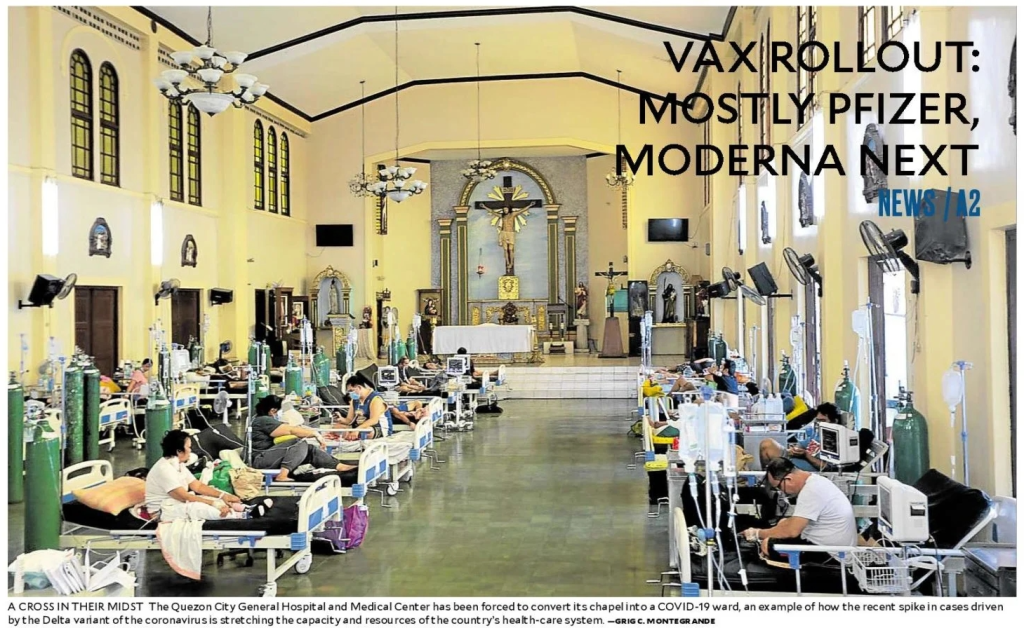
My favorite front page photo during the Delta outbreak of the COVID-19 pandemic published by the Inquirer on 20 August 2021. So evocative of the truth of Jesus himself being our true food and drink – and medicine.
As we have reflected last Sunday, a mystery is a divine truth revealed by God we learn through the gift of faith. It is non-logical but not illogical. It can be explained and understood but not fully.
Here in the mystery of the Body and Blood of Christ we call as the Eucharist, the mystery of our Triune God becomes a reality in our life truly present in perceptible signs of bread and wine. From relating, we now come to the mystery of sharing of our selves like God who shared us his Son Jesus Christ who in turn gave himself for us on the Cross that continues today in the Holy Eucharist as his everlasting sign of his loving presence and service.
See how Jesus spoke clearly in this passage of his giving us his physical body and blood that to receive it, we have to actually eat it too.
First we notice is how in other parts of the New Testament that the term soma is used to refer to the Eucharist which is the Greek word for “body” that may have symbolic meanings; but in this passage, Jesus used the word sarx which means “flesh” in Greek that means only one thing, the corporeal reality of his physical body. Jesus is telling us in no uncertain terms in this passage after the miracle feeding of more than 5000 in the wilderness that he himself is truly and really present as flesh and blood in the Eucharist. Recall that at his Prologue to his gospel, John also used the same term sarx in declaring “the Word became flesh” (Jn.1:14) to correct misunderstandings and doubts that were already developing during the first century of Christianity regarding the physical Incarnation of Jesus the Eternal Word and his true presence in the Eucharist.
Second term used by Jesus four times as he emphasized the reality of his Body and Blood in the Eucharist is the word trogein which in Greek means “to munch” or “bite”; the other Greek word for the verb to eat is phragein which evokes many symbolic meanings like “digesting” a book or “assimilating” the culture. Again, when Jesus said we have to eat his flesh and drink his blood, he truly meant himself as a true food and true drink to nourish and sustain us in this life and hereafter.
Photo by Kuya Ruben, 04 August 2022.
There lies the beauty of this mystery of the Eucharist: Jesus himself is the one we receive, who comes to us personally, physically to be one with us in our very selves. We do not have to wait for death and be in heaven to experience fullness of life in Christ because he comes truly to us while in this life when we receive him in the Holy Communion.
St. Paul reminds us in the second reading with his rhetorical questions, “The cup of blessing that we bless, is it not a participation in the blood of Christ? The bread that we break: is it not a participation in the body of Christ?” (1 Cor. 10:16) of this reality of Christ’s presence in us and among us. He was not waiting for answers of yes or no but posed those questions to affirm the very truth we all know that Jesus is really present in us and among us especially when we are broken like the Israelites in the first reading. This is where the mystery deepens, becomes more real and more fascinating. Jesus the Son of God emptying himself to be like us in everything except sin so that we may become like him, holy and divine.
This I have learned in my two years of being a chaplain in the hospital. Admittedly, it is difficult especially for me as I could easily be carried away by emotions in seeing the sick and suffering while at the same time, can often have my stomach overturned by sights of blood and wounds of others. But, there is always that indescribable feelings of joy and fulfillment after visiting and anointing our sick patients.
Photo by Kuya Ruben, June 2022.
I have no claims to holiness as I am a sinner too but the Eucharist has become most truest to me these past two years in the hospital and university as well as I get into contact with the sick and the students. When I touch patients to pray over them or help in moving them, when students cry to me or ask for hugs after confessions, they all flash to me during the consecration as I raise and say, This is my Body… This is my Blood. Jesus is most truest in the Eucharist when we too imitate him in giving ourselves to others to be broken and shared.
The Eucharist is the most wonderful gift of God to us when we receive his Son Body and Blood to make us strong and holy like him in this life.
That is why we have to go to Mass every Sunday. That is why a priest has to celebrate Mass daily for the people to be strengthened like him in this journey of life filled with trials and sufferings. That is why Moses kept on reminding the Israelites of their many hardships from their exodus into their wandering in the wilderness. That is why this coming Friday, we cap these three weeks of transition into the Ordinary Time with the Solemnity of the Most Sacred Heart of Jesus, another mystery of Christ truly among us and within us as we experience his love most truly right here in our hearts.
What an awesome God we have indeed who has become so small and so simple like us so we can be great like him. Like the simple bread and wine, in the Mass through the Holy Spirit, they become Christ’s Body and Blood. Let’s make it happen this Sunday in our celebration of the Mass. Amen.Have a blessed week ahead.
The Lord Is My Chef Daily Recipe for the Soul by Fr. Nicanor F. Lalog II
Thursday in the Ninth Week of Ordinary Time, Year I, 08 June 2023
Tobit 6:10-11, 7:9-17   <*((((>< + ><))))*>   Mark 12:28-34
Photo by author, January 2023.
God our loving Father,
cleanse our hearts,
purify us of our desires
and intentions in life;
make us like Tobiah
who could wholeheartedly
declare before you of his
noble intentions in marrying
Sarah:
Now, Lord, you know that I take this wife of mine not because of lust, but for a noble purpose. Call down your mercy on me and on her, and allow us to live together to a happy old age.” They said together, “Amen, amen,” and went to bed for the night.
Tobit 8:7-8
Like the man who inquired
Jesus about the first of all
commandments, grant us
dear God same pure heart
that leads to "understanding"
so that we may be "no longer
far from the Kingdom of God"
(cf. Mark 12:34).
Amen.
The Lord Is My Chef Daily Recipe for the Soul by Fr. Nicanor F. Lalog II
Friday in the Sixth Week of Ordinary Time, Year I, 17 February 2023
Genesis 11:1-9   ><]]]]'> + ><]]]]'> + ><]]]]'>   Mark 8:34-9:1
Thank you, O God our loving Father
for this wonderful Friday;
after a week of stories of our Creation
and Fall, your words today invite us
anew to look deeper into our hearts
to find you and see your plans for us.
The story of the tower of Babel reveals
many things about our hearts,
of how we would always start seeming
to be good, like being one and united
as a people which you have always desired;
but, like the people at that time, our seemingly
good and innocent plans reveal sinister
evil within our hearts:  "Come,
let us build ourselves a city
and a tower with its top in the sky,
and so make a name for ourselves;
otherwise we shall be scattered
all over the earth" (Genesis 11:4).
Forgive us, O God,
the many times we have tried
manipulating you, fooling our selves
with our supposed to be good intentions
when in fact full of evil and selfish motives;
how funny we have never learned that in
our efforts to preserve ourselves through
our many selfish schemes, the more we fall,
the more we ended up divided like at Babel.
The Lord brings to nought the plans of nations; he foils the designs of peoples. But the plan of the Lord stands forever, the design of his heart through all generations.
Psalm 33:10-11
Let us not confuse unity
with oneness right away;
yes we have to be one in you
through others, but never one
in ourselves or with others for a
vested interest for it shall surely collapse
and crash like Babel;
take away our arrogance that pretend
to be sincere and true in always having
the best intentions, the most beautiful plans
when in fact are all self-serving,
trying to impose our very selves on others;
make us realize that life is fragile,
that anything can always happen
with us and with our plans,
that we have no total control of everything
and hence, simply be open to your
new directions and instructions.

Help us forget our selves,
to take up our cross and follow
your Son Jesus Christ
in humility and simplicity,
in hiddenness and silence,
in kindness and love
for others which is your
original plan for us as a people.
Make us one in you, dear Father,
regardless of our language and color,
or any other differences like at Pentecost.
Amen.
















 lordmychef.com