The Lord Is My Chef Sunday Music, 01 December 2019
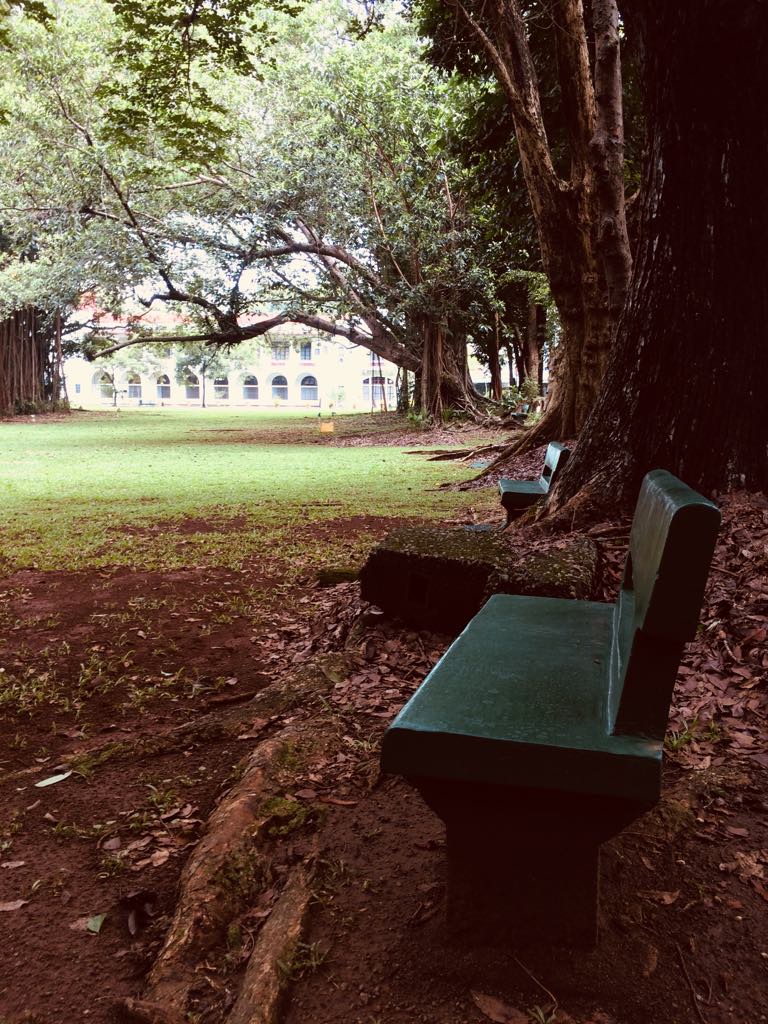
Photo by Mr. Jim Marpa, 2018.
A blessed Sunday to you my dear follower and reader!
It’s the first day of December, the final month of the year but at the same time the start of a new year in our Church calendar with the Season of Advent, the four Sundays before Christmas.
From the Latin adventus that means coming, Advent has a two-fold character on the two comings of Jesus Christ: beginning today until December 16, all readings and prayers are focused on his Second Coming; from December 17 to the 24th, we shift our sights to the first Christmas when Christ was born in Bethlehem 2000 years ago.
Jesus said to his disciples: “As it was in the days of Noah, so it will be at the coming of the Son of Man. In those days before the flood, they were eating and drinking, marrying and giving in marriage, up to the day that Noah entered the ark. They did not know until the flood came and carried them all away. So will it be also at the coming of the Son of Man.”
Matthew 24:37-39
Nobody knows when Jesus Christ is coming again but he assures us that it will be sudden and unexpected like in the days of Noah. It is useless to know exactly when it would be because it may be any time. According to St. Bernard of Clairvaux, between the two comings of Christ is his third coming – that is, in every moment of our lives.
Contrary to common beliefs, the Second Coming of Christ at the end of time known as parousia will not necessarily be catastrophic. It all depends to our attitude: if we are negligent of our Christian duties to love and serve those in need, then we end in disaster like what Jesus tells us in the gospel today.
Jesus is coming again not to destroy the world but to bring it to perfection, into new heaven and new earth. What he is asking us is to be like him, Christ-like, to be his presence by allowing us to let his light shine through our words and deeds.
Here to inspire us to glimpse Christ’s coming to our daily lives is Johnny Nash in his 1972 hit “I Can See Clearly Now”.
Composed and produced by Nash himself, I Can See Clearly Now evokes a very Advent spirit of active waiting and vigilance. Its musical arrangement laced with reggae influences from Nash’s earlier collaborations with Bob Marley gives the song with some touch of solemnity that makes it so perfect for this First Sunday of Advent.
Happy listening and may the song open your eyes too to Jesus Christ’s love for you!
Isaiah 2:1-5 ><}}}*> Romans 13:11-14 ><}}}*> Matthew 24:37-44
From Google.
A blessed first Sunday of Advent to you my dear reader and follower! Today we begin another new year in our Church calendar with this season of Advent. Both the word “Advent” and its concept were borrowed from ancient Rome when provinces prepared for the coming, or “adventus” of the emperor to visit the occupied territories of his empire.
But, Jesus is more than any emperor of the world for he is true God and King of kings, the one who had come, always comes, and will be coming again at the end of time to judge us, both the living and the dead. This Season of Advent gives us the opportunities to intensely prepare for the Lord’s adventus that always begins in our hearts.
Advent has a two-fold character: beginning today until December 16, the readings and prayers set our sights to the Second Coming of Christ at the end of time or the parousia. From December 17-24, focus shifts to the first Christmas when Jesus was born in Bethlehem more than 2000 years ago.
According to St. Bernard of Clairvaux, between these two comings of Christ is his third coming that happens daily in our lives, so ordinary but very sudden like in the time of Noah.
Photo by author, sacristy of our Parish, Advent 2018.
Jesus said to his disciples: “As it was in the days of Noah, so it will be at the coming of the Son of Man. In those days before the flood, they were eating and drinking, marrying and giving in marriage, up to the day that Noah entered the ark. They did not know until the flood came and carried them all away. So will it be also at the coming of the Son of Man.
Matthew 24:37-39
Staying awake, actively waiting for the Lord.
Jesus is definitely coming at the end of time. It is useless to be concerned when that would be because it will be sudden and unexpected. What matters most is our attitude of “staying awake, actively waiting” for the Lord’s coming again.
The Lord cites to us the example of Noah whom God had instructed to build an ark in the Old Testament for the coming great flood meant to cleanse the earth of sins and evil.
To actively wait for the Lord’s parousia means to be a sign of contradiction like Noah who faithfully obeyed God’s will in building an ark and later gathering into it all the animal species of earth.
Imagine the insults Noah had to endure from people laughing at him while building the ark. Yet, he never wavered and faithfully fulfilled his task before the Lord.
From Google.
Jesus cites three other instances of displaying the right attitude in actively waiting for his Second Coming: the two men out in the field, the two women grinding, and the master of the house.
One of the two men in the field was taken while one of the two women grinding was also taken because they were responsibly fulfilling their tasks when the parousia comes; their respective counterparts were most likely doing nothing or very lazy that they were left behind.
The mini parable Jesus inserted at the end shows us the imagery of the master of the house staying awake to keep the thief from breaking into the house in the middle of the night.
These are all about having the right attitude as disciples of Jesus actively awaiting his return. From Noah to the other man in the field, the other woman grinding, and the master of the house, we find from their attitudes of active waiting budding forth their hope in God.
Generally speaking, the way we live our lives determines also how we hope in the Lord.
And this we find in St.Paul’s exhortation to the Christians of Rome:
Brothers and sisters: you know the time; it is the hour now for you to awake from sleep. For our salvation is nearer now than when we first believed; the night is advanced, the day is at hand. Let us then throw off the works of darkness and put on the armor of light; let us conduct ourselves properly as in the day, not in orgies and drunkenness, not in promiscuity and lust, not in rivalry and jealous. But put on the Lord Jesus Christ, and make no provisions for the desires of the flesh.
Romans 13:11-14
Altar table at the Parokya ng San Juan Apostol at Ebanghelista, Bagbaguin, Santa Maria, Bulacan, Advent 2018.
Putting on Christ to show his light to dispel darkness.
St. Paul wrote the Christians in Rome more than 2000 years ago to remind them of the fierce spiritual warfare between good and evil, light and darkness while they were living in the midst of a pagan world and culture.
It was a very difficult time to be truly Christians but St. Paul felt the need to remind everyone of the ever-present reality of the parousia. Like in most of his letters, he captured by the grace of the Holy Spirit the beautiful imagery of disciples with the right attitude awaiting the Second Coming as “putting on the Lord Jesus Christ”.
Putting on our Lord Jesus Christ is not just a mere call to be morally perfect persons but for us to strive in making the light of Christ shine on us so that we may manifest Jesus more in us and in our lives.
Simply put, it is becoming “Christ-like”, a true Christian who is “dead to sin but alive for God in Christ Jesus” (Rom. 6:11), one who lives differently by making Jesus more present especially in these difficult and troublesome times.
The time of St. Paul was no different with our present age with growing materialism and consumerism among peoples, including Christians afflicted with Pope Emeritus Benedict XVI’s “dictatorship of relativism” that have removed God from every aspect of human life, including Christmas itself!
See how we are so focused on Christmas countdowns than with the very reason of the Season, Jesus Christ. See how the media equate Christmas with material things, sugarcoating it with sentimental feelings as most Christmas songs nowadays indicate.
Advent is seeing more of Jesus, than of time.
On this first Sunday of Advent, our sights are redirected anew into Christ’s Second Coming with our important task of making him present in our very selves.
As children of the light, we slowly discover and realize how our definitive salvation is slowly moving towards its fullness in Christ’s parousia when everything is totally changed by God with peace finally reigning supreme over all.
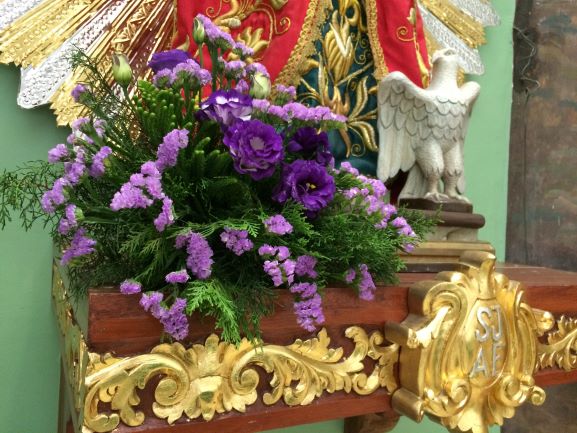
Violets on the pedestal of our Patron Saint, John the Evangelist.
This was the vision of Isaiah a long, long time ago.
It had been fulfilled in Christ’s first coming in Bethlehem over 2000 years ago and it is being fulfilled daily through people filled with hope in God’s justice and love.
In the days to come, the mountain of the Lord’s house shall be established as the highest mountain and raised above the hills. All nations shall stream toward it; many people shall come and say: “Come, let us climb the Lord’s mountain…” They shall beat their swords into plowshares and their spears into pruning hooks; one nation shall not raise the sword against another, nor shall they train for war again. O God of Jacob, come, let us walk in the light of the Lord!
Isaiah 2:2-3, 4-5
People who keep on wondering and asking when will Jesus come again are not really interested with the Lord’s Second Coming but only with themselves like the people during the time of Noah – oblivious to anything else and busy with their own pursuits.
The more we think of the WHEN, the less we think of the WHO of Advent. Let us put on the Lord Jesus Christ to be filled with his light until all darkness in life is dispelled. Amen.
Daniel 7:2-14 ><)))*> ><)))*> ><)))*> Luke 21:29-33
Praise and glory to you, O God! Thank for this blessed Friday, the last working day of November 2019. Most of all, thank you for keeping us safe always in your protection despite our sins and being stubborn.
Like the vision of Prophet Daniel in the first reading, so many “beasts” have tried destroying us. In fact, these “beasts” are so “horrible” that so many people have come to believe them, accepting them and all their lies and malice.
Red Wednesday 2019, Parokya ng San Juan Apostol at Ebanghelista, Bagbaguin, Santa Maria, Bulacan.
There are times that we lose hope, fearing that everything is going to nothing.
Sometimes, it is so difficult to find meaning in life at all amidst all the sufferings and miseries around us and even within us!
May we always trust in your Word, Jesus Christ who became flesh to be with us.
In the many trials and tribulations that come our way, may we always hold on to his assurance:
“Heaven and earth will pass away, but my words will not pass away.”
Red Wednesday in Memory of Persecuted Christians, 27 November 2019
Revelation 15:1-4 ><)))*> ><)))*> ><)))*> Luke 21:12-19
From Google.
Today, O dear Jesus, we gather as one nation to remember the 300 million Christians worldwide who are persecuted in various forms because of their faith in you: those who were denied of work, housing, liberty, and most especially, life.
We remember and pray for our Christian brothers and sisters who were unjustly tortured and murdered because of carrying a cross and confessing their love for you, Jesus Christ.
Jesus said to the crowd: “You will be hated by all because of my name, but not a hair of your head will be destroyed. By your perseverance you will secure your lives.”
Luke 21:17-19
May those who have suffered and those still suffering be consoled with your love and peace, Lord.
Have mercy on their persecutors, let them realize that religion should bring us together and not apart.
Most especially, Lord Jesus, teach us to remember in carrying and embracing our crosses in the midst of these persecutions. Wash away our sins of indifference. Give us courage to follow promptings of your Holy Spirit in working for genuine peace and justice.
Empty ourselves of hatred and mistrust of one another to always remember we are all brothers and sisters in the Father. Amen.
Red Wednesday poster of Bacolod Diocese last year.
Lawiswis ng Salita ni P. Nicanor F. Lalog II, Ika-26 ng Nobyembre 2019
Ang Krus ni Kristo sa tuktok ng simbahan sa Birhen ng Lourdes, France. Larawan ay kuha ng dati kong estudyante si Arch. Philip Santiago noong Setyembre 2018.
Panginoong Hesu Kristo
tunay ngang kay dakila mo
nang gawin mong trono
ng pagkahari itong Krus
na pinagpakuan mo.
Kakaiba sa gawi ng mundo
pagkahari mo'y pakikiisa
sa aming abang pagkatao
upang kami'y mahango at makasama
sa luwalhati ng pagkabuhay mo.
Sa Krus ikaw ay pumasok
sa aming pagkatao;
sa Krus mo rin kami'y
pinapasok sa iyong kabanalan
nang kami'y bahaginan ng iyong pagkabuhay.
Dating sumpang dulot ng kamatayan
sa iyong Krus naging pagpapala
at ito ay nagsimula nang iyong
ipinangako ang Paraiso
sa kasamang nakapako.
Itong Krus ni Kristo
hindi lamang trono ng kanyang pagkahari
kungdi pintuan din patungo sa Paraiso;
nawa tantuin ng bawat tao
saan mayroong Krus, naroon din si Kristo!
Altar ng Parokya ng San Juan Apostol at Ebanghelista, Bagbaguin, Santa Maria, Bulacan, 17 Nobyembre 2019.
The Cross is the throne of our Lord Jesus Christ, King of the Universe. It is also a lesson in itself, the most profound Jesus has given us that continues to unfold and unravel the “depth and breath” of God’s love for each of us.
Through his Cross, Jesus did not only enter humanity but also allowed humanity to enter him by putting into his heart its very symbolism which is death we all deny and are afraid of. By dying on the Cross, Jesus turned it into a blessing to now become the symbol of life.
Let’s make an illustration.
Yes, it is Bruce Willis from a scene in one of his popular series, “Die Hard” which I continue to watch whenever possible.
What I like most with Bruce Willis in all of his movies is his being so “human” – very vulnerable physically, emotionally and even psychologically. His roles never hide his being a frail human being despite his muscular strength and tactical acumen. Bruce never hides his weaknesses that he can get shot and wounded, dumped and divorced or cheated by his wife like in “The Last Boy Scout”, making him more believable than the other action stars.
And that’s our point here: Jesus never hid his humanity from us. The all-powerful God on whose everything was created according to St. Paul in the second reading became human like us in every aspect except sin.
He is the image of the invisible God, the firstborn of all creation. For in him were created all things in heaven and on earth… He is before all things, and in him all things hold together. He is the head of the body, the church. He is the beginning, the firstborn from the dead, that in all things he himself might be preeminent. For in him all the fullness was pleased to dwell, and through him to reconcile all things for him, making peace by the blood of his cross through him, whether those on earth or those in heaven.
Colossians 1:15-19
Carmelite Monastery, Guiguinto, Bulacan, 12 November 2019.
In becoming human like us, Jesus entered our humanity. He who is the Son of God became an infant and child so weak, entrusting himself to us humans.
And when he had grown into a man, he experienced leaving home and family to fulfill his mission like almost everybody. He had friends, some eventually became faithful while another had betrayed him.
Jesus went to almost every gathering like weddings and banquets, met everybody from the “who’s who” to the nobody like sinners and marginalized. He was manly enough to relate with every kind of people, be they children or women, rich and poor alike.
He had wept at the death of a good friend and the impending destruction of his beloved city of Jerusalem, felt hunger and thirst, got angry and was surprised in some occasions.
Jesus is truly human that we can also identify with him but in his dying on the cross, we were able to enter him to become like him when on his Resurrection, he took away the curse of death and turned it into pure grace in him.
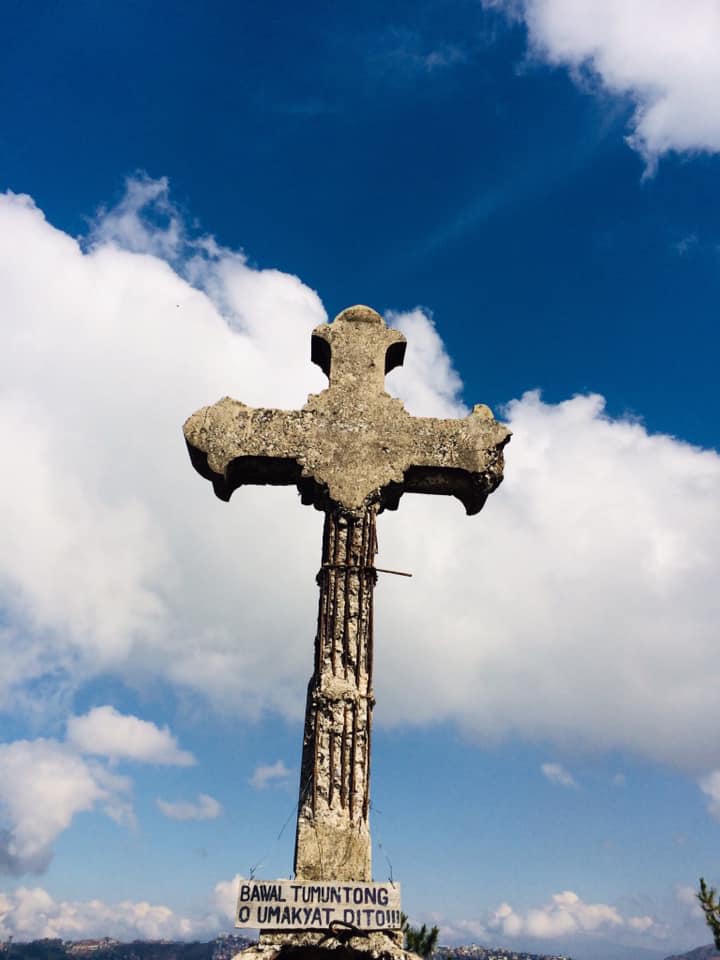
Cross at the Dominican Hill in Baguio City, January 2019.
A very unique characteristic of Jesus as a human is his being a radical in its truest essence and meaning. From the Latin word “radix” that means roots, Jesus brought us back to our very roots, to our grounding of being who is God himself.
Too often, we think of radical people as rebels and revolutionaries leading movements and many changes in the society. They are the “game changers” because they radically change things to show us the more essential.
But in reality, radicals do not change things: they restore things to its original state and being. They get into the roots or “radix” of things to bring out its true meanings by doing away with the unimportant accidentals that have taken over the realities.
That is why Jesus is a radical: by dying on the Cross, he firmly reestablished his throne as King of the Universe because that is where evil ended and death is conquered.
It is on the Cross his throne where every new life begins because it is our very rootedness and “grounding of being” as beloved children of God in him.
Most of all, it is on the Cross his throne, our root and grounding from which comes our sole focus and attention in life – God in Christ Jesus.
The rulers sneered at Jesus… even the soldiers jeered at him. Now one of the criminals hanging there reviled Jesus, saying, “Are you not the Christ? Save yourself and us.” The other, however, rebuking him, said in reply, “Have you no fear of God, for you are subject to the same condemnation? And indeed, we have been condemned justly, for the sentence we received corresponds to our crimes, but this man has done nothing criminal.” Then he said, “Jesus, remember me when you come into your kingdom.” He replied to him, “Amen, I say to you, today you will be with me in Paradise.”
Luke 23:35, 36, 39-43
We have a beautiful expression in Filipino about a person described as “malalim” or deep. A radical is the truly deep person because he is rooted and grounded in his being who is God!
Anyone who truly recognizes Jesus Christ becomes a radical person too, a person of depth because he is rooted in God like the other thief hanging on the cross with Jesus.
See how the rulers or the elite like the priests and elders of Israel who sneered at Jesus: the more they poked fun on him as “the Christ of God”, the more they indict themselves of the grave crime of putting Jesus to death. Eventually at the death of Jesus, the Temple curtain would be torn from top to bottom to signal the end of temple worship and the start of worshipping God in “truth and spirit” in Christ.
The soldiers jeered Jesus too because they “know not what they were doing” because they were all pagans. But again, upon Christ’s death, we find one soldier there at the scene declaring “truly this is the Son of God.”
In any case, some members of Israel’s rulers and Roman soldiers eventually followed Jesus after the Resurrection to show us how the Cross is indeed the throne of Christ the King: it is also a door that opens anyone to conversion, to accept his reign and kingdom!
Most of all, the “good thief”, usually referred to as Dimas, shows us how at the cross any one can become radical like the Lord. While agonizing with Jesus on the cross, Dimas must have examined his life and got into his very core, his roots and realized that basic truth inside him was right there suffering also with him — Jesus whose name means “Yahweh saves”.
What is so surprising with his request from Jesus “to remember him he gets into his kingdom” is the fact that in the Old Testament, it is God who always remembers his people, remembers his promise, remembers his covenant.
Man always forgets God and his covenant that we always turn away from him to live in sin. But at the cross, the throne of Jesus our King, he enables us to remember our roots, our being children of God, our being loved and forgiven that we finally find our way back home.
And that home is God in eternity: “Today you shall be with me in Paradise.”
Every time we are at the cross, when we are getting through so many pains and sufferings, failures and disappointments, even darkness and sin, get into your roots – Jesus Christ – and you will never get lost.
Long before we got into all these crosses in life, remember Jesus was there first for us to suffer and die on his Cross. And that is why he is our King for he rose again so we can become like him in eternity. Amen.
Friday, Memorial of St. Cecilia, Virgin and Martyr, 22 November 2019
1 Maccabees 4:36-37, 52-59 ><)))*> <*(((>< Luke 19:45-48
Candles seen from our altar onto our church rear, 18 November 2019.
Lord Jesus Christ, Light of the World, please keep your fire burning within us, always aglow with your firm faith, fervent hope and unceasing charity and love.
On this memorial of your virgin and martyr, St. Cecilia who is also the patroness of sacred music, may we imitate her to keep on “singing the song of God in our hearts”, whether in good times or in bad.
Let us praise you both in words and in deeds without ceasing.
How sad that we are like the Jews after their victory over the Gentiles in the Maccabean revolt: very enthusiastic at first that eventually waned, becoming complacent that after a hundred years, the Romans easily conquered and subdued Jerusalem.
On the anniversary of the day on which the Gentiles had defiled the temple, on that very day it was reconsecrated with songs, harps, flutes, and cymbals. All the people prostrated themselves and adored and praised heaven, who had given them success.
1 Maccabees 4:55-56
Forgive us, Lord, on the many occasions when we are so eager and full of zeal in praising you and doing your will after we have gained particular blessings and intentions from you that later on, we become complacent like your contemporaries.
Jesus entered the temple area and proceeded to drive out those who were selling things, saying to them, “It is written, my house shall be a house of prayer, but you have made it a den of thieves.”
Luke 19:45-46
Candle in our sacristy, 19 November 2019.
Let us not be complacent, Lord.
Remind us that our work and mission from you will continue until we rest in you, O Lord.
Malaci 3:19-20 ><}}}*> 2 Thessalonians 3:7-12 ><}}}*> Luke 21:5-19
The Wailing Wall of Jerusalem Temple, May 2019.
We are now at the penultimate Sunday of the year as Jesus continues to summarize his teachings today at the Temple area in Jerusalem about his final coming at the end of time.
While some people were speaking about how the temple was adorned with costly stones and votive offerings, Jesus said, “All that you see here — the days will come when there will not be left a stone upon another stone that will not be thrown down.” Then they asked him, “Teacher, when will this happen? And what sign will there be when all these things are about to happen?” He answered, “See that you not be deceived… “
Luke 21:5-8
On the surface, Jesus seemed like to be a “kill joy” in making those bold assertions about the coming destruction of the Temple while everybody was admiring it. But notice how the people reacted: instead of being worried, they asked when it would happen and what would be the warning signs before it takes place as if it is just an ordinary thing!
“Wala lang…” as the young would say these days. Nothing, duh…?
View of Jerusalem from the Church of Dominus Flevit where Jesus wept upon seeing the city from the Mount of Olives.
St. Luke tells us that before Jesus entered Jerusalem, “he wept over it” at the thought that it would be destroyed and that its enemies would not “leave one stone upon another” (Lk.19: 41-44).
If there is anyone deeply hurt and saddened with the Temple’s destruction, it is not other than Jesus Christ our Lord. He certainly shared the people’s admiration for the Temple which he had also claimed as “my Father’s house” (Lk.2:49) when he was accidentally left behind there by Mary and Joseph when he was 12 years old.
Imagine what Jesus must have felt when he spoke of the destruction of the Temple which is the heart of Jerusalem, the jewel of the city, and most of all, the sign of God’s presence among his chosen people!
There must be something deeper with his warning words of the Temple’s destruction that pertains not only to his people at that time but also to us today.
Wailing Wall of Jerusalem, may 2019.
For the Jews at that time, the destruction of the Temple is the end of the world, the signal of the apocalypse. More than a catastrophe involving the destruction of buildings and almost everything including life, it is judgment day that must not be taken lightly.
It is a day calling for conversion as the prophet Malachi in the first reading reminds us that every coming of God is a day of judgment and salvation.
Lo, the day is coming, blazing like an oven, when all the proud and all evildoers will be stubble, and the day that is coming will set them on fire… But for you who fear my name, there will arise the sun of justice with its healing rays.
Malachi 3:19-20
Christ had already come and will come again.
This was his promise and this is what he meant at the cleansing of the temple, “Destroy this temple and in three days I will raise it up” (Jn.2:19). At his Passion, Death, and Resurrection, Jesus Christ had replaced the old Temple worship with himself!
This is what we celebrate in every Holy Mass, God’s coming to us in Jesus Christ his Son.
Jesus comes in every here and now, and his every coming is a process of destroying our old temple of self to give rise to a new temple in Christ. Our concern need not be about a future date of his Second Coming or specific signs of its fulfillment.
Every day Jesus comes again and the challenge is for us to live authentically as Christians daily and not be bothered about the future. He warns us not to be deceived by all of these apocalyptic predictions and statements.
The key word is conversion, of living in the present. Jesus tells us so many things that can be very frightening and scary because what he wants us to do in preparation for his Second Coming is to love, love, and love.
And to love is to always suffer in Christ, with Christ.
He answered, “See that you not be deceived, for many will come in in my name… Do not follow them! When you hear of wars and insurrections, do not be terrified; for such things must happen first, but it will not immediately be the end.” Then he said to them, “Nation will rise against nation, and kingdom against kingdom. There will be powerful earthquakes, famines, and plagues from place to place; and awesome sights and mighty signs will come from the sky. Before all this happens, however, they will seize and persecute you… You will even be handed over by parents, brothers, relatives, and friends, and they will put some of you to death. You will be hated by all because of my name, but not a hair of on your head will be destroyed. By your perseverance you will secure your lives.”
Luke 21:8-19
From I.REDD.IT.
Yes, Jesus will definitely come again at the end of time. Like last Sunday, definitely, there is a resurrection of the dead and life everlasting. But both must be seen in the context of the present time, of the here and now.
When Jesus comes again to judge us at the end of time, he won’t be asking us about the things we have been so preoccupied with in this life like how much money we earn, what car do you drive, or how big is your house?
When Jesus comes again, he will be asking us questions we have always refused to answer in our daily lives like how much have you loved, how much have you sacrificed and suffered for a loved one, or how much have you shared to a stranger?
These are the questions we must be asking ourselves as we near towards the end of the year: how close have I followed Jesus Christ in his Passion and Death so I may be with him in his Resurrection?
May we imitate St. Paul in his second letter to the Thessalonians today to faithfully and calmly fulfill our daily tasks in this life, avoiding being idle for each day is the day of the Lord. Amen.
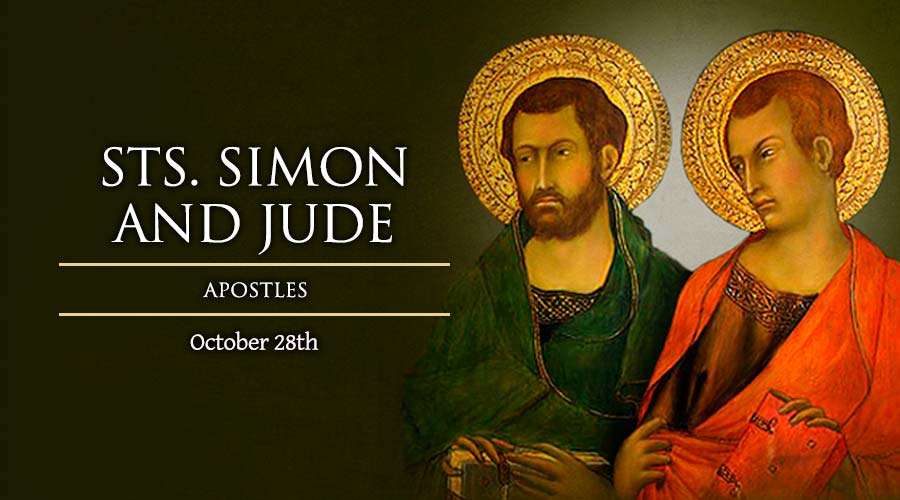
Monday, Feast of St. Simon and St. Jude, Apostles, 28 October 2019
Ephesians 2:19-22 ><)))*> ><)))*> ><)))*> Luke 6:12-16
From Google
What a glorious Monday, O Lord, we have today with the Feast of your Apostles St. Simon and St. Jude!
Whenever I think of your Apostles, O sweet Jesus, I am always filled with hope and love because they show us how you are interested with people, not with social classes or labels.
Jesus went to the mountain to pray, and he spent the night in prayer to God. When day came, he called his disciples to himself, and from them he chose Twelve, whom he also named Apostles: Simon, whom he named Peter, and his brother Andrew, James, John, Philip, Bartholomew, Matthew, Thomas, James the son of Alphaeus, Simon who was called Zealot, and Judas the son of James, and Judas Iscariot, who became a traitor.
Luke 6:12-16
How amazing you have called and gathered these people of different backgrounds and temperament.
Like St. Simon described as “the Zealot” who must be so passionate with his Jewish identity advocating independence yet working with the former Roman collaborator, St. Matthew the tax collector.
How they were able to overcome their many differences is a wonderful lesson for us all who tend to highlight our polarities and contrasts, forgetting that in you, Lord Jesus, we are given the grace to overcome our many conflicts in life.
But, at the same time, you call us to be men and women of integrity like St. Jude Thaddeus who minced no words in his letter against some Christians who “pervert the grace of our God into licentiousness and who deny our only Master and Lord, Jesus Christ” (v.4) by sowing divisions through their erroneous teachings.
May we have the courage of St. Jude to defend your teachings Lord strongly especially in this age when we try to tolerate everything for the sake of pluralism and openness and acceptance.
May St. Simon the Zealot and St. Jude Thaddeus help us rediscover the beauty of Christian faith to live it without tiring, knowing how to bear a strong and yet peaceful witness to it in Christ our Good Shepherd. Amen.
Romans 6:12-18 ><)))*> ><)))*> ><)))*> Luke 12:39-48
Sacred Heart Novitiate in Novaliches, QC, July 2017.
God our Father, All Saints’ Day and All Souls’ Day are still a week from now but today’s gospel reminds us that death is so certain to come one day to each one of us.
Nobody is exempted.
And the sooner we come to accept this fact and reality, the better for us.
Then Peter said, “Lord, is this parable meant for us or for everyone?” And the Lord replied, “Who, then, is the faithful and prudent steward whom the master will put in charge of his servants to distribute the food allowance at the proper time? Blessed is that servant whom his master on arrival finds doing so.”
Luke 12:41-43
Too often, we are like St. Peter, feeling so secured with our association with you, that we are always exempted from others.
Today you are reminding us that death will certainly come to each one of us, your stewards here on earth.
Remind us that the greatest gift you have entrusted with us is this gift of self, this gift of life.
Give us the grace to use our very selves, our whole body, for your greater glory as St. Paul told the Romans in our first reading.
It is in coming to terms with death when we begin to come to terms with life because that is when we start living authentically and readily for the great inevitability.
Not in fear but in great honor and privilege in serving you well, our Lord.
Whatever we do with our life shall be our gift to you. Amen.