Advent & Christmas begin in the church

The Lord Is My Chef Daily Recipe for the Soul by Fr. Nicanor F. Lalog II
Simbang Gabi-4 Homily, 19 December 2024
Judges 13:2-7, 24-25 <*((((>< + ><))))*> Luke 1:5-25
Photo by author, wailing wall of Jerusalem where Jews pray until now being the section closest to the Holy Holies destroyed in year 70AD.

From Matthew, we now shift to Luke to listen to his account of Christmas which is the most complete and detailed. In fact, most artistic renditions of Christmas were inspired by Luke’s gospel.

Very surprising in his Christmas story, Luke started it with the annunciation of the birth of John the Baptist to his father Zechariah who was then serving at the temple of the Lord in Jerusalem. It is a reminder to us all these days that Advent and Christmas begin in the church, in our holy celebrations.

In the days of Herod, King of Judea, there was a priest named Zechariah of the priestly division of Abijah; his wife was from the daughters of Aaron, and her name was Elizabeth. Once when he was serving as priest in his division’s turn before God, according to the practice of the priestly service, he was chosen by lot to enter the sanctuary of the Lord to burn incense. Then, when the whole assembly of the people was praying outside at the hour of the incense offering, the angel of the Lord appeared to him, standing at the right of the altar of incense (Luke 1:5, 8-11).

Luke’s detailed account of the event is the Jewish Day of Atonement (Yom Kippur) when their priests incense yearly between September 18-24 the Holy of Holies where they used to keep the Ark of the Covenant. From this detail by Luke we got the reliable timetable in the celebration of Christmas on December 25 by considering this event as the time of Elizabeth’s conception of John who was born June 24 or nine months after. Tomorrow we shall hear in the gospel how “on the sixth month” of Elizabeth’s pregnancy which fell on March 25, the angel Gabriel announced to Mary the birth of Jesus, the Solemnity of the Annunciation we celebrate on that date. Nine months from March 25, we have December 25! Who said our Christmas date is not in the Bible? We got it here in our gospel today courtesy of Luke!

Photo by author, Parish Church of St. Joseph in Morong, Rizal, January 2021.

It may sound simple yet, it is so profound. In narrating this to us, Luke reminds us today that the Christmas story began in a holy celebration in the temple of Jerusalem now happening in our Eucharistic celebrations in every church around the world.

Many take our Sunday Masses for granted these days with so many excuses and alibis but, let us set aside all these to reflect on this simple detail from Luke’s first story on Christmas.

Photo by Mr. Jim Marpa, 2018.

First, this is a call for us all to go back to the church by finally putting a stop NOW of online Masses. Online Mass as a term is an oxymoron because it presupposes actual presence of people. There can be no virtual Mass because there is no such thing as virtual sacrament nor virtual grace. That is why God introduced Himself to Moses as “I AM WHO AM”, the One who is perfectly present, always actual never virtual.

Since the waning of the COVID virus last year, both the Pope and the CBCP have called for the ending of online Masses but unfortunately, so many priests have remained stubborn with some making “shameful profit” out of it which is strongly prohibited by Canon Law and other Church and papal documents. Unless online Masses are stopped, people will always find reasons and alibis not to go to church on Sundays.

As we reflect on Luke’s account of the celebration at that time of the annunciation of the angel to Zechariah while he was incensing the Holy of Holies, we get the feel of solemnity and sacredness that are sorely missing these days in many of our celebrations of the Mass.

Like Zechariah and the priests of the Jerusalem temple at that time who were all steeped in traditions and presumably spirituality, we have every reason to expect the same, even more, from our bishops and priests today. They are the ones who set the tone of every celebration and of life in the parish; their spirituality or lack of it is manifested in the parish life, from its building structure to its witnessing.

Photo by author, pious Jews and Rabbis in another enclosed section of the wall of the temple of Jerusalem, May 2017.

How sad when priests have lost the sense of the sacred of the Holy Mass when they disregard the solemnity of the celebration with all their antics and gimmicks; worst of all, of coming to Mass unprepared without a homily and good vestments, sometimes without having showered or shaved! What is tragic is when the priest attends all socials in proper attire, but never in the Mass.

The other day, I saw a sticker at the back of a delivery van that asks, “How’s my driving? And my grooming?” Too bad I was not able to get the name of the company of that delivery van but how great are its people must be in giving a premium on how their drivers behave and look!

Some priests shamelessly argue that what is essential is what is inside but they forget that the outward appearance is an indication of what’s inside them too. How can the people feel and experience God if their pastor comes shabbily dressed without any good vestments, so untidy as in dugyot, unprepared for the Mass, without a good homily?

What had become of our churches that have been the shining glory of architecture through the centuries but now look like malls? Some churches look like videoke bars with a lot of giant TV screens while priests serenade the people with their wonderful voices instead of delivering a homily.

How sad that many churches are untidy and ugly. Yes, ugly is the word. And kitschy, bereft of any sense of the holy that people cannot experience God except be played on their emotions with dramas and not to forget, second and third collections. Choirs are on their own with a concert, totally deaf to the fact their music is supposed to lead the congregation into prayerful reflections not to applaud them for a performance. It is about time we restore the dictum of the Roman liturgy of noble simplicity not only of the church and also of celebrations.

Photo by author, Archdiocesan Shrine of Nuestra Señora De Guia, Ermita, Manila, 28 November 2024.

Our gospel invites us today, especially us priests and bishops along with those involved in preparing our parish celebrations to be silent like Elizabeth – lest we be silenced and be made mute by the Lord like Zechariah to finally open ourselves to listen to God’s instructions about His Son’s coming.

Let’s face that sad reality of so many of us clergy and laity in the church who are like Zechariah trying to control everything including God, even playing God who give the people enough reasons to turn away from the Church completely.

Photo by author of the beautiful sacristy of the Archdiocesan Shrine of Nuestra Señora De Guia in Ermita, Manila where even a guest priest could feel at “home” with everything in order.

Like Elizabeth, let us choose to be silent in order to pray truly, awaiting God in the Holy Spirit to stir us into His Divine Plans like Samson in the first reading, “The boy grew up and the Lord blessed him; the Spirit of the Lord first stirred” (Jgs.13:24-25). We find the same thing in the gospel when Gabriel told Zechariah how John while still in Elizabeth’s womb would be filled with the Holy Spirit (Lk.1:15) in accomplishing his mission as precursor of Jesus.

If we could allow ourselves to be stirred by God first – not by fad or ulterior motives in our church celebrations – then every Mass becomes a Christmas, a coming of Christ.

Let us do away with unnecessary things in the church and in our celebrations that call attention to us, to our abilities and talents, even power like Zechariah by being more daring in silence and noble simplicity to experience God’s coming every Mass.

As we shall see in the coming days from the gospel of Luke, Christmas is both a journey into Bethlehem, Jerusalem and other places as well as into the very hearts of Joseph and Mary and of those who would recognize and accept Jesus Christ. May our churches reflect what is in our hearts as disciples of Christ, always with a space for Jesus to come and dwell inside and among us. Amen.

Photo by author, Simbang Gabi in our previous parish, 2018.

Advent a time machine?

The Lord Is My Chef Daily Recipe for the Soul by Fr. Nicanor F. Lalog II
Simbang Gabi-3 Homily, 18 December 2024
Jeremiah 23:5-8 <*[[[[>< + ><]]]]*> Matthew 1:18-25
Photo from panmacmillan.com

For those looking for a great gift this Christmas, whether for others or for yourself, I strongly recommend a copy of Before the Coffee Gets Cold. If you can afford, get its four other sequels too!

Written by the Japanese Toshikazu Kawaguchi, Before the Coffee Gets Cold and its sequels is a collection of stories about “time travel” set in a Tokyo cafe with a funny name that is actually the title of 1921 Italian opera song, Funiculi Funicula that means “A Merry Life”. It is very appealing because we all have dreamt or wished of travelling in time with its crucial question – who is that one person you would like to meet in the past or future?

There are many rules to follow for anyone wishing to travel time in the Tokyo cafe like you can only time travel with someone who had been there; you sit only at one particular table inside the small cafe; you may go back to the past or even go to the future but you cannot change them as it would adversely affect the present; and most of all, you have to drink the coffee before it gets cold to return to the present.

The novel is aptly titled Before the Coffee Gets Cold because anyone wishing to travel time, whether in the past or future, one has to drink and swallow all bitterness (coffee) we have in life in order to find fulfillment in the present and future.

Is it not funny that in life and in fantasy like time travel, we are governed by rules as well as commandments? Many times most of us disregard them while some almost worshipped them like the Jews of biblical times, except Joseph.

From vaticannews.va.

After establishing the fact that Jesus Christ is from the lineage of the two greatest personages of the Old Testament, Abraham and David, Matthew logically placed next to his genealogy the circumstances surrounding the birth of the Lord by solemnly declaring, “This is how the birth of Jesus Christ came about (Mt.1:18).” 

Notice how Matthew not only stressed Joseph as “the husband of Mary.  Of her was born Jesus who is called the Christ (Mt.1:16)” to indicate his royal blood from the lineage of King David but as a true blooded Jew for he was “a righteous man (Mt.1:19).”

In the Bible, a “righteous man” or a “just man” is a “holy man” called a zaddik in Hebrew, one who lives his life according to the sacred Scriptures as word of God, delighting in His laws and commandments, and entrusting everything to the Divine will. 

Joseph was exactly that kind of Jewish “zaddik” who lived in constant dialogue with God in His words, concretely living it out minus the legalisms of Pharisees and scribes.  For Joseph, the Torah was a “good news” meant to make life better not bitter that it was not difficult for him to choose to leave Mary silently so as to spare her of all the shame and trouble in bearing a child not his if he went by their laws. Eventually after the angel had appeared to him in a dream to explain the virginal conception by Mary, “When Joseph awoke, he did as the angel of the Lord had commanded him and took his wife into his home (Mt.1:24).”

Matthew is teaching us that to be holy like Joseph, we have to make that important decision of bridging our faith with our life, of being obedient to God. Obedience literally in Latin means “to listen intently”; in being open to God’s words and will, Joseph listened intently that he was able to obey and follow God. It required a lot of listening and humility on Joseph’s part to set aside his plans and let God’s will prevail. That early, Joseph realized that for him to accept God in Jesus, he had to take Mary as his wife. And here lies Joseph’s greatness: in taking Mary as his wife as told by the angel, Jesus Christ was born and we have Christmas to celebrate!

Photo by author, March 2024.

As a true blooded Jewish man, Joseph knew all the rules and commandments and lived by them but never in absolute terms especially when they superseded persons. Later, Jesus would insist to His detractors that “the sabbath was created for man not man for sabbath.” Joseph as a righteous man did exactly that when he took Mary as wife and became the Lord’s “foster father” on earth.  There was a clear application in life whatever was in the heart and mind of Joseph as he walked his talk (or silence). 

Joseph’s holiness in the real sense is best expressed in his ability to sleep soundly in the midst of great crises as he completely trusted God. There were four instances that the angel appeared to Joseph in a dream with important messages from God: first was here in the annunciation of Christ’s birth; then, when he was told to flee to Egypt with Mary and Baby Jesus to escape Herod’s wrath; third, when he was told to return to Israel after Herod’s death, and fourth when he was told to raise Jesus in Mary’s town of Nazareth in fulfillment of the prophecy “he shall be called a Nazorean.”

Joseph was always asleep because he completely trusted God whenever he made decisions in life.  He never dilly-dallied with important decisions unlike us who could not firm up our decisions that is why we are restless, could not sleep at all. In the first reading we heard the prophecy of the coming of Christ who shall be called “the Lord our justice (Jer.22:6)” because like Joseph, Jesus would entrust Himself completely to God’s will when He died on the Cross for us. 

Photo by author, December 2023.

Sleeping and dying are similar in the closing of our eyes when we entrust ourselves to God completely without knowing what shall happen next if we would still wake up or, in the case of death, rise again. 

When we sleep, we travel through time in our dreams, in our hopes and aspirations in the future, and in the pains of the past. We submit them all to God as we sleep hoping for His surprises upon waking up. Christmas happens and Jesus comes to us when like Joseph we abandon everything to God and go to sleep to be ready and prepared for new, unexpected, and even incredible things the following morning. So, face your problems and issues squarely before going to bed, pray and then decide like Joseph and be surprised by the Lord, whether in your dream or upon waking up.

One of the stories in Before the Coffee Gets Cold is about an accomplished Japanese career woman; she asked to travel to her past when her younger boyfriend dated her in the cafe before leaving for the US. The woman was so sad as she felt discarded by her boyfriend in favor of a career in the the States. When she finally travelled in time, she kept her mouth shut unlike in their last meeting; lo, and behold, it was only then she “heard” her boyfriend asking her to wait for him after three years. She never listened to her boyfriend during their last meeting, oblivious to his request that she wait for him after three years when he comes back to get married with her! Everything changed when she returned to the present: without changing the past, she could still change the future in her favor as she happily awaited her boyfriend’s return.

When we are open to God in Jesus, we can also “travel time” in Him for He is eternal, to listen intently to Him as we revisit our past with all its mistakes and sins or peek into the future with all of its fears and uncertainties or simply remain in the present moment with all the problems and trials we grapple. That’s when we admit and swallow the bitterness we have and surprisingly find Jesus Christ in our present, past and future always loving us, calling us, speaking to us. Do we listen to Him and to those around us or, are we so bound by rules and our own prejudices? Amen. Have a blessed day!

Photo by author, Fatima Avenue, Valenzuela City, December 2023.

Are we all lost stars trying to light up the dark?

The Lord Is My Chef Daily Recipe for the Soul by Fr. Nicanor F. Lalog II
Simbang Gabi-2 Homily, Tuesday, 17 December 2024
Genesis 49:2, 8-10 <*[[[[>< + ><]]]]'> Matthew 1:1-17
Photo by Atty. Polaris Grace R. Beron atop Mt. Sinai in Egypt, May 2019.

Some of you must have noticed – even sang – the title of our second Simbang Gabi homily is from the lyrics of the song Lost Stars of the 2013 movie “Begin Again” starring Keira Knightley, Mark Ruffalo, Adam Levine and James Corden.

Every time the Advent season would come since the pandemic in 2020, Lost Stars would always come to my mind as it has some semblance with Isaiah’s prophecy about the coming of the Messiah when peace would finally be achieved with predators and preys living in harmony. It is a passage so lovely that it is used twice or thrice during Advent until Christmas.

Then the wolf shall be a guest of the lamb, and leopard shall lie down with the kid; the calf and the young lion shall browse together, with a little child to guide them. The cow and the bear shall b e neighbors, together their young shall rest; the lion shall eat hay like ox. The baby shall play by the cobra’s den, and the child lay his hand on the adder’s lair (Isaiah 11:6-8).

See now its semblance with Lost Stars and if you know the song, sing it:

And God
Tell us the reason youth is wasted on the young
It's hunting season and this lamb is on the run
We're searching for meaning
But are we all lost stars
Trying to light up the dark?

Who are we?
Just a speck of dust within the galaxy
Woe is me

If we're not careful turns into reality
Don't you dare let our best memories bring you sorrow
Yesterday I saw a lion kiss a deer
Turn the page, maybe we'll find a brand new ending
Where we're dancing in our tears

Begin Again and Lost Stars are unlikely movie and song for Christmas but you will be surprised that they are indeed so perfectly apt for this season which is about love and loss, friendships and ties, hopes and dreams of a better future.

Christmas is actually a story about mankind “beginning again” in Jesus, of us like the prodigal son who was a “lost star” but found again by Christ. These realities we find in both our readings today from Genesis and from Matthew’s account of the genealogy of Jesus.

The world had always been at a loss since the fall of Adam and Eve. Mankind was in darkness that is why God sent His Son Jesus so that we can “begin again” no longer as “lost stars trying to light up the dark” but this time sharing Christ who is the true light of the world as we have reflected yesterday.

Like in that movie Begin Again, the coming of Jesus did not simply happen. There were a lot of twists and turns in the lives of the different characters in the story who were totally unaware and uncertain of what would happen next but, as every good love story would end, and they lived happily ever after.

Photo by author, BED Chapel, Our Lady of Fatima University, Valenzuela City, 2022.

The same is true with the coming of Jesus and with us today: how amazing and interesting that our Savior came from a lineage of family just like ours – imperfect even crazy and weird people. But, the good news is, eventually at the coming of Jesus, everything was neatly tied up by God in His grace we tremendously enjoy now.

Both the first reading and the gospel traced to us the roots of Jesus to the very beginning of Israel and Judaism, from Abraham, Isaac, Jacob and his sons led by Judah from whom came their greatest King, David, an ancestor of the Christ.

Of Jacob’s twelve sons, we wonder why Judah was the one blessed when it was Joseph who saved them all from famine and gave them a new start in Egypt. In fact, Judah would have a son with his daughter-in-law Tamar who disguised herself a prostitute to lure him into sex so she can have a son after her husband, Jacob’s son died and left her childless. Their children were Perez and Zerah (Mt. 1:3).

Photo by author, San Fernando, Pampanga December 2022.

Meanwhile, if Tamar pretended to be a prostitute, the second woman in the Lord’s genealogy was actually a prostitute named Rahab who was the mamasan of the brothel in Jericho where the spies sent by Joshua hid before attacking the ancient city. Rahab welcomed the Israelite spies led by Salmon after securing a pledge from them to save her family after their attack. Jericho fell and so were Salmon and Rahab. They named their son Boaz who later married a pagan woman named Ruth that was a big no-no among jews at that time. They had a son named Obed who became the father of Jesse, the father of King David.

Known as the greatest king of Israel from whose lineage the Savior would come, David was not totally a good king. He sinned big time against God not once: first, he not only took the wife of his army officer but even had him killed in a scheme after Bathsheba got pregnant with Solomon. One of his sons in his previous wife overthrew him but was later beheaded by his loyalist soldiers that caused David deep sorrow to compose Psalm 51.

Photo by author, Fatima Avenue, Valenzuela City, December 2023.

Behind all those names in the Lord’s genealogy by Matthew are great materials for modern-day telenovela with its unique plots with exciting twists and turns.

However, we hear it proclaimed today as we shift our focus into the second aspect of Advent of preparing for the first coming of Christ more than 2000 years ago to remind us that Jesus did not just appear as an isolated human being. He came from God, no doubt about it, but, He is also intimately and crucially linked with the history of His own people. And because of that, so are we.

All four evangelists have as their primary objective in writing their gospel accounts the provence, or origin of Jesus Christ, the Promised One of God. That had to be clear before everything else because they have to established clearly the identity of Jesus Christ.

Matthew opened his gospel account with the genealogy of Jesus to remind us too today of our origin in faith in Christ who gives us a new beginning in God. May this second day of our Simbang Gabi be our new beginning, no longer a lost star but a true star in the eyes of God meant to light the dark in Christ. Amen.

Photo by author, Sacred Heart Novitiate, Novaliches, QC, 20 March 2024.

*You might be interested to listen to “Lost Stars”…better, watch “Begin Again” to warm your heart this Christmas.

From YouTube.com

Advent is sharing the light of Christ

The Lord Is My Chef Daily Recipe for the Soul by Fr. Nicanor F. Lalog II
Simbang Gabi-1 Homily, Monday, 16 December 2024
Isaiah 56:1-3, 6-8 <*((((>< +. ><))))*> John 5:33-36
Photo by Mr. Boy Cabrido at Mt. Carmel Shrine, QC, December 2023.

Today – or last night – we begin our nine-day novena to Christmas more known as Simbang Gabi which actually began last night or Misa de Gallo which is the pre-dawn Mass most of the faithful observe.

How you call it does not really matter for as long as you complete the nine-day Masses before Christmas which is actually a novena to the Blessed Mother Mary known as Nuestra Señora dela Expectacion. And of course, the other important thing is the setting of the Simbang Gabi, that of darkness that calls us to muster enough courage and strength to be awake and vigilant, praying for the Lord’s coming.

Night time and darkness in the bible connote evil and other negativities that Jesus conquered in His coming to us. In fact, His birthdate was pegged at December 25 partly because it is the darkest night of the year, making Jesus truly the light of the world.

Photo by cottonbro studio on Pexels.com

It is very interesting that during our Christmas celebrations, our brothers and sisters in the Jewish faith celebrate their Hanukkah (Chanukah) or eight-day festival of lights beginning December 25 to January 2, 2025. It commemorates the victory of the Maccabean brothers and followers against their Syrian-Greek occupiers led by King Antiochus IV who defiled the Jerusalem Temple during their brief take-over of Judah around the year 170 BC. After driving out the pagans, Judas Maccabeus and his followers cleaned the temple and found only a small amount of consecrated oil lamp left that was good only to last for a day. Miraculously, the lamp burned for eight consecutive days, giving them enough time to prepare according to their rituals new sets of holy oil for their temple lamp.

During their Hanukkah, every Jewish family celebrate at home by lighting eight candles in their menorah that means “to shine” in Hebrew to remember and thank God for those eight days of light in their temple as well as their deliverance from their enemies despite their being outnumbered.

Regardless of faith, there is one truth we all believe in, that God’s love and mercy abides in us not only for one day or eight days but all the days of our lives even through all eternity. That is actually the meaning of eight-days which we Catholics borrowed from the Jewish liturgy in having Christmas and Easter octaves to signify eternity. We have always stressed that we do not have weekend because the week does not end but simply goes on and on because after the seventh day of Saturday, we have Sunday again which is eighth day! (The Beatles were right after all when they sang, “eight days a week… I looooo-ve you.”)

Photo by author, San Fernando, Pampanga, December 2021.

Whether it is the menorah or the beautiful parol (lantern) that lights our homes during this season, they all remind us of God’s abiding love and presence in the midst of many darkness in our lives.

In the story of creation in the Book of Genesis, God created light first of all on the first day because light is so essential that it also means life itself. In light, we find things easier, we travel better. And we need light so much – literally and figuratively speaking – to move on in life.

As we go through our Simbang Gabi – whether at night or at dawn in preparation for Christmas, Jesus reminds us at the start of our novena to continue searching, following and sharing Him as the true light of the world.

During that time, Jesus said to the Jews, “He (John) was a burning and shining lamp, and for a while you were content to rejoice in his light. But I have testimony greater than John’s. The works that the Father gave me to accomplish, these works that I perform testify on my behalf that the Father has sent me” (John 5:35-36).

It is very sad, even tragic despite our many advancements achieved in science and technology that our world today is still in a lot of darkness due to wars going on especially in the Holy Land, of natural calamities displacing many people that claimed many lives almost everywhere this year, as well as poverty, hunger, and oppression in all forms that put so much sufferings especially to children, women and elderly.

Everyone of us is challenged, as God told Isaiah in the first reading to “observe what is right, do what is just” (Is.56:1) to alleviate and ease the hardships of so many of our brothers and sisters who have to face survival daily.

Let us be the light of Christ with our loving service and presence with others especially those facing financial challenges at this time, those grieving at the loss of a loved one, and others not having a merry Christmas this year. May we share the light of Christ too to those losing hope and faith in life and mankind because of being in too much or prolonged darkness in life. Amen. Have a blessed Simbang Gabi everyone!

Artwork by Kay Bratt in Facebook, 13 December 2023.

Advent is making Christmas happen

The Lord Is My Chef Daily Recipe for the Soul by Fr. Nicanor F. Lalog II
Saturday, Misa De Gallo VIII, 23 December 2023
Malachi 3:1-4, 23-24 <'[[[[>< + ><]]]]'> Luke 1:57-66
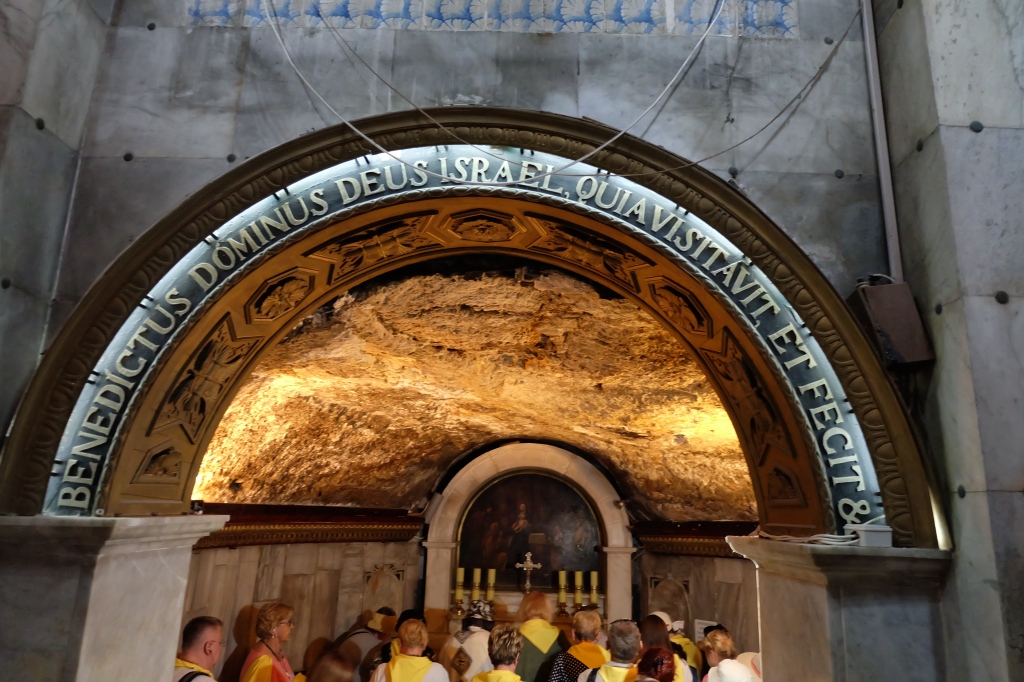
Photo by author, Church of St. John the Baptist (birthplace) also in Ein Kerem, other side of Church of Visitation, May 2019.

We Filipinos always thought prophets are “fortune-tellers” who predict the future because “prophecy” is wrongly translated as “hula”; thus, when somebody says something would happen and becomes fulfilled, it is often described as “prophetic” because “nahulaan niya”.

But a prophet is neither a fortune teller nor someone who sees the future: a prophet is first of all a spokesman of God.  The great prophets of Israel like Isaiah, Jeremiah, Daniel, Elijah even Moses all spoke for God.  It was in their task of speaking for God that they seemed like seers when everything they have spoken happened – but not because they saw the future but more because they made God’s words happened. 

Being a prophet or prophetic is making things happen not seeing what is going to happen. This is the meaning of our sharing in the prophetic ministry of Jesus as baptized Christians when in our speaking and standing for the truth of the Gospel, we make Jesus present in the world. 

Hence, in that sense, advent is actually making Christmas happen! And that is why John the Baptist is considered a prophet because in preparing the way of the Lord, he already made Jesus present in his time that he was mistaken to be the Christ.

When the time arrived for Elizabeth to have her child she gave birth to a son.  When they came on the eighth day to circumcise the child, they were going to call him Zechariah after his father, but his mother said in reply, “No.  He will be called John.”  So they made signs, asking his father what he wished him to be called.     He asked for a tablet and wrote, “John is his name,” and all were amazed.  Immediately his mouth was opened, his tongue freed, and he spoke blessing God.  All who heard these things took them to heart, saying, “What, then, will this child be?”  For surely the hand of the Lord was with him.

Luke 1:57, 59-60, 62-64, 66
Photo by author, apse of Church of St. John the Baptist also in Ein Kerem, other side of Church of Visitation, May 2019.

In our first reading, we have heard the prophet Malachi declaring the coming of the great prophet Elijah, later understood in the time of Jesus as a reference to John the Baptist, with all the functions of a precursor of the Christ. 

Malachi is the last of the prophets in the Old Testament who showed us the transition into the New Testament through John the Baptist that Luke beautifully employed in presenting Zechariah and Elizabeth as links from the Old Testament like the patriarch Abraham and Sarah as well as Elkanah and Hannah, parents of another great prophet, Samuel. 

Recall the annunciation of John’s birth that was reminiscent of the annunciation of the birth of Isaac to Abraham and Sarah while the Temple setting was very similar to the annunciation of Samuel’s birth to Elkanah and Hannah who then prayed in the Lord’s tent who was mistaken for a drunk by the chief priest of that time, Eli. 

That is the artistry of Luke who portrayed to us this Old Testament links of John the Baptist so that in some Eastern churches until now you find above their entrance doors murals of the Baptist followed by the Blessed Virgin Mary at the middle and then Jesus to show how St. John marked the end of the Old Testament leading to the New Testament that started with Mama Mary when she accepted Jesus in her womb. It is the reason Jesus himself acknowledged John the Baptist as the greatest person ever born by a woman.


Photo by author, altar of Church of St. John the Baptist in Ein Kerem, shortly before its closure for restoration, May 2019.

We today are prophets too when we link the past with the present by continuing the work of Jesus Christ, making him present in this world. We are all bridges, linking and linked with one another in Christ.

Furthermore, the naming of John in itself was very prophetic because his parents made it happened to be fulfilled as God planned it wherein Elizabeth insisted to her neighbors “John” would be his name while Zechariah who was mute at that time affirmed his wife by writing “John is his name.”

That is our mission in this world – to be a prophet who makes things happen by fulfilling God’s plans for us. As prophets, we must be open always to God’s work among us, to always listen to his words in people and events so that we make his words realized. When we become prophetic, we shall hear people say what Luke noted at the end of our gospel today, All who heard these things took them to heart, saying, “What, then, will this child be?”  For surely the hand of the Lord was with him (Lk.1:66).   


As we move closer to Christmas Day, the birth of John the Baptist reminds us of our prophetic role in this world of making that future a present reality by fulfilling God’s words and holy will in us. 

If we would just persevere in our prayer life, of immersing ourselves in prayer, the more we become sensitive not only of God’s presence but also of everyone like this very short story I recently found on my friend’s wall in Facebook shared by a certain Therese Williams Hudson last December 15, 2023. She wrote….

"I heard my mother ask the neighbors for salt. 
But we had salt at home.
I asked her why she asked the neighbors for salt.
And she replied: "Because our neighbors don't have much money
and they often ask us for something. From time to time
I also ask them for something small and economical,
so that they feel that we need them too.
That way, they will feel more comfortable
and it will be easier to keep asking us for everything they need.

And that's what I learned from my mother."
Photo by author, Fatima Avenue, Valenzuela City, 08 December 2023.

Lovely, is it not? The author added at the end of her story these words: “Let’s build empathetic, humble, supportive children​”​. Let’s join her but not just to have emphatic, humble, supportive children but most of all, prophetic ones, those with heightened sensitivity of God and of others made possible only by a deep prayer life where we can all be a “JOHN”, a graciousness of God who makes his divine plans realized. Amen.

The songs we sing, the music we dance

The Lord Is My Chef Daily Recipe for the Soul by Fr. Nicanor F. Lalog II
Friday, Misa De Gallo VII, 22 December 2023
1 Samuel 1:24-28 <*[[[[>< + ><]]]]*> Luke 1:46-56
Photo by author, RISE Tower, Our Lady of Fatima University, Valenzuela City, 13 December 2023.

As a chaplain of our university with six campuses and two medical centers, I have always emphasized to our deans and program coordinators that I strongly advocate a “one-party system” every December – just one Christmas party each day for me!

You know very well that we are really back to normal with the many parties going on since the start of December though, we are still strongly urged to take all necessary precautions for COVID is still with us. 

Next to all the food and raffles in every party, there are always the singing and dancing that make these occasions so wonderful.

But I hope that amid all these fun and celebrations, we do not forget the other side of Christmas, of those in pain and suffering this season: those who are sick or taking care of a sick loved one, those grieving at the loss of a beloved, the poor and marginalized. 

Photo by author, Fatima Avenue, Valenzuela City, 13 December 2023.

That is why I cannot stop sharing with you too the beautiful gesture of our Administrators last Monday in hosting an Appreciation Dinner last Monday for our employees in their senior years, those 60 and above still working, still teaching. I was not able to join them but have heard feelings of fulfillment, deep joy, and gratitude with a lot tears rolling in the eyes of those honored for their service, dedication and passion all these years. They all felt so special that aside from our Christmas party last December 8, there was another party hosted in their honor.

I remembered how when I was still assigned in our diocesan school in Malolos 25 years ago how we taught our students to set aside a certain amount of their budget for their Christmas party so they can host a party too for students in some selected public schools, complete with gift-giving. We wanted to instill in them the spirit of love and charity by thinking always of others during this season.

While we are singing and dancing in our Christmas party, let us not forget those who could not even go to parties because of their poverty, sickness and other limitations. See how the Blessed Virgin Mary taught us this important aspect of sharing Jesus Christ concretely during this Christmas when she visited her cousin Elizabeth.

“My soul proclaims the greatness of the Lord, my spirit rejoices in God my savior.  For he has looked upon his lowly servant.  From this day, all generations will call me blessed:  the Almighty has done great things for me, and holy is his Name.  He has mercy on those who fear him in every generation.  He has shown the strength of his arm, and has scattered the proud in their conceit.  He has cast down the mighty from their thrones and has lifted up the lowly.  He has filled the hungry with good things, and the rich he has sent away empty.  He has come to the help of servant Israel, for he has remembered his promise of mercy, the promise he made to our fathers, to Abraham and to his children forever.”

Luke 1:46-55
Photo by author, Fatima Avenue, Valenzuela City, 13 December 2023.

In a certain sense, the Visitation was like a Christmas party of the Blessed Virgin Mary and her cousin Elizabeth. There was great rejoicing in their getting together as we have reflected yesterday. 

Today we heard Mary singing her praises to God in Magnificat as a response to the praises she received from Elizabeth on her Visitation.  Notice that instead of returning Elizabeth’s gesture like most of us would do in our “mutual praise club” especially during parties, Mary praised God through her Magnificat his outpouring of love not only to her and Elizabeth but to the whole nation of Israel.  

Actually, the Magnificat was composed by St. Luke he placed on the lips of the Virgin Mary. It is a part of his artistry, of putting songs on the lips of some of his Christmas characters like Zechariah after John’s circumcision and later on Simeon at the Presentation of Jesus in the temple.

Why? Because singing, like dancing, is the highest expression of our feelings to the one we love. Mothers sing lullabies to their infants, suitors compose and sing songs to their beloved, and we Filipinos sing and dance in whatever mood we are wherever we may be! There is always music in us from the simple gesture of washing the dishes, ironing of clothes to driving and taking a shower. When we sing and dance, we show what’s inside us as well as who we are.

Photo by author, 2019.

In singing the Magnificat which St. Luke patterned after a similar song by Hannah at the birth of her son the Prophet Samuel who’s story we heard in the first reading, the Blessed Virgin Mary expressed her joy and gratitude in the nearness of God among us not only with the coming birth of her Son Jesus Christ but also through her! 

All those great things done by God to Israel as per the Magnificat – “mercy on those who fear him, showing the strength of his arm, scattering the proud in their conceit, casting down the mighty from their thrones, lifting up the lowly, filling the hungry with good things, sending the rich away empty, coming to the help of Israel, for he has remembered his promise of mercy” – happened not only in the coming of Jesus Christ but every time we share and proclaim him in words and in deeds like Mary.

The late Fr. Raymond Brown, one of the great biblical scholars of our time noted in his classic “Birth of the Messiah” that Mary as the first Christian is teaching us the essential task of every disciple of the Lord, that is, after hearing the word of God and accepting it, we must share it with others, not by simply repeating it but by interpreting it so that people can see it truly as the good news

How are we interpreting the message of Christmas this Advent so that people would realize Jesus has come?

I hope this beautiful poem from another blog I have found a long time ago could help you sing and dance like Mary the Magnificat this Christmas.

Photo by author, Fatima Avenue, Valenzuela City, 08 December 2023.
1 Corinthians 13 Christmas Style
by Sharon Jaynes
(https://sharonjaynes.com/1-corinthians-13-christmas-style/            
If I decorate my house perfectly with lovely plaid bows, 
strands of twinkling lights,
and shiny glass balls,
but do not show love to my family – I’m just another decorator.

If I slave away in the kitchen,
baking dozens of Christmas cookies,
preparing gourmet meals, and arranging
a beautifully adorned table at mealtime,
but do not show love to my family – I’m just another cook.

If I work at the soup kitchen,
carol in the nursing home,
and give all that I have to charity,
but do not show love to my family – it profits me nothing.

If I trim the spruce
with shimmering angels and crocheted snowflakes,
attend a myriad of holiday parties,
and sing in the choir’s cantata
but do not focus on Christ, I have missed the point.

Love stops the cooking to hug the child.

Love sets aside the decorating to kiss the husband.

Love is kind, though harried and tired.

Love doesn’t envy another home that has coordinated Christmas china and table linens.

Love doesn’t yell at the kids to get out of your way.

Love doesn’t give only to those who are able to give in return,
but rejoices in giving to those who can’t.

Love bears all things, believes all things, hopes all things, and endures all things.

Love never fails. Video games will break; pearl necklaces will be lost; golf clubs will rust.
But giving the gift of love will endure.

Amen. May you have and share Jesus Christ always.

Blessed are the women

The Lord Is My Chef Daily Recipe for the Soul by Fr. Nicanor F. Lalog II
Thursday, Misa de Gallo VI, 21 December 2023
Zephaniah 3:14-18 <*{{{{>< + ><}}}}*> Luke 1:39-35
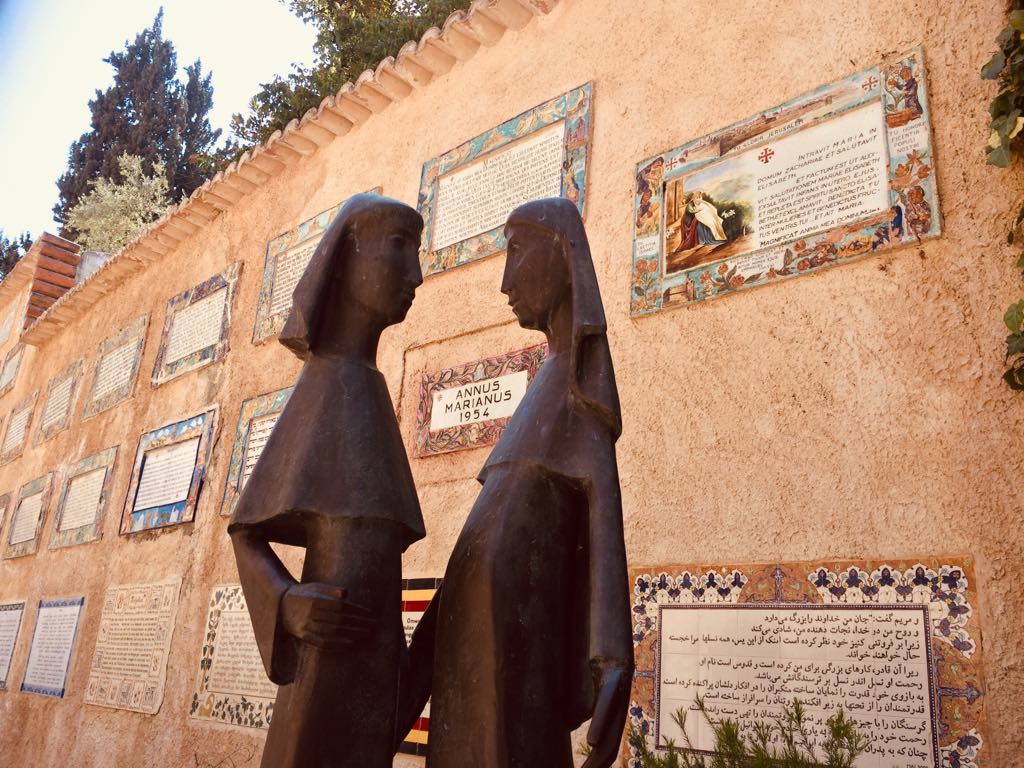
Photo by author, bronze statues of the Blessed Virgin Mary and St. Elizabeth, Church of the Visitation at Ein-Karem, Israel, April 2017.

For the third straight day since Tuesday until Saturday morning at the end of our Christmas novena, all our gospel readings will be from St. Luke, the only evangelist with the most “comprehensive coverage” of the first Christmas following his extensive research on Jesus Christ’s life and teachings (cf. Lk.1:1-4).

Hence, his gospel has the most stories and parables than the gospel accounts of Mark and Matthew. Most of all, St. Luke’s gospel account has two distinctive characteristics that showed Jesus always at prayer while at the same time gave special emphasis on women like the Blessed Virgin Mary. You must have noticed this by this time since Tuesday when we began listening to his infancy narrative.

Mary set out in those days and travelled to the hill country in haste to a town in Judah, where she entered the house of Zechariah and greeted Elizabeth.  When Elizabeth heard Mary’s greeting, the infant leaped in her womb, and Elizabeth, filled with the Holy Spirit, cried out in a loud voice and said, “Most blessed are you among women, and blessed is the fruit of your womb.”

Luke 1:39-42
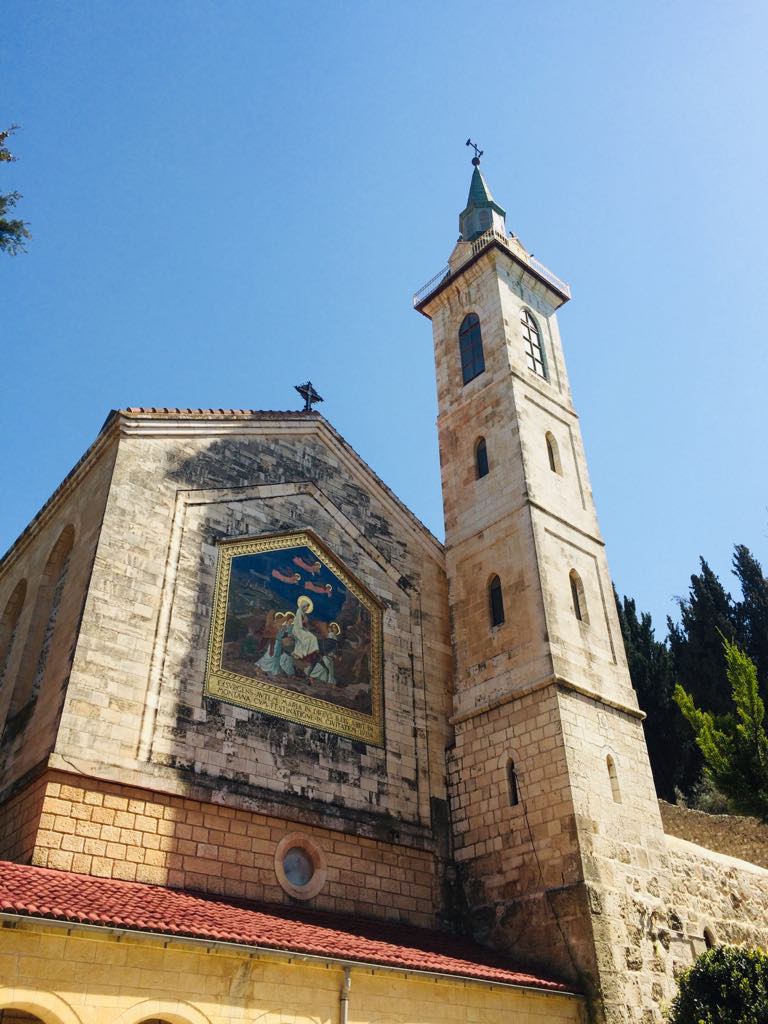
Photo by author, mural on the apse of the Church of the Visitation at Ein-Karem illustrating the Visitation (left panel) and how the angel helped St. Elizabeth hid the infant St. John the Baptist after King Herod ordered the murder of all children aged two and below.

It is rare in the Bible to find two women presented positively together in a single scene. Very often especially in the Old Testament, there is always a sort of animosity among them due to the prevailing patriarchal points of view of the time. 

The only instance two women were presented together in good terms in the Old Testament is in the Book of Ruth that still hinted some sense of superiority of Naomi over her daughter-in-law Ruth who was like her a widow but childless.

Therefore, this scene of the Visitation only St. Luke has is a gem in itself as it speaks eloquently of the important place of women in God’s plan of salvation. It beautifully portrays to us the joy of two great women filled with God and humble before him, affirming and acknowledging the two great men in their wombs about to change the course of human history: Elizabeth with John the Baptist who would prepare the way of the Savior, Jesus Christ in the womb of Mary. 

Photo by Mr. Boy Cabrido, Our Lady of Mt. Carmel, QC, Misa de Gallo, 18 December 2023.

The story of the Visitation reminds us how God works mysteriously in everyone without exceptions by linking or interconnecting us with each other in Jesus Christ our great Mediator and Savior. How lovely to see in this instance how John and Jesus already performing their mission even while in the womb of their mothers, of bringing together people. What a wonderful illustration of women as God’s vessels and carriers!

In both Mary and Elizabeth, we now “shout for joy” as Zephaniah prophesied in the first reading at how God saved us when he “removed the judgment against you, he has turned away your enemies; the Lord, your God, is in your midst, a mighty savior, who will rejoice over you with gladness, and renew you in his love… so that no one may recount your disgrace” (Zep. 3:14,15,17, 18).

Do we truly share in this shout for joy for the women of the world, for the women among us? How sad that until now women continue to suffer from all kinds of abuses not only from men but even from their fellow women. 

Some spiritual writers say God is more like a woman because whatever was lacking in man, God put it in her. Perhaps that is why it is the woman who completes every man – including with us priests! But sadly, as we speak a lot about synodality in the Church these days, it is often among us priests with whom women are often taken for granted, and worst, abused.

One problem directly related today with how we regard women is the great number of people especially the youth trapped in the insidious effects of pornography due to prevalence of social media. At its core, the problem and evil with pornography is the failure of so many to recognize the lack of respect for women who are created equal with men in the image and likeness of God. 

St. Joseph showed us the other day that true holiness is expressed in the way we respect women. According to an article by Papal Preacher Cardinal Cantallamessa I have read two decades ago where he cited a Dominican biblical scholar who’s name I could not recall, “the way we treat and regard women is a reflection of our relationship with God”.

That is very true.

When I review my life, I have found God making so many ways to lead me into the priesthood through the many women I have met and known, and many of them have remained my “bestest” friends like the three former executives of GMA-7 News Department who asked me to guide them in their Holy Land pilgrimage in Easter 2017.

Photo by author, Church of the Visitation, Ein Karem, Israel, April 2017.

It was my second Holy Land pilgrimage but my first time to visit the beautiful Church of the Visitation in Ein Karem. 

Outside that lovely church are two bronze statues of Elizabeth and Mary conversing on how God had blessed them with sons under unique circumstances:  Elizabeth was too old and barren while Mary was too young, a virgin, not yet married with Joseph. 

What a beautiful reminder of God coming to us through women!

While there at Ein Karem, I prayed for all the women I have loved and have loved me before, all the women who have blessed me and have taken care so well of my vocation to the priesthood.  I thanked God for the women like Elizabeth who have blessed me in believing that what was spoken to me by the Lord would be fulfilled in the priesthood.  Blessed are the women who like Mary have helped me see the women’s perspectives that made my priesthood more complete especially in dealing with feminine issues.  The women who taught me how to respect differences, to feel the society’s bias against them, and most especially feel their deep pains when they shared with me their ordeals of abuse and rape.

Let me end this reflection with an unforgettable anecdote at the funeral Mass for the mother of our late Bishop Jose F. Oliveros in Quezon province about ten years ago when he recalled how his mother held his right hand while still a child, and taught to make the sign of the Cross.  On her deathbed, it became his turn, as a priest and a bishop, to hold his dying mother’s hands to make the sign of the Cross. 

Hail to all women and mothers in the world who bring life into this dying world with their joy and perseverance, artistry and simplicity, warmth and presence of God almighty. May this story of the Blessed Virgin Mary’s Visitation of St. Elizabeth teach us to always respect women for they are the carriers of God to us. Amen.

At the wailing wall of Jerusalem, April 2017.

What’s inside you?

The Lord Is My Chef Daily Recipe for the Soul by Fr. Nicanor F. Lalog II
Tuesday, Misa De Gallo IV, 19 December 2023
Judges 13:2-7, 24-25 <'[[[[>< + ><]]]]'> Luke 1:5-25
Photo by Taryn Elliott on Pexels.com

Here’s another beautiful story I got from a blogger I recently followed from Spain at wordpress.com. It is actually an analogy which may sound simple but very true.

You are holding a cup of coffee when someone comes along and bumps into you or shakes your arm, making you spill your coffee everywhere. 
Why did you spill the coffee?

"Because someone bumped into me!!!"

Wrong answer. You spilled the coffee because there was coffee in your cup. Had there been tea in the cup, you would have spilled tea. Whatever is inside the cup is what will spill out.

Therefore, when life comes along and shakes you - which surely happens all the time - whatever is inside you will come out. It's easy to fake it, until you get rattled. So, we have to ask ourselves, "what's in my cup?" When life gets tough, what spills over from me? 

(see, https://pkmundo.com/2023/12/17/i-love-this-analogy/comment-page-1/#respond)
Photo by Mr. Boy Cabrido, Quiapo Church, Misa de Gallo, 17 December 2023.

My dear friends, we are now on the fourth day of our Misa de Gallo and I find that story/analogy so appropriate with our readings today. 

How interesting that Zechariah with his wife Elizabeth – according to St. Luke – prayed so hard all their lives to have a child but when God was about to fulfill it, Zechariah doubted it despite being told by an angel from God. Like in that story/analogy we presented above, Zechariah was “rattled” by the angel’s good news. “What was inside Zechariah that he doubted the good news”? 

Then Zechariah said to the angel, “How shall I know this? For I am an old man, and my wife is advanced in years.” And the angel said to him in reply, “I am Gabriel, who stand before God. I was sent to speak to you and to announce to you this good news. But now you will be speechless and unable to talk until the days these things take place, because you did not believe my words, which will be fulfilled at their proper time.”

Luke 1:18-20
Photo by author, Wailing Wall of Jerusalem, May 2017, the section of the remaining parts of the temple closest to the Holy of Holies where priests used to incense once a year.

Advent is the presence of God but sometimes when we are overburdened with so many things like anxieties and problems in life, frustrations and disappointments, sickness and death in the family, we become unaware of his divine presence even if we continue to pray and do our religious duties and devotions.  Too often we lack the conscious awareness of God in our lives that we take him for granted, considering him more as a given than a presence and a reality.

This is exactly what we told you yesterday about some of us pretending to be real disciples of Christ when in reality we are merely dreaming in a sleepwalking existence. It is a kind of spiritual immaturity due to our lack of honesty and sincerity with one’s self and with God that we remain a spiritual dwarf. Like Zechariah who happened to be a priest who must be more attuned and rooted in God, we too hardly notice God’s coming or even doubt him and his powers because we want to hold on to our comfort zone or insist our own agenda. 

God is never put off by our queries in life but what “irritates” him is when we question him, when we doubt him, when we ask about his character like Zechariah.  That is a lack of faith in God, a lack of trust, and lack of personal relationship with him unlike St. Joseph in our reflection yesterday, truly a righteous man. 

Contrast Zechariah with his wife Elizabeth who is presented by St. Luke in a better position despite her being barren. In the Bible, barrenness is a sign of lifelessness and absence of God’s blessings. Worst, it was seen as a punishment from God for one’s sins.

Yet in this opening scene of St. Luke’s infancy story beginning with the annunciation of John’s birth, we find God’s power at its fullest when we are most emptied which is exactly the imagery of Elizabeth being barren and old. She had nothing at all to be proud of unlike Zechariah who still had duties to perform as a priest. 

As we have reflected yesterday too, we burst in great rejoicing actually in those moments filled with negativities, with a lot of “no” answers of rejections and failure. That was how Elizabeth felt after being pregnant with John.

After this time, his wife Elizabeth conceived, and she went into seclusion for five months, saying, “So has the Lord done for me at a time when he has seen fit to take away my disgrace before others.”

Luke 1:24-25

Earlier, we asked what was inside Zechariah that he doubted the good news of the angel; now, we imagine what was inside the barren Elizabeth who welcomed the good news rejoicing by voluntarily going into a seclusion?

The story of the elderly couple Zechariah and Elizabeth finally being blessed by God with a child shows us God’s consistency not only in keeping his promises but most of all in working best even in our worst conditions, in the most unusual circumstances. In these two stories, one from the Old Testament and in the New Testament, we find the importance of being filled with God always.

Recall our story/analogy above. What is inside us that comes out when we are shaken? What spills over from our cup, is it joy, gratitude, and peace? Or, anger, bitterness, harsh words and reactions long festering within?

In starting his Christmas story with the annunciation of the birth of John the Baptist, St. Luke is telling us an important aspect in celebrating this blessed season – the need to fill ourselves with God. 

See how Zechariah was forced to be silent and made mute so that he could spend more time listening and rediscovering God anew in his heart, of filling himself with God. On the other hand, Elizabeth opted to go into seclusion also to contemplate God already dwelling in her though she may have never known before that is why she wanted to listen more intently to his other plans with the gift of John. Similarly like her in the first reading was the wife of Manoah who remained silent and open when a man of God told her she would bear a son to be called Samson, saying that “I did not ask him where he came from” (Jgs.3: 6). Advent invites us to simply be still to be filled by God, with God.

The other day I joined my nieces and nephew for lunch. After dropping me off at the parish, they asked for a nearby Starbuck’s because my nephew had to buy a coffee mug for his exchange gift in their class. When I asked him why he had to give a Starbuck’s mug as gift, it turned out that is now the way it is in class Christmas party – your exchange gift partner can make a wish for the gift to receive for as long as it is within the agreed budget by the class.

Anyway, our life gives us the cup or the mug. We make the decision, the choice to fill it with coffee or chocolate or tea, in the same manner we fill ourselves with joy or bitterness, anger or serenity, gratitude or complaints. Or God.

Like Zechariah in the gospel today, we could be so tired already of doing so much, of banging our heads on the wall to solve everything, to answer everything.  In this final stretch before Christmas, let us empty our cups or mugs of our selves and fill it with God who alone can truly fill us with life despite our dryness and barrenness. Amen.Have a blessed Tuesday!

Advent is waking up to God’s realities

The Lord Is My Chef Daily Recipe for the Soul by Fr. Nicanor F. Lalog II
Misa De Gallo III, Monday, 18 December 2023
Jeremiah 23:5-8 ><))))*> + <*((((>< Matthew 1:18-25
Photo by author, sunrise at the Pacific Ocean from Katmon Nature Sanctuary & Beach Resort, Infanta, Quezon, 04 March 2023.

“This is how the birth of Jesus Christ came about” (Mt. 1:18). I love this opening line of our gospel this Monday. So simple and warm, even magical that we know the whole story it is about to tell not only by heart but because it is now fulfilled. 

It evokes in us that scent of Christmas or amoy Pasko whatever that means to you. 

Basta, you know that feeling of being so safe and secured that everything in life will be fine, just like with St. Joseph after being told by an angel in his dream of the coming of Jesus Christ.

Photo by author, San Fernando, Pampanga, November 2021.

“Joseph, son of David, do not be afraid to take mary your wife into your home. For it is through the Holy Spirit that this child has been conceived in her. She will bear a son and you are to name him Jesus, because he will save his people from their sins.”

Matthew 1:20-21

Feel the solemn note of Matthew’s infancy account from the perspective of St. Joseph, the fulfillment of God’s promise that burned slowly through long years of waiting that burst into light with the birth of Jesus Christ in Bethlehem more than two thousand years ago.

Every prophecy and dream and longings were finally fulfilled because “When Joseph awoke, he did as the angel of the Lord had commanded him and took his wife into his home” (Mt. 1:24).

As we enter the final stretch of the week leading into Christmas Day when Christmas rush tries to hijack our souls from its true essence, we are invited to go deeper, to be more intense in our prayers and reflections on the meaning of Christ’s coming to us.

Are we willing to be like St. Joseph?

Very often, St. Joseph is taken so lightly because of his silence. And amusingly, his being portrayed always asleep that God communicated to him at least four times in his dreams about the birth and safety of Jesus Christ.

For anyone fast approaching the senior year of 60 like me, you would exactly know the feeling and frustration of difficulty in having a good night sleep. If my alarm clock were a human, he would have long been fired from the job because I always wake up ahead before it alarms!

Photo by author, Sacred Heart Novitiate, Novaliches, Quezon City, 20 March 2023.

First thing we find with St. Joseph sleeping soundly in the midst of a major problem – in fact, a fiasco – which invites us to examine our faith in God. 

Many times we find it hard to fall asleep not really because of our problems but with our indecisions. 

Our failure to confront and solve our problems make us sleepless. If we can be firm in our decisions due to our deep faith and love for God like St. Joseph which is the meaning of his being a righteous man, we too can sleep soundly like him. Go back to the story and you will find how quickly St. Joseph had decided to divorce Mary quietly so as not to expose her to shame. In making that decision, we find St. Joseph’s selflessness and complete trust in God: primary in his consideration was Mary, his beloved. His love for her was the expression of his love for God too.

As we age, can we start our memoir with the similar lines of Matthew, This is how the birth of Jesus Christ came about? Can we unabashedly telling everyone in all sincerity “this is how what I am today came about”? Can we wholeheartedly tell straight what really happened amid all the pains and disappointments we went through when God suddenly changed the course of our lives with his own plans? Would we have regrets or none at all like St. Joseph because he obeyed everything upon waking up?

Now, that is the more important part in Matthew’s short infancy narrative: nothing much was told after the St. Joseph awoke except that he did as the angel of the Lord had commanded him and took his wife into his home. The final sentence cemented everything with his total union with God that “He had no relations with her until she bore a son, and he named him Jesus.”

Here we are given a glimpse of the spiritual maturity and holiness of St. Joseph, his being open to God expressed in his taking of Mary as his wife that in doing so, Jesus Christ the Son of God came into the world. What a wonderful flow of events we too must have experienced in our lives when everything falls into its right places simply because we cooperated with God

According to St. John Paul II’s friend, the Orthodox Christian theologian Olivier-Maurice Clement, a lot often we pretend to be real disciples of Christ when in reality we are merely dreaming. He called it “sleepwalking existence”; my Jesuit spiritual director Fr. Danny Gozar calls it “spiritual dwarfism”. Both refer to our spiritual immaturity due to our lack of honesty with our self and with God.

Being righteous like St. Joseph is simply being holy, a spiritually matured person generous enough to confront and consider everything in one’s life with open mind and open heart to set them aside and give way to God’s greater plans. Sleepwalking existence and spiritual dwarfism happen when there are certain things we want to hold on to and pursue or keep even if we could feel it is not God’s will for us. Tendency is to fool ourselves that we delay any decisions as we claim we are not yet certain with God’s will when in fact we are simply hoping against hope God would change his mind.

Photo by author, San Fernando, Pampanga, November 2021.

The angelic annunciations to St. Joseph and to Virgin Mary may not be literal but we can be certain of one truth with God: he is most consistent in communicating his will to us even if he does not speak clearly and directly as humans or angels. Very often, the faintest voice within us that persists, the most ordinary things and events happening daily we take for granted, the simplest truths we realize and deem so little are God’s consistent communication of his will for us.

This Advent Season, let us try to wake up to life’s realities like St. Joseph in order to hear God’s voice in silence. To be silent is to be awake to life’s realities, to be able to listen and discern God from all other voices and noises. It is important that we are awake to life’s realities like St. Joseph because God’s voice may be the very words, silence, tears or smiles of those who love us most but we often take for granted. Amen.

Saying “no” leads us to rejoicing

The Lord Is My Chef Sunday Recipe for the Soul by Fr. Nicanor F. Lalog II
Third Sunday in Advent Week III-B, Gaudete Sunday, 17 December 2023
Isaiah 61:1-2, 10-11 ><}}}*> 1 Thessalonian 5:16-24 ><}}}*> John 1:6-8, 19-28
Photo by author, Gaudete Sunday 2018.

Our church is bursting with pink shades this Third Sunday of Advent known as Gaudete (Latin for rejoice) Sunday following calls from our antiphons and readings for us to rejoice in Jesus who had come more than 2000 years ago in Bethlehem.

We also rejoice on this date, the 17th of December, as we shift our focus to enter Advent’s second phase when we remember and reflect the events surrounding Christ’s birth on that first Christmas. Today is also the second day of our Simbang Gabi and without sounding a Scrooge, I wish to propose in my reflection this Sunday for us to examine those moments in the scriptures and in our lives when saying “NO” leads us too into great rejoicing.

It is normal most of the time that rejoicing comes after every big “YES” in life like when a woman finally says “YES” to her suitor or when a boss says “YES” to promote an employee. The reason mankind rejoices at Christmas is because of the Blessed Virgin Mary’s “YES” to be the Mother of Jesus Christ our Savior.

Photo by author, Gaudete Sunday 2019.

However, history and our own experiences have taught us also that the key to rejoicing is when we say “NO” or receive or do something in the negative like during the pandemic when we prayed for “negative results” whenever we would get COVID tests. A lot often in life, a negative can be positive like what we see in our gospel today:

A man named John was sent from God. He came for testimony, to testify to the light, so that all might believe through him. He was not the light, but came to testify to the light. And this is the testimony of John. When the Jews from jerusalem sent priests and Levites to him to ask him, “Who are you?” he admitted and did not deny it, but admitted, “I am not the Christ.”

John 1:6-8, 19-20

See the progression of the negatives in the fourth gospel’s Prologue: after establishing “In the beginning was the Word” who is Jesus Christ the “life” and “light” in verses 1-5, John the Baptist is introduced with the immediate declaration “He was not the light, but came to testify to the light” in verses 6 and 8. In the following questioning by the priests and Levites sent from Jerusalem, John twice told them “I am not the Christ… not Elijah”, insisting with a strong “No” if he were the Prophet in verses 21-22 before wrapping up the scene with a solemn statement that “there is one among you whom you do not recognize, the one who is coming after me, whose sandal strap I am not worthy to untie” in verses 26-27.

Photo by author, Gaudete Sunday 2019.

What a lovely scene of negatives, of nots and nos!

Recall those moments in our past filled with painful rejections and humiliating failures that we now look back with rejoicing because of the valuable lessons we have learned and made us stronger today. We realize too that the past negative moments darkened by sin and evil were not totally bad at all as these have led us into the light of Jesus Christ that we now rejoice in being forgiven and loved. When we remember those trials and difficulties we have hurdled in life, we do not feel ashamed but actually feel so proud, being sources of rejoicing for all our victories and successes today.

As we have been saying, Jesus was born during the darkest night of the year, a big negative so we can see the great positive, Christ our Savior, our Light. He is the fulfillment of that great prophecy by Isaiah in the first reading which Jesus himself proclaimed at the start of his ministry in their synagogue in Nazareth on a sabbath. 

The spirit of the Lord God is upon me, because the Lord has anointed me; he has sent me to bring glad tidings to the poor, to heal the brokenhearted, to proclaim liberty to the captives and release to the prisoners, to announce a year of favor from the Lord and a day of vindication by our God.

Isaiah 61:1-2
Photo by author, Gaudete Sunday 2019.

Luke tells us in his account how “the eyes of all in the synagogue looked intently” at Jesus who then said, “Today this scripture passage is fulfilled in your hearing” (Lk.4:20-21).

When there is fulfillment, rejoicing follows because that is when we say no to the many negatives holding and preventing us from welcoming Jesus in our lives.

When we feel poor and inadequate and try to find Christ beyond what we do not have, that is when we rejoice to find everything in him who fulfills, enriches and enables us in this life and beyond.

Rejoicing happens when we finally say no to our toxic relationships with people who break our hearts with their infidelities and say yes to Jesus who remain faithful and true to us in our family and old friends who truly loved us ever since.

True joy and rejoicing happen when we finally say no to unforgiveness of self and others, when we say no to the past sins and mistakes, baseless guilt-feelings that have held us captives for so long to find mercy and forgiveness in Jesus.

Every day is a part of the year of favor from the Lord, calling us to say no to hopelessness and despair, to say no to cynicism and indifference because Jesus always vindicates though slowly all our efforts and sacrifices, strivings and perseverance in being good and honest in a world that honors thieves and criminals.

Many times in life, rejoicing bursts when we say no to sin, when we say no to disrespect, when we say no to injustice and inequality. More rejoicings will surely come our way the moment we start saying no to violence and war, no to discrimination, no to deaths and violence, no to selfishness and vanities.

Photo by author, Gaudete Sunday 2019.

The list of the no’s we can say and affirm in Jesus Christ is endless for us to truly rejoice. But of all the great rejoicing in Christ that we need is to everyday have a firm and big NO to all our fears in loving. 

One main reason our lives are miserable because we choose not to love for fears of being hurt, of losing, of separation, of death. St. Paul asks us in the second reading to rejoice always simply by choosing to love always too.

Brothers and sisters: Rejoice always. Pray without ceasing. In all circumstances give thanks, for this is the will of God for you in Christ Jesus. Do not quench the Spirit. Test everything; retain what is good. Refrain from every kind of evil.

1 Thessalonians 5:16-19, 21-22

Recall how the great apostle Paul described to us in 1 Corinthians 13 what is love and what is to love; what he told us today in his letter to the Thessalonians are basically the same: love, love, and love. And the first expression of love of God is praying. Just like in human love, we always talk with the one we love. If we truly love, then we must keep on praying which is beng one with God who is love.

To love is simply to be good, to avoid sin and evil. True rejoicing can happen only when we love, when we shun and say NO to sin which is a refusal to love. 

Photo by author, Gaudete Sunday 2021, Basic Education Department chapel, Our Lady of Fatima University, Valenzuela City.

That is why throughout his ministry, Jesus chose to dine and be with sinners, never afraid of what others would say about him because he truly loved. His enemies could not rejoice for they chose to reject Christ’s calls for them to say no to judging others, say no to legalisms, say no to their self-righteousness and conceit. In their refusal to say no to their pride that have closed their minds and their hearts to God and others, they have chosen not to love and thereby failed to meet Jesus the Christ.

Until now, life continues to be miserable to many people because they could not accept Jesus Christ and his Cross, the very sign of his immense love for us. An essential part of the joy of this Christmas is the Cross of Good Friday looming behind that manger in Bethlehem. Before Christ, the cross used to be a big negative but with Jesus, it literally became a plus sign – a positive when he chose to suffer and die in order to rise again on Easter because he loves us so much. Like him, let us say no to sin and evil so we can rejoice in him and in love. Amen. Have a blessed final week towards Christmas Day!