Holiness is being gentle

Quiet Storm by Fr. Nicanor F. Lalog II
Holy Monday, 11 April 2022
Isaiah 42:1-7   +   John 12:1-11
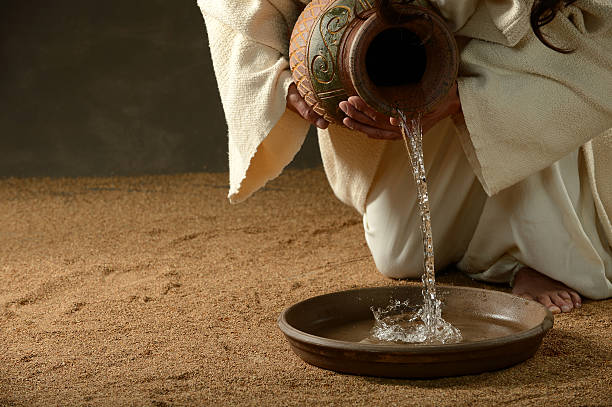
Photo from Pinterest.

A blessed Holy Monday to you and your loved ones!

Every year beginning with the Palm Sunday of the Passion of the Lord until the morning of Holy Thursday, the Church has regarded since the fourth century these days as holy and sacred in commemoration of the Lord’s Passion in Jerusalem.

These days, people frown and withdraw from any discussions about holiness, believing it is just for a selected few like saints and angels, and religious men and women like priests and nuns. For many, holiness is being sinless like God.

Not really.

The word holy came from the Greek holos meaning whole or perfect; holiness is being filled with God who fills in the gaps and broken corners in us, making us whole, a person of integrity and character. Holiness is an ongoing process, never a one-shot deal. That is why Jesus said “be perfect (or holy) as your heavenly Father is perfect (or holy).”

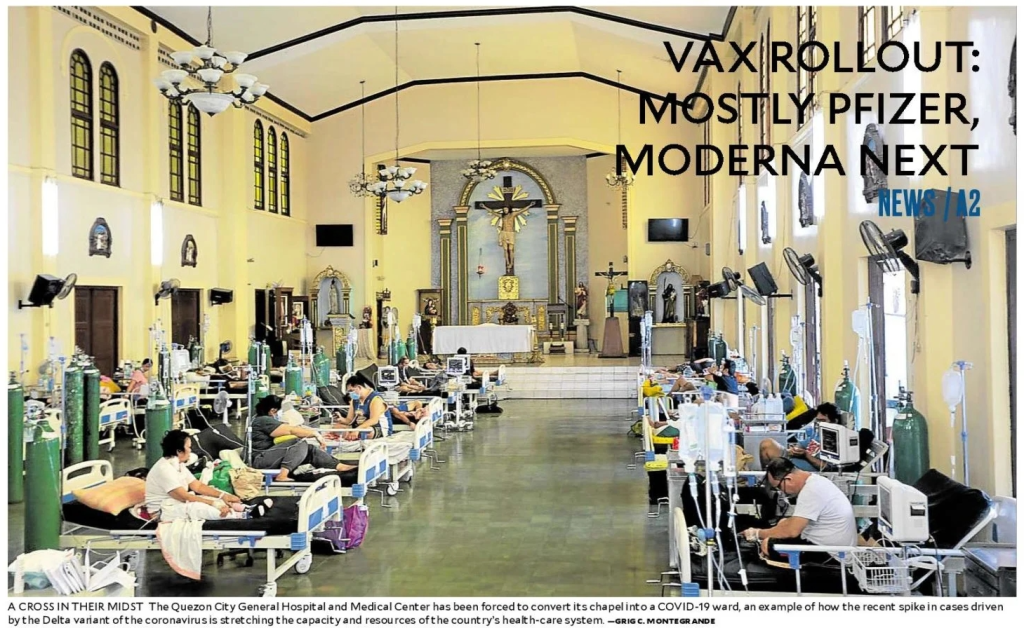
Photo by Ezra Acayan/Getty Images.

One beautiful aspect of holiness is being gentle, something that has become so rare in our highly competitive world today. Jesus described himself as being “humble and gentle of heart” in whom we can find rest for his “yoke is easy” and his “burden is light” (cf. Mt. 11:29).

Being gentle means being open to everyone, especially those burdened in life like the poor and the sick, the elderly, the orphans, the widowed, the marginalized.

Being gentle is to be welcoming or hospitable and caring of others instead of threatening and indifferent. Hospitality is from the Latin word hospis which means to welcome like hospital while hostility is from the Latin word hostes which means to hostage.

Just like Jesus who was prefigured as the Suffering Servant in today’s first reading described by God as one who “shall bring forth justice to the nations, not crying out, not shouting, not making his voice heard in the street. A bruised reed he shall not break, and a smoldering wick he shall not quench” (Is.42:1-3).

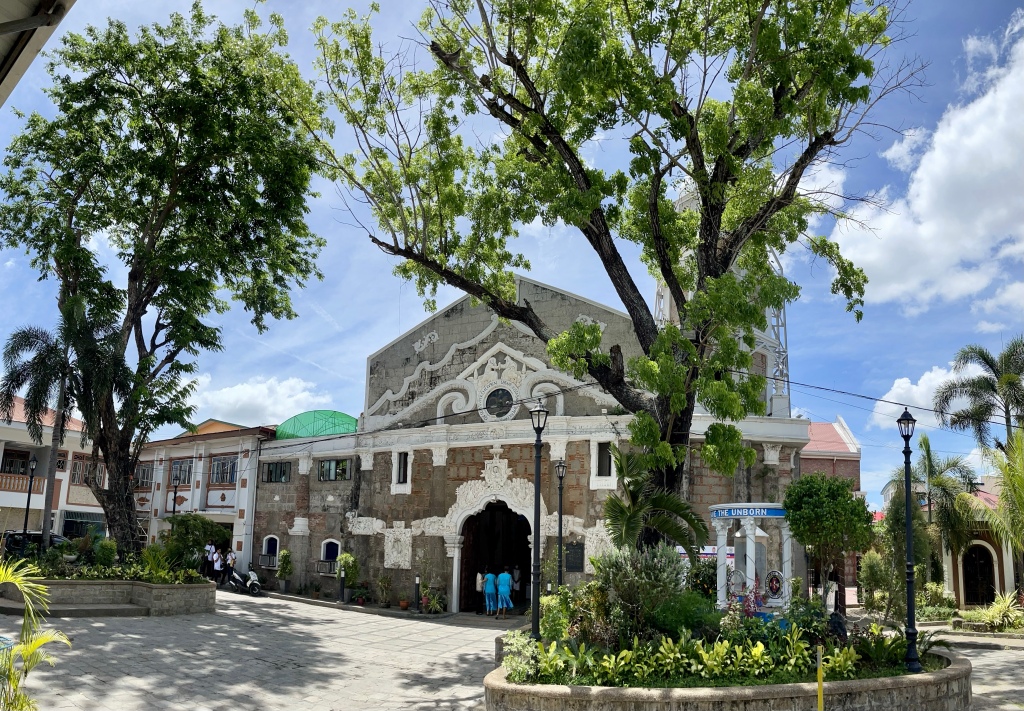
Photo by author, Sacred Heart Center for Spirituality, Novaliches, QC, 2016.

In our world where everyone has all the means to be heard and seen loudly and clearly in high definition, gentleness has become so rare, almost extinct! Lahat na lang “mema” may masabi. What is sad is how we speak and get our messages across in every media platform, from the simple text messages to the giant tarps and screaming stickers on vehicles that are always harsh and laden with insults and sarcasms.

In this world where “size always matters” while power is expressed in force and violence, gentleness is being one with the weak and the suffering, the broken ones like the “bruised reed” that the Suffering Servant “would not break or smoldering wick he shall not quench.”

Wherever there is gentleness, there is always hospitality, there is God; without gentleness, we get hostilities like war and violence.

See the attitude of Jesus in today’s gospel, how he welcomed Mary at a dinner in Bethany who anointed his feet with a liter of costly perfumed oil and later dried them with her hair that the house was filled with fragrance. Notice the hostile attitude of Judas Iscariot pretending to care for the poor when he asked “Why was this oil not sold for three hundred days’ wages and given to the poor?” (Jn.12:5).

Jesus simply told Judas to leave Mary alone with what she was doing that was a preparation for his burial soon to happen, adding, “You always have the poor with you, but you do not always have me” (Jn.12:8).

Very loaded words from the Lord, telling us to be gentle with everyone’s devotion and expression of faith and love in God while reminding us all how the poor must always be welcomed and cared for even after he had gone back to the Father.

Photo by author, Sacred Heart Center for Spirituality, Novaliches, QC, 2016.

Gentleness is more than offering a seat to an elderly or opening the door for a woman; being gentle is having that disposition to care for everyone, consciously guarding against hurting them physically and emotionally.

Gentleness is holiness because it is an act of loving others, of finding Christ in everyone because whatsoever you do to the least of his brethren, that you do unto him.

There is a beautiful saying I have found from an unknown author who said “if you have love in your heart, you have been blessed by God; if you have been loved, you have been touched by God.” So many among us could not know nor experience God because many of us refuse to be gentle with everyone; many could not understand nor imagine a loving and merciful God when everybody is hostile and violent.

This Holy Monday, let us examine ourselves, our attitude with others, if we have been welcoming, hospitable and caring. It costs us nothing to adjust ourselves, to be more gentle in words and in deeds – and looks, too! It could be your step closer to simple holiness as God fills you with himself in Christ who is humble and gentle of heart.

Lord Jesus Christ,
teach us to be gentle like you;
make us feel more our being human
and stop feeling superior with others,
always analyzing, always thinking
that in the process we have forgotten 
to feel the persons around us.
Make us gentle in our thoughts
and in our words.  Amen.
Photo by author, Baguio Cathedral, 2018.

Lent is seeing Jesus in everyone

40 Shades of Lent by Fr. Nicanor F. Lalog II
Monday in the First Week of Lent, 07 March 2022
Leviticus 19:1-2, 11-18  <*(((>< + ><)))*>  Matthew 25:31-46
Photo by author, the Holy Land, 2019.
On this blessed Monday,
I join dear God our Father
the psalmist in proclaiming
“Your words, Lord, are Spirit and Life” 
for it summarizes the two long
readings for today:  your instruction
to Moses telling us to “be holy, for I, 
the Lord your God, am holy (Lev.19:2)” 
and Jesus reminding us that
“whatever you did/did not do 
for one of these least brothers of mine, 
you did/did not do for me (Mt.25:40,45).”  
Beginning this Lent as we slowly
begin to go back to some semblance 
of normalcy in our lives, help us 
recover our lost identity of being
your beloved children, of being 
the dwelling-place of your Holy Spirit
who animates us to do what is good,
avoid what is evil, always seeing Jesus
Christ in everyone, especially those
silently suffering among us like the poor
and the sick.
Help us, Lord Jesus, to learn again 
that it is our nature to share and 
give life in you who is our Life; 
how wonderful it would be that on
judgment day, we shall all be surprised, 
asking “when were you Lord hungry 
we gave you something to eat, 
when were you Lord…?” in doing good
to everyone who turns out to be your
very presence!
The blessed ones, the holy ones 
like the saints are never bothered 
to think of anything else upon seeing 
the poor and suffering except to love 
and practice charity like St. Francis 
of Assisi who taught his disciples 
to preach always Jesus Christ, 
speaking only when necessary.  
Make us holy, like you,
O God, who is our life
present in everyone 
we meet.  Amen.

Taking Jesus to the heart

The Lord Is My Chef Sunday Recipe for the Soul by Fr. Nicanor F. Lalog II
Sunday Week VIII-C in Ordinary Time, 27 February 2022
Sirach 27:4-7 ><}}}}*> 1 Corinthians 15:54-58 ><}}}}*> Luke 6:39-45
Photo by author, 2016.

We enter the Season of Lent this week with Ash Wednesday as the Ordinary Time takes on a long break until June; hence, our gospel this Sunday is a fitting cap to the teachings of Jesus these past three weeks about discipleship.

After expounding on the need to love like God full of mercy even to enemies, Jesus now speaks in parables citing ordinary experiences in life to underscore “wholeness” in one’s self that is rooted in one’s heart where speech and being go together.

True discipleship in Christ is taking into heart his words by putting them into practice – of walking the talk – to bear fruits in our lives of holiness.

Jesus told his disciples a parable: “Can a blind person guide a blind person? Will not both fall into a pit? A good person out of the store of goodness in his heart produces good, but an evil person out of a store of evil produces evil; for from the fullness of the heart the mouth speaks.”

Luke 6:39, 45
Photo from news.abs-cbn.com, 2020.

Our heart, our center of being

People often make various gestures of the heart to convey the message of love especially when posing for pictures. But of all these gestures, nothing beats those two hands shaped like ears and put together to look like a heart.

It is the best sign of the heart, of two ear lobes joined together because a loving heart is one that listens, never judges just like what Jesus taught us last Sunday.

Most of all, one’s heart is always known by its words and actions wherein the actions speak louder than words! In this symbolism, we find the inner dynamics of speech and being perfectly together.

See in the three parables of Jesus in today’s continuation of his sermon on the plains, we find this primacy of listening to his words and putting them into practice: guides cannot guide others unless they have clear eyesight; the hypocrisy of seeing other’s faults unmindful of one’s own faults; and, how every tree is known by its fruit.

Jesus is calling us today to an “education of the heart” so that we may have open ears, open hearts, open minds, and open arms to be truly his disciples!

It is with the heart that one must listen to the Word to produce good and plentiful fruit, it is in the heart where every disciple of the Lord must meditate and treasure his Word like his Blessed Mother Mary “who kept all these things, reflecting on them in her heart” (Lk.2:19).

When the heart is cleansed of its impurities, it opens to God and to others, gets filled with the Holy Spirit to become like the Father who is merciful and loving as revealed by Jesus Christ.

Recall how in Genesis God created everything by simply speaking because his speech and being are one. In the prologue of the fourth gospel, we find how the Logos – the Word who is Jesus Christ became flesh to save us and make us experience God himself which he fully expressed while proclaiming the Book of Isaiah in the synagogue at Nazareth while launching his ministry (Third Sunday, 23 January 2022).

This Sunday we find everything coming to full circle, showing us the whole picture of Jesus and his mission, of his plans for us to be like the Father.

And here lies our problem so often when our words betray our true character, when our speech and being do not match, when what we say is far from what we live.

Image from Google.

Our sharing in the power of God to love

Of all that God has created, only humans were gifted with the ability to communicate intelligibly. Unlike the animals and other creatures, only us humans can speak to express what we feel, what we know, what we want.

Our ability to communicate is in fact a sharing in the power of God, a power to serve in love like Jesus, not power to dominate or lord it over upon others as the world sees and uses it.

This is why Ben Sirach reminds us in the first reading to hold our praises of any person, especially the eloquent speakers because words are empty unless supported by actions. One’s real worth is found in times of trials and tests like “what the potter molds in the furnace” (Sir. 27:5).

It is Jesus Christ himself, his very words who purify us his disciples to be able to preach his good news of salvation to others in words and in deeds without any duplicity and hypocrisy.

Photo by Ms. Jo Villafuerte, 21 February 2022.

The Lord is not asking us to stop criticizing nor be silent in the midst of so many injustices and evil around us. That remains an integral part of preaching the good news, of standing for what is true and just; however, Jesus is demanding us his disciples to always examine our very selves to see the kind of deeds that arise from our hearts.

Our actions, our very lives reveal the purity of our hearts, of our intentions and of our sentiments.

This is the reason why we priests and bishops are always doubted and even questioned by so many faithful whenever we denounce the many ills in the society, when we speak against social injustices, against corruption in government because our lives do not match our words. The worst and most painful part of it is when people see our “double-standard” with priests who lead lives so far from the Good Shepherd, that instead of taking care of the flock, there are some of us who take advantage of the poor sheep entrusted to us!

Today’s gospel challenges us, especially us your priests, if we lead a truly Christian life with preferential options for the poor?

Let us not be contented with outside appearances only, especially this coming Lenten Season. Take Jesus and his words into our hearts.

Discipleship is not about frequenting the church, reciting all the prayers, observing all the rites and rituals and devotions nor just denouncing the wrongs in the society nor fund-raising for so many projects for the benefit of the poor.

Discipleship is bringing to fruition all our prayers and faith expressions to loving service for one another. If not, we might just stay home so as to minimize the damages and hurts to the Body of Christ.

Let us continue to strive in purifying our hearts with the Word so that we may bear much fruits of good works in our lives, to “be firm, steadfast, always fully devoted to the work of the Lord, knowing that in the Lord your labor is not in vain” (1 Cor. 15:58). Amen.

Have a blessed week ahead!

Photo by Ms. Jo Villafuerte, 21 February 2022.

Each of us an “Emmanuel” too!

The Lord Is My Chef Simbang Gabi Recipe by Fr. Nicanor F. Lalog II
Saturday, Day 3, 18 December 2021
Jeremiah 23:5-8   ><}}}*> + <*{{{><   Matthew 1:18-25
Photo by author, Baguio Cathedral, January 2018.

We have just concluded the “Year of St. Joseph” last December 8 but it seems due to the pandemic, we have not celebrated truly enough to realize the virtues and person of the most silent character in the New Testament, St. Joseph.

We find no story in the gospels with St. Joseph either speaking or conversing with anyone at all. At least the Blessed Virgin Mary conversed with the angel during the Annunciation and spoke to Jesus her Son upon finding him at the Temple and at the wedding feast at Cana. St. Joseph was totally silent and most of all, could sleep soundly despite the tremendous stress he must have gone through! Truly a man of great faith and trust in God!

This is how the birth of Jesus Christ came about. When his mother Mary was betrothed to Joseph, but before they lived together, she was found with child through the Holy Spirit. Joseph her husband, since he was a righteous man, yet unwilling to expose her to shame, decided to divorce her quietly. Such was his intention when, behold, the angel of the Lord appeared to him in a dream and said, “Joseph, son of David, do not be afraid to take Mary your wife into your home. For it is through the Holy Spirit that this child has been conceived in her.”

Matthew 1:18-20
Photo from vaticannews.va, December 2020.

Notice how Matthew presented the climax of his genealogy not only with the coming of Jesus Christ at the end but also in his lineage to St. Joseph he described as “a righteous man” and addressed by the angel in a dream as “son of David”.

In him we find that expression “silent water runs deep” so very true. Imagine the maturity and deep spirituality of St. Joseph being called as a righteous man or a holy man which for the Jews is one who obeys the Laws of Israel.

But in this scene of the Annunciation of Christ’s birth to him in a dream, Matthew goes deeper into what is to be holy as more than obeying the the Laws but most of all, abiding by the will of God always as described in many instances in the Old Testament like the Book of Psalms. If holiness were simply an adherence to the Laws, St. Joseph would have not decided to silently leave Mary found pregnant with a child not his; in their laws, she would have been shamed in public which St. Joseph avoided in trying to leave her silently. For him, higher than the letters of the law was the welfare and well-being of Mary and her Child that until then he did not know was the Christ.

At the same time, here we find the deep spirituality of St. Joseph: compared with Mary to whom the angel appeared and spoke in person while with St. Joseph, the angel appeared only in a dream. He had a more difficult situation discerning whether his dream was real or not, which we all experience upon waking up from a dream so real!

Only a man with deep spirituality, so attuned with God like St. Joseph could perceive the divine in fact while at the same time discern it as very true the will of God that “When Joseph awoke, he did as the angel of the Lord had commanded him and took his wife into his home. He had no relations with her until she bore a son, and he named him Jesus” (Mt.1:24-25).

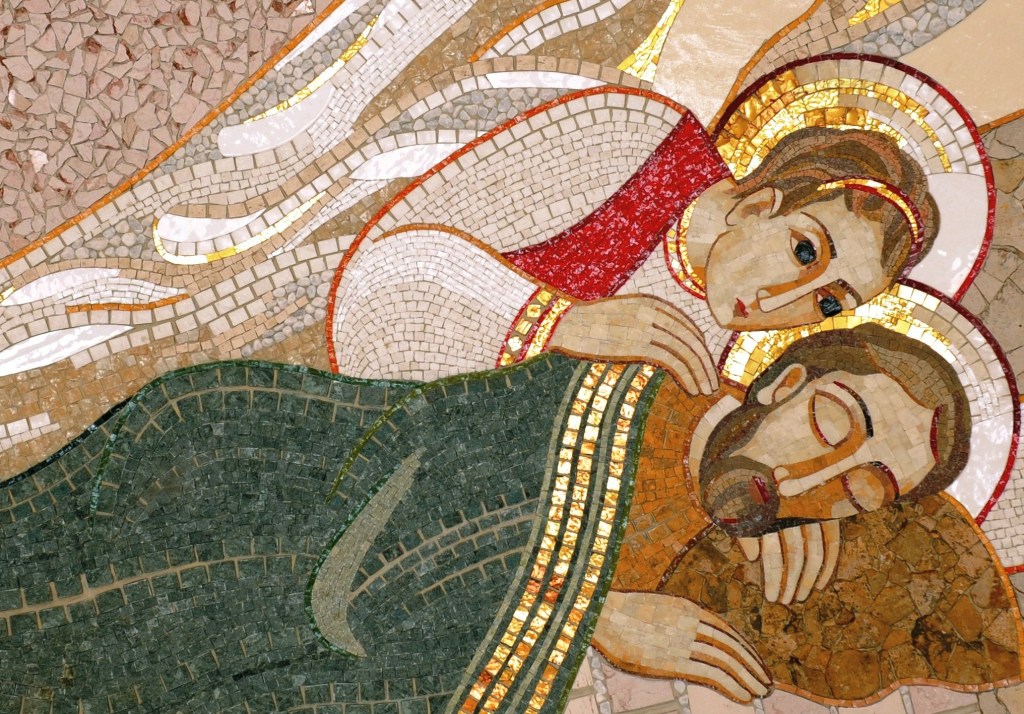
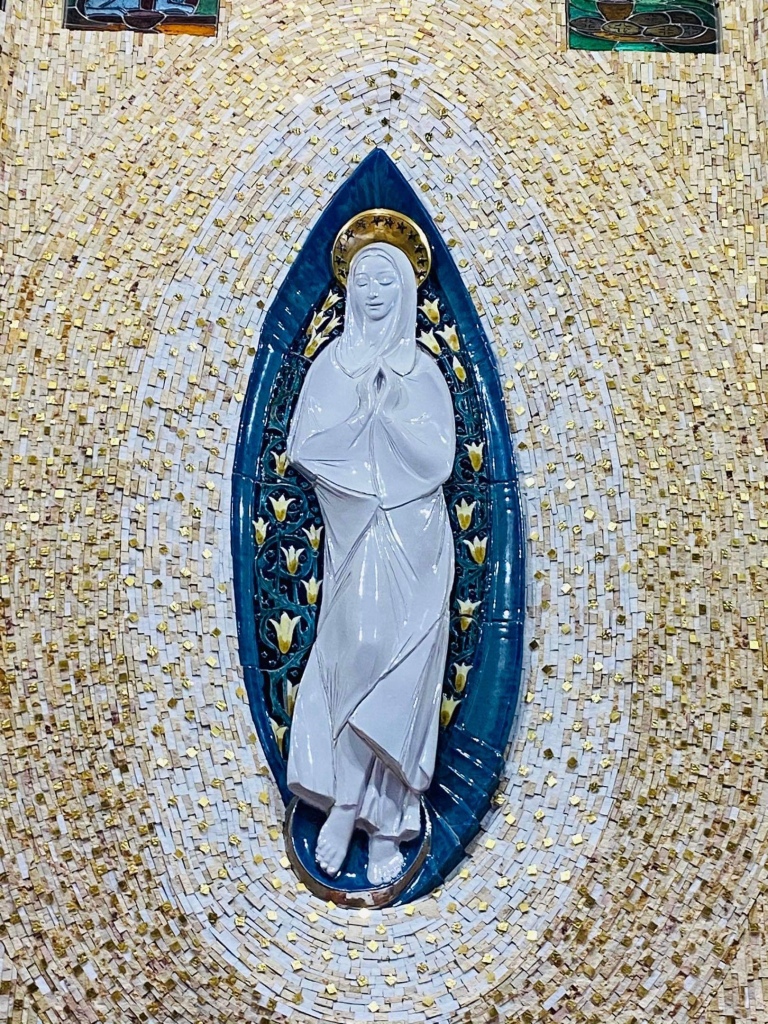
Photo by Arch. Philip Santiago, mosaic of the Annunciation to Joseph at the Shrine of St. Padre Pio in San Giovanni di Rotondo, Italy, 2017.

In a very concise manner – like our very silent saint and foster father of Jesus – Matthew presents to us in this short story of the Annunciation of the Birth of Jesus to St. Joseph all the critical and essential elements about the mystery of the Incarnation.

As we have reflected yesterday at the genealogy, Matthew now goes deeper into the humanity and divinity of Jesus Christ as the fulfillment of the Old Testament promises of God. This he beautifully presented also through the person of St. Joseph, a reminder of the need for us to be vessels of God’s graces and instruments of God’s works.

St. Joseph showed in this brief scene the true meaning of holiness, of being whole by seeking to find ways to bring into unity their laws and love and persons, something which Jesus Christ would keep on elaborating in his entire ministry, like his favorite expression “Sabbath was created for man, not man for sabbath.”

See how he tried to give more importance to Mary whom he loved so much that he was intent in not putting her to shame and harm. And upon listening and discerning the angel’s message to him in a dream, he obeyed everything, showing us the unity of the laws in love long before Jesus came to show it on the Cross himself. In accepting God and Jesus, St. Joseph had to take Mary; and in taking Mary, Jesus came into the world.

Here we are challenged by the example of St. Joseph that we too become an Emmanuel in the sense that in our lives, we become the sign that God-is-with-us specially in this time of the pandemic and with coming elections next year. We need to pray more deeply and be attuned with God for his divine will that always takes unexpected turns, so different from our own ways and methods.

Photo by author, 15 December 2021.

To be an Emmanuel like Jesus and St. Joseph, one has to be definitely pro-life, one who values life and every person, regardless of his/her status in life.

Like St. Joseph, let us learn to be silent for God and be louder with our actions, always choosing and standing for life and for every person’s dignity.

Like St. Joseph, he chose from the very start the value of Mary as a person which is the hallmark of Jesus as Emmanuel, the God who became human to be with us because it is good to be human. Amen.

Mary, advocate of grace and model of holiness

The Lord Is My Chef Daily Recipe for the Soul by Fr. Nicanor F. Lalog II
Wednesday, Solemnity of the Immaculate Conception, 08 December 2021
Genesis 3:9-15, 20 ><}}}*> Ephesians 1:3-6, 11-12 ><}}}*> Luke 1:26-38
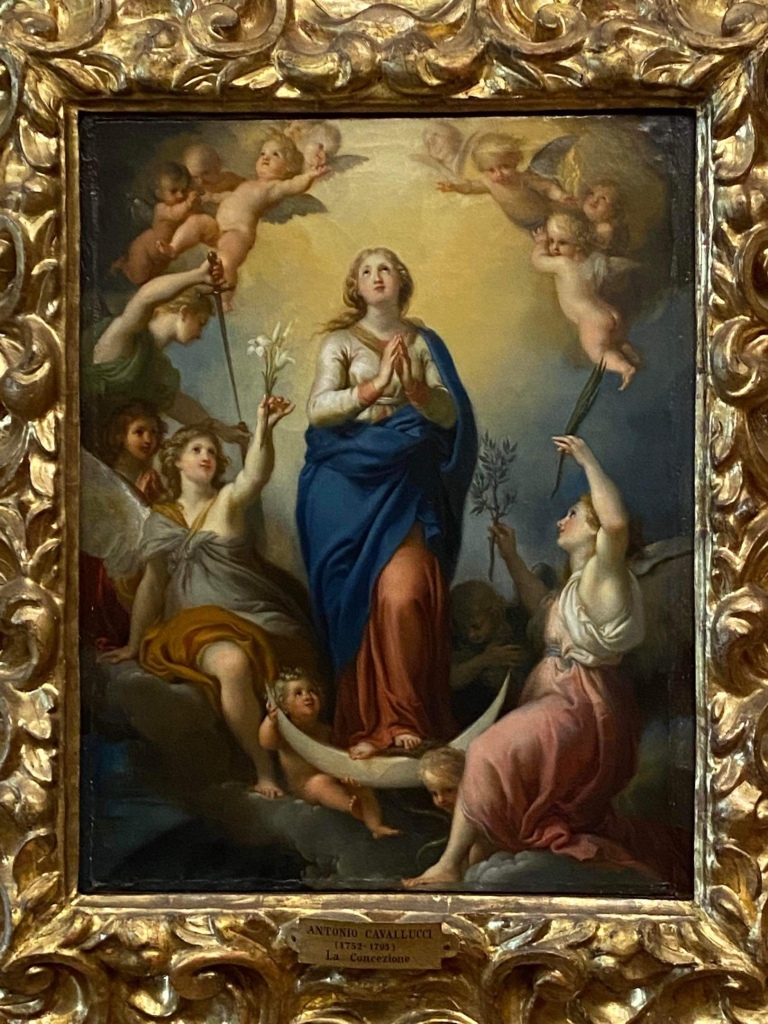
Photo by Rev. Fr. Gerry Pascual at Palazzo Borromeo, Isola Bella, Stresa, Italia, 2019.

Recently I saw on a Facebook post the photo of American model Kendall Jenner in a swimsuit showing what for many is the “perfect body” in a woman. The photo had reportedly gone viral last year.

What caught my attention was the other photo posted opposite Jenner: that of 19-year-old Alyssa Carson who became the youngest female in history to pass all NASA aerospace tests to train as astronaut for future travel to Mars! The caption said it so well, lamenting the fact how the world gives so much attention to “fashion models” with many going insane imitating their bodies forgetting the more essential like inner beauty and intelligence.

More sad is how we have fixed our human understanding and analogies of a “model” as someone who poses and remains still to be painted or photographed for glossy magazines and giant billboards that people are willing to buy or pay for just to view and let their senses feast on.

It may sound funny but those two photos accompanied me while praying and preparing for our celebration today of the Solemnity of the Immaculate Conception. Sorry, I am not going to show you the link to those photos but wha I want to share with you are the two beautiful expressions depicting Mary as “advocate of grace” and “model of holiness” found in the Preface of today’s Mass (that is the prayer before the Holy, Holy leading to the consecration): “She, the most pure Virgin, was to bring forth a Son, the innocent lamb who would wipe away our offenses; you placed her above all others to be for your people an advocate of grace and a model of holiness.”

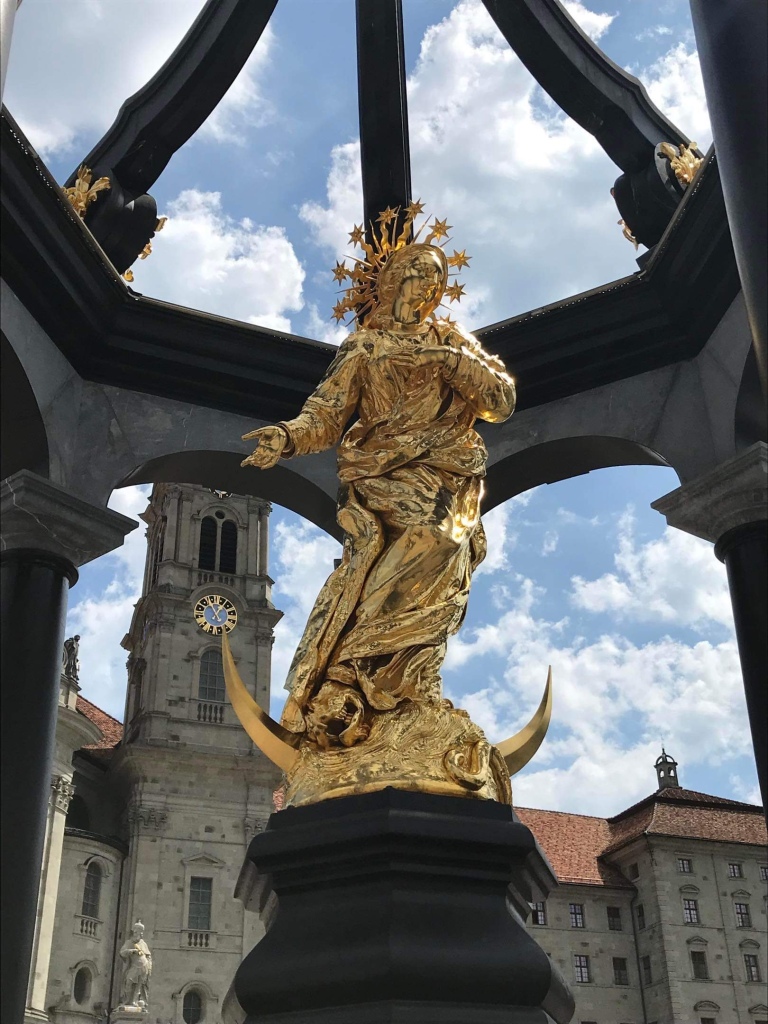
Photo by Fr. Gerry Pascual at Einsiedeln Abbey, Einsiedeln, Switzerland, 2019.

So often with Marian feasts, many people complain and find it hard to relate with the Blessed Virgin because they find them as celebrations of the privileges of Mary who was so blessed and unique, thinking she’s almost a god, not human anymore whom we cannot imitate and emulate.

That is totally untrue and baseless!

Of course, only she has the distinction of being immaculately conceived, one never stained by sin but, aside from that, Mary is like all of us, so human; and we too can be like her, full of grace and holy!

Brothers and sisters: Blessed be the God and Father of our Lord Jesus Christ, who has blessed us in Christ with every spiritual blessing in the heavens, as he chose us in him, before the foundation of the world, to be holy and without blemish before him. In love he destined us for adoption to himself through Jesus Christ, in accord with the favor of his will.

Ephesians 1:3-5

Very clear in this reflection by St. Paul in our second reading that our truest destiny is to be holy and without blemish – that is, immaculate. It is the plan of God since the beginning that we all become his people until sin came and destroyed momentarily that divine plan as we have heard in the first reading.

With the coming of Jesus through his sacrifice on the Cross, we were redeemed from sin to become God’s holy people which the same Preface mentions Mary as the “beginning of the Church”. The same prayer reiterates to us our universal calling from God which is to be holy and blameless before God through Jesus Christ. It is very doable and attainable “for nothing is impossible for God” as the Archangel Gabriel told Mary during the Annunciation (Lk.1:37). And Mary is our proof to that!

Photo by Rev. Fr. Gerry Pascual at Santuario di Greccio, Rieti, Italy in 2019.

While it is very true that nothing is impossible for God, today’s celebration of the Immaculate Conception reminds of how God “needs” us to cooperate and participate in his beautiful plans for us like Mary to be his instrument or seedbed for his Divine Word to receive and grow and bloom.

That is the meaning of Mary as “advocate of grace” who became the vessel in the coming of Jesus Christ. See how St. Luke was very clear in narrating Mary’s “supporting” role and place in the plan of God: she remains a human being – not God – like us except she was full of grace, that is, immaculately conceived.

Behold, you will conceive in your womb and bear a son, and you shall name him Jesus. He will be great and will be called Son of the Most High, and the Lord God will give him the throne of David his father, and he will rule over the house of Jacob forever, and of his kingdom there will be no end… The Holy Spirit will come upon you, and the power of the Most High will overshadow you. Therefore the child to be born will be called holy, the Son of God.”

Luke 1:31-33, 35

The Church Fathers used to call Mary as the “aquaeductus ecclesiae” or neck of the Church connecting Jesus the caput or head and us the corpus or body. Mary as an advocate of grace is that vessel of all blessings we now have in Jesus Christ because of her obedience and participation in that plan of God of sending Jesus.

Keep in mind that as advocate of grace, Mary brings us all to Jesus as the one Mediator, not away from him. True devotees of Mary bring others to Jesus not away from him for he alone is the Mediator. A true and authentic devotion to Mary always result in deeper knowledge and intimacy with Jesus and his gospel. Notice this in her apparitions especially at Fatima in 1911 where her messages call us to get closer to Jesus, not her.

Mary continues as our advocate of grace telling us the very same words she had told the servers at Cana to “do whatever he tells you” (Jn.2:5).

Do we do the same? Or, mislead others into putting Mary at par or even above Jesus her Son and Lord? In this time of pandemic, are we like Mary as an advocate of grace, a vessel and instrument of blessings to others or do we grab every credit of “charity” and “kindness”, grandstanding for more media mileage of “likes” and “followers” to be viral and trending?

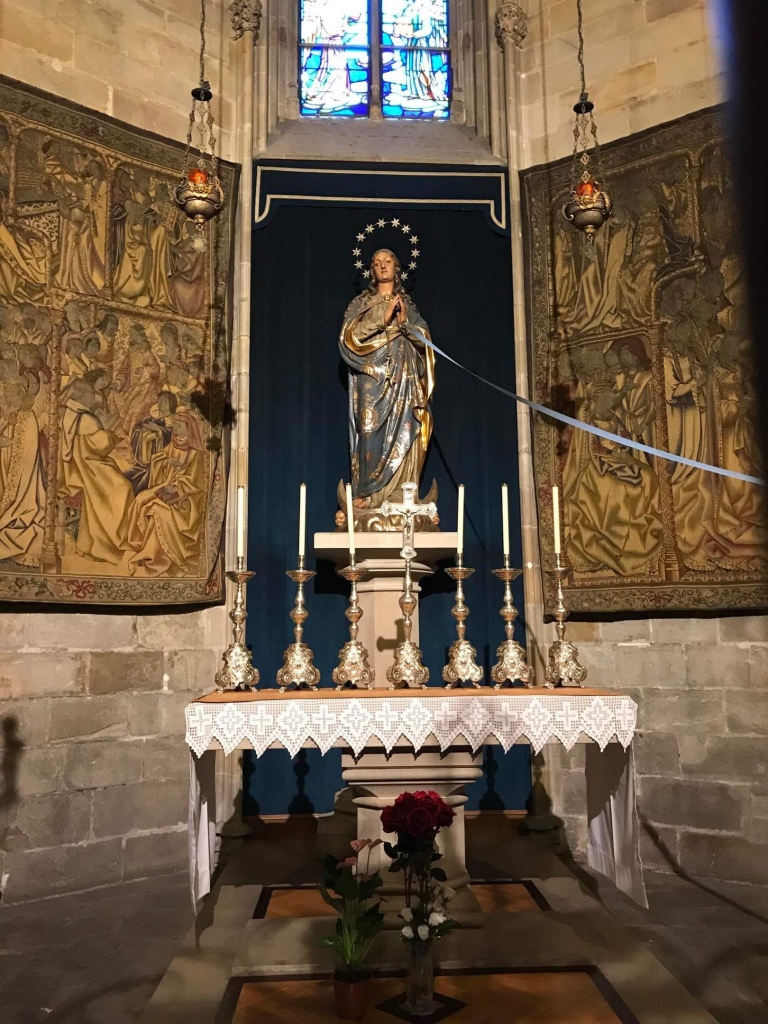
Photo by Fr. Gerry Pascual at the Cathedral of Barcelona, Spain in 2019.

From her being an “advocate of grace”, Mary thus becomes our “model of holiness” too as she reminds us of God’s original plan for us, created in his image and likeness destroyed by sin with the fall of Adam and Eve. See how God immediately promised salvation through the woman fulfilled in Mary as he reprimanded the serpent in tempting Eve:

“I will put enmity between you and the woman, and between your offspring and hers; He will strike you at your head, while you strike at his heel.”

Genesis 3:15

Because of her being the advocate of grace of God by giving birth to Jesus, Mary stands before us as the perfect reminder of Christ’s work of purification and recovery of the image of God in us. Described as the “perfect disciple” and “doer of the Word”, Mary had shown us in her very life which continues to this day in her intercessions and apparitions how discipleship is a life-long process and commitment of holiness. From giving birth to Jesus to his dying on the Cross until his burial, Mary had always been with Jesus that on Easter, it was to her that the Risen Lord first appeared because she was the first to believe totally in him.

At the Pentecost, Mary was with the Apostles awaiting the coming of the Holy Spirit that became the coming out party of the Church. In her life, Mary is the model of holiness because she keeps on working with us and in us, guiding us in following Jesus our Lord and Master so that we might be “conformed to his image” (Rom. 8:29).

Photo by author, Christmas 2020.

Holiness is not being sinless but being filled with God who is all-holy, being like Jesus Christ. Mary showed us the way to holiness is being humble before God, seeing herself as the “handmaid” or servant of the Lord.

If there is one thing the world needs now so badly in this time of the pandemic, it is holiness. Before the pandemic came, mankind was so filled with self, so arrogant and proud acting like god, manipulating everything.

How ironic that a microscopic virus with the simplest signs similar to the common colds made the world stood still for some time, reminding us that there is a God all-powerful who is in control of everything.

Through Mary, may this Solemnity of her Immaculate Conception lead us back to God to recover in us his image and likeness, cleansed and purified of our blemishes and wrinkles of sin by having an enlightened devotion to her, the servant of the Lord par excellence. Amen.

A blessed day to everyone!

Fluidity in life

The Lord Is My Chef Daily Recipe for the Soul by Fr. Nicanor F. Lalog II
Thursday, Memorial of St. Martin of Tours, Bishop, 11 November 2021
Wisdom 7:22-8:1   ><]]]]'> + <'[[[[><   Luke 17:20-25
Photo by author, La Union, 2018.
Today O God I am so struck
by your words from the first reading:
"For Wisdom is mobile beyond all
motion, and she penetrates and 
pervades all things by reason of 
her purity.  For she is an aura of 
the might of God and a pure effusion
of the glory of the Almighty; 
therefore, nought that is sullied
enters into her... Indeed, she reaches
from end to end mightily and
governs all things well" 
(Wisdom 7:24-25, 8:1).
What a beautiful description
of Wisdom, of you, dear God!
Someone so fluid, so natural 
like water:  everything flowing
naturally in order - so subtle yet
powerful, hidden but evident and 
felt that so often for those with 
closed minds and closed hearts,
you seem to be so far, even 
unrecognizable.

Asked by the Pharisees when the Kingdom of God would come, Jesus said in reply, “The coming of the Kingdom of God cannot be observed, and no one will announce, ‘Look, here it is,’ or, ‘There it is’. For behold, the Kingdom of God is among you.”

Luke 17:20-21
Teach me to be fluid, Jesus,
like St. Martin of Tours who
naturally cut his tunic into two
to share it with a poor beggar
one cold evening; his kindness was
instinctively filled with Wisdom, fluidly
finding you among the least of our
brethren; may we have the same grace
of  St. Martin to find you among the needy
and most specially to look up to heaven
for our soul's journey back to you.
Amen.
St. Martin of Tours, Patron of my hometown Bocaue, Bulacan; photo from the Parish Commission on Social Communication.

Slave of sin vs. slave of grace

The Lord Is My Chef Daily Recipe for the Soul by Fr. Nicanor F. Lalog II
Wednesday, Week XXIX, Year I in Ordinary Time, 20 October 2021
Romans 6:12-18   ><]]]]'> + ><]]]]'> + ><]]]]'>   Luke 12:39-48
Photo by Ms. Nikki A. Vergara, 2020 in Victoria, Laguna.
We are all slaves, 
born as your servants
O God our Lord and Master;
how sad that the more we refuse
to accept this reality, the more
we are enslaved to sin;
the more we assert our freedom
and decide to choose whatever
we want, the more we become unfree.

Do you not know that if you present yourselves to someone as obedient slaves, you are slaves of the one you obey, either of sin, which leads to death, or of obedience, which leads to righteousness? But thanks be to God that, although you were once slaves of sin, you have become obedient from the heart to the patterns of teaching to which you were entrusted. Freed from sin, you have become slaves of righteousness.

Romans 6:16-18
Jesus our Lord and Savior,
let us realize this truth applies to us all;
that although you have saved and
justified us with your offering on the Cross
that continues in our Sacraments like
Baptism and the Eucharist that have
brought us closest to you and the Father,
it is not something like a "magic"
that fixes everything, that automatically
brings us to heaven.
Let us be faithful and prudent stewards,
slaves of grace in you like in today's gospel
who faithfully await your return
with good works and deeds.
Let us keep in our minds and hearts that
the more we profess our faith in you, dear Jesus,
as your servants, the more we have to participate
in your grace to produce fruits of
the Holy Spirit in our lives.  Amen.

Remembering our call

The Lord Is My Chef Daily Recipe for the Soul by Fr. Nicanor F. Lalog II
Monday, Week XXVIII, Year I in Ordinary Time, 11 October 2021
Romans 1:1-7   ><]]]]*> + ><]]]]*> + ><]]]]*>   Luke 11:29-32
Photo by author, 2019.
Praise and glory to you,
O God our loving Father
who has called us through
Jesus Christ your Son 
to be your servants.
As we begin this brand new
week of work and school, 
let us be reminded
of this great honor from you
that we have taken for granted,
even forgotten and disregarded.
May we learn from St. Paul
to take pride in this calling
to be your servant.

Paul, a slave of Christ Jesus, called to be an Apostle and set apart for the Gospel of God… among whom are you also, who are called to belong to Jesus Christ; to all the beloved of God in Rome, called to be holy. Grace and peace from God our Father and the Lord Jesus Christ.

Romans 1:1, 6-7
In Baptism, we have been called
to be your servant and apostle,
most of all called to be holy
like you, God our Father;
help us recapture the beauty
and honor of this call from you;
enable us to activate this call in us
set apart as a people for a very special
mission especially in this time of the
pandemic.
Most of all, let us remember today
your call for us to witness to Jesus Christ
and his Gospel of salvation through the
particular circumstances of our lives
lest that day of judgment catch us by
surprise immersed in sin and evil,
forgetting the sign of Jonah 
and Nineveh (Lk.11:29-32).
Amen.

On the path of holiness with Mary

The Lord Is My Chef Daily Recipe for the Soul by Fr. Nicanor F. Lalog II
Thursday, Memorial of Our Lady of the Rosary, 07 October 2021
Malachi 3:13-20   <*(((><  +  ><)))*>   Luke 11:5-13
Photo by author, December 2020.
Glory and thanksgiving
to you God our loving Father
in fulfilling to us your promise
to the Prophet Malachi in
sending us Jesus Christ, our Light
of healing and wholeness born 
by the Blessed Virgin Mary.

But for you who fear my name, there will arise the sun of justice with its healing rays.

Malachi 3:20
But, still, times and people have
not truly changed that much since the time
of Malachi as many of us are easily tempted
to seek the easier way to the good life
through evil and sins; many of us choose
to simply pay lip service to calls of faith,
going through external religious observances,
and worst of all, still refuse to pray and 
reach out to be one with you, O God. 
Teach us to rediscover prayer through 
the beauty and efficacy of the Holy Rosary 
of the Blessed Virgin Mary that has guided
nations and history for almost 2000 years,
enabling us to contemplate the face of Jesus
your Son through Mary his Mother.

Yes, it is a Marian prayer method but
strongly Christ-centered because it is
Mary who truly knows Jesus so well
that through her Holy Rosary, we are able
to enter into the Lord's very life expressed
in its Mysteries that hopefully help us to
become like him through Mary. 
Most of all, open our eyes
to the wonder and joy of praying,
of coming to you, loving Father,
that is pure grace from the Holy Spirit
who enables us to call you in
Jesus Christ your Son; in the Rosary,
"we plead to you with Mary, the 
sanctuary of the Holy Spirit, interceding
for us before you Father who filled her
with grace and before the Son born
of her womb, praying with us and
for us" (St. John Paul II, Rosarium 
Virginis Maria, #16). 

“And I tell you, ask and you will receive; seek and you will find; knock and the door will be opened to you. For everyone who asks, receives; and the one who seeks, finds; and to the one who knocks, the door will be opened. What father among you would hand his son a snake when he asks for a fish? Or hand him a scorpion when he asks for an egg? If you then, who are wicked, know how to give good gifts to your children, how much more will the Father in heaven give the Holy Spirit to those who ask him?”

Luke 11:9-13
On this day of remembering
the intercession of our Lady of the
Holy Rosary at the Battle of Lepanto Bay,
we praise and thank you Father
for this unique grace of praying
to be like Jesus Christ your Son
victorious over sin and evil at his Cross
where he gave us his Mother Mary
to be our teacher in following and
imitating him our Lord and Master.
Amen.
Photo by Pixabay on Pexels.com

The Holy month of August

Quiet Storm by Fr. Nicanor F. Lalog II, 30 August 2021
Photo by Fr. John Howard Tarrayo, National Shrine and Parish of Fatima, Valenzuela City, 06 August 2021.

Like the months of November and January, August now suffers the same fate of being more known with pagan rituals and beliefs despite its rich liturgical celebrations and feasts we celebrate – ironically – as the only Christian nation in this part of the world.

Spurred mainly by the social media, more and more Filipinos now believe that August is a “ghost month” with almost everybody even not a Chinoy are posting those “Do’s” and “Don’ts” on Facebook to cast away or avoid the evil spell by ghosts that August is supposed to bring.

What a sad reality in our Catholic Christian country.

Forty or 30 years ago, all we have was “pangangaluluwa” when some people would sing in front of our homes for some donations like in caroling during Christmas season. With the advent of social media and our penchant for anything American, we now have every November those grossly erroneous and pagan Halloween practices of costume party and “trick or treat”. Not far from that is our January tradition borrowed also from pagans of literally welcoming every New Year with a lot of “bang”, wasting precious money that also cost some lives and injuries to so many due to fireworks and firecrackers.

Here we find the kind of religiosity that binds most of us, more on rites and rituals but lacking in roots and spirituality, centered on ourselves to be assured of every kind of blessings, forgetting all about the very object of faith who is God expressed in our concern for one another.


August is not a ghost month nor any other month of the year.  
Like the days of the week, every month is a blessed one.  
No day nor date nor time is malas because 
when God became human like us in the coming of Jesus Christ, 
life has become holy, filled with God, 
debunking those ancient beliefs of the Divine being seen in various cosmic forces.

August is not a ghost month nor any other month of the year. Like the days of the week, every month is a blessed one. No day nor date nor time is malas because when God became human like us in the coming of Jesus Christ, life has become holy, filled with God, debunking those ancient beliefs of the Divine being seen in various cosmic forces.

In this regard a text by Saint Gregory Nazianzen is enlightening. He says that at the very moment when the Magi, guided by the star, adored Christ the new king, astrology came to an end, because the stars were now moving in the orbit determined by Christ[2]. This scene, in fact, overturns the world-view of that time, which in a different way has become fashionable once again today. It is not the elemental spirits of the universe, the laws of matter, which ultimately govern the world and mankind, but a personal God governs the stars, that is, the universe; it is not the laws of matter and of evolution that have the final say, but reason, will, love—a Person. And if we know this Person and he knows us, then truly the inexorable power of material elements no longer has the last word; we are not slaves of the universe and of its laws, we are free. In ancient times, honest enquiring minds were aware of this. Heaven is not empty. Life is not a simple product of laws and the randomness of matter, but within everything and at the same time above everything, there is a personal will, there is a Spirit who in Jesus has revealed himself as Love[3].

#5 of Spe Salvi (Saved in Hope) by Pope Emeritus Benedict XVI, 30 November 2007
From catholicapostolatecenter.org.

Consider the name of this month August which was borrowed from the Roman Caesar Augustus that signifies reverence or to hold someone in high regard. As an adjective, august means “respected and impressive” like when we say “in this august hall of men and women of science”.

Most of all, consider the great feasts that fall on this month of August: the Transfiguration of the Lord Jesus Christ on August 6 and the Assumption of the Blessed Virgin Mary into Heaven on August 15. Both feasts remind us of the promise of glory in heaven as we strive and persevere to lead holy lives in this world filled with pain and sufferings.

(See our blogs on these feasts, https://lordmychef.com/2021/08/06/transfiguration-in-time-of-corona/ and https://lordmychef.com/2021/08/14/mary-mirror-of-gods-greatness/.)

There are also so many saints we celebrate on this month of August like our patron saint as priests, St. John Vianney (August 4); St. Dominic who died 800 years ago on August 8 after serving not only the Church but also the whole world in general when he founded the Order of Preachers (O.P.) also known as the “Dominicans”; St. Clare of Assisi (August 11), a contemporary and friend of St. Francis; St. Bernard of Clairvaux (August 20) who wrote so many beautiful homilies, hymns and prayers like the Memorare; St. Rose of Lima (August 23) who was the first saint from the New World; and of course not to forget the greatest mother and son tandem next maybe to Mary and Jesus, St. Monica (August 27) and St. Augustine (August 28).

August is also the month of two great followers of Jesus, St. Bartholomew the Apostle (August 24) and two former Pharisees who buried our Lord, St. Joseph of Arimathea and St. Nicodemus (August 31). Likewise, it is on August 29 when we celebrate the martyrdom of the Lord’s precursor, St. John the Baptist who was beheaded during the birthday party of Herod who was so afraid to take back his oath to give whatever Salome would ask him after delighting his guests with a dance number.

There are two special saints we celebrate this holy month that according to St. John Paul II are both saints of our modern time, St. Teresa Benedicta of the Cross (August 09) and St. Maximilian Kolbe (August 14). Both saints were martyred in the gas chambers of Auschwitz during the Holocaust.

St. Teresa Benedicta is the same German philosopher Edith Stein, a former Jew who had become an atheist in her younger years in the university but upon further studies and prayer, converted into Catholicism, becoming a Carmelite nun where she adopted her new name. She wrote in one of her writings that “Those who seek truth seek God, whether they realize it or not“.

Though she had become Catholic, she did not abandon her Judaic roots, even writing the Pope at that time to ask him to speak strongly against the Nazi Germans’ extermination of Jews. Her death on August 9, 1942 at Auschwitz with her younger sister who had become a Catholic too was a fitting testimony to her faith, honoring her Jewish roots by dying among them as a martyr of Christ and one who had “learned to live in God’s hands” according to Sr. Josephine Koeppel, OCD, a translator of much of her works.

Dying ahead of her in Auschwitz on August 14, 1941 was St. Maximilian Kolbe, a Franciscan priest who was arrested for his writings against the evil Nazis. It was actually his second time to be arrested.

When a prisoner had escaped from the camp, authorities rounded up ten men to die in exchange of the lone escapee. Fr. Kolbe volunteered to take the place of a married man with children. They were all tortured and starved in order to die slowly in pain. A devotee of the Blessed Virgin Mary, St. Maximilian was injected with carbolic acid on the eve of the Assumption after guards found him along with three other prisoners still alive, without any signs of fear like screaming but silently praying.

Photo of Auschwitz from Google.

We no longer have gas chambers but atrocities against human life continue in our time, hiding in the pretext of science and laws. Until now, men and women, young and old alike including those not yet born in their mother’s womb are hunted and killed to correct what many perceived as excesses and wrongs in the society. Just like what Hitler and his men have thought of the Jews at that time.

The Nazi officers and soldiers of Auschwitz remind us the true “ghosts” or evil spirits of our time sowing hatred and deaths are people who may be well-dressed, even educated in the best schools, and come from devout or “normal” families. They sow evil every day without choosing any particular month, blindly following orders without much thinking and reflections or introspection.

By the lives of the many great saints of August, or of any other month for that matter, we are reminded especially in this time of the pandemic that holiness is not being sinless but simply being filled with God, allowing that holiness to spill over and flow onto others with our lives of authenticity to the truth of God among us in Christ expressed in charity and mercy, kindness and justice, humility and openness with one another.

It is very sad and depressing to watch in the news and social media feeds how some among us continue to display their lack of any concern at all with the suffering people with their lavish lifestyles and display of expensive clothes and food. And worst of all are those men and women, in power or hungry for power, in their excessive display of brute force against the weak and the poor.

Let us make every month holy and blessed with our good deeds to make everyone aware of Christ’s presence among us.

Photo from inquirer.net.