Learning to pray to our Father with Mary our Mother

Lord My Chef Daily Recipe for Soul by Fr. Nicanor F. Lalog II
Wednesday, Twenty-Seventh Week in Ordinary Time, Year II
Memorial of Our Lady of Rosary, 07 October 2026
Acts 1:12-14 <*{{{{>< + ><}}}}*> Luke 11:1-4
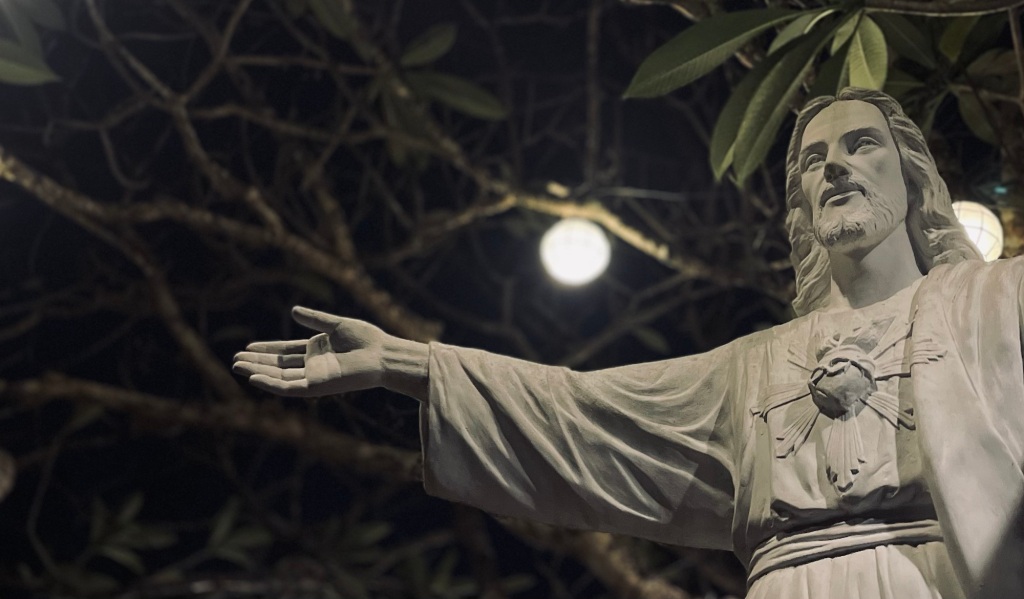
Photo by author, Sacred Heart Novitiate, Novaliches, Quezon City, March 2024.

After leaving the minor seminary in 1982, I felt my priestly vocation anew in 1990 while working as a reporter at GMA News. And one of the stumbling blocks that delayed me in finally deciding to give it another try had something to do with the Holy Rosary: I could not believe if God was really calling me to become a priest because I did not pray the Rosary. Fact is, I did not like the Rosary at all while in high school seminary because it was repetitive and too long to pray.

All the priests I consulted during that time clarified that the Rosary is a devotion that is distinct from the priesthood, that it is not a determinant whether one has a priestly vocation or none at all. Eventually, I resigned from GMA News, went back to the seminary in 1991, becoming a priest in 1998 along with my six classmates.

And I must confess, I still did not have that devotion with the Holy Rosary until I was assigned to a parish of my own in 2011. It was a devotion that did not happen instantly but slowly in 2016 as demands in the ministry grew, I felt the need for more prayers aside from our Liturgy of the Hours and daily meditations before the Blessed Sacrament. It was during the COVID pandemic when I found myself praying the Holy Rosary daily until I literally fell in love with it becoming an integral part of my prayer life. It was a coming into full circle for me, from being a big question mark before, now the Rosary has become an essential response to my priesthood.

The Rosary of the Virgin Mary… still remains, at the dawn of this third millennium, a prayer of great significance, destined to bring forth a harvest of holiness. It blends easily into the spiritual journey of the Christian life, which, after two thousand years, has lost none of the freshness of its beginnings and feels drawn by the Spirit of God to “set out into the deep” (duc in altum!) in order once more to proclaim, and even cry out, before the world that Jesus Christ is Lord and Saviour, “the way, and the truth and the life” (Jn 14:6), “the goal of human history and the point on which the desires of history and civilization turn” (St. John Paul II, Rosarium Virginis Mariae, Introduction).

Photo from canningliturgicalarts.com, painting of the Battle of Lepanto Bay with our Lady of Victory or Rosary.

On this Memorial of the Our Lady of the Rosary that had its origins in after Pope St. Pius V attributed to it the victory of the Christians forces agains the Ottoman Turks at Lepanto Bay in 1571, countless devotees worldwide will pray the words that Jesus taught his disciples.

Jesus was praying in a certain place, and when he had finished, one of his disciples said to him, “Lord, teach us to pray just as John taught his disciples.” He said to them, “When you pray, say: Father, hallowed be your name, your Kingdom come…” (Luke 11:1-2).

It is one of the most beautiful requests by the Apostles to our Jesus Christ, “Lord, teach us to pray as John taught his disciples.” Who else can teach so well how to pray even us today but Jesus, the Son of God?

In calling God Our Father, Jesus taught us the basic truth of every prayer that it is never alone nor solitary but always implies a community, a family — that we are all called and gathered to be one in God. It is a prayer that is all about relationship with the Father, reliance on the Father, faith in the Father.

Again, we read St. John Paul reflecting on the nature of the Holy Rosary that at every mystery starts with the Our Father:

After listening to the word and focusing on the mystery, it is natural for the mind to be lifted up towards the Father. In each of his mysteries, Jesus always leads us to the Father, for as he rests in the Father’s bosom (cf. Jn 1:18) he is continually turned towards him. He wants us to share in his intimacy with the Father, so that we can say with him: “Abba, Father” (Rom 8:15; Gal 4:6). By virtue of his relationship to the Father he makes us brothers and sisters of himself and of one another, communicating to us the Spirit which is both his and the Father’s. Acting as a kind of foundation for the Christological and Marian meditation which unfolds in the repetition of the Hail Mary, the Our Father makes meditation upon the mystery, even when carried out in solitude, an ecclesial experience (#32, Rosarium Virginis Mariae).

Painting by El Greco, “Pentecostes” (1597) from commons.wikimedia.org.

This communitarian aspect of the Our Father we see in the first reading during the Pentecost when the disciples gathered at the Cenacle room in Jerusalem praying with the Blessed Virgin Mary who is our constant reminder of the importance and need to pray always to God our Father.

Next to Jesus, his Mother taught us in her later apparitions to bring all our needs before the Father who loves us so much – especially those trials and sufferings and challenges we face each day because it is in prayer that we truly find our connections.

Notice how the disciples in asking Jesus to teach them how to pray that they mentioned “just as John taught his disciples” because they must have noticed a big difference in their ministry, of John’s connection with his disciples. The Twelve must have felt this connection with Jesus missing that they asked him to teach them how to pray too.

Here lies the gift and challenge of every prayer: it leads to our “connectedness” with God. Both the Rosary and the Our Father are learned by rote and spoken by heart but – do we pray with the heart? What is the our connection with prayer in general, with the Rosary and with the Our Father? Is it an expression, a witness, something that happens only with others as in a community or when we have time or, something deeper and personal?

The Blessed Cardinal Fulton Sheen who was beatified recently used to teach that it is in our prayer life that we become like Jesus Christ. It is most true with the Holy Rosary:

The contemplation of Christ has an incomparable model in Mary. In a unique way the face of the Son belongs to Mary. It was in her womb that Christ was formed, receiving from her a human resemblance which points to an even greater spiritual closeness. No one has ever devoted himself to the contemplation of the face of Christ as faithfully as Mary. The eyes of her heart already turned to him at the Annunciation, when she conceived him by the power of the Holy Spirit. In the months that followed she began to sense his presence and to picture his features. When at last she gave birth to him in Bethlehem, her eyes were able to gaze tenderly on the face of her Son, as she “wrapped him in swaddling cloths, and laid him in a manger” (Lk2:7) (#10, Rosarium Virginis Mariae).

By praying the Holy Rosary, may we learn through Mary to contemplate the face of Jesus Christ so we may be faithful to our call and mission especially in this 24/7 world of continuous action and noise that have left many of us empty and without meaning in life, no connections and so scattered in life. Amen. God bless you with Mary our Mother!
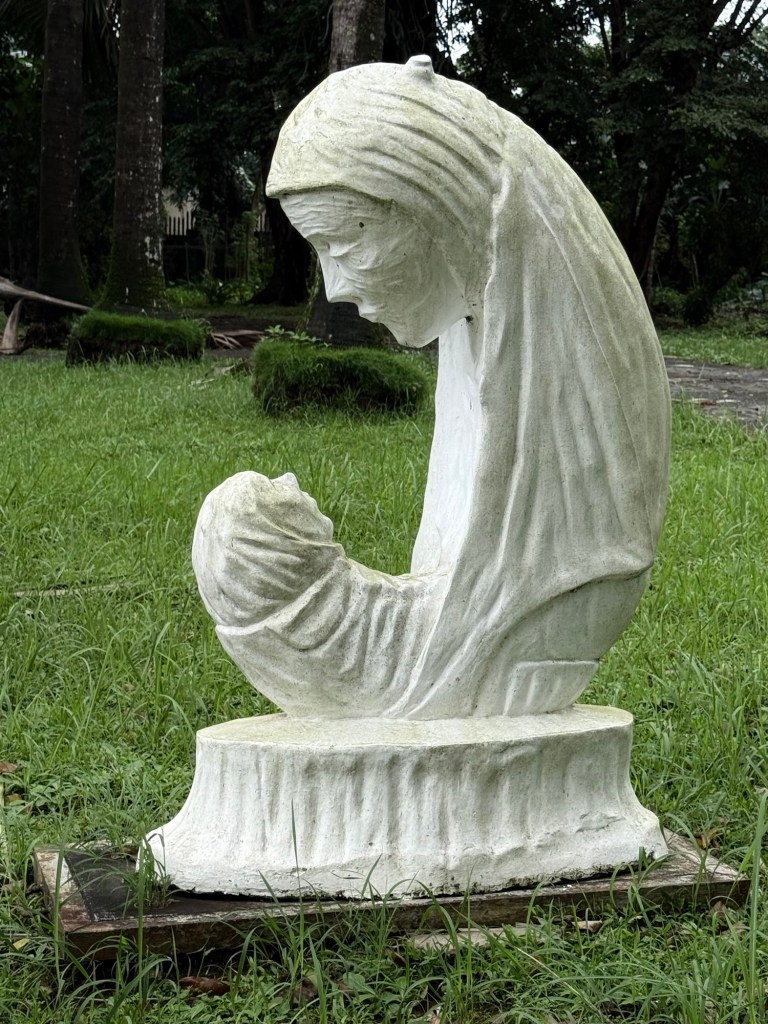
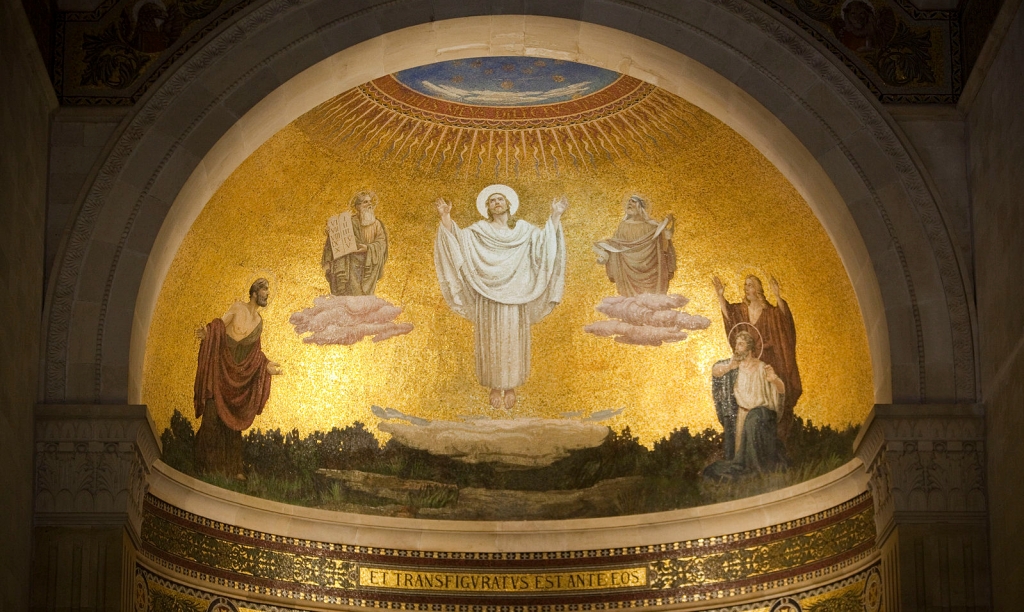
Photo by author, St. Paul Spiritual & Renewal Center, Bgy. Tanyawak, Alfonso, Cavite, 19 August 2026.

Transfiguration is seeing the face of Jesus

Lord My Chef Daily Recipe for Soul by Fr. Nicanor F. Lalog II
Thursday in the Eighteenth Week of Ordinary Time, Year II
Feast of the Transfiguration of the Lord, 06 August 2026
2 Peter 1:16-19 <*{{{{>< + ><}}}}*> Matthew 17:1-9
Mosaic inside the Basilica of the Transfiguration on Mt. Tabor, Israel; photo from commons.wikimedia.org.

The face is a reflection of what is in the heart and soul of every person. No amount of cosmetics and beauty procedures can ever bring out that glow and radiance of anyone’s face beaming with joy and fulfillment, peace and contentment coming from the heart.

This direct correlation of the face and the heart is called countenance – an indication of someone’s depth – or shallowness – of inner transformation due to deep spirituality, of communion with God. This is most evident on those we find whose face looks younger than one’s age that we often describe as malalim or deep, or magaling magdala ng problema. Another favorite Filipino expression of a person’s countenance is when we find somebody as madaling makagaanan ng loob – a person we meet for the first time yet we feel so light and easy with, we feel at home with him or her. In the same manner, we sense or notice something negative and unpleasant like rotting inside a person despite having good features like flawless skin or aquiline nose and beautiful eyes, we still find him or her so chaka or ugly.

Countenance is what young people call as “uma-aura” when they pose for FB or IG from “aura” or spirit within evoked and projected by one’s face that cannot be manipulated nor faked.

Jesus took Peter, James, and his brother, John, and led them up a high mountain by themselves. And he was transfigured before them; his face shone like the sun and his clothes became white as light (Matthew 17:1-2).

Painting of the Transfiguration by Italian artist Duccio di Buoninsegna between 1308 and 1311 from commons.wikimedia.org.

What a beautiful expression by Matthew, “his (Jesus’) face shone like the sun” at his transfiguration primarily because deep inside him is his complete and perfect union in the Father. Jesus always insisted on this reality within him, of his perfect communion in the Father from which also flows his total obedience that reached its highest point at his Passion and Death on the Cross, his own Pasch or exodus.

Try recalling unexpected moments in your life when God’s presence was so clear to you like a light shining from within; it could be those moments you have overcome a major obstacle in life or simply when you felt so loved while in some forms of darkness in life. Like the three apostles, during those moments we felt so overwhelmed by God’s glory and majesty that we felt like remaining in that state of comfort and certainty and consolation. Most often, these occurred during or after some trying times or occasions.

There on Mount Tabor in his transfiguration, we are shown that Christ’s glory cannot be separated from the Cross. His majesty and triumph shall come from his pasch. And so are we his disciples. That is why the voice heard by the apostles said, “This is my beloved Son, with whom I am well-pleased; listen to him”. From now on after his transfiguration, Jesus would be speaking thrice of his coming Passion, Death and Resurrection as he heads toward Jerusalem. All his lessons after Mount Tabor are about our participation in his paschal mysteries.

Do we listen at all? How’s our facial expression when we dwell on his conditions of discipleship? Is there a spark within us, a light shining through? Or, do we experience a “blackout”?

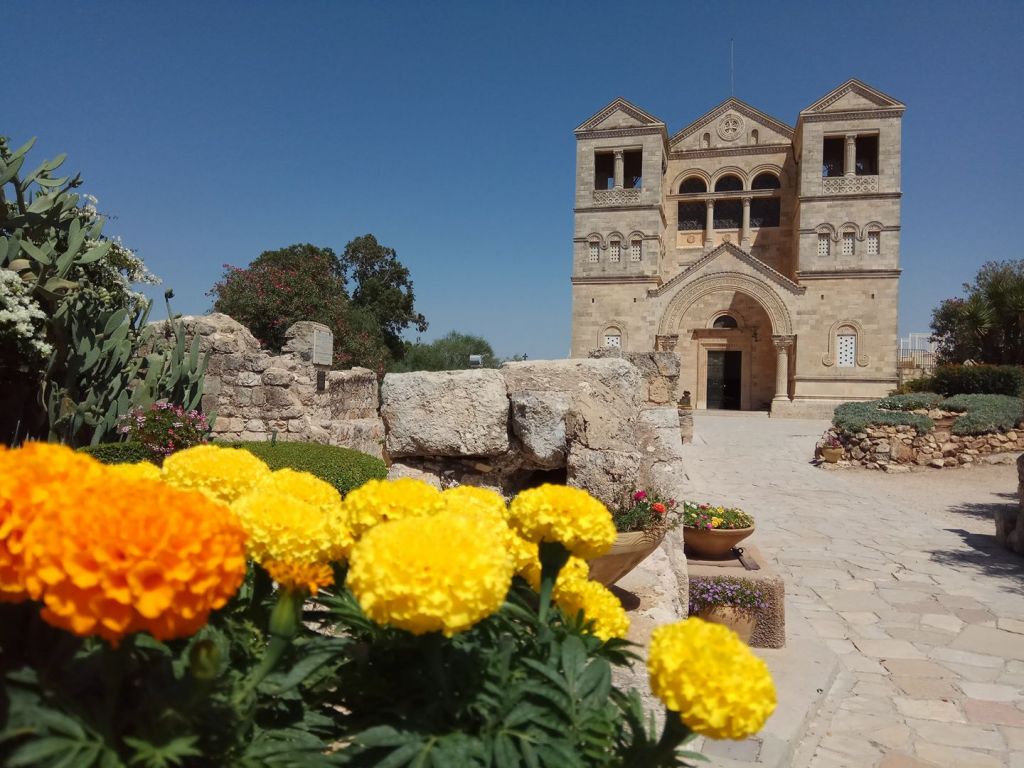
Photo from custodia.org of Basilica of the Transfiguration on Mt. Tabor, Israel.

Every second Sunday in Lent, we hear the same gospel of Christ’s transfiguration in preparation for Easter; this August 6 is the 18th week in Ordinary Time and we celebrate the Feast of Transfiguration to help us sustain in following Jesus in the last 16 weeks of the year.

During this time especially August when everything seems to slow down with life getting a bit difficult, the Transfiguration of Jesus calls us to never lose sight of the Cross of Good Friday as our path to glorious transfiguration in Christ. It is a process we have to patiently and persevere to go through in life.

The apostles learned and embraced all these lessons in a process slowly with the guidance of the Holy Spirit after Pentecost. That is why Jesus told them to come down from Tabor to continue their journey to Jerusalem to fulfill his mission. Through them we have believed despite our not having seen Jesus that is how he would appear as “Lord” on the mountain that we the faithful are climbing to participate in the ultimate manifestation of his return at the end of time.

To journey with Christ, listening and obeying his voice is something of the inside, of the heart. Not of the outside like places. The light of Christ does not remain still, continuously drawing us forward unto him, right into our hearts.

Life is a daily ascent to Mount Tabor, often when nights are long and dark, when the temptation to follow the artificial lights of the world and modernisms offering shortcuts to fulfillment and meaning are so tempting.

Photo from iStockphoto.com of Mount Tabor in Israel where Jesus is believed to have transfigured.

St. Peter warns us in the first reading that “we did not follow cleverly devised myths when we made known to you the power and coming of our Lord Jesus Christ… we possess the prophetic message that is altogether reliable. You will do well to be attentive to it, as a lamp shining in a dark place, until day dawns and the morning star rises in your hearts” (2Pt.1:16, 19).

The path to glory is the path of the Cross of Jesus, right in our hearts when we are willing to forgive and understand, when we are more loving and kind, when we are empty of pride and filled with Jesus always. May the light of Christ shine on us, on our face. Let us pray:

Show me your face,
Jesus by dwelling right here
in my heart,
filling me with your
love and kindness,
justice and truth,
mercy and forgiveness;
show me your face,
Jesus by showing me
Moses too that I may love
your laws and commandments
that often I see as burdensome
not realizing they actually lead
to true freedom to love and be
faithful to you, Lord;
sow me your face,
Jesus by showing me too
Elijah, your powerful prophet
taken to heaven body and soul
by a chariot because he believed
in your words Lord;
show me your face,
Jesus that my face may
shine with your light
while I transfigure in you.
Amen.

Christ the King, the face of suffering

Lord My Chef Sunday Recipe for the Soul, 23 November 2025
Solemnity of Christ the King, Cycle C
2 Samuel 5:1-3 ><}}}}*> Colossians 1:12-20 ><}}}}*> Luke 23:35-43

I was teasing our campus ministry head for communication last Tuesday after he had presented to me this announcement for our Christ the King celebration today. “Para namang malnourished si Jesus diyan,” I told Darwin as he scratched his head laughing during our meeting.

But, that evening after praying our gospel, I changed my mind the following Wednesday and told Darwin to go ahead with his original artwork because I have realized that the face of Christ the King is also the face of us suffering.

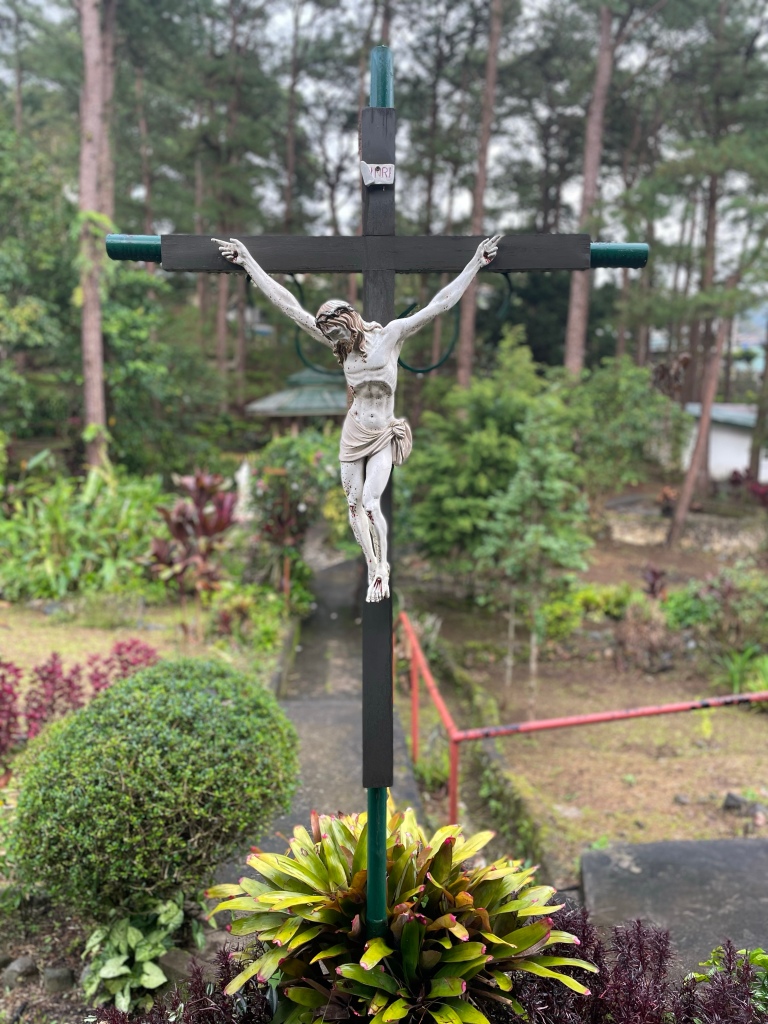
Photo by author, Holy Monday, 2025.

Are you not surprised that on this final Sunday of the liturgical year, we are not presented with an image of a victorious Jesus like that Cristo Rey found in every Catholic home but the gospel scene of Jesus suffering in excruciating pain there on the Cross on Good Friday?

Above him there was an inscription that read, “This is the King of the Jews.” Now one of the criminals hanging there reviled Jesus, saying, “Are you not the Christ? Save yourself and us.” The other, however, rebuking him, said in reply, “Have you no fear of God, for you are subject to the same condemnation? And indeed, we have been condemned justly, for the sentence we received corresponds to our crimes, but this man has done nothing criminal.” Then he said, “Jesus, remember me when you come into your kingdom.” He replied to him, “Amen, I say to you, today you will be with me in Paradise” (Luke 23:38-43).

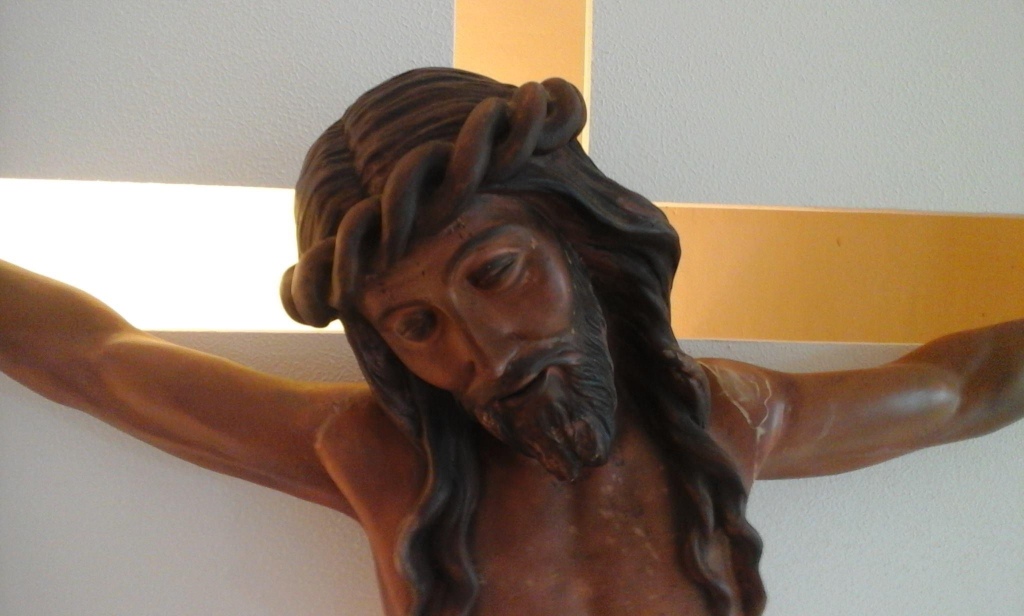
Photo by author, Chapel of St. Francis Xavier, Sacred Heart Novitiate, Quezon City, 2024.

On this Solemnity of Christ the King, St. Luke invites us for the last time we hear his gospel this year to look at the face and into the eyes of Jesus crucified.

What do you see and feel in him?

Ever wondered what the rulers and soldiers saw on the face of Jesus crucified that they sneered and jeered him from below? They were so filled with pride in finally putting into shame and silence Jesus who had always spoken the truth and exposed their lies and hypocrisies.

What do we see when people are put on the spot and shamed like Jesus crucified or like the woman caught committing adultery Jesus forgave and saved from being stoned by the angry crowd? So sad that in this age of social media, public trials and condemnation have become a hobby for many without even checking the accusations are true or not.

Let us move closer to Jesus on the Cross like those two thieves hanging at each of his side: what do you see and feel about him?

Why did the other thief join those below in deriding and insulting Jesus crucified? Now one of the criminals hanging there reviled Jesus, saying, “Are you not the Christ? Save yourself and us” (Lk.23:39).

Have you ever found yourself in the ER or waiting for your turn at the doctor’s clinic with other patients also in pain and suffering? How do you see the other patients and sick people like you? Is there in your mind any tinge of suspicion why or how they got sick? The best and the worst in us come out in such times when we are so down beside another suffering brother or sister.

Or, do we choose the path of humility and sincerity of Dimas, the good thief? What did he see in Jesus there on the Cross? The other, however, rebuking him, said in reply, “Have you no fear of God, for you are subject to the same condemnation? And indeed, we have been condemned justly, for the sentence we received corresponds to our crimes, but this man has done nothing criminal” (Lk.23:40-41).

Most likely, Dimas must have heard a lot about the teachings and healings by Jesus but he felt something so unique and liberating, so personal during those dark moments of excruciating pains when he finally recognized Christ his Savior, the only true King that is why he asked to be remembered in his kingdom!

Finally, somebody greater than him there beside him, saying nothing to judge nor condemn him nor irritate him like his fellow criminal at the other side. In recognizing Jesus, Dimas also found himself as truly human, weak and finite who can only be whole and complete – saved and redeemed – in Christ who chose to be there on the Cross with him exactly as St. Paul had written in our second reading.

He is before all thing, and in him all things hold together. He is the beginning, the firstborn from the dead, that in all things he himself might be preeminent. For in him all the fullness was pleased to dwell, and through him reconcile all things for him, making peace by the blood of his cross through him, whether those on earth or those in heaven (Colossians 1:17, 18-20).

Photo by author, St. Scholastica Spirituality Center, Baguio City, August 2023.

Here we find the beauty of the Cross, of how God so perfect without any need to suffer and experience pain yet chose to go through it to express his solidarity and love for us humans.

It is on the cross when we are most able to identify and be one in Jesus Christ. That is why it is also on the Cross that we enter heaven with Jesus amid suffering and death. Jesus said today you shall be with me in Paradise – not later when we die or after three days at Easter. How lovely that Jesus never promised heaven when he was strong and freely moving around but when he was there on the cross, nailed and dying.

Jesus Christ is the King of the Universe not because of his powers and might but primarily of his being one of us in sufferings and death. It was the very feeling the tribes of Israel were telling David when they came to him in Hebron to reaffirm their allegiance to him as their king, “Here we are, your bone and your flesh” (2 Sm. 5:1).

The people we admire most are not always the best nor most powerful nor talented because often we envy them. On the other hand, we are more drawn with those down and burdened because we see in them our own brokenness, too, that it is part of life and of being human. That is why we easily empathize with those grieving or sad than with those happy or rejoicing.

Our humanity reaches its highest point and beauty when broken and weak as we realize our mortality and similarity with others in suffering needing for a Savior. We are most inhuman whenever we enjoy inflicting or causing pains on others or when rejoicing in their agonies. To proclaim Christ is the King of the Universe is to always see him in our sufferings and among those suffering too like us. Amen. A blessed week ahead of you!

Lord, show me your face

Lord My Chef Daily Recipe for the Soul by Fr. Nicanor F. Lalog II
Wednesday, Seventeenth Week in Ordinary Time, Year I, 30 July 2025
Exodus 34:29-35 <*((((>< + ><))))*> Matthew 13:44-46
Photo by author, sunrise in Laurel, Batangas, February 2025.
God our Father,
it has been quite a long time
since these rains started
and how I miss seeing the sun
rising in the morning
like your face appearing
before me; how I love arising
early in the morning
to experience the sunrise
that I imagine as closest to
the experience of Moses conversing
with you, Lord,
face to face like two friends;
in the sunrise
I find and experience
the paradox of you,
of your presence in absence,
when you seem "veiled"
to me and everyone.

When he finished speaking with them, he put a veil over his face. Whenever Moses Moses entered the presence of the Lord to converse with him, he removed the veil until he came out again. On coming out, he would tell the children of Israel all that had been commanded. Then the children of Israel would see that the skin of Moses’ face was radiant; so he would again put the veil over his face until he went in to converse with the Lord (Exodus 34:33-35).

"Nobody sees your face,
O Lord, and lives again"
because to see your face
is our final fulfillment in life;
to see your face like Moses
and still live is to live
"veiled" in your mystery
that eyes cannot see
but the heart and soul can feel
and recognize; you come to us,
Lord, "veiled" in many instances
like the sunrise when I cannot
see your face fully
and directly like the sun
but the more I look at you,
the more I experience you in me,
the more I become aware of my own face
created in your image and likeness;
show me your face, God,
not as an image but as a reality
inside me so that like Moses,
your kindness and love
may shine in me always,
living authentically,
living fully in your loving presence,
veiled in the mystery
and beauty of your kingdom
buried like a treasure in the field
or like a pearl of great price
I would never trade for anything
except you in Jesus.
Amen.
Photo by author, sunrise over the Pacific from Katmon Nature Sanctuary & Resort, Infanta, Quezon, March 2023.

Jesus “looking with love”

The Lord Is My Chef Sunday Recipe for the Soul by Fr. Nicanor F. Lalog II
Twenty-eighth Sunday in Ordinary Time, Cycle B, 13 October 2024
Wisdom 7:7-11 ><}}}}*> Hebrews 4:12-13 ><}}}}*> Mark 10:17-30

Lately in my prayers I have felt so drawn on the “face” of Jesus, trying to imagine and feel how He looked at the various people He met in the gospel accounts. Most of all, of how Jesus looks at us too (https://lordmychef.com/2024/10/09/to-his-face/).

Consider our gospel this Sunday that shows us how Jesus has that “look of love” to everyone. No matter how bad and sinful we may be, He is full of love and mercy, compassion and joy in seeing us. The problem is often the way we look at Him like that man who approached Him as well as the disciples conversing with Him who were all so much like us.

Photo by Mr. Jim Marpa, 2019.

As Jesus was setting out on a journey, a man ran up, knelt down before him, and asked him, “Good teacher, what must I do to inherit eternal life?” Jesus answered him, “Why do you call me good? No one is good but God alone. You know the commandments…” He replied and said to him, “Teacher, all of these I have observed from my youth.” Jesus, looking at him, loved him and said to him, “You are lacking in one thing. Go, sell what you have, and give to the poor and you will have treasure in heaven; then come, follow me.” At that statement his face fell, and he went away sad, for he had many possessions.

Jesus looked around and said to his disciples, “How hard it is for those who have wealth to enter the kingdom of God!” The disciples were amazed at his words. So Jesus again said to them in reply, “Children, how hard it is to enter the kingdom of God!” It is easier for a camel to pass through the eye of the needle than for one who is rich to enter the kingdom of God.” They were exceedingly astonished and said among themselves, “Then who can be saved?” Jesus looked at them and said, “For human beings it is impossible, but not for God. All things possible for God” (Mark 10:17-27).

Photo by author, Sacred Heart Novitiate, Novaliches, QC, 20 March 2024.

Jesus, looking at him, loved him...
his face fell, went away sad,
for he had many possessions.

We readily identify with this man because all of us have the same question deep in our hearts to Jesus, wondering there must be more to keeping the commandments, of being good, of a better way to get into eternal life that is not necessarily a shortcut.

In fact, we have to rejoice, dear friends if we ask the same question because it is a grace that can only come from God, so unlike the Pharisees who asked Jesus last Sunday on the legality of divorce because they wanted to “test” Him. See how Jesus like last week brought us all back to the Sacred Scriptures, the very word of God expressing His will in human terms. The question was a sincere longing for God like the Psalmist, “Your testimonies are my delight; they are my counsellors”; “I observe your precepts and testimonies; all my ways are before you” (Ps. 119:24, 168).

Jesus looked at the man with love because He saw a great opening for more grace in him that is why He told him to sell everything he had, give it to the poor and follow Him. At that moment, like most of us, his face fell and went away sad because he had many possessions.

Are we not this man too who can’t look at Jesus with the same love because we probably love somebody or something else than Him found among those in the margins of our lives?

Photo by author, Sacred Heart Novitiate, Novaliches, QC, 20 March 2024.

Jesus looked around...
the disciples were amazed.

If Jesus did not care at all and has no love for those around Him, He would have not looked around after that man had left. Here is the lovely thing with Jesus: His look is always filled with love for us His disciples, a look so penetrating, so luminous because He is divine.

What is amazing is not only that it is difficult for us to enter the kingdom of God due to our many attachments, sinfulness and weaknesses, but, despite all these, Jesus still speaks to us, conversing with us because He simply loves us so much! Jesus never looks on qualifications but instead qualifies His call so we can follow Him. Most of all, look at Him too!

Consider the amazing grace for us to remain in Jesus, albeit hiding that question in our hearts so afraid to ask because we know His answer would be so unexpected like in this scene and yet, here is Jesus looking around, looking at us with love sincerely telling us it is not easy at all. Remember the bread of life discourse of how Jesus talked straight because He was sincere and truthful to us that it is difficult to follow Him to the Cross which is what discipleship is all about. Just keep following Jesus, keep looking at Him no matter what!


Photo by Mr. Jay Javier, Quiapo Traslacion 2020.
Jesus again said to them...
they were exceedingly astonished.

Wow…! See the style of Mark who was not contented in writing how astonished the disciples were by describing them as “exceedingly astonished”. See his attention to details, so wonderful and beautiful because what is exceedingly astonishing is Jesus Christ’s love for us, not just His words!

Here, Jesus was already telling the disciples what would happen on Good Friday, of how Jesus would do everything for us all – that is, in doing the impossible that is only possible with God because He loves us so much.

Like what St. Paul had extensively reiterated to the Galatians in the weekday readings last week, Jesus did everything for us to be saved. Salvation is a gift, a pure grace from God. It is never our work; stop playing God, or a Messiah! There is nothing we can really do to be saved except to be like a child as Jesus had reiterated these past two Sundays.

To be like a child is to completely trust Jesus every step of the way especially on His way to Jerusalem. Now we see the importance of having that child-like attitude to belong in the kingdom of God as Jesus identified what await His disciples in following Him: “houses and brothers and sisters and mothers and children and lands, with persecutions, and eternal life in the age to come” (Mark 10:30).


Photo by Mr. Jim Marpa, 2019.

Don’t be sad now. Mark had a purpose in writing the persecutions that await every disciple of Jesus because these shall purify us, give more depth and meaning to our lives and existence.

Mark knew so well how everyone is like the author of the Book of Wisdom who lived in a time similar with ours with all the affluence around us that deep inside us we still feel and know for sure that life is more than comfort and pleasures. He knew too the story of King Solomon like us so blessed with that consciousness that more than the material wealth and fame the world offers us, what matters most in life is wisdom to discern what is right and good.

These are difficult indeed for us, like getting married threatened by divorce then and now; but, again Jesus proposes an ideal, inviting us to remain in Him in prayers. After all, Jesus is the word of God who became flesh is “living and effective” among us found in the Sacred Scriptures (second reading) to guide us closer to Him.

Let us not worry because Jesus had done everything for us to be saved. Stay in the Lord, and let our face shine with His love! Keep looking at Jesus who looks at us full of love today and always. Have a blessed week ahead!

From forbes.com, 2019.

To his face…

The Lord Is My Chef Daily Recipe for the Soul by Fr. Nicanor F. Lalog II
Wednesday in the Twenty-seventh Week of Ordinary Time, Year II, 09 October 2024
Galatians 2:1-2, 7-14 ><]]]]'> + <'[[[[>< Luke 11:1-4
Photo by author, Sacred Heart Novitiate, Novaliches, QC, 2017.

And when Cephas came to Antioch, I opposed him to his face because he clearly was wrong… (Galatians 2:11).

For so long,
I have always wondered
how You look like,
Lord Jesus,
of what or how
your face looks
like really;
your face deeply in pain
on the Cross has always been
the face I have known when
thinking of You;
how I wished I could see your face
moved with pity
with that widow of Nain
or how your face looked
full of love to the rich young man
whose face fell after You asked him
to sell his belongings,
share them to the poor
and follow you.

Oh, how I long to see your face,
Lord!
Christ and the Widow of Nain, c.1550-55 (oil on canvas) by Caliari, Paolo (Veronese) (1528-88); 97.7×163.8 cm; Private Collection; (add.info.: Christ and the Widow of Nain. Paolo Caliari (Veronese)(1528-1588). Oil on canvas. 97.7 x 163.8cm.); Photo © Christie’s Images.
“Christ and Rich Young Ruler” by Heinrich Hofmann from en.wikipedia.org.
St. Paul's account of 
"opposing Cephas to his face"
invites me today
to see face
in a more deeper sense than
something physical;
as I immersed into the scene,
I could sense and picture
the courage and sincerity
on St. Paul's face in telling
St. Peter into his face
his double standards
in dealing with early Christians,
that is, of having two faces:
one with Jewish converts
and another with Gentile converts!
The lithography of Sts. Peter and Paul in Missale Romanum by unknown artist with initials F.M.S (19. cent.) printed by Typis Friderici Pustet. (Renáta Sedmáková | us.fotolia.com)
How sad,
dear Jesus,
that until now,
we your disciples
are like St. Peter before:
many of us are not only double-faced
but even multiple-faced with
one another, never our true selves
at all!
Worst, many of us can't even
show our true face as we put on masks
that literally in Greek are called
hypokritein --- hypocrites!
Teach us, Lord Jesus,
how to pray,
that is,
to be single-faced in our prayers:
to face up before our Father
as His children
forgiving each other's debts,
living as brothers and sisters;
teach us, Lord Jesus,
to face up our prayers,
of living out what we pray
not with many faces
nor with masks on our face;
teach us, Lord Jesus,
to face You more often
in prayers to transform our face
into your face that is truly
an image and likeness
of God,
radiating with your loving presence.
Amen.
Photo by author, CAS Chapel, Our Lady of Fatima University, August 2023.

Why are you here?

The Lord Is My Chef Daily Recipe for the Soul by Fr. Nicanor F. Lalog II
Friday in the Tenth Week of Ordinary Time, Year II, 14 June 2024
1 Kings 19:9, 11-16 <*((((>< + ><))))*> Matthew 5:27-32
Photo by Mr. Vigie Ongleo, Sagada, Mt. Province, 2014.
O God, dear Father,
how I have loved so much
ever since today's story
of Elijah fleeing from death
at the hands of Jezebel's army;
so many times I have felt like Elijah,
so tired, fed up fighting,
hoping for death when the going
gets tough and rough;
and so many times too,
You have never forsaken me,
Father like Elijah,
asking me many times
that question,
"Why are you here?"
(1 Kings 19:9, 13).
Very often, I get confused, Father,
if I am that zealous for You 
like Elijah or just me so insistent 
with what I believe,
with what I know,
with what I hold so dear
in You and for You;
many times I do not know
if I am still doing your will
especially when it is so difficult,
so uncomfortable and,
yes, I have asked You many times
why not just make me
an ordinary man,
instead of being your prophet....
Photo by Mr. Vigie Ongleo, Sagada, Mt. Province, 2014.
But your question remains,
Lord, that I rarely face nor
answer squarely:
"Why are you here?"

You know me so well,
Lord: like Simon Peter in
Capernaum after your discourse
on the bread of life,
my favorite response to You is
"Master, to whom shall we go?
You have the words of eternal life.
We have come to believe and
are convinced that you are the
Holy One of God" (John 6:68-69).
But most of all,
I am here because like the
psalmist,
"I long to see your face,
O Lord" (Psalm 27:7-8);
and for me to see your face
means to love more
until it hurts me;
to see your face, Lord,
is to be still and silent
amid the noise of this world
for you are always there in our
midst among the weak
and voiceless,
among those in the margins
and underneath the heaps
of scraps and garbage;
to see your face, O Lord,
is to remember always
it is your work,
not mine that I must
accomplish.

Why am I here, Lord?
Because You told me so.
Thank you so much
in bringing me here this far,
no matter what
for as long I feel
getting closer
with You.
In that case,
I shall always be here
for You!
Amen.
Photo by Mr. Vigie Ongleo, Sagada, Mt. Province, 2014.