The Lord Is My Chef Daily Recipe for the Soul by Fr. Nicanor F. Lalog II
Wednesday, Feast of Sts. Philip & James the Less, Apostles, 03 May 2023
1 Corinthians 15:1-8   ><))))"> + ><))))"> + ><))))">   John 14:6-14
Photo by author, sunrise at Katmon Nature Sanctuary & Beach Resort, Infanta, Quezon, 04 March 2023.
Thank you, dearest Lord Jesus Christ
for the gift of two Apostles whose
feast we celebrate today,
St. Philip and St. James the Less;
thank you in giving us examples
to personally be near you,
to be one with you
and to be one in you.
How lovely it is to recall
when Philip along with Andrew
approached and asked you
where you stayed and you told them
to "come and see"; what they saw
and experienced must be so wonderful
that Philip was so convinced in
calling Nathanael to come and see you
whom he had recognized as the Messiah.

In being your apostles,
Philip and James remind us
of the need to be close
and familiar with you to
discover your true identity,
to enter into a personal contact
with you by listening, responding
and communing in you Jesus daily,
of the need to dwell in you always.

During your last supper,
you expressed clearly how
the word "dwelling" means -
intimacy and oneness in the Father
in you and with one another also
in you, dear Jesus.
Your cousin James who eventually
became the bishop of Jerusalem
practiced this meaning of dwelling
in you by working to resolve the
the tensions among the Jewish
and Hellenist converts to
Christianity; how beautiful that
the early Church lived in
harmony with each other,
rooted in you, Jesus,
our home,
our dwelling.
Amen.
The Lord Is My Chef Daily Recipe for the Soul by Fr. Nicanor F. Lalog II
Tuesday, Memorial of St. Athanasius, Bishop & Doctor of the Church, 02 May 2023
Acts 11:19-26   ><}}}}*> + ><}}}}*> + ><}}}}*>   John 10:22-30
Photo by author, Sacred Heart Novitiate, Novaliches, Quezon City, 22 March 2023.
God our loving Father,
fill us with your grace of
encouragement;
give us the grace to
encourage people especially
those discouraged to move
on with life,
those discouraged by setbacks
and other disappointments
in life,
those discouraged by sickness,
by poverty, by so many other
reasons that they lose hope
and trust in you.

Like the Apostle Barnabas
whose name means
"son of encouragement",
may we bring encouragement
to others especially in times of
uncertainties, of sufferings,
and difficulties; most of all, like
Barnabas who went out of his way
to look for Saul to bring him to
the Church, may we search for those
who have opted to stay out from our
circles to encourage them to join
the mainstream, to be involved in
spreading the gospel of Jesus Christ,
especially his truths now under
attack from people promoting modern
trends of heresies.
Gift us with the conviction and
clarity of St. Athanasius who
fought Arianism with such vigor and
passion until his death.
Amen.
The Lord Is My Chef Daily Recipe for the Soul by Fr. Nicanor F. Lalog II
Monday, Feast of St. Joseph the Worker, 01 May 2023
Genesis 1:26-2:3   ><]]]]'> + <'[[[[><   Matthew 13:54-58
Photo by author, Sacred Heart Novitiate, Novaliches, QC, 20 March 2023.
Glory and praise to you,
God our loving Father
in giving us a share
in your work in making
this world a better place;
despite our sinfulness and
turning away from you
in the time of Adam and Eve,
you still call us to participate
in your work of holiness
by calling St. Joseph to
marry the Blessed Virgin
Mary, the Mother of your Son
and our Lord Jesus Christ.
Despite the difficult situation
and work ahead of him,
St. Joseph obeyed you,
working in silence,
doing your will,
taking care of Jesus and Mary
that in his work,
people recognized
Jesus!
Jesus came to his native place and taught the people in their synagogue. They were astonished and said, “Where did this man get such wisdom and mighty deeds? Is he not the carpenter’s son?”
Matthew 13:54-55
Like St. Joseph,
may we not find only
the labor and amount
of work to be done
in our tasks and jobs
but most of all,
that we may find
you in Jesus Christ,
the very meaning of
our life and work.
Amen.
The Lord Is My Chef Sunday Recipe for the Soul by Fr. Nicanor F. Lalog II
Fourth Sunday in Easter-A, Good Shepherd Sunday, 30 April 2023
Acts 2:14, 36-41 ><}}}*> 1 Peter 2:20-25 ><}}}*> John 10:1-10
Photo by author, Baguio City, January 2018.
Beginning this Sunday, all our gospel readings will be about the major teachings of Jesus before his arrest that led to his Passion, Death, and Resurrection. Like the Apostles, we are reviewing the Lord’s final teachings in the light of Easter to fully appreciates its meaning and significance.
First of these teachings is the Lord’s declaration, “I am the good shepherd” (Jn. 10:11).
This is very significant in the fourth gospel where we find Jesus using the phrase I AM. It was not just reminiscent of God identifying himself as I AM WHO AM to Moses in the Old Testament but most of all, for Jesus it is his self-identification as the Christ, the Son of God whom his enemies refused to accept nor recognize.
More interesting in our gospel this Sunday is how the Good Shepherd discourse of Jesus actually began with his claim as being the gate or door through whom the sheep enter and pass through.
Jesus said: “Amen, amen, I say to you, whoever does not enter a sheepfold through the gate but climbs over elsewhere is a thief and a robber. But whoever enters enters through the gate is the shepherd of the sheep. I am the gate. Whoever enters through me will be saved, and will come in and go our and find pasture. A thief comes only to steal and slaughter and destroy; I came that they might have life and have it more abundantly.”
Jesus spoke twice “I am the gate” in vv. 7 and 9 to emphasize and clarify that flock belongs to him, never to us. That is why Jesus is the gate, the only way through whom the sheep pass through. Hence, the true mark of a good shepherd is one who passes in Jesus as the gate, the owner of the sheep. Whoever does not pass through Jesus is a thief, a robber. A fake shepherd.
Nobody else could ever replace Jesus as Shepherd of the flock but he wants us all to be shepherds like him, passing in him our gate. This we can understand when we fast-forward to his third and final appearance to the seven disciples at Lake Tiberias after Easter. After their breakfast at the lakeshore, Jesus asked Simon Peter thrice, “Do you love me?” In every question, Peter professed his love for Jesus who asked him only for one thing, “feed my sheep” until finally adding at the end, “follow me” (cf. Jn. 21: 15-19). His call to follow him came after describing to Peter how he would suffer and die for him.
To pass in Jesus as the door to the sheep is first of all to love Jesus.
We all have experienced that loving calls for nearness which Nat King Cole described perfectly in his hit “The Nearness of You”. Whenever we love somebody, we want to be always near our beloved. The same desire we must possess if we truly love God. Furthermore, being near demands that we share feelings with the one we love – his/her joy is our joy, his/her pain is our pain. No wonder when we love somebody, we are willing to suffer. That is the first true mark of our love for Christ – we are willing to suffer for him and with him on the Cross!
That is the first meaning of Jesus is the gate of the sheep as the Good Shepherd: his Cross is our path to fulfillment, to true joy in this life and to eternal life eventually. We can only have a true relationship with him through others when we are willing to share in others’ sufferings like Jesus. Because of his Passion, Death and Resurrection, Jesus has turned suffering into a grace itself and a source of grace too because to suffer with somebody else is love. Anyone who avoids suffering does not love at all and can never be a shepherd like Jesus.
The second meaning of Jesus is the gate flows from that nearness with him – it is not enough to be close but most of all, to be obedient, submitting our total self to him in the same manner he obeyed the Father as expressed in St. Paul’s beautiful hymn found in Philippians 2:6-11.
How close can we come to Jesus is the sum of our obedience to him. Or to anyone we love. It is only in being obedient can we truly follow Christ and those we love. When we love, we are not presented right away with everything that could happen in our relationship and journey in life. Love is a wholesale, a package deal always without ifs nor buts. Nobody knows to where our lives would lead to as most couples could attest. That is why, more than being close and near to Jesus or our beloved, we need to be obedient too because that is the mark of true love when we humbly submit ourselves to the one we love.
Obedience calls us to go down to our lowest level because that is the highest mark of our love too. Recall how Jesus at their last supper “loved his own in the world and he loved them to the end” (Jn.13:1) by washing their feet. See how the Son of God went so low, lower than what slaves were not supposed to do, that is, wash feet of others. Jesus showed this in no uncertain terms the following Good Friday by dying on the Cross, of literally going under earth at his burial that led to his highest glory, his Resurrection.
That is why Jesus is the Good Shepherd by first being the gate because in him, we have shared in his pasch to share in his glory. As the gate or door, we enter in Jesus by sharing in his paschal mystery of loving, suffering, and following.
Photo by Dr. Mylene A. Santos, MD, 2020.
Today we are reminded that our being the flock of Jesus, a sheep of the Good Shepherd is not our choice but a gift of God himself.
Our coming together in the church, in our celebrations and sacraments is not a mere social function out of our own volition. It is a gift and a call from Jesus. That is why it is very important to celebrate the Sunday Mass.
It is Christ himself we refuse and turn down when we skip Sunday Masses because when we love somebody, we show it by being present, being near, ready to suffer and obey to show our love.
Jesus is not asking us too much except an hour each week to immerse ourselves in his life giving words, to find him with others we meet and live with.
Peter said something still very true especially in our time, “Save yourselves from this corrupt generation” (Acts 2:41) where God is totally disregarded as if we can live without him, without loving like him. Let us return to Jesus, pass in him our door to life and fulfillment by loving, suffering and following him our Good Shepherd. Amen. Have a blessed week and month of May ahead!
The Lord Is My Chef Daily Recipe for the Soul by Fr. Nicanor F. Lalog II
Friday in the Third Week of Easter, 28 April 2023
Acts 9:1-20   ><}}}}"> + ><}}}}"> + ><}}}}">   John 6:52-59
Photo by author, Lian, Batangas, 2022.
Thank you dear Jesus
for your wonderful words
today that remind us of your
personal call to each one of us
like St. Paul; sometimes we envy
O Lord the manner you have called
the saints to follow you but at
closer look, you have called us all
in the most personal manner,
in the most unique way
according to our person
and situation,
our own "Damascus".
Today's first reading is so
marvelous because we too
have experienced you personally
calling us in our name like "Saul",
who like us too, many times do not
know you nor recognize you at all;
sometimes, we are like Ananias
arguing with you, telling you what
we know as if you do not know!
Dearest Lord Jesus,
like Saul or St. Paul and
Ananias, give us the grace to
answer and respond to your calls:
First, to work for you, the Christ:
"I am Jesus, whom you are persecuting.
Now get up and go into the city
and you will be told
what you must do" (Acts 9:5,6).

Second, to follow you, the Christ:
"Go, for this man is a chosen
instrument of mine to carry
my name before Gentiles, kings,
and children of Israel" (Acts 9:15).

Third, most of all, to suffer for you, O Christ:
"and I will show show him
what he will have to suffer
for my name" (Acts 9:16).
Let us keep this in our minds
and hearts, Lord Jesus:
that each day you come to meet
us in our various "Damascus",
calling us to work for you,
follow you,
and most of all,
suffer for you.

Stop us, dear Jesus,
in our many quarrels
 like the Jews at your time;
let us go with you
and suffer with you to be
a bread too for others
in sustaining their
journey with you.
Amen.
The Lord Is My Chef Daily Recipe for the Soul by Fr. Nicanor F. Lalog II
Thursday in the Third Week of Easter, 27 April 2023
Acts 8:26-40   ><))))*> + ><))))*> + <))))*>   John 6:44-51
Lord Jesus Christ,
teach us to listen more
intently to you speaking to us
in the most unusual manner,
often when we least expected
like in the story of Philip and
the Ethiopian eunuch.
Now there was an Ethiopian eunuch… who had come to Jerusalem to worship, and was returning home. Seated in his chariot, he was reading the prophet Isaiah. The Spirit said to Philip, “Go and join up with the chariot.” Philip ran up and heard him reading Isaiah the prophet and said, “Do you understand what you are reading?” He replied, “How can I, unless someone instructs me?” So he invited Philip to get in and sit with him.
Acts 8:27, 29-31
What a wonderful
and amusing passage of how
it happened!  But that is
beside the point because
that's the way it is with you,
Lord Jesus and your Holy Spirit
working in most extraordinary
ways; what matters is first of all
Philip showing us the importance
of listening and obeying your
promptings no matter how
difficult or funny it may be!
Listening to you, Lord,
means listening to others, too!
Teach us to see this important
relationship of listening to your
voice in our human voice.
Many times, we are afraid to
obey you because we doubt
your voice jibes with the human
voice.  Give us courage to express
your words by listening to what
others are saying like Philip when
he asked the eunuch if he understood
what he was reading.
Likewise,
keep us attuned with your words
and teachings, Lord so that when
people ask us to explain things for them,
we would always be ready like Philip
to confirm your voice others hear.
When we know and appreciate
these dynamics of listening,
then it becomes so true that
"No one can come to me unless
the Father who sent me draw him,
and I will raise him on the last day"
(John 6:44).  Amen.
The Lord Is My Chef Daily Recipe for the Soul by Fr. Nicanor F. Lalog II
Wednesday in the Third Week of Easter, 26 April 2023
Acts 8:1-8   ><]]]]'> + ><]]]]'> + ><]]]]'>   John 6:35-40
Photo by Mr. Jim Marpa, 2019.
Lord Jesus,
teach me to be a "devout"
person; not just righteous or
holy but devout as well
like those "Devout men (who)
buried Stephen and made a loud
lament over him" (Acts 8:2).

Yesterday, you taught us dear Lord
that whatever is in our heart is
reflected on our face;
today you teach us that
to be "devout" is still of the heart
which is to be of a good heart
ready to believe and act openly
with courage on that belief.
Only St. Luke used the adjective
"devout" to describe some persons
like Simeon who praised God upon
seeing Jesus when presented to the
temple by his parents; the Jews from
all over the world who came to observe
Pentecost day in Jerusalem;
the men who buried Stephen, and
Ananias who sought Saul while
still blind to bring him to the Church.
Many times dear Lord
our being devout is
self-serving when we merely
open our eyes for things
that are seen in our many
devotions, seeing more our selves
failing to see Christ in
the other persons
who have to be loved
and cared for, understood
and forgiven, accepted and
affirmed.
No wonder until now,
though we receive you Jesus
in the Eucharist, we do not
experience and feel your Body,
your Person because our hearts
are not open at all to you through
others especially the sick and
suffering.  Amen.
The Lord Is My Chef Daily Recipe for the Soul by Fr. Nicanor F. Lalog II
Tuesday in the Third Week of Easter, Feast of St. Mark, Evangelist, 25 April 2023
1 Peter 5:15-14   <*(((>< + ><)))*> + <*(((>< + ><)))*>   Mark 16:15-20
A painting of St. Mark the Evangelist by French artist Valentin de Boulogne done in 1624-1625 from en.wikipedia.org.
Thank you, dear Lord Jesus
for calling and sending us
St. Mark the Evangelist,
the first to have written
your gospel account based
on the teachings of his
friend and mentor,
St. Peter; his gospel
account eventually
became the guide of
later gospel accounts by
Matthew and Luke.

And we thank you for
that giftedness of being
the first to write,
the first to dare
go out and make you
known by everyone,
Lord Jesus Christ!
Jesus appeared to the Eleven and said to them: “Go into the whole world and proclaim the gospel to every creature. Whoever believes and is baptized will be saved; whoever does not believe will be condemned.
Mark 16:15-16
St. Mark is often described
as being young
and at the same time
immature:  twice he is
portrayed as fleeing
from your mission,
first from the scene
when you O Lord was
arrested that he left his
linen cloth behind
and then during the
missionary journey of
Paul and Barnabas
when he left them
and went back to
Jerusalem.
But, it was his youthfulness
that pushed him too to dare and
write the first gospel account;
how wonderful that he is
represented by the lion
as he began his gospel with
the fulfillment of the prophecy of
Isaiah in John the Baptist as
"the voice crying in the wilderness"
like the lion.

Every time we dare to cry
and shout in the wilderness
of your coming, dear Jesus,
your gospel comes,
your gospel is fulfilled;
every time we overcome
our immaturities
and recklessness,
you become present;
every time we imitate you,
Jesus, we write the gospel!

Let us clothe ourselves
with humility in our dealings
with one another, resisting
the devil by being steadfast
in our faith in you (1 Peter 5:5, 9).
Amen.
The Lord Is My Chef Daily Recipe for the Soul by Fr. Nicanor F. Lalog II
Monday in the Third Week of Easter, 24 April 2023
Acts 6:8-15   ><)))*> + <*(((><   John 6:22-29
Photo by author, La Mesa Eco Park seen from OLFU-Quezon City campus at Hilltop Subdivision, January 2023.
Many times
people ask me
how your face looks like,
Lord?
Often I tell them you
are spirit like the angels
without a physical face
as we know so well
but even I, dear Lord,
wonder too how your face
really looks like.

Today's first reading
does not give us a direct
answer to that but somehow
helps us a lot in finding
the meaning of what's
in a face, inviting us to
face our face.
All who sat in the Sanhedrin looked intently at him (Stephen) and saw that his face was like the face of an angel.
Acts 6:15
In Genesis,
we are told you created us
in your image and likeness,
O God, the crowning glory
of all your creation;
image and likeness imply a face,
an identity, a recognition;
O Lord, help us to find your face,
to imitate your face,
to have a face like yours
that must be totally
different from the face
of those in the Sanhedrin
who looked intently at Stephen.
How sad that it is either we
could not look at the face of
others because of lack of interest
or with anger and suspicion that we
look intently for the wrong reason;
what a face we have filled
with malevolence and negativities,
locked in ourselves unlike the face of
an angel, your face that must be aglow
with love and joy, openness and
kindness!
On the other hand,
like those people looking
for Jesus who found him at
Capernaum, we also have
a thick face, a shameless one
that sees the other face for self-interests;
no matter how we hide what's
in our heart, the face would
always show and radiate
what is inside us!

And so we pray,
dear Jesus today,
as we face another week
of work and studies,
another week of showing
our face, looking or avoiding
other's faces, let us face
the truth within us
by purifying our hearts
of our pride so that our
face may be filled with warmth
and tenderness to reflect
your presence in our hearts.
Amen.
The Lord Is My Chef Sunday Recipe for the Soul by Fr. Nicanor F. Lalog II
Third Sunday in Easter, 22 April 2023
Acts 2:14, 22-33 ><)))*> 1 Peter 1:17-21 ><)))*> Luke 24:13-35
The Road to Emmaus” painting by American Daniel Bonnell from fineartamerica.com.
As I have been telling you, the beauty and joy of Easter is in its “nothingness” like the empty tomb of Jesus and its “darkness” found in the setting of the Lord’s appearances. We have found these in the past two Sundays when Jesus appeared to the Twelve “on the evening of the third day” and “eight days later” amid locked doors.
This Sunday is very different. It is the story of two disciples going back home to Emmaus whom St. Luke did not identify except the one named Cleopas. There is still the setting of darkness as it happened at sunset to early evening while news of the empty tomb was still trending amid reports Jesus had appeared to some women but still nowhere to be seen. But this time, darkness is more evident inside the two disciples walking away from Jerusalem – sad, disappointed and frustrated, forlorn.
Now that very day two of them were going to a village seven miles from Jerusalem called Emmaus, and they were conversing about all the things that had occurred. And it happened that while they were conversing and debating, Jesus himself drew near and walked with them, but their eyes were prevented from recognizing him. He asked them, “What are you discussing as you walk along?” They stopped, looking downcast.
Did you feel the sadness of the two disciples? Today, Jesus assures us of his companionship especially when we are in a “perfect storm”, when everyone and everything are against us, when it is all darkness within us, when we are at our lowest low awaiting for the next worst thing that could happen to us.
It is during these times we think of quitting, of just going home, going back where we have been before, abandoning everything because it seems better to start all over again as everyone/everything have been lost. There need not be tragedies in life for these to happen. Many times it could be when we are in the midst of grave sins or even with our most common sins repeated over and over like venial sins. We feel discouraged, even depressed we could not see any sense at all in going back to God in prayers and the sacraments especially the Holy Eucharist. Those moments we tell ourselves and everyone, “para que?” or “para saan pa?” that we would go back to God, our Jerusalem.
Like the two disciples, we have become so nega that as we walk to the opposite direction in life, we fail to notice Jesus accompanying us, making sakay (ride on) with our trip, just listening to our woes and complaints, stories of sins and failures, pains and hurts, disappointments and frustrations.
Here we find Jesus our only true friend who allows us to be our truest self, even our worst self. He walks with us not only in darkness but in the opposite direction, waiting for the prefect timing to gently bring us back to the right path to Jerusalem. And sometimes, he does it with a splash of humor like when he told the two disciples “Oh, how foolish you are! How slow of heart to believe all that prophets spoke!” (Jn. 21:25).
Many times, we fail to bring back to God and to the right path our lost family and friends because we lack the compassion and gentleness of Jesus. Very often, fail because we react than act like Jesus who’s companionship and compassion opened the hearts of the two disciples: it was only after they have unloaded their burdens when Jesus loaded them or filled them with his words and eventually with his very presence at the breaking of the bread.
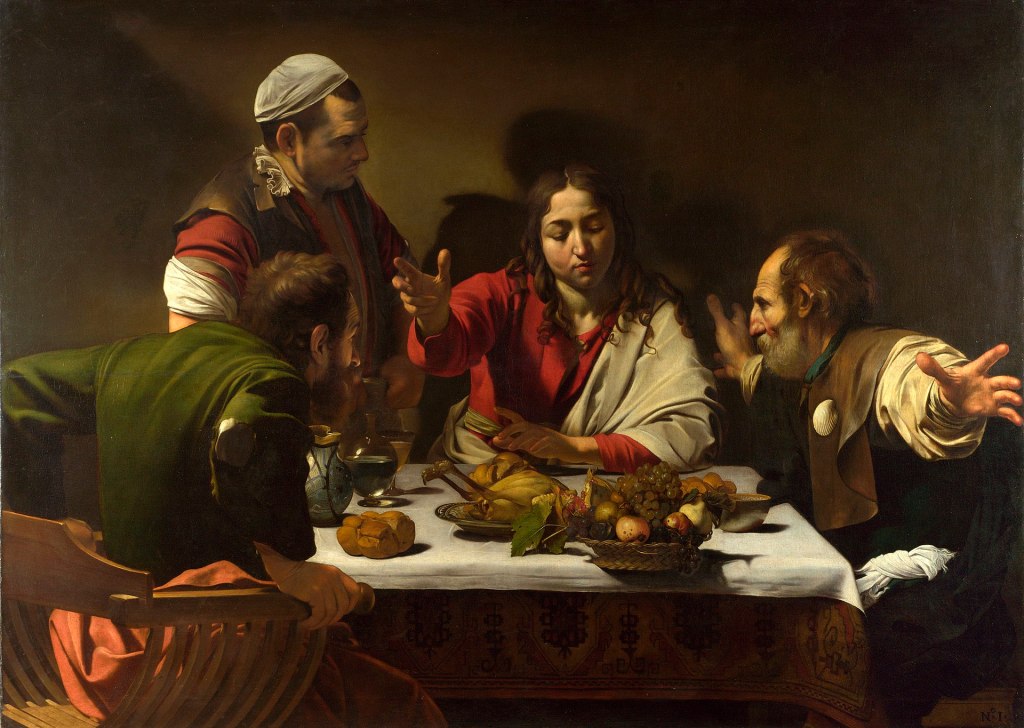
“Supper at Emmaus” by renowned painter Caravaggio from en.wikipedia.org. See the emotion depicted by Caravaggio with his trademark of masterful play of light and shadows. At the center is the Risen Lord blessing the bread that caught the two disciples who are seated in disbelief, one outstretching his arms and the others pushing back in his chair. The third character in the painting is the innkeeper unaware of the significance of the gesture of Jesus. It was at this instance that the two disciples recognized Christ as the traveling man with them to Emmaus.
Human transformation happens only in Christ, with Christ and through Christ in the Eucharist where we also experience a reversal of roles in our relationships with God and with others. Notice how the attitudes and perspectives of the two disciples changed when Jesus broke the bread. Remember it was the two disciples who invited Jesus inside to stay because it was getting dark, hosting a meal for him as their guest but that changed at the table: the two disciples ended up as guests of Jesus who merely joined them in their journey!
And it happened that, while he was with them at table, he took bread, said the blessing, broke it, and gave it to them. With that their eyes were opened and they recognized him, but he vanished from their sight. Then they said to each other, “Were not our hearts burning within us while he spoke to us on the way and opened the scriptures to us?” So they set out at once and returned to Jerusalem where they found gathered together the eleven and those with them who were saying, “The Lord has truly been raised and has appeared to Simon!” Then the two recounted what had taken place on the way and how he was made known to them in the breaking of the bread.
John 21:30-35
One thing I have found in life these past 25 years as a priest is that we can only realize and understand, even see the clearer and bigger picture of our life later after so many years of series of trials and tribulations, joys and celebrations. And often, what we see is the Lord, the companionship of Jesus Christ even in those times we were in sin and away from him. St. Peter said it so well in the second reading that we are in a “sojourning, realizing that you were ransomed from your futile conduct with the precious blood of Christ” (1 Pt. 1:17, 18, 19).
Photo by author, Sacred Heart Novitiate, Novaliches, QC, 20 March 2023.
Many times in life we feel as if we are really the captain of our ship, we direct everything, we control everything but it is actually Jesus. There is always Christ our companion in this journey of life, our true host and we are his guests who shared himself with us on the Cross so we can share in the mystery and victory of his Resurrection. In being one with us in our brokenness, Jesus immediately vanishes the moment we recognize him so we may keep on following him by changing course and direction in our lives.
In this time when people have lost interests in the Church, the Sacraments especially the Holy Eucharist, and the Scriptures along with prayers and devotions, we who are inside the church especially us priests are reminded of this important truth by Jesus, that he is the one in command, he is our host. We only share him in our co-journeyers in life, he is the one who opens our eyes, the one who effects transformation and changes within us. Not us.
Are we one with Jesus, especially in the Eucharist we manipulate so much with our many rituals and acts not necessary? See that the more we manipulate the Mass and other devotions, the more Christ disappears and persons especially priests become the focus.
In Emmaus, Jesus walked with the two disciples going the opposite direction to lead them back and never the other way around as it happens when we priests and volunteers are the ones who mislead people away from Jesus with our lack of warmth and charity for people like the unchurched.
Jesus is truest in the Eucharist when we touch people literally with our hands, when we get our hands dirty in taking care of the sick and needy, when we are truly present with them especially in their griefs, emptiness and sinfulness. That is when they experience, not just know that Jesus is real and true in the Eucharist when they first experience him in us his disciples, in our companionship and compassion with those suffering.
Nobody is perfect. As St. Peter had noted in the first reading, we are all responsible for the suffering and death of Jesus with our sinfulness; however, God’s love for us is far greater than our sins so that in our darkness and emptiness, we are able to see and have fulfillment in Jesus his Son. Amen. Have a blessed week!
Photo by author, Sacred Heart Novitiate, Novaliches, QC, 20 March 2023.












 lordmychef.com