Christ the King, the face of suffering

Lord My Chef Sunday Recipe for the Soul, 23 November 2025
Solemnity of Christ the King, Cycle C
2 Samuel 5:1-3 ><}}}}*> Colossians 1:12-20 ><}}}}*> Luke 23:35-43

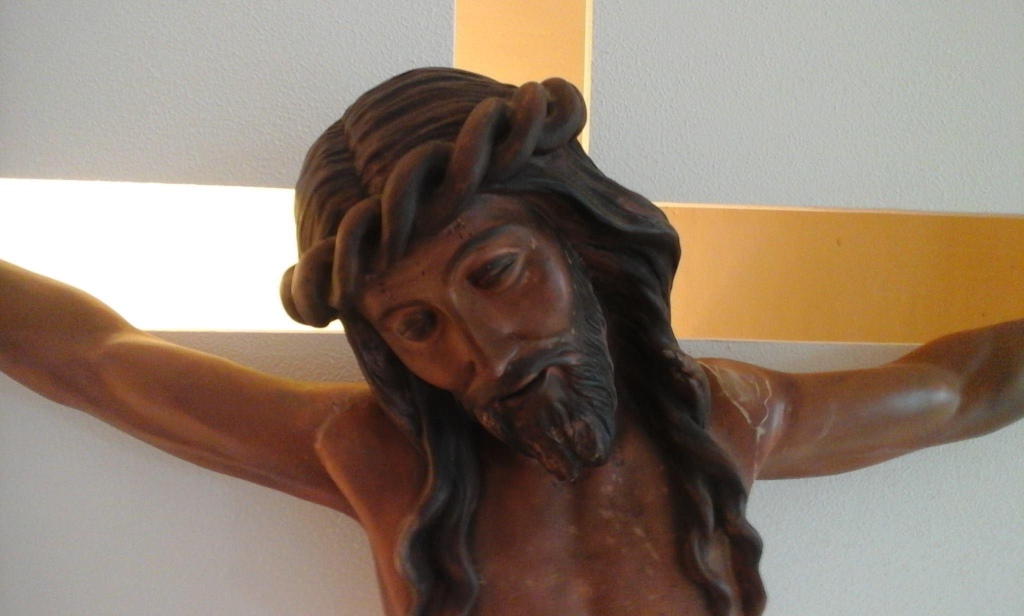
I was teasing our campus ministry head for communication last Tuesday after he had presented to me this announcement for our Christ the King celebration today. “Para namang malnourished si Jesus diyan,” I told Darwin as he scratched his head laughing during our meeting.

But, that evening after praying our gospel, I changed my mind the following Wednesday and told Darwin to go ahead with his original artwork because I have realized that the face of Christ the King is also the face of us suffering.

Photo by author, Holy Monday, 2025.

Are you not surprised that on this final Sunday of the liturgical year, we are not presented with an image of a victorious Jesus like that Cristo Rey found in every Catholic home but the gospel scene of Jesus suffering in excruciating pain there on the Cross on Good Friday?

Above him there was an inscription that read, “This is the King of the Jews.” Now one of the criminals hanging there reviled Jesus, saying, “Are you not the Christ? Save yourself and us.” The other, however, rebuking him, said in reply, “Have you no fear of God, for you are subject to the same condemnation? And indeed, we have been condemned justly, for the sentence we received corresponds to our crimes, but this man has done nothing criminal.” Then he said, “Jesus, remember me when you come into your kingdom.” He replied to him, “Amen, I say to you, today you will be with me in Paradise” (Luke 23:38-43).

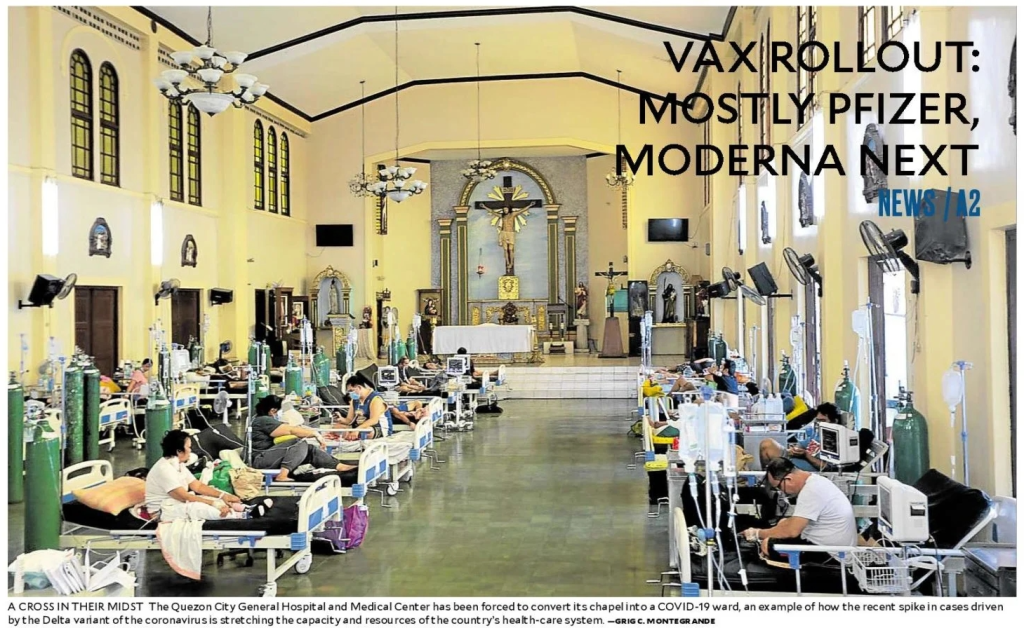
Photo by author, Chapel of St. Francis Xavier, Sacred Heart Novitiate, Quezon City, 2024.

On this Solemnity of Christ the King, St. Luke invites us for the last time we hear his gospel this year to look at the face and into the eyes of Jesus crucified.

What do you see and feel in him?

Ever wondered what the rulers and soldiers saw on the face of Jesus crucified that they sneered and jeered him from below? They were so filled with pride in finally putting into shame and silence Jesus who had always spoken the truth and exposed their lies and hypocrisies.

What do we see when people are put on the spot and shamed like Jesus crucified or like the woman caught committing adultery Jesus forgave and saved from being stoned by the angry crowd? So sad that in this age of social media, public trials and condemnation have become a hobby for many without even checking the accusations are true or not.

Let us move closer to Jesus on the Cross like those two thieves hanging at each of his side: what do you see and feel about him?

Why did the other thief join those below in deriding and insulting Jesus crucified? Now one of the criminals hanging there reviled Jesus, saying, “Are you not the Christ? Save yourself and us” (Lk.23:39).

Have you ever found yourself in the ER or waiting for your turn at the doctor’s clinic with other patients also in pain and suffering? How do you see the other patients and sick people like you? Is there in your mind any tinge of suspicion why or how they got sick? The best and the worst in us come out in such times when we are so down beside another suffering brother or sister.

Or, do we choose the path of humility and sincerity of Dimas, the good thief? What did he see in Jesus there on the Cross? The other, however, rebuking him, said in reply, “Have you no fear of God, for you are subject to the same condemnation? And indeed, we have been condemned justly, for the sentence we received corresponds to our crimes, but this man has done nothing criminal” (Lk.23:40-41).

Most likely, Dimas must have heard a lot about the teachings and healings by Jesus but he felt something so unique and liberating, so personal during those dark moments of excruciating pains when he finally recognized Christ his Savior, the only true King that is why he asked to be remembered in his kingdom!

Finally, somebody greater than him there beside him, saying nothing to judge nor condemn him nor irritate him like his fellow criminal at the other side. In recognizing Jesus, Dimas also found himself as truly human, weak and finite who can only be whole and complete – saved and redeemed – in Christ who chose to be there on the Cross with him exactly as St. Paul had written in our second reading.

He is before all thing, and in him all things hold together. He is the beginning, the firstborn from the dead, that in all things he himself might be preeminent. For in him all the fullness was pleased to dwell, and through him reconcile all things for him, making peace by the blood of his cross through him, whether those on earth or those in heaven (Colossians 1:17, 18-20).
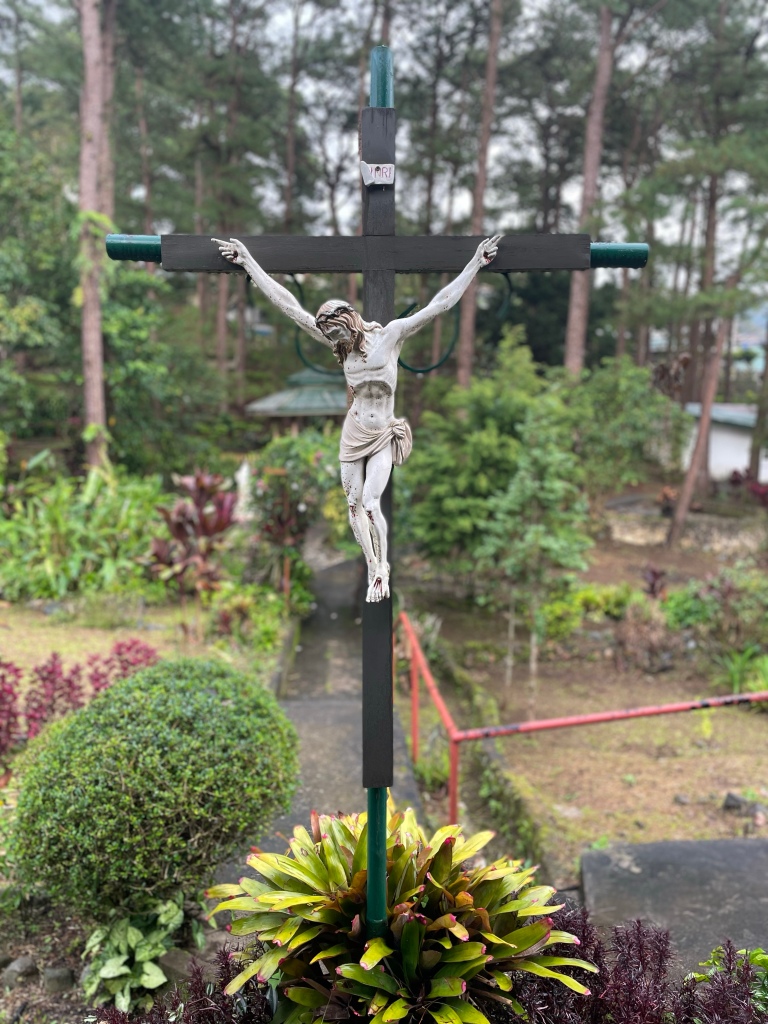
Photo by author, St. Scholastica Spirituality Center, Baguio City, August 2023.

Here we find the beauty of the Cross, of how God so perfect without any need to suffer and experience pain yet chose to go through it to express his solidarity and love for us humans.

It is on the cross when we are most able to identify and be one in Jesus Christ. That is why it is also on the Cross that we enter heaven with Jesus amid suffering and death. Jesus said today you shall be with me in Paradise – not later when we die or after three days at Easter. How lovely that Jesus never promised heaven when he was strong and freely moving around but when he was there on the cross, nailed and dying.

Jesus Christ is the King of the Universe not because of his powers and might but primarily of his being one of us in sufferings and death. It was the very feeling the tribes of Israel were telling David when they came to him in Hebron to reaffirm their allegiance to him as their king, “Here we are, your bone and your flesh” (2 Sm. 5:1).

The people we admire most are not always the best nor most powerful nor talented because often we envy them. On the other hand, we are more drawn with those down and burdened because we see in them our own brokenness, too, that it is part of life and of being human. That is why we easily empathize with those grieving or sad than with those happy or rejoicing.

Our humanity reaches its highest point and beauty when broken and weak as we realize our mortality and similarity with others in suffering needing for a Savior. We are most inhuman whenever we enjoy inflicting or causing pains on others or when rejoicing in their agonies. To proclaim Christ is the King of the Universe is to always see him in our sufferings and among those suffering too like us. Amen. A blessed week ahead of you!

What have you done?

The Lord Is My Chef Sunday Recipe for the Soul by Fr. Nicanor F. Lalog II
Solemnity of Our Lord Jesus, King of the Universe, 24 November 2024
Daniel 7:13-14 ><}}}}*> Revelation 1:5-8 ><}}}}*> John 18:33-37
Photo by author, Bohol Sea scene from Salum Dive Resort, Dauin, Negros Oriental, 10 November 2024.

We are now on the final Sunday of the year, the Solemnity of Jesus Christ, King of the Universe. Next Sunday we begin the Season of Advent, the official countdown to Christmas which is the birth of Jesus Christ, King of kings.

See how our Church calendar begins and ends each year in Jesus Christ’s eternal kingship as seen by Prophet Daniel in his vision (first reading); Christ’s coming to the world was not an addendum or a plan B of God because Jesus has been enthroned at His side, conferred with “dominion, glory, and kingship” (Dn. 7:14).

“Ecce Homo” painting by Vicente Juan Masip (1507-1579) from masterapollon.com

Jesus reiterated this in our gospel this Sunday from John’s account of His trial before Pilate, His first “face-to-face” with a representative of political power. According to St. John Paul II in an interview published in 1994 (Crossing the Threshold of Hope), this scene continues to happen when we, too, like Pilate put God on trial when we insist in doing what we perceive as right and true. Let’s try to enter this scene to unravel its many layers of truth about ourselves who are actually the ones in trial, not Jesus Christ.

Pilate said to Jesus, “Are you the King of the Jews?” Jesus answered, “Do you say this on your own or have others told you about me?” Pilate answered, “I am not a Jew, am I? Your own nation and the chief priests handed you over to me. What have you done?” Jesus answered, “My kingdom does not belong to this world…” So Pilate said to him, “Then you are a king?” Jesus answered, “You say I am a king, for this I was born and for this I came into the world, to testify to the truth. Everyone who belongs to the truth listens to my voice” (John 18:33-36, 37).

Photo by Ms. Ria De Vera, Christ the King procession during COVID, November 2020.

From the very start of His trial before Pilate, we find Jesus so “cool” – so sure of everything, actually the One in control of the trial despite the sarcasm of Pilate who, eventually, would be the one to give in to the penetrating truth of Christ.

In fact, we find here how Pilate was already inclined to the truth of Christ as the King as he later affirmed unconsciously when he wrote the inscription on the Cross, “Jesus the Nazorean, the King of the Jews” that the priests tried to edit but Pilate insisted, “what I have written, I have written” (cf. Jn.19:19-22).

Many times like Pilate, the more we try to justify our sins or inclinations to evil with our various excuses and alibis, the more we sink deeper into admitting the truth that Jesus Christ is King, that He is truth and good Himself. We imitate Pilate’s sarcasm even with God through others like our parents or elders, teachers, even friends who truly love us and care for us as we remain adamant with our wrong beliefs and points of view.

Photo by Mr. Joey Principe, Parish of St. Joseph the Worker, Jaro, Iloilo, 10 November 2024.

What really gave away Pilate – and us – in the process of our trial of Jesus was his final question which I love so much, “What have you done?”

Pilate was sincerely trying to know the truth about Jesus as he was evidently irritated with the case thrown to him by the priests and scribes. His asking Jesus “Are you the King of the Jews?” was a request for clarification as a Roman state official because the word “king” meant only one thing.

And here is the twist in our own days – it is the same question we unconsciously ask Jesus so often to clarify too!

How many times have we sought clarification on the kingship of Jesus especially in this modern time when we discuss divorce, abortion, same-sex marriage, and almost everything from clothes we wear to how we conduct ourselves in this modern time that has become so relative and permissive in morals?

Every time we put Jesus on trial when we insist on what we want and what we believe in, the Pilate within us question Jesus, what have you done? Let us count them… you may add .


"What have you done, Jesus?" 

You have forgiven our sins, Jesus,
giving us new chances in life daily;
You have saved us, Jesus, from many
instances when we felt so lost,
even gone that's why we are
still intact at this very moment in our lives;
You have consoled us, Jesus, in countless times
that made us to keep believing,
hoping, and trusting God and others;
You love us so much, Jesus, in ways
we can't believe nor understand
that's why we too keep on loving
despite the hurts and pains;
and the list goes on and on and on...
that makes You truly our King, Jesus!

Photo by author, Chapel of St. Francis Xavier, Sacred Heart Novitiate, Novaliches, QC, 20 March 2024.

See that when we remember everything Jesus had done to us, we also realize His being a King of different kind who never forced us to believe Him nor follow Him unlike the powerful people of the world.

Jesus as a King simply invites us gently and lovingly to come to Him to find rest and comfort when we are burdened in life. There were times when we have felt Jesus just closed His eyes to our many sins and imperfections, not even reminding us of our shameful selves like when He washed the dirty feet of His Apostles after their last supper.

Jesus never threatened us when we were in the height of our pride and stupidity and instead waited patiently for us to come home to Him like the prodigal son. He never locked us, allowing us to go and explore everything, standing by just in case we cross the point of no return.

Photo by author, St. Scholastica Retreat House, Baguio City, 2023.

Whatever Jesus had done to us, it is always good and comforting, beyond our expectations and imaginations like healing us of our every sickness, feeding us and clothing us when we were hungry and naked, even cleansed us when we were so dirty and untidy.

Therefore, this Sunday as we celebrate the Solemnity of Christ the King, let us cast off all our fears of Jesus taking away our perceived “kingdoms” like King Herod who ordered all infants and children killed on that first Christmas upon hearing the news of “the birth of the king of the Jews” (Mt. 2:2).

Jesus never said “My kingdom is not in this world” because His kingdom while not of this world is right here below on earth that is why John tells us in the second reading from his vision of the end of time, Jesus is coming again here on earth to take us to eternity. The Kingdom of Jesus is here in the world but not of this world; similarly, we are in this world but we are called not to be of this world for our true citizenship is in heaven.

This Sunday, Jesus is asking us in the most personal manner, what have I done to you that have kept you running away from Me? Most lovely of all is that Jesus never asked us what have we done to Him nor for Him… Let us pray:

Lord Jesus Christ,
my Lord and my God,
You have done so much
good to me and I have done
so little for You and for others;
reign in my heart so that I can
make others experience Your
loving kind of Kingship.
Amen.
From Facebook, 10 March 2024.

Christ the King, the Power to Love

The Lord Is My Chef Sunday Recipe for the Soul by Fr. Nicanor F. Lalog II
Solemnity of Our Lord Jesus, King of the Universe, Cycle A, 26 November 2023
Ezekiel 14:11-12, 15-17 ><}}}*> 1 Corinthians 15:20-26, 28 ><}}}*> Matthew 25:31-46
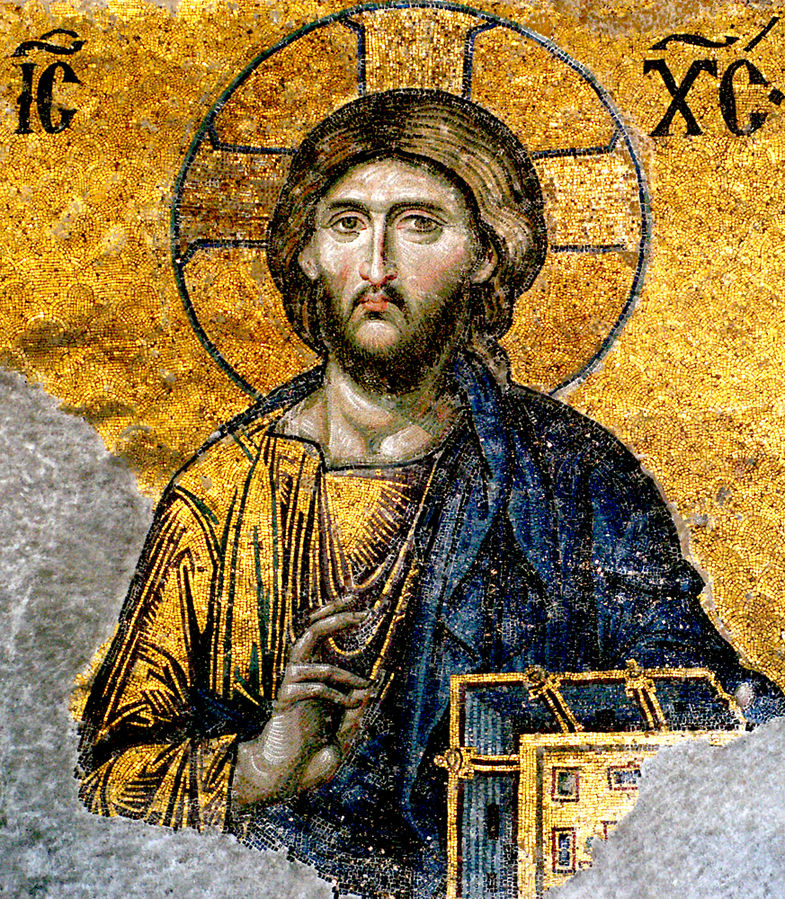
Detail of Jesus Christ at the Hagia Sophia in Istanbul, Turkey; photo from wikipedia.org.

We now come to the final Sunday celebration of the year, the Solemnity of Christ the King. See how we close the liturgical calendar celebrating Christ’s kingship, only to open it anew next Sunday with Advent Season in preparation for Christmas, the birth of the King of kings.

Far from the connotations of power and authority of kings of the world, Christ’s kingship is more pastoral in nature by taking its cue from the image of a shepherd prevalent in the ancient Middle Eastern culture. In fact, Jesus is more perfect than any shepherd being the Good Shepherd himself, the fulfillment of the promise of God we heard in the first reading who would come to personally tend his flock.

As I prayed over our readings of this Solemnity which is one of the youngest feasts we have in the church at less than 100 years old since its introduction in 1925 by Pope Pius XI, my thoughts wandered during that first year of the COVID-19 pandemic in 2020 when churches were closed and public Masses were prohibited.

Photo by Ms. Ria De Vera, Christ the King celebration in our former parish during pandemic, November 2020.

Right on the first Sunday when lockdown was imposed, we started our weekly “motorized procession” of the Blessed Sacrament around our former parish in Bulacan. I was so moved at the piety of our parishioners who knelt on the streets whenever we passed by.

We continued the practice until the Solemnity of Christ the King on that year of 2020. As usual, the people knelt on the streets when we passed by with the Blessed Sacrament. Even passengers of buses and other vehicles that chanced upon our procession paid homage to Jesus in the Blessed Sacrament.

Photo by Ms. Anne Ramos, March 2020.

Looking back to those days during my prayer periods this week, I realized that it was on that first year of the pandemic when we had the most meaningful liturgical celebrations in the Church when people felt intensely the need for God, when they clearly had Jesus alone as King and Lord.

Everyone’s faith was put to test as we were all gripped in fears and uncertainties with the deadly effects of COVID virus. Almost every family prayed the Rosary daily or nightly, so many trying to sneak inside churches to attend Mass celebrations. Of course, there were still some who went on their evil ways during those difficult times with the tokhang still implemented while those in power shamelessly grabbed the opportunity to rake in millions of pesos from corruption at the expense of the poor and suffering people.

When we recall that year 2020 of the pandemic, it was at that time we experienced Christ’s Second Coming as everyday was a judgment day, the end of the world — though not entirely fearful because it was also during that time we felt closest to God in Jesus our Lord and King!

Behind all those acts of kindness and goodness of the people are the immense love and mercy of God in Jesus Christ we have experienced in the recovery of infected loved ones or in the simple negative results of our COVID tests.

It was during those days when we experienced and felt Jesus truly present in us and among us that we simply radiated him on many occasions. That first year of the pandemic proved to many of us that being good, being kind, being helpful would never destroy nor diminish our person but had actually strengthened us as individuals and as a community. Recall how the “community pantry” caught the whole country on fire in just a matter of weeks when a young lady started it in their neighborhood at Maguinhawa Street, UP Village in Quezon City.

When families and communities banded together in love and kindness to help the poor and needy, the sick and those who have lost loved ones, the experience did not pulverize them but actually crystallized them as family or friends or neighbors. Walang nadurog sa pagdadamayan bagkus nabuo ang lahat ng nagtulungan!

That is the kingship of Jesus Christ. His power and authority were never meant to destroy us. In fact, when he came to us, he showed us and made us experience that the power and authority of his kingship is found not in force but in love and mercy that sadly many see these days as weaknesses.

Then the righteous will answer him and say, ‘Lord, when did we see you hungry and feed you, or thirsty and give you drink? When did we see you a stranger and welcome you, or naked and clothe you? When did we see you ill or in prison, and visit you?’ And the king will say to them in reply, ‘Amen, I say to you, whatever you did for one of these least brothers of mine, you did for me.’

Matthew 25:37-40
Photo by Ms. Marivic Tribiana, April 2020.

Christ the King today reminds us that true authority and power lead to humility which is more than being lowly but also of seeing the other person as another human in need, vulnerable and weak. Being humble is not only accepting our humanity but recognizing the humanity of those around us who need to be respected, loved and cared too.

Moreover, Christ the King reminds us that whatever authority and power we have is a sharing in God’s power and authority; hence, these must be used to help others, not lord over them. True power and authority lead to compassion, enabling us to feel the sufferings of others that move us to do something for them like Jesus.

This is what St. Paul reminds us in the second reading: the kingship of Jesus Christ – his power and authority – are a sharing in God. Unlike the worldly kings, Christ’s kingship is intimately related to the rule of God and ultimately subjected to the Father that is why it is transformative and performative to borrow one of Pope Benedict XVI’s favorite terms.

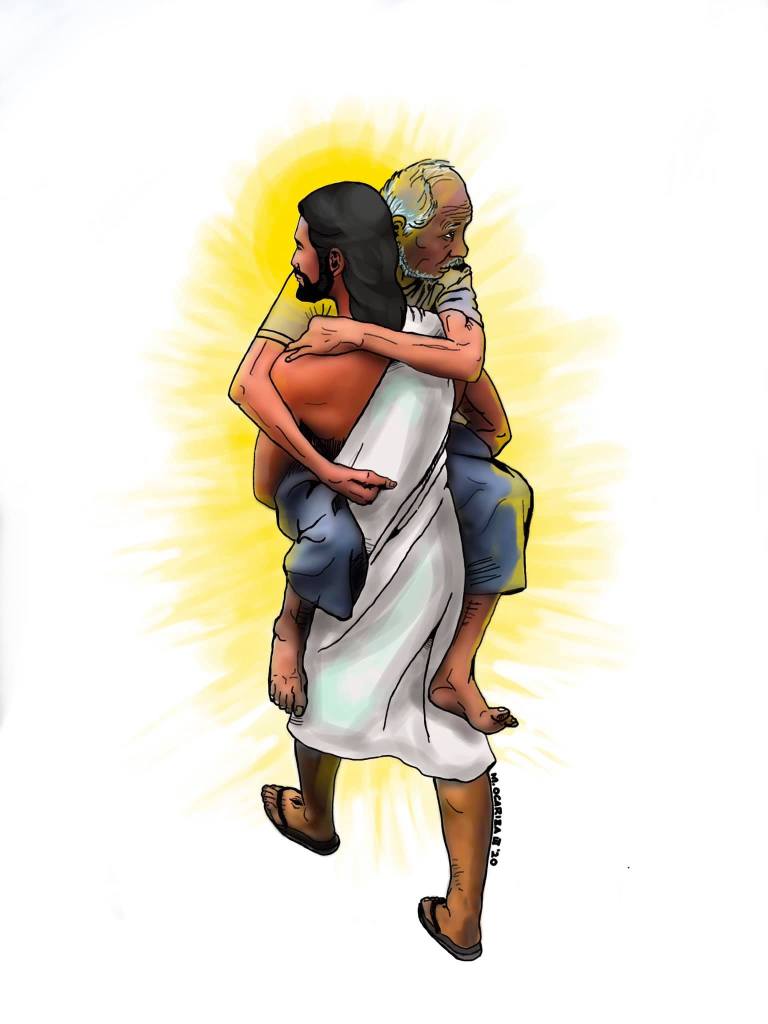
Artwork by Fr. Marc Ocariza based on Ms. Tribiana’s photo, April 2020.

The Kingship of Jesus Christ is the power to love, the most potent force in the universe. Yes, there are still evil and sin in the world today but soon, they shall be finally removed in Christ’s return as king. The present moment calls us to see Jesus in everyone we meet so that we act like him in loving service to others.

Notice how Jesus ended today his teachings at the temple area with a parable of the judgment of nations where people are separated according to their deeds. At the end of time, that is what Jesus will ask and judge us: how much have we loved like him? What have we done in this world, in life?

For us to better answer that, let us keep in mind what Jesus had done and still does to us and for us, of how much he loves us as our King and Protector. Recall the countless times he poured us his love for us. The moment we see his kingship in God’s way, then we follow Christ’s power and authority in the name of love and mercy, kindness and gentleness. Amen. Have a blessed week ahead!

Christmas is “manifesting” Christ

The Lord Is My Chef Christmas Recipe for the Soul by Fr. Nicanor F. Lalog II
Solemnity of the Epiphany of the Lord, 08 January 2023
Isaiah 60:1-6 ><}}}}*> Ephesians 3:2-3, 5-6 ><}}}}*> Matthew 2:1-12

Still, a blessed Christmas to everyone! As I have been telling you, let us continue greeting one another with a Merry Christmas for it is still the Christmas Season. Forget those happy new year greetings. Insist on Merry Christmas especially today when our celebration reminds us that Christmas is manifesting, showing Jesus Christ!

In fact, our celebration today is a high point of Christmas – even the Christmas in some parts of Europe, the US and even the Philippines. As a result, so much focus have been given on the magi that we forget the very essence of Epiphany is Jesus Christ – not the names of the magi nor their gifts nor their number.

From the Greek word epiphanes that means “manifestation”, the Epiphany of the Lord celebrates the discovery of Jesus by the foreigners known as magi from the East, learned men who were seeking the truth. In discovering Jesus, he was made known to all the world as the Savior and the King of Kings.

It is very interesting that what we have we heard proclaimed in the gospel today is the first conversation ever recorded by Matthew in his account that was uttered by the magi searching for Jesus:

When Jesus was born in Bethlehem of Judea, in the days of King Herod, behold, magi from the east arrived in Jerusalem, saying, “Where is the newborn king of the Jews? We saw his star at its rising and have come to do him homage.”

Matthew 2:1-2

That spoken question by the magi which stirred the whole of Jerusalem and bothered even King Herod – “Where is the newborn king of the Jews? – is a theme that resonates throughout Matthew’s gospel because in the Jewish thought, God is their only king. King for them is more than a political ruler but a manifestation or reflection of the face of God who alone is the king of the universe.

Matthew is teaching us something very important in recording the first conversation spoken in his gospel account was by the magi asking “where is the newborn king of the Jews” to remind us that every day, it is Jesus Christ whom we must seek first in our lives, in our prayers, especially in the scriptures.

Upon waking up in the morning, what is the very first thing you do – check on your cellphone for messages? turn on the radio or TV or laptop? What or who do you look for first thing in the morning? Do you at least light a candle on a little altar in your room to pray the Morning Offering or meditate on the scriptures of the day?

The person(s) or things that we immediately focus upon waking up indicate very much the persons or things that rule us daily. See how the magi from the east were seriously seeking Jesus Christ by daring to ask even King Herod about the newborn king of the Jews! Don’t you find that funny considering that the magi were regarded as men of wisdom but dared to inquire and trouble Herod with that question? Were they insulting Herod?

Definitely not. They were just sincerely searching for the true King of all!

That is the essential point in Matthew’s telling us of the magi searching for Jesus: the experts of Jerusalem knew where their newborn king was born based on the scriptures but they never bothered to look for him! Many times we are guilty like them when God is just in our head as an idea or a concept but not a reality in our life.

Next to assiduously seeking Christ, I love to reflect on that aspect of these wise men asking (with sarcasm?) King Herod where is the newborn king of the Jews: the magi must have noticed and felt King Herod was not a true king after all in the Jewish thought and tradition. They must have heard and personally proven upon meeting him that he was indeed ruthless and evil when he ordered the massacre of all boys two years old and below in Bethlehem and vicinity after they have left by going through a different route.

See how Matthew as well as the other gospel writers showed in their accounts the kindness and goodness of Jesus in healing the sick, forgiving the sinners, teaching and guiding the people who were so lost. When we pray the gospel accounts, what we find and experience is the immense love and mercy of God through Jesus Christ. He is rightly called the face of the unseen God – so gentle, so loving, so humble, so merciful. Because of Jesus, we were able to have a glimpse and experience of the great love of this God Jesus taught us to call as Father. That is why at his crucifixion we saw Jesus hailed as truly the “King of the Jews, truly the Son of God” (Mt. 27:37, 54) because he manifested God’s love and holiness, compassion and mercy, kindness and care.

This is the essence of the Epiphany. It was not just the discovery of Jesus by the magi nor his manifestation to all the nations but most of all, the making known of God’s goodness when like the magi who “departed for their country by another way” (Mt.2:12), we change our ways to become icons of Jesus Christ.

Don’t worry; it is a lifelong process. The magi saw Jesus as a child, not as an infant anymore because of their long journey. What matters is that like them, we never stop persevering in following and manifesting Jesus in our lives.

Perhaps this Sunday, we must examine ourselves in the way we deal with other people especially in our family and in our office or school, especially in our parish and community: do we reflect the Kingship of Jesus Christ or that of the world like Herod in our lives?

This Solemnity of the Epiphany is inviting us not just to seek Christ our King but most of all, to manifest Christ’s Kingship based on loving service to others. That is the best gift we can offer Jesus, our very gift of selves just like him. Let us pray:

Dearest Lord Jesus Christ:
let me search you always in my life,
in my prayers,
among the people I meet,
in the Sacraments;
most of all, 
let me manifest you Jesus
not only my words and thoughts
but most of all in my daily living,
in my actions
of loving service to others
especially the sick and lowly,
the marginalized and misunderstood;
let me be your light, O Lord,
to guide people in darkness of sin
and ignorance and indifference;
most of all, let me reveal like St. Paul
your mystery of love and salvation
to the many among us who have turned
away from you,
seeking to follow and imitate
King Herod in his ruthless ways
of control and too much pride.
Amen.

Christ our King & our overcoming of sin

The Lord Is My Chef Sunday Recipe for the Soul by Fr. Nicanor F. Lalog II
Solemnity of Christ the King, Cycle C, 20 November 2022
2 Samuel 5:1-3 ><000'> Colossians 1:12-20 ><000'> Luke 23:35-43
Painting of Christ’s Crucifixion by Tintoretto in 1565 portraying Jesus so “kingly”; interesting too were the people dressed as Venetians of his time as reminder that the evils that crucified Jesus continue in our own time. Photo from wikiart.org.

We now come to the final Sunday of our liturgical calendar called the Solemnity of Christ the King with a scene from his crucifixion on Good Friday. All these Sundays since June “When the days for Jesus’ being taken up were fulfilled, he resolutely determined to journey to Jerusalem” (Lk.9:51), Luke had been showing us that Christ’s crucifixion and glory are one just like John in his gospel account.

But the most beautiful part of our gospel on this solemn celebration is the fact that inasmuch as Jesus had clearly showed in all eternity his kingship while dying on the Cross, it is also right on the cross of sufferings as we strive to resist temptations of turning away from God that we proclaim Christ’s kingship. Please bear with me, my friends in reflecting Luke’s artistic presentation of Christ’s crucifixion as the expression of his kingship.

Notice how Jesus was “sneered, jeered, and reviled” at the cross, reminding us of the devil’s three temptations in the wilderness after his baptism at Jordan by John. After failing to tempt Jesus at the wilderness, Luke said the devil “departed from him for a time” (Lk.4:13), returning at his crucifixion as the most opportune time to test him.

In the wilderness, the temptations by the devil to Jesus applied very well with us too but, here on the cross, it was totally different. The devil himself was nowhere to be found because he was in the person of the rulers, the soldiers, and the thief! And that is how evil and sin have become so “powerful” in a pernicious manner among us when many times we are the devil in fact.

Here, we are reminded to be aware always of that opportune time when the devil attacks us when we see or face many sufferings in life by reflecting the last three temptations of Jesus on the Cross.

Photo by author, 2017, Sacred Heart Novitiate, Novaliches, QC.

The rulers sneered at Jesus and said, “He saved others, let him save himself if he is the chosen one, the Christ of God” (Lk.23:35).

Just like at the wilderness when the devil tempted Jesus with what he can do as the Son of God by changing stone into bread, at the Cross it was the same temptation hurled on him by the rulers of Israel, the priests and the scribes.

How sad that amid the many sufferings in the world today we contemptuously mock others like the poor for not working so hard to liberate themselves from poverty and hunger. There is the tendency among us blessed with better living conditions to look down at others without considering how they never have the same opportunities in life like us in having good education or a caring family or worse, not having the right connections.

The tragic part of this “sneering” by the rulers on Jesus is when we look at others as if they are not humans and persons like us who play gods knowing everything even who should live and who should die like in the systematic approach by state rulers to come up with what St. John Paul II called as “culture of death” in solving poverty and crime with abortions and capital punishments.

Let us examine our attitudes at the way we look at those going through sufferings and pains like sickness, poverty and other social ills we do not go through. Let us stop the mockeries of blaming them for their plight because many times like Jesus Christ, they were betrayed by loved ones like us, by the society, or even by the institutions meant to uplift them.

Photo by author, 2017.

Even the soldiers jeered at him. As they approached to offer him wine they called out, “If you are King of the Jews, save yourself.” Above him there was an inscription that read, “This is the King of the Jews” (Lk.23:36-38).

Sneering and jeering are both contemptuous mocking or insulting of others; they are both employed by those in vantage positions of power and control like the rulers of Israel. Going “higher” than the priests, the Roman soldiers sneered Jesus by rudely mocking him in loud voice. Sneering is a superfluous display of might, of superiority, of power. It is a kind of vanity that is why in the wilderness, the devil tempted Jesus to have all the kingdoms in the world for him to be famous and popular in exchange of worshipping him.

Sneering is something so prevalent these days in our use of the social media where we practically scream and insist on everyone to notice and recognize us, that we have “arrived” in having the latest and most expensive clothes, food, gadgets and everything. There is so much wild attitude among us like the soldiers at the cross when we use social media in too much talks, even of spewing foul languages and invectives as well as lies. Fake news and lies spread so fast and are sadly taken as true to the detriment of its victims because we have been so gullible for gossips and rumors too.

But the worst part of our imitation of the soldiers jeering at Jesus is when many of us are afflicted with this perversion called exhibitionism – from those salacious posts in TikTok to those “food porns” and too much display of everything about ourselves and of our loved ones. When do we get tired of all these selfies that have become so sickening that we do not realize of how we make known to everyone of our emptiness and lack of the more essential things like love and self-respect? Like the soldiers, the more we promote ourselves, the more we affirm the obvious that Jesus indeed is the King we needed most.

Photo by author, 2017.

Now one of the criminal hanging there reviled Jesus, saying, “Are you not the Christ? Save yourself and us” (Lk.23:39).

Reviling is also kind of of mocking others like sneering and jeering; however, to revile is the lowest kind because it is to insult somebody you are with in a same situation. To revile is the lack of recognition of one’s faults and sins that he would rather insult others like this thief traditionally identified as Hestas. In reviling Jesus while also hanging on the cross, Hestas went down deeper his lowest point as a convicted criminal when he had the gall to insult Jesus!

And that is the most unkind evil of all when we become so numb, so dense and stupid to even mock others we are with us in a similar situation. It happens daily when even we are in deep shit, we still see ourselves cleaner and better than others! Just read or watch the news about our politicians.

In the wilderness, the final temptation of the devil to Jesus was to jump from the top of the temple because his angels would not let him fall and even touch ground; here at the cross, Hestas saw himself no different from Jesus, feeling so entitled to be liberated. Many times, this is the problem why evil continues among us: when people from below are promoted to higher positions, they forget their roots that they also forget to fix the problems of inequalities and injustices down below where they came from. The key is to always remember. Like Dimas, the good thief.

Photo by author, 2017.

The other, however, rebuking him, said in reply, “Have you no fear of God, for you are subject to the same condemnation? And indeed, we have been condemned justly, for the sentence we received corresponds to our crimes, but this man has done nothing criminal.” Then he said, “Jesus, remember me when you come into your kingdom.” He replied to him, “Amen, I say to you, today you will be with me in Paradise” (Lk.23:40-4).

See how Luke inserted here the fourth verb “to rebuke” to break the series of sneering, jeering, and reviling of Jesus. Like Dimas, we have to strive in breaking the cycle and series of evil especially in this time.

To rebuke means to express sharp disapproval. Imagine Dimas contradicting Hestas and even the rulers and soldiers as well by defending Jesus Christ while hanging there on the cross.

How sad when we remain silent, when we just walk away from people sneering, jeering and reviling Jesus in those who suffer in life because we are afraid to make a stand for what is true and good, what is right and just. How ironic that another thief hanging on the cross was the only one who made a stand for Jesus on that Good Friday along with the Mary and the beloved disciple below.

Every time we make a stand for life and dignity of every person, when we stand for what is true, right and just, that is when we imitate the tribes of Israel in the first reading coming to David to pledge their loyalty and allegiance to him as their king.

When we submit ourselves to Jesus Christ as our only King to be obeyed and followed, that is when our celebration today becomes a daily reality.

That is when we also earn heaven right on the Cross of our sufferings like Dimas when we “remember” Jesus.

Normally in the whole Bible, it is God who remembers. People always forget. When we sin, we forget consciously and unconsciously God and all the good things he had done to us. We forget others too.

There on the Cross, see the reversals of roles Luke has presented so beautifully, from the devil replaced by the rulers, the soldiers and the other thief; and now Dimas sort of assuming God’s role who remembered everything and everyone, especially Jesus our Savior. Dimas remembered what St. Paul expressed to the Colossians that Jesus is Lord in whom, with whom and through whom everything was created and renewed because he is the Christ!

From Google.

The word “remember” literally means to make member or part again, that is, “re” + “member”.

When we remember somebody, we make that person present with us again.

In asking Jesus to remember him when he comes into his kingdom, Dimas was assured that right now as he remembered everything including his sins, he already becomes a member, a part of his kingdom.

May we not forget and always remember Jesus and others always to experience Paradise even when we are on the cross. Amen. Have a blessed week ahead!

Any World (That I’m Welcome To) by Steely Dan (1975)

The Lord Is My Chef Sunday Music by Fr. Nick F. Lalog II, 21 November 2021
Photo by author, Singapore, 2018.

Please suspend any judgment yet for our choice of music this Sunday: I have waited so long for this inspiration to come in my prayers since we started this blog on music linked with the gospel.

Yes, I have always been a big fan – a Danhead – of Steely Dan since my elementary days in the mid-70’s and thanks to YouTube and the internet, the more I have come to love their music now that I am a priest!

Though I must confess that I have never learned nor fully understood their lyrics until now, I have always been faithfully in love with their music that is brusque and sophisticated at the same time yet charming and mysterious.

Just Google the meaning of Steely Dan, the band is essentially the duo of the late Walter Becker and Donald Fagen whose ability to gather the best musicians in itself is a stroke of genius.

Next to prayers, Steely Dan music has been my best antidote against all the blues, worries and fears since this pandemic began last year. And when burdens are so heavy that I feel so down, this is the Steely Dan tune I liked most at this time as it spoke so well exactly how I would always feel:

If I had my way
I would move to another lifetime
I’d quit my job
Ride the train through the misty nighttime
I’ll be ready when my feet touch ground
Wherever I come down
And if the folks will have me
Then they’ll have me

Any world that I’m welcome to
Is better than the one I come from

From their album Katy Lied released in 1975, Any World (That I’m Welcome To) speaks so well of our longing to go to another world where everything fits us right — the kind of feeling we tend to have when our plans do not happen, when everything seems to be wrong and out of order.

Like all their songs, Any World is loaded with philosophical musings by Becker and Fagen that words could not sufficiently express and that is why they always have to improvise and innovate in their music and instrumentations that sound so sublime, filled with enigma.

But, where is Jesus Christ and our celebration today of Christ the King in this music which many of my elders used to frown when I was growing up (and discerning my vocation)?

The inspiration came to me while praying on the first reading, on the “vision” of the prophet Daniel of the “Son of man” or Savior God sent to save us, Jesus Christ. Instantly, I remembered the last stanza of this song:

I think I’ll go to the park
Watch the children playing
Perhaps I’ll find in my head
What my heart is saying
A vision of a child returning
A kingdom where the sky is burning
Honey I will be there
Yes I’ll be there

Any world that I’m welcome to
Is better than the one I come from

And when we try visualize the gospel from John of the trial of Jesus before Pilate, the more we wish we are in any world where we are welcomed to! How ironic when we continue to put God on trial, always questioning him for all our woes, doubting his love and presence, his kingship, his very person in Jesus Christ (https://lordmychef.com/2021/11/20/jesus-truly-our-king/).

And that is where I find the genius and “spirituality” of Becker and Fagen: their music like Any World not only tells us of our deep longings but also at the same time of our convictions that there is something better, something good coming despite all the problems and darkness we have in life.

Yes, it will be pushing too hard to speak of faith and religion with Steely Dan music but, as I have cautioned you at the start, suspend any judgment and get the feel of Becker and Fagen in the second stanza of this great song:

I can hear your words
When you speak of what you are and have seen
I can see your hand
Reaching out through a shining daydream
Where the days and nights are not the same
Captured happy in a picture frame
Honey I will be there
Yes I’ll be there

Any world that I’m welcome to
Is better than the one I come from

Who else can understand us so well, who can see everything in us and most of all would be there? That must be Jesus, truly our King who died for us to make this a better world for us!

Have a blessed Sunday!

*We have no intentions of infringing into the copyrights of this music and its uploader except to share its beauty and listening pleasure.

From YouTube.com.

Jesus, truly our King

The Lord Is My Chef Sunday Recipe for the Soul by Fr. Nicanor F. Lalog II
Solemnity of Our Lord Jesus, King of the Universe, 21 November 2021
Daniel 7:13-14 ><]]]]'> Revelation 1:5-8 ><]]]]'> John 18:33-37
Photo by GMA-7’s Mr. Raffy Tima, 07 November 2021.

We now come to the final Sunday of our liturgical calendar, leading us to our “new year” next Sunday with the Season of Advent. See how we in the Church begin and end every liturgical year: in the four Sundays of Advent we prepare the coming of Jesus the “King of kings” and now we close the year with the Solemnity of Christ the King.

But despite this emphasis of our celebrations on the kingship of Jesus, many people still refuse to recognize him as King while more others are not clear yet of his kind of kingship. Until now, the same scene of Jesus being tried by Pilate continues to happen when we put Christ on trial, questioning him if he were truly a king.

Pilate said to Jesus, “Are you the King of the Jews?” Jesus answered, “Do you say this on your own or have others told you about me?” Pilate answered, “I am not a Jew, am I? Your own nation and the chief priests handed you over to me. What have you done?” Jesus answered, “My kingdom does not belong to this world…”

John 18:33-36
“Ecce Homo” painting by Murillo from commons.wikimedia.org.

So many times in life, we keep asking God with many questions but we cannot take his answers. Instead of being contented with what he tells us, we even feel slighted when it is God who wishes to clarify our questions.

Jesus asked Pilate whether his question was really his own or due to others’ perception because to recognize Jesus as King is ultimately to recognize his very person as the Son of God, true God and true man who became like us so we may become like him.

Every Sunday this year, Mark (and John for six weeks) step by step presented to us like an unfolding the identity of Jesus who “spoke with authority” unlike the scribes and priests of his time, mighty in power and in deeds who could command the sea and the winds, heal the sick and bring back to life the dead. This Sunday, all questions by the disciples and the people “who is this man” are answered with finality by Jesus himself.

Photo by author, Chapel of St. John at Cana, Galilee, 2019.

Evidently in our readings and in our own lives, we have experienced Jesus always in control, truly a king in total command especially in hopeless situations like when there was a great crowd with just a handful of bread or when they were caught in a violent storm in the middle of the sea.

Like the Prophet Daniel and the beloved disciple John in the first two readings, we need to have their conviction in God’s very person first.

Daniel lived at the time of severe trials when King Antiochus of Greece invaded Israel, desecrated the Temple of Jerusalem, and killed so many Jews who refused to worship idols and eat pork. It was the topic last week’s daily first readings from the Book of Maccabees.

Despite those very difficult times, Daniel saw in his vision his very conviction of the coming of God’s Messiah called “Son of man” – the title Jesus adopted top himself – who would deliver Israel from their enemies with his “everlasting dominion that shall not be taken away; his kingship shall not be destroyed” (Dn. 7:14).

In a similar way, John expressed his conviction and faith in God through Jesus Christ in his vision of the Lord’s “coming amid the clouds…even those who pierced him”, calling him “the Alpha and the Omega, the one who and who was and who is to come, the almighty” (Rev.1:7, 8).

In both visions by the prophets who not only saw and spoke the words of God but most of all, lived out his very words that they made God’s will happened, there is no doubt of the kingship of Jesus Christ as the God of history, its origin and final destination. Both Daniel and John were convinced of the very person of God, of the One who has the final say in this life through Jesus Christ and whose powers reign supreme from the past to the present and into the future.

And so, never lose hope in life and its various aspects, from the simplest to the most complex. There is nothing that God cannot prevail upon for he got us all in his hands. Most of all, Jesus had triumphed over death and sin. Let us have that faith and conviction in him.

But there is still something deeper in that trial of Jesus by Pilate we also repeat in our own time: it reveals not only the tensions about the spiritual and material realms, of the kingdom of God and of the kingdom of men but also of our own self-identity.

So Pilate said to him, “Then you are a king?” Jesus answered, “You say I am a king. For this I was born and for this I came into the world, to testify to the truth. Everyone who belongs to the truth listens to my voice.”

John 18:37
Photo by author, Chapel of the Holy Family, Sacred Heart Spirituality Center, Novaliches, QC, 2016.

At the crux of the trial of Jesus – then and now – is man’s usurpation of power as “king” of the world, as captain of his ship and master of his fate, of his obsession to break free from God, crowning himself as the king of the world. It is a question that boils down to issues with our own identity.

Notice the “irritation” of Pilate with the question of Jesus, trying to separate and distance himself from Jesus, as if he was different, not one of them but immediately in the course of their conversation, Pilate himself would conclude that “then, you are a king” – a self indictment to himself that also answered his question to Jesus!

Here is the irony, the twist in our pursuit to assert our very selves as the one in charge in life, in this world like Pilate when we fall into our own traps against God. The more we run away from him, the more we separate ourselves from him and refuse to do anything with him, eventually we swallow our own pride before God, confessing that indeed, he is the Boss, the one in charge.

And that is the truth, something inherent in us, something we cannot shrug off and deny.

Jesus is our King because he has made us into his kingdom, the very reason he was born and came into the world, to testify to this truth.

Truth in the bible means the path to follow. And that is who Jesus is, the way because he is the truth and the life (Jn.4:16). Without him, we are nothing. And the path he shows us is the path of the Cross which he had repeatedly explained to us these last two months.

“Losing one’s head/self in prayer”, photo by GMA7 News Ms. JJ Jimeno, 2019.

In this Solemnity of Christ the King, Jesus reminds us of this basic truth we always evade, of how he invites us to elevate or “level up” our lives and existence in him through the Cross. The sooner we accept and embrace his Cross, the sooner we experience his kingship and great power over our lives.

The main stumbling block why people cannot accept or are confused that Jesus Christ is our King is our refusal to accept or denial of the path of the Cross of Jesus. Power in the world is always equated with force and prestige, in the ability to dominate and subdue others.

How amazing, how wonderful to see our almighty and powerful King took the path of powerlessness to show us his immense power. Let it be a reminder to each one of us to imitate and follow that path. Most of all, to never lose hope especially at this time when so many fake kings and wannabe kings abound, making all promises without having proven anything at all and worst, lacking the moral integrity to lead.

It is now in our very hands, if we are truly the followers of Christ the King that “we make his kingdom come and his will be done here on earth like in heaven” by taking the decisive steps to witness his Cross and sufferings by standing and abiding by his very truth. Amen.

Have a blessed week ahead!

From inquirer.net,20 August 2021.

Beloved children of God led by the Good Shepherd

The Lord Is My Chef Sunday Recipe for the Soul by Fr. Nicanor F. Lalog II
Fourth Sunday In Easter, Good Shepherd Sunday and 
World Day of Prayer for Vocations, 25 April 2021
Acts 4:8-12  ><)))">  1 John 3:1-2  ><)))">  John 10:11-18

After listening to the Easter stories by John and Luke these past three weeks, we are now initiated into the implications of Christ’s Resurrection as the Father’s beloved children belonging to him led by Jesus our Good Shepherd.

Jesus said:
"I am the good shepherd,
and I know mine and mine know me,
just as the Father knows me
and I know the Father; 
and I will lay down my life for the sheep."
(John 10:14-15)
Photo by Dr. Mylene A. Santos, MD, March 2021.

Image of shepherd pasturing the weak

Since Easter we have been reflecting on Jesus as our Lord and Savior who comes as our invisible guest in almost every aspect of our lives especially in the Holy Eucharist where he appears, speaks and shares meal with us despite the lockdowns due to COVID-19 pandemic.

In our country where the sheep is only beginning to be known as an excellent food, better than pork and beef especially Abes’s lamb adobo, the image of the shepherd is hardly known, even irrelevant for many especially for those in urban areas.

But, it is important that we try to bridge this gap even a little to appreciate and understand Jesus Christ’s words this Sunday being the Good Shepherd.

One very important aspect we have to keep in mind with the imagery of a shepherd in the Near East region where Israel is located is its symbolism of the relationship between the king and his subjects. Pasturing sheep was clearly an image of the task of every king in the region in ancient times not only in Israel but even in the pagan kingdoms of Babylonia, Assyria, and Sumer. This is the reason we find books in the Old Testament teeming with many references to God as the true king and shepherd of Israel, taking care of the people, leading them in green pastures and clear waters.

When the kings including the priests of Israel abused their roles, forgetting their mission to pasture especially the weak and the poor as they turned to pagan gods like Baal, God became so angry with them that he vowed to come himself to shepherd his flock fulfilled in the coming of Jesus Christ.

This decadence of the image of the shepherd continued in the time of Christ when shepherds were looked down and typecast as thieves and trouble-makers who belonged to the lowest level of the poor who could not even afford to attend temple worship due to their poverty.

Here we find the stage perfectly set for Jesus to restore and fulfill this degeneration of the beautiful and noble image of the shepherd while teaching after his healing of the man born blind that created a very big stir among peoples and temple authorities at that time in Jerusalem.


Knowing and belonging are interrelated:  
one knows because he/she owns like when we claim things as ours.  
When we possess, we know because we have.  
But, Jesus is speaking here not of owning and taking control an object or any material thing.  
Jesus and the Father know each other as they belong to each other as one 
in a perfect relationship but never because they "own" nor "possess" one another.

Photo by Mr. Lorenzo Atienza, Malolos Cathedral, 12 June 2019.

Knowing God, belonging to God

When Jesus declared “I am the good shepherd”, notice that he goes beyond simile: he did not say “I am like a good shepherd” but declares emphatically, repeating thrice the words “I am the good shepherd” – twice in verse 11, and again in verse 14.

His knowledge of the sheep is not from casual nor in-depth observations and study of the sheep but from a totally different and transcendent order when he declared, “I know mine and mine know me, just as the Father knows me and I know the Father”.

Here, Jesus is clearly re-establishing our lost relationship with God as our Father and we his children that is emphasized in our second reading, “Beloved: See what love the Father has bestowed on us that we may be called the children of God. Yet so we are” (1Jn.3:1).

Unlike the monarchs of the world, Christ our King is the Good Shepherd because his relationship with us is based on love and concern especially for the weak and the lowly as the Father had intended since the beginning! Jesus is the good shepherd because his is a relationship of unity in God as our Father.

Knowing implies relationship because it connotes belonging.

Knowing and belonging are interrelated: one knows because he/she owns like when we claim things as ours. When we possess, we know because we have. But, Jesus is speaking here not of owning and taking control an object or any material thing. Jesus and the Father knows each other as they belong to each other as one in a perfect relationship but never because they “own” nor “possess” one another.

To illustrate, we belong to our parents, we belong to a church or a community, we belong to an organization. There is always a degree of knowledge in every belonging not because we are possessed or owned in the same way we own our house, our car, or any gadget for that matter. Owning, possessing or having persons and even pets are of higher degree of knowing and belonging, of something deeper about invisible links that tie us with someone we believe “belongs” to us.

Is it not funny that sometimes we claim how our possessions also seem to be like persons that try to get to know whoever is using it as in “nangingilala” wherein if somebody borrows our car or any thing, sometimes they do not function well? And we say, maybe because the car or the thing did not know who’s driving or using it!

Pope Francis last year mentioned a very beautiful trait of St. Joseph that speaks so well about this very positive kind of “possession”, of knowing and belonging like his relationship with Jesus Christ and Mary. The Pope described it as St. Joseph’s being “a father in the shadows”.

In his relationship to Jesus, Joseph was the earthly shadow of the heavenly Father: he watched over him and protected him, never leaving him to go his own way… Being a father entails introducing children to life and reality. Not holding them back, being overprotective or possessive, but rather making them capable of deciding for themselves, enjoying freedom and exploring new possibilities. Perhaps for this reason, Joseph is traditionally called a “most chaste” father. That title is not simply a sign of affection, but the summation of an attitude that is the opposite of possessiveness. Chastity is freedom from possessiveness in every sphere of one’s life. Only when love is chaste, is it truly love. A possessive love ultimately becomes dangerous: it imprisons, constricts and makes for misery. God himself loved humanity with a chaste love; he left us free even to go astray and set ourselves against him. The logic of love is always the logic of freedom, and Joseph knew how to love with extraordinary freedom. He never made himself the centre of things. He did not think of himself, but focused instead on the lives of Mary and Jesus.

Pope Francis, “Patris Corde” (08 December 2020), #7

What a beautiful way of describing this sense of knowing and belonging – like St. Joseph and very much like Jesus our Good Shepherd!

See that Jesus never forces us into being one with him nor in following him. He simply calls us, inviting us to follow him, to be one with him. That is why we heard him also telling us today that he has “other sheep that do not belong to this fold” that he must lead and care too.

Jesus is the shadow of the Father who leads us back to him as his beloved children. He does not coerce us nor demands us even though he “owns” us as his sheep. In his Passion, Death, and Resurrection, Jesus had shown us how he had become the foundation, the cornerstone we have always rejected in many instances in our lives now pasturing us back to greener pastures.

To know and to belong in the light of Jesus as the Good Shepherd is for us to regard one another as a family, as a brother and a sister we love and trust, allowing them to be free and faithful to God and one another instead of manipulating people like what some parents do to their children or dictators in the government and military.


Knowing and belonging like the Good Shepherd 
is less of controls and more of trust with one another 
because you see them as brothers and sisters in Christ 
perfectly expressed in the Community Pantry dictum, 
"magbigay ayon sa kakayahan, kumuha batay sa pangangailangan" 
(give whatever you can, take only what you need).

Knowing and belonging like the Good Shepherd is less of controls and more of trust with one another because you see them as brothers and sisters in Christ perfectly expressed in the Community Pantry dictum, “magbigay ayon sa kakayahan, kumuha batay sa pangangailangan” (give whatever you can, take only what you need).

What Ms. Ana Patricia Non and her followers did was become like Jesus the Good Shepherd when she said this community pantry is “not about charity but more of mutuality like helping the needy” which is about seeing each other as a brother and a sister belonging to one family under God our Father. Charity happens where there is first a relationship of persons respecting one another.

No wonder, she had perfectly called her effort as “community pantry” because every home has a pantry where everyone goes when hungry. And what is more, her community pantry has become a steady source of kindness and tenderness we have missed so much during this pandemic!

How beautiful that a shepherdess from Maginhawa Street led us to realize that we are one big family – brothers and sisters in Jesus Christ and beloved children of the loving and merciful Father in heaven.

May this be the start of a beautiful journey for our country when we see more our belonging to one nation, one country we collectively “own” and therefore, we must ensure its bright future by seeing each other in the light of Christ our Good Shepherd – not us possessions to be manipulated or even sold for personal interests alone.

Have a blessed week ahead!

Posted by Jean Palma on Facebook, 18 April 2021 with the caption: “All these community pantries in four days, and counting. What a powerful movement.” #CommunityPantry

Christ the King: never imposing, always inviting

The Lord Is My Chef Sunday Recipe for the Soul by Fr. Nicanor F. Lalog II
Solemnity of Jesus, King of the Universe, 22 November 2020
Ezekiel 14:11-12, 15-17  >><)))*>  1Corinthians 15:20-26, 28  >><)))*>  Matthew 25:31-46
Photo by author, Chapel of the Graduate School of Theology, ICMAS, Guiguinto, Bulacan, 11 November 2020.

We Filipinos have a saying – sometimes taken as a riddle (bugtong) – that goes, “Utos ng hari, hindi mababali” that literally means the command of the king is unbreakable, always absolute.

Kings exist primarily to unite and help the people especially the weak, the suffering, and the voiceless; hence, kings are portrayed with strong bodies as well as sound minds to render justice. But, as we all know, power corrupts people that once kings like politicians have tasted the sweet elixir of authority and fame, everyone and everything is forgotten except one’s self interests.

And that has always been how kingship is seen based on power and supremacy, always imposing and domineering, insisting in their “power trips” that lead to divisions among peoples even nations that eventually, instead of serving others, they become the ones being served.

Exactly the opposite with the kingship of Jesus Christ that is not based on human power and authority but on the loving service of others, especially the weak and the marginalized. It was a radical move, of moving back to the very roots of kingship by God himself as prophesied by Ezekiel in the first reading. No wonder in Israel, kingship is closely seen in the imagery of shepherding.

Thus says the Lord God: I myself will look after and tend my sheep. As a shepherd tends his flock when he finds himself among his scattered sheep, so I will tend my sheep. I will rescue them… I will pasture them… I will give them rest… The lost I will seek out, the strayed I will bring back, the injured I will bind up, the sick I will heal…

Ezekiel 34: 11-12, 16

This is the essence of our celebration today of the Solemnity of Christ the King: Jesus is in the other and within us, the Emmanuel or “God-is-with-us” that the greatest honor we can give him as our King is to lovingly serve him in one another. See our many images in art of him suffering and dying than regal as a king because Jesus is truly one with us in our most difficult and trying times. That is why he is the only one truly a king!

“Ecce Homo” by Murillo, from wikipediacommons.com.

Christ the King grounds us to God and others again

When Pope Pius XI instituted this feast in 1925, the world was going through a lot of changes in every sphere of human life – for better and for worst – following the many advances in science and technology as well as in thoughts and ideas.

This continues to this day in our own age with its own twists that are more pernicious with everyone trying to reign supreme as kings and queens in life no longer with a scepter that was like a “magic wand” to get everything done but with the cellphones that can either build or destroy anyone with the slightest touch of ones’s fingers!

How sad that as the world had shrunken into a global community interconnected by modern means of communications invented to bring us all together, we have actually grown more apart from each other, polarizing us even further with every color of the rainbow signifying so many groups, agenda, and beliefs.

Worst of all, with these modern means of communications, we have become more focused with gadgets and things than with persons.

What an irony that we can be so close with those miles apart from us yet we hardly notice nor even recognize the persons seated next to us. Long before COVID-19, we have always been socially distant from each other, have always failed to appreciate or even look at the warmth and beauty of the human face now covered with a mask because we have always been “washing our hands”, escaping from our responsibilities as our brothers and sisters’ keepers.

See how in our readings this Sunday Jesus Christ is reminding us to go back to our solid grounding in God who dwells in each one of us.

Jesus said to his disciples: “When the Son of Man comes in his glory, and all the angels with him, he will sit upon his glorious throne, and all the nations will be assembled before him. And he will separate them from one another, as a shepherd separates the sheep from the goats.

Matthew 25:31-32
Photo by John Bonding, Architecture&Design Magazine, 25 May 2019 via Facebook.

I have always loved this photo above that speaks perfectly well of our situation today, of how most of us are missing so much in life when everything is “media-ted” that we no longer touch ground as if we are “floating on air” with everything reduced to a mere show or “palabas” that must be caught, kept, and shared in Instagrams instead of being enjoyed in our collective memories.

More tragic is the fact how most of these are often fake and not true at all, leaving many of us empty, even alienated that have resulted in many instances of depressions and suicides.

What an irony when everybody is claiming to be their own king or queen and master, of being free from religions and God, the more they have become unfree and empty! The more our egos and self-interests reign, the more chaotic we have become with peace and fulfillment most elusive.

When Jesus is our only King reigning in our hearts and relationships, that is when we find fulfillment in our lives as we discover our rootedness in God and interconnectedness with others.

When Jesus spoke of separating the goats and the sheep, we are reminded of how these animals can sometimes be indistinguishable — exactly like when we fail to recognize our loved ones and persons nearest to us.

And true enough, even Jesus has become indistinguishable among us right in our homes and most of all, among the suffering people like the hungry and thirsty, the strangers and homeless, the sick, the poor we have stripped not only of their clothings but also of their dignity as persons, and those imprisoned.

Recall what Jesus told Pilate at his trial, “You say I am a king. For this I was born and for this I came into the world to testify to the truth…” (Jn.18:37) that “God is love, and whoever remains in love remains in God and God in him” (1Jn.4:16).

All this comes to full circle today as Jesus tells us, “Amen, I say to you, whatever you did for one of these least brothers of mine, you did for me” (Mt.25:40) and “what you did not do for one of these least ones, you did not do for me” (Mt.25:45).

Jesus will surely come again

As we have reflected these past two Sundays, Jesus is coming again at the end of time to judge us if we have been faithful and loving to him through others. He himself assures us of his return as he declared When the Son of Man comes in his glory” and not the conditional If the Son of Man comes”.

The key is not to know the when and how but to be vigilant, of being awake, always finding Jesus our king with the least among us which is the truest sense of kingship — never imposed on others but always recognized and imitated. In Filipino, “sinusunod, sinusundan at tinutularan; hindi nasusunod”.

St. Paul reminds us anew in the second reading how Jesus Christ’s death on the Cross had decisively won over sin and death; but, he is coming again to fully establish his kingship when he vanishes sin and death completely to pave the way for new heaven and new earth.

When he comes again, will anyone recognize him among the poor and suffering like the hungry and thirsty, the sick and imprisoned, the strangers and homeless, and the naked? May we all have the eyes of a child who sees God in everyone and everything! Amen.

A blessed Sunday to you all!

Photo by a parishioner of his son, Red Santiago, praying in our parish, November 2019.