Mary, mirror of God’s greatness

The Lord Is My Chef Sunday Recipe for the Soul by Fr. Nicanor F. Lalog II
Solemnity of the Assumption of the Blessed Virgin Mary, 15 August 2021
Revelation 11:19-12:1-6,10 ><}}}*> 1 Corinthians 15:20-27 ><}}}*> Luke 1:39-56
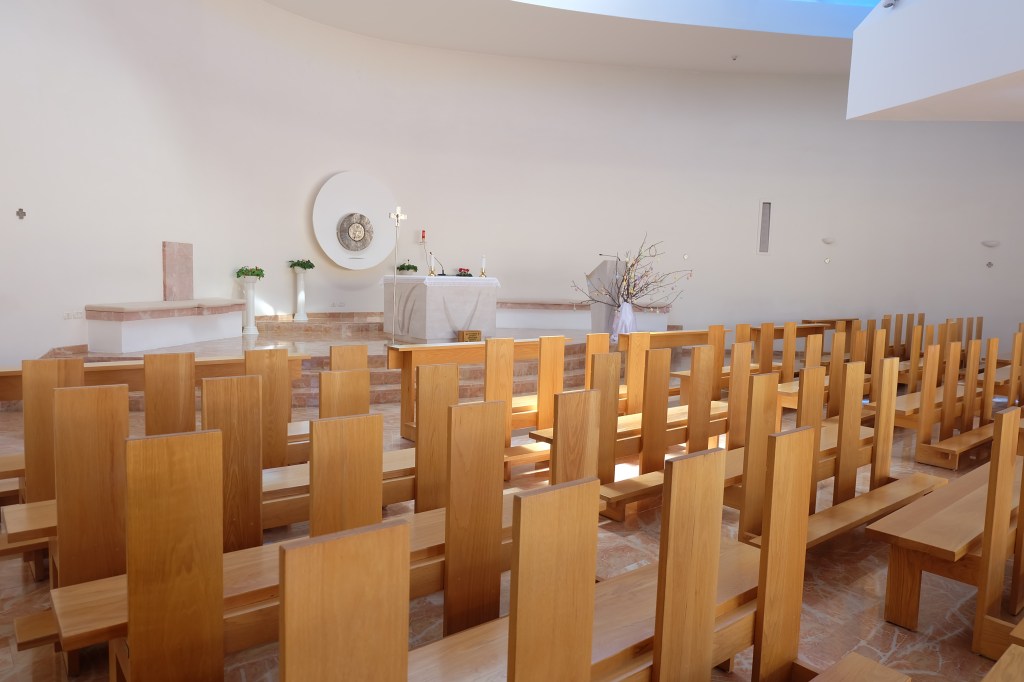
Photo by author, December 2020.

We take a break this Sunday from our readings in the bread of life discourse in John’s gospel to celebrate on this date the Solemnity of the Assumption of the Blessed Virgin Mary following Pope Pius XII’s dogma in 1950 that at the close of her earthly life, Mary was taken up body and soul into the glory of heaven.

Without telling the manner or the circumstances of time and place of the Assumption, its dogma forms part of the deposit of our faith received from the Apostles as attested by its long line of traditions since the Pentecost. It is so important that its celebration supersedes the liturgy of any Sunday because it invites us all to see in Mary raised to heaven the image of the Church and of all the faithful on our way to eternal glory with God.

It is a very timely celebration while we are in the midst of another lockdown due to a surge in COVID-19 cases, giving us hope and inspiration to persevere in all these difficulties and trials to become better disciples of Jesus like his beloved Mother.

Photo by author at the Assumption Sabbath, Baguio City, 2019.

Mary, a type of the Church

Our first reading today presents us with two images of a woman that seem to contradict each other with scenes that anti-climactic, flowing in the reverse mode. It could have been better as in most cases that the first scene depicting the woman in all glory should have been last instead of the woman in childbirth pains and dangers that comes in second. Is it not the sorrowful always comes first leading to glory?

A great sign appeared in the sky, a woman clothed with the sun, with the moon under her feet, and on her head a crown of twelve stars. She was with child and wailed aloud in pain as she labored to give birth. Then another sign appeared in the sky; it was a huge red dragon, with seven heads and ten horns, and on its heads were seven diadems.

Revelation 12:1-3

It is easy to see the Blessed Virgin Mary in that woman depicted in John’s vision especially if we continue reading on to find the title and authority attributed to her child as our Savior Jesus Christ. But modern biblical studies go deeper than that simplistic view: the scenes speak more of the birth of Christ among us his disciples. It is “painful” because it takes place amid many evil and sins like persecutions and temptations symbolized by the red dragon; but, amid all these, Jesus remains among us, leading us, protecting us, and blessing us. Hence, the woman in this passage becomes a symbol of the Church in the glory of God following Christ’s Resurrection while at the same time in the midst of many earthly battles.

Of course, no other woman can best fit that image than Mary who gave birth to Jesus, who has always been in the most intimate relationship with her son as disciple among all humankind. And because of her role in relationship to her Son, to us his disciples also his Body as community, Mary is the image or type of the Church still giving painful birth to believers like in this time of the pandemic while we are already assured of glory in heaven as children of God. Vatican II perfectly expressed it in declaring:

“By reason of the gift and role of divine maternity, by which she is united with her Son, the Redeemer, and with His singular graces and functions, the Blessed Virgin is also intimately united with the Church. As St. Ambrose taught, the Mother of God is a type of the Church in the order of faith, charity and perfect union with Christ.”

Lumen Gentium #63

With that, Mary has also become the mirror of God’s greatness in all time, the very reason we venerate her as first among the saints and angels because it is also the same call of holiness to us all as children of the Father and disciples of Christ. It is in this framework that we celebrate her Assumption, especially when we profess every Sunday: “I believe in the Holy Spirit, the holy Catholic Church, the communion of saints, the forgiveness of sins, the resurrection of body and life everlasting. Amen.”

Photo by author, Nazareth, 2019.

Greatness of God, lowliness of Mary

As we have mentioned at the start, the dogma of the Assumption of Mary does not go into details how it took place. What matters most is the fact of the Assumption of Mary, body and soul. Like with her Immaculate Conception, there are no direct nor explicit biblical references to her Assumption; however, from the collective meditations and contemplations in the Church, we find vast and rich sources in reflecting the beauty and wonder of the Blessed Mother’s unique place in our salvation history.

For the Mass of the day of the Solemnity, we contemplate on Mary’s canticle called Magnificat which she sang after being praised by her cousin Elizabeth during the Visitation.

And Mary said:
"My soul proclaims 
the greatness of the Lord;
my spirit rejoices in God my savior.
For he has looked upon his lowly servant.
From this day all generation will call me
blessed:  the Almighty has done 
great things for me, and holy is his Name."
(Luke 1:46-49)

It was the first proclamation of the gospel of salvation in Jesus Christ whom Mary first received and shared first with her cousin Elizabeth in a town in Judah. See how in the Visitation Elizabeth praised and admired Mary, becoming the first to call her “blessed among women” because “she believed the word spoken to her by the Lord would be fulfilled” (Lk.1:45). Instead of giving back her praise and admiration to Elizabeth who was pregnant with John the Baptist at that time despite her old age and being barren, Mary sang praises to God like the other great women in the Old Testament after experiencing God’s extraordinary acts in their personal lives and in Israel’s history.

Though we may never have the same personal experiences of the Blessed Virgin Mary, as members of the Church she represents, we can always look through her Magnificat the extent we have also become the mirror of the greatness of God especially at this time when everybody seems to doubt his loving presence in this time of the pandemic.


 It is the reason why we also sing the Magnificat 
during our evening prayers in the Church because 
before we can ever praise God for his kindness and majesty, 
we must first allow him to work in us by being lowly before him like Mary.

See how the Magnificat sings of the depths of Mary’s soul and her faith, of her perfect obedience to the word of God and the mission entrusted to her. Very clear in its lyrical expression, the focus and center is God, not Mary. It is the reason why we also sing the Magnificat during our evening prayers in the Church because before we can ever praise God for his kindness and majesty, we must first allow him to work in us by being lowly before him like Mary.

Have we truly been God’s lowly servant like Mary, allowing God to work his great wonders through us?

Three things I wish to share with you on Mary’s lowliness that enabled God to work his wonders through her:

First is her openness to the word of God like in the Annunciation of the birth of Jesus. Mary had a prayer life, a discipline of making time with God, setting her self aside for the Lord. Prayer is always the start of every relationship with God. That is when we truly become humble to lose control of ourselves, to forget our selves and let God in the Holy Spirit dwell into us. Even in the darkest moments of our lives, there will always be that glimmer of hope because the Holy Spirit enlightens us in our paths.

Second is Mary’s saying “YES” to God. She does not merely listen to God; she says “be it done unto me according to your word.” From the very start, Mary never doubted God in his wisdom and plans that she always said yes. One most beautiful expression by the evangelists of Mary saying yes to God is whenever Mary would “treasure in her heart” words of Jesus and of others.

But Mary’s greatest yes happened at the Cross, in her sharing in the Paschal Mystery of her Son Jesus Christ, being the only other disciple who remained with the Lord until his death. No wonder, it was to her based on tradition that the Risen Lord first appeared on Easter.

Third is Mary’s fidelity to God, her yes was not just a one-shot deal but an everyday yes to Jesus even after he had ascended into heaven. The Acts of the Apostles tells us explicitly how Mary was among the disciples present inside the upper room at Jerusalem when the Holy Spirit came on the day of Pentecost. Throughout the ages in her numerous apparitions, Mary said yes to God delivering Jesus Christ’s call for us to penance and conversion, to prayers and the Holy Eucharist especially at Fatima in Portugal.

“The Assumption of the Virgin” by Italian Renaissance painter Titian completed in 1518 for the main altar of Frari church in Venice. Photo from wikidata.org.

Mary went through many hardships and difficulties in her life and in the history of Israel, coming from an obscure town that was a butt of jokes of their time like when Nathanael asked Philip who claimed to have found Jesus Christ, “Can there any good thing come out of Nazareth? (Jn.1:45)”.

In this time of the pandemic, the vision of John in the first reading becomes more real when people refuse to recognize the spiritual dimension of COVID-19, of the need to be converted and to again nurture that relationship with God following decades of affluence and materialism. Like Mary, let us be humble to accept we are not the masters of this world nor of our own life but God almighty.

We are called to persevere with Mary, to be strong in our faith and charity that God will never forsake us so we can be present among the poor and marginalized including those spirits weakened by the prolonged quarantines.

With Mary, let us believe the words of St. Paul how all will come to life again – body and soul like Mary – in the final end of time that begins right now, right here in the midst of all these trials and sufferings. Amen.

Have a blessed week ahead!

Praying for holiness in the world

Reblogging our prayer last year as we honor St. Maximilian Kolbe on this date.

lordmychef's avatar

The Lord Is My Chef Breakfast Recipe for the Soul by Fr. Nicanor F. Lalog II

Friday, Memorial of St. Maximilian Mary Kolbe, Priest and Martyr, 14 August 2020

Ezekiel 16:1-15, 60, 63 >><)))*> || + || <*(((><< Matthew 19:3-12

From companionsofstanthony.org

“The most resplendent manifestation of God’s glory is the salvation of souls, whom Christ redeemed by shedding his blood. To work for the salvation and sanctification of as many souls as possible, therefore, is the preeminent purpose of the apostolic life.”

From the Letters of Maximilian Mary Kolbe, Office of Readings

Praise and thanksgiving to you our loving Father for a holy saint in our modern time, St. Maximilian Mary Kolbe whose memorial we celebrate today. His offering of his life in place of another prisoner at Auschwitz in 1941 was a fitting cap for his life of dedication in proclaiming the Gospel of Jesus Christ in words…

View original post 273 more words

What God is asking from us

The Lord Is My Chef Breakfast Recipe for the Soul by Fr. Nicanor F. Lalog II
Friday, Week XIX, Year I in Ordinary Time, 13 August 2021
Joshua 24:1-13   ><]]]]*> + ><]]]]'> + ><]]]]*>   Matthew 19:3-12
Photo by author, modern chapel at the Milk Grotto in Bethlehem, the Holy Land, 2019.
I know, dear God our Father,
you have no need of our words 
nor works in exchange for your 
abounding love and grace given us 
in Christ Jesus; and there lies 
your goodness and holiness when 
all you ask of us is our fidelity
to your covenant, that we remain true 
to you by dealing with love and justice
to one another which is all for our own good too.

“I gave you a land that you had not tilled and cities which you had not built, to dwell in; you have eaten of vineyards and olive groves which you did not plant.”

Joshua 24:13
You have given us everything, O God:
the earth and everything on it that we have
wasted and destroyed; worst of all, you
have given us family and friends, every person
 and people to love and cherish, respect and
be kind with but whom we have always
hurt with our words and actions when we
see only our very selves, failing to see
others as brothers and sisters in you
as Father from the the very beginning.

“Have you not read that from the beginning the Creator made them male and female, and said, For this reason a man shall leave his father and mother and be joined to his wife, and the two shall become one flesh? So they are no longer two, but one flesh. Therefore, what God has joined together, man must not separate.”

Matthew 19:4-6
Forgive us, merciful Father
for the "hardness of our hearts" (Mt.19:8),
in our building walls among us instead
of bridges to bring us close together
as your children reconciled in Jesus Christ;
help us to find the common grounds that
make us all the same, not different;
make us find and accept our vocation
in life so we may fulfill your calling
by serving you through one another
with love and respect, kindness and mercy
especially in this time of the pandemic.
Amen.

My screen this quarantine

Quiet Storm by Fr. Nicanor F. Lalog II, 17 August 2021
Image from Pinterest.

We are almost done with the first week of our third lockdown with nine more days before it is either extended or modified depending on what jumbled letter combinations come out from the magic roulette in the Palace. Either way, hail to all couch potatoes for longer weeks in front of that magic screen!

Thanks for the gift of Netflix in keeping our sanity in this pandemic. And more thanks again Netflix in streaming more television shows lately especially coming from the Philippines.

Forget My Amanda that should have been called My Cars or My Abs or My Hair

One series you should not miss before the end of this Enhanced Community Quarantine (ECQ) is Bagman starring Arjo Atayde.

First released in 2019 as an original series in iWantTFC, Bagman is so unique as a Filipino series because of its fast-paced tempo of less than 30 minutes per episode without the usual Pinoy director’s penchance for intense close up shots on faces of the characters with nothing expected to happen at all.

Everything in the production is superb, especially cinematography and musical scoring as well location sets that are characteristically the hallmarks of every ABS-CBN film undertaking. In fact, Bagman is one perfect reason that ABS-CBN should get back its franchise to operate for helping elevate television and film in the country.

Unlike other socio-political movies where we already know how low and evil is politics in the country, Bagman challenges us for a more personal response in ending this vicious circle of corruption and decadence in our culture and life as a nation.

Kudos to its creators Philip Kind, Lino Cayetano and Shugo Praico who directed the two-season series we hope would still have a final sequel. Their great attention to details with subliminal meanings on the roles and manners of different characters make the viewers “experience” – not just watch – the series done in first-person storytelling with narrations by Atayde himself as a former barber becoming a bagman of the governor. Each episode opens with a disclaimer that it is a work of fiction based on realities we have heard and read.

At its best, Bagman can be described as “totoong-totoo” – very true with its great storyline with characters played out so well by every actor like a thespian, beginning with Atayde and his co-stars that included the resurrected former sex-goddess Ms. Rosanna Roces and former Bagets Ms. Yayo Aguida.

From Twitter.

Personally striking for me as a former smoker and police reporter is Atayde puffing his cigarettes clipped between his middle and ring finger.

So classic, tsong!

They must really have a superb study for Atayde and even everyone, like Mr. Joel Saracho who played a supporting role in a few episodes as a former cobbler turned “assistant” of the evil congressman played by Romnick Sarmenta. A writer himself and a veteran to many great productions on stage and the movies, Saracho brought his usual finesse in the few scenes he was included with great impact.

Bagman teems with many scenes focused on marginalized people forced to make that desperate “kapit sa patalim” due to poverty and exploitation by crooks who come from both the rich and poor alike. Here lies the beauty of the series in teaching everyone without pontificating the need to always choose the right path in life, to be careful of getting stuck into a situation one can no longer get out and cost one’s life or loved ones, or both.

One unforgettable scene for me is that episode focused on Atayde’s father-in-law played by Rolando Inocencio as a Political Science professor telling his class the story how three congressmen died and were held at the gates of heaven by St. Peter for interview. The first two were sent to hell for their sins but the third lawmaker made into heaven after “bribing” St. Peter!

The whole class burst into laughter while Inocencio lamented in a very fatherly manner how deeply ingrained is corruption among us Filipinos until the bell rang and his class dismissed. In a later episode, Inocencio would ask their hostage-taker (Karl Medina) claiming to be his former student how did the third congressman get into heaven to check if he was indeed in his class at the university.

Medina would not give any reply at all to Inocencio who would again lament how every student of his would surely know the answer because he tells the same story in every class he handled. For me as a priest, the scenes that followed reverberated with voices, asking us teachers and educators what have we really done in forming the minds of the young in our schools and parishes when corruption is even getting worst?

Bagman is a timely reminder for us in this time of pandemic of rectifying the excesses of our “old normal way of life” that is so unfair and unjust that many clamor to bring back in the face of the “new normal” that is still far from what is just and true.

One downside for me with Bagman is the excessive use of foul language, one of the worst “new normal” introduced to our society four years before COVID-19 came. The series could have been more effective and compelling minus those p*@#&^_!

See it for yourself. Enjoy and reflect the series.

More power to the people behind Bagman!

From Esquire Philippines.

God doing everything for us

The Lord Is My Chef Breakfast Recipe for the Soul by Fr. Nicanor F. Lalog II
Thursday, Week XIX, Year I in Ordinary Time, 12 August 2021
Joshua 3:7-10, 11, 13-17   ><]]]]'>   Matthew 18:21-19:1
Photo by author, sunrise at Lake of Tiberias (Galilee), the Holy Land, 2019.
Praise and glory to you,
O God our loving Father!
How great indeed are your
works that you do everything for 
our own good even long before 
we are born, preparing us
for every great moment of 
trials long before we have seen
them coming or even happening!
You are always there, Father
ahead of us in every step of 
the way in this life like in the 
entrance of your chosen people
to your promised land preceded
by the ark of the covenant,
parting the Jordan River so that
your people may cross on dry land
reminiscent of the Exodus at Red Sea.

No sooner had these priestly bearers of the ark waded into the waters at the edge of the Jordan, which overflows all its banks during the entire season of the harvest, than the waters flowing from upstream halted, backing up in a solid mass for a very great distance indeed… While all Israel crossed over on dry ground, the priests carrying the ark of the covenant of the Lord remained motionless on dry ground in the bed of the Jordan until the whole nation had completed the passage.

Joshua 3:15-16, 17
Dear God, whenever I review my life
especially those low moments of
failures and disasters, sins and evil,
sickness or wrong decisions when I thought
everything had collapsed and totally gone,
you were always there, bringing me to safer
grounds; you were always there five steps
or more ahead of me, fixing all the problems
and troubles I have fallen into, even trapped inside.
Like in the history of Israel from Abraham to Joshua,
you never stopped surprising me
with your mighty presence and love.
 
But the greatest of all
marvelous things you have done
to me and us all, loving Father,
is sending us your Son Jesus Christ
to save us from all our sins with your mercy
 and forgiveness that is without end.
Like in today's parable, teach us to be
merciful and forgiving to those who have 
sinned against us for we are all 
forgiven sinners you love so much.
You have done so much for us, Father,
but we have done so little for you through others.
Amen.

Praying to be bridges, not walls

The Lord Is My Chef Breakfast Recipe for the Soul by Fr. Nicanor F. Lalog II
Wednesday, Memorial of St. Clare, Virgin, 11 August 2021
Deuteronomy 34:1-12   ><)))*> >><)))*> ><)))*>   Matthew 18:15-20
The Golden Gate bridge in San Francisco during the wildfires across California last year. Photo from MediaNews Group/The Mercury News via Getty Images; 10 September 2020.
God our loving Father,
today we pray that we become
bridges among people, bringing 
them together, closing their gaps
instead of becoming a wall who
prevent unity and harmony.
As we end our readings from 
the Book of Deuteronomy with
the death of Moses by recalling
his greatness in the history of Israel
and of the story of our salvation,
we remember his great role
of reconciling people with you,
O God our merciful Father;
Moses was indeed another prefiguration
of your Son Jesus Christ who came 
to unite and reconcile in you mankind
separated by sin and evil. 
"Amen, I say to you,
whatever you bind on earth
shall be bound in heaven, 
and whatever you loose on earth
shall be loosed in heaven.  Again,
amen, I say to you, if two of you
agree on earth about anything
for which they are to pray, it shall
be granted to them by my heavenly Father."
(Matthew 18:18-19)
As we remember today
St. Clare who was a collaborator
of the great St. Francis of Assisi
and foundress of the Poor Clares,
she is most remembered too
in reconciling warring families and
kingdoms in Italy during her time;
in her life of prayer and austerity,
she had lived bridging people
with one another and with God,
exactly what we need these days
of the pandemic and social distancing.
We pray, dear God
with the intercession of St. Clare,
may we take this time of quarantine
to bridge our gaps with one another
especially with our family and friends
so that at the end of this pandemic,
we may start afresh anew
in Jesus Christ, working together
for a better world where we can live
in peace and harmony,
justice and freedom in the spirit
of humility and reconciliation.  Amen.

St. Lawrence: the saint we need during this pandemic

The Lord Is My Chef Breakfast Recipe for the Soul by Fr. Nicanor F. Lalog II
Tuesday, Memorial of St. Lawrence, Deacon and Martyr, 10 August 2021
2 Corinthians 9:6-10   ><}}}}'> + ><}}}}'> + ><}}}}'>   John 12:24-26
“Martyrdom of St. Lawrence, Deacon” by Hipolito de Rioja (16th c.) from commons.wikimedia.org
God our loving Father,
give us the grace in this time
of pandemic the zeal and fervor,
kindness and humor of Saint Lawrence,
deacon and martyr of the second century.
You must have loved him so much,
lavishing him with your grace to 
witness the gospel of Jesus Christ
for St. Paul said:  "God loves a 
cheerful giver" (2 Cor. 9:7).
Saint Lawrence was so cheerful
in his dedication and fidelity to his
office as deacon, serving the Pope
and the people by distributing alms 
and other help to the poor and suffering.
In this time of the pandemic 
when so many people lack
food and money and other essentials,
give us the courage to trust in you
Lord to share whatever we have. 
Most especially, in this time of lockdowns
when so many of us are emotionally drained
with spirits sagging due to quarantine fatigue, 
gift us with the wit and humor of Saint Lawrence
who asked his executioners to turn his body
to make his roasting even on all sides!
Above all dear Father,
like Saint Lawrence may we realize
that to see your Son Jesus 
is not only with one's eyes but 
with one's total self, willing to lose 
one's life like a grain of wheat that dies 
and produces much fruit in Christ (Jn.12:24).
Amen.

To fear the Lord especially in time of crisis

The Lord Is My Chef Breakfast Recipe for the Soul by Fr. Nicanor F. Lalog II
Monday, Memorial of St. Teresa Benedicta of the Cross, 09 August 2021
Deuteronomy 10:12-22   ><]]]]*>  +  <*[[[[><   Matthew 17:22-27
Photo by author, April 2018.
August has always been a difficult 
month for us ever since when farmers 
wait for their crops to bloom while 
parents have spent most of their savings
for enrollment and other expenses
in the family; now, the pandemic has 
made August more difficult with the 
imposed lockdown due to pandemic.
But you have blessed us, O God our Father
in this month of August with so many great 
saints in our midst to inspire us, to pray for us
in our difficulties like St. Teresa Benedicta
of the Cross who rallied her fellow prisoners
at Auschwitz to keep their faith in you, our God
even she had been a Catholic nun having
left Judaism after becoming an atheist for some time.
"Those who seek truth seek God,
whether they realize it or not."
-St. Teresa Benedicta of the Cross
Teach us to be like St. Teresa Benedicta,
Lord, who always sought the truth,
and once finding you, remained in you
like what Moses had asked your people:
  "And now, Israel, what does the Lord
ask you but to fear the Lord, your God
and follow his ways exactly, to love and
serve the Lord your God with all your heart
and all your soul." (Deuteronomy 10:12)
How good it is to know from a survivor
at Auschwitz that “Every time I think of her
sitting in the barracks, the same picture 
comes to mind: a Pieta without the Christ.” 
Like Jesus her Master, she died with him
and like him for her people and for their 
persecutors, paying everything with her life
worth more than any amount of tax money 
(cf. Mt.17:27).
St. Teresa Benedicta lived
during the darkest and most troubled
time in modern history, almost eclipsed 
today by this COVID-19 pandemic; 
we pray, God our Father, for the victims
of violence and exploitation that 
their plight be addressed and finally 
be stopped, never to happen again 
in whatever form in the future.  Amen.

“Pag Tumatagal Lalong Tumitibay” by Wadab (1979)

The Lord Is My Chef Sunday Music by Fr. Nick F. Lalog II, 08 August 2021
Photo by author, Sonnen Berg Mountain View, Davao City, 2018.

We are on the first week of our fourth lockdown in Metro Manila since this pandemic began last year. All we need at this time are good vibes to uplift the sagging spirits of our suffering people, those who have lost loved ones as well as have lost their jobs or livelihood as a result of COVID-19 and its quarantine.

Since we are also celebrating the whole of August as “Buwan ng Wika” (Month of Filipino National Language), we have chosen an Original Pilipino Music (OPM) from 1979 by a group of five gentlemen from down south calling themselves “Wadab”, the inverted name of Davao City.

Long before today’s generation had this lodi (for idol) expressions, our generation have long been speaking backwards like jeproks to refer to spoiled brats from Quezon City’s middle class living in different subdivisions called “Project” like Project 7 (spent my early childhood there), Project 2, Project 6. Invert the word “project”, make it hip by adding an “s”, you get jeproks. It was the coolest thing at that time!

Going back to Wadab’s 1979 hit called “Pag Tumatagal Lalong Tumitibay”, the song speaks about the love of a man to his beloved, telling her how his love has grown stronger and deeper for her through time, assuring her of his undying love and fidelity.

Wadab’s song is very interesting for many reasons. Our readers in the US and other English speaking countries can easily relate because like some of the OPM songs of the 70’s, the lyrics is a mixture of Tagalog or Filipino language mixed with English expressions called “Taglish” (from Tagalog + English).

Melody and music are very soothing as they were patterned after the American Philly soul sounds of the Stylistics among others.

We thought of this lovely song for this Sunday because in essence, it is what Jesus is telling us in the gospel today, his being the bread from heaven, the bread of life giving life and nourishment to all believers. It is not enough that we know Jesus in our head; we need to believe in him to experience and share the love he has for us (https://lordmychef.com/2021/08/07/knowing-believing-loving-jesus/).

Imagine Jesus serenading you with this song, assuring you of his loving presence especially in this time of trials. Try to reflect also on our depth of love for Jesus through our family and friends.

Has our love gone stronger through the years despite our failures and sins?

Before listening to our featured music this Sunday, try reflecting on these beautiful words by St. Bernard of Clairvaux (1090-1153) from one of his homilies about love:

"Love is fully sufficient to itself;
when it enters the heart,
it absorbs all other feelings.
The soul who loves,
loves and knows nothing more."


A blessed week ahead of you. Stay safe always.

*We have no intentions of infringing into the copyrights of this song and video except to share its beauty with others. Thank you.

From Youtube.

Knowing, believing, loving Jesus

The Lord Is My Chef Sunday Recipe for the Soul by Fr. Nicanor F. Lalog II
Sunday XIX-B in Ordinary Time, 08 August 2021
1 Kings 19:4-8 ><]]]]'> Ephesians 4:30-5:2 ><]]]]'> John 6:41-51
Photo by Mr. Vigie Ongleo, 04 August 2021, Singapore.
Elijah went a day's journey into the desert,
until he came to a broom tree and sat 
beneath it.  He prayed for death, 
saying:  "This is enough, O Lord!
Take my life, for I am no better
than my fathers." (2 Kings 19:4)

Many of us can probably identify with the Prophet Elijah in the first reading today: so tired and fed up with all the sufferings and trials that seem unending with another round of lockdown due to a surge in COVID-19 infections.

“This is enough, O Lord!”

Elijah was not the only one to cry out to God in that way: there were Moses, Jeremiah, and Jonas who cried in a similar way while bent under the heavy load of responsibilities on their shoulders from God who never failed in coming to their rescue with his comforting and reassuring words of encouragement.

And this time as we have heard from the first reading, God sent Elijah with bread from heaven to sustain his 40 day journey to Mt. Horeb to escape the soldiers of Queen Jezebel out to kill him after a showdown with the priests of baal at Mount Carmel. God nourishes us not only spiritually and emotionally but also physically and materially if we know him, believe him, and love him in Jesus Christ his Son!

This is the context of the continuation of Jesus Christ’s second bread of life discourse at Capernaum, very timely in these two weeks of our fourth Enhanced Community Quarantine (ECQ) as we rely on God’s mercy and protection against COVID-19 and its new Delta variant.

Photo by Ms. Anne Ramos, March 2020.

Knowing Jesus.

When the people finally caught up with Jesus and his disciples last Sunday at Capernaum, the Lord immediately began his bread of life discourse by declaring “I am the bread of life; whoever comes to me will never hunger, and whoever believes in me will never thirst” (Jn. 6:35).

That is the first time in the fourth gospel where Jesus introduced himself with the “I AM” declaration very crucial for John in presenting him as the Christ, the Son of God. This would be followed later by similar statements when Jesus said “I am the good shepherd”, “I am the vine”, and “I am the resurrection”.

Recall how God told Moses to say to his people in Egypt that he was sent by “I am who am”; hence, when Jesus says “I AM”, it was a cue of who he is – the One who had come down from heaven!

The Jews murmured about Jesus because he said, “I am the bread that came down heaven,” and they said, “Is this not Jesus, the son of Joseph? Do we not know his father and mother? Then how can he say, ‘I have come down from heaven?'” Jesus answered and said to them, “Stop murmuring among yourselves.”

John 6:41-43

Reminiscent of the desert experience when the people murmured against God for lack of food and water, John also begins referring to the crowd as “Jews” to indicate their lack of belief in Jesus, like their forefathers who doubted God in the wilderness. Here we find something so common even to our own time of “knowing” God we so easily claim with everybody even if what we know does not square up with the reality.

Knowing is not purely cerebral. In the Jewish culture, to know is to enter into a relationship. Unlike us Filipinos who are so fond of name dropping when we usually tell everyone how we know somebody’s name and address like on Facebook – even if we are not friends or related at all!


To know anyone especially God by entering 
into a relationship requires an opening of the mind.  
That is why Jesus told the crowd to stop murmuring, 
telling them and us today to stop limiting 
ourselves to what we know who the Lord really is 
because so often, we hardly know him at all! 

To know anyone especially God by entering into a relationship requires an opening of one’s mind. That is why Jesus told the crowd to stop murmuring, telling them and us today to stop limiting ourselves to what we know who the Lord really is because we hardly know him at all!

We keep on receiving him in Holy Communion not as the Person but more as the Bread or Sacred Host; we go to Mass but hardly celebrate it with him; and lastly, we know Jesus more as provider and giver, rarely as companion and friend, most of all as Savior.

The Jews have refused to believe in Jesus at the very start because they have always been closed from knowing him, insisting they know better, that he is the “son of Joseph”. We have seen how last Sunday in their asking of “Rabbi, when did you get here?” in Capernaum was cloaked in suspicion at how was he able to cross the lake at night when winds were strong and waves were huge, unmindful of the signs he had shown in feeding them all at a deserted place.

Their knowing of Jesus as well as of God and the Scriptures have remained superficial, stuck in the material level manifested in their being too legalistic and ritualistic in religion without any regard for the people especially the sick and marginalized. Most of all, they did not seem to really believe in God as they saw more of themselves as God himself who knows everything!

Photo by Ms. Ria De Vera, March 2020.

Believing, loving Jesus.

All these words and actions by Jesus during his public ministry at Galilee and Jerusalem later would be used by his enemies against him, wrongly accusing him of blasphemy and disregard for the Laws or Torah. Their minds were all closed to God’s coming in Jesus or at least to his heavenly origin.

Jesus tried to clarify it with them by referring to God his Father, citing the prophet Isaiah:

“No one can come to me unless the Father who sent me draw him, and I will raise him on the last day. It is written by the prophets: They shall all be taught by God. Everyone who listen to my Father and learns from him comes to me. Amen, amen, I say to you, whoever believes has eternal life. I am the bread of life; this is the bread that comes down from heaven so that one may eat it and not die. I am the living bread that came down from heaven; whoever eats this bread will live forever; and the bread that I will give is my flesh for the life of the world.”

John 6:44-45, 47-48, 50-51

Now here we find Jesus taking off to higher level in his discourse, from knowing to believing that is perfected in loving. As we have said, knowing is relating. It is through our relationship with God that we are taught through Jesus Christ in knowing all about him. Yes, God in the Old Testament revealed himself to the Chosen People through the prophets and his Laws. But now, Jesus is telling the people that God is revealing himself through him, the Son who had come from heaven with the gift of faith.

As a gift, it is not like an ordinary present given to just one or several persons privileged to receive it like the Israelites in the Old Testament; faith as a gift from the Father is freely given to everyone for all time. Jesus is now inviting his audience in Capernaum including us today to open one’s mind, to level up in thinking and understanding because it is above the realm of material world but of spirituality that leads to relating, believing, and loving to be expressed later in the Eucharist, the sign of his self-sacrifice on the Cross.

Recall how last Sunday Jesus stressed that it is a work of God, not of men – that is faith! It is a gift from God freely given to everyone which every individual must “turn on” like a switch and make it operate. In that discourse also, Jesus added that the ultimate fulfillment of this faith in God as work of God is faith in himself, the Son sent by the Father.

In this scene alone, Jesus had mentioned the word “bread” five times, repeating it to the crowd like in a crescendo, rising from a sapiential or cerebral and material meaning into something so profound, higher level inviting us to put on our faith in him as he continues to reveal the Father’s plan for all mankind for all time leading to eternity.

And what is it that remains into eternity? LOVE!

"Love is fully sufficient to itself;
when it enters the heart,
it absorbs all other feelings.
The soul who loves,
loves and knows nothing more."
(St. Bernard of Clairvaux)
Photo from Dr. Yangas Colleges Inc., Bocaue, Bulacan in one of their community pantry called “Paraya”, May 2021.

Jesus is now hinting at his discourse the Eucharist as the meaning of the sign he did at the deserted place when he fed and satisfied the more than 5000 people from just five loaves of bread and two fish. Notice the words “eats” and “flesh” – indications of the elevation of knowing into believing, blossoming in love.

To eat his flesh is to accept Jesus, to be one in him and with him through one another. Knowing Jesus, relating with him means believing him, loving him through one another.

Faith is closely linked with love, they always go hand in hand because whoever believes truly always loves!

St. Paul sums up everything that Jesus had taught this Sunday with his call to us to “live in love, as Christ loved us and handed himself over for us as a sacrificial offering to God for a fragrant aroma” (Eph.5:1-2).

It is very difficult to dissect knowing, believing and loving, of finding the very cause of faith and love except in Jesus Christ who had come to us and continues to come in every Eucharistic celebration. There are times we can be aware of the reasons why we believe and love God and our beloved, even explain what we find so lovable in them but still difficult to locate with precision the starting point of everything. That is why at the end of this discourse two weeks from now, we find everybody leaving Jesus except the Twelve who chose to remain with him.

In this life, we may know so many things but we cannot know everything like God.

Let us stop murmuring, stop all talks and sink into silent prayer, opening our minds and our hearts to Jesus to receive him not only in words but in himself as Body and Blood in the Holy Mass so we can start loving him in one another to make life more bearable in these trying times. Amen.

Have a blessed and safe week ahead!

Photo by author, 2019.