The gift of self

The Lord Is My Chef Sunday Recipe for the Soul by Fr. Nicanor F. Lalog II
Solemnity of the Body & Blood of Jesus Christ, 11 June 2023
Deuteronomy 8:2-3, 14-16 ><}}}}*> 1 Corinthians 10:16-17 ><}}}}*> John 6:51-58
Photo by author, 2018.

There is a weird British series in Netflix called the Inside Man about a professor of criminology at the death row in the States for the murder of his own wife. He had deep perceptions and analysis of events that people came to see him in prison to consult in locating their missing loved ones. One of them is an American journalist trying to do a story about him while at the same time seeking his expertise in locating her missing friend, a math tutor in England held hostage in the basement by a pastor and his wife.

Though the series is weird, it has some interesting lines about life and death like when the wife of the pastor told him how she had spent the whole afternoon searching the internet how to kill their son’s math tutor they have thrown in their basement. The wife found it unusual there was nothing in Google that tells of ways of killing another person (so weird, is it not?); however, she was surprised that almost everything she had found in the internet and social media was mainly about sex as he teased her husband that it is not love that makes the world go round but sex!

Yes, it is very funny and weird but her observations seem to be true because nobody in his right mind would ever want to destroy life except terrorists and lunatics. People generally love life that our social media are saturated with contents that try to show how we can enjoy this life through sex, food, and travels in that order. Also with cars for boys aged 5 to 95.

Photo by author, March 2020.

Of course, we all know that is not what life is all about that is filled with mysteries.

Last Sunday we reflected in the Solemnity of the Holy Trinity that mysteries are not problems to be solved but realities to embrace to discover life’s truest meaning found in our relationships with God and with others

This Sunday we celebrate the second most important doctrine and mystery of our faith, the Incarnation of the Son of God Jesus Christ. It is a mystery not only how the Son of God became human like us in everything except sin but most of all, of how he has given us his very flesh and blood as our food and drink in this journey called life.

Jesus said to the crowds: “I am the living bread that came down from heaven; whoever eats this bread will live forever; and the bread that I will give is my flesh for the life of the world.” The Jews quarreled among themselves saying, “How can this man give us his flesh to eat?” Jesus said to them, “Amen, amen, I say to you, unless you eat the flesh of the Son of Man and drink his blood, you do not have life within you. For my flesh is true food, and my blood is true drink.”

John 6:51-53, 55
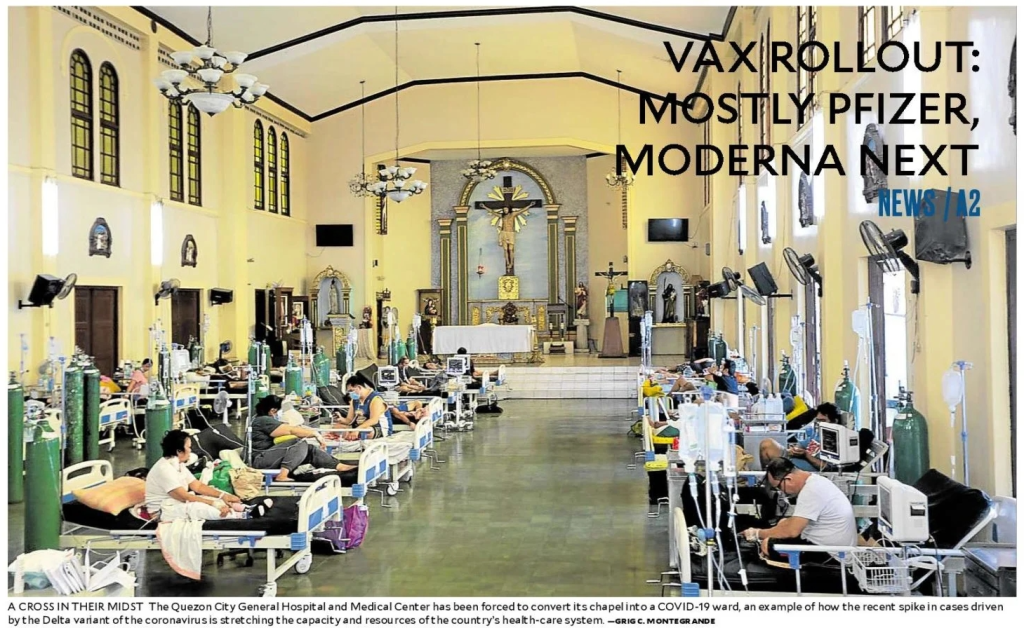
My favorite front page photo during the Delta outbreak of the COVID-19 pandemic published by the Inquirer on 20 August 2021. So evocative of the truth of Jesus himself being our true food and drink – and medicine.

As we have reflected last Sunday, a mystery is a divine truth revealed by God we learn through the gift of faith. It is non-logical but not illogical. It can be explained and understood but not fully.

Here in the mystery of the Body and Blood of Christ we call as the Eucharist, the mystery of our Triune God becomes a reality in our life truly present in perceptible signs of bread and wine. From relating, we now come to the mystery of sharing of our selves like God who shared us his Son Jesus Christ who in turn gave himself for us on the Cross that continues today in the Holy Eucharist as his everlasting sign of his loving presence and service.

See how Jesus spoke clearly in this passage of his giving us his physical body and blood that to receive it, we have to actually eat it too.

First we notice is how in other parts of the New Testament that the term soma is used to refer to the Eucharist which is the Greek word for “body” that may have symbolic meanings; but in this passage, Jesus used the word sarx which means “flesh” in Greek that means only one thing, the corporeal reality of his physical body. Jesus is telling us in no uncertain terms in this passage after the miracle feeding of more than 5000 in the wilderness that he himself is truly and really present as flesh and blood in the Eucharist. Recall that at his Prologue to his gospel, John also used the same term sarx in declaring “the Word became flesh” (Jn.1:14) to correct misunderstandings and doubts that were already developing during the first century of Christianity regarding the physical Incarnation of Jesus the Eternal Word and his true presence in the Eucharist.

Second term used by Jesus four times as he emphasized the reality of his Body and Blood in the Eucharist is the word trogein which in Greek means “to munch” or “bite”; the other Greek word for the verb to eat is phragein which evokes many symbolic meanings like “digesting” a book or “assimilating” the culture. Again, when Jesus said we have to eat his flesh and drink his blood, he truly meant himself as a true food and true drink to nourish and sustain us in this life and hereafter.
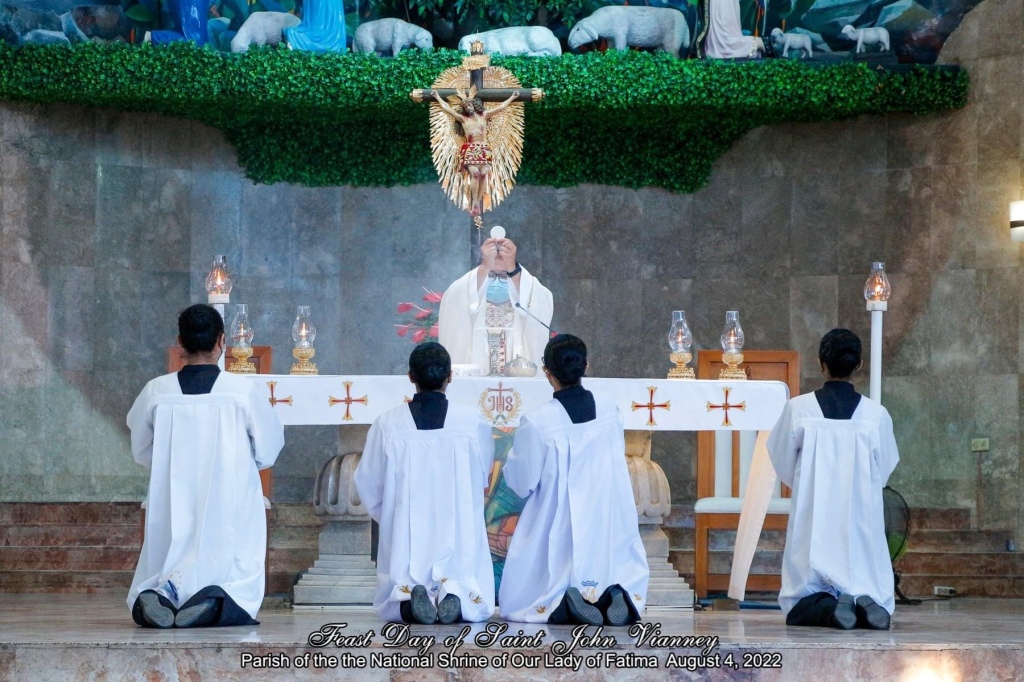
Photo by Kuya Ruben, 04 August 2022.

There lies the beauty of this mystery of the Eucharist: Jesus himself is the one we receive, who comes to us personally, physically to be one with us in our very selves. We do not have to wait for death and be in heaven to experience fullness of life in Christ because he comes truly to us while in this life when we receive him in the Holy Communion.

St. Paul reminds us in the second reading with his rhetorical questions, “The cup of blessing that we bless, is it not a participation in the blood of Christ? The bread that we break: is it not a participation in the body of Christ?” (1 Cor. 10:16) of this reality of Christ’s presence in us and among us. He was not waiting for answers of yes or no but posed those questions to affirm the very truth we all know that Jesus is really present in us and among us especially when we are broken like the Israelites in the first reading. This is where the mystery deepens, becomes more real and more fascinating. Jesus the Son of God emptying himself to be like us in everything except sin so that we may become like him, holy and divine.

This I have learned in my two years of being a chaplain in the hospital. Admittedly, it is difficult especially for me as I could easily be carried away by emotions in seeing the sick and suffering while at the same time, can often have my stomach overturned by sights of blood and wounds of others. But, there is always that indescribable feelings of joy and fulfillment after visiting and anointing our sick patients.

Photo by Kuya Ruben, June 2022.

I have no claims to holiness as I am a sinner too but the Eucharist has become most truest to me these past two years in the hospital and university as well as I get into contact with the sick and the students. When I touch patients to pray over them or help in moving them, when students cry to me or ask for hugs after confessions, they all flash to me during the consecration as I raise and say, This is my Body… This is my Blood. Jesus is most truest in the Eucharist when we too imitate him in giving ourselves to others to be broken and shared.

The Eucharist is the most wonderful gift of God to us when we receive his Son Body and Blood to make us strong and holy like him in this life.

That is why we have to go to Mass every Sunday. That is why a priest has to celebrate Mass daily for the people to be strengthened like him in this journey of life filled with trials and sufferings. That is why Moses kept on reminding the Israelites of their many hardships from their exodus into their wandering in the wilderness. That is why this coming Friday, we cap these three weeks of transition into the Ordinary Time with the Solemnity of the Most Sacred Heart of Jesus, another mystery of Christ truly among us and within us as we experience his love most truly right here in our hearts.

What an awesome God we have indeed who has become so small and so simple like us so we can be great like him. Like the simple bread and wine, in the Mass through the Holy Spirit, they become Christ’s Body and Blood. Let’s make it happen this Sunday in our celebration of the Mass. Amen. Have a blessed week ahead.

When catastrophes happen

The Lord Is My Chef Daily Recipe for the Soul by Fr. Nicanor F. Lalog II
Tuesday in the Sixth Week in Easter, 16 May 2023
Acts 16:22-34   ><]]]]'> + ><]]]]'> + ><]]]]'>   John 16:5-11
Photo by author, Katmon Nature Sanctuary & Beach Resort, Infanta, Quezon, 04 March 2023.
Today dear Jesus we pray 
for those going through
catastrophes in life:
victims of natural and man-made
calamities,
victims of wars and persecutions,
people going through everything
that is wrong in life, so to speak.
Teach us Lord to stay still
in you in times of catastrophe;
like St. Paul and Silas who remained
inside their prison cell when a powerful
earthquake struck Philippi:

About midnight, while Paul and Silas were praying and singing hymns to God as the prisoners listened, there was suddenly such a severe earthquake that the foundations of the jail shook; all the doors flew open, and the chains of all were pulled loose. When the jailer woke up and saw the prison doors wide open, he drew his sword and was about to kill himself, thinking that the prisoners had escaped, But Paul shouted out in a loud voice, “Do not harm yourself; we are all here.”

Acts 16:25-28
Oh what a beautiful event
for that jailer, Lord!
Twice he faced situations with
catastrophic consequences that could
have cost his own life - first the severe
earthquake and second the possible escape
of Paul and Silas;
but you spared his life, Lord,
not only in making him survive
the earthquake but most of all
opening eternal life to him
in hearing your gospel from Paul
and eventually being baptized with
his whole family!
In the gospel, amid the 
dangers lurking with your 
impending arrest and pasch,
you told your disciples that it
is better for you to go and leave
so you could send the Holy Spirit,
the Advocate (Jn.16:7).
Teach us, Jesus,
to be still, to be not foolish
in rushing, to avoid panic 
when catastrophes happen;
let us trust in you alone;
let us think clearly of avoiding
drastic steps that may put us
and others in harm's way;
let us cultivate a prayer life,
a relationship with you that 
would keep us attuned with the
Holy Spirit in reading the signs 
of the times so we may find you
always especially when uneventful
things happen to us.
Amen.

Praying not to quit

The Lord Is My Chef Daily Recipe for the Soul by Fr. Nicanor F. Lalog II
Monday in the Sixth Week of Easter, 15 May 2023
Acts 16:11-15   ><)))*> + ><)))*> + ><)))*>   John 15:26-16:4
Photo by author, Jesuit cemetery, Sacred Heart Novitiate, Novaliches, Quezon City, 21 March 2023.
Dearest Jesus,
this prayer is for those
who are about to quit,
for those who feel like giving up,
for those losing hope and
meaning in life because of
failures and disappointments,
of sickness and medical conditions,
of all kinds of brokenness.
Send them your Holy Spirit, Lord,
to touch their hearts and souls,
to enlighten their minds and their hearts
that they are loved,
that nothing happens in life without
your knowing,
and most of all, setbacks are temporary;
not all days are bright
and shiny!
Console, dear Jesus,
those at the edge of giving up
their dreams and goals,
of giving up in life;
let them see the beautiful journey
they have taken even though marred
and punctuated with losses
and defeats; 
give them strength and courage 
to move on, to forge on,
to persevere like St. Paul;
give them breaks to lighten their loads,
to put smiles on their lips,
and deep sighs of relief
with little moments of grace
and consolation. 
For those undergoing different
forms of persecution in life,
keep them strong testifying
and witnessing to your truth, Jesus;
despite the many oppositions 
and darkness we face in life,
let us still choose
love because it is stronger than fear,
life which is stronger than death,
hope that is stronger than despair;
let us choose you always, dear Jesus,
because it is always worth the risk
in following your Cross.
Amen.

Remaining in love

The Lord Is My Chef Daily Recipe for the Soul by Fr. Nicanor F. Lalog II
Thursday in the Fifth Week of Easter, 11 May 2023
Acts 15:7-21   ><]]]'> + ><]]]'> + ><]]]'>   John 15:9-11
Photo by author, Sacred Heart Novitiate, Novaliches, Quezon City, 20 March 2023.
Today dear Jesus,
thrice you have asked us
"remain in my love"
in three short verses
of the gospel.

And I wonder why you used
the word to "remain" 
than "stay" as we would use
these days,
"staying in love"?
Should I stay, or
should I remain?
It may sound like more of 
semantics but to remain 
sounds strong,
evoking firmness
and resolve.

Jesus said to his disciples: “As the Father loves me, so I also love you. Remain in my love. If you keep my commandments, you will remain in my love, just as I have kept my Father’s commandments and remain in his love.”

John 15:9-10
Remaining in your love,
Lord Jesus, 
is being deeply rooted in you
like a big tree;
to be rooted in you
means being secured 
about who we are
as your beloved
and what is our mission
in this world which is to love,
love, and love;
remaining in your love, Lord,
is therefore having our hearts
connected with your heart,
feeling your presence
and movements in us and among us,
when we do not become anxious
when challenged and attacked,
when turmoil happen in our
relationships because it is you
whom we always see
and tries to find like Peter
and James, Paul and Barnabas
during the Council of Jerusalem
in the first reading.
Remaining in your love,
Jesus, is remaining connected,
remaining one in you, with you
that results in joy in us
because what we see,
what we experience,
what we believe 
is you working
in us and among us.
Amen.

Jesus our home, our tahanan

The Lord Is My Chef Sunday Recipe for the Soul by Fr. Nicanor F. Lalog II
Fifth Sunday in Easter-A, 07 May 2023
Acts 6:1-7 ><}}}*> 1 Peter 2:4-9 ><}}}*> John 14:1-12
Photo by Ms. April Oliveros, March 2023, Mt. Pulag.

From being our “gate” as the Good Shepherd last week, Jesus today introduces himself as our “home”, our dwelling by being “the way and the truth and the life”. Our scene is still at the last supper with Jesus teaching his disciples including us today with some of his important lessons expressed in words so touching and full of mysteries.

Jesus said to his disciples: “Do not let your hearts be troubled. You have faith in God; have faith also in me. In my Father’s house there are many dwelling places. If there were not, would I have told you that I am going to prepare a place for you? And if I go and prepare a place for you, I will come back again and take you to myself, so that where I am you also may be.”

John 14:1-3

Though the apostles were still at a loss at the meaning of the words spoken by Jesus that night, they knew and felt something so bad would happen, that life for them would no longer be the same as before that troubled them so deeply inside.

To be troubled here means more than the feeling but experience itself of confrontation with the power of evil and death, when we get that existential feeling of our mortality, when we feel so helpless in a situation, asking “paano na ito?” or “paano na kaya ako/kami?” Like the apostles that night, we too have been into similar situations of being troubled deep inside when we realize in no uncertain terms something so sweeping is happening, altering our lives “forever” like when we or a loved one is diagnosed with cancer, gets a stroke, or has to undergo a major surgery of the heart or brain, and losing a loved one.

Jesus is telling us this Sunday like on that holy Thursday evening to stand firm because these evil and death will just have momentary control over us, a passing over that is why we have to summon all our strength and courage, confidence and perseverance in him as he himself had already triumphed with his own passion, death, and resurrection.

And that is the good news! Jesus had won over all our worst fears like death. It is the gift of Easter, of the Lord’s Resurrection right there inside our hearts, already in our very core we only need to recover by abiding in him always. But before going any further, let us first confront one important lesson this gospel scene offers us: When are we really most troubled in life?

Photo by Ms. April Oliveros, March 2023, Mt. Pulag.

When we examine the many troubles we have been through, we find that more than the difficult and harsh situations we have faced were the many troubles within our very selves. What really trouble us most are not those outside us but within us. These are those little guilt feelings we used to take for granted, little details in life we used to ignore and dismiss as nothing for so long that suddenly now under our very nose as so serious, so important after all.

The most troubling experience of all is when we realize how we have wasted so many opportunities to love and be kind, to be more forgiving and understanding, when we know we have done something wrong and have done nothing to rectify it. We are troubled when outside conditions throw us into situations that make us confront not only death and evil but our very selves that suddenly, we feel unprepared and inadequate especially sickness and death that both surely come. Always.

And here is the big difference: Jesus was not surprised, was never caught unaware of his pasch because all his life he has been one in the Father and one with us. See in all four gospel accounts how Jesus had total control over everything that is why he was so prepared for his passion, death and resurrection because he never turned away from the Father and anyone in need of healing, of forgiveness, of comfort, of his presence. Jesus never turned away from his very essence, his mission which is oneness in the Father and oneness with us his beloved.

Jesus was so at home, so to speak, with himself and with the Father that he never fell into sin despite the devil’s temptations nor the scheming traps and plots of his enemy. This is what Jesus is telling us of preparing a room for us in the Father’s house, that we be at home with our true selves in the Father in him.

We are most troubled when we are not home, literally and figuratively speaking. And sadly, many times as we have experienced in this pandemic that even in our own homes we could not be at home because we are detached and away from our families and loved ones.

“In my Father’s house there are many dwelling places… Do you not believe that I am in the Father and the Father is in me? The words that I speak to you do not speak on my own. The Father who dwells in me is doing his works.”

John 14: 2, 10
Photo by author, Katmon Nature Sanctuary & Beach Resort, 04 March 2023.

The word “dwelling” is a favorite of John especially in this part of his gospel. For John, dwelling is more than a home but unity of Jesus and the Father as well as unity of Jesus and his disciples including us. In his prologue he spoke of Jesus as the Word who became flesh and “dwelled” among us. So beautiful an imagery of the Son of God living among us, being one with us and in us, not just physically present but through and through like going through our human experiences except sin.

To dwell is not just to reside but most of all to abide in Christ, to be united, to be one in him which he would say in the following chapter when he identified himself as the true vine and we are his branches.

Therefore, to dwell is to be one, to commune in the Lord. That is why heaven is not just a place but a condition, a being of eternal union with God where Jesus assures us of a dwelling. And because Jesus is our dwelling, our home, that is why he is also our way because he alone is the truth and the life.

Now, if anyone lives in Jesus, he/she lives in the Father too as he clarified with Philip who asked him to show them the Father and that would be enough.

How lovely that Jesus taught these lessons of unity and oneness in him and the Father and with one another in the context of the table, of a meal.

Here we find his last supper was not just a prelude to his coming Passion, Death and Resurrection but to his Ascension into heaven too when Jesus was already speaking of his entrance into a new and higher level of relating with the Father and with us his disciples, his Body as the Church.

This “dwelling” continues in our Eucharistic celebrations especially the Sunday Mass and even right in our own homes too during meal time. And there lies the challenge of our gospel this Sunday.

The first major problem in the early church came in the context of the table when “the Hellenists complained against the Hebrews because their widows were being neglected in the daily distribution” (Acts 6:1) of food. The Hellenists were the Jews who have lived outside Israel that when they returned home, they have become so alienated because of language barriers even of outlook in life. The Apostles resolved the issue by ordaining the first seven deacons.

It is interesting that the word “deacon” came from the Greek word diakonia which means “to serve at the table”. In Latin, diakonia is ministerium which is service in the table too. How lovely that to serve is actually rooted in the table found in homes!

We say home is where the heart is. In that case, God is our home. Jesus is our dwelling. We are troubled when we are not at home with God in Jesus and with our own families. Any problem at home takes priority in us too because family is important to us. How sad that some people could reject their own family without realizing that no matter what happens to us, it is still our family who would save us and stand by us in the end. This is what St. Peter’s was saying in the second reading of Jesus being the stone rejected to become the cornerstone when often we dismiss our family but in the end remain with us when our chips are down.

This Sunday, let us go home in Jesus our true home found in our own families. Home in Filipino is tahanan from the root word tahan which means to stop crying. To dwell in Filipino is manahan, from the same root too. We stop crying in our home because that is where we find security and comfort, love and acceptance, most of all, life and direction. Amen. Have a blessed week ahead!

The companionship of Christ

The Lord Is My Chef Sunday Recipe for the Soul by Fr. Nicanor F. Lalog II
Third Sunday in Easter, 22 April 2023
Acts 2:14, 22-33 ><)))*> 1 Peter 1:17-21 ><)))*> Luke 24:13-35
The Road to Emmaus” painting by American Daniel Bonnell from fineartamerica.com.

As I have been telling you, the beauty and joy of Easter is in its “nothingness” like the empty tomb of Jesus and its “darkness” found in the setting of the Lord’s appearances. We have found these in the past two Sundays when Jesus appeared to the Twelve “on the evening of the third day” and “eight days later” amid locked doors.

This Sunday is very different. It is the story of two disciples going back home to Emmaus whom St. Luke did not identify except the one named Cleopas. There is still the setting of darkness as it happened at sunset to early evening while news of the empty tomb was still trending amid reports Jesus had appeared to some women but still nowhere to be seen. But this time, darkness is more evident inside the two disciples walking away from Jerusalem – sad, disappointed and frustrated, forlorn.

Now that very day two of them were going to a village seven miles from Jerusalem called Emmaus, and they were conversing about all the things that had occurred. And it happened that while they were conversing and debating, Jesus himself drew near and walked with them, but their eyes were prevented from recognizing him. He asked them, “What are you discussing as you walk along?” They stopped, looking downcast.

Luke 24:13-17
From https://www.clarusonline.it/2017/04/29/i-discepoli-di-emmaus-andata-e-ritorno/

Did you feel the sadness of the two disciples? Today, Jesus assures us of his companionship especially when we are in a “perfect storm”, when everyone and everything are against us, when it is all darkness within us, when we are at our lowest low awaiting for the next worst thing that could happen to us.

It is during these times we think of quitting, of just going home, going back where we have been before, abandoning everything because it seems better to start all over again as everyone/everything have been lost. There need not be tragedies in life for these to happen. Many times it could be when we are in the midst of grave sins or even with our most common sins repeated over and over like venial sins. We feel discouraged, even depressed we could not see any sense at all in going back to God in prayers and the sacraments especially the Holy Eucharist. Those moments we tell ourselves and everyone, “para que?” or “para saan pa?” that we would go back to God, our Jerusalem.

Like the two disciples, we have become so nega that as we walk to the opposite direction in life, we fail to notice Jesus accompanying us, making sakay (ride on) with our trip, just listening to our woes and complaints, stories of sins and failures, pains and hurts, disappointments and frustrations.

Here we find Jesus our only true friend who allows us to be our truest self, even our worst self. He walks with us not only in darkness but in the opposite direction, waiting for the prefect timing to gently bring us back to the right path to Jerusalem. And sometimes, he does it with a splash of humor like when he told the two disciples “Oh, how foolish you are! How slow of heart to believe all that prophets spoke!” (Jn. 21:25).

Many times, we fail to bring back to God and to the right path our lost family and friends because we lack the compassion and gentleness of Jesus. Very often, fail because we react than act like Jesus who’s companionship and compassion opened the hearts of the two disciples: it was only after they have unloaded their burdens when Jesus loaded them or filled them with his words and eventually with his very presence at the breaking of the bread.

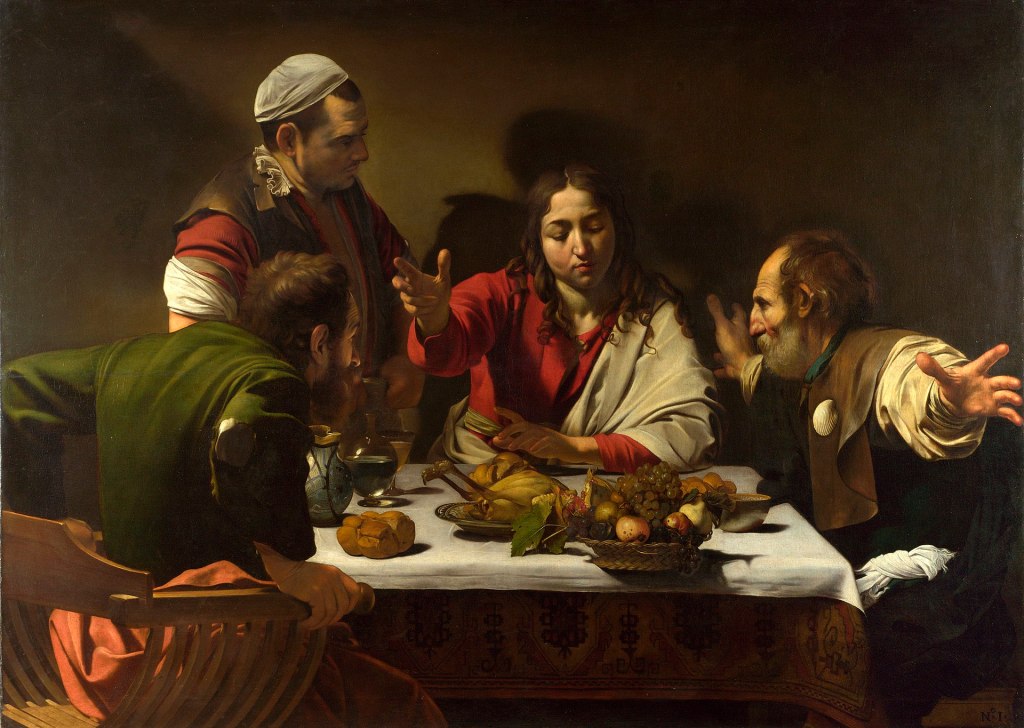
“Supper at Emmaus” by renowned painter Caravaggio from en.wikipedia.org. See the emotion depicted by Caravaggio with his trademark of masterful play of light and shadows. At the center is the Risen Lord blessing the bread that caught the two disciples who are seated in disbelief, one outstretching his arms and the others pushing back in his chair. The third character in the painting is the innkeeper unaware of the significance of the gesture of Jesus. It was at this instance that the two disciples recognized Christ as the traveling man with them to Emmaus.

Human transformation happens only in Christ, with Christ and through Christ in the Eucharist where we also experience a reversal of roles in our relationships with God and with others. Notice how the attitudes and perspectives of the two disciples changed when Jesus broke the bread. Remember it was the two disciples who invited Jesus inside to stay because it was getting dark, hosting a meal for him as their guest but that changed at the table: the two disciples ended up as guests of Jesus who merely joined them in their journey!

And it happened that, while he was with them at table, he took bread, said the blessing, broke it, and gave it to them. With that their eyes were opened and they recognized him, but he vanished from their sight. Then they said to each other, “Were not our hearts burning within us while he spoke to us on the way and opened the scriptures to us?” So they set out at once and returned to Jerusalem where they found gathered together the eleven and those with them who were saying, “The Lord has truly been raised and has appeared to Simon!” Then the two recounted what had taken place on the way and how he was made known to them in the breaking of the bread.

John 21:30-35

One thing I have found in life these past 25 years as a priest is that we can only realize and understand, even see the clearer and bigger picture of our life later after so many years of series of trials and tribulations, joys and celebrations. And often, what we see is the Lord, the companionship of Jesus Christ even in those times we were in sin and away from him. St. Peter said it so well in the second reading that we are in a “sojourning, realizing that you were ransomed from your futile conduct with the precious blood of Christ” (1 Pt. 1:17, 18, 19).

Photo by author, Sacred Heart Novitiate, Novaliches, QC, 20 March 2023.

Many times in life we feel as if we are really the captain of our ship, we direct everything, we control everything but it is actually Jesus. There is always Christ our companion in this journey of life, our true host and we are his guests who shared himself with us on the Cross so we can share in the mystery and victory of his Resurrection. In being one with us in our brokenness, Jesus immediately vanishes the moment we recognize him so we may keep on following him by changing course and direction in our lives.

In this time when people have lost interests in the Church, the Sacraments especially the Holy Eucharist, and the Scriptures along with prayers and devotions, we who are inside the church especially us priests are reminded of this important truth by Jesus, that he is the one in command, he is our host. We only share him in our co-journeyers in life, he is the one who opens our eyes, the one who effects transformation and changes within us. Not us.

Are we one with Jesus, especially in the Eucharist we manipulate so much with our many rituals and acts not necessary? See that the more we manipulate the Mass and other devotions, the more Christ disappears and persons especially priests become the focus.

In Emmaus, Jesus walked with the two disciples going the opposite direction to lead them back and never the other way around as it happens when we priests and volunteers are the ones who mislead people away from Jesus with our lack of warmth and charity for people like the unchurched.

Jesus is truest in the Eucharist when we touch people literally with our hands, when we get our hands dirty in taking care of the sick and needy, when we are truly present with them especially in their griefs, emptiness and sinfulness. That is when they experience, not just know that Jesus is real and true in the Eucharist when they first experience him in us his disciples, in our companionship and compassion with those suffering.

Nobody is perfect. As St. Peter had noted in the first reading, we are all responsible for the suffering and death of Jesus with our sinfulness; however, God’s love for us is far greater than our sins so that in our darkness and emptiness, we are able to see and have fulfillment in Jesus his Son. Amen. Have a blessed week!

Photo by author, Sacred Heart Novitiate, Novaliches, QC, 20 March 2023.

We enter Paradise in the Cross

Quiet Storm by Fr. Nicanor F. Lalog II
The Seven Last Words, 02 April 2023
Photo by author, Chapel of the Holy Family, Sacred Heart Novitiate, Novaliches, Quezon City, 2014.

Then he said, “Jesus, remember me when you come into your kingdom.” He replied to him, “Amen, I say to you, today you will be with me in Paradise.”

Luke 23:42

Every time we feel good, whenever we see something so beautiful, whenever we are with those we love, we describe the feelings as “like paradise” or “heaven”. For us, paradise is all bliss. No sickness, no problems, no sufferings, nothing bad, nothing dark, nothing unpleasant. It is all good. In fact, perfect.

And that is why heaven or paradise is! From the ancient Persian word paradiso, it referred to the innermost room in the palace where only the most trusted ministers of the King were allowed to enter along with his immediate family, From that came the idea that paradise must be so beautiful that the Greek translators of the Bible used it to refer to heaven as God’s dwelling. After all, our God is the only One who is perfect and supreme than any king in the world.

Recall that when Adam and Eve sinned, they were banished from Paradise that was henceforth closed until that Good Friday when Jesus promised Paradise – of all people – to a former thief!

Yes, Paradise is for every sinner ready to beg forgiveness, ready to claim Jesus Christ as our Savior!

And that is just one of the surprising things about Paradise or Heaven according to Jesus on that Good Friday.

See that Jesus never promised “Paradise” when He was freely going around Galilee, preaching and healing the people, when He was dining with sinners and tax collectors, when He was very well and strong.

Jesus promised Paradise when he was dying there on the Cross, not when He was strong and free!

See also how He said the words to Dimas, “today you will be with me in Paradise”.

Jesus promised Paradise at that very moment they were on the Cross, hanging and dying. Not later when they died nor on Sunday when He resurrected from the dead.

Jesus promised Paradise at that very moment they were suffering and dying, in extreme, excruciating pains never imagined by anyone, presumably with all the fears, negative thoughts and feelings that went with it.

And that is precisely when we enter Paradise with Jesus, too.

When we are suffering from our sickness and disabilities especially over a long period of time, when we are deep in pains in our heart for all the hurts inflicted by a loved one, when we are old and bed-ridden awaiting the final moment of death, when we are in agony for the loss of a loved one, when deep in trials and disappointments, or whenever we are so weak and dying literally or figuratively speaking.

That is when we slowly enter Paradise.

In a world where the most prescribed medicine is the pain reliever, where everything is invented to minimize even eradicate difficulties and hardships, Jesus is reminding us that we enter Paradise when we are with Him suffering there on the Cross.

That is the value and meaning of the Cross we always evade these days. It is not all suffering but also a foretaste of eternal bliss, of perfect joy and happiness because it is during our darkest moments in life that we get a glimpse of Christ’s eternal light, when we are transformed and made stronger and better as persons soon enough to be worthy to enter the most exclusive circle of all – Paradise – to dwell in the Lord with His angels and Saints.

Let us pray for those going through many sufferings these days, including ourselves.

Lord Jesus Christ,
before all these pains and trials
came to my life, 
You were there FIRST for me on the Cross;
You were there FIRST for me to suffer and die
on the Cross.
 Let me stay with you on Your Cross
so I may enter Paradise with You,
right now,
right here.
Amen.
One of the most beautiful front page photos I have seen in many years. Taken in August 2021 when we were in the midst of a surge in COVID-19 cases, the photo evokes Paradise, “right here, right now” while people were suffering in Jesus, with Jesus and through Jesus. Photo from inquirer.net.

Lent is for delaying.

40 Shades of Lent by Fr. Nicanor F. Lalog II
Fifth Sunday in Lent-A, 26 March 2023
Ezekiel 37:12-14 + Romans 8:8-11 + John 11:3-7, 17, 20-27, 33-45
Photo by author, 22 March 2023, Sacred Heart Novitiate, Novaliches, Quezon City.

We conclude this Sunday the three Johannine readings during this Lenten season with the story of the raising of Lazarus from the dead. More powerful than the healing of the man born blind last Sunday, St. John shows in this raising of Lazarus who had been dead for four days that Jesus is truly the Christ, the awaited Messiah. Most of all, it is in this raising of Lazarus that Jesus also made his greatest “I AM” statement of all, “I am the resurrection and the life”.

Like the two previous long stories from St. John, let us focus on the opening paragraph of this long narrative that right away gives us a hint of something very striking, of why Jesus delayed his coming to Lazarus supposed to be his friend, someone so dear to him.

The sisters of Lazarus sent word to Jesus, saying, “Master, the one you love is ill.” When Jesus heard this he said, “This illness is not to end in death, but is for the glory of God that the Son of God may be glorified through it.” Now Jesus loved Martha and her sister and Lazarus. So when he heard that he was ill, he remained for two days in the place where he was. Then after this he said to his disciples, “Let us go back to Judea.”

John 11:3-7
An icon of Jesus visiting his friends, the siblings Sts. Lazarus, Mary and Martha. Photo from crossroadsinitiative.com.

Don’t you find it striking that after asserting that “Now Jesus loved Martha and her sister and Lazarus”, then, “he remained for two days in the place where he was” (vv.5-6)? How could Jesus loved Martha and Mary and Lazarus yet delayed his coming in visiting them, especially Lazarus who was sick? His love for Lazarus as his friend should have made him proceeded to visit him right away and had he gone soon enough, Lazarus would have not died at all!

Many times we are also baffled with God who claims to love us so much but too often, delays his coming to us, in answering our prayers, and even seems to allow us to suffer so much before finally coming to our rescue!

The key, my dear friends, is found in verse 4 when Jesus said “This illness is not to end in death, but is for the glory of God that the Son of God may be glorified through it.” Like in the healing of the man born blind last Sunday when Jesus told his disciples that “Neither he nor his parents sinned; it is so that the works of God might be made visible through him” (Jn.9:3), St. John is reminding us in this raising of Lazarus from the dead that the love of Jesus Christ for us is manifested in works that show the glory of God by which we his disciples come to deeper faith.

When bad things happen to us making us feel in dire need of help and deliverance from God immediately, we tend to focus on what’s wrong, what’s broken and what needs help, expecting God to do something quick about it. But Jesus is teaching us this Sunday to approach situations of tragedy and deep crises like when somebody is too sick, even death by first seeking means how we can be an instrument who manifest God’s glory in this moment of great danger and need. Jesus is governed by something greater than human affection and expectations but by the Father’s will.

See at a very young age after Jesus was lost and then found in the temple when he clarified to his parents that he had to be in his Father’s home?! As he matured and later with his disciples, he would always insist on the need to seek, follow, and stand by the truths of the Father for he does and says nothing not known by the Father. When it seems to take time so long in receiving God’s assistance, never think he loves us less. In fact, he loves us so much that he finds something else so beautiful in such situations that he opts to delay in answering our prayer requests immediately.

Remember how the Israelites spent 40 years wandering in the wilderness before entering the Promised Land after their exodus from Egypt when they could have accomplished that in less than a month maybe or even a year. But in their wandering in the desert for 40 years, they were purified and bonded as a nation. It was during those years they developed their language and culture and most especially, the composition of the first five books of the bible! Many times, God delays his coming to us so as to make us stronger and deeper in our faith like Martha and Mary. Just because God does not act quickly to our needs does not mean he loves us less that we begin doubting his love for us.

“The Raising of Lazarus”, 1311 painting by Duccio de Buoninsegna. Photo by commons.wikimedia.org

The love of Jesus for everyone, especially his friends, Lazarus, Martha and Mary is best expressed in giving glory to the Father by helping them come into deeper faith. That is the greatest gift we can also give our family and friends – deepened faith through a life that points to God and not us.

There are times we feel like being grounded and even pulverized by God – dinudurog – not because he does not love us but primarily to transform us into better persons. In the first reading, God assured Ezekiel which was fulfilled in Christ that he would make us rise not only at the end of time but even in our little deaths daily in life by breathing into us his Spirt. This is the goal of every Lenten journey that leads to Easter, that amid all the sufferings and pains, even deaths we experience in life, we always emerge better, living more in the Spirit of God (second reading) than in flesh.

Hindi lang tayo mahal ng Diyos. Mahal na mahal na mahal tayo ng Diyos kay Jesus!

After each darkness in life, there is always new life in each new day with Jesus calling us to “come out” like Lazarus as a better disciple. Amen. Have a blessed week!

Photo by author, 22 March 2023, Sacred Heart Novitiate, Novaliches, Quezon City.

A “centering” prayer

The Lord Is My Chef Daily Recipe for the Soul by Fr. Nicanor F. Lalog II
Wednesday, Memorial of St. Josephine Bakhita, Virgin, 08 February 2023
Genesis 2:4-9, 15-17   ><000'> ><000'> + <'000>< <'000><   Mark 7:14-23   
Photo by author, 01 February 2023, La Mesa Dam Eco Park seen from OLFU-QC, Lagro, QC.
On this middle of the week,
I pray to you dear God our Father,
that I may keep you at the center of my life
always inasmuch as you have made us humans
the center of all your creation.

At the time when the Lord God made the earth and the heavens while as yet there was no field shrub on earth and no grass of the field had sprouted, the Lord God formed man out of the clay of the ground and blew into his nostrils the breath of life, and so man became a living being.

Genesis 2:4-5, 7
How lovely it is, O God,
to keep in mind in this other 
creation story in Genesis that
you created us humans first as 
"center" of your creation!
Equally lovelier, O God,
is the imagery of man you have
settled in the garden of Eden,
creating him in your image and likeness
endowed with the most wondrous gift
of freedom which is at the "center"
of our humanity, right in our hearts.
Alas, O God!
Instead of remaining at the center
with you and in you, we prefer
creating our own "center",
moving away from you and from each other;
forgive us in making our hearts,
our very center, dirty with sin and evil.

Jesus summoned the crowd again and said to them, “Hear me, all of you, and understand. From the within the man, from his hearts, come evil thoughts, unchastity, theft, murder, adultery, greed, malice, deceit, licentiousness, envy, blasphemy, arrogance, folly. All these evils come from within and they defile.”

Mark 7:14, 21-23
Reign in our hearts, dear Jesus;
may you be center of our lives!
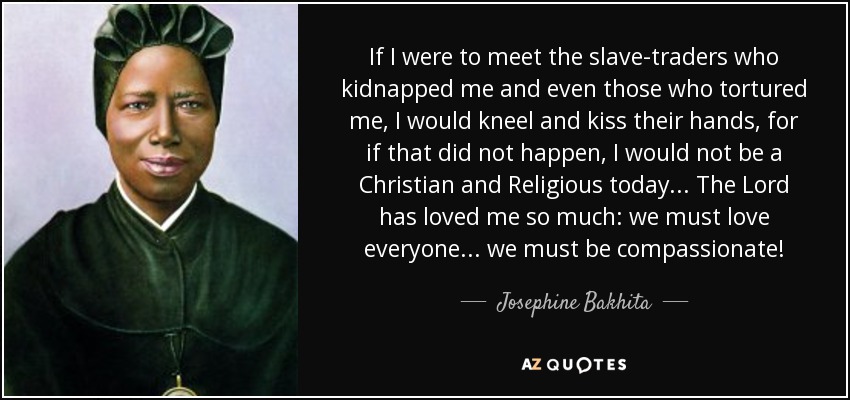
Like St. Josephine Bakhita who went
through so much pain and sufferings as 
child when she was sold as a slave in Sudan 
that in the process she had forgotten her name,
she was able to keep her sanity and 
regained her dignity as a person
until she converted to Catholicism
and eventually became a nun
because she found you, Jesus,
as the center of her life, even forgiving
those who have tortured and maltreated her.
Her redemption from a life of slavery
and constant sufferings proved that indeed,
we are the center of your creation, O Lord,
that you hear our pleas
and come to save us
if we remain centered in you too.
Amen.

Finding God in the ordinary

The Lord Is My Chef Daily Recipe for the Soul by Fr. Nicanor F. Lalog II
Wednesday in the Fourth Week of Ordinary Time, Year I, 01 February 2023
Hebrews 12:4-7, 11-15     ><]]]'> + ><]]]'> + ><]]]'>     Mark 6:1-6
Jesus departed from there 
and came to his native place,
accompanied by his disciples.
When the sabbath came
he began to teach in the synagogue,
and many who heard him were astonished
(Mark 6:1-2).

How nice, O Lord,
that you never stop 
to come home with us,
to be with us,
to be one of us.
And too often,
we are astonished
with your works.
Just like your local folks
back then at Nazareth.
So often, it all ends
that way with us with you,
Jesus:  we are astonished,
surprised, amazed, and wowed
by your works.
But rarely by your person
that we cannot see you anymore
in ordinary things and most especially,
when things become difficult.
Forgive us, Jesus, when like
your town folks, we also "took
offense at you" (Mk. 6:3), 
questioning you,
daring you with your powers;
make us realize the beauty of
you being a Brother,
a Friend to us,
someone we can come to,
someone we can rely on
as being present with us
always, and most of all,
our life and salvation 
for you are our Lord and Master.
Help us also endure our trials 
as a discipline like what the author of the
Letter to the Hebrews exhorted us
in the first reading today;
let us enter into a personal relationship
with you, Jesus, so we may also experience
our being children of the Father
who disciplines us with the trials
that come our way.

At the time, all discipline seems a cause not for joy but for pain, yet later it brings the peaceful fruit of righteousness to those who are trained by it. So strengthen your drooping hands and your weak knees. Make straight paths for your feet, that what is lame may not be dislocated but healed.

Hebrews 12:11-13
On this first day of February,
open our eyes and our hearts
to you dear Jesus that we may find you
always in ordinary and difficult times
of our lives for that is when 
you are most present in us and 
among us.  Amen.