Our questions, our epiphanies

The Lord Is My Chef Sunday Recipe for the Soul by Fr. Nicanor F. Lalog II
Solemnity of the Epiphany of the Lord, 07 January 2024
Isaiah 60:1-6 ><}}}}*> Ephesians 3:2-3,5-6 ><}}}}*> Matthew 2:1-12

I have been thinking these past days after Christmas at how ironic when we rejoiced on the Lord’s birthday, we also unconsciously left him behind our celebrations. It seemed that the more we celebrated Christmas, the more we think of our very selves, the more we forget Jesus found in other people, especially the little ones. 

This is perhaps the problem with our prolonged Christmas season in the country that as we try so hard to be “in” beginning September, the more we actually push Jesus “out” of Christmas! We are so concerned with everything new and beautiful – from our clothes to our gifts and decorations, food and parties when Jesus actually came for what is old and worn out like the sinful, the outcasts, and the marginalized. Christmas is being “out” with Christ when we think less of ourselves within like the magi from the East who went out of their ways, of their comfort zones and even ivory towers to find Jesus in Bethlehem.

This is what Epiphany or Manifestation of the Lord to the Nations of the world is showing us today in this last major celebration in the Christmas season before we shift into Ordinary Time on Tuesday after the Feast of the Lord’s Baptism tomorrow.

Yes, Jesus is out there, manifesting himself daily in so many ways but we could not recognize him because we are locked inside our own beliefs of the Christ, held captive by our many fears like King Herod and the people of Jerusalem.

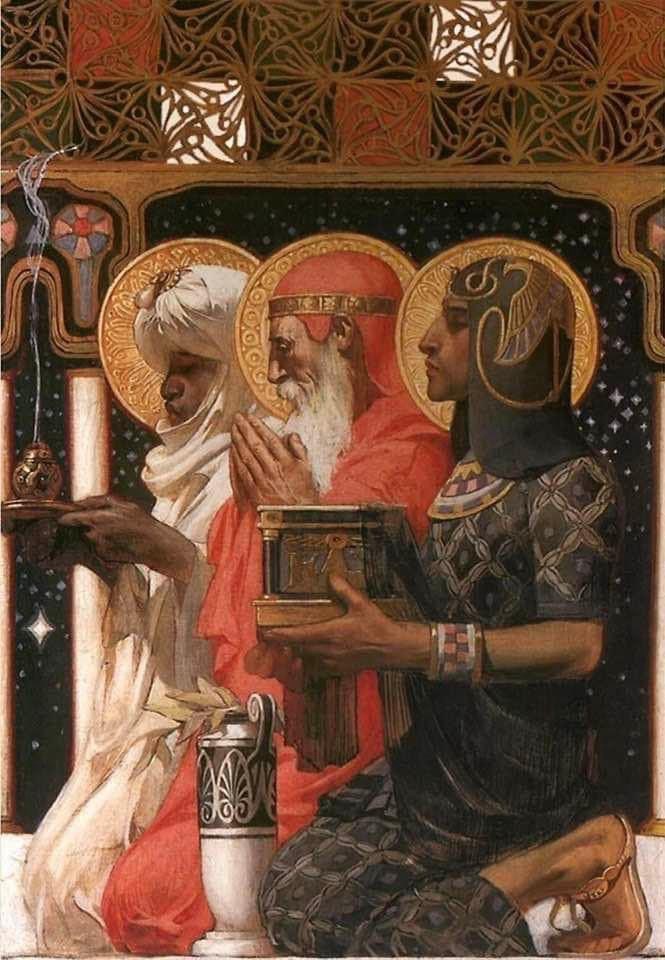
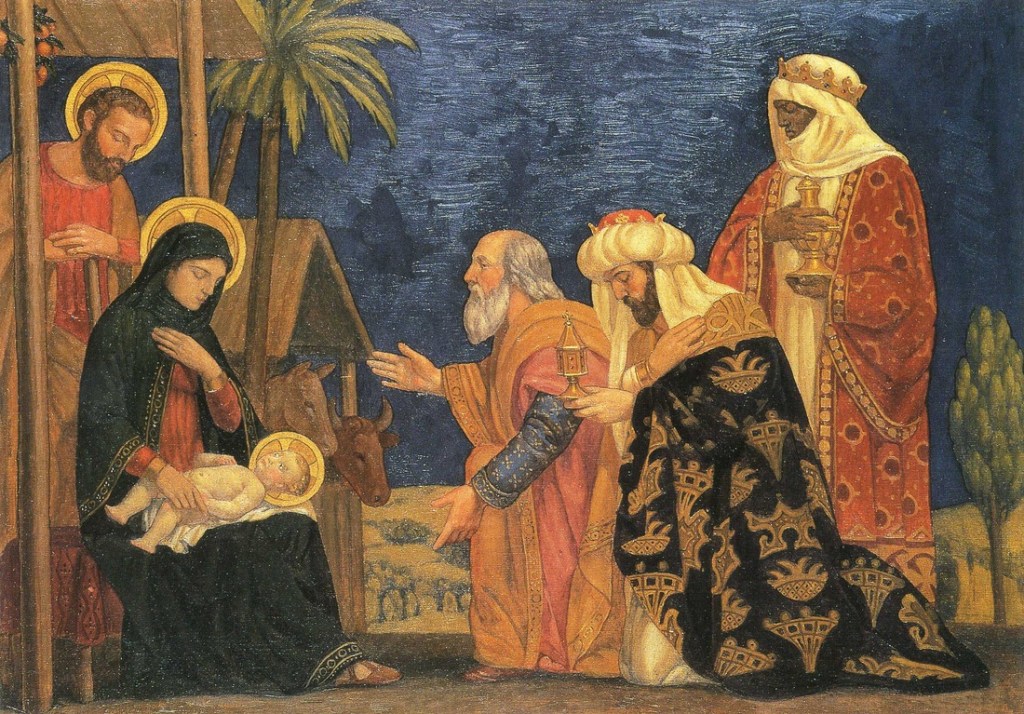
When Jesus was born in Bethlehem of Judea, in the days of King Herod, behold, magi from the east arrived in Jerusalem, saying, “Where is the newborn king of the Jews?  We saw his star at its rising and have come to do him homage.”  When King Herod heard this, he was greatly troubled, and all Jerusalem with him. Assembling all the chief priests and the scribes of the people, he inquired of them where the Christ was to be born.

Matthew 2:1-4
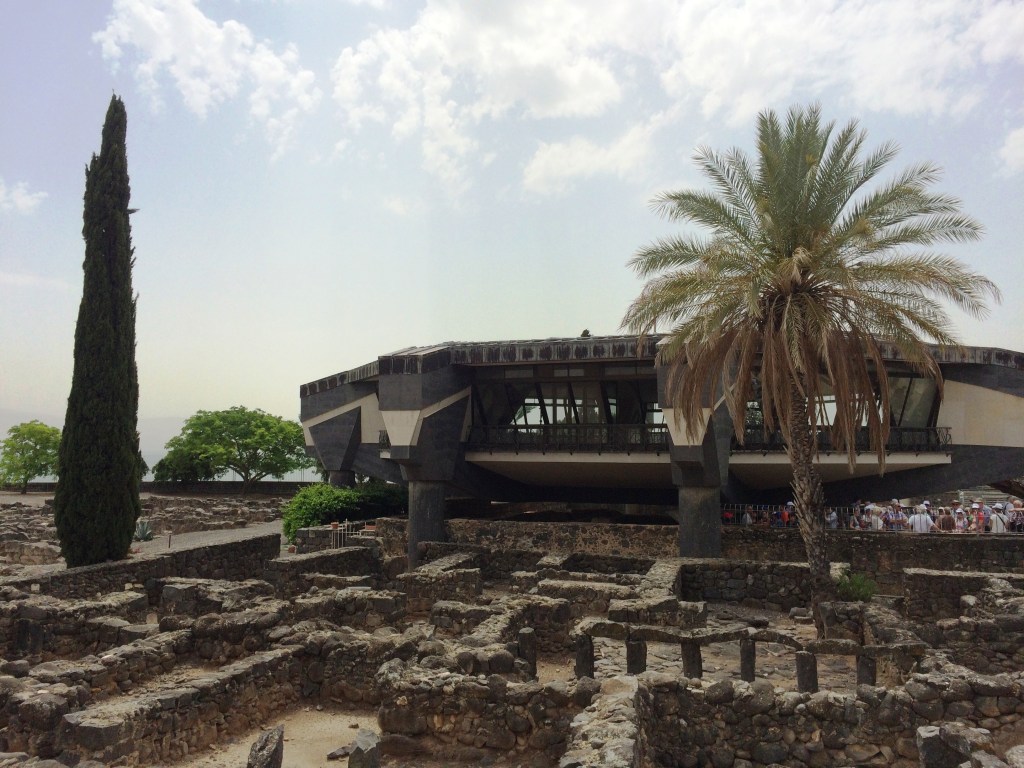
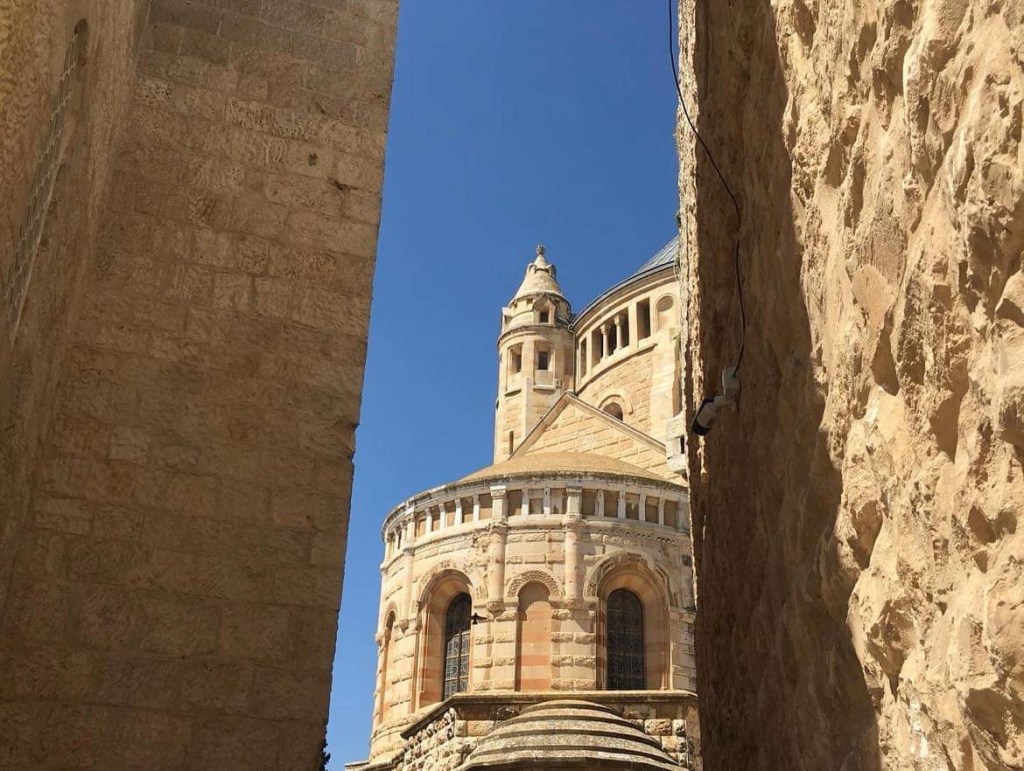
Photo by author, Jerusalem, May 2017.

If somebody today would come inquiring where is the newborn king or lord and master of Christians, how would we feel?  Would we feel “greatly troubled” like King Herod and the rest of Jerusalem? 

Don’t you find it odd that when the magi asked about the newborn king of the Jews, Herod and the people were troubled instead of at least first asking for clarifications on who was the king they were looking for? The least they could have done was looked up to see the star that brought the magi there in the first place so that instead of being troubled, they could have felt perplexed or baffled, with the familiar reactions of “what?” or “duh…” or “huh” or as we would always say, “ha, ano daw iyon?”

This is what I meant of Christmas as a celebration of going out to check on others like the magi and their star: Herod and the people of Jerusalem went inside themselves and got locked in their beliefs and presuppositions as well as fears! They were troubled because they felt the status quo would be disturbed that could throw them off their comfort zones. And the biggest irony is that they who have the answers in the scriptures remained locked inside their own selfish worlds, refusing to get out and meet the newborn king!

But there is another side to this reality of our refusal to go out, to meet and recognize Christ in his manifestations. This is a more dangerous expression of being locked inside ourselves when our motivation in asking questions is dubious. Why do we ask and inquire on someone or anything? Is it because we want to learn and know better or is it because we want our beliefs validated and affirmed?

The magi were clearly searching for the truth, for an answer to their queries. They wanted to know because they knew very well that they knew nothing or so little about the newborn king of the Jews that is why they asked questions in Jerusalem. See their sincerity and humility in finding the truth that they they went out of themselves. And they were not disappointed for eventually, they were filled and fulfilled with Jesus.

King Herod on the other hand inquired about the birth of the Messiah because of his sinister plans against him. He was filled with pride and conceit, locked inside himself without any intentions of truly learning and knowing, of relating with Jesus nor with anybody else. He felt he knew everything so well without realizing he knew nothing at all. Herod and the rest of Jerusalem were troubled precisely because they were not interested with Jesus Christ. 

It is said that a person is known by the questions he/she asks. Very often, our questions are a manifestation too of who we are. 

Let us not be complacent that this happened only to King Herod and the people of Jerusalem more than 2000 years ago for it continues to happen to this day in many instances in our lives, in our families, and in our parishes and the Church when we no longer search for Christ Jesus as we are busy pursuing many other things for personal fame and glory.

How often does it happen with us in our parish, in our Church, in our families that we are so stuck into our old beliefs even traditions that we refuse to go out and meet Jesus Christ Who have come to set us free from all forms of slavery caused by sins? 

Jesus fulfills the longings of the people since the Old Testament time as heralded by Isaiah’s prophecy in the first reading which St. Paul beautifully explains in the second reading as “the mystery made known by God to him.”  Mystery in this sense is not something hidden but revealed so that in Christ Jesus, the mystery of God, His plan for us is revealed or made known for everyone not only the Jews but for all peoples of the world represented by the magi. 

Are we willing to be like the magi who dared to leave everything behind, unmindful of the long and perilous journey to make in order to meet Jesus Christ?  In meeting the Lord like the magi, are we willing to give up everything we have especially the most precious ones and offer these to Him?  Most of all, upon finding God, are we willing to go back home by “another way” like the magi as instructed in a dream never to return to Herod?  The Lord continues to manifest Himself to us in so many ways every day, often in the simplest occasions and things.  May we have the courage to meet Jesus Christ so that we may see the light and beauty of this New Year He has for us. Have a blessed week ahead!

“Lord Jesus Christ, 
give us the courage
to leave our baggages of 2023: 
the pains and hurts, the sins,
the failures and disappointments
so that we may meet You this New Year 2024. 
Teach us to give up our worldly treasures
so that we could truly ask honest
and sincere questions to know You,
to love You, and to follow You
in Your many epiphanies
of truth and realities,
of love and kindness,
of mercy and forgiveness
through the people we meet. 
Amen.” 

Saying “no” leads us to rejoicing

The Lord Is My Chef Sunday Recipe for the Soul by Fr. Nicanor F. Lalog II
Third Sunday in Advent Week III-B, Gaudete Sunday, 17 December 2023
Isaiah 61:1-2, 10-11 ><}}}*> 1 Thessalonian 5:16-24 ><}}}*> John 1:6-8, 19-28
Photo by author, Gaudete Sunday 2018.

Our church is bursting with pink shades this Third Sunday of Advent known as Gaudete (Latin for rejoice) Sunday following calls from our antiphons and readings for us to rejoice in Jesus who had come more than 2000 years ago in Bethlehem.

We also rejoice on this date, the 17th of December, as we shift our focus to enter Advent’s second phase when we remember and reflect the events surrounding Christ’s birth on that first Christmas. Today is also the second day of our Simbang Gabi and without sounding a Scrooge, I wish to propose in my reflection this Sunday for us to examine those moments in the scriptures and in our lives when saying “NO” leads us too into great rejoicing.

It is normal most of the time that rejoicing comes after every big “YES” in life like when a woman finally says “YES” to her suitor or when a boss says “YES” to promote an employee. The reason mankind rejoices at Christmas is because of the Blessed Virgin Mary’s “YES” to be the Mother of Jesus Christ our Savior.

Photo by author, Gaudete Sunday 2019.

However, history and our own experiences have taught us also that the key to rejoicing is when we say “NO” or receive or do something in the negative like during the pandemic when we prayed for “negative results” whenever we would get COVID tests. A lot often in life, a negative can be positive like what we see in our gospel today:

A man named John was sent from God. He came for testimony, to testify to the light, so that all might believe through him. He was not the light, but came to testify to the light. And this is the testimony of John. When the Jews from jerusalem sent priests and Levites to him to ask him, “Who are you?” he admitted and did not deny it, but admitted, “I am not the Christ.”

John 1:6-8, 19-20

See the progression of the negatives in the fourth gospel’s Prologue: after establishing “In the beginning was the Word” who is Jesus Christ the “life” and “light” in verses 1-5, John the Baptist is introduced with the immediate declaration “He was not the light, but came to testify to the light” in verses 6 and 8. In the following questioning by the priests and Levites sent from Jerusalem, John twice told them “I am not the Christ… not Elijah”, insisting with a strong “No” if he were the Prophet in verses 21-22 before wrapping up the scene with a solemn statement that “there is one among you whom you do not recognize, the one who is coming after me, whose sandal strap I am not worthy to untie” in verses 26-27.

Photo by author, Gaudete Sunday 2019.

What a lovely scene of negatives, of nots and nos!

Recall those moments in our past filled with painful rejections and humiliating failures that we now look back with rejoicing because of the valuable lessons we have learned and made us stronger today. We realize too that the past negative moments darkened by sin and evil were not totally bad at all as these have led us into the light of Jesus Christ that we now rejoice in being forgiven and loved. When we remember those trials and difficulties we have hurdled in life, we do not feel ashamed but actually feel so proud, being sources of rejoicing for all our victories and successes today.

As we have been saying, Jesus was born during the darkest night of the year, a big negative so we can see the great positive, Christ our Savior, our Light. He is the fulfillment of that great prophecy by Isaiah in the first reading which Jesus himself proclaimed at the start of his ministry in their synagogue in Nazareth on a sabbath. 

The spirit of the Lord God is upon me, because the Lord has anointed me; he has sent me to bring glad tidings to the poor, to heal the brokenhearted, to proclaim liberty to the captives and release to the prisoners, to announce a year of favor from the Lord and a day of vindication by our God.

Isaiah 61:1-2
Photo by author, Gaudete Sunday 2019.

Luke tells us in his account how “the eyes of all in the synagogue looked intently” at Jesus who then said, “Today this scripture passage is fulfilled in your hearing” (Lk.4:20-21).

When there is fulfillment, rejoicing follows because that is when we say no to the many negatives holding and preventing us from welcoming Jesus in our lives.

When we feel poor and inadequate and try to find Christ beyond what we do not have, that is when we rejoice to find everything in him who fulfills, enriches and enables us in this life and beyond.

Rejoicing happens when we finally say no to our toxic relationships with people who break our hearts with their infidelities and say yes to Jesus who remain faithful and true to us in our family and old friends who truly loved us ever since.

True joy and rejoicing happen when we finally say no to unforgiveness of self and others, when we say no to the past sins and mistakes, baseless guilt-feelings that have held us captives for so long to find mercy and forgiveness in Jesus.

Every day is a part of the year of favor from the Lord, calling us to say no to hopelessness and despair, to say no to cynicism and indifference because Jesus always vindicates though slowly all our efforts and sacrifices, strivings and perseverance in being good and honest in a world that honors thieves and criminals.

Many times in life, rejoicing bursts when we say no to sin, when we say no to disrespect, when we say no to injustice and inequality. More rejoicings will surely come our way the moment we start saying no to violence and war, no to discrimination, no to deaths and violence, no to selfishness and vanities.

Photo by author, Gaudete Sunday 2019.

The list of the no’s we can say and affirm in Jesus Christ is endless for us to truly rejoice. But of all the great rejoicing in Christ that we need is to everyday have a firm and big NO to all our fears in loving. 

One main reason our lives are miserable because we choose not to love for fears of being hurt, of losing, of separation, of death. St. Paul asks us in the second reading to rejoice always simply by choosing to love always too.

Brothers and sisters: Rejoice always. Pray without ceasing. In all circumstances give thanks, for this is the will of God for you in Christ Jesus. Do not quench the Spirit. Test everything; retain what is good. Refrain from every kind of evil.

1 Thessalonians 5:16-19, 21-22

Recall how the great apostle Paul described to us in 1 Corinthians 13 what is love and what is to love; what he told us today in his letter to the Thessalonians are basically the same: love, love, and love. And the first expression of love of God is praying. Just like in human love, we always talk with the one we love. If we truly love, then we must keep on praying which is beng one with God who is love.

To love is simply to be good, to avoid sin and evil. True rejoicing can happen only when we love, when we shun and say NO to sin which is a refusal to love. 

Photo by author, Gaudete Sunday 2021, Basic Education Department chapel, Our Lady of Fatima University, Valenzuela City.

That is why throughout his ministry, Jesus chose to dine and be with sinners, never afraid of what others would say about him because he truly loved. His enemies could not rejoice for they chose to reject Christ’s calls for them to say no to judging others, say no to legalisms, say no to their self-righteousness and conceit. In their refusal to say no to their pride that have closed their minds and their hearts to God and others, they have chosen not to love and thereby failed to meet Jesus the Christ.

Until now, life continues to be miserable to many people because they could not accept Jesus Christ and his Cross, the very sign of his immense love for us. An essential part of the joy of this Christmas is the Cross of Good Friday looming behind that manger in Bethlehem. Before Christ, the cross used to be a big negative but with Jesus, it literally became a plus sign – a positive when he chose to suffer and die in order to rise again on Easter because he loves us so much. Like him, let us say no to sin and evil so we can rejoice in him and in love. Amen. Have a blessed final week towards Christmas Day! 

Life is a daily Advent, a new beginning in Christ

The Lord Is My Chef Sunday Recipe for the Soul by Fr. Nicanor F. Lalog II
Second Sunday in Advent, Cycle B, 10 December 2023
Isaiah 40:1-5, 9-11 ><}}}*> 2 Peter 3:8-14 ><}}}*> Mark 1:1-8
Photo by author, the Forest Lodge, Camp John Hay, Baguio City, 12 July 2023.

It has been a week since we started our new liturgical year with the Season of Advent. And let’s admit that we have hardly noticed how fast time passes by these days with all the parties and gatherings we have been having since December started!

And that is the joy of patient waiting even in the dark during this time of active waiting for Jesus Christ’s Second Coming which is the first phase of this Season of Advent.

If we remain and persevere to be faithful in Jesus and his teachings, we realize that every day in life is always a new beginning in Christ to start anew in becoming a better disciple. We hardly notice the passing of time when we love and serve God in others because we experience that life is more of a series of beginnings than of endings as Mark reminds us at the start of his gospel account:

The beginning of the gospel of Jesus Christ the Son of God.

Mark1:1
Photo by author, Malolos Cathedral Advent 2019.

Mark was the first to write a gospel account, composing it in Rome in the year 70 AD when the early Christians who were mostly of Jewish origins were under persecution. For his audience of Jewish origins, the word beginning meant a lot like the Book of Genesis, connoting how God is always present amid the persecution, of how order comes after chaos.

In simply declaring to us “The beginning of the gospel of Jesus Christ the Son of God”, Mark is reminding us how God is always starting a new creation, a new order, a new revelation in us and among us.

Very often, beginning connotes an ending; but, not with God nor with the gospel who is Jesus Christ. Remember how Mark’s gospel ended abruptly and unexpectedly in the discovery of the empty tomb by Mary Magdalene, Mary mother of James and Salome who all “fled… bewildered and trembling… in great fear that they said nothing to anyone” (Mk.16:1-8).

By “ending” his gospel account that way, Mark actually wanted his listeners that include us today to continue writing and proclaiming the gospel of Jesus Christ in our own lives. For Mark, the gospel never ends but simply begins over and over again through the lives of disciples who meet and befriend Jesus Christ, the Son of God.

Photo by author, Advent 2018.

Now, to think of the beginning is to remember our origin or starting point, the person of Jesus Christ.

The late Fr. Henri Nouwen used to say that the word remember means “to make a member a part again”; hence, re-membering our beginning is making God in Jesus Christ a part of our lives again, of our present moment again.

More than just going back to the basics shouted by everyone these days even in the Church, remembering our beginning is bringing back the person of Jesus Christ in our lives today. That is what a new beginning means, a return to the person of Jesus Christ who is the essence of Christmas, of the Church, of the world.

Everything in life becomes clear when we begin in Jesus Christ. All these questions we have been asking inside, the many whys of life, will only be answered and clarified when we begin in Jesus. Many in the world would say it is very simplistic but, the problems of the world then and now are all due to the removal Jesus Christ from our hearts, homes, offices, and classrooms, and relationships. Begin again in Christ and see how everything, everyone becomes new and beautiful again!

Photo by author, Advent 2018.

Sometimes, Mark’s gospel is called the “Gospel of Beginnings” because of his frequent mention of Jesus “beginning” to do something like when “he began to teach” in many occasions in the synagogue and temple area (Mk. 4:1, 6:2 and 34, and 8:31) or when “he began to speak in parables” (Mk. 12:1); when Jesus came to Jerusalem and entered the temple, “he began to cleanse” it (Mk.11:15) while at the agony in the garden, “he began to be troubled” (Mk. 14:33).

All these indicate how our ministries began in Jesus Christ and nowhere do we find Mark telling us Jesus had ended them all. In fact, in the longer ending of his gospel that was later on added by his followers, we find Jesus telling his disciples that include us today to continue with his works and mission. Every mission we have in life especially in the Church must always begin in Jesus Christ.

After all, when we reflect on Mark’s brief opening sentence to his gospel account that associated the word beginning with the Lord’s name Jesus Christ, we find him telling us that same truth that everything created began in Jesus Christ as expounded by John at his prologue (Jn. 1:1-5) and Paul in his letter to the Colossians 1:15-20.

Examine how John and Paul beautifully expressed in poetry their theology simply expressed by Mark as “The beginning of the gospel of Jesus Christ the Son of God”.

Here we find that even if Mark’s gospel is the shortest of the four gospel accounts, “brevity is the soul of wit” (Shakespeare in Hamlet). And that is the short of all these things we believe in and hold so dearly in our faith: Jesus Christ as the beginning and the origin of everything.

There lies the challenge to us these days when people no longer remember, and even willing to forget God and Jesus Christ: of how like Mark we can always begin each day, our work and ministries, our missions and everything in Jesus Christ. In the first reading, God calls us through the Prophet Isaiah to comfort his people, especially those sick and weary, those losing hope in life that until now happens. Perhaps because what we keep on offering others are not really the essential one, Jesus Christ, our beginning.

It is a brand new week again as we get closer to Christmas and most especially to Parousia. The problems and darkness remain in our lives. The words of Peter in the second reading today are scary when God “dissolves” everything at the Parousia; however, it is a call for us believers to witness the hope in Christ’s coming not by our words and beliefs but by our witnessing to Jesus Christ, by the holiness of our lives that begin in Jesus Christ. Amen.

We are never empty & alone when waiting patiently even in the dark

The Lord Is My Chef Sunday recipe for the Soul by Fr. Nicanor F. Lalog II
First Sunday in the Season of Advent, Cycle B, 03 December 2023
Isaiah 63:16-17, 19; 64:2-7 ><}}}*> 1 Corinthians 1:3-9 ><}}}*> Mark 13:33-37
Photo by author, National Shrine of Our Lady of Fatima, 08 December 2022.

I was literally waiting the “advent” or coming of my doctors last Thursday as I wrote this homily for this first Sunday of Advent, the new year in our Church calendar. It was a hazy morning with some drizzle when I arrived for my doctors’ appointments.

But, it was a graceful moment too as I rediscovered the virtue of patience by being a patient myself again.

Sick people are called patients precisely because healing requires a lot of patience. Tons of patience in fact, especially if we are incapacitated or too weak to move. And the most difficult part of patience is waiting, from the simple waiting for doctors and nurses, waiting for the end of the day to waiting for our complete healing until we are well again.

Photo by author, First Sunday of Advent 2021, Basic Education Department, Our Lady of Fatima University, Valenzuela City.

The difficult part of waiting is that we are so conscious of time which we find to be flowing so slowly, making us irritable even doubtful if ever the one we are awaiting would ever come or materialize at all. That is why patience has become a virtue so rare these days.

Many people reject, even abhor patience in this age of instants when everybody wants to bear fruit but resent how it takes time to ripen. We want to have everything now na! We do not want to wait because we are no longer contented with whatever comes to us so that we advance our salaries and buy things in credit cards. Worst is this notorious practice of advancing public holidays to other dates closest to weekends to have “long weekend” celebrations. Even Christmas is not spared from our impatience! See how malls and local government buildings, homes and radio stations could not wait after the Halloween with all the lighting of Christmas trees and decors everywhere.

Unknown to us, we are robbing ourselves of very essence of the event of Christ’s coming to us when we manipulate time and its natural flow. When we lose patience, we stop waiting, then we miss the essence of life, of persons, of everything because we think waiting is being empty.

That is not true! Waiting is never empty. On the contrary, waiting is actually fullness because the very fact that we wait means we have.

Photo by author, lanterns for sale in San Fernando, Pampanga, November 2020.

When we were growing up, we loved waiting for dad’s coming home from work. We were filled with joy the moment we heard jeepneys stopping, hoping it was dad. Even if he would come home later in the evening when it was dark, we always felt so sure and excited of his arrival with pasalubong because he was always in our hearts.

That is the greatest joy of patient waiting – it is fullness of love due to our relationships. People who can’t wait, who are impatient are often loners, even complainers because they always feel empty within without any regard at all for relationships. Most likely, they have no relationships at all!

Photo by author, lanterns for sale in San Fernando, Pampanga, November 2020.

The first reading reminds us of this great beauty of patient waiting, of already having God himself within us with Isaiah calling God “our father, our redeemer” that both indicate kinship and relationships with him.

You, Lord, are our father, our redeemer you are named forever.

Isaiah 63:16

Very notable is the word “redeemer” that is go’el in the Hebrew language – the family relative who pays off debts or redeems a foreclosed property so that their family or tribe could keep it.

That is exactly what Jesus came for – to redeem us, to ransom us from our debt we could not repay God which is love. By dying on the Cross, Jesus saved us, redeemed us from the clutches of death and evil to be filled with life again. And that is why he is coming again to ultimately vanish all evil and sin to bring us to new heaven and new earth.

Physically we do not see Jesus but realistically, spiritually, we are certain he is with us, within us. Therefore, our waiting for him is never empty but always full of Jesus precisely due to the relationship we have in him and with him.

Photo by author, Advent 2019 in our former parish.

Waiting for Jesus is an expression of our faith. And we wait with him, just like the apostles in the agony of the garden. Notice how Mark narrated to us this calls for being watchful by Jesus; unlike Matthew, Mark mentions the time of Christ’s coming – at night.

Jesus said to his disciples: “Be watchful! Be alert! You do not know when the time will come… whether in the evening, or at midnight, or at cockcrow, or in the morning. May he not come suddenly and find you sleeping. What I say to you, I say to all: ‘Watch!'”

Mark 13:33, 35-37

This may be a minute detail for us but not for Mark who was the first to write the gospel of Jesus which happens to be the shortest and most concise. Night time in the Bible evokes darkness when evil seems to dominate the time which we continue to think of in the present.

But, we are children of light as St. Paul reminds us in one of his letters. And this Sunday he assures us in the second reading that “God is faithful” who “called us to fellowship” in him through Jesus Christ (1 Cor. 1:9). Let us not be afraid of the dark and long waiting for Jesus because he had conquered it when he walked on water, when he stilled the storm in the sea, when he rose again on Easter. Do not forget too that Jesus was born during the darkest night of the year, a reminder and assurance to us that no matter how dark our lives may be, Jesus is near, Jesus is here. So, have no fear in him, our brother and kin who had saved us!

Photo by author, Advent 2019 in our former parish.

Watch and be on guard on Christ’s coming and presence in darkness because too often, we are the ones who miss the Lord. Keep in mind that it is at night, it is in darkness when it is best to believe in the light. Here, we again find that waiting even in darkness in never empty because that is when we are so sure there would be great light bursting forth soon as Isaiah had prophesied that was eventually fulfilled in Jesus Christ. Sometimes, we get bored even impatient or sleepy waiting for Jesus like the five wise virgins who brought extra oil waiting for the groom to arrive. The key is to remain in Jesus, only Jesus, always Jesus as we pray like John the Beloved, Maranatha, “Come, Lord Jesus!” Amen.
Christ the King, the Power to Love

The Lord Is My Chef Sunday Recipe for the Soul by Fr. Nicanor F. Lalog II
Solemnity of Our Lord Jesus, King of the Universe, Cycle A, 26 November 2023
Ezekiel 14:11-12, 15-17 ><}}}*> 1 Corinthians 15:20-26, 28 ><}}}*> Matthew 25:31-46
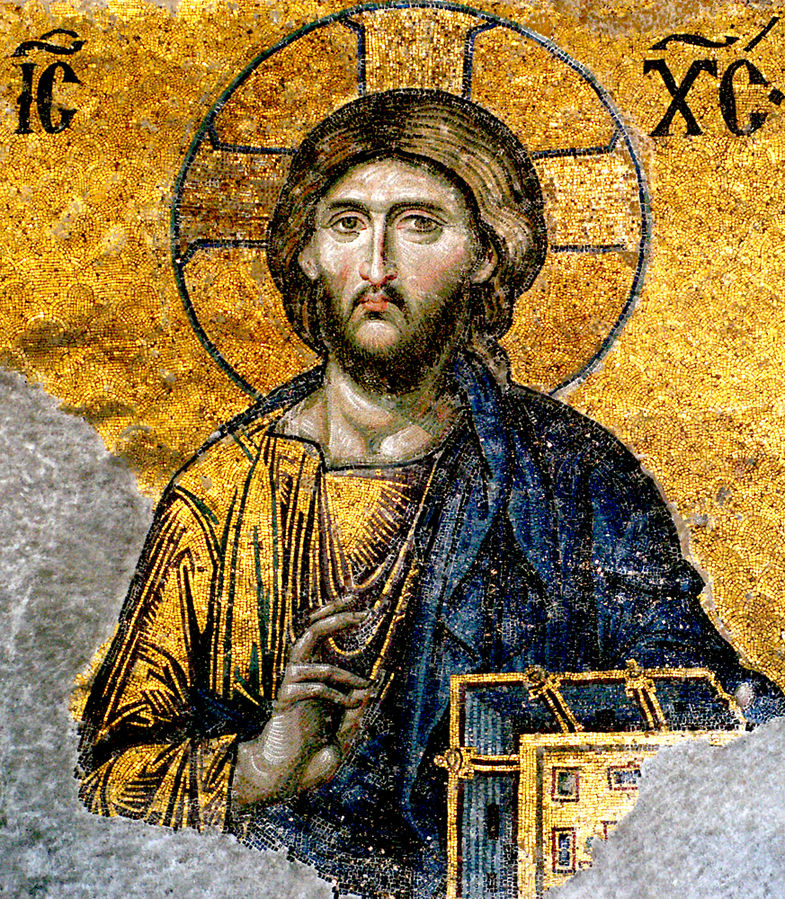
Detail of Jesus Christ at the Hagia Sophia in Istanbul, Turkey; photo from wikipedia.org.

We now come to the final Sunday celebration of the year, the Solemnity of Christ the King. See how we close the liturgical calendar celebrating Christ’s kingship, only to open it anew next Sunday with Advent Season in preparation for Christmas, the birth of the King of kings.

Far from the connotations of power and authority of kings of the world, Christ’s kingship is more pastoral in nature by taking its cue from the image of a shepherd prevalent in the ancient Middle Eastern culture. In fact, Jesus is more perfect than any shepherd being the Good Shepherd himself, the fulfillment of the promise of God we heard in the first reading who would come to personally tend his flock.

As I prayed over our readings of this Solemnity which is one of the youngest feasts we have in the church at less than 100 years old since its introduction in 1925 by Pope Pius XI, my thoughts wandered during that first year of the COVID-19 pandemic in 2020 when churches were closed and public Masses were prohibited.

Photo by Ms. Ria De Vera, Christ the King celebration in our former parish during pandemic, November 2020.

Right on the first Sunday when lockdown was imposed, we started our weekly “motorized procession” of the Blessed Sacrament around our former parish in Bulacan. I was so moved at the piety of our parishioners who knelt on the streets whenever we passed by.

We continued the practice until the Solemnity of Christ the King on that year of 2020. As usual, the people knelt on the streets when we passed by with the Blessed Sacrament. Even passengers of buses and other vehicles that chanced upon our procession paid homage to Jesus in the Blessed Sacrament.

Photo by Ms. Anne Ramos, March 2020.

Looking back to those days during my prayer periods this week, I realized that it was on that first year of the pandemic when we had the most meaningful liturgical celebrations in the Church when people felt intensely the need for God, when they clearly had Jesus alone as King and Lord.

Everyone’s faith was put to test as we were all gripped in fears and uncertainties with the deadly effects of COVID virus. Almost every family prayed the Rosary daily or nightly, so many trying to sneak inside churches to attend Mass celebrations. Of course, there were still some who went on their evil ways during those difficult times with the tokhang still implemented while those in power shamelessly grabbed the opportunity to rake in millions of pesos from corruption at the expense of the poor and suffering people.

When we recall that year 2020 of the pandemic, it was at that time we experienced Christ’s Second Coming as everyday was a judgment day, the end of the world — though not entirely fearful because it was also during that time we felt closest to God in Jesus our Lord and King!

Behind all those acts of kindness and goodness of the people are the immense love and mercy of God in Jesus Christ we have experienced in the recovery of infected loved ones or in the simple negative results of our COVID tests.

It was during those days when we experienced and felt Jesus truly present in us and among us that we simply radiated him on many occasions. That first year of the pandemic proved to many of us that being good, being kind, being helpful would never destroy nor diminish our person but had actually strengthened us as individuals and as a community. Recall how the “community pantry” caught the whole country on fire in just a matter of weeks when a young lady started it in their neighborhood at Maguinhawa Street, UP Village in Quezon City.

When families and communities banded together in love and kindness to help the poor and needy, the sick and those who have lost loved ones, the experience did not pulverize them but actually crystallized them as family or friends or neighbors. Walang nadurog sa pagdadamayan bagkus nabuo ang lahat ng nagtulungan!

That is the kingship of Jesus Christ. His power and authority were never meant to destroy us. In fact, when he came to us, he showed us and made us experience that the power and authority of his kingship is found not in force but in love and mercy that sadly many see these days as weaknesses.

Then the righteous will answer him and say, ‘Lord, when did we see you hungry and feed you, or thirsty and give you drink? When did we see you a stranger and welcome you, or naked and clothe you? When did we see you ill or in prison, and visit you?’ And the king will say to them in reply, ‘Amen, I say to you, whatever you did for one of these least brothers of mine, you did for me.’

Matthew 25:37-40
Photo by Ms. Marivic Tribiana, April 2020.

Christ the King today reminds us that true authority and power lead to humility which is more than being lowly but also of seeing the other person as another human in need, vulnerable and weak. Being humble is not only accepting our humanity but recognizing the humanity of those around us who need to be respected, loved and cared too.

Moreover, Christ the King reminds us that whatever authority and power we have is a sharing in God’s power and authority; hence, these must be used to help others, not lord over them. True power and authority lead to compassion, enabling us to feel the sufferings of others that move us to do something for them like Jesus.

This is what St. Paul reminds us in the second reading: the kingship of Jesus Christ – his power and authority – are a sharing in God. Unlike the worldly kings, Christ’s kingship is intimately related to the rule of God and ultimately subjected to the Father that is why it is transformative and performative to borrow one of Pope Benedict XVI’s favorite terms.

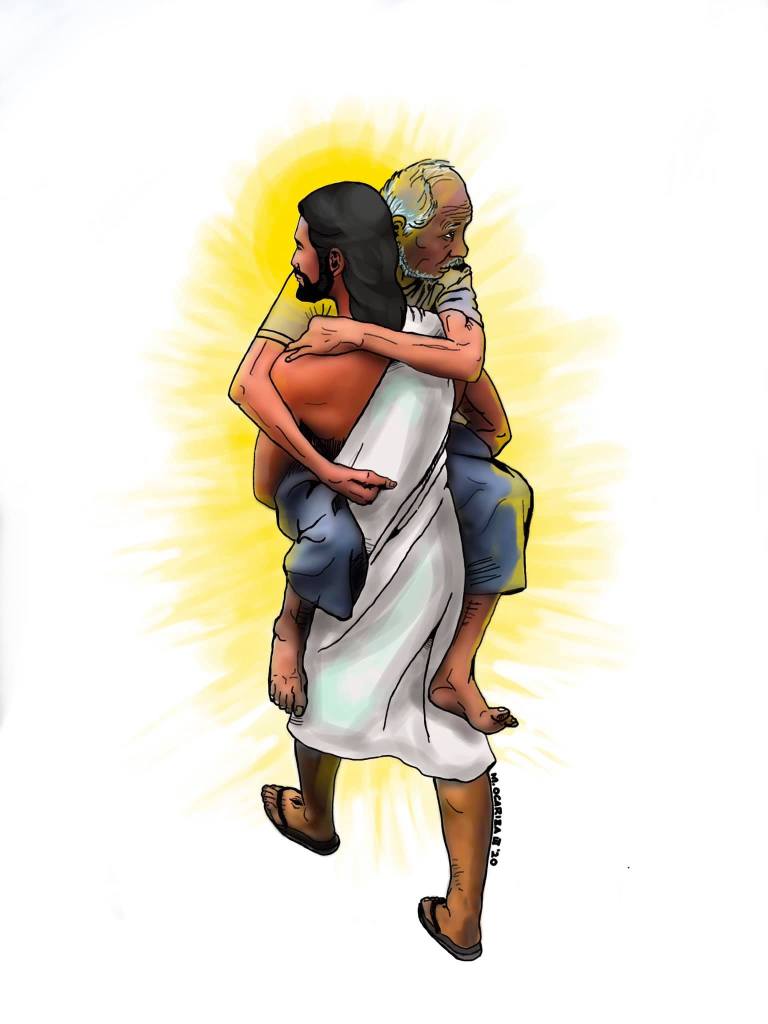
Artwork by Fr. Marc Ocariza based on Ms. Tribiana’s photo, April 2020.

The Kingship of Jesus Christ is the power to love, the most potent force in the universe. Yes, there are still evil and sin in the world today but soon, they shall be finally removed in Christ’s return as king. The present moment calls us to see Jesus in everyone we meet so that we act like him in loving service to others.

Notice how Jesus ended today his teachings at the temple area with a parable of the judgment of nations where people are separated according to their deeds. At the end of time, that is what Jesus will ask and judge us: how much have we loved like him? What have we done in this world, in life?

For us to better answer that, let us keep in mind what Jesus had done and still does to us and for us, of how much he loves us as our King and Protector. Recall the countless times he poured us his love for us. The moment we see his kingship in God’s way, then we follow Christ’s power and authority in the name of love and mercy, kindness and gentleness. Amen. Have a blessed week ahead!

“Every Little Thing She Does Is Magic” by the Police, 1981

The Lord Is My Chef Sunday Music, 19 November 2023
The Housewife 1871 Frederick Walker 1840-1875 Bequeathed by R.H. Prance 1920 http://www.tate.org.uk/art/work/N0352.

Hi everyone! So glad to be back this Sunday for our music related with our Mass celebration. We hope you have gone to your local church or wherever for the Sunday Mass where the first reading was taken from the Book of Proverbs that spoke of a “worthy wife”, a perfect wife.

When one finds a worthy wife, her value is far beyond pearls. Her husband, untrusting his heart to her, has an unfailing prize. She brings him good, and not evil, all the days of her life. She obtains wool and flax and works with loving hands. She puts her hands to the distaff, and her fingers ply the spindle. She reaches out her hands to the poor, and extends her arms to the needy.

Proverbs 31:10-13, 19-20

You must be wondering if there is a perfect wife – or a perfect husband – who really exist.

Of course, none. Nobody is perfect. You have to understand human words are so limited to express God’s thoughts and words. What the author of Proverbs mean today is an “ideal wife” – someone who keeps all the little things at home we (especially men and children) often take for granted that are actually the most important things that keep our homes nice and clean, cozy and orderly (https://lordmychef.com/2023/11/18/little-things-are-the-big-things/).

The reading from the Book of Proverbs this Sunday invites us to imitate the attitudes of the “worthy wife” like her diligence and fidelity to her tasks at home in actively waiting for the Second Coming of Christ at the end of the world. It supports the teaching of Jesus in today’s parable of the talents that God is not asking us great things in life but simply to be faithful to the tasks and responsibilities he entrusted to us. Exactly like the perfect wife who got everything covered not only at home but even outside! When we die, the only thing Jesus will ask us is how we have cared for those persons and things he entrusted us in this life – not what we have done nor achieved nor amassed like wealth.

And that is why as I prayed while preparing this Sunday’s homily, I kept hearing at the back of my head Sting and the Police singing their 1981 hit Every Little Thing She Does Is Magic.

Though I’ve tried before to tell her
Of the feelings I have for her in my heart
Every time that I come near her
I just lose my nerve as I’ve done from the start
Every little thing she does is magic
Everything she do just turns me on
Even though my life before was tragic
Now I know my love for her goes on
Do I have to tell the story
Of a thousand rainy days since we first met?
It’s a big enough umbrella
But it’s always me that ends up getting wet
Every little thing she does is magic
Everything she do just turns me on
Even though my life before was tragic
Now I know my love for her goes on

Written by Sting, the song is about a man who could not express his love for a woman he finds so beautiful and amazing. The song is actually about unrequited love and she never became his wife!

I resolved to call her up
A thousand times a day
And ask her if she’ll marry me
Some old-fashioned way
But my silent fears have gripped me
Long before I reach the phone
Long before my tongue has tripped me
Must I always be alone

And so you ask how do I find this song related with that reading from the Book of Proverbs about a perfect wife? We find that in the repetitive chorus line “Every little thing she does is magic” as well as in the superb instrumentation, especially its opening tune. This piece of music in itself is magic.

Let’s face it, man… women are so good in this life that without them, our world would stop, including the Church. For me, that “battle of sexes” had long been won by women because they are better than us in many accounts. That is why God gave them to us as our part-ners in life. Women, especially mothers and wives, have that attention to details we could not see (ask any husband how his wife could still see even even nothing can be seen?). Most of all, they have that flair and elan so built in within them that everything they do is magic – effortless, easy, so natural and personal.

Jesus is not asking us to do something so great or monumental in life. He simply wants us to be faithful and consistent with our calling as his disciples, as Christians who lovingly serve God through one another. Something that women, especially wives and mothers, could teach us a lot with in this life. Here’s the Police to all the great women out there with their loving and faithful men.

From Youtube.com.

Little things are “the” big things

The Lord Is My Chef Sunday Recipe for the Soul by Fr. Nicanor F. Lalog II
Sunday in the Thirty-Third Week of Ordinary Time, Cycle A, 19 November 2023
Proverbs 31:10-13, 19-20, 30-31 ><}}}*> 1 Thessalonians 5:1-6 ><}}}*> Matthew 25:14-30
Photo by Mr. Jim Marpa in Carigara, Leyte 2018.

Our first reading today from the Book of Proverbs is very interesting on this penultimate Sunday of the liturgical calendar before the Solemnity of Christ the King next week. If we go by today’s way of thinking, it sounds “sexist”, stereotyping the tasks of a “worthy” or perfect wife:

She obtains wool and flax and works with loving hands. She puts her hands to the distaff, and her fingers ply the spindle. She reaches her hands to the poor, and extends her arms to the needy.

Proverbs 31:13, 19-20

But for those like me who grew up in the generation reared by mothers proudly described as “plain housewife”, there’s no sexism nor stereotyping of women by the author of the Book of Proverbs. It is actually in praise of women, of housewives and mothers supposed to be the most attentive in details, truly dedicated and faithful in daily house chores.

Photo by Mr. Jim Marpa in Carigara, Leyte 2018.

Our first reading reminds us to be like a “worthy wife” who is consistent in doing those little things mothers do to keep our homes warm and tidy. Most of all, orderly.

Moms are blessed with special grace and talent in budgeting limited resources to come out with outstanding meals daily, of keeping socks and handkerchiefs as well as cuff links and old clothes ready and handy just in case there is an instant out of town trip or school project. With moms, life is practically worry-free because she gets everything covered even outside home! I remembered how my mom had everything in her little bag, from medicines like Cortal to Vick’s Vaporub and Band-Aid, candies and money, tissues and even tape measure called medida! Truly a Girl Scout, always ready for any eventuality.

And that is why we have this part of the Book of Proverbs this Sunday: to wait for the Second Coming of Christ which is also the end of the world is to be like a “worthy wife” concentrated on life’s essentials “who fears the Lord” (v.30) and “reaches out her hands to the poor, and extends her arms to the needy” (v. 20). It is basically being wise like the five virgins last Sunday – faithful to God, to his laws and commandments expressed in lovingly serving others especially the poor.

Photo by author, sunset in Tagaytay City, 07 February 2023.

That is the whole point of Jesus in today’s parable of the talents where he spoke to his disciples who include us today “of his coming” that no one knows like those servants awaiting their master’s return.
The parable did not tell us how the first two servants made use of their talents that earned them interests but it clearly pointed out what the third servant did not do. The time of waiting for the Parousia is an active waiting, of keeping up with the tasks entrusted to us by Jesus our Master. Instead of knowing its date with all those useless calculations and speculations, we are called to be diligent and committed in striving and persevering to be good at what is entrusted to us according to our ability like the first two servants and the perfect wife in the Book of Proverbs.

To wait for Jesus is not to be idle, doing nothing like the third servant in the parable who simply buried the talent entrusted to him. He was lazy, lacked any initiative, a whiner and a complainer.

Perfection and holiness lead to readiness for Christ, achieved in our faithfulness to our daily duties as his disciples, not elsewhere like in great moments we often await but never happen at all nor in appearances that do not matter like “charm and beauty” as the author of Proverbs said (v.30). Active waiting for the return of Jesus is living fully in every present moment, not in useless crying over the past or fearful anxieties of the future.

Photo from inquirer.net, 2021.

Jesus is not asking us – and would never ask us anything beyond our abilities – to do great feats like that master who simply entrusted his possessions according to his servants’ abilities.

Jesus is not telling us to do a Mother Teresa but simply be kind first to your family. Smile more often at people, laugh your heart out at the simple joys and stories especially of children. Choose silence than answering every call and conversation. Forgive a lot and you forget what isn’t nice. Then you see the hidden beauty of every person and thing. And not far from that, you find Christ coming right in front of you, too.

When we do the work of God, it does not really matter how big or small nor how simple or complicated that may be. It is always great to do the work of God because it is God’s work entrusted to us! A basketball is just an ordinary rubber ball but when used by Michael Jordan, it becomes of great value. The same is true when we do the works of God.

When Christ comes again to judge both the living and the dead, the only thing he would ask us is what have we done to those people and responsibilities he had entrusted to us. Ultimately, it is a question of how much have we loved, have we lived like him? Remember Jesus said “Not everyone who says to me ‘Lord, Lord,’ will enter the kingdom of heaven, but only the one who does the will of his Father in heaven” (Mt. 7:21-23). What are we doing, how are we living our faith in God these days are the questions we must answer to be ready for the Second Coming.

Photo by author, Jesuit Cemetery at the Sacred Heart Novitiate, Novaliches, QC, 21 March 2023.

St. Paul lived at a time when people were so excited for the apocalypse, the end of time when Christ is expected to come again. They believed – along with St. Paul – that they would witness the return of Jesus in their lifetime.

And that is why St. Paul wrote them, trying to calm them by telling them to always live in the present moment, to live fully every day because the Parousia will come like a thief in the night, just “when people are saying ‘Peace and security,’ then suddenly disaster comes upon them, like labor pains upon a pregnant woman” (1 Thes. 5:2-3).

How sad that what is happening today is exactly the opposite. These days, many people live as if Christ is never coming back to judge us at the end of time. Worst, many people live as if there is no God at all with all the wars and crimes going on, the continuing disrespect for life and persons, as well the many abuses and injustices committed with impunity.

Photo by Mr. Jim Marpa in Carigara, Leyte 2018.

These very presence of sin and evil in the world show that God’s final victory has not taken place yet. Therefore, each day is actually a reminder of the coming end of time, the return of Jesus to establish final peace and order. Far from terrifying and discouraging us, it is a call for us to live fully in the present, mindful of that Latin phrase “memento mori” that means “remember you must die.”

The German philosopher Martin Heidegger said we are all “beings-towards-death”, meaning, we all die someday.

It is in being aware of this certainty of death that we humans live authentically. It is only when we have come to terms with death that we also come to terms with life. We fear death because we have not yet started living truly. Now is the time. No need to write those bucket list. Simply live in God, in Jesus. Be good, be joyful. Then, it does not matter anymore when death comes. Amen. Have a blessed, faithful week ahead.

Living in the end of time

The Lord Is My Chef Sunday Recipe for the Soul by Fr. Nicanor F. Lalog II
Sunday in the Thirty-second Week of Ordinary Time, Cycle A, 12 November 2023
Wisdom 6:12-16 ><}}}}*> 1 Thessalonians 4:13-18 ><}}}}*> Matthew 25:1-13
Photo by author, PDDM Chapel, James Alberione Center, G. Araneta Ave., QC, 09 November 2023.

For the next two Sundays before the Solemnity of Christ the King, our readings deal with the urgency of the end of time, of the final judgment when Jesus comes again. Every Sunday in the Mass we profess in the Creed that “Jesus will come again to judge the living and the dead” and proclaim after Consecration that “Christ has died, Christ is risen, Christ will come again!”

But, do we really take Christ’s Second Coming to our hearts?

Maybe not at all if you scan the social media like Facebook or the news these days. Many people live as if there is no God nor final judgment. Worst, many have lost the virtue of waiting as nobody waits anymore in this age of instants! So unlike the Thessalonians during the time of St. Paul who all believed Jesus would come again in their lifetime. In fact, they were even so concerned with the sequence of entrance to heaven after some of them died ahead of the Parousia (Greek for Christ’s Second Coming). In explaining Christ’s return at the end of time, St. Paul insisted on two important points in his letter we have heard today.

Photo by author, National Shrine of Our Lady of Fatima, Valenzuela City, 06 November 2023.

First, the Resurrection of Jesus is the beginning of the end of time. We have to live daily as if it is the end of time. Easter is not an isolated event in the past; it is directly linked with everyone for all ages. Like Jesus, all those who have died shall go through “general resurrection” at the end of time when he comes again anytime he wishes. “For if we believe that Jesus died and rose, so too will God, through Jesus, bring with him those who have fallen asleep” (1 Thes. 4:14).

Second, the Parousia is God’s final victory over sin and death. Jesus had definitively won over sin and death on the Cross on Good Friday but its “powers” would finally cease and end at the end of time when Christ comes again to start anew everything in God with “new heaven, new earth”. That is why while awaiting his Parousia, we persevere in witnessing his gospel message of salvation amid the many sufferings we go through in this world like diseases and sickness, famine and poverty, wars and violence.

Here lies our problem – and foolishness – when we turn away from God, refusing to wait by falling into the devil’s temptation of “turning stones into bread” for instant solutions that have left us more divided, more miserable. We need faith in God who is our oil to keep our lamps aglow, giving light in this dark world even if we “become drowsy and fall asleep” while awaiting Christ’s return.

Jesus told the disciples this parable: “The Kingdom of heaven will be like ten virgins who took their lamps and went out to meet the bridegroom. Five of them were foolish and five were wise. The foolish ones, when taking their lamps, brought no oil with them, but the wise brought flasks of oil with their lamps. Since the bridegroom was long delayed, they all became drowsy and fell asleep.

Matthew 25:1-5
Photo by author, Chapel of the Holy Family, Sacred Heart Novitiate, Novaliches, QC, 2016.

Nobody knows when the Parousia will happen, not even Jesus except the Father. But the good news is that Jesus assures us today that it is normal to be drowsy and fall asleep in our lives while awaiting his final coming.

There are times we get so used to the darkness around us in life that we become cynical and even indifferent in our attitudes. We fall asleep, choosing to be mere bystanders, seeing nothing, hearing nothing, saying nothing, and doing nothing.

It is not good, of course. But, it can happen as we find our hands so full of our own personal and family issues that many times, we would opt to just “pray” than actively take part in advocacies and crusades against the many problems that plague the world today from poverty to hunger, wars and violence, human trafficking and prostitution to the destruction of our environment and climate change.

Becoming drowsy and falling asleep mean we get tired of all the problems and chaos in the world, even in our personal lives that we just want to stop and be detached, away from all troubles. No more dramas. To be silent until Jesus Christ comes to us in the dead of the night. Like the wise virgins, we keep focused on Jesus even if we become drowsy and fall asleep in his sure arrival.

Photo by Irina Anastasiu on Pexels.com

Being foolish like those other five virgins in the parable is abandoning God, not waiting for him, being busy with worldly concerns without thinking and looking into the wider horizons of life and realities.

Many times, the world seeks quick fixes to our many problems only to create bigger problems. Jesus had to wait until the hearts of the more than 5000 people who have followed him in the wilderness were opened to God and to one another before he miraculously fed them with bread and fish.

Being wise is having faith in God with good works. How sad that many people have foolishly turned away from God, even declared “God is dead” as they relied more on themselves and their technologies and modern thoughts that are often old mistakes in the past being repeated. Our bodies may get tired but never should we let our minds and spirits droop and fall behind, joining the materialistic and selfish bandwagon of the world. Being wise is to continuously seek God and his ways for a more meaningful way of living. This is the message of the author of the Book of Wisdom we heard today where God is personified as Wisdom like a beloved being sought.

Resplendent and unfading is wisdom, and she is readily perceived by those who love her, and found by those who seek her… because she makes her own rounds, seeking those worthy of her, and graciously appears to them in the ways, and meets them with all solicitude.

Wisdom 6:12, 16
Photo by author, 2019.

God is never far from those who truly seek him, who truly await him. There are always delays as God takes time before coming to us until we are ready for him and his plans.

There are many times in life that the solution to our problems require long waiting not only to find the best answers but most of all to purify our very selves. After all, the problems in the world are mere reflections of what is within each one of us as Jesuit Fr. Manoling Francisco expressed in his song One More Gift.

This is the sad thing with social media around us. Many times, some people use social media only to advance their own agendas that only add flames of hatred and violence. Instead of gathering first the facts and evaluating them prayerfully, we tend to react quickly, becoming emotional that we forget the face of every human person already suffering on the ground, regardless of their color and creed, thus continue the cycle of sins and evil.

Being wise is being grounded in Jesus, believing and trusting in his presence among us in everyone, that he shall surely come to save us and change everything for the best. Far from making us nervous and anxious, discouraged and careless in the uncertainty of his Second Coming, Jesus invites us today to be watchful and attentive to his presence especially in our Sunday Mass when we live in the end time, rehearsing our entrance into heaven as we wait. Amen. Have a blessed week!

Choose love. Always.

The Lord Is My Chef Sunday Recipe for the Soul by Fr. Nicanor F. Lalog II
Sunday in the Thirtieth Week of Ordinary Time, Cycle A, 29 October 2023
Exodus 22:20-26 ><}}}}*> 1 Thessalonians 1:5-10 ><}}}}*> Matthew 22:34-40
Photo by Dra. Mai Dela Peña, Mt. Carmel, Israel, 2017.

The enemies of Jesus continued with their barrage of questions to trick him into saying something that could lead to his arrest and execution. After failing last Sunday, the Pharisees sent today an expert – a “scholar of the law” – to test him anew with the question:

“Teacher, which commandment in the law is the greatest?” He said to him, “You shall love the Lord, your God, with all your heart, with all your soul, and with all your mind. This is the greatest and the first commandment. The second is like it: You shall love your neighbor as yourself. The whole law and the prophets depend on these two commandments.”

Matthew 22:36-40

For the second straight Sunday, Jesus not only responded to his enemies’ malicious questions with brief and brilliant answers but also taught them, including us today, with important lessons on discipleship.

Once again, Jesus is inviting us to have a wholistic view of life centered on God by healing the divisions within our hearts that are reflected in our broken relationships as individuals and family, church and community, and nation. How often do we reveal that same division in our hearts whenever we ask that same question 2000 years ago by the Pharisee, “which of the commandment in the law is the greatest”?

Photo by author, view from temple of Jerusalem, May 2017.

After receiving the Ten Commandments from God through Moses at Mount Sinai, the Jews dissected them into 613 instructions with 248 of these as positive laws every individual “should do” and the other 365 as negative laws everyone “should not do”.

Naturally, it was very difficult – if not impossible – for them to remember and observe these 613 precepts to guide them in their daily living so that their rabbis devised ways in which the Law could be prioritized with some categorized as “important” or “heavy” that should be followed more than those considered as “less important” or “lighter” in gravity. For example, laws pertaining to persons like parents are more important than those concerning animals that included about bird’s nest (Dt. 22:6-7)! Problem with this was when they circumvented the Law to give priority to lesser things that disregard the more important ones as Jesus pointed out so often to their religious leaders who have emphasized the sabbath by neglecting the human person like the sick.

Photo by author, St. Anne’s Church, Jerusalem, Israel, May 2017.

Another solution they have devised was to establish summary statements of the Law that could help put it all in perspective like “whatever is hateful to you, don’t do it to others”. Again, like in categorizing the Law, putting them into perspectives eventually led to their lost of essence because in our human experience, when many factors are weighed into our daily life, the way we see things are often narrowed and dimmed; then we begin making excuses and alibis to be exempted from our religious instructions. That is why Jesus “leveled up” the people’s perspectives in their views of the Law by telling them to shift their sights to higher level not just its letters but its spirit and source – God himself like the love enemies and the beatitudes.

Here we find the beauty and nobility of Jesus Christ’s answer to the scholar’s question by leading us all into the very essence of the Law which is love who is God too! Eventually on the Cross on Good Friday just like during the sermon on the mount, Jesus would show to everyone he was not only the fulfillment of the Law but the Law himself when he gave himself in love – to God our Father and to us his brothers and sisters. Today he deepens his teaching last Sunday that inasmuch as we have to give to Caesar what is Caesar’s like paying of taxes, then, we have to give our total self, our whole heart to God because that is what is due to God, our Maker and Master. To give our hearts to God is to always choosing to love God and love others as one loves one’s self.

Photo by author, garden beside St. Anne’s Church in Jerusalem, Israel, May 2017.

The moment we start categorizing or putting God’s laws into perspectives, into our own points of view, then we deviate from God himself and his plans. When we divide, separate and split the laws of God to find which could best suit us, then it becomes a DIY (do-it-yourself) Christianity where we choose laws applicable to us and disregard the rest we find difficult, calling them as outdated and conservative like divorce, contraceptives, and abortion.

In summarizing the commandments into the law of love, Jesus is inviting us today to welcome him into our hearts to let him alone dwell and reign over us so that when we are confronted with any issue and dilemma or confusion in life, we resolve them in the light of Christ which is always love. Letting Jesus reign in our hearts is choosing to find him in the other person we must respect and love and care.

Photo by author at Via Dolorosa in Jerusalem, May 2017.

To choose Jesus and his love is to always choose the human person above material things and even with one’s self. And to choose Jesus and his love is choosing his Cross too because he said there is no greater love than to offer one’s self for another. The true sign that we have really loved is when we love somebody more than ourselves like Jesus!

It is difficult and even insane as St. Paul declared “we are fools for Christ” (1 Cor. 4;10) because anyone who loves like Jesus who loves God with one’s total self and loves others like one’s self is crazy in the world’s point of view and standard. It has always been the way of Christianity ever since, always suspected as a threat to the ways of the world because the ways of Christ and his disciples are opposite the ways of the world as St. Paul explained to the Thessalonians “who received the word in great affliction, with joy in the Holy Spirit” (1 Thes. 1:6).

When I was still a young priest giving Marriage Encounter weekends to couples, I used to ask them this question: when husband and wife have an LQ or “lover’s quarrel”, who should make the first move to say sorry and be reconciled?

Many couples laugh, saying it should be the man first while men claim it must be ladies first. Still others reason out it should be the one who had sinned.

My answer: whoever has more love to give must be the first to make the move to reconcile because whoever has more love should love more!

The more we love, the more we are able to love because love is infinite like God. It is the only thing that will remain in the end because God is love. His laws are his expressions and manifestations of his love expressed in his compassion being a personal God relating with us through men and women around us (first reading). His laws fulfilled as love in the person of Jesus Christ light and guide our path in life often darkened by sin and imperfections. Choose love always and you shall never get lost! Amen. Have a lovely long weekend!

Photo by author, Pater Noster Church, Jerusalem, the Holy Land, May 2019.

Our divided hearts, divided lives, divided world

The Lord Is My Chef Sunday Recipe for the Soul by Fr. Nicanor F. Lalog II
Twenty-Ninth Sunday in Ordinary Time, Cycle A, 22 October 2023
Isaiah 45:1, 4-6 ><}}}}*> 1 Thessalonians 1:1-5 ><}}}}*> Matthew 22:15-21
Photo by author, Jerusalem, May 2017.

We are now getting closer toward the end of our liturgical calendar with our gospel scenes of Jesus still at the temple area in Jerusalem where his enemies were growing more intense in banding together to trap him for his arrest and crucifixion.

Many times, that same die-hard religious conceptions of the Lord’s enemies continue to distort our way of Christian living today. First of these is the apparent division between the realms of the world or Caesar and of God and his kingdom.

The Pharisees went off and plotted how they might entrap Jesus in speech. They sent their disciples to him with the Herodians saying, “Tell us, then, what is your opinion: Is it lawful to pay the census tax to Caesar or not?” Knowing their malice, Jesus said, “Why are you testing me, you hypocrites? Show me the coin that pays the census tax.” Then they handed him the Roman coin. He said to them, “Whose image is this and whose inscription?” They replied, “Caesar’s.” At that he said to them, “Then repay to Caesar what belongs to Caesar and to God what belongs to God.”

Matthew 22:15-16, 17-21
Photo by Lauren DeCicca/Getty Images in Laoag City, 08 May 2022.

It’s election fever again in the country (does it ever end?) when talks on the separation of the Church and the state abound in every corner of campaigns and discussions. What is very funny is despite everyone’s insistence of such separation, candidates keep on going to every church and chapel of all faith to meet their religious leaders and followers who in turn endorse some of them!

Then and now, the division was more clearly in our hearts than in religion and political life. Despite everyone’s endless quoting of the Lord’s declaration to “repay to Caesar what belongs to Caesar and to God what belongs to God”, we remain more divided as a people and individuals right in our hearts where the first casualty is Jesus Christ. Then us and our loved ones.

The way of God as Jesus had shown and taught us is not found in opposing civil and religious or spiritual realms of life but in giving ourselves for the good of others in all areas of life, first to God and everything follows. Jesus Christ came to the word to heal our divided hearts, to make us whole again (and be holy) by showing us how we are all one in God, our origin and end. St. Francis of Assisi saw this unity of God’s creation and was so central in his life and teachings that he was able to literally live out the gospel values of both material and spiritual poverty.

Photo by author, Jerusalem, May 2017.

There are no divisions between the material world and the spiritual world because everything is created by God, came from God and will ultimately end in God. “Caesar” is everything of the world we so often give more emphasis in life, more attention and more focus. Primary is our own self as we consciously and unconsciously stamp with the image and inscription of “Caesar” as we try to hide and remove God’s image in us.

See how Jesus in many instances did not bother himself with our worldly affairs like being a judge to divide the share of inheritance of feuding brothers (Lk. 12:13-15) or of James and John asking him to have them seated at his sides when his glory comes (Mk. 10:35-45) because those things separate us from God and each other.

One tragedy of Christ’s time that continues today is when we the supposed religious leaders and guides are divided within each of us, so concerned with our own pride and other priorities in life like fame and wealth. Forgive us your priests and bishops whose lifestyle and way of relating to others betray like the Pharisees who and what is first in our lives.

Keep in mind how the Pharisees were not supposed to have anything that bears semblances of idolatry in the temple area like the Roman coin with image and inscription of the Caesar considered as god and emperor by the Romans. We priests and bishops still have that “Roman coin” today in the form of social media especially Facebook that show and prove more than ever how we are a church for the rich and not of the poor no matter what the gospel and documents say. What a scandal of our time to find priests and bishops shamelessly posted on social media always present, readily available especially for funeral Masses of the rich but never or so rare with the poor! These only prove to the people of the existence of the great divide among us Jesus had supposedly healed more than 2000 years when churchmen continue to play these days the very game of the Pharisees, scribes, chief priests and elders of Christ’s time.

Photo by author, Jerusalem, May 2017.

When we examine world history, it has actually felt easier for us to divide our lives into the material and spiritual realms by giving what is due and proper to each one. This has been the way of the world especially in the past 300 years at the start of the Industrial Revolution that resulted in so many inventions and scientific breakthroughs that have spawned various thoughts and philosophies.

On the outside or in the realm of Caesar, we seem to be better with more technologies and affluence but as persons, we have remained lost and more hurting inside that drive many into suicides and depression. How ironic when we are supposed to be better, crimes against human persons get worst these days with wars and atrocities still happening. Life may had drastically improved especially in the fields of medicine and communications but the gaps among us peoples have grown wider especially these last 20 years known as the “Fourth Industrial Revolution” characterized by digitization and robotics that include Artificial Intelligence or AI. Like in the parable of the wicked tenants, we have usurped everything from God, even our very lives and the world itself.

Of course, the obligations to Caesar and to God are radically different: to the state we pay taxes, but to God we give our undivided hearts, our total being. This is what Isaiah told us in the first reading that everything in history is directed by God for the good of his people. He is the God of history. Let no one mistake any god for God because “I am the Lord, there is no other” (Is.45:6).

When Jesus asked his enemies to show him the coin that pays the census taxes, he is also asking us this Sunday to bare our hearts before him to let him heal us of the divisions within that are reflected by the many wars and divisions in the world. The deepest divide within us in this time is when we live and act like the Pharisees and Herodians with insincere hearts living a big lie of living in “accordance with the truth” (Mt. 22:16).

Let me end this reflection with those beautiful words by St. Paul in our second reading today:

We give thanks to God always for all of you, remembering you in our prayers, unceasingly calling to mind your work of faith and labor of love and endurance in hope of our Lord Jesus Christ, before our God and Father, knowing, brothers and sisters oved by God, how you were chosen. For our gospel did not come to you in word alone, but also in power and in the Holy Spirit and with much conviction.

1 Thessalonians 1:2-5
Photo by author, Church of St. Anne in Jerusalem, May 2017.

So lovely! St. Paul is also talking to us today, assuring us how despite our many sins, of being slaves of Caesar and other gods like the Thessalonians who were pagans before, we too were willed by God to be called as his children in Jesus Christ.

We in the Church are a people despite our many flaws and imperfections especially us your priests were called out of sin and darkness to be God’s own people, beloved children. He has given us life in the Holy Spirit that when we look back in our lives, we are convinced in our hearts it was him who worked in us in the realm of material world. God has always been the “invisible hand” leading us when we felt so down and lost, defeated and almost dead. Here we are, still alive and forging on amid the many difficulties we encounter within and outside us.

When we cooperate with the grace of God and focus more on him than to the many Caesars, when we live in faith in Christ, laboring in his love for others, God becomes more present in our material world, enabling us to endure further life’s challenges in hopes that Jesus Christ will come again. Amen. Have a blessed week ahead.