The Lord Is My Chef Daily Recipe for the Soul by Fr. Nicanor F. Lalog II Monday, Seventh Week in Ordinary Time, Year I, 24 February 2025 Sirach 1:1-10 ><))))*> + ><))))*> + ><))))*> Mark 9:14-19
Photo by author, Hidden Valley Springs Resort, Calauan, Laguna, 20 February 2025.
Your words today O Lord God our Father are so timely when some people in power try to erase from our consciousness the grace of EDSA People Power 1986; your words O Lord are so timely when some people in power dilly dally with their authority refusing to serve justice to those who belittle the laws of the land, without any decency at all with themselves and with others; your words dear God are so timely when we your people will elect again our next batch of lawmakers and leaders.
Your words, O Father are so timely that we may finally wake up to the reality of the great difference between wisdom and intelligence: how sad people put more premium on intelligence though important but always abused and misused for personal gains; wisdom is different because it is YOU, O God! Wisdom is finding you, seeing the whole of everything, our interrelatedness, more of "looking into" than "looking at" because wisdom is holiness.
All wisdom comes from the Lord and with him it remains forever. The sand of the seashore, the drops of the rain, the days of eternity: who can number these? Heaven’s height , earth’s breadth, the depths of the abyss: who can explore these? Before all things else wisdom was created; and prudent understanding, from eternity.
How sad the world looks more, follows more and believes more people of high intelligence, so brilliant but empty of humanity, filled with technology driven with utility; let us desire more of wisdom, of being wise, of wrapping with prayer our every endeavor; let us grow in wisdom by growing in Christ who clearly taught us today how certain kinds of exorcisms and other ministry "can only come out through prayer" (Mark 9:29). Amen.
Photo by author, Hidden Valley Springs Resort, Calauan, Laguna, 20 February 2025.
Quiet Storm by Fr. Nicanor F. Lalog II, 05 February 2025
Photo by author, Cathedral of St. Catherine of Alexandria, Dumaguete City, 07 November 2024.
Discipline is a word so misunderstood these days that too often, it is frowned upon or even feared by many. In this age of so much “freedom” without any regard to “responsibility”, discipline has become its main casualty.
Discipline has very interesting origins. From the Latin verb discere which is to learn or to follow, its noun is disciplina for teaching or learning from which came the word discipulus for disciple, a follower or a pupil. Hence, a person of discipline is one who follows or obeys teachings.
The more disciplined a person is, the more free a person becomes!
As we have mentioned at the start, due to the wrong perception of “freedom” these days as the ability to do whatever one wants, many see discipline as suppression of freedom. But what is most true is its opposite – the more disciplined a person is, the more free the person becomes!
Photo by author, sunrise at St. Paul Spirituality Center, Pico, La Trinidad, Benguet, 06 January 2025.
When we discipline ourselves in every aspect of our lives like in food and drink intake, in using our time wisely, in budgeting our money and resources among other things, the more we become free to many other things in life. Remove discipline and do whatever you like in your life, eventually you become “unfree” because definitely you will miss your responsibilities and obligations like studies in school and duties at home and the office.
Freedom is never absolute. It has always been limited to choosing and doing what is good. When freedom is abused, it can lead us into being not free at all.
Likewise, some people think discipline is temporary and optional. Many believe that discipline is just for kids and young people who ought to follow their parents and elders. What about adults following their superiors and those above them in the natural and social hierarchy of things and relationships? This perhaps explain the reason why there is a growing complaint against young people lacking respect to elders and those in authority.
Discipline is a life-long process, the one sure thing we would need even rely upon so much as we age and get old. Discipline is imposed and taught in our younger age so that we would mature, grow and develop as persons. It is a lifelong process, a habit, a good that we keep on doing until we die. Or, even if we get old and sick, discipline is our North Star, the Polaris within ourselves especially when everything is dark, when we seem lost in life. Discipline enables us to succeed and be fulfilled in life. Find any bum and surely you shall find no discipline at all; but, you can never find a successful person without any discipline.
“Jesus Unrolls Book In the Synagogue” painting by James Tissot (1886-1894), brooklynmuseum.org
Our Lord Jesus Christ is the most perfect example of a disciplined person, of leading a disciplined life. All evangelists tell us how Jesus always went to the synagogue on a sabbath to worship and to preach. Most of all, Jesus always prayed early in the morning or later in the evening in some deserted place. These were all forms of discipline He must have learned from His parents Mary and Joseph who were both portrayed in the gospels as devout Jews, both with high degrees of discipline in life even before Christ was born.
Prayer after all is a discipline, something we have to cultivate that leads to a loving relationship with God and with others too! And here we find the deeper reality of discipline which is not just a human effort and endeavor. Discipline is the work of God, His gift and grace to each one of us to have fulfillment in life
Discipline is not just a human effort; discipline is the work of God too!
Brothers and sisters: You have also forgotten the exhortation addressed to you as children: My son, do not disdain the discipline of the Lord or lose heart when reproved by him; for whom the Lord loves, he disciplines; he scourges every son he acknowledges. Endure your trials as “discipline”… At the time, all discipline seems a cause not for joy but for pain, yet later it brings the peaceful fruit of righteousness to those who are trained by it (Hebrews 12:5-7, 11).
Photo by author, St. Scholastica Spirituality Center, Tagaytay, August 2024.
How I wish parents would still use that analogy by the author of the Letter to the Hebrews regarding discipline. When we were growing up, our parents would always explain to us after scolding us due to misdemeanor or a mistake that it was to discipline us in doing what is right or what is good.
This is something so evident these days, when you hear the older folks saying how life was more orderly before because of discipline unlike today. And one may find this lack of discipline everywhere – in public places not only home, including in churches. Partly to be blamed for that is us, the older folks who have stopped teaching discipline to kids and the youth.
Lately I have been seeing many of my former students in elementary and high school. I have always known many of them hated me when in school because I was a strict teacher (and priest). Including many of our teachers too! That is why whenever we talked about their school days, I always asked them to forgive me for making their lives so difficult as I demanded excellence and precision in their studies and most of all, discipline at all times like cleanliness in their clothing and bearing, order and silence in classrooms, and of course, proper decorum inside the church.
At the wedding of one of my former student with his classmates in January 2020.
Surprisingly, they always ended up thanking me for the discipline I have taught and instilled in them that according to them led to their success in both their personal and professional life. Many of them have their family of their own now with some living overseas. It brings me so much joy with some tears when they tell me how they have taught their own children of the discipline I drilled in them about studies and reading, of prayer, and of simply being the very best for God in everything. It is the same thing with some of our teachers who have remained some of my dearest friends today with some living and working abroad. In fact, they claimed that it was my “terroristic discipline” that greatly prepared them for their lives and work in foreign lands and cultures.
We need to discipline ourselves for God’s grace to work in us. And remember, grace builds on nature – that’s the beauty of discipline: the more we practice it, the more blessed we become! It is a built-in app or program God has installed in each of us. Use it extensively by switching it on always. In case there’s a glitch, still, switch it on and surely it would work. As always. Have a disciplined week ahead.
Quiet Storm by Fr. Nicanor F. Lalog II, 03 February 2025
Photo from the Presentation Chapel of the Basilica of the National Shrine of the Immaculate Conception in Washington DC.
Every night before going to bed, we priests and religious along with some laypeople pray the Compline or Night Prayer of the Liturgy of the Hours. From the Latin completus, the Compline completes the daily prayers of the Church.
It is also my most favorite since our seminary days when we chanted Simeon’s Canticle which we heard proclaimed in yesterday’s gospel in the celebration of the Feast of the Lord’s Presentation.
He (Simeon) came in the Spirit into the temple; and when the parents brought in the child Jesus to perform the custom of the law in regard to him, he took him in his arms and blessed God, saying: “Now, Master you may let your servant go in peace, according to your word, for my eyes have seen your salvation, which you prepared in sight of all the peoples, a light for revelation to the Gentiles, and glory for your people Israel” (Luke 2:27-32).
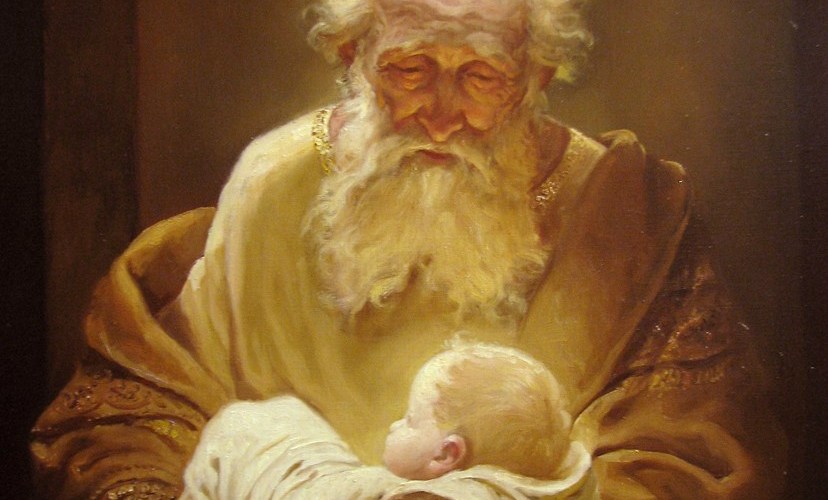
A painting of Simeon with the Child Jesus from the dailyprayerblog.blogspot.com
The Simeon Moment is befriending death as we find Jesus Christ.
The “Simeon Moment” is when we are like Simeon in realizing that nothing matters most in this life except God found within us and those closest to us like family and friends whom we would never trade for anybody and anything. It is finding true joy in Christ alone that we are able to befriend death like St. Francis of Assisi who called death a “cousin”.
According to Luke, God had promised Simeon that he would not die until he had seen the promised Messiah (Christ). All his life, Simeon prayed and offered sacrifices at the temple in Jerusalem awaiting the coming of Christ – and he was not disappointed even if it took so long! That is why, he burst into a song which we now pray every night because that is when we experience in the stillness of the darkness within and outside us that only Jesus and always Jesus who fulfills us.
Those who have cared and lost a loved one to cancer or any terminal illness have experienced that “Simeon Moment”. Remember when our loved ones have finally accepted their fate, when they suddenly become more emotionally stable and even joyful in their dispositions? Unlike before when they were first diagnosed with their illness, they were so afraid, always crying but as they came to embrace the reality, they cried less with a strong sense of courage while we are the ones crying more and most stressed out?
Photo by author, November 2024.
That is because the dying must have seen their their final destination in life, Jesus Christ. Like Simeon during the presentation at the temple after seeing and holding in his hands so close to himself the Holy Infant, we find the dying so calm and peaceful during their final hours because they have seen or were already in the presence of the Lord.
Like Simeon, they were silently joyful in Christ’s presence while we who were left behind cried not only due to the pain and sadness of separation but because we do not know where we are going, where we are heading unlike our departed loved ones.
Feel the courage and confidence of Simeon boldly telling God to “take him” at that instance because he had found Jesus Christ. Its Filipino translation says it so well, “Kunin mo na, Panginoon, ang iyong abang alipin, ayon sa iyong pangako, yamang nakita na ng aking mga mata ang iyong pagliligtas (Lk.2:29-30).”
We Filipinos often take it as a joke, always laughing to dismiss the topic or cope with the reality that to see God literally means to die like when we say “gusto nang makita si Lord”. But, that was how Simeon really felt because he had literally seen the Son of God, as if telling him to take him “now na!” because the Simeon Moment is therefore we have that realization within us that coming to terms with death is coming to terms with life, and vice versa.
Photo from crossroadinitiative.com.
The Simeon Moment is living in the Holy Spirit
Wherever is Jesus Christ, there is always the Holy Spirit. We will never find Christ and have the Simeon Moment unless we are attuned first with Holy Spirit who animates us and opens us to Christ’s coming.
Imagine the great crowds of people at the temple on that day, of couples trying to fulfill the law of Moses of purification and presenting their first-born son to God. How did Simeon know Joseph and Mary were the parents of the Christ? How was he able to accurately spot and find Jesus is the Messiah amid the many male children being offered on that day at the temple?
“To come in the Spirit” like Simeon is more than being faithful to God; it is having a good and pure heart that is ready to believe and act openly with courage, always looking forward at the fulfillment of what we believe. Coming in the Spirit is being at the right place at the right time when we make things happen than wait, exactly how Luke portrayed Simeon and Anna who both lived in the presence of God! Coming in the Spirit is living in the present moment in God.
We cannot see Christ nor live in the Spirit unless we humbly submit ourselves to God, our Lord and Master. Seeing Christ and living in the Spirit presuppose humility before God – we His creatures, He our Lord and Master.
Most of all, our origin and our end too!
It is the principle and foundation of life as St. Ignatius of Loyola stressed in his Spiritual Exercises, “El hombre es criado para alabar, hacer reverencia y servir a Dios nuestro Señor, y mediante esto, salvar su anima”, that is, “Man is created to praise and serve God his Lord and Master and by doing this save his soul”.
There is something so beautiful and lovely, so touching in the opening verse of Simeon’s canticle that underscores firmly this basic truth we have always forgotten since the fall of Adam and Eve when he asked God to take him after seeing the Christ. Every time we sin, we act like Adam and Eve, playing gods, desiring to be like God.
Also known as Nunc Dimittis, Simeon’s canticle echoes the fiat of Mary to God during the Annunciation, expressing his fidelity and humility, his total submission to God. Most of all, it summarizes both the Magnificat of the Blessed Mother and the Benedictus of Zechariah, making Simeon’s Nunc Dimittis the finale in Luke’s Christmas “concert” on the birth of the Messiah.
This is the reason why we chant Nunc dimittis at the end of our Night Prayer. It is the perfect prayer to close each day as we prepare for the coming new day to meet Jesus again, hoping we may be enlightened in our life’s mission expressed by the antiphon we recite before and after chanting it, “Protect us Lord as we stay awake; watch over us as we sleep that awake we may keep watch with Christ and asleep rest in his peace”.
Or, if ever we ever do not wake up the following day, we still thank God all the more in making us meet Jesus the past day, eager to finally sing to him our praises in eternity with Night Prayer’s final blessing, “May the Lord grant us a restful night and a peaceful death”.
The Simeon Moment is a grace and gift Jesus gives us daily not only for the dying but to everyone of us seeking Him, awaiting Him like Simeon. And like Simeon, we are assured that anyone who seeks and awaits God is never disappointed. Have a blessed day in Christ Jesus! Amen.
Photo by author, sunrise bursting through thick fogs over Taal Lake in Bgy. Dayap Itaas, Laurel, Batangas, 17 January 2025.
Quiet Storm by Fr. Nicanor F. Lalog II, 05 December 2024
Pope Francis waves to pilgrims as he enters St. Peter’s Square for his general audience on Wednesday, Dec. 4, 2024. Credit: Julia Cassell/CNA
Pope Francis again called on us priests to keep our homilies short during his General Audience at the Vatican yesterday, December 04, 2024. He said, “Preachers must preach an idea, a feeling, and a call to action. Beyond eight minutes the preaching starts to fade, it is not understood.”
According to the Catholic News Agency, the pilgrims applauded the Pope’s remarks that is again sweeping the social media circles of many Catholics especially in the Philippines. It is trending, in fact, because our people are so fed up with our long, boring homilies.
However, I find the Pope’s reminder lacking in substance, in what is most essential.
Photo from Catholic News Agency, 12 June 2024.
This is the second time this year since June and the third since 2018 that Pope Francis urged priests to be brief with their homilies. It is actually an echo to the recommendations by Archbishop Nikola Eterovic’s 2010 book on the 2008 Synod on the Word of God that advised bishops to keep their homilies to eight minutes or shorter to avoid “improvisations” at the pulpit.
(Now you see, the problem actually is with the bishops who mostly give poor homilies but effective tranquilizers. In fact, Pope Francis’ homily last Holy Thursday was over 20 minutes, but, of course, he is the Supreme Pontiff…)
Instead of focusing on the duration of the homily, Pope Francis should have adopted St. Augustine’s stance: the priest must first and foremost pray to give a good homily. Duration and length of homily is secondary when the priest’s homily is the fruit of his prayers (and studies).
From Pinterest.com.
In the fourth book of his Doctrina Cristiana, St. Augustine said that “every homily is from God” when truly prayed upon by the priest and deacon. He admitted that not every priest is gifted in preparing good homilies that is why he encouraged priests to share homilies that others may imitate. St. Augustine categorically wrote that there is no problem in copying the homily of other priests; what is unacceptable (and sinful) is when the priest’s homily and life do not jibe, when the priest does not walk his talk.
That is why when people ask me what is the most difficult part of priesthood, I always say since my first year as a priest, it is the prayer life – not celibacy nor poverty. Both are hinged on the priest’s prayer life.
Prayer is always difficult because it is the work of the Holy Spirit, demanding our time and total self. When we pray, we strip ourselves naked before God, facing our true selves minus our many pretensions and masks as a person. And a priest.
Hence, whatever we preach is the fruit of our prayer which is very scary. When we priests deliver our homily, we subject ourselves to your scrutiny. And that’s how we are judged by the people: does this priest practice what he preaches?
I have been a priest for more than 26 years but I still get nervous and scared before every celebration of the Mass, specially in delivering the homily.
When the Alleluia is sung and we bow our heads before the altar to recite our silent prayer – “Lord, cleanse my heart and my lips that I may worthily proclaim the Gospel” – I always add the words of John the Baptist to Jesus at Jordan before His baptism, “Lord, let me decrease so that you will increase.”
We priests are the first to be affected by our preaching. Kami ang unang nasasaktan at tinatamaan sa katotohanang ipinahahayag namin. That is when true connection with people and the gospel happens which Pope Francis discussed lengthily in his 2013 Apostolic Exhortation “Evangelii Gaudium”, giving practical tips in preparing homilies in its third chapter, “Proclaiming the Gospel”. Always at the very core of every homily and of the priesthood in particular is prayer, our communion with Jesus Christ, our Eternal Priest.
When the priest lacks the passion in celebrating the Sacraments particularly Holy Eucharist and Confession, when he habitually skips giving a homily, and worst, when he avoids celebrating the Mass daily – he is no longer praying. That is 100% sure. Most likely, Father is in crisis, deep into a vice, or a relationship.
Therefore, instead of zeroing into the duration of the homily, the Holy Father must encourage – or demand – us priests and bishops to have a prayer life, to go back to Jesus in prayer as the late Pope Benedict XVI had insisted until shortly before his death in December 2022.
And this falls upon you, too, our dear lay people. Please stop inviting us priests too often to late night socials and coffee. Give us the space and time to be home before 9PM or better, to keep us in our rectory in the evening to study and pray for our celebration of the Holy Mass the following day. We may go out at night but not so often. It is not our way of life.
Let me end this with another worthy lesson from St. Augustine in his other book about teaching catechism called De Catechizandis Rudibus, “the catechist is the lesson himself/herself.” In the same manner, “the priest is the homily himself”, too! Pray for us your priests and help us remain holy and prayerful.
The Lord Is My Chef Daily Recipe for the Soul by Fr. Nicanor F. Lalog II Tuesday, Memorial of St. Monica, Married Mother, 27 August 2024 2 Thessalonians 2:1-3, 14-17 <*((((>< + ><))))*> Matthew 23:23-26
Photo by author, St. Scholastica Spiritual Center, Tagaytay City, 20 August 2024.
I thank you today, dear God our Father for the gift of mothers as we celebrate today the Memorial of St. Monica, mother of St. Augustine.
Therefore, brothers and sisters, stand firm and hold fast to the traditions that you were taught, either by an oral statement or by a letter of ours. May our Lord Jesus Christ himself and God our Father, who has loved us and given us everlasting encouragement and good hope through his grace, encourage your hearts and strengthen them in every good deed and word (2 Thessalonians 2:15-17).
How wonderful to find St. Monica handled her life with prayer, the most beautiful tradition the Church had always taught and passed on since its beginning; it was St. Monica's life of prayer that flowed out into the grace of patience and perseverance as well as kindness to others leading ultimately to undying hope in God's goodness in converting first her pagan husband Patricius and then their three sons led by the eldest St. Augustine.
Thank you dear God for our mothers who shed tears when we go wayward as children so lost in a life of sin, and for us aching and hurting deep inside only mothers can detect and empathize with.
Thank you dear God for our mothers who have taught us the importance of prayer and goodness to others and most especially of the value of sincerity than hypocrisy. Bless all mothers today, merciful Father, may they find comfort in Jesus always. Amen.
Photo of St. Monica from the cover of the book “St. Monica Club: How to Wait, Hope and Pray For Your Fallen-away Loved Ones by Maggie Green, Sophia Institute Press, 2019.