A blessed happy Mothers’ Day to all the sweet and hardworking moms! Thank you for bringing us out into this world and most of all, thank you for making this planet a better place to live in filled with love and joy. Like Jesus, you make our joy complete with your kindness and affection, fidelity and dedication.
That is why we have chosen this greatest hit by the Swing Out Sister in 1986, Breakout. Composed by lead singer Corinne Drewery, its video features her former profession as fashion designer who also modeled her creations.
Though she looks formal, Corinne exudes with great spunky spirit in her singing filled with courage and joy that one feels the intense love and passion she has in her art and maybe even life – exactly what the gospel tells us today of the need to remain rooted in the love of Christ so we may bear fruit with much love for him and with others.
Breakout may not be speaking about love and joy but as you listen to its music and lyrics, it is very affirming of one’s worth as being loved so much by God even by others.
When explanations make no sense
When every answer's wrong
You're fighting with lost confidence
All expectations come
The time has come to make or break
Move on don't hesitate
Breakout
Don't stop to ask
Now you've found a break to make at last
You've got to find a way
Say what you want to say
Breakout
This Sunday, we are so blessed with so much love from God and others. “Breakout” from your negative thoughts and other imprisonments that prevent you from experiencing complete joy in Jesus!
A joyful Sunday to everyone especially to our dear Mothers!
The Lord Is My Chef Sunday Music by Fr. Nick F. Lalog II, 02 May 2021
Photo by Dr. Mylene A. Santos, MD in Rhode Island, April 2020.
It’s a warm and laid back Sunday, perfect for some chilling especially with family and friends, or simply favorite people and loved ones who have kept our sanity through all these trying 14 months of the pandemic and quarantine. That is why we have chosen a new genre called “electronic music” – so bagets if you wish – as we try on new artists and “make sakay” (ride on) with the times.
It was the pre-COVID period of November 2019 when I read the return engagement in the country by the British duo of Andy Clutterbuck and James Hatcher who call themselves HONNE.
They sounded interesting that after trying their music on YouTube, I got hooked on them especially after finding out their interests with anything that is Asian. In fact, their name HONNE refers to a person’s true feelings and desires in Japan that literally means “true sound” or hon’ne, like this 本音.
And that is what we like with their 2018 hit “Location Unknown” – it sounds raw yet sophisticated in its appeal to the senses that evokes one’s hidden feelings of emptiness and loss, wishing and desiring to connect again, to be one anew to the one you love who truly loves you. It is what Jesus is telling us in today’s gospel: as the true vine with us his branches, we have to remain in him because we shall never be fruitful in life without him (https://lordmychef.com/2021/05/01/remaining-in-christ-the-true-vine/).
Sometimes in life, even if we are successful and we have everything like fame and wealth, we feel something greatly missing in our lives, like a big hole no one can fill except God, the only who truly loves us, working for our own good without us knowing.
HONNE captures so well in this song that feeling of loss – Location Unknown – after being separated, of not remaining with a beloved. Don’t wait for it to happen. Remain in Christ, our true vine. And with your loved ones!
I wish I knew where I was ‘Cause I don’t have a clue I just need to work out some way of getting me to you ‘Cause I will never find love like ours out here In a million years A million years
My location unknown Tryna find a way back home To you again I gotta get back to you Gotta, gotta get back to you My location unknown Tryna find a way back home To you again I gotta get back to you Gotta, gotta get back to you
Listening to HONNE is like having an exquisite piece of sushi – as I have told you, raw yet sophisticated, simply flavorful that delights even the soul. Try their music and you will surely love!
The Lord Is My Chef Sunday Music by Fr. Nick F. Lalog II, 25 April 2021
Today is the Good Shepherd Sunday and we have chosen Michael Mcdonald’s 1977 composition with Ms. Carly Simon called “You Belong to Me” which echoes the words of Jesus, “I am the good shepherd, and I know mine and mine know me, just as the Father knows me and I know the Father” (Jn.10:14-15).
Knowing and belonging are interrelated: one knows because he/she owns like when we claim things as ours. When we possess, we know because we have.
But, Jesus is speaking here not of owning and taking control an object or any material thing. Jesus and the Father knows each other as they belong to each other as one in a perfect relationship but never because they “own” nor “possess” one another.
To illustrate, children belong to parents while a husband belongs to a wife and vice versa, we belong to our friends and our friends belong to us. There is always a degree of knowledge in every belonging not because we are possessed or owned in the same way we own our house, our car, or any gadget for that matter. Owning, possessing or having persons and even pets are of higher degree of knowing and belonging, of something deeper about invisible links that tie us with someone we believe “belongs” to us.
This is the whole point of McDonald in this song which is about infidelity: the girl is having an affair. But no matter what she does, she belongs to him.
Why'd you tell me this
While you look for my reaction
What do you need to know
Don't you know I'll always be the one

You don't have to prove to me you're beautiful to strangers
I've got lovin' eyes of my own
You belong to me
In this life
Anyone could tell
Any fool can see who you need
I know you all too well
You don't have to prove to me you're beautiful to strangers
I've got lovin' eyes and I can tell

You belong to me
Tell him you were foolin'
You belong to me
You belong to me
Tell him he's a stranger
You belong to me
This is something many people – couples, children, and friends – always forget: we always belong to someone who truly loves us that even if we sin and become unfaithful to them, that belonging remains.
McDonald sounds like Jesus the Good Shepherd who never forces us into being one with him nor in following him. He simply calls us, inviting us to follow him, to be one with him.
Knowing and belonging like the Good Shepherd is less of controls and more of trust with one another because you see them as brothers and sisters in Christ. It is no wonder that like Jesus “the stone rejected by the builders who has become the cornerstone” (Acts 4:11), it always happens that the people who reject us for loving them truly in the end comes back to us to take care of them, to love them, to forgive them. Don’t wait for it to happen. Go back to whom you belong, be sorry and live honorably.
Lawiswis ng Salita ni P. Nicanor F. Lalog II, Ika-21 ng Abril 2021
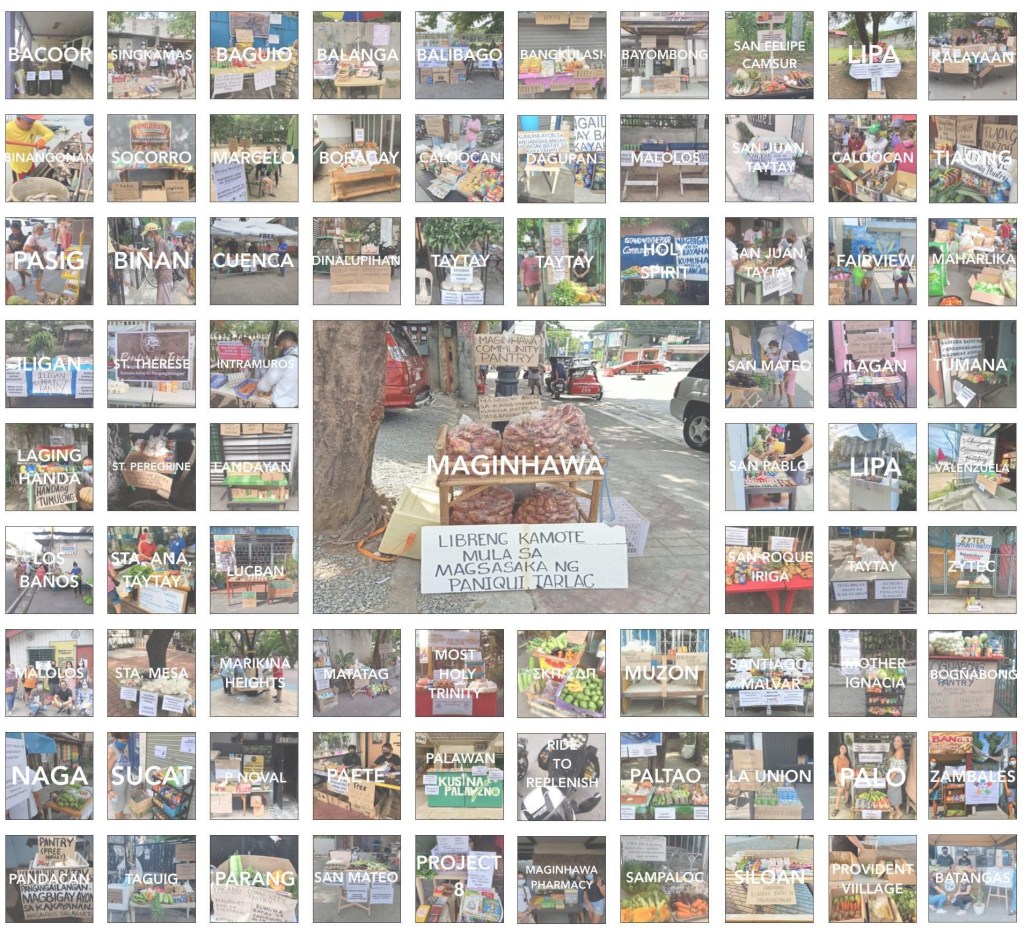
Mula sa Facebook ni Jean Palma noong ika-18 ng Abril 2021 na nilagyan niya ng caption: “All these community pantries in four days, and counting. What a powerful movement.” #CommunityPantry
Tila magpapasko, presko at mahangin ang panahon noong Lunes ng umaga dito sa Pambansang Dambana ng Birhen ng Fatima sa Valenzuela.
Natutuwa ako noon sa napakabuting balita ng paglaganap nitong tinaguriang mga “community pantry” na nagsimula sa kalye Maginhawa sa Quezon City noong a-kinse lang ng Abril. Wala pang isang linggo ay kumalat na sa buong kapuluan ang kilusan na kung isasalin sa ating sariling wika ay “paminggalang pampamayanan”.
Sa mga kagaya ko na inabot ang singko sentimos na de bote ng Cosmos, bago dumating ang pridyider ay paminggalan ang puntahan ng lahat lalo na sa bahay na matanda kung saan nakatira ang mga impo at lola.
At ang turo sa aming mga bata noon, maaring kumuha ng pagkain sa paminggalan pero huwag uubusan ang ibang kasama sa tahanan.
Higit sa lahat, magsabi lagi upang mapalitan o mapunan sakaling mauubusan lalo na ng kape at asukal.
Kaya naman napakagandang makitang muli itong mga paminggalan hindi na sa tahanan kungdi sa lansangan na tila baga bawat pamayanan naging isang malaking pamilya pinamamayanihan ng pagkakapatiran.
Iyon ang pinaka-buod at kahulugan nitong mga paminggalang pampamayanan na siya rin namang ipinahayag ni Bb. Ana Patricia Non: hindi aniya ito pagkakawanggawa o “charity” kungdi pakikipagkapwa-tao o mutual aid upang matulungan ang bawat isang nangangailangan.
Sa Banal na Kasulatan ay ating natunghayan kamakailan paglalarawan ng pamumuhay ng mga unang Kristiyano:
At nagsasama-sama ang lahat ng sumasampalataya at para sa lahat ang kanilang ari-arian. Ipinagbibili nila ito at ang pinagbilhan ay ipinamamahagi sa lahat ayon sa pangangailangan ng bawat isa.
Mga Gawa ng Apostol 2:44-45
Larawan mula sa inquirer.net.
Isinaysay sa atin ni San Lucas ang naturang bahagi sa buhay ng mga unang Kristiyano upang muling mahimok sa atin ang pagkakapatiran, ang magising ating mga kaisipan at kamulatan na sa buhay hindi pinag-uusapan at batayan ang ano mang kakayahang gawin kungdi ang pagkakakilala sa bawat isa bilang ka-patid, ka-dugtong, at ka-putol. Alisin mo ang unlaping “ka”, ika’y patid at putol. Hiwalay at nag-iisa, walang karugtong.
Kapatiran, samahan ng magkakapatid, hindi ng mga gawain.
Kung babalikan natin yung tagpo matapos mag-ayuno at manalangin ang Panginoong Hesus sa ilang, ang unang panunukso sa kanya ng demonyo ay gawin niyang tinapay ang mga bato.
Ganyang-ganyan pa rin ginagawa ng diyablo at kanyang kampon sa ating panahon na ang palaging tanong ay “ano ba ang nagawa mo?” o “mayroon ka bang naambag?”: para sa kanila, pinakamahalaga yung nagagawa kesa makipag-kapwa.
Hindi nila batid na ang sino mang tunay sa pakikipag-kapwa, laging kasabay ang gumawa ng mabuti.
Kaya hindi rin kataka-taka sa kanila na ang mga addict at kriminal ay patayin dahil para sa kanila walang nagagawang mabuti mga ito sa lipunan.
Isang magandang pagkakataon itong pag-usbong
ng maraming paminggalang pampamayanan
na muli nating mapagtanto dangal ng bawat tao
na dapat mahalin at igalang bilang larawan
at wangis ng Diyos na lumikha sa tanan.
Larawan mula sa Dr. Yanga’s Colleges Inc. sa kanilang “community pantry” sa Bocaue, Bulacan, 20 Abril 2021.
Isang magandang pagkakataon itong pag-usbong ng maraming paminggalang pampamayanan na muli nating mapagtanto dangal ng bawat tao na dapat mahalin at igalang bilang larawan at wangis ng Diyos na lumikha sa tanan.
Inyong pagmasdan, madalas mga taong mapagbilang at mapaghanap ng mga nagawa ay siya ring mga mapanaghili, binibilang mga gawain na tila lahat dapat tumbasan o mayroong kapalit.
At ang pinaka-masaklap, sila din yaong mga wala ring ginagawa, puro salita kaya sila’y katawa-tawa parang sirang plaka katulad ng kanilang pamumula at “red tagging” sa mga nasa likod ng paminggalang pampamayanan o community pantry.
Ayaw nila sa paminggalang pampamayanan dahil doon ang batayan ay pagtuturingan bilang magkakapatid; walang ganid at sakim, nasa isip palagi ang kapwa na maaring mas kawawa kaysa sarili.
Kaya heto ang aking awit na handog sa mga nagpasimuno at nagpapalaganap nitong community pantry.
Kasama na rin ang mga hindi naniniwala, namumula.
At, sumasalaula.
Humuhuni ang ibon
Nagsasayaw sa hangin
At laging masaya
Bakit kaya ang tao may isip at talino
Nalulungkot pa siya

Matutuhan lang ng bawat nilikha
Ang umibig sa tao't daigdig
Lungkot nila'y mapapawi ligaya'y ngingiti

Pagibig at pag-asa
Ang damdaming gigising sa taong mahimbing
Ang tunay na ligaya sa ating puso
Muling magniningning

Ikaw at ako
Hindi man magkalahi
Ay dapat matutong magmahal
Ituring mong tayong lahat ay magkakapatid
(New Minstrels, 1980)
The Lord Is My Chef Sunday Music by Fr. Nick F. Lalog II, 18 April 2021
Photo by author, 2020.
Don't want to open your heart
You're afraid from the start
That a new love's gonna let you down
There is something you should know
Before you give up and go
I don't believe in the run around
I just want to define myself
And show you how I feel
Yes! We’re feeling so romantic this Sunday because of this great love we’re feeling deep inside.
Like you, we have fallen in love, we have been hurt and disappointed, even felt betrayed and forgotten by a beloved that too often, we have closed our doors to new love, new relationships out of fear of being hurt again.
But, as Daryl Hall and John Oates sang in 1997 from their Marigold Sky album we thought would be their last (thankfully not!)….
If a promise ain't enough
Then a touch says everything
Got to hold you in my arms
Till you feel what I mean
Know that my heart just tells me what to say
But words can only prove so much
If a promise ain't enough
Hold onto my love
No… we’re not talking of a special relationship with anyone.
We’re feeling so good today because it is our 23rd year of Ordination to the priesthood – a love relationship like those of between a husband and wife that demands fidelity and trust, respect and kindness, mercy and forgiveness.
And a lot of prayers!
Human love is imperfect; only God can love us perfectly.
Too often in life, we we get hurt in so many ways, some so severe, others may be dismissed but still, every pain always leaves a mark in us that sometimes prevents us from loving again.
The disciples of Jesus felt the same: they thought he was gone after seeing his Crucifixion on Good Friday that when he suddenly appeared to them, they were so amazed and could not believe it so true that the Lord had risen (https://lordmychef.com/2021/04/17/jesus-in-our-midst/).
The same feeling we have when we love again.
When we forgive, when we move on, when we let go and let God.
Whenever we go back to our “Jerusalem” – to our crucifixion and sufferings, we are purified by Jesus, opening our minds and our hearts of how despite all the pains, the gains still outweigh the past that we can look forward to better days ahead as we share in his new life now.
So many times in our lives, in our relationships with one another, Jesus comes as the invisible guest, always appearing, speaking, and sharing meal with us. And after sometime, as we look back to our past, we feel deep inside how our hearts burned during those times we were not aware of Christ’s presence.
It is true, we humans make so many promises to be broken but only Jesus is keeping them.
Welcome him especially amid the many pains and darkness, let his love be perfected in your perseverance and you shall see…
It took a lifetime to find what I want
I won't let it get away
If a promise ain't enough
Then a touch says everything
Got to hold you in my arms
Till you feel what I mean
Know that my heart just tells me what to say
But words can only prove so much
If a promise ain't enough
Hold onto my love
If a promise ain't enough
Hold on
If a promise ain't enough
Hold onto my love
This is one of Hall and Oates’ most loved love songs that tells us the basic truth about love: it is best expressed in actions than in words.
Photo by Dr. Mylene A. Santos, MD, at Rhode Island, 10 April 2021.
It was the best of times, it was the worst of times,
it was the age of wisdom, it was the age of foolishness,
it was the epoch of belief, it was the epoch of incredulity,
it was the season of Light, it was the season of Darkness,
it was the spring of hope, it was the winter of despair,
we had everything before us, we had nothing before us,
we were all going direct to Heaven, we were all going direct the other way
 – in short, the period was so far like the present period,
that some of its noisiest authorities insisted
on its being received, for good or for evil,
in the superlative degree of comparison only.
(Charles Dickens, "A Tale of Two Cities")
I know this blog is supposed to be music but Charles Dickens’ famous lines opening his novel “A Tale of Two Cities” are in fact very lyrical and musical. And with our Dickensian situation especially in the way this government has mishandled the pandemic since the very start, we have chosen for our music this Sunday of Divine Mercy something so lively and upbeat, so intense like our Risen Lord who broke free from death and sin, able to enter any locked door and person.
It is a song “resurrected” in 2014 with Justin Timberlake after Michael Jackson suddenly died in 2009, earning so much popularity and acclaim as if MJ were back in life again with this posthumously released hit, Love Never Felt So Good.
Originally written and recorded in a demo track in 1980 with Paul Anka, Love Never Felt So Good was the first single released from Jackson’s second posthumous album, Xscape.
The song is the second collaboration between Jackson and Anka to be released since Jackson’s death in 2009 with This Is It being the first. (Interesting trivia: Anka rearranged the song in 1984 for Jackson’s longtime friend Johnny Matthis who recorded it in his 1984 album A Special Part of Me.)
We chose Love Never Felt So Good primarily for its feel good, positive vibes so infectious which we all need this Easter 2021 with all the deaths and sickness happening due to the pandemic.
There is also the semblance with Easter in a sense with MJ being “resurrected” with the reworked version of the song with Timberlake, another intense artist who can surely drive away the blues today.
Most of all, we find the lyrics very apt with our gospel story of St. Thomas who doubted Christ’s appearance to his fellow apostles (not his Resurrection).
Let us not take doubt as lack of faith; in fact, doubts lead us to deeper and stronger faith like with what happened to Thomas. What matters is we remain in the Lord, keeping ourselves open to his coming like St. Thomas (https://lordmychef.com/2021/04/10/easter-the-intensity-of-jesus/).
In Love Never Felt So Good, Jackson mentions his doubts many times if he is also loved by the woman he desires; but in spite of those doubts, he believed deep in his heart that love never felt so good if they would be together.
The same thing is true with us: amid our doubts are also the strong conviction something good can still happen with the grace of God. What matters is that we learn to balance the many twins in our lives like Thomas: the joys and sorrows we experience, the light and darkness that come our way, the triumph and defeats we face, and lately, the births and healing and deaths we experience in this pandemic.
Trust in Jesus always who promised us his Divine Mercy overflowing despite our sins and sufferings.
The Lord Is My Chef Sunday Music by Fr. Nick F. Lalog II, 04 April 2021
“The Three Marys” by Henry Ossawa Tanner, from womeninthebible.net.
Blessed happy Easter to everyone!
This is perhaps the only year when it is so difficult to greet others with “Happy Easter” due to this ongoing lockdown following the worsening surge in COVID-19 infections with hospitals now beyond capacity.
But, that is the mystery of Easter: it is an event that truly happened in our history but something more than the usual thing like in Christmas when God became a child like us. At Easter, God broke through all human limitations to enter a new realm, a vast expanse of unknown realities beyond our imaginations, beyond our most dreaded thing in this life we call “death” (https://lordmychef.com/2021/04/04/breaking-into-new-realities/).
Like Mary Magdalene and the rest of the apostles except for John the Beloved, there are times we see nothing at all and say things we hardly think or process because everything seemed to have been lost when suddenly from within we realize life bursting forth, new hope, new beginnings!
And that is Easter!
Like this great song composed by Sting with his former group The Police, Every Breath You Take from their penultimate album Synchronicity released in 1983.
Sting was surprised with the great reception by people worldwide to this song that became their most recognized piece, spending so many weeks in almost every music chart around the globe. It is a song filled with negativities, according to Sting who wrote it in 1982 while on a retreat at Jamaica in the Caribbean following his separation from Frances Tomelty when he got involved romantically with her best friend and neighbor, Trudie Styler. The affair was so controversial, even condemned by many. Complicating things was the brewing rift among them in The Police.
But, that’s how Easter is: death becoming gateway to new life!
Imagine Jesus Christ now singing this to us in the midst of the pandemic, assuring us in every breath we take, he is not only watching us but in fact, with us!
The Lord Is My Chef Sunday Music by Fr. Nick F. Lalog II, 21 March 2021
Photo from GMA Network of a scene from Ben&Ben’s music video “Pagtingin” with Gabbi Garcia and Khalil Ramos, 25 February 2021.
We go OPM this final Sunday in Lent to ease everyone with the alarming surge of COVID-19 infections happening in our country especially at the National Capital Region. Stay home, be safe, pray and listen to some good music from our homegrown local band Ben&Ben as we try to link the Sunday gospel to their recent hit “Pagtingin”.
I know… Ben&Ben is not my generation but that is the wonder and joy of music as food of the soul: it always strikes a chord in anyone’s heart that reaches to the soul, enabling us to see more beyond the material and natural realities.
Like with their 2019 hit called “Pagtingin” which means in English as “feelings, a sort of crush and attraction to a woman or a man.” Its Filipino root is “tingin” or “see” in English. Remember when we were growing up, feeling drawn to someone so special that we would look at her or steal glances just to see the woman we adore? And the kilig moments when your sights meet?
But of course, the moment you reveal those secret feelings, that is also when you begin to see the bigger picture: your object of pagtingin will either accept or reject you. There is always that risk because sometimes in life, what we see is not what we truly get.
Dami pang gustong sabihin Ngunit ‘wag na lang muna Hintayin na lang ang hanging Tangayin ang salita
‘Wag mo akong sisihin Mahirap ang tumaya Dagat ay sisisirin Kahit walang mapala’
Pag nilahad ang damdamin Sana ‘di magbago ang pagtingin Aminin ang mga lihim Sana ‘di magbago ang pagtingin
Bakit laging ganito? Kailangang magka-ilangan Ako ay nalilito, ooh-ooh-ooh Ooh-ooh-ooh, ooh
Seeing in the bible means believing. There are times when we see, we believe; but, ultimately, it is in believing first that we are able to see the whole picture in life especially Jesus in the light of his dying on the Cross. And this is what the song Pagtingin is hoping in the end that amid the pains and hurts with some prayers, the man with special feelings will finally see closely with him the woman he sees from afar.
Pahiwatig Sana ‘di magbago ang pagtingin Pahiwatig Sana ‘di magbago ang pagtingin
Iibig lang kapag handa na Hindi na lang kung trip-trip lang naman Iibig lang kapag handa na Hindi na lang kung trip-trip lang naman
‘Pag nilahad ang damdamin Sana ‘di magbago ang pagtingin Aminin ang mga lihim Sana ‘di magbago ang pagtingin
Subukan ang manalangin Sana ‘di magbago ang pagtingin Baka bukas, ika’y akin Sana ‘di magbago ang pagtingin
A blessed week ahead of everyone. Stay safe always. Amen.
The Lord Is My Chef Sunday Music by Fr. Nick F. Lalog II, 14 March 2021
Photo by Dr. Mylene A. Santos, MD, at Rhode Island, February 2021.
We are now halfway through to celebrating another Easter amid the darkness of the COVID-19 pandemic worsening anew with a recent surge in infections. But today’s Sunday readings especially the gospel give us so many reasons to celebrate and rejoice for the gift of life and love, light and hope in Jesus Christ who had come not to condemn us but to save us (Jn.3:16-17).
By his dying on the Cross, Jesus had opened a path for us back to the Father by uplifting us from our sins and miseries, becoming our light that dispelled the many darkness that enveloped us if we follow him with our sacrifices and efforts to be good like him (https://lordmychef.com/2021/03/13/the-joy-of-lent-4/).
This we find in our gospel story of Jesus conversing with Nicodemus under the cover of darkness of the night, reminding us of the 1982 hit Up Where We Belong by Joe Cocker and Jennifer Warnes from the equally smash hit movie of that year, “An Officer and A Gentleman” starring Richard Gere and Debra Winger.
The movie is also interesting for us because of some references to the Philippines with the opening scenes of Zack played by Gere growing up with his father who was a Navy officer assigned at the Subic Naval Base.
Like Nicodemus in the gospel, Zack had so many darkness within him following his mother’s suicide and his living with his father who initially refused to take him, afraid he would not be a good father after separating from his mother earlier in childhood. After graduation in college, Zack went to train to become a Naval aviator where he encountered more darkness in life especially from their tough and hard-driving Marine training officer played by Louis Gosset Jr. that earned him an Academy Award for Best Supporting Actor for the film (the first African-American male to do so).
More instances of darkness in Zack were also shown in the film like the suicide of a fellow trainee and friend whose marriage proposal was rejected when his girlfriend learned he had left Naval training. Zack almost quit his training because of that but was prevailed upon by Gosset after an unsanctioned fight bout.
After graduation, Zack went to see his girlfriend at work (Debra Winger), declaring his love for her. And when she said yes to his love, they kissed, after which he carried her in his arms as he walked out of the factory while her co-workers clapped their hands in a round of applause.
The scene is so touching, so lovely. And that is when Jennifer and Joe began their duet.
Who knows what tomorrow brings In a world few hearts survive All I know is the way I feel When it’s real, I keep it alive
The road is long There are mountains in our way But we climb a step every day
Love lift us up where we belong Where the eagles cry On a mountain high Love lift us up where we belong Far from the world below Up where the clear winds blow
Some hang on to used to be Live their lives looking behind All we have is here and now All our lives, out there to find
The road is long There are mountains in our way But we climb a step every day
Love lift us up where we belong Where the eagles cry On a mountain high Love lift us up where we belong Far from the world we know Where the clear winds blow
The song is very Lent, in fact very spiritual that some Christian stations in the States have reportedly adapted it into some religious variations as it speaks so well of overcoming every obstacle in life with determination and perseverance. And of course, with a lot of help and light from above, Jesus Christ. Have a joyful and blessed week ahead, everyone!
The Lord Is My Chef Sunday Music by Fr. Nick F. Lalog II, 07 March 2021
Photo from turbosquid.com.
The Season of Lent is like a refresh or reset button of the computer: it is a time when we “reboot” ourselves with prayers, fasting and abstinence, and alms giving to be connected anew with God and with one another. It gives us another chance to make things better in our lives marred by sins and many pains and hurts in the past.
And that is why for this Sunday we have chosen American R&B group Champaign’s 1983 single “Try Again” from their album Modern Heart. It peaked at number 23 on the Billboard Hot100 of that year.
I find the song very lenten in character. The music is sober but not bland. In fact, the cool instrumentation especially at the start kept ringing in my ears as I prayed over the readings this whole week, kind of convinced me of how truly sorry was Pauli Carman to his beloved in failing to be more loving, more intimate, and more personal to her.
I been starin’ at your photograph Wondering where you’re at today And I’ve been hanging by the telephone Hopin’ that you’d call home and stay
You told me you needed More walks, more talks More feelin’ close to me I want to be close to you
I didn’t know you needed Some roses, some romance A little candlelight and slow dance That’s not how it’s been But maybe we can try again Try, try, maybe we can try again
Sometimes in life, we take people around us for granted, we always presume everything is given, everything is well and good, that our loved ones know or assured that we love them so much. Worst is how we sometimes forget that in our love for our family and friends, we have been so focused in our other pursuits purportedly for them that in the process we actually forget them. Things can never replace persons who need to be loved and cherished.
I always tell couples that after years of living together with the coming of kids and career and problems, always remember, first there was your wife or husband for you. No matter what happens, God first called you to each other. Continue the courtship, keep surprising each other with expressions of your love for each other. Watch movies, have romantic dinners together.
The same with us priests: before all the demands of the ministry and apostolate came, there was first Jesus Christ who had come to call us, loving us that every day we have to pray, make time for him.
Try Again exactly tells us what the readings this Sunday teach us: of how we must cleanse ourselves to find our first love again, the person dearest to us. And the good news from God is that we can always try again and make up for our past sins and shortcomings to him and to one another.
Refresh, reset or reboot your self this Lent by making time for your loved ones for intimate and personal moments.
Have a blessed and refreshing week ahead!
Music video by Champaign performing Try Again. (C) 1981 Sony Music Entertainment