We are missionaries of Christ

The Lord Is My Chef Sunday Recipe for the Soul by Fr. Nicanor F. Lalog II
Sunday XV-B in Ordinary Time, 11 July 2021
Amos 7:12-15 ><}}}'> Ephesians 1:3-14 ><}}}'> Mark 6:7-13
Photo from Joint Task Force Sulu via Inquirer.net, 07 July 2021,

Everybody is saying 2020 is a very bad year that had extended its negative vibes into 2021 with the continuing string of disasters and bad news like the recent C-130 plane crash in Sulu where 50 soldiers were killed, mostly were young in the prime of their lives.

Not to mention are the persistent threats of new surge of COVID-19 that continues to mutate into deadlier and more transmissible variants despite the vaccine roll outs.

Photo courtesy of Dr. Julian Arguilla.

But, upon closer look and deeper reflections, we also realize what we are going through is not that totally bad. It is still a very beautiful world, so blessed by God with the people he sends us to bring hope and find meaning amid all the deaths and darkness around us.

In that recent C-130 plane crash is 30 year-old Capt. Dr. Nigel Emeterio who selflessly served our people as a medical frontliner of the Philippine Air Force fighting COVID-19 in far flung areas and as a flight surgeon of troops sent to fight terrorist rebels in Mindanao.

A graduate of the Our Lady of Fatima University’s College of Medicine Batch 2015 here in Valenzuela City, Capt. Dr. Nigel is most of all a faithful husband and loving father to his wife and kids left behind in a life so short but filled with loving service and dedication to others.

Earlier this year, another young woman in Quezon City – Ms. Patricia Non – inspired us to harness the vast powers we have in our hands to see one another as a brother and a sister by setting up a community pantry where the poor may get basic food according to their needs provided by others according to each one’s ability.

The movement soon caught the attention of more people in various parts of the country, even abroad, setting up their own community pantry with support coming in from the rich and poor alike, bringing out the spirit of Christ’s gospel in the most concrete manner.

And lastly, who was not touched by the infectious smiles and fighting spirit of America’s Got Talent contestant called Nightbirde when she courageously admitted to the world the multiple cancers she was afflicted with a 2% chance of survival?

We were all moved to tears when she sang her own composition to assure everyone that “I’m Ok”, that despite all her sufferings, she chooses to be happy due to her strong and deep faith in God?

There are still so many stories of men and women, young and old alike, being sent by God in Christ Jesus to remind us amid all the darkness hovering above us in this time that the world and life he created for us is truly beautiful because he created us meant to be filled with joy and fulfillment, not misery and sufferings.

Jesus summoned the Twelve and began to send them out two by two and gave them authority over unclean spirits. He instructed them to take nothing for the journey but a walking stick – no food, no sack, no money in their belts. They were, however, to wear sandals but not a second tunic.

Mark 6:7-9

Our first mission is to cast out unclean spirits

Photo by author, Jerusalem, 2017.

Life is always beautiful, true and good. Despite all the bad news we hear and see daily, overall we realize that it is always a beautiful world out there waiting to be discovered by us. Everyday God sends us in his Son Jesus Christ to proclaim this reality by fighting the evils that try to destroy life.

For the past Sundays, St. Mark has been presenting to us who is Jesus Christ, telling us the teachings he preached, the miracles he performed, and the setbacks he went through when he went home to Nazareth.

This time, we find Jesus sending his Apostles that include us in this modern time to continue his work and mission of proclaiming the good news of salvation amid the many demons or unclean spirits in our time found not only in dire situations but among evil men and women in their arrogant display of power going unpunished, escaping justice. It is a scenario we have seen throughout history, of natural and man-made disasters happening along with a dash of human inanities and follies in every period everywhere.

But life continues and gets better largely with the prophets sent by God sent to speak his words of justice and truth to bring back order and harmony in our world distorted and marred by evil and sin.

That was the first order of Jesus: authority over unclean spirits, over “demons” who destroy lives.

From the Greek word “daemon”, a demon is someone or anything that destroys life. It refers not only to evil persons but also situations like diseases, afflictions, addictions, economic imbalances, social injustice and systematic evils happening everywhere, even among church people.

Any form of evil and sin is always a lack of order and wholeness, a privation. Too often, evil to us is something interior that is difficult to remove or even diagnose. It has entangled its roots deep within us, creating confusions and doubts. Hence, we feel Jesus very emphatic in his commissioning of the Twelve: he “gave them authority over unclean spirits”.

It is the power of Jesus Christ borne out of our deep faith that leads to boldness and courage tempered with humility and simplicity that enables us to fight evil in this world. As that famous saying tells us, “the only thing needed for evil to succeed is for good men to do nothing”.

Fighting evil and sin is not a personal crusade of anyone but a sharing in the power and destiny of our Lord Jesus Christ. The mission of the Twelve that is also our mission is a direct continuation of the mission of Jesus Christ who offered his life on the Cross for our salvation.

We are the first to be affected by Christ’s preaching and actions by being transformed in him. That is why he calls us to be detached from the world and its allurements to be one in him alone.

Like the prophet Amos in the first reading, it is always a call from God, a mission from God. We are mere instruments of the Lord for he is still the one who will effect changes and transformations.

Forget all those myths and illusions of being the savior of the world or “messianic complex” as if we are indispensable and much needed in the world. We might even be surprised that the world might be better off without us!

As missionaries of Christ like the Twelve and Amos in the first reading, we only propose but never impose our message of salvation with conviction. It is not our persuasive arguments and discourses that will cast out the unclean spirits but the Christ in us with our life of witnessing.

It is never easy and can be a thankless task prone to misinterpretations and criticisms. That is why next Sunday upon the return of the Twelve, Jesus will invite them to rest at the other side of the lake that clearly shows us the very essence of being a missionary of Christ – oneness in him.

Photo by Ms. Ria De Vera, June 2021.

Restoring all things in Christ

Blessed be the God and Father of our Lord Jesus Christ, who has blessed us in Christ with every spiritual blessing in the heavens, as he chose us in him, before the foundation of the world, to be holy and without blemish before him. In love he destined us for adoption to himself through Jesus Christ, in accord with the favor of his will…

Ephesians 1:3-5

For many people today, the world is very chaotic, lacking harmony and rhythm with all the bad things happening right in their personal lives and in their homes and places of work. While the pandemic drags on, there is a strong temptation to be negative and even lost hope, of being cynical.

As missionaries of Christ, we are called to imitate the courage and conviction of St. Paul to faithfully reveal God’s plan of peace and harmony in him through Jesus.

Photo by author, 2019.

In his opening benediction that is so beautifully structured and expressed, St. Paul is inviting us to restore all things in Jesus Christ.

Like St. Paul, we missionaries of Christ must be the first to have that conviction that life is beautiful, that God has great plans for each of us despite all the sins and evil going on.

Imagine St. Paul writing the Ephesians while in prison, awaiting trial and certain death that did not deter him in being so upbeat and joyful with life?!

God knows very well the trials and difficulties we are all going through. Others have gone worst than us but never lose that sparkle of hope in Christ, giving their very lives for us to have a better world today.

Let us cast away all doubts and indifference and start living faithfully in Christ to realize the Father’s vision for us today. I pray that God hear your prayers to be filled with all the blessings you need to be a wtiness of his love and mercy. Amen.


When extraordinary is ordinary

The Lord Is My Chef Breakfast Recipe for the Soul by Fr. Nicanor F. Lalog II
Thursday, Week XIII, Year I in Ordinary Time, 01 July 2021
Genesis 22:1-19   <*(((><  +  ><)))*>   Matthew 9:1-8
Photo by Dr. Mylene A. Santos, M.D., March 2021.
When I look at your beautiful creation
O God our loving Father
I cannot but stop and wonder
be at awe with all the beauty 
and mystery so extraordinary
yet ordinary in your majesty.
Today we have two stories 
so extraordinary but with you
simply ordinary:  when you asked
Abraham to offer to you Isaac, 
off he went faithfully
even blindly:

As the two walked on together,
Isaac spoke to his father Abraham, 
"Father!" he said.
"Yes, son," he replied.
Isaac continued, "Here are the fire
and the wood, but where is the sheep
for the burnt offering?"
"Son," Abraham answered,
"God himself will provide the sheep 
for the burnt offering?"
Then the two continued going forward.
(Genesis 22:7-8)
The faith of Abraham in you, O God,
is so great, so extraordinary;
and so was the faith of Isaac
to his father that it never occurred 
to him he would be the one to be
sacrificed either.
Both Abraham and Isaac showed
extraordinary faith you ordinarily ask from us.
Give us the grace, O God,
to imbibe this ordinariness
of having extraordinary faith in you,
like the harmony and beauty
found ordinarily in nature;
may we realize that any sickness
is a "dis-ease", our lack of harmony
with you and with others due to sin.
Let us not "harbor evil thoughts"
like those scribes present at
Christ's healing of a paralytic
to whom he declared
"your sins are forgiven" (Mt.9:2)
to show that wherever there is
dis-ease, there is a lack of harmony
wanting your mercy and unity.
Amen.

Arise, be whole again in Christ!

The Lord Is My Chef Sunday Recipe for the Soul by Fr. Nicanor F. Lalog II
Thirteenth Sunday in Ordinary Time, Cycle B, 27 June 2021
Wisdom 1:13-15; 2:23-24 <+> 2 Corinthians 8:7, 9, 13-15 <+> Mark 5:21-24, 35-43
Photo by author, sunrise at the Lake of Galilee, the Holy Land, 2017.

Once again, we find Jesus crossing the Lake of Galilee this week with a crowd following him to listen to his teachings and experience his healing. What a beautiful image of life in Jesus, of constantly crossing the sea, sometimes in the darkness of the night amid storms.

It was something like what we had gone through last Thursday on the Solemnity of the Nativity of John the Baptist when as a nation we crossed history with the inauguration of the new Archbishop of Manila marked with the passing of former President Noynoy Aquino.

We hope and pray that like our gospel this Sunday, our recent crossing will lead us to new awakenings and realizations leading to national healing and yes, a resurrection, a rising from the dead like that young daughter of Jairus brought back to life by Jesus.

When they arrived at the house of the synagogue official, he caught sight of a commotion, people weeping and wailing loudly. So he went in and said to them, “Why this commotion and weeping? The child is not dead but asleep.” And they ridiculed him. Then he put them all out. He took along the child’s father and mother and those who were with him and entered the room where the child was. He took the child by the hand and said to her, Talitha koum, which means, “Little girl, I say to you, arise!” The girl, a child of twelve, arose immediately and walked around. At that they were utterly astounded.

Mark 5:38-42
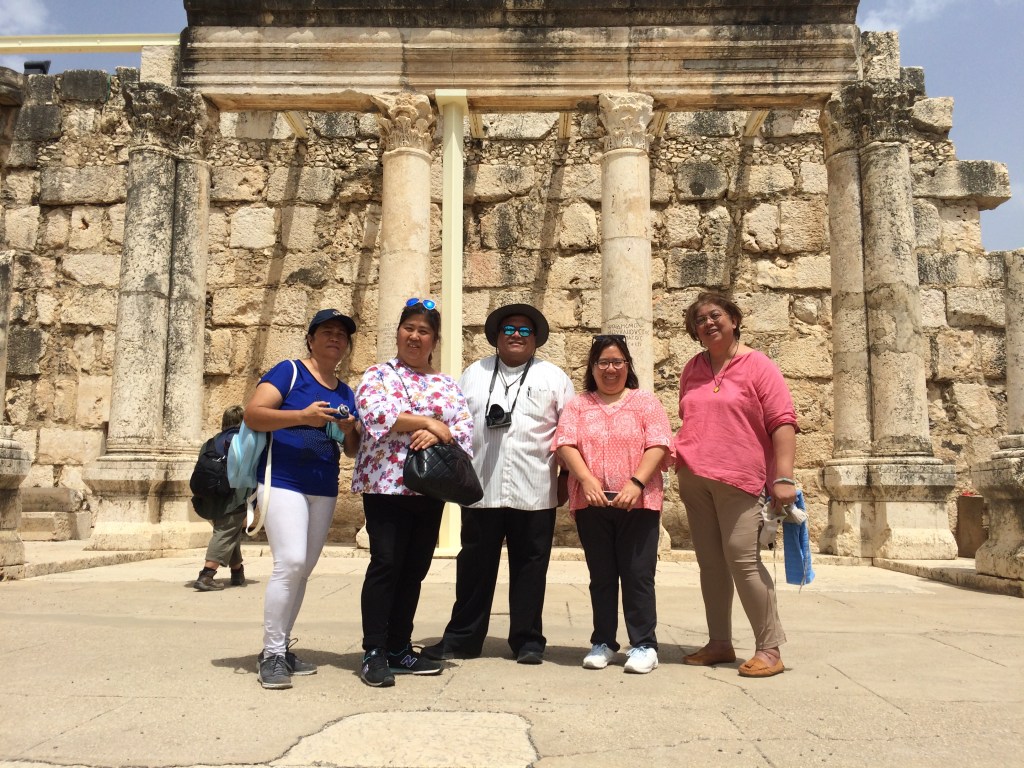
Photo by author with friends at ruins of the synagogue at Capernaum, 2017.

Examining our faith in Jesus

Notice, my dear reader, how similar is our story of Jesus raising to life the dead daughter of Jairus with that of the calming of the storm while crossing the lake last Sunday. In both instances, we find Mark “exaggerating” some details as if Jesus were somewhat oblivious to what was going on around him.

But again, Mark is not entertaining us with his stories narrating the powers and miracles by Jesus for he is telling us something deeper and very important with those surprising details of his stories. Primary of which is the supremacy of Jesus as the Son of God over nature like the sea and death both symbolizing evil and sin.

Mark affirms this truth today in telling us how Jesus brought back to life the dead daughter of Jairus, that Jesus is the Christ who had come launching a new world order where death and sin are overcome in him through his pasch.

Recall last Sunday how Mark ended his story with the disciples asking, “Who then is this whom even wind and sea obey?” (Mk.4:41).

That question is finally answered by our story today that clearly shows Jesus is the Christ, the Son of God who is life himself when he brought back to life the dead little girl.

Unfortunately, like during the time of Mark until now, many still doubt the powers of Jesus. Then and now, there is still that crisis of faith among us expressed by people from the synagogue official’s house who arrived and said, “Your daughter has died; why trouble the teacher any longer?”(Mk.5:35).

If you were in that crowd following Jesus, would you still go with him to enter the house? Would you heed his words like Jairus, “Do not be afraid; just have faith” (Mk.5:36)?

And while inside the house, knowing the little girl was already dead, would you join the rest in ridiculing Jesus who said, “The child is not dead but asleep” (Mk.5:39)?

These are the questions Mark is asking us today like the Christians of his time going through persecution and crisis in the early Church.

It is easy to “believe”, proclaiming with arms raised that Jesus is Lord, that Jesus is the Son of God but it is another thing to be truly convinced, to have faith in him when faced with the stark realities of life persistently attacked by sickness and death, of pains and sufferings that make us wonder why God could allow these to happen!

We have all felt our faith shaken when this pandemic struck us last year that took away those dearest to us so sudden, often without seeing them at all before they were cremated.

Like his story last Sunday, Mark’s narration of the raising to life of the daughter of Jairus is filled with many surprising details we find it so true with our own experiences of struggling to avoid or survive COVID-19, of having a sick child or spouse, of trying to make it to another day, of keeping our jobs to pay for food and rent and other needs of our family.

Do we really have that faith in Jesus, convinced that everything will be “okay” like Nightbirde who can brim with all smiles even if saddled with three kinds of cancer with a 2% chance of survival, claiming it is better than zero?

Today’s gospel is more than the revelation of who Jesus Christ is: the raising to life of the daughter of Jairus dares to invite us in examining our faith in God in the face of unrelenting attacks on life by sickness and death especially in this time of the pandemic.

Death and sickness are realities we face daily, that make us doubt God’s love and concern for us which the first reading clarifies with its declaration that

God did not make death, nor does he rejoice in the destruction of the living. For God formed man to be imperishable; the image of his own nature he made him. But by the envy of the devil, death entered the world, and they who belong to his company experience it.

Wisdom 1:13, 2:23-24
Photo by author, Lake of Galilee, 2019.

Arising and being whole in Jesus

Jesus came not to remove sickness and death, pains and sufferings which did not come from God for God is love. He came to be one with us in sickness and death, in our pains and sufferings so that we may rise with him too in his resurrection and be whole again in him.

Notice the words Jesus used in every healing, “your faith has saved you” to show that healing is not just a cure of the disease but making the person whole again. The words health, healing, wholeness, and holiness are all interrelated if we examine their origins and implications. Hence, we see that whenever Jesus would heal, it is not only an eradication of an illness but restoring harmony and balance in the person – physical, spiritual, mental, and emotional aspects.

It is the same in raising the dead young man in Nain and his friend Lazarus: Jesus or the evangelists used the word “arise” as a foreshadowing of Easter when Jesus himself rose from the dead, an indication of his power over death.

All these people in the gospels Jesus had healed and brought back to life eventually died but the good news is that death and sickness are no longer dark and an ending in itself.

Jesus came to bring salvation to the world, a wholeness in life which disease and physical death can no longer control and hold. That is why we need a firm faith to believe in him in spite of the many sickness and deaths now around us. It is faith that will enable us to grasp the full meaning of this pandemic and other sufferings we are going through in life. It is our deep faith in God that will also enable us to explain and show to others especially our loved ones the true meaning of healings and resurrections performed by Jesus who gives us a share in his victory over sickness and death.

May we dwell on the beautiful exposition of St. Paul today about being poor like Christ “that though he was rich, for your sake he became poor, so that by his poverty you might become rich” (2Cor. 8:9).

We can only be whole when we share whatever we have because that is when we allow Jesus to work in us, to be in us, to complete us. This happens when we wholeheartedly celebrate the Holy Eucharist where we become poor like Jesus, emptying ourselves of our sins, sharing with others our wealth through our contributions not only to the church collections but also to other charities where some of us share also time and talent aside from treasures.

The experience of the community pantry recently had taught us the value of St. Paul’s call for us to share and be poor like Christ when we were encouraged to take only what one needs and to give according to one’s ability – “kumuha ayon sa pangangailangan, magbigay ayon sa kakayahan”.

Yes, the realities of poverty and hunger remain with us but people are fed, sufferings are alleviated and most of all, the whole nation is united in believing again there is hope amidst the pandemic worsened by the systematic evil that has plagued us for so long.

Faith in God is deepened and strengthened when we become poor and weak like Jairus because that is only when we can arise and be whole again in Jesus Christ who is himself our Resurrection and Life. Amen.

A blessed new week to you and everyone!

Photo by author, Lake of Galilee, 2017.

Prayer to not shrink

The Lord Is My Chef Breakfast Recipe for the Soul by Fr. Nicanor F. Lalog II
Tuesday in the Seventh Week of Easter, 18 May 2021
Acts 20:17-27   ><)))*> + ><)))*> + ><)))*>   John 17:1-11
Photo by Mr. Red Santiago of his son, 2019.

God our loving Father, we thank you in giving us St. Paul and all the other saints who inspire us in dealing with life’s many troubles and challenges especially in this time of the pandemic. How great are his words – and courage – in telling “the presbyters of Ephesus” of the great trials coming his way that he might never see them again.

"You know how I lived among you
the whole time from the day I first came
to the province of Asia.  I served the Lord
with all humility and with tears and trials 
that came to me because of the plots of the Jews,
and I did not at all shrink from telling you
what was for your benefit, or from teaching
you in public or in your homes."
(Acts 20:18-20)

Twice St. Paul mentioned to them, “I did not at all shrink”: what an amazing gift and grace of courage! He never chickened out in proclaiming Christ’s gospel of salvation, boldly admitting to everyone his repentance to God in persecuting the Christians before while at the same time proudly declaring his deep faith in Jesus in words and in deeds.

Most of all, St. Paul gallantly faced the realities of life like rejection and other hardships most especially of death, telling the Ephesians they would never meet again (v.25) as he bid them goodbye for Jerusalem that led him to his trial in Rome.

Too often, O Lord, we are afraid to seriously discuss or even entertain thoughts of our death, of our finiteness not only because we are afraid of dying but mostly because we are also afraid of facing the harsh realities of our selves — that we have been wasting our time, we have been remiss with our duties and responsibilities.

And yes, we have shrunk from many instances when we should have stood for what is right and good, for what is fair and just.

Worst, we have left you, dear God and failed to do good, choosing to sin than be loving and kind, and forgiving.

May we hold on always to your High Priestly prayer for us, Lord Jesus that like you, may we realize that the path to glory is always the way of the Cross.

We pray most especially for those who are stuck in situations they know so well as not proper and good; give them the grace and chance to correct their lives, to repent for their sins and return to you and their loved ones.

We pray for those we look up to who do not shrink but deep inside are so hard pressed with the many challenges of remaining upright and holy.

Keep us faithful to you, O Lord, now and forever. Amen.

Photo by Onnye on Pexels.com

Lent is uncovering our sins

40 Shades of Lent by Fr. Nicanor F. Lalog II
Monday, Fifth Week in Lent, 22 March 2021
Daniel 13:41-62   ><}}}*> + <*{{{><   John 8:1-11

Praise and glory to you, O God our loving Father for the gift of life, for this final week of Lent you are giving us to continue uncovering the sins we hide from you, from others and even from ourselves. And worst, the sins of others we bare to cover our own sins.

How wonderful are your words today, Lord, of two women accused of adultery – one falsely, the other guilty – but, the same story of your justice and mercy.

Susana in the first reading was spared from death when her two accusers who were both elders and judges of the people were convicted of perjury following the courage and wisdom of your prophet Daniel.

As she was being led to execution, God stirred up the holy spirit of a young boy named Daniel, and he cried aloud, “I will have no part in the death of this woman.” All the people turned and asked him, “What is this you are saying?” He stood in their midst and continued, “Are you such fools, O children of Israel! To condemn a woman of Israel without examination and without clear evidence? Return to court, for they have testified falsely against her.”

Daniel 13:45-48

Stir in us, O God the same Holy Spirit that like Daniel we may have the courage to defend and stand for those wrongly accused of any wrongdoing whether in our homes or community or in the courts.

I pray most especially for women who are often at the receiving end of false accusations, of gossips and of hurtful lies. The victims of rape and molestation and sexual harassment cry in the silence of their deep pains and sufferings just because they are women and sadly, because their accusers are men of stature and position. Send us more Daniels, dear God to defend them.

Let us take into our hearts the challenge of your Son Jesus Christ to let the one who is without sin be the first to throw a stone at anyone guilty of sins (Jn.8:7). It is not that we must be silent with the evil persisting around us but so we may be cautious against hasty pronouncements and judgement against those guilty of any sin.

Worst of all is when we accuse sinners of evil they are guilty of doing only to cover our own sins we have been hiding from you and others, even foolishly from ourselves. Give us some decency, at least like those people, “beginning with the elders (Jn.8:9)” who left guilty of sins without casting any stone to the woman caught in adultery.

Have mercy on us, Jesus, when we act like those Pharisees and scribes who look for sinners, accuse them in public in order to look good and find something against you. Amen.

The joy of Lent

40 Shades of Lent by Fr. Nicanor F. Lalog II
Fourth Sunday in Lent-B (Laetare Sunday), 14 March 2021
2 Chronicles 36:14-16, 19-23 ><}}}*> Ephesians 2:4-10 ><}}}*> John 3:14-21
Photo by Dr. Mylene A. Santos, MD, in Candaba, Pampanga, February 2021

Today we burst in joyful shades of pink in our liturgy as we rejoice in this Fourth Sunday in Lent known as “Laetare Sunday” when our entrance antiphon calls us to “Rejoice, Jerusalem! Be glad for her, you who love her; rejoice with her…”

This early as we go halfway through in our journey to Easter, we are called to rejoice as we continue to experience God’s immense love for us in Jesus Christ seen in our readings and most especially, if we have truly taken into heart the spirit of Lent through prayer, fasting and abstinence, and alms-giving.

Jesus said to Nicodemus: “Just as Moses lifted up the serpent in the desert, so must the Son of Man be lifted up, so that everyone who believes in him may have eternal life. For God so loved the world he gave his only Son, so that everyone who believes in him might not perish but might have eternal life.”

John 3:14-16
Photo by author, 2018.

Path to God opened for us in Christ crucified, our light.

As we have mentioned last week, the fourth gospel is also called “the book of signs” because John refers to the miracles and words of Jesus as “signs” that point to him as the Messiah or Christ, the Anointed One of God.

This Sunday we hear John introducing to us another sign and symbol he uses in his gospel for Jesus: his being LIGHT himself.

This we must first see in the context of his crucifixion which John refers to so many times in his gospel as Jesus being lifted up or raised up on the cross.

It is very meaningful for John because the Crucifixion is Christ’s greatest sign and revelation of his glory when he opened a path for us back to God in his Cross. It is in opening this path to God in his Cross that Jesus had also shone so brightly as our light along the way.


After cleansing the temple last week, John tells us how at the start of the following third chapter of his gospel that “There was a Pharisee named Nicodemus, a ruler of the Jews” who “came to Jesus at night” (Jn.3:1,2) to discuss things he must have heard and seen about Jesus.

Remember chronemics, the non-verbal communication expressed by time and space? Again we find this employed by John in our gospel scene this Sunday in Nicodemus meeting Jesus at night.

According to biblical scholars, Nicodemus came to see Jesus at night in order to hide in darkness for he was afraid of being publicly associated with Jesus considering his being member of the Sanhedrin, the highest governing body in Israel at that time.

Photo by author, November 2020.

Moreover, his coming at night to Jesus is also symbolic, suggesting that despite his expertise in the Mosaic Law, Nicodemus felt within him a sense of still living in darkness and ignorance. If you read this whole scene, you find many instances of darkness and ignorance in Nicodemus that at one point, there is a tinge of sarcasm from the Lord telling him, “You are a teacher of Israel and you do not understand this?” (Jn.3:10)

Eventually on Good Friday, Nicodemus would come out into the open to join another secret disciple of Jesus named Joseph of Arimathea when they asked Pilate for his body to be buried in a new tomb not far from the site of the crucifixion (Jn.19:38-42).

The fourth gospel teems with many teachings as well as scenes depicting Jesus as the light dispelling the many darkness that envelops the world beginning at its Prologue.

Only John has this scene of Jesus discussing with Nicodemus his coming from heaven to dispel the darkness in our lives.

For God did not send his Son into the world to condemn the world, but that the world might be saved through him. Whoever believes in him will not be condemned, but whoever does not believe has already been condemned, because he has not believed in the name of the only Son of God. And this is the verdict, that light came into the world, but people preferred darkness to light, because their works were evil. For everyone who does wicked things hates the light and does not come toward the light, so that his works might not be exposed. But whoever lives the truth comes to the light, so that his works may be clearly seen as done in God.”

John 3:17-21
Photo by author, Holy Family Chapel, Sacred Heart Center for Spirituality, Novaliches, QC, 2017.

Jesus enlightening us, uplifting us

This love of God for us through the coming of Jesus Christ is not only the joy of Lent but the very joy of our lives the Lord had expressed in two ways: in being our light in the many darkness of life as well as in uplifting us all from the quagmire of sins and evil.

But this joy in the Lord needs to be worked for; it does not come in handy as something given out freely in the sense that it calls us to do a Nicodemus too, of making efforts to come out from darkness, to follow the light of Jesus Christ that leads to the Cross.

And this is where it becomes more joyous, how Jesus enlightens us and lifts us up with him to the Father.

Let me explain it this way: when we talk of sin, we always find its logical connection with punishment. We see it everywhere and have always experienced it because rightly so, every sin is punished. Certainly, no one escapes punishment of sins in this life or life after. It is the law of karma that in every action, there is a corresponding reaction (excluded are other concepts like reincarnation we do not accept).

Photo by author, December 2020.

The problem arises in the question who punishes us for our sins?

Unfortunately, in any religion the finger always points at God which is very untrue and unfair!

God does not punish and would never do so because “God is love (1 Jn.4:16)”!

Those passages we find in the Old Testament of God “getting angry, punishing people” are literary devices used to convey to us deeper truths about God as a person relating with us like human. But notice too that the Sacred Scriptures itself declare in so many instances how God is “so gentle and slow to anger, full of mercy always foregoing his wrath” on the sinful.

Jesus clarified this in many instances, in words and in deeds, when he showed mercy and forgiveness to sinners like prostitutes and tax collectors who were then considered the most wretched and hopeless ones in the society. In the healing of the man born blind, Jesus clarified that sickness and disease are not a punishment from God (Jn.9:1-12).

Rest be assured in his words today to Nicodemus, “For God did not send his Son into the world to condemn the world, but that the world might be saved through him.

St. Paul attests to this truth found in his beautiful reflection in the second reading:

Brothers and sisters: God, who is rich in mercy, because of the great love he had for us, even when we were dead in our transgressions, brought us to life with Christ — by grace you have been saved — raised us up with him, and sealed us wit him in the heavens in Christ Jesus…

Ephesians 2:4-6

Such is the great love of God for us. When something bad happens to us due to our sins or somebody else’s sins, it is not from God. It is our self-indictment of refusing to change our sinful ways that we suffer the consequences of our evil deeds: “And this is the verdict, that light came into the world, but people preferred darkness to light, because their works were evil. For everyone who does wicked things hates the light and does not come toward the light, so that his works might not be exposed.

Photo by author, Lent 2019.

When we try to reflect deeper, we find that avoiding sins is the most practical thing we can always do in life but, unfortunately, something we refuse to do for so many reasons.

Why we prefer darkness than light is something we have always been struggling with when we know so well it is better to be out in the light.

If we reflect deeply, we realize that God has no need for us; he remains perfect even if we sin, if we do not obey him, if we abandon him. But God chose to love us, even begging us to remain good and holy so we can be fulfilled in this life.

Should something bad happens to us because of our sins or somebody else’s sins, the very good news is that God would always find ways to enlighten us to ensure it will turn out well for our own good, even if he has to use pagans and unbelievers or sinners to bring us back into light as experienced by his people with King Cyrus of Persia.


We all have a Nicodemus in us when we sometimes prefer darkness, of coming to Jesus at night because of fears of what others might say about us in following the path of the Lord, of being good, being just, being kind, and being holy.

Like Nicodemus, we try following and listening to Jesus from afar as we have been so used to staying and living in darkness when light sometimes hurt our eyes, making it difficult for us to really see and accept people and things because truth hurts.

This Sunday, let us examine the many darkness we still have within us. Like the author of the Book of Chronicles we heard in the first reading, let us try to see the religious significance of what is happening in our lives and nation to find where God is leading us.

Jesus had come to save us, not to judge us. Step out from your darkness within and let the light of Jesus enlighten and uplift you high like never before in rejoicing as you see the beauty of life in God its author. Amen. A blessed and joyful week to everyone!

Photo by author at Silang, Cavite, September 2020.

A shamefaced prayer

40 Shades of Lent by Fr. Nicanor F. Lalog II
Monday, Second Week of Lent, 01 March 2021
Daniel 9:4-10     ><}}}*>  +  <*{{{><     Luke 6:36-38
Photo by Mr. Jay Javier, Quiapo, January 2020.

On this first day of March in the second week of Lent, we borrow, dear God our Father this wonderful prayer by the Prophet Daniel. It is so sincere, filled with contrition because of admission of sin and guilt:

“Lord, great and awesome God… We have sinned, been wicked and done evil; we have rebelled and departed from your commandments and your laws. Justice, O Lord, is on your side. We are shamefaced even to this day: we, the men of Judah, the residents of Jerusalem, and all Israel, near and far, in all the countries to which you have scattered them because of their treachery toward you. O Lord, we are shamefaced, like our kings, our princes, and our fathers, for having sinned against you.”

Daniel 9:4, 5, 7-8

What a beautiful prayer for us especially this Lent, a prayer to be shamefaced which we need at this time when we have lost our sense of sinfulness, when more often we think of our many alibis and arguments in committing sins but never admitting nor owning them.

Detail of the Seventh Station of the Cross at the Parish of St. Ildephonse in Tanay, Rizal with the high priest Caiaphas wearing dark glasses. Photo by author, January 2021.

Forgive us, Lord, for our shamelessness in sins and evil when we should have long been shamefaced like the people of Judah during their Babylonian captivity.

Forgive us, Lord, most especially when instead of being shamefaced with our sins, we even defend and take pride in the evil we have done, filled with arrogance, lacking in any compunction at all.

It is this lack of being shamefaced with our sins that leads us too to being judgmental of others’ misgivings and evil. As a result, many of our relationships fall out because as we refuse to admit our sinfulness, we stop being generous in our love and mercy, kindness and goodwill.

This Lent, give us some sense of shame again, Lord. Mahiya naman kami maski sa aming sarili, Panginoon. Amen.

Be surprised this Lent

40 Shades of Lent by Fr. Nicanor F. Lalog II
Wednesday, Week I, 24 February 2021
Jonah 3:1-10     <*(((><   +   ><)))*>     Luke 11:29-32
Photo by author, 26 February 2020.

Praise and glory to you, O God our Father, in making Lent a season of surprises just like in our readings today. Continue to surprise us with your love and mercy, with your movements in our lives and in our time. Open our hearts and minds at the many possibilities of good things happening even in the midst of great evil and sufferings.

Forgive us when we lose hope, when we refuse to be surprised with our pessimism and cynicism like Jonah who refused to obey you in going to Nineveh to warn the pagans and sinners there of your coming wrath lest they repent and change their ways.

Jonah began his journey through the city, and had gone but a single day’s walk announcing, “Forty days more and Nineveh shall be destroyed,” when the people of Nineveh believed God; they proclaimed a fast and all of them, great and small, put on sackcloth. When God saw by their actions how they turned from their evil way, he repented of the evil that he had threatened to do to them; he did not carry it out.

Jonah 3:4, 10

It is about time that we reflect and examine also this Lent our attitudes with other people, especially those different from us not only in ways and looks but also in beliefs, that there is always hope in everyone to change and become a better person.

Even your Son Jesus Christ had told us how we would be surprised someday with the kinds of people entering your kingdom in heaven. Let us not be surprised in the end in the wrong sense like that warning by Jesus:

While still more people gathered in the crowd, Jesus said to them, “This generation is an evil generation; it seeks a sign, but no sign will be given except the sign of Jonah. Just as Jonah became a sign to the Ninevites, so will the Son of Man be to this generation. At the judgment the queen of the south will rise with the men of this generation and she will condemn them, because she came from the ends of the earth to hear the wisdom of Solomon, and there is something greater than Solomon here. At the judgment the men of Nineveh will arise with this generation and condemn it, because at the preaching of Jonah they repented, and there is something greater that Jonah here.”

Luke 11:29-32

Cleanse us of our prejudices and biases, Lord, and open our sense of wonder and awe to continue to be surprised of your presence and coming, of your love and mercy in us and among others. Amen.

God’s encompassing love

The Lord Is My Chef Sunday Recipe for the Soul by Fr. Nicanor F. Lalog II
40 Shades of Lent, First Sunday, Year B, 21 February 2021
Genesis 9:8-15   +   1Peter 3:18-22   +   Mark 1:12-15
Photo by author, ancient fortress of Masada in Israel, 2017.

Lent may be the most sparse in outward signs and decorations like flowers in all liturgical seasons but it is the most dense in meaning and imageries. Although it is often seen as a drab with its motif of penitential violet and subdued music when both Gloria and Alleluia are omitted, Lent sparkles with profundity and depth leading to joy deep within if we truly dwell into its main message of God’s encompassing love for us.

Take our gospel this First Sunday of Lent this year taken from Mark. It is the shortest compared with Matthew and Luke who both give us details, but, Mark’s brevity is so precise and thought-provoking, too!

The Spirit drove Jesus out into the desert, and he remained in the desert for forty days, tempted by Satan. He was among wild beasts, and the angels ministered to him. After John had been arrested, Jesus came to Galilee proclaiming the gospel of God: “This is the time of fulfillment. The kingdom of God is at hand. Repent, and believe in the gospel.”

Mark 1:12-15
Photo by Dr. Mylene A. Santos, MD, 2020, Infanta, Quezon.

Life is a daily Lent.

Of all the seasons in our liturgical calendar, Lent is my favorite because for me, it captures best the reality of life that is at the same time so beautiful but in some aspects ugly, nice but painful. There is always that contrasts of light and darkness that indeed, life is Lent, a daily Exodus filled with trials and difficulties that lead to joy and fulfillment in God.

See how Mark shows this so well in his brief narration that begins after the scene of the baptism of Jesus by John at Jordan. Immediately after that, Mark tells us without fanfare, “The Spirit drove Jesus out into the desert, and he remained in the desert for forty days, tempted by Satan.”

Is it not this is how life really is?!

At once after praying, after celebrating the Mass that is when you get into a debate with your wife or husband, son or daughter or siblings. Sometimes it happens while you are still in the church you get into arguments about parking. Right after you have resolved to be a better person and turn away from sins and its occasions, that is when your friends would come and ask you to join their “gimmicks” or that is when your “ex” would come or text you, entice you to go out again.

Photo by author, Egypt, 2020.

The desert is the image of that place of so many battles in life, where we cried in pain, where we were rejected, where we were hurt. Our life is like the desert, so hot and humid at day, so cold and freezing at night. Worse of all, the desert is our life because that is where we fight Satan who always deceives us with his many temptations that eventually lead us to wrong decisions, hurting not only us but those dearest to us, dividing our families, separating us from one another that in the end, we feel trapped in a terrible mess.

But, it is not that all bad because Jesus joins us in our battles and struggles in this life, in this desert that we find ourselves in a similar situation, “He was among wild beasts, and the angels ministered to him.”

Yes, life is difficult but it is in those situations we find its meaning and beauty. Though there are so many trials and sufferings, God never leaves our side, sending us angels like family and friends, even strangers who come and stay with us in life, believing in us, helping us, and most of all, loving us — right in the desert.

Photo by author, an oasis in the Dead Sea area of Israel, 2017.

Like an oasis where life springs abundantly, Jesus joins us in our many struggles against Satan by giving us the strength and courage to remain faithful to God, to experience fulfillment and salvation by giving us little pockets of Easter in the midst of our daily lent.

See that “After John had been arrested, Jesus came to Galilee proclaiming the gospel of God. Amid the bad news of John’s arrest, Jesus began his ministry and mission of love and mercy for us all, It was in the middle of such disturbing situation that Jesus came boldly proclaiming, “This is the time of fulfillment. The kingdom of God is at hand. Repent, and believe in the gospel.”

The same is true with us today as we enter the first full year of the pandemic that had altered our way of life so drastically, causing us so much pains in the many losses we have suffered in life and properties, God comes closest to us in Jesus especially in the Mass (https://lordmychef.com/2021/01/23/from-fishermen-to-fishers-of-men/)!

Most of all, as we shall see in this Season of Lent, even in the midst of sins and evil, that is when God comes closest to us to experience him and his saving grace.

Beloved: Christ suffered for sins once, the righteous for the sake of the unrighteous, that he might lead you to God. Put to death in the flesh, he was brought to life in the Spirit. In it he also went to preach to the spirits in prison who had been disobedient while God patiently waited in the days of Noah… This prefigured baptism, which saves you now.

1Peter 3:18-21
From Google.

Baptism as the key to Lent.

The key to understanding the Season of Lent is to see it in the light of the Sacrament of Baptism. Originally as a preparation to the mother of all feasts in the Church we call Easter, Lent was the period when candidates (catechumens) for baptism were prepared. That explains why the Easter Vigil we celebrate is too long because it was only during that time when people were baptized especially when the Church came under persecution.

In Jesus Christ, we are washed clean of our sins, we are cleansed and purified to get by in this life in the desert as beloved children of God.

He knows so well our human situation, our living in the wilderness that Jesus had to leave Paradise for a while to be with us here on earth, going through all our human experiences except sin so we may return to the Father’s home in heaven. Remember how we mentioned Lent as a journey back into the Father’s home: Ash Wednesday is the porch and every Sunday is a room we enter until we reach the Father’s inner room on Easter to be one with him in Jesus.

Photo by author, Chapel of Holy Family, Sacred Heart Spirituality Center in Novaliches, QC, 2015.

In the first reading we have heard the story when God made a covenant with Noah and his children after the great flood which prefigured Baptism that cleansed the world of all the sins and evil. God had felt sad in creating the world when people turned away from him living in sins that he decided to destroy everything by sending a great flood. However, he found Noah as the only one along with his family still living uprightly. So, God asked Noah to build an ark where they stayed during the flood along with the different animals representative of every species. In effect, Noah prefigured the new Adam in Christ who came to be the new beginning of the human race, clean and without sin. After the flood, God sealed a covenant with Noah with the rainbow as its sign.

God added: “This is the sign that I am giving for all ages to come, of the covenant between me and you and every living creature with you: I set my bow in the clouds to serve as a sign of the covenant between me and the earth. When I bring clouds over the earth, and the bow appears in the clouds, I will recall the covenant I have made between me and you and all living beings, so that the waters shall never again become a flood to destroy all mortal beings.”

Genesis 9:12-15

As I was telling you at the start, Lent is so rich in meanings. When you look on the Crucifix and find those arms of Jesus outstretched when he died on Good Friday, that is the new rainbow of his covenant with us we celebrate daily in the Holy Eucharist.

Remember when you look at Jesus Christ crucified, he is the rainbow promised to Noah by God that he would never destroy all mortal beings again.

Photo by author, Chapel of Holy Family, Sacred Heart Spirituality Center in Novaliches, QC, 2015.

During the first Sunday of the COVID-19 lockdown that fell on the Fourth Sunday of Lent that was also my 55th birthday last year, we decided to carry around my previous parish the Blessed Sacrament so that the people may at least adore God after churches were ordered closed and public Masses suspended.

On the last leg of our route, it began to rain but I told our driver to go ahead with our “libot” until suddenly, as we turned to a long stretch of road in the middle of rice fields, there appeared over the horizon a rainbow! The sight made me cry as I felt God assuring me on my birthday that we can pull through this pandemic, that he is with us and would protect us, keep us safe.

And he kept his promise. Our parish had the lowest incidence of COVID-19 in the town of Santa Maria. From then on every Sunday afternoon, we would borrow the F-150 truck of our neighbor and I would carry the Blessed Sacrament around our parish, blessing the people who knelt at the side of the road. Eventually, it led us to innovations like “walk-thru” and “drive-thru” Holy Communion when I would announce the distribution of Holy Communion after our online Masses in front of our Parish Church and in some designated areas along the highway.

It was the most memorable Lent I ever had in my life when everything felt so real like Jesus in the desert being tempted. Yes, life is like in the desert where the devil and wild beasts attack us.

Have faith, be firm, and take courage in Jesus Christ for we are all covered and protected in his power and might, love and mercy. He is the Father’s best sign of his all-encompassing love for us sinners. Amen.

A blessed week to you!

Photo by author, 2019.

Email me at <lordmychef@gmail.com>.

Opening to God

The Lord Is My Chef Breakfast Recipe for the Soul
Friday, Fifth Week in Ordinary Time, Year I, 12 February 2021
Genesis 3:1-8     <*(((><<   +   >><)))*>     Mark 7:31-37
Photo by author, Pililla Wind Farm in Rizal, 07 January 2021.

Listening to your words as the day unfolds, dearest Lord, I have realized that not all “opening” is good after all. Sometimes we want to open so many things in ourselves that only lead to opening to sin and evil, instead of opening to truth and peace and justice found only in you.

Teach us, O God our loving Father, to open only to you and completely trust you in your opening to us because it is when we start opening other possibilities like gaining more knowledge, more life, more of ourselves that we actually start closing out from you like in the story of the fall of man.

The woman saw that the tree was good for food, pleasing to the eyes, and desirable for gaining wisdom. So she took some of its fruit and ate it; and she also gave some to her husband, who was with her, and he ate it. Then the eyes of both of them were opened, and they realized that they were naked. When they heard the sound of the Lord God moving about in the garden at the breezy time of the day, the man and his wife hid themselves from the Lord God among the trees of the garden.

Genesis 3:6-7, 8
Photo by author, Mt. St. Paul Spirituality Center, La Trinidad, Benguet, February 2020.

So many times in life, dear God, we cannot accept other’s openness because we are so closed to ourselves. There are times that instead of going out into the open, we hide from you as if we can conceal what is exposed and open.

Open our eyes to see you in ourselves, to see ourselves in you and in others too.

How funny that in the gospel today, your Son our Lord Jesus Christ, healed a deaf man by opening his ears. And in doing so, he first “took him off by himself away from the crowd” (Mk.7:33), then healed him by looking up to heaven, groaning with the word “Ephphatha!” (that is, “Be opened!”).

Ultimately, Lord, it is always easy to open our eyes and see or, open our ears and hear without really opening ourselves, opening our hearts that connect all senses into our whole being.

What matters most which we all pray today is to open us, O God, to you completely so that we may see and listen with our hearts inclined to you. Amen.