Ash Wednesday: rising from the ruins of life

40 Shades of Lent by Fr. Nicanor F. Lalog II
Ash Wednesday, 02 March 2022
Joel 2:12-18 ><}}}}*> 2 Corinthians 5:20-6:2 ><}}}}*> Matthew 6:1-6, 16-18
Image from Google.

For the third straight year, we enter the Season of Lent in the most unusual conditions in the world. Perhaps, even surreal. We had in 2020 the start of the COVID-19 pandemic persisting through 2021 up to the present that has altered the way we live and how we look at life.

Just when we felt like “Easter” coming in 2021, there came the stronger Delta variant at around this time that claimed so many lives among us.

Now in 2022 after we have all the vaccines available to put COVID-19 in control with a “tamer” variant Omicron, we have a more serious concern with Russia invading Ukraine.

To a certain degree, it is “good” this had happened at this time when we are starting the Lenten Season with Ash Wednesday that reminds us the question we should be asking is not “where is God” but “where are we, his people”?

It has always been the same question ever since – of “where are we in relation to God” every time there are man-made and natural disasters like wars and famine, epidemics and plagues, or earthquakes, drought and floods.

It is easier to blame God for all of our troubles because he is always silent, never answering us back; but, it is in his silence when we also realize the truth that we are the ones who have drifted apart from God, who have gone lost away from him who is always looking for us, waiting for us to come back.

It is in the silence of God that he is most present especially when we are deep in sin and sufferings.

Even now, says the Lord, return to me with your whole heart, with fasting, and weeping, and mourning; rend your hearts, not your garments, and return to the Lord, your God. For gracious and merciful is he, slow to anger, rich in kindness, and relenting in punishment. Why should they say among the peoples, “Where is their God?” Then the Lord was stirred to concern for his land and took pity on his people.

Joel 2:12-13, 17b-18
From istockphoto.com by Getty Images.

Lent: A coming home to God for us mortals, sinners, and ruined

Lent is a “coming home” to God with Ash Wednesday serving like a porch that leads us inside the “house of God” with each of its five Sundays acting like a door opening us closer and closer into the innermost room where God is.

In the shadows of the war in Ukraine, the COVID-19 pandemic and the heated national elections in our country, let us focus on the practice of giving of ashes every Ash Wednesday which is a gesture often mentioned in the Bible.


Ashes remind us first of all, of our mortality, that we shall all die one day. This is the reason why we priests say “Remember that you are dust and to dust you shall return” (Gen.2:7) while imposing ashes on your foreheads in the form of a cross.

And there lies the good news too of Ash Wednesday: we do not just die, rot and return to ash because at the end of time, we shall all rise again to become whole – body and soul – like Jesus Christ!

From ravenscov.org.

Though we are marked for death, Ash Wednesday reassures us of our resurrection and salvation in Christ signified by the ash in the form of a cross on our foreheads.

Ashes signal our readiness for repentance as expressed in the new formula in the imposition of ashes, “Turn from sin and believe in the Gospel”.

Recall how in the Book of Jonah when the king of Nineveh removed his royal robe, covered himself in sackcloth, and sat in ashes upon hearing Jonah’s preaching as he ordered too his people to do the same that averted the wrath of God.

In the gospels of Matthew and Luke, we find how Jesus lambasted the people of Chorazin and Bethsaida for not repenting upon seeing his mighty deeds, so unlike the pagans at Tyre and Sidon who would have “repented long ago in sackcloth and ashes” (Mt. 11:21 & Lk.10:13).

Ashes also signify ruin, destruction and devastation in life like Job who had lost all precious to him when he said, “(God) He has cast me into the mire; I am leveled with the dust and ashes” (Job 30:19).

It is the most applicable signification of ashes to us today in this time of prolonged pandemic with its deep emotional and psychological impact on everyone trying to grapple with life’s many challenges as we try to start anew almost daily.

The feeling is best described by the Book of Lamentations in the aftermath of the destruction of Jerusalem: “Those accustomed to dainty food perish in the streets; those brought up in purple now cling to the ash heaps” (Lam. 4:5).

Indeed, that ash on our foreheads reminds us of the ruin we are into as an individual, as a nation, as citizens of the world.

How often did we have to shelve and postpone our many plans in life since 2020 due to this pandemic with its recurring surges now worsened by this war at Ukraine launched by Russian president Putin?

We were already sighing in great relief the past weeks with declining cases of COVID when suddenly – to our great disbelief and dismay that this can still happen in the 21st century when Putin invaded Ukraine, casting the world into another grave danger of unimagined proportion.

And lastly, who does not feel ruined after all these years of the pandemic worsened by decadent politics that has gone into an abyss of filth and insanity?

Now more than ever we could feel and experience the “ash heap” we are into with only God who can raise us up and cleanse us again.

Photo by Ms. Jo Villafuerte, 21 February 2022.

Lent is a joyful season!

Contrary to what most people believe, Lent is not all that drab and dry. While its prevailing mood is of sobriety and seriousness in the light of its call for penance, fasting and almsgiving, Lent is a joyful season preparing us to Easter.

St. Paul tells us in the second reading that “now is the day of salvation”:

Brothers and sisters: We are ambassadors for Christ, as if God were appealing through us. We implore you on behalf of Christ, be reconciled to God. Behold, now is the acceptable time; behold, now is the day of salvation.

2 Corinthians 5:20, 6:2

To be reconciled with God who is “gracious and merciful, slow to anger, rich in kindness, and relenting in punishment” begins right inside our hearts when we open it – rend – so it may be cleansed of sins for Jesus to dwell inside again.

Like our reflection last Sunday, it is the truth of the heart that must be expressed on this Ash Wednesday, that must be cleansed and “repaired” after so many beatings and ruins especially these past years (https://lordmychef.com/2022/02/26/taking-jesus-to-the-heart/).

It is the heart that must be strengthened and converted by our lenten practices because its purity is revealed by our very lives, the kind of life we lead, the aura we project even if half of our face is covered by the face mask.

This is the very essence of the Lord’s calls in the gospel to do these practices “in secret”, not be seen by others that it becomes more of a show. It is God whom we must please, not the people; to enter into one’s room is to enter into one’s self to meet God with our true selves, without our usual alibis, of ifs and buts.

From Google.

This is the grace of Lent that begins on this Ash Wednesday: it is God who actually comes to us, to meet us, to work in us in his “mercy and graciousness” so we may experience his loving presence again despite all our sins and troubles.

Life is a daily Lent, a cleansing of our hearts, a repairing of our hearts ruined especially when we have truly loved and ended up being misunderstood and persecuted.

Do not worry, human love is always imperfect; only God can love us perfectly. That is what Ash Wednesday is reminding us, that we are finite and sinful, ruined most of the time but always open to God who never leaves nor forsakes us his children.

In this spirit, let us also not forget that Lent is a journey we take with others, a daily exodus from darkness to light, from sickness to healing, from ruins to newness, from sin to forgiveness and grace.

Photo by author, Lent 2019.

We come home to God together as a people, as a family, as brothers and sisters in Christ.

May our gathering together on this Ash Wednesday be an occasion to free ourselves from the ever-growing threats of individualism that has marked our age with everyone feeling a celebrity, even playing God.

Please don’t forget to practice fasting and abstinence today to create a space for God and for others in your heart.

Have a blessed and safe Lenten season, everyone!

Prayer to be “durable” like salt

The Lord Is My Chef Daily Recipe for the Soul by Fr. Nicanor F. Lalog II
Thursday, Week VII, Year II in Ordinary Time, 24 February 2022
James 5:1-6   ><)))*> + ><)))*> + ><)))*>   Mark 9:41-50
Photo by author, salt at the shore of the Dead Sea, Israel, May 2017.
Lord Jesus, 
as I prayed your words
today, I remembered our
dear Pope emeritus, 
Benedict XVI telling us 
in his book "Jesus of
Nazareth, Holy Week"
how Luke strangely recorded 
that you "ate salt" with your 
disciples in Acts 1:4;
according to this most holy
and learned Pope of modern
time, "Salt is regarded as a 
guarantee of durability.  It is a
remedy against putrefaction,
against the corruption that
pertains to the nature of death...
of preserving life" (page 271).
I have always loved that piece of 
information and deep reflection by 
Pope Benedict XVI that when you,
O Lord, mentioned this most common
commodity in the gospel, I just felt
joy and assurance from you:

Everyone will be salted with fire. Salt is good, but if salt becomes insipid, with what will you restore its flavor? Keep salt in yourselves and you will have peace with one another.

Mark 9:49-50
"Rub" us with your salt,
Jesus, to purify us and make us
durable in being faithful to you
always, never becoming a scandal
for others to commit sin.
Keep us salted, Lord, 
always flavorful and tasty,
so alive filled with zest for life
with your presence, with your
love and mercy for others 
that truly lead us to peace
and harmony; do not let us be
"corroded" by the world as
St. James warned in the first
reading.  Amen.
Photo by cottonbro on Pexels.com

Remove my blindness, Lord

The Lord Is My Chef Daily Recipe for the Soul by Fr. Nicanor F. Lalog II
Tuesday, Week VI, Year II in Ordinary Time, 15 February 2022
James 1:12-18   ><))))*> + <*((((><   Mark 8:14-21
Photo by Philip Santiago, Lourdes, France, 2018.
Lord Jesus,
please remove the many
blindness I have in myself
that prevent me from seeing you
from understanding you
from following you.
Please remove that one
particular blindness in me
about temptations:  they
do not come from God nor
God wills anyone of us to be tempted;
temptations come from deep
within each one of us!

No one experiencing temptation should say, “I am being tempted by God;” for God is not subject to temptation to evil, and he himself tempts no one. Rather, each person is tempted when he is lured and enticed by his desire. Then desire conceives and brings forth sins, and when sin reaches maturity it gives birth to death.

James 1:13-15
Thank for this clarification and
reminder by St. James that 
temptations originate from
one's self in three stages:
desires, sins, death.
Please open my eyes, Jesus,
enlighten my mind, my heart
and my soul to see the sources
of evil in me to see where these
are leading me.
At the same time, Lord, 
let me count my blessings too
at how "God willed to give us
birth by the word of truth 
that we may be a kind of
firstfruits of his creatures"
(James 1:18).
Open my eyes, dear Jesus,
remove my many blindness
like your apostles who readily
jumped into conclusions and 
missed your whole point about 
hypocrisies of the Pharisees,
thinking you were worried with
their lack of bread, totally forgetting
how you have multiplied bread twice
to feed thousands.
Sometimes too, we are so blinded
with our high regard for ourselves,
seeing more ourselves that we no
longer look at you nor see you
as our sole sole reference in 
everything and everyone.
Amen.

Ang santong suhi at ang multo ni Herodes

Lawiswis ng Salita ni P. Nicanor F. Lalog II, Ika-04 ng Pebrero 2022
Larawan mula sa Catholic News Agency.
Napag-isipan ko lang naman
hindi upang pagtawanan
kungdi upang makita iba pang 
kahulugan ng kapistahan ng ating
pinagpipitaganang San Blas, 
patron ng mga may sakit 
sa leeg at lalamunan
matapos niyang masagip 
sa kamatayan batang natinik 
ang lalamunan.
Sa aking pagkakaalam,
tinik sa lalamunan nalulunasan 
ng sino mang suhi nang isilang;
ngunit bago ninyo ako pagtawanan
ibig ko sanang inyo ring tingnan
hindi ba't tayo ay nabibilaukan,
nahihirinan, at natitinik sa lalamunan
kapag pilit nating sinusubo, nilulunok
higit sa kaya nating kainin,
pilit inaangkin maski hindi atin?
Pagmasdan at pagnilayan
leeg at lalamunan na pinapagaling
ni San Blas ang siyang bahagi 
sa pagitan ng ulo at katawan kaya 
marahil ang nalalaman ng isipan at 
ang nararamdaman ng puso at kalooban 
hindi magsalakupan dahil nababarahan 
ng kamunduhan leeg at lalamunan
kaya katotohanan at kabutihan
hindi natin masundan at mapanindigan!
Ito rin ang karanasang inilalarawan
sa Banal na Kasulatan tungkol kay
Haring Herodes nang kanyang mabalitaan
mga himala ni Hesus sa pag-aakalang
nabuhay mag-uli si Juan Bautista na
kanyang pinapugatan ng ulo
dahil lamang sa sumpang binitiwan;
nahirinan siya sa kapangyarihan
 at kapalaluan, kaya di kalaunan, gumawa
din ng sariling multong kinatakutan!
Bihag ng kasalanan
kaya si Herodes ay naguguluhan,
 nalilito at hindi magawa ang kabutihan,
naliligalig sa mga ginawang kabuktutan
nang marinig ang Mabuting Balita
 ni Hesus sa tanan;
ganyan din tayo kadalasan:
gumagawa ng sariling multo na katatakutan
nililibang sarili sa kasalanan, kunwa'y
kayang lampasan pinagdaraanan.

Tinawag ni Hesus ang Labindalawa, at sinugong dala-dalawa. Binigyan ng kapangyarihang magpalayas ng masasamang espiritu, at pinagbilinan: “Sa inyong paglalakbay, huwag kayong magdala ng anuman, maliban sa tungkod. Ni pagkain, balutan, salapi sa inyong lukbutan o bihisan, ay huwag kayong magdala. Ngunit magsuot kayo ng panyapak.”

Marcos 6:7-9
Iyan ang bilin ng Panginoon
na sinikap sundin ni San Blas
na siya namang tinanggihan
ni Haring Herodes at mga kagaya niya
hanggang sa kasalukuyan, di alintana
pagdarahop ng karamihan,
nagpapasasa sa kapangyarihan 
at karangyaan hanggang sa mahirinan,
nakalimutan na ang tunay na kayamanan
ay sa Diyos lamang matatagpuan!

When evil overtakes us

The Lord Is My Chef Daily Recipe for the Soul by Fr. Nicanor F. Lalog II
Friday, Memorial of St. Thomas Aquinas, Priest & Doctor of the Church, 28 January 2022
2 Samuel 11:1-4, 5-10, 13-17   ><]]]]*> + <*[[[[><   Mark 4:26-34
Photo by Ms. Ria De Vera, 25 January 2022.
Why do we always try to "imprison"
or keep you in a place, God our Father?
Why, despite our faith and knowledge
of your power and might, we insist on 
trying to entrap you in the hope we can
get away with our evil deeds or sins?
Praying over the first reading for today
on how King David committed his first 
grave sins against you, I could see myself
in him overpowered by evil during those
instances when I thought you were out
or far from my side not to see my sins:

At the turn of the year, when kings go out on campaign, David sent out Joab along with his officers and the army of Israel, and they ravaged the Ammonites and besieged Rabbah. David, however, remained in Jerusalem (while the ark of the covenant was lodged in tents while his soldiers fought the Ammonites, cf. v. 11).

2 Samuel 11:1
What happened with David that
after getting Bathsheba pregnant,
he tried to dupe her husband Uriah
by luring him to sleeping with his wife
that when it did not work, he had him
positioned in a battle to die and get away
with his sins?
How sad and so shameful when we,
like David, fall into a series of sins we
thought we could get under control
only to find ourselves imprisoned
in the darkness of evil.
Make us realize, Lord, the enduring
truth of your powerful and silent 
presence even in the darkest night
when nothing seems to happen:

Jesus said to the crowds: “This is how it is with the Kingdom of God: It is as if a man were to scatter seed on the land and would sleep and rise, night and day, and the seed would sprout and grow, he knows not how.”

Mark 4:26-27
"Grant me, O Lord my God", 
as St. Thomas Aquinas would 
pray to you: 
"a mind to know you,
a heart to seek you,
wisdom to find you,
conduct pleasing to you,
faithful perseverance in waiting for you,
and a hope of finally embracing you."
Amen.

St. Thomas Aquinas,
Pray for us!

Praying when to speak

The Lord Is My Chef Daily Recipe for the Soul by Fr. Nicanor F. Lalog II
Wednesday in the Week I of Ordinary Time, 12 January 2022
1 Samuel 3:1-10, 19-20   ><]]]]*> + <*[[[[><   Mark 1:29-39
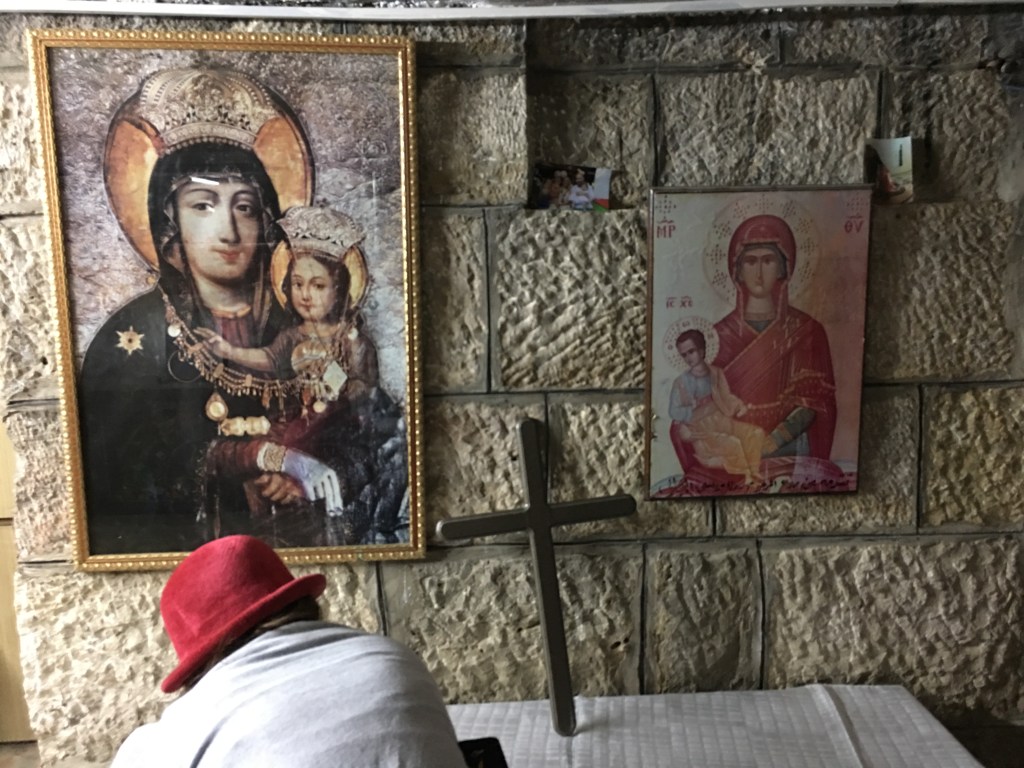
Photo by author at St. George’s Greek Orthodox Church in Madaba, Jordan, May 2019.
Teach me, O Lord, when to speak -
not only how and what to speak;
Teach me, O Lord, to speak only 
when you want me to speak,
only after you have spoken and 
I have listened.

When Samuel went to sleep in his place, the Lord came and revealed his presence, calling out as before, “Samuel, Samuel!” Samuel answered, “Speak, for your servant is listening.” Samuel grew up, and the Lord was with him, not permitting any word of his to be without effect.

1 Samuel 3:10, 19
So many times my words are
without effect because they are
empty of you, Jesus, the Word who
became flesh; many times my words
are without effect because they are
empty of truth and sincerity, no love 
nor mercy, without any kindness and
care or concern.
Sad to say, many times, my words
are filled with evil and malice and lies; 
like the demons you have driven out
in the gospel, never allow me to speak
when my words are not coming from you.
O Lord open my lips,
cleanse my heart of every evil 
and worthless thoughts
so that my mouth shall 
declare your praise.  Amen.

Being wise, avoiding sin

The Lord Is My Chef Daily Recipe for the Soul by Fr. Nicanor F. Lalog II
Monday, Week XXXII, Year I in Ordinary Time, 08 November 2021
Wisdom 1:1-7   ><]]]]*> + <*[[[[><   Luke 17:1-6
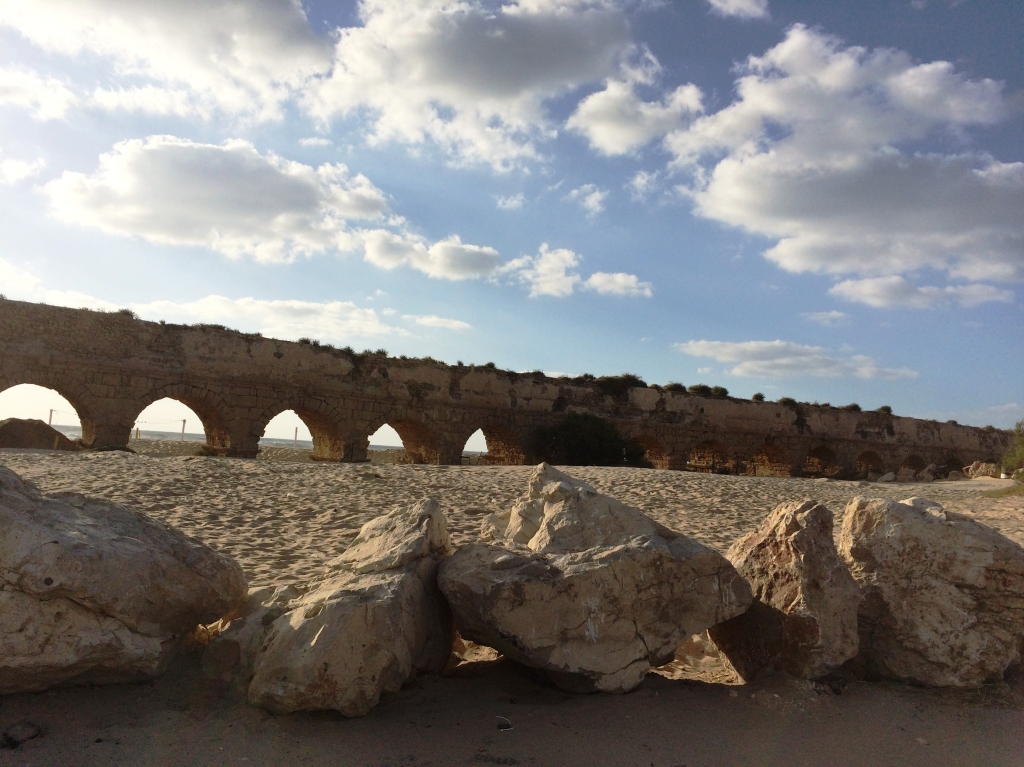
Photo by author, Israel, 2017.
Thank you dear Jesus 
for the assurance of your
love and understanding 
as well as the fair warning that
"Things that cause sin will 
inevitably occur.  It would be
better for him if a millstone 
were put around his neck and 
he be thrown into the sea than
for him to cause one of these
little ones to sin" (Luke 17:1-2).
I know, Lord, it is not an excuse
but a fact of life that we shall always
be fighting sins and evil while here
on earth as we strive to follow you;
but I know too well, dear Lord, of the
deep pains and sorrows, the widespread 
anguish every kind of scandal brings
to our family and society, most 
specially to the Mother Church.

Love justice, you who judge the earth; think of the Lord in goodness, and seek him in integrity of heart; because he is found by those who test him not, and he manifests himself to those who do not disbelieve him. For perverse counsels separate a man from God, his power, put to the proof rebukes the foolhardy; because into a soul that plots evil wisdom enters not, nor dwells she in a body under debt of sin.

Wisdom 1:1-4
Forgive us, merciful Jesus,
strengthen us to live in wisdom,
keeping our hearts free from "perverse 
thoughts" so that your Holy Spirit of
instruction may fill and guide us to 
keep us from becoming a "skandalon"
or a rock that causes one to fall and sin.
Amen.

Blessed are those who mourn

The Lord Is My Chef Daily Recipe for the Soul by Fr. Nicanor F. Lalog II
Monday, Solemnity of All Saints, 01 November 2021
Revelation 7:2-4, 9-24 ><]]]'> 1 John 3:1-3 ><]]]'> Matthew 5:1-12
Photo by Fr. Howard John Tarrayo, 05 August 2021.

For the second time since last year, all roads do not lead to the cemeteries this November 1-2 due to the pandemic. While there is still that annual exodus to the provinces, the government has preferred to keep cemeteries closed despite the many casualties of COVID-19 while allowing malls and other establishments to operate, including the opening this week of favorite destinations of Baguio and Tagaytay.

Most unkind of all is how thousands of people were allowed including children to visit for several days Manila Bay’s newest attraction, the dolomite beach while cemeteries remain closed and religious gatherings still limited as this government is more concerned in “resurrecting” the economy than considering as “essential” at this time the people’s religious and spiritual needs.

And so, we mourn for the second straight year this November 1 and 2 not only for our departed loved ones but for the benighted souls of this Administration.

But, have a heart as we find solace and comfort in Jesus Christ who encourages us every year on this first day of November with his teachings on the Beatitudes which we hear proclaimed every Solemnity of All Saints. The Beatitudes reveal the mystery of Jesus Christ who invites us to enter into a communion in him by expressing also the meaning of being his disciples. Jesus is in fact every Beatitude – the one who is truly poor in spirit, the first to be persecuted, the one with a clean heart, and the peacemaker.

For this year, let us reflect on the second beatitude which we find very close to our situation under the COVID-19 pandemic as most of us have lost a family member or friends.

When Jesus saw the crowds, he went up the mountain, and after he had sat down, his disciples came to him. He began to teach them, saying: “Blessed are the poor in spirit, for theirs is the kingdom of heaven. Blessed are they who mourn, for they will be comforted.”

Matthew 5:1-4

Photo by Irina Anastasiu on Pexels.com

In a world that thrives and promotes so much fun and merry-making, our second beatitude is difficult to understand or even grasp in this time of the pandemic. What is “blessed” with grieving and mourning when you have lost a loved one so suddenly, without having the chance to even see them before they were cremated?

There are two kinds of mourning that the gospels offer us exemplified by the two most extreme of the Apostles, Judas Iscariot who betrayed Jesus and, Simon Peter who denied the Lord thrice (see “Jesus of Nazareth” by Pope emeritus Benedict XVI, The Beatitudes, pp.86-89).

The first kind of mourning as shown by Judas Iscariot is when one has lost hope, succumbing to the miseries of losing a beloved and becomes mistrustful of love and of truth that leads to self-destruction. It is the worst kind of mourning that eats away and destroys man within just like Judas Iscariot who hanged himself.

Then Judas, his betrayer, seeing that Jesus had been condemned, deeply regretted what he had done. He returned the thirty pieces of silver to the chief priests and elders, saying “I have sinned in betraying innocent blood.” They said, “What is that to us? Look to it yourself.” Flinging the money into the temple, he departed and went off and hanged himself.

Matthew 27:3-5

The second kind of mourning that Jesus must be referring to as “blessed” which leads to salvation is when the mourning is caused by an encounter with the truth that leads to conversion like what happened to Simon Peter who was struck by the gaze of Jesus that he burst into healing tears and cleansed his soul to enable him to begin anew in his life in the Lord.

Just as he was saying this, the cock crowed, and the Lord turned and looked at Peter; and Peter remembered the word of the Lord… He went out and began to weep bitterly.

Luke 22:60-61, 62

This will have its lovely conclusion eight days after Easter before Jesus ascended into heaven when he asked Simon Peter thrice, “Do you love me?” (Jn.21:15ff.) to remind him of that episode that eventually pushed him to follow Christ unreservedly “by taking care of his sheep”.


Blessed are those who weep because first of all, they have love in their hearts. Deaths and bad news that befall our loved ones sadden us, even jolt us with deep pain that move us to console them, to suffer with them, and to be one with them by reconnecting with them and their loved ones like when we go to a funeral or a wake.

This did not happen with Judas Iscariot. The little love he had in his heart when he realized his sin was completely wiped out when he chose to surrender totally to evil, finding no more hope for forgiveness and reconciliation with Jesus. When grief becomes so overpowering and consuming, it totally wipes out the embers of love left in our hearts and like Judas, that is when we choose to die miserably sad and separated from God who is love.

Never lose hope in Jesus. Seek that love in your heart. Seek Jesus in that tiny voice telling you to always come home to him. Do not be shy nor ashamed of your loss and failure. Keep that fire of love in Jesus burning.


Blessed are those who weep because more than the love they have in their hearts, they have been loved first of all. We weep and grieve the death of a beloved family member or relative or friend because of the love they have given us, of the kindness they have shown us, and the care they have lavished us.

Simon Peter did not merely have love in his heart. Luke dramatically described to us how Peter’s eyes met the merciful and loving eyes of Jesus while he was denying the Lord. It must have struck him so hard that immediately he felt contrition for his sin, feeling strongly the need to reform himself and reconnect with the Lord. He could not let the imperfect love he has in his heart to just go to waste that is why when he wept bitterly on that Holy Thursday evening, it was not the end but the beginning of another chapter in his beautiful story of love for Jesus. It was precisely what he meant when he told Jesus at Tiberias, “Lord, you know everything; you know that I love you” (Jn.21:17) – that despite his weaknesses and failures, he loves Jesus, he tries so hard to love Jesus in his little ways.

When in the midst of great sufferings and pain specially after we have sinned or we have lost a loved one, we are blessed as we mourn and grieve because that is when we realize strongly our weakness and limitations that we reach out to God, to be nearer to him. To desire God in itself is always a grace and a blessing too!


Photo by author, 2018.

Blessed are those who mourn because that is when we actually stand for what is true and good, for what is just and right.

When we weep, it does not mean we have lost; in fact, even in the face of apparent loss like Jesus on the Cross, mourning is the most firm expression of our belief in what is right and just, and what is true and good.

The best scene for this kind of blessed mourning that leads to salvation is found at the death of Jesus Christ where his Mother, the Blessed Virgin Mary stood by the foot of his Cross with her cousin Mary the wife of Clopas, Mary Magdalene, and the beloved disciple John (Ibid.,p. 87).

By standing at the foot of the Cross and later carrying in her arms the dead body of her Son Jesus Christ called La Pieta, Mary showed us that mourning is blessed because it is the strongest depiction of our solidarity with God, of our going against evil and sin.

In this world when conformity to whatever “everyone is doing” is the rule of the game like corruption, dishonesty, infidelity, lies and manipulation of people, mourning and weeping with the victims of oppression and persecution can be our strongest signs of protest and resistance against the prevailing evils of our time.

When we weep and mourn for victims of violence and evil, that is when we become God’s instruments of his comfort to his people. From the Latin words cum fortis “with strength”, to comfort means to strengthen those persecuted or oppressed or those facing intense sufferings and tests.

When we weep, when we grieve and mourn over a lost beloved or a lost cause, that is when God comforts us, when he makes us stronger in resisting evil and sin.

Ultimately, that is when our mourning leads to salvation, that is why blessed are those who mourn and weep.


What are your griefs today?

What do you mourn?

Blessed are you in your weeping not only in having love in your heart but most of all, for being loved. Dwell in the love of God in Jesus Christ like the saints who have gone ahead of us, resisting all evils and temptations to sin for the Lord comforts us his people always. Amen.

A blessed All Saints’ Day to you!

When the spirit is willing but flesh is weak…

The Lord Is My Chef Daily Recipe for the Soul by Fr. Nicanor F. Lalog II
Friday, Memorial of St. John Paul II, Pope, 22 October 2021
Romans 7:18-25  ><]]]]'> + <'[[[[><   Luke 12:54-59
Photo by author, 2019.
Thank you very much, 
dearest God our Father 
for knowing me so well like
St. Paul, of how I constantly have
to wage that battle against evil 
deep within me.

Brothers and sisters: I know that good does not dwell in me, that is, in my flesh. The willing is ready at hand, but doing the good is not. For I do not do the good I want, but I do the evil I do not want. Now if I do what I do not want, it is no longer I who do it, but sin that dwells in me. So, then, I discover the principle that when I want to do right, evil is at hand.

Romans 7:18-21
There is an ongoing war deep within
each one of us between what is right
and good and what is wrong and evil;
there is always that inner struggle that
even if we know the right thing to do,
sometimes we choose what is wrong 
and sinful not simply because we are weak
as humans; like St. Paul, we are not 
offering an excuse to you but ask for
your grace for us to be responsible 
to our decisions and actions for it is 
only in admitting our guilt and sinfulness
can we truly see and follow you.
This inner battle between good and
evil within us are in fact the very roots
of the bigger wars and strife we have
among nations and peoples, of the more
pernicious indifference and self-centeredness
we choose daily in the face of widespread
poverty and hunger, corruption and deceptions
not only in our streets but also right in
our own homes and houses of worship.
Send us your Holy Spirit, Lord Jesus
to enlighten our minds and our hearts
to be able to read spiritually the things
happening in us and around us, 
that we may be able to judge for
ourselves what is right.  
Let us grow in the courage and wisdom
of St. John Paul II, your great Pope who
lived and served us with great example of
his life waging war against the many evils of
our time, standing for what is true and good,
your voice in this wilderness, telling us to
"be not afraid" to love like Jesus your Son
with Mary his Mother.  Amen.
From Twitter.com.

The “wages of sin”

The Lord Is My Chef Daily Recipe for the Soul by Fr. Nicanor F. Lalog II
Thursday, Week XXIX, Year I in Ordinary Time, 21 October 2021
Romans 6:19-23   ><)))*> + <*(((><   Luke 12:49-53
Photo by Pixabay on Pexels.com

But what profit did you get from the things of which you are now ashamed? For the end of those things is death. But now that you have been freed from sin and have become slaves of God, the benefit what you have leads to sanctification, and its end is eternal life. For the wages of sin is death, but the gift of God is eternal life in Christ Jesus our Lord.

Romans 6:21-23
In our modern way of living and
thinking, your words today O God 
our Father are difficult to grasp 
and accept because we are taught 
that any kind of slavery has to be rejected;
but, that is the irony of our time - we keep
on rejecting every form of slavery, 
insisting on our freedom to choose and
decide what we want in life that in the
process the more we are enslaved
to sin and powers of evil that lead
to death.
So many times in this modern way of living
we assert how each one of us is the captain
of my ship, free to determine my course in
life in the hope of finding meaning and fulfillment
that often end up with us getting lost and
alienated.  
How ironic that it is actually in being 
a slave to your grace in Jesus Christ as
St. Paul had asserted that we become 
totally free to offer ourselves unconditionally
to you our loving and merciful God and Father;
it is in surrendering ourselves to you as your
servants and slaves when we are more alive,
more fulfilled, more joyful and most peaceful
because slavery to you dear God and your
goodness bring all the good effects in life!
It is only when we empty ourselves to you, O God
that we are filled with your holiness, becoming
like you who is perfect.  Grant us the grace
to stand for what is true and good always,
standing by your side even if it means death
for it is in losing that we gain and in dying that
we truly live.  Amen.