Para sa henerasyon ngayon
wala sa kanilang isipang puntahan
ni pasyalan mga perya at karnabal ng kabukiran;
katawa-tawa at walang kuwenta sa kanila
ang sumakay sa tsubibo at ruweda,
panoorin mga salamangkero at payaso
at mas gusto maglaro ng mga video.
Mga dambuhalang kahon ng sapatos
na ginawang pamilihan,
tinaguriang mall naging pasyalan
kung saan natatagpuan pinagtatawanang
perya at karnabal ng kabukiran
naging sosyal na pasyalan
ng mga kabataan.
Ngunit hindi alintana, lingid sa mga mata
higit katawa-tawa mga pormahan at pasiklaban
masahol pa sa mga peryaan at karnabal
ating kalagayan nang mismo ating buhay
naging isang malaking palabas na lamang
mistulang mga salamangkero at payaso na rin tayo
inaasam-asam ay palakpakan at hangaan.
Saan man pumunta ay kapuna-puna
tila ang lahat nang-aagaw pansin
ibig sa kanya lamang nakatingin
kaya anu-ano gagawin, iba-iba sasabihin
pananamit at asta di mawari
ngunit kung susuriin, agad mabubuking
parang ampaw, wala kungdi hangin.
Hindi na ba natin napapansin
nangyayari sa atin saan man tumingin
tila lahat nagiging palabas na lamang
walang laman ni kahulugan mga pinagtutuunan;
nahan ang kadluan ng karunungan
at kabutihan na pinabayaang matuyuan
maubusan ng katangiang kapitag-pitagan?
Walang nasasagwaan ni kinikilabutan
pangangalandakan ng kapalaluan at kawalang kabuluhan
loob kinalimutan, panlabas pinahalagahan
perya at karnabal di na nga pinupuntahan
dahil tayo na mismo ang katatawanan!
Hindi ba natin alam iyan ang malagim na katotohanan
dapat tayong kabahan kung di sumasagi sa ating kalooban?
Zechariah 8:1-8 ><)))*> ><)))*> ><)))*> Luke 9:46-50
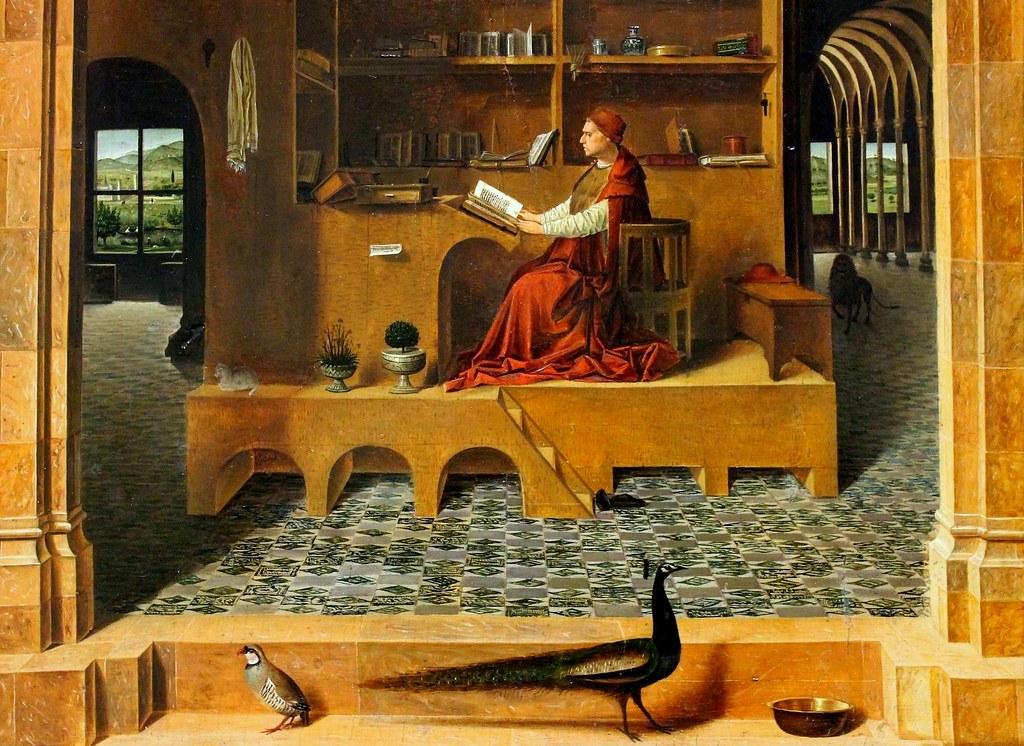
St. Jerome painting by El Greco portrayed as wearing the Cardinal’s robe to represent his highly esteemed works and contributions to the Church as one of the Four Western Fathers along with St. Augustine, St. Ambrose of Milan, and St. Gregory the Great. Photo from Google.
Praise and glory to you, God our loving Father! Thank you very much for giving us saints, men and women like us who were sinners with so many weaknesses but through your grace were able to lead holy lives.
Through your saints, you give us so much hope to be become better persons despite our many imperfections like our great Doctor of the Church, St. Jerome, the Father of Catholic biblical studies who immersed himself in the study and prayer of the Sacred Writings right in the Holy Land.
Considered as one of the great theologians of the Church, St. Jerome is said to be approachable but notorious for being a difficult person too due to his temper as well as sarcasm and being argumentative at times.
I confess, O God, that I am exactly the opposite of the kind of person Jesus Christ is telling us to be like – a child. Instead of being childlike, many times I have become childish, difficult to handle with my burst of temper and sometimes annoying sarcasm.
Like St. Jerome, fill me with your grace, with courage and willpower to conquer my irascibility and direct all my negative energies in pursuing you in prayers and good works.
Help me to follow St. Jerome in his call to “let us translate the words of the Scriptures into deeds.”
Fill me with your words, O Lord, cleanse me of my sins and iniquities so that your Holy Spirit may dwell in me, suffuse me with your holiness. Amen.
My favorite depiction of St. Jerome by Italian painter Antonello da Messina (c.1430-79), “St. Jerome in his Study.” Again, we see St. Jerome in red robe and hat like a Cardinal at his study desk with his faithful lion in the background which tradition says he had helped in the forest by removing a thorn in its paw. At the foreground are two birds: a peacock which is an ancient Christian symbol of eternal life that our saint meditated often (reason why he always has a skull in other paintings), and a partridge, a reference to St. Jerome’s notorious temper as the bird often represents jealous rage. Photo from Google.
The Lord Is My Chef Sunday Music, 29 September 2019
Our gospel today speaks a lot about our eyes, of what we see and recognize, of sights and vision. For the third straight consecutive Sunday, we hear again another parable by Jesus proper only to St. Luke called “the rich man and Lazarus”.
Jesus said to the Pharisees: “There was a rich man who dressed in purple garments and fine linen and dined sumptuously each day. And lying at his door was a poor named Lazarus, covered wit sores, who would gladly have eaten his fill of the scraps that fell from the rich man’s table. Dogs even used to come and lick his sores. When the poor man died, he was carried away by angels to the bosom of Abraham. The rich man also died and was buried, and from the netherworld, where he was in torment, he raised his eyes and saw Abraham far off and Lazarus at his side.”
Luke 16:19-23
The rich man went to hell because amid his affluent lifestyle, he did nothing to help the poor Lazarus. He was so blinded by his wealth that he was so oblivious of the plight of Lazarus. Sadly, the same scene continues in our days despite the social media around us.
The famous blind American Helen Keller wrote, “the only thing worse than being blind is having sight but no vision.”
Very true!
Many people are like the rich man who only have sight that can only see what is material and temporary, failing to see the face of God especially among brothers and sisters in need. Only a few people are like Lazarus with a vision who dare to look at things beyond what can be seen, even beyond time. They are the visionaries who dream with eyes wide open, working hard to make their dreams a reality.
Having a vision, of seeing beyond what is material and physical is essential in being a Christian tasked with a mission to lovingly serve others especially those living at the margins of the society.
No one can truly love and serve without having a vision, of seeing beyond the ordinary and the present moment. This is the reason why I always tell young people in choosing a wife or a husband, choose someone with a vision who would always look beyond sights and time.
This is the message too of American singer-songwriter Joshua Kadison’s 1993 hit “Beautiful in My Eyes” that delighted the romantic side of us Filipinos in 2009 and 2007 when Christian Bautista and Jericho Rosales respectively covered the song.
The song speaks of the great vision of the lover in seeing in his beloved everything wonderful and lovely. Most of all, the man is also a dreamer and a visionary who could see their future as a couple still in love because she’s always “beautiful in his eyes”.
You’re my peace of mind, in this crazy world. Your’re everything I’ve tried to find, your love is a pearl.
You’re my Mona Lisa, you’re my rainbow skies, and my only prayer, is that you realize, you’ll always be beautiful, in my eyes.
The world will turn, and the seasons will change. And all the lessons we will learn, will be beautiful and strange.
We’ll have our fill of tears, our share of sighs. My only prayer, is that you realize. You’ll always be beautiful, in my eyes.
You will always be, beautiful in my eyes. And the passing years will show, that you will always grow, evermore beautiful, in my eyes.
The Lord Is My Chef Sunday Recipe XXVI-C, 29 September 2019
Amos 6:1.4-7 ><)))*> 1 Timothy 6:11-16 . ><)))*> Luke 16:19-31
Photo by Mr. Jim Marpa, 2018.
Last Sunday we focused on our hands that we use to pray and serve in reflecting the parable of the wise steward. Today, let us “look” into our eyes that see God in others as we reflect on another parable only St. Luke has, the rich man and Lazarus.
Eyes are the “windows of one’s soul”.
Eyes reveal what is inside us: how we look and move our eyes, the sparkle or dullness in our eyes indicate the kind of person within. Eyes never lie for they reveal if we are telling the truth or not. Most of all, eyes do not only direct us to sights outside but even visions to beyond what we can see.
This is very clear in the parable of the rich man and Lazarus, inviting us to take a deeper look into ourselves, on others, and with the things we possess like money and wealth.
Jesus said to the Pharisees: “There was a rich man who dressed in purple garments and fine linen and dined sumptuously each day. And lying at his door was a poor man named Lazarus, covered with sores, who would gladly have eaten his fill of scraps that fell from the rich man’s table. Dogs even used to come and lick his sores. When the poor man died, he was carried away by angels to the bosom of Abraham. The rich man also died and was buried, and from the netherworld, where he was in torment, he raised his eyes and saw Abraham far off and Lazarus at his side.”
Luke 16:19-23
Photo by Mr. Jim Marpa, September 2019.
For the third consecutive Sunday, we again heard another well-known parable proper to St. Luke like the prodigal son two weeks ago and the wise steward last Sunday. Today’s parable of the rich man and Lazarus follows the same thread of last week’s wise steward which is about the thorny issue of money. But again, there is something deeper than that which is the call for daily conversion by always looking beyond what we can see.
In this parable, Jesus never said the rich man was bad that is why he went to hell or the “netherworld”. Neither did he also claim that the poor man was holy that led him into the “bosom of Abraham” which is heaven. Jesus only described their daily life: the rich man lived in affluence with fine clothings and sumptuous meals while the poor was very destitute feeding on scraps falling from the former’s table as dogs licked the sores that covered his body.
The only critical clues Jesus gives us are the name of the poor man – Lazarus – which means “God has rescued” or El’azar in Hebrew and the final scene in the afterlife.
Let it be clear that the issue here is how people, rich and poor alike, can be blinded by money and wealth that they fail or even refuse to see God and others as brothers and sisters that lead them into evil and sins.
Abraham replied (to the rich man), “My child, remember that you received what was good during your lifetime while Lazarus likewise received what was bad; but now he is comforted here, whereas you are tormented. Moreover, between us and you a great chasm is established to prevent anyone from crossing who might wish to go from our side to yours or from your side to ours.”
The sad reality is that this parable continues to happen in our days when so many of us are oblivious of the poverty and miseries afflicting many of the poor among us.
We are that rich man who has no name but have eyes that refuse to see and recognize Jesus in everyone especially the poor and suffering. How tragic in this age of social media where everything and everyone is exposed and seen, we have become blind to the plight of those around us. No need to look far but right in our own family when members are on their own without bothering to know how everyone is doing in life.
In my 21 years of priesthood, I have realized that most often, the people who truly suffer are often the Lazarus among us who prefer to be silent, to bear all their pains trusting only in God who would vindicate and raise them in the end. The Lazarus are the poor not just in material wealth but “poor in spirit for theirs is the kingdom of heaven” (Mt. 5:3) who completely trust in God.
Reading further that version of the Beatitudes of St. Matthew, we find Jesus saying
Blessed are the clean of heart, for they will see God.
The clean of heart are the Lazarus, the poor who try to find God in this life even amid the many sufferings. Our minds and intellect, including our eyes can never see God. As the Little Prince would say, “what is essential is invisible to the eye; it is only with the heart that one can truly see”. Very true!
A clean heart is a loving heart. When we speak of the heart, we also mean person for the heart embodies the whole person. Therefore, a loving heart is the Lazarus, the one who tries to see God, the one who envisions the end that he is willing to sacrifice, to forgive and to welcome the lost.
Lazarus the poor beggar went to heaven because he has a clean heart unlike the rich man who refused to see beyond himself and his affluence. They are the ones being reprimanded in the first reading by the Prophet Amos, the “complacent” people who may have also included the priestly class of Israel unmindful of the real situation of the people because they have been insulated from realities by the perks and good life of wealth and power (Amos 6:1).
Most people have eyes that have sights but only a few have a vision in life. People with a vision in life are the ones who can see beyond the ordinary, they are the dreamers who dream with eyes wide open working hard to make their dreams happen in reality.
Lazarus is a visionary and a dreamer who saw beyond the door of the rich man, beyond his hunger and sickness the glory of God in eternal life. The rich man on the other hand only had sights for what is “here and now”; and, that is what he is so afraid of with his five brothers still alive who have no vision of the afterlife, no vision of God among others in the present life like him.
My dear friends, Jesus is inviting us today while there is still time to go back to the path of conversion, to see beyond ordinary things and see the more essential, the more lasting things that according to St. Paul in the second reading prepare us for eternal life like “righteousness, devotion, faith, love, patience, and gentleness” (1Tim. 6:11).
Let us listen to the words of God found in the Sacred Scriptures that Abraham referred to in the parable as “Moses and the prophets” (Lk.16:29).
Most of all, let us listen to Jesus Christ, the only one who had risen from the dead (cf. Lk. 16:31) who enables us to see him on the face of everyone we meet, giving us a vision of heaven by helping us in fulfilling our mission as his disciples in proclaiming the coming of the kingdom of God. Amen.
Saturday, Memorial of St. Lorenzo Ruiz and Companions, 28 September 2019
Zechariah 2:5-9, 14-15 ><)))*> ><)))*> ><)))*> Luke 9:43-45
From Google.
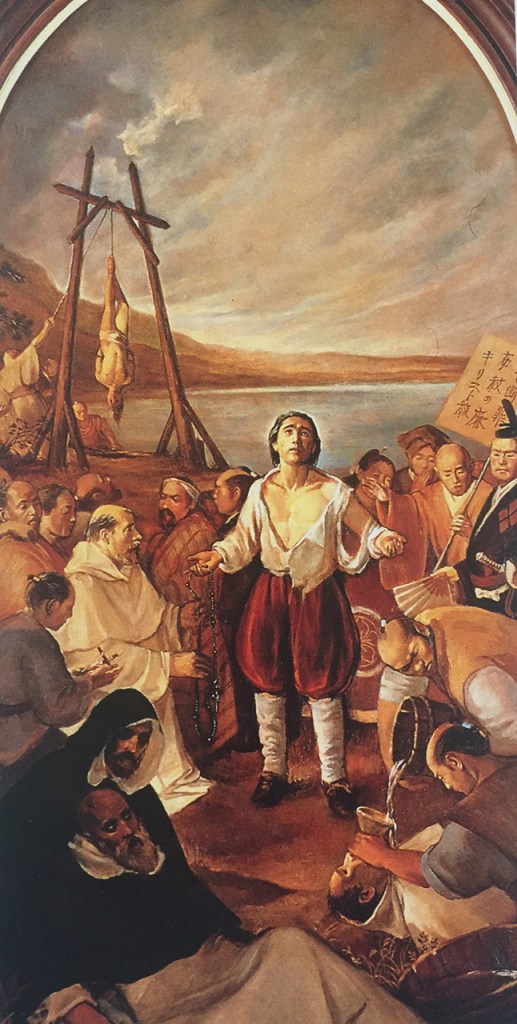
Today, O God our loving Father, we praise and thank you for the gift of our first Filipino saint, San Lorenzo Ruiz along with his companions martyred in Japan on this day in 1637.
What a great blessing too, dear Father, that our first saint is a layman, someone we need these days to look up to and follow your universal call to holiness.
Bless our lay people who make up most of our faithful who are also our most essential co-workers in your vineyard, Lord.
We need them so much in this world that has become very secularized.
Restore their faith not only to you O God but also to us your priests, their priests and teachers and guides to you. May the lay people be faithful to your teachings through the Church they now question in the name of progress and liberalism.
Like San Lorenzo Ruiz, may the faithful trust again their priests and bishops despite the scandals that continue to rock our wounded Church.
What a beautiful sight to behold the martyrdom of San Lorenzo Ruiz with other fellow lay faithful and Dominican priests who all comprise the Body of Christ, the Church. In them were fulfilled your words to the prophet:
“People will live in Jerusalem as though in an open country, because of the multitude of men and beasts in her midst. But I will be for her an encircling wall of fire, says the Lord, and I will be the glory in her midst.”
Zechariah 2:8-9
May we all trust you, O Lord, especially in this time of varied forms of persecution against the Catholic Church here and abroad. May we have the courage of San Lorenzo Ruiz and companions to suffer with you, and to suffer for you. Amen.
Friday, Memorial of St. Vincent de Paul, 27 September 2019
Haggai 2:1-9 ><)))*> ><)))*> ><)))*> Luke 9:18-22
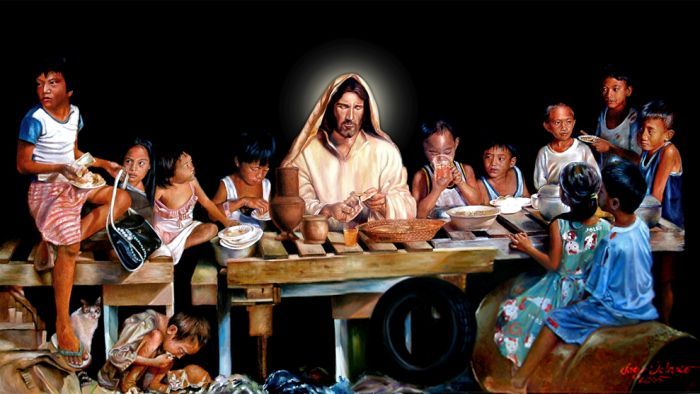
“Hapag ng Pag-Asa” painting by the late Joey Velasco. From Google.
Dearest Lord Jesus Christ:
Thank you for coming to us poor, for giving us the poor. But, tragically many times we have refused to see you among the poor.
On this feast of St. Vincent de Paul who faithfully and lovingly served you among the poor, we pray for the same gift of seeing you and loving you among the poor.
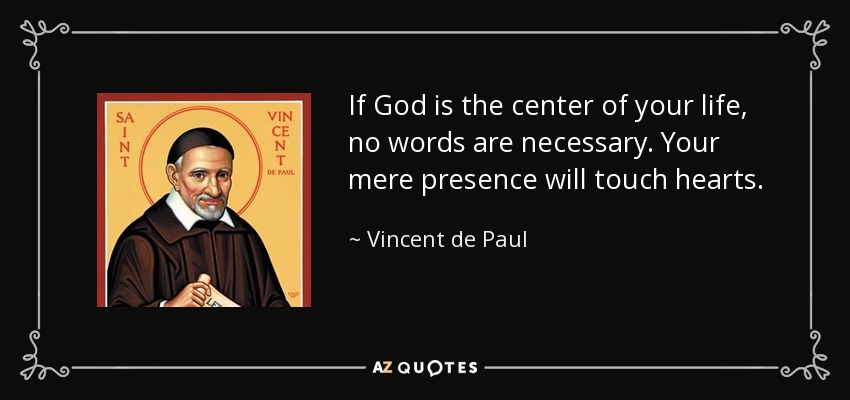
“It is our duty to prefer the service of the poor to everything else and to offer such service as quickly as possible… this very service is performed for God. Charity is certainly greater than any rule. Moreover, all rules must lead to charity.”
St. Vincent de Paul, from the Breviary
In the first reading from Haggai today, your people the Israelites were so poor with literally nothing left to rebuild your temple in Jerusalem. What a gift for them to still see you among the ruins, in their poverty feeling your “spirit in their midst” assuring them with your “peace in the temple to be rebuilt” (Hag. 2:5, 9).
Empty us of our pride, let us appreciate and embrace the poverty within us like Simon Peter and all the saints like St. Vincent de Paul that we may boldly proclaim you are the “Christ of God” (Lk. 9:20) not only in words but also in deeds. Amen.
Lawiswis ng Salita ni P. Nicanor F. Lalog, 26 Setyembre 2019
Larawan kuha ni G. Jim Marpa sa Carigara, Leyte, Setyembre 2019.
Kay sarap pagmasdan
at maliliman lalo na sa gitna ng kainitan
ng matayog na puno
may malalabay na sanga
mga dahong luntian.
Mainam ding pagnilayan
talinghagang nababalot nitong larawan
mga kahulugan at kaugnayan
ng mga kataga na puno at pinuno
sa punong kahoy din naka-ugat.
Husay ng ano mang puno
ng tahanan at pamayanan,
tanggapan at paaralan,
simbahan at pamahalaan
natatagpuan sa kabuuan, walang kasiraan.
"Integrity" sa Inggles
hiniram sa wikang Latin, "integer" at "integritas"
na kahuluga'y "intact" o buo:
nakakabit, sama-sama
hindi sabog at kalat-kalat.
Ito ang tinaguriang integrity:
karangalan dahil buo ang pagkatao
nababakas sa kanya larawan at wangis
ng Lumikha na Siyang pinagmumulan
at pinag-uugatan ng ating katauhan at karangalan.
Sa isang pinuno, ito ang batayan
at ugat ng kanyang pamumuno
buo at hindi wasak, may kaisahan
kanyang iniisip, sinasabi at ginagawa
kaya siya ay buo at mayroon karangalan.
Malalaman natin kung tunay
at hindi huwad ating pinuno
kapag kanyang katauhan
ihalintulad sa punong kahoy
upang matukoy kanyang karangalan.
Malalim ba kanyang pagkakaugat
sa katotohanan at kabutihan
hindi pumapanig at di mabubuwal
ng kasinungalingan?
Matuwid at matayog ba kanyang
mga pananaw at inaasam,
sinisikap matanawan, masundan
kaliwanagan ng katotohanan at katuwiran?
Nagsasanga hindi ang dila
kungdi mga bisig upang abutin
di lamang langit kungdi iba pang sanga
upang lumabay at liliman sino mang kumakanlong?
Katulad ng puno ng kahoy
ikababagsak o ikatatayog ng
sino mang puno ng sambahayan,
pamayanan, pamahalaan, at simbahan
ay nasa kayang kabuuan  o karangalan bilang nilalang.
Chapel of San Padre Pio at San Giovanni Rotondo, Italy. Photo by Arch. Philip Santiago, 2017.
Praise and glory to you, O Lord our God and almighty Father! You never cease to amaze us, doing great marvels for us your people. Despite our sins, you always make yourself present among us in so many ways.
In the first reading from Ezra, you have used the pagan king of Persia, Cyrus, to be the instrument in fulfilling your promise to Israel to bring them back home from their Babylonian exile.
In our modern time, you have sent us San Padre Pio to prove and show to us that worrying is useless in this age when we believe and rely more with science and technology than with you, a loving and personal God who had come to us in Jesus Christ.
Teach us to be like San Padre Pio to “pray, hope and not worry” by embracing Christ crucified, by bearing all the pains and sufferings in love contrary to the ways of the world seeking power, wealth, fame, and pleasures.
From Google.
May we befriend silence and prayer than the noise of the world; may we persevere in patiently waiting for you than be in the foolish “rat race” with no winner at all; and, may we believe in things we cannot see with our eyes contrary the modern dictum to see is to believe.
Give us the courage of San Padre Pio to bring out your light, Lord, especially at this time when people claiming to be liberal and progressive are calling for so many rights that are outrightly wrong, destroying the human person, family, and society.
May our hands bear the wounds of your crucifixion, Lord Jesus, like San Padre Pio in praying to you and serving you through those most in need. Amen.
They always reveal something about us. Medical doctors say our hands’ texture and color indicate our health condition. Psychics always read our palms to see our past, present and future. And every suitor always asks for the hand of his beloved for marriage.
In fact, it is always fascinating to observe the hands of a man courting a woman. See how he would always hide his hands inside his pockets or at his back as he puts his best foot forward to impress the lady he is courting. If he wins her heart, they get engaged and that is when they keep on holding each other’s hands until they get married.
There are a lot great beauty and profundity in our human hands that always come in handy for daily living!
“It is my wish, then, that in every place the men should pray, lifting up holy hands, without anger or argument.”
1 Timothy 2:8
I love St. Paul’s expression of men praying “lifting up holy hands” which is the sum or integration of prayer and action. Very picturesque, showing us how we must conduct ourselves with God and one another by living in peace and harmony as brothers and sisters in Jesus Christ. That is why today until next Sunday, our gospel from St. Luke would be challenging us on how authentic our life is as seen from last week’s parable when we experienced God as a loving Father embracing us despite our sins.
This Sunday, the Lord is asking us, “what’s in our hands”?
What are we holding on, literally and figuratively speaking?
Whatever our hands touch and hold are always linked with our whole selves. They cannot be separated from our body for our hands extend us to other people and even with things. Our hands reveal the balance or imbalance within us, the truth and lies we hold on deep inside us.
Photo by Jim Marpa in Carigara, September 2019.
“No servant can serve two masters. He will either hate one and love the other, or be devoted to one and despise the other. You cannot serve God and mammon.”
Luke 16:13
In our gospel today, Jesus is not asking us to “dirty our hands” with sin. What he wants us to realize from his parable is to be like the wise steward or “hired hand” who used all his resources and intelligence in securing a sound future by doing something finally good to those he had cheated.
Like that hired hand, what are the main concerns of our hands? Do we use our hands for good or for evil? Would we dare to use our hands extensively to achieve eternal life by entering through the “narrow door” Jesus told us last month by keeping our hands busy in doing good, serving the poor and needy?
Our hands are a blessing from God, including the fruits of its labor.
How unfortunate that like during the time of the prophet Amos whom we have heard in the first reading today, we use these very blessings from God to curse and trample others especially the poor and the weak. How ironic and sad that the very hands we use to care for others are the very same hands that beat and even kill others perfectly expressed in the term “blood in one’s hands”. Worst of all, the very hands that pray to God are the same hands that hurt others!
Betania Tagaytay, August 2017.
The late Jaime Cardinal Sin of Manila used to narrate a short story about the gracious hands of God. He said that most of the time, the hands of God caress us, pat our shoulders and even soothe us whenever we are in pain. But, sometimes, the hands of God tap us, even “spank” us when things do not seem to favor us. What matters most, according to Cardinal Sin, whether we are caressed or tapped, the same touches come from God’s loving and healing hands always filled with grace.
In the gospels, we find many instances of Jesus using his hands to raise the sick, to touch the eyes and mouth in restoring senses, and to bless, break and share bread with his friends and sinners alike. When he expressed his immense love for us and the Father, Jesus stretched out his arms and offered his hands on the cross on Good Friday.
Just imagine how with all our sins, God with a stroke of his hand can make us all vanish but chose not to do so and let our trespasses pass. Like the master in the parable we have heard, God is giving us all the opportunities to work with our hands in lovingly serving the people he has entrusted to us in our homes and offices, school and parish, and community.
But unlike that master who still fired his hired hand despite his resourcefulness, God is not judging us into doom. In is infinite love, God gave us Jesus Christ his Son to bring us back to him in eternal life. It is for this that we lift up our hands to him every day, especially in the Holy Mass we celebrate. The best prayer we can offer God is for these “blessed hands” to reach out to everyone in love and forgiveness, kindness and peace. Amen.
Lawiswis Ng Salita ni P. Nicanor F. Lalog II, Ika-21 ng Setyembre 2019
Larawan kuha ni G. Chester Ocampo sa Catanduanes, Abril 2019.
Isang gabi pagkaraang magdasal at magnilay
kinailangang pansinin at sagutin
isang nagtext sa akin:
kanyang tanong ay napakalalim
bumaon din sa aking loobin.
Aniya'y, "bakit nagkaganito ang buhay namin?"
isang tanong tumimo sa akin
marahil ilang ulit din sa inyo dumating
nakaka-praning, ang hirap sagutin
bagkus maraming katanungan pa rin.
Ang hirap naman kasi sa atin
kapag maganda buhay natin
dinaraanang landasin ayaw suriin
sa pag-aakalang kasiyahan magpapatuloy pa rin
hindi alintana lahat lilipas din.
Kapag ito ang naitatanong natin
mas malamang mga salarin
ng suliraning kinalalagyan natin
tiyak hanggang ngayon ay mga tulog at lasing pa rin
hindi kayang aminin ni tanggapin kanilang pagkukulang din.
Kaya kung ikaw ay nagtatanong
"bakit nagkanito buhay natin?"
tiyak ikaw ay gising at higit na mapalad pa rin
iyong maaapuhap balang araw dahilan
nitong hantungang hindi para sa atin.
Mga taong nagpapasakit sa atin
kadalasan maraming sugat at sakit na dalahin
sadyang kaawa-awa kung tutuusin
ni hindi nila batid bakit nagkanito buhay natin
sigaw ng kanilang loobin sila'y pansinin at saklolohan natin!
Larawan kuha ni G. Chester Ocampo sa Catanduanes, Abril 2019.