Lord My Chef Daily Recipe for the Soul by Fr. Nicanor F. Lalog II
Wednesday, First Week in Ordinary Time, Year II, 14 January 2026
1 Samuel 3:1-10, 19-20     <'[[[[><  +  ><]]]]'>     Mark 1:29-39
Photo by author, Bgy. Ubihan, Meycauayan City, January 2022.
How lovely are your words
today, Lord Jesus Christ,
the Word who became flesh
and dwelled among us!
Thank you very much
in sharing with us the power
of your words; in fact,
we are the only ones with whom
you have gifted with this power;
the world and everything in it
was created simply by God speaking
the words that came to exist.
Teach us, Jesus
the value of listening to you,
letting you speak first
so that like Samuel,
you may "not permit any word
we speak to be without effect"
(1 Samuel 3:19); may we truly share
in your prophetic ministry
by "enfleshing" the words we speak
by walking our talk;
likewise, heal us,
dear Jesus
of our many infirmities
and sickness due to sins
and evil that make us
speak too much
that instead of building up
others we destroy one another;
like those demons you drove out
from the sick you have cured
in today's gospel,
keep our mouths shut,
"do not permit us to speak"
(Mark 1:34)
when not necessary.
Amen.
The Lord Is My Chef Sunday Recipe for the Soul by Fr. Nicanor F. Lalog II
Eighth Sunday in Ordinary Time, Cycle C, 02 March 2025
Sirach 27:4-7 ><}}}}*> 1 Corinthians 15:54-58 ><}}}}*> Luke 6:39-45
The last time we have celebrated the eighth Sunday in Ordinary Time Cycle C was in 2001 when just like this year, the Season of Lent started late in March. In fact, the other last two Sundays of sixth and eighth in Cycle C were last celebrated in 2010 and 2007, respectively.
It is worth noting this because as Jesus delivered his Sermon on the Plain, we find that contrary to claims by many in this modern time, the teachings of Christ are actually taken directly from life as he reveals to us the truth in our hearts. Two Sundays ago, Jesus taught us the paradoxical happiness of our lives, of being poor, hungry, weeping, and maligned than rich, filled, laughing and well-spoken of; last Sunday, he taught us of the need to love truly that is rooted in God by loving without measure, loving even our enemies.
This Sunday, Jesus tells us something we often debate about as it usually puts us into a bind even a quandary on what to say and do.
Jesus told his disciples a parable, “Can a blind person guide a blind person? Will not both fall into a pit? Why do you notice the splinter in your brother’s eye, but do not perceive the wooden beam in your own eye? How can you say to your brother, ‘Brother, let me remove that splinter in your eye,’ when you do not even notice the wooden beam in your own eye? You hypocrite! Remove the wooden beam from your eye first; then you will see clearly to remove the splinter in your brother’s eye” (Luke 6:39, 41-42).
Photo by author, Hidden Valley Springs Resort, Calauan, Laguna, 20 February 2025.
Very often in many instances, most of us choose to be quiet than speak out against evil and other irregularities among us and in our society because of this teaching of the Lord. Many are afraid to notice the splinter in the brother’s eye lest they too might have a wooden beam blocking their views of themselves.
And that is why, evil persists everywhere that eventually, many of us become silent partners in the many sins happening around us which is very far from the demands of Jesus for us to choose what is right and good, to always make a stand for him even on the Cross.
See the flow of the Sermon on the Plain, of how Jesus is first of all never condemning nor judgmental of anyone. We have reflected his four “woes” were actually invitations for the rich et alii to change their ways in life, to think more of things that do not pass like wealth and other material things.
Secondly, last Sunday, Jesus directed our intentions into our hearts, to probe our hearts and find his grace of supernatural or divine love poured in there so that we can love selflessly without measure like him.
This Sunday, Jesus still directs us into our hearts, to examine whether we are truly his disciple or a hypocrite as someone who says something yet does the opposite. It is not opposite his exhortation last week for us to be merciful like God our Father rather a challenge to examine what we practice, our Christian praxis.
“A good tree does not bear rotten fruit, nor does a rotten tree bear a good fruit. For every tree is known by its own fruit. For people do not pick figs from thornbushes, nor do they gather grapes from brambles. A good person out of the store of goodness in his heart produces good, but an evil person out of a store of evil produces evil; for from the fullness of the heart the mouth speaks” (Luke 6:43-45).
Photo by Mr. Lorenzo Atienza, leftmost section of the stained glass at the National Shrine of Our lady of Fatima in Valenzuela City, 25 February 2025.
It is clearly a lesson in holiness, in integrity of every disciple! Do we walk our talk? The most basic norm of morality is that what we know in our mind and what we feel in our heart is what we say and therefore what we do.
Where are we now? Everybody is speaking about corruption while the devils celebrate everywhere as we are all entangled in all forms of corruption not only in the streets and government offices but even in our homes, in schools and offices and yes, right inside the church in many parishes.
Now we come full circle with Christ’s opening to his parable, Can a blind person guide a blind person? And this is what is now happening in the world, in our lives, in our country and in our parishes. Nobody would want to speak because nobody would want to examine one’s heart and follow the path of Jesus.
It is in our deeds that one is recognized as a true disciple. Let us not forget that. And let us not be afraid to examine constantly the value of our many ways and practices.
Photo by author, St. Paul Spirtuality Center, Pico, La Trinidad, Benguet, 05 January 2025.
One of the famous bishops and saint both recognized by the Eastern and Western Churches is St. John Chrysostom who served as Archbishop of Constantinople until the early 400’s. He is called the “golden mouthed” because of his gift in eloquence most true in his witnessing Christ, always meaning what he said like in this homily that sounds so 2025:
The Church is in an extremely critical state, and you think that all is going well. The fact is that we are plunged into countless sins, and we do not even know it!
You wonder why. We hav e churches, money, and everything else. There are places for assembly, people come there everyday; surely this is not nothing?
But it is not thus that we judge the state of the Church. Then how?, you ask.
Whether we lead a truly Christian life. Whether everyday we make ourselves spiritually more rich, bearing fruit, whether great or small; if we are not content simply with flfilling the law and expediting our religious duties.
Who is a better person, after having frequented the church all month?
This is what we must look for! After all, even what appears to be a good action is only a bad action, when one does not follow it up… If we bring nothing to fruition through it, it would be better to stay home (from Days of the Lord, vol. 6, page 62).
Photo by Mr. Lorenzo Atienza, 25 February 2025.
The kind of life we lead is the final test of our discipleship, the proof of what is in our hearts. St. Francis of Assisi used to tell his followers whenever they would preach to use only their mouth if necessary. Our actions speak louder than our words.
This is the biggest problem in the Church today: our lack of credibility as bishops and priests when our lives are far from what we say and teach.
God shared with us his power of the words. In the Bible, we find how his words and his being are always one since the story of creation into the coming of Jesus Christ who could heal with just mere words being the word who became flesh.
This is the whole point of Ben Sirach in our first reading this Sunday, reminding us that inasmuch as the potter knows the quality of his work after it has passed through fire, the same thing is most true with our words. We have to harness and master our speech, our words so that we walk what we talk.
We master our power of the words in our prayer life as St. Paul assured us in today’s second reading how in the Lord our labor is not in vain (1 Cor. 15:58). Let us pray to the Holy Spirit especially this Sunday as we approach the Season of Lent with Ash Wednesday. Let us keep our zeal for Christ not nonly for his words and teachings but most especially in his life and witnessing. Amen.See you at Ash Wednesday.
Campus Ministry, Our Lady of Fatima University, Valenzuela City.
The Lord Is My Chef Daily Recipe for the Soul by Fr. Nicanor F. Lalog II
Friday in the Fourteenth Week of Ordinary Time, Year II, 12 July 2024
Hosea 14:2-10     <*[[[[><<  +  >><]]]]*>     Matthew 10:16-23
Thus says the Lord: Return, O Israel, to the Lord, your God; you have collapsed through your guilt. Take with you words, and return to then Lord; Say to him, “Forgive all iniquity, and receive what is good, that we may render as offerings the bullocks from our stalls” (Hosea 24:2-3).
Loving Father,
let us "take words" with us
this Friday,
words of contrition for our sins,
words of true repentance,
words begging your mercy,
words that are sincere
not empty words;
many times in this world
of social media,
we multiply words,
we shout words,
we alter words
to give new meanings
that suit us;
many times our words
are mere words,
never bearing fruit,
could not even stand
because they are not true;
like Jesus your Son,
teach us to "enflesh"
our words,
let our words to You be
translated into realities of
conversion and loving service
for one another.
When they hand you over, do not worry about how you are to speak or what to say. You will be given at that moment what you are to say. For it will not be you who speak but the Spirit of your Father speaking through you” (Matthew 10:20).
Let us heed your words,
Lord Jesus Christ,
for us to be "shrewd as serpents
and simple as doves"
by learning to be silent
to let the Holy Spirit speak
through us;
in this noisy world
with so many competing
words and sounds,
it has become indeed
a persecution to be silent;
it is more difficult to be silent
to await your words, Lord;
it is always easier to speak
and add to the cacophony of
deafening and hurtful words
against each other
than to just listen to
our hearts,
to listen to your words
of love and mercy;
like the psalmist,
let my mouth
declare your praise
by awaiting your words
first, not mine.
Amen.
The Lord Is My Chef Daily Recipe for the Soul by Fr. Nicanor F. Lalog II
Wednesday in the First Week of Ordinary Time, 10 January 2024
1 Samuel 3:1-10,19-20  <*[[[[>< + ><]]]]*>  Mark 1:29-39
Photo by author, 2020.
Dearest God our Father:
I find it so funny these days
we have that feature in our phones
"call waiting" - when we can identify
whoever is calling us, giving us
the easy choice to answer it
or not; if we have missed a call,
we still have a chance to call back
to return a missed call;
with "call waiting",
we cannot actually miss
a call.
Ideally.
Supposed to be.
But we not only ignore calls of
friends and relatives;
worst of all,
we refuse
answering your calls!
During the time young Samuel was minister to the Lord under Eli, a revelation of the Lord was uncommon and vision infrequent… Samuel grew up, and the Lord was with him, not permitting any word of his to be without effect.
1 Samuel 3:1, 20
How interesting the author
noted that "revelation of the Lord
was uncommon and vision infrequent"
during that time of Eli as your priest;
most likely reason was nobody
was listening to you at all
until Samuel came.
Teach us, dear Jesus,
to never keep you waiting
for us in answering your calls;
like the brothers Peter and Andrew,
James and John
that we immediately speak to you,
most of all always listen to you.
This 2024,
let us not keep you waiting in
answering your call
for you never missed our calls;
let me be patient, O Lord,
in awaiting your words,
your calls
so that like Samuel
when we speak,
our words have effect
because we speak your
words alone.
Amen.
The Lord Is My Chef Daily Recipe for the Soul by Fr. Nicanor F. Lalog II
Monday in the First Week of Advent, 28 November 2022
Isaiah 4:2-6   ><000'> + ><000'> + ><000'>   Matthew 8:5-11
Photo by author, 27 November 2022.
Thank you very much,
dear Jesus for the gift of Advent,
for your promise to come again
after you have come
and still come;
let me come rejoicing
to your house, O Lord!
I rejoiced because they said to me, “We will go up to the house of the Lord.” And now have set foot within your gates, O Jerusalem. Because of my relatives and friends I will say, “Peace be within you!” Because of the house of the Lord, our God, I will pray for your good.
Psalm 122: 1-2, 8-9
As I look back to 2022 about to end,
the more I believe in your Second Coming,
Lord Jesus; with grateful heart,
I praise and thank you, Lord,
in letting us survive this year,
in letting us survive this pandemic
as you washed us all clean from our sins
that was long seen by Isaiah
and fulfilled in your coming.
Let me come to you, Lord,
like that centurion,
filled with faith and trust
in his belief in you,
in your powerful coming
even in words.
Amen.
The Lord Is My Chef Daily Recipe for the Soul by Fr. Nicanor F. Lalog II
Wednesday in the Week I of Ordinary Time, 12 January 2022
1 Samuel 3:1-10, 19-20   ><]]]]*> + <*[[[[><   Mark 1:29-39
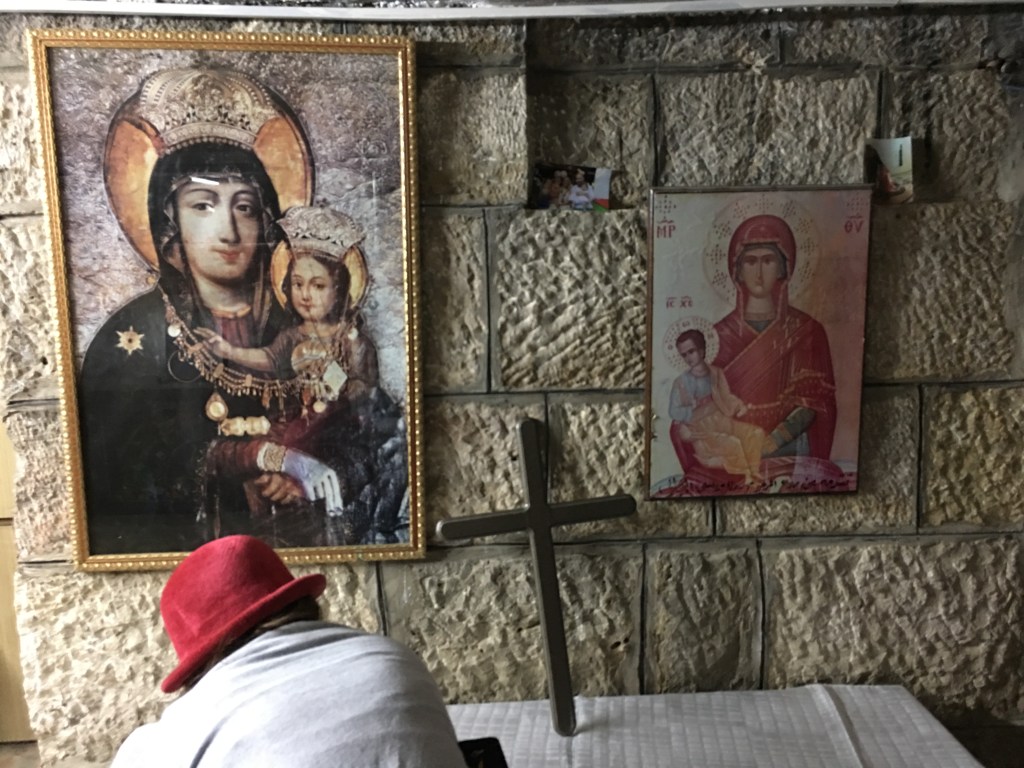
Photo by author at St. George’s Greek Orthodox Church in Madaba, Jordan, May 2019.
Teach me, O Lord, when to speak -
not only how and what to speak;
Teach me, O Lord, to speak only
when you want me to speak,
only after you have spoken and
I have listened.
When Samuel went to sleep in his place, the Lord came and revealed his presence, calling out as before, “Samuel, Samuel!” Samuel answered, “Speak, for your servant is listening.” Samuel grew up, and the Lord was with him, not permitting any word of his to be without effect.
1 Samuel 3:10, 19
So many times my words are
without effect because they are
empty of you, Jesus, the Word who
became flesh; many times my words
are without effect because they are
empty of truth and sincerity, no love
nor mercy, without any kindness and
care or concern.
Sad to say, many times, my words
are filled with evil and malice and lies;
like the demons you have driven out
in the gospel, never allow me to speak
when my words are not coming from you.
O Lord open my lips,
cleanse my heart of every evil
and worthless thoughts
so that my mouth shall
declare your praise.  Amen.
The Lord Is My Chef Breakfast Recipe for the Soul by Fr. Nicanor F. Lalog II
Thursday, Week XX, Year I in Ordinary Time, 19 August 2021
Judges 11:29-39   ><)))*> + ><)))*> + ><)))*>   Matthew 22:1-14
Photo by author, Jerusalem at dawn, May 2017.
God our loving Father,
please make me conscious
beginning today of every word
that I say, of its meaning and
implications; better, teach me
to be silent and still, to speak only
when necessary, avoiding especially
making any oath even before you.
Jephthah made a vow to the Lord. “If you deliver the Ammonites into my power,” he said, “whoever comes ot of the doors of my house to meet me when I return in triumph from the Ammonites shall belong to the Lord. I shall offer him up as a burnt offering. When Jephthah returned to his house in Mizpah (after defeating the Ammonites), it was his daughter who came forth, playing the tambourines and dancing. She was an only child: he had neither son nor daughter besides her. When he saw her, he rent his garments and said, “Alas, daughter, you have struck me down and brought calamity upon me. For I have made a vow to the Lord and I cannot retract.”
Judges 11:30-31, 34-35
"Words, words, words!"
Like Hamlet, we read and say
many words without meaning,
falsely believing words become true
when multiplied and said over and over
not realizing the most powerful words
ever spoken where those borne out of
silence when you created everything.
Give us the grace, dear God,
to be like Jesus your Son,
"the Word who became flesh"
to be a person of credibility
and integrity whose "yes" means "yes"
and "no" means "no" - always dressed
in "wedding garment" for your
banquet in heaven (cf.Mt.22:12-14).
Amen.
The Lord Is My Chef Breakfast Recipe for the Soul by Fr. Nicanor F. Lalog II
Wednesday, Week XVI, Year I in Ordinary Time, 21 July 2021
Exodus 16:1-5, 9-15   ><]]]]'>  +  <'[[[[><   Matthew 13:1-9
Photo by Mr. Jim Marpa, 2018.
Every day God,
we pray to you
"Our Father in heaven
hallowed be thy name...
Give us each day
our daily bread"
without realizing the daily bread
you give us that truly nourishes us:
your words of truth and of life
that became flesh in Jesus Christ.
On that day, Jesus went out of the house
and sat down by the sea.
Such large crowds gathered around him
that he got into a boat and sat down,
and the whole crowd stood along the shore.
And he spoke to them at length in parables.
(Matthew 13:1-3)
Thank you very much, dear God
for listening to our prayers,
in giving us the food we need
to nourish our bodies
and your words that sustain us
especially in these trying times.
May we hunger more
for this daily bread from heaven,
listening attentively,
fulfilling your words as you willed them so.
Then the Lord said to Moses,
"I will now rain down bread
from heaven for you.
Each day the people are to go out
and gather their daily portion;
thus will I test them,
to see whether they follow
my instructions or not."
(Exodus 16:4)
But most of all, O God
teach us to be like you: to be more
selective in our listening,
to be more circumspect with what
to hear and process wherein
we listen more on essential things
that matter most than on trivial
and mundane words that are
divisive, preventing our growth
and maturity in our relationships.
If you would listen and act
on everything we say, especially
our grumblings and complaints,
no one among us would still be alive;
but you are kind and understanding,
unlike us who listen more on petty
than essential things said by others.
May we be like the good soil
that is open to listen and nurture
words that build and give life.  Amen.
The Lord Is My Chef Breakfast Recipe for the Soul by Fr. Nicanor F. Lalog II
Monday, Feast of San Lorenzo Ruiz and Companions, 28 September 2020
Job 1:6-22     >><)))*>  >><)))*>   +   <*(((><<  <*(((><<     Luke 9:46-50
How great it is, O God our loving Father that on this Feast of our first Filipino saint, San Lorenzo Ruiz, our readings today and even yesterday were all about words and how we must “walk our talk”.
San Lorenzo Ruiz remained true to his words that if given with a thousand lives, he would give them all to God when he chose martyrdom in Nagasaki, Japan in 1637 along with 15 others that included nine Dominican priests, two brothers, two laymen, and two consecrated women.
Exactly the same way Job is the best example of fidelity and complete trust in God when after losing all his children and properties in just one day, all he said was…
“Naked I came forth from my mother’s womb, and naked shall I go back again. The Lord gave and the Lord has taken away; blessed be the name of the Lord!” In all this Job did not sin, nor did he say anything disrespectful of God.
Job 1:21-22
So many times, Lord, we say so many things without really meaning them well, when our words and actions do not jibe at all.
Sometimes, all we have are good intentions, lacking in actions.
And worst, there are times when we our words reveal dark intentions in our hearts that cannot escape you.
Help us to be true to our words, to be your witnesses in this world where words mean so cheap that even if we say more, we still mean nothing at all because our words are empty.
Through the intercession of San Lorenzo Ruiz, grant us the gift of martyrdom, of witnessing to your Gospel not only in words but most of all in actions. Amen.
The Lord Is My Chef Sunday Recipe for the Soul by Fr. Nicanor F. Lalog II
Week XXVI-A in Ordinary Time, 27 September 2020
Ezekiel 18:25-28   |+|   Philippians 2:1-11   |+|   Matthew 21:28-32
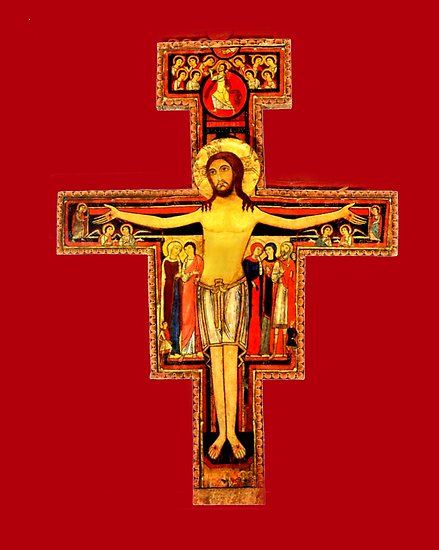
Cross of San Damiano before which St. Francis of Assisi prayed and received Christ’s commission to rebuild His Church. Photo from wikipedia.org.
Brothers and sisters: If there is any encouragement in Christ, any solace in love, any participation in the Spirit, any compassion and mercy, complete my joy by being of the same mind, with the same love, united in heart, thinking one thing. Do nothing out of selfishness or out of vainglory; rather, humbly regard others as more important than yourselves, each looking out not for his own interests, but also for those of others. Have in you the same attitude that is also yours in Christ Jesus, who, though he was in the form of God, did not regard equality with God something to be grasped. Rather, he emptied himself, taking the form of a slave, coming in human likeness; and found human in appearance, he humbled himself, becoming obedient to death, even death on a cross.
Philippians 2:1-8
We priests and religious pray this beautiful hymn by St. Paul every Saturday evening. It is also proclaimed on Palm Sunday to show us Jesus Christ’s self-emptying (kenosis in Greek) to offer himself for our salvation. It is the most important text of St. Paul’s letter to the Philippians that has played a vital role in the discussions of Christ’s preexistence.
Seen in the light of the gospel this Sunday, it is also part of St. Paul’s moral exhortation to the Philippians and us living today to be united as one in Jesus by following his pattern of kenosis that is similar with his teachings that “the first will be last, and the last will be first, that the greatest is the servant of all.”
It is the fundamental model of Christian life, the very essence of following Jesus by denying one’s self and taking up one’s cross but also the most difficult to learn and put into practice as it is exactly the opposite of the way of the world – “upward mobility” — of being rich and famous, of being in control that had divided us with massive walls of indifference, hate, and antagonisms making peace and joy more elusive.
Christ’s kenosis is the only way up in life to be back in God that leads us to unity, peace, and joy.
In this time of the pandemic when we are supposed to be more united and kind and nice with everyone, St. Paul’s call to imitate Jesus Christ’s kenosis is very timely and relevant, calling us to soften our hearts by emptying ourselves of our pride unlike the chief priests and elders of Israel to whom the Lord addressed his parable this Sunday.
Photo by author, wailing of Jerusalem, May 2017.
Our sense of entitlement
Jesus said to the chief priests and elders of the people: “What is your opinion? A man had two sons. He came to the first and said, ‘Son, go out and work in the vineyard today.’ He said in reply, ‘I will not,’ but afterwards changed his mind and went. The man came to the other son and gave the same order. He said in reply, ‘Yes, sir,’ but did not go. Which of the two did his father’s will?” They answered, “The first.” Jesus said to them, “Amen, I say to you, tax collectors and prostitutes are entering the kingdom of God before you.”
Matthew 21:28-31
Beginning today in three successive Sundays, Jesus teaches us again in parables to soften our hearts and let go of our pride that we are better than others, that we deserve more than what is due us like those early workers to the vineyard in last week’s gospel.
In a sense, today’s gospel tells us that there are too many works to be done in God’s kingdom that we have to keep going, imitating Jesus and be careful of falling into the same trap of those workers in last Sunday’s parable who felt entitled to more pay because they worked longer than others.
Notice how Jesus directly addresses his parables in these three Sundays to the same crowd of “chief priests and elders of the people” who have always felt favored by God for being of his “chosen people” since Abraham’s time. They always looked down at others specially the “tax collectors and prostitutes” considered as sinners.
They are not just people from the past who have lived during Christ’s time more than 2000 years ago. Even among us today, there are still chief priests and elders who continue to live and exist!
And here is the rub — among these people who may really be good in faithfully keeping the commandments of the Lord, praying and doing all kinds of devotions and charities are also the worst. Their religiosity are tied only to themselves and never to God, without any love at all.
Keep in mind that every time we feel entitled like the chief priests and elders of the people, it means our hearts have gone hard and cold like the elder son of the merciful father of the parable of the prodigal son or the early workers hired to the vineyard last week.
Photo by author, Mt. St. Paul Spirituality Center, La Trinidad, Benguet, March 2020.
So many times it happens that those who are supposed to be on higher moral grounds turn out to be without any roots and grounding in God at all, becoming harsh and judgmental of others, more sinful than the ones they condemn.
Like the chief priests and elders of the people in the crowd listening to Jesus, they start as the vida only to end up as the contravida like when there is a “black sheep” in the family or a “rotten tomato” in class, that instead of helping them rise from their sinfulness, they who are the ones who condemn and sink others deeper into their holes!
That is why God questions, stirs their hearts through the prophet in the first reading,
Thus says the Lord: You say, “The Lord’s way is not fair!” Hear now, house of Israel: Is it my way that is unfair, or rather, are not your ways unfair?
Ezekiel 18:25
Always examine our hearts for we must all be converted again and again.
We must keep on praising and thanking God for his mercies like in our responsorial psalm this Sunday because he gives us all the chances in life to change and become better persons. Here we find a semblance with the gospel the other Sunday why we must forgive without limits because God’s love for us is infinite.
Actions, not intentions, judge us
Last Monday we celebrated the feast of St. Matthew, the tax collector called by Jesus to become one of his Twelve Apostles who also wrote one of the four gospels. It is very interesting to know that in all gospel accounts, tax collectors and prostitutes are always grouped together because they are the worst sinners at that time.
Tax collectors not only enriched themselves with excessive collections from the people but were seen as traitors who worked for the Roman colonizers of Israel at that time. Prostitutes, on the other hand, have always been considered very low because as women supposed to give birth for the awaited Messiah, they have “dirtied” their womb. Together, tax collectors and prostitutes were seen as the worst sinners in Israel because they have sold their souls to the devil; hence, they were considered beyond redemption, beyond hope, a scourge to their families and to the community that nobody would want to deal with them.
And so, it was very radical, out-of-this-world and totally unimaginable for everybody then when they heard Jesus telling them how “tax collectors and prostitutes” were entering the kingdom of God before the chief priests and elders of the people who were considered very holy at that time!
It was a serious warning to them and us today from the Lord who reminds us that our actions judge us. The parable is an echo of his warning that “not everyone who calls him ‘Lord, Lord’ will enter heaven” (Mt.7:21). St. Matthew is very particular in his gospel account of the complete jibing together of what we say and what we do, of “walking the talk”.
We have so many sayings expressing this important lesson of today’s parable by the Lord like “A single act of good deed is always better than the grandest and best intention” and “Actions always speak louder than words.”
Photo by author, sunset in the parish, August 2020.
In this time of the pandemic when church attendance is limited and we are advised not to sing and reply aloud in the Mass, it is best that we examine how we have become mechanical in our celebrations without realizing the gravity of things we say like when we acclaim after the gospel proclamation “Praise to you, Lord Jesus Christ!”: do we really work hard in his vineyard or are we like the other son who said yes but did not go? When at the end of the Mass we are told “Go in the peace of Jesus Christ” and we say, “Thanks be to God”, do we really go home at peace or still having that festering anger or dislike to someone?
Make your joy complete. Ask Jesus to soften your heart. Take a step backwards like the first son though at first he seemed so bad to disobey his father in refusing to follow his command, do not be ashamed to take back your words and do what is right.
Be careful not with your words but with your actions for which the Lord would judge us in the end.
Find solace in St. Paul’s beautiful hymn this Sunday: the lower we go down, the higher we are lifted up like Jesus. Nobody had ever gone wrong and lost in life going down, of being humble. Many men and women have gone to oblivion, lost and forgotten when their ivory towers collapsed, burying them in the rubble.










 lordmychef.com