Lord My Chef Daily Recipe for the Soul by Fr. Nicanor F. Lalog II
Thursday, Second Week in Ordinary Time, Year II, 22 January 2026
1 Samuel 18:6-9; 19:1-7     <*{{{{>< + ><}}}}*>     Mark 3:7-12
Your words today,
O Lord, are very disturbing,
even baffling but very revealing:
in the first reading we heard
the beginning of Saul's jealousy
of David while in the gospel
of how "unclean spirits" recognized
Jesus as the Son of God.
Lord, give us the courage
to confront every jealousy
that seeps into us,
from the most simple ones
to more greater ones that really
get us destabilized like that of Saul
when he heard people praised David
for killing ten thousand
compared to his thousands;
jealousy can be a terrible thing
because it is difficult to see others
better than us; most of all,
most difficult of all is to see people
turning away their attention from us
for others.
Saul was very angry and resentful of the song… And from that day on, Saul was jealous of David (1 Samuel 18:8, 9).
Teach us Jesus
to accept fully our strengths
and weaknesses,
to not measure our success
as persons by what we can do
or what others say; teach us to
imitate St. John the Baptist who
declared "Christ must increase,
but I must decrease" (John 3:30).
Teach us, Lord Jesus
to be honest and sincere
like you, so contented in yourself:
you silenced the unclean spirits
from making you known;
how intriguing that so often,
it is our dark, sinful side
where we truly find the hard truths
of life; if we could just be like you,
we would never be taken over
by jealousy because the moment
we experience jealousy,
then we realize the truth
of somebody better than us
in some aspects; jealousy is an
unclean spirit within us that
speak of the truth not to set us
free but to enslave us by driving us
into the opposite direction of self-
aggrandizement.
Teach us, Jesus,
that all that matters
is for us to give glory to God
and that the work of your
Kingdom is always done,
by us and by others.
Amen.
Photo by author, Don Bosco Chapel on the Hill, Nasugbu, Batangas, January 2023.
Lord My Chef Daily Recipe for the Soul by Fr. Nicanor F. Lalog II
Friday, Memorial of Sts. Basil the Great & Gregory Nazianzen,
Bishops and Doctors of the Church, 02 January 2026
1 John 2:22-28     ><))))*> + ><))))*> + ><))))*>     John 1:19-28
Photo by author, Hagia Sophia, Istanbul, Turkiye, 01 November 2025.
Lord Jesus,
today I feel like John
being asked by priests
and Levites sent by Jews
from Jerusalem:
"Who are you?"

What a great question
we all have to confront
at the start of the new year
because unless we truly know
and accept who we are,
we can never give the right
answer in making you known,
Jesus; many times,
we fail to make you known
not because you are difficult to
know but simply because we do not
know who we are unlike John;
we cannot give a definitive answer
"I am not the Christ"
because even if we do not
claim it verbally, unconsciously
we pretend as the Christ;
many times, Lord
you are not known
not because you are so far
but because our lives are so far
from you that people could not
believe what we say about you;
most often, you are not known
Jesus not because your teachings
are hard and difficult but because
we ourselves are lost and could not
find the way into our true selves
to be the voice of one in the desert
like John crying out,
"Make straight the path
of the Lord."
At the start of this new year,
dear Jesus,
help me to be like John
or St. Basil or St. Gregory
who knew themselves very well,
embracing everything about me
especially my sins and weaknesses
so that like John,
I can declare "I am not the Christ"
and therefore, stop from pretending
or acting or speaking as the Messiah;
let me embrace the limitations I have,
the darkness and emptiness
within me so that
I may remain in you
and your grace only.
Amen.
Photo by author, detail of John the Baptist from the Deesis Mosaic in the hagia Sophia in Istanbul, Turkiye, 01 November 2025.
Quiet Storm by Fr. Nicanor F. Lalog II, 11 September 2025
Photo by author, Sacred Heart Novitiate, Novaliches, QC, 2023.
Of course, there is no need for us to impress Jesus Christ for he loves us so immensely beyond measure. However, I have realized this week in my prayers that the Lord is most impressed with us when we are in our weakest.
It has been recurring in my prayers several times with the latest in this Wednesday’s gospel, “Raising his eyes toward his disciples Jesus said: ‘Blessed are you who are poor, for the Kingdom of God is yours’” (Luke 6:20).
I just love that scene of Jesus looking up to his disciples, looking up to us because normally we humans are the ones who look up to God his Father where he is seated to his right in heaven. When we pray, we sometimes raise our hands reaching up to God.
There is something so beautiful and wonderful when the Sacred Scriptures tell us of Jesus looking up to us. What an honor and a privilege! Because that happens when we are weakest, most flawed, and dirty with sin.
Imagine being there at that scene of the sermon on the plain and Jesus had to raise his eyes toward his disciples: he must have been at a lower position than them. This scene will have its fullness in the washing of the disciples’ feet after their Last Supper on Holy Thursday.
We who could no longer bow that low to clean and wash our feet as well as trim our toenails know this so well. Imagine all the dirt and flaws Jesus must have seen in the disciples’ feet that evening. Not a word was heard from Jesus. He teased no one nor complained of the dirt and unsightly things he must have seen too. Jesus simply bore everything because he loved them so much.
Photo from Our Lady of Fatima University website, June 2025.
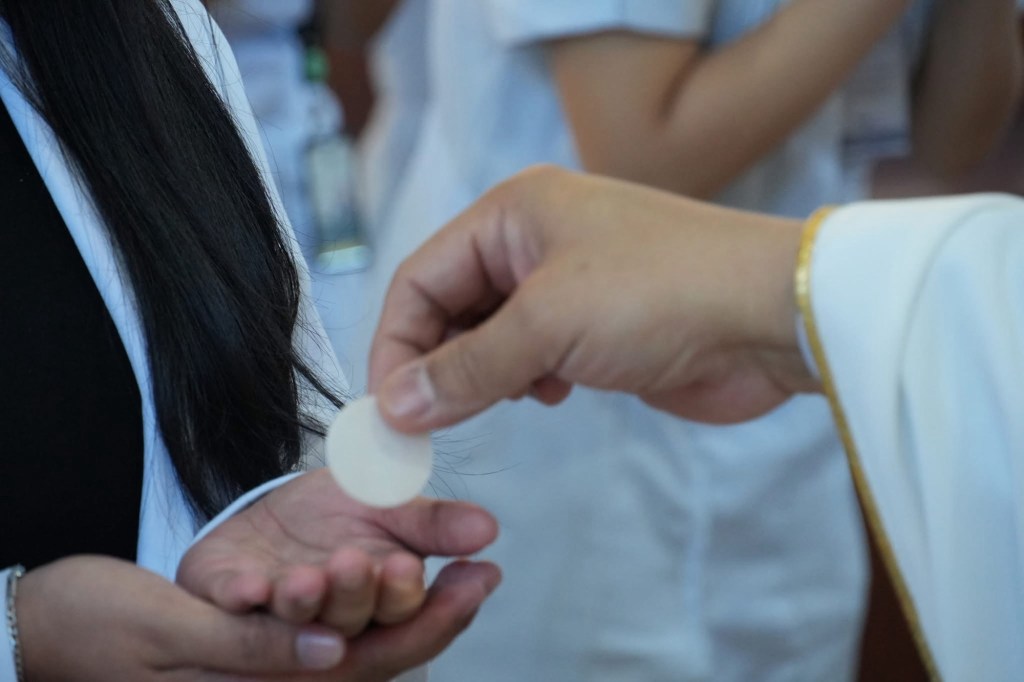
Jesus continues to look up to us every time we receive him in our hands during the Holy Communion. That is why I always tell the people especially our students to be very solemn during that occasion when the Son of God most powerful, all-knowing in his simplest form and sign as a thin wafer, enters us body and blood. It is the most perfect time to pray to Jesus, to tell him everything and most of all, to listen to him because that is when he is right inside our body, when he is down inside us, we above him.
Jesus does not need our triumphs and “goodness” because they all came from him actually. What he does not have is what we have a lot- the negative things like sins, hurts and bitterness, anger and resentment festering deep inside us for a long time. Those are the thing Jesus want from us, the very things he is most “impressed” with us that we are able to live with those burdens for so long. But, he is most impressed with us in the truest sense when we are able to surrender these to him because that’s when we are blessed and filled in him.
Raising his eyes toward his disciples Jesus said: “Blessed are you who are poor, for the Kingdom of God is yours. Blessed are you who are now hungry, for you will be satisfied. Blessed are you who are now weeping, for you will laugh. Blessed are you when people hate you, and when they exclude and insult you, and denounce your name as evil on account of the Son of Man” (Luke 6:20-22).
Photo by author, Sacred Heart Novitiate, Novaliches, QC, 2023.
In this age of affluence brought about by technological advances, being poor and hungry, being maligned and weeping are things to be avoided at all costs. With people so fascinated with money and wealth, fame and power, being poor and hungry for God, weeping and being maligned for what is true and good and just are not impressive at all, even foolish.
But, look at the effect of those shameless social media posts by “nepo babies” of their crass lifestyle sustained by ill-gotten wealth at the expense of the poor – they have all been bashed relentlessly in the country leading to more evidence of corruption among government officials and law-makers while in Indonesia and Nepal, these same practices have sparked social unrest and upheavals recently!
For so long, many have wished to be rich and wealthy, to have all the money to buy good food and drinks, build mansions filled with expensive cars and adorn themselves with signature clothes and jewelries in the belief they can impress others. Maybe with their fellows with the same benighted souls but more often, they only bred jealousies and envies that led to vicious circles of corruption and crimes in the name of having more money.
In truth, no one is impressed with material things because people who feel good only with possessions are actually the most pitiable ones for they could not see their own value as a person. To be able to see one’s value as a person despite one’s sins and weaknesses is the beginning of being truly human.
Recall the Lord’s parable of the Pharisee and the publican praying at the temple: the publican who stayed at the back beating his chest so contrite for his sins went home blessed according to Jesus than the Pharisee who boasted of his own righteousness. “Magpakatotoo ka!” screamed a soda commercial not too long ago but still echoes so true these days.
Jesus is not impressed with what we have done nor achieved but with what we have become – that amid all the beatings and pains of life with all of our shortcomings and sins, we forge on with life, persevering in faith, filled with hope that Christ is our salvation. What impresses Jesus Christ most in us is what we lack because that is when he can be closest to us, one in us. See yourself the way Jesus sees you – as a person, loved and cared for. Regardless of what. Let me end this with a prayer wrapped in a song which I have always loved because it sounds like Jesus speaking to me, so impressed with me despite of everything.
Lord My Chef Sunday Recipe, 31 August 2025
Twenty-Second Sunday in Ordinary Time, Cycle C
Sirach 3:17-18, 20, 28-29 ><}}}*> Hebrews 12:18-19, 22-24 ><}}}*> Luke 14:1,7-14
“Meal in the House of a Pharisee” 1886-1896 painting by James Tissot from brooklynmusueum.org.
For the next three Sundays beginning today, Luke gathered teachings of Jesus Christ all set on the dining table, a sort of some “table talks” about the great banquet in the end of time and how we could all get in to share in the eternal meal with the Father.
On a sabbath Jesus went to dine at the home of one of the leading Pharisees, and the people there were observing him carefully. He told a parable to those who had been invited, noticing how they were choosing the places of honor at the table (Luke 14:1, 7).
I love the way Luke presented this scene when he said “the people there were observing Jesus carefully” while the Lord told them a parable after “noticing how they were choosing places of honor at the table.”
How lovely! People observe, Jesus notices.
As it had happened in every instances of gatherings with Jesus, people carefully observed him, trying to find something to accuse him in of disregarding their traditions and laws like healing the sick on a sabbath day. They have “boxed” and judged Jesus as a dissident and a trouble-maker among them in his apparent disregard of laws and traditions.
Photo by author, Manila Club, BGC, June 2025.
In a funny twist, Luke tells us in this scene the immense love of Jesus then and now for everyone that despite his noticing and knowing everything in us, he neither counted those things against us nor ever judged us. How sad many of us with that habit of putting God in a box like a cop keeping tabs of our infractions when in fact God simply noticed our actions and behavior to invite us to become better without any judgment at all.
Keep in mind this scene reveals to us its context of the heavenly banquet which took place after the sabbath services at the synagogue where Jesus participated, hosted by a Pharisee, a VIP of the synagogue and of the society at that time. It was a party where every who’s who was supposed to be present, with everyone competing for the best seats closest to the host. And so, Jesus the keen observant but never judgmental used the occasion to teach us the essence of humility to make it to heaven or eternal life that is signified by a wedding banquet like that big meal he attended.
“When you are invited by someone to a wedding banquet, do not recline at table in the place of honor. A more distinguished guest than you may have been invited by him… For everyone who exalts himself will be humbled, but the one who humbles himself will be exalted” (Luke 14:8, 11)
These past Sundays, we have seen Christ’s insistence of the Father’s desire to have everyone welcomed into heaven by giving us some instructions of what to do to gain eternal life.
This Sunday while in a big party, Jesus took the occasion to teach us the value of humility to get into heaven. From doing, Jesus now moves into being, our disposition and attitude to make it into heaven where what matters most is not where we are seated but where we stand. Recall how Jesus reminded the brothers James and John with their mother that he has nothing to do with the seating arrangements prepared by the Father in heaven after she requested her two sons to be seated beside him when he comes into his glory.
Heaven is more of where we stand with Jesus where his virtue of humility is most pronounced when he “humbled himself, becoming obedient to death, even death on a cross” (Phil.2:8). That is why St. Augustine taught that “humility is a sign of Christ”, a revelation of Jesus that allows us to recognize him our Lord and Master leading us to the Kingdom of heaven without any feelings of inferiority and despair.
On the Cross which he prefigured at his Last Supper, Jesus showed himself as the most humble of all who went to life’s lowest point of suffering and dying to meet us as he noticed everything in us to lift us up and be like him, humbly standing in our sufferings. It is on the Cross that we find humility as the basic and essential requirement to get into the heavenly banquet of the Lord.
Very often when we examine our state of humility, what comes to our mind are the many negativities we have like our sins and failures, vices and weaknesses, our being unworthy. But, that is when we bow down most to beg for Christ’s mercy like before the Holy Communion when we pray, “Lord, I am not worthy to receive you under my roof but only say the word and I shall be healed.”
That is both the humility of Jesus and of us humans so vividly expressed at the washing of the feet after the Last Supper. Normally, we look up to Jesus in heaven but at the washing of feet, like every time we receive Holy Communion, we take the higher position, looking down at him not with pride but with all humility because Jesus humbled himself first before us. Here we find humility as seeing ourselves the way Jesus sees us – weak and sinful, yet so loved and forgiven. This is what Ben Sirach taught us in the first reading: humility is the fundamental attitude of wisdom because it opens us to the splendor of God when we find our self-worth and value too!
Without humility, it is either we see only the best or the worst in us as a person, without God, without others.
This is the bigger issue with the “nepo babies” now being bashed on social media after flaunting their wealth and ostentatious lifestyles. Their posts were far from inspiring, at most are tasteless and most convulsive. All we have noticed in their posts is their pride not only in lacking humility but most precisely in not finding value in themselves. Sadly but I dare say they are the ugliest and most pitiable persons because they find value only in wealth and things, not in themselves as persons. Hence, the flaunting of their possessions that only make them so pathetic because along that came their utter disregard for others especially the poor who suffer most with their parents’ greed for money through corruption.
Humility is always uplifting in the positive sense, not looking at others as below us but to realize despite our sins and weaknesses, we are loved, we are noticed as a person so worthy, so valuable. When we are humble, then we become joyful too because we are assured of love and acceptance despite our flaws. This is the gist of the message to us this Sunday of the author of the Letter to the Hebrews: unlike the Israelites in the Old Testament who were so fearful to approach God who spoke to them with thunder and lightning, we can get close to God in Jesus who humbled himself to be one with us by dying on the Cross.
True humility keeps us rooted with our selves, with others and with God. It is this rootedness best expressed in the Sunday Eucharist that we are able to follow Jesus in his journey to Jerusalem and eventually into heaven in all eternity. Amen.Have blessed Sunday and most blessed September too!
Photo by the Marketing Office, Our Lady of Fatima University, Valenzuela City, June 2025.
Lord My Chef Daily Recipe for Soul by Fr. Nicanor F. Lalog II
Wednesday in the Fifth Week of Easter, 21 May 2025
Acts 15:1-6     <*((((><  +  ><))))*>     John 15:1-8
Photo by author, Cabo da Roca Villas, Pundaquit, San Antonio, Zambales, 15 May 2025.
Let me abide in you,
Lord Jesus for you are
the true vine and we are
your branches,
having life and sustenance
only in you and through you;
Let me remain in you
like the branches of the vine
so I may remain fruitful,
not just successful that is based
only on my efforts that are never
good enough;
Let me abide with you,
Lord especially when no one
else can truly be relied on
for you alone remains unchanged
in love and mercy.
Jesus said to his disciples, “I am the true vine, and my Father is the vine grower. He takes away every branch in me that does not bear fruit, and everyone that does he prunes so that it bears more fruit… Remain in me, as I remain in you. Just as a branch cannot bear fruit on its own unless it remains on the vine, so neither can you unless you remain in me” (John 15:1-2, 4).
There are so many things in me
that need to be pruned and removed
especially those blocking my
growth in you as a person
and a disciple; so many parts
of my life need your nourishing
presence Lord like my temper
and anxieties that make me
hurt many people around me;
prune me of my old vices and
new ones that I have acquired
that prevent me from totally
giving myself to you in prayer
and charity; cleanse my heart
and my mind to see the other
"branches" that link me to you
our true vine like the Apostles
and the presbyters in the early
Church (Acts 15:6) by being open
to meet with others and discuss
the many issues that divide
and separate us from each other
by focusing alone in you dear Jesus.
Amen.
The Lord Is My Chef Daily Recipe for the Soul by Fr. Nicanor F. Lalog II
Thursday, Week II in Ordinary Time, Year I, 23 January 2025
Hebrews 7:25-8:6     <*{{{{><  +  ><}}}}*>     Mark 3:7-12
Photo by author, St. Paul Spirituality Center, Pico, La Trinidad, Benguet, 06 December 2024.
Let me come to you,
Jesus, with confidence
and humility to express
to you my deepest longings
and desires,
my deepest needs
and cries you know so well
but I always deny or too shy
to tell you completely.
Though I know very well
how your death on the Cross
is the single most important event
in history for all times
and for all peoples,
I balk its realities not for lack
of faith but due to low self-esteem,
lack of self-acceptance
that you do love me truly.
The main point of what has been said is this: we have such a high priest, who has taken his seat at the right hand of the throne of Majesty in heaven, a minister of the sanctuary and of the true tabernacle that the Lord, not man, set up. Now he has obtained so much more excellent a ministry as he is a mediator of a better covenant, enacted on better promises (Hebrews 8:1-2, 6).
Let me follow you,
Jesus like the people in
the gospel:
let me not follow you only
to the sea but even to the
Cross to be one in you,
one with you
for you alone
is truly one with me
everywhere,
all the time.
Amen.
Photo by author, Mount Olis, Atok, Benguet, 27 December 2024.
The Lord Is My Chef Sunday Recipe for the Soul by Fr. Nicanor F. Lalog II
Feast of the Baptism of the Lord, Cycle C, 12January 2025
Isaiah 40:1-5, 9-11  ><}}}*>  Titus 2:11-14; 3:4-7  ><}}}*>  Luke 3:15-16, 21-22
Photo by author, San Fernando, Pampanga, November 2021.
Today is your last chance to greet “Merry Christmas” the people you have forgotten as well as claim your gifts from Santa because this Sunday’s “Feast of the Lord’s Baptism” closes the Christmas Season.
The Lord’s Baptism shows us that Jesus did not remain an infant on the manger in Bethlehem nor a child in Nazareth. It is sad to note both the religious and secular emphasis on this child imagery of Christ have reinforced the notion among people that Christmas is for children and a time for adults to return to the innocence and joy of their childhood.
Jesus grew up and matured into an adult on a mission from the Father to save us that led to His Passion, Death and Resurrection at Easter. Through our baptism in becoming the children of God, Jesus invites us to continue His Christmas story by maturing in our faith, hope and love in Him by embracing His Cross that His Baptism anticipated.
This Sunday Feast of the Lord’s Baptism is a coming to full circle of last week’s Epiphany into a theophany. Yes, they sound Greek because both are from the Greek words “epiphanes” and “theophanes”.
Epiphany is Jesus manifesting Himself to all nations through the Magi as the King of kings last Sunday; today, it is God the Father who recognizes Jesus as His Christ, His Anointed One with the voice declaring as a theophany, “You are my beloved Son; with you I am well pleased” (Lk.3:22).
Every morning as we wake up is a theophany with God telling us “You are my beloved child; with you I am well pleased.” Three things I wish to share with you for us to hear God’s daily theophany and fulfill our mission as baptized children of the Father.
Photo by author, sunrise in Atok, Benguet, 27 December 2024.
First, let us recognize and affirm our being, identity, and existence. Many times, we are more of a “zombie” than a human person who can’t find life nor experience living at all, wasting precious time to be somebody else, living in the past or living in the future.
When Luke noted “The people were filled with expectation, and all were asking in their hearts whether John might be the Messiah”(Lk.3:15), he wished to inform us how the people at that time recognized and admitted they were sinners, that they were broken, that they were sick physically, emotionally and spiritually as they all affirmed their need for salvation. They accepted and owned the realities of their lives that they needed God, they needed the Christ whom they thought was John the Baptizer.
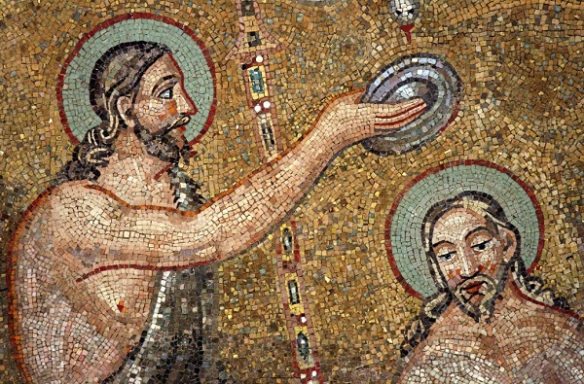
The Baptism of Christ by John the Baptist in the Jordan River. Detail of dome mosaic in the Battistero Neoniano (Orthodox Baptistery) in Ravenna, dating from 451-75. On lower right is a personification of the Jordan River as an old man rising from the water, holding a reed in one hand and offering a garment to Christ in the other. The right arm and dish of John the Baptist, the dove, and Christ’s head are 18th- and 19th-century restorations; the rest is original.
Even John the Baptizer is presented by Luke as also so sure of who he was as the precursor of the Messiah. Among the expectant people and John, we realize that indeed, growth happens the moment we accept who we are.
Examine the testimonies of many devotees of the Nazareno at Quiapo, of how they support each other in their woes and sufferings in life that we find a sort of theophanies by God, something like what we have heard from the first reading today, “Comfort, give comfort to my people, says your God”(Is.40:1). That comfort, that salvation, happened right there and then, in the now and not in a distant future.
Despite my “dislike” for their attitudes during the Traslacion, devotees of the Nazareno have always amazed me for daring to be truthful and honest with themselves, admitting their own sinfulness and weaknesses as they recognized too their need for help and most especially of their desire for God. This desire for God and admission of one’s sinfulness are very crucial to experience and hear God’s daily theophanies to us.
Photo by Mr. Jay Javier, 09 January 2019.
Second, for us to hear God’s theophany, we need to imitate Jesus Christ in taking the downward movement in life. His baptism at Jordan clearly illustrates this with His coming down to the Jordan valley through the mountains that evoked His own coming down from heaven to be born here on earth, in Bethlehem.
What is so beautiful with Jesus Christ’s downward movement is essentially a being with the sinful, the sick, the rejected, the marginalized, the poor, and those considered dirty. From being purely clean and sinless, Jesus took all our dirt to be cleansed like Him. Such is the kindness of God that Paul speaks today to Titus “so that we might become heirs in hope of eternal life”(Titus 3:7).
Our world today teaches us the opposite direction Jesus Christ had taken by climbing up the pinnacle of success, of good life, of supremacy, of power, of everything! They call it “upward mobility” that has prompted everyone even those in the Church to join the rat race for being rich and famous, of being somebody, putting on masks and taking more of the goods the world offers until we get lost in misery finding no meaning at all with one’s self because we thought life is “up there.”
Jesus Christ is not up there but down here, in our very selves, in our very hearts filled and battered with our many agonies and failures, hurts and pains, weaknesses and sins. Look down more into our very selves to find Jesus in our dirt and miseries which is the message of Jesus Nazareno.
Observe all those interviewed in Quiapo have only one prayer – well-being of a loved one. They never asked to be rich or have money. Just heal a sick child or parent was the most requested prayer of devotees. Our favorite Pope Benedict XVI explained this downward movement so well:
To accept the invitation to be baptized now means to go to the place of Jesus’ Baptism. It is to go where he identifies himself with us and to receive there our identification with him. The point where he anticipates death has now become the point where we anticipate rising again with him (Jesus of Nazareth, page 18).
Photo by author, sunset in Liputan Island, Meycauayan City, Bulacan 31 December 2022.
Last but not least for our reflection is something very peculiar with Luke alone: the theophany of Jesus happened not right after His baptism but while He was praying, “After all the people had been baptized and Jesus also had been baptized and was praying, heaven was opened and the Holy Spirit descended upon him in bodily form like a dove”(Lk.3:21-22).
In the Acts of the Apostles, Luke recorded the Pentecost happened while the Apostles with the Blessed Mother Mary were all praying when the Holy Spirit descended upon them like tongues of fires which is similar with what took place at Jesus’ Baptism. In all books of the whole Bible, divine revelation is always preceded with prayer. As we shall see this year when Luke guides us every Sunday with his gospel account, he is the one who portrayed Jesus most in prayer than any of the other evangelists.
Photo by author, Garden of Gethsemane, the Holy Land, May 2017.
If we want to hear God’s theophanies to us, let us handle life with prayer which is more of listening and being one with God. Begin and end each day with prayer. There is no other way to hear God’s voice, to hear Him affirming us, to know His plans for us until we are one with with Jesus in prayer.
In His baptism at Jordan, Jesus Christ as the Second Person in the Holy Trinity prayed not because He needed something from the Father but because He is one with Him in the Holy Spirit. That was when the Father affirmed Him as the Christ being sent on a mission.
Through the Sacrament of Baptism we have received, we are reminded today of God’s anointing of each of us as His beloved child. May we heed His voice and be one with Him for a more blessed 2025 ahead of us as we begin Ordinary Time tomorrow. Have a blessed week. Amen.
Quiet Storm by Fr. Nicanor F. Lalog II, 22 March 2024
Photo by author, Sacred Heart Novitiate, Novaliches, QC, 19 March 2024.
Salamuch to all your birthday greetings and prayers. You were all prayed for during my five day silent retreat here at the Sacred Heart Novitiate in Novaliches, my “Bethel” and “Peniel” in the last ten years.
It was in Bethel where Jacob dreamt of a stairway to heaven that upon waking up realized “the Lord is in this spot, although I did not know it” (Gen.28:16, 19) while it was in Peniel where he wrestled with an angel that he was given the other name “Israel… because you have contended with divine and human beings and have prevailed” (Gen.32:29, 31).
The newly reblocked tree-lined road of Sacred Heart Novitiate.
God has been so kind to me to let me reach 59 – isang taon na lang may Senior Citizen Card na ako!
Last Sunday I had a long lunch with two of my former students in our girls’ high school in Malolos. It was a great feeling of being “reconnected” not only with Karen and Kweenie but also with myself.
God is our most important “connection” in life. To be connected, to reconnect with him is to be one, to be whole again with one’s self, with others and the rest of creation. And that is what a retreat is, a vacation with the Lord which is to reconnect with Him, to be healed and be whole again to find our other vital connections in life (https://lordmychef.com/2024/03/18/re-con-nect/). Here are some of my reflections; hope to help or guide you too to God.
After sunset at the Sacred Heart Novitiate, 21 March 2024.
If I say, “Surely darkness shall hide me, and night shall be my light” — Darkness is not dark for you, and night shines as the day. Darkness and light are but one.
Psalm 139:11-12
Very often, we feel disconnected from God and everyone, even from one’s self when there is darkness in life due to sins and failures or disappointments as well as when we are tired and feeling sad, even depressed, for varied reasons.
But, the grace of God is actually most bountiful when we are in darkness. And the irony of it all, it is in our darkness is also our light! It is the other side of that another irony I realized a few years ago that it is in emptiness when we are actually full. Kung kailan wala, at saka mayroon!
From the refectory of Sacred Heart Novitiate, 18 March 2024.
In His great silence, God never stops doing something in us and with us while we are groping in the dark. Many times, the very things we complain and cry about that brought us darkness are in fact the most beautiful things we can have and must have done in this imperfect world. Feel God tapping our shoulders, even thanking us that despite the darkness we are into, we remain faithful and committed, still caring and loving those entrusted to us, especially the children and the sick as well as those who hurt us or a burden to us.
Life is always difficult but many times we ignore this reality.
Have you sometimes wondered why life has become so complicated and competitive these days that even if you are not in the “rat race” itself especially when friends and family come to unburden themselves to us, we also get affected. That is when we overextend ourselves helping them, connecting them without realizing we are the ones getting disconnected too with our very selves and the realities of life.
When things are getting dark, stop and accept the fact we are tired or sad. That it is already night time and too dark to go out, that we need to stay inside or remain where we are. Let the darkness pass to avert disasters like breakdowns, feeling exhausted and depleted that we get sick physically and emotionally. When darkness comes, rest in the Lord and enjoy the stars and the moon above.
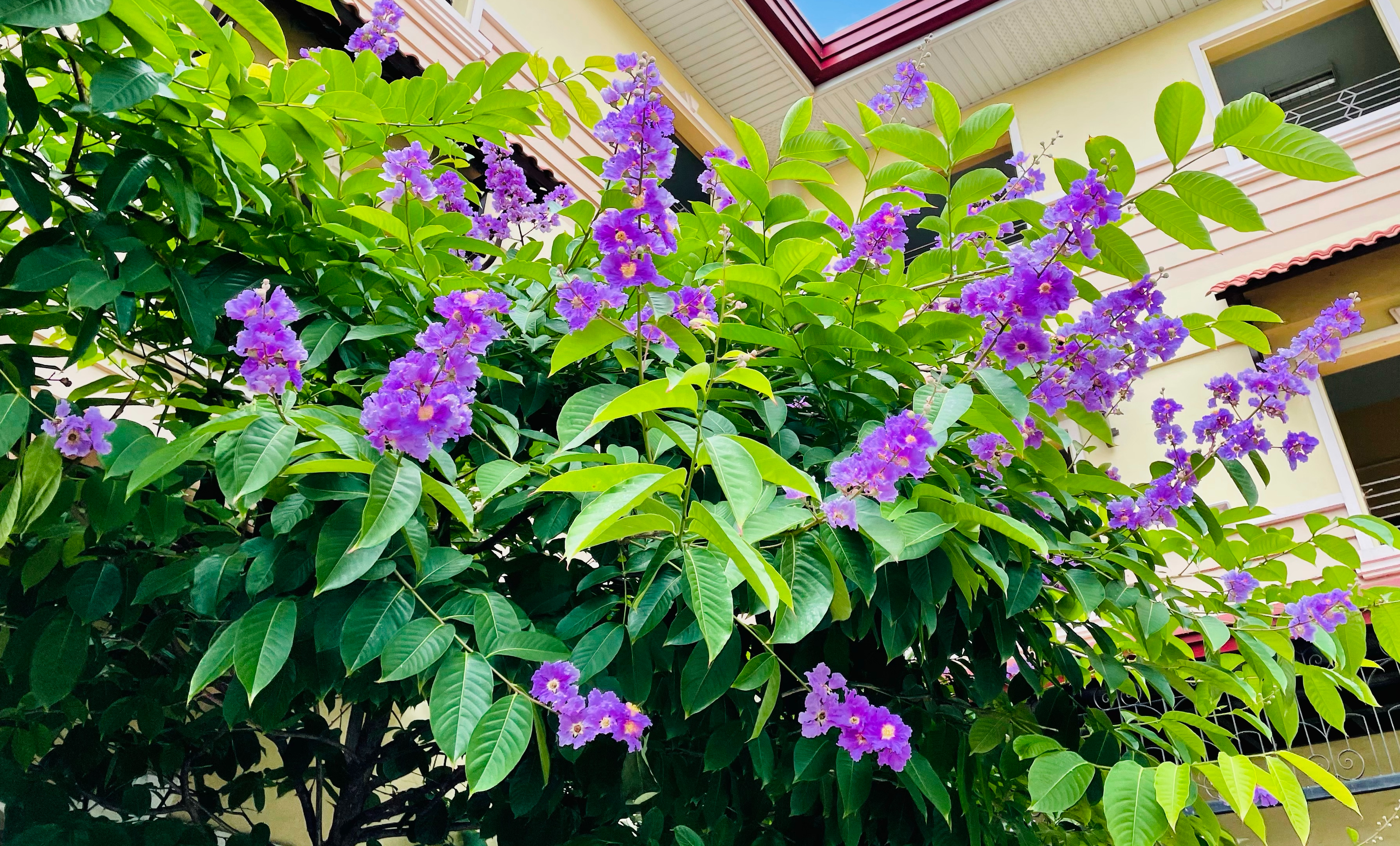
The Novitiate abounds with calachuchi trees that one can smell the sweet scent of its flowers especially in the evening.
I praise you, so wonderfully you made me; wonderful are your works! My very self you knew; How precious to me are your designs, O God; how vast the sum of them!
Psalm 139:14, 17
Why can’t I accept that I am good, so wonderfully created by God? What a shame at how I always tell people, especially students and youth, to always believe in themselves, that our main problem in life is self-rejection which I am also guilty of.
Lately I have been questioning myself if I am really good at all: “talaga ba akong magaling at mahusay o ma-papel lang?”
Tranquil afternoon at the Sacred Heart Novitiate, 19 March 2024.
It is funny that as I cross into the threshold of senior years, I still have many insecurities in life, still doubting my abilities, of who I am.
One thing God has revealed me this week of prayers is how self-rejection is a result of lack of gratitude to Him. It is only when we are truly grateful to God can we accept, then own our giftedness as a person.
Many times we thank God for his “material” gifts to us that include our family and friends, jobs and career, house and cars and gadgets. Not to forget money and wealth, including fame for some. We thank God for everything except our very gift of selves. We are the most precious gift of God we always forget to thank Him for – our giftedness as a person with all of our talents and abilities.
Bethel and Peniel in one.
Being grateful to God means seeing myself as God sees me His beloved child. Not the way we see ourselves before God that would always be in extremes, either we are too good like the Pharisee in Christ’s parable (Lk. 18:9-14) or too bad almost like the devil.
The more I am grateful to God, the more I cherish my personhood that despite my many flaws and sins, I am still loved by God our Father.
Gratitude is more than being thankful; it is entering into a deeper relationship with God and with anyone good to us. Ungrateful people who could not say “thank you” are the ones who do not care at all to others and their kindness. Whenever we say “thank you,” it means we not only appreciate and acknowledge their gift but most of all, their personhood inasmuch as they have recognized us in the first place.
Photo by author, Sacred Heart Novitiate, Novaliches, QC, 20 March 2024.
This morning in our Mass, I felt so touched by God that tears swelled in my eyes twice. First when we sang in the entrance hymn “Buksan ang aming plad, sarili’y maialay; turuan Mong ihanap kami ng bagong malay.”
I think that is one thing I need this year, a new consciousness about God, of myself, and my vocation. Lately, I have been “romancing” death. It is not being morbid but simply accepting that reality becoming more real as we age. But, sometimes, I must confess, any fascination with death is defeatist in nature like when we start thinking of retiring early. I have always believed the priesthood is always seeking new directions in the ministry, in serving God and others but lately with all the darkness in me and around me, I just feel like retiring early, of just waiting for the end, whatever that may mean.
Lord Jesus Christ,
bring back that fire and
enthusiasm in me;
give me a new
consciousness of You,
of me,
and of my ministry.
The beauty and majesty of God at the Sacred Heart Novitiate.
Tears swelled in my eyes the second time during the Offertory in our Mass as we sang Take and Receive which is actually the surrender prayer by St. Ignatius. It was the last prayer I recited before the Blessed Sacrament last night as I closed my retreat with a Holy Hour. It is my most favorite prayer but also the one I rarely pray after realizing and feeling its “existential” meaning during our 30-day retreat in 1995.
Try contemplating its meaning and you feel scared praying it, as if telling God, “not yet, Lord, not yet”: “Take Lord, and receive all my liberty, my memory, my understanding, and my entire will, all that I have and possess. Thou has given all to me. To thee, O Lord, I return it. All is Thine, dispose of it wholly according to Thy will. Give me thy nlove and thy grace, for this is sufficient for me.”
As I closed my retreat last night, I felt praying it again with the same conviction in 1995 after our 30-day retreat, in 1997 for our diaconal ordination and in 1998 for our presbyteral ordination. Once in a while I pray it too in high moments with the Lord. Like last night and this morning.
Thank you,
dearest Father
for the gift of life,
for the gift of personhood;
Lord Jesus Christ,
You have given me with so much
and I have given You so little;
teach me to give more of myself,
more of of Your love and mercy;
take whatever I still have
so that I can give more of You
in the Holy Spirit.
With Mary,
teach me to be poor
in You.
Amen.
Thank you everyone for your love, for your gift of self, for your friendship.
40 Shades of Lent by Fr. Nicanor F. Lalog II
Friday, Memorial of St. John of God, Religious, 08 March 2024
Hosea 14:2-10     ><]]]]]'> + ><]]]]]'> + ><]]]]]'>     Mark 12:28-34
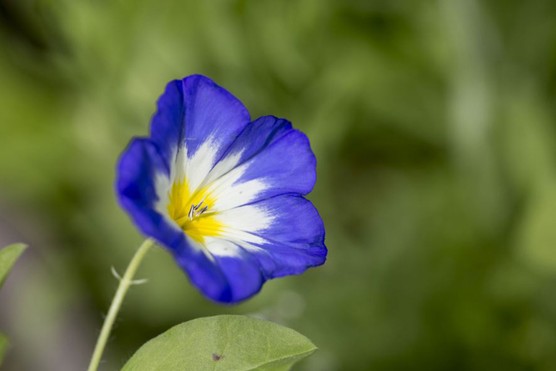
Photo of convolvulus sabatius from frustratedgardener.com
Your words today,
dear Father,
led me back to the
Monday reflection of another
blogger about the word
"acceptance":
“Acceptance” can be seen as a passive word suggesting that we just put up with something we cannot change.
On the other hand, it can be a positive condition in our spirituality by which we prepare ourselves to hospitably receive that which we had not expected. Such positive acceptance suggests a non-judgmental, wise, and discerning heart.
Why are we so fond,
O God, of doing anything
except precisely what you want
us to do?
Why can't we just accept
your words,
your plans,
or your instructions
we always disregard,
"hoping" there could be
something better?

Forgive us, Father,
when even in the
quagmire of sin and evil,
we keep resisting you,
refusing to accept
your suggestions;
let us learn
beginning this Lent
when to just stop
and simply accept
you and your words.
Photo by author, Banaba Tree, 2020.
Thus says the Lord: Return, O Israel, to the Lord, your God; you have collapsed through your guilt. Take with you words, and return to the Lord; say to him, “Forgive all iniquity, and receive what is good, that we may render as offerings the bullocks from our stalls.”
Hosea 14:2-3
Draw us closer to you,
Lord Jesus Christ and your
kingdom by accepting
the basic truth of our faith
that the love of God is
always the love of others;
help us realize
life is more than searching
for what is the best
possible condition
or situation we can have
but to accept our whereabouts
where we can give our best selves
to you through others
to make this world a
better one.
'
Everything, O Lord,
begins in finding you
within each of us
so we may find you in others
especially the sick and
the weakest like St. John of God
who simply accepted
everything that came to his life
as coming from you;
it is in our acceptance
of you, O Lord,
that we begin to lovingly serve
you in others because that is
also when we are able to relate
our lives
with your Church,
with the world,
with our callings;
it is in accepting these
that we become
"not far
from the Kingdom
 of God."
Amen.
Photo of a convolvulus tricolor from BBC Gardeners World Magazine.
The Lord Is My Chef Daily Recipe for the Soul by Fr. Nicanor F. Lalog II
Wednesday, Memorial of St. Rose of Lima, 23 August 2023
Judges 9:6-15   ><))))*> + ><))))*> + ><))))*>   Matthew 20:1-16
Photo by author, St. Scholastica Spirituality Center, 22 August 2023.
How lovely are your words
today, god our loving Father,
expressed in fables and parables
to remind us to remain true
to our self to be faithful to our calls.
Once the trees went to anoint a king over themselves. So they said to the olive tree, ‘Reign over us.’ But the olive tree answered them, ‘Must I give up my rich oil, whereby men and gods are honored, and go to wave over the trees?’ Then the trees said to the fig tree, ‘Come; you reign over us!’ But the fig tree answered them, ‘Must I give up my sweetness and my good fruit, and go to wave over the trees?’ Then the trees said to the vine, ‘Come you, reign over us.’ But the vine answered them, ‘Must I give up my wine that cheers gods and men, and go to wave over the trees?'”
Judges 9:8-13
Heal us inside, Lord,
make us whole again
and regain our nature,
our identity,
of who we are
so we may do what we are
supposed to do;
many times we are divided inside
that we also divide those around us
and peace becomes elusive
precisely because we are
not at peace.
Let us be like you,
O God, in the parable
of vineyard owner:
filled with love and justice,
fair and kind to everyone;
never preoccupied with
competition because
everyone is regarded
as a beloved.
Amen.
Photo by author, St. Scholastica Spirituality Center, 22 August 2023.














 lordmychef.com