The Lord Is My Chef Daily Recipe for the Soul by Fr. Nicanor F. Lalog II
Wednesday, Memorial of St. Rita de Cascia, Religious, 22 May 2024
James 4:13-17     ><]]]]'> + ><]]]]'> + ><]]]]'>     Mark 9:38-40
"you have no idea
what your life will be like
tomorrow.
You are a puff of smoke
that appears briefly
and then disappears"
(James 4:14).
St. James' imagery
of our lives
and of our very selves
are so light as the
puff of a smoke
but so heavy in meaning
for it is true indeed
we are nothing in this world
without God;
it is only in God
we have worth
and meaning.

Forgive us,
dear Jesus
when we are arrogant,
proud and boastful,
when we live so far from You,
detached from You,
living on our "own"
as if we have control
of everything;
forgive us,
dear Jesus
when we are like John
who tried to prevent
someone driving out demons
in Your name simply because
he was not one of us;
forgive us,
dear Jesus
whenever we think we
have an edge over others
simply because they are
not with us in the Church
or just because they are
different in their approach
and style.
Like St. Rita of Cascia
to whom You did so many
wondrous things,
help us to rely solely in
You, Jesus;
that nothing is too late
nor too early
with Your grace
for as long as we rely
on You.
Not in us.
Amen.
Photo by author, San Juan, La Union, 25 July 2023.
The Lord Is My Chef Daily Recipe for the Soul by Fr. Nicanor F. Lalog II
Tuesday in the Seventh Week of Ordinary Time, Year II, 21 May 2024
James 4:1-10     ><))))*> + ><))))*> + ><))))*>     Mark 9:30-37
Photo by author, September 2020.
"Beloved:
Where do the wars and
where do the conflicts
among you come from?"
(James 4:1)
What a beautiful question
to ponder upon on this
second day of Ordinary Time,
Lord Jesus: the "where",
the origin,
the source,
the root
of our many desires
in life;
ultimately,
the question You have asked
Your disciples "What were
you arguing about on the
way?" (Mark 9:33)
leads also to the same
question of James of
"where".
Many times,
O Lord, we presume
and insist we are on the
right tracks,
on the right path
following the world
even if deep inside
we know we are lost,
we have gone astray,
that we are on the wrong
bearings in life
because we merely
follow the rest that like
everybody, we end up
lost and more confused
than ever.
You covet but do not possess. You kill and envy but you cannot obtain; you fight and wage war. You do not possess because you do not ask. You ask but do not receive, because you ask wrongly, to spend it on your passions.
James 4:2-3
Teach us, Jesus,
to bravely ask ourselves
from "where" are we coming from
in everything we are doing,
saying, and pursuing;
help us to be sincere
and humble of our "where"
wherever it may be;
most of all,
let us ask too
"where" we are going to
"where" do we want to be.

During these 33 to 34 weeks
in Ordinary Time,
let us find,
our bearing in YOU, Jesus
so that our "where" from
and "where" to would only
be YOU.
Amen.
Photo by Mr. Vigie Ongleo, Sagada, Mt. Province, 2014.
The Lord Is My Chef Daily Recipe for the Soul by Fr. Nicanor F. Lalog II
Monday, Memorial of Mary, Mother of the Church, 20 May 2024
Acts 1:12-14     ><}}}}*> + ><}}}}*> + ><}}}}*>     John 19:25-34
Icon of Mary “Mater Ecclesiae” (Mother of the Church) in St. Peter’s Square from opusdei.org.
What a wonderful way
of assuring us today, dear Jesus,
at the resumption of Ordinary Time
of Your presence and guidance
throughout this year in giving
us Your Mother the Blessed Virgin Mary
as "Mater Ecclesiae",
Mother of the Church.
From the very beginning,
during Your public ministry
until Your death on the Cross,
Mary Your Mother has always
stood by Your side, Jesus;
when You sent the Holy Spirit
on that Pentecost day in Jerusalem,
Mary was also present with
Your disciples praying in the
Upper Room: "All these
devoted themselves
with one accord to prayer,
together with some women,
and Mary the mother of Jesus,
and his brothers" (Acts 1:12).
What a beautiful portrayal
of the Church on its very first day
as Your Body, O Christ,
gathered in prayer with Mary
whom You have given to us through
Your beloved disciple at the Cross:
"When Jesus saw his mother
and the disciple there whom he loved,
he said to his mother, 'Woman,
behold your son.'
Then he said to the disciple,
'Behold, your mother'" (John 19:26-27).
Photo by author, Sacred Heart Novitiate, Novaliches, QC, 20 March 2024.
As we resume today
Ordinary Time,
may we imitate Mary
Your Mother, O Lord,
in being a faithful disciple,
open to welcome
and accept You, Jesus,
saying "Yes" to Your will
like at the Annunciation;
let our faith in You be firm
like hers at the wedding at Cana
when she told You immediately
how the newly-weds have ran out
of wine, instructing the servants
to do whatever "he tells you";
most of all, like Mary,
let us remain intimate with You,
Jesus in prayers,
her most important trait
as Your faithful and model disciple.
Teach us, dear Jesus,
to be like Mary,
deeply absorbed in You
in prayers;
her standing at the Cross
was not a result of a spur in the moment
but the fruit of her long, vibrant prayer
life centered in You her Son;
unlike us, we come and pray
 to You only when we are
 going through trials and difficulties
but when everything is going well
in life, we hardly remember You, Lord,
nor pray at all.
All her life,
Mary lived in prayer,
in communion and oneness
in You, Jesus
that is why when the Church
was born on Pentecost,
Mary was there.
She has always been
with us as our Mother
and companion in mission;
let us be like Mary
in her discipleship that
is essentially
a prayer life.
Amen.
Photo by author, Della Strada Chapel, Sacred Heart Novitiate, Novaliches, QC, 20 March 2024.
The Lord Is My Chef Easter Recipe for the Soul by Fr. Nicanor F. Lalog II
Pentecost Sunday-B, 19 May 2024
Acts 2:1-11 ><]]]]'> Galatians 5:16-25 ><]]]]'> John 15:26-27, 16:12-15
Illustration from istockphoto.com.
Blessed happy birthday to everyone this Pentecost Sunday, the “birthday” or official coming out party of the Church! In the Ascension of Jesus last Sunday, we have an upward movement that was a “leveling up” in our relationships with God and one another, calling us to be light to rise.
Today’s Pentecost Sunday is opposite, a downward move that “presses” us to “spread” like in compressing a sandwich to make it wider or bigger, calling us to be small and be “dissolved” so we can be mixed or shared with others.
Sorry for sounding a recipe but that’s how we are all as the kingdom of God here on earth – the Body of Christ we His disciples make up as the Church in the power of the Holy Spirit whose very image is us.
When time for Pentecost was fulfilled, they were all in one place together. And suddenly there came from the sky a noise like a strong driving wind, and it filled the entire hose in which they were. Then there appeared to them tongues of fire, which parted and came to rest on each one of them. And they were all filled with the Holy Spirit and began to speak in different tongues, as the Spirit enabled them to proclaim.
Acts 2:1-4
Pentecost is not just an event in the past but a daily reality calling us to be “dissolved” in ourselves, to be little and small so that we can be one with others to be united in Christ through the Holy Spirit.
Being a Christian is being united, being one in Jesus; remove “Christ” in the word Christian, we are left with the letters -ian that stand for “I-am-nothing”.
That is why we as the Church is the image or icon of the Holy Spirit, the Third Person of the Blessed Trinity promised by Jesus to come after His ascension. It is the principle of unity in the Trinity because the Holy Spirit is the love that exists between the Father and the Son. This union between the Father and the Son happens also among us, the community of believers despite our diversities and differences when we allow the Holy Spirit to empower us in our daily dying to ourselves that Jesus likened to the grain of wheat that falls to the ground in order to grow and yield bountiful harvest (Jn. 12:24-26). This is the reason why St. Paul calls us to live in the Spirit in the second reading:
I say, then: live by the Spirit and you will certainly not gratify the desire of the flesh. For the flesh has desires against the Spirit, and the Spirit against the flesh; these are opposed to each other, so that you may not do what you want… Now those who belong to Christ have crucified their flesh with its passions and desires. If we live in the Spirit, let us follow the Spirit. Let us not be conceited, provoking one another, envious of one another.
Galatians 5:16-17, 24-26
Jesus is inviting us today to go through daily Pentecost by allowing the Holy Spirit to “burn” us with its fire, to dissolve our old selves to become new in Him. It is a process of conversion, of daily dying in our flesh in order to build up His Church.
Here we go back to one of the central theme of Jesus of becoming like a child, becoming small which is true greatness because that is when we no longer live but Christ in us as St. Paul experienced. Today he tells us some of the works of our old self we must turn away from like “immorality, impurity, licentiousness, idolatry, sorcery, hatreds, rivalry, jealousy, outbursts of fury, acts of selfishness, dissensions, factions, occasions of envy, drinking bouts, orgies, and the like” (Gal. 5:19-21).
See how all his examples lead to disunity and divisions instead of unity that is happening today. Some people call for inclusivity but the opposite happens as we get divided so sharply that anyone who opposes them is accused of “gaslighting” or worst, end up being “cancelled”! So sad that some people are exaggeratingtruth when in fact they are exaggerating themselves as new standards of truth, insisting themselves and their beliefs on us.
Why change the rules of grammar or beauty pageants or genders just because they are different? Worst, they want to change even religious feasts like Santacruzan or the praying of the Our Father! Where is the unity in diversity if there is one group insisting on themselves? What happens is a repeat of the Tower of Babel, not of the Pentecost.
Losing ourselves in the Holy Spirit does not hinder our search for truth. The Holy Spirit actually leads us to the whole truth of Jesus revealed in His coming but He is too big to be grasped wholly that He continues to unfold, telling us we can only arrive at truth when we think in Him, with Him, and through Him in the Holy Spirit.
“I have much more to tell you, but you cannot bear it now. But when he comes, the Spirit of truth, he will guide you to all truth. He will not speak on his own, but he will speak wht he hears, and will declare to you the things that are coming. He will glorify me, because he will take from what is mine and declare it to you. Everything that the Father has is mine; for this reason I told you that he will take from what is mine and declare it to you.”
John 16:12-15
The key here is being small, being dissolved in the Holy Spirit to see the larger whole who is Jesus Christ found in the face of every person next to us. See how we find in the first reading the reality of the Church starting out big right away as “catholic” or universal when it began on Pentecost speaking all the languages of the world, uniting the peoples as one in the power of the Holy Spirit.
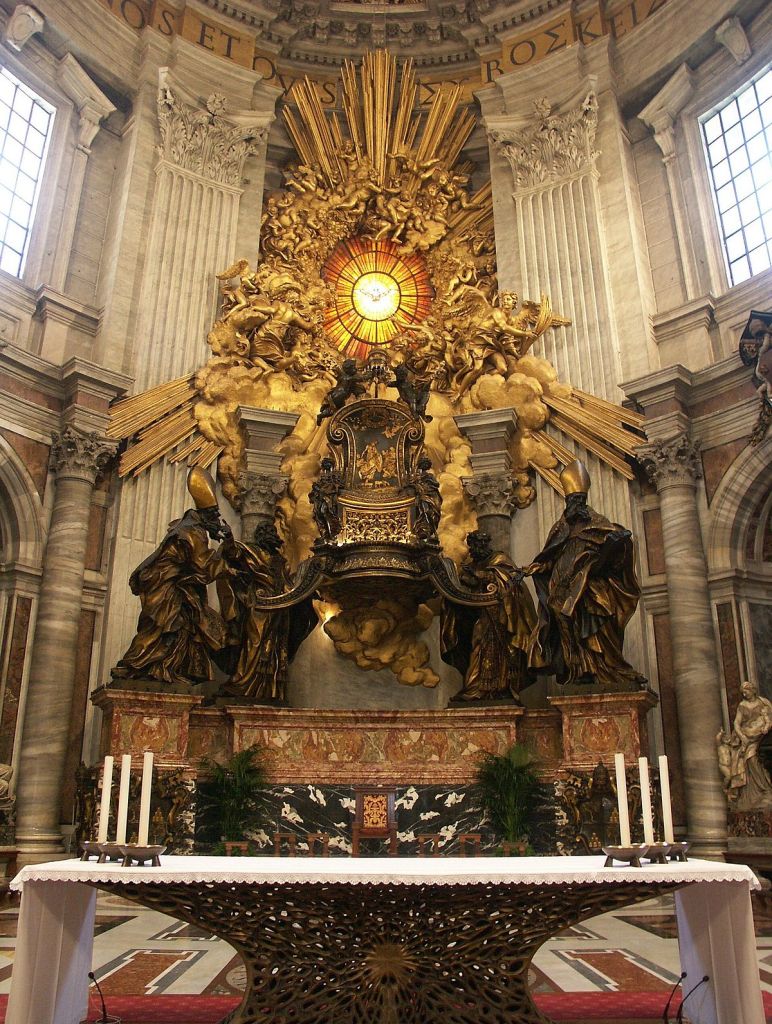
Stained glass of the Holy Spirit in the form of a dove as background of the Chair of St. Peter in the Vatican in Rome; photo from wikipedia.
The Church never started small like a club spreading into federations to become one. We become a part of that big reality of the Church in Christ by becoming small, by being dissolved by the fire of the Holy Spirit by letting go of our selfish selves.
The Holy Spirit continues to come down to us in daily Pentecost explaining and revealing to us the truth of Jesus through the many events iand persons in our lives. When my mother was still alive, she was the only reason why I came home; but, after she had left us peacefully last week, I have realized I still have to come home for my family and relatives and friends. It is a process of dying in myself amid the pain of seeing her room empty, that she is gone.
Death, like the ascension of Jesus is not about replacing those who have left us but a Pentecost, of allowing the Spirit to come to make us smaller, to be one with those still with us to continue celebrating life. That is when we experience the “fruit of Spirit” like “love, joy, peace, patience, kindness, generosity, faithfulness, gentleness, self-control” (Gal. 5:22-23). When that happens, then we have the Church as well as our own family as an image and indwelling of the Holy Spirit. Let us pray:
Lord Jesus Christ,
make us aware of
the coming of the Holy Spirit
to us in our daily Pentecost;
keep us open and humble,
dissolve our selfishness,
our pride, our "flesh"
so that we may live in
the Holy Spirit
as the Church,
its very image
here on earth.
Amen.
Have a Spirit-filled week ahead!
The Lord Is My Chef Easter Recipe for the Soul by Fr. Nicanor F. Lalog II
Friday in the Seventh Week of Easter before the Pentecost, 17 May 2024
Acts 25:13-21     ><]]]]'> + ><]]]]'> + ><]]]]'>     John 21:15-19
Photo by Mr. Gelo Carpio, 2020.
Today, O Lord Jesus,
You asked me the loveliest
yet most dreaded question
of all: "Do you love me?"
And You know very well
my answer,
"Yes, Lord! I love You!"
even if most often my yes
to You does not flow to my
works and actions:
You know so well,
dear Jesus,
how my yes to You remains
only in my lips
and in my heart
because more often I turn away
from Your love to commit sins;
yet, despite these,
You still love me very much,
Jesus.
Yes, I love You, Jesus!
Please help me to pray always
to You, to center my life in You,
to be close and intimate with You,
to be one in You
because love first of all
means being one with
the beloved,
making time, not finding time.
Yes, I love You, Jesus!
Help me to appreciate
myself more, to find You
in myself despite my sinfulness
and weaknesses like Peter
whom You have called in
his original name, Simon
because loving You and
others begins in loving
myself, being grateful
to You that I am alive
and most of all, loved.
Yes, I love You, Jesus!
Let me love You
with all my heart,
with all my soul,
with all my very self;
let me love You first
so that I may truly love
everyone, especially
the poor and the needy
You have entrusted to me;
let me love You first, Jesus,
so that I may love deeply
the Church;
O my Jesus,
let me love You first
so I can truly love
because without You as basis
and foundation of my love,
that love could be self-serving,
momentary and merely an altruism
without meaning
and depth that truly liberates
the beloved.
Amen.
Photo by author, Chapel of St. Francis Xavier, Sacred Heart Novitiate, Novaliches, QC, 20 March 2024.
The Lord Is My Chef Easter Recipe for the Soul by Fr. Nicanor F. Lalog II
Wednesday, Memorial of St. Isidore Labrador, Farmer, 15 May 2024
Acts 20:28-38     <*{{{{>< + ><}}}}*>     John 17:11-19
Photo by Ms. Ria De Vera, one summer morning during COVID-19 lockdown in 2020.
Lord Jesus Christ,
"the truth, the way
and the life",
today I pray to You
for more strength and
perseverance in working in
Your vineyard,
in caring for Your flock;
You and St. Paul have rightly
warned us of the coming time -
which is today,
in this time of ours -
when "savage wolves will come
among you, and they will not spare
the flock. And from your own
group, men will come forward
perverting the truth to draw the
disciples away after them"
(Acts 20:29-30).
So true, Lord Jesus,
when those among us,
supposed to be fellow disciples
are "perverting the truth"
which is more than creating
and spreading lies and falsehoods
but most of all are allowing evil
and sin to continue and prosper
in the name of mercy and consolation
to others, in the pretext of openness
and understanding in all aspects of
our faith and teachings, from simple
deviations in liturgical norms and
rubrics to relativism in morals.
Help us recover our
"consecration to truth"
You have made after Your Last Supper
by being faithful to Your words,
Lord Jesus Christ through the
centering of our lives to You
in the Eucharist like
Saint Isidore Labrador.
Amen.
Photo of painting of St. Isidore with wife St. Mary Torribia with angels helping them in their farming. From MyCatholicLife.com.
The Lord Is My Chef Easter Recipe for the Soul by Fr. Nicanor F. Lalog II
Tuesday, Feast of St. Matthias, Apostle, 14 May 2024
Acts 1:15-17, 20-26   ><)))'>  +  <'(((><   John 15:9-17
Photo by author, Sacred Heart Novitiate, Novaliches, QC, 20 March 2024.
Dearest Jesus,
please pardon me
in telling You
how it saddens me
when I hear of so many
stories of Judas Iscariots
among us especially
in our ministry;
why You chose
and called them is a total mystery,
and I am so sorry
how they came out to be;
I have no claims to
holiness nor being perfect
but I thank You, Jesus,
for this feast of St. Matthias
whom You have called
to replace Judas Iscariot
to show us how much You
love us, most of all,
believe in us and
trust us even if You know
so well we could be unfaithful
to You and Your call like
Judas Iscariot.
I pray, therefore, O Lord,
for the gift to be faithful always
to Your call,
to fully participate in Your choices,
in Your choosing me
to Your mission
despite my sins
and weaknesses;
let me keep in mind
and heart it was You
who chose me
and not me who chose You:
“It was not you who chose me, but I who chose you and appointed you to go and bear fruit that will remain, so that whatever you ask the Father in my name he may give you.”
John 15:16
How lovely,
O sweet Jesus,
to find in St. Matthias
Your choice to replace
Judas Iscariot, a reminder from
You of that fact that while
there is no lack of unworthy
and traitorous Christians
everywhere like unfaithful spouses,
corrupt officials,
callous and self-centered priests
and bishops,
You still call each of us to
counterbalance the
evils they have done
with our faithful witnessing
to You,
our Eternal Priest,
Lord and Savior.
Like St. Matthias,
let us value Your call, Jesus
to continue Your mission
so maligned and destroyed
by the many Judas Iscariots
among us; like St. Matthias,
let us nourish Your choice
by remaining in You, Lord,
by keeping our choices
according to Your
holy will; in making choices
in this life, help me, Jesus
to be discerning,
to be most prayerful
like the Apostles.
So they proposed two, Joseph called Barsabas, who was also known as Justus, and Matthias. Then they prayed, “You, Lord, who know the hearts of all, show which one of these two you have chosen to take the place in this apostolic ministry from which Judas turned away to go to his own place.”
Acts 1:23-24
Lastly,
I pray today on this
feast of St. Matthias
for people having difficulties
praying to finally realize
Your choices for them;
for those afraid to accept
Your choices;
for those who keep looking
for other options
despite Your clear choice for them;
please enlighten their minds
and fill them with courage
and trust in
You, sweet Jesus.
Amen.
Photo by author, Sacred heart Novitiate, Novaliches, QC, 20 March 2024.
The Lord Is My Chef Easter Recipe for the Soul by Fr. Nicanor F. Lalog II
Monday, Memorial of Our Lady of Fatima, 13 May 2024
Isaiah 61:9-11 ><}}}*> Galatians 4:4-7 ><}}}*> Luke 11:27-28
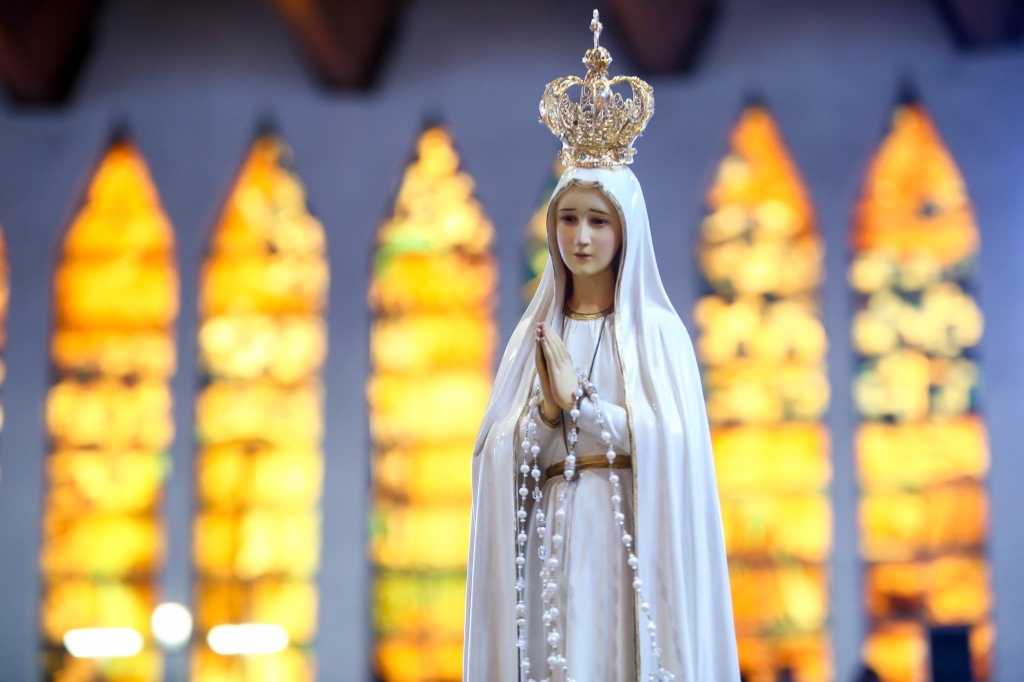
From cbcpnews.net, 13 May 2022, at the Parish of the National Shrine of Our Lady of Fatima, Valenzuela City.
We celebrate today the Memorial of Our Lady of Fatima when she first appeared there in Portugal on May 13, 1917. What a wonderful coincidence the eve of her Memorial was the Solemnity of the Lord’s Ascension that fell on the third Sunday of May, Mother’s Day.
What a wondrous alignment of celebrations this May – the Lord’s Ascension, Mother’s Day and Memorial of Fatima – as they all speak of love and belongingness despite the painful reality of separations we experience while in this life filled with sufferings and darkness due to evil and sin.
When Jesus ascended into heaven, it was not about His going up to a certain place or location in the universe but actually a leveling up of His relationships with the Father and with us. Though He had physically left earth, He is still very much present in the world. In fact, Jesus had to leave us physically to be with us at all time here in this life.
True to His promise of not totally leaving us, Jesus not only sent us the Holy Spirit to dwell in each of us to make us strong and holy but also gave us His Mother the Blessed Virgin Mary to be our Mother too in this world still filled with sufferings and darkness due to the seeming prevalence of sin and evil.
When Jesus saw his mother and the disciple there whom he loved, he said to his mother, “Woman, behold your son.” Then he said to the disciple, “Behold, your mother.” And from that hour the disciple took her into his home.
John 19:26-27
The Blessed Mother’s apparition in Fatima, Portugal more than 100 years ago was a resounding proof of the reality of God and His abiding love for mankind in this modern time when the world is more bent in denying His very existence.
How lovely that in reminding modern man of Himself to us, God used the most unique yet so common experience of everyone in every race – the mother. Everyone of us, including the most hardened criminals, always have two softest spots in our hearts, for children and our own mother. The umbilical cord with our mothers remain forever with us, even after they have died. This I realized yesterday on Mother’s Day.
While rehearsing my homily for the Mass, I had a hearty cry in my room when I came to the part of inserting the celebration of Mother’s Day. How can I speak of Mother’s Day when I am now “motherless”?
But hey…!!!
As I prayed and reviewed my prepared homily yesterday, I realized we are never “motherless” in this world!
Mothers are like Jesus Christ who ascended into heaven: when a mother dies, she remains a mother to us. Still so loving and caring.
Like Jesus who ascended into heaven, our mothers have to die and depart too to be with us more than ever. Those memories of our mother’s selfless love, from her singing of lullabies to make us fall into sleep to all her sacrifices we never saw and knew but so evident in her wrinkles and gray hair remain fresh until the end of our lives, assuring us of her and God’s love, that we shall get by in this life even when we do not see her like Jesus.
The Jews have a saying that God created mothers so that He can be everywhere. So true! That is why mothers are always lovely, “I rejoice heartily in the Lord, in my God is the joy of my soul; for he has clothed me with a robe of salvation, and wrapped me in a mantle of justice, like a bridegroom bedecked with her jewels” (Is.61:10).
Photo by author, December 2023.
Mary’s apparition in Fatima is motherhood at its finest, non pareil in history and the world. She appeared at the most crucial moment when the world was in great transition in all aspects of life that tempted us to go on our own, bragging on our achievements and knowledge.
Just like what happens in most families when many leave their families behind, especially their mother, blinded by success and the limelight. Despite all the hurts, mothers are life’s most enduring proof of God’s mercy and love. Like most mothers appealing to their children to return to their father, to come home, Mary called us in Fatima to go back to the Father in Jesus through the three children of Fatima. Her calls were very similar with every mother’s appeal to her children – pray always and repent.
Mary at Fatima reminds us of our own mothers who would never sleep – and die – until she’s assured her children are safe back home. See how the recent turn of events in history in the last 50 years were still shaped or affected by the Fatima apparition that further bolstered it to be one of the most popular devotion and pilgrimage sites in the world today.
Fatima and Mother’s Day cannot be separated from each other primarily because of all the mothers, the Blessed Virgin Mary is the foremost of all mothers in all time, the model disciple of her Son Jesus Christ not because of her just giving birth to Him but most of all, being the first to believe in Him!
While he was speaking, a woman from the crowd called out and said to him, “Blessed is the womb that carried you and the breasts at which you nursed.” He replied, “Rather, blessed are those who hear the word of God and observe it.
Luke 11:27-28
May we heed the calls of the Blessed Mother in Fatima. Most of all, let us be like her, a model disciple of Jesus Christ, be a “mother” to everyone, nurturing and inspiring others with our faithful witnessing of the gospel especially in this time when people in many parts of the world are at edge or actually in war already, forgetting we are all brothers and sisters in one Father in heaven.
Our dear Mother Mary of Fatima, thank you for coming to us to remind us of God's love, to assure us we are never motherless in this world; help us to share God's loving tenderness and fidelity to promise to never forsake us; may our lives nurture and inspire others to hope and be open to God in the midst of the seeming meaningless world, striving to do what is true and good, making Jesus present in a humanity so often absent to God. Amen.
Quiet Storm by Fr. Nicanor F. Lalog II, 10 May 2024
Photo by Veejay Villafranca/Bloomberg via Getty Images
My most vivid image of mommy’s love for me is from June 1979 when I bid her goodbye in her sari-sari store on my way to the high school seminary. That was the last time I felt I was a kid, her child, when she hugged me tightly, then held my head and kissed me as she fixed by combed hair, telling me “magpapakabait ka doon, anak.”
She had always been against my entering the seminary, saying I was too young to know about the priesthood. She did all the scare tactics to me: “hindi ka mag-aasawa, isda at tuyo araw-araw ang ulam ninyo, hindi masarap pagkain doon…” She finally allowed me to enter the seminary on second year high school I believe after my dad had silently persuaded her.
It was funny because on my fourth year before graduation, I felt I was not ready yet for the major seminary that was eventually confirmed by the results of my entrance exam (psychological tests actually) to San Carlos Seminary that it was suggested I better leave the seminary.
My mother Corazon before their wedding in 1964.
Tama nga si mommy.
It was from then on when we had that kind of not so smooth mother-son relationship. I felt far from her as she would always say something to my plans and decisions. She was not really a contravida but more of an oppositionist. That is why when I felt my vocation anew later in 1988, I never told her about it until I was about to go back to the seminary. That time, there was no more hugging and kissing maybe because I was already an adult, a man bigger and stronger than her.
But what was most memorable for me now that she is gone was the scene every time I would go back the seminary and later to my assignments as a priest.
Whenever I would tell her “mommy, uuwi na po ako”, she would say while smiling, “e nasa bahay ka, paano ka pa uuwi?”
That happened so often that she sounded so corny but still, thank God, I never tired explaining to her, “uuwi sa seminaryo” later to Malolos then to Bagbaguin and now to Fatima. She never failed to banter with me with her dry humor and stroke during those moments of my leaving home. I think she was telling me in those every good bye of ours that my home would always be her, my family. That is why after her body was taken from her room last Tuesday morning, the scene that struck me most on her death was her empty room, vacant big bed.
As I left home pauwi sa Fatima, the morning sunshine were so lovely as it softly brightened mommy’s empty room as she is now “home” in heaven with daddy.
Overall, I feel so joyful and grateful in my mother’s demise. She left so peacefully in her sleep as I have prayed to God daily. The outpouring of love and sympathies and friends are beyond our expectations or imaginations. But, there is that fear, a dread in me about coming home, finding her room empty, telling me she is gone.
Mommy’s room is now empty but our hearts are so full of her love, of her memories, of her gift of self.
During the pandemic, I begged God not to take my mom yet. I told God I was not ready because she was primarily the reason I “go home”. As I reflect on the meaning of that image of her empty room, I realized that it is not about going home but coming home. We go home to the house and place but we come home to persons, to family and friends.
Pag-uwi in Tagalog which is literally coming home. Not going home. Because when we leave, we say uuwi also as we come home to our new home.
We Filipinos express both our kinship and Christian faith in our goodbyes.
Our professor in liturgy Msgr. Andy Valera used to tell us we never say aalis na ako or “I am leaving” because that means we are angry. It is very rude and should never be said when saying goodbye in any Filipino gathering. Instead, we say next to uuwi na ako either tutuloy na ako or mauna na ako. But, how can we make tuloy which is to enter when we are in fact leaving? And why say mauna na ako which means I’ll go ahead when nobody is going with you?
Photo by author.
According to Msgr. Andy, our coming home indicates our theology of heaven: we all come home, uwi to heaven our true home that is why when we leave our gatherings we say tutuloy na ako because in the end, we enter heaven. Most of all, we say mauna na ako because nobody knows who is next to die.
What a beautiful lesson I just realized now after mommy had died; even if she’s gone and her empty is room, I will still come home to my sisters and brother, nieces and nephew, relatives and neighbors.
How lovely that despite the pain and emptiness death creates in us here on earth is also the grace of God to fill each others heart with His loving presence and joy as we await our final coming home to Him with our departed loved ones in heaven.
Jesus told his disciples: “Do not let your hearts be troubled. You have faith in God; have faith also in me. In my Father’s house there are many dwelling places. If there were not, would I have told you that I am going to prepare a place for you? And if I go and prepare a place for you, I will come back again and take you to myself, so that where I am you also may be.”
John 14:1-3
The best way to come home to heaven is to come home often to our family and friends not only to dine and celebrate but most of all, to praise and thank God in prayers, especially the Sunday Mass. God bless everyone!
The Lord Is My Chef Easter Recipe for the Soul by Fr. Nicanor F. Lalog II
Wednesday in the Sixth Week of Easter, 08 May 2024
Acts 17:15, 22-18:1     <*((((>< + ><))))*>     John 16:12-15
Your words today,
Lord Jesus remind us
in the most amusing way
our state of miscommunication:
When they heard about resurrection of the dead, some began to scoff, but others said, “We should like to hear you on this some other time.” And so Paul left them.
Acts 17:32-33
Many times in life
we are like the Athenians of old,
so proud of what
we know,
of what we believe,
of what we
hold on as true
without having them tested;
we refuse to open
our minds and our hearts
to truly listen
to the other person,
especially to You,
dear Jesus;
help us realize
that we cannot know
the whole truth
and everything in this life
and world
in an instant;
help us realize
how truth unfolds
in time
in persons;
most of all,
help us realize
we do not know
that much.
Jesus said to his disciples: “I have much more to tell you, but you cannot bear it now. But when he comes, the Spirit of truth, he will guide you to all truth. He will not speak on his own, but he will speak what he hears, and will declare to you the things that are coming.
John 16:12-13
Teach us to be patient
and humble, Jesus,
to listen with our hearts,
to reach out and wait
for the other person;
teach us to have that
sense of wonder like a child,
eager to learn,
always asking questions
without getting right away
the answers to them
because many times in life,
the answers
we seek are found right within
 our questions,
right in our hearts
where You dwell.
Amen.