Choose love. Always.

The Lord Is My Chef Sunday Recipe for the Soul by Fr. Nicanor F. Lalog II
Sunday in the Thirtieth Week of Ordinary Time, Cycle A, 29 October 2023
Exodus 22:20-26 ><}}}}*> 1 Thessalonians 1:5-10 ><}}}}*> Matthew 22:34-40
Photo by Dra. Mai Dela Peña, Mt. Carmel, Israel, 2017.

The enemies of Jesus continued with their barrage of questions to trick him into saying something that could lead to his arrest and execution. After failing last Sunday, the Pharisees sent today an expert – a “scholar of the law” – to test him anew with the question:

“Teacher, which commandment in the law is the greatest?” He said to him, “You shall love the Lord, your God, with all your heart, with all your soul, and with all your mind. This is the greatest and the first commandment. The second is like it: You shall love your neighbor as yourself. The whole law and the prophets depend on these two commandments.”

Matthew 22:36-40

For the second straight Sunday, Jesus not only responded to his enemies’ malicious questions with brief and brilliant answers but also taught them, including us today, with important lessons on discipleship.

Once again, Jesus is inviting us to have a wholistic view of life centered on God by healing the divisions within our hearts that are reflected in our broken relationships as individuals and family, church and community, and nation. How often do we reveal that same division in our hearts whenever we ask that same question 2000 years ago by the Pharisee, “which of the commandment in the law is the greatest”?

Photo by author, view from temple of Jerusalem, May 2017.

After receiving the Ten Commandments from God through Moses at Mount Sinai, the Jews dissected them into 613 instructions with 248 of these as positive laws every individual “should do” and the other 365 as negative laws everyone “should not do”.

Naturally, it was very difficult – if not impossible – for them to remember and observe these 613 precepts to guide them in their daily living so that their rabbis devised ways in which the Law could be prioritized with some categorized as “important” or “heavy” that should be followed more than those considered as “less important” or “lighter” in gravity. For example, laws pertaining to persons like parents are more important than those concerning animals that included about bird’s nest (Dt. 22:6-7)! Problem with this was when they circumvented the Law to give priority to lesser things that disregard the more important ones as Jesus pointed out so often to their religious leaders who have emphasized the sabbath by neglecting the human person like the sick.

Photo by author, St. Anne’s Church, Jerusalem, Israel, May 2017.

Another solution they have devised was to establish summary statements of the Law that could help put it all in perspective like “whatever is hateful to you, don’t do it to others”. Again, like in categorizing the Law, putting them into perspectives eventually led to their lost of essence because in our human experience, when many factors are weighed into our daily life, the way we see things are often narrowed and dimmed; then we begin making excuses and alibis to be exempted from our religious instructions. That is why Jesus “leveled up” the people’s perspectives in their views of the Law by telling them to shift their sights to higher level not just its letters but its spirit and source – God himself like the love enemies and the beatitudes.

Here we find the beauty and nobility of Jesus Christ’s answer to the scholar’s question by leading us all into the very essence of the Law which is love who is God too! Eventually on the Cross on Good Friday just like during the sermon on the mount, Jesus would show to everyone he was not only the fulfillment of the Law but the Law himself when he gave himself in love – to God our Father and to us his brothers and sisters. Today he deepens his teaching last Sunday that inasmuch as we have to give to Caesar what is Caesar’s like paying of taxes, then, we have to give our total self, our whole heart to God because that is what is due to God, our Maker and Master. To give our hearts to God is to always choosing to love God and love others as one loves one’s self.

Photo by author, garden beside St. Anne’s Church in Jerusalem, Israel, May 2017.

The moment we start categorizing or putting God’s laws into perspectives, into our own points of view, then we deviate from God himself and his plans. When we divide, separate and split the laws of God to find which could best suit us, then it becomes a DIY (do-it-yourself) Christianity where we choose laws applicable to us and disregard the rest we find difficult, calling them as outdated and conservative like divorce, contraceptives, and abortion.

In summarizing the commandments into the law of love, Jesus is inviting us today to welcome him into our hearts to let him alone dwell and reign over us so that when we are confronted with any issue and dilemma or confusion in life, we resolve them in the light of Christ which is always love. Letting Jesus reign in our hearts is choosing to find him in the other person we must respect and love and care.

Photo by author at Via Dolorosa in Jerusalem, May 2017.

To choose Jesus and his love is to always choose the human person above material things and even with one’s self. And to choose Jesus and his love is choosing his Cross too because he said there is no greater love than to offer one’s self for another. The true sign that we have really loved is when we love somebody more than ourselves like Jesus!

It is difficult and even insane as St. Paul declared “we are fools for Christ” (1 Cor. 4;10) because anyone who loves like Jesus who loves God with one’s total self and loves others like one’s self is crazy in the world’s point of view and standard. It has always been the way of Christianity ever since, always suspected as a threat to the ways of the world because the ways of Christ and his disciples are opposite the ways of the world as St. Paul explained to the Thessalonians “who received the word in great affliction, with joy in the Holy Spirit” (1 Thes. 1:6).

When I was still a young priest giving Marriage Encounter weekends to couples, I used to ask them this question: when husband and wife have an LQ or “lover’s quarrel”, who should make the first move to say sorry and be reconciled?

Many couples laugh, saying it should be the man first while men claim it must be ladies first. Still others reason out it should be the one who had sinned.

My answer: whoever has more love to give must be the first to make the move to reconcile because whoever has more love should love more!

The more we love, the more we are able to love because love is infinite like God. It is the only thing that will remain in the end because God is love. His laws are his expressions and manifestations of his love expressed in his compassion being a personal God relating with us through men and women around us (first reading). His laws fulfilled as love in the person of Jesus Christ light and guide our path in life often darkened by sin and imperfections. Choose love always and you shall never get lost! Amen. Have a lovely long weekend!


Photo by author, Pater Noster Church, Jerusalem, the Holy Land, May 2019.

Refreshing our faith in Lent

40 Shades of Lent by Fr. Nicanor F. Lalog II
Third Sunday of Lent in Cycle B, 07 March 2021
Exodus 20:1-17  ><}}}*>  1Corinthians 1:22-25  ><}}}*>  John 2:13-25
Parish Church of St. Joseph in Baras, Rizal.

One thing we notice in Lent is the “noble simplicity” of celebrations: no flowers at the altar, simple music without percussions, without Gloria no Alleluia meant to refocus our attention back to God in a more personal level.

That is why during Lent, our faith is refreshed or rebooted in order to “reset” it back to God himself than with rites and rituals and other formalisms that have made our relationships with him and with one another stagnant.

When faith and religion get fixated on formal codes of worship and belief, detached not only from God but even with people like those in the margins, then it had become an idolatry.

Since the Passover of the Jews was near, Jesus went up to Jerusalem. He found in the temple area those who sold oxen, sheep, and doves, as well as the money-changers seated there. He made a whip out of cords and drove them all out of the temple area, with the sheep and oxen, and spilled the coins of the money changers and overturned their tables, and to those who sold doves he said, “Take these out of here, and stop making my Father’s house a marketplace.” His disciples recalled the words of Scripture, “Zeal for your house will consume me.”

John 2:13-17
Photo from turbosquid.com.

Our personal, relating God

On this Third Sunday of Lent until its final Fifth week, we turn to the fourth Gospel of John to deepen our personal relationship with the Father in Christ when each gospel is compacted with signs and language rich in meanings to reignite our faith with “zeal” that “consume” us like Jesus.

Observe John’s formal introduction of this episode of cleansing of the temple by presenting to us its chronemics, the non-verbal communication of time and space to indicate the presence of God in Passover (time), Jerusalem, and temple (space/place). Keep in mind that the fourth gospel is called “the book of signs” because John would always use events, buildings and places, and people as signs pointing to Jesus as the Christ, the Son of God.

In this episode that immediately happens at the start of the Lord’s ministry as seen by John, something very wrong have happened with the very signs of God’s presence so revered by the people during their important feast of Passover right in their temple in Jerusalem: God had been eased out from the lives of the people and from their worship itself!

The gospels teem with many references at how the people at that time led by the temple officials and religious leaders have turned into worshipping rites and rituals than God himself, forgetting to serve the people by sticking to the letters than to the spirit of the Laws that Jesus always attacked.

It is similar to our own time where our faith and church worship have become empty of God and spirituality filled with human inanities led by some priests who tinker with liturgy, forgetting its noble simplicity, that less is always more. In our efforts to make God “present” with so many “shows” and gimmicks in the liturgy and church buildings, the more we have removed the Divine, unconsciously creating a cult around ourselves.

Notice some churches devoid of the holy with all the flat screens and tarpaulins all over. Worst is how priests have promoted this culture of shouting and clapping of hands during and after Mass as if God were deaf!

So many other things are sadly going in our celebrations where emotions are heightened without really stirring the hearts nor souls with God’s presence. Good liturgy flows from our personal and faithful relationship with God anchored in prayer life, not with shows and activities.

In the first reading, God reminds us in his Commandments that more than laws, these are meant to bring us into a relationship with him our God. See God speaking in the first person, addressing everyone with conversational personal pronouns, “I am the Lord your God” or “I am the Lord thy God”.

More than a mere body of commandments, the Decalogue are a covenant by God with people he had freed from slavery, pledging his unfailing fidelity to them who are expected to be wholeheartedly attached with him as their Lord and God. The Decalogue is first of all a call to intimacy with God expressed with our respect for one another.

This Lent, God invites us to renew our personal relationship with him in Jesus who had come to bring equilibrium in our lives through his Cross where our vertical relationship with the Father is intersected by our relationships with one another in Christ, through Christ, and with Christ. Without this, our faith or any religion will drift to extremes, either to joyless conformism as seen in fundamentalism and traditionalism or exaggerated expressionisms happening nowadays, disregarding the norms of liturgy and of sanity as well. In both instances, there is human manipulation strongly present that pretend to serve God but actually massage somebody’s ego, totally forgetting the people who suffer most.

Photo by author, 2019.

Jesus himself as the new temple

When Pope Emeritus Benedict XVI was newly elected in office, he wrote a bishop in Europe suffering with cancer. According to reports, the former Pope tried to uplift the spirits of the sick bishop by telling him that “Jesus saved the world not with activities but by suffering and dying on the cross.”

Beautiful words from one of the most spiritual and theological man of our time! Here lies too the fullness of our relationship with God expressed in our worship when our “zeal” for him is consumed in our oneness in Jesus Christ, our new temple.

At this the Jews answered and said to him, “What sign can you show us for doing this?” Jesus answered and said to them, “Destroy this temple and in three days I will raise it up.” The Jews said, “This temple has been under construction for forty-six years, and you will raise it up in three days?” But he was speaking about the temple of his body. Therefore when he was raised from the dead, his disciples remembered that he had said this, and they came to believe the Scripture and the word Jesus had spoken.

John 2:18-22

John now presents to us Jesus more than a prophet cleansing the temple with full authority, being the perfection of every worship that is “in Spirit and truth” (Jn.4:23) because as the Messiah of God offered on Good Friday which is also the feast of the Jewish Passover, his Body becomes the new temple.

Of course, sacred buildings are still important as well as rites and rituals but they are signs pointing to the realities of Jesus Christ, the Emmanuel or God-is-with-us truly felt in ourselves, in our lives when we have that oneness, that intimacy in him in our personal and communal prayers that flow down to our interpersonal relationships with others especially the poor and the suffering.

Photo by Pixabay on Pexels.com

Last October, I had the most severe test in life when my only brother was diagnosed with an ailment affecting his spine, becoming immobilized for three months. I took him to my parish so I can look after him. What was most difficult for me was seeing him suffer, writhing in pain even in the middle of the night, sometimes begging me to ask God to take him so his sufferings may finally end.

I thought already knew how to pray, that I was tough and strong especially in my faith but, like a child, I would always hide and cry to God for my only brother who in his entire life has always been sickly and afflicted with many illnesses.

One morning in our daily Mass, tears swelled in my eyes during consecration as I held the Body of Christ in my hands with my voice breaking as I said, THIS IS MY BODY WHICH WILL BE GIVEN UP FOR YOU.

How I wanted to stop the Mass at that moment to cry in joy as I felt Jesus so true, in his flesh and blood, truly alive and personal!

Until now I could not explain what or how I felt that I cried at that time except that the night before, I assisted my brother in bed and cleaned him up. It was very difficult and even messy but a great moment of God’s grace and mercy for me expressing my love for him through my brother. That is when I realized that to truly touch Jesus is first of all to touch him among our sick brothers and sisters; that there is an intimate connection between the real presence of Jesus in the Eucharist and everyone especially the sick and suffering. And, for us to truly receive the Body of Christ, to experience the Holy Communion in him, we must first have his eyes and heart and hands among those deprived around us (https://lordmychef.com/2020/10/28/the-body-of-christ/).

Photo by Ms. Ria De Vera, Good Friday 2020.

Brothers and sisters: Jews demand signs and Greeks look for wisdom, but we proclaim Christ crucified, a stumbling block to Jews and foolishness to Gentiles, but to those who are called, Jews and Greeks alike, Christ the power of God and the wisdom of God. For the foolishness of God is wiser than human wisdom, and the weakness of God is stronger than human strength.

1 Corinthians 1:22-25

Faith in God is not meant to be explained nor analyzed. Though we do not stop studying and learning our faith doctrines and teachings, we are reminded this third Sunday of Lent to keep our zeal for God burning. Let us pray to Jesus that like him, may our zeal for the Father consume us by seeing him in persons not on things that are often self-serving. Amen.

Have a blessed and refreshing Sunday in the Lord with your family and loved ones!

Photo by author, 2019.

Praying for you on our pilgrimage to the Holy Land

The Lord Is My Chef, 28 April 2019
Early morning view of the modern side of Jerusalem taken in April 2017.

My dearest followers, relatives and friends:

Tomorrow early morning we are leaving for the Holy Land. It is the only place here on earth that the Lord had blessed me to visit thrice. It is what I call in my homily today as an “a basta!” experience — there is something deep within me that make me confess like the Apostles that “Jesus is risen! Jesus is alive!” , and, “I have seen the Lord!”.

A basta! is all I can tell people why they have to visit the Holy Land even once in their lifetime. And the biggest surprise I have experienced the second time I went there in April 2017 courtesy of my friends from GMA-7 News, even if you visit again the same places you have seen before, Jesus has always something different for you. Very true.

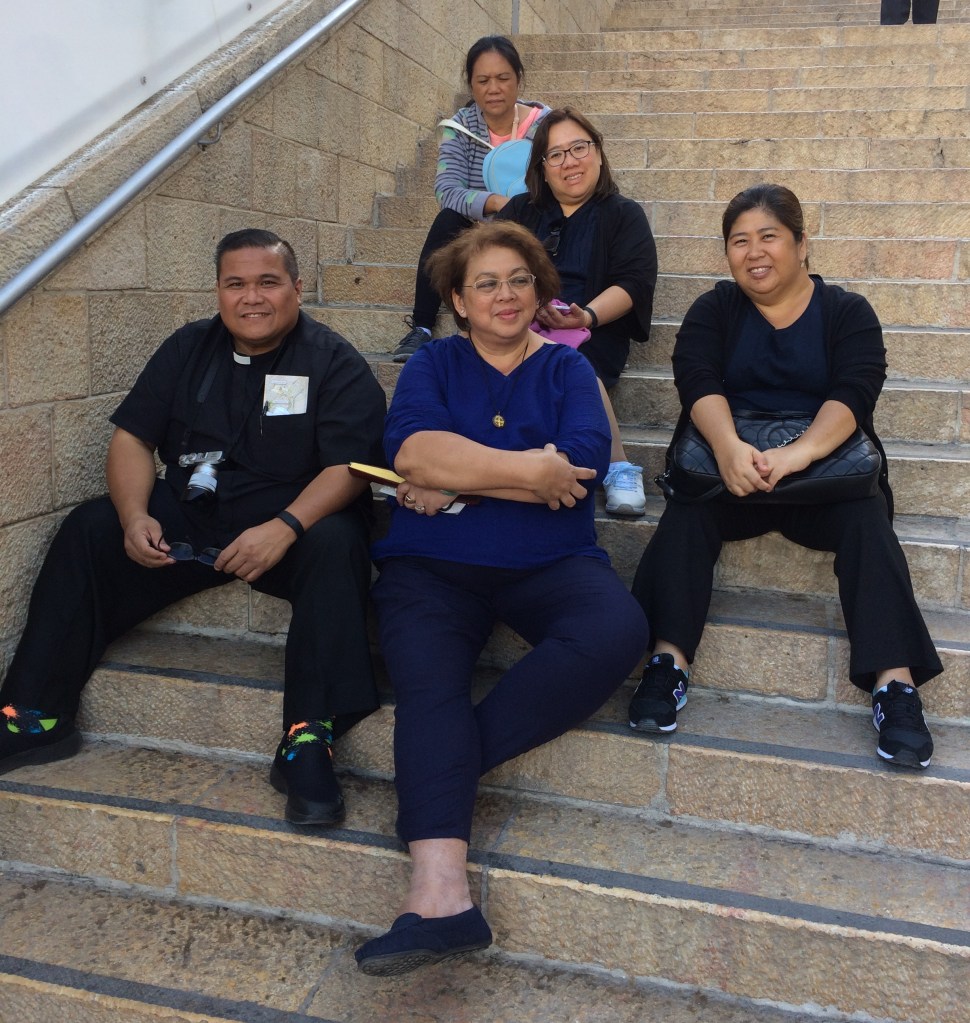
With my three friends who are not only great news women who turned GMA-7 News to what it is today but great “prayer-warriors” too. Since my ordination to the priesthood in 1998, they have never failed to always ask me for prayers not only for themselves and loved ones but also for everyone in the news — as in everyone even form other news organizations who are sick or going through trying moments in their lives. This photo was taken after praying at the Wailing Wall of Jerusalem.

I am not sure if I could blog from there during these next two weeks as I have to lead a large group of pilgrims mostly from our parish. I have always considered myself as a “dinosaur” when it comes to new technology. But since June last year, I have overcome my fears with new technology that I feel I have grown in learning so many things about life and the world through the amazing internet and computers. As a priest, I have found a new calling from the Lord in blogging to reach out to more people with my prayers and sharing of the good news of Jesus Christ.

I shall be praying for you my dear followers, relatives and friends in a very special way during this pilgrimage. Do pray for me too and for my fellow pilgrims. Will surely share with you our experiences – and blessings – from the Lord in this journey in his Holy Land.

God bless you all!

fr. nick

At the sacristy of the Church of Dominus Flevit (The Lord Wept) with a painting of the historic meeting of St. Pope Paul VI and the Patriarch of the Orthodox Church in Jerusalem in 1970’s.