Photo by author of the new bypass road that cuts through vast ricefields from Baliwag to Pulilan, January 2020. And we ask anew, what price of development and, for whom?
We are all familiar with the expression that “familiarity breeds contempt” and sad to say, it has always been true to us even with our relationship with you, God our loving and merciful Father in heaven.
Day in, day out we pray, or simply mumble prayers.
We pray more of security latch, just in case something bad happens to us.
But to be one with one, nah….
Besides, even if we do not pray, there is always somebody praying for us. We believe so.
Everywhere we see churches and your images to remind us of your presence and existence, of your love and goodness to us.
But, we take you for granted. You have become so ordinary to us that sometimes, we look for something extraordinary.
Unknown to us, that is when we stop believing in you and when we also stop living in you.
Be amazed at this, O heavens, and shudder with sheer horror, says the Lord. Two evils have my people done: they have forsaken me, the source of living waters; they have dug themselves cisterns, broken cisterns, that hold no water.
Jeremiah 2:12-13
Through your Son Jesus Christ who preached using parables, open our eyes and our ears, our hearts and our very being to begin seeing anew from the ordinary and usual things the deeper realities of your presence and love.
Familiarity need not breed contempt among us and in you.
Let familiarity remind us of your consistency in relating with us, Lord.
Let familiarity lead us to the natural flow of life rooted in you, God, so that we may discover daily the many wonders and beauty of this life; that, despite the seeming cycle and repetition even routine, we may find its deeper meaning right in our hearts where you dwell. Amen.
Van Gogh’s “The Sower” from commons.wikimedia.org.
The Lord Is My Chef Sunday Recipe for the Soul by Fr. Nicanor F. Lalog II
Week XVI, Cycle A in Ordinary Time, 19 July 2020
Wisdom 12:13, 16-19 >><}}}*> Romans 8:26-27 >><}}}*> Matthew 13:24-43
Our Lord Jesus Christ invites us today to join him into a different kind of journey that would take us deep into God’s mystery in our very selves through the parables he has started to tell us last Sunday.
Recall, dear readers, that parables constitute the heart of the Lord’s preaching.
We have defined these as simple stories with deep realities that must be cracked open through prayers and reflections to get its meaning. From the French para bolein that literally means “along the path”, a parable is likewise a bridge that leads us into something unknown to us before.
In itself, a parable is a journey calling us to walk through it into our inner selves to discover the many inner beauties that lie within us but we take for granted. Ultimately, as we discover these giftedness within us, we then uncover God dwelling within us.
This is the reason why Jesus would always tell his audience after narrating his parables that “Whoever has ears ought to hear” (Mt.13:43) to insist on them to go deeper inside themselves for their meaning.
And that is when we are transformed, when our lives are changed into true disciples of Jesus Christ.
Greatness in littleness
First thing we notice in the three parables of Jesus today is his insistence on the coming of the kingdom of heaven or kingdom of God through him as the mysterious seed.
This kingdom of heaven is used interchangeably with “kingdom of God” that Jesus would always speak of in his entire ministry until his crucifixion is not according to our understanding of a kingdom: it is not about a territorial domain or the exercise of power over subjects using force.
St. John Paul the Second expressed it beautifully by declaring the person of Jesus Christ himself is the kingdom of God. No wonder, Christ would always liken himself and the kingdom of God with the seed being sown.
It is always good. It is for everyone as the sower scatters the seeds everywhere. And it is always small like Jesus who was born like any infant so fragile and even poor like most of us. He is like the seed we take for granted from which comes forth all kinds of plants like trees, big and small.
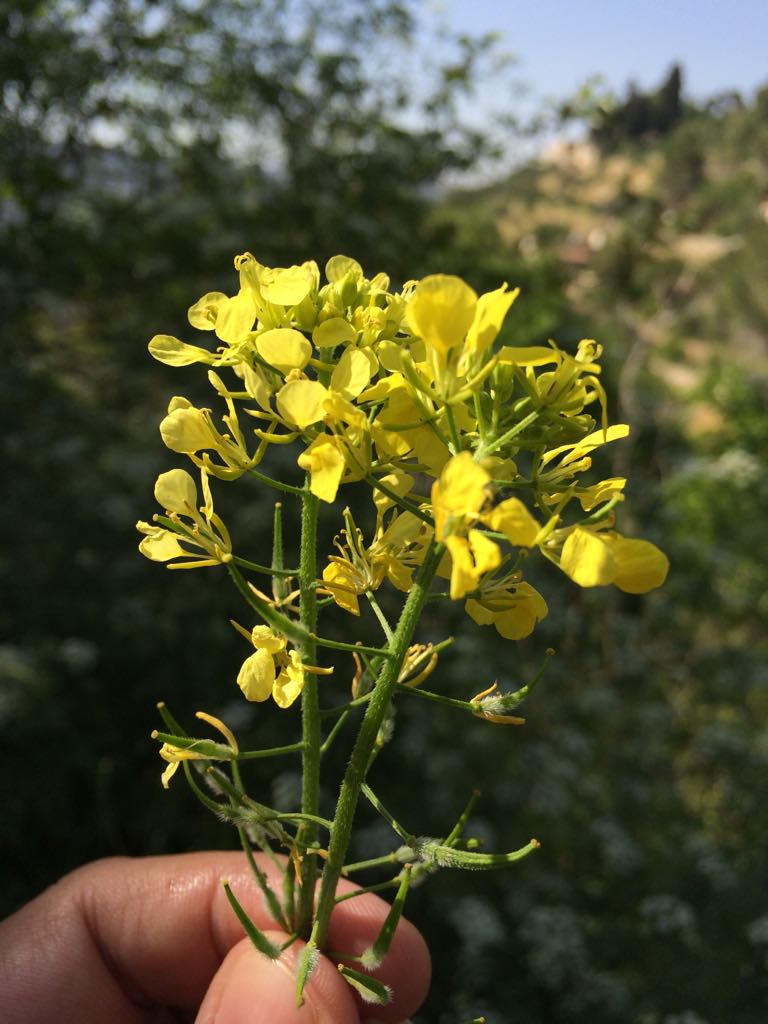
Flowers of a mustard plant from which seeds are taken. Photo by author, Israel, 2017.
Or most specially, like those seeds that turn into crops of wheat and shrubs like the mustard with leaves and branches where birds may dwell that describe the first two parables today.
Jesus then added a third parable of the yeast mixed into flour that leavened the dough into a bread.
Like him our Lord, we his disciples are also like the small seeds packed with great possibilities in God.
In all these three parables today, there is that element of smallness, of littleness that remind us how everything that is great always starts small.
When we come to think of this, we realize how we embarked on this great mission of making Jesus Christ known: it started like a small spark within us, perhaps from a single word we have heard or read, a simple inspiration by God through the most ordinary persons and situation.
Not only in things regarding our spiritual lives but even our personal lives when we recall those humble beginnings of our family and of our business.
Like a little seed or yeast, they just grew!
Now we are surprised, even amazed, how we have changed, how we have grown. Of how we are now reaping the fruits of our labors and sacrifices.
Most of all, how we have known and experienced Jesus Christ who fulfills our lives.
Weeds among the wheat
But not all days are bright and sunny. There are dark clouds that hover above us bringing storms and heavy rains that lead into floodings. A lot often in life, the darkest nights turn out to be the longest nights too.
And this is the meaning of Christ’s main parable for today.
Jesus proposed another parable to the crowds, saying: “The kingdom of heaven may be likened to a man who sowed good seeds in his field. While everyone was asleep his enemy came and sowed weeds all through the wheat, and then went off. When the crop grew and bore fruit, the weeds appeared as well. The slave of the householder came to him and said, ‘Master, did you not sow good seed in your field? Where have the weeds come from?’ He answered, ‘An enemy has done this.’ His slaves said to him, ‘Do you want us to go and pull them up?’ He replied, ‘No, if you pull up the weeds you might uproot the wheat along with them. Let them grow together until harvest; then at harvest time I will say to the harvesters, ‘First collect the weeds and tie them in bundles for burning; but gather the wheat into my barn.'”
During my prayer periods this past week, I have been filled with anger and disappointments at how things are going on in our country and even in my personal life. It pains me so much why at this time of the pandemic when we have to go through all these bad things.
Last Friday morning before our daily Mass, we discovered the glasses shattered in our windows near the office door and at the side door of the church. There were scratches outside indicating attempts to unlock the doors inside and steal from the church.
After the Mass, I grew more angry as we inspected the damages, thinking so negatively harsh against whoever tried to burglarize us.
By night time during prayers, I remembered Victor Hugo’s Les Miserables where Valjean was caught by the police stealing silver from the good bishop who had welcomed him into his rectory with food and accommodations. Instead of pinning him down for his crime, the bishop told the police he had given Valjean the silver found in his bag, even chastising him he had left behind the other silver candlesticks he had asked to take!
The wheatfield owner in our parable and the good bishop of Les Miserables are both the merciful God mentioned by the author of the Book of Wisdom in our first reading today:
But though you are master of might, you judge with clemency, and with much lenience you govern us; for power, whenever you will, attends you. And you taught your people, by these deeds, that those who are just must be kind; and you gave your children good ground for hope that you would permit repentance for their sins.
Wisdom 12:18-19
Think of our parents and elders, our mentors or those we look up to for their wisdom gifted with wonderful insights in life called perspicacity which means “a penetrating discernment… a clarity of vision or intellect which provides a deep understanding and insight.”
Being perspicacious or having perspicacity like the wheatfield owner or the good bishop of Les Miserable means having a deeper wisdom that one can keenly see and understand things beyond ordinary perception following a long process of silent reflections in life.
Many times, our sights can be limited that we do not see the other repercussions and even ramifications of our decisions on certain situations. There are times we think only of finding solutions, of winning the battle but not the war.
It is also along this line that Jesus added the third parable: the yeast is mixed with the flour to leaven the dough.
We are like the yeast who have to mix with others, including the evil ones to become bread that will feed the world.
We are the wheat, the mustard seed, the yeast thrown into the world to make a difference in Christ! We are not the ones who will change the world but Jesus Christ, the mysterious seed, the yeast in the dough who grows and effects the changes in us and among us.
Parables as inner journey in Christ Jesus
With Jesus living and nurturing within us, that is when we become fruitful like the wheat and mustard plant or leavened bread that we are able to feed more people who would eventually become bearers his in the future. That is how the kingdom of heaven comes into this world, when God is seen and felt by everyone through us
This we achieve in prayers as St. Paul reminds us in the second reading. It is not just reciting our basic prayers as Christians including the novenas we love to collect and follow through. The kind of prayer that St. Paul speaks here is a prayer guided by God’s Holy Spirit who perfectly knows God’s will.
Photo by Dr. Mylene A. Santos of kids she’s teaching on the values of health, education and nature at Katmon Harbor Nature Sanctuary, Infanta, Quezon.
Brothers and sisters: The Spirit comes to the aid of our weakness for we do not know how to pray as we ought, but the Spirit himself intercedes with inexpressible groanings.
Romans 8:26
In this time of too much weeds among the wheat, of so many evil and sins prevailing over us, we can feel frustrated at times that make it so difficult for us to pray.
Sometimes, the evil and sins, or the plain sufferings we go through in our own family, in our community or at work and in school can be so overwhelming that we feel our prayers are useless, that God is not listening at all to us.
Then we stop praying, we stop journeying within even with weeds among the wheat. How can the flour be leavened if the yeast is not mixed with the dough to become bread or cake.
Remain in the Lord!
Pulling out the weeds will not solve the problem; worst, it may endanger us all too in the process that we become like our enemies in the end. Never lose hope in God who knows very well of the presence and source of weeds. Sometimes, these pains and sufferings from evils we go through from others may actually lead us to our being fruitful!
Evil and sins are a parable in themselves that can teach us so well in life if we handle them with prayers.
Photo by Dr. Mylene A. Santos, Infanta, Quezon, May 2020.
Praying in the Holy Spirit is when we spend time with Jesus to reflect and crack open his words that come to us in the Sacred Scriptures and ordinary events in daily life through long hours of silent meditation and contemplation.
The more we dive into God’s mysteries in the parables he sends us in daily living, the more we see the beauty and wonder of life because our horizons are widened and get clearer.
Praying into our parables in life is like looking into a telescope or binoculars that enable us to see something distant within reach.
The Lord Is My Chef Sunday Recipe for the Soul by Fr. Nicanor F. Lalog II
Week XV, Cycle A in Ordinary Time, 12 July 2020
Isaiah 55:10-11 >><}}}*> Romans 8:18-23 >><}}}*> Matthew 13:1-23
“The Sower” painting by Van Gogh, photo from Wikimedia Commons.
Parables constitute the heart of Jesus Christ’s preaching. From the French para bolein which means “along the path”, parables are simple stories with deep realities that must be cracked open through prayers and reflections to uncover its meaning.
In fact, every parable by Jesus is a word of God that is like a seed that must be received, planted, and nurtured so we may eventually see and experience what is within it who is God himself!
On that day, Jesus went out of the house and sat down by the sea. Such large crowds gathered around him that he got into a boat and sat down, and the whole crowd stood along the shore. And he spoke to them at length in parables, saying: “A sower went out to sow. As he sowed, some seed fell on the path, and birds came and ate it up. Some fell on rocky ground, where it had little soil. It sprang up at once because the soil was not deep, and when the sun rose it was scorched, and it withered for lack of roots. Some seed fell among thorns, and the thorns grew up and choked it. But some seed fell on rich soil, and produced fruit, a hundred or sixty or thirtyfold. Whoever has ears ought to hear.”
Beginning today until the last Sunday of this month of July we shall hear different parables by Jesus taken from this 13th chapter of the gospel according to St. Matthew.
It is very interesting that as Jesus now begins to preach in parables, we also notice his usual usage of this image of the seed, especially of the mustard seed to stress to us what we have mentioned earlier about the significance of parables as simple things with deeper realities. Every seed is so small, easy to overlook and taken for granted. Yet, we all know how every seed is also the presence of what is to come in the future, of something so big and huge that we can never imagine.
That is how Jesus would always portray the Kingdom of God, which is himself, his very person who is always taken for granted but full of mysteries that later in the fourth gospel he would reveal a deeper reality of this seed akin his Cross:
“Truly, truly, I say to you, unless a grain of wheat falls into the earth and dies, it remains alone; but if it dies, it bears much fruit.”
John 12:24
That is the mystery of the seed, the mystery of Christ: something so ordinary we take for granted with immense possibilities when given up, when it dies. In this parable of the sower, Jesus shows us a hint of this profound truth about himself as a mysterious seed, someone who must be broken to die in order to grow and bear fruit.
If we read the full text of today’s gospel, we find Jesus explaining the meaning of this parable and we discover that he himself is both the sower and the seed: he goes out everyday to bring us the good news of salvation, providing us with seeds we must plant so we can have food in the future.
Every seed Jesus sows in us is always good as the first reading assures us.
Thus says the Lord: Just as from the heavens the rain and snow come down and do not return there till they have watered the earth, making it fertile and fruitful… so shall my word; my word shall not return to me void.”
Isaiah 55:10-11
Most of the time, we reflect on this parable on the importance of the soil on which the seed is sown.
This Sunday, let us reflect on what kind of a seed are we, of how we waste or put into good the enormous potentials packed in each of us by God.
“A sower went out to sow. As he sowed, some seed fell on the path, and birds came and ate it up.“
Jesus the sower does not make distinctions on different kinds of soil; he just scatters the seeds freely. His words concern everyone.
Unfortunately, there are some of us who do not care at all, as hardened as the path or pavement.
These are the people who has no plans in life, no directions, spending their lives watching days pass without knowing that they are really the ones passing by.
Sometimes, they just go wherever the winds would lead them while once in a while, they step out of themselves a little to join friends or peers wherever they may be going. Eventually they leave when the journey gets farther.
They are literally wasting their lives.
“Some fell on rocky ground, where it had little soil. It sprang up at once because the soil was not deep, and when the sun rose it was scorched, and it withered for lack of roots.“
They are the “spur of the moment” type who eventually end up as what we call ningas-cogon (a kind of local grass when dried is highly combustible; quick to start fire but quick to extinguish too).
Beware of them who are at the beginning very enthusiastic in every project and endeavor but when the goings get tough and difficult, they are the first to leave.
No roots, no foundations in life. Easy to give up. Just as hard as those seeds on the pavement.
Photo by author at Petra, Jordan, May 2019.
“Some seed fell among thorns, and the thorns grew up and choked it.”
These are the people who thrived a little but eventually the “thorns of the world” choked them that they eventually dried and died.
They are the kind of people we lament and sometimes grieve, wondering what have happened within them that their hearts have suddenly turned away from God and others with their noble causes we used to share with them at the beginning.
Oh, they are well represented in Congress, especially the party-list representatives of various advocacies for the marginalized and less privileged who eventually come out with their true colors and ugly features. Some of them simply stopped thinking and feeling the other persons, blinded with power and wealth selling off their souls completely to any golden calf willing to pay them.
The modern Judas Iscariots.
“But some seed fell on rich soil, and produced fruit, a hundred or sixty or thirtyfold.“
Photo by Ms. Jo Villafuerte, flower farm at Atok, Benguet, 2019.
We now come to the better seeds (because all are good seeds, remember?).
They are the ones who fell on rich soil and produced fruit because they were the ones who willingly gave themselves up to the Sower. They are the ones who let go and let God, those who let themselves “die” and fell on the ground to give way to new life.
They are fruitful, not successful; the former relied on the powers of God, patiently bearing all pains and sufferings while the latter relied on their own powers, own intelligence and even connections that on the surface may seem to have the upper hand but totally empty inside.
The fruitful seeds are those willing to fall and be broken by God according to his divine plan. Many times, what is fruitful to God may be failures to us humans. Being fruitful is not about results and accumulations we have made but what have we become.
Fruitful people are focused on with the future glory to revealed by God through our pains and sufferings as St. Paul reminds us in the second reading today.
Let us not put into waste this good seed sown in us by Jesus Christ, allow it to be cracked open and broken to let the new life within us spring forth and lead us to becoming fruitful. Amen.
The Lord Is My Chef Sunday Recipe, Week XXIV-C, 15 September 2019
Exodus 32:7-11, 13-14 ><)))*> 1Timothy 1:12-17 ><)))*> Luke 15:1-32
Camp John Hay, Baguio City, 23 August 2019.
Today we conclude the series of “table talks” by Jesus with three parables narrated while dining; but, unlike the other Sunday when he was with prominent people, this time we find the Lord among the notorious ones of his time.
Tax collectors and sinners were all drawing near to listen to Jesus, but the Pharisees and scribes began to complain, saying, “This man welcomes sinners and eats with them.”
Luke 15:1-2
It is the perfect setting where Jesus bared what we may call as “the wildness and wideness” of God’s love and mercy for everyone, especially the lost and rejected. This explains why Luke 15:1-32 is the “heart” of the third gospel also known as the Gospel of Divine Mercy. So, please bear with me reflecting today’s long but lovely gospel.
The first two parables are about things – a sheep and a coin – that were lost and later found. There is nothing extraordinary about losing things that we also experience today. But, in narrating these parables, Jesus ended both with a saying to explain their meanings and significance to introduce the third parable of the lost son.
“I tell you, in just the same way there will be more joy in heaven over one sinner who repents than over ninety-nine righteous people who have no need of repentance.”
“In just the same way, I tell you, there will be rejoicing among the angels of God over one sinner who repents.”
Luke 15: 7, 10
Photo by Ms. Jo Villafuerte, Atok, Benguet, 01 September 2019.
For the past two Sundays, we have been reflecting about the importance of our personhood, of how God comes first to our very persons, of the need for us to be true and humble because God meets us right in our weaknesses and sinfulness. Jesus warned us the other Sunday that “for everyone who exalts himself will be humbled, but the one who humbles himself will be exalted” (Lk.14:11). As they say, bloom wherever you are planted for God’s grace is more than enough for each one of us!
Such is God’s love us that Jesus demands total faith in him that “if anyone comes to me without hating his father and mother, wife and children, brothers and sisters, and even his own life, he cannot be my disciple” (Lk.14: 26). In our lives as his disciples, there would be countless times when no explanations, no reasons are enough why we choose to love and forgive, to be kind and understanding except the very person of Jesus Christ. That is what we call as communion, oneness with the Lord, of always preferring Jesus above anyone and anything!
This is the very reason why the Pharisees and scribes were complaining against him: the tax collectors and sinners were turning to Jesus and not to the Laws they represent! And that continues to happen in our time when some people insist more on religion and vocation, roles and rituals, totally forgetting and even disregarding the very person of God who calls us to himself in Christ!
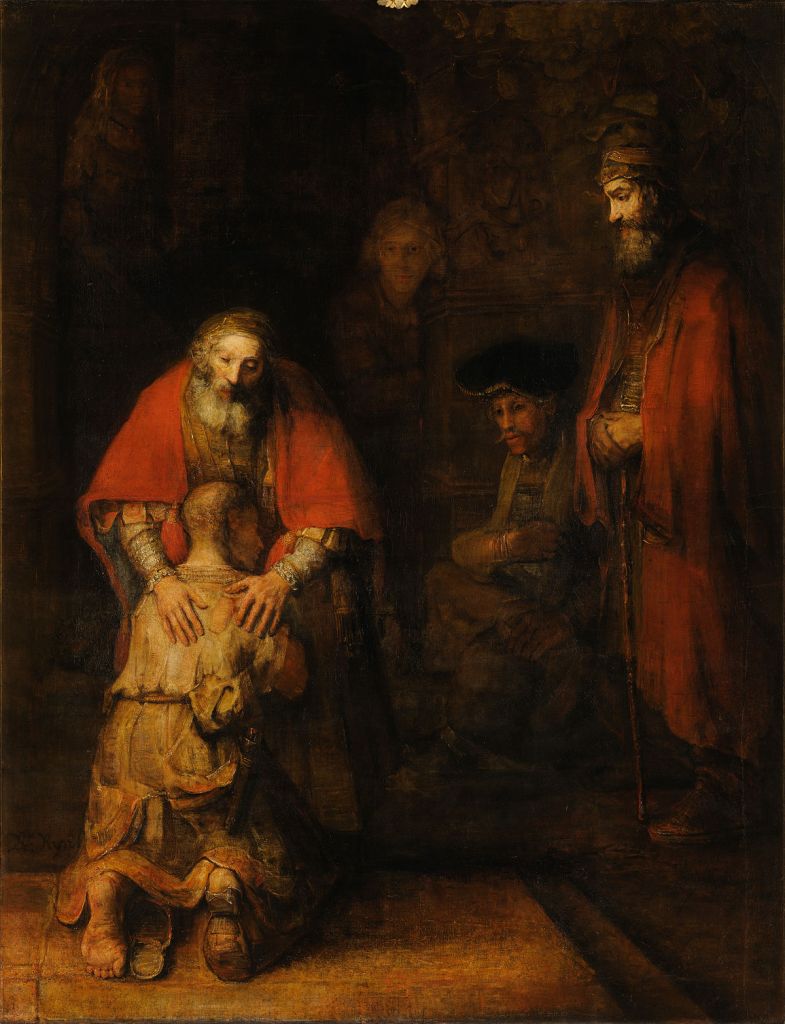
The Return of the Prodigal Son by Rembrandt (c.1661-1669). From Google.
Then he said, “A man had two sons, and the younger son said to his father, ‘Father, give me the share of your estate that should come to me.’ So the father divided the property between them. After a few days, the younger son collected all his belongings and set off to a distant country where he squandered his inheritance on a life of dissipation.”
Luke 15:11-13
Feel the solemnity of Jesus in introducing this parable, shifting from lost sheep and lost coin to lost son, from things to persons because the elder son is also lost. It is the father who eventually restored the lost personhood of the two sons when he lavished them with his love and mercy towards the end of the story. And that is why this parable is so lovely as it reminds us of how unconsciously we are “dumping” our own personhood despite our bloated egos. Slowly we are becoming robots or worst, even zombies without feelings and personal relations with others and with one’s self.
Just like the two sons in our parable who both define sonship in terms of servile obligations that is utilitarian and contractual in relationships, not as a family.
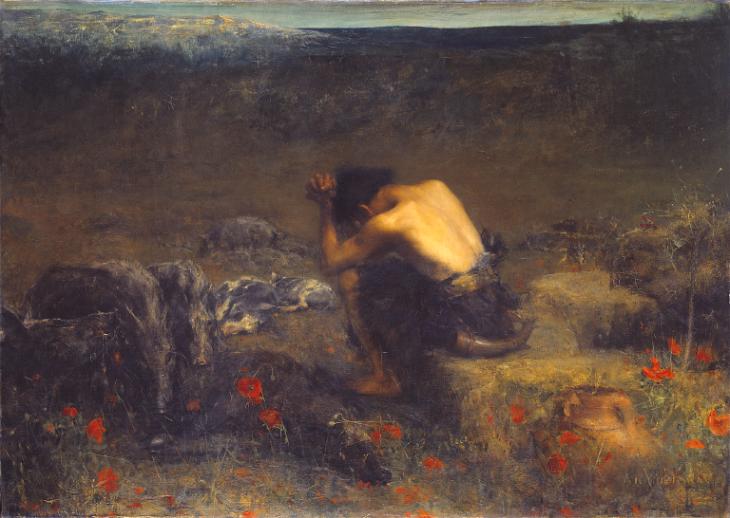
The Prodigal Son by John Macallan Swan, 1888. From Google.
Coming to his senses he thought, ‘How many of my father’s hired workers have more than enough food to eat, but here I am, dying from hunger. I shall get up and go to my father and I shall say to him, “Father, I have sinned against heaven and against you. I no longer deserve to be called your son; treat me as you would treat one of your hired workers.”
He (elder son) said to his father in reply, “Look, all these years I served you and not once did I disobey your orders; yet you never gave me even a young goat to feast on with my friends. But when your son returns who swallowed up your property with prostitutes, for him you slaughtered the fattened calf.”
Luke 15:17-19, 29-30
The prodigal son remembered his father when he was starving, thinking more of the food he could have if he returns home as a servant, not as a son. See how in the midst of sin, he never thought of his father as his parent, of himself as a son. He was convinced that the path to reconciliation with his father was becoming a hired worker, forgetting the very fact he is the youngest son.
The same is true with the elder son who refused to join the celebration when his brother had returned home, feeling so bad that his long years of service to his father deserve him a reward. In a sense, he is worst than the prodigal son: no father, no brother – just himself alone!
Both sons have a slanted view of their father, a very truncated one that is self-isolating, very constricting like the Pharisees and scribes who have forgotten their being persons, of being interrelated with one another in God. Very much like us today that slowly as the ties that bind us as family and friends are slowly being severed by so many things, we also start to lose many of our values like “malasakit” or concern for one another.
The father redefined their – and ours, too – relationships as family that lead to joy and celebration.
He (father) said to him, “My son, you are here with me always; everything I have is yours. But now we must celebrate and rejoice, because your brother was dead and has come to life again; he was lost and has been found.”
Luke 15:31-32
Santorini. Photo by Dra. Mai Dela Pena, 2016.
Today, Jesus reminds us, and assures us too that no matter what happens with us, we will always be his brothers and sisters, beloved and forgiven children of the Father.
We call and relate with God as Father because as his children, he is our giver and keeper of life.
And should this life get lost, God as our Father, can also be so “prodigal” to “wastefully” love us and bring back this life to us for we are more valuable than anything else in this universe. That’s how wild and wide is his love and mercy. Amen.
The Lord Is My Chef Sunday Recipe for the Soul, Wk. XV-C, 14 July 2019
Deuteronomy 30:10-14 >< )))*> Colossians 1:15-20 >< )))*> Luke 10:25-37
From America Magazine via Google.
After teaching us about discipleship these past two Sundays, Jesus shifts his lessons to things “we must do” following a series of questions he encountered from people when he “resolutely determined to journey to Jerusalem” (Lk.9:51).
There was a scholar of the law who stood up to test Jesus and said, “Teacher, what must I do to inherit eternal life?” Jesus said to him, “What is written in the law? How do you read it?” He said in reply, You shall love the Lord, your God, with all your heart, with all your being, with all your strength, and with all your mind, and your neighbor as yourself. He replied to him, “You have answered correctly; do this and you will live.” But because he wished to justify himself, he said to Jesus, “And who is my neighbor?” Jesus replied, “A man fell victim to robbers as he went down from Jerusalem to Jericho.”
Luke 10:25-30
And thus Jesus answered the scholar of the law with the beautiful parable of the Good Samaritan that can only be found in St. Luke’s gospel. It has so endeared the world that hospitals and charities including laws and awards everywhere use the “Good Samaritan” title in recognition of the parable’s conviction that we are all neighbors.
Problem is, we have become so familiar with this parable that sometimes we think it teaches us nothing new. Like the Laws or the Ten Commandments, it has degenerated into becoming letters like a code imposed from the outside we simply follow. Moses tells us in the first reading how the Laws are “something very near to you, already in your mouths and in your hearts; you only have to carry it out” (Dt.30:14). Loving God and loving others is an interior and life principle innate within each of us.
This Sunday, Jesus is inviting us to set aside our thoughts about his parable of the Good Samaritan in order to see it in a deeper and personal perspective.
For most Christians especially Catholics, we always reach that stage in our lives when deep within us there is a longing for something deeper, for something more than what we have been used to. It is a very positive sign of spiritual growth. Like the scholar, we are no longer contented with the usual things we do like praying, Sunday Masses, and keeping the laws. At first we may not be able to verbalize or even identify what are the stirrings within us until we realize it is something more than this life we are having.
Like the scholar, we ask Jesus, “Teacher, what must I do to inherit eternal life?” (Lk.10:25). But, instead of probing deeper into our hearts, we tend to look outside for answers like the scholar asking, “who is my neighbor?”.
From Google.
Twenty years ago, the sci-fi series “The X-Files” was a hit worldwide with its tagline “the truth is out there” to refer to all kinds of conspiracy theories and paranormal activities by the US government. Of the same genre today is the Netflix series “Stranger Things” that also points us to something “out there” for answers to many mysteries happening to us.
The answer is never out there – it has always been inside us! Always.
From Google.
How strange that we keep on asking “who is my neighbor?”, searching for a theoretical definition of a neighbor we always think as somebody outside us. What we must be asking is, “am I a neighbor to others?”
Observe how Jesus narrated the parable where both the priest and the Levite “saw the victim and passed by the opposite side. But a Samaritan traveler who came upon him was moved with compassion at the sight. He approached the victim, poured oil and wine over his wounds and bandaged them. Then he lifted him up on his own animal, took him to an inn, and cared for him” (Lk.10:32-34).
That’s the strangest thing of all! Two Temple officials simply “saw” the victim and passed by while a Samaritan “saw” also but was moved with compassion. To be moved with compassion in Latin is misericordia, a “stirring or disturbing of the heart” which translates into mercy.
Here we find the Samaritan looking deep inside him that he saw in him the plight of the victim that he was moved with mercy to help him. And that is to be a neighbor, to treat somebody with mercy that transcends any color or creed or nationality. See the question of Jesus at the end of his parable, “Which of these three, in your opinion, was neighbor to the robbers’ victim?” The scholar answered, “The one who treated him with mercy” (Lk.10:36-37).
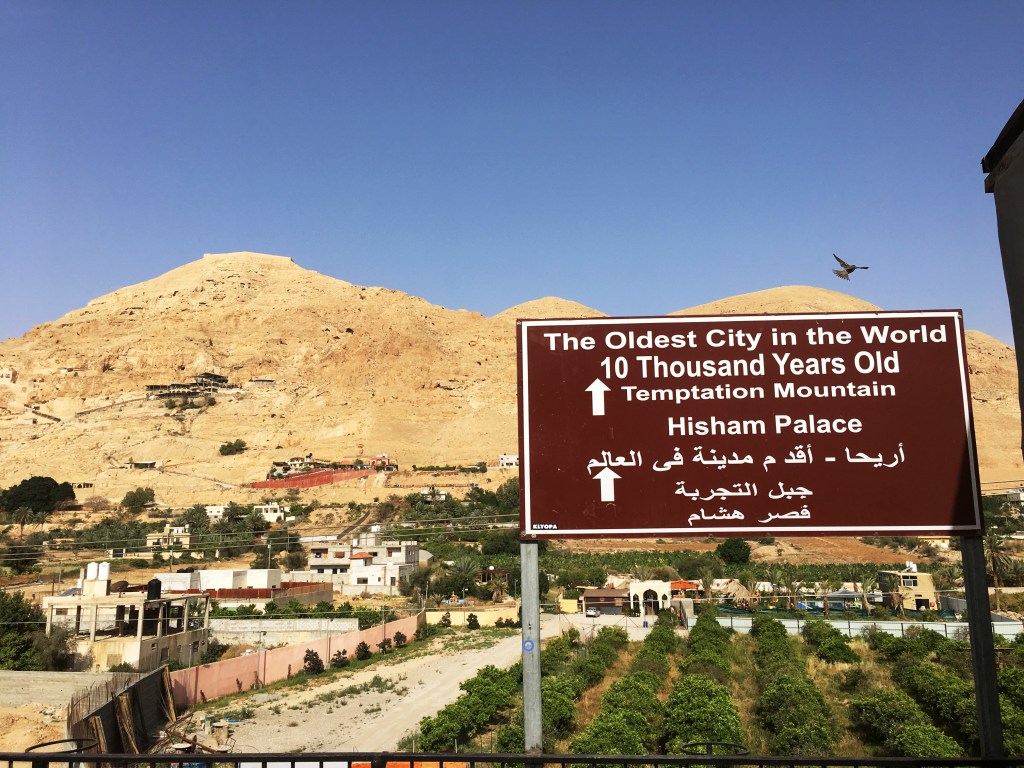
City of Jericho, the setting of the parable of the Good Samaritan. Photo by author, 06 May 2019.
My neighbor is the one with whom I identify with, with whom I am drawn near because of the mercy that moved me within to help in his or her sufferings. A neighbor is one who feels his or her own humanity that he or she is always moved with compassion with those who are in suffering and pain.
And the more we reflect on this parable, the more we see Jesus Christ is in fact the Good Samaritan himself. He is “the image of the invisible God, in him all things hold together” (Col. 1:15,17). It was Jesus who went down the road, becoming human like us in everything except sin, picking us up from our sinfulness and miseries, healing us of our wounds, and restoring us to life “through the blood of his cross” (Col. 1:20).
Let us heed his command this Sunday to “Go and do likewise” (Lk.10:37) as the Good Samaritan. Be a blessed neighbor to everyone! Amen.
















 lordmychef.com