The God we delightfully await

Lord My Chef Sunday Recipe by Fr. Nicanor F. Lalog II
Solemnity of the the Holy Trinity, Cycle C, 15 June 2025
Proverbs 8:22-31 ><}}}}*> Romans 5:1-5 ><}}}}*> John 16:12-15
Photo by author, Hidden Spring Resort, Calauan, Laguna, 20 February 2025.

We resume the Sundays in Ordinary Time with the Solemnity of the Holy Trinity today that is the highest truth in our Church teachings often referred to as a “mystery” or something so difficult to explain and understand.

We find this context of “mystery” right in our gospel this Sunday that takes us back again to the Last Supper scene as in the final Sundays of Eastertide.

Jesus said to his disciples: “I have much more to tell you, but you cannot bear it now. But when he comes, the Spirit of truth, he will guide you to all truth. He will not speak on his own, but he will speak what he hears, and will declare to you the things that are coming” (John 16:12-13).

Photo by author, Hidden Spring Resort, Calauan, Laguna, 20 February 2025.

What is the “more” Jesus has to tell his disciples that include us today which we cannot bear, that we need to be guided by the Holy Spirit?

“I have much more to tell you, but you cannot bear it now.”

As we have learned in the scriptures especially during the Holy Week and Easter, Jesus was speaking at that time of his life and death prefigured by his Last Supper. He was preparing his disciples to do the same as he expressly said after washing their feet.

It is the same lesson Jesus teaches us every Sunday in the Holy Eucharist, of how we his modern disciples must learn to offer our lives with others which is what the Holy Trinity is all about – a sharing and giving of life of the Three Persons in One God. Unity happens only in the total union of one’s self-giving.

This is the mystery of our personal or relating God revealed to us slowly through time, from the Old Testament that reached its highest point in Jesus Christ in the New Testament that continues to these days because each one of us is a reality of the Holy Trinity.

This Holy Trinity sharing and mutuality of Persons in One God is an ongoing lesson we undergo as disciples of Jesus because like the Apostles, we too continue to cling to life, finding it so hard to let go and let God.

Photo by author, Sacred Heart Novitiate, Novaliches, 20 March 2025.

As we move on with life, we realize that life is not in clinging but in dying and letting go, in giving and sharing than having or taking or keeping. We realize as we age and mature that more than the wealth and recognition we all aspired for when younger were nothing but a waste in life because what really matters most is our relationships – with God and with others.

It is a lesson that unfolds to us every day, getting better as we age, when we look back to our past especially to our very roots like our parents with whom we find not only proximity and intimacy but most of all, delight and pride in being one with them. This is exactly what the first reading is telling us about Wisdom said to be the personification of Jesus Christ as the Second Person of the Trinity who is one with the Father:

Thus says the wisdom of God: “The Lord possessed me, the beginning of his ways, the forerunner of his prodigies long ago; from of all I was poured forth, at the first, before the earth… When the Lord established the heavens I was there, when he marked out the vault over the face of the deep… then was I beside him as his craftsman, and I was his delight day by day, playing before him all the while, playing on the surface of his earth; and I found delight in the human race” (Proverbs 8:22-23, 27, 30-31).

Photo by Mr. Boy Cabrido, EDSA 1986 People Power Revolution.

Life and man are all a mystery. Many times there are no easy answers to our many questions in life. There are times when our questions in life are actually answered in deaths like in the passing of our loved ones. Most of all, many questions in life can never be answered at all.

But, the joy of living is in still asking more questions. Man is known more in the questions he asks because the answers he gives are often wrong or off-tangent. When we ask the right questions, even if we do not arrive at the right answers, somehow we get a grasp or glimpse of the bigger realities and mysteries of life, of the things to come that Jesus tells us today.

I have always been curious as a child, always asking my father on the various things I heard from him and my mother or from the television and later from books I have read. After explaining things to me or passages I have read that I still could not understand, daddy would assure me that “pag-tanda mo maiintindihan mo rin yan.”

Those are my fondest memories of childhood with my father – the delight of learning, of discovering, of understanding. Now that I am a priest and a senior, there is still that deep joy and delight in searching and asking because like what Jesus said, there is so much more to learn in this life and in our very selves. There is that desire and attraction within that leads us outside our very selves to search for more meaning – like resulting from faith and hope in God as reflected by St. Paul speaks in the second reading wherein the Holy Spirit leads us to the glory of God.

Photo by Ms. Ria De Vera in Delia, Alberta, Canada, 03 June 2025.

A senator recently made a mockery of the Holy Spirit, claiming his move to dismiss the impeachment complaint as a leading of the Holy Spirit. Making things worst and most unbelievable is the fact that another senator, son of a founder of a local church and preacher played a real devil in quashing efforts to find the truth about the charges of corruption against the Vice President of the Republic.

Clearly, it was not of the Holy Spirit but more of the devil that is divisive and most untruthful, totally unmindful of our relationships as a nation.

The “more” that Jesus speaks of in sending us the Holy Spirit is for each of us to realize our being a Trinity in our very selves, our connectedness as one in God. It is sad that for many, the Blessed Trinity does not really matter that much for them to appreciate or even understand. For many, it is enough to believe in God just like the others in various religions and sects or worst, like those who do not care at all about God except that they “believe” in a Supreme Being.

As we resume the Sundays of Ordinary Time, this Solemnity of the Holy Trinity evokes the most concrete reality of God, that he is a Person like a Father who is the giver of life because he is life himself with whom alone we owe our lives. This we realize and experience in the Son Jesus Christ who became like us humans so we may become like him again as divine, with honor and dignity. It is the Holy Spirit, the third Person of the Trinity who guides us to more realities and truth of this loving God so immense, delighting us in awaiting our union in him. Let us pray:

Come, Holy Spirit!
Fill our hearts with that
desire to continuously await
God's coming in Jesus Christ,
as we delight in a life of
giving and sharing,
of caring and kindness,
of mercy and forgiving
until that day we shall be one
in the Father in heaven
in his love.
Amen.

Happy Father’s Day too!

Jesus sitting among us

The Lord Is My Chef Sunday Recipe for the Soul by Fr. Nicanor F. Lalog II
Thirty-second Sunday in Ordinary Time, Cycle B, 10 November 2024
1 Kings 17:10-16 ><}}}}*> Hebrews 9:24-28 ><}}}}*> Mark 12:38-44

Our Sunday readings are so lovely, so picturesque where you find in both first reading and gospel the character of a poor widow standing side by side with great men of faith in God as the main focus, the Prophet Elijah and Christ Jesus, respectively.

In the first reading, we find humorously the Prophet Elijah asking for water, then some bread from a widow gathering sticks outside her home in Zarephath.

Elijah said to her, “Do not be afraid… For the Lord, the God of Israel, says, ‘The jar of flour shall not go empty, nor the jug of oil run dry, until the day when the Lord sends rain upon the earth.'” She left and did as Elijah had said. She was able to eat for a year, and he and her son as well; The jar of flour did not go empty, nor the jug of oil run dry, as the Lord had foretold through Elijah (1 Kings 17:13, 14-16).

Elijah had fled Israel after proclaiming a drought because the people turned away from God to worship baals or false gods brought by the wife of King Ahab, Queen Jezebel. God then directed Elijah to Zarephath outside the city of Sidon to hide where the king was the father of his archenemy, Queen Jezebel!

Imagine Elijah hiding in the most hostile place of all with a pagan widow who worshipped baal so denounced by him. But, here is a marvelous story of faith of Elijah who trusted God completely in obeying Him to move to the pagan region ruled by his enemies. Similar was the faith of the pagan widow who surprisingly believed Elijah and God’s power that she did not mind putting her life and her son’s at risk in harboring their enemy. Their admirable faith both remind us how God accomplishes His great acts of mercy and love when we surrender ourselves totally to Him.

Photo by author, Wailing Wall of Jerusalem, May 2019.

Nine hundred years later after Elijah, we had Jesus in Jerusalem like the prophet in a very hostile place and situation too – in the Temple that was the very domain of His enemies. This was the Holy Week after Jesus had entered Jerusalem on Palm Sunday leading to Good Friday.

And like Elijah who approached a widow worshipper of baal, Jesus dared to sit at the temple area after harshly castigating the scribes there:

He sat down opposite the treasury and observed how the crowd put money into the treasury. Many rich people put in large sums. A poor widow also came and put in two small coins worth a few cents. Calling his disciples to himself, he said to them, “Amen, I say to you, this poor widow put in more than all the other contributors to the treasury. For they have all contributed from their surplus wealth, but she, from her poverty, has contributed all she had, all her livelihood” (Mark 12:41-44).


Jesus sat down 
opposite the treasury and observed
how the crowd put money into the treasury.

Throughout this week, that scene of Jesus seated at the Temple had so absorbed me. What was Mark trying to tell us in reporting this? Jesus seated at the temple opposite the treasury observing the crowd is something else.

See the genius of Mark in weaving this Sunday’s gospel scene: right after castigating the corrupt leaders of Israel who were affiliated with the temple, Mark segued into this poor widow dropping some coins into the treasury box. In ancient Israel, the poor like the widows were not required to give those contributions. In a stroke of genius, Mark tells us something is wrong in this scene which Jesus rightly attacked because that widow was one of those widows whose house was devoured by the scribes!

“The Widow’s Mite” painting by French painter James Tissot, from brooklynmuseum.org.

And Mark never intended the story only for the Christians of his time but also for us as we have continued in the Church that malpractice by priests and scribes of Jerusalem. Woe to us priests and bishops who go around in “long robes and accept greetings, seats of honor” and worst of all, “devour houses of widows”, forgetting the poor, preferring always to be with the rich and powerful that social media attest.

Like Zarephath and the Jerusalem Temple, there is Jesus sitting in the middle of our Church under attack on all fronts and within in order to be closer with us especially the widows and the poor who are victims of an unjust society and systems perpetrated by same men and women supposed to be servants of God, or, at least men and women of God.

Photo by author, July 2024.

That image of Jesus seated at the Temple opposite the treasury was in fact a reminder of His being the victim too of injustice in the temple like the poor widow, of His Crucifixion on Good Friday. In fact, the 30 pieces of silver the priests have paid Judas Iscariot to betray Jesus must have come from that treasury.

In the midst of the hostilities and hurts, the divisions and abuses of power by priests and lay alike, in the Jerusalem Temple then and now in our Church, there has always been Jesus sitting among us, observing our offerings after first offering Himself for us all as our perfect High Priest (second reading) who finally freed us from these injustices and inhumanity of the past.

That is why I love this scene so much.

More than tithing, Jesus tells us this Sunday that like that generous heart of the poor widow, despite her plight, she continued to give because she believed, she hoped, most of all, she loved God. She need not give but still insisted because the treasury was for the upkeep of the temple, the very house of God, therefore, for God Himself.

There are times I hurt deep inside for the pains of the many scandals some priests and bishops have caused the Church but I choose to remain, even to sit in this Church or be a victim like Jesus amid all these because I love Jesus. Yes, amid all these sorrows, there is one “first” I see above all, Jesus Christ. This is concretization of last Sunday’s “which is the first of the commandments” – God who is love above all!

Jesus is telling us this Sunday through the poor widow that it is recognizing God in us and in one another that matters, and that is why we give at all.

Photo by author, 2022.

If we love God, if we find God in us and in others, when we find Jesus seated among us, then we realize we are the Church, we are the Temple we love. The moment we realize this, the more we feel at home “sitting with Jesus in the temple”, then we start giving totally because we love as well as know for a fact that whatever we give is actually what we receive from God in Jesus.

Why give so little? Give all, give everything because you never have anything to begin with! Everything is from God. That is why it is in giving that we truly receive. In every Mass, we do not give anything except our mere presence that is not even complete and yet, we get abundant blessings, primarily Jesus Christ whom we receive wholly, Body and Blood.

In every Mass we celebrate, we sit with Jesus in the midst of this inhospitable world we live in, even right in the church we love and hate sometimes. We do not give up. We persevere because we believe, we trust, we hope. Most of all, we love like Elijah and Jesus and believe like the poor widows of Zarephath and Jerusalem Temple. Amen. Have a blessed week ahead!


“Rationing” God?

The Lord Is My Chef Easter Recipe for the Soul by Fr. Nicanor F. Lalog II
Thursday in the Second Week of Easter, 11 April 2024
Acts 5:27-33 ><))))*> + <*(((((>< John 3:31-36
Photo by author, Bolinao, Pangasinan, April 2022.
Once again,
O Lord,
Your words
are very amusing today:
"For the one whom God sent
speaks the words of God.
He does not ration his gift
of the Spirit" (John 3:34).
It sounds so funny
yet so true, dear Jesus!
We not only ration the
Holy Spirit but we also
ration every good gift
You give us as if it would
run out, as if You would
stop blessing us,
as if You are not God.
Forgive us, Lord,
when we ration
especially Your love
to others, when we
do not realize that love
and life and every blessing
You give are meant to be
given and shared fully
with others.

“We gave you strict orders did we not, to stop teaching in that name. Yet you have filled Jerusalem with your teaching and want to bring this man’s blood upon us.”

Acts 5:28
Dearest Jesus,
fill us with courage
like Your Apostles
after Pentecost that
we too may give all
to fill the world
with Your Good News
of salvation
in You,
with You,
and through You!
Amen.

Noble spirit

The Lord Is My Chef Daily Recipe for the Soul by Fr. Nicanor F. Lalog II
Wednesday, Memorial of St. Cecilia, Virgin & Martyr, 22 November 2023
2 Maccabees 7:1, 20-31   ><]]]]'> + ><]]]]'> + ><]]]]'>   Luke 19:11-28
Photo by Dra. Mylene A. Santos, MD, in Tagalag, Valenzuela City, 13 September 2023.
Praise and glory to you,
God our loving Father!

Today I pray to you for 
the gift of a "noble spirit"
like that courageous mother
of seven brothers who died on
the same day before her as she
extolled them to resist temptations
and remained faithful to you:
"Filled with a noble sprit that 
stirred her womanly heart with
manly courage" (2 Maccabees 7:21).
What a beautiful description of that
woman's great courage and faith 
in you, dear God!
Give us a noble spirit, Lord, 
a selfless soul that thinks more
of others than one's self especially
in this age when we are so self-conscious
and conceited with our bloated egos
always on the take, as if the world
revolves around us; a soul that is
not selfish and other centered
because of deep faith and trust
in you, Father.
Stir your noble spirit in us, Lord;
let us find anew our moral compass,
our moral grounding in you and your
laws especially in this age when
"everything and anything goes"
regardless of morals and virtues,
an age that glorifies every person as
a universe in himself,
crowning himself as god, 
yet so afraid of the truth,
so ignorant of freedom,
without any idea of 
the real meaning of living
and loving that in the end,
could not accept death.
Like that courageous woman
and St. Cecilia, stir the noble spirit
within us, Lord Jesus,
to embrace wholeheartedly
our being human,
our being finite,
our being-towards-death
so that we may start living
as you have taught us by
giving and sharing ourselves
and everything we have
in order to be fulfilled,
by facing death so that
we may live in you.
Amen.

Praying and thanking, truly

The Lord Is My Chef Daily Recipe for the Soul by Fr. Nicanor F. Lalog II
Wednesday, Memorial of St. Aloysius Gonzaga, Religious, 21 June 2023
2 Corinthians 9:6-11   ><]]]]'> + ><]]]]'> + ><]]]]'>   Matthew 6:1-6, 16-18
Photo by Ms. Jo Villafuerte at Atok, Benguet, 01 September 2019.
Lord Jesus Christ,
let me realize everything
is purely your grace
so that I may learn to
pray and thank you 
truly and sincerely;
it is only when we recognize 
this fundamental truth
that whatever we have
is a grace from you, O Lord,
that we learn 
to truly pray 
and 
give you thanks.

Moreover, God is able to make every grace abundant for you, so that in all things, always having all you need, you may have an abundance for every good work. You are being enriched in every way for all generosity, which through us produces thanksgiving to God.

2 Corinthians 9:8, 11
We can only be true
to you in our prayers, 
Jesus, when we acknowledge 
all your grace in us;
that is when we stop
showing off our kindness
and holiness, we stop
wasting time and efforts
on superficialities and 
outside appearance
because you are in us
and you are more than
enough for us.

In the same manner,
we can only be truly
grateful when we 
accept and own and
recognize the many 
grace you have 
showered us;
that is when we 
become a cheerful giver
because the best act
of thanksgiving
is in sharing our gifts,
your grace
with others.

After all, the word grace
is "charis" in Greek from
which also came the word
eucharist or thanksgiving
which is "eu-charis-tia".

What a tremendous grace
indeed to love and serve you,
Lord Jesus Christ when we
witness your loving service
to others, sharing and giving
only you,
always you.
Amen.

Why give?

The Lord Is My Chef Daily Recipe for the Soul by Fr. Nicanor F. Lalog II
Tuesday in the Eighth Week of Ordinary Time, Year I, 30 May 2023
Sirach 35:1-12   ><]]]]'> + ><]]]]'> + ><]]]]'>   Mark 10:28-31
Photo by Mr. John Ryan Jacob, December 2022, Paco, Obando, Bulacan.
Why give at all, Lord?

Today you answer this 
"frequently asked question" 
of so many people especially
Christians:  why should I give?

Appear not before the Lord empty-handed, for all that you offer is in fulfillment of the precepts. The just one’s offering enriches the altar and rises as a sweet odor before the Most High. The just one’s sacrifice is most pleasing nor will it ever be forgotten.

Sirach 35:4-6
There are so many reasons
why we should give but in the
wise words by Ben Sirach today,
one clear reason why we should
give is because everything is yours,
O God; we own nothing at all!

Whatever we have is yours
and the more we give,
the more we share,
the more you bless us!
Teach us, O God,
not to be selfish,
to be open,
to be generous
for we are mere channels
of your blessings and 
grace; forgive us, Jesus,
when we are like the rich man
who asked you about gaining
eternal life but unwilling to give
up his possession to share with others
or like Simon Peter counting 
whatever we have given
and shared, most especially 
what we have given up for you
as if everything we have is 
totally ours, that we owe no one
except ourselves in having them
without realizing we are your mere
stewards of whatever we have;
so often, we fail to realize 
the simple truth 
that when everyone
gives, everyone receives.
That is why we must give.
Amen.

Life is more than #POV

The Lord Is My Chef Sunday Recipe for the Soul by Fr. Nicanor F. Lalog II
Sunday XXXII-B in Ordinary Time, 07 November 2021
1 Kings 17:10-16 ><]]]]'> Hebrews 9:24-28 ><]]]]'> Mark 12:38-44
Photo by Min An on Pexels.com

Perspectives and points of view play important roles in our lives, affecting our judgements and conduct; however, we also know by experience that perspectives and points of view are not enough, cannot be entirely reliable that lead us into stereotyping of people.

I just learned recently from the teenaged daughters of a friend that the #POV for “point of view” may be used in two ways: first, to express “this is my personal point of view” to which everyone is entitled that should not be contradicted because “it is how I see things”; the second is to present a “first person point of view”, that is, through the eyes of the one who uploads a video to show exactly how things are like the first steps of a baby.

This Sunday, Jesus is challenging our perspectives, our #POV on wealth and poverty, sharing and grandstanding, on our selves before God and other people.

Since last month we have seen how Jesus refused to get into debates with people on persistent issues humans have always been discussing like divorce (Oct.3), power and positions (Oct. 17), and the most important laws to follow (Oct. 31) because Jesus came to reveal to us the will of the Father so we may level up in our perceptions about self, others, and life itself.

Jesus was still in the temple area; he had silenced his enemies from asking him further with other questions to test him. After going on the offensive attacking the scribes’ hypocrisies, Jesus sat to observe the people dropped their donations into the temple treasury.

He sat down opposite the treasury and observed how the crowd put money into the the treasury. Many rich people put in large sums. A poor widow also came and put in two small coins worth a few cents. Calling his disciples to himself, he said to them, “Amen, I say to you, this poor widow put in more than all the other contributors to the treasury. For they have all contributed from their surplus wealth, but she, from her poverty, has contributed all she had, her whole livelihood.”

Mark 12:41-44
Photo by author, Jerusalem, 2017.

A Tale of Two Widows

Before going into that story of the widow praised by Jesus, let us consider first the story of another widow mentioned earlier in our first reading, the widow of Zarephath, a region governed by Queen Jezebel’s father. Queen Jezebel was the pagan wife of Israel’s King Ahab who had ordered troops to kill Elijah after putting to shame the priests of her pagan god “baal”.

After 40 days of hiding in the mountain fed by birds with a stream providing him fresh water, God instructed Elijah to proceed to Zarephath to meet the widow who would take care of him during the drought that would come as a punishment to Israel.

More than the miracle of living through the year of drought that hit the region at that time, it is a marvelous story of the faith of both Elijah and the pagan widow. We can understand the deep faith and total obedience of Elijah to God who had told him everything that would happen while hiding in enemy territory.

Things were greatly different with the widow of Zarephath who was first of all a pagan, in fact, a worshipper of the false god baal Elijah had openly bashed in every occasion everywhere. Her faith is so admirable that she risked her own life including her son in welcoming into her home an enemy of their king. Most of all, she put her complete faith in the words of God spoken through Elijah whom she hardly knew.

She left and did as Elijah had said. She was able to eat for a year, and he and her son as well; the jar of flour did not go empty, nor the jug of oil run dry, as the Lord had foretold through Elijah.

1 Kings 17:15-16

In a very similar manner, it was the very nature of faith of the simple and poor widow at the temple treasury that earned praises from Jesus. Keep in mind that money was meant for the upkeep of the Temple, not for the poor; therefore, the very act of donating money into the treasury was in fact an act of faith by the poor widow on God. She was convinced that her offering goes directly to God himself!

It is in this aspect that we must see the whole point of the story which is not about big money and small coins but our personal attitude and faith in giving that is ultimately linked with God. Every amount we offer to church and charities indicates the kind of relationship we have with God.

Jesus had nothing against giving “large sums” of money to the temple collection box; it was not the amount of donation he was raising issue with as he contrasted how the rich “have all contributed from their surplus wealth, but she, from her poverty, has contributed all she had, her whole livelihood.”

It is always easy to honor God – even self – with one’s huge donations while still relying on our false securities of money and wealth unlike the poor widow who offered her very self to God. In a sense, Jesus had seen in the poor widow’s offering his coming total gift of self on the Cross soon to happen at Jerusalem!

The beauty of both women, widow and poor having lived in totally different times – one in Zarephath, a pagan and another in Jerusalem, so pious and religious – is in their total entrusting of themselves to God, forgetting their very selves in the process, unmindful of the dangers and uncertainties ahead in life except that firm faith in a loving and merciful God.

From Facebook, 24 March 2020.

Our many concerns in life

I was recently interviewed for a special program that focuses on our lives as priests. At the end of the interview, I was asked by the hosts: “what legacy do I wish to leave after my term of office in my present assignment”? It was not really a difficult question at all but I was surprised because that such was the frame of mind of my interviewers. Their perspective and POV, so to speak.

After a few seconds, I politely told them that I no longer think such things as legacies to leave behind even in this life, explaining that priesthood is a journey wherein we come and leave to different assignments and tasks with just one purpose which is to make Jesus Christ known and experienced by the people we serve. After every assignment, I tell people to forget me and that is why I never come to visit my previous assignments. For me, it is only Jesus, always Jesus whom people must remember and keep. No one else, nothing else.

That I think is discipleship: a shift in our perspectives and points of view into God’s very own perspectives and POV wherein we present ourselves before God and not before humans.

Discipleship in Christ does not mean doing great things nor achieving heroic feats in life; God knows our limits, our weaknesses. We are all small and poor before him like those two widows in Zarephath and Jerusalem; but, if we can be like them completely trusting and faithful to God, giving our very selves to him, then, the little amount we offer can eventually accomplish the love and mercy God expects from us.

See the many concerns we have in life. The more we address them, the less we actually have in life like those abusive scribes Jesus mentioned: they have everything like status and fame, clothes and money but have lost God and the people while the poor may have nothing material but have everything in Jesus Christ.

That is what the author of the Letter to the Hebrews is telling us in the second reading: in the Priesthood of Christ, he had accomplished everything for us by offering himself on the Cross, forgiving us our sins to lead us to eternal life. Like Jesus, are we willing to give our very selves to him through others so we may gain him and everything?

What have you offered lately to God?

A blessed new week ahead! Amen.

Photo by Irina Anastasiu on Pexels.com

Always something, never nothing

The Lord Is My Chef Breakfast Recipe for the Soul by Fr. Nicanor F. Lalog II
Tuesday in the Eight Week of Ordinary Time, 25 May 2021
Sirach 35:1-12  ><)))’> + <‘(((><   Mark 10:28-31
Photo by author, St. Paul Center for Spirituality at Alfonso, Cavite 2019.

Praise and glory to you, O most loving and merciful God our Father, for you never leave us empty-handed even if we always claim to have nothing at all, to be “walang-wala” when we always have something with to offer and share, never without anything at all.

Forgive us in being so preoccupied with the “scarcity mentality” – of how little we have, of not having enough that we refuse to share and give to others, forgetting the reality that to be alive and to always do what is good and pleasing to you is all you want us to offer to you through others.

In works of charity one offers fine flour, 
and when he gives alms he presents 
his sacrifice of praise.  
To refrain from evil pleases the Lord, 
and to avoid injustice is an atonement.
Appear not before the Lord empty-handed,
for all that you offer is in fulfillment of the precepts.

How wonderful, O Lord, are your words through Ben Sirach! Help us remember that true worship, true prayer is always being good and holy before you through our loving service to others.

We do not have to look beyond ourselves to find so many things to offer to you, primarily our good works that you ask from us. We may not have all the material wealth the world has to offer, but you always shower us with every spiritual gifts more needed especially in our world today plunged in the darkness of sin and selfishness.

Sometimes like Simon Peter, we become proud of the little things we give up for you, thinking they are so great without realizing the great rewards you have in store for our sacrifices.

Jesus said,
"Amen, I say to you,
there is no one who has given up house
or brothers or sisters or mother or father
or children or lands for my sake 
and for the sake of the Gospel
who will not receive a hundred times more 
now in the present age:  houses and brothers
and sisters and mothers and children and lands,
with persecutions, and eternal life 
in the age to come.
(Mark 10:29-30)

Indeed, you have given us with so much, dear God and we have given so little. Teach us to give more of our kindness and mercy, love and understanding, time and presence and most of all, more of YOU to others. Amen.

True greatness in being small to become part of the whole

The Lord Is My Chef Sunday Recipe for the Soul by Fr. Nicanor F. Lalog II
Solemnity of the Pentecost, 23 May 2021
Acts 2:1-11  ><}}}*>  Galatians 5:16-25  ><}}}*>  John 15:26-27.16:12-15
Photo by Ms. Jo Villafuerte at Atok, Benguet, 2019.

Today we bring to completion our celebration of the Lord’s Paschal Mystery – his Passion, Death, and Resurrection, Ascension and Coming of the Holy Spirit to his disciples. Although this mystery is one single reality, we have stretched its celebration over a period of 50 days (hence, Pentecost) or more than seven weeks because it will never be enough to fully grasp its whole meaning for it is a continuing reality and mystery in our midst just like the Ascension last week.

Note the upward movement of the Ascension that calls us to “level up” our relationships with God and one another in Christ; today, the downward movement of the coming of the Holy Spirit calls us to being small in order for us to be broken and shared with others. Whenever there is a downward push, what happens usually is a breaking down into smaller parts to fuse with the larger whole like a mix.


...our greatness is in our sharing ourselves with others...  
It is in our becoming small to participate in the whole 
that we truly become great - 
whether in the Church or a community, 
in our personal relationships...

Jesus had taught us in his life and example especially on the Cross that our greatness is in our sharing ourselves with others like him. It is in our becoming small to participate in the whole that we truly become great – whether in the Church or a community, in our personal relationships like family and circle of friends and most especially in the union of man and woman as husband and wife in marriage.

That is why the Pentecost is called the birthday of the Church when the disciples after being filled with the Holy Spirit came out in the open to proclaim the Gospel of salvation in Jesus Christ. It was actually more of a “coming out party” of the Church that was established by Christ during his Last Supper.

See that since the very beginning, the Church started as a catholic – a whole – at the Last Supper of the Lord when he also instituted the Holy Eucharist that has become the sign of our unity from then on that enabled the disciples to recognize him at Easter at the breaking of bread.

Jesus promised them at the Last Supper how things would get clear to them when the Holy Spirit comes.

"When the Advocate comes whom I will send you
from the Father, the Spirit of truth that proceeds
from the Father, he will testify to me.  And you 
also testify... I have much more to tell you,
but you cannot bear it now.  But when he comes,
the Spirit of truth, he will guide you to all truth."
(John 15:26-27. 16:12-13)

Believing in the Holy Spirit, Believing in the Church

Every Sunday in the Mass we profess our faith, declaring “I believe in the Holy Spirit, the Holy Catholic Church” but, do we really understand its meaning? To believe in God is to believe in the Holy Catholic Church, to forget one’s own agenda in life, to submit ones self to her teachings from Christ our Lord and Master.

It is a declaration of the mystery and reality of the Pentecost, reminding us that becoming Christian means receiving and embracing the whole Church!

This is the beautiful meaning of the account by St. Luke at the first reading of the coming of the Holy Spirit on Pentecost at Jerusalem when all barriers – physical, emotional, intellectual, spiritual – were broken as the disciples went around speaking in various languages to proclaim the truth of Jesus Christ.

When the time of Pentecost was fulfilled,
they were all in one place together.
And suddenly there came from the sky a noise
like a strong driving wind, and it filled the entire house
in which they were.  Then there appeared to them
tongues of fire, which parted and came to rest
on each one of them.  And they were all filled 
with the Holy Spirit and began to speak in different tongues,
as the Spirit enabled them to proclaim.
(Acts 1:1-4)

Here we find the disciples of Jesus and their converts on that day of Pentecost allowing themselves to be taken up into the Church!

And how did this happen? St. Luke tells us “Then there appeared to them tongues of fire, which parted and came to rest on each one of them.” Each one was parted, was broken down from their sins and selfishness that they became open for each other, trying to understand and accept each one as brother and sister in Christ.

It was a reversal of the story of Babel in Genesis when people were so arrogant and proud building a tower that reaches to heaven who were punished to speak in different languages that led to their confusion and quarrel until they all perished along with their ambitious plan.

Pentecost was different. There were different languages, different peoples with different backgrounds yet they were united and understood each other because everybody tried to become small, to mix into the whole and thus becoming a part of the Church on that day.

Unless we are willing to be parted by the Holy Spirit’s “tongues of fire” and “strong driving wind” like a storm, we can never be filled with God and his holiness to experience his peace and his joy.

It is a lifelong process and that is why Pentecost is a daily reality, happening to us especially when we sometimes have to be shaken by so many events and circumstances that come our way.

In the second reading, we heard St. Paul reminding the Galatians, including us, to “live by the Spirit and not gratify the desire of the flesh” (Gal.5:16). At that time, some missionaries sowed confusion among the Galatians, telling them to follow Jewish practices and Mosaic prescriptions to be fully Christians like circumcision. The issue had long been settled at the Council of Jerusalem but some Jewish converts persisted.

Here, St. Paul teaches us a valuable lesson in resolving conflicts and confusions in daily life in the light of Jesus Christ, of salvation, of the Church. For St. Paul, we always have to ask the Holy Spirit in guiding us in everything, no matter how secular and mundane it may be to find the theological and spiritual implications of our experiences.

What he told the Galatians remains true to our days, that freedom is not the ability to do whatever we want but to choose and do what is good. Every person has that tendency to sin, an imperfection in the “flesh” that is always in contradiction with the “spirit”.

As we have mentioned earlier, our greatness lies in our ability to share and give ourselves to others by dying to our sins and selfish motives, precisely what St. Paul is telling us:

Now the works of the flesh are obvious: immorality, impurity, licentiousness, idolatry, sorcery, hatred, rivalry, jealousy, outbursts of fury, acts of selfishness, dissensions, factions, occasions of envy, drinking bouts, orgies, and the like.

Galatians 5:19-21

These are the things that the Holy Spirit “part” in us when it comes to us daily especially in our prayers and in the celebrations of the sacraments like the Holy Eucharist. Through the power of the Holy Spirit, we are unified as a person, we become whole and integrated that we see the value and importance of being one with God and with others. It is not longer the rituals that become the law guiding us but the interior law of love of Jesus Christ that enables us to get out of our selfishness to give ourselves in loving service to others.

When we live in the power of the Holy Spirit guided by this interior law of love, that is when we become truly free and experience the gifts and fruits mentioned by St. Paul like peace and joy.

In our world today marred by sin and so many divisions happening in our society and even in the Church, in our communities and right even in our families and personal relationships, let us pray today to the Holy Spirit to come to us, break down within us the many walls we have and lead us to surrender ourselves to God to be led by his hand in continuing the mission of love and mercy of our Lord Jesus Christ. Amen.

A blessed week ahead of everyone!

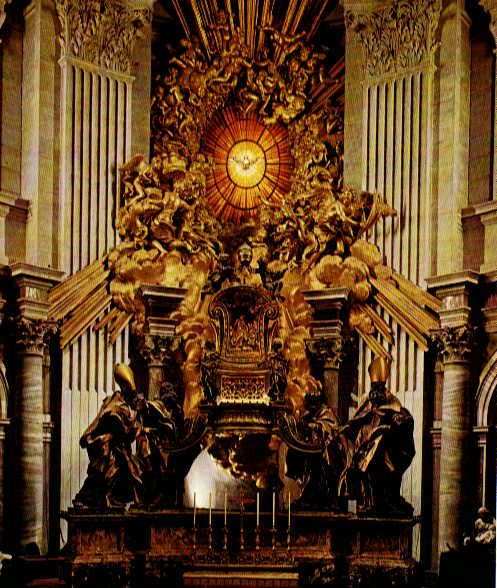
Photo of the stained glass with the Holy Spirit bringing light into the altar of St. Peter’s Basilica in Rome. Photo from wikipediacommons.org.

Give, forgive, and forgive.

40 Shades of Lent by Fr. Nicanor F. Lalog II
Tuesday, First Week of Lent, 23 February 2021
Isaiah 55:10-11     ><)))*>   +   <*(((><     Matthew 6:7-15
Photo by author, the “Our Father” Church at the Mount of Olives outside Jerusalem where Jesus taught his disciples to pray (2017).

Of the many things you have taught us, Lord Jesus, the “Our Father” remains one of the most enigmatic: on the surface it appears so simple but as we dwell and reflect on it, the more it becomes mysterious and fascinating as well that it is rightly called “the Lord’s Prayer”.

Today, I feel so touched, dear Jesus at how you have arranged the order of the prayer in the part of give and forgive:

Give us this day our daily bread; and forgive us our trespasses, as we forgive those who trespass against us;

Matthew 6:11-12

Give – forgive – forgive.

How amazing at how you have taught us to ask the Father to “give” us only once but asked to “forgive” twice! First to ask the Father to forgive us for our sins and second, that we may be like him to forgive those who sin against us.

There is also something very interesting with giving and forgiving, something deep in meaning and feeling: to give is so simple, as in to grant or bestow or simply, give. But, to forgive in itself is thought provoking, inviting everyone to an inner journey of meanings. Phonetically, it sounds like “four gives” as against just one “give”.

And this is where it gets so beautiful, Jesus: the word forgive is formed from the prefix fore that means first in order or rank or place or time like foreword, forewarn and forward.

We ask Father once only that he may give us our needs for he knows what is best for us.

But, we have to ask him twice to forgive — first that he forgive us for our sins so that we may also forgive others who sin against us.

Teaching them young how to pray (photo by Mr. Red Santiago, 2019).

There is something so deep in forgiving that inspired Shakespeare to write, “to err is human, to forgive is divine.” From the prefix fore, to forgive means to give something first even before you get anything in exchange for whatever you give. And that is what you have done for us, dear Jesus: giving yourself on the cross for us long before we asked forgiveness, long before we give our selves to you in repentance and conversion!

When we ask your forgiveness, what we actually do is claim that forgiveness you have given us without us asking for it!

Here lies the difficult part of the Our Father that makes us divine like you, Jesus: how do we imitate the Father of giving first forgiveness to those who have wronged us even if they have not come to us asking for forgiveness? It is indeed very difficult to follow for how can we give something first even if we have not received anything like a simple sorry in return?

How easy it is to ask you, Jesus, to give us grace to forgive but I think, what we must ask is for you to forgive us so we can forgive. How wonderful to realize that every time you forgive us, you actually give us something fourfold as in “four gives”.

Open our eyes, open our hearts to see this wonder and beauty of forgiving, of giving first even without receiving anything in exchange like the Father. Amen.