Our “Nunc Dimittis” experience

Quiet Storm by Fr. Nick F. Lalog II, 03 February 2020

Detail of the Presentation painting by Italian artist Andrea Mantegna (1431-1506) with Mary handing the Child Jesus to Simeon at the temple of Jerusalem (man at the middle Mary’s husband, Joseph).

As we come to close today’s Feast of the Presentation of the Lord, I wish to share with you a Quiet Storm brewing within me which I call “the Nunc Dimittis experience”.

Nunc dimittis is the Latin opening line of Simeon’s Canticle that says “Now you dismiss” when he was filled with joy by the Holy Spirit upon meeting our Lord and Savior on his presentation at the temple.

According to St. Luke’s account, God had promised Simeon that “he would not see death before he had seen the Christ of the Lord” (Lk. 2:26). Hence, the overflowing joy of Simeon when he finally met the Child Jesus at the temple 40 days after Christmas!

Part of St. Luke’s artistry in his Christmas story is to put songs on the lips of some of its important characters to express their profound joys in their unique experiences of the coming of Christ.

The Nunc Dimittis is the fourth canticle in the Lucan Christmas story: first is Mary’s Magnificat when she visited her cousin Elizabeth who was six months pregnant with St. John the Baptizer; second is the Benedictus by Zechariah when he regained his speech after naming his son John; and third is the Gloria sang by the angels when Christ was born in Bethlehem.

Simeon bursting in joy as depicted by American illustrator Ron DiCianni’s “Simeon’s Moment”. From http://www.tapestryproductions.com

Of these four canticles recorded by St. Luke, Simeon’s Nunc Dimittis sounds the highest level of all, the fulfillment of time within each one of us when we personally recognize and meet Jesus the Christ our Savior like Simeon.

And so often, when we are overjoyed in experiencing Jesus Christ, that is also when we feel like saying “now I am ready to go, ready to die” exactly like Simeon because we have met the Lord.

That is why I call it “the Nunc Dimittis experience”: real joy can only come from that experience and intimacy with Jesus Christ, when we feel so close with him. It does not really matter whether we experience him here in this life or hereafter. What matters most is we feel so close with him, as if embracing him, here and now.

This may be a religious experience like after listening to a homily that really touched us, or after a good confession, or while attending a wonderful retreat or recollection. It may also happen when we feel so loved and accepted, when we are vindicated, or when assured of support and trust and confidence while going through difficult trials in life.

Our Nunc dimittis experience always comes at the end of each day, when we feel despite our failures and shortcomings, we are in God’s loving presence.

Simeon’s Canticle, our Night Prayer
Since the early sixth century during the time of St. Benedict, the “Nunc Dimittis” has been sung in the monks’ night prayer or “compline” from the Latin completorium or completion of the working day. Eventually, it was adopted into the Liturgy of the Hours or the prayers of the Church usually recited by priests and religious. (St. John Paul II had suggested in his encyclical Novo Millennio Innuete after the Great Jubilee of 2000 that the lay faithful also pray the Liturgy of the Hours.)

After the praying of the psalms and meditation of the Sacred Scriptures, there is a Responsory that declares, “Into your hands, Lord, I commend my spirit.” Like Jesus before he died on the Cross, we offer to God our very selves. This is takes on a beautiful dimension especially if we have done a good examination of conscience at the start of the compline, before the psalms and readings.

Then, we recite the antiphon that introduces the Nunc dimittis: “Protect us, Lord, as we stay awake; watch over us as we sleep, that awake, we may keep watch with Christ, and asleep, rest in his peace.”

The antiphon in itself is already a prayer!

It is after the antiphon that we chant or recite Simeon’s Canticle:

Lord, now you let your servant go in peace; your word has been fulfilled: my own eyes have seen the salvation which you have prepared in the sight of every people: a light to reveal you to the nations and the glory of your people Israel.

From the Compline of the Breviary

The antiphon is repeated and immediately followed by the Closing Prayer.

The cross atop our parish church at night with the moon above taken with my iPhone camera, 02 February 2020.

Capping the compline is the blessing at the end that says: “May the all-powerful Lord grant us a restful night and a peaceful death. Amen.”

Usually, a hymn to Mary is sung, then all the lights are turned off and the great silence (magnum silencium) begins until the morning prayers or lauds (Latin for praise).

See how our night prayer or the compline is oriented towards meeting God, or to put it bluntly, towards death.

Yes, it is always easy to say we are ready to die. It is a lot whole different when we are already face to face with death itself.

But, when we come to think of it, we realize that indeed, in death, “there is nothing to fear but fear itself”.

When we die, everything happens so fast. We may not even feel anything at all. And unknown to us, every night when we go to sleep, we rehearse our death, so to speak!

And what a tremendous joy to keep in mind how every night, the Lord fills us with joy and faith within us even if we often forget him. Every night when we sleep, it is automatic within us to entrust everything to God “unconsciously” without even thinking we may never wake up!

It is a “Nunc Dimittis” experience too because most of us go to bed filled with joy, full of hope the following morning would be a better day than today. And that is Jesus still coming to us at the end of the day to assure us of his love and concern, never bothering us at all of this tremendous grace gratuitously given to us.

Next time you sleep, remember how blessed you are to have come to the end of another day, blessed and loved.

Pray, and start experiencing Jesus more from the beginning to the end of each day and forevermore. Amen.

How much do you love?

The Lord Is My Chef Sunday Recipe for the Soul

Week XXXIII-C, 17 November 2019

Malaci 3:19-20 ><}}}*> 2 Thessalonians 3:7-12 ><}}}*> Luke 21:5-19

The Wailing Wall of Jerusalem Temple, May 2019.

We are now at the penultimate Sunday of the year as Jesus continues to summarize his teachings today at the Temple area in Jerusalem about his final coming at the end of time.

While some people were speaking about how the temple was adorned with costly stones and votive offerings, Jesus said, “All that you see here — the days will come when there will not be left a stone upon another stone that will not be thrown down.” Then they asked him, “Teacher, when will this happen? And what sign will there be when all these things are about to happen?” He answered, “See that you not be deceived… “

Luke 21:5-8

On the surface, Jesus seemed like to be a “kill joy” in making those bold assertions about the coming destruction of the Temple while everybody was admiring it. But notice how the people reacted: instead of being worried, they asked when it would happen and what would be the warning signs before it takes place as if it is just an ordinary thing!

“Wala lang…” as the young would say these days. Nothing, duh…?

View of Jerusalem from the Church of Dominus Flevit where Jesus wept upon seeing the city from the Mount of Olives.

St. Luke tells us that before Jesus entered Jerusalem, “he wept over it” at the thought that it would be destroyed and that its enemies would not “leave one stone upon another” (Lk.19: 41-44).

If there is anyone deeply hurt and saddened with the Temple’s destruction, it is not other than Jesus Christ our Lord. He certainly shared the people’s admiration for the Temple which he had also claimed as “my Father’s house” (Lk.2:49) when he was accidentally left behind there by Mary and Joseph when he was 12 years old.

Imagine what Jesus must have felt when he spoke of the destruction of the Temple which is the heart of Jerusalem, the jewel of the city, and most of all, the sign of God’s presence among his chosen people!

There must be something deeper with his warning words of the Temple’s destruction that pertains not only to his people at that time but also to us today.

Wailing Wall of Jerusalem, may 2019.

For the Jews at that time, the destruction of the Temple is the end of the world, the signal of the apocalypse. More than a catastrophe involving the destruction of buildings and almost everything including life, it is judgment day that must not be taken lightly.

It is a day calling for conversion as the prophet Malachi in the first reading reminds us that every coming of God is a day of judgment and salvation.

Lo, the day is coming, blazing like an oven, when all the proud and all evildoers will be stubble, and the day that is coming will set them on fire… But for you who fear my name, there will arise the sun of justice with its healing rays.

Malachi 3:19-20

Christ had already come and will come again.

This was his promise and this is what he meant at the cleansing of the temple, “Destroy this temple and in three days I will raise it up” (Jn.2:19). At his Passion, Death, and Resurrection, Jesus Christ had replaced the old Temple worship with himself!

This is what we celebrate in every Holy Mass, God’s coming to us in Jesus Christ his Son.

Jesus comes in every here and now, and his every coming is a process of destroying our old temple of self to give rise to a new temple in Christ. Our concern need not be about a future date of his Second Coming or specific signs of its fulfillment.

Every day Jesus comes again and the challenge is for us to live authentically as Christians daily and not be bothered about the future. He warns us not to be deceived by all of these apocalyptic predictions and statements.

The key word is conversion, of living in the present. Jesus tells us so many things that can be very frightening and scary because what he wants us to do in preparation for his Second Coming is to love, love, and love.

And to love is to always suffer in Christ, with Christ.

He answered, “See that you not be deceived, for many will come in in my name… Do not follow them! When you hear of wars and insurrections, do not be terrified; for such things must happen first, but it will not immediately be the end.” Then he said to them, “Nation will rise against nation, and kingdom against kingdom. There will be powerful earthquakes, famines, and plagues from place to place; and awesome sights and mighty signs will come from the sky. Before all this happens, however, they will seize and persecute you… You will even be handed over by parents, brothers, relatives, and friends, and they will put some of you to death. You will be hated by all because of my name, but not a hair of on your head will be destroyed. By your perseverance you will secure your lives.”

Luke 21:8-19
From I.REDD.IT.

Yes, Jesus will definitely come again at the end of time. Like last Sunday, definitely, there is a resurrection of the dead and life everlasting. But both must be seen in the context of the present time, of the here and now.

When Jesus comes again to judge us at the end of time, he won’t be asking us about the things we have been so preoccupied with in this life like how much money we earn, what car do you drive, or how big is your house?

When Jesus comes again, he will be asking us questions we have always refused to answer in our daily lives like how much have you loved, how much have you sacrificed and suffered for a loved one, or how much have you shared to a stranger?

These are the questions we must be asking ourselves as we near towards the end of the year: how close have I followed Jesus Christ in his Passion and Death so I may be with him in his Resurrection?

May we imitate St. Paul in his second letter to the Thessalonians today to faithfully and calmly fulfill our daily tasks in this life, avoiding being idle for each day is the day of the Lord. Amen.

Faith in the Living God, Faith in the Resurrection

The Lord Is My Chef Sunday Recipe for the Soul, Week XXXII-C, 10 November 2019

2 Maccabees 7:1-2, 9-14 ><}}}*> 2 Thessalonians 2:16-3:5 ><}}}*> Luke 20:27-38

Jesuit Mirador House, Baguio City, January 2019.

Our gospel today helps us to further reflect the meaning of last week’s All Saints’ Day and All Souls’ Day when we honored our departed loved ones with prayers, believing and hoping that some day we shall be with them in heaven at “the resurrection of body and life everlasting”.

Every Sunday this is what we profess and so today, our readings invite us to reflect anew this last but crucial article of our faith, the resurrection of body and life everlasting.

Some Sadducees, those who deny that there is a resurrection, came forward and put this question to Jesus, saying, “Teacher, Moses wrote for us, If someone’s brother dies leaving a wife but no child, his brother must take the wife and raise up descendants for his brother. Now there were seven brothers; the first married a woman but died childless. Then the second and the third married her, and likewise all the seven died childless. Finally the woman also died. Now at the resurrection whose wife will that woman be? For all seven had been married to her.”

Luke 20:27-33
The Jewish Cemetery at the Mount of Olives facing Jerusalem, May 2019.

Jesus had finally entered Jerusalem. What an extraordinary manner for him to discuss death and resurrection right in the city he knew where he would eventually die and rise again in a few days later!

And the first to confront him there were the Sadducees, Israel’s elite from whose ranks came the high priests who later conspired with Rome to put Jesus to death.

Jews at the wailing Wall, May 2017.

Very conservative and rigorous in their practice of religion, the Sadducees were basically fundamentalists who refused to accept oral traditions on equal footing with the Pentateuch. They only accepted whatever was explicitly written on the Pentateuch, discarding anything that the Torah does not mention at all like the resurrection, existence of spiritual beings like angels and immortality of the soul.

Don’t we find ourselves into the same situation too when despite our professed religiosity, we subscribe to other beliefs like reincarnation and fortune-telling because of “proofs” we find about their veracity unlike the resurrection that seems to be so difficult to think of in the first place?

We have those vestiges of fundamentalism within, always searching and asking for proofs on so many things about our religious beliefs, especially about God and Jesus Christ.

Jesus said to them, “The children of this age marry and remarry; but those who are deemed worthy to attain to the coming age and to the resurrection of the dead neither marry nor are given in marriage. They can no longer die, for they are like angels… That the dead will rise even Moses made known in the passage about the bush, when he called ‘Lord’ the God of Abraham, the God of Isaac, and the God of Jacob; and he is not God of the dead, but of the living, for to him all are alive.”

Luke 20:34-38
Photo by Mr. Raffy Tima of GMA-7 News, 2018.

Notice how Jesus right away told them analogies and comparisons are not applicable because marriage and resurrection are of two different realms. The Sadducees were thinking on ground level when resurrection is definitely of a higher plane.

Jesus finds no need to prove anything at all to them – even to us! What he is more concerned is for us to “level-up” our thoughts, to set our sights to him, the Son of the Living God.

Now in Jerusalem to fulfill his mission, Jesus in the next two weeks will summarize for us all his teachings that lead to our coming home to the Father in heaven upon our death. Like Jesus Christ who died and rose again, we shall experience the same in the end.

How? Nobody really knows but our faith teaches us that resurrection is more than being restored to life; resurrection is life perfected in Christ. Life is surely changed and that is why it is on a different and higher level of existence.

Photo by Pixabay on Pexels.com

And it starts right here in this life.

Every time we experience our little deaths on our daily cross with Christ, we also experience our little resurrection when our lives are changed for the better. Amidst our many struggles in this life, we experience God’s loving presence, his very revelation of himself that moves us to deeper faith in him for indeed, he “is not God of the dead” – nor a dead God – because “for him all is alive” .

This faith in the resurrection is faith in the living God “who has loved us and given us everlasting encouragement and good hope through his grace” (2 Thes. 2:16) in Jesus Christ.

It is a faith borne out of our encounter with him as our loving and merciful Father that we are filled with passion to do everything for him because he is so true, so real, like in the experiences of the seven Maccabean brothers who heroically accepted death than sin against God in the first reading.

In 2013, I lost my best friend from high school to cancer.

One week before he died, I visited him three more times and that was when I noticed something so different: during the early months of his sickness, he would always cry to me, expressing his fears and anger but, during that final week of his life, I was the one crying to him while he was the one who would console and explain things to me!

Later, I experienced the same thing with some friends and parishioners I have accompanied in their final journey as a priest.

I have learned that the dying stop crying, stop fearing death because they could already see their final destination. They could feel God so close already that they no longer resist dying, so certain of their own resurrection. We who are left behind cry not only in losing our loved ones but unconsciously because we are afraid, unsure of where our lives are leading to.

Photo by Pixabay on Pexels.com

In one of the beautiful scenes of the Netflix series The Kominski Method, Sandy (Michael Douglas) told his friend Norman (Alan Larkin) how everyone else is also afraid because nothing is so certain in this life. But, Sandy added, we continue to live because we have others with us journeying together in this life.

Let that Other be Jesus Christ who has come to accompany us in this life and back to the Father in heaven. Amen.

“Dust in the Wind” by Kansas (1978)

The Lord Is My Chef Sunday Music, 04 August 2019
Petra, Jordan, 30 April 2019.

We were in Grade Six when the American progressive rock band Kansas released “Dust In the Wind” in 1978. Immediately upon hearing it on radio with its signature guitar plucking, everybody was talking about its spiritual meaning, especially its music that sounded so mystical.

According to its composer and band guitarist Kerry Livgren, the song was inspired by a line from the Book of Ecclesiastes which we have heard proclaimed in today’s Sunday Mass with some references also from Genesis 3:19 “…for dust thou art, and unto dust thou shall return.”

I have seen all things that are done under the sun, and behold, all is vanity and a chase after wind.

Ecclesiastes 1:14

Like the author of the Ecclesiastes who called himself Qoheleth, Dust in the Wind is no “kill joy” but a beautiful and timely reminder to us all that indeed, we are all dust in the wind, that we must seek things that truly last even after death.

And that is God alone.

What I like most in Dust in the Wind is its haunting melody that elicits a kind of fear that does not make you cower or tremble. It is a positive kind of fear that according to experts motivates man to further his knowledge and abilities. Like this fear of death that has enabled man to achieve so many breakthroughs in medicine and the sciences to cure and prevent many diseases that have greatly improved our quality of life. It was also the fear of death, of going hungry that enabled many explorers to discover many new lands and territories that now push advanced nations to explore the universe for future human colonies.

Sometimes in life, we have to be shocked and shaken because fear can be a good motivator for us to strive for the best. But more than a motivator, the fear of death can also be a path to holiness and communion in God as the Book of Ecclesiastes shows us: the more we realize our nothingness like dust in the wind, that everything is vanity, the more we also desire and hold on to God who is the only One permanent and absolutely good after death.

The French author and film director Georges Bernanos (Diary of a Country Priest) wrote in one of his novels that,

In a sense, you see, Fear is the daughter of God, redeemed on the night of Good Friday. It is not pretty to see— of course not!— sometimes mocked, sometimes cursed, renounced by everyone… And yet, do not deceive yourself: it is at the bedside of each agony, it intercedes for man.

Joy (La Joie)

May this music by Kansas remind us that only Jesus Christ can fulfill us. Not money or wealth, power or fame for “one’s life does not consist of possessions” (Lk. 12:15). May it also remind us of Christ’s parable of the rich man who died after storing treasures for himself, forgetting to be rich in what matters to God (cf. Lk.12:21).

Happy listening and blessed Sunday to you!

Shock preaching the plain truth

The Lord Is My Chef Sunday Recipe for the Soul, Wk. XVIII-C, 04 August 2019
Ecclesiastes 1:2; 2:21-23 >< }}}*> Colossians 3:1-5, 9-11 >< }}}*> Luke 12:13-21
Mount of Olives Jewish Cemetery

Outside Jerusalem is the Mount of Olives Jewish Cemetery. It is one of the world’s oldest, existing for over 3000 years. It is also one of the most expensive cemetery in the world for having the choicest spot to be buried in the planet as it faces the Eastern Gate of Jerusalem where the bible tells us the Messiah would be coming through. Hence, all tombs at the Mount of Olives Cemetery point to that direction so that all those buried there would be the first to rise again to life and welcome the Messiah when he comes.

Of course, we Christians believe Jesus is the Messiah or the Christ who in fact came through that Eastern Gate on Palm Sunday when he entered Jerusalem over 2000 years ago to offer his life for our salvation on Good Friday, resurrecting on Easter Sunday!

And while the Jews await the Messiah and we Christians affirm he has come in Jesus, our Moslem brothers and sisters sealed the Eastern Gate during the Middle Ages that since then, no one could pass through it except literally face a blank wall.

I love telling this amusing story to fellow pilgrims to the Holy Land but find it today as a beautiful springboard for reflection to balance our Sunday gospel that sounds like a “shock preaching” by Jesus Christ.

Someone in the crowd said to Jesus, “Teacher, tell my brother to share the inheritance with me.” He replied to him, “Friend, who appointed me as your judge and arbitrator?” Then he said to the crowd, “Take care to guard against all greed, for though one may be rich, one’s life does not consist of possessions.” Then he told them a parable… “Thus will it be for the one who stores up treasure for themselves but are not rich in what matters to God.”

Luke 12:13-16, 21

Beginning this Sunday until the next three weeks, we’ll hear Jesus Christ “shock preaching” us the plain truth we always forget or even disregard: that we all die and what really matters most in life are the good deeds we have done. All our cherished possessions, everything we have labored so hard in this life we shall leave behind when we die because as the Lord had said, “life does not consist of possessions”.

We have known this all along but we rarely realize its full impact until we come face to face with death due to an illness, retirement, or situations when we existentially feel we are mortals after all, contrary to what we have felt and held when we were younger.

So, why wait until it is too late? Start considering now in everything of what will remain after our death.

And if you find this shocking, see also how Jesus coldly refused the man’s plea for his intervention to have his share of inheritance that is rightly his: “Friend, who appointed me as your judge and arbitrator?” What had happened to his teachings last week about prayer, of God giving what is best for us like our sinful parents?

Here we find the value of Christ’s shock preaching: his response was not only directed to the man but to us all who always pray to him, asking him for so many things when we forget the more essential, God. As we have reflected last Sunday, we pray to have God because when we have him, we have everything! Jesus is redirecting our attention and focus on things that last even after our death, on “being rich in what matters to God.”

After my father had retired, he was diagnosed with glaucoma. While driving for him on our way home from the hospital, he told me how he had realized that God is not really so concerned about our temporal affairs like wealth. He claimed that everything he had prayed for was granted by God except only that one thing of being rich.

I totally agree with my Dad and that is why I do not pray for any material thing for myself since 1995 while a seminarian until now that I am a priest for 21 years. I do pray for the material well-being of my family, relatives and friends because when they are financially stable, I know they would take care of me and of my needs just like last week when a relative gave me a brand new laptop (a Mac, in fact). I do not pray for things because I am so convinced that whatever I need, God will give me. The only thing I pray for myself is that when I die, God brings me to heaven.

When we try to pray deeper, we also realize that in whatever problem we find ourselves confronted with especially with those pertaining to material things like money, cars, house, and gadgets, Jesus always responds in the same manner he did with that man who requested him on his way to Jerusalem. That is because Jesus came not to be a judge and arbitrator of our inheritance and assets. Jesus came for the salvation of our souls, for the fulfillment of our lives that can never be achieved with money and wealth or power and fame.

Jesus came for us, for you and me. Personally. He wants us to focus more on “what matters to God” like love and mercy, kindness and generosity with others which he lavishly gives us. When we are rich with these gifts that matter to God, we also find ourselves desiring less material things, being more fair and just in our dealing with others. No stealing, no cheating, no character assassination. When we have more of spiritual goods, we have more joy within, more peace and contentment. But when we have more of material goods, we feel more uneasy and most prone to sin.

Vanity of vanities, says Qoheleth, vanity of vanities. All things are vanity! For what profit comes to a man from all the toil and anxiety of heart with which he labored under the sun? All his days sorrow and grief is his occupation; even at night his mind is not at rest. This is also vanity.

Ecclesiastes 1:2; 2:22-23
Women pose for photos near a homeless man during the New York Fashion Week , October 2012. Photo by Reuters via The Economist Magazine.

Qoheleth is no “killjoy” but merely telling us that everything on earth vanishes like thin air. Only God lasts for all eternity. And that is also the whole point of St. Paul in the second reading.

Brothers and sisters: If you were raised with Christ, seek what is above, where Christ is seated at the right hand of God. Think of what is above, not of what is on earth. For you have died, and your life is hidden with Christ in God.

Colossians 3:1-3

Sometimes in life, we need to be shocked and shaken of the simple facts we take for granted like our relationships with God and with others. Here we find that fear can sometimes be good. In fact, it was our fear of death that led mankind to many medical and scientific breakthroughs in history that have made life today better and safer, and yes, easier. It was also this fear of death that had enabled man to discover new lands to inhabit and is now pushing us to explore the universe.

But most of all, this fear of death can also be holy and blessed too because when we become conscious of our own end in life, that is when we start living authentically in the hope of eternal life in God. A blessed Sunday to you! Amen.

Discipleship is facing death

The Lord Is My Chef Sunday Recipe, Wk. XIII-C, 30 June 2019
1 Kings 19:16, 19-21 >< )))*> Galatians 5:1, 13-18 >< )))*> Luke 9:51-62
Jerusalem as seen from the Mount of Olives with a Jewish cemetery at the foreground facing its eastern wall where the Messiah is believed would pass through when he comes. It is the very route Jesus had taken more than 2000 years ago on Palm Sunday before his Passion, Death and Resurrection. Photo by author, 04 May 2019.

After all the solemnities we have celebrated since the closing of Easter Season last Pentecost Sunday, we now get into the very heart of the Ordinary Time of our liturgy with St. Luke as our guide. Feel the sobriety and hint of solemnity at the start of the second part of his gospel we have heard today which is about discipleship and facing death like Jesus.

When the days for Jesus’ being taken up were fulfilled, he resolutely determined to journey to Jerusalem.

Luke 9:51

I love the way St. Luke wrote this part about Jesus “resolutely determined to journey to Jerusalem.” In some translations, they have retained its literal equivalent from the original Greek text that says “Jesus set his face to Jerusalem”. For Jesus, Jerusalem is where he fulfills his mission from the Father by dying on the Cross. So, if we are going to be more literal with this opening sentence by St. Luke, it would be “Jesus set his face to death.”

Photo by Pixabay on Pexels.com

A friend who had inspired me about blogging has been writing about death lately. Last June 10, 2019 he wrote:

No one wants to write about death. Or dying.

To many, it’s not only a morbid topic. It is a taboo to talk about it.

Of course we’d rather talk about the joie de vivre in our daily chronicles. It is, after all, what sparks joy.

Death is a stranger to this world. Until it comes knocking at your door.

https://relativejoyforyou.wordpress.com/2019/06/10/dear-death/?fbclid=IwAR2ryu6Kou_CIRYqTz193ZTkpdS5bSabCX9-7NuhDSHM3jYcrhjNY8rta6o

His words are very true.

In fact, I have been very hesitant to write about death as a topic for my homily this Sunday because Sundays are supposed to be joyful! And that is perhaps our problem with death: we always see it as something dark and negative. (Is it not?)

Today Jesus is teaching us to see death in his perspective as something beautiful and even glorious. St. Luke saw it and is now leading us in this new approach to death as he tells us the story when “Jesus resolutely determined to journey to Jerusalem.”

One thing that strikes me during sick visitations in my parish and in Metro Manila is how we see death as an escape or an ending. Patients and relatives alike always tell me to pray for death to end all sufferings and pains.

When “Jesus resolutely determined to journey to Jerusalem,” he was not sick, physically and emotionally. He was very well and able. When he was hanging on the Cross, he did not wish death to end his pains. On the contrary, he actually faced death head on. And this is one of the very important lessons Jesus had taught and shown us: facing death, even embracing death. Recall how during his Last Supper on Holy Thursday Jesus was never caught surprised by death. He was in total control of everything.

This is the reason why Jesus accomplished so much in just three years of his ministry because he was very aware of his coming death. In coming to terms with death, Jesus lived fully even if he died at 33 years old. The same is very true with some of our saints who have died young and have accomplished so much because they have all lived to the fullest that death did not surprise them at all in their works and mission.

The “sleeping Jesus” on a bench at the entrance to Capernaum. See the wounds on his feet, markings from his crucifixion. Photo by author, 02 May 2019.

One of the new attractions at Capernaum today when you come to visit the ruins of the synagogue Jesus used to visit there during his lifetime is a park where one finds his statue sleeping on a bench at the entrance across the Franciscans’ quarters. The statue is executed artistically and realistically that passersby would drop some coins for alms in a pot near the image! The sleeping Christ on a bench depicts exactly the second part of the gospel we have heard today: there is nothing certain in this life except Jesus Christ. The sooner we come to accept and embrace this reality vis-a-vis death, the better for us.

As they were proceeding on their journey someone said to him, “I will follow you wherever you go.” Jesus answered him, “Foxes have dens and birds of the sky have nest, but the Son of Man has nowhere to rest his head.”

Luke 9:57-58

Discipleship is coming to terms with death, accepting its reality so that we stop wasting our lives with bitterness and resentments to start living joyfully and meaningfully in Christ. I have heard countless of times how most patients including relatives and friends would bargain for more time, for more life because they felt they have not lived fully. As they come face to face with death during sickness or an accident, they beg even for a little time to live fully, proving that “in the end, it is not the years in your life that count but the life in your years.”

Facing death like Jesus Christ is having God as our top priority. Unlike the second and third people Jesus had invited to follow him and asked his permission “to first bury his dead father” and “to first say goodbye to his family.” Jesus is not teaching us to turn away from our family and loved ones; he wants us to always have God and eternal life as our top priorities in life. Like Elisha in the first reading who slaughtered his oxen and cooked them using the yoke and plow as firewood to show he was foregoing everything to follow Elijah as a prophet.

Every disciple is a nomad following Christ, a pilgrim and sojourner whose true home is in heaven with the Father; hence, the importance of thinking always of things of the above, of heaven and of eternal life. St. Ignatius of Loyola calls it the “principle and foundation” in life wherein we do the things that would lead us to salvation and avoid things that would bring us to eternal damnation.

Of course, such a vision about life is not only contrary to the values of the world but even a folly. See how the world tells us to “just do it” and to “obey your thirst” so that we can have easy and comfortable lives, enjoying everything to the fullest by ensuring our security with material wealth. On the other hand, discipleship in Christ as St. Paul reminds us in the second reading is allowing the Holy Spirit to direct our lives because it is the spiritual things that truly fulfill us. What a tragedy especially among affluent nations we hear reports of increasing number of people committing suicides, feeling empty and lost despite their material wealth?!

Jesus alone is our joy and security. In him, trials and sufferings become blessings because they make us stronger and better persons. Most of all, death is neither an end nor an escape in Jesus but a passage to life in the fullest. This is not a simplification of the complex reality of death but an assurance that Jesus had conquered it and had made it into a blessing that we can now discuss and reflect about it.

I know that speaking about death is easier said than done. It may even be Quixotic. But, death is a reality of life we have to face and deal with, even befriend little by little as we age. Reflecting about death is a kind of death itself and at the same time a grace from God who enabled us to face it even in our limited abilities. Let us put our complete faith in Christ, following him resolutely to Jerusalem as his disciples so that when death finally comes to us, we find Jesus by our side. A blessed week to you! Amen.

Facing death

The Lord Is My Chef Breakfast Recipe for the Soul, Tuesday, Easter VII, 04 June 2019
Acts 20:17-27 >< )))*> >< )))*> >< )))*> John 17:1-11
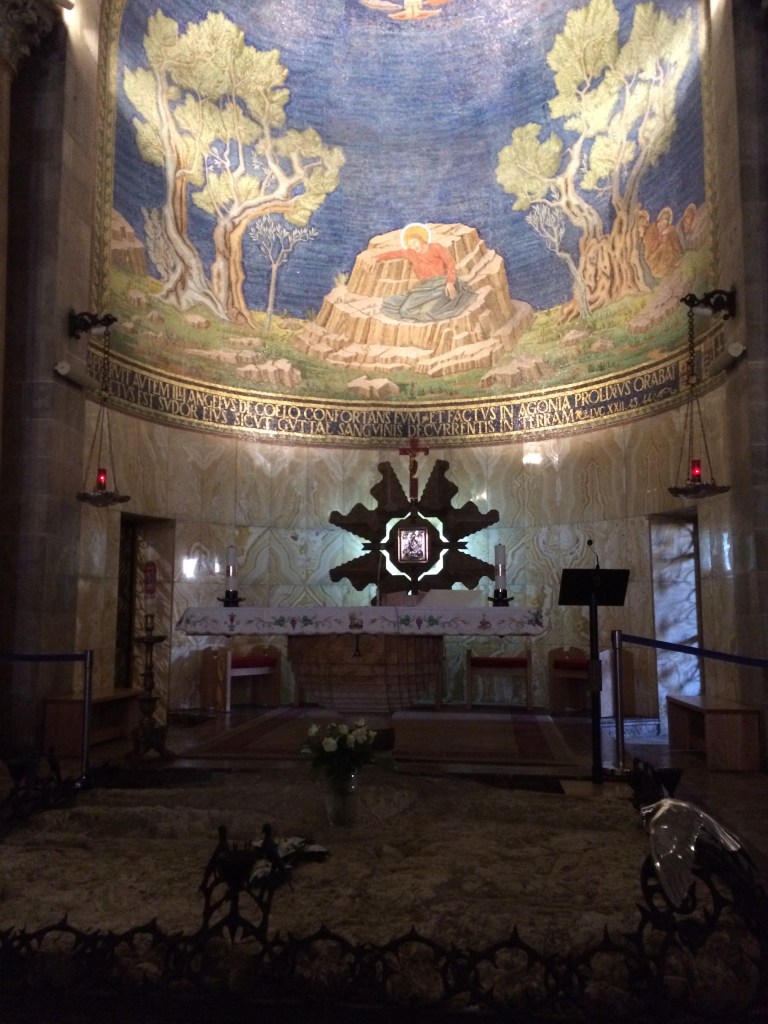
Altar of the Church of All Nations beside the Garden of Gethsemane in the Holy Land. Photo by author, April 2017.

I am hesitant in greeting you a good morning, Lord Jesus Christ. How I wish I could have even a fifth of your courage in facing death. All throughout your life here on earth, you faced death squarely. You were never caught by surprise.

Jesus raised his eyes to heaven and said, “Father, the hour has come.”

John 17:1

In the first reading, St. Paul also spoke about his coming death when he summoned the leaders of the church in Ephesus to a meeting in Miletus where he told them that after that meeting, they would never see his face again.

Every day, Lord, we face death every time we make choices and decisions. But rarely are we aware about death with the capital “D” except when we are in extreme danger or when diagnosed with the big “C”.

Last night as I prayed, I got focused about facing death. I am afraid, Lord even though I know that when it comes, I will not feel anything. The pain would be with those I would leave behind, with those who love me and care for me. Yet, I am still afraid.

And that is when you consoled me, making me realize that what is most terrifying with death is when we fail to live authentically. When we waste every opportunity to live fully because coming to terms with death is coming to terms with life too!

That is the reason why you – and the saints – were never afraid with death. That is part of the joy of Easter, of living authentically.

Help us, O Lord, to live truthfully, and fully in your love and mercy so that when our time comes, we have no regrets leaving this life on earth because while still here, we are already one with you in the Father (Jn.17:3).

We pray also for those who are terminally ill, undergoing surgery and other medical procedures today, for those languishing in jail especially those who are innocent, for those barely surviving the many trials of every day living trying to make ends meet. Comfort them, Lord Jesus with your healing presence. Amen.

A sculpture of Jesus’ Agony at the Garden below a window of the Church of All Nations beside the Garden of Gethsemane. Photo by author, April 2017.
Did our prayer help you?
Share us your thoughts and prayers too.
Follow our blog for your daily recipe for the soul.
God bless!
fr nick

Darkest hour, Finest hour

The Lord Is My Chef Recipe for Good Friday, 19 April 2019
Isaiah 52:13-53:12///Hebrews 4:14-16;5:7-9///John 18:1-19:42
Jerusalem at dawn. Photo by author, April 2017.

Yesterday I saw the Maundy Thursday letter of Archbishop Soc Villegas to us his brother priests. I have never had a death threat in my life but have experienced being the subject of a fake news on being dead in 2005. And like the good Bishop Soc, I also asked “why me for doing what is right?”

It was one of the darkest hours in my entire life. I was then assigned at our diocesan school for boys in Malolos when I initiated an investigation on two married teachers allegedly having an affair following a tip from some faculty members. Our school principal who was well-respected by everyone headed the board. After a few days into the investigation, the teachers concerned resigned after realizing the overwhelming evidences their accusers have gathered against them. We were so glad the case was peacefully and easily resolved.

A week later, a teacher woke me up very early morning with a call, asking if the text message they have received was true that I have died of a heart attack past midnight. My immediate response to the teacher was, “why did you call me if I have died already?” She was crying and was so concerned as I listened to her on the phone. Then I asked her to send me the text message, but, later I changed my mind, telling her “what if it were true?”

I was never able to get back to sleep that morning because everybody was asking about the fake news that spread so quickly. I had to call my family to assure them I am very alive and well. By eight o’clock I realized the gravity of the matter: nuns were praying and masses have been offered for my “untimely death” that some priests have in fact came to see me in the school. I tried to brushed it aside, taking it lightly with my usual jokes. I even held my classes that whole day, telling my students that even if I die, I would always come to teach them.

Things became so different later that day for me. Especially when I prayed first in our chapel that evening and later in my room. Alone, I cried, feeling a deep pain within, asking myself what have I done wrong to deserve such a fake news? It was a pain so different, something you could really piercing through one’s self, slashing and shredding every bit of my being. That night I felt I have finally grasped all those existential absurd and pessimistic stuffs by Abert Camus and Soren Kierkegaard. Like what young people would say these days, “gets ko na sila”.

Crucifixion at the altar of the Betania Retreat House, Tagaytay. Photo by author, 2017.

It did not stop there. The “mystery texter” eventually texted me, threatening me of so many things, cursing me that I would suffer so much before I die. With that, I sought help from my friends in the news who referred me to a text scam investigator whom I never met but was so kind to help me for free. With his technical skills plus my news background as well as pastoral psychology, I was able to eventually identify my mystery texter who was a co-teacher of the accusers of the teachers in the illicit affair. It turned out, she was so broken-hearted after being dumped by the male teacher for another co-teacher who was prettier and lovelier than her. And she’s also married! She thought I was protecting the accused male teacher who happened to be an ex-seminarian but later we learned he was notorious in having illicit affairs among his married co-teachers.

She eventually resigned from our school in 2006 along with her group of co-teachers who all end up miserable in life. Their leader got separated from her husband who was caught in the act in another school banging an employee in a vacant room during summer break. Another was widowed. The third just got uglier. And she? She went to teach abroad in 2007 but had to go back home after learning her husband’s extra-marital affairs. She was able to go back to our old school because I never told my rector my findings. After a year and a half, she was fired from our school when the wife of our school driver caught them having an affair. I have never seen her nor her group since I left our school in 2010.

The Cross of Christ atop the church of our Lady of Lourdes in France. Photo by my former student Arch. Philip Santiago during his pilgrimage in 2018.

Thank you for bearing with me with my long story. It is the first time I have shared it with anyone except with one good teacher I have kept as a friend. Since yesterday I have been telling you about the “hour” of Jesus Christ, his passion that started at the Last Supper, culminating at his crucifixion. We said the darkest hour of Jesus Christ is also his finest hour because of his immense love. In the end, it was his love that triumphed over sin and evil. And that is why we call this Friday as Good.

When I recall that episode in my life, I thank God. You know when I was being attacked then by that mystery texter, that was the same year God gifted me my first trip to the US when my Ninang’s daughter got married. Life has become harder for me since then but has become “betterer”.

Of course I was scared at that time, checking on everything I was doing. Everything in my life has to be planned and calculated; I hate surprises that is why I am not fond of gifts, that I do not readily open them. But, was I angry or mad? No. Even at that time. I even pitied our teacher for being fooled. There is still pain in my heart when I remember those people behind those things but overall, I have transcended the episode. And I feel I have been transformed by it. The incident made me more resolved to be good and better as a person, as a priest. Most of all, it had taught me that like Jesus Christ, we always have to make a stand for what is true, what is good, what is just. It is always painful, lonely and scary to be on the cross. But it is on the Cross of Christ where we shine and share in his glory. It is only at the Cross of Christ where we are truly transformed into better persons because of love. It is only on the Cross of Christ where we realize the value and beauty of this gift of life, of every person in our lives that we start living authentically. At the Cross of Christ, we are assured always of a bright new day to get better and stat anew in life. A blessed weekend to you!

The Crucifix by National Artist Napoleon Abueva at the Holy Sacrifice Parish at UP Diliman. Here we find Good Friday and Easter Sunday, Death and Glory of Christ always together, a hairline apart from each other. See also the long arms of Christ that seem to be disproportionate to his body. According to a story, the UP Chaplain who commissioned that crucifix, the Jesuit Fr. John Delaney asked Abueva to make the arms of Christ longer than usual to show Jesus welcomes everyone; there’s a room for everyone in the Lord’s Cross, especially those suffering. Photo from Google.

Praying And Dying with Jesus

The Lord Is My Chef Good Friday Recipe, 19 April 2019
Isaiah 52:13-53:12//Hebrews 4:14-16;5:7-9//John 18:1-19:42
Crucifix at the Fatima Square in Portugal. Photo by Arch. Philip Santiago, October 2018.

The Evangelists tell us that Jesus died on the Cross on a Friday at about 3:00 PM. And they tell us too that our Lord died praying, exactly what most of the Seven Last Words have expressed.  But from the gospel we have heard this afternoon written by the beloved disciple John, we discover something very beautiful: Jesus was very calm and peaceful in his prayer unto death.

After this, aware that everything was now finished, in order that the Scripture might be fulfilled, Jesus said, “I thirst.”  There was a vessel filled with common wine.  So they put a sponge soaked in wine on a sprig of hyssop and put it up to his mouth.  When Jesus had taken the wine, he said, “It is finished.”  And bowing his head, he handed over the spirit.

John 19:28-30

When we are deep in suffering, in severe pain like Jesus on the cross, what do we usually pray? 

Most often, we pray that the terrible ordeal we are going through would finally end or be finished.  And sometimes, due to desperation, we even pray for death, of how we wish God would finally end our life to be free from all the problems and pains we are going through. And we feel death is the solution.

One of the things I have realized about death came from the 1990’s movie “House of Spirits” when the mother played by Meryl Streep told her daughter played by Winona Ryder that “you do not pray for death because death surely comes.” I always tell that to patients I visit who are in deep pain and suffering. I know it is easier than done. But when we reflect on the Crucifixion of Jesus Christ, we discover how he had made death an offering, a gift of self in love. Clearly we find here that his darkest hour is also his finest hour because of love.

Chapel of the Holy Family, Sacred Heart Novitiate, Novaliches. Photo by author, 2016.

In the original Greek text of St. John, the word used to express Jesus Christ’s final prayer “It is finished” is “tetelestai” from the root word “telos” meaning the final end and direction.  It is not just an ending but a direction too. At the start of this year’s Lenten season, we have reflected that life is more about direction than destination. Direction leads to growth and maturity because it is about persons. Destination is just about place and location. 

From the very start, Jesus was clear with His mission, of how it would be accomplished.  He has always been sure of himself, of who he is.  Notice how St. John repeated many times in his account of the Last Supper how Jesus was “fully aware” of everything that was going to happen: he was so composed and serene that he even gave bread to his betrayer Judas Iscariot during their supper.  Last night we heard how Jesus knew everything was coming to end that he washed the feet of his disciples.

When his “hour” had come, Jesus was “fully aware of everything” that he was never left to the whims and powers of his enemies when he went through his Passion, calmly and courageously facing his death on the Cross. He always had the upper hand that he was able to pray “It is finished” because he was so sure of his Resurrection on Easter. In praying “It is finished,” Jesus consecrated not only himself but also all humanity to the Father so that we are able to bear and face death squarely like him.   

Mt. St. Paul Retreat House, Baguio. Photo by author, June 2017.

In the Mass after the consecration of the bread and wine into Christ’s Body and Blood, we proclaim “Christ has died; Christ is risen; Christ will come again.” We call it as “the mystery of our faith” because when we say “Christ has died,” we admit that truly, the Son of God went through all kinds of sufferings in life we all go through like betrayal, rejection, loneliness, sickness, hunger, thirst, and yes, even death.  And His sufferings continue as we suffer more in this world marred by evil and sins, making us cry, asking when would these end and be finished. And there lies the mystery of our faith on the Cross that led to Easter: when we look at Jesus Christ on His Cross, we see our own pains and agony as God’s pains and agony too.  Jesus joined us in our anguish and death so that we could experience all the more his immense love for us.  Without Jesus and his Cross, we would never be able to bear or even face the many deaths we go through daily.  May we recognize God’s immense love for us again this afternoon when we venerate the cross and see it as the merging point of human and Divine suffering.  Keep praying with Jesus who has the final say with death at Easter. Amen.

*This is an updated version of my Good Friday reflection last year.

Valentine’s Is Love and Death Together

DSCF1341
Lover’s Bridge in Tamsui Fisherman’s Wharf, New Taipei City, Taiwan opened on Feb. 14, 2003.  Photo by author, 29 January 2019.

Quiet Storm by Fr. Nicanor F. Lalog II, 15 February 2019

 I thought last year’s Valentine’s Day was the most interesting in recent years because February 14 fell on an Ash Wednesday, a beautiful juxtaposition of the secular and the sacred that both remind us of love and death.  It happened again to me yesterday very early morning when I drove with my brother down south to visit a beloved aunt who is our late father’s favorite sister sick with Parkinson’s for the last seven years.  It was the closest experience I ever had with the realities of love and death intimately related.

 Unlike my previous visits to her in the last two years, the latest last January 03, Tita Neneng has always looked so sad and depressed with her situation, choosing to be left alone than be seen in her plight.  She used to be bursting with life, so busy with her career and family that upon retirement, she spent it going almost everywhere especially to visit her children in the US.  Yesterday, Tita Neneng was so different, almost like back to her old self as she smiled and talked a lot.  Her face was radiant, exuding with her beauty that had captivated so many men until her 50’s!  She was bubbling with joy as we reminisced the good old days when my father was still alive along with her older siblings, our many family reunions, and of course, our Lola Queta.  After anointing her with Holy Oil for the Sick and giving her the Viaticum, she told me something that made me cry so hard after:  “Father, I am ready.”

Of course, I knew what she meant but I had to lean close to her to ask her again what she just said.  “Father, handa na ako mamatay,” she told me with a smile on her lips while her eyes lovingly looked at me.  I asked her if she had told it to her husband, Tito Terry and she replied, “hindi pa.”  I told her she must tell it to Tito Terry so he would also be ready.  She then looked down, then faced me again and told me, “yung mga anak ko umaasa pa sa milagro.  Ayaw pa nila ako payagan.”  I looked at her and asked permission to inform her children in the States of her feeling ready.
She just smiled.  And I cried.  Very hard.
I had to excuse myself to run for some tissue in her bathroom as I could not contain myself crying and sobbing beside her.  Once in a while, a lesson from our pastoral psychology crossed my mind that as a pastor or minister, I should not cry in front of a patient, but, what can I do?  She’s my dearest aunt who had made me feel so loved and special even before I ever thought of becoming a priest in high school?!

Deep inside me, I also felt some joy amidst the sadness because I felt my Tita Neneng is indeed ready to go anytime soon because she was so composed without any tear in her eyes and always with that sweet smile on her lips.  Before, Tita Neneng would always cry to me, begging me to pray that God would take her as she could not endure her sufferings anymore.  That was before when she begged for death out of desperation as a way out of her pains and sickness.  But yesterday, she simply told me she was ready to die maybe because she must have found her direction in life already.

 Yesterday was actually a déjà vu for me, having experienced it before with my bestest friend from high school seminary, Gil who was diagnosed with colorectal cancer in January 2013.  He would always cry to me whenever I would visit him, asking “why me” with the Big C?  Seven months after undergoing surgery and some chemo treatment, his doctors gave up.  It was time to face the inevitable as his cancer cells were so strongly active; but, surprisingly, my friend Gil accepted it gallantly, even with joy on his face!  I visited him thrice on his final week before he died.  And there I was, breaking into tears before him, crying like a child.  A reversal of roles had suddenly happened with Gil assuring me with everything, explaining things I should know more as a priest.  The most remarkable thing I have discovered with Gil as he approached death was the inner peace he head when he told me how he had forgiven his wife who had abandoned them, telling me how much he still loved her, vowing to keep his marital vows until his end!

 The beloved disciple of Christ wrote, “No one has ever seen God.  Yet, if we love one another, God remains in us, and his love is brought to perfection in us” (1Jn.4:12).

 Have you ever noticed how when our loved ones were diagnosed with serious illness, they always cried to us while we tried to assure them that everything would be fine?  Then, as our loved ones slowly embraced their mortality and faced death, we in turn cried before them who also assured us that everything would be fine?  There seems to be a reversal of roles when our loved ones embrace death because their love has been perfected that they no longer fear anything at all.  They must be so assured of where they are going to in life, unlike us who are still uncertain of what awaits us and that is why we cry when they go.  We not only cry for them but we cry more for ourselves because we have not seen the bigger picture yet that we still love imperfectly.  The great love stories of literature like Shakespeare’s “Romeo and Juliet” and Charles Dickens’ “A Tale of Two Cities” show us that death and love always go together not only for a beautiful story but precisely because death shows the depth of one’s love.  It is in suffering and death love is perfected.  A heart willing to suffer and die for another is the heart that truly loves.  Though love is symbolized by the heart as we have it on Valentine’s day, love is best expressed by the Cross of Jesus Christ who showed us the way of true love.  Coming to terms with life is coming to terms with death and vice versa.  So, let us have Valentine’s day every day!

1-corinthians-15-55-57
From Google.